Category: News

Arlington Heights’ ‘Stranger Things’ star Jake Connelly got ‘the call’ he was going to Hawkins during a tornado warning
It’s been an exciting few weeks for Jake Connelly.
The 13-year-old from Arlington Heights has had the thrill of watching the Chicago Bears — his favorite hometown team — clinch a playoff spot, saw New York City done up for the holidays for the first time and has been on a winter break from his northwest suburban middle school, giving him ample time to spend with family.
Oh, and he’s starring in one of the world’s biggest TV shows.
Jake is a new cast member in the fifth and last season of “Stranger Things.” The supernatural Netflix series set in the 1980s, which concluded with a final two-hour episode Wednesday night, has captivated viewers for the past decade, garnering a steadfast following with its retro callbacks and horror-infused science fiction flair.
Jake plays Derek Turnbow this season, a loudmouth bully-turned-unlikely hero. He fits right in with the series’ long-tenured cast, but fans have especially taken a liking to the local newcomer, relishing in his painstakingly endearing performance.
“The comedic timing of this kid is remarkable,” one person commented on a compilation video of Turnbow’s one-liners that Netflix posted to Instagram last month. “A masterclass in comedy (to be honest),” the streaming service replied.
Jake Connelly, right, attends Netflix’s “Stranger Things” Season 5 world premiere at TCL Chinese 6 Theatres on Nov. 6, 2025, in Hollywood, California. (Roger Kisby/Netflix)
It’s been a whirlwind since episodes started coming out just ahead of Thanksgiving, Jake said, but he’s been taking the newfound stardom in stride.
“I’m looking forward to just riding the wave and seeing where everything takes me,” he told the Tribune in an interview Tuesday, speaking side by side with his parents in the lobby of a Chicago hotel. The three of them, plus Jake’s 16-year-old brother and a few members of their extended family, flocked to the city ahead of Wednesday’s finale, which they watched on the big screen together in a Streeterville movie theater.
Headed into the homestretch, he was a little nervous — but mostly excited. And, as a fan of the show himself, sad to see “Stranger Things” draw to a close.
“(It’s) very bittersweet,” he said.
Born and raised in Arlington Heights, Jake comes from a family of Chicagoans; his parents met in the city before moving to the northwest suburbs to start a family.
Acting wasn’t ever really on his radar, with his mom a pediatric nurse and his dad a data analytics manager. Rather, they were a sports family, Jake playing tackle football since he was a second grader. It wasn’t until one of his mom’s friends invited Jake to take part in a local commercial that he found himself putting on a character for the camera.
The gig was for the home renewal company Feldco and Jake, who was 9 years old at the time, had a single line: “Mom!”
“He memorized his lines in one night,” his dad, Phill Connelly, quipped.
Jake Connelly, the 13-year-old Arlington Heights resident who is one of the breakout stars from the latest season of “Stranger Things,” with his parents, Phil and Kerri, while talking about his experience on the Netflix show, Dec. 30, 2025, in Chicago. (Brian Cassella/Chicago Tribune)
Hooked from the get-go, Jake signed with a Chicago-based talent agency, then one short film, a bit of musical theater and a couple of years later, he had an audition for “Stranger Things.” He sent in a self-tape, where he put his own spin on a small snippet of dialogue from “Home Alone.” Two months and a few callbacks had passed by the time he’d heard the role was his and when he did, Jake was utterly surprised, though already on alert.
He got the call from his talent agency in spring 2023 — mid-tornado warning.
“We had just come out of the basement,” Jake remembered. With sirens blaring in the background, his agents told him he was going to Hawkins (the fictional Indiana town in which “Stranger Things” takes place).
At the news, his whole family screamed.
“I never thought I would get something this big,” he said.
The idea was for then 11-year-old Jake to head to Atlanta — where the show films — shortly after booking the job, his mom, Kerri Connelly said, adding she’d also planned to go with him. But then a writer’s strike hit Hollywood in May 2023, putting filming on pause and pushing their move to the following January.
That meant Jake had to keep his role under wraps among friends and classmates longer than anticipated. So he came up with a small fib to turn away any suspicion: He announced that he was going to be in a mayonnaise documentary. Well, the cover story started out as a mayo commercial, but knowing he’d be gone for a while, Jake amended the alibi to a feature-length film.
“Nobody was asking anything else to a mayonnaise documentary,” he said.
Kerri Connelly with her son, Jake Connelly, the 13-year-old Arlington Heights resident who is one of the breakout stars from the latest season of “Stranger Things,” while they talk about his experience on the Netflix show, Dec. 30, 2025, in Chicago. (Brian Cassella/Chicago Tribune)
Jake and his mom eventually moved to Atlanta for a full year to shoot, where they lived in the same neighborhood as the rest of the cast and, in between call times, went on a tour of former filming locations for the show.
Four years old when “Stranger Things” debuted in 2016, Jake had to wait a few years before delving into the cult favorite. He and his family watched together by the time he turned 10 and immediately loved it.
Despite initial nerves, Jake felt at home on set as the older actors welcomed him with open arms and his years of football prepared him for stunt work. He reveled in the experience, from taking in the surprisingly practical effects to having his own movie-style fashion montage as he tried on his wardrobe to the tune of ’80s music.
He even recalled debating the best spot to grab an authentic Chicago hot dog with castmate and DePaul University alumnus Joe Keery.
Keery, who was waiting tables at a Lakeview bar when he landed his role in “Stranger Things,” has since made a name for himself not just as an actor but as a singer-songwriter under the alias Djo. Over the summer, Keery returned to Chicago to perform as Djo at Lollapalooza.
“Joe always said that Devil Dawgs was the best but for me, I’m just a big Superdawg fan,” Jake said.
Jake brought a piece of Chicago with him to the Season 5 premiere in Los Angeles earlier this fall, wearing Bears cufflinks and Superdawg socks with his tuxedo. On the way to the premiere, which Jake attended with his brother and parents, Kerri Connelly remembered grabbing her son’s hand and telling him: “Be yourself, soak it all in (and) enjoy the moment.”
Jake Connelly, the 13-year-old Arlington Heights resident who is one of the breakout stars from the latest season of “Stranger Things,” talks about his experience on the Netflix show, Dec. 30, 2025, in Chicago. (Brian Cassella/Chicago Tribune)
The moments haven’t stopped. Back home, he’s had watch parties for the show with friends and family, including one night when his aunt decked out her entire basement in all things “Stranger Things,” complete with a fog machine. And a few weeks ago, Jake appeared on “The Tonight Show with Jimmy Fallon,” where he exchanged jokes with Fallon and even gave the former “Saturday Night Live” star a run for his money, taking over Fallon’s desk chair and playing host for a few minutes live on air.
“Comfy chair,” Jake recalled, flashing a grin. Meanwhile, his family saw his talk show debut from behind the cameras, where Kerri Connelly was so nervous she almost couldn’t watch.
Jake’s parents haven’t quite wrapped their heads around how their son’s life, and their lives, have changed. Retaining a sense of normalcy has helped, with Jake staying in school and hanging out with his friends as always, but some things are undeniably different.
While in the hotel lobby Tuesday, a small group of fans stopped Jake for pictures. Among them was 12-year-old Camila Aritzmendi, a longtime “Stranger Things” fan from Panama on vacation in Chicago with her family. She did a double take when she saw Jake.
“I was telling all my friends and family, ‘Is that Derek?’” she said. “But I didn’t believe it.”
Jake doesn’t know what’s next, but said he’s keen to take things one step at a time. His mom threw out a few ideas: a role in “Star Wars” or maybe a superhero.
“What do you think?” she asked him.
“That would be funny,” Jake replied.
https://www.chicagotribune.com/2026/01/03/stranger-things-jake-connelly-derek-chicago/
Musician Natalie Merchant brings Mother Goose and other rhymes to life for the next generation with Cabinet of Wonder
Do you remember Mother Goose? Are you familiar with the nursery rhyme, “Mary Had a Pretty Bird?” What about “The Cuckoo”?
Thanks to singer-songwriter-artist-activist Natalie Merchant, students from one dozen Chicago Public Schools are experiencing them reimagined.
Merchant melds music, play and Mother Goose tales into “Cabinet of Wonder,” a creation from her mind brought to life in collaboration with the Chicago Symphony Orchestra, Chicago Children’s Theatre, Manual Cinema, artists, and early childhood educators.
Designed as an enrichment tool for teachers and parents of children ages 3 to 6, the multimedia project is a web-based collection of professionally produced music recordings, inventive videos and teaching guides.
The nursery rhymes, sheet music and photographs are available to download for use in classrooms and at home. At CPS, “Cabinet of Wonder” is part of a pilot program with the National Head Start Association, providing feedback on students’ responses to the experience.
Merchant is best known for her award-winning career as the lead singer of the band 10,000 Maniacs and for her successful solo career. She told the Tribune she aims for the site to be an experience that nurtures curiosity and critical thinking as she, costumed as the eternal maternal figure Mother Goose, sings 17 nursery rhymes from “Humpty Dumpty” to the “Queen of Hearts” accompanied by the orchestra.
Alongside her, child actors dance and frolic with shadow puppetry in the land of make-believe, where youths go on adventures and learn math, science and reading skills. “The thing that makes it magic is your own imagination,” Merchant told teachers at an assembly with the CSO in October.
For Merchant, imagination is everything.
In a video, she tells the origin story of Mother Goose: She is a poet and writer who uses language to convey her skill of pretending. Children love her because she’s clever and makes them laugh. Every time a child learns one of her rhymes, Mother Goose lives another day.
Mothering origins
Merchant took up the mantle of sharing nursery rhymes with youths eight years ago while living in Troy, New York.
After an intense period of creativity and activism (anti-fracking and domestic violence), Merchant took some time for herself.
She laughed, recalling how that downtime lasted a brief two weeks. A transplant to the town, since her daughter was attending school there, she didn’t know anyone. So she sought community by volunteering.
“I went to the Head Start offices and said I’d like to sing with the kids a couple hours a week,” she said.
That ended up being three days a week for three years and transitioned Merchant to an artist-in-residence for the Head Start program. She hired a guitarist and violinist and took her “sweet little band” to public schools, housing projects and Head Start sites to perform for hundreds of kids.
Merchant’s classroom interactions and dialogue with the children now exist virtually in “Cabinet of Wonder,” a bridge that entertains as well as taps into the building blocks of early education.
For instance, when she would teach “Jack Be Nimble,” students would ask questions like “What does ‘nimble’ mean?” and “Why isn’t Jack afraid of the candle?” When she talked about Jack Sprat, she said it provided an opportunity to talk to the kids about making good food choices and using good table manners.
“I found really lovely ways to talk about many things other than the rhymes. Science, math … the conversations about history would be really fascinating,” Merchant said.
“We’d do ‘Rub-a-dub-dub’ and talk about sea travel. They’re in the ocean. The ocean is full of salt. Some bodies of water don’t have salt. Then we talk about rivers, ponds, lakes, and streams. It was all trying to get them to make connections — form this love of learning for the sake of building knowledge, not because ‘I’m in school and I have to.’”
Topics such as opposites, similes, prepositions, homophones and homonyms are introduced on the free website.
Merchant also incorporated music education into “Cabinet of Wonder.”
Each rhyme showcases a different musical genre, such as Dixieland jazz, calypso, funk, chamber, Celtic and folk, with dance including circle, partner and line. The goal: Expose children to a broad spectrum of music, helping them learn how instruments look and sound.
In doing the work, Merchant learned that few students in her Head Start program were aware of Mother Goose, much less the nursery rhymes associated with her.
“I developed this program of poetry, music, and dance based on Mother Goose rhymes because that was something that I shared with my child,” Merchant said. “People don’t teach Mother Goose so much anymore. One of my missions with this project was to tell people every generation gets to reinvent Mother Goose.”
It only takes one generation to lose culture, Merchant said, citing how Native American children were sent to boarding schools and forbidden to speak their own language. “How many languages died in this country in one generation?” she said.
When working with children in Troy, New York, she noticed that those learning English as a second language were uncomfortable with words and phrases new to them. Merchant discovered that, through play and music, language became more comfortable for them. It gave kids a sense of agency, she said.
“If I repeat these rhymes, I’ll keep this culture, this tradition alive,” Merchant said. “That’s a powerful obligation for a child to feel. It makes them feel important, like the things that I learn matter.”
Grover Cleveland Elementary students participate in the “Cabinet of Wonder” in-school workshop with flutist Emma Gerstein, of the Chicago Symphony Orchestra on Nov. 5, 2025, in Chicago. The workshop utilized Natalie Merchant’s Mother Goose curriculum. (Stacey Wescott/Chicago Tribune)
The proof was in the pudding at Grover Cleveland Elementary one morning in November.
It was a special day, as the weekly “Cabinet of Wonder” sessions came to life when Emma Gerstein, a CSO flautist, showcased her instrument’s melodic sounds to 4-year-olds sitting cross-legged on a classroom floor. The trill Gerstein produced elicited responses from the crowd like: “That sounds like ballet!” and “That sounds like my dad’s music!”
After the demonstration, the tykes were treated to a “Cabinet of Wonder” video where the nursery rhyme, “Mary Had a Pretty Bird” is performed. In it, children clad in dandelion-hued costumes that resemble said pretty bird, and Mary in a dress. Off-screen, Catherine Councell of Chicago Children’s Theatre engages the students in a call-and-response exercise to the rhyme’s lyrics as they clap to the tempo, move their bodies to the beat, use their hands to mimic the bird’s beak and flap their arms like a bird’s wings.
“What does the color yellow make you feel?” Councell asked. A resounding “happy” comes forth from the crowd.
Three full-day pre-K rooms are implementing Merchant’s vision at Cleveland Elementary in Irving Park, according to teacher Jennifer Cepeda. Before the live performance, she’d introduced “Little Miss Muffet” and “Peter, Peter Pumpkin Eater” to her students.
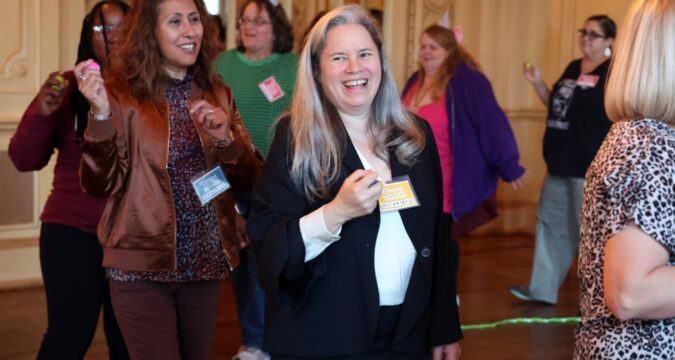
Jonnisha Moore, center, of Walt Disney Fine and Performing ARTS Magnet School, laughs as Natalie Merchant leads a workshop for Chicago Public Schools early educators at Symphony Center on Oct. 8, 2025. (Terrence Antonio James/Chicago Tribune)
Rhymes are powerful
Building “Cabinet of Wonder” was challenging for Merchant.
From fundraising $600,000 to clerical work and outreach to school systems, Merchant utilized all the skills she acquired throughout her career. Combined with her network of creatives — many of whom offered their services for free or at cut rates because they believed in the work — the “Cabinet of Wonder” came to fruition.
Jacqueline Russell, co-founder and artistic director of Chicago Children’s Theatre, is a proponent of “Cabinet of Wonder’s” scale and quality of content. When Russell learned about the project, she offered it a home in Chicago.
“We’re going into this new frontier … and the one thing we all agree on is children deserve the very best quality arts experience. That’s what they’re going to get with this website,” Russell said.
The work Merchant put in over the years didn’t go unnoticed by Head Start. Rachel Hutchison, manager of online instructional design at the National Head Start Association, helped align Cabinet of Wonder material with Head Start standards — such as fine and gross motor control, cognitive development and emotional and behavioral development.
Merchant’s work is supported by a University of Chicago white paper on the benefits of nursery rhymes for children’s neurodevelopment and language. Hutchison considers “Cabinet of Wonder” a world-class resource that’s free.
The work continues to evolve as the pilot gains traction nationwide. “Cabinet of Wonder” will be made available to the National Head Start Association’s 50,000 classrooms serving nearly 750,000 children and families nationwide. Head Start will have a series of virtual events with Merchant and in-person events throughout the school year.
The CSO reached out to its list of teachers last spring to request applications to join “Cabinet of Wonder’s” pilot phase. Chicago schools participating will provide Merchant with feedback on which materials kids responded to and what they liked. By participating, educators will be part of a network where they can communicate with one another through the project’s content, Merchant said.
Mother Goose celebration in Chicago
After Merchant taught students rhymes in New York, she gathered them for an end-of-year pageant titled “Happy Birthday, Mother Goose,” where her band performed a staged production, complete with 150 costumes Merchant designed and made for the children. They are the same costumes we see the youths wearing in the “Cabinet of Wonder” videos.
A costume created by Natalie Merchant for a video production of “Little Miss Muffet,” a well-known Mother Goose rhyme, is displayed at Symphony Center in Chicago on Oct. 8, 2025. Merchant created a video series called the “Cabinet of Wonder,” a musical introduction to the traditional nursery rhymes of Mother Goose. (Terrence Antonio James/Chicago Tribune)
“Kids from all over the city would come. They all shared the same knowledge, which was really big for them,” Merchant said. “When I would say, ‘Hey, diddle, diddle,’ all 150 four-year-olds would go, ‘The cat and the fiddle!’ They felt this immense power together. They got to experience sharing culture. They got that feeling you get when you go to a concert and you’re like, ‘I love this song!’ but you’re with 5,000 other people.”
That’s what Chicago’s school-age children will experience May 8-9. Children from schools participating in the “Cabinet of Wonder” pilot will be treated to a concert at Symphony Center featuring Merchant and the orchestra performing Mother Goose rhymes. The Friday concert is free and open to school groups; families can order tickets through cso.org for the Saturday event as part of the CSO for Kids concert series.
As the Chicago cohort progresses, Merchant is in conversation with public schools in New York and Boston to get pilot programs underway there. Her dream for “Cabinet of Wonder” is to secure funding to publish a rhyme book and to have a literacy organization like Reading is Fundamental distribute it to school districts and Head Start locations nationwide.
“Cabinet of Wonder” could be similar to The New York Times’ recipe app, where individuals follow but make the pieces their own, according to Jonathan McCormick, managing director of the Negaunee Music Institute, CSO’s education/community engagement wing.
“I appreciate the website is designed in a way that will be fun for children to explore, but it’s also setting teachers and parents up to utilize the content in a way that is meaningful to them,” he said.
https://www.chicagotribune.com/2026/01/03/natalie-merchant-mother-good-cabinet-of-wonder/

Biblioracle: My 2026 reading resolution
For longer than I can count, the first column of the year is a declaration of my reading resolutions.
These resolutions are a declaration of hope, an attempt at refreshing and refurbishing stale practices.
In the past, I’ve declared an intention to read more women authors, more works in translation, more small and independent press books, and to read at least an hour a day that was not in the period before bedtime.
For the most part, I’ve been successful in meeting my resolutions because I’ve adhered to the first recommendation for all successful resolutions: Focus on the positive thing you’re adding, rather than something you may be denying yourself.
I’ve always thought that some year, I might run out of resolutions as my reading habits grow more and more impeccable with practice — please note the sarcasm in that last bit — but that year is not this year. I have a clear resolution for 2026: Put more browsing back into my life.
One of my favorite things is to wander around a bookstore with no particular purchase in mind, seeing what might grab my attention, sampling the wares and then walking out with a stack of books that I may not have even heard of before I walked in. Browsing is particularly pleasurable in used bookstores, where you really never know what you’re going to find, and finding that special thing may take extra time to look through the chaff.
But for a number of different reasons, I didn’t do much browsing this year, perhaps not for the last several years, and I think my behaviors are rooted in larger cultural trends that extend beyond my book-buying habits.
Thinking about my diminished browsing, I’ve started to realize that I’ve become increasingly vulnerable to the siren song of “optimization.” Need a new carry-on suitcase? Someone else has figured that out. Want to know what new music is best suited to you? Let the algorithm tell you based on your listening habits. Want to know what book to read? Peruse any number of the lists of new releases, make a choice and execute the purchase. Many do this online, but I call it in to my preferred local bookseller. But either way, no browsing.
A culture of optimization promises two chief benefits: speed and increasing the likelihood of the “best” choice. But what are the virtues of these benefits in the context of a life well-lived? Taking the time to browse the shelves versus zeroing in on a specific book for purchase ahead of time are two fundamentally different experiences. How could I ever regret those 30 or 60 minutes of measured consideration as I browse? Isn’t this the stuff of life?
And how could we possibly measure the “best” choice in these cases? Unlike the “best” suitcase or television or immersion blender, the universe of books with which we can intersect is virtually boundless, and what is best may depend on time, place, context. Sure, I get as anxious as anyone about the ticking clock and the increasing likelihood that I will not get to all of the books I want to or should read, but maybe I should see this inevitability as permission to not optimize and instead to explore … to browse.
Maybe I should also consider extending my pro-browsing lifestyle to other aspects of my life, to stop scouting online ahead of time, or to insist on figuring out the specifics of what I want, rather than defaulting to the view of the masses?
Here’s to a non-optimized 2026 of thinking, feeling, living … and browsing.
John Warner is the author of books including “More Than Words: How to Think About Writing in the Age of AI.” You can find him at biblioracle.com.
Book recommendations from the Biblioracle
John Warner tells you what to read based on the last five books you’ve read.
1. “In the Garden of Beasts: Love, Terror, and an American Family in Hitler’s Berlin” by Erik Larson
2. “Five Banners: Inside the Duke Basketball Dynasty” by John Feinstein
3. “The Exchange” by John Grisham
4. “Open” by Andre Agassi
5. “Paper Lion” by George Plimpton
— Dave R., Glenview
I’m going to lean into the sports thing and also recommend a book with a dash of history, a John McPhee classic about future senator Bill Bradley during his senior year as an All-American at Princeton University, “A Sense of Where You Are.”
1. “Culpability” by Bruce Holsinger
2. “James” by Percival Everett
3. “Flesh” by David Szalay
4. “The Secret of Secrets” by Dan Brown
5. “Buckeye” by Patrick Ryan
— David N., Wilmette
I’m going with a major book of a slightly earlier era that I think still holds up, “The Corrections” by Jonathan Franzen.
1. “Persuasion” by Jane Austen
2. “A Manual for Cleaning Women” Lucia Berlin
3. “Reading Like a Writer” by Francine Prose
4. “Tenth of December” by George Saunders
5. “Olive Kitteridge” by Elizabeth Strout
— Sofia M., Lincolnwood
Sofia’s clear comfort with short stories means I can (and shall!) go that direction. Here’s one that’s stuck with me for over 25 years, “The Girl in the Flammable Skirt,” by Aimee Bender.
Get a reading from the Biblioracle
Send a list of the last five books you’ve read and your hometown to biblioracle@gmail.com.
https://www.chicagotribune.com/2026/01/03/biblioracle-reading-resolution/

Prosecutors link South Side gang faction to 14 slayings in 2 years
Federal and state prosecutors now say a single gang faction on Chicago’s South Side committed 14 murders and shot at least 18 other people in just two years as part of a brazen crime spree meant to tighten the group’s grip on the West Chatham neighborhood.
From March 2019 through April 2021, authorities say, members and associates of Faceworld — a faction of the Gangster Disciples — used stolen cars to track down rival gang members, sometimes targeting funerals and memorial services.
The faction — whose territory is bounded by 79th Street, 83rd Street, Vincennes Avenue and State Street — also carried out several armed robberies, a home invasion and sexual assault, and trafficked cocaine and heroin in Illinois and Iowa, prosecutors allege.
“The defendants and other Faceworld members and associates used threats and intimidation to prevent victims and witnesses from cooperating with law enforcement,” the U.S. attorney’s office in Chicago said in a statement last week. “Faceworld members allegedly promoted their violent enterprise on social media, posting comments, photos, and videos to proclaim membership in the gang, taunt rivals, and boast about murders and other acts of violence.”
Since 2021, six federal indictments have been brought against members of Faceworld, according to a review of court records.
The most recent federal charges, unveiled last month, linked the gang to 13 murders and several other shootings — including the killings of two women who worked as neighborhood peacekeepers and a mass shooting outside the funeral of a slain gang rival in which 15 people wounded.
If convicted, three defendants would be eligible for the death penalty.
Meanwhile, one of the federal defendants also faces a murder charge in Cook County that stems from another fatal shooting in July 2019.
Prosecutors say Faceworld’s primary rivals were the Wuga World and 900 factions, also based on the South Side.
Most of the violence charged in the latest indictment is par for the course in modern Chicago gang conflicts. One shooting spurs retaliation, a “get back.” There’s opening fire on a group at a memorial for another murder victim, social media threats that manifest in the real world.
The first slaying charged in the newly unsealed indictment was the March 2019 killing of Antwon Fields, a drill rapper who performed under the name “Lil Mister.” Fields, an affiliate of Wuga World who was shot in the 7400 block of South Harvard Avenue, was a cousin of Chicago rapper Lil Durk, who’s facing federal murder-for-hire charges in Los Angeles.
About two weeks later, two women — Brittani Rice and Senobia Brantley — were shot and killed as they sat in a vehicle in the 7700 block of South Eggleston Avenue. Police officials were quick to say the shooting was “targeted,” but downplayed the possibility of a gang dispute.
“There’s no gang conflict in the area, so it’s puzzling, actually, to have this act occur here in this community,” Chicago police Capt. Gilberto Calderon told reporters days after the shooting.
The following July, Chantell Grant and Andrea Stoudemire, two members of the anti-violence group Mothers and Men Against Senseless Killings (MASK), were shot to death as they stood in the 7500 block of South Stewart Avenue. Another man, Donald Weathersby, was also shot in the arm.
MASK founder Tamar Manasseh called the shooting “one of the saddest nights of my life.”
“For mothers to be killed in a place where mothers go to seek safety and sisterhood, I take that as a personal threat,” Manasseh told reporters shortly after the shooting. “Because when you come for one of us, you better believe they came for all of us.”
A week later, Calvin Seay was shot to death outside his home in the 7300 block of South Stewart, just two blocks north of where Grant and Stoudemire were killed.
Prosecutors say Seay was outside with his brother, and Faceworld members “believed (them) to be rival gang members, and together decided to shoot at Seay in retaliation for a shooting that had happened in Faceworld Enterprise territory the night before.”
The next day, prosecutors allege, several Faceworld members “were driving in Wuga World territory with the intent to shoot up a memorial taking place for Calvin Seay.”
They soon saw Cornelius Jordan, “who they believed to be affiliated with Wuga World,” driving in the 6800 block of South Wentworth Avenue. Faceworld members opened fire, killing Jordan and wounding another woman.
A week later, Faceworld members would, again, shoot and wound Donald Weathersby, prosecutors say. The next year, in July 2020, he was killed in the 7400 block of South Stewart, just a day after a member of Faceworld was murdered a few blocks away.
Weathersby’s services were held a week later at a funeral home in the 1000 block of West 79th Street. Prosecutors allege Faceworld members targeted mourners in a drive-by shooting. Fifteen people were shot and wounded.
The alleged attacks by Faceworld members were not limited to the city. One of the killings in the latest indictment was that of Osama Ibrahim, shot to death in October 2020 outside his home in southwest suburban Romeoville.
One member of Faceworld — who died before the indictment was filed — wanted Ibrahim dead “because he believed Ibrahim was a member of the rival gang 900 and that Ibrahim had publicized information about Faceworld Enterprise members’ addresses,” prosecutors said.
A day after the shooting, Romeoville police called it “a targeted attack.”
“It appears Ibrahim may have exchanged gunfire with two other male assailants. It is unknown at this time if Ibrahim knew his assailants, but all indications lead investigators to believe this was a singular incident,” police said.
The first federal charges against Faceworld members were unsealed in 2021, and other cases followed in 2023 and 2024.
Last year, a federal grand jury brought charges against four Faceworld members and associates who made threats against two victims who previously gave testimony in another Faceworld indictment.
The next hearing in the latest indictment is scheduled for Jan. 28, court records show.
https://www.chicagotribune.com/2026/01/03/prosecutors-link-gang-faction-to-14-murders/

New year, new gardening to-dos: Edit your garden to fit your unique taste
I take possession of a new home in early January, and wonder how to approach renovating the garden. The garden has many plants that are either overgrown or that I do not care for. I want to balance my goals for the garden with removing plants that appear to be healthy or simply overgrown.
— Grace Williams, Morton Grove
Some gardeners have a hard time removing plants in their gardens, especially when they are robust. This can impede the success of a garden in the long term. I have no reservations about removing healthy plants that no longer have a purpose in my garden, and I’d suggest that you be ruthless in editing your new garden too. A normal part of gardening is the routine editing of plants as your tastes change or the plants do not perform. You might not think twice about modifying the decor and function of spaces in a new home. The same should go for a garden. In my first house, I removed all the plants in the front foundation and replaced them, much to the dismay of a neighbor who wondered why I threw away perfectly good plants. It was an easy decision for me, as the plants were pedestrian and somewhat overgrown with little hope of rejuvenation. Even if rejuvenation pruning could have saved them, I still would have removed them because I did not like how the front looked and wanted to change it. I slept better at night after getting rid of the existing plants.
Generally, I try to save old, dramatic, specimen plants that are in a landscape, even if I do not care much for them. However, I have no qualms about removing large plants such as Norway maples, which are considered an invasive species in this region and cast a deep shade that makes it nearly impossible to grow other plants nearby. Over three years, I removed eight large Norway maples from my garden and replaced them with better shade trees, including sugar maple and ginkgo, along with new shrub and perennial layers. The short-term impact was shocking with the loss of foliage but today, about 15 years later, the border looks beautiful and screens the neighbor’s house and yard while providing a reliable habitat for birds. Being aggressive in editing out undesirable plants in your new garden will be the beginning of a great garden in the future.
Many overgrown deciduous shrubs can be aggressively cut back in the dormant season to become nice-looking plants again in a couple of years if they are healthy. Large, overgrown yews are very common in home gardens and typical along house foundations, often in odd shapes caused by years of shearing. Yews will respond to very aggressive pruning, but can take several years to recover and look good again. The more aggressive the pruning, the longer the recovery period will be, but you should plan for at least three years for the yews to look unsightly, so it’s generally best to remove old yews and start with new ones.
I do not have a lot of time to garden, so my garden needs to be bird- and insect-friendly with a natural look that requires little effort and no pesticide applications to look good. Standing in the backyard and watching fireflies in the summertime is very relaxing. I thought it was interesting when bald-faced hornets built a big nest by a garden speaker just above our gas grill — they were never an issue for us. I have only made one insecticide application over 35 years in my home garden. It was for viburnum leaf beetle, which would have killed my arrowwood viburnums, a plant I no longer use because of this insect issue.
This overall strategy guided me in renovating my home garden. Reflect on where you want to take your garden and make your decisions accordingly. You may find it beneficial to hire a consultant this winter to recommend rejuvenation pruning to get started, and again in spring once plants are up and growing to provide information and guidance to support your decision-making. My advice is to make bold decisions now and act aggressively to remove plants you don’t like. In ten years, you will be much happier with the results.
For more plant advice, contact the Plant Information Service at the Chicago Botanic Garden at plantinfo@chicagobotanic.org. Tim Johnson is senior director of horticulture at the Chicago Botanic Garden.
Museums for winter 2026: ‘Oz,’ owls and ‘Costumes of Paul Tazewell’
Bummed Open House Chicago is over? Getting really into birding? Fresh from a “Wicked: For Good” showing, where you belted along to the whole thing?
Boy, do we have a winter museum roundup for you. Even as the rest of Chicago shifts into hibernation mode, our city’s finest museums remain busy and open for business.
A few picks worth your time and — if applicable — dollars:
What’s on at the Chicago Architecture Center
Revisit Open House Chicago through “Framed Views,” a gallery of winners from its photography competition. For a time-bendy twist on the same idea, head around the corner for “The Disappointed Tourist,” artist Ellen Harvey’s nostalgic renderings of Chicago landmarks that no longer exist.
“Framed Views,” open through Feb. 22, and “The Disappointed Tourist,” open through April 19. Both at the Chicago Architecture Center, 111 E. Wacker Dr., open 10 a.m. to 5 p.m. Sun.-Thurs. and 10 a.m. to 7 p.m. Fridays and Saturdays; adults $15, students $10, children under 5 are free. For more, visit architecture.org.
Ozians, assemble
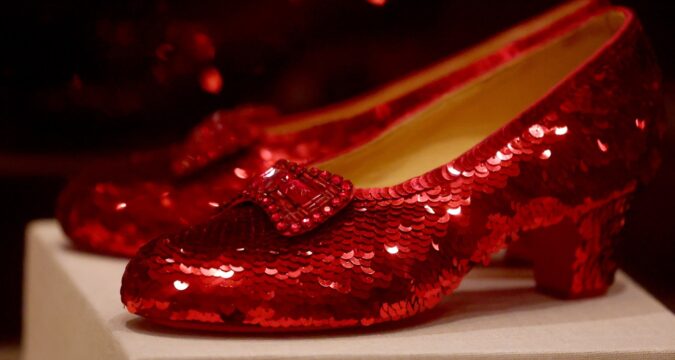
As the craze for all things “Wicked” continues, dive into the original “Wizard of Oz” film with a new exhibit of memorabilia at the Driehaus Museum. Displays include costumes, production memos and a draft of the script. Baum, lest we forget, was a Chicagoan — and there’s no place like home for all things Oz.
“The Land of Oz: Beyond the Page,” open through March 15 at the Richard H. Driehaus Museum, 50 E. Erie St., open Weds.-Sun. 11 a.m. to 5 p.m., with additional free admission hours 4 to 7 p.m. on Wednesday; $20 general admission, $15 seniors, $10 students, free for active military and children 12 and under. For more information, visit driehausmuseum.org.
Pull up a chair
What might the affordable housing of tomorrow look like? From now through the spring, the National Public Housing Museum hosts one vision. Architect and University of Illinois Chicago professor Alexander Eisenschmidt designs a living room for you to nestle into, all while reading up on Department of Housing and Urban Development history.
“BREAKTHROUGH: Housing Futures,” open through April 19 at the National Public Housing Museum, 919 S. Ada St., open Weds.-Sun. 10 a.m. to 5 p.m.; free admission. For more information, visit nphm.org.
A snowy owl and a great horned owl on display at the Peggy Notebaert Nature Museum, photographed in 2014. (Nancy Stone/Chicago Tribune)
“Whoooo is in your backyard?”
So asks the Nature Museum in “Night Flyers,” its new exhibition on owls. The museum’s taxidermic collection shows off the diversity of this regal order of raptors.
Through June 28 at the Peggy Notebaert Nature Museum, 2430 N. Cannon Drive, open daily 10 a.m. to 4 p.m.; admission $15 in-state adults, $10 students and seniors, $8 children; naturemuseum.org.
America’s expats
James Baldwin. Josephine Baker. Richard Wright. These are just a few of the African American luminaries who moved to Paris at the height of their careers, seeking to escape the prejudice of their home country. The City of Lights became a refuge for Black artists and intellectuals, if not an uncomplicated one. A recently opened exhibition at the DuSable Museum explores this migration.
“Paris in Black: Internationalism and the Black Renaissance,” The DuSable Black History Museum and Education Center, 740 E. 56th Pl., open 10 a.m. to 5 p.m. daily except Mondays (closed); general admission $12.50 for Chicago residents, $9 for students and seniors, $4 for children 6-11, free for children 6 and under. For complete pricing information, visit dusablemuseum.org.
The Adler Planetarium features the new exhibit “Stars Aligned” on the Museum Campus this winter. (Provided by Adler Planetarium)
Ancient knowledge
Like its recent “Chasing Eclipses,” the Adler Planetarium mixes history and science in “Stars Aligned,” a survey of astronomical methods over time. The new exhibition displays tracts and calendars from across cultures and ages. And yes, horoscope nerds, that means there’s some astrology in the mix, too.
“Stars Aligned: Tracing the History of Astronomy and Astrology” at Adler Planetarium, 1300 S. DuSable Lake Shore Drive, open Fri.-Mon. 9 a.m. to 4 p.m., open until 10 p.m. Wednesdays, closed Tuesdays and Thursdays; museum entry begins at $25 for adults and $13 for children 3 to 11. For complete ticketing information, visit adlerplanetarium.org.
Where the wild things are
The Chicago Children’s Museum educates little ones about natural habitats — cities very much included — through “I AM WILD,” a new exhibition inspired by the whimsical, geometric style of artist Charley Harper. (The Cincinnati-based artist wrote a popular book series of the same name before his death in 2007.) While there, be sure to swing by Ella Jenkins’ spinning top collection, gifted to the museum after the adored singer-songwriter’s death in 2024 and recently put on display.
“I AM WILD: A Charley Harper Exhibit,” Jan. 17 to May 10 at the Chicago Children’s Museum at Navy Pier, 700 E. Grand Ave.; open 10 a.m. to 5 p.m. Fri.-Sun. and 10 a.m. to 2 p.m. Mon.-Thurs., closed Tuesdays; chicagochildrensmuseum.org.
Costumes by Paul Tazewell in a scene from the 2021 movie “West Side Story.” (20th Century Studios)
When a celebrity clothier came to the science museum
Masterminding the couture in “Wicked,” “Hamilton,” Steven Spielberg’s redux of “West Side Story,” and more, Paul Tazewell is safely one of the most famous costume designers of our time. The Museum of Science and Industry displays some of his most iconic creations. The retrospective is very much in keeping with the institution’s not-at-all-sciencey-but-fun-so-who-cares curational strategy while it preps for “Powering the Future,” a major permanent exhibition opening at a date-to-be-determined later this year.
“Crafting Character: The Costumes of Paul Tazewell,” Jan. 19 to Sept. 7 at the Griffin Museum of Science and Industry, open daily 9:30 a.m. to 4 p.m.; $26 general admission, $15 children ages 3 to 11; for more ticketing info, visit griffinmsi.org.
Ya’ like “Jazz”?
Visitors to the Reva and David Logan Center at the University of Chicago have already gotten a taste of Henri Matisse’s cut-paper series “Jazz,” with prints displayed in the complex’s lower level. But the Art Institute has the real thing, showing the set for the first time since its 1948 acquisition.
“Matisse’s Jazz: Rhythms in Color,” March 7 to June 1 at the Art Institute of Chicago, 111 S. Michigan Ave.; open 11 a.m. to 5 p.m. daily except Tuesdays (closed) and Thursdays (open until 8 p.m.); $20 general admission for Chicago residents, $14 for seniors and students, and free for youth 17 and under. For complete admission pricing, visit artic.edu.
Extension alerts
“Paradise Lost,” Raqib Shaw’s epic, 100-foot tableau, has become an Art Institute favorite since its installation in the Alsdorf Galleries this spring. After effusive visitor feedback, Shaw has permitted the Art Institute to hang onto the work through November 15, nearly a year longer than planned. Meanwhile, West Town’s Intuit Art Museum has extended its reopening exhibition, “Catalyst: Im/migration and Self-Taught Art in Chicago,” through March 22.
Art Institute of Chicago, 111 S. Michigan Ave., open 11 a.m. to 5 p.m. daily except Tuesdays (closed) and Thursdays (open until 8 p.m.); $20 general admission for Chicago residents, $14 for seniors and students, and free for youth 17 and under. For complete admission pricing, visit artic.edu.
Intuit Art Museum, 756 N. Milwaukee Ave., open Weds.-Sun. 11 a.m. to 6 p.m., with hours extended to 8 p.m. every third Thursday; admission $20, visitors 24 and under get in free; art.org.
Hannah Edgar is a freelance writer.
https://www.chicagotribune.com/2026/01/03/museums-winter-2026/

The Tribune’s Quotes of the Week quiz for Jan. 3
Happy New Year, quotes readers!
Thousands of Chicagoans braved the cold to celebrate New Year’s Eve at the corner of Wacker and Franklin in the Loop and were treated to fireworks, musical performances and a countdown to midnight projected on the Merchandise Mart. This year’s expanded festivities were part of the national broadcast for “Dick Clark’s New Year’s Rockin’ Eve with Ryan Seacrest,” which featured the Windy City for the first time.
But while downtown Chicago rang in the new year with raucous revelry, a quieter celebration took place at Mount Sinai Hospital, when Brandon Alexander Whittington entered the world as the first Chicago baby of 2026. A day later, Elizabeth Branske and Melissa Nunez became the first couple married in Cook County in the new year, making history as the first lesbian couple selected for the annual honor by the Cook County clerk’s office.
The start of the new year signifies a time of change for many — local governments included. In Illinois, hundreds of new state laws took effect Jan. 1: expanding legal protections for abortion care providers, implementing a measure aimed at police accountability and regulating the use of artificial intelligence at community colleges. Meanwhile, in New York, Zohran Mamdani was sworn in as mayor just after midnight Thursday, becoming the city’s first Muslim mayor and the first of South Asian descent.
Millions of Americans will also begin the new year with higher health insurance costs after Affordable Care Act subsidies expired, which Cook County Health leaders warn could impact hospitals across the state. At the same time, flu cases are on the rise nationwide. Chicago is reporting a spike in flu-related emergency department visits and hospitalizations, and in suburban Cook County, flu activity has jumped to high levels.
In education news, the school board voted Monday to hike its property tax levy, and Chicago Public Schools formally challenged a petition in favor of unionizing 1,600 “miscellaneous” district workers.
Also this week, a state investigation revealed that roughly 400 government employees fraudulently obtained Paycheck Protection Program loans meant to keep small businesses afloat during the COVID-19 pandemic, the national Sports Betting Alliance sued the city to prevent a sports betting tax from going into effect and President Donald Trump announced on social media that the National Guard will leave Illinois, as his administration drops the push to deploy troops in Chicago, Los Angeles and Portland.
The past year was a good one for all kinds of Illinois football fans — and 2026 is shaping up to be even better. The Illini won the Music City Bowl, Northwestern’s $862 million stadium is set to open in the fall and the Chicago Bears went from worst to first in their division, clinching the NFC North title and a chance to win in the wild-card round at home.
But before the bright lights of the NFL playoffs, the regular season is still underway. On Sunday, the Bears ran out of late-game magic, coming up short of a game-winning touchdown in the final seconds and falling to the San Francisco 49ers 42-38. Now the team is preparing for one final regular season game — and the stakes couldn’t be higher. The Bears and first-year coach Ben Johnson will take on the Detroit Lions on Sunday at Solider Field. And with the No. 2 seed in the NFC on the line, Johnson says they’re “playing to win” against his former team.
Well, that’s all for this week! Here’s the Tribune’s Quotes of the Week quiz, this time with excerpts and utterances from Dec. 28 to Jan. 3. Want more quotes? You can find our past editions, here. And in case you missed it, check out the Great 2025 Chicago Tribune holiday news quiz.
Happy quizzing!
https://www.chicagotribune.com/2026/01/03/quotes-quiz-january-3/
Letters: Why we need print journalism
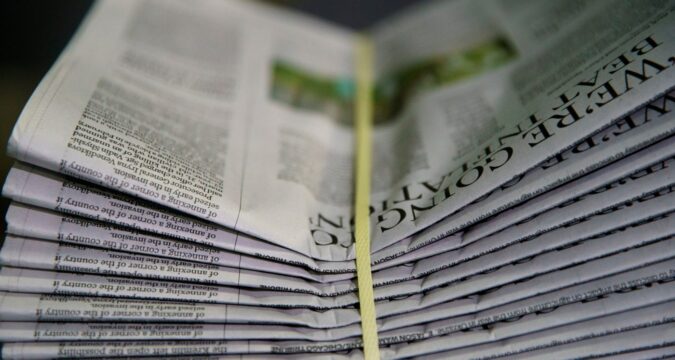
If there is one thing that has kept me hopeful throughout this past year of chaos and uncertainty, it has been the faithful delivery of my Chicago Tribune newspaper at my front door. It’s a daily reminder that a free press still thrives and stands up for the freedom of speech.
It wasn’t too long ago that I feared my beloved Tribune would fold to the economic pressure that has overtaken 3,000 newspapers since 2005. The Atlanta Journal-Constitution ended its physical newspaper in December after 157 years, making Atlanta the largest U.S. metro area without a printed daily newspaper. The Star-Ledger, once New Jersey’s highest-selling newspaper, discontinued its print edition in February.
I can hear younger people and those who permanently gravitated to digital media wondering why I’m concerned. Since the dawn of the internet and the ubiquity of digital media and smartphones, our greatest challenge has become distractions. We may be reading and seeing more online. But are we comprehending more? Are we learning more?
While conducted primarily on young people, research has shown that people retain information better when they read from printed materials. A University of Valencia study found that print reading over a long time could lead to a boost in understanding and retention skills by six to eight times in comparison with digital reading. Another study clarified this by showing that readers of print media exhibit more selective and intentional reading behavior.
If there was a time in recent history when we needed a well-informed public, able to think critically about what affects the future, it’s now. From pamphlets to periodicals to local newspapers, the printed news created this country.
Here’s a suggestion. Don’t toss your Tribune after you read it this year. Find a neighborhood or a teacher who can’t afford a subscription and share it with them. Let’s begin spreading the news in the best possible format.
In my opinion, there is no better source for news and quality journalism than the Chicago Tribune. I have been a loyal subscriber since moving here in 1991 and will continue to be until one of us is gone.
— Linda Finley Belan, Chicago
Everyone bears a gift
I have not always been kind to an elderly woman in my building. I am annoyed with her slowness in getting on and off the elevators. I have to strain to understand her broken English. Her constant chattering in corridors and common areas seems a total waste of time, and for the life of me, I can’t begin to fathom why others seem to enjoy it.
Just before Christmas, her sister made her an extraordinary necklace, which she was ecstatic to show me. This piece of jewelry, not made with any precious gems, has to be one of the most beautiful necklaces I have ever seen. I praised it to the heavens, and my “friend” was just delighted.
On Christmas Eve, I heard a soft knock on my door just as I was getting ready for bed. It was none other than my chatty friend. With a huge smile, she held out the necklace to me and said, “Please take this. It’s my Christmas present to you.” She was not about to take no for an answer.
After I thanked my visitor with a sincere hug and gently closed my door, it became abundantly clear what my New Year’s resolution had to be: Get a grip on the virtue of patience and treat everyone with the respect they deserve.
Everyone, absolutely everyone, bears a gift of some kind.
— Kathleen Melia, Niles
A chance for Congress
‘Tis the season for New Year’s resolutions that may include pledges to change our diets and commitments to spend less time on social media. We make promises to lose weight — while at the same time searching media services for Dunkin’ Donuts coupons.
Research tells us that New Year’s resolutions, a popular noncontractual commitment, began over 3,000 years ago in Babylonian culture and shortly after in other cultures as a way, in general, to atone for questionable practices and/or debt. Many thought they would receive special blessings from the gods for positive adjustments in their behavior.
The practice of making resolutions in modern times is simply a personal commitment to do better or improve upon our perceived or assumed weaknesses.
I have decided for 2026 to participate in the resolution tradition by sharing my own personal desire. I am hoping that all of Congress and those who sit in the seats of power will support and make available affordable health care for the 4 million to 5 million people who are at risk of losing their health insurance if Congress does not act soon. What a great beginning for a new year if health insurance issues could be resolved!
Let’s pray that this resolution will become a centerpiece in the hearts of members of Congress and that they will embrace the words of Oprah Winfrey: “Cheers to a new year and another chance to get it right.”
— George Comer, Crown Point, Indiana
The tenets of my faith
In his Jan. 1 op-ed (“Faith and compassion can see us through 2026”), Willie Wilson writes: “Faith is trust in God even though you cannot see or trace him.” He then concludes his piece with “I write this commentary to make those comfortable with lacking faith, hope and love uncomfortable.” Should I be uncomfortable with my lack of faith in God?
I understand and respect that many people believe in a god (most religions have their own version of a supreme being), and I appreciate that these people naturally want to share their faith with others so that they, too, may see the “light.” I also recognize that while religion can be a force for good, history tells us that a religious faith can be used to vilify those who have a different faith or none at all. I would argue that Wilson’s remark about discomfort with lacking faith may not reflect positive values and could conflict with the inclusive views of many religions.
While I do not have faith in a god, I try to follow the universal teachings of various religions such as the golden rule. I do have faith in the general goodness of others, our Constitution and our collective ability to overcome whatever natural or human-made difficulties we may face.
I hope that Wilson will respect my faith as much as I respect his.
— Richard Badger, Chicago
Submit a letter, of no more than 400 words, to the editor here or email letters@chicagotribune.com.
https://www.chicagotribune.com/2026/01/03/letters-010326-print-journalism/
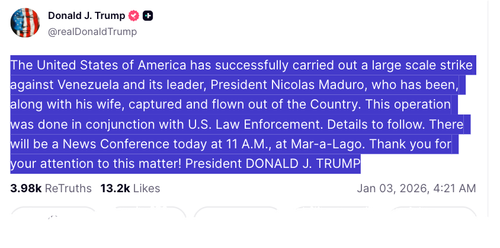
US Forces Strike Venezuela, Trump Reveals Maduro Has Been “Captured”
US Forces Strike Venezuela, Trump Reveals Maduro Has Been “Captured”
President Donald Trump announced on Truth Social that U.S. forces “successfully carried out a large-scale strike” against Venezuela and captured President Nicolás Maduro and his wife.
“The United States of America has successfully carried out a large-scale strike against Venezuela and its leader, President Nicolás Maduro, who has been, along with his wife, captured and flown out of the country. This operation was done in conjunction with U.S. law enforcement. Details to follow. There will be a news conference today at 11 a.m. at Mar-a-Lago. Thank you for your attention to this matter!” Trump wrote on Truth Social.
According to officials cited by CBS News, the operation was carried out by the U.S. Army’s Delta Force. The action to dismantle the Maduro regime follows months of foreign policy maneuvering described as gunboat diplomacy, aimed at starving the country of oil revenues.
Footage from the operation:
🇺🇸🇻🇪⚡️- Airstrike against a refinery (or factory) in Caracas, the capital of Venezuela. pic.twitter.com/w77iM1NNoo
— Military Observer (@MilitaryObs2222) January 3, 2026
Full-scale military operations appear to be underway against Venezuela, with dozens of helicopters with the U.S. Army spotted over the capital of Caracas. pic.twitter.com/kIqfbGjOK4
— OSINTdefender (@sentdefender) January 3, 2026
*Developing…
Tyler Durden
Sat, 01/03/2026 – 05:32

Today in Chicago History: Feds charge longtime Ald. Edward Burke with extortion
Here’s a look back at what happened in the Chicago area on Jan. 3, according to the Tribune’s archives.
Is an important event missing from this date? Email us.
Front page flashback: Jan. 4, 1984
President Ronald Reagan said the release of Navy Lt. Robert Goodman Jr. on Jan. 3, 1984, would be “helpful” for U.S.-Syria relations and could unite the countries in working toward peace in Lebanon. (Chicago Tribune)
Navy Lt. Robert Goodman Jr., whose plane was shot down during a U.S. raid against Syrian positions in Lebanon, was freed after a month’s captivity in Syria following an appeal by Jesse Jackson.
Weather records (from the National Weather Service, Chicago)
High temperature: 60 degrees (1950)
Low temperature: Minus 18 degrees (1879)
Precipitation: 1.24 inches (1897)
Snowfall: 7.1 inches (1971)
1943: Three Bentley brothers teamed up to score a goal for the Chicago Blackhawks in a 3-3 tie against the Rangers in New York.
“At 5:44 Reg Bentley poked home a goal from a melee in front of the Ranger net, with his two brothers (Doug and Max) drawing assists,” the AP reported.
The new McCormick Place at 23rd Street and Lake Michigan opened with the Style Exhibitions show. (Chicago Tribune historical photo, circa Dec. 22, 1970)
1971: The new McCormick Place opened — almost four years after the previous structure was destroyed by a fire — with 700 exhibits of women’s fashions.
Chicago Bears general manager Jim Finks, right, and head coach Jack Pardee, review the first-round picks at their La Salle Hotel draft headquarters on Jan. 28, 1975. Finks and Pardee are pointing at their No. 1 draft choice, Walter Payton. (Phil Mascione/Chicago Tribune)
1975: The Chicago Bears introduced Jack Pardee as head coach.
From George Halas to Ben Johnson: What was said about every Chicago Bears coach when they were hired
Pardee’s record was 20-22 (.476) from 1975-77.
Longtime Ald. Edward Burke was charged in a federal criminal complaint, unsealed Jan. 3, 2019, with attempted extortion. (Chicago Tribune)
2019: A federal criminal complaint unsealed on this date charged former 14th Ward Ald. Edward Burke with attempted extortion for allegedly using his position as alderman to try to steer business to his private law firm from a company seeking to renovate a Burger King in his ward.
The Dishonor Roll: Chicago officials
Burke was convicted Dec. 21, 2023, by a federal jury of racketeering conspiracy and a dozen other counts. He was sentenced June 24, 2024, to two years in federal prison. Less than 10 months after reporting to federal prison, Burke was released in July 2025 to spend the rest of his sentence in the Chicago area, according to federal officials.
Want more vintage Chicago?
Subscribe to the free Vintage Chicago Tribune newsletter, join our Chicagoland history Facebook group and follow us on Instagram for more from Chicago’s past.
Have an idea for Vintage Chicago Tribune? Share it with Kori Rumore and Marianne Mather at krumore@chicagotribune.com and mmather@chicagotribune.com
https://www.chicagotribune.com/2026/01/03/january-3-chicago-history/