Category: News

Japan says Donald Trump has invited its leader to the US. It comes as ties with China are strained.
WASHINGTON — President Donald Trump invited Japanese Prime Minister Sanae Takaichi during a phone call Friday to visit the United States this year, the Japanese foreign ministry said, in what would be the ultraconservative leader’s first trip to the U.S. since taking office in October.
The White House is yet to confirm the call and the invitation. It comes as ties between Japan and China have been strained, ramping up tensions in the region. The U.S., a close ally of Japan, is seeking to strengthen its ties with Tokyo but also stabilize its relationship with Beijing ahead of a likely trip by Trump to China in April.
Beijing staged two-day military exercises in the waters off Taiwan this week. Takaichi, Japan’s first female prime minister, infuriated China late last year when she said Chinese military action against Taiwan could be grounds for a Japanese military response, breaking away from former Japanese leaders’ strategic ambiguity on the highly sensitive matter.
In a statement Friday, the Japanese foreign ministry said Takaichi and Trump agreed to coordinate for the visit to happen this spring. Kyodo News, Japan’s news agency, suggested that Takaichi’s trip could coincide with the annual cherry blossom festival in Washington.
The foreign ministry said the two leaders affirmed that they would “carve out a new chapter in the history of the Japan-U.S. alliance” in a year when the U.S. celebrates the 250th anniversary of its founding and that they would “further deepen the friendly relations” between the two nations, including economic and security cooperation.
Takaichi and Trump also agreed on their commitment to promoting cooperation among like-minded partners, including the Japan-U.S.-South Korea partnership, and to a free and open Indo-Pacific, the foreign ministry statement said.
The two exchanged views “mainly on the Indo-Pacific region,” the ministry said, but it did not provide details, including whether the two discussed recent actions by Beijing in the region.
China’s military drills off Taiwan also came after the Trump administration announced a package of arms sales to Taiwan valued at more than $11 billion. If approved by Congress, it would represent the largest such aid to the island ever — a move criticized sharply by China.
Beijing claims sovereignty over the self-governed island and vows to seize it — by force if necessary. The U.S. is obligated by a domestic law to provide Taiwan with sufficient hardware to deter any attack from the mainland.
Trump on Monday said he was not informed of the exercises in advance but still touted his relationship with Chinese President Xi Jinping.
Trump met Takaichi in Tokyo in October, shortly after she took office. The two exchanged warm words, and Trump took her with him when he spoke to U.S. troops aboard an aircraft carrier in Japan.
After Takaichi’s Taiwan comments angered Beijing, Trump called her and said they were “extremely good friends” and that she should call him any time, according to the Japanese leader, without disclosing if the two talked about her remarks.
https://www.chicagotribune.com/2026/01/02/japan-trump-invited-leader/

United Arab Emirates says it pulled troops out of Yemen
ADEN, Yemen — The United Arab Emirates said early Saturday it had withdrawn all its troops from Yemen.
The move comes after days of airlifts by UAE military aircraft following an order to withdraw from anti-Houthi forces in Yemen following Saudi Arabia pushing back against the advance of Emirati-backed separatists there.
“The UAE forces follows the implementation of a previously announced decision to conclude the remaining missions of counter-terrorism units,” a Defense Ministry statement said. “The process has been conducted in a manner that ensured the safety of all personnel and carried out in coordination with all relevant partners.”
THIS IS A BREAKING NEWS UPDATE. AP’s earlier story follows below.
ADEN, Yemen — Yemen‘s separatist movement on Friday announced a constitution for an independent nation in the south and demanded other factions in the war-torn country accept the move in an escalation of a confrontation that has pitted Gulf powerhouses Saudi Arabia and the United Arab Emirates against each other.
The UAE-backed Southern Transitional Council depicted the announcement as a declaration of independence for the south. But it was not immediately clear if the move could be implemented or was largely symbolic. Last month, STC-linked fighters seized control of two southern provinces from Saudi-backed forces and took over the Presidential Palace in the south’s main city, Aden. Members of the internationally recognized government — which had been based in Aden — fled to the Saudi-capital Riyadh.
On Friday, Saudi warplanes bombed camps and military positions held by the STC in Hadramout province as Saudi-backed fighters tried to seize the facilities, a separatist official said. It was the latest direct intervention by Saudi Arabia, which in recent weeks has bombed STC forces and struck what is said was a shipment of Emirati weapons destined for the separatists.
Ostensibly, Saudi Arabia and the UAE and their allies on the ground in Yemen have all been part of a Saudi-led coalition fighting Iranian-backed Houthi rebels who control the north in the country’s decade-long civil war. The coalition’s professed goal has long been to restore the internationally recognized government, which was driven out of the north by the Houthis. But tensions between the factions and the two Gulf nations appear to be unraveling the coalition, threatening to throw them into outright conflict and further tear apart the Arab world’s poorest country.
Southern separatists’ declaration
The head of the STC, Aidarous al-Zubaid, issued a video statement Friday saying that the constitution his group issued would be in effect for two years, after which a a referendum would be held on “exercising the right to self-determination for the people of the South.” During those two years, he said, the “relevant parties” in north and south Yemen should hold a dialogue on “a path and mechanisms that guarantee the right of the people of the South.”
He said that if the other factions don’t agree to his call or if they take military action, “all options remain open.”
The 30-article “constitution” proclaimed the creation of “the State of South Arabia,” covering the same territory of the former People’s Democratic Republic of Yemen, the independent southern state that existed from 1967-1990.
It seemed to be the most overt move yet by the STC toward its long-proclaimed goal of independence. In the confusion that has reigned in the south in recent weeks, it was not clear what practical impact it would have. But the declaration could set back efforts to avert an outright conflict between the separatists and the rest of the Saudi-led coalition.
The UAE’s Foreign Ministry said in a statement Friday that the country was dealing with the situation “with restraint, coordination, and a deliberate commitment to de-escalation, guided by a foreign policy that consistently prioritizes regional stability over impulsive action.”
Saudi warplanes strike as fighting continues in the south
The Saudi-led coalition in Yemen demands the withdrawal of the STC-linked Southern Shield forces from the two governorates they seized, Hadramout and Mahra, as part of de-escalation efforts. The STC has so far refused to hand over its weapons and camps.
Saudi-backed fighters, known as the National Shield Forces, advanced on two STC-camps in Hadramout, said a senior STC official, Ahmed bin Breik, a former governor of the province. The separatist forces refused to withdraw and in response, Saudi planes struck the camps, he said.
Mohamed al-Nakib, spokesperson for the STC-backed forces, said the strikes caused fatalities, without providing details. The Associated Press couldn’t independently verify that claim.
He told the AP later Friday that “intense clashes” erupted between his forces and the National Shield forces across several areas of Hadramout.
It was not clear if the Saudi-backed forces succeeded in retaking the camps.
Salem al-Khanbashi, the governor of Hadramout who was chosen Friday by Yemen’s internationally recognized government to command the Saudi-led forces in the governorate, said the move to reclaim the camps was “not a declaration of war and is not seeking an escalation.” He said it was a “pre-emptive measure to remove weapons.”
Escalating tensions
In a post on X, the Saudi ambassador to Yemen, Mohammed al-Jaber, said the kingdom had tried “all efforts with STC” for weeks “to stop the escalation” and to urge the separatists to leave Hadramout and Mahra, only to be faced with “continued intransigence and rejection from Aidarous al-Zubaidi.”
Al-Jaber said the STC had not permitted a Saudi delegation’s jet to land in Aden, despite having agreed on its arrival with some STC leaders to find a solution that serves “everyone and the public interest.”
Yemen’s Transportation Ministry, aligned with STC, said Saudi Arabia on Thursday imposed requirements mandating that flights to and from Aden International Airport undergo inspection in Jeddah. The ministry denounced the decision. There was no confirmation from Saudi authorities.
ِA spokesperson with the transport ministry told the AP late Thursday that all flights from and to the UAE were suspended until Saudi Arabia reverses these reported measures.
Khaled reported from Cairo. Associated Press writer Bassem Mroue in Beirut contributed to this report.
OnlyFans Model Gets Baptized, Reconnects With Jesus After Sex Spree
OnlyFans Model Gets Baptized, Reconnects With Jesus After Sex Spree
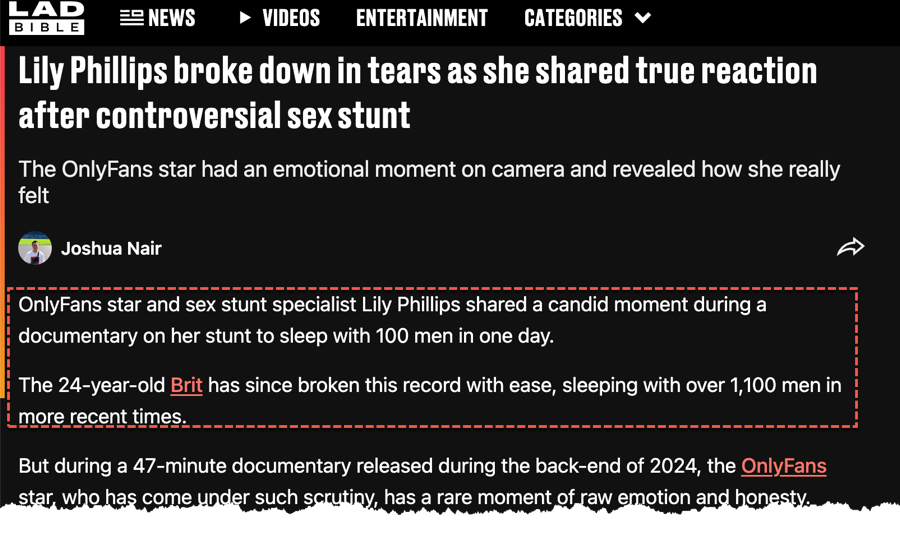
A viral video shows OnlyFans content creator Lily Phillips taking part in a baptism ceremony, saying she has “found Jesus” and now feels “closer to God.”
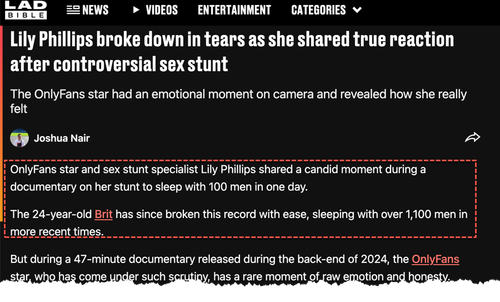
British adult OnlyFans content creator Phillips is known for a series of sensational stunts, including reportedly outdoing fellow OF creator Bonnie Blue by sleeping with more than 1,100 men.
The baptism represents spiritual cleansing, commitment, and transformation for Phillips after years of creating adult content on OF.
The exact end of her OF activity isn’t clear. She hasn’t publicly announced any retirement, but a viral video shows Phillips getting baptized.
It’s hard to know whether this baptism- intended to wash her of sins – is genuine or a public stunt.
Lily Philips, the woman who slept with 1,113 men in 12 hours gets baptized and says she’s ‘Closer to God’. 🤔 pic.twitter.com/O6kpCAhkVe
— kira 👾 (@kirawontmiss) January 1, 2026
One X user said…
Change that water ASAP 🤮
— DWebbs (@DWebbs) January 1, 2026
However, we’ve documented another well-known OF model who apparently found Jesus…
The entire OF fad for young women has generated $25 billion in earnings since 2016, but it comes at a reputational cost.
As we’ve pointed out, OF “isn’t cultural drift; it’s social engineering.”
Now, an upswing in Christianity may suggest that, once models peak, they will “find Jesus” and likely require retraining to reenter the actual workforce
Tyler Durden
Fri, 01/02/2026 – 20:30
https://www.zerohedge.com/technology/onlyfans-model-gets-baptized-reconnects-jesus-after-sex-spree

State agency says information of more than 670,000 Illinois residents publicly exposed
The personal information of more than 670,000 Illinois residents may have been publicly accessible online for several years, the Illinois Department of Human Services said Friday.
The department discovered Sept. 22 that maps created by one of its divisions on a mapping website were “publicly viewable due to incorrect privacy settings,” according to a notice shared with the media Friday. The maps were intended for the department’s internal use to help it make decisions about where to allocate resources, such as where to open new local offices.
Those maps included the personal information of 32,401 customers with the department’s Division of Rehabilitation Services, as well as information of 672,616 people who were Medicaid and Medicare Savings Program recipients. The Medicare Savings Program is a state Medicaid program that helps people pay for Medicare premiums and other costs.
Personal information of Division of Rehabilitation Services customers included names, addresses, case numbers and case statuses, and was publicly accessible from April 2021 through September 2025.
Exposed information of Medicaid and Medicare Savings Program recipients included addresses, case numbers, demographic information and the names of medical assistance plans but not individual patients’ names, and the information was publicly viewable from January 2022 through September 2025.
The department was unable to identify who may have viewed the maps, but said in its notice that it’s not aware of any misuse of the personal information.
The department changed the privacy settings on the maps, when it discovered the issue, so only authorized employees could see them. The department has also implemented a policy prohibiting customer data from being uploaded to public mapping websites.
The department is in the process notifying affected individuals, according to the media notice.
“IDHS is working to ensure that this does not happen again, as the privacy of customers is of paramount importance,” the department said in the notice.
The Health Insurance Portability and Accountability Act requires many types of organizations to report breaches of protected health information involving 500 or more individuals to the U.S. Department of Health and Human Services’ Office for Civil Rights.
https://www.chicagotribune.com/2026/01/02/data-breach-illinois-department-human-services/

US Coast Guard searches for survivors of boat strikes as odds diminish days later
WASHINGTON — The U.S. Coast Guard said Friday it’s still searching for people in the eastern Pacific Ocean who had jumped off alleged drug-smuggling boats when the U.S. military attacked the vessels days earlier, diminishing the likelihood that anyone survived.
Search efforts began Tuesday afternoon after the military notified the Coast Guard that survivors were in the water about 400 miles southwest of the border between Mexico and Guatemala, the maritime service said in a statement.
The Coast Guard dispatched a plane from Sacramento to search an area covering more than 1,000 miles, while issuing an urgent warning to ships nearby. The agency said it coordinated more than 65 hours of search efforts, working with other countries as well as civilian ships and boats in the area.
The weather during that time has included 9-foot seas and 40-knot winds. The U.S. has not said how many people jumped into the water, and, if they are not found, how far the death toll may rise from the Trump administration’s monthslong campaign of blowing up small boats accused of transporting drugs in the region.
The U.S. military said earlier this week that it attacked three boats traveling along known narco-trafficking routes and they “had transferred narcotics between the three vessels prior to the strikes.” The military did not provide evidence to back up the claim.
U.S. Southern Command, which oversees the region, said three people were killed when the first boat was struck, while people in the other two boats jumped overboard and distanced themselves from the vessels before they were attacked.
The strikes occurred in a part of the eastern Pacific where the Navy doesn’t have any ships operating. Southern Command said it immediately notified the U.S. Coast Guard to activate search and rescue efforts for the people who jumped overboard before the other boats were hit.
Calling in the Coast Guard is notable because the military drew heavy scrutiny after U.S. forces killed the survivors of the first attack in early September with a follow-up strike to their disabled boat. Some Democratic lawmakers and legal experts said the military committed a crime, while the Trump administration and some Republican lawmakers say the follow-up strike was legal.
There have been other survivors of the boat strikes, including one for whom the Mexican Navy suspended a search in late October after four days. Two other survivors of a strike on a submersible vessel in the Caribbean Sea that same month were sent to their home countries — Ecuador and Colombia. Authorities in Ecuador later released the man, saying they had no evidence he committed a crime in the South American nation.
Under President Donald Trump’s direction, the U.S. military has been attacking boats in the Caribbean Sea and eastern Pacific since early September. As of Friday, the number of known boat strikes is 35 and the number of people killed is at least 115, according to numbers announced by the Trump administration.
Trump has justified the boat strikes as a necessary escalation to stem the flow of drugs into the United States and asserted that the U.S. is engaged in an “armed conflict” with drug cartels.
Along with the strikes, the Trump administration has built up military forces in the region as part of an escalating pressure campaign on Venezuelan President Nicolás Maduro, who has been charged with narco-terrorism in the United States.
https://www.chicagotribune.com/2026/01/02/us-coast-guard-boat-strikes/

SMRs Explained: Real-World Economics, Fuel Bottlenecks, & The Race To Scale
SMRs Explained: Real-World Economics, Fuel Bottlenecks, & The Race To Scale
Authored by Michael Kern via OilPrice.com,
The shift to Small Modular Reactors (SMRs) is driven by rising global electricity demand, especially from AI data centers, and the limitations of intermittent renewable energy sources, positioning nuclear as the essential source of 24/7 “firm” baseload power.
SMRs bypass the financial risks of traditional megaprojects like Vogtle by offering shorter construction timelines (3–5 years) and a lower initial cost, trading “economies of scale” for “economies of unit production” through factory-built components.
Key challenges for the SMR industry include the need for mass production to achieve economic viability, managing the waste issue, and navigating the geopolitical risks associated with a highly concentrated global uranium fuel supply chain.
Nuclear power is currently having its “Silicon Valley” moment. After decades of being treated as a dinosaur technology—too slow, too expensive, and too politically toxic—the industry has pivoted toward something it calls the Small Modular Reactor (SMR). The goal is to stop building energy cathedrals and start building energy appliances.
The market fundamentals are finally in place for a new era. Global electricity demand is rising at twice the rate of total energy demand, pushed over the edge by the relentless growth of AI data centers and the slow-motion electrification of the global vehicle fleet. Generation from the world’s fleet of nearly 420 reactors is already on track to reach an all-time high in 2025. This is about a global realization that “intermittent” renewables cannot carry the load of a 24/7 civilization alone.
Baseload power is no longer a luxury; it’s the price of admission for the modern economy.
Why Small Is the Only Way Big Nuclear Survives
If you’ve spent any time reading about energy, you know the term “Small Modular Reactor” is used as a catch-all… it actually refers to three distinct shifts in how we think about the atom.
First, “Small” means anything up to 300 MWe. That is roughly a third of the output of a traditional Gigawatt-scale plant… enough to power about 250,000 homes or a massive industrial complex.
Second, “Modular” is the real economic engine. Instead of custom-designing every pipe and valve on a muddy construction site, components are factory-built and shipped via truck or rail.
Finally, “Reactor” is where the physics get messy. Current designs aren’t just “shrunk down” versions of the 1970s light-water tech.
We are seeing a move toward Generation IV concepts: molten salt reactors that can’t melt down because the fuel is already liquid, and gas-cooled reactors that can provide the 700°C+ process heat required for making steel or hydrogen.
Why Megaprojects Died in Georgia
Traditional nuclear projects like the Vogtle plant in Georgia or Hinkley Point C in the UK have become legendary for their cost overruns. They aren’t just power plants; they are multi-decade civil engineering nightmares that consume capital faster than they produce watts.
Vogtle ended up costing over $30 billion… nearly double the original estimate.
No private investor wants to sit on a $30 billion debt for fifteen years before the first dollar of revenue trickles in. SMRs attempt to bypass this “Valley of Death” by shortening construction timelines to roughly 3–5 years and lowering the initial check to something a mid-sized utility or a tech giant can actually afford.
It’s an attempt to trade “economies of scale” for “economies of unit production.”
The East Is Building While the West Files Paperwork
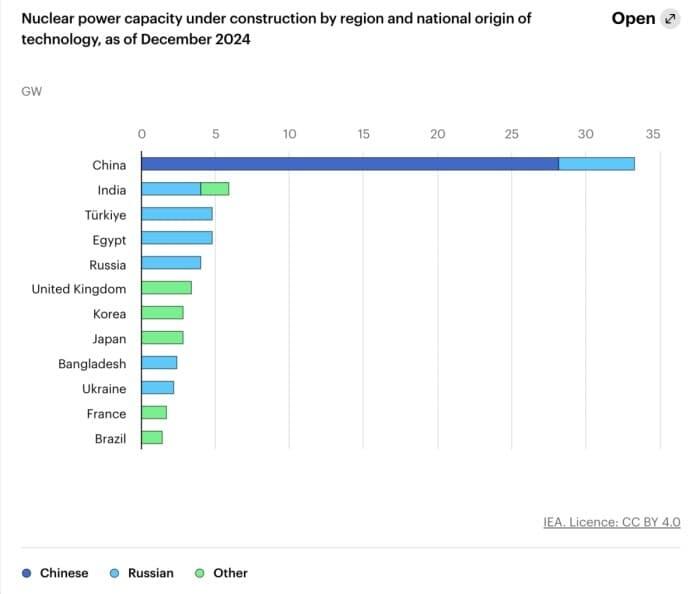
The “Nuclear Renaissance” is already happening; it just hasn’t reached the Atlantic yet. Of the 52 reactors started since 2017, nearly half are Chinese, and the other half are Russian.
(Source: IEA)
And the bottleneck isn’t technology…it’s fuel. Russia currently controls 40% of the world’s uranium enrichment capacity. Energy security is a hollow promise if you have to buy the uranium from your primary adversary.
AI Is the Insatiable Beast That Only Fission Can Feed
The tech giants aren’t buying nuclear because they’ve suddenly developed a passion for carbon-free baseload. They’re doing it because their AI roadmaps are hitting a physical wall… a single ChatGPT query consumes roughly ten times the electricity of a Google search.
Amazon, Google, and Microsoft have realized that wind and solar are essentially “part-time” energy sources.
When the sun goes down and the wind stops, the data centers don’t. This creates a massive, expensive problem called “intermittency” that batteries aren’t ready to solve at a multi-gigawatt scale. The SMR is the only thing on the menu that offers 24/7 “firm” power with a small enough footprint to sit next to a server farm.
For the first time in history, the primary driver for nuclear power is coming from the private sector, not the state.
Microsoft: Signed a 20-year PPA to resurrect Three Mile Island (Unit 1).
Google: Ordered 6–7 reactors from Kairos Power for 500 MW of clean energy.
Amazon: Bought a stake in X-energy and signed an MoU with Dominion for SMR siting.
Oracle: Announced a massive data campus powered by three modular reactors.
These companies have the credit ratings and the long-term horizons to do what traditional utilities can’t: they can guarantee “offtake.”
By signing 20-year Power Purchase Agreements (PPAs), they provide the bankability that SMR manufacturers need to start their assembly lines.
Picking Winners in a Graveyard of Energy Startups
The SMR market is a graveyard of good ideas that ran out of money. To win, a company needs three things: a simple design, a licensed site, and a customer with deeper pockets than God.
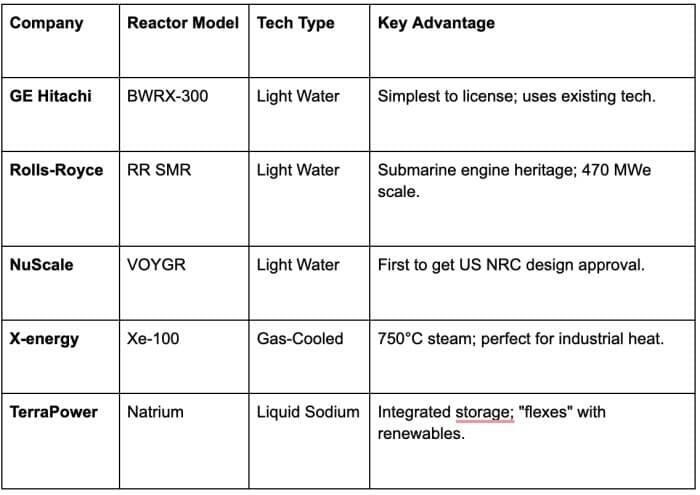
The market is split between the “Old Guard” shrinking proven tech and “Disruptors” chasing Generation IV designs.
The $2,500/kW Target: Chasing the Chinese Cost Curve
This is where the marketing brochures usually stop being honest. If you build one SMR, it is the most expensive electricity on Earth. The “Modular” promise only works if you build them like airplanes—in a factory, at scale.
The IEA projects SMR investment will hit $25 billion annually by 2030. That sounds like a lot until you realize that building the first factory for these modules could eat half that budget before the first reactor is even shipped. The “learning curve” for SMRs is a steep and expensive climb. Studies suggest that “learning-by-doing” can reduce capital costs by 5% to 10% for every doubling of production. However, a report by Germany’s BASE suggests that an average of 3,000 SMRs would have to be produced before they reach true economies of mass production.
This is the central friction of the industry. No CEO wants to tell their board they are the “guinea pig” for an unproven $1 billion reactor.
Private funding alone won’t work. The long timelines for permitting mean the “breakeven point” for a large reactor is 20-30 years after project start. SMRs cut that timeline in half, but it’s still a tough sell for commercial lenders.
This is where Green Bonds and Public-Private Partnerships come in.
Over $5 billion in green bonds have been issued for nuclear so far, and the U.S. DOE’s Advanced Reactor Demonstration Program is throwing billions at prototypes. But the real bridge across the “Financial Valley of Death” is the credit rating of Big Tech. When Google or Amazon signs a 20-year PPA, the debt becomes bankable.
Fukushima-Proofing the Atom With Passive Physics
SMR proponents love to talk about “passive safety”—designs where physics (gravity and convection) cool the reactor even if the power goes out. It’s essentially “Fukushima-proofing” by design. Because these units are smaller, they have a lower radioactive inventory per reactor, allowing them to be placed on the sites of retired coal plants. The need:
Gravity-Driven Cooling: If power is lost, cool water is naturally pulled into the core.
Smaller Cores: Less radioactive inventory means the “exclusion zone” can be significantly smaller.
Underground Siting: Placing reactors below grade adds a natural barrier against external threats.
But the waste issue remains messy. A 2022 Stanford study claimed that SMRs might actually produce more waste per unit of energy because smaller cores “leak” more neutrons, making the surrounding shielding more radioactive over time. The industry’s rebuttal? They claim they can “burn” this waste as fuel in the next generation of breeder reactors. Both sides are technically correct, but the breeder reactors aren’t here yet, and the waste is.
If we build thousands of SMRs and ship them to remote mining sites or developing nations, we are “distributing” nuclear material across the globe. That is a security nightmare. The fix is “Battery-Style” SMRs: built, fueled, and welded shut in a factory. They are shipped to a site, run for 20 years, and shipped back. The end-user never touches the fuel.
Teaching the NRC to Move at the Speed of Light
The U.S. Nuclear Regulatory Commission (NRC) was designed to regulate massive, one-off light-water reactors. Applying 1970s regulations to 2025 technology is like trying to get a Tesla licensed using rules written for steam engines.
In July 2024, the ADVANCE Act was signed into law, explicitly directing the NRC to streamline the process for microreactors and SMRs. By December 2025, the NRC had already met 30 of its 36 planned deliverables under the act. It’s an attempt to stop the “licensing-by-exhaustion” strategy that has killed so many designs in the past.
International harmonization is the next frontier. If a design is approved in Canada (like the BWRX-300), why does it need to spend another five years and $100 million being “re-approved” in the U.S. or the UK? Strategic leadership is being built in concrete while the West waits for a policy consensus.
The $1.5 Trillion Industrial Heat Prize
Most people think of nuclear as a way to keep the lights on. But electricity is only about 20% of global primary energy demand. The real monster in the room is Industrial Process Heat. If you want to make steel, cement, or glass, you need temperatures that wind and solar simply cannot provide through a wire without massive efficiency losses. Today, 89% of that high-temperature demand is met by burning fossil fuels.
The SMR—specifically the High-Temperature Gas Reactor (HTGR)—is the only zero-carbon technology that can sit “inside-the-fence” with a chemical plant and provide 750°C steam. According to a 2025 study by LucidCatalyst, the potential market for industrial SMRs could hit 700 GW by 2050.
We’re talking about a $1.5 trillion investment opportunity.
The top five markets for this aren’t utilities… they are synthetic aviation fuels, coal plant repowering, maritime fuels, data centers, and chemicals.
In October 2025, the European Commission launched its first pilot auction for industrial heat decarbonization. Companies like France’s Blue Capsule are designing reactors specifically for this market.
If SMRs can’t crack the industrial heat market, Net Zero is a mathematical impossibility.
Why Desalination Might Be the Secret Middle East Play
In the Middle East and North Africa (MENA), energy security is inseparable from water security. Arab states currently account for more than 50% of global desalination capacity. Desalination is an energy hog. Traditionally, it’s been powered by oil and gas, but the GCC nations have pledged net-zero goals for 2050–2060.
SMRs offer a “dual-purpose” solution: they provide baseload power for the grid and the massive amounts of heat or electricity needed for Reverse Osmosis (RO) or Multi-Effect Distillation (MED).
In Jordan, an IAEA team recently evaluated studies for using SMRs to pull drinking water from the Red Sea to Amman. In Saudi Arabia, the world’s largest desalinated water producer, the government is looking at nuclear as the cornerstone of its move away from an oil-based economy.
The economics are starting to pencil out. Using the Desalination Economic Evaluation Program (DEEP) model, 2025 data shows that high-temperature helium-cooled reactors can produce water at an economically viable range of $0.69 to $1.04 per cubic meter.
Microreactors Are the Frontier Batteries for the Arctic and the Mine
While the 300 MWe reactors get the headlines, a subset of the industry is going even smaller. Microreactors (under 10 MWe) are being designed as “nuclear batteries” for the most austere environments on Earth.
The U.S. Department of the Air Force is the lead customer here. In May 2025, they issued a Notice of Intent to Award a contract to Oklo, Inc. for a microreactor pilot at Eielson Air Force Base in Alaska.
Why Alaska?
Because shipping diesel to remote Arctic bases is expensive, dangerous, and a massive logistical vulnerability.
The Eielson project is a 30-year PPA where the vendor owns and operates the reactor. It is “Mission Assurance” in a 50-below-zero environment. But it’s not just the military.
Remote mining operations in Canada and Australia are looking at microreactors like the eVinci (Westinghouse) or the KRONOS (Nano Nuclear). For a mine that currently spends $50 million a year on diesel fuel, a microreactor that runs for 10 years without refueling isn’t just a “green” choice… it’s a massive competitive advantage.
Navigating the Yellowcake Landmine in Kazakhstan and Niger
Now, we have to talk about the fuel. Everything we’ve discussed depends on HALEU (High-Assay Low-Enriched Uranium), and right now, the supply chain is a geopolitical landmine. Kazakhstan currently supplies over 43% of the world’s uranium. That is a terrifying level of concentration, especially given the civil unrest seen in the region.
Then there is Africa.
The 2023 military coup in Niger effectively knocked out a reliable supplier for Europe. In 2025, no production was reported from the SOMAÏR mine.
The West is finally waking up. In late 2025, Urenco USA produced its first run of enriched uranium above 5% in New Mexico. Centrus Energy launched commercial enrichment activities in Ohio, targeting HALEU production to meet a $2.3 billion backlog. But new mines take 7–10 years to come online. We are currently in a “seller’s market,” with uranium prices hitting a range of $86 to $90 per pound in new contracts. If the fuel supply isn’t diversified, the SMR revolution will be choked in its cradle.
Overcoming the Duck Curve
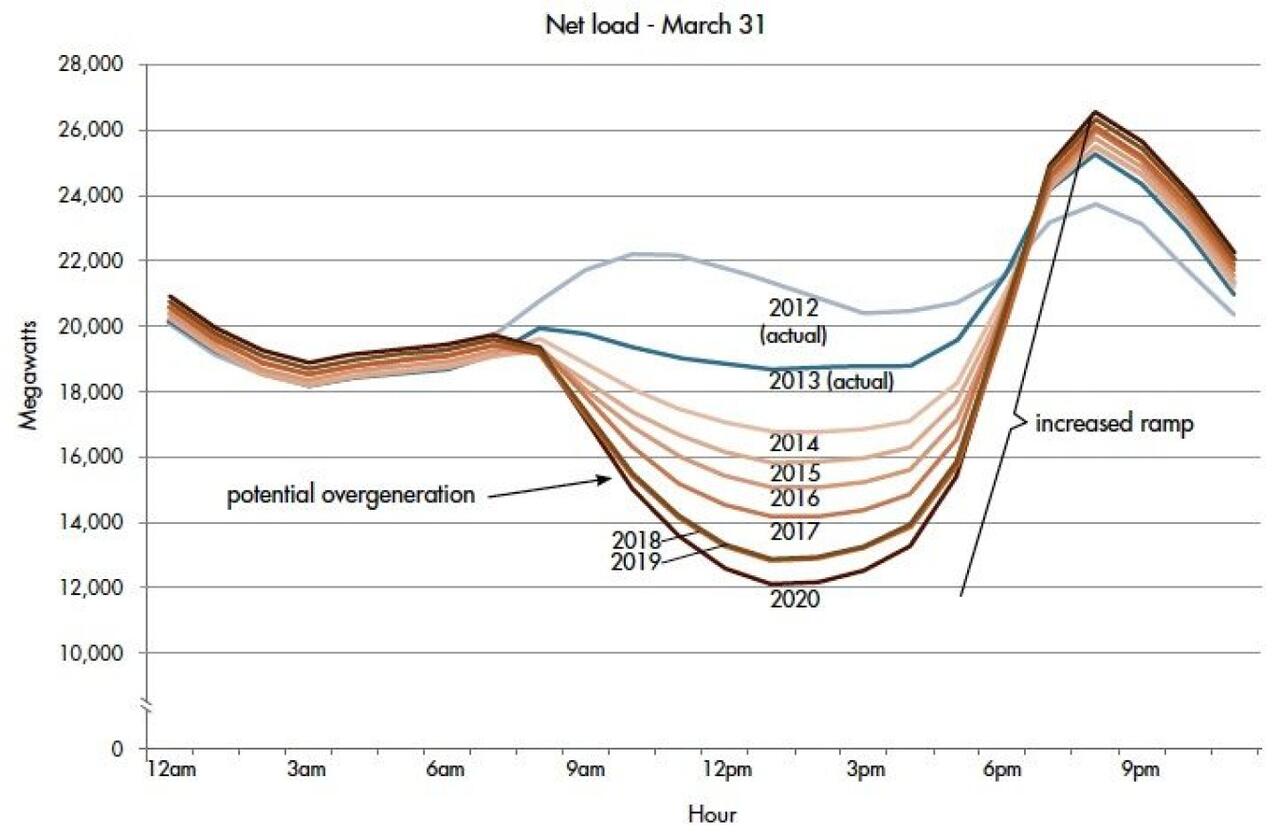
The modern grid is struggling to handle the “Duck Curve“—the massive fluctuation in supply caused by solar and wind.
(Source: DOE)
Traditionally, nuclear was considered “inflexible” baseload… you turned it on and left it at 100% for two years.
SMRs are being designed with Load-Following capabilities.
TerraPower’s Natrium reactor, for example, includes a molten salt heat storage system. This allows the reactor to run at a constant temperature while the storage system “flexes” the electrical output to the grid. When the sun is shining, the reactor stores heat. When the sun goes down, it releases it to generate power.
It turns the nuclear reactor from a “firm floor” into a “flexible battery.” This is the missing piece of the renewable energy transition. Without this flexibility, we are forced to keep gas-fired “peaker” plants on standby, which defeats the purpose of the carbon-free goal.
Resurrecting the Rust Belt With Coal-to-Nuclear Pivots
There are over 300 retired or retiring coal plant sites in the United States alone. These sites are energy goldmines. They already have the grid connections, the cooling water access, and, most importantly, a workforce that knows how to run a thermal power plant.
The SMR is the only technology that can “slot” into these sites without requiring a total overhaul of the local economy.
NuScale is currently working with Dairyland Power in Wisconsin to evaluate VOYGR plants for retiring coal sites. It preserves high-paying jobs in rural communities that would otherwise be hollowed out by the move away from coal. It turns a liability (a dead coal plant) into a 60-year asset.
The 2030 Deadline: A Final Verdict for the Assembly Line Era
We have moved past the era of “paper reactors.” By the end of 2025, the industry has shifted its focus to the three pillars of success: Licensing, Supply Chain, and Offtake. The technology is no longer the main question… the factory is.
The IEA’s APS scenario calls for 120 GW of SMR capacity by 2050. Under today’s policy settings, we are only on track for 40 GW. The gap between those two numbers represents the difference between a grid that works and a grid that fails.
The next five years (2025–2030) will be the most important in the history of nuclear power. SMRs are not a “silver bullet,” but they are the only “firm” floor that makes a clean grid physically possible. If SMR manufacturers can reach a production rate of just one unit per month, the “learning curve” will finally drive costs toward that $4,500/kW target.
If they remain stuck in “bespoke project” mode, they will join the graveyard of 20th-century energy experiments.
The stakes are higher than they’ve ever been.
Between AI’s hunger for power and the world’s desperate need for clean industrial heat, the SMR isn’t just an “option.”
For a carbon-free industrial civilization, it might be the only move left on the board. The atomic renaissance is here; the only question is whether the West can build it fast enough to matter.
Tyler Durden
Fri, 01/02/2026 – 20:05
https://www.zerohedge.com/energy/smrs-explained-real-world-economics-fuel-bottlenecks-race-scale

Double-double producer Jeffrey Hassan adds blocking shots to Kaneland’s list. ‘Just plays winning basketball.’
As the high school boys basketball season nears the midpoint, junior center Jeffrey Hassan and undefeated Kaneland are emerging from the Rodney Dangerfield-like shadows.
Even though recognition for the 6-foot-9 Hassan is growing by leaps and bounds, coach Ernie Colombe feels Hassan deserves more respect as a double-double machine for the Knights.
On top of points and rebounds, Hassan has been as clean as an eraser in blocking shots, too.
“The sky’s the limit for Jeffrey and he’s getting better and better,” Colombe said. “The nice thing about him? I think teams see this. He’s another guy who starts with defense.
“When you’re 6-9 and you play defense and rebound, people are gonna want you. He’s not a ball hog — doesn’t need 35 shots. He just plays winning basketball. We’re blessed.”
That was evident Tuesday night in a 62nd annual Plano Christmas Classic championship game pitting top-seeded Kaneland and second-seeded Yorkville Christian in a rematch from 2024.
Kaneland’s Jeffrey Hassan (34) passes the ball against Yorkville Christian during a Plano Christmas Classic championship game on Tuesday, Dec. 30, 2025. (Sean King / The Beacon-News)
Hassan blocked five shots in the first five minutes and teamed with senior guards Marshawn Cocroft and Jalen Carter to lead the Knights to a 78-47 win that secured a third straight title.
Cocroft, a Grand Valley State recruit, scored 22 points and repeated as tourney MVP after averaging 24.5 points in four games for Kaneland (13-0). Hassan added 17 points, 12 rebounds and seven blocked shots.
“It’s great to have him,” Cocroft said of Hassan, who averaged 14.3 points, 11.3 rebounds and 4.3 blocked shots in the tournament. “Just to know when you’re pressuring, if you do get beat, you have someone in the paint that can block the shot.
“It’s great for our guards, giving us the freedom to pressure.”
Kaneland’s Jeffrey Hassan (34) plays the ball in the post against Yorkville Christian’s Kayden Maxwell (2) during a Plano Christmas Classic championship game on Tuesday, Dec. 30, 2025. (Sean King / The Beacon-News)
Carter scored just one point against Yorkville Christian (10-3) but drew praise for his defense, including drawing two charges in the first quarter on senior guard Jayden Riley.
Riley, an SIU Edwardsville recruit, led the Mustangs with 21 points but was held scoreless in the first quarter when the Knights grabbed control while building a 21-5 lead.
Senior guard Isaiah Gipson came off the bench to score 12 points, while senior guards Evan Frieders and Connor Kimme added 10 points apiece for Kaneland.
“Riley’s two early fouls were huge,” Hassan said. “Jalen Carter was playing tremendous defense and is always doing that. We really depend on him.”
Kaneland’s Jeffrey Hassan (34) takes a free throw against Yorkville Christian during a Plano Christmas Classic championship game on Tuesday, Dec. 30, 2025. (Sean King / The Beacon-News)
Defense was the key as it has been all season for the Knights, according to Colombe, who was well aware his team’s strength of schedule being a point of contention for critics.
Kaneland’s three closest games have been wins by 15, 16 and 17 points over West Aurora, Marmion and LaSalle-Peru, respectively. Their other 10 wins have all been by 30 or more points.
“Defense again,” Colombe said. “It started with Jalen and Jeffrey inside. Carter has heart and doesn’t need the ball. He’s so unselfish.”
Carter has committed to play football at Northern Illinois as a cornerback, adding a layer to Kaneland’s Christmas mystique.
“We heard all week, ‘Why do you come here?’” Colombe said. “It’s a great tournament, great atmosphere and Plano does a great job.”
“Our guys hear stuff. We hear it. We felt a little disrespected coming in, so maybe we earned some. These guys deserve it. They’ve worked their butts off.”
Kaneland’s Jeffrey Hassan (34) puts up a shot from the post over Yorkville Christian’s Carter Wells (11) during a Plano Christmas Classic championship game on Tuesday, Dec. 30, 2025. (Sean King / The Beacon-News)
Hassan joined Cocroft and Riley on the Jim Teckenbrock all-tournament team, honoring the late WSPY broadcaster who passed away earlier this year. Yorkville Christian’s Tray Alford, Plano’s Alan Contreras and Marmion’s Joseph Kramer also were selected.
Hassan confirmed that continuing his offseason work with older brother Freddy, who graduated last year and is playing in college at Waubonsee, has helped his development.
“Freddy has pushed me really far, lifting my skills,” Jeffrey said.
The best is yet to come, pointed out Colombe, who noted that Atlantic Coast Conference coaches have been in touch with Kaneland’s staff.
“Jeffrey has grown a lot and he’s not even scratching the surface yet,” Colombe said. “He’s got a lot of talent. He shoots the threes in practice just as well as anybody we’ve got.”
https://www.chicagotribune.com/2026/01/02/jeffrey-hassan-kaneland-plano-ihsa-boys-basketball/

America’s Top New Year’s Resolutions For 2026
America’s Top New Year’s Resolutions For 2026
Exercising more is top of mind for many Americans making resolutions for 2026.
As Anna Fleck reports, data from a recent survey by Statista shows that close to half of U.S. adults are committing to the fitness goal.
You will find more infographics at Statista
Vows to save more money, eat healthier, spend more time with family and friends and lose weight were the next most commonly cited resolutions this year.
Rounding off the top ten were spending less time on social media (21 percent) and quitting smoking (19 percent).
Tyler Durden
Fri, 01/02/2026 – 19:40
https://www.zerohedge.com/markets/americas-top-new-years-resolutions-2026

North Central University of Naperville? NCC considers name change as it grapples with brand recognition, identity
As North Central College examines its image and identity as an institution, the school is considering the possibility of changing its name to include “Naperville” or “university.”
The evaluation’s part of a larger strategic effort by the university to improve itself and ensure its long-term success. While nothing is set in stone, the idea of a name change has been suggested in a survey that went out to students, faculty, alumni and other members of the North Central community.
That survey asked respondents their thoughts on a number of topics, including whether the word “university” sounds more prestigious than the word “college” and what respondents’ overall perception of Naperville was.
It also asked which of the following would be preferred for a school name: Naperville University, University of Naperville, North Central University of Naperville or leaving the name as North Central College.
Amid an uncertain and tumultuous landscape for institutions of higher education — from fast-changing federal policy to an expected decline in the total number of high school graduates across the country to growing skepticism over the value of higher education — name recognition and branding is key for sustaining the school’s future, North Central College President Abiódún Gòkè-Paríolá said.
Furthermore, the name North Central College is not one that necessarily captures what the school is: a four-year, private university with undergraduate and graduate degree programs in one of the most sought-after cities in Illinois.
“Some people will tell us they thought we’re a community college. Others would say they thought we were a state school because it sounds like North Central Ohio, North Central Arkansas,” Gòkè-Paríolá said.
North Central College President Abiódún Gòkè-Pariolá said changing the name of North Central College in Naperville is one path the school is considering to help improve its marketing and reach a wider audience. (Tess Kenny/Naperville Sun)
Historically, North Central College’s location has not always been at the center of its identity, according to Gòkè-Paríolá. When a survey from 2019 showed the university had low name and brand recognition from people outside of the Naperville area, the institution started to reconsider how it markets itself.
Now, as the third largest city in Illinois, North Central College’s location in Naperville is increasingly advertised as a major part of the student experience.
“We definitely always tell people we are located in Naperville so we can make that be more prominent every time” Gòkè-Paríolá said.
Naperville has made national headlines as it garners attention for such things as safety and quality of life. In 2025, Naperville was named the best city to live in America by online rating database Niche for the second consecutive year. It also consistently ranks as the best city to raise a family in America by Niche.
With all the national attention the city has grabbed, aligning North Central College with Naperville helps make it more identifiable for those not from the area.
“If they are in Maryland and you try to recruit them and say, ‘Come to North Central College,’ well, you got your work cut out for you,” Gòkè-Paríolá said. “But when you tell them, ‘Where is it?’ ‘Naperville.’ (They say) ‘Oh, Naperville. I know Naperville’ or ‘I read something about it.’”
On top of that, the name North Central College does not always conjure up the image of a mid-sized university with advanced degree programs, which further contributes to brand recognition issues. Finding a way to emphasize that NCC is a school that offers graduate and doctoral programs is another key aspect to sustaining its future.
The university has not taken any steps to change its name and the survey is still ongoing, but reactions among alums appeared to be mixed, according to Lynn Pries, a retired NCC chaplain who sits on the alumni advisory board.
“Older alums understand college to mean small classes, getting to know your professors, personalized education, personal relationships with other students and the experience that they had when they were students,” Pries said.
But for many younger alums, the word college carries a different connotation.
“Younger alums strongly favor university because North Central has all the aspects of a university, and when they use the term college, it’s less of an academic institution,” Pries said. “One younger alum said her grandmother thought she was going to a two-year school when she said said, ‘I was accepted at North Central College.’ And another younger alum said, ‘I never mentioned the word college’ … she said, ‘I just use North Central.’”
If North Central were to go through with a name change, it would not be the first time the university has done so. When the school was founded in 1861 by leaders of the Evangelical Church, it was known as Plainfield College and located in Plainfield. In 1864, the school changed its name to North-Western College before moving to Naperville in 1870, where it was embraced by the town in the hope that it would fuel Naperville’s prosperity and growth.
The name change at the time was supposed to reflect the school’s ambitions for attracting a broader geographical range of students, according to a North Central College Presidential Prospectus from 2022.
The name North-Western College proved to be an issue for the institution because it was similar to Northwestern University in Evanston, which was established in 1851. In 1926, the school would rename itself North Central College to both better represent its place in the Evangelical world and to distinguish itself from Northwestern University and Naperville, the prospectus said.
With the survey still ongoing, it is unclear if NCC will take steps to change its name. But even if the institution decides not to go down that path, there are other things the school can pursue to help bolster its image.
“Changing the name is one option,” Gòkè-Paríolá said. “Another option is actually just branding yourself.”
What is important, Gòkè-Paríolá emphasized, is to “figure out a way to communicate that we are not the same school even 10 years ago.” Since 2016, the university has added eight advanced clinical degree programs, including a physician assistant program, a doctor of occupational therapy and doctor of physical therapy program.
“How can we communicate that we are, in fact, a university, and that we are located in Naperville?” Gòkè-Paríolá said. “That’s really it, and that could be as simple as North Central University of Naperville.”
cstein@chicagotribune.com
https://www.chicagotribune.com/2026/01/02/north-central-college-naperville-name-change/

Dropping The Façade: Propaganda, Power, & The Absurdity Of Empire
Dropping The Façade: Propaganda, Power, & The Absurdity Of Empire
Authored by Chris Macintosh via InternationalMan.com,
Whenever you see a coordinated full-frontal assault, a blizzard of the same rhetoric all focused on an end result with a particular narrative attached, you know that it is pure unadulterated propaganda.
Recall the Covid scam and every channel parroting the same lines…
“Safe and effective” and “we’re not all safe until everyone is safe,” and on and on.
The model, tried and tested many times prior, has proven remarkably effective on a docile populace, spoon-fed junk media, junk food, and junk science.
Critics and skeptics are labeled. Different labels are pulled out of the toolbox and used — depending on the topic in question — all designed to shut down discourse and discredit the questioning. Playing the man, not the ball.
You weren’t allowed to question the vaccine, and so you were labeled a “conspiracy theorist” for simply asking valid questions. You aren’t today allowed to question the genocide in Gaza without being “anti-Semitic.” Or the war in Ukraine without being “pro-Putin.” Never mind that the two questions above have nothing to do with the labels attached.
Now, fast forward to the “narco-terrorist” Maduro…
Question the narrative and you’re a “communist lover.” In the meantime, every shill has been brought out of the woodwork to do the bidding of the deep state.
Apparently West Israel is at grave risk of “narco-terrorism” — whatever that is.
Remember the CIA’s last failed coup attempt in the country?
They did manage to do some serious pillaging, though. They nicked the president’s plane, stole their gold (an entire story in itself… how they “seized” it then “lost” it).
And true to form they’re rolling out some tired shulbit narrative. Hey, the rubes bought it with the “weapons of mass destruction” story, which turned out to be what we knew it was all along: codswallop.
I guess it’s time to bring some LGBTQ to Venezuela. Most of the peasants in America haven’t ever been to Venezuela, but hey… they’d never been to Iraq either, and they fell for that one, so…
I wonder if they’ll completely destroy it like they did to Libya, Iraq, Syria. To be fair, Maduro has done a pretty good job of destroying it with socialist policies, but I’m quite sure that the Americans can keep the populace poor, enslaved, and hungry while the bankers pilfer the country.
First, they’ll allow the US multinationals in… but only after securing loans (because it is always the debt that is created that is the ultimate tool of coercion and enslavement).
Hilariously, while the podium donut-in-chief is threatening Maduro and accusing him of “drug trafficking,” guess what he just did — and I swear I’m not making this shit up…
He’s just pardoned former Honduran President Juan Orlando Hernández.
Look him up if you have to, but he is — at least according to the US Government themselves — not only a “narco-terrorist” but one of the worst EVER!
And to drive the insanity nail hard into the coffin of plausibility…
It’s like we’re living in a live Monty Python skit. If we are to consider that the Trump administration can end wars started by previous administrations (pretty easy to cut the funding), then the current podium donut of the Deep State in the US has failed spectacularly.
Existing wars: Ukraine and Israel’s war. Can’t really call it a war, but… well, that conflict.
Trump has continued to fund the oligarchs in Ukraine. He’s continued to fund the Zionists’ genocide in Gaza. He’s bombed Iran on behalf of his handlers. He’s bombed Yemen, funded and assisted in the overthrow of Syria and installed the previous head of ISIS (you can’t make this shit up). And he’s now threatening war with both Venezuela and Colombia on the laughable excuse of “drug trafficking.”
It is the most insane inversion of the truth. I understand how history tends to unfold, and reading through the collapse of previous empires I’m quite sure that none were so terribly absurd as this. Curiously, the rest of the world is no longer playing by the empire’s rules.
China and Russia reopening direct flights to Venezuela is a clear message: Washington can issue “closures,” but the world no longer circles around American permission slips.
Caracas is reconnecting with its allies, and the era of unilateral US gatekeeping is fading fast.
Trump is now in an awkward position. He can’t do nothing (otherwise he risks being seen as a blustering blowhard fool). And if he does enter Venezuela, he risks a repeat of Vietnam.
Certainly, it would be a ripe opportunity for US enemies to fund guerrilla activities designed to wear down and weaken the empire. The goal then would not be to actually kick the US Military out of Venezuela, but rather to entrench them deeply in the country… like a mud pool.
This is all actually understandable when you acknowledge that Trump — and in fact all politicians in the US — are merely effigies. They are merely front men to the Deep State. And the Deep State profits handsomely from war. They serve no allegiance to any state. The idea that they’re “for” or “against” some nation is simply not true. They couldn’t care less.
Trump and all the other podium donuts will simply abide by their handlers and will then be tossed aside when no longer useful. Same as it’s always been.
Either way, it is fascinating to note that all of this is done in order to secure the oil.
Meanwhile, the market still hasn’t woken to the opportunity in oil.
What is happening here is simply the Monroe Doctrine 2.0, where the US is shoring up its influence in the Americas. This explains the pressure on Brazil, Mexico, Venezuela, and Colombia.
* * *
Empires don’t collapse in a straight line — they fracture through contradiction, narrative control, and reckless policy, usually while most people are still focused on the surface story. What’s happening now isn’t just about Venezuela, war, or propaganda; it’s about a system desperately trying to preserve power as its economic foundations weaken. Those shifts always leave clear signals in the markets, currencies, and commodities long before they become obvious to the public. For readers who want to look past the theater and understand how this moment fits into a much larger transition, we’ve prepared a special report titled Clash of the Systems: Thoughts on Investing at a Unique Point in Time. It lays out the forces now colliding — and what they could mean for your money and personal freedom in the years ahead. You can access the free PDF report by clicking here.
Tyler Durden
Fri, 01/02/2026 – 19:15
https://www.zerohedge.com/geopolitical/dropping-facade-propaganda-power-absurdity-empire