Category: News

UK Goes Full Cradle-To-Grave With ‘Sinister’ Plan For Newborn Baby Digital IDs
UK Goes Full Cradle-To-Grave With ‘Sinister’ Plan For Newborn Baby Digital IDs
Authored by Steve Watson via Modernity.news,
The UK government’s digital ID push is escalating into outright dystopia, with ministers privately floating the idea of assigning digital identities to newborns right alongside their health records.
This “sinister” expansion, revealed by the Daily Mail, exposes Labour’s true agenda: a lifelong tracking system masquerading as a tool to curb illegal immigration.
The move is being slammed as a blatant power grab, with many warning it has nothing to do with border control and everything to do with eroding freedoms from birth.
?NEWBORN BABIES TO BE GIVEN DIGITAL I.D
Ministers in the Labour Government have now let slip their latest proposal
This must be stopped
Nobody wants this pic.twitter.com/dZfkwgZi4K
— Basil the Great (@BasilTheGreat) January 1, 2026
The proposal emerged in secretive Cabinet Office meetings led by minister Josh Simons, who cited Estonia’s model where infants get unique numbers at birth registration for accessing public services.
Simons even suggested digital IDs could help teenagers log into social media, tying into global crackdowns like Australia’s under-16 ban on apps such as TikTok.
Announced by Prime Minister Keir Starmer in September as a way to verify job candidates’ right to work, the scheme is slated for rollout by 2028-29 at a staggering £1.8 billion cost. But the government has stonewalled on details, fueling suspicions of mission creep.
Shadow Cabinet Office minister Mike Wood blasted the idea: “Labour said their plan for mandatory digital ID was about tackling illegal immigration. But now we hear they are secretly considering forcing it on newborns. What do babies have to do with stopping the boats? This would be a deeply sinister overreach by Labour – and all without any proper national debate.”
Former Tory Cabinet minister Sir David Davis echoed the outrage, calling it “creeping state surveillance.” He added: “The idea that we should allocate children ID at birth is frankly an affront to centuries of British history, and is being put out by stupid ministers who really don’t understand the technology they are playing with. They think they are being clever and modern, but a large number of people will be outraged by this. It will end up being hated by a lot of people.”
Davis accused Starmer of peddling the policy on a “bogus premise” before quietly ballooning it without parliamentary input, labeling it a “constitutional disgrace delivered in a disgraceful manner.”
Liberal Democrat spokesman Lisa Smart warned: “Reports that ministers may be considering dragging newborn babies into their already over-reaching digital ID scheme would be a frightening development.”
Attendees at the meetings, sworn to secrecy, described jaws dropping when the newborn ID concept was raised. One source told the Daily Mail: “The disturbing prospect of digital IDs for newborn babies shows this has nothing to do with right-to-work checks, immigration or giving people choices. It’s a cradle-to-grave digital file being dishonestly forced on every single Briton. This is a shocking, underhand way to massively expand a controversial policy our country has always rejected.”
Big Brother Watch, a leading privacy advocacy group, sounded the alarm on X:
? BREAKING ?
Newborn babies could be given Digital ID under secretive cradle-to-grave surveillance plans.
The disturbing prospect of digital IDs for newborn babies shows this was never about right-to-work checks, immigration or “choice”.
We must stop this #No2DigitalID pic.twitter.com/XpQ7i9PQRR
— Big Brother Watch (@BigBrotherWatch) January 1, 2026
The group’s director, Silkie Carlo, has been vocal against the scheme.
?Nobody believes that a mandatory digital ID is about stopping illegal immigration
So…what is it really about?@silkiecarlo speaks truth to power, giving evidence against digital ID. pic.twitter.com/l9VRpC8bnM
— Big Brother Watch (@BigBrotherWatch) December 28, 2025
This development builds on Starmer’s broader biometric tracking rollout, the “Brit Card” system—tied to the UK One Login platform—promises to block “illegal” migrants from jobs but ignores the flood of legal asylum seekers and offers endless tools for government overreach.
With net migration hitting around 500,000 annually and only a fraction deemed “illegal,” the ID won’t stem the tide but could easily punish dissenters by revoking access to work or services. It’s a classic globalist bait-and-switch: exploit public frustration over open borders to impose surveillance that targets natives.
A government spokesman claimed: “The only mandatory area of the programme will be for digital right-to-work checks. Only people starting a new job will need to use the scheme.” But a Whitehall source admitted it’s all “hypothetical,” with a public consultation pending—hardly reassuring given the secretive plotting.
This is the death of privacy, starting at the cradle. Brits must reject this authoritarian slide before every citizen is fully reduced to a tracked data point in a vast surveillance state.
Your support is crucial in helping us defeat mass censorship. Please consider donating via Locals or check out our unique merch. Follow us on X @ModernityNews.
Tyler Durden
Sun, 01/04/2026 – 09:20
https://www.zerohedge.com/political/uk-goes-full-cradle-grave-sinister-plan-newborn-baby-digital-ids
Insider Trading? New Polymarket Account Made 12x Gain On Venezuela Intervention
Insider Trading? New Polymarket Account Made 12x Gain On Venezuela Intervention
As the dust settles on President Trump’s Friday-night blitz on Venezuela, suspicions of insider trading on the secret operation are rising, after a brand-new Polymarket account scored a huge profit by betting on a US military attack just before it happened. As a result, a US House representative is already preparing to introduce a bill that would prohibit government officials from using inside info to profit in prediction markets.
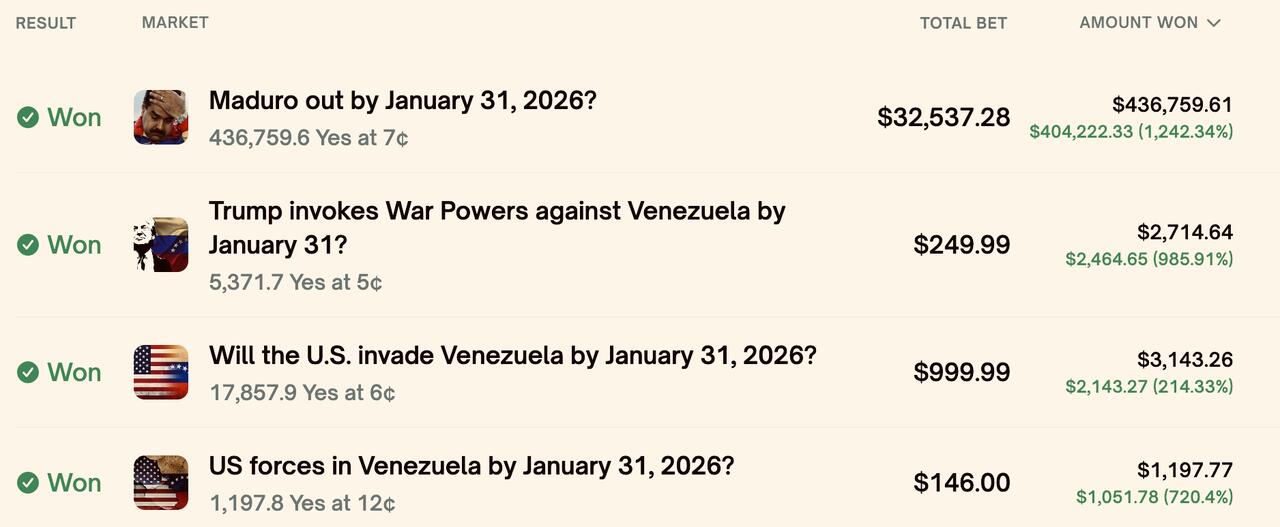
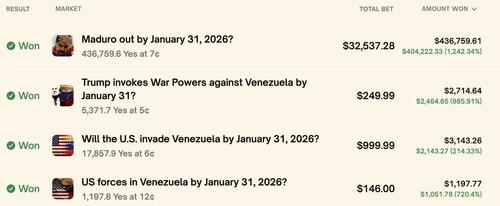
The account in question was created on Dec. 27, and quickly placed roughly $34,000 in bets on US intervention in Venezuela and Maduro’s ouster both happening by January 31. On the Maduro prediction alone, the account scored a 1,242% gain, turning $32,537 into $436,760. At the time of the bets, the market placed the probability of intervention in January at just 6%.
The list of suspects could be quite a long one, given the military was poised to strike for days. “We were going to do this four days ago but the weather was not perfect,” Trump said after the attacks and Maduro’s extraction. “And then all of a sudden it opened up and we said go.” Military officials were said to have contemplated a Christmas-day attack. What’s more, given officials’ public talk about rehearsals of the operation, preparations likely spanned weeks, following months of a build-up of assets in the region.
That said, one can’t entirely rule out the possibility of someone outside reading headlines and placing a big bet, and the mystery account wasn’t the only one placing bets on US intervention. According to the Wall Street Journal, more than $56 million had been placed on Maduro’s ouster, with $11 million betting he’d be gone by Jan. 31. Another $40 million in losing bets had been placed on him leaving by Nov. 30 or Dec. 31. This X user claimed to have made $80,000 by translating a surge in Pentagon-area pizza traffic into imminent military action:
How i made 80,000$ in a single night using @Polymarket
Basically ever since the US brought their largest aircraft carrier i knew a strike was 100% going to happen, but i did not know when. So i built a vibe coded bot to track the dominos pizza orders around the pentagon because… https://t.co/Jx1ODEGtJ2
— Sweetcheeks (🌲,🌲) (@SweetcheeksReal) January 3, 2026
Regardless of who owns all those accounts, Democratic New York Rep. Ritchie Torres is planning to target officials’ potential to profit from access to government secrets. According to Jake Sherman of Punchbowl News, Torres will introduce the “Public Integrity in Financial Prediction Markets Act of 2026.” Here’s how Sherman’s source describes it:
This bill prohibits federal elected officials, political appointees, and Executive Branch employees from engaging in certain transactions involving prediction market contracts when they either possess material nonpublic information relevant to the transaction or could reasonably obtain such information through their official duties. The restriction applies to buying, selling, or exchanging prediction market contracts tied to government policy, government action, or political outcomes on platforms engaged in interstate commerce.
Torres is targeting a narrow universe of people, leaving plenty of opportunity for other people in government to profit from inside information — such as a staff sergeant at the Pentagon, or his girlfriend. Outside government, staffers at the Washington Post and New York Times also had an opportunity to profit on the Venezuela operation, as Semafor reports that both outlets learned of the operation shortly before it took place, but refrained from publishing the news to avoid putting US forces in peril.
Responding to news of Torres’ upcoming bill, Polymarket rival Kalshi said its rules prohibit trading by anyone inside or outside of government who “has access to material non-public information that is the subject of an Underlying of any Contract or that has the ability to exert any influence on the subject of an Underlying of any Contract.” Of course, platform rules are one thing and federal laws are another. The Block notes that Donald Trump Jr has advisory roles on both prediction platforms.
It was Baron Trump.
— Cornelius Vanderbilt (@supplychainldr) January 3, 2026
Tyler Durden
Sun, 01/04/2026 – 08:45

Brexit Architect Blows Lid Off Deep State Plot To Destroy Nigel Farage And Reform UK
Brexit Architect Blows Lid Off Deep State Plot To Destroy Nigel Farage And Reform UK
Authored by Steve Watson via Modernity.news,
Dominic Cummings, the political strategist who oversaw Brexit, has dropped a bombshell warning to Nigel Farage: the UK establishment is plotting to crush him and Reform UK by any means necessary, including illegal tactics, to prevent a populist takeover.
As Reform surges in polls and eyes major gains in the 2026 local elections, Cummings has revealed how insiders view Farage as the next Trump-style threat they must eliminate early and ruthlessly.
Speaking on The Spectator’s Quite Right! podcast, Cummings told hosts Michael Gove and Madeline Grant: “They’ll leak medical records, they’ll leak tax records.They’ll bug his phone and leak that. They’ll do anything that they need to.”
Dominic Cummings: ‘The people around Keir Starmer and the upper echelons of Whitehall are saying to themselves: “Let’s smash the absolute living shit out of Farage and make sure he doesn’t win”.
‘They’ll leak medical and tax records, they’ll bug his phone and leak that. They’ll… pic.twitter.com/7q8wHrl7if
— The Spectator (@spectator) January 1, 2026
Cummings added that populists in other countries will be targeted too, noting “That will be happening across Europe and they’ll all be telling themselves they’re fighting fascism together.”
He pinpointed “the people around {British PM} Starmer” as driven by Brexit revenge, saying: “The people around Starmer and all through the upper echelons of the Whitehall system are looking at Trump.”
“They’re looking across Europe, and they’re saying to themselves: ‘The lesson is to strike early and strike hard and not let these people in’,” Cummings further noted.
Cummings added that establishment figures regret allowing Vote Leave to win the Brexit referendum, seeing it as “the beginning of the disaster for us.”
Cummings claimed that the ultimate goal of the establishment is “Smashing the absolute s*** out of Farage and making sure that he doesn’t win it – by fair means and foul.”
Whitehall is absolutely TERRIFIED of Nigel Farage – because they know he is destined to be the next Prime Minister.
They’ll collaborate – right and left – to make sure #REFORM doesn’t win.
Article | https://t.co/xGwYvFXrbK pic.twitter.com/qZtDClrCXw
— The Spectator Australia (@SpectatorOz) January 2, 2026
Reform’s Zia Yusuf responded ominously: “It’s already begun.”
It’s already begun. pic.twitter.com/snLE9DIKnR
— Zia Yusuf (@ZiaYusufUK) January 1, 2026
Uniparty latest. https://t.co/z01FAdtHjZ
— Zia Yusuf (@ZiaYusufUK) January 2, 2026
Cummings also described the Conservative Party as “completely dead,” urging that “They’re like the local vagrant who used to smash everything up who is now cabbaged in a wheelchair and isn’t relevant anymore.”
Dominic Cummings: ‘The Tories are completely dead. They’re like the local vagrant who used to smash everything up who is now cabbaged in a wheelchair and isn’t relevant anymore.’@Dominic2306 @michaelgove @Madz_Grant pic.twitter.com/WnKJwqGlJq
— The Spectator (@spectator) January 2, 2026
The warning comes amid reports of media smears against Farage, including decades-old allegations from The Guardian, which he dismissed as backfiring: “It’s having zero effect. It’s maybe solidifying our core support.”
‘It shows how desperate they are.’
Nigel Farage MP lashes out at ‘the Guardian and the BBC’ for reporting on the racist allegations made towards the Leader of Reform. pic.twitter.com/fuTi63CMRk
— GB News (@GBNEWS) November 25, 2025
Farage vowed in a New Year’s message that strong local election results could propel Reform to victory in the next general election: “If we get this right on May 7 this year, we will go on and win that General Election.”
Cummings’ exposé aligns perfectly with revelations from ex-Starmer aide Paul Ovenden, who just hours earlier accused civil servants of hijacking government via a “Stakeholder State” obsessed with fringe issues while siphoning power from voters.
Ovenden slammed this perma-class for wasting time on bizarre priorities like importing anti-white activist Alaa Abd el-Fattah, calling it a “morbid symptom of a state that has got bigger and bigger while simultaneously and systematically emasculating itself.”
This entrenched blob – NGOs, regulators, and lobbyists – now appears laser-focused on neutralizing threats like Farage, using dirty tricks to protect their grip.
It’s the same elite network plotting cradle-to-grave surveillance through newborn digital IDs, as exposed in our report on Labour’s dystopian scheme to track citizens from birth under the guise of immigration control.
The message is clear: the Deep State are not willing to let populists like Farage further disrupt their globalist agenda.
Your support is crucial in helping us defeat mass censorship. Please consider donating via Locals or check out our unique merch. Follow us on X @ModernityNews.
Tyler Durden
Sun, 01/04/2026 – 08:10
Canceled Flights Across Caribbean Resume After US Captures Maduro
Canceled Flights Across Caribbean Resume After US Captures Maduro
Air travel across the Caribbean has normalized after a day of disruptions triggered by a U.S. special forces operation that successfully captured Venezuela’s socialist dictator Nicolás Maduro.
Late Saturday night, Transportation Secretary Sean Duffy wrote on X that “original restrictions around Caribbean airspace are expiring at 12:00 a.m. ET and flights can resume.”
“Airlines are informed and will update their schedules quickly. Please continue to work with your airline if your flight was affected by the restrictions,” Duffy said.
UPDATE: The original restrictions around the Caribbean airspace are expiring at 12:00am ET and flights can resume.
Airlines are informed, and will update their schedules quickly. Please continue to work with your airline if your flight was affected by the restrictions. https://t.co/5Cv46Xnjy4
— Secretary Sean Duffy (@SecDuffy) January 4, 2026
There was widespread confusion on Saturday as flights across the Caribbean were canceled or delayed following the U.S. operation in Venezuela. Airspace over Puerto Rico was temporarily restricted, forcing the cancellation of departures from Luis Muñoz Marín International Airport, officials at the airport wrote in a statement. At least 150 outbound flights from the region’s busiest Caribbean hub were cancelled, according to flight tracking website FlightAware, while another 140 inbound flights bound for San Juan were also canceled.
Delta Air Lines said normal operations in the region would resume early Sunday after airspace restrictions were lifted at 13 Caribbean airports.
Some of the affected airports Delta listed included:
V.C. Bird International Airport (ANU)
Queen Beatrix International Airport (AUA)
Grantley Adams International Airport (BGI)
Flamingo International Airport (BON)
Curaçao International Airport (CUR)
Maurice Bishop International Airport (GND)
Luis Muñoz Marín International Airport (SJU)
Robert L. Bradshaw International Airport (SKB)
Cyril E. King Airport (STT)
Henry E. Rohlsen Airport (STX)
Argyle International Airport (SVD)
Princess Juliana International Airport (SXM)
Hewanorra International Airport (UVF)
One reader traveling inbound to Cancún said early Saturday that his Frontier Airlines flight was delayed, citing the captain, who told passengers the disruption was due to airspace restrictions.
In addition to Delta and Frontier, American Airlines, JetBlue, Southwest Airlines, and Spirit Airlines also experienced flight disruptions on Saturday.
Readers can catch up on the latest reporting (here), detailing Maduro’s capture, how he was captured by Delta Force operators, and his transfer with his wife to New York City, where he was placed in federal detention. Maduro has been charged with drug trafficking and terrorism-related charges.
Nicolas Maduro and his wife, Cilia Flores, have been indicted in the Southern District of New York. Nicolas Maduro has been charged with Narco-Terrorism Conspiracy, Cocaine Importation Conspiracy, Possession of Machineguns and Destructive Devices, and Conspiracy to Possess…
— Attorney General Pamela Bondi (@AGPamBondi) January 3, 2026
The good news is that air traffic will begin to normalize across the Caribbean as restrictions expire and carriers begin restoring schedules.
Tyler Durden
Sun, 01/04/2026 – 07:35

Chicago Bears vs. Detroit Lions: Everything you need to know about the Week 18 game before kickoff
The 11-5 Chicago Bears will play the 8-8 Detroit Lions at Soldier Field in a Week 18 matchup. Here’s what you need to know before kickoff (3:25 p.m., Fox-32).
Want the latest Bears news? Subscribe to the Chicago Tribune to read it all — and sign up for our free Bears Insider newsletter.
5 things to watch — plus our Week 18 predictions
Lions running back Jahmyr Gibbs jumps over Bears defensive end Dayo Odeyingbo in the second quarter Sept. 14, 2025, in Detroit. (John J. Kim/Chicago Tribune)
The marathon is over. Sunday marks the end of the NFL regular season.
In recent years, Week 18 has signaled the end for the Bears. Not so this year. For the first time since 2020, the Bears are headed to the postseason. They have bigger goals on the horizon, starting with next week’s wild-card round of the playoffs. Read more here.
Rome Odunze returns to Bears practice — and the wide receiver is listed as questionable for Week 18
Ben Johnson says Bears are ‘playing to win’ in Week 18 finale vs. the Lions
Who will the Bears play in the wild-card round?
Bears and Packers fans prepare for the game on Dec. 20, 2025, at Soldier Field. (Brian Cassella/Chicago Tribune)
The simplest scenario for the Bears is to beat the Lions and clinch the No. 2 seed in the NFC.
Even if Philadelphia beats Washington, which would give the Bears and Eagles the same record, the Bears hold the head-to-head tiebreaker. That would mean a matchup with the Packers, who are locked in as the No. 7 seed.
If the Bears lose, it gets more complicated. Read more here.
Eagles — in a battle with Bears for NFC’s No. 2 seed — to rest key starters in finale
NFL playoff picture: Final week of regular season arrives with No. 1 seeds still undecided in AFC and NFC
Who would be the Bears’ most favorable 1st-round matchup?
Bears clinch their 1st NFC North title since 2018
‘I was brought here for those types of things, the things that haven’t been done here, to try and be able to accomplish’
Bears quarterback Caleb Williams walks on the field while warming up before playing the 49ers at Levi’s Stadium on Dec. 28, 2025 in Santa Clara, Calif. (Armando L. Sanchez/Chicago Tribune)
Caleb Williams will be staring down history this afternoon.
With 3,730 passing yards this season, Williams is 108 yards shy of tying Erik Kramer’s franchise record of 3,838 passing yards from 1995. He’s also 270 yards shy of becoming the first Bears quarterback ever to total 4,000 passing yards in a regular season.
The Bears are the only franchise to never have a 4,000-yard passer. When Carson Wentz threw for 4,039 yards in 2019 with Philadelphia, becoming the Eagles’ first 4,000-yard passer, the Bears were left as the only team still looking for its first.
It’s a remarkable stat, considering the 100-plus-year history of the Bears franchise. Read more here.
Column: Finding edges in the running game fuels Ben Johnson’s evolution of the Bears offense
Bears Q&A with Brad Biggs: Will Caleb Williams reach 4,000 yards?
Bears won’t go far in the playoffs if their defense doesn’t improve
49ers quarterback Brock Purdy throws in the second quarter against the Bears at Levi’s Stadium on Dec. 28, 2025, in Santa Clara. (John J. Kim/Chicago Tribune)
Week 17 marked the fourth time this season the Bears have surrendered 431 yards or more and third time an opponent has averaged 7.3 yards per play or more. A defense that flirted with being in the top five on third down through the first half of the season has slumped to 19th, and as explosive as the Bears offense has been, opponents are hitting far too many big plays.
This is a better defense right now than the one the Lions crushed for 52 points in Week 2. Whether it’s ready for playoff football remains to be seen. Read more here.
About last week
Caleb Williams and the offense took possession with 2:15 remaining in the fourth quarter Sunday night against the 49ers. Trailing by four points, the Bears needed a touchdown.
Williams took over with the game on the line, a position he has grown very comfortable with after leading the Bears to six fourth-quarter comebacks this season. He connected with wide receiver Luther Burden III and tight end Colston Loveland for key completions to draw the offense to the 13-yard line. A pass to Loveland, who pitched to running back D’Andre Swift, brought the Bears to the 2.
With four seconds on the clock and the game on the line, Williams scrambled from the pocket and tossed a pass intended for Jahdae Walker in the end zone, but it fell incomplete for a dramatic 42-38 loss. Read more here.
Read more here.
Bears run out of magic late: Brad Biggs’ 10 thoughts on Week 17
Inside the Bears’ 15-play, 63-yard, nail-biting final series that came up short: ‘We had a shot’
‘We’re always in the game’: How the Bears have become battle-tested against the NFC’s best
Bears’ Darnell Wright took a private plane to Week 17 game after a bug ‘did a number on our guys’
https://www.chicagotribune.com/2026/01/04/chicago-bears-detroit-lions-week-18/
Germany’s Banking Sector Faces Growing Crisis Amid Record Insolvencies
Germany’s Banking Sector Faces Growing Crisis Amid Record Insolvencies
Submitted by Thomas Kolbe
The German economic crisis is slowly but surely making its way into the balance sheets of banks. Above all, the crisis in the largely credit-financed Mittelstand is increasingly weighing on savings banks and cooperative banks.
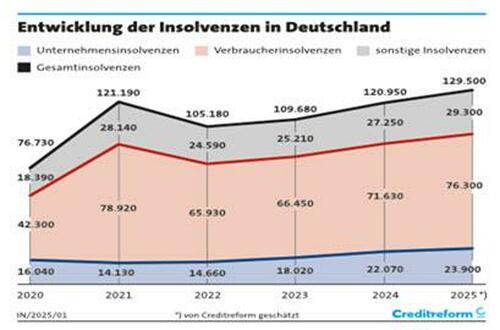
The year 2025 is ending as a disastrous year for the German economy. Around 24,000 companies filed for insolvency—a record figure, surpassed only in the crisis year 2003 following the bursting of the dotcom bubble and the subsequent recession. Back then, a total of 39,000 companies went bankrupt.
Deindustrialization and Loan Defaults
Loan defaults in the past year are estimated at around €57 billion. These losses hit suppliers and banks hard, especially since the German Mittelstand finances roughly 40% through savings banks and 25% through cooperative banks.
Already in the previous year, losses from corporate insolvencies had accumulated to around €59 billion. The causes have long been known: the persistent weakness of the German economy results from a toxic mix of overregulation, climate-policy-driven deindustrialization, a self-inflicted energy crisis, and high fiscal burdens. This poisonous cocktail severely strains the economy, weakens private demand, and makes industrial production in Germany increasingly unattractive on the international stage.
The ripple effects of a roughly 20% drop in industrial production reach far into other sectors. Supplier companies as well as industry-related services are increasingly under pressure—and are collapsing in many areas.
Pressure Beneath the Surface
At first glance, the German banking sector still appears stable. Industry giant Deutsche Bank increased its pre-tax profit in Q3 2025 by 8% year-on-year to €2.4 billion. The bank saw growth across all business areas—from traditional lending to investment banking to asset management.
The situation is different for cooperative banks. Volks- und Raiffeisenbanken already suffered a 25% drop in profits last year compared to the previous year. Further revenue declines are expected for 2025. The main reasons are the persistently weak economy, rising geopolitical tensions, and higher risk provisions in the face of growing credit default risks.
Germany’s once stable three-pillar banking model—private large banks, public-sector institutions like savings banks and state banks, and cooperative banks—still shows outward growth. But beneath the surface, deep cracks are forming: years of low interest rates have sharply squeezed bank margins, and the abrupt interest rate reversal is weighing on both businesses and consumers. Added to this is the problematic close entanglement between cooperative banks and politics.
For example, the agricultural cooperative BayWa in Bavaria nearly went bankrupt after engaging in global renewable energy investments—leaving a €100 million loss.
This example illustrates the risks of political steering of the banking sector through public institute credit guarantees like KfW. Nowadays, billions are channeled annually into the climate economy and the military sector—keeping a zombie economy afloat that could never survive in a free capital market.
Examples of the emerging banking crisis are multiplying: VR-Bank Dortmund Nordwest suffered losses of €280 million from risky real estate fund investments, requiring a bailout from the Cooperative Protection Fund (BVR).
VR-Bank Bad Salzungen-Schmalkalden lost a similar amount in dubious real estate deals two years ago and also called on the BVR for rescue. These cases show that banks, facing a declining credit business with the Mittelstand, are forced to move outward on the risk curve to generate operational profits.
The effects are tangible: a BaFin analysis shows that last year, about 1.9% of savings bank loans and 2.2% of cooperative bank loans were non-performing. This corresponds to a volume of €36.5 billion—a 25% increase from the previous year. Consequently, banks are forced to increase credit risk provisions—freezing more capital and making new loans harder to grant.
Branch Closures and a Mortgage Crisis on the Horizon
Raiffeisenbank Hochtaunus recently fell into serious financial trouble after making €500 million in value adjustments to its real estate portfolio.
Creaking sounds are coming from all corners of the German economy. It is expected that the economic crisis will translate into a crisis of regional banks’ mortgage portfolios, alongside private insolvencies. Stress in the banking system is increasing quarter by quarter.
Banks are responding to growing pressure with tough measures. Over 1,000 bank branches are closed annually in Germany. The local Sparkasse may soon become a thing of the past. This not only makes personal consultations harder for older customers but also hits bank clients in rural areas. Small and medium-sized enterprises, craft businesses, bakeries, and local retailers who rely on personal financial advice increasingly find fewer direct contacts and a trusted banking environment.
Balance Sheet Damage Becomes Visible
Bank balance sheets reflect the overall economic situation. At the same time, they are influenced by financial and fiscal policy developments. Years of elevated loan defaults erode the financial substance of banks just as much as the globally high sovereign debt, which has caused significant devaluations of bond holdings on balance sheets.
In short: the longer the crisis in the private economy persists and the more it is exacerbated by fiscal undiscipline and growing government debt, the lower the lending potential of the banking sector.
This is precisely the crux of monetary policy. The European Central Bank can lower interest rates and private sector financing costs all it wants. Lending in the real economy is determined by the interaction between private companies and credit-granting banks.
Unless Germany’s economic outlook brightens considerably—which, under current political conditions, is unlikely—lending will significantly slow on the one hand, while defaults accelerate on the other. This would be further evidence that the German economy is continuing to sink deeper and deeper into a contraction phase.
* * *
About the author: Thomas Kolbe is a German graduate economist. For over 25 years, he has worked as a journalist and media producer for clients from various industries and business associations. As a publicist, he focuses on economic processes and observes geopolitical events from the perspective of the capital markets. His publications follow a philosophy that focuses on the individual and their right to self-determination.
Tyler Durden
Sun, 01/04/2026 – 07:00

Groups hope to save Calumet Country Club’s golf, though property owner says plan is impossible
Two golf organizations, the Chicago District Golf Association and the Donald Ross Society, have proposed plans to acquire and revive Calumet Country Club as a golf destination.
Calumet Country Club has been at the center of a multiyear struggle over how the land should be used, with multiple attempts by the owner to develop the property for industrial use meeting resistance from local communities and governments.
The property owner, W&E Ventures, announced last month that golf would be permanently shut down on the course and all infrastructure demolished.
A large part of the golf course’s appeal to golf enthusiasts is in its pedigree. It was designed by Donald Ross, a famous Scottish golf course designer.
“It’s like a Frank Lloyd Wright house. You hate to lose one, and you try to take some time, you make the effort to try and preserve it,” said Vaughn Halyard, president of the Donald Ross Society. “And plus, it’s a tremendous opportunity to deliver excellently architected, excellently conditioned, almost private club-quality golf to the public.”
For Michael Grandinetti, Halyard’s partner in the project, there’s also a sentimental reason to ensure the course is preserved.
“I was a member there for 45 years. We had our wedding reception there in 1970,” Grandinetti said. “I was able to join Calumet at a very young age because my mother and father-in-law were members.”
Grandinetti is a former president of the Chicago District Golf Association, the Chicago area affiliate of the United States Golf Association.
Grandinetti served in a succession of leadership roles at Calumet Country Club over the years, including two terms as president, though he had no involvement in the property sale that kicked off the ongoing development struggle, he said.
“Our desire is to maintain that golf course as a piece of history and as something people can use and appreciate for a lot longer than I’m going to be around,” Grandinetti said.
Halyard said he and Grandinetti were prompted to put together a plan focused on saving the golf course when the village of Hazel Crest issued an open request for proposals for the property’s future.
“It’s no secret that people just don’t want any more industrial. Communities are sick of industrial development,” Halyard said.
In order to bring that vision to life, however, the partnership would need to eventually acquire the property.
Property owner Walt Brown Jr. said there is no opportunity for the partnership to buy the property because it is in escrow for redevelopment. Brown declined to say who would develop the property.
Brown also said that the property cannot be run sustainably or profitably as a golf course because of the property taxes.
“We’ve run the golf course for five years,” Brown said. “The golf course doesn’t have the income to run as a business because of the tax bill.”
Brown said that the industrial redevelopment he envisions would benefit Hazel Crest most, both in terms of jobs and increased tax income.
“With the redevelopment comes jobs for the city and income for the Police Department, Fire Department and the school district,” Brown said.
In order to be developed for industrial use, though, the property would first need to be rezoned, a process controlled by the village. The village’s approval is also necessary to grant the demolition permits needed to tear down the existing infrastructure on the property.
Halyard said the partnership had positive communications with Hazel Crest officials regarding their proposal.
Having a Donald Ross golf course is a valuable asset for the community that should be capitalized on, Halyard said.
“Donald Ross designed courses for the bulk of people to be able to enjoy golf,” Halyard said. “To simplify, a Donald Ross course is designed not to be hard. It’s designed to be enjoyable for the bulk of people. But if you want to really score and want to really win a tournament, or really be an excellent golfer, the shots that you make on the way to putting out and making the green are harder than they would be for just a layperson.”
Halyard and Grandinetti’s proposal for a revitalized course draws on a model prioritizing local residents and emphasizing golf courses as public spaces with a variety of uses.
“Everybody has to learn how to manage when the golf is in play, but if we’re in the winter, I will groom cross-country and hiking trails to our front door because I want you guys to come in and buy some hot buttered rum and hang out in front of the fireplace while people are hitting in the simulator bay,” Halyard said. “Essentially, this is what golf is looking to be about going forward.”
The quality of the course is such that Halyard said he believes it can become a destination for golf enthusiasts.
“If we do it right, which we intend to, we’ll have a waiting list of tee times,” Halyard said.
Grandinetti said as someone who lives in the area, he hoped to see the course not just preserved but opened up for more public use.
“I live in Flossmoor. It would be very comforting to me to drive down 175th Street and look over and see Calumet Country Club maintained the way it used to be and still a viable entity within the community, and actually more accessible to more people in the community,” Grandinetti said.
elewis@chicagotribune.com
https://www.chicagotribune.com/2026/01/04/calumet-country-club-golf-owner/

Letters: The city and union groups should include these critical allies to bring about reform in Chicago
Chicago’s labor and community organizations share a common goal: a city where working families can afford to live, public services are strong and small businesses remain viable neighborhood anchors. Achieving that goal, however, depends more on building durable coalitions grounded in economic reality and less on bold slogans.
Recent debates, including the failed proposal to reinstate a city head tax, offer an important lesson. The idea was rooted in a desire for fairness, yet it ultimately fell short because too many stakeholders — small businesses, entry-level workers and neighborhood groups — felt unheard. That outcome should not be seen as a defeat, but as a reminder that lasting progress requires broad consensus and shared ownership.
The Chicago Teachers Union plays a vital role in shaping the city’s future, and its voice carries significant influence. With that influence come an opportunity and a responsibility to bring more partners into the conversation. CTU leadership should actively invite churches, neighborhood groups, community organizations and small-business representatives into a sustained, good-faith coalition focused on shared priorities and realistic pathways forward.
Parents, faith communities, neighborhood groups and small business owners are not obstacles to reform; they are essential allies. When these groups are meaningfully engaged from the start, policies are stronger, more sustainable and far more likely to succeed.
It is also important to recognize the limits of municipal government. Chicago is already operating at or near the upper bounds of what local taxpayers can absorb. Property taxes, fees and operating costs weigh heavily on residents and employers alike. Pushing further at the city level risks tipping fragile businesses and households past the breaking point, undermining the very communities public policy aims to protect.
That reality does not mean change is impossible. It means the scale of change must match the level of government best equipped to deliver it. Structural reforms in education funding, housing, health care and wages require state and federal partnership. When labor and community coalitions focus their collective power at those levels, they gain leverage without overburdening cities already stretched thin.
Chicago has a long tradition of successful collaboration when labor, community and business leaders work together. Rebuilding and strengthening those coalitions is not just good politics; it is the only sustainable path forward for a city that cannot afford division.
— Joe Angelastri, City News Cafe, Chicago
Strong watchdog needed
Regarding the Dec. 24 editorial that references my office (“Cook County’s inspector general must give taxpayers the straight story on Tyler Technologies fiasco”): The Cook County Office of the Independent Inspector General is always monitoring issues that affect members of the public. However, the OIIG ordinance prohibits us from commenting on many of those issues. The OIIG is one of the few safeguards residents can rely on to protect their tax dollars from corruption, waste and mismanagement. However, the OIIG has been underfunded for many years. In the Chicago area, the OIIG is the lowest-funded IG office as a percentage of the overall government agency’s budget.
Before the 2026 budget, the OIIG had approximately the same number of staff members budgeted since its inception in 2007. However, the county’s overall budget tripled during that same period. This imbalance meant that there was approximately one OIIG investigator for every 1,000 county employees.
For over a year now, I have sought an OIIG budgetary floor, such as the one provided for the city of Chicago IG, with the help of lawyer Michael Shakman, political science professor Dick Simpson and Alisa Kaplan of Reform for Illinois. As a result, the OIIG has been budgeted an additional five positions, which is progress but far short from what is necessary.
Despite these staffing challenges, we have taken on enormous public matters with efficacy but could do a lot more with the proper funding. We previously examined county commissioners’ discretionary accounts that had oversight in name only. Additionally, the county health system was losing $80 million to $100 million per year due to claim denials before the OIIG issued a report about that situation. Moreover, we performed a detailed review of lobbying activities in Cook County government that identified loopholes and led to changes in the law. All these investigations required enormous amounts of time, effort and expertise.
Supporting a budgetary floor for the inspector general’s office will directly affect public corruption, waste and mismanagement in Cook County government. It is a practical, nonpartisan reform that protects taxpayers and reinforces the checks and balances essential to good governance.
Cook County residents are better served when oversight is strong, independent and properly funded. I urge the Tribune Editorial Board and public to stand with us.
— Tirrell J. Paxton, inspector general, Cook County Office of the Independent Inspector General
Conversation on transit
Regarding the editorial on the state of Chicago transit (“More workers are coming downtown in the new year. It’s showtime for our transit systems,” Jan. 2), the focus on “return to office” mandates paints an incomplete picture of our downtown’s future and safety reality.
While safety concerns on transit should never be dismissed, context is essential. The editorial highlights sensational anecdotes about crime on transit but ignores a critical statistic: Driving remains significantly more dangerous. Statistically, traveling by private car is more lethal than taking public transit. If the goal is truly to get people to the Loop “safely,” encouraging a return to gridlock traffic is the wrong answer.
Furthermore, the editorial clings to an outdated vision of the Loop as solely a 9-to-5 business district. The Loop is currently one of the fastest-growing residential downtowns in the country. Its revival will not be a return to the “old way” of 2019, but an evolution into a mixed-use neighborhood where transit serves residents and visitors as much as suburban commuters.
Finally, claiming the agencies are simply “out of excuses” ignores the substance of the recent victory in Springfield. The state’s finance and reform package — which the editorial glosses over — does more than just write a check. It mandates reforms. Metra and the CTA have already announced specific strategies tied to this funding to address the exact scheduling and safety concerns the Tribune Editorial Board raises; discussing these changes would be a better way to help drive the change asked for in this editorial.
We need a transit conversation grounded in the reality of a changing city, not one that pines for a pre-pandemic office culture that isn’t coming back.
— Ashley Dodson, Chicago
Alcohol-related harm
Kudos to the Illinois Department of Public Health on its first-ever “Alcohol Use in Illinois” report, which provides critical, data-driven insights into the prevalence, patterns and consequences of alcohol consumption across our state from 2020 to 2023. The findings reinforce what front-line providers such as the Haymarket Center already know: Alcohol-related harm is an urgent public health priority, and there is a critical need for sustained investment in evidence-based treatment and recovery services.
Alcohol use remains a leading driver of admissions to Haymarket Center, and many patients come with complex, co-occurring needs, including mental health conditions, housing instability and trauma, which reflect the severity and breadth of alcohol’s impact.
In fact, the report linked 2,300 deaths to chronic drinking, including liver disease and alcohol dependency syndrome, with another 2,000 deaths indirectly associated with alcohol-related conditions such as hypertension and heart disease. Additionally, 37% of fatal motor vehicle crashes in 2022 involved a driver under the influence, highlighting the intersection of alcohol misuse with public safety.
The report also reveals that nearly 23% of Illinois high schoolers reported consuming at least one alcoholic beverage in the past month, with over 11% acknowledging binge drinking. This behavior surges among adults, with 57% reporting drinking and more than 18% reporting binge drinking. These patterns reflect significant risk for acute and chronic health harms and align with the demand we see for treatment.
The good news is that recovery is possible with comprehensive, evidence-based care. The IDPH report indicates that prevention efforts, early intervention and expanded treatment capacity remain essential.
Haymarket Center supports the report’s call for coordinated evidence-based strategies among public health, health care systems, behavioral health providers, criminal justice agencies and community partnerships. Data sharing, care coordination and aligned policy strategies can significantly improve engagement and continuity of care. And funding mechanisms should support equitable, culturally responsive services spanning early intervention to long-term recovery.
IDPH’s rigorous analysis can — and should — shape policy, program development and resource allocation.
If we are to reduce alcohol-related harm and improve health outcomes, every Illinoisan affected by alcohol use disorder must have access to timely, effective and compassionate care.
— Dan Lustig, president and CEO, Haymarket Center, Chicago
Submit a letter, of no more than 400 words, to the editor here or email letters@chicagotribune.com.
https://www.chicagotribune.com/2026/01/04/letters-010426-chicago-head-tax/

Editorial: Lo and behold, Chicago. There’s a legitimate bench of political talent at City Hall.
Even as the state of municipal governance in Chicago continues to sap the confidence needed for investors to bet on the city’s future, there is a silver lining in all this anxiety. Chicago now boasts a legitimate bench of promising political talent at the municipal level.
This is new. With a pair of Daleys dominating the political scene locally since the 1950s, Chicago’s City Council historically hasn’t been the sort of place that drew ambitious, promising politicians.
The leadership vacuum in the mayoral office on the fifth floor of City Hall has changed all that.
We’ve been heartened to see that a substantial number of alders has emerged from the recent city budget fracas to show resolve, self-discipline and real political chops.
They represent many parts of the city, both economically and ethnically. While they have differing policy views on many issues, all share something in common: They understand that their main job is problem-solving, not advancing a preconceived agenda.
Not everything was advisable in the budget this group shepherded against the wishes of Johnson, who allowed the tax-and-spending plan to become law without his signature. But these alders’ pushback against economically destructive ideas such as Johnson’s $33-per-month tax on jobs — as if employing people were a sin to be punished — was a badly needed signal to the business community that there’s a sensible and pragmatic middle at City Hall that understands Chicago’s already precarious finances will crater without private-sector investment.
Deftly leading the City Council through the budget debate that culminated in a convincing margin of victory were Aldermen Nicole Lee, 11th, and Scott Waguespack, 32nd. Lee, the only Asian American alderman, represents Chinatown and Bridgeport, the latter of which has become one of the most diverse neighborhoods in Chicago. Waguespack, whose ward contains affluent areas including parts of Lakeview, Lincoln Park and Wicker Park, is a former Finance Committee chairman who understands the intricacies of budgeting better than most of his colleagues.
Another key figure proved to be Ald, Samantha Nugent, 39th, whose Northwest Side ward is a middle-class bastion. Nugent, using her power as president pro tempore to vote on any City Council panel, cast meaningful votes during critical Finance Committee budget deliberations. She also has doggedly and effectively challenged the Johnson administration on the issue of homeless encampments in city parks. First elected in 2019, Nugent is a real up-and-comer.
One of the council’s longest-tenured members also has risen to prominence over this period. Ald. Pat Dowell, 3rd, was first elected nearly two decades ago and as Finance Committee chair played perhaps the most critical role in winning the budget battle. Representing African American Bronzeville on the South Side, Dowell calmly rebutted Johnson’s attempt to cast the fevered debate in terms of racial and class-based division, one group of Chicagoans against another.
Addressing attack ads that falsely accused her and other alders of “trying to take meals away from seniors” and favoring property tax hikes, Dowell told the Tribune last month, “No one likes the attacks when they are not true. Many of the priorities that the mayor has, I also share, but we have to figure out how to fund those.”
Dowell embodies Theodore Roosevelt’s famous saying, “speak softly and carry a big stick.” Throughout the fraught final two months of 2025, her actions spoke louder than her words, which unfailingly were conciliatory and left the door open to compromise. Dowell’s cool head impressed us.
Other aldermen also emerged from relative obscurity as the council flexed muscles always institutionally available but rarely employed. Ald. Bill Conway, 34th, was a consistent voice against the Johnson administration’s worrying reliance on debt in a city swimming in IOUs. Ald. Anthony Beale, 9th, used his deep knowledge of parliamentary procedure to aid the cause.
This is not a comprehensive list. There are others as well.
We would be remiss, though, if we didn’t highlight the fortitude shown by Ald. Desmon Yancy, 5th. A first-term alder and member of the Progressive Caucus, representing South Side neighborhoods such as Woodlawn and South Shore, Yancy was the target of some of this budget season’s most intense political attacks. Before voting with the majority Dec. 20, Yancy spoke memorably on the council floor, calling out his fellow progressives for their attacks on him.
“This is more about pushing an agenda than it is about making a real difference in this city,” he said of their tactics. “I didn’t sign up for that. I signed up to listen to my constituents and to be fiduciarily responsible for how we do the work in this city.”
That’s courage.
The next few years — indeed, the next decade — in Chicago are shaping up to be among the most challenging in our long and storied history. So while Chicagoans are justified to feel anxious about the future, we think they also should take some comfort and even some pride in what we’ll call the City Council’s Pragmatic Caucus.
Submit a letter, of no more than 400 words, to the editor here or email letters@chicagotribune.com.
https://www.chicagotribune.com/2026/01/04/editorial-chicago-city-council-aldermen-political-talent/
Syda Segovia Taylor: I beat cancer. America’s racism will require the same fight.
At age 32, I began my fight with breast cancer and won after a mastectomy, chemotherapy, radiation, multiple corrective surgeries and years of tamoxifen. Now, as I celebrate my 50th year of living, I can articulate the parallels between my battle with cancer and our collective fight against racism. It is shocking, painful and transformative.
When diagnosed, my first question was, “How bad is it?” From my observation, America’s societal cancer has spread to the point in which we can no longer ignore its deadly progression.
As a first-generation American with roots in Colombia and Honduras, I embraced the beauty of diversity while witnessing our country’s anti-Blackness reality, which along with the principles of my Bahá’í faith compelled me to stand for justice at a young age.
But now, entering the seventh year of Organic Oneness, an organization I founded on principles that bring people together to eliminate racism and create healthy communities in Chicago, the work against racism is multiplying with fewer resources. America continues to suffer from the cancer of racism, and its health is declining rapidly, creating openings for other global ills to attack its fragile state.
The beautiful veins of this country are plagued by cancerous cells; these cells have entered every organ. We are witnessing how this diseased mindset laid the foundation for every major system: law, health, education, economics and housing.
Liberation movements were like chemotherapy, flushing our systems to reboot their chemistry at the cellular level. And now it’s time for another blast as major cities in our nation resemble the countries my family fled from. I now understand why my grandmother never left the house unassisted, as I am hesitant to take walks where I normally felt safe, and I am afraid for my parents.
While fighting cancer, I had to manage extreme emotions and be patient in the midst of anxiety. I had to envision myself being healthy while painfully battling myself away from death. But here’s what truly transformed me: understanding how to love myself, realizing how each part is interconnected and honoring how each system works. My thoughts manifested emotions and behaviors. My spiritual centeredness determined my mental strength or weakness. My food contributed to physical wellness or illness. My environment promoted or delayed my healing.
I had to relearn how to live life, understand root causes, aggressively change my habits and build new structures so the cancer cells died and never returned. I learned to accept all the parts of my body that I was conditioned to hate. I found my voice to be brave with words. I created space to heal and taught everyone my new boundaries. This reflective, perilous process is what I had to do for my body to survive.
The mature love I experienced required sacrifice of immediate gratification for the greater good so my daughter can have a mother and my husband a wife. My new love carried me through the darkest moments.
Fighting racism is no different. America must do similar work to survive. There is a dire need for us to understand that we are one human family; we are witnessing the danger of believing we are not interconnected.
The treatment for racism must take place on every level: individual, community and institutional. No one is exempt as we are all affected by this deadly disease. It will require us to confront uncomfortable truths about this nation — who we took land from, who suffered to build it and who is still presently suffering — and aggressively, systematically repair the harm.
We need to rid ourselves of any ideas of inherent superiority and see the nobility in each person. We need to let go of old patterns of behavior while integrating new ways of life. We need to focus on individual transformation while actively serving the community. We need to replace hate with thoughts of love.
The Rev. Martin Luther King Jr. said: “Those who love peace must learn to organize as effectively as those who love war.”
This means everything; our data, strategic plans, human capital, materials and supplies, and mindset all need to be focused on one common goal. Our decisions should be made with everyone at the table. Embracing our diversity allows us to build new systems so everyone lives to their fullest potential.
This is where local community building becomes essential. As Organic Oneness convenes its annual King Day of Service on Jan. 19 for 350-plus volunteers, I witness how love manifests in action when we bring people together for service projects, create spaces for healing conversations and invest in the well-being of all people, foregrounding Black and brown communities.
Transformation happens when neighbors look each other in the eye and choose connection over division. It happens when we show up for each other and build trust through spontaneous conversations and genuine care, when we share a meal, laugh and pray together. This grassroots heart work is how love becomes tangible and shifts from abstract ideals to lived reality and policy.
I stayed hopeful while fighting cancer, even when the treatment felt worse than the disease. America can do the same. We can eradicate racism if all communities commit to doing this together with love as the guiding force and stay centered and healthy during the transformation.
The beautiful life we want is possible. Start with love in your heart, and that energy will flow through the veins of the community to the rest of the nation.
Syda Segovia Taylor is the founder and executive director of Organic Oneness and a member of the Chicago Reparations Task Force and the Be the Healing Movement. She is also a member of the Bahá’í Faith.
Submit a letter, of no more than 400 words, to the editor here or email letters@chicagotribune.com.
https://www.chicagotribune.com/2026/01/04/opinion-cancer-battle-systemic-racism/