Category: News

Park Ridge Mayor Marty Maloney leads the Christmas Eve carols near City Hall: It’s ‘just neighbors standing together’
In a show of community and a grand yuletide celebration, Park Ridge residents and more gathered at a local park near City Hall on Christmas Eve for a crowd sing-along of tunes of the season.
In his invitation to all to join the city’s second annual “Christmas Eve Community Sing,” Mayor Marty Maloney called it “something truly special.”
For 30 minutes at Hodges Park on Christmas Eve, in the city’s Uptown area, having had, “No rehearsals. No professional voices. No pressure at all,” the mayor had called for, the community sing took place. It was “just neighbors standing together, singing familiar carols, and sharing the simple joy of being part of this incredible community we call Park Ridge,” as the mayor had said.
Maloney said the community holiday sing-along was created to help bring people together in what he called a joyful way.
Residents of Park Ridge, and others, participated in the second annual “Christmas Eve Community Sing” on Dec. 24, 2025 at Hodges Park, near City Hall, in Park Ridge. (Talia Sprague/for Pioneer Press)
The city of Park Ridge held its second annual “Christmas Eve Community Sing” on Dec. 24, 2025 at Hodges Park, near City Hall, in Park Ridge. (Talia Sprague/for Pioneer Press)
Park Ridge Mayor Marty Maloney calls the city’s annual “Christmas Eve Community Sing” an event that is “something special.” The sing-along was held on Dec. 24, 2025 at Hodges Park, near City Hall, in Park Ridge. (Talia Sprague/for Pioneer Press)
Community members sing Christmas carols during the second annual “Christmas Eve Community Sing” on Dec. 24, 2025 at Hodges Park, near City Hall, in Park Ridge. (Talia Sprague/for Pioneer Press)
“Whether you come straight from church, take a break from dinner prep, or slip out after setting cookies out for Santa, we hope you’ll find half an hour to be part of it,” he said in his invitation posted on social media.
And people did just that: Took a break to join the community chorus of carolers.
The mayor said the event takes a beat from a tradition started nearly a century ago in Basking Ridge, New Jersey. He said the local version helps build something special in Park Ridge.
“Once you see it, it’s hard not to imagine the same warmth and magic right here in Park Ridge on Christmas Eve,” the mayor said.

Judge Convicted Of Helping Illegal Escape ICE Resigns, Faces 5 Years In Prison
Judge Convicted Of Helping Illegal Escape ICE Resigns, Faces 5 Years In Prison
A Milwaukee judge who was found guilty last month of obstructing federal agents by letting an illegal immigrant slip through a side door at her courthouse has resigned.
Judge Hannah Dugan, who was convicted last month on a federal felony charge, was charged by federal prosecutors after she distracted federal agents who were trying to arrest Eduardo Flores-Ruiz, a Mexican citizen who had entered the United States illegally and was scheduled to appear before Dugan for a hearing in a state-level battery case.
The indictment, dated May 13, 2025, accused her of obstructing the law by assisting Floriz-Ruiz to evade arrest, and falsely advising ICE agents that they required a judicial warrant to arrest him.
Dugan was found guilty by a federal grand jury on Dec. 18, 2025 on one count of violating Section 1505 of Title 18 of the US code. Her resignation comes as GOP members of the Wisconsin State Legislature were preparing to impeach her and remove her from office following her conviction.
Democrat Gov. Tony Evers said his office had received her resignation letter and would move forward with filling the judicial vacancy. In her resignation letter addressed to Evers, Dugan said that during her years on the bench, she oversaw thousands of cases with “a commitment to treat all persons with dignity and respect, to act justly, deliberately and consistently, and to maintain a courtroom with the decorum and safety the public deserves.” (as opposed to following the law, of course).
“As you know, I am the subject of unprecedented federal legal proceedings, which are far from concluded but which present immense and complex challenges that threaten the independence of our judiciary,” the letter continues.
“I am pursuing this fight for myself and for our independent judiciary,” she added.
Dugan, who has not been sentenced, faces up to five years in prison.
Her attorneys filed a motion with the trial judge, U.S. District Judge Lynn Adelman of the Eastern District of Wisconsin, on Dec. 23, 2025, asking to set aside the conviction.
Hannah Dugan broke the law, was found guilty by a jury, and is resigning.
A word to the wise: Don’t obstruct federal law enforcement when they are arresting a criminal illegal alien. https://t.co/fNkNdvMRn5
— Rep. Tom Tiffany (@RepTiffany) January 3, 2026
Tyler Durden
Sun, 01/04/2026 – 12:15
The Bearish Counterpoint: What Could Go Wrong For Markets In 2026?
The Bearish Counterpoint: What Could Go Wrong For Markets In 2026?
Authored by Lance Roberts via RealInvestmentAdvice.com,
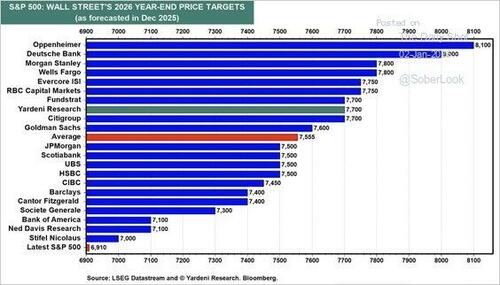
Wall Street’s market outlook enters 2026 in a bullish mood, albeit with nuance. After three consecutive years of substantial gains in major indexes, many strategists expect the U.S. stock market to extend its rally into another year, with the central Wall Street banks highlighting several drivers supporting continued upside, from increases in productivity due to AI to the tax cuts and deregulation from the OBBBA.
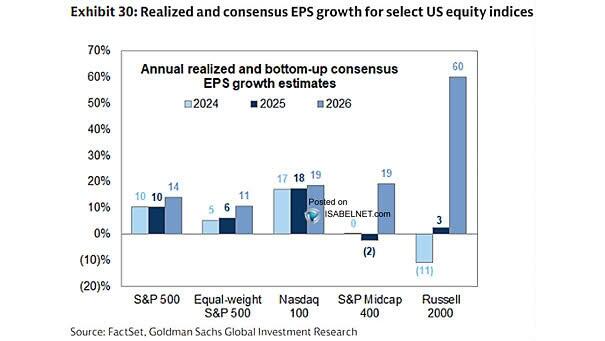
Goldman Sachs, for example, forecasts that S&P 500 earnings per share will accelerate in 2026, rising approximately 12 percent from 2025 levels. This earnings momentum underpins the constructive view on equities, and they see opportunities not just in prominent technology names, but also across cyclical sectors such as small caps, non-residential construction, and consumer stocks exposed to the middle-income consumer.
Furthermore, global growth is expected to stay sturdy in 2026. Goldman Sachs projects 2.8 percent global GDP growth, up from consensus expectations, with the U.S. economy outpacing most major peers. China’s growth is also forecast to improve, broadening the backdrop for global stock demand.
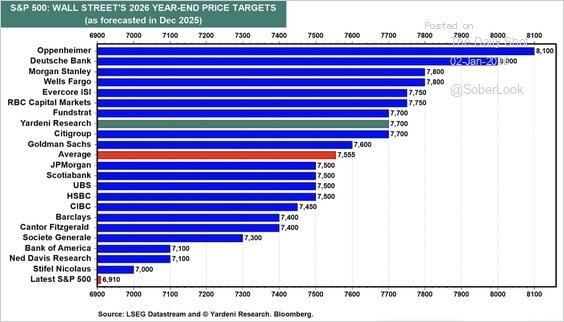
Morgan Stanley echoes a positive but tempered outlook, suggesting that U.S. equities will outperform global peers, a reversal from last year, with the S&P 500 projected to rise to about 7,800.
Regardless of the firm, several key structural factors universally support their bullish outlook:
Monetary policy is expected to remain supportive. The Federal Reserve has already enacted rate cuts in 2025, and further moderation in borrowing costs could preserve liquidity and investment demand. Historical data indicate that positive equity returns occur when rate cuts coincide with established bull markets.
Earnings growth is forecast to remain robust. Beyond headline numbers, broad sectors could benefit from technological adoption and operational leverage as companies expand margins.
Sector breadth may improve. After several years of narrow leadership dominated by mega‑cap tech, strategists see room for cyclicals, financials, and industrials to play a larger role in 2026 performance.
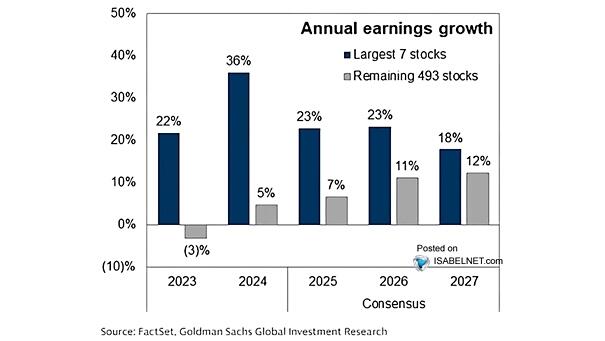
This combination drives the bullish premise: 2026 will not just be about extending the past year’s returns, but consolidating gains across more parts of the market. That view is supported by the earnings expectations for this year, with the Magnificent 7 growth rates slowing but the bottom 493 surging.
So, with such a bullish market outlook, what is there to worry about?
The Bearish Counterpoint: What Could Go Wrong?
Despite the bullish narrative, a thoughtful case against unbridled optimism exists. Unlike the simple bull versus bear dichotomy, credible risks could significantly dampen or reverse the more bullish market outlooks.
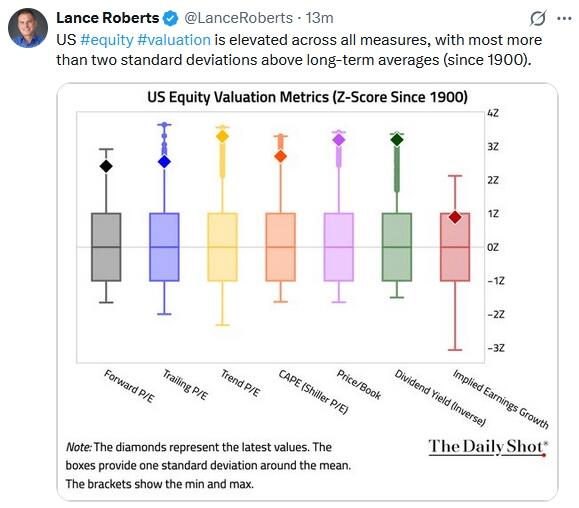
First, we would be remiss not to mention valuations. Forward valuations are elevated, and while they are terrible market timing devices, they do represent investor sentiment, which is universally bullish. This means the market’s upside is more sensitive to disappointments in earnings or macro trends. If earnings growth does not materialize as expected, stocks may struggle, even in a benign macro setting. We discussed this recently, in “Risks To Market Outlooks.“
“Notably, these forecasts rest on an assumption that the economy will not only avoid recession but reaccelerate in the face of waning inflation. As noted, equity markets have responded by pushing valuations higher across major indexes, with price-to-earnings ratios well above historical medians. Simultaneously, investors have rewarded narratives built on the idea of a soft landing and a return to pre-pandemic trends.”
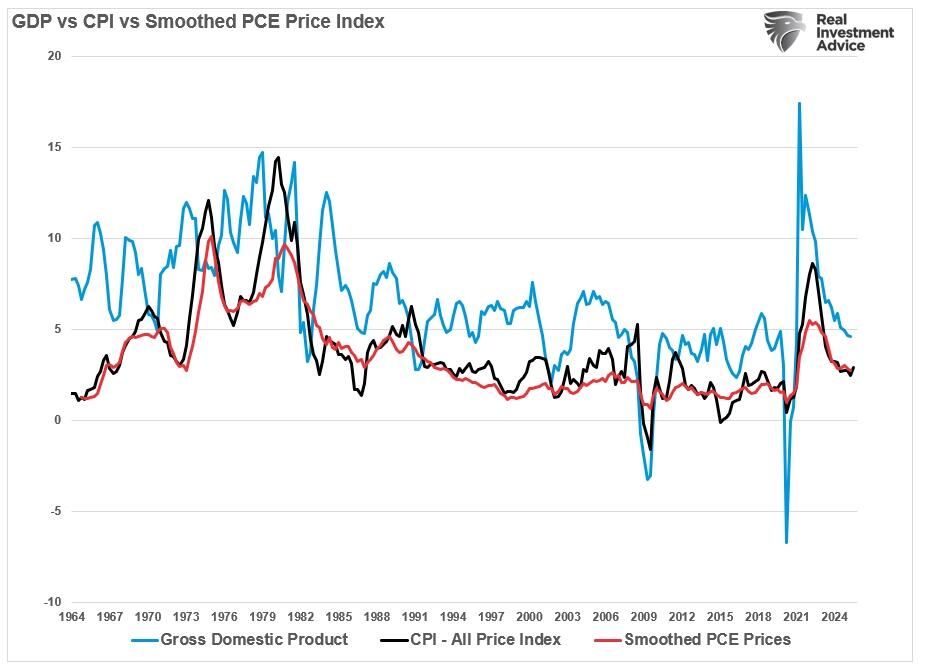
“However, this narrative appears to overlook the trends in recent economic data. Inflation expectations have moderated, not because of increased demand, but due to weaker consumption and cooling labor dynamics. As recent economic data indicate, disinflation has accompanied slower GDP growth and a decline in personal consumption momentum. If the economy were indeed set to reaccelerate, these trends should be increasing rather than returning to historical averages.”
Secondly, the market is pricing a “soft landing” where inflation cools, growth persists, and rate cuts continue. Yet, that outcome would be historically rare. When inflation falls this quickly, it typically reflects a slowdown in demand rather than policy success. Additionally, the strong relationship between economic growth and earnings should not be dismissed. That disconnect exposes investors to market risk if growth does not materialize as expected and valuations are reconsidered.
Furthermore, if inflation stubbornly remains above targets or the labor market shows uneven data, the Federal Reserve might delay or reduce the magnitude of rate cuts. A less accommodative stance could tighten financial conditions and pressure asset prices as market outlooks reverse.
Third, earnings growth estimates are very optimistic. As we head into 2026, strategists are hopeful that the bottom 493 stocks will begin to grow earnings aggressively. As noted previously:
“Wall Street currently expects the bottom 493 stocks to contribute more to earnings in 2026 than they have in the past 3 years. This is notable in that, over the past three years, the average growth rate for the bottom 493 stocks was less than 3%. Yet over the next 2 years, that earnings growth is expected to average above 11%.
“Furthermore, the outlook is even more exuberant for the most economically sensitive stocks. Small and mid-cap companies struggled to produce earnings growth during the previous three years of robust economic growth, driven by monetary and fiscal stimulus. However, next year, even if the Fed’s soft landing narrative is valid, they are expected to see a surge in earnings growth rates of nearly 60%.”
There is nothing wrong with having an optimistic market outlook when it comes to investing; however, “outlooks can change rapidly,” which is a significant market risk, particularly when expectations and valuations are elevated.
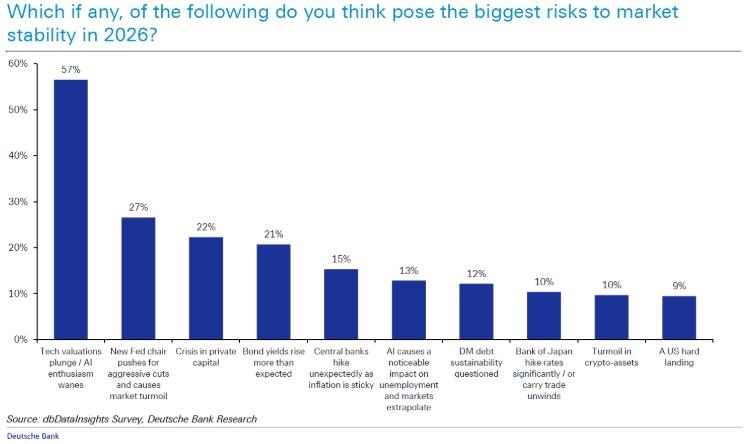
Third, geopolitical and global trade pressures persist as a threat to more bullish market outlooks. Trade friction, geopolitical tension, or currency instability all contribute to sudden shifts in risk tolerance. Recent fund manager surveys identify AI valuation bubbles, bond market turbulence, inflation resurgence, credit stresses, and trade escalations as top concerns.
Which one will it be that “derails the apple cart?”
The most likely answer is that it will be none of them. This is because when investors are monitoring some risk, they make portfolio changes to hedge against that risk. Therefore, that “risk” becomes priced into the market. Most likely, the risk that eventually manifests itself will be something that no one is expecting. That “surprise” is what causes markets to buckle. Consider Trump’s tariff announcement last March; investors had to materially reprice the markets for a rapid change in forward expectations of earnings.
Finally, investors have become extremely complacent about above-average returns. Take a look at the total annual returns of the market since 2019.
2019 +31.2%
2020 +18.0%
2021 +28.5%
2022 -18.0%
2023 +26.1%
2024 +24.9%
2025 +17.8%
While those returns have been very healthy, they are detached from the underlying drivers of economic growth, which is why valuations have risen so much in recent years.
With analysts’ market outlooks based on strong revenue growth and margin expansion, several factors could derail the markets. As is always the case, a market priced for perfection leaves little room for earnings misses or growth shocks. If reality falls short of those optimistic assumptions, market risk could rise abruptly.
Tyler Durden
Sun, 01/04/2026 – 11:40
https://www.zerohedge.com/markets/bearish-counterpoint-what-could-go-wrong-markets-2026

Cuba, Venezuela, China, And America’s Left-Wing Revolution
Cuba, Venezuela, China, And America’s Left-Wing Revolution
Yesterday’s spectacle would have been unthinkable a generation ago.
Donald Trump retrieved Nicolás Maduro from Venezuela and brought him to New York to be arraigned in the Southern District. Venezuelans in the diaspora celebrated the symbolic end of a tyrant’s impunity. Meanwhile, in the United States, something stranger happened: American socialist organizations erupted in rage.
🧵 Who organized and funded the pro-Maduro demonstrations?
I was up when the news broke that U.S. forces had possibly had a military strike on Caracas. Immediately, I knew where to look next, not for confirmation from the Pentagon, but for signals.
🔗 READ my 1st story for… pic.twitter.com/HbJUqRi4tN
— Asra Nomani (@AsraNomani) January 4, 2026
The Democratic Socialists of America (DSA) issued a statement condemning the action and demanding Maduro’s release. New York City Mayor Zohran Mamdani—a DSA member—reportedly consulted with Ramzi Kassem, a lawyer infamous for representing al-Qaeda figures, and allegedly called President Trump to “register his opposition.” At the same time, Neville Roy Singham’s network hosted a pro-Maduro protest in Times Square, even as Venezuelan exiles celebrated freedom from the man who ruined their country.
🚨BREAKING: Leftist activists and foreigners waving communist flags gathered in Times Square, NYC, calling for the release of Nicolás Maduro.
U.S. authorities should take a much harder look at who is organizing and participating in these demonstrations, especially when they… pic.twitter.com/JI698DuMp7
— I Meme Therefore I Am 🇺🇸 (@ImMeme0) January 3, 2026
Meanwhile, actual Venezuelans…
Venezuelans celebrate the capture of dictator Nicolás Maduro in Times Square, gleefully sing their nation’s national anthem.
pic.twitter.com/420OHet4zU
— The Post Millennial (@TPostMillennial) January 3, 2026
So we must ask the obvious question: why? Why are ostensibly American organizations so emotionally invested in the fate of a foreign dictator? Why does the capture of a Venezuelan strongman trigger outrage in gentrified Brooklyn, rather than relief?
The first answer is ideological. Socialists, even those who insist on calling themselves “democratic”, do not fundamentally support American interests.
The branding is marketing. “Democratic socialism” is designed to sound like Scandinavia with better coffee. In practice, their heroes are Havana and Caracas, not Helsinki. They tell voters they want the Nordic model; what they defend, reflexively and ferociously, is the Cuban and Venezuelan model: centralized power, ideological conformity, and permanent opposition to the United States.
🧵 Let’s talk about what the DSA supports and so does their candidate Zohran Mamdani.
1) Here is the DSA international committee meeting with Venezuelan socialist dictator Nicolas Maduro just four years ago. They support Venezuelan & Cuban style of socialism. https://t.co/Ys5OR0kYxi pic.twitter.com/ndZ6HkDFnn
— Daniel Di Martino 🇺🇸🇻🇪 (@DanielDiMartino) July 12, 2025
The second answer is historical and structural. The modern American left did not materialize spontaneously on college campuses. It was built, carefully, deliberately, over decades, beginning with Soviet influence operations and later absorbed by Cuban intelligence. And today, that network is materially dependent on Venezuela. Without Venezuelan oil, Cuba collapses. When Maduro falls, the lights quite literally go out in Havana.
As ZeroHedge noted…
Is There A “Cuba Connection” Behind The Radicalization Of America’s Nonprofit Left https://t.co/dTBlj7FIv6
— zerohedge (@zerohedge) December 25, 2025
To understand how we got here, we need to go back.
The first organization to understand the context of foreign front groups is the Communist Party USA (CPUSA), founded in 1919 and still operating out of New York City. CPUSA was a member of the Communist International (Comintern) from 1919 to 1943, the Soviet apparatus that coordinated global communist movements. The party received substantial covert funding from Moscow. Its leaders, like William Z. Foster and Earl Browder, were trained in the Soviet Union where they learned Marxist-Leninist tactics and internal discipline. CPUSA became an instrument of foreign power.
Next came the National Lawyers Guild (NLG), founded in 1937. As the Capital Research Center notes, the NLG has been consistently identified with radical-left politics and was heavily influenced by communists in its early years. Key Weather Underground figures like Bernardine Dohrn and Bill Ayers had strong ties to the National Lawyers Guild (NLG). Dohrn served as the first law student organizer.
Today, the Guild provides legal support and protest training for Black Lives Matter, Antifa, and other left-wing street movements, teaching activists how to push confrontation to the legal edge without crossing into prosecutable domestic terrorism.
🚨🚨 ANOTHER WAYMO AUTONOMOUS VEHICLE HAS BEEN LIT ON FIRE
I AM ON THE GROUND | LA RIOTS pic.twitter.com/1txEezTApS
— Cam Higby 🇺🇸 (@camhigby) June 9, 2025
Third is the Institute for Policy Studies (IPS), founded in 1963 with seed money from the Samuel Rubin Foundation. Rubin was a CPUSA member. His daughter, Cora Weiss, and her husband Peter Weiss, who also held senior roles in the National Lawyers Guild, ran the foundation and guided IPS for decades. IPS presented itself as a benign progressive think tank. Its real objective was more ambitious: to move American law, culture, and foreign policy leftward, aligning with Soviet interests.
IPS quickly became a safe haven for America’s radical left. It worked with the Castro regime on anti-war activism, hosted Black Panther figures, and nurtured activists like Barbara Ehrenreich who went on to become an early leader in the Democratic Socialists of America. It also attracted the attention of the KGB; agents from the nearby Soviet embassy reportedly convened there and attempted recruitment. In the 1960s, IPS sponsored the Venceremos Brigades, whose members were organized and trained by Fidel Castro’s intelligence service.
IPS perfected a model that still defines the American left: front groups. New issue? New organization. Feminism, NATO opposition, racial activism, each sprouted its own institute, foundation, or coalition, often sharing staff, donors, and ideology. It became a printer for anti-western astroturf groups.
Closely linked was the Center for Constitutional Rights (CCR), founded in 1966 by civil-rights attorneys, many of them NLG members. CCR co-founder Arthur Kinoy had ties to CPUSA. CCR lawyers collaborated with IPS scholars on civil liberties cases and campaigns, especially during the Church Committee era. Yesterday, CCR condemned Trump’s action against Venezuela as “unlawful aggression,” describing it as a “caricature of imperialism.” The language has not evolved; only the villains have.
According to a defected Cuban intelligence officer, sometime in the 1970s—after Cuba’s deep integration with the Soviet Union—the Cuban intelligence service (DGI) gained operational control over CPUSA, the National Lawyers Guild, and the Venceremos Brigade.
Fast-forward to today. The DSA, who just won NYC’s mayoralty, has direct roots in IPS. CODEPINK co-founder Jodie Evans sits on the IPS board. IPS receives funding from Neville Roy Singham. Singham activists like Manolo De Los Santos don’t just organize protests on behalf of the Maduro regime, they’re actually friends in real life.
New Marching Orders? Code Pink Signals “Gaza-Style” Cuba Flotilla Aimed At Trump’s Gunboat Diplomacy https://t.co/VQYJdcJH0x
— zerohedge (@zerohedge) December 28, 2025
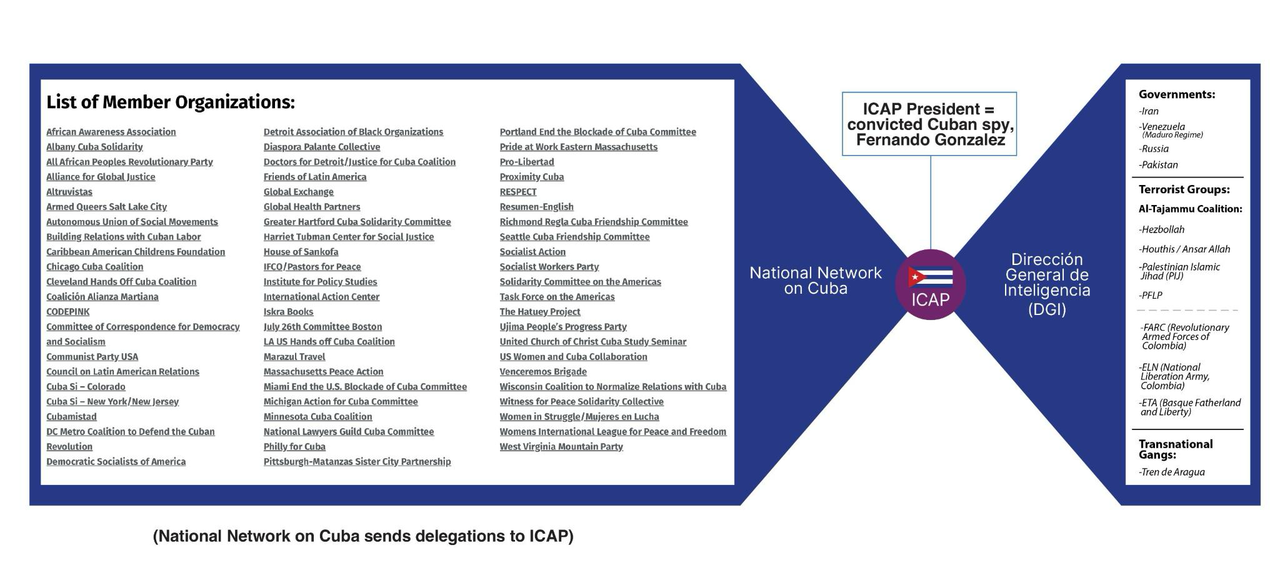
All of these networks—whether the Singham organizations, the DSA, or the fake “civil rights groups” that are actually organizing protests—have been traveling to Cuba for years, where they interact with the Cuban Intelligence Service through its front group, ICAP.
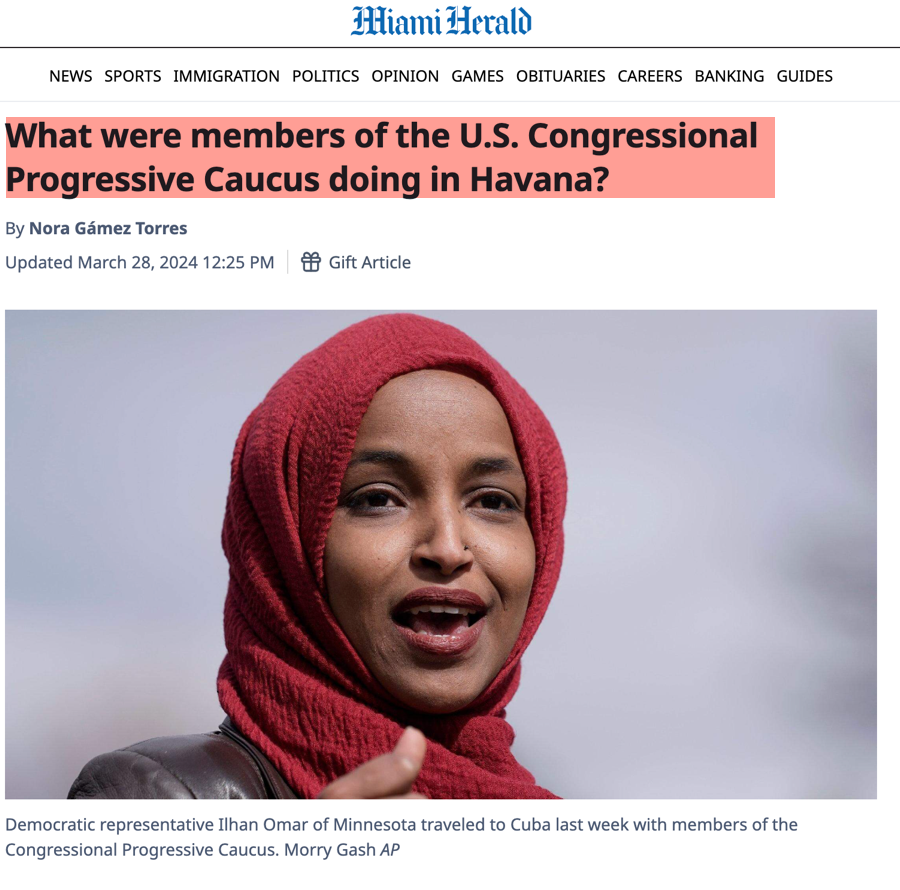
Omar in Havana. Opening daycare centers?
This matters because Cuba is running on fumes, quite literally. With electricity available only a few hours a day, the Cuban regime is utterly dependent on Venezuelan oil. That reality is a huge deal for America’s revolutionary left. They see themselves not as observers, but as participants in the Cuban revolution.
When Maduro is threatened, they react as if their own infrastructure is under attack—because it is.
A list of who condemned Maduro’s capture:
1. Rep. Thomas Massie
2. CODEPINK
3. Ana Kasparian
4. The Iranian government
5. The Russian government
6. The Chinese government
7. Hamas
8. AOC
9. Head of UN
10. Editor of “The American Conservative”
Who am I missing? pic.twitter.com/WnQ4aN5NKE
— Eitan Fischberger (@EFischberger) January 3, 2026
Today, Democrats will claim @POTUS‘ decisive action in Venezuela violated international law.
Yet, when Nicolás Maduro STOLE an election, they remained silent.
In fact, Democrats like AOC are on record REFUSING to denounce Maduro’s terrorist regime. pic.twitter.com/AnWOHSS4zm
— Lance Gooden (@Lancegooden) January 3, 2026 Bernie Moreno (@berniemoreno) November 1, 2025
BREAKING: The Democratic Socialists of America have released their statement on the capture of President Maduro, and it’s propaganda with a DSA logo on it.
They deny the premise (“no substantiated evidence”), ignore Maduro’s international legitimacy crisis, and then demand he be… pic.twitter.com/t9vNFsuHPn
— Stu Smith (@thestustustudio) January 3, 2026
Truly some of the worst people in our society. https://t.co/7QqnqNsdWw
— Legal Phil (@Legal_Fil) January 4, 2026
When people tell you who they are, believe them. The American left is not merely influenced by Cuba, Venezuela, Russia, and China. It functions as their domestic network. Yesterday’s protests were not a moral response.
VENEZUELA: Chinese CCP PAID & ORGANIZED pro-Maduro protests in:
1) New York City
2) Chicago Illinois
3) Orlando, Florida
4) Boston, Massachusetts
5) Portland, Oregons
All have same signs and same No Kings protesters. pic.twitter.com/b7Sbl2g87G
— @amuse (@amuse) January 4, 2026
They were a supply-chain reaction.
Tyler Durden
Sun, 01/04/2026 – 11:05
https://www.zerohedge.com/political/cuba-venezuela-china-and-americas-left-wing-connection
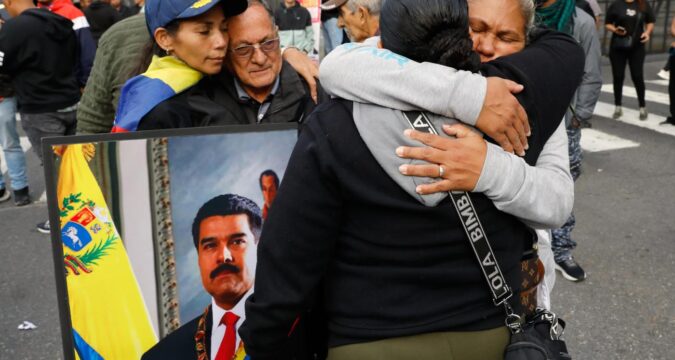
Deposed Venezuelan leader Nicolás Maduro arrives in US after operation that Trump says will let US ‘run’ Venezuela
CARACAS, Venezuela — Deposed Venezuelan leader Nicolás Maduro arrived in the United States to face criminal charges after being captured in an audacious nighttime military operation that President Donald Trump said would set the U.S. up to “run” the South American country and tap its vast oil reserves to sell to other nations.
Maduro landed late Saturday afternoon at a small airport in New York following the middle-of-the-night operation that extracted him and his wife, Cilia Flores, from their home in a military base in the capital, Caracas — an act that Maduro’s government called “imperialist.” The couple faces U.S. charges of participating in a narco-terrorism conspiracy.
The dramatic action capped an intensive Trump administration pressure campaign on Venezuela’s autocratic leader and months of secret planning, resulting in the most assertive American action to achieve regime change since the 2003 invasion of Iraq. Legal experts raised questions about the lawfulness of the operation, which was done without congressional approval. Venezuela’s vice president, Delcy Rodriguez, meanwhile, demanded that the United States free Maduro and called him the country’s rightful leader as her nation’s high court named her interim president.
Some Venezuelan civilians and members of the military were killed, said Rodríguez, who didn’t give a number. Trump said some U.S. forces were injured, but none was killed.
Speaking to reporters hours after Maduro’s capture, Trump revealed his plans to exploit the leadership void to “fix” the country’s oil infrastructure and sell “large amounts” of oil to other countries.
After arriving at a small airport in New York City’s northern suburbs, Maduro was flown by helicopter to Manhattan, where a convoy of law enforcement vehicles, including an armored car, was waiting to whisk him to a nearby U.S. Drug Enforcement Administration office.
A video posted on social media by a White House account showed Maduro, smiling, as he was escorted through that office by two DEA agents grasping his arms.
Trump says US will ‘run the country’
The Trump administration promoted the ouster as a step toward reducing the flow of dangerous drugs into the U.S. The president touted what he saw as other potential benefits, including a leadership stake in the country and greater control of oil.
Trump claimed the U.S. government would help lead the country and was already doing so, though there were no immediate visible signs of that. Venezuelan state TV aired pro-Maduro propaganda and broadcast live images of supporters taking to the streets in Caracas in protest.
“We’re going to run the country until such time as we can do a safe, proper and judicious transition,” Trump said at a Mar-a-Lago news conference. He boasted that this “extremely successful operation should serve as warning to anyone who would threaten American sovereignty or endanger American lives.”
Maduro and other Venezuelan officials were indicted in 2020 on narco-terrorism conspiracy charges, and the Justice Department released a new indictment Saturday of Maduro and his wife that painted his administration as a “corrupt, illegitimate government” fueled by a drug-trafficking operation that flooded the U.S with cocaine. The U.S. government does not recognize Maduro as the country’s leader.
The Trump administration spent months building up American forces in the region and carrying out attacks on boats in the Caribbean Sea and eastern Pacific Ocean for allegedly ferrying drugs. Last week, the CIA was behind a drone strike at a docking area believed to have been used by Venezuelan drug cartels — the first known direct operation on Venezuelan soil since the U.S. campaign began in September.
Early morning attack
Taking place 36 years to the day after the 1990 surrender and seizure of Panama leader Manuel Antonio Noriega following a U.S. invasion, the Venezuela operation unfolded under the cover of darkness early Saturday. Trump said the U.S. turned off “almost all of the lights” in Caracas while forces moved in to extract Maduro and his wife.
Gen. Dan Caine, chairman of the Joint Chiefs of Staff, said U.S. forces had rehearsed their maneuvers for months, learning everything about Maduro — where he was and what he ate, as well as details of his pets and his clothes.
“We think, we develop, we train, we rehearse, we debrief, we rehearse again and again,” Caine said. “Not to get it right, but to ensure we cannot get it wrong.”
Multiple explosions rang out that morning, and low-flying aircraft swept through Caracas. Maduro’s government accused the United States of hitting civilian and military installations, calling it an “imperialist attack” and urging citizens to take to the streets. The explosions — at least seven blasts — sent people rushing into the streets, while others took to social media to report what they saw and heard.
Restrictions imposed by the U.S. government on airspace around Venezuela and the Caribbean expired early Sunday, Transportation Secretary Sean Duffy said on X, an announcement that suggested any further immediate major U.S. military action was unlikely. “Airlines are informed, and will update their schedules quickly,” he posted.
Under Venezuelan law, Rodríguez would take over from Maduro. Rodríguez, however, stressed during a Saturday appearance on state television that she did not plan to assume power, before Venezuela’s high court ordered that she become interim president.
“There is only one president in Venezuela,” Rodriguez said, “and his name is Nicolás Maduro Moros.”
Some streets in Caracas fill up
Venezuela’s ruling party has held power since 1999, when Maduro’s predecessor, Hugo Chávez, took office, promising to uplift poor people and later to implement a self-described socialist revolution.
Maduro took over when Chávez died in 2013. His 2018 reelection was widely considered a sham because the main opposition parties were banned from participating. During the 2024 election, electoral authorities loyal to the ruling party declared him the winner hours after polls closed, but the opposition gathered overwhelming evidence that he lost by a more than 2-to-1 margin.
Venezuela’s capital remained unusually quiet Sunday with few vehicles moving around and convenience stores, gas stations and other businesses closed. A road typically filled with runners, cyclists and other fitness enthusiasts on Sundays only had a handful of people working out the day after Maduro was deposed.
The presidential palace was guarded by armed civilians and members of the military. At a nearby plaza, only a street sweeper and a soldier stood, and across the street, a church remained close for a second day in a row.
Caracas resident David Leal arrived to the lot where he parks vehicles for a living only to quickly realize that he would likely not see any clients for a second day.
“People are still shaken,” Leal, 77, said.
Questions of legality linger
Whether the United States violated any laws, international or otherwise, was still a question early Sunday. “There are a number of international legal concepts which the United States might have broken by capturing Maduro,” said Ilan Katz, an international law analyst.
Pope Leo XIV, who last month had expressed concern about growing U.S. threats of military intervention in Venezuela, raised alarms during his Sunday noon blessing and said the good of the Venezuelan people must prevail above everything else. History’s first U.S. pope demanded an end to violence and for Venezuela’s sovereignty to be guaranteed.
In New York, the U.N. Security Council, acting on an emergency request from Colombia, planned to hold a meeting on U.S. operations in Venezuela on Monday morning.
Lawmakers from both American political parties have raised reservations and flat-out objections to the U.S. attacks on boats suspected of drug smuggling. Congress has not approved an authorization for the use of military force for such operations in the region.
Connecticut Rep. Jim Himes, the top Democrat on the House Intelligence Committee, said he had seen no evidence that would justify Trump striking Venezuela without approval from Congress and demanded an immediate briefing by the administration on “its plan to ensure stability in the region and its legal justification for this decision.”
Toropin and Tucker reported from Washington. Associated Press writers Jorge Rueda in Caracas, Venezuela; Lisa Mascaro, Michelle L. Price, Seung Min Kim and Alanna Durkin Richer in Washington; Farnoush Amiri in New York; Larry Neumeister in South Amboy, New Jersey, and Nicole Winfiled in Rome contributed to this report.
https://www.chicagotribune.com/2026/01/04/nicolas-maduro-arrives-in-us/
Europe’s AI Ambitions Threatened By Soaring Memory Chip Prices
Europe’s AI Ambitions Threatened By Soaring Memory Chip Prices
Submitted by Thomas Kolbe
The ongoing boom in artificial intelligence is sending memory chip prices skyrocketing, putting pressure on data center operators. Europe currently lacks a strategy to break free from this price spiral.
The persistent surge in digitalization, particularly in AI, requires immense data storage capacity and is driving global demand for memory chips. These so-called RAM modules (Random Access Memory) have transformed from classic commodity products into highly specialized, strategic key resources of the new economy.
This strategic battle over memory chips is also reflected these weeks in the struggle for pole position between the United States and China. Just a few weeks ago, the administration of U.S. President Donald Trump granted American chipmaker NVIDIA limited permission to export its chips to China—while simultaneously collecting a 25 percent export levy from the Chinese side.
It is clear that the U.S. will increasingly use chip exports as a geopolitical lever, much like it has already done with LNG deliveries to Europe.
Memory Chips as the Foundation of the Digital Economy
These chips are used in smartphones, data centers, AI applications, cloud solutions, servers, and nearly every industrial production process. Demand for memory chips such as DRAM and NAND Flash has surged massively over the past five years. Combined global revenue for these chips was around $120 billion in 2020—about 25 percent of the overall semiconductor market—and has increased to roughly $176 billion this year.
Worldwide lockdowns in 2020 further accelerated this trend. At the same time, they posed enormous challenges for the global economy in both energy production and memory chip manufacturing.
Europe, in particular, now faces a severe shortage problem as skyrocketing demand pushes chip prices ever higher. A few highly specialized manufacturers, such as Samsung and SK Hynix, are increasingly in the political spotlight. Their enormous pricing power directly affects European data center operators. With such market concentration, prices are rising not linearly, but exponentially, systematically stalling the expansion of European data center capacity.
Exponential Price Pressure
To provide some relief, Samsung announced it would continue producing the soon-to-be-phased-out DDR4 standard chip beyond 2026, before factories fully switch to the new DDR5 generation. The crisis has become so acute that even this outdated technology is being artificially kept alive. The price sensitivity is stark: a 16GB DDR4 chip that previously cost around $20 now exceeds $60—and can be even higher in urgent data center upgrades.
This is not classic monetary inflation, but scarcity-driven price pressure. The crisis could last for years, with no relief in sight—particularly impacting AI and high-performance computing.
European cloud providers and mid-sized data centers face the dilemma of massive price hikes alongside slim margins. High electricity costs and shrinking financial buffers in Europe, especially Germany, exacerbate the issue. Smaller European data center operators are likely to be forced out of business under these conditions.
Europe’s Dilemma
Apple represents an exception. The company relies on highly optimized specialty RAM modules (LPDDR5X) and has strategically secured long-term supply contracts, meaning the current chip supply crisis will hit Apple much later than other providers.
From a European perspective, the situation could hardly be more dramatic. Intel’s planned chip production facility in Germany highlights the dilemma: while it would have little immediate impact on the shortage of specialized memory chips, it exposes the core problem—billion-euro subsidies are insufficient to sustainably build competitive chip manufacturing in Europe. High energy costs and excessive bureaucracy cannot be subsidized away.
Big Goals, Limited Impact
In response, the European Commission launched the European Chips Act in September 2023, a strategic framework aimed at strengthening Europe’s position in the global semiconductor market and reducing dependence on imports from Taiwan, South Korea, the U.S., and China. Europe currently accounts for well under 15 percent of the global chip market. Brussels is following a familiar political pattern: funding programs for startups, SMEs, research institutions, and competence centers to build knowledge, infrastructure, and retain talent.
The EU aims to locate around 20 percent of global chip production within Europe by 2030. For example, €920 million in funding has been mobilized for Infineon in Dresden—the largest semiconductor investment in the company’s history. The goal is to bring not only low-end production but large parts of the value chain to Europe. Public and private investments totaling €43 billion are targeted by 2030.
Intel’s example highlights structural challenges: European policy supports chip production, but creating a dynamic environment for startups, venture capital, and entrepreneurial innovation is left out. Greater reliance on free capital markets, less state intervention, and reduced regulation could make Europe’s technological independence more realistic. Yet, neither Brussels nor Berlin appears ready for such a paradigm shift.
* **
About the author: Thomas Kolbe is a German graduate economist. For over 25 years, he has worked as a journalist and media producer for clients from various industries and business associations. As a publicist, he focuses on economic processes and observes geopolitical events from the perspective of the capital markets. His publications follow a philosophy that focuses on the individual and their right to self-determination.
Tyler Durden
Sun, 01/04/2026 – 10:30
https://www.zerohedge.com/technology/europes-ai-ambitions-threatened-soaring-memory-chip-prices
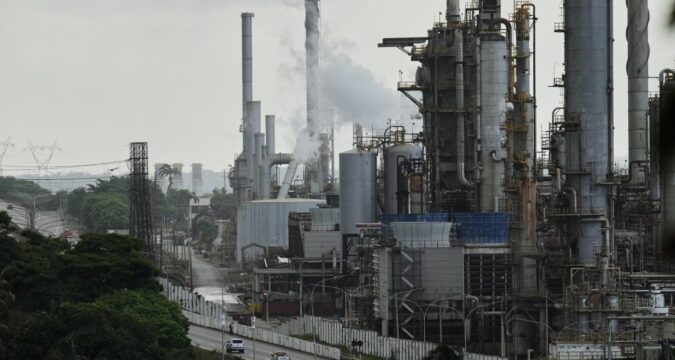
Trump’s plan to seize and revitalize Venezuela’s oil industry faces major hurdles
President Donald Trump’s plan to take control of Venezuela’s oil industry and ask American companies to revitalize it after capturing President Nicolás Maduro in a raid isn’t likely to have a significant immediate impact on oil prices.
Venezuela’s oil industry is in disrepair after years of neglect and international sanctions, so it could take years and major investments before production can increase dramatically. But some analysts are optimistic that Venezuela could double or triple its current output of about 1.1 million barrels of oil a day to return to historic levels fairly quickly.
“While many are reporting Venezuela’s oil infrastructure was unharmed by U.S. military actions, it has been decaying for many many years and will take time to rebuild,” said Patrick De Haan, who is the lead petroleum analyst at gasoline price tracker GasBuddy.
American oil companies will want a stable regime in the country before they are willing to invest heavily, and the political picture remained uncertain Saturday with Trump saying that the United States is in charge — while the current Venezuelan vice president argued, before Venezuela’s high court ordered her to assume the role of interim president, that Maduro should be restored to power.
“But if it seems like the U.S. is successful in running the country for the next 24 hours, I would say there would be a lot of optimism that U.S. energy companies could come in and revitalize the Venezuelan oil industry fairly quickly,” said Phil Flynn, a senior market analyst at the Price Futures Group.
And if Venezuela can grow into an oil production powerhouse, Flynn said “that could cement lower prices for the longer term” and put more pressure on Russia.
Oil isn’t traded over the weekend, so there wasn’t an immediate impact on prices. But a major shift in prices isn’t expected when the market does reopen. Venezuela is a member of OPEC so its production is already accounted for there. And there is currently a surplus of oil on the global market.
Proven reserves
Venezuela is known to have the world’s largest proven crude oil reserves of approximately 303 billion barrels, according to the U.S. Energy Information Administration. That accounts for roughly 17% of all global oil reserves.
So international oil companies have reason to be interested in Venezuela. Exxon Mobil didn’t immediately respond to a request for comment Saturday. ConocoPhillips spokesperson Dennis Nuss said by email that the company “is monitoring developments in Venezuela and their potential implications for global energy supply and stability. It would be premature to speculate on any future business activities or investments.”
Chevron is the only one with significant operations in Venezuela, where it produces about 250,000 barrels a day. Chevron, which first invested in Venezuela in the 1920s, does business in the country through joint ventures with the state-owned company Petróleos de Venezuela S.A., commonly known as PDVSA.
“Chevron remains focused on the safety and wellbeing of our employees, as well as the integrity of our assets. We continue to operate in full compliance with all relevant laws and regulations,” Chevron spokesman Bill Turenne said.
But even with those massive reserves, Venezuela has been producing less than 1% of the world’s crude oil supply. Corruption, mismanagement and U.S. economic sanctions saw production steadily decline from the 3.5 million barrels per day pumped in 1999 to today’s levels.
The problem isn’t finding the oil. It’s a question of the political environment and whether companies can count on the government to live up to their contracts. Back in 2007, then President Hugo Chávez nationalized much of the oil production and forced major players like ExxonMobil and ConocoPhillips out.
“The issue is not just that the infrastructure is in bad shape, but it’s mostly about how do you get foreign companies to start pouring money in before they have a clear perspective on the political stability, the contract situation and the like,” said Francisco Monaldi, who is the director of the Latin American energy program at Rice University.
But the infrastructure does need significant investment.
“The estimate is that in order for Venezuela to increase from one million barrels per day — that is what it produces today — to four million barrels, it will take about a decade and about a hundred billion dollars of investment,” Monaldi said.
Strong demand
Venezuela produces the kind of heavy crude oil that’s needed for diesel fuel, asphalt and other fuels for heavy equipment. Diesel is in short supply around the world because of the sanctions on oil from Venezuela and Russia and because America’s lighter crude oil can’t easily replace it.
Years ago, American refineries on the Gulf Coast were optimized to handle that kind of heavy crude at a time when U.S. oil production was falling and Venezuelan and Mexican crude was plentiful. So refineries would love to have more access to Venezuela’s crude because it would help them operate more efficiently, and it tends to be a little cheaper.
Boosting Venezuelan production could also make it easier to put pressure on Russia because Europe and the rest of the world could get more of the diesel and heavy oil they need from Venezuela and stop buying from Russia.
“There’s been a big benefit for Russia to see Venezuela’s oil industry collapse. And the reason is because they were a competitor on the global stage for that oil market,” Flynn said.
Complicated legal picture
But Matthew Waxman, a Columbia University law professor who was a national security official in the George W. Bush administration, said seizing control of Venezuela’s resources opens up additional legal issues.
“For example, a big issue will be who really owns Venezuela’s oil?” Waxman wrote in an email. “An occupying military power can’t enrich itself by taking another state’s resources, but the Trump administration will probably claim that the Venezuelan government never rightfully held them.”
But Waxman, who served in the State and Defense departments and on the National Security Council under Bush, noted that “we’ve seen the administration talk very dismissively about international law when it comes to Venezuela.”
Associated Press writers Matt O’Brien and Ben Finley contributed to this report.
https://www.chicagotribune.com/2026/01/04/trump-seize-venezuela-oil/
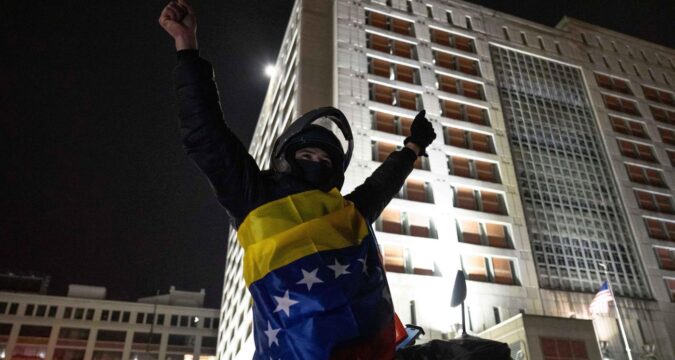
After capture and removal, Venezuela’s Maduro is being held at notorious Brooklyn jail
NEW YORK — The Brooklyn jail holding Venezuelan President Nicolás Maduro is a facility so troubled, some judges have refused to send people there even as it has housed such famous inmates as music stars R. Kelly and Sean “Diddy” Combs.
Opened in the early 1990s, the Metropolitan Detention Center, or MDC Brooklyn, currently houses about 1,300 inmates.
It’s the routine landing spot for people awaiting trial in federal courts in Manhattan and Brooklyn, holding alleged gangsters and drug traffickers alongside some people accused of white collar crimes.
A throng of Venezuelan expatriates, many draped in flags, gathered on the sidewalks outside the jail Saturday night to celebrate Maduro’s capture. The crowd cheered as the law enforcement motorcade believed to be carrying the deposed leader and his wife arrived at the jail.
Maduro is not the first president of a country to be locked up there.
Juan Orlando Hernández, the former president of Honduras, was imprisoned at MDC Brooklyn while he was on trial for trafficking hundreds of tons of cocaine into the U.S. Convicted and sentenced to 45 years in prison, Hernández was pardoned and freed by President Donald Trump in December.
Current detainees include the co-founder of Mexico’s Sinaloa drug cartel, Ismael “El Mayo” Zambada Garcia, and Luigi Mangione, who is accused of killing the CEO of UnitedHealthcare. Past inmates have included crypto mogul Sam Bankman-Fried and longtime Jeffrey Epstein associate Ghislaine Maxwell.
Located next to a shopping mall in a waterfront industrial area and within sight of the Statue of Liberty, the jail has been described, at its worst, as a “hell on earth” and an “ongoing tragedy.”
Detainees and their lawyers have long complained about rampant violence. Two prisoners were killed by other inmates in 2024, and jail workers have been charged with accepting bribes or providing contraband.
During the winter of 2019, a power outage plunged the facility and its inmates into a cold darkness for a week.
Recently, however, the federal Bureau of Prisons says it has worked to improve conditions.
The facility added correctional and medical staff, remedying more than 700 backlogged maintenance requests and answering judges’ concerns. Improvements were also made to electrical and plumbing lines, food service and heating and air conditioning systems.
In addition to the physical upgrades, federal authorities have tried to crack down on crime inside the lockup. Last March, 23 inmates were charged with offenses ranging from smuggling weapons in a Doritos bag to the stabbing of a man convicted in the killing of hip-hop legend Jam Master Jay.
“In short, MDC Brooklyn is safe for the inmates and staff,” the Bureau of Prisons said in September. The inmate population also decreased from 1,580 as of January 2024, which, it said, led to a “substantial decrease” in crime and contraband.
While there Maduro is likely to see some familiar faces if he is allowed out of the isolated quarters where he will initially be housed.
One is co-defendant Hugo Carvajal, the former Venezuelan spy chief who broke ranks with Maduro in 2019 and has indicated that he wants to cooperate with U.S. authorities.
There is also Anderson Zambrano-Pacheco, an alleged member of Venezuela’s Tren de Aragua gang who was arrested last year in New York on firearms charges. Zambrano-Pacheco was among those caught on security video terrorizing residents at an apartment complex in a Denver suburb, an incident that Trump seized on during his presidential campaign.
The MDC has drawn more scrutiny since 2021, when the Bureau of Prisons closed its other New York City jail — the Metropolitan Correctional Center — after Jeffrey Epstein’s suicide there highlighted its lax security, crumbling infrastructure and dangerous, squalid conditions.
Associated Press writer Joshua Goodman in Miami contributed.
https://www.chicagotribune.com/2026/01/04/venezuela-maduro-brooklyn-jail/

Concerns raised about delay of NIPSCO’s Schahfer closure
Multiple organizations wrote a letter to the Northern Indiana Public Service Co. detailing their concerns with a U.S. Department of Energy order that would require the utility to keep its R.M. Schahfer generating station operating.
The letter comes from EarthJustice, Citizens Action Coalition, Hoosier Environmental Council, Just Transition Northwest Indiana, and the Sierra Club, and it’s addressed to Erin Whitehead, NIPSCO’s vice president of regulatory policy and major accounts.
“We write to emphasize the following points: NIPSCO must carefully evaluate whether it would be prudent to expend money to repair R.M. Schahfer Generating Station Unit 18 due to the order,” the letter said. “There are several legal bases to conclude that DOE lacks authority under section 202(C) to direct NIPSCO to revive the generation facility. We intend to litigate the recovery of any imprudently incurred expenditures.”
In the letter, the organizations claim that Schahfer Unit 18 is broken and cannot operate without “substantial expenditures.” The unit had a 2,890-hour forced outage from Feb. 16, 2025, to June 23, 2025, because a turbine blade separated from its root. On July 9, 2025, Schahfer had another 1,996-hour outage because of significant damage to the upper portion of the condenser tubes.
“We expect that the expenditure to procure and install the referenced long lead time equipment to revive Unit 18 — instead of allowing the units to retire as previously planned — will be substantial,” the letter said. “Before incurring any of those costs, NIPSCO must carefully evaluate whether the expenditure is prudent.”
The organizations also claim that the DOE cannot direct NIPSCO to revive the Schahfer unit, saying that Congress has not given the department the authority. The order would require the repairs or modifications to the unit that would go far beyond electric power generation, according to the letter.
The order would require rebuilding significant parts of the plant because the unit is “beyond its useful life.”
The organizations also claim that the Federal Energy Regulatory Commission’s prudence requirement doesn’t allow NIPSCO to recover costs expended pursuant to an unlawful directive, according to the letter.
“It would be imprudent for NIPSCO to expend money to revive Schahfer Unit 18 without, at minimum, carefully evaluating the legality of the department’s order, particularly any element of the order that could be interpreted to direct repair of Unit 18 to an operational condition,” the letter said. “ … A reasonable utility management does not in good faith expend money in response to an unlawful directive, particularly when the utility management is on notice of the unlawful nature of the directive.”
In a Friday email, a NIPSCO representative referred to a previous statement regarding the Schahfer order, saying that compliance is mandatory. The utility is reviewing the details to assess its impact on employees, customers and the company to ensure compliance.
The order alters the timeline for decommissioning Schahfer, according to the statement, but NIPCSO’s long-term plan to transition to sustainable energy remains unchanged.
“Guided by our Integrated Resource Plan, NIPSCO and NiSource recognize the importance of reliable and affordable energy as we manage costs and adapt to changing regulatory requirements,” the statement said. “Our commitment to providing safe and dependable energy remains steadfast both now and in the future.”
According to Post-Tribune archives, NIPSCO plans to convert the Schahfer station into a natural gas plant as part of the plan to provide energy for data centers, including a $15 billion Amazon Web Services plans to invest in the region, including Hobart.
U.S. Secretary of Energy Chris Wright, on Dec. 23, issued an emergency order that would keep Schahfer operating, according to Post-Tribune archives. The order went into effect on Dec. 23 and ends on March 23, 2026.
According to Post-Tribune archives, the order was made to ensure Midwesterners “have access to affordable, reliable and secure electricity heading into the winter months.” The Midcontinent Independent System Operator was also told to continue operations at its F.B. Culley generating station in Newburgh.
“The Trump administration remains committed to swiftly deploying all available tools and authorities to safeguard the reliability, affordability and security of the nation’s energy system,” Wright said in a previous statement. “Keeping these coal plants online has the potential to save lives and is just common sense. Americans deserve reliable power regardless of whether the wind is blowing or the sun is shining during extreme winter conditions.”
Earlier this year, the Citizens Action Coalition has found that statewide electric utility bills have increased more than $28 per month, or 17.5%. NIPSCO residential customers were hit hardest, with about a $50 per month, or 26.7% increase, in one year, according to the organization’s July report.
“The federal government’s order to force extremely expensive and unreliable coal units to stay open will result in higher bills for Hoosiers who are already reeling from record-high rate increases in 2025,” Ben Inskeep, program director for Citizens Action Coalition, said in a previous statement. “We can’t afford this costly and unfounded federal overreach.”
https://www.chicagotribune.com/2026/01/04/concerns-raised-about-delay-of-nipscos-schahfer-closure/

Russia, China Demand That US Immediately Release Maduro From Custody
Russia, China Demand That US Immediately Release Maduro From Custody
Within mere hours after President Trump announced the Saturday capture by US forces of Venezuelan President Nicolás Maduro and his wife after a brief shock bombing campaign and special forces operation in Caracas, Russia has demanded from Washington his immediate release.
“We firmly call on the U.S. leadership to reconsider this position and release the lawfully elected president of a sovereign country and his wife,” the Russian Foreign Ministry said in a statement, and described that the crisis should be resolved through diplomatic means.
“Russia will continue to support the course pursued by its Bolivarian leadership to defend the country’s national interests and sovereignty,” the Foreign Ministry said, while also calling for restraint and cautioning against further escalation.
This of course contradicts the US stance, which maintains that Maduro and his socialist government ‘stole’ the last July elections which kept him in power.
Moscow’s demand that the US release and return Maduro, which is extremely unlikely at this point, comes amid rumors that Venezuelan Vice President Delcy Rodriguez Gomez is actually in Moscow. Russian officials have called these rumors and reports “fake”, however.
Russian Foreign Minister Sergei Lavrov meanwhile said he held a phone conversation with Gomez, during which he conveyed his “solidarity with the Venezuelan people in the face of armed aggression.”
According to Venezuela’s national constitution, the Vice President assumes the power of the presidency, but amid the quick power vacuum opening up, it’s anyone’s guess what leadership in the country will look like even by next week.
China has joined Moscow’s calls for the immediate release of Maduro from US custody:
China has called on the United States to immediately release Venezuelan President Nicolas Maduro after Washington carried out massive military strikes on the capital, Caracas, as well as other regions, and abducted the leader.
Beijing on Sunday insisted the safety of Maduro and his wife Cilia Flores be a priority, and called on the US to “stop toppling the government of Venezuela,” calling the attack a “clear violation of international law“.
Russia’s embassy in Caracas has made clear it is continuing to operate normally and remains in close communication with both Venezuelan officials and Russian nationals in the country. It confirmed in a statement that no Russian citizens were killed or injured in the attack.
There are reports that 40 people total died during the assault – possibly mostly at the large military bases struck in and around the capital, as the NY Times writes, “At least 40 people were killed in the U.S. attack on Venezuela early Saturday, including military personnel and civilians, according to a senior Venezuelan official who spoke on condition of anonymity to describe preliminary reports.”
News: The CIA covertly installed a small team inside Venezuela over the summer, to track Maduro’s patterns, locations and movements, which helped bolster Saturday’s operation as to his exact whereabouts and where he would be sleeping, a sources familiar with the plans tell me…
— Alayna Treene (@alaynatreene) January 3, 2026
China, Russia, Iran and other US rivals have vehemently condemned what they’ve characterized as a brazen act of aggression in the regime change operation. As months of US military build-up in the region unfolded, there was ample speculation that a full land invasion would ensue, or else kinetic strikes on cartel locations; however, few analysts could have envisioned a relatively clean special forces kidnapping op of a head of state. Currently, it is widely believed there must have been high-ranking military officials assisting the US behind the scenes – given just how quickly Maduro was apprehended in the capital.
Tyler Durden
Sun, 01/04/2026 – 09:55
https://www.zerohedge.com/geopolitical/russia-china-demand-us-immediately-release-venezuelas-maduro