Category: News

Ethereum Ready To Solve Blockchain Trilemma: Vitalik Buterin
Ethereum Ready To Solve Blockchain Trilemma: Vitalik Buterin
Authored by Brian Quarmby via CoinTelegraph.com,
Ethereum co-founder Vitalik Buterin claims Ethereum has “solved” one of the biggest challenges in crypto: the blockchain trilemma.
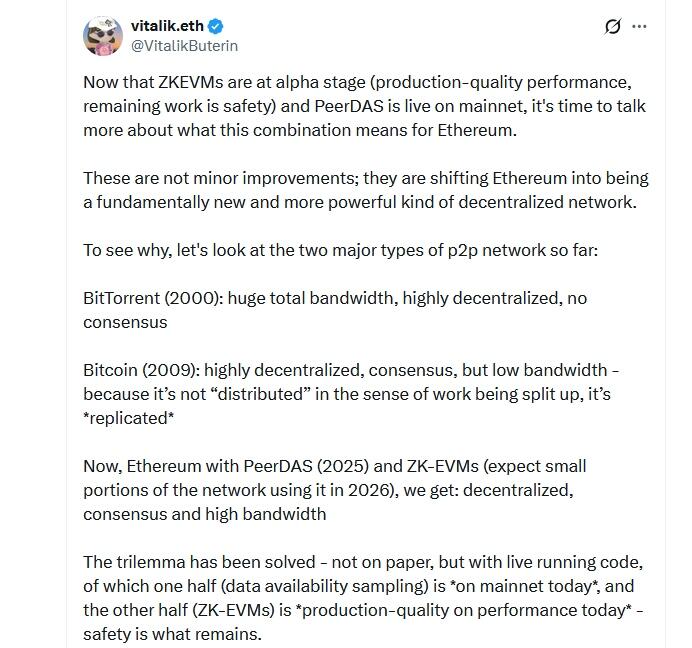
In a X post on Saturday, Buterin emphasized the potential of peer data availability sampling (PeerDAS) and Zero-Knowledge Ethereum Virtual Machines (zkEVMs), noting that these two upgrades are making Ethereum “a fundamentally new and more powerful kind of decentralized network.”
“Now, Ethereum with PeerDAS (2025) and ZK-EVMs (expect small portions of the network using it in 2026), we get: decentralized, consensus and high bandwidth,” he said, adding:
“The trilemma has been solved — not on paper, but with live running code, of which one half (data availability sampling) is *on mainnet today*, and the other half (ZK-EVMs) is *production-quality on performance today* — safety is what remains.”
Source: Vitalik Buterin
PeerDAS is a scalability enhancement introduced in the Fusaka upgrade in December that enables Ethereum to handle significantly more data.
Meanwhile, zkEVMs, which have been around for a while, are virtual machines compatible with both ZK proofs and the existing Ethereum virtual machine.
The Ethereum co-founder said that zkEVMs are still in their “alpha stage,” as they are performance-ready but require additional security improvements. He has given a four-year timeline for zkEVMs to be fully utilized within Ethereum.
Buterin said that once these upgrades are fully rolled out, Ethereum’s long-running effort to balance decentralization, security and scalability will be complete
“Over the next ~4 years, expect to see the full extent of this vision roll out: * In 2026, large non-ZKEVM-dependent gas limit increases due to BALs and ePBS, and we’ll see the first opportunities to run a ZKEVM node*,” he said.
“In 2026-28, gas repricings, changes to state structure, exec payload going into blobs, and other adjustments to make higher gas limits safe * In 2027-30, large further gas limit increases, as ZKEVM becomes the primary way to validate blocks on the network,” he added.
Ethereum took 10 years to solve the trilemma
Buterin said that it has taken 10 years of solid work to get Ethereum to the level of being able to solve the trilemma, pointing to his first post on solving data-availability problems back in April 2017.
“This was a 10-year journey […] but it’s finally here,” he said.
The blockchain trilemma refers to the complexity of building a blockchain network that sufficiently achieves decentralization, security and scalability simultaneously without any one pillar hampering the other.
Generally, most blockchains are forced to prioritize one or two of these pillars, such as speed and security, in their early stages while they gradually work to balance all three.
In his post, Buterin pointed to Bitcoin as an example, noting that the network was designed to be “highly decentralized” and secure, but suffers from scalability issues.
Tyler Durden
Mon, 01/05/2026 – 22:35
https://www.zerohedge.com/crypto/ethereum-ready-solve-blockchain-trilemma-vitalik-buterin
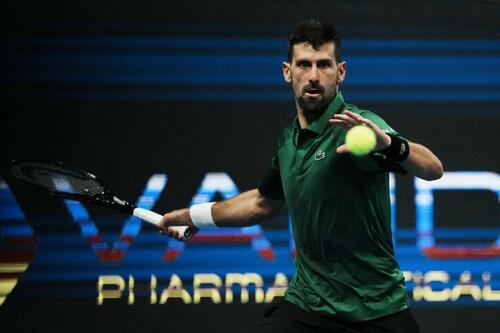
Novak Djokovic Severs Ties With PTPA Players’ Association He Co-Founded
Novak Djokovic Severs Ties With PTPA Players’ Association He Co-Founded
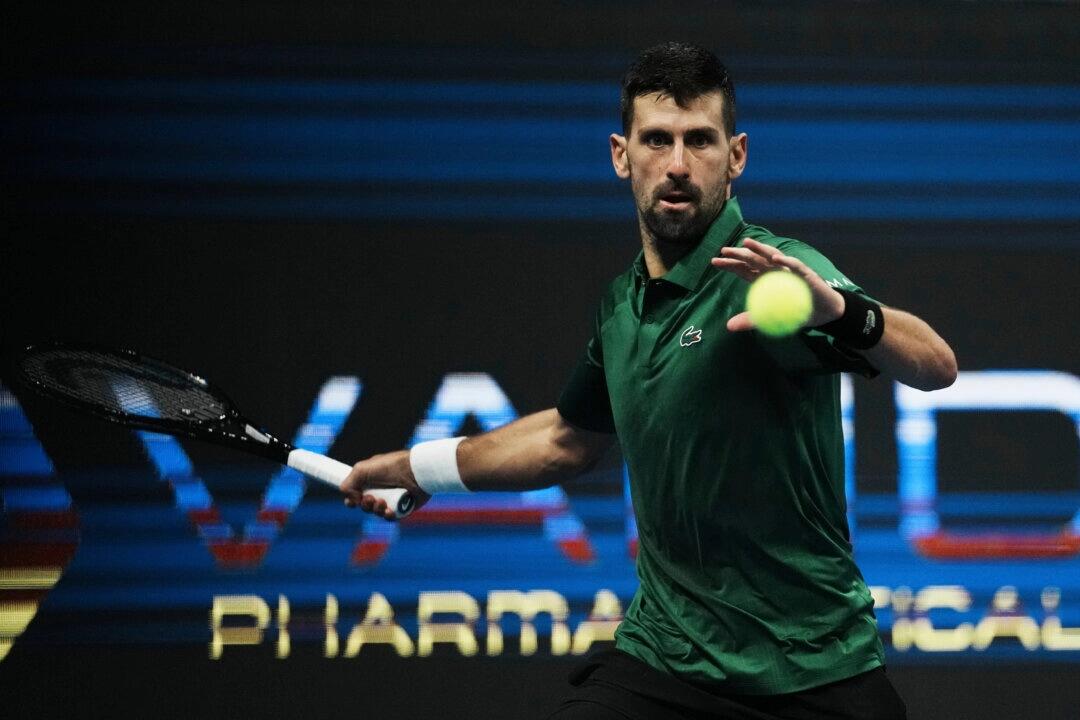
Novak Djokovic just dropped a shocker in the world of professional tennis; he’s cutting ties with the very players’ association he helped create.
The 24-time Grand Slam champion announced Sunday on X that he has stepped away completely from the Professional Tennis Players Association (PTPA), saying his “values and approach are no longer aligned with the current direction of the organization.”
I am proud of the vision that Vasek and I shared when founding the PTPA, giving players a stronger, independent voice – but it has become clear that my values and approach are no longer aligned with the current direction of the organization.
— Novak Djokovic (@DjokerNole) January 4, 2026
The move marks a dramatic turn for Djokovic, who once stood front and center promoting the PTPA as a new force to represent pro players outside the sport’s traditional structure.
From disruptor to dissenter
Djokovic and Canadian Vasek Pospisil unveiled the idea for the PTPA at the 2020 U.S. Open, aiming to build a players’ group that could function like a union, giving athletes a powerful, unified voice in a sport where players are independent contractors and tours operate separately.
The new organization was pitched as an alternative to the Association of Tennis Professionals (ATP) and Women’s Tennis Association (WTA) councils – advocating for equal representation, better pay, and greater input in decisions that affect players’ careers.
In recent months, however, tensions have emerged behind the scenes.
Djokovic said his decision stems from “ongoing concerns regarding transparency, governance, and the way my voice and image have been represented within the organisation.”
Lawsuits, splits and strategy disputes
The PTPA grabbed headlines last year when it filed a sweeping class-action lawsuit in March against tennis’ governing bodies – including the ATP, WTA, International Tennis Federation, and the sport’s integrity unit – accusing them of “systemic abuse, anti-competitive practices, and a blatant disregard for player welfare,” RTE.ie reports.
Later, the four Grand Slam tournaments – the Australian Open, Roland-Garros, Wimbledon and the U.S. Open – were added as defendants, with Tennis Australia reaching a settlement.
Notably, Djokovic’s name was not on the legal filing when it went public – a sign of early distance between him and the group’s legal strategy. In March, Djokovic himself admitted he didn’t agree with parts of the lawsuit.
Reports surfaced late last year that internal disagreements intensified after the PTPA reached a separate deal with Tennis Australia — a move seen by some as undermining the unity of the lawsuit and the organization’s broader mission.
The PTPA’s official account on social media struck back at Djokovic’s departure, defending its mission and pushing back against what it called “misinformation” about the association’s work, though it did not directly single him out.
A statement from the PTPA. pic.twitter.com/WIlRInXDur
— Professional Tennis Players Association (@ptpaplayers) January 5, 2026
With more than 500 members at its peak and backing from some top players, the PTPA had been trying to shake up tennis’ longstanding power structures and push for reforms.
What’s next for Djokovic?
Djokovic said he will now focus on his tennis, his family and contributing to the sport in ways that reflect his principles and integrity – language that suggests he’s closing the chapter on this particular fight.
The news comes just ahead of the Australian Open in January, where Djokovic is expected to compete as he chases more major titles even as this off-court drama unfolds, the Guardian reports.
Tyler Durden
Mon, 01/05/2026 – 22:10
How Energy Scarcity Is Reshaping The Global Economy
How Energy Scarcity Is Reshaping The Global Economy
Authored by Gail Tverberg via Our Finite World,
Growing inequality reflects deeper physical limits on energy and resource extraction rather than purely financial or policy failures.
Rising debt and higher interest rates are emerging as binding constraints on governments, businesses, and households alike.
The 2026 downturn is likely to be uneven, with deflationary pressures, weaker oil demand, and selective regional resilience rather than a single global collapse.
Recently, many people have begun talking about the US having a k-shaped economy. In it, a handful of wealthy people are doing very well financially, while many others are falling further and further behind. I expect that the low wages of the majority of workers will soon lead to adverse impacts on businesses, governments, and international organizations. This phenomenon is likely to lead to a very uneven world economic downturn in 2026.
The world economy is subject to the laws of physics. The world economy seems to be reaching growth limits because there are too few easily extractable energy resources (as well as other resources, such as fresh water), relative to the world’s population. The Maximum Power Principle strongly suggests that even as limits are hit, the world economy cannot be expected to collapse all at once. Instead, the most efficient producers of goods and services will be able to succeed as long as resources are available, while less efficient producers will tend to fall by the wayside. Thus, the Maximum Power Principle somewhat limits the speed of the world’s economic downturn.
In this post, I will try to explain the challenges the world economy is now facing. I will also provide some thoughts on how 2026 will turn out.
[1] The k-shaped economy that the US and many other countries are experiencing is an indication that resources are, in some way, “running short.”
Humans all have similar basic needs. They need food to eat, and they need to cook at least some of this food before they eat it. They tend to need transportation services, both for themselves (to get to work) and for goods, such as the food they eat. They also need governments to keep order and to provide basic services, such as roads and schools. All these goods and services require energy of a suitable kind, such as human labor, burned biomass, or fossil fuel energy. They also require arable land, fresh water, and minerals of many kinds.
If there are not enough resources to go around, the easiest way to accomplish this is by creating a k-shaped economy. One example is with farmland. In many traditions, when a farmer dies, his oldest son inherits the farm. Younger children are then forced to find other kinds of employment, such as being a craftsman, farmer’s helper, or priest in a church. Wages for these younger children can easily fall lower than the income of their land-holding older brothers, especially if large families become common. Creating jobs that pay well for all the younger children becomes a problem.
A similar phenomenon has been happening in many Advanced Economies (US, UK, and other countries included in the OECD) in recent years. Parents are doing quite well financially, but their children often have difficulty finding jobs that pay well, even after advanced schooling. Some adult children are also left with educational debt to repay. This is a new type of k-shaped economy.
[2] The world’s current problem is an ever-rising population paired with resources that are becoming ever-more “expensive” to extract.
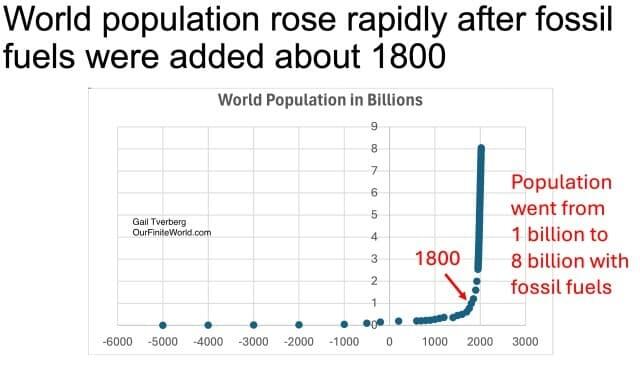
World population has exploded since fossil fuel consumption became abundant. This has allowed more food to be grown, inexpensive transportation of goods and people, and the development of antibiotics and other drugs.
Figure 1. Chart made by Gail Tverberg based on several population sources.
At the same time, the most accessible resources were extracted first. For example, fresh water initially came from streams, lakes, and shallow aquifers. As the population grew and industrial needs became increased, wells had to be dug deeper and aquifers began to be drained. In some places, desalination now needs to be used. Each of these advances in producing fresh water became more resource-intensive. It became increasingly difficult to gather enough fresh water using human labor alone. Instead, increasing quantities of physical materials, energy supplies, and debt were needed to make the new systems work.
The reason debt was needed to purchase capital goods, such as those required to obtain high-cost water, was because the devices purchased were expected to provide the desired output (water, in this case) for a long time in the future. Securing this future benefit required advance funding, using an approach such as debt. The sale of shares of stock, which are expected to appreciate over time and pay dividends, provides a similar benefit to debt.
A similar issue arises with the increasing extraction of minerals of many kinds, such as copper, tin, uranium, lithium, coal, and oil. Early on, extraction using manual labor and simple tools was sufficient. However, once the easiest to extract resources were removed, capital goods became necessary to make extraction efficient.
Capital goods, such as coal fired power plants, wind turbines, solar panels, and hydroelectric power plants also allowed electricity to be produced, extending the benefits of fossil fuels. Producing these capital devices requires physical materials and energy supplies, as well as debt or the sale of shares of stock for financing.
[3] A major limit on the system seems to be debt and the interest required on the debt.
In an economy, the growth of inexpensive energy supply acts very much like leavening works in making bread; it greatly helps economic growth. With the increasing use of inexpensive energy supply, vehicles can be made ever-less expensively, compared to using much hand labor for manufacturing (literally, making goods by hand). With this growing efficiency, wages rise faster than inflation. In the 1950s and 1960s, young people found that they could marry and live in nicer homes than their parents. Now, the reverse seems to be happening: many adult children are finding it difficult to keep up with the lifestyles of their parents.
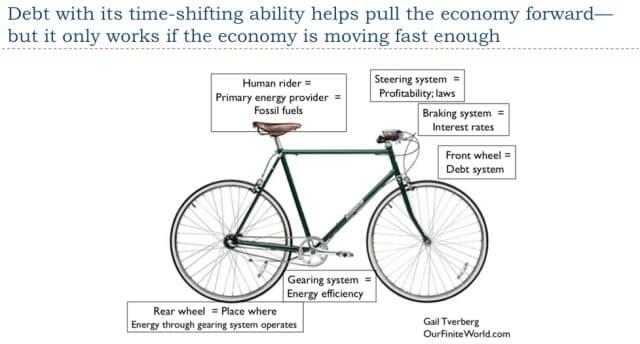
Once the inexpensive-to-extract energy supply is depleted, economies tend to add an increasing amount of debt, in an attempt to pull the economy forward. It seems to me that a major limit on the system comes when an economy slows down so much that it can no longer repay its debt with interest.
Figure 2. The author’s view of the analogy of a speeding upright bicycle and a speeding economy. “Debt with its time-shifting ability helps pull the economy forward, but it only works if the economy is moving fast enough.”
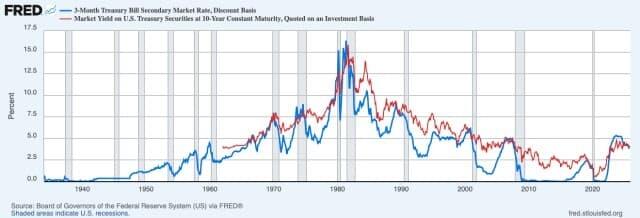
Political leaders like to believe that growing debt, by itself, will pull the economy forward. In fact, this does work, for a time, as long as interest rates are falling. But falling interest rates stopped happening in 2022.
Figure 3. Interest rates on 10-year Treasuries (red) and on 3-month Treasuries (blue), based on data of the Federal Reserve of St. Louis.
Of course, all the added debt contributes to the k-shaped economy. The already wealthy disproportionately benefit from debt payments. They also tend to benefit from dividends on shares of stock and from share price appreciation. The poorer people find that an increasing share of their wages goes to paying interest on debt, especially as interest rates rise.
As debt levels grow, governments eventually have a problem with repayment of debt with interest. They need to raise taxes simply to cover their rising interest payments. This is the reason why Donald Trump wants to get interest rates down. Interest payments are rising rapidly, with near-zero interest rates in the rear-view mirror (Figure 3).
[4] Added technology and economies of scale have been adding to the k-shaped economy.
Technology requires specialization. People with more training and higher skill levels tend to earn more than others. Economies of scale encourage the growth of ever-larger businesses. The people at the top of huge organizations tend to earn more than those at the bottom. Also, as international trade is added, low-wage people in the hierarchy increasingly compete for wages with workers from countries with much lower wage scales. Thus, the wages of less-skilled individuals are increasingly squeezed down.
Furthermore, both added technology and economies of scale require added debt. Again, the interest on this debt (and dividends on stock) disproportionately benefits those who are already wealthy.
[5] In a sense, artificial intelligence (AI) is simply an extension of added technology, with a huge need for electricity, water, and debt.
The hope for AI is that it will make our already k-shaped economy, a great deal more k-shaped. The hope is that AI can eliminate a significant share of jobs, with such high profits that the owners of this technology can become very rich. If it works, the wealth will be even more concentrated at the top than today.
I see the need for electricity, water, and debt as stumbling blocks for AI. I expect that, starting in 2026, the AI rapid growth spurt will seize up because it is already using more resources than are available in some areas. I expect that a significant downshift in AI will adversely affect the US stock market and the rate of growth of the US economy. My hope is that the loss of growth in the AI sphere will not, by itself, bring down the US economy–just nudge it toward recession.
[6] In 2026, with an increasingly k-shaped economy, I expect that world oil prices will drift lower than today.
“Demand” for oil really means “the quantity of oil that people, businesses, and governments around the world can afford to purchase.” As the economy becomes more k-shaped, fewer people can afford to buy vehicles of any kind. Poor people, in the lower part of the k, are hardest hit. They will tend to increasingly rely on low energy approaches, such as ride-sharing, walking, or using a bicycle. They will tend to buy fewer goods that are transported internationally. Governments, as they begin collecting less in tax revenue from the many poorer people, will be inclined to cut back their spending on new buildings and road improvements. These changes work in the direction of reducing oil demand, and thus oil prices.
It is this increasingly k-shaped economy that has been holding world oil prices down in 2025. I expect that prices will drift even lower in 2026 because of the increasingly k-shaped world economy. There aren’t enough very rich people to hold up oil and other resource demand by themselves.
Oil production will not immediately drop in response to these low prices, although it may start drifting lower in 2027. The US Energy Information Administration is forecasting that world oil production will rise by 1.1 million barrels per day in 2025 and by 1.2 million barrels per day in 2026. These amounts do not seem unreasonable based on new developments that have already started producing higher amounts of crude oil.
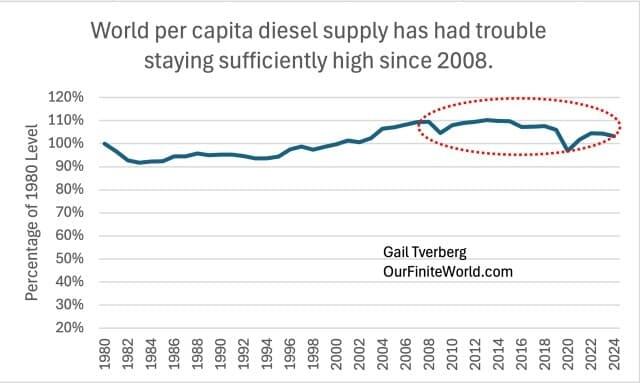
[7] The heavier types of oil, from which diesel and jet fuel are disproportionately made, are in short supply now. They are likely to continue to be in short supply in 2026.
World oil production has risen in recent months. When I investigated, I found that the vast majority of the recent growth seems to be in light oil. Thus, the shortfall in diesel and other heavy fuels is likely to continue as in the recent past.
Figure 4. Chart showing the level of per-capita diesel consumption, relative to the per-capita consumption in 1980. Amounts are based on Diesel/Gasoil amounts shown in the “Oil-Regional Consumption” tab of the 2025 Statistical Review of World Energy, published by the Energy Institute.
This shortage of the heavy types of oil has several impacts:
With a shortage of heavy oil, a fairly strong country, such as the US, is tempted to attack Venezuela, which has the world’s largest reserves of heavy oil.
Island nations without their own fossil fuel supplies tend to use a disproportionately large share of diesel and jet fuel, for several reasons: (1) Such islands often burn diesel fuel for electricity. This is an expensive way to make electricity; goods produced with this electricity become too expensive to export. (2) Imports and exports need to be shipped in by boat or by air, again using limited types of fuel supply. Physics tends to push these economies down by making their products expensive to sell elsewhere. Examples of islands with these problems include Cuba, Puerto Rico, Madagascar, and Sri Lanka. Such places tend to be adversely affected by shortages of heavy oil sooner than other locations.
Without enough jet fuel, long distance tourism is likely to be reduced in 2026. One issue is the lack of jet fuel for flying planes. Another issue is that an increasing share of the population will not be able to afford long-distance tourism because of the k-shaped economy.
Tariffs are a way of discouraging the shipping of goods long distance, to indirectly save on heavy oil. We should not be surprised by their increasing usage.
[8] In my view, deflation is a greater risk than inflation in 2026.
With a k-shaped economy, demand for apartments (especially smaller ones) tends to stay low. As an economy becomes increasingly k-shaped, low-paid workers tend to share an apartment with one or more friends or move in with family members to save money. In a December 23 report, Apartment Advisor writes that the US average asking rent for studio apartments fell by 2.81% in 2025 compared to 2024. The similar comparison for one-bedroom apartments showed a price drop of 1.72% in 2025. In an increasingly k-shaped economy, I would expect this trend toward lower rental prices of smaller apartments to continue and perhaps become more pronounced.
Real estate selling prices may also be an area for downward price pressure. Young people who have not built up equity through prior home ownership tend to find themselves shut out from buying homes. Also, commercial real estate of many kinds seems to be grossly oversupplied in many areas. Given this situation, downward price adjustments seem likely.
Underlying this downward pressure on prices may be some actual cuts in wages. One law firm reports that cuts in wages are becoming increasingly common, especially for employees of smaller companies.
There are precedents for deflation becoming a problem. The US had problems with deflation at the time of the Great Depression. Japan had problems with deflation after its crash in real estate prices in the 1990s, and China (with its real estate price crash) has recently been having problems with deflation.
[9] “Bread and circuses” become more important as the economy becomes more k-shaped.
Many readers have heard about bread and circuses. Before the Roman Empire collapsed, it used bread and circuses to keep its citizens from rioting from a lack of food. The way to prevent food riots is by making sure everyone has enough to eat through food distribution programs, described as “bread.” Providing circuses offers a distraction from the fact that there are not enough well-paying jobs to go around.
Today, with our increasingly k-shaped economies, leaders have figured out that meeting citizens’ basic needs is essential if unrest is to be avoided. Political leaders somehow need to provide food and healthcare to their poorer citizens. They also need to keep people distracted with entertainment. For many years, governments of Advanced Economies have been trying to provide the equivalent of bread and circuses. In the US, legislation providing Social Security for the elderly was enacted in 1935, during the Great Depression. Many other financial support programs have been added over the years. Today’s circuses today are provided through televised entertainment and video games.
A major problem is that the costs of these programs have become more expensive than tax revenue can support. This is especially true of the cost of “bread,” if its cost is defined as including healthcare and pensions for the elderly, in addition to food. Ultimately, these high-cost programs can bring an economy down. The high cost of bread and circuses is thus a second limiting factor, besides excessive interest payments on government debt, (discussed in Section [3]).
[10] Leaders of many countries are already making plans that can be used to deal with shrinking resources per capita.
If there aren’t enough resources to go around, what can governments do to prevent riots? Two obvious choices come to mind:
(a) Tighten controls on citizens to prevent riots. China has been a leader in this area, and the UK and US seem to be trending in a similar direction. In a sense, the Covid requirements of 2020 were practice with respect to restrictions on movement.
(b) Develop a rationing system that can be used, in case of a shortfall of essential goods. Many countries are looking at central bank digital currencies (CBDCs). These are a digital form of central bank money that is widely available to the public. In the US, I expect CBDCs will be rolled out initially as a way for those who are entitled to food stamps to easily access their benefits. If these digital currencies work, CBDCs can easily be expanded into a widespread rationing system. Government leaders will then be able to decide who can afford to buy what, rather than depending on the way the k-shaped economy currently allocates buying-power.
[11] What lies ahead in 2026?
I don’t think any of us know for certain. The general direction of the world economy seems to be toward contraction, but some parts of the world economy will fare better than others.
Europe looks increasingly like it is an “also-ran” behind the US and China in the world economy. I expect its resource use will continue to shrink back in 2026, indirectly benefiting the United States and the rest of the world. I am hoping that with cutbacks in oil usage by island nations and Europe, and the resulting lower world oil prices, the United States will be able to avoid the worst of the recessionary tendencies looming in 2026.
There are some reports that AI, as it is being applied in China, is providing major success in reducing the cost of coal mining in China. If this is true, it may allow China’s economy to grow in 2026, despite downturns in many other countries.
I am fairly certain that AI, as it is being developed in the US and Europe, cannot continue its recent exponential growth trajectory, and I expect this to become obvious in the next few months. This shift seems likely to pull down US stock market indices. Here again, I am hoping that despite this issue, the US will be able to avoid the worst of the world’s recessionary tendencies.
I don’t expect a world war in 2026. For one thing, no country has adequate ammunition capability. I think civil wars and wars against nearby countries are more likely.
It is possible that the EU will collapse in 2026, leaving the individual countries on their own.
At some point in the future, I expect that the central government of the US will also collapse, in the manner of the Soviet Union in 1991. States will likely regroup and issue new local currencies; the new combined governments will likely provide much more limited benefits than the US government provides today.
Many people think that different leadership will change the current trajectory, but I am doubtful about this. Most of the world’s problems are “baked into the cake” by resource shortages and by too high a population relative to resources. Keeping immigration down is one way of trying to keep resources and population in closer balance.
All in all, I expect a very uneven world economic downturn in 2026. Economies will continue to become more k-shaped. Governments will do their best to hide problems from the public. Stock markets will likely not do well in 2026, if they can no longer count on AI for an uplift.
Tyler Durden
Mon, 01/05/2026 – 21:45
https://www.zerohedge.com/geopolitical/how-energy-scarcity-reshaping-global-economy

Growing List Of Democratic Billionaire Kings & Queens Funnel Millions Into Terror-Tied Nonprofits
Growing List Of Democratic Billionaire Kings & Queens Funnel Millions Into Terror-Tied Nonprofits
Never did we ever imagine Fox News would run a headline that sounds ZeroHedge-style: “Second front: How a socialist cell in the US mobilized pro-Maduro foot soldiers within 12 hours.”
Yet here we are in 2026. Former Wall Street Journal reporter Asra Nomani, now at Fox News, is investigating the left-wing, billionaire-funded dark money networks in the nonprofit world and offering much-needed coverage for mainstream Americans on how these NGOs influence protest movements, unleash riots, and conduct sophisticated political pressure campaigns (color revolutions).
Coverage on the billionaire Democratic kings and their NGO empires that are in an all-out war against President Trump, his MAGA supporters, and anything America First is becoming mainstream in a very quick way, as the censorship cartel from Europe to the Americas has seen a degradation in their ability to control fake news narratives.
Stay ahead of the curve and understand what’s next:
Is There A “Cuba Connection” Behind The Radicalization Of America’s Nonprofit Left
Cuba, Venezuela, China, And America’s Left-Wing Revolution
In this note, we want to revisit a report from last fall by the Capital Research Center, a think tank that tracks foundations, charities, and other nonprofit organizations. The report – published last September – found that roughly $80 million in funding from the Open Society Foundations flowed into groups described as “pro-terror” organizations or nonprofits linked to nationwide disorder and unrest.
George Soros is funding Global Terrorist Operations.
Since 2016, George Soros’s Open Society Foundations (OSF), now run with his son Alexander, has poured over $80 million into groups tied to terrorism or extremist violence.
The evidence is stark: Open Society has sent…
— General Mike Flynn (@GenFlynn) September 18, 2025
The evolution of the story is that the figure is likely much higher. Peter Schweizer’s lead researcher, Seamus Bruner, told President Trump just that – last fall – at the Antifa roundtable.
Way more than $100M of US taxpayer money
— Elon Musk (@elonmusk) October 8, 2025
And the list of left-wing billionaires funding these anti-American pressure campaigns against Trump continues to grow. A new report from The Washington Free Beacon says that MacKenzie Scott, the billionaire ex-wife of Jeff Bezos, funneled millions of dollars into highly questionable left-wing nonprofit networks fueling organized chaos.
Key details from the report:
MacKenzie Scott disclosed sending at least $5 million in a new round of donations to the Solidaire Network, on top of a $10 million gift in 2021 via her philanthropy vehicle, Yield Giving.
Solidaire funds a network of radical anti-Israel activist groups, including Students for Justice in Palestine and American Muslims for Palestine, both of which are under House and Senate investigation for alleged coordination with Hamas-linked activities.
Other Solidaire-backed groups include the Palestinian Youth Movement and the US Palestinian Community Network, which publicly justified Hamas’s October 7, 2023 attack on Israel.
Scott’s grants are unrestricted, allowing recipients to spend funds freely. Solidaire used this flexibility to finance campaigns promoting “Palestinian liberation,” campus protests, and direct-action activism, including efforts to block U.S. military logistics supporting Israel.
Funding was often routed through fiscal sponsors such as WESPAC Foundation and Tides Foundation, structures that have drawn scrutiny from Republican lawmakers investigating possible links to extremist groups.
Scott’s cumulative charitable giving has reached roughly $26 billion since 2019, surpassing the lifetime donations of George Soros, and placing her at the center of growing political controversy over billionaire-funded activist networks.
Democratic billionaire kings and queens weaponizing their NGO empires against Trump is nothing new. But now, the average American is beginning to understand firsthand that many of the riots and protests are manufactured chaos funded by left-wing billionaires – and before DOGE nuked USAID, partially funded by taxpayers.
From here on out, every protest should be questioned: was it organic, or was it funded and engineered? That shift in perception effectively strips Democrats of the ability to manufacture another nationwide BLM-style riot without immediate public skepticism.
* * *
* * *
Tyler Durden
Mon, 01/05/2026 – 21:20
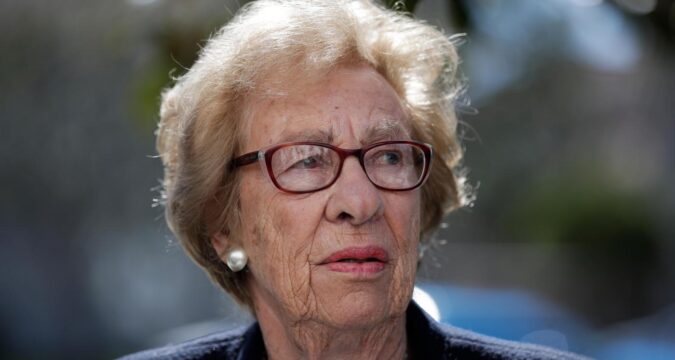
Holocaust survivor Eva Schloss, stepsister of Anne Frank, dies at 96
LONDON — Auschwitz survivor Eva Schloss, the stepsister of teenage diarist Anne Frank and a tireless educator about the horrors of the Holocaust, has died. She was 96.
The Anne Frank Trust UK, of which Schloss was honorary president, said she died Saturday in London, where she lived.
Britain’s King Charles III said he was “privileged and proud” to have known Schloss, who co-founded the charitable trust to help young people challenge prejudice.
“The horrors that she endured as a young woman are impossible to comprehend and yet she devoted the rest of her life to overcoming hatred and prejudice, promoting kindness, courage, understanding and resilience through her tireless work for the Anne Frank Trust UK and for Holocaust education across the world,” the king said.
Born Eva Geiringer in Vienna in 1929, Schloss fled with her family to Amsterdam after Nazi Germany annexed Austria. She became friends with another Jewish girl of the same age, Anne Frank, whose diary would become one of the most famous chronicles of the Holocaust.
Like the Franks, Eva’s family spent two years in hiding to avoid capture after the Nazis occupied the Netherlands. They were eventually betrayed, arrested and sent to the Auschwitz death camp.
Schloss and her mother Fritzi survived until the camp was liberated by Soviet troops in 1945. Her father Erich and brother Heinz died in Auschwitz.
After the war, Eva moved to Britain, married German Jewish refugee Zvi Schloss and settled in London.
In 1953, her mother married Frank’s father, Otto, the only member of his immediate family to survive. Anne Frank died of typhus in the Bergen-Belsen concentration camp at the age of 15, months before the end of the war.
Schloss did not speak publicly about her experiences for decades, later saying that wartime trauma had made her withdrawn and unable to connect with others.
“I was silent for years, first because I wasn’t allowed to speak. Then I repressed it. I was angry with the world,” she told The Associated Press in 2004.
But after she addressed the opening of an Anne Frank exhibition in London in 1986, Schloss made it her mission to educate younger generations about the Nazi genocide. Over the following decades she spoke in schools and prisons, at international conferences and told her story in books including “Eva’s Story: A Survivor’s Tale by the Stepsister of Anne Frank.”
She kept campaigning into her 90s. In 2019, she traveled to Newport Beach, California to meet teenagers who were photographed making Nazi salutes at a high school party. The following year she was part of a campaign urging Facebook to remove Holocaust-denying material from the social networking site.
“We must never forget the terrible consequences of treating people as ‘other,’” Schloss said in 2024. “We need to respect everybody’s races and religions. We need to live together with our differences. The only way to achieve this is through education, and the younger we start the better.”
Schloss’ family remembered her as “a remarkable woman: an Auschwitz survivor, a devoted Holocaust educator, tireless in her work for remembrance, understanding and peace.”
“We hope her legacy will continue to inspire through the books, films and resources she leaves behind,” the family said in a statement.
Zvi Schloss died in 2016. Eva Schloss is survived by their three daughters, as well as grandchildren and great-grandchildren.
https://www.chicagotribune.com/2026/01/05/eva-schloss-stepsister-anne-frank-obit/
Network Of Left-Wing Nonprofits Raced To Counter Trump’s Narrative Of Maduro Raid
Network Of Left-Wing Nonprofits Raced To Counter Trump’s Narrative Of Maduro Raid
Submitted by The Bureau’s Sam Cooper,
Within hours of the Trump administration’s surprise extraction operation in Venezuela, commentary surrounding President Nicolás Maduro’s arrest for alleged narco-state conspiracies metastasized into something Trump’s war cabinet could not control with stealth helicopters, radar jamming, or the world’s most effective special forces units: a narrative war in support of Maduro, waged at internet speed by organizations that already had templates, coalitions, and street logistics in place — and that have demonstrated well-oiled campaigns in support of causes such as Hamas, the Iranian regime, and China’s geopolitical aims in recent years.
Using the language of illegality, imperialism, sovereignty, and kidnapping, the narrative surged online and spilled into public demonstrations.
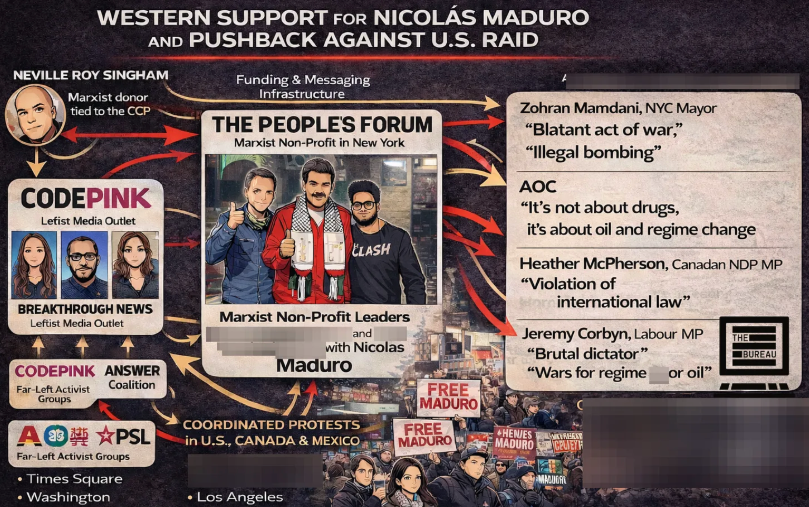
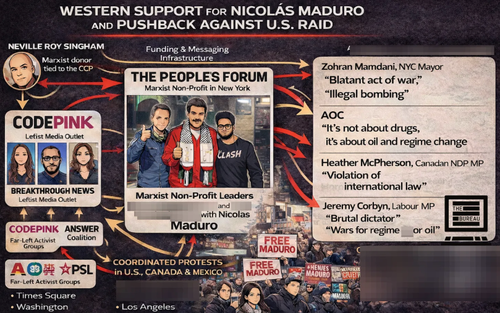
It came from a familiar set of hubs: the People’s Forum in Manhattan; Code Pink, a veteran anti-war group; and a set of allied media accounts including BreakThrough News that, for years, have moved from international flashpoint to international flashpoint with a consistent ideological lens.
It is a tightly aligned cluster of voices that reporting from The New York Times has connected previously to Marxist billionaire Neville Roy Singham, who lives in Shanghai and is part of Beijing’s global United Front funding and media-messaging ecosystem, according to reporting cited by U.S. Congressional leaders.
In the first hours after the raid, accounts associated with that ecosystem pushed a blunt claim: the United States had launched an “illegal bombing” of Caracas and carried out the “kidnapping” of Venezuela’s leaders — framing the operation less as a law-enforcement action than an imperial seizure.
The People’s Forum published early messaging calling the strikes “illegal,” and allied organizers circulated “Emergency” calls for rallies under a single slogan — “No War on Venezuela” — directing supporters to gather in public squares, including Times Square, and to replicate the model in dozens of cities.
Code Pink, amplifying the same call, promoted a national list of actions while issuing statements that described the U.S. operation as an “act of war” and a dangerous escalation.
By Monday, January 5, at least 100 pro-Maduro rallies had been documented across North America, with the bulk in the United States and additional events in Canada and Mexico, many clustered around a coordinated “day of action” on January 3–4.
EXPOSED 🚨 The “Hands Off Venezuela” protest taking place in New York City supporting Nicolas Maduro is being organized by ‘The People’s Forum’
The People’s Forum is a NGO that has received over $20 million dollars from a billionaire who lives in China with ties to the CCP
The… pic.twitter.com/q4Bu5r5b8w
— Wall Street Apes (@WallStreetApes) January 4, 2026
The organizing architecture was equally consistent: long-standing socialist and anti-war groups, including the Party for Socialism and Liberation, and mobilization infrastructure associated with The People’s Forum and BreakThrough News.
On Saturday, January 3, by daybreak, the message discipline was visible across platforms: the same “illegal” framing; the same sovereignty language; the same depiction of the raid as a prelude to regime change; the same mobilization graphics; the same cluster of organizations amplifying one another.
And as the protests moved from the screen to the street, a set of prominent elected officials—especially those aligned with the Democratic Socialists of America orbit and adjacent progressive coalitions—adopted language that strongly resembled the overnight framing pushed by these activist nodes.
Zohran Mamdani, the newly elected mayor of New York City, called the raid a “blatant act of war” and argued it violated “federal and international law,” adding that the United States was “bombing another country, kidnapping its president,” without congressional authorization.
Representative Rashida Tlaib of Michigan condemned what she called an “illegal and unprovoked bombing” and “kidnapping” — language that mirrored the slogans being broadcast by the activist coalition infrastructure.
Representative Alexandria Ocasio-Cortez, in posts that ricocheted across social media and were widely re-shared, framed the Trump administration’s Venezuela action not as a narcotics case but as a familiar American pattern: “It’s not about drugs,” she wrote. “It’s about oil and regime change,” casting the raid as “ratings & distraction” politics rather than enforcement.
North of the border, at least two Canadian New Democratic Party figures used closely aligned rhetoric. Heather McPherson, a senior NDP foreign-affairs critic, issued a condemnation that described the operation in the language of sovereignty and international law, warning against a U.S. escalation.
Don Davies, current NDP leader, argued publicly that the U.S. action lacked lawful authorization and amounted to aggression — a message that tracked closely with the activist coalition’s claims of illegality and imperial overreach.
From Britain, Jeremy Corbyn posted: “The US has launched an unprovoked and illegal attack on Venezuela. This is a brazen attempt to secure control over Venezuelan natural resources. It is an act of war that puts the lives of millions of people at risk — and should be condemned by anyone who believes in sovereignty.”
On the other side, representing Pax Americana, the bipartisan House Select Committee on the Chinese Communist Party moved almost immediately to cast the episode as a geopolitical victory over Beijing’s footprint in the Western Hemisphere. In a statement distributed by Representative John Moolenaar of Michigan, the committee’s chairman, the committee portrayed Maduro as “a Chinese ally.”
“China’s partnership with Maduro propped up an authoritarian ruler who worked with our nation’s adversaries and hurt the American people,” Moolenaar stated, adding, “China is actively working against us in Central and South America and those who choose to work with Xi Jinping should note that he could not save Maduro from defeat.”
Meanwhile, as the online battle over “kidnapping” and “illegal bombing” was still hardening into its first slogans, the Justice Department put a very different narrative into the public record — one that framed the same Venezuelan leadership the protest ecosystem was now defending as the apex of a long-running, hemispheric criminal enterprise, embedded in — and facilitating — a wider political economy of protection and profit along the cocaine route north.
In the superseding indictment unsealed in federal court in Manhattan, prosecutors alleged that Nicolás Maduro Moros and senior figures in his circle, including his wife, Cilia Flores, a powerful politician and lawyer seen by some Venezuelan journalists as the true brain behind Maduro’s brawn, abused positions of state power for more than a quarter century, corrupting Venezuelan institutions to move “tons” — and later “thousands of tons” — of cocaine toward the United States while enriching political and military elites.
Maduro and Cilia Flores are expected to make their first appearance in federal court in New York today.
The indictment alleges that between 2004 and 2015, Maduro and Cilia Flores trafficked cocaine — including shipments that Venezuelan law enforcement had previously seized — using armed military escorts and state-sponsored gangs known as colectivos to protect the operation and enforce discipline, including kidnappings, beatings, and murders of those who threatened the enterprise, which included multiple justice ministers.
The filing is explicit that Venezuela—while not a significant cocaine producer—became the predominant state-protected logistical hub in the Western Hemisphere for narcotics trafficking and money laundering, with alleged links to leftist narco-terror groups such as the Revolutionary Armed Forces of Colombia (FARC).
But Venezuela is not treated as an isolated narco-state. Prosecutors alleged that transshipment points in Honduras, Guatemala, and Mexico “relied on a culture of corruption,” in which traffickers paid portions of their profits to politicians who protected and aided them—and that those “cocaine-fueled payments” were then used to maintain and augment political power.
In its “overt acts” section — backed, prosecutors allege, by recorded meetings and DEA informants — the indictment sketches a pipeline in which narcotics profits were not only protected by political and military power, but used to fund political campaigns for Maduro’s network and Cilia Flores herself.
Between approximately 2014 and 2015, prosecutors alleged, a Venezuelan National Guard captain on Margarita Island coordinated hotels, transportation, women, and food for visits by Venezuelan officials — including Maduro’s son, Nicolás Ernesto Maduro Guerra (“The Prince”), who visited the island approximately twice monthly. Maduro Guerra, prosecutors alleged, arrived on a Falcon 900 owned by Venezuela’s state oil company, PDVSA, and before leaving, the plane would be loaded — sometimes with the assistance of armed sergeants — with large packages wrapped in tape that the captain understood were drugs.
Prosecutors also pointed to recorded-meeting evidence involving two relatives of Maduro Moros.
Between October 2015 and November 2015, the two men agreed during recorded meetings with DEA confidential sources to dispatch multi-hundred-kilogram cocaine shipments from Maduro Moros’s “presidential hangar” at the Maiquetía Airport.
In those recorded meetings, prosecutors alleged, the men said they were “at war” with the United States. They discussed the so-called “Cartel of the Suns,” which refers to generals, and their connection to a “commander for the FARC” who was “supposedly high ranked.”
They also indicated, prosecutors alleged, that they were seeking to raise $20 million in drug proceeds to support a campaign by Cilia Flores tied to the late-2015 National Assembly election — with one of the relatives referring to Maduro Moros as his “father” and stating they wanted him to “take control again” of the National Assembly.
Prosecutors noted that, in November 2016, the two Maduro relatives were convicted at trial of conspiring to import cocaine into the United States.
The filing also lays out a sequence of episode-level logistics that prosecutors appear to use as proof-of-method — the kind of granular detail meant to survive cross-examination.
For example, in 2006, prosecutors alleged, Venezuelan officials dispatched more than 5.5 tons of cocaine from Venezuela to Mexico on a DC-9 jet. They alleged that Diosdado Cabello Rondón, then-director of Venezuela’s military intelligence agency, and Hugo Armando Carvajal Barrios, a retired general and military intelligence boss under former president Hugo Chávez, and Venezuelan National Guard Captain Vassyly Kotosky coordinated the shipment with other regime members. Carvajal Barrios, prosecutors noted, pleaded guilty in June 2025 to narco-terrorism.
The cocaine, prosecutors alleged, was transported in approximately five vans to the hangar reserved for the Venezuelan president at Simón Bolívar International Airport in Maiquetía, where members of the Venezuelan National Guard loaded it onto the plane, which departed using a flight plan National Guard Captain Vassyly Kotosky approved in exchange for bribes.
Prosecutors also alleged direct Venezuelan state-to-Colombian insurgent dealings in the form of weapons and safe-passage facilitation.
In 2007, prosecutors alleged that, at former general and military intelligence leader Carvajal Barrios’s direction, Venezuelan General Cliver Alcalá Cordones delivered to FARC leadership four crates of weapons from the Venezuelan government, including 20 grenades and two grenade launchers. Prosecutors noted that Alcalá Cordones pleaded guilty in June 2023 in New York to conspiring to provide material support to the FARC, a designated foreign terrorist organization.
And prosecutors alleged that between 2022 and 2024, Cabello Rondón, then-director of Venezuela’s military intelligence agency, regularly traveled to clandestine airstrips controlled by Colombia’s National Liberation Army, a leftist guerrilla insurgency, near the Colombia-Venezuela border to ensure cocaine’s continued safe passage in Venezuelan territory.
From these jungle airstrips, the cocaine was allegedly dispatched out of Venezuela both on flights approved by Venezuelan military officials and on clandestine flights designed to avoid detection by law enforcement or militaries in South and Central America.
Contours of Iranian, Russian, and Chinese backing in Latin proxy states
Taken together, the filing’s theory is that the raid’s targets are not merely accused traffickers, but alleged architects of a state-backed system in which official status, diplomatic cover, military logistics, armed gangs, and bribery are fused into an enterprise that, prosecutors allege, is mirrored by — and financially interlocks with — corrupt political protectors and elites across the Western Hemisphere, where the Trump administration has vowed to reassert its political and security dominance.
In one of the more recent episodes described in the superseding indictment, prosecutors connect Maduro’s alleged state-protected trafficking apparatus to Héctor Guerrero Flores, known as “Niño Guerrero,” whom they identify as the leader of Tren de Aragua.
The filing alleges that between roughly 2006 and 2008, Guerrero Flores worked with Walid Makled, described as one of Venezuela’s largest traffickers, and that members of the Venezuelan regime helped protect Makled’s cocaine shipments as they moved from San Fernando de Apure to Valencia, before being flown from Valencia’s international airport to Mexico and other points in Central America for eventual distribution to the United States.
The superseding indictment does not name Tareck El Aissami, the longtime Venezuelan power broker who served as interior and justice minister and later held senior national posts. But Makled’s trafficking network has been tied to El Aissami in separate U.S. government action: in 2017, the U.S. Treasury Department sanctioned El Aissami under the Foreign Narcotics Kingpin Designation Act, alleging that he received payment for facilitating drug shipments linked to Makled and tying him to coordination and protection for other traffickers, including shipments connected to Mexican cartel networks.
Beyond the narcotics record, El Aissami has also been the subject of sustained security analysis that has pointed to Venezuela’s deepening ties with Middle Eastern state and non-state actors — particularly Iran — and to allegations that Hezbollah-linked facilitators exploited identity-document systems in Venezuela.
The Justice Department’s superseding indictment against Maduro and his co-defendants does not allege an operational Iran or Hezbollah role as part of the charged conspiracy.
Still, the broader Western Hemisphere dimension of Venezuela’s alleged networks — and the way Latin American power can be leveraged by larger hostile states — has been underscored in pointed political commentary from Canada.
In a post on X, Jason Kenney, the former Conservative federal immigration minister, offered a broader national-security frame to the Justice Department’s portrait of Venezuela as a protected trafficking platform.
Kenney said that while in office he received one of the most “fascinating” briefings of his tenure — from a foreign intelligence agency — on connections between Venezuela and Hezbollah, which he called an Iranian terror proxy. He said the officials “showed me the receipts.”
Kenney said he was walked through an alleged pipeline in which the Venezuelan regime imported raw cocaine sourced from the Revolutionary Armed Forces of Colombia, then worked with the Quds Force of Iran’s Islamic Revolutionary Guard Corps to ship it on “dark” aircraft to Beirut. There, he wrote, the drugs were processed in Hezbollah facilities in Lebanon’s Bekaa Valley, then shipped onward to Europe, with proceeds used to finance Hezbollah operations, including weapons procurement. When he questioned how an Islamic movement could justify narcotics trafficking, Kenney said he was shown religious rulings that treated drug sales to nonbelievers — and the use of the profits to fund “the struggle” — as permissible.
He added that the same briefing described Canada as a weak link in the Latin-Iranian laundering chain: Hezbollah-linked actors, he wrote, were said to be buying stolen vehicles with cash from criminal gangs and shipping them out of the Port of Montreal for resale in West Africa. This is a system first exposed in prior reporting from The Bureau, sourced from senior U.S. officials who complained Canada’s federal police stonewalled Washington’s DEA unit requests to crack down on the Hezbollah networks set up in Canadian laundering hot spots from Windsor and Toronto and Montreal to Vancouver, Halifax, and elsewhere.
The Bureau’s sources in the U.S. said they assessed Hezbollah agents in Latin America were making calls that suggested leaders of the drug trafficking schemes were in Canadian cities. Recent Canadian government reporting has generally affirmed the vulnerabilities.
Kenney also said the foreign intelligence service’s broader concern was that Canada was being too lax in permitting Iranian and Hezbollah agents to enter the country — a warning he said prompted a 2008 trip to Damascus to work with Canadian officials on tougher visa screening for applicants from Lebanon and Iran.
Kenney argued that cooperation between Caracas and Tehran has only deepened since then, pointing to Iran’s support for Venezuela with arms, oil-sector assistance, and help marketing sanctioned crude — and casting Venezuela as an Iranian base of operations in the Western Hemisphere. His conclusion was blunt: stable democratic governments in both Iran and Venezuela, he wrote, would represent a major gain for global peace and security, including for Canada.
And in a post responding to The Bureau’s prior reporting on the superseding Maduro indictment, Senator Leo Housakos, Conservative Party leader in the Senate, argued that “the evidence has been clear for years” that Beijing has aligned itself with dictators across Central and South America, using Venezuela, Cuba, and other authoritarian partners, he wrote, “as a base” to project pressure against North America.
He framed those “attacks” as a blend of drug trafficking, illegal immigration, money laundering, and a sustained campaign of misinformation aimed at Western democracies — and cast China’s Communist Party as “leading the way” for a broader bloc that includes Russia, Iran’s Islamic Revolutionary Guard Corps, and Turkey, in what he described as an effort to undermine free societies.
The cumulative effect, he warned, is a threat environment democracies “haven’t seen since” the Second World War.
That message is bolstered by Congressional leader John Moolenaar’s statement, in which he said the CCP Select committee will continue “to investigate how China is trying to threaten America’s national security interests in the Western Hemisphere, and we will work within Congress and alongside the Trump Administration and our allies to prevent it.”
So this is the collision of ideologies and contested facts that will be adjudicated in two different venues, under two different standards.
One part — the Justice Department’s allegations about trafficking, corruption, and violence — is designed to be tested in court, by evidence rules, cross-examination, and the burden of proof.
The other part — the “kidnapping” and “illegal bombing” narrative, the sovereignty or imperialistic regime change frame, will be tested in a different tribunal: the court of public opinion, where legitimacy is fought out through media ecosystems, protest turnout, and, ultimately, elections, in nations that allow citizens to choose their governments.
Tyler Durden
Mon, 01/05/2026 – 20:55

In college finale, Marist alum Le’lani Harris gets down to business for unbeaten St. Francis. ‘Worked so hard.’
The college basketball career of Le’lani Harris is coming to an end in a few months.
Harris, a 5-foot-10 senior guard and Marist product, will graduate from St. Francis in Joliet with a bachelor’s degree in marketing. But there’s still more business for her to take care of this winter.
“I’m excited to end my career here,” she said. “There’s no place else I would rather be.”
Before she puts on the cap and gown and enters the business world, Harris and her teammates want the undefeated Saints to make a deep run in the NAIA Tournament.
St. Francis (16-0) was ranked No. 17 in the nation in the Nov. 26 poll by the NAIA’s coaches. The Dec. 17 poll wasn’t released and the next poll is scheduled for Jan. 14.
Since the last poll, the Saints won 10 straight games and scored 100 or more points three times, including Saturday’s 119-33 win over Mount Mary and a 103-44 win on Dec. 28 over East-West.
Harris, who leads the team in scoring by averaging 15.4 points, is happy with the red-hot Saints.
“We worked so hard during the summer and during the season and it’s really nice to see it come to fruition for us,” she said. “We liked what we’ve done so far and we need to keep it going.
“I knew we had it in us. Last year didn’t end like we wanted it to, and we all had a chip on our shoulder.”
Last season, the Saints finished 25-8 but lost to Dordt 73-48 in the second round of the NAIA Tournament. Dordt went on to win four more games to claim the national championship.
St. Francis guard Le’lani Harris, left, looks for an open teammate against East-West during a nonconference game in Joliet on Sunday, Dec. 28, 2025. (Jeff Vorva / Daily Southtown)
Harris, an Oak Lawn native, actually missed a chunk of her sophomore season with a knee injury but has returned with a consistent vengeance, also averaging 15 points a game as a junior.
She delivered a 34-point performance on Dec. 17 in a 91-65 win over Clarke.
“Le’lani has been a great leader for us,” St. Francis coach John McGinty said. “She does a really good job of holding players accountable for us.
“She’s battling that thing every day with her knee to rehab that thing. But she’s back to playing at a high level and I’m happy that she is seeing that ball go through the net.”
St. Francis guard Mia Kennelly, middle, tries to dribble out of trouble against East-West in a nonconference battle in Joliet on Sunday, Dec. 28, 2025. (Jeff Vorva / Daily Southtown)
The roster and coaching staff for the Saints have plenty of Southland talent.
The roster features Taylor Schergen (De La Salle), Alainna Poisson (Marian Catholic), Laurelei Thormeyer (Providence) and Mia Kennelly (Oak Lawn).
McGinty was an assistant boys coach at St. Laurence. USF assistants Jimmy Copenhaver (Providence), Janae Poisson (Marian) and Hanna Swiatek (Mother McAuley) are also on board.
Kennelly and Harris also have an interesting backstory. Before high school, the two had some fun battles, with Kennelly going to grade school at St. Gerald and Harris at Queen of Martyrs.
“There was always a good turnout when we played,” Harris said. “Whenever we played them, we had to shut Mia down. That was hard to do and it still is.”
After Harris’ injury and Kennelly missing the 2024-25 season with a hip injury, they are both finally getting a lot of time on the court together.
“We mesh pretty well,” Kennelly said of Harris. “Coming back and being able to play with Le’lani and the other seniors is great and our record is amazing.”
And who knew that the two rivals from grade school would grow up and help build a national college powerhouse?
“Lani is one of the best teammates I’ve ever played with,” Kennelly said. “She’s always picking us up in practice. If my confidence is low, she’s always picking me up.”
Jeff Vorva is a freelance reporter for the Daily Southtown.
https://www.chicagotribune.com/2026/01/05/lelani-harris-marist-st-francis-womens-basketball/
Thune’s Quiet Deal With Trump: Power Without The Drama
Thune’s Quiet Deal With Trump: Power Without The Drama
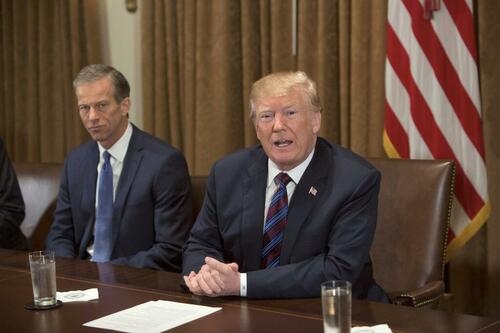
One year after taking over as Senate Majority Leader, John Thune has answered the question many skeptics were asking: could an old school , process-oriented senator function under President Donald Trump?
(Chris Kleponis – Pool/Getty Images)
The answer is yes – Thune is going full send on Republican initiatives, providing Trump with an arsenal of wins to brag about as we head into midterms.
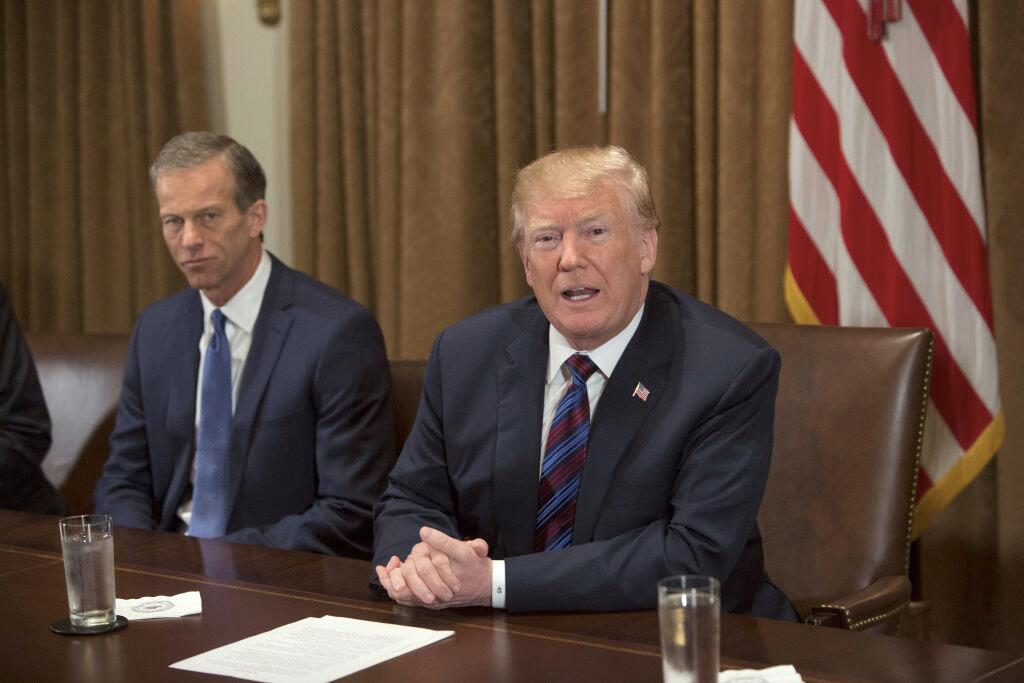
Trump of course dominates the headlines – using his bully pulpit to excoriate enemies, while steamrolling those who step out of line with ‘revised’ agenda like MTG and Thomas Massie. Apparently he’s made Foreign Intervention Great Again (with some arguing that removing Maduro denied foreign adversaries a foothold in the region).
And while mainstream MAGA twists itself into a pretzel to justify the whiplash, Thune has been quietly running the Senate the way it has long been run – using majorities, rules, and procedural control to move legislation and nominations efficiently, Punshbowl News reports following an interview with Thune marking his first year as GOP leader.
When Thune replaced Mitch McConnell, pundits assumed that friction with the executive branch was a foregone conclusion. Thune’s skepticism of tariffs, his attachment to Senate norms, and his discomfort with public political combat seemed ill-suited to a president who thrives on chaos as a tool to apply pressure. Instead, he’s making hay while the sun shines.
In 2025, Senate Republicans passed a sweeping tax-and-spending-cut bill, confirmed Cabinet nominees at a historic pace, and altered Senate rules to accelerate nominees stalled by Democratic obstruction. These were not concessions extracted by Trump so much as long-standing Republican priorities that moved once political obstacles were cleared.
Trump supported the outcomes. Thune managed the process.
“I feel like I’ve gotten to a point where [Trump] respects enough how I view the world and look at these issues,” Thune told Punchbowl. “And he has an understanding that I want what’s in his and our best interest. Let’s talk about the things we can do and not the things we can’t.”
The boundaries of the relationship are most visible in what Thune has refused to do. Despite pressure from Trump and his allies, he has not eliminated the filibuster or abandoned the blue-slip process for judicial nominees. Those guardrails remain intact, but they remain intact alongside rapid confirmations, large spending packages, and of course – they need Trump’s signature at the end of the day.
Rather than confronting Trump publicly when disagreements arise, Thune has chosen to raise concerns privately. He has said he prefers to “not litigate these things in public.”
Democrats argue they no longer trust Thune, accusing him of failing to push back when Trump pressures Congress on spending and funding decisions. Republicans complain that Thune is too cautious and too deferential to process. Thune’s response is essentially the same to both: public resistance is not how power operates in the current environment.
“The president has his way of doing things,” Thune said. “We’ve got to figure out how to work around that.”
Meanwhile, Thune continues to pursue bipartisan deals on housing, market structure, and permitting reform, and he has left the door open to a limited Obamacare compromise. He has acknowledged how difficult legislating has become in a polarized, election-year environment, calling these “not normal times.”
Tyler Durden
Mon, 01/05/2026 – 20:30
https://www.zerohedge.com/political/thunes-quiet-deal-trump-power-without-drama

Prediction Markets Move Into Real Estate With Polymarket–Parcl Deal
Prediction Markets Move Into Real Estate With Polymarket–Parcl Deal
Authored by Nate Kostar via CoinTelegraph.com,
Parcl and Polymarket have partnered to launch real estate prediction markets that will settle against Parcl’s daily housing price indexes, bringing housing price data into prediction markets for the first time.
Under the partnership announced Monday, Polymarket will list and operate markets tied to movements in housing price indices, while Parcl will supply the index data used to determine market outcomes and settlement values.
Each market will link to a Parcl resolution page showing the final settlement value, historical index data and the methodology used to calculate the index, providing a standardized reference for verifying outcomes once markets close.
The initial rollout will focus on major US housing markets, with contracts structured around whether local home price indexes rise or fall over set periods, as well as threshold-based outcomes tied to published index levels.
The companies said the rollout will occur in phases, beginning with a limited set of high-liquidity US cities and expanding to additional markets and contract types over time.
Parcl, a platform founded during the early months of the COVID-19 pandemic when housing markets became volatile, publishes real-time housing price indexes and analytics and operates onchain products tied to residential real estate prices, using Solana for settlement.
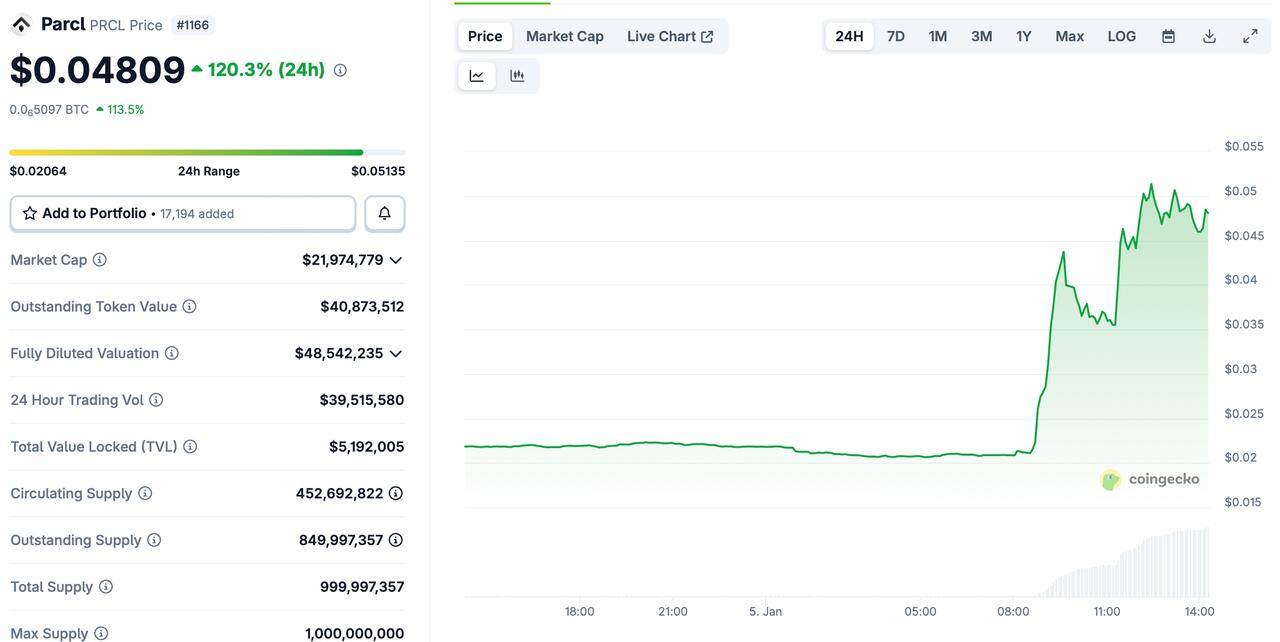
Parcl’s native token, PRCL, was up about 120% over the past 24 hours at time of writing, according to CoinGecko data.
Source: CoinGecko
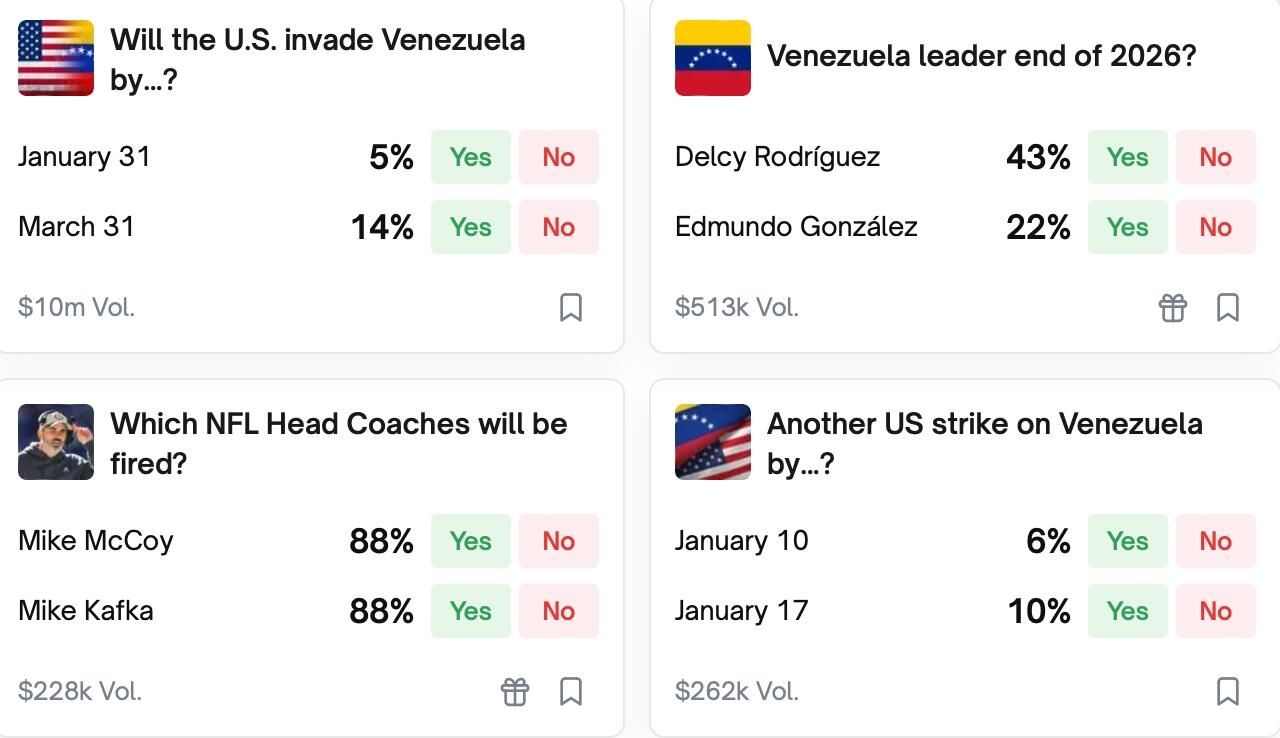
Polymarket is a prediction market platform where users trade on real-world events, ranging from sports and politics to forecasts for Bitcoin’s price on a given date.
Prediction markets expand in 2025-2026
After a surge in user activity during the 2024 US presidential election, prediction markets such as Kalshi and Polymarket became a mainstream narrative in crypto in 2025.
Polymarket bets. Source: Polymarket
Both platforms secured high-profile partnerships during the year, including Kalshi’s deal with CNBC and Polymarket’s partnerships with DraftKings, the Ultimate Fighting Championship and PrizePicks.
In September, Polymarket was reported to be weighing a US launch while seeking new funding at a valuation of up to $10 billion. The discussions followed a reported $200 million raise in June led by Founders Fund, the investment company co-founded by Peter Thiel.
In November, Kalshi was reported to have raised $1 billion, valuing the company at roughly $11 billion, with Sequoia Capital and CapitalG leading the round. The raise followed a $300 million funding round in October.
Tyler Durden
Mon, 01/05/2026 – 20:05
https://www.zerohedge.com/technology/prediction-markets-move-real-estate-polymarket-parcl-deal
Trump Flips, Has More Info: Ukraine Didn’t Target Putin Residence With Drones
Trump Flips, Has More Info: Ukraine Didn’t Target Putin Residence With Drones
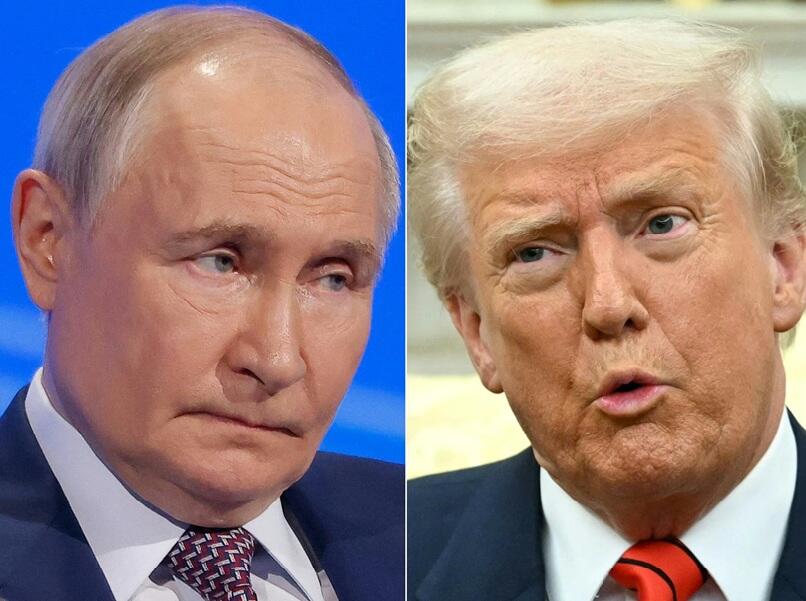
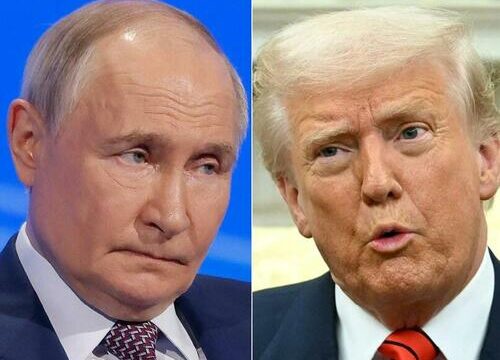
President Trump has now made clear that he has reversed his position on the alleged Ukrainian massive drone attack on Russian President Putin’s residence last week.
Trump explained to reporters that he’s now been given a chance to be presented with more information, based on intelligence briefings and other undisclosed data which has come to light. He says Ukraine was not responsible, after previously seeming to agree with Kremlin allegations, which Trump had earlier called “deeply concerning”.
The US President explained American officials had determined that Ukraine did not do it. According to his newest remarks:
Trump said that “something happened nearby” Putin’s residence but that Americans officials didn’t find the Russian president’s residence was targeted.
“I don’t believe that strike happened,” Trump told reporters as he traveled back to Washington on Sunday after spending two weeks at his home in Florida. “We don’t believe that happened, now that we’ve been able to check.”
On December 29 Russian Foreign Minister Sergey Lavrov said that Ukraine launched multiple drones toward Putin’s official residence in the northwestern Novgorod region, describing that the drone wave was in the dozens, but that Russian air defenses intercepted all them.
The timing was further interesting given that just the day prior Ukrainian President Volodymyr Zelensky visited Florida to meet Trump at his Mar-a-Lago estate to take up the issue of the stalled 20-point peace plan.
As for this week, the whole world is talking about Trump’s removal of Venezuelan President Maduro by military force, which likely also had elements of a coup from within, based on Venezuelan officials cooperating with the CIA and US military.
This Latin American intervention against a Putin ally is likely to further complicate talks to achieve Ukraine peace.
The Kremlin has already blasted the blatant ‘double standard’ – given Washington has spent years berating Moscow for the Ukraine ‘special military operation – yet now effortlessly invades a country in its own backyard.
Now, after the US intervention against Venezuela, Putin will see less incentive in making any kind of peace deal which falls anything short of Russia’s complete and maximalist demands.
China could also get more aggressive in its anti-Washington rhetoric, as its citizens have been loudly highlighting American hypocrisy on the Taiwan issue.
Tyler Durden
Mon, 01/05/2026 – 19:40