Category: News

Jueza posterga juicio a hijo de Rob Reiner, acusado de matar a sus padres
Por ANDREW DALTON
LOS ÁNGELES (AP) — Una jueza aplazó el miércoles la lectura de cargos de Nick Reiner por el asesinato de sus padres, Rob Reiner y Michele Singer Reiner, después de que su abogado solicitara ser reemplazado por un defensor público.
La jueza Theresa McGonigle accedió a la solicitud del abogado Alan Jackson durante una audiencia en la que Nick Reiner iba a ser procesado e iba a dar declaración. Jackson no explicó por qué quería dejar el caso.
McGonigle entonces aplazó la lectura de cargos hasta el 23 de febrero.
Durante su breve aparición en la Corte Superior de Los Ángeles el miércoles, Nick Reiner vestía un uniforme de preso marrón y tenía el cabello rapado. Su aparición se produjo tres semanas y media después de que el querido actor-director y su esposa de 36 años fueran encontrados asesinados a puñaladas en su hogar en la exclusiva zona de Brentwood en Los Ángeles.
McGonigle aprobó el uso de cámaras dentro de la sala del tribunal, pero dijo que no se podían tomar fotos del acusado.
Nick Reiner, de 32 años, el tercero de los cuatro hijos de Rob Reiner, ha estado detenido sin fianza desde su arresto el mes pasado, horas después de que sus padres fueran encontrados muertos. Fue acusado dos días después de dos cargos de asesinato en primer grado.
Tampoco presentó una declaración durante una breve primera aparición en la corte el 17 de diciembre, cuando llevaba grilletes y un chaleco de prevención de suicidios. No llevaba ese chaleco el miércoles.
Jackson no había dado indicios de los planes para su defensa. Antes de que la jueza lo retirara del caso, Jackson le dijo a la jueza que había 10 citaciones pendientes en la investigación de la defensa. La jueza le puso el secreto a la lista de personas y acordó que aún no era necesario compartirla con la fiscalía.
La defensora pública adjunta Kimberly Greene fue asignada como la nueva abogada de Nick Reiner.
Hace una década, Nick Reiner habló públicamente sobre sus luchas con la adicción y problemas psiquiátricos después de hacer una película con su padre, “Being Charlie”, que estaba vagamente basada en sus vidas.
Rob Reiner, de 78 años, y Michele Singer Reiner, de 70, fueron asesinados temprano en la mañana del 14 de diciembre, y fueron encontrados a última hora de la tarde. El médico forense del condado de Los Ángeles dijo en los hallazgos iniciales que murieron por “múltiples heridas de fuerza cortante”, pero no se dieron más detalles, y la policía no ha dicho nada sobre posibles motivos.
Jackson es un exfiscal del condado de Los Ángeles que representó a Harvey Weinstein en su juicio en Los Ángeles y a Karen Read en sus juicios en Massachusetts. Después de la audiencia inicial de Reiner, Jackson calificó el caso como “una tragedia devastadora”. Dijo que los procedimientos serán muy complejos y pidió considerarlos “sin juicio apresurado”.
Los cargos contra Reiner incluyen circunstancias especiales de múltiples asesinatos y una acusación de que usó un arma peligrosa, un cuchillo. Las adiciones podrían significar una sentencia mayor.
Los fiscales han dicho que aún no han decidido si buscarán la pena de muerte.
La fiscalía está siendo dirigida por el fiscal adjunto del distrito Habib Balian, cuyos casos recientes incluyeron el intento de resentencia de los hermanos Menéndez y el juicio de Robert Durst.
Rob Reiner fue un director prolífico cuyo trabajo incluyó algunas de las películas más memorables y eternamente disfrutables de las décadas de 1980 y 1990. Sus créditos incluyeron “This is Spinal Tap”, “Stand By Me”, “A Few Good Men” y “When Harry Met Sally”, durante cuya producción conoció a Michele Singer, una fotógrafa, y se casó con ella poco después.
___________________________________
Esta historia fue traducida del inglés por un editor de AP con ayuda de una herramienta de inteligencia artificial generativa.

Gary council elects new leadership, hears financial data
In its first meeting of 2026, the Gary Common Council saw shake ups in its leadership and heard a presentation detailing the city’s economic outlook, especially after legislative changes last year.
Councilwoman Linda Barnes Caldwell, D-5th, was elected president in a 5-4 vote Tuesday night. Council members Mary Brown, D-3rd; Barnes Caldwell; Darren Washington, D-at large; Kenneth Whisenton, D-at large; and Dwight Williams, D-6th, all voted for the former parliamentarian.
“I would like to take the opportunity to thank my colleagues for supporting me as president for 2026,” Barnes Caldwell said during Tuesday’s meeting. “I plan to make you proud.”
Councilwoman Lori Latham, D-1st, also received votes from herself and council members Dwight Halliburton, D-2nd; Marian Ivey, D-4th; Myles Tolliver, D-at large. Latham previously led the council, taking over in February after a Democratic party caucus chose former President Tai Adkins to serve as Calumet Township trustee.
Latham also served as vice president, and no one filled the position after she took over as president.
Washington was elected vice president Tuesday night, receiving votes from himself, Barnes Caldwell, Brown, Whisenton and Williams. Tolliver was also nominated and received votes from himself, Halliburton, Ivey and Latham.
“I also want to thank my colleagues for electing me vice president, but I also personally want to say thank you to Councilwoman Lori Latham,” Washington said. “You stepped in, became our president and led our council, and for that, I want to say thank you. … Thank you for stepping in and taking the bull by the horns.”
Whisenton is the council’s new parliamentarian, taking over the position from Barnes Caldwell.
Following the reorganization, Latham introduced representatives from Baker Tilly Municipal Advisors, a financial advisory firm, who presented a city economic model overview.
“At the beginning of last year or maybe even the year before that, we established an idea that for the legacy of the council, we wanted to leave the city in a better financial situation than we found it in,” Latham said.
Baker Tilly’s presentation looked at Gary’s historical financial situation, including the city’s tax rates and how much of its budgeted money is disbursed. The firm also gave recommendations for the city’s financial future.
“We do not take our engagements lightly, and this is the first significant engagement we’ve had with the city,” said Andre Riley, principal at Baker Tilly.
In the presentation, Baker Tilly found that the city’s local income tax increased steadily between 2021 and 2025, growing about 23%. The firm also found that the city spent $15 million less annually than what was budgeted in 2022, 2023 and 2024.
City tax rates decreased between 2021 and 2025, but Gary’s net assessed property values increased by 41% between 2021 and 2026, according to Baker Tilly.
Eric Walsh, principal and municipal advisor for Baker Tilly, presented estimated fund results for the city, with estimates from 2025 to 2029. Walsh expects the general fund to continue growing through 2029.
Senate Enrolled Act 1 will impact the city and other Indiana communities, Walsh said, and all existing local income tax rates will expire on Dec. 31, 2027. If the city implements a 1.2% tax rate in 2027, Baker Tilly estimates that the local income tax impact would be neutral.
Public safety and CEDIT funds will end in 2028 because of SEA 1, Walsh said, and the council will have the option to pass the municipal income tax.
Washington previously told the Post-Tribune that he was concerned the legislation could have unprecedented consequences for Gary, and he was worried that the city would have to implement a local income tax on top of Lake County’s tax to fund its resources.
The majority of Gary’s tax dollars come from homeowners, according to Post-Tribune archives, and the city doesn’t have enough money to make up for the property tax relief, Washington said.
Baker Tilly encourages the Gary Common Council to consider the potential budget impacts of SEA 1 before making decisions, including adding a municipal local income tax in 2027. The firm also encourages the council to look for other revenue replacements within the city.
House Enrolled Act 1448 went into effect during the session for the 2026 budget, according to Post-Tribune archives, which requires Gary to pay more than $12 million to East Chicago and Michigan City after a state comptroller mistake that was supposed to address the financial burden after the move of Majestic Star casinos.
Gary owes more than $6.4 million to East Chicago and more than $5.7 million to Michigan City, and payments will start this year. Money will be deducted from state comptroller funds and money appropriated by the Indiana General Assembly, and funds will be withheld for 10 years.
House Enrolled Act 1448 was not included in Baker Tilly’s presentation.
mwilkins@chicagotribune.com
https://www.chicagotribune.com/2026/01/07/gary-council-elects-new-leadership-hears-financial-data/
Trump-Defying Conservatives Shower Massie With Cash After President’s Latest Rant
Trump-Defying Conservatives Shower Massie With Cash After President’s Latest Rant
In a new iteration of a seemingly self-defeating tactic, President Trump’s latest social media rant against Republican Rep. Thomas Massie has triggered a deluge of contributions to the man Trump has targeted for a primary challenge in May. However, with three billionaires on his side, Massie’s challenger is building a formidable war chest, making this — at least in dollar terms — the most serious challenge he’s faced to date.
On Monday, Trump used a lengthy Truth Social post to reiterate his endorsement of Massie’s primary challenger, Ed Gallrein, a donor to Sen. Lindsey Graham and former Navy SEAL. Trump called Massie “the Worst ‘Republican’ Congressman we have had in many years…a Weak and Pathetic RINO.” In his parting shot, Trump accused Massie of insufficient affection for a foreign country, calling him “a true hater of Israel.”
It happened again today! Why do I get attacked weekly? Because I’m the only Republican who refuses to rubber stamp foreign aid, endless deficits, and unnecessary wars. I’m also exposing sex traffickers.
My primary is in May. Please help if you can: https://t.co/AgJY01IWPL pic.twitter.com/AAHNPtCU8H
— Thomas Massie for Congress (@MassieforKY) January 6, 2026
Though Trump urged “all MAGA Warriors” to rally behind Gallrein, money immediately started flowing into the Massie campaign. In a Tuesday evening post on X, Massie celebrated having received over $41,000 in donations from 667 people in 24 hours. “Maybe we schedule a tweet from Donald Trump every week … because every time he does it, it boosts my fundraising,” Massie previously told the Cincinnati Enquirer.
If past remarks in the ZeroHedge comment section are any indication, there are people for whom each Trump attack on the libertarian-minded Kentuckian is something akin to the Bat-Signal, spurring them to chip in a little more money to Massie’s re-election campaign. “I donate to Massie every time I learn about a new attack on his House seat by Trump or the Israel-Firsters,” one such commenter wrote after the Trump team launched a SuperPAC focused solely on ousting Massie. The commenter likened his donations to the “Money Bomb” events used to solicit large numbers of small-dollar donations to Ron Paul’s presidential campaigns.
Though it’s called the “MAGA Kentucky” PAC, federal filings revealed the anti-Massie PAC was funded entirely by three Israel-backing billionaires who live somewhere else: Miriam Adelson, John Paulsen and Paul Singer initially poured in a combined $2 million. On top of that PAC stash, Gallrein’s campaign last week announced it raised $1.2 million in 2025’s fourth quarter.
On the other side of the board, Massie’s campaign had a little over $2 million on hand as of Sep 30, and Massie now has his own out-of-state billionaire in his corner: Jeff Yass, co-founder and managing director of trading-and-tech firm Susquehanna International Group, gave the Massie-backing Kentucky First PAC $1 million on Oct. 23.
Thomas Massie tonight says DOJ is citing laws that don’t apply to hide key parts of the Epstein files: “They’re still trying to protect billionaires, politically connected people, and trying to obscure the involvement of our own intelligence agencies.” pic.twitter.com/kmuOg6QPWJ
— Ron Filipkowski (@RonFilipkowski) January 7, 2026
Massie has clashed with Trump on a variety of issues. He’s been leading the drive to force the release of the Epstein files — which Trump now calls a “Democrat hoax.” He has routinely opposed US aid to Israel and condemned Trump’s decision to join Israel’s war on Iran in June. He first notably triggered Trump’s wrath in March 2020, when Massie tried to derail the $2 trillion Covid relief bill, and he’s continued to resist Trump’s other big spending initiatives, such as 2024’s Big Beautiful Bill. A fiscal hawk, the MIT graduate built his own digital lapel pin that tracks the growing national debt in real time.
The Kentucky primary is 132 days away — on May 19. While there are no recent, credible, public polls on the race, Massie says he’d confident he’ll win, and that, in the face of what’s shaping us a grim midterm for the Republican Party, the Trump Team is squandering scarce resources:
There’s still time for him to tell his henchmen not to spend millions against me that they could otherwise spend to keep the majority.
— Thomas Massie for Congress (@MassieforKY) January 6, 2026
Tyler Durden
Wed, 01/07/2026 – 13:15

President and CEO of Chicago History Museum is stepping down
The Chicago History Museum announced Wednesday that its president and CEO Donald E. Lassere is resigning.
Lassere had held the post since April 2021, coming to Chicago from the Muhammad Ali Center in Louisville, Kentucky.
According to the announcement from the museum’s board of directors, Michael Anderson, currently vice president of external engagement and development, will serve as interim president and CEO as the board conducts a national search for a successor. Anderson has worked at the CHM for 12 years.
“We appreciate Donald’s stewardship, and know he will thrive in whatever path he chooses,” board chair Warren Chapman said in part in a statement.
dgeorge@chicagotribune.com
https://www.chicagotribune.com/2026/01/07/president-history-museum-resigns/

Oak Lawn ice arena to reopen with new look on Jan. 14
After closing in March for $4 million of renovations, the Oak Lawn Park District’s ice arena is scheduled to be back up and running by Jan. 14.
Visitors to arena at 9320 S. Kenton Ave., including hockey teams, figure skaters and those looking to rent skates, will notice a fresh ice surface, new dashboards, glass and perimeter netting.
“Being a part of the Park District, this is such a unique amenity to the community of Oak Lawn — we’re really happy to provide that,” marketing manager Justin Waters said Tuesday. “A lot of people have been asking and are excited about it, and we’re just trying to match that excitement when people come through the doors.”
The ice arena was originally planned to reopen in September, as part of larger scale park facilities improvements totaling $15 million. Upgrades of the community pavilion are complete while the Racquet, Fitness & Gymnastics Center will face a several week closure for construction this year.
Michael Sinkewich, general manager of the ice arena, said the ice rink and mechanical equipment, which were installed in 1994, are due for upgrades. While many renovations won’t be visible to the general public, such as switching out the ice rink base from a sand floor to a concrete floor, the Park District also worked to improve the overall atmosphere.
Sinkwich said the first thing people will notice will be a large graphic on the entrance window showing off Park District community partnerships.
“As soon as they walk up, they’ll see it and be like, OK, we know this is a nice arena,” Sinkwich said.
The ice arena is the home rink for St. Jude Elementary School and Brother Rice High School hockey players and local figure skating groups, Sinkwich said. Practices and open skates will resume as soon as the ice arena reopens.
Workers replaced all benches in the ice arena lobby and added graphics to columns. (Oak Lawn Park District)
The Park District will also add graphics on columns inside to thank the teams for their loyalty over the years.
“We wanted to make them feel like they were at home when they came in and feel like it’s a home ice advantage,” Sinkwich said. “We’re a community rink, part of a Park District, so our community feel feels really important to us.”
The Park District offers its own figure skate rentals and is adding hockey skate rental options as part of the upgrades. The arena’s front lobby was also opened up, as a barrier wall previously closed off the lobby from the front entrance, Sinkwich said.
Workers replace the Oak Lawn Park District ice arena’s ice surface Dec. 3, 2025. (Oak Lawn Park District)
“It’s a wide open space now, so it gives it a more open feeling,” he said.
The Park District replaced all of the lobby’s benches, desks and carpeting as well as bleachers and dash boards at the ice rink. Penalty boxes and the scorer’s table were moved to the opposite side to allow more more foot traffic near the lobby.
Sinkwich said he’s excited to see community members back at the ice arena “and have them experience a fresh sheet of ice and see all the new features that we added.”
Marcos Estrada opened Valor Jiu Jitsu
The last major renovations were in 2005, and replacing mechanics in the ice arena, community pavilion and Racquet, Fitness & Gymnastics Center were necessary to prevent potential emergency closures, Park District Executive Director Tom Hartwig told the Daily Southtown in April.
He said an architectural assessment discovered priority systems replacements and two community surveys showed residents wanted surface level improvements. The Park District secured $15 million budget in alternate revenue bonds to cover the entire project because the district settled all its long-term debt, including money borrowed to construct the facilities being updated.
Six parking lots have already been replaced, including at Stony Creek Golf Course, the Centennial Aquatic Center, the administrative building/central pool/ice arena, the northern portion of the ice arena lot, the community paviolion and the David Johnston Center.
ostevens@chicagotribune.com
https://www.chicagotribune.com/2026/01/07/oak-lawn-ice-arena-reopen-renovations/

Blackstone Craters After Trump Teases Institutional Ban On Single-Family Homes
Blackstone Craters After Trump Teases Institutional Ban On Single-Family Homes
Shares in Blackstone cratered on Wednesday after President Donald Trump announced that he would be ‘immediately taking steps to ban large institutional investors from buying more single-family homes,’ and will be calling on Congress ‘to codify it.
“For a very long time, buying and owning a home was considered the pinnacle of the American Dream. It was the reward for working hard, and doing the right thing,” Trump posted on Truth Social. “but now, because of the Record High Inflation caused by Joe Biden and the Democrats in Congress, that American Dream is increasingly out of reach for far too many people, especially younger Americans.”
Trump said he would discus the topic – along with other cost-of-living initiatives, during a speech at the World Economic Forum in Davos later this month.
“People live in homes, not corporations,” Trump said in his post.
The US president said last month he was planning to unveil “some of the most aggressive housing reform plans in American history” in the coming year.
The cost of housing has soared in recent years due to a historic supply shortage, after construction rates fell in the wake of the global financial crisis. A pandemic boom exacerbated the problem: As of August, the S&P Case-Shiller 20-City Composite Home Price Index had risen 68% since January 2020.
Both parties have been keen to show they take the housing problem seriously heading into the November midterms. -Bloomberg
Shares of Blackstone, widely considered the nation’s largest landlord, were off to the tune of 9.3% on the news.
Developing, stay tuned for more…
Tyler Durden
Wed, 01/07/2026 – 13:05
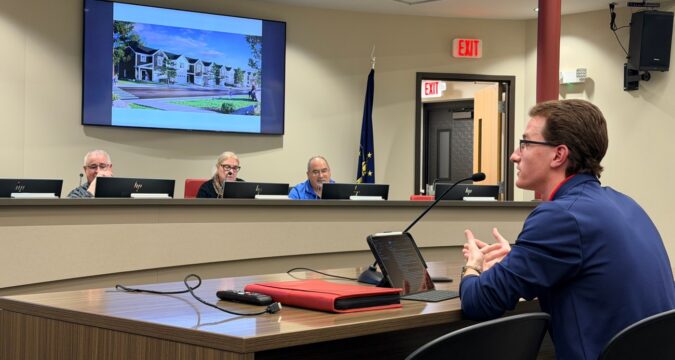
Portage planners get first peek at affordable housing subdivision
South of Simon CRE’s Target development at U.S. 6 and Airport Road in Portage, Olthof Homes is planning to hit another target – affordable housing.
The Portage Plan Commission got a first peek Monday at a 42-acre subdivision that aims to provide homes for roughly $235,000 to $315,000.
Olthof Homes plans to build a total of 268 housing units, about 6.38 per acre, on the parcel, representative Kevin Paszko said.
Included are 34 single-family attached paired cottages, or 68 homes; 88 single-family attached one-car, two-story townhomes, with eight units per building; and 112 single-family attached two-car, two-story townhomes.
About an acre in the northwest corner of the subdivision is set aside for a future fire station.
“We’ve taken our cues from the city goals,” Paszko said, in attempting to provide the “missing middle” segment of the housing market.
“These would be a great fit for families moving out to live on their own for the first time,” he said. The housing units will all be owner-occupied, not rentals.
“We think projects like this have much more appeal,” with multiple housing types available to serve a mix of needs, Paszko said.
A detention pond on the northeast corner of the park would have a dog park with seating on the east side and a shelter, gas fire pit and seating area on the west side. Together, the detention pond and amenities total about 16.5 acres.
Because it’s such a large detention pond, it probably would have multiple fountains to aerate water and make the pond more attractive, Paszko said.
A homeowners association would handle maintenance, including mowing and landscaping, to keep the subdivision tidy and prevent outlots from becoming unkempt.
The subdivision is part of an 84-acre parcel being developed. This portion of the land was rezoned last year for higher-density residential use.
Paszko promised a few different home styles and a color palette for buyers to choose from to provide variety. The subdivision would be a planned unit development, giving the city more control over the development standards than typical zoning would allow.
One standard the homes wouldn’t meet is for minimum square footage on the ground floor, Paszko said. The garage takes up some of the ground-floor space but isn’t included in determining the amount of living space. However, each unit would be more than 1,400 square feet total.
Paszko said prices would be determined by market conditions at the time, but he’s expecting the paired cottages to be priced at $285,000 to $315,000, the one-car homes from $235,000 to $245,000 and the two-car homes from $265,000 to $275,000.
No approval was sought for the subdivision Monday; Director of Planning & Community Development Tom Cherry just wanted to give the commission a first look to help notice any concerns or make suggestions early in the process.
“It’s going to go further in the process, and we’ll still be able to discuss all this,” he said.
At the Development Review Committee meeting, various city departments, including police and fire, will review plans and offer their input.
“I do like that it’s affordable housing,” commission member Deb Ekdahl said.
“The yards are small, so the kids are going to need someplace to go,” plus a walking path to get there, she said.
Doug Ross is a freelance reporter for the Post-Tribune.

Pseudo-Recessions
Pseudo-Recessions
Authored by Victor Davis Hanson (get well soon) via American Greatness,
As the 1992 campaign approached, incumbent president George H.W. Bush was seen as a shoo-in for reelection.
The First Gulf War ended in 1991 with a spectacular U.S. victory at the head of a coalition that had expelled Saddam Hussein from Kuwait with few losses.
For much of 1991, Bush’s approval ratings hovered between 90 and 70 percent.
By February 1992, an obscure Arkansas governor, Bill Clinton, emerged as the favorite Democratic nominee. But he was written off as having little chance to knock off the popular Republican incumbent president with far more foreign affairs experience.
Bush, however, had just lost his brilliant 1988 campaign manager, Lee Atwater, to cancer. And third-party prairie-fire candidate Ross Perot had entered the race, drawing off conservative Bush support.
Most importantly, in 1990, the U.S. economy had experienced a mild recession that had bottomed out in early 1991.
By the 1992 election, the U.S. was headed to full recovery.
In the last six months of 1992, GDP rebounded at over an astonishing four percent.
The inflation rate in the months before the election was often less than three percent.
Even stubborn unemployment was starting to fall to 7.3%.
The eight-month recession officially ended in March 1991, followed by continual positive economic growth.
No matter. The brilliant Clinton campaign still ran on the directive “It’s the economy, stupid” and the slogan “Putting people first.”
The Clinton theme song was the upbeat Fleetwood Mac hit “Don’t Stop,” highlighting the young Clinton-Gore ticket in supposed contrast to the 68-year-old Bush.
Key to the Clinton campaign rhetoric was the false charge of “the worst job growth since the Great Depression.”
By November 1992, Clinton had convinced voters that the prior year’s recession was still in full force.
The doom-and-gloom, near-depression “recession,” together with Perot’s third-party candidacy and Bush’s sluggish campaign, won Clinton the presidency with 43% of the popular vote.
In response, the Bush campaign had tried to trumpet the administration’s many foreign policy successes.
The Berlin Wall fell in November 1989.
The Cold War ended in a U.S. victory.
Germany was reunified in October 1990.
In December 1989, Bush successfully removed the narco-dictator Manuel Noriega of Panama, who threatened the viability of the Panama Canal.
The Gulf War was won brilliantly by February 1991.
The nuclear START treaty was signed with the Soviet Union in July 1991, just before the USSR itself collapsed in December.
By any normal reckoning, Bush should have been a shoo-in: spectacular foreign policy successes and a rebounding economy after a brief recession that had ended 15 months before the November 1992 election.
Instead, the pseudo-recession of 1992 dominated the campaign.
Indeed, Bush’s many achievements overseas were cleverly distorted by Clinton as proof that the globe-trotting president was more interested in the world abroad than “putting people first” at home.
As in Bush’s prior 1988 campaign, Lee Atwater would have torn the Clinton campaign apart as inexperienced and disingenuous. Atwater would have ordered Bush to talk nonstop about virtually no inflation, robust four percent economic growth, and declining unemployment.
Instead, the lackluster Bush campaign team never caught on and was crushed by Clinton, with help from the economic populist Ross Perot.
The pseudo-recession of 1992 should remind the Trump people not to repeat the same mistake in the 2026 midterms.
Trump’s first ten months of foreign policy achievements are almost as impressive as Bush’s entire four years.
He neutered the feared Iranian nuclear bomb project. He ensured Israel could devastate the terrorist cabals of Hezbollah, Hamas, and the Houthis, as well as their sponsor, theocratic Iran.
Instead of a trade war, increased tariff revenue and fair trade agreements were signed.
The border was closed shut.
Military recruitment rebounded to near record levels.
NATO was strengthened, and the intractable Ukraine war may end in a ceasefire.
Compared to the prior moribund Biden economy, Trump’s has set new precedents: record energy production and falling gas prices; inflation now below the three percent he inherited; and third-quarter GDP growth at a remarkable 4.3%.
But more importantly, 2026 may see even stronger economic growth, given a historical $10 trillion in foreign investment, tax cuts, deregulation, ever-greater energy production, huge investment in new technologies like AI and nuclear fusion, and dozens of favorable trade deals.
Yet, the left, like the Clinton campaign of old, is talking nonstop bout “affordability”—both ignoring the Democrats’ own dismal 2021-2025 economic record and claiming Trump, like Bush, cares more about those overseas than at home.
Whether the pseudo-recession of 2025-2026 works as well as the fake 1992 recession now hinges on whether the Trump campaign learns from the past and from now on fixates on the economy.
Tyler Durden
Wed, 01/07/2026 – 12:55

Dance for winter 2026: Our top 10 includes Joffrey, Red Clay and a visit from Martha Graham
The first part of the year used to be slow for dance in Chicago. Not so, recently. And in 2026, the chilly months are teeming with rare appearances and fresh collaborations capable of inspiring a trip to the theater even in the darkest depths of winter. The Martha Graham Dance Company presents its first full evening in Chicago since 2007. As a nod to the 100th season of that revered choreographer’s company, the Joffrey Ballet tries on Graham’s “Secular Games” for its winter mixed rep — a program celebrating the blurred lines between modernism and classicism. Speaking of lines, festivals aplenty, at Steppenwolf, the Logan Center and the Harris Theater this winter and spring, dissolve perceived boundaries between genres and forms, dance and music — crafting rich and varied experiences for patrons and performers, both.
LookOut Series
With Links Hall, Stage 773, Hamlin Park Fieldhouse and other venues vanishing in recent years, Steppenwolf has stepped up as a gap-filler, annually presenting a suite of cross-genre performing artists on the vanguard. Called LookOut, the series spans January to March, including a macabre tribute to “Granddaddy of Goth” Edward Gorey, created by Jennifer “The Bunny Royale” Friedrich of Incurable and Redmoon Theater and Poonie’s Cabaret steward Bazuka Joe. In “Mudra,” Shalaka Kulkarni pairs with Yoshinojo Fujima to explore gestures central to the Indian dance forms Bharatanatyam and Kathak. And Project Bound Dance uses meat as a metaphor for a dance about societal give-and-take.
Jan. 15 to March 14 at Steppenwolf’s 1700 Theater, 1700 N. Halsted St.; tickets $23-$43 at 312-335-1650 and steppenwolf.org/lookout
Martha Graham Dance Company
The country’s oldest modern dance company hasn’t visited Chicago in earnest for two decades. A program for this, the Martha Graham Dance Company’s centennial season, includes two classic works by Graham — “Diversion of Angels” and “Chronicle” — and one by Hope Boykin, an Alvin Ailey American Dance Theater alum, two degrees of separation from Graham, widely considered one of modern dance’s legendary matriarchs. From Boykin comes the Midwest premiere of “En Masse,” a piece set to Chris Rountree’s adaptation of Leonard Bernstein’s “MASS,” plus a recently discovered theme believed to have been composed by Bernstein for Graham, but not used until now.
Jan. 24 at the Auditorium Theatre, 50 E. Ida B. Wells Drive; tickets $35-$195 at 312-341-2300 and auditoriumtheatre.org
Gallim Dance
In a roundabout way, choreographer and artistic director Andrea Miller of Gallim Dance is also connected to Martha Graham, through her time dancing for Ohad Naharin, a Graham alum, with Israel’s Batsheva Dance Company. Miller started her New York-based company in 2007, a time of deep questioning about the future of contemporary dance as the next generation of choreographers sought to distinguish themselves from their elders. Gallim, which visits Chicago for the first time in over a decade, basically said “hold me beer,” creating works that are physically and intellectually rigorous — and downright gorgeous.
Feb. 5 at the Harris Theater for Music and Dance, 205 E. Randolph St.; tickets $40-$172 at 312-334-7777 and harristheaterchicago.org/gallim
Anais Bueno and Stefan Gonçalvez in Joffrey Ballet’s “American Icons.” (Todd Rosenberg)
Joffrey Ballet’s “American Icons”
Adding Martha Graham’s “Secular Games” to Joffrey’s usual winter mixed repertory program was a twist I didn’t see coming, paired with pieces by the company’s two founders, Gerald Arpino and Robert Joffrey, plus Glen Tetley, one of the Joffrey’s original dancers. The latter created “Voluntaries” in 1973 as a tribute to choreographer John Cranko, whom he succeeded as the director of Stuttgart Ballet the next year — in a style blending modernism and classicism derived from his joint experiences training at George Balanchine’s School of American Ballet and with Graham and Hanya Holm, another of modern dance’s progenitors. Joffrey and Aprino, too, were much inspired by their innovative contemporaries. So it turns out, it’s not that weird for the Joffrey, which turns 70 this year, to adopt Graham, whose company is now 100 years old.
Feb. 19 to March 1 at the Lyric Opera House, 20 N. Wacker Drive; tickets $46-201 at 312-386-9805 and joffrey.org
Hubbard Street’s Winter Series
Amy Hall Garner was among the very first choreographers Hubbard Street Dance Chicago commissioned following a change of leadership and a pandemic pause in live performances. “As the Wind Blows,” the richly saturated, aesthetically satisfying result, returns this season alongside the company premiere of Juel D. Lane’s “Touch & Agree,” set to a mixtape by Sam Cooke, James Blake, H.E.R. and Byrell the Great. The cherry on top? After a long absence, Nacho Duato’s stunning “Gnawa,” created for Hubbard Street in 2005, returns to the active rep for the first time in several years.
Feb. 26 to March 1 at the Harris Theater for Music and Dance; tickets $20-$112 at hubbardstreetdance.com
Lindsey Barlag Thornton in “flights for future generations” as part of the LookOut Series. (Elyse Mertz)
Trinity Irish Dance Company
Tap phenom Michelle Dorrance, one of the two choreographers behind Trinity’s spectacular tap-Irish fusion called “American Traffic,” flies solo this time with a new work custom-crafted for Chicago’s only professional Irish dance company. Also new, a world premiere from Jamey Hampton and Ashley Roland of BodyVox.
Feb. 28 at the Auditorium Theatre, 50 E. Ida B. Wells Drive; tickets $35-$136 at 312-341-2300 and auditoriumtheatre.org
“Turn it Out” with Tiler Peck & Friends
The “and friends” part of New York City Ballet star Tiler Peck’s big swing as a first-time director are among the country’s very best dancers, like fellow NYCB dancers Chun Wai Chan, Roman Mejia and Christopher Grant; tap dancer Michelle Dorrance; and “So You Think You Can Dance” champion Lex Ishimoto, to name a few. Peck calls the evening a “love letter to dance,” with works she created with Dorrance and two titans of contemporary dance: Alonzo King and William Forsythe. Honestly, what’s not to love?
March 7-8 at the Auditorium Theatre, 50 E. Ida B. Wells Drive; tickets $35-$130 at 312-341-2300 and auditoriumtheatre.org
The Seldoms’ “Floe”
Artistic director and choreographer Carrie Hanson pedals in politics and the natural world for her deeply researched dance theater works. An evening-length piece about climate change certainly touches both, using dance to tell the fractured story of rising seas, melting polar ice caps and the collective, global responsibility to do something about it. Also there: the tension between those who believe what is happening and those who don’t.
March 12-13 at the Dance Center of Columbia College Chicago, 1306 S. Michigan Ave.; tickets $35 at dance.colum.edu
Red Clay Dance Company performs “Freedom Square: The Black Girlhood Altar” at the Museum of Contemporary Art Chicago. (Ricardo Adame / MCA)
Chicago Human Rhythm Project’s “Stomping Grounds”
The festival dedicated to all-things percussive arts returns with a global program featuring American, African, South Asian and East Asian music on the same stage. The ERA, who pioneered Chicago’s lightning-fast street dance style of footworking as a concert dance form, makes its Stomping Grounds debut — part of a program that is equal parts dance and drums.
March 22 at the Reva and David Logan Center for the Arts, 915 E. 60th St.; tickets free with reservation at chicagotap.org
Red Clay Dance Company’s La Femme Dance Festival
Much of the magic in Red Clay Dance’s every-other-year festival is what happens off stage, gathering dancers, choreographers and dance leaders for workshops and conversations about the contributions of Black women in the field. For those of us who generally sit in the auditorium, though, this year’s “La Femme” is particularly special, with a one-day-only performance featuring the Los Angeles-based tap company Syncopated Ladies, a world premiere by Hubbard Street alumna Rena Butler and a revival of Red Clay artistic director Vershawn Sanders-Ward’s “Unconditional Conditions” — easily among the best of her recent works. As a bonus, South Chicago Dance Theatre tags along with excerpts from artistic director Kia Smith’s “Memoirs of Jazz in the Alley,” a tribute to her late father, tenor saxophonist and South Side jazz titan, Jimmy Ellis.
March 27-28 at the Harris Theater for Music and Dance, 205 E. Randolph St.; pre-sale tickets $19-$59 beginning Jan. 12 at redclaydance.com
Lauren Warnecke is a freelance critic.
https://www.chicagotribune.com/2026/01/07/dance-winter-2026/

Naperville Police Arrests for Jan. 2-5
The following items were taken from Naperville police reports and press releases. An arrest does not constitute a finding of guilt:
A 29-year-old man from Chicago was arrested on charges of financial institution fraud and defrauding a financial institution/$500 to $10,000 at 2:56 p.m. Jan. 2 at the police station, 1350 Aurora Ave.
A 21-year-old man from Lombard was arrested on two warrants at 3:02 p.m. Jan. 2 in the 1500 block of Naperville Wheaton Road.
A 33-year-old woman from Aurora was arrested on a warrant at 12:11 a.m. Jan. 3 at North Route 59 and West Diehl Road.
A 29-year-old man from Plainfield was arrested on a charge of driving under the influence of alcohol at 3:40 a.m. Jan. 3 in the 800 block of Cherry Blossom Lane.
A 48-year-old man from Montgomery was arrested on charges of disregarding a red light, driving on a suspended license and transportation or possession of open alcohol by a driver at 11:44 p.m. Jan.3 at Liberty Street and North Route 59 in Aurora.
A 22-year-old man from Aurora was arrested on charges of improper lighting, driving with expired license plates and driving under the influence of alcohol at 1:32 a.m. Jan. 4 at South Main Street and Jackson Avenue.
A 42-year-old man from Naperville was arrested on a charge of driving on a suspended license at 7:10 p.m. Jan. 4 at East 75th Street and South Naper Boulevard.
A 26-year-old man from Rochelle was arrested on a warrant at 7:53 p.m. Jan. 4 at East Ogden Avenue and Naperville Wheaton Road.
A 41-year-old man from Naperville was arrested on a warrant at 9:49 p.m. Jan. 4 in the 2600 block of Freeland Circle.
A 25-year-old man from Aurora was arrested on charges of speeding, improper lane usage and driving under the influence of alcohol at 12:47 a.m. Jan. 5 at West Ogden Avenue and South Route 59.
A 68-year-old woman from Naperville was arrested on a warrant at 9:35 p.m. Jan. 5 at the police station, 1350 Aurora Ave.
https://www.chicagotribune.com/2026/01/07/naperville-police-arrests-blotter-january-2/