Category: News

Chicago teen curfew proposal again advances, Mayor Brandon Johnson mum on veto
Chicago’s police superintendent is once again on the cusp of gaining new teen curfew powers after aldermen advanced an ordinance Wednesday aimed at controlling large youth gatherings.
The measure would give Superintendent Larry Snelling and his successors the power to declare a teen curfew anytime, anywhere across the city with at least 12 hours notice. Aldermen supported the ordinance in a 10-4 vote in the Public Safety Committee, teeing it up for a final full City Council vote later this month.
But its fate is far from certain.
The council passed a nearly identical ordinance in June, 27-22. However, the measure — then featuring just a 30-minute minimum notice — never became law. Mayor Brandon Johnson blocked it with a rare mayoral veto, decrying it as “lazy governance” and unnecessary.
But Ald. Brian Hopkins, 2nd, took up his curfew push again after a large November teen gathering ended in tragedy.
Following the downtown Christmas tree lighting ceremony, eight people were shot and a 14-year-old boy was shot and killed amid a sprawling social media-fueled meetup.
Johnson said Wednesday he remains opposed to one person having “unilateral control” over such a curfew, an apparent reference to the final say the ordinance would give the police superintendent. But he declined to say whether he would again issue a veto if the measure passed.
On the council floor at around the same time, Hopkins argued the ordinance does not give the superintendent unilateral control, because it requires the superintendent to consult with public safety leaders in the mayor’s administration.
The downtown alderman praised Johnson’s decision to publicly state that police would enforce the city’s pre-existing 10 p.m. teen curfew on New Year’s Eve ahead of the holiday. The move appeared to effectively quash online efforts to spark such a meetup that night, Hopkins said.
But Johnson said his pre-New Year’s remarks were only an effort to highlight the current rule.
“I’ve never been opposed to that,” he said. “What I simply said was that for New Year’s Eve, the curfew that’s already in place, as we always have, we will make sure that that curfew is implemented.”
Hopkins told reporters he has gained more support for his tweaked curfew ordinance since the last one was vetoed, noting the backing of Johnson ally Ald. William Hall, 6th. He also claimed Snelling has told him that he supports the council’s effort to pass such a curfew law.
“I know he hasn’t said as much publicly because of the controversy surrounding it,” Hopkins said. “I believe we’re going forward with the full support of the superintendent.”
Snelling, always careful to avoid taking political stances, has so far not publicly said whether he supports such an ordinance. The police leader doubled down on the decision to not take a side Wednesday in a statement shared by the department.
“The Chicago Police Department enforces all laws,” the statement attributed to the department said. “Draft ordinances are out of the control of CPD, and we have no comment on any proposed ordinances.”
The City Hall teen curfew debate has now lasted for nearly a year, first sparked in 2025 by two high-profile Streeterville gatherings, both of which ended in shootings.
Another ordinance debated Wednesday sought to take aim at those so-called “teen takeovers” or “teen trend” events with a different angle: by fining social media companies $50,000 if they do not take down the posts advertising such gatherings when asked to by the city.
The ordinance, sponsored by Hall, did not advance through the committee Wednesday, but could see further debate. After hearing pushback from colleagues who questioned the proposal’s legal footing and argued responsibility should instead be placed on the people who post invitations, Hall criticized the “cold-hearted” members of the council.
The ordinance simply pushes social media companies to enforce anti-violence rules that are already a part of their guidelines, Hall argued.
“We want corporate responsible partners, not predatory partners,” he said. “I’ll be damned if we lose another kid because they saw something on the internet that said, ‘come do something illegal.’”
https://www.chicagotribune.com/2026/01/07/chicago-teen-curfew-proposal-mayor-brandon-johnson-veto/
Math Of A Debt Trap: Who’s Gonna Bail First – US, UK, Or EU?
Math Of A Debt Trap: Who’s Gonna Bail First – US, UK, Or EU?
Authored by Alasdair Macleod via VonGreyerz.gold,
Stagnating economies, together with high government debt loads, inevitably create funding crises and debt traps. Nowhere is this problem more destructive than for the fiat dollar.
But it’s not just the dollar. Economies in the Eurozone and the UK have insufficient growth to support their colossal mountains of government debt. In this article, I explain the mechanics of a debt trap. And how a combination of rising interest rates reflecting growing risk and stagnating economies bring on debt traps, leading to yet higher interest rates making the situation even worse.
My memory is of the sterling crisis in 1976, when the IMF bailed out the British government, and the Bank of England had to fund medium-term debt with gilt coupons of over 15%. The Labour government was forced to cut its spending to resolve the situation. So I have a question for today: who is going to bail out first, the US Government, then the UK and Eurozone, and who is going to force them to cut spending on the edge of a recession?
Only the markets will do it: crisis first, and only if we are lucky, the solution follows.
Read on…
Introduction
Understanding debt, the counterpart of credit, is of increasing importance. For example, it is the other side of bank credit, and when banks become overleveraged, there comes a time when their managers become concerned about the risk to their balance sheets. In any economy, the risk is conventionally understood to be in private sector lending, and a recession is part and parcel of the withholding of further credit, leading to corporate and personal insolvencies. Under these circumstances, banks redirect their balance sheet assets from private sector loans and corporate bonds to government debt, which is seen as the risk-free asset in any currency.
There are signs that, with respect to some jurisdictions, these views are evolving, with the outlook for government debt being examined more closely. There is also little confidence in economic prospects for all the major economies, improving government budgets.
Given mounting government debts, debt is a problem no longer confined to private sectors which have suffered from the generally unexpected rise in interest rates over the last few years. And governments in the advanced economies appear to have little sense of the debt trap being sprung upon them, too. As well as the rate of nominal GDP growth, the interest rate matters and a combination of slowing economies moving into recession together with high interest rates is a lethal combination for government finances.
More specifically than growth in GDP, what matters is the growth in tax revenue required to fund the pace at which the combination of debt and interest is being rolled over. In Europe and the UK, tax rates are already so high that attempts to obtain more revenue by increasing them will almost certainly lead to lower revenues due to the Laffer curve effect. The US is probably not at that point yet tax-wise, but economic stagnation has the same effect.
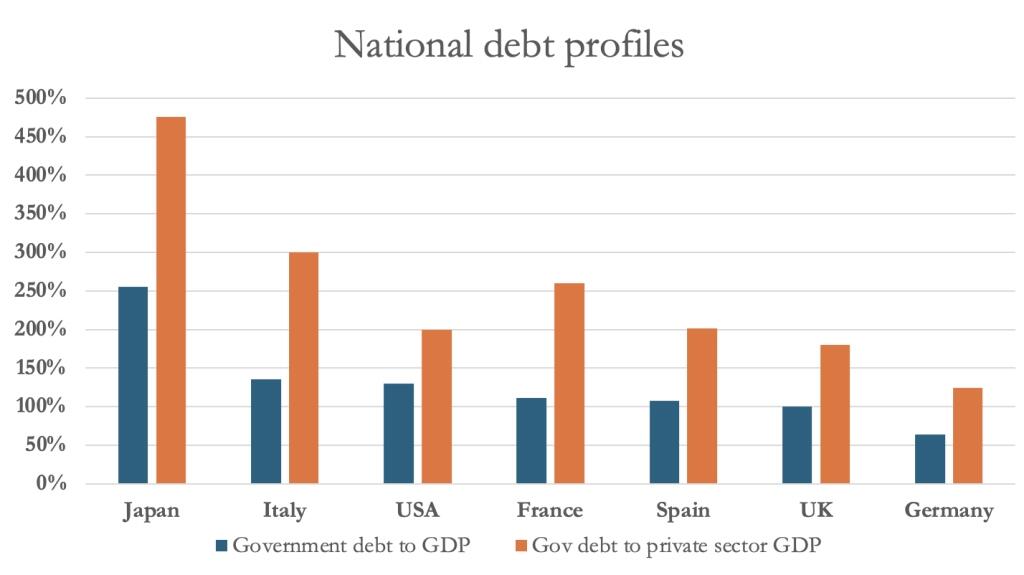
The following table illustrates government indebtedness relative to GDP for the G7 nations and also relative to private sector GDP, which produces the revenue for governments upon which debt credibility depends.
Various papers have been written on this problem, all concluding that a debt trap occurs when the rate of GDP growth falls to below the rate at which the cost of funding the debt increases. But it is surely more correct to compare the rate of increase of tax revenues with the rate of increase of the debt: do tax revenues increase more rapidly than the debt, or does the compounding debt increase more rapidly than revenues?
How did governments cut the debt-to-GDP ratio following WW2?
Much of the complacency over government debt levels arises from the fact that high WW2 debt levels were reduced over the following two decades to manageable levels, fuelling a belief that it can be done again. America’s government debt to GDP in 1946 peaked at 120%, below current peace-time levels, falling to 35% in 1971 when Nixon suspended the Bretton Woods Agreement. The relevant figures are shown in the table below.
The increase in gross Federal debt was 142%, but the increase in GDP was 483%. And the increase in revenue, which ultimately pays for the debt, was slightly more than the increase in GDP. Therefore, revenue growth outpaced debt growth nearly three and a half times, leading to a significant reduction in debt to GDP. This was how the war debt relative to GDP was reduced, before the discipline of gold on government spending and interest rates was finally abandoned.
The common belief that debt reduction was due to financial repression, that is to say, the cost of funding was suppressed by central bank interest rate policies and yield curve control, is incorrect. To understand why, we need to address another point. And that is what happened to prices. The dollar and through the dollar all other currencies were tied to gold at $35 for the whole 25 years, but the CPI for Urban Consumers rose from 22 to 40, nearly doubling at an average annual rate of about 0.7%. Yet, measured in gold there should have been no inflation, because the expansion of economic activity under a gold standard is expected to lead to better manufacturing processes, product improvements, and a tendency towards falling prices.
The problems with a CPI measure are many. Logically, there is no such thing as a statistical measure of price inflation, the subjectivity of which has been clearly demonstrated in more recent decades by wildly differing estimates. Government intervention in the economy distorts outcomes, and the savings rate fluctuated, but not enough to explain the disparity between a steady gold standard and a statistical outcome.
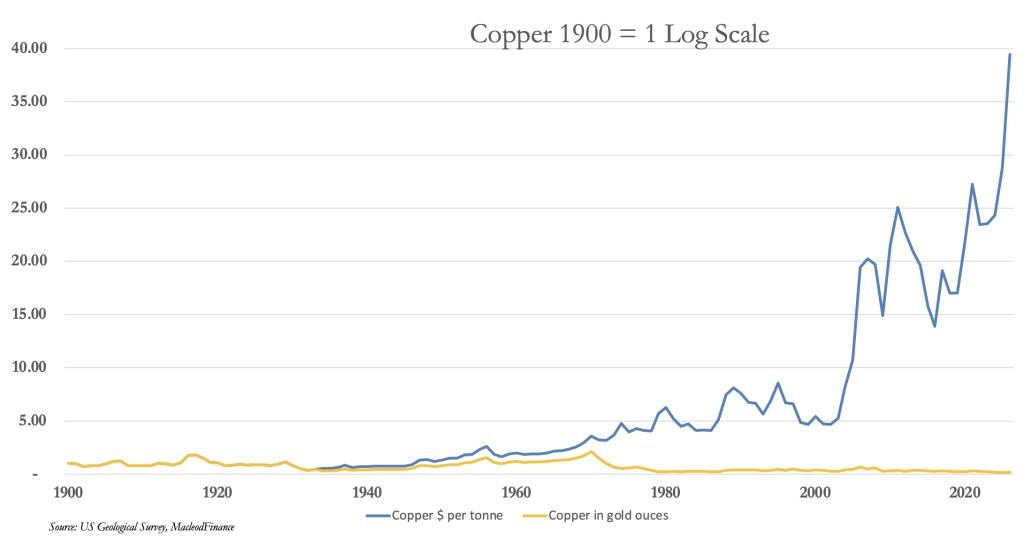
A cleaner price comparison is found in commodity prices. Oil was pegged at $2.57 per barrel, increasing to $3.56, which held until 1973: that’s a 38% increase compared with a near doubling of US consumer prices. Copper was similarly more stable priced in gold, as the next chart demonstrates.
That both copper and oil did increase in price by either measure in the post war years can be explained by demand increasing for these commodities more rapidly than supply. But this does not get round the fact that with the dollar supposedly acting as a gold substitute at a fixed value of $35 per ounce there is an unexplained disparity in consumer price performance. The answer is that the Bretton Woods system ended up suppressing the value of gold, evidenced by the selling down of US gold reserves from 21,828.2 tonnes in 1949, representing over 70% of global official reserves and 45% of total above-ground stocks, to 9,069.7 tonnes, less than 25% of global official reserves and only 12% of above-ground stocks in 1971.
The suspension of the Bretton Woods Agreement in August 1971, far from removing gold from the monetary system, had the effect of releasing gold from its increasing suppression by US economic policies in the post-war years. It is important to understand this relationship in its proper context, now that in this new millennium US Government debt is spiralling out of control.
This millennium is different from the post-war years
The next table replicates the first table in this article, but for the 25 years of this current millennium.
Here, we can see that gross debt has been rising nearly three times faster than GDP, and even more so measured in the federal government revenues which are behind the sustainability of the debt. With the increase in revenue badly lagging the debt increase, the US Treasury is in a classic debt trap, a condition which has been accelerating, particularly since the pandemic of 2020. It is a fact which is increasingly recognised by foreign central bankers who are getting out of dollars and into gold.
The second element of the debt trap – soaring interest rates
So far, we have seen that in the first 25 years of this new century, the increase in tax revenue has failed lamentably to keep pace with the increasing growth of debt. For the US Government, this has not mattered too much while the Fed was able to suppress interest rates even to the zero bound and therefore contain the compounding cost of funding. Additionally, with the dollar being everyone’s reserve currency, foreign buyers were always demanding them and investing in the regulatory “risk-free” status of US Treasury debt. It is this combination which has extended the dollar’s life as a fiat currency, pushing it even further into a debt trap waiting to be sprung by higher interest rates.
Interest rate suppression is less evident today, at least not to the degree of recent years. The sharp rise in interest rates and bond yields between2021—2023 have only partially been corrected in the belief that inflation has receded as a problem. This is an error, because the inflationary consequences of a $2+ trillion budget deficit and a decline in the personal savings rate will continue to feed into a falling purchasing power for the currency. And geopolitical factors encourage members of the Shanghai Cooperation Organisation and BRICS, representing a large majority of the world’s population, to reduce their dollar exposure as well.
Both these factors are feeding into an inevitable funding crisis for the US Government, as foreign buyers of US Treasury debt stay away, and in some cases are actually selling. And instead of interest rates and bond yields being under the control of the Fed, they will be exposed to the brutal consequences of falling market demand. A buyers’ strike by foreign investors at the margin is already forcing the US Treasury to fund itself in short-term T-bills, with auctions for longer maturities being generally avoided. Increasingly, the $38.6 trillion debt mountain sees longer maturities being replaced by T-bills as well. The whole maturity structure of US Treasury debt is changing, and it is not for the good.
The yield curve has begun to price in maturity risk, with the 30-year long bond yielding 68 basis points more than the 10-year note, and 127 bp more than the 6-month T-bill. But there is a further problem: in a debt trap, the higher the funding cost, the less attractive an investment proposition becomes, because the compounding pace at which the debt rises accelerates.
The consequences for the credit bubble
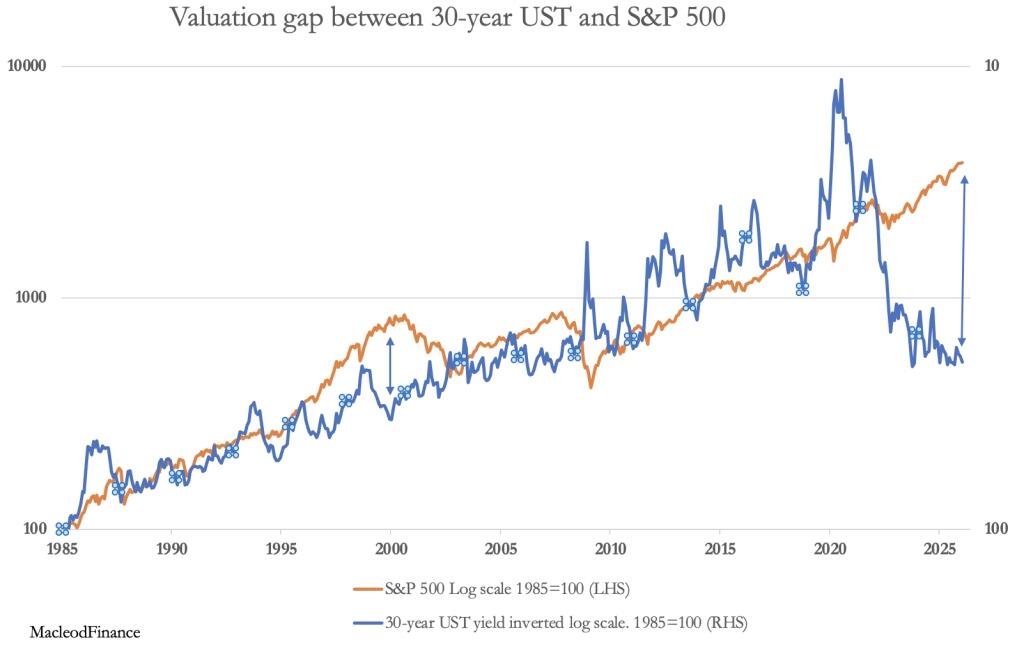
For every debt, there is a credit and in recent years significant quantities of this credit, has found its way into financial instruments, particularly equities. As the interest cost on this debt increases, the credit side of the bubble will burst. Today, the disparity between the returns on long maturity bonds and equities is at an all-time record, illustrated by the chart below:
It is worth taking time to study this chart closely. Not only is the excessive value of the S&P over the long bond greater than it has ever been, but it shows signs of going higher due to rising bond yields. This will only be resolved by an equity crash to rival or even exceed anything seen in history.
It is hardly a surprise that gold measured in dollars is rising at an accelerating rate. It reflects and signals that a final collapse in the dollar’s credibility as a currency is underway.
Tyler Durden
Wed, 01/07/2026 – 15:40
https://www.zerohedge.com/markets/math-debt-trap-whos-gonna-bail-first-us-uk-or-eu

College of Lake County receives record $6M donation: ‘This gift will open the door for access to a college education for hundreds’
With the establishment of an endowment at the College of Lake County, more students will be able to afford and complete their education there well into the future thanks to a record $6.065 million donation from Schreiber Philanthropy.
Unlike donations earmarked for a building or project, CLC President Lori Suddick said the gift will be used for scholarships and other student-centered needs, making the school more affordable and stress-free for a larger number of students.
“This gift will open the door for access to a college education for hundreds of students who would never have the opportunity because of the financial cost,” Suddick said. “This will give access to students who would not have considered college before.”
Schreiber Philanthropy made the record donation to the college on Monday, benefiting its three campuses in Grayslake, Waukegan and Vernon Hills, in part to create an endowment enabling scholarships now and well into the future.
Donors to the college since 2014, Suddick said Schreiber Philanthropy is a significant benefactor. This contribution is more than double the contributions received from any benefactor at one time.
Divided into four components, Leigh Ann Jacobson, the executive director of the College of Lake County Foundation, said the major portion of the donation is earmarked for the establishment of an endowment to allow scholarships to continue well into the future.
Most of the money going into the endowment will form what Jacobson termed the “corpus,” which will eventually generate revenue to fund scholarships indefinitely. A smaller amount will be used to help finance students’ education in the immediate future until the endowment matures.
“This gift is meant to do more than support today; it is meant to inspire tomorrow,” Jacobson said. “Since it’s a pooled endowment, the gift is inspirational in its generosity to encourage others to give. Part of the gift will support students now while the endowment is growing.”
Bethany Williams, Schreiber Philanthropy’s Lake County portfolio manager, said in a news release from CLC, that finding a way for students to pursue their education without financial pressure was a goal of the endowment and the donation overall.
“We asked the CLC team to dig into data on the number of students each year who have unmet need,” Williams said in the release. “This grant will help make a CLC education possible for many students who are furthest from opportunity, but there are still more who need support.”
Suddick said while community colleges like CLC are significantly less expensive than four-year universities, public or private, some students on the school’s three campuses still face financial barriers to their education.
“We know of at least 450 students who face unmet financial costs,” she said. “We want to prevent students from having any debt. When they can focus on their education, the outcomes are better for them, for the community and for the workforce.”
Along with money for the endowment, Jacobson said a portion of the Schreiber Philanthropy donation will help “build overall student success and provide collateral relevant for student-centered services.”
“They will provide a sense of welcomeness to the campus,” Jacobson said. “They (could) translate materials like signage, brochures and pamphlets into languages such as Spanish.”
A portion of the record donation will be used to supplement the Lancer Emergency Assistance Fund (LEAP). Jacobson said LEAP provides money for basic needs like housing, transportation or utilities when a crisis arises.
“Our goal is to remove the needs barrier,” Jacobson said. “We want to take these barriers away so students can stay on their path to completion of their education.”
With a significant number of CLC students being parents with young children, Jacobson said the donation will also help fund child care services.
https://www.chicagotribune.com/2026/01/07/college-of-lake-county-record-donation/

CPS watchdog details sexual abuse, pandemic relief fraud in annual report
Chicago Public Schools’ watchdog released its annual report Wednesday, detailing dozens of the more than 1,200 complaints it received between July 2024 and June 2025. The report addressed accusations of pandemic program fraud, excessive overtime, stolen equipment, residency violations and sexual misconduct by district employees.
The Office of the Inspector General (OIG) is an independent body that investigates allegations of fraud, waste and misconduct within the district. The office does not disclose the identities of accused employees in the report.
Pandemic relief fraud
The OIG reported closing two cases in fiscal year 2025 involving former CPS principals who defrauded pandemic relief programs, including one who received more than $41,000 in loans on top of her six-figure salary.
One principal’s termination hearing is pending with the Illinois State Board of Education. The other principal retired amid OIG’s investigation, but a “Do Not Hire” designation was placed in her personnel file due to unrelated conduct.
The two principals join the more than 20 investigations by the agency in previous fiscal years into CPS employees defrauding pandemic relief programs, as well as district charter schools that received over $43 million in forgivable loans from the federal Paycheck Protection Program, in addition to their full school funding, the report said.
About 400 government employees were recently investigated by the state for similar fraud.
Past investigations into pandemic relief spending also revealed $28.5 million in “good-faith” payments to bus vendors who performed no services during the suspension of in-person learning. Themoney was intended for bus drivers who were laid off amid the pandemic but were never distributed to them, the report said. The bus vendors agreed to pay back the district about $3 million, according to a previous report.
The agency also found a 74% increase in overtime and other forms of additional compensation between 2017 and 2021 — a year after CPS began receiving federal pandemic relief funds.
More than 77,000 laptops and other technical equipment were also previously reported lost or stolen in the first year after the return to in-person learning, totaling $23 million, the report highlighted.
CPS used the remaining $233 million of the $2.8 billion allocated to address the effects of COVID-19 under the federal Elementary and Secondary School Emergency Relief Fund, the report said.
The agency wrote that it “remains committed to ensuring that individuals and entities affiliated with CPS who abused the public trust during the pandemic are held accountable.”
Other reports of fraud and mismanagement
The watchdog also found that a former CPS program manager repeatedly falsified federal grant applications over the course of a year by submitting fake enrollment data. The federal government required CPS to pay back more than $1 million, the report said.
Another agency investigation revealed that a former CPS employee defrauded the district of potentially more than $135,000 over three years by reporting false or inflated work hours, the report said.
The inspector general also found that the school’s remote work policy allowed staff members to get around CPS’ policy. The report said 15 staff members at one school violated the residency policy by living outside Chicago, and that three of them lived outside Illinois. A school administrator lived as far away as Florida with her family for nearly two years and intentionally misled CPS about her residency status, according to the report.
OIG’s annual review comes on the heels of a November report that found CPS travel expenditures, including airfare and lodging, more than doubled between fiscal year 2019 and 2024 — rising from $3.6 million to $7.7 million. Months prior, the district faced a steep $734 million deficit before passing a $10.2 billion budget in August 2025.
In response to these findings, CPS issued a temporary freeze on district-funded travel, except for travel tied to student activities.
Over 300 sexual misconduct complaints closed
In fiscal year 2025, the agency’s Sexual Allegations Unit closed 335 cases related to sexual misconduct, with 55 reports having substantiated findings of misconduct. The nature of those cases varied, with touching being the No. 1 allegation reported.
Overall, sexual misconduct complaints have steadily declined since 2023, while teachers still account for nearly 40% of all allegations during this time period, according to the report.
In terms of demographics, 44 female students and 21 male students were identified as victims of the misconduct, ranging in age from 4 to 19.
“These victims and witnesses made the initial reports … exhibited enormous bravery and potentially prevented more students from being victimized,” the report said.
Of the 55 substantiated cases, the unit — which mainly investigates adult-on-student sexual misconduct — looked into multiple occurrences of alleged sexual abuse that happened on a high school campus in the 2010s, involving eight staff members. Reports about these incidents were made several years after the abuse occurred, as the agency’s sexual allegations unit was not created until 2018.
One of those cases includes an ex-CPS dean who was sentenced in August 2025 to 22 years in prison for sexually abusing a former student when she was about 15 years old, occurring from 2013 to 2016.
Other cases mentioned in the report involve sexual misconduct between teachers and students shortly after graduation.
While the OIG did not find a root cause for the multiple occurrences of sexual misconduct on one campus, it recommended several policy changes to address systemic concerns, including adopting a policy that prohibits staff members from engaging with recently graduated or disenrolled students.
Plans for a new policy are underway at the district, the report said.
Other policies the unit is recommending are that the district modify its training materials on grooming to emphasize that emotional connections with students for sexual purposes are prohibited, even if the staff member is waiting until after the student graduates.
The unit has also underscored a need for additional training to all shared campus staff members regarding their duty to report allegations of potential sexual misconduct, which CPS said they conducted in August 2025, according to the report.
In a statement to the Tribune, the district said it takes the OIG’s recommendations seriously, adding that it “strictly enforces all applicable policies, rules, and laws, including those related to preventing abuse, harassment, and misconduct.”
“CPS is committed to providing comprehensive, ongoing training for employees and vendors to recognize, prevent, and report abuse, and to ensure compliance with established policies and procedures,” the district added. “CPS will also continue to strengthen its policies, reporting mechanisms, and oversight practices to foster a culture of accountability, ethical conduct, and support ensuring that all staff act in the best interests of students, the District, and the City of Chicago.”
https://www.chicagotribune.com/2026/01/07/cps-oig-report-released-abuse-fraud/

Chicago and Cook County again see fewer opioid deaths in 2025
Chicago and Cook County saw another steep decline in fatal opioid overdoses last year, records show, four years after a recent peak in such cases during the height of the COVID-19 pandemic.
2025 brought a 40% drop in deaths attributed to narcotics overdoses from the prior year, according to statistics from the Cook County medical examiner’s office. As of this week, the medical examiner’s office found 683 people died of opioid overdoses last year in Cook County, with 500 of those recorded in Chicago.
Pending toxicology test results in 180 other cases will likely bump the total up even more. Three years earlier, in 2022, Cook County recorded 2,001 fatal opioid overdoses, according to the medical examiner’s office.
Public health officials were quick to credit outreach efforts by community organizations and the continued, expanded distribution of overdose-reversal medications Narcan and Naloxone for the decline.
“There are a number of evidence-based interventions that we have deployed at scale over the past three to four years, particularly after we saw the high-water mark of 2021 with over 1,400 overdoses,” Dr. Jennifer Hua, deputy commissioner for the Chicago Department of Public Health, told the Tribune in an interview this week.
The city’s and county’s outreach efforts have expanded to include testing illicit street narcotics for their ingredients and potency, and making overdose-reversal medications more widely available in areas where opioid use is most common.
Outreach workers distribute supplies of Narcan along West Lake Street on Dec. 30, 2025, outside the West Side Heroin/Opioid Task Force offices in Chicago’s West Garfield Park neighborhood. (Brian Cassella/Chicago Tribune)
“We’ve really extended the work of drug-checking, which used to be somewhat underground work, but with tremendous, tremendous public health relevance and value,” Hua said. “That’s a line of work that we’re really glad to see happen.”
Data show opioid deaths remain most common in three ZIP codes that cover most of Chicago’s West Side, the longtime epicenter of the local narcotics trade where gun violence and drug sales often go hand-in-hand.
However, those neighborhoods have also seen the largest declines in opioid fatalities in recent years.
In 2021, the neighborhoods of Little Village, North Lawndale, Austin, East and West Garfield Park and Humboldt Park recorded 311 fatal opioid overdoses, records show. Last year, those same neighborhoods saw 96 opioid fatalities — a nearly 70% decline in four years.
The medical examiner’s office said, too, that more than 80% of 2025’s overdose deaths involved fentanyl, the synthetic opioid largely produced by Mexican drug cartels that’s 100 times more potent than morphine.
Nationally, fatal opioid overdoses surged after the onset of the COVID-19 pandemic, with deaths cresting in 2022 and 2023, records show. Like Chicago, other major cities across the country, including New York and Philadelphia, saw major drops in fatal opioid overdoses last year.
A drop in cases around the country has generated speculation about the production side of the fentanyl trade, including whether drug cartels were purposefully dropping the strength of their product. Federal authorities have said it could also signal issues in the making of the substance.
A report from the U.S. Drug Enforcement Administration released in 2025 said much of the fentanyl trafficked into the United States was less potent than in recent years past, “consistent with indicators that many Mexico-based fentanyl cooks are having difficulty obtaining some key precursor chemicals.”
However, the decline in fentanyl potency has opened the door for other illicit narcotics to be introduced.
Outreach workers demonstrate how to use a fentanyl detection device on Dec. 30, 2025, outside the West Side Heroin/Opioid Task Force offices in Chicago’s West Garfield Park neighborhood. (Brian Cassella/Chicago Tribune)
“The downward trend in fentanyl purity does not mean that street-level fentanyl is less dangerous,” the report stated. “Drug dealers in the United States continue to adulterate fentanyl with various animal tranquilizers (such as xylazine), anesthetics (such as ketamine), and other synthetic opioids (such as nitazenes).”
In a statement to the Tribune, Todd C. Smith, special agent in charge of the DEA’s Chicago Field Division, noted nearly a half-ton of fentanyl powder was recovered by local DEA agents in 2025.
“While recent overdose data shows encouraging signs, this crisis is far from over,” Smith said. “Over the past year, we have seized nearly two million fentanyl pills and 915 pounds of fentanyl powder across Illinois, Indiana and Wisconsin. Maintaining momentum requires sustained enforcement, strong partnerships and continued prevention through public health, education and community outreach.”
On the local level, records show the Chicago Police Department has carried out more drug arrests in recent years, too, especially on the West Side in CPD’s Harrison (11th) District where several open-air drug markets operate 24 hours a day.
CPD officers last year made 1,962 arrests related to the sale or possession of heroin, records show. More than 60% of those arrests — nearly 1,200 — occurred in the Harrison District, roughly bounded by Division Street, Roosevelt Road, Western and Cicero avenues.
Seven years ago, the Police Department launched its Narcotics Arrest Diversion Program, which steers low-level drug offenders toward treatment instead of incarceration, provided they meet certain criteria. In 2025, 1,387 people were entered into the program, up from 926 people in 2024, according to a CPD spokesperson.
Municipalities across suburban Cook County have experienced sizable drops in opioid deaths, too. Between 2020 and 2024, Cicero, Harvey and Maywood saw a combined 301 opioid deaths, according to records from the county medical examiner’s office.
Last year, though, those three accounted for 25 opioid deaths.
Dr. Kiran Joshi, chief operating officer of the Cook County Department of Public Health, stressed that even with the continued decline in opioid deaths, “each one is a tragedy and our goal is to prevent them entirely.”
“It’s absolutely critical that we sustain the efforts that we put into place to prevent overdoses because we do not want to go backwards,” Joshi told the Tribune.
In suburban Cook County, more than 46,000 Naloxone kits have been distributed since 2020, Joshi said. In that time, nearly 200 doses were administered to people experiencing an overdose.
“Public health, good public health, requires partnership and we’re very fortunate in suburban Cook County to have really long-lasting, deep relationships with a number of partners across the suburbs,” Joshi said.
https://www.chicagotribune.com/2026/01/07/opioid-deaths-chicago-cook-county/

Kane County panel recommends 3% raises for non-union department employees
Some Kane County employees may see 3% raises this fiscal year, after the Kane County Board Executive Committee on Wednesday recommended approval of wage increases for non-union employees in the county’s various departments, and for non-union employees working in the County Board office.
The proposed raises are set to come to the full Kane County Board on Tuesday for a final vote.
All non-union employees working in county departments, including but not limited to department heads and Animal Control employees, would be getting the 3% pay hike, per the measure discussed and recommended for approval Wednesday. Employees whose pay is set by a collective bargaining agreement, statute, ordinance or employment contract would not be included, nor would employees who have been working in the county for less than 90 days.
The Kane County Board is also set to vote Tuesday on a separate measure granting a 3% pay hike for non-union employees working in the County Board office. That accounts for a total of seven employees, the county’s spokesperson confirmed — four employees directly within the County Board office, and three who oversee the spending of the county’s American Rescue Plan Act, or ARPA, funds.
The raises, if approved, would be effective as of Dec. 7, 2025, which was the start of the first pay period after the beginning of the county’s 2026 fiscal year, per the county.
According to documents included in Wednesday’s meeting agenda, the additional costs for the department employee raises are going to be paid from the fund balance reserves of each fund, and the nearly $300,000 that would otherwise have been coming out of the county’s general fund will instead be covered by expense reductions.
For the Animal Control raises, all of the $27,450 in additional costs would be covered by reducing expenses, per the county — the Animal Control Department is primarily funded by fees, rather than through the general fund, the county spokesperson said.
As for the raises in the Kane County Board office, those are being covered by expense reductions within the general fund — the bulk of it coming from what had been budgeted for the county’s strategic plan, per the county.
The strategic plan has previously been a source of debate among the board, with the Finance Committee in September considering terminating it early, but ultimately opting not to cancel it. The board also considered paying for the contract in the 2026 fiscal year with money from the Grand Victoria Riverboat Fund, which provides a portion of the annual net operating income of the Grand Victoria Riverboat to the county, but that too was voted down.
The county ultimately ended its relationship with the accounting and consulting firm BerryDunn after the county opted not to fund the strategic plan in the 2026 fiscal year, the county’s spokesperson confirmed on Wednesday. The contract was for a period of one year, meaning it is set to expire in February.
Following an affirmative vote by the Executive Committee on Wednesday, the raises are now set to be voted on at the county board’s meeting on Tuesday.
mmorrow@chicagotribune.com
https://www.chicagotribune.com/2026/01/07/kane-county-raises-department-employees/

Feds pull back on gang accusations against man charged in alleged Border Patrol Cmdr. Gregory Bovino murder-for-hire plot
Federal prosecutors acknowledged for the first time Wednesday they have no direct evidence that a Chicago man accused of putting a bounty on the head of Border Patrol Cmdr. Gregory Bovino is actually in a street gang, let alone a “ranking” member as originally alleged when the high-profile case was filed at the peak of Operation Midway Blitz.
Instead, the upcoming trial of Juan Espinoza Martinez will focus on whether he had an “affinity” for the Latin Kings and that text messages he sent to associates calling for Bovino’s killing were backed by specific knowledge he had of the gang’s activities, prosecutors said at a pretrial hearing in the case.
“The relationship of the defendant to the Latin Kings stems from the language that he used himself,” Assistant U.S. Attorney Minje Shin said. “What we must prove is whether (Espinoza Martinez) intended that a murder-for-hire occur. That absolutely bears on whether his relationship with the Latin Kings is real.”
Espinoza Martinez’s attorney, Jonathan Bedi, called that a “big pullback” from the original allegations, and said it was particularly “atrocious” that prosecutors wanted to use the fact that Espinoza Martinez lives in Chicago’s Little Village neighborhood — which is known Latin Kings territory — as evidence he’s associated with the gang.
“It’s probably one of the most prejudiced things that I’ve heard a U.S. attorney say,” Bedi told U.S. District Judge Joan Lefkow.
But prosecutors said they were not abandoning the argument that Espinoza Martinez was in the gang, saying it could be up to the jury to decide whether there was enough circumstantial evidence to show it.
Another prosecutor on the case, Assistant U.S. Attorney Jason Yonan, told the judge some of the gang-related evidence came from Espinoza Martinez himself in a post-arrest interview to agents, which so far has not been made public.
“He said the Latin Kings know him, are cool with him, they respect him,” Yonan said. “He’s allowed to come and go in the neighborhood.”
Espinoza Martinez, 37, who has lived in Chicago for years but is not a U.S. citizen, is charged in an indictment with a single count of solicitation of murder for hire, which carries up to 10 years in prison. A jury trial is set to begin before Lefkow on Jan. 20.
The discussion about the gang affiliation allegations came during a final conference over what evidence can be shown to the jury at trial, which is expected to draw national headlines.
Lefkow agreed that allowing evidence that Espinoza Martinez simply lived in a certain gang neighborhood was prejudicial and barred it from trial. She also excluded other evidence that his cousin may have been in the gang years ago, as well as a photo of a gun allegedly found on Espinoza Martinez’s phone after his arrest.
But any statements Espinoza Martinez made himself about his relationship or knowledge of the gang was fair game, the judge said. “I do think that relationships with Latin King members, if you have evidence of that, would be relevant,” she said.
Another photo from Espinoza Martinez’s phone of a different gun, which prosecutors allege the defendant was offering for sale to the informant, also could come in, the judge ruled.
Espinoza Martinez was originally charged in October via criminal complaint, which alleged he was a “ranking” member of the Latin Kings, meaning some sort of leadership position. When the one-page indictment was handed up a few weeks later, however, there was no mention at all of any gang affiliation.
Meanwhile, the Department of Homeland Security and Bovino himself have held the case up as a prime example of the violence that immigration officials were facing, including death threats allegedly coming from street gangs and even international cartels.
As the case was nearing trial, the lead prosecutor, Bradley Tucker, abruptly announced he was leaving the U.S. attorney’s office for reasons not publicly explained, the Tribune reported exclusively last month.
According to the charges, Espinoza Martinez told a law enforcement source after an immigration agent shot a woman in the Brighton Park neighborhood “that he had dispatched members of the Latin Kings” to the area of 39th and Kedzie in response to the shooting.
A day later, the source showed a screenshot to law enforcement that had been sent to him by Espinoza Martinez depicting a conversation Espinoza Martinez had with an unknown individual, according to the complaint. In that conversation, Espinoza Martinez allegedly said, “lets get some guys out here bro.” The other person wrote back, “Let one of us be in front with the (green gun emoji),” the complaint stated.
The law enforcement source also shared Snapchat messages that Espinoza Martinez had sent him saying, “2k on information when you get him” and “10k if u take him down,” according to the complaint.
The message also stated “LK on him,” which was a reference to the Latin Kings, the complaint alleged.
Included in the message was a photo of Bovino, the Border Patrol “commander at large” who headed up an immigration enforcement surge in California before becoming the public face of Midway Blitz in Chicago.
In the days after Espinoza Martinez’s arrest, Bovino addressed the charges without identifying himself as the target of the alleged plot.
“It’s a war zone out there,” Bovino told Fox News host Sean Hannity about Chicago. “(Homeland Security) Secretary Kristi Noem mentioned a bounty on the heads of federal agents. That $2,000 to kidnap, $10,000 to kill senior Border Patrol officials and senior ICE officials here in Chicago. Now, Sean, what happens between the kidnapping and the killing portion? That’s something out of a third-world country. Is this America?”
As the hearing was taking place Wednesday, Bovino was in Minneapolis, where an immigration agent shot and killed a woman in an incident federal officials claimed was an act of self-defense but the city’s mayor described as “reckless” and unnecessary.
Espinoza Martinez’s lawyers, meanwhile, have said that not only is he not a high-ranking Latin King, but he has no gang affiliation at all, and no prior criminal history. The father of three and volunteer youth sports coach was arrested at the construction site where he was working long hours to support his family, his relatives and lawyers said.
In court Wednesday, Bedi said that Espinoza Martinez intends to testify in his own defense.
Bedi also asked the judge to bar prosecutors from using the word “hit” during the trial, saying it “brings up a box of Hollywood movies and cartel and mafia” and that it was the government that introduced the “inflammatory language” in questioning Espinoza Martinez after his arrest.
Lefkow agreed that “hit” should not be used because it was ambiguous, but prosecutors could use the term “bounty” when questioning witnesses.
The judge also brought up questioning of potential jurors, which she said could be “pretty dicey” since “Mr. Bovino and his people came in here not that long ago.”
Prosecutors proposed a series of questions about immigration enforcement in order to weed out potential bias. Bedi, however, asked that questions on immigration be limited, saying the case is not a “referendum on Mr. Bovino, however you feel about him.”
Both sides agreed to confer on appropriate questions ahead of jury selection.
jmeisner@chicagotribune.com

Afternoon Briefing: Cook County clerk and Bears train student election judges
Good afternoon, Chicago.
Mayor Brandon Johnson raised the possibility of city worker layoffs today after a bruising budget fight that he again claimed led to an unbalanced spending plan for this year.
At a City Hall news conference, the mayor responded to a question about retroactive changes to the 2026 budget, which aldermen passed over his objections last month, by reiterating the package could force personnel cuts.
Meanwhile, the top financial official in Johnson’s administration, Jill Jaworski, is leaving to take a job with the nonprofit corporation that runs Navy Pier.
Here’s what else is happening today. And remember, for the latest breaking news in Chicago, visit chicagotribune.com/latest-headlines and sign up to get our alerts on all your devices.
Subscribe to more newsletters | Asking Eric | Horoscopes | Puzzles & Games | Today in History
Ayelech Gray, left, of Elk Grove High School, Jonila Ilazi of Rolling Meadows High School and Nell Krzyszczuk of Rolling Meadows High School receive training to be official election judges while operating on-campus early voting sites as part of the Cook County clerk’s office’s first-ever high school early voting program at Hersey High School in Arlington Heights on Jan. 6, 2026. (Chris Sweda/Chicago Tribune)
Cook County clerk’s office teams up with Chicago Bears to launch inaugural student election judge program
Through the initiative, dubbed “Defenders of DA’mocracy,” students across the county will see the inner workings of the election system firsthand by becoming official election judges for their peers ahead of this spring’s primary. Read more here.
More top news stories:
US Rep. Jan Schakowsky endorses Evanston Mayor Daniel Biss for Illinois’ 9th Congressional District
Federal government withholding $1 billion from Illinois meant for child care, family assistance
Republican candidate for Illinois governor Ted Dabrowski fills news conference with contradictions
Northwestern Memorial Hospital workers hold signs during a rally to call attention to emergency department staffing needs, among other concerns, across the street from the hospital on Jan. 6, 2026, in Chicago. (John J. Kim/Chicago Tribune)
Northwestern Memorial Hospital workers demand better staffing, ahead of expansion vote
A hospital workers’ union is calling on Northwestern Memorial Hospital to beef up its emergency department staffing, ahead of a scheduled state board vote next week on whether the hospital should be allowed to embark on a $96 million expansion project. Read more here.
More top business stories:
CAVA at Block 59 to open next week, Yemeni coffee and New York-style street food coming
Warner Bros. rejects Paramount takeover again and tells shareholders to stick with Netflix bid
Bulls center Nikola Vučević defends Hornets guard Kon Knueppel on Jan. 3, 2026, at the United Center. (Matt Marton/AP)
Chicago Bulls are being forced to play small again. Absence makes the heart grow fonder for double-big lineups.
Sometimes, going big is better. That has been a new trick for the Bulls this season. Small ball wasn’t cutting it. Read more here.
More top sports stories:
NFL coaching and GM tracker: Atlanta Falcons to interview Chicago Bears assistant GM Ian Cunningham
FCS championship notes: Illinois State QB Tommy Rittenhouse praised as ‘a competitor’ — plus a big-man TD
Yoonshin Park stands in her studio at Mana Contemporary Chicago on Dec. 30, 2025, while surrounded by artist book prototypes for her upcoming exhibition “Prompt and Prompted.” The show will be on display from Jan. 24-May 10 at the Hyde Park Art Center. (Eileen T. Meslar/Chicago Tribune)
Yoonshin Park includes students’ artwork in upcoming ‘Prompt and Prompted’ exhibit
The fascination with papermaking has always been inside of Yoonshin Park. Her newest exhibit, “Prompt and Prompted,” at the Hyde Park Art Center, showcases reimagined structures of what books can be in an art form known as artist books. Read more here.
More top Eat. Watch. Do. stories:
Jazz for winter 2026: Concerts to heat up the cold months
President and CEO of Chicago History Museum is stepping down
In appreciation: Chicago singer Josie Falbo had a voice bigger than her fame
A bullet hole is seen in a windshield as law enforcement officers work at the scene of a shooting involving federal law enforcement agents Jan. 7, 2026, in Minneapolis. (Tom Baker/AP)
Minneapolis mayor says ICE officer’s killing of motorist was ‘reckless’ and wasn’t self-defense
An Immigration and Customs Enforcement officer shot and killed a Minneapolis motorist today during the Trump administration’s latest immigration crackdown on a major American city — a shooting that federal officials claimed was an act of self-defense but that the city’s mayor described as “reckless” and unnecessary. Read more here.
More top stories from around the world:
Denmark and Greenland seek talks with Rubio over US interest in taking the island
Nick Reiner’s arraignment in parents’ killing is delayed after his attorney asks to be replaced

Chicago Tribune, other papers, seek sanctions over allegations Open AI deleted key evidence
Lawyers representing an array of news organizations suing OpenAI for allegedly stealing and distorting their reporters’ work have asked a Manhattan judge to sanction ChatGPT’s parent company, alleging the tech behemoth deleted millions of conversations they were required to hand over as evidence of copyright infringement.
OpenAI continued to destroy output logs despite orders from two judges to preserve and provide them to the news organizations, new court filings allege. More than 1 million logs that had been requested — containing information the news outlets believe was based on their journalists’ reporting — were subbed out, according to court documents.
“[A]fter this Court ordered OpenAI to produce 20 million logs over OpenAI’s vociferous and repeated objections, OpenAI substituted millions of conversations that it was ordered to produce with other conversations – seemingly because it had deleted millions of the selected logs,” attorney Steve Lieberman wrote to the court in a Monday letter.
“OpenAI has refused to answer News Plaintiffs’ questions about the deleted and substituted logs.”
The dispute has come up amid a complex lawsuit brought by Chicago Tribune, New York Daily News, The New York Times, The News and other outlets affiliated with Tribune Publishing and MediaNews Group. The news organizations allege OpenAI is stealing and distorting their copyrighted works, thus providing ChatGPT users stolen reporting that’s often inaccurate. They have been joined by the Authors Guild, and a litany of best-selling writers are also parties in the complex litigation.
As part of the litigation, OpenAI was required to hand over the logs per a November order by Manhattan Magistrate Judge Ona Wang, which was affirmed this week in a Jan. 5 order by Manhattan Federal Judge Sidney Stein.
The A.I. company also engaged in “hashing,” meaning they changed the ID numbers of some 20 million anonymized ChatGPT user conversations, presenting an enormous challenge for the media lawyers sorting through the immense volume of materials, attorneys for the news organizations said.
In denying OpenAI’s objections to Wang’s order, Stein on Monday wrote that her “rulings were neither clearly erroneous nor contrary to law.”
“She adequately balanced ChatGPT users’ privacy interests against the relevance of the documents in light of the privacy protections already in place,” the judge wrote.
In challenging Wang’s November order, OpenAI had argued it was “clearly erroneous” for the judge to have rejected the company’s proposal to run search terms across a sample of 20 million anonymous chats, claiming it would better protect users’ privacy.
Stein said those arguments were “largely a repackaging” of the company’s failed argument that Wang failed to account for the privacy of ChatGPT users.
Lawyers for the news outlets say OpenAI also included billions of “grossly overbroad and inappropriate” redactions in the info they handed over, blacking out the names of news outlets cited to ChatGPT, bylines and other information critical to the case.
“Since this case was about our requests for content of certain publications,” Lieberman said in an interview, “It makes it rather hard to find the evidence we’re looking for.”
The news organizations’ request to the court asks the court to order the tech company to explain why it shouldn’t be held in contempt. They’re requesting an evidentiary hearing in the coming months.
On Friday, a company spokesperson told the legal news outlet MLex, “As we’ve made clear to the Court, this is just another example of the Times distorting the facts and misrepresenting how our technology actually works.”

Watch: Migrant Chinese Trucker Caught With Trailer Load Of “Puffing Gas” For Teens
Watch: Migrant Chinese Trucker Caught With Trailer Load Of “Puffing Gas” For Teens
Submitted by American Truckers United,
America’s interstate highways, the backbone of its economy and critical infrastructure, are increasingly traversed by an invisible fleet of truck drivers tied to the Chinese Communist Party (CCP). Through lax enforcement of non-domiciled Commercial Driver’s Licenses (CDLs), Beijing-linked networks are exploiting glaring gaps in U.S. visibility and oversight, placing unvetted operators behind the wheels of 80,000-pound vehicles. This is not merely a safety issue—it represents a deliberate national security vulnerability.
At the center stands the Chinese American Trucker Organization USA Inc. (CATOU), a New York-based nonprofit whose chairwoman, Geng Hang, has held leadership roles in organizations affiliated with the CCP’s United Front Work Department, a known influence and intelligence arm.
CATOU boasts training over 1,000 Chinese nationals—many entering via the southern border—to obtain CDLs with a claimed 100% pass rate. Social media videos document migrants crossing illegally, rapidly securing California licenses, and hitting the road in months, often without verifiable backgrounds or strong English proficiency. Such was the case with this driver who failed a roadside English proficiency check.
🚨Another California truck driver pulled over—this time in Arkansas—unable to speak basic English or read common traffic signs.
California’s treasonous Non-Domicile CDL standards are endangering motorists nationwide. How long before other states revoke all reciprocity for… pic.twitter.com/ISrbwNg3PU
— American Truckers 🚛🦅 (@atutruckers) October 28, 2025
These drivers integrate into opaque California-based trucking webs, hauling freight nationwide. The lack of visibility is profound: foreign-owned electronic logging devices can store data overseas, evading U.S. scrutiny, while undeclared cargo risks—including controlled substances or strategic materials—can go completely undetected. The most recent example showed a non-domiciled truck driver with a native language of Mandarin in possession of undeclared hazardous material (“puffing gas”) that is widely known to be abused by young teens.
🚨NON-DOMICILE CDL DRIVER CAUGHT HAULING HIDDEN HAZMAT LOAD THRU ARKANSAS – AND ARKANSAS HIGHWAY POLICE ENFORCEMENT OFFICERS FAIL TO CHECK HIS IMMIGRATION STATUS
A non-domiciled CDL driver, licensed in California—unable to speak English and appearing to speak Mandarin… pic.twitter.com/dS0Schd3a9
— American Truckers 🚛🦅 (@atutruckers) January 6, 2026
Federal audits in 2025 exposed systemic abuses, with nearly 200,000 non-domiciled CDLs issued improperly, prompting an emergency FMCSA rule in September restricting issuances to specific employment visas and mandating federal immigration checks. None of them were revoked at that time, and currently only 17,000 have been revoked in California over a technicality in the expiration date. What about the fact that they never should have been given to people without proper legal status to begin with? They should all have been immediately revoked.
Yet today, enforcement remains inconsistent and not in any way meaningful. A November 2025 court stay paused full implementation, and random operations have arrested hundreds of foreign CDL holders—including Chinese nationals—but thousands more operate below the radar. Deadly 2025 crashes involving non-domiciled drivers underscore the peril, as cartels and foreign networks exploit the same loopholes.
China’s calculated infiltration grants strategic access to America’s supply chains, ports, and infrastructure. An 18-wheeler can become a weapon or smuggling vector with minimal oversight. As DHS warns of cartel exploitation threatening homeland security, the question looms: How long will Washington allow this enforcement vacuum to persist?
We cannot trust the people that created this mess to be the ones cleaning it up. They will fumble the ball on purpose. You don’t call the arsonist to put out the fire.
Secretary Duffy must fire everyone at FMCSA involved in fumbling this Interim Final Ruling. The same…
— American Truckers 🚛🦅 (@atutruckers) November 11, 2025
Meaningful reform—revoking all non-domiciled CDLs, mandating immigration status checks at roadside stops, banning issuance and renewal of non-domiciled CDLs, and investigating CCP-linked training networks—is overdue. Elevating this to a top national security priority is essential to close the gaps Beijing is actively widening.
Tyler Durden
Wed, 01/07/2026 – 14:55