Category: News

Mayor Austin Bonta breaks tied votes to pick Portage council leaders
Mayor Austin Bonta cast tiebreaking votes Tuesday to select the City Council president and vice president.
The votes were along party lines, with Republicans on the council voting to retain Victoria Vasquez as president and Melissa Weidenbach for vice president. Democrats voted for Collin Czilli for president and Ferdinand Alvarez for vice president.
Vasquez, the fourth Republican on the seven-member council, was absent Tuesday.
After city attorney Dan Bartnicki and Czilli did some quick research into the unprecedented situation, Bonta voted for Vasquez and Alvarez.
The council president serves as president pro tem, with the mayor presiding over council meetings and the president pro tem filling in when he’s absent, Bonta said.
“It’s a little bit more important than that,” Czilli said. If the mayor vacates office, the president pro tem becomes acting mayor until a caucus is held to name a replacement.
“We actually had that happen,” Czilli pointed out, with Democrat Sue Lynch, then council president, succeeding Mayor James Snyder as president upon Snyder’s conviction on federal corruption charges.
Czilli pointed Bartnicki to the state statute that said the council has to elect officers at its first meeting of the year, along with a statute that says the mayor casts votes only to break ties.
“My heart will break either way,” Bonta said before voting for Vasquez. “This is the hardest part of the meeting.”
“I will cast my deciding vote for Victoria. Collin, you’re an awesome guy, but I think we’ll go with Victoria on this one,” Bonta said.
In 2025, the council voted along party lines to name Vasquez president and Weidenbach vice president. That year was the first year Czilli, the longest-serving member of the council, could remember two nominations for both those offices.
This year was the first year for tied votes for both offices, requiring the mayor to break the ties.
In other business, the council began considering a request to annex a 47-acre parcel east of Bauer Farms, south of County Road 700 North and west of 625 West. Olthof Homes plans to develop Sweetwater subdivision there.
Plans call for 104 single-family homes and 44 paired cottages with 25.8% open space, attorney Todd Leeth said.
A large area would be set aside for a detention pond in the property’s northeast corner, plus another in the middle with a small pocket park near the center.
The fiscal plan approved by the council estimates the subdivision’s 148 homes would generate $151,000 more in taxes than it would cost the city to provide services.
A vote on the annexation is planned for February.
Leeth said Olthof proposes to commit to the concept plan, lot count, home styles, landscaping plan and development standards, locking in commitments in an agreement that would be enforceable even if Olthof transferred the property to another owner.
Neighbor Don Pavy urged the council not to approve the development. “My neighbors and I have been forced to spend thousands of dollars” to block the view and lights from Bauer Farms, he said.
He spoke against the proposed lot sizes. “An inner-city-style neighborhood is directly inconsistent with this area,” Pavy said.
“This annexation does not benefit the residents living nearby and does not benefit the city of Portage,” he said.
Pavy cited flooding issues in the area, noting that high water recently closed Willowcreek Road.
He also complained of the extra traffic the subdivision would bring to county roads. “I know that traffic studies exist. I know they show what developers want them to show,” he said.
Councilwoman Penny Ambler asked if Pavy and his neighbors, who live in unincorporated Porter County, shoot at targets on their land. “Absolutely,” Pavy said. “I will continue to shoot on that property,”
Ambler said when Bauer Farms was approved, the traffic study said that the subdivision’s extra traffic would mean the city was on the verge of needing a traffic light at 700N and Willowcreek Road. Approving the annexation could tip the scales toward needing the light, she said.
Leeth addressed Pavy’s concerns. “This is not a high-density development,” he said, with 148 homes on 47 acres. Olthof has been in business a long time and knows the market, which is drifting toward smaller homes, he said.
“The reason we’re seeking annexation is that we want your utilities,” Leeth said. “We couldn’t build this in the county on septic systems, and you wouldn’t want us to.”
The city requires new subdivisions to handle stormwater on-site. If the Plan Commission says Sweetwater’s drainage plan doesn’t work, the subdivision wouldn’t be built, he said.
Doug Ross is a freelance reporter for the Post-Tribune.

Southland crime: Armed robbery in Tinley Park, arson threat in Lansing, and more
The following items were taken from police and court reports and news releases. An arrest does not constitute a finding of guilt.
Burbank
SCHOOL BATTERY: Taniyah Love, 18, 7300 block of 79th Place, Bridgeview, is scheduled to appear in Cook County court at Bridgeview Feb. 6, charged with battery and criminal damage to property in connection with Dec. 10 violent acts toward staff at a special education school in the 5400 block of 77th Street and throwing a laptop computer, police said.
ARMED THEFT: Four armed males twice visited a residential driveway in the 7900 block of Normandy Avenue early Dec. 11 before breaking into several vehicles, ramming two parked in front of a Chevy Camaro, taking the Camaro and then abandoning two vehicles on the street, police said. During their visit one male acted as lookout and several pointed guns at the home’s windows and doors, police said.
Crete
DUI CRASH: Angelo L. Agnew, 35, first block of Chillon Drive, Lynwood, is scheduled to appear in Will County court Jan. 13, charged with aggravated drunken driving/third arrest, driving on a revoked/suspended license and causing a personal injury crash stemming from an Oct. 9 two-vehicle collision at Steger and Volbrecht roads, according to police and court records online.
SEX OFFENDER: Christopher Sullivan Ryan, 32, Rockford, is scheduled to appear in Will County court Jan. 15, charged with failing to register as a sex offender and residing within 500 feet of a facility serving children, according to court records online. Ryan, previously convicted of a sex-related offense in Wisconsin, was arrested Nov. 3 in the 1400 block of Main Street, which is near an elementary school, police said.
Evergreen Park
FRAUD: Johnny T. Gurley, 60, 14000 block of Grace Avenue, Robbins, was charged Dec. 17 with forgery and unlawful possession of a fraudulent identification card in connection with using an altered driver’s license and altered business check to attempt a Dec. 10 purchase at a home improvement center in the 9100 block of Western Avenue, police said.
Ford Heights
GUN POSSESSION: Patrick Johnson, 19, Chicago, is scheduled to appear in Cook County court at Markham Jan. 13, charged with aggravated unlawful possession of a weapon, according to sheriff’s police and jail records online. Johnson was arrested during a Dec. 29 traffic stop in the 1600 block of Lincoln Highway after deputies recovered a loaded .40 caliber handgun and determined he lacked a gun permit or concealed carry license, sheriff’s police said.
Homewood
DUI CRASH: Elvin Cintron, 41, 900 block of Bowling Green Drive, Homewood, was charged with drunken driving and failing to reduce speed to avoid a collision Nov. 16 in the 1700 block of 187th Street, police said.
FORGERY: Michael Goosby, 49, Chicago, was arrested Nov. 19 and subsequently charged with forgery after cashing a fraudulent check for $1,488 at a bank in the 17800 block of Halsted Street, police said.
AGGRAVATED ASSAULT: David Eaglin, 47, first block of Rosewood Lane, Chicago Heights, was arrested Nov. 26 and charged with aggravated assault after resuming an argument in a store in the 17500 block of Halsted Street by returning with a loaded handgun in his pocket and referring to the weapon’s presence in a way that alarmed people in the business, police said.
Lansing
ARSON THREAT: Jose A. Santiago Perez, 60, 17900 block of Escanaba Avenue, Lansing, was arrested and accused of aggravated assault and child endangerment Dec. 1 after forcing his way into a home in that block with a gas can and threatening to burn the home down if the other adult left with the children, police said. Santiago Perez also gestured with a knife while addressing the other adult, police said.
Lockport
FIREARM USE: A Vienna, Illinois man accused of participating in a jewelry store robbery that turned into a shootout is scheduled to appear in Will County court Jan. 15, charged with aggravated discharge of a firearm, burglary, reckless discharge of a firearm and aiding and abetting in the theft of a vehicle, according to court records online. David Guzman, 19, was arraigned Dec. 8 on the charge, which stems from a Dec. 7, 2024 jewelry store break-in interrupted, according to police and court records.
Oak Lawn
AGGRAVATED ASSAULT: Issam O. Itani, 35, 91st Street, Oak Lawn, was charged Dec. 21 with aggravated assault, based on witness statements that he made threatening statements in the 5800 block of 91st Street while holding a handgun, police said.
Orland Park
DRUNKEN PARKING: Edgar Castillo-Flores, 40, 9800 block of 144th Street, Orland Park, is scheduled to appear in Cook County court at Bridgeview Jan. 13, charged with drunken driving and failing to provide proof of insurance, police said. Officers found Castillo-Flores in a vehicle slumped over the steering wheel with the keys in the ignition Dec. 9 in an elementary school lot in the 14300 block of Highland Avenue, police said.
DUI CRASH: Kevin R. Martinez Aragon, 32, 5800 block of 158th Place, Oak Forest, is scheduled to appear in Cook County court at Bridgeview Jan. 29, charged with drunken driving, failing to reduce speed to avoid a collision and failing to provide proof of insurance in connection with a Dec. 10 crash involving a utility pole and stop sign at 158th Street and 71st Court, police said.
DUI CRASH: Michael P. Hardek, 45, 16400 block of Paw Paw Avenue, Orland Park, was arrested Dec. 16 and subsequently charged with drunken driving, failing to reduce speed to avoid a collision, improper turning at an intersection, illegally transporting alcohol and failing to produce proof of insurance after a two-vehicle personal-injury crash at 169th Court and LaGrange Road, police said.
Steger
AGGRAVATED DISCHARGE: A Richton Park man accused of shooting a .22 caliber bullet at another motorist in Steger is scheduled to appear in Will County court Jan. 22, charged with aggravated discharge of a firearm, according to police and Will County court records online. Julius J. Peebles, 33, was taken into custody Dec. 30 in Monee in connection with the Dec. 7 shooting, police said.
Tinley Park
ARMED ROBBERY: Two males displaying a handgun held up a gas station in the 7200 block of 183rd Street at 2:20 a.m. Jan. 5, leaving with an undisclosed amount of money.
https://www.chicagotribune.com/2026/01/07/southland-crime-armed-theft-burbank-arson-threat-lansing/

US Announces Revision Of American Citizenship Tests
US Announces Revision Of American Citizenship Tests
Authored by Naveen Athrappully via The Epoch Times (emphasis ours),
The U.S. Citizenship and Immigration Services (USCIS) has revised the naturalization tests that all applicants must pass to officially become citizens, the agency said in a Jan. 5 post on X.
“Our new version of the test will ensure all new citizens understand the privilege of citizenship and what it means to be an American,” the agency said.
USCIS did not provide more details regarding the specific changes it has made in the tests.
There are two naturalization tests administered by USCIS to applicants—one for English language skills and another for civics knowledge.
On the agency’s Naturalization Interview and Tests resource page, last updated on Oct. 31, 2025, USCIS said it was implementing an updated 2025 naturalization civics test to align with a Jan. 20 national security presidential action from President Donald Trump.
“During the civics test, you will answer important questions about American history, U.S. government, and civics,” the agency said.
“The 2025 naturalization civics test is an oral test consisting of 20 questions from the list of 128 civics test questions. You must answer 12 questions correctly to pass the 2025 test. You will fail the test if you answer nine of the 20 questions incorrectly.”
The new 2025 civic test is applicable to people who filed Form N-400 for naturalization after Oct. 20, 2025. Individuals who applied prior to this date will be administered the 2008 naturalization civics test, which requires applicants to correctly answer six out of 10 questions from a list of 100.
Some of the questions asked in the 2025 civics tests include the form of government in the United States, the number of amendments in the U.S. Constitution, explanation of rule of law, parts of the U.S. Congress, number of seats on the Supreme Court, the individual who wrote the Declaration of Independence, the war that ended slavery in the United States, and the name of an American Indian tribe, according to the test document.
There are special exemptions for lawful permanent residents aged 65 or older who have been residents for 20 or more years.
Such individuals need to study a set of 20 questions rather than the usual list of 128. Moreover, “you may also take the civics test in the language of your choice. The USCIS officer will ask you to answer 10 out of the 20 civics test questions with an asterisk. You must answer at least six out of 10 questions (or 60 percent) correctly to pass the 2025 version of the civics test,” the document said.
Official Language Test
The language test for naturalization requires that the applicant “demonstrate an understanding of the English language, including the ability to read, write, and speak basic English,” according to the USCIS.
Speaking and understanding skills will be determined by a USCIS officer during the eligibility interview.
In the reading test, an applicant has to read aloud one out of three sentences provided to demonstrate their ability. And for writing, they must write one out of three given sentences accurately.
On March 1, Trump signed a presidential action that designated English as the official language of the United States.
“From the founding of our Republic, English has been used as our national language. Our Nation’s historic governing documents, including the Declaration of Independence and the Constitution, have all been written in English,” Trump wrote.
“It is therefore long past time that English is declared as the official language of the United States. A nationally designated language is at the core of a unified and cohesive society, and the United States is strengthened by a citizenry that can freely exchange ideas in one shared language.”
On Feb. 28, before the Trump action, the League of United Latin American Citizens (LULAC) criticized the move, arguing it contradicts the nation’s founding principles and marginalizes millions of Americans.
“America is stronger when we embrace multilingualism. Over 350 languages are spoken in the U.S., expanding our global influence in trade, diplomacy, and business. Bilingual and multilingual individuals give our economy a competitive edge and strengthen our communities,” Roman Palomares, LULAC national president, said.
“Limiting language access is not just exclusionary—it harms our future. We must uplift, not restrict, the diversity that has made this nation a global leader.”
According to a March 17 report from Pew Research Center, 82 percent of U.S. adults in a survey said it was “extremely/very” or “somewhat” important to make English the official language of the United States.
Responses were split along political lines. Among Republicans and Republican-leaning individuals, 73 percent said it was “extremely/very” important for English to be a national language, compared to just 32 percent among Democrats and Democrat-leaning individuals.
Tyler Durden
Wed, 01/07/2026 – 11:35
https://www.zerohedge.com/political/us-announces-revision-american-citizenship-tests

Glenview’s Oil Lamp Theater begins $5 million campaign to expand, add 83 seats
Since its early beginnings in the living room of a Lakeview condominium 20 years ago, Glenview’s Oil Lamp Theater has prided itself in delivering an intimate live performance.
And that won’t change, even as supporters of the 60-seat storefront theater in downtown Glenview eye expansion, said Executive Director Jay Pastucha.
“We’re aiming for a space that is just as inviting and just as cozy as the Oil Lamp,” said Pastucha, who has held the top leadership position at the theater since 2020. “Our intimacy and community spirit is just what we want.”
Recently, the Oil Lamp Theater launched “Light the Way,” a $5 million capital campaign to renovate a long-vacant storefront—the former Country Cobbler Shoe Store—across the street from the existing theater at 1723 Glenview Road.
Once completed, the new, 5,700 square feet of space, which will be rented by the theater, will include 143 seats, a stage that is “triple” the size of the current stage, better sight lines for audience members, sound and lighting improvements, a lobby, box office, and an improved backstage area for the actors.
If the capital campaign is successful, Pastucha said the goal is for the new theater to open by the end of 2027.
When performances were first held in the home of founder Keith Gerth back in 2005, the Oil Lamp had an audience of 30, Pastucha said. After moving to Glenview in 2012, the number of seats doubled to 60 and the theater gained a 14-foot stage.
But the small space has put limits on the types of productions Oil Lamp can stage, Pastucha acknowledged.
“The musicals we do are often with a one-person band,” he said. “And our cast size has to be small because there is not a lot of space to work with ….There are literal lists of shows that we are sitting on because they won’t fit our current space.”
With more space, the theater can present a wider range of productions, use bigger casts, and appeal to a wider audience, Pastucha noted.
Paul Slade Smith’s “The Outsider,” a satirical play, is set to open on the theater’s stage Jan. 23 and run through Feb. 22. Four more shows are planned for 2026, including “Poor Behavior,” which opens in April, and “The Last Five Years” in June.
Peter Argondizzo, an Oil Lamp patron, supporter and member of the Light the Way campaign committee, agreed that the renovated space is an opportunity for more people to discover the theater.
“We’re blessed that most of the shows sell out; it’s almost like our little secret in Glenview,” he said. “But when we are able to expand the space and get more patrons into the seats, it will finally allow us to reach outside our community and get more people involved. I’m really, really excited about sharing the Oil Lamp with more theater patrons around greater Chicago.”
Like Pastucha, Argondizzo, too, stressed that the “homey feel” of the theater will remain.
“That’s what we’re really trying to carry forward into the larger space,” he said.
Planning for the theater’s future began in late 2022 when community and patron surveys were conducted. The timing was “perfect,” Pastucha said, as it tied in with the village of Glenview’s focus on boosting the viability of its downtown with new shops, restaurants and other businesses.
“Oil Lamp can have a big impact on not only the revitalization of downtown, but on the sustainability and long term plans for what Glenview wants downtown to be,” he said.
Argondizzo agreed.
“My wife and I are business owners here in Glenview and we love to see the revitalization of downtown. We think the theater is going to be a really important part of that,” he said.
Oil Lamp has already experienced an expansion of sorts. Earlier this year, the theater opened the SPARK CENTER for the Performing Arts, 2,750-square-foot space at 1009 Waukegan Road where arts education classes, camps and workshops are offered for children and adults.
Pastucha said the Light the Way committee includes Peter Argondizzo, Tim Faerber, Beth Goldberg, Adam Kushabi, Kay Laurie, Jessica Lemmon, Jackie Lucarelli, Lisa Faremouth Weber, Dan McMillan, Robert Meiksins, Dan Peterson, Paul Sill, and Jeff Zehe.

China Launches Anti-Dumping Probe Against Japan Over Key Chip-Making Chemical
China Launches Anti-Dumping Probe Against Japan Over Key Chip-Making Chemical
The China-Japan spat now seems to be accelerating by the day, with Tokyo warning in the aftermath of Tuesday’s dual use export curb announcement by China’s commerce ministry that the fresh action could “impact more than 40% of Chinese exports to Japan” – according to Bloomberg.
In unveiling its fresh punitive measures Tuesday, marking a serious escalation, a Chinese government spokesperson railed against Japanese Prime Minister Sanae Takaichi’s “erroneous” comments from last November where she suggested her forces could defend Taiwan in a future invasion by China.
“These comments constitute a crude interference in China’s internal affairs, seriously violate the one-China principle and are extremely harmful in nature and impact,” the statement said, followed by a warning that any entity or individual which violates the export ban will be held legally accountable. These new controls on ‘military-civilian’ dual use are likely to affect shipments of semiconductors and rare earth materials to Japan’s Self-Defense Forces and defense industry firms – which is without doubt the intent, and signals that greater punishment and damage could be further implemented at any time.
Within hours of Beijing unveiling these measures, Masaaki Kanai, secretary general of the Japanese Foreign Ministry’s Asian and Oceanian Affairs Bureau, had “strongly protested and demanded the withdrawal of these measures.”
Kanai conveyed the formal diplomatic protest to the Chinese embassy’s deputy chief of mission in Tokyo, Shi Yong. Kanai said the measures “deviate significantly from international practice, is absolutely unacceptable and deeply regrettable.”
But Beijing isn’t backing down, also after its sought-for formal retraction and apology from Takaichi has failed to materialize. Instead, Japan is bracing for continued incremental punitive measures. The latest includes China’s Commerce Ministry further announcing an anti-dumping probe into Japan Dichlorosilane imports. According to the new statement and press release:
China’s Ministry of Commerce announced on Wednesday that it has initiated an anti-dumping investigation into imports of dichlorosilane originating from Japan. Dichlorosilane is a chemical critical to the manufacture of semiconductor chips.
The investigation is not scheduled to conclude until January next year, and could be extended for an additional six months if deemed necessary, according to a ministry statement. On Tuesday, the ministry announced control measures on the export of dual-use items to Japan.
According to a ministry spokesperson, the investigation was initiated after requests by domestic manufacturers in China.
“The preliminary evidence submitted by the applicant indicates that from 2022 to 2024, the volume of dichlorosilane imported from Japan showed an overall increasing trend, with its cumulative price decline reaching 31 percent,” the spokesperson said.
But some analysts consider that there still a chance for de-escalation and walk-back, with Global risk consultancy Teneo describing that the lack of clarity in China’s announcement may be deliberate.
“The brief statement by China’s commerce ministry is vague, and the impact of the new measures could range from almost entirely symbolic to highly disruptive,” the consultancy said. “By triggering concern in Japan about the ongoing availability of critical Chinese industrial inputs, the announcement puts immediate pressure on Takaichi to offer concessions,” Teneo added.
“A plausible scenario is that the commerce ministry initially rejects a small handful of license applications, creating only minor supply-chain disruption but signaling potential for broader damage in future unless Tokyo takes conciliatory action.”
Bloomberg noted overnight that shares tied to rare earths rose across Asia-Pacific markets within the day after the announcement. It reviews that Tokyo trading, Toyo Engineering Corp – which develops technology to extract rare earths from the seabed – surged 20%. And Cerium producer Daiichi Kigenso Kagaku-Kogyo Co jumped as much as 27%. Australian-based companies surged as well, with Lynas Rare Earths Ltd climbing as much as 16%, its biggest gain since July, and Australian Strategic Materials Ltd advancing nearly 10%.
On Wednesday a fresh Bloomberg headline further noted: “The Japan-China squabble is causing some jitters after a strong start to the year for the region’s stocks.” It added: “The rally had also started to show signs of overheating. The 14-day relative strength index for the MSCI Asia Pacific Index climbed above 70 this week, entering technical overbought territory for the first time since early October.”
Despite the open question of just how the export controls will be implemented, China Daily has indeed confirmed that the restrictions will extend to rare earth-related products.
China had already been steadily retaliating through measures related to curbing trade, cultural exchanges, and tourism – coupled with threats of more punitive action to come. There have lately been some serious military ‘close calls’ as well.
Tyler Durden
Wed, 01/07/2026 – 11:15
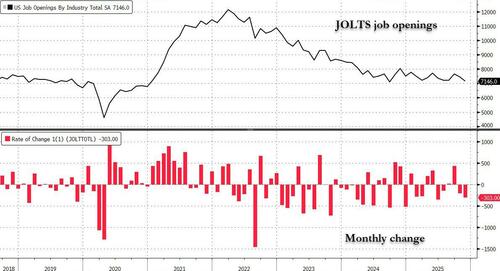
Job Openings Plunge Below Lowest Estimate As Gov’t Openings Crater; Hiring Plummets
Job Openings Plunge Below Lowest Estimate As Gov’t Openings Crater; Hiring Plummets
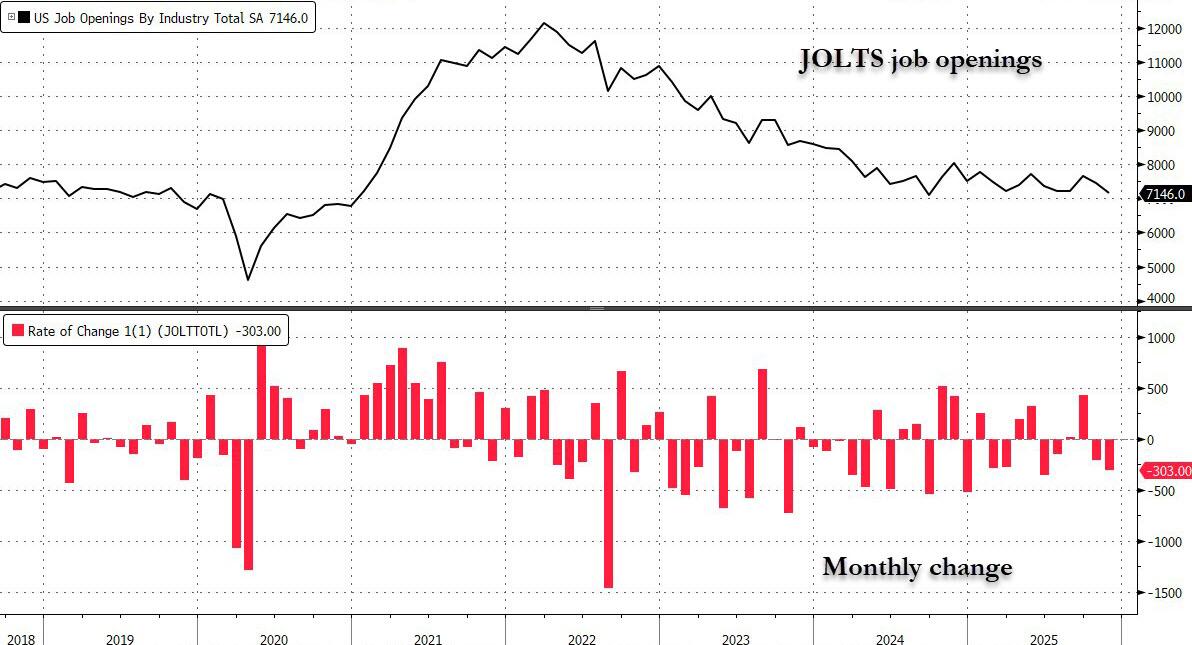
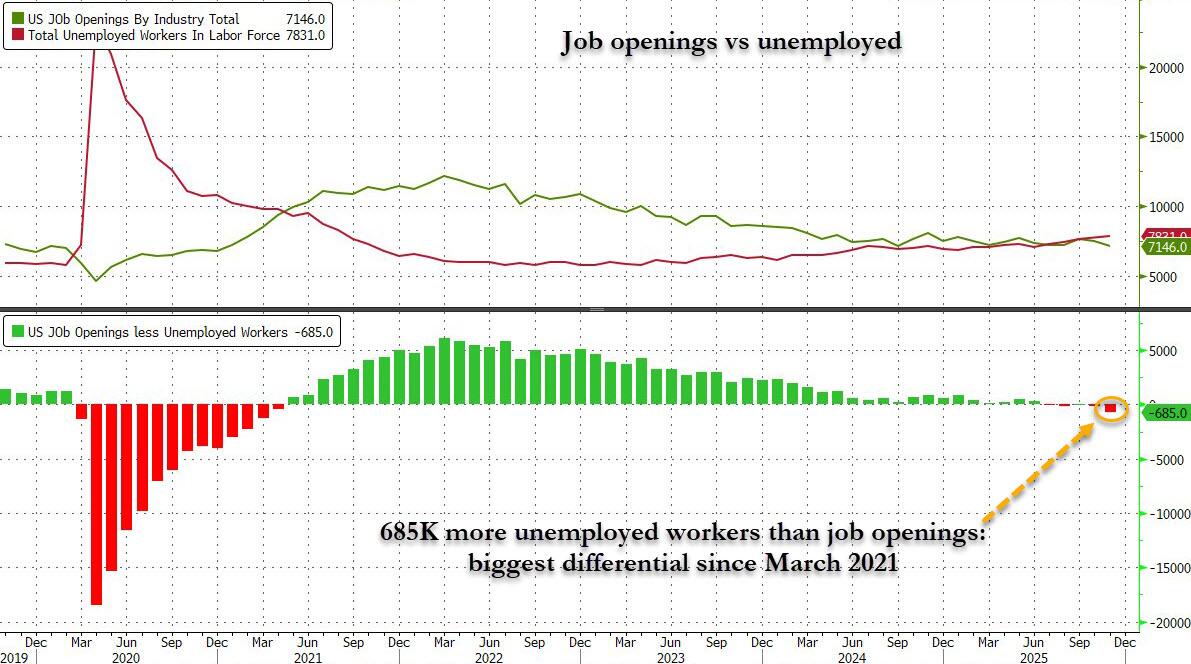
While today’s ADP report was a solid rebound from the worst monthly report in years (even if it missed expectations due to a sudden plunge in California payrolls), the same could not be said for the JOLTS job opening report that followed less than two hours later, and which was another epic disaster: for the month of November (recall JOLTS lags the payrolls report by a month), the US had only 7.146 million job openings, a huge drop from the 7.670 million in October (which was conveniently revised lower to 7.449 million) and the lowest since September 2024.
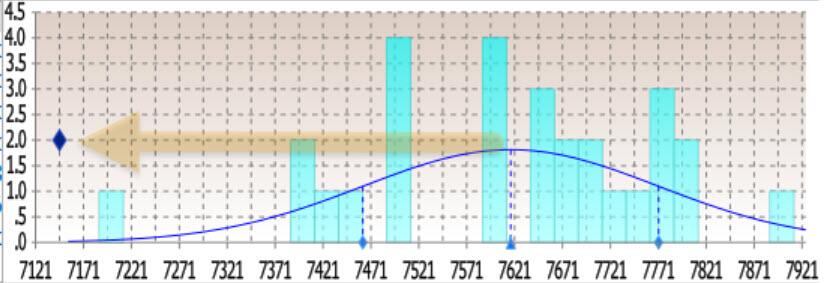
The November print was also a 3+ sigma miss to expectations and came in below the lowest estimate (that of TD Securities).
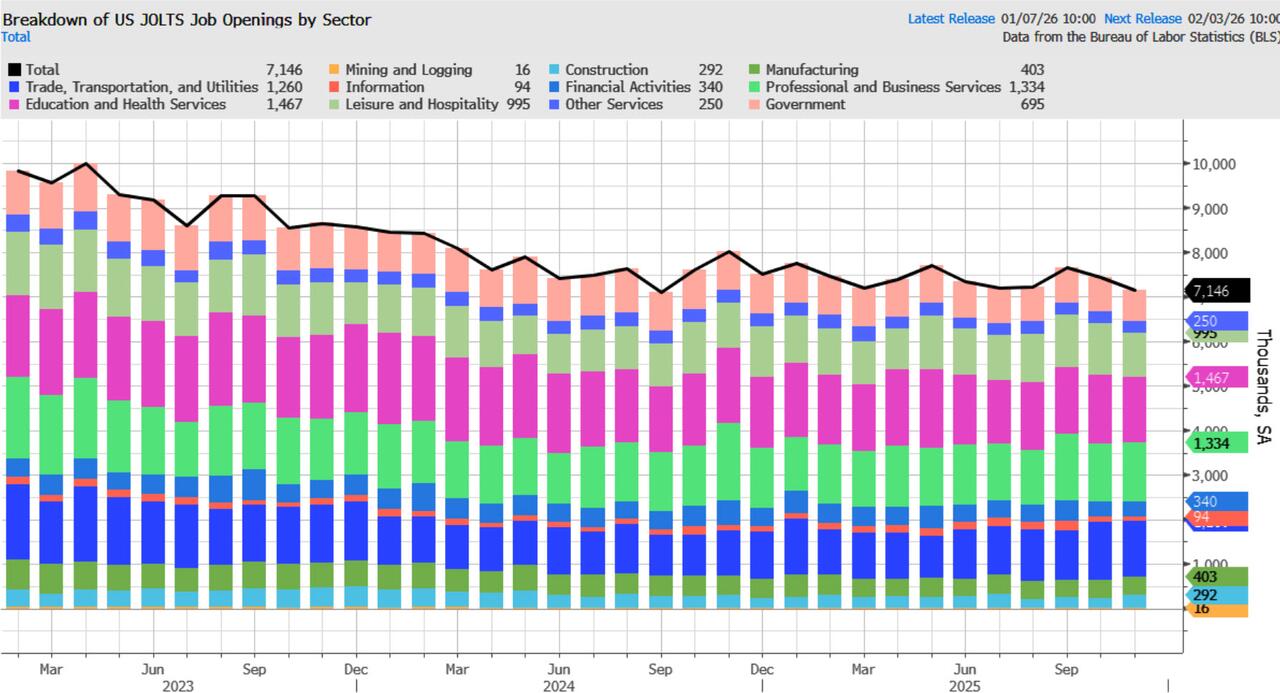
According to the BLS, the number of job openings decreased in accommodation and food services (-148,000); transportation, warehousing, and utilities (-108,000); and wholesale trade (-63,000). Job openings increased in construction (+90,000).
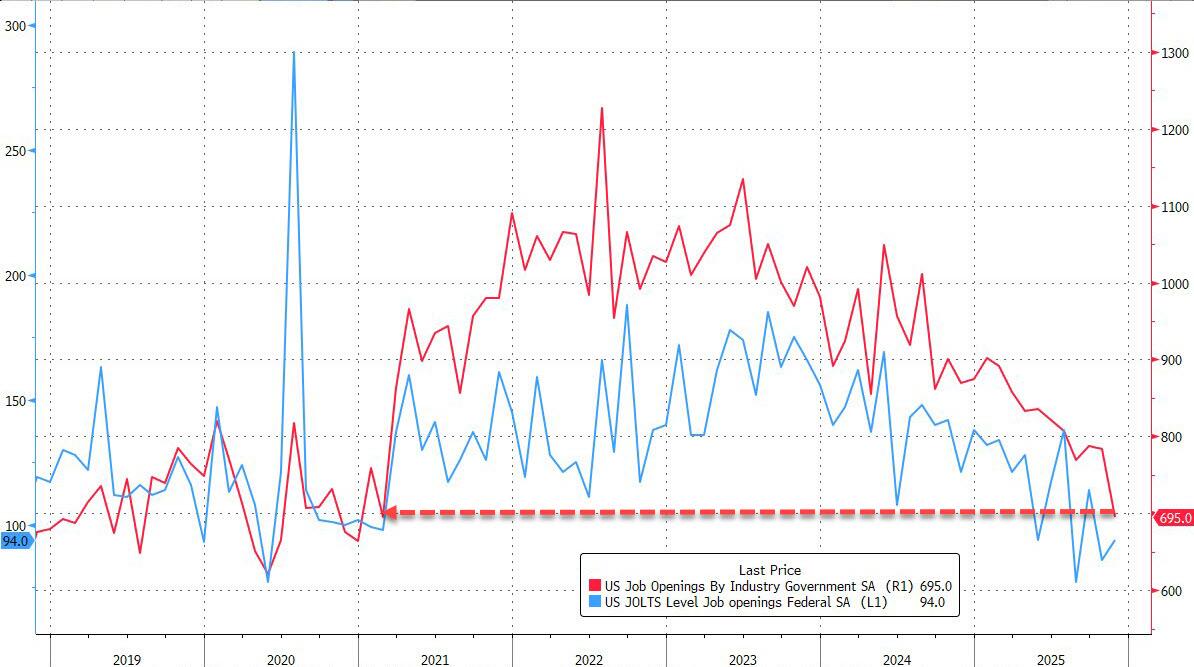
But the most notable drop by far, was that in government, where the number of workers collapsed to the lowest level since early 2021.
Meanwhile, after four years of the US labor market dodging the bullet, its luck has finally run out because while until just a few months ago, the labor market was supply-constrained, with more job openings than unemployed workers in the US, in November we are finally back to sharply demand constrained, with 685k fewer job openings than unemployed workers, the most since March 2021...
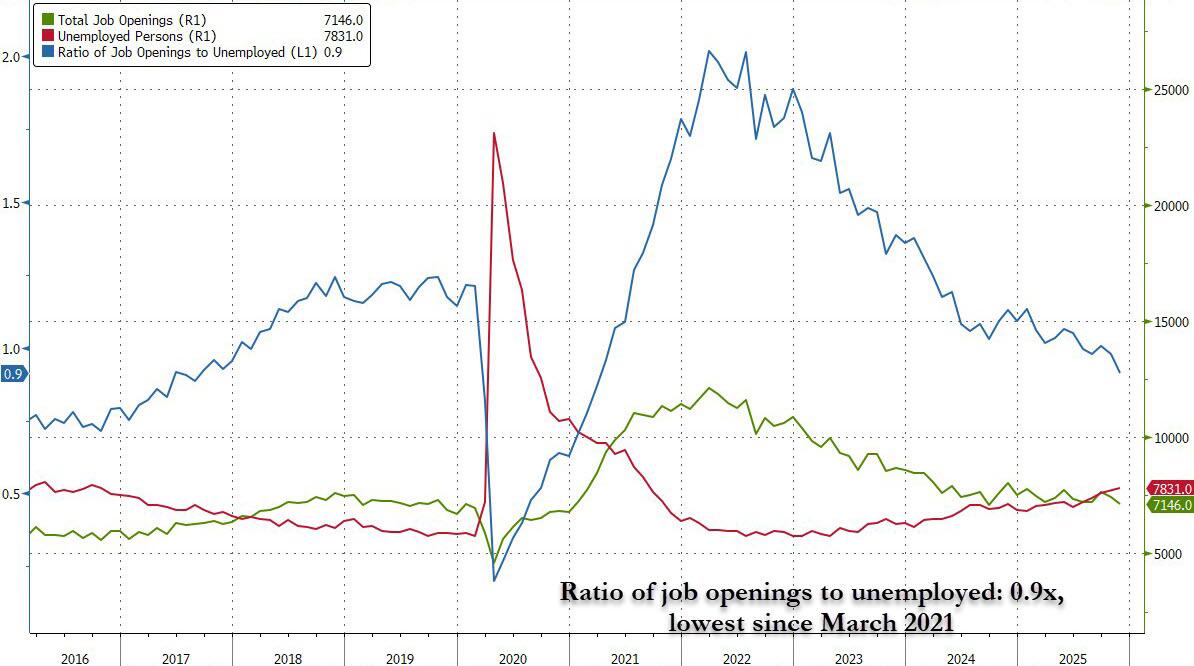
… and translating into a 0.9 ratio of job openings to unemployed workers, the first sub-1.0x print in 4 years.
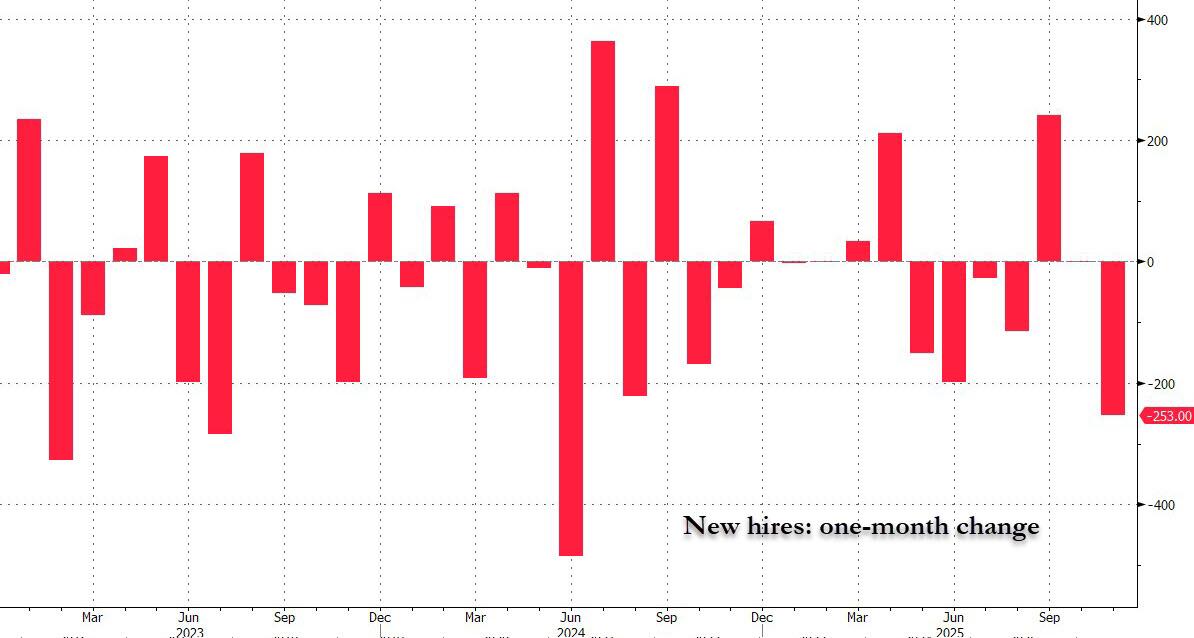
While the job openings data was ugly and potentially another harbinger of the coming jobs recession – things were even uglier below the surface, as the number of new hires tumbled by 253K – the biggest one month drrop since June 2024 – to 5.1156MM the lowest since June 2024.
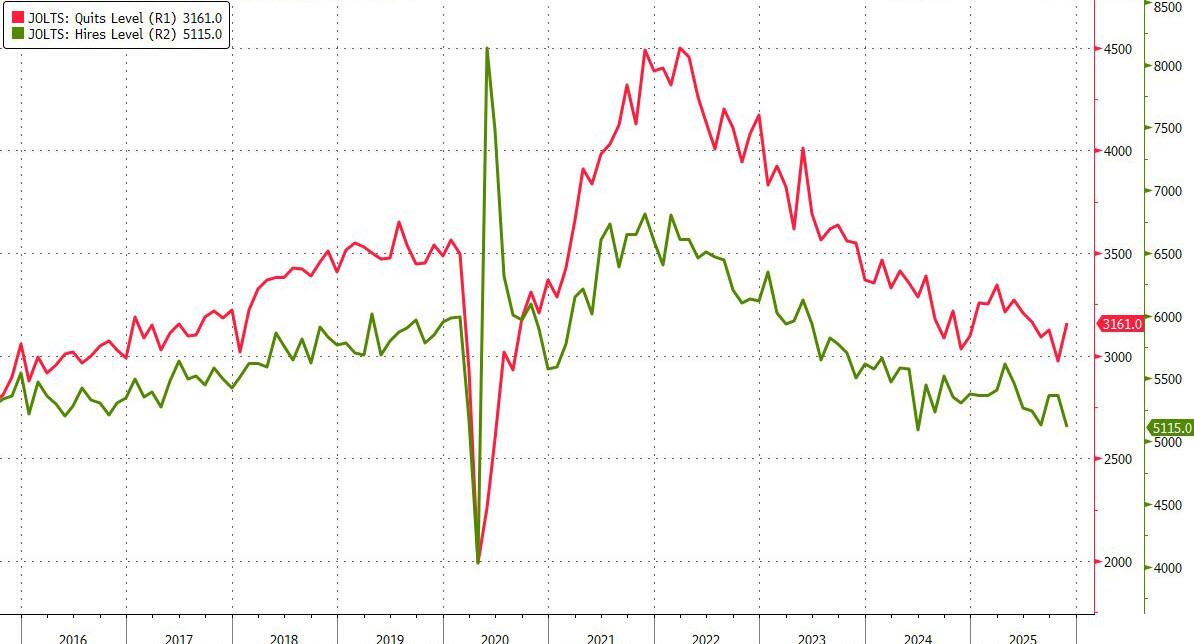
The only silver lining is that the number of people quitting their jobs – also known as the take this job and shove it indicator – rebounded by almost 200K, to 3.161MM, from 2.994MM.
Putting it all together, despite a rather solid ADP print earlier, today’s JOLTS report was quite terrible and certainly enough to ensure that Fed rate cuts continue (assuming no dramatic improvement in Friday’s job report). The flip side, of course, is that this report took place when the government was still mostly shut down, so our advice would be to just ignore everything since it is not indicative of the current state of the US economy after it reopened shortly after Democrats captiulated without achieving anything.
Tyler Durden
Wed, 01/07/2026 – 11:02

False Choice: Individualism Vs Collectivism
False Choice: Individualism Vs Collectivism
Authored by Jeffrey Tucker via The Epoch Times,
The Second World War had ended and the Cold War had already begun. The public was exhausted from grand ideological struggles. The notion that the United States would embark on yet another global campaign seemed implausible. And yet, there was Harry Truman in 1948 warning about the new threat: the Russians.
The Republican Party was in no mood for this. The sense was captured by Senator Robert Taft’s book “A Foreign Policy for Americans” (1951). It passionately argued that America needed to focus on rebuilding this country rather than unleash global military campaigns.
The same year, a new intellectual star emerged on the scene. He was William F. Buckley, Jr., a new graduate of Yale University. His debut book left a huge impression: “God and Man at Yale.” Even now, it is a wonderful read, and a reminder that campus struggles over politics, with the establishment forever tilting left, is nothing new. Eventually, he would take a position as the intellectual head of what came to be called American conservatism.
Buckley’s book documented two main sectors of teaching on campus: economics and religion. In economics, the bias was always toward top-down planning. Keynesian economics was the rage at the time, and it enticed a generation of intellectuals to believe they managed macroeconomics the way engineers built and managed large machinery. Buckley, for his part, was a partisan of the free market and classical economics.
Then there was the matter of religious faith. Then as now, it was rather unfashionable to be a theist on campus. As a devout Catholic, Buckley revealed how people of faith are made to feel wholly excluded in the upper reaches of campus culture. They are second-class citizens while a sniffy atheism dominated the culture of the campus.
“I myself believe that the duel between Christianity and atheism is the most important in the world,” he wrote in his most famous passage.
“I further believe that the struggle between individualism and collectivism is the same struggle reproduced on another level.”
The critical language here is to pit individualism against collectivism. Here is where the language that would dominate the Cold War was mapped out. In Buckley’s view, this was a battle of systems: one which centered on individual rights and action and one which treated the human population as a uniform blob to be pushed and molded by the state.
Buckley was of course referencing the economic model of the Soviet Union, WWII allies with the United States against Germany and Japan that would become the foe of focus for the next 40 years. It so happened that the Soviets also backed an official policy of atheism that would be consistent with Marxian philosophical postulates.
This language of individualism versus collectivism was not unique to Buckley (the sources were likely Ayn Rand and Buckley’s friend Frank Chodorov) but it was he who popularized it on the right side of the political spectrum. Such language stuck for decades.
I can see the attraction of methodological individualism. Only individuals think and act. Only individuals have rights under law. Groupthink and group action are inconsistent with the idea of freedom. Every central plan focused on the status of whole groups overriding individual choice. There is always something wrong with a policy that purports to act on behalf of whole groups as if individual minds are not at work: workers, investors, the rich, the poor, women, blacks, and so on. Such aggregate thinking can be dangerous.
That said, there are grave limits associated with a strict philosophical individualism. We all come from families and seek to build them. We associate with groups in the form of civic community and religious associations. We have friend groups, family responsibilities, loyalties to others in commerce and faith, and live in nations with traditions and aspirations.
Freedom requires community. It lives as part of it. The deployment of a raw individualism ignores these complexities.
Indeed, a peculiar feature of Ayn Rand’s book “Atlas Shrugged” (1957) is how she posits a society made up of only adult individual actors, mostly unmarried, none with children, none with elderly parents who need care, none with disabled people who need attention, and none who are part of some religious group to which they feel an attachment. Marriage itself comes across as oppressive, something to escape, while child-rearing makes no appearance at all.
The book is a fascinating and sometimes inspiring read but once you see these holes in the narrative, you cannot unsee them. Yes, it is a book about individualism but it is not a book about society as we know it in real life. The oversight here is undoubtedly deliberate: a philosophy of strict individualist ethic will necessarily pretend as if a whole class of normal human struggles simply do not exist.
This is why the term individualism is too limited to describe how freedom works. It was a fine slogan for Cold War purposes but it does not work as a defense of the kind of society in which we want to live.
The new mayor of New York City, Zohran Mamdani stated in his inaugural address that he would reject the “frigidity of individualism” for the “warmth of collectivism.” His comment revived this old language and led to a flurry of memes about the terrible history of communist and socialist experiments. He got a grilling for that remark but what troubles me most is the language here.
The alternative to collectivism is not frigid individualism but the infinitely complex social arrangements that come with freedom itself, which involves not just individuals but a multiplicity of spontaneously evolved community relationships and mutual responsibilities. Indeed, in the vision of Alexis de Tocqueville, that is the essence of what America is all about.
The sociologist Robert Nisbet explained further that a freedom that depends solely on individualism is not likely to survive an assault by the state and other powerful institutions. Rather, we need what are called mediating institutions to serve as a kind of bulwark against the encroachments of power. We need schools, churches, civic relationships, coherent communities, robust families, as well as a thriving commercial sector that combines heroic individuals and group relationships.
Nisbet warned that individualism without community leads to alienation, psychological insecurity, and the growth of an overweening state—precisely the opposite of genuine liberty. “It is impossible to understand the massive concentrations of political power in the twentieth-century … unless we see the close relationship that prevailed … between individualism and State power.”
“The abstract, autonomous individual does not exist nor can he ever exist,” he wrote. “True individuality thrives within social relationships and groups, not in a social vacuum.”
It’s even more than what he says. The individual inhabits a vast ocean of social mores, traditions, deep philosophical assumptions, technologies, cultural contexts, and presumptions about law and the expectations of others, and an entire world around us that far outstrips our individual capacity to comprehend it all. There is no such thing as an isolated individual actor.
This is why I offer this point of caution. Just because Mamdani rejects something does not mean his opponents should embrace it. Buckley’s use of the term individualism worked in his time as a way of framing up existing debates. But it does not work to describe what a free society requires to retain its freedom. Yes, we need heroic individuals but they come from somewhere and leave something behind that is necessarily larger than the individual.
There is no warmth in collectivism but neither does it exist in atomized individualism as such. It is community we are going for—and that includes the nation as an entity too—one that is naturally evolves from a society of aspirational people who appreciate acting as, and on behalf of, both individuals and as part of groups.
Tyler Durden
Wed, 01/07/2026 – 10:55
https://www.zerohedge.com/political/false-choice-individualism-vs-collectivism

Dumbocracy? US Falls Below The OECD Average At Math
Dumbocracy? US Falls Below The OECD Average At Math
Math skills are a foundational input into modern economies. They support innovation, productivity, and long-term competitiveness. As technology and data-driven work become more central, countries with stronger math outcomes often gain an edge.
This infographic, via Visual Capitalist’s Bruno Venditti, ranks countries by their average math scores among 15–16 year-olds.
The data for this visualization comes from the OECD’s PISA 2022 assessment. PISA measures how well students can apply math knowledge to practical problems, offering a global comparison of education systems.
Scores typically range from below 400 to above 600. Top performers in this dataset score well above the OECD average of 472.
East Asia Sets the Global Benchmark
Singapore ranks first with an average math score of 575.
Macau (SAR), Taiwan, Hong Kong (SAR), Japan, and South Korea also appear near the top of the ranking. These economies have consistently prioritized math education through rigorous programs and high academic expectations.
Rank
Country
Average PISA Score
1
🇸🇬 Singapore
575
2
🇲🇴 Macau
552
3
🇹🇼 Taiwan
547
4
🇭🇰 Hong Kong
540
5
🇯🇵 Japan
536
6
🇰🇷 South Korea
527
7
🇪🇪 Estonia
510
8
🇨🇭 Switzerland
508
9
🇨🇦 Canada
497
10
🇳🇱 Netherlands
493
11
🇮🇪 Ireland
492
12
🇧🇪 Belgium
489
13
🇩🇰 Denmark
489
14
🇬🇧 United Kingdom
489
15
🇵🇱 Poland
489
16
🇦🇺 Australia
487
17
🇦🇹 Austria
487
18
🇨🇿 Czech Republic
487
19
🇸🇮 Slovenia
485
20
🇫🇮 Finland
484
21
🇱🇻 Latvia
483
22
🇸🇪 Sweden
482
23
🇳🇿 New Zealand
479
24
🇩🇪 Germany
475
25
🇱🇹 Lithuania
475
26
🇫🇷 France
474
27
🇪🇸 Spain
473
28
🇭🇺 Hungary
473
29
🇵🇹 Portugal
472
🌐 OECD average
472
30
🇮🇹 Italy
471
31
🇳🇴 Norway
468
32
🇲🇹 Malta
466
33
🇺🇸 U.S.
465
34
🇸🇰 Slovakia
464
35
🇭🇷 Croatia
463
Europe’s Strong, Steady Performers
Several European countries cluster just above or around the 500 mark. Estonia leads the region, followed closely by Switzerland and the Netherlands. Ireland, Belgium, Denmark, and Poland also post solid results.
How North America Compares
Canada ranks ninth overall with a score of 497, standing out as one of the strongest performers outside East Asia and Europe. The United States ranks lower at 465, below the OECD average.
Countries from Africa, the Middle East, and Latin America are absent from the list, reflecting long-standing gaps in educational performance across regions.
If you enjoyed today’s post, check out Ranked: Productivity of the World’s Largest 30 Economies (2005-2025) on Voronoi, the app from Visual Capitalist.
Tyler Durden
Wed, 01/07/2026 – 10:35
https://www.zerohedge.com/geopolitical/dumbocracy-us-falls-below-oecd-average-math

Only a freshman, Kouts’ Avery Elijah leads state in steals. ‘She’s always thinking one or two plays ahead.’
There’s nowhere for Avery Elijah to hide on the basketball court.
The 5-foot-10 guard is only a freshman but is already one of the best players on the floor in any given game.
So perhaps it’s no surprise that when she’s away from basketball, Elijah prefers to keep to herself. That might mean drawing, painting pictures of her sister’s cat, Meeko, or spending time on her family’s 186-acre farm.
“I have a family farm I like to visit a lot,” Elijah said. “My sister has a lot of animals. We have goats, chickens, dogs, cats, all that stuff. My dad owns cows there too.”
By all accounts, Elijah is shy, at least off the court. On it, she makes sure people notice her. That mentality has fueled a monster debut season for Porter County Conference leader Kouts (12-3, 4-1).
Elijah is averaging 14.2 points and 3.3 assists, both team highs, but it’s her defense that has drawn the most attention. She’s averaging a state-best 6.8 steals.
“I feel like I’m good at anticipating passes and just using my arms really well,” she said. “So I think maybe that’s where most of the steals come from.
“But I’ve been wanting to be ranked pretty high in this since I was little, and it’s a really good feeling to know I’m up there with all these other talented athletes.”
It’s easy to see why Kouts coach Tim Schwartz was eager to find out what his newest player could do as soon as possible.
“She’s always thinking one or two plays ahead, anticipating,” Schwartz said. “In her heart, she’s a point guard who loves to distribute the ball. That’s the kind of player she is. She’s very unselfish, and that’s what I noticed even in middle school. She’s unselfish with the ball, and she’ll share it with anyone on the court.”
Kouts’ Avery Elijah (10) tries to steal the ball from Hanover Central’s Simone Parker (4) during a nonconference game in Cedar Lake on Tuesday, Jan. 6, 2026. (Mandy Coppinger / Post-Tribune)
Kouts junior guard Bella Birky, Elijah’s backcourt mate, noticed the same traits.
“She has a really good basketball IQ,” Birky said. “We’re probably two of the quickest girls on the team, but she’s also very poised and calm. She really shows no emotion, which I really like about her, and she’s not a selfish player. She knows how to share the ball.
“I knew when she first came to practice that she was going to be in a starting-five spot.”
Elijah and Birky average nearly 11 steals between them. The havoc they create and the fast-break chances that follow have fueled the Fillies, who have already matched their win total from last season and hope to end a 20-year conference tournament title drought.
Elijah identified the key to making that happen.
“Communicating on the court,” she said. “If somebody doesn’t know what to do, just tell them where to go and stuff like that. Communicating with my (teammates) is a big thing for me, especially, because I used to not talk as much on the court. But now that I’m with these girls, I feel like I talk way more than I have before.”
Kouts’ Avery Elijah (10) blocks a shot during a nonconference game against Hanover Central in Cedar Lake on Tuesday, Jan. 6, 2026. (Mandy Coppinger / Post-Tribune)
That’s the latest step in Elijah’s maturation, and she has big goals for her future, too, from improving her 3-point shot in the short term to playing in the Big Ten down the road. Considering she’s already hearing from colleges, that may not be far-fetched.
If she continues her career in college, she will follow in the footsteps of multiple family members. Her father, Mark, played football at Valparaiso University, her older sister Madison ran at Minnesota Crookston, and her older sister Sidney runs at Purdue University Northwest and previously played basketball at Calumet College.
Noah Poser is a freelance reporter.
https://www.chicagotribune.com/2026/01/07/basketball-kouts-avery-elijah/
An Arctic Chill In Greenland
An Arctic Chill In Greenland
By Elwin de Groot, Head of Macro Strategy at Rabobank
You may already have buckled yourself up, but an arctic chill may also require you to wear an extra vest these days. President Trump and some officials in his administration amplified threats to take Greenland. Preferably by “buying” it, but by force if necessary.
The White House yesterday said it is discussing options for acquiring Greenland, including potential use of the military. The key reason put forward in a statement is that it sees this action as neccessary to “deter our adversaries in the Arctic region”. “The president and his team are discussing a range of options to pursue this important foreign policy goal, and of course, utilizing the U.S. military is always an option at the commander-in-chief’s disposal,” the White House said.
Several government officials did try to take the sting out of that last sentence. US special envoy to Greenland, Jeff Landry, told CNBC that Trump isn’t ready to seize the island and the President “supports an independent Greenland,” whilst the Wall Street Journal reported that Secretary of State Marco Rubio told lawmakers during a classified briefing on Monday that recent administration threats against Greenland did not signal an imminent invasion and that the goal is to buy the island from Denmark.
Meanwhile US Senate Democrats have said they plan to introduce a resolution to block Trump from invading Greenland. The US has portrayed its action in Venezuela as support for the ‘arrest’ of Maduro, which -some argue- offered the president more leeway. But the Greenland case may not be so easy to fit into that category.
Still, the threat remains wide open on the table now. And that this risks driving a big wedge between the US and its allies is clear. Earlier this week, Denmark’s Premier Mette Frederikson had already warned that, while she is taking the threats by the Trump administration seriously, “everything stops, including NATO and thus the security that has been established since the end of the Second World War”, should the US choose to attack another NATO country.
What is interesting, is that the US has long neglected its military presence on Greenland. Since 1951 it has had a Defense Agreement with Denmark, establishing the operation of Pituffik (Thule) Air Base on the island. During the Cold War this hosted up to 6,000 US personnel across several camps; today that presence has shrunk dramatically to roughly 150 service members. Last June Denmark’s parliament expanded US access to the island through the 2023 Defence Cooperation Agreement (DCA), giving it broad rights to station personnel, store equipment, conduct maintenance and exercises and have jurisdiction over US troops.
The reference to these existing arrangements was also a key feature in a (quite unusual) joint statement by the leaders from France, Germany, Italy, Poland, Spain, the UK and Denmark yesterday. It notes that “Arctic security remains a key priority for Europe and it is critical for international and transatlantic security. NATO has made clear that the Arctic region is a priority and European Allies are stepping up. We and many other Allies have increased our presence, activities and investments, to keep the Arctic safe and to deter adversaries. The Kingdom of Denmark – including Greenland – is part of NATO.” The statement emphasizes NATO unity and collective security in the Arctic and the importance of adhering to UN principles: sovereignty, territorial integrity and the inviolability of borders. It also declares that Greenland’s future is for its people and Denmark to decide.
How the situation and diplomatic activity around Greenland evolves in the coming weeks could also have a bearing on that other – and much more acute – dossier, namely Ukraine. On that front there was actually some positive news yesterday. After meeting in Paris with Zelenskyy and European leaders from the ‘coalition of the willing’, US Special Envoy Steve Witkoff said that “significant progress” had been made on a security guarantee framework.
With their Paris Declaration – Robust Security Guarantees for a Solid and Lasting Peace in Ukraine, European leaders clearly wanted to project some rare Euro-Atlantic unity. The statement suggests, among other things, that the US would support a US-led ceasefire monitoring and verification mechanism and that there will be binding commitments to support Ukraine in the case of a future armed attack by Russia. If approved by Washington this would be a significant step forward, although many details still need to be fleshed out. It is also very unclear how this would land in Russia and –if Russia dismisses the plan– how allies and particularly the US would respond.
So far, markets have remained largely unfazed despite the geopolitical landslides that have been taking place in recent weeks. The S&P 500 hit a fresh record high yesterday and so did the Eurostoxx 600 index. Whilst Treasury yields rose by 1 to 2 basis points, European yields slipped, as investors took their cues from mixed PMI surveys and relatively benign inflation data from the region. The euro also weakened vis-à-vis the dollar, with EURUSD falling below the 1.17 handle.
December PMI surveys for Spain and Italy showed contrasting developments, with Spain surprising positively (composite index up 0.5 points to 55.6) but Italy negatively (composite index down 3.5 points to 50.3). Together with small downward revisions in the French and German PMIs, the overall message is that the European economy likely entered a soft spot towards the end of 2025. This confirms our cautious view on the economy for the next several months.
Meanwhile, inflation data surprised to the downside. French inflation was down one notch in December, where expectations were for a slight rise. The headline print moderated to 0.8% from 0.9% whilst harmonized inflation eased to 0.7% from 0.8%. This print again underscores that France remains in the lower league when it comes to inflation in Europe. The fall in inflation was mainly attributed to a more pronounced decrease in energy prices, particularly petroleum, INSEE noted. Fresh food inflation accelerated, whilst the decline of prices in manufactured goods moderated to -0.4% y/y from -0.6% y/y. Services inflation stayed at 2.2% y/y.
In Germany, the fall in inflation was more pronounced. Harmonized inflation for December dropped no less than 0.6 percentage points to 2% (consensus: 2.2%). Although a fall in food and energy inflation added their bit, a significant fall in core inflation – in contrast to the French numbers – was a key driver for the German inflation rate. The national measure for core inflation dropped 0.3 percentage points. There were notable declines in prices of clothing and recreation. The latter tend to be volatile items and quite sensitive to distortions in seasonal patterns (such as the timing of holidays etc.), so not all of the drop in core inflation may stick as we head into 2026.
Overall, though, the benign inflation data from Germany and France shifted investor’s focus to the possibility that the ECB could still cut rates if both the economy and inflation were to slip further in the months ahead. The ECB doves have been relatively quiet of late, but these kind of numbers are sufficient to keep some speculation alive.
Tyler Durden
Wed, 01/07/2026 – 10:15
https://www.zerohedge.com/geopolitical/arctic-chill-greenland