Category: News

Mayor Brandon Johnson raises possibility of midyear layoffs
Mayor Brandon Johnson raised the possibility Wednesday of city worker layoffs after a bruising budget fight that he again claimed led to an unbalanced spending plan for this year.
At a City Hall news conference, the mayor responded to a question about retroactive changes to the 2026 budget, which aldermen passed over his objections last month, by reiterating the package could force personnel cuts.
“There are still some concerns about whether or not the budget projections that were put forth by those other alders, that those projections will actually materialize,” Johnson told reporters. “So now I am bracing for what could be midyear layoffs, right? We warn people.”
Asked to elaborate on the layoff threat, Johnson hinted that police and fire could be affected.
“Well, if the revenues do not match the expenses, that’s what’s going to trigger it,” the mayor said. “As far as individuals who could be laid off, I mean we’re talking about public employees, right? There could be real, serious consequences to workers who are attached to community safety.”
The mayor specifically called out the budget’s projected $90 million debt sale measure as “immoral” and, on the issue of legalizing video gambling to raise an expected $6.8 million this year, he said more vaguely “there are more sound ways” to generate revenue. He did not elaborate on how he hopes to tweak the package beyond saying he wants to work with the City Council to manage government expenses.
Johnson’s motive for fighting the video gambling terminals would be because revenues would eat into the city’s first casino at Bally’s Chicago, which was billed as a way to help buoy pension funds, and because critics say vice taxes are a regressive way to raise revenue. But he has not indicated whether he would actually fight.
He pointed the finger at his City Council opponents, who in December took the remarkable step of passing their own $16.6 billion budget after Johnson’s 2026 proposal, which called for reinstating a corporate head tax and shorting an advance pension payment, failed to shore up enough support. Johnson opted to neither veto nor sign the final package, an implicit surrender after weeks of failing to stop the rebellion from his legislative counterparts. But he maintained that he will not wear the political jacket for any adverse consequences.
Both the mayor and the aldermanic opposition agree this 2026 budget is not perfect. But the specter of layoffs remains hypothetical for now, and is part of Johnson’s ongoing messaging to hit back at City Council in the weeks leading up to and following his defeat in a 30-18 vote.
Also Wednesday, Johnson declined to answer directly when asked if he will seek re-election, telling reporters who asked about the looming 2027 election that he’s focused on making Chicago the safest and most affordable big city. “When it’s time to talk politics, you know, we’ll get into that,” he said.
And he bristled at a question about President Donald Trump’s ongoing threats to withhold federal funds to the CTA over a safety plan that the Trump administration says falls short, saying “there is nothing that we can submit to this president and it’s going to satisfy him.”
“I mean, you’re talking about a doty-brained individual,” Johnson said.
https://www.chicagotribune.com/2026/01/07/mayor-brandon-johnson-midyear-layoffs/
Spot The Odd One Out: Life Expectancy Vs Healthcare Spending
Spot The Odd One Out: Life Expectancy Vs Healthcare Spending
As Warren Buffett popularized: “Price is what you pay, value is what you get”.
As Visual Capitalist’s Jeff Desjardins details below, just because someone pays the most, doesn’t mean that they extract the biggest payoff from a product or service.
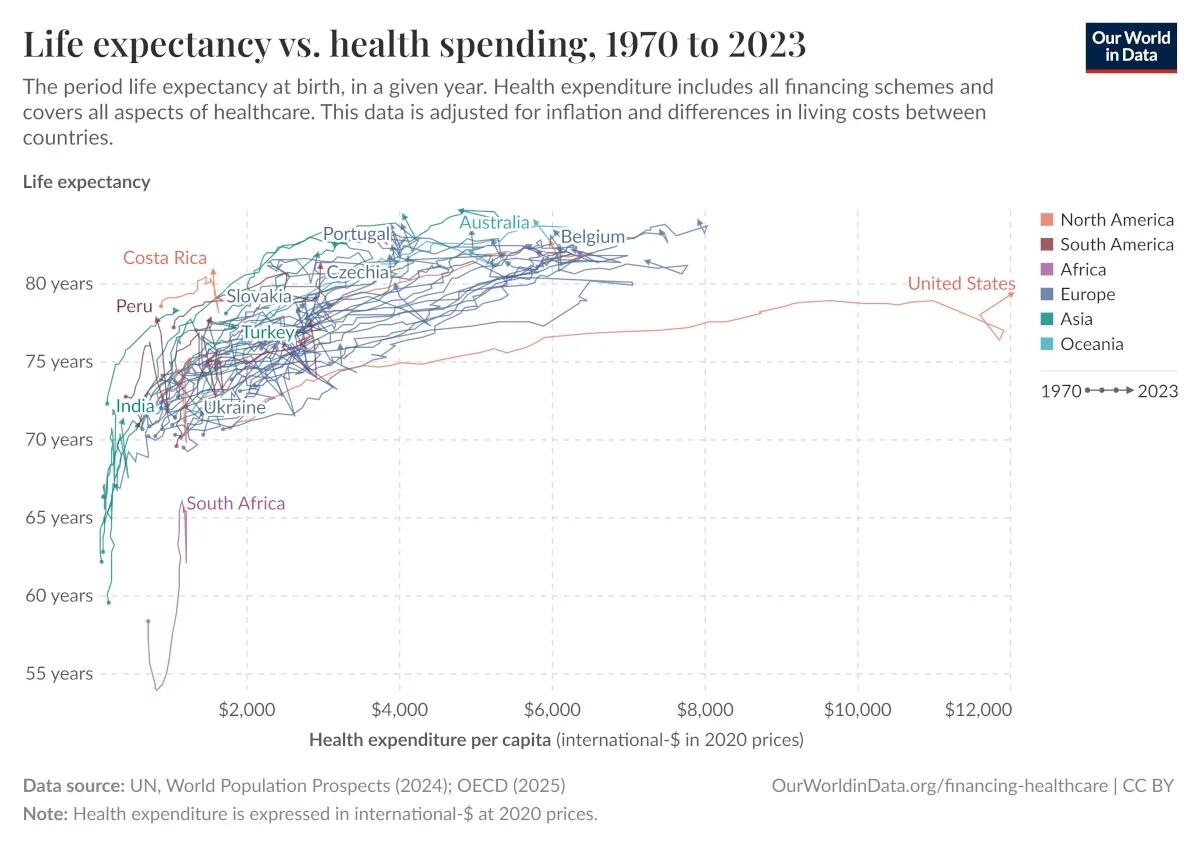
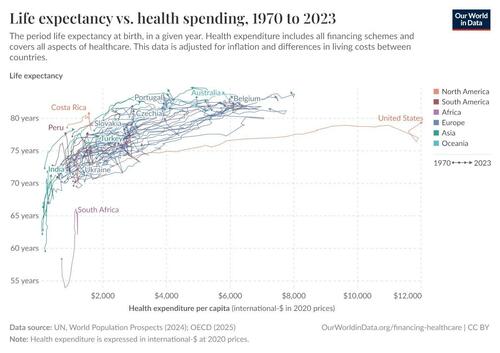
Today’s visual from Our World in Data that compares life expectancy with healthcare spending per capita hints at exactly this paradox.
The Data on Life Expectancy vs. Healthcare Spending
Below is the data for 51 countries for the year 2023:
Rank
Country
Life expectancy (2023)
Health expenditure per capita (2023)
1
🇯🇵 Japan
84.71
$4,806
2
🇰🇷 South Korea
84.33
$4,055
3
🇨🇭 Switzerland
83.95
$7,930
4
🇦🇺 Australia
83.92
$5,778
5
🇮🇹 Italy
83.72
$4,046
6
🇪🇸 Spain
83.67
$3,901
7
🇫🇷 France
83.33
$6,036
8
🇳🇴 Norway
83.31
$7,424
9
🇲🇹 Malta
83.30
$4,941
10
🇸🇪 Sweden
83.26
$6,204
11
🇮🇸 Iceland
82.69
$5,228
12
🇨🇦 Canada
82.63
$5,981
13
🇮🇪 Ireland
82.41
$5,689
14
🇮🇱 Israel
82.41
$3,154
15
🇵🇹 Portugal
82.36
$3,906
16
🇱🇺 Luxembourg
82.23
$6,078
17
🇳🇱 Netherlands
82.16
$6,273
18
🇧🇪 Belgium
82.12
$6,123
19
🇳🇿 New Zealand
82.09
$4,938
20
🇦🇹 Austria
81.96
$6,361
21
🇩🇰 Denmark
81.93
$5,823
22
🇫🇮 Finland
81.91
$5,375
23
🇬🇷 Greece
81.86
$2,943
24
🇨🇾 Cyprus
81.65
$3,869
25
🇸🇮 Slovenia
81.60
$4,118
26
🇩🇪 Germany
81.38
$7,248
27
🇬🇧 United Kingdom
81.30
$5,413
28
🇨🇱 Chile
81.17
$2,964
29
🇨🇷 Costa Rica
80.80
$1,565
30
🇨🇿 Czechia
79.83
$3,943
31
🇺🇸 United States
79.30
$12,023
32
🇪🇪 Estonia
79.15
$2,921
33
🇵🇱 Poland
78.63
$3,125
34
🇭🇷 Croatia
78.58
$2,751
35
🇸🇰 Slovakia
78.34
$2,672
36
🇨🇳 China
78.20
$1,086
37
🇵🇪 Peru
77.74
$817
38
🇨🇴 Colombia
77.73
$1,537
39
🇦🇷 Argentina
77.40
$2,850
40
🇹🇷 Turkey
77.16
$1,846
41
🇭🇺 Hungary
77.02
$2,613
42
🇱🇻 Latvia
76.19
$2,494
43
🇱🇹 Lithuania
76.03
$3,224
44
🇷🇴 Romania
75.94
$2,373
45
🇧🇬 Bulgaria
75.64
$2,612
46
🇲🇽 Mexico
75.07
$1,244
47
🇧🇷 Brazil
74.87
$1,661
48
🇮🇳 India
71.70
$290
49
🇺🇦 Ukraine
71.63
$1,429
50
🇮🇩 Indonesia
71.15
$376
51
🇿🇦 South Africa
65.45
$1,218
—
Average
79.74
$3,986
The clear takeaway is that while most high and upper-middle income countries cluster around the same trajectory, the United States is a clear outlier.
On average, the countries on the above list have a life expectancy of 79.74 years for a cost of $3,986 per person, while the U.S. has a life expectancy of 79.3 and spend of $12,023 per person.
Peer countries (Canada, UK, Germany, Japan, France, Italy) spend about half of what the U.S. does on healthcare per capita on average, but all have better life expectancy outcomes.
Why is the U.S. an Outlier?
While the U.S. excels in advanced and specialized medical care, life expectancy outcomes are held back by lifestyle and social factors rather than clinical capability.
Higher rates of obesity, chronic disease, opioid overdoses, gun violence, and traffic fatalities all weigh on average lifespan.
At the same time, healthcare access is uneven, with large gaps by income, race, and geography. As a result, additional spending often goes toward higher prices and end-of-life care, producing diminishing returns in overall life expectancy.
View the highest and lowest life expectancy rates around the world in this map.
Tyler Durden
Wed, 01/07/2026 – 12:35
https://www.zerohedge.com/medical/spot-odd-one-out-life-expectancy-vs-healthcare-spending

Cook County clerk’s office teams up with Chicago Bears to launch inaugural student election judge program
At 17 years old, Melissa Loch has never cast a ballot. It’s something the politically minded Arlington Heights student is eager to do for the first time this year.
But she’s not stopping there.
Loch is training to become an election judge as part of a new effort by the Cook County clerk’s office to engage more young voters — a historically elusive age group when it comes to turnout — in local politics.
Through the initiative, dubbed “Defenders of DA’mocracy,” students across the county will see the inner workings of the election system firsthand by becoming official election judges for their own peers ahead of this spring’s primary.
Preparations for the inaugural venture started this week, with some 150 students from two dozen high schools across suburban Cook County learning the ins and outs of running a polling place at a series of training sessions. Students are training to ultimately run early voting sites at their schools for the March election and, if they want, to officiate future elections, too.
Loch was one of about 40 students who turned out for a night of judge training Tuesday at John Hersey High School in Arlington Heights. Hoping to go into law and politics when she’s older, Loch said that when her teacher asked if anyone was interested in piloting the county’s new program, she jumped at the chance.
“I want to get involved, help people vote and help democracy,” she said, “because I want to be a part of that one day.”
And to her, Loch continued, there was no better way than learning how the voting process works from the ground up.
Motivating more young voters to participate in local elections has long been a goal of the Cook County clerk’s office, Deputy Clerk of Elections Edmund Michalowski said.
Historically, young people have voted at lower rates than older adults across the country, per Tufts University’s Center for Information & Research on Civic Learning and Engagement, or CIRCLE, which studies youth and politics. That started to change in recent years, with the 2018 and 2020 elections seeing historic highs in youth voter turnout, according to a CIRCLE analysis of voter file data.
Still, barriers persist. A poll from The Associated Press-NORC Center for Public Affairs Research last summer found that young people are less engaged with U.S. politics than older Americans and less likely to say voting is important. The poll also found that young adults are more likely to reject political party labels and far less likely to follow politics closely than their older counterparts.
Local election data shows that among Cook County voters between ages18 to 22, less than 1% typically turn out to vote in municipal elections, 2% to 4% turn out for midterms and less than 5% cast their ballots in presidential cycles, according to Michalowski.
Among the factors hindering higher youth participation, CIRCLE research shows, include confusing registration deadlines and requirements, a lack of youth outreach and a dearth of regular curriculum that teaches young people about elections and voting in school.
With Defenders of DA’mocracy, the hope is to bridge that gap and meet young voters where they’re at, Michalowski says.
Recruiting election officials from high school campuses isn’t a new idea in and of itself. State statute allows juniors and seniors to be appointed election judges, even if they aren’t yet old enough to vote. In Cook County, more than 1,500 high schoolers serve as election judges each year.
Students from various Cook County high schools learn about submitting a ballot as they receive training to be official election judges while operating on-campus early voting sites as part of the county clerk’s office’s first-ever high school early voting program. The training took place at Hersey High School in Arlington Heights on Jan. 6, 2026. (Chris Sweda/Chicago Tribune)
With the new program, however, the difference lies in time and place. As judges, students will be operating on-campus early voting sites specially instituted for the initiative. The polling places will solely be open to eligible students and school staff and operate for one day only, Feb. 26, before early voting for the upcoming primary opens on March 2.
“It just adds a different layer to our democracy,” Michalowski said. “It’s theirs. They’re running it, they know about it, they can promote it.”
Also setting the venture apart: It comes with an inherent flare for local pride. Supporting the county clerk’s office in the initiative is none other than the Chicago Bears, who are providing team-branded merch, down to an orange and blue-colored early voting handbook, and words of encouragement to participating students.
On the heels of the Bears’ wild-card playoff game this weekend, students at Tuesday’s training were met with a video message from the team rousing their involvement in the voting process, which ended with two words to the young audience: “Bear down.”
The support isn’t one-sided either. A few weeks ago, Cook County Clerk Monica Gordon and staff from her office visited a Bears training camp in north suburban Lake Forest, where they explained the election process and even helped register a few players to vote.
“Strong elections don’t just happen,” Gordon told students as she sported a Bears jersey with the words “DA’mocracy Defenders” written across the front. “Like a winning game plan, they depend on people who show up, learn their roles and work together to get it right.”
Speaking with the Tribune after her remarks, Gordon said seeing how low turnout was among young voters in Cook County was a call to action.
“We’ve got to do something about this. … If we don’t, there’s danger in our future,” she said.
Gordon hopes the county’s initiative catches on and is adopted across Illinois, she said, adding she’d also like to see the effort eventually implemented throughout the country and even the globe.
“(These students will) carry this purpose with them throughout their lives,” she said. “They encourage others, they tell others what’s going on. Then what you have is a more informed, a more energized electorate.”
At the end of Tuesday’s training, students finished with a written test gauging their election judge prowess. Afterward, long-standing election officials who helped lead the event reviewed the questions aloud, sending the county’s newest slate of judges home with a clean bill of ballot expertise.
Seventeen-year-old Erik Kunicki left keen to use his newfound knowledge in real-time.
The Buffalo Grove High School junior said he signed up to become a judge because he has a passion for local elections, which he thinks are especially important for deciding the policies and elected officials that communities engage with most day to day. In tandem, he wants to see his peers, through the county’s new program and efforts like it, recognize the role elections play and exercise their right to participate.
“I hope that (this will help) people see how important voting is,” he said, “and how it’s not that scary.”
https://www.chicagotribune.com/2026/01/07/cook-county-election-chicago-bears/
US Service Activity Expands At Fastest Pace Since 2024, In Mirror Image To Manufacturing Slump
US Service Activity Expands At Fastest Pace Since 2024, In Mirror Image To Manufacturing Slump
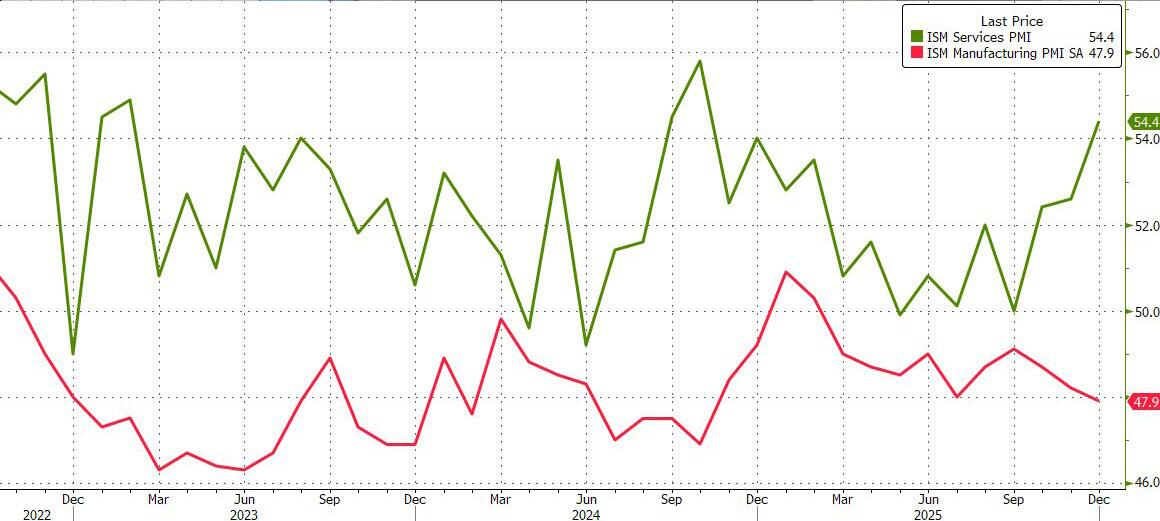
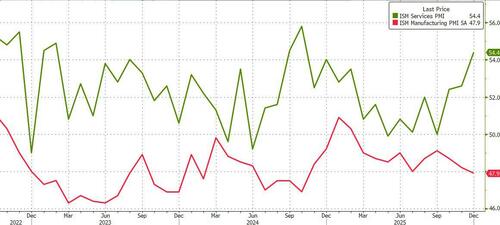
It’s only fitting that two days after we got the weakest US Manufacturing ISM print in over a year, earlier this morning we got a diametrically opposite report from the Service sector, which according to the Institute for Supply Management expanded in December at the fastest pace in more than a year, fueled by solid demand growth and a pickup in hiring. As the chart below shows, while the Service sector grew at the fastest pace since October 2024, the Manufacturing sector contracted at the fastest pace since November 2024.
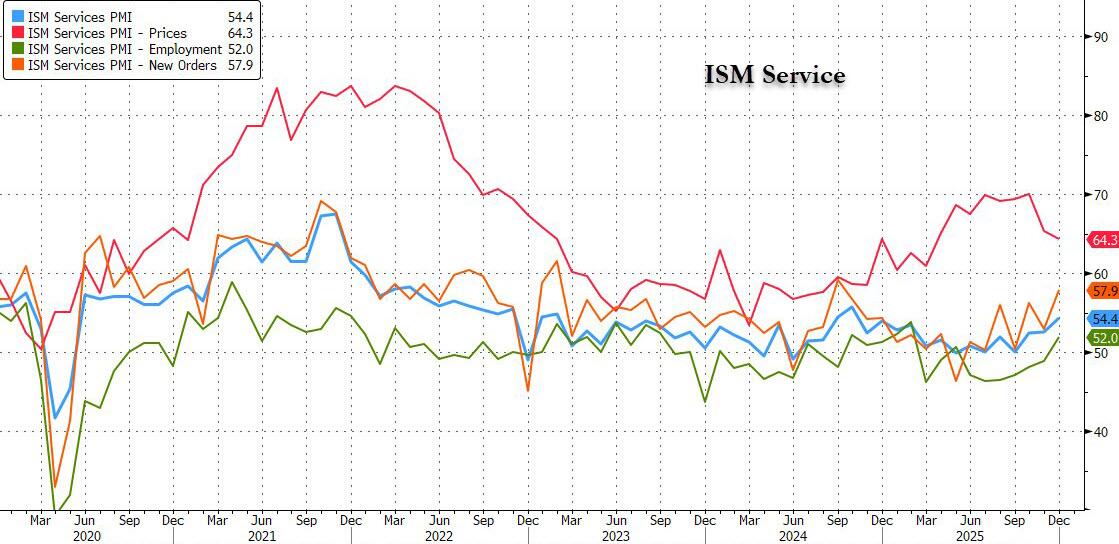
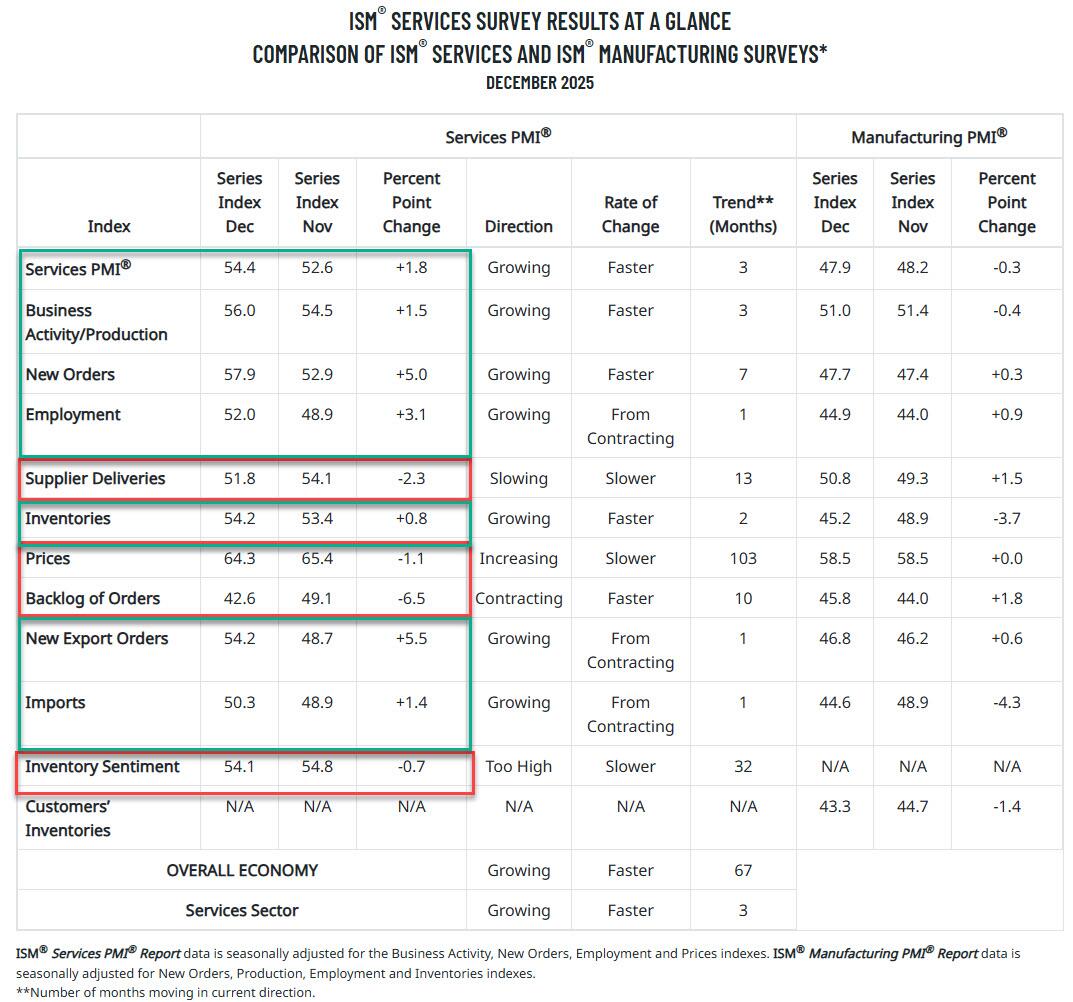
The Institute for Supply Management’s index of services rose 1.8 points to 54.4, the highest since October 2024 (recall readings above 50 indicate expansion in the largest part of the economy). The December figure exceeded all projections in a Bloomberg survey of economists. Ironically, it printed at the exact same time as the latest JOLTs report which as we noted earlier, printed below all Wall Street estimates.
New orders expanded by the most since September 2024 and a measure of business activity, which parallels the ISM’s factory output gauge, climbed to a one-year high. Export bookings grew at the fastest pace in more than a year. Meanwhile, ISM’s index of prices paid for services and materials showed the slowest growth in nine months. The supplier deliveries index fell 2.3 points from the highest level in a year.
Inventories expanded at the fastest pace since October 2024, based on the ISM’s gauge. Even so, a measure of inventory sentiment fell for a third month, suggesting fewer service providers saw their stockpiles as being too high.
The pickup in demand helped spark the biggest growth in services employment since February, and comes just days before the December jobs report out Friday is projected to show moderate payrolls growth in December and a slightly lower unemployment rate than a month earlier.
“The broad-based strength in the headline index suggests that conditions in the services sector are picking up, hinting at the potential for some more broad-based economic growth,” Alexandra Brown, North America economist at Capital Economics, said in a note.
Eleven industries reported growth last month, led by retail trade, finance and insurance, and accommodation and food services. Five contracted, including management of companies and support services.
Below we share Select ISM survey respondent comments:
“We continue to experience higher prices, primarily due to the impact of the administration’s trade and tariff policies. We are disproportionately impacted by importing seafood from Southeast Asia and coffee from South America.” — Accommodation & Food Services
“In general, business is flat. Value brands are still experiencing higher demand. But premium brands struggle to maintain market share.” — Agriculture, Forestry, Fishing & Hunting
“Overall, business is healthy, most of our purchasing is staying consistent, and we are renewing most contracts as we head into the new year.” — Finance & Insurance
“Flu cases on the rise; the vaccine is not of much help this year. Respiratory equipment and supplies are seeing a surge in demand.” — Health Care & Social Assistance
“Annual pricing markups from key service and data providers are higher than they’ve been for many years — gradually drives costs up.” — Information
“Continuing uncertainty and apprehension regarding tariffs and the resulting impact on pricing.” — Public Administration
“High business activity due to the holiday season.” — Transportation & Warehousing
Commenting on the report, Bloomberg economist Alex Tanzi said that “the December ISM Services PMI reflects the economic turnaround since the government shutdown ended in November. Despite the sizable improvement, however, the tone of commentary remained uneasy, a warning sign for the future.”
Tyler Durden
Wed, 01/07/2026 – 12:28

Freshman guard Jayden Alford already provides spark off bench for Yorkville Christian. ‘Feel more comfortable.’
Freshman guard Jayden Alford may be Yorkville Christian’s young pup, but he’s proving to be more than capable of running with the big dogs.
Was he surprised to join older brother Tray, a junior guard, on the Mustangs’ varsity this season?
“A little bit, to be honest,” Jayden said. “I feel like I still need to work on my body and get stronger. During the summer, I wasn’t really comfortable, but I started lifting and doing my pushups.
“Now, I just feel more comfortable. I try not to let the crowd or people get in my head. Blocking out the noise and playing free is my goal.”
Jayden came off the bench Tuesday night as he usually does, leading Yorkville Christian in scoring with 11 points in a 66-53 loss to visiting Fenger of the Public League’s Red South.
Senior guard Jayden Riley and senior forward Carter Wells and junior guard Jordan Purvis added nine points apiece for the Mustangs (10-5), who suffered a third straight loss.
Yorkville Christian’s Tray Alford (4) drives to the basket on Fenger’s Savion Singleton (1) during a nonconference game in Yorkville on Tuesday, Jan. 6, 2025. (Sean King / The Beacon-News)
Demarion Clark led Fenger (8-9), which had three players score in double figures, with 16 points.
The youngest Alford brother, however, opened some eyes.
“Jayden does a good job of giving us a spark off the bench,” Yorkville Christian coach Aaron Sovern said of Alford. “Unfortunately, we need those sparks too much because our starts have been slow, even going back to the tournament we won in Wisconsin when we beat the No. 3 team in their state’s biggest class after trailing 14-3.
“From top to bottom, and I’m starting with myself, we have to get better. We had an off night in all facets. Fenger didn’t do anything we didn’t know about. We’ve played them three times in our history, and they play hard and get after it.”
Yorkville Christian’s Jayden Alford (24) glides to the basket against Fenger’s Jovanne Jackson (4) during a nonconference game in Yorkville on Tuesday, Jan. 6, 2025. (Sean King / The Beacon-News)
Fenger never trailed in a game featuring nearly 20 turnovers and 20 fouls on each side. It was tied four times in the first quarter and finally a fifth — 39-39 late in the third quarter — before the Titans finally extended it above nine points midway through the fourth.
The 6-foot Jayden Alford is two inches taller than his older brother. Tray, a second-year starter after being the team’s sixth man as a freshman, isn’t surprised Jayden was ready for varsity.
They live in Oswego and have no other siblings, but Tray pointed to Jayden Riley, the Mustangs’ team leader and SIU Edwardsville recruit, as being like another brother in the family.
“We call them Big Jay and Little Jay,” Tray said. “Little Jayden has grown up playing with us.”
Yorkville Christian’s Jayden Alford (24) defends at the top of the key against Fenger’s Lareese Sims (3) during a nonconference game in Yorkville on Tuesday, Jan. 6, 2025. (Sean King / The Beacon-News)
Both Tray Alford and Jayden Riley have “pushed me to be the best version of myself I can be,” Jayden Alford said. “It’s tough to guard Jayden in practice because of his strength and he’s shifty.
“In a game, people are doubling him because they know he’s the star player so he can look in the corner for me because I’m usually wide open. His passes do catch me by surprise sometimes.”
His coach has gotten more and more comfortable with the younger Alford.
“He just comes and plays,” Sovern said. “I’ve tried to ease him in a little bit. We didn’t want to throw him to the wolves. We have a tough schedule that doesn’t let up in the second half.
“You jump on that treadmill after Christmas and it doesn’t slow down.”
Yorkville Christian’s Jayden Alford (24) shoots a 3-pointer against Fenger during a nonconference game in Yorkville on Tuesday, Jan. 6, 2025. (Sean King / The Beacon-News)
Games against Leo, a strong Unity Christian, as well as Metamora and Neuqua Valley remain on the schedule.
“Honestly, getting in there and rebounding and his defense are his strengths,” Tray Alford said of his younger brother. “He’s led the team in rebounding a couple games. He can shoot, too.”
That included three 3-pointers on Tuesday.
“His playing time has gradually progressed,” Sovern said. “It’s getting to the point where I have trouble taking him out.”

Truth Is The Best Weapon In The War On Woke Insanity
Truth Is The Best Weapon In The War On Woke Insanity
Authored by Rob Smith via RealClearMarkets.com,
Now that Epiphany has begun and Christmas is over, perhaps it’s time to stop being so excessively nice to “groups” that do the most damage to an orderly and civilized world. The greater good requires us to hurt some feelings. Remember in Star Trek when the Klingons attacked the USS Enterprise and Captain Kirk raised a force field so enemy weapons couldn’t penetrate the ship? That is precisely what the clever jackals on the Left have done to public discourse.
A generation ago, importing 100,000 Somalis into Minneapolis would have been rejected outright, because Westerners were still permitted to speak plainly about Somalis, their culture, and Islam. Today, that conversation is impossible. The Left has erected a rhetorical force field to shield its political interests from its most dangerous enemy: the truth.
No societal problem can be solved unless the remedy addresses reality. Speak a truth—no matter how calmly or sincerely—and you are instantly branded a racist, homophobe, white supremacist, misogynist, fatphobe, xenophobe, and bigot. Yet by every objective metric, certain groups of people simply aren’t very smart—100% demonstrable through IQ data, test scores, and long histories of non-achievement. Men and women are biologically, emotionally, and cognitively different. But the force field forbids me from saying that liberal white women are clinically insane due to biological brain differences, or that saving the Republic may require repealing the 19th Amendment. Oops—I said it. Instead of screeching “misogyny” and shutting down speech, how about a debate? Prove me wrong. In New York, ninety percent of them voted for Mamdani!
Spare me the Indian land acknowledgements and the performative inability to acknowledge who actually founded this country. By modern standards, every living American is a white supremacist. The Western world created virtually everything of value. Anyone here not living in a grass hut, speaking a language without an alphabet, and eating grasshoppers has voluntarily assimilated into Western European culture because they recognize it as—yes—supreme.
So can we finally discard “intersectionality,” that pathetic framework where every group that sucks demands handouts while blaming the groups that don’t suck for their failures? The only way to help groups that suck is to tell them they suck—and that improvement requires emulating those who don’t. What, exactly, is wrong with being xenophobic when the culture in question is a rotten, thieving, low-IQ Islamic culture that has been terrorizing the West for 1,400 years?
The wizards atop Leftist orthodoxy make the rules for everyone else—rules designed to insulate themselves from criticism and preserve political hegemony. If you tell dysfunctional groups the truth and then leave them alone, they tend to improve. Anyone who has spent time among the liberal elite knows their public virtue signaling about forbidden language is a sham. In private, they readily admit the truths they forbid others from stating. Somehow, they’ve convinced their hordes of useful idiots to believe what they themselves do not.
Acknowledging objective reality—things that are undeniably true—is not hate speech. We’ve been bullied into silence by the threat of being labeled a hater. And yes, there are plenty of things I hate—crime, waste, stupidity, fraud, dishonesty, Duke University—but I don’t hate people. Thinking liberal white women shouldn’t vote is not hatred. It’s recognition that they lack Aristotelian logic, the cornerstone of sound government and durable civilizations. I’m trying to protect them—from destroying the country and from having their suburban homes confiscated by red-star-wearing commissars, or worse, being sold into sex slavery by neighborhood mullahs. Calling insanity what it is an act of love.
Every day on social media we see videos of inner-city youths bum-rushing retail stores and looting with impunity. Total mayhem. Yet the force field prevents criticism—let alone identification of the culprits. Something is profoundly wrong with this culture, and the only cure is ruthless denunciation and an end to enabling dystopia. That, too, is love.
As one of the world’s great wordsmiths, I resent being told what words I may or may not use. Imagine if, during World War II, the Japanese informed MacArthur and Admiral Nimitz that they couldn’t deploy the Marines or aircraft carriers—or else be called a bad name—and our leaders complied. Wars are not won by surrendering your most effective weapons. Sometimes the forbidden word is le mot juste. It says exactly what needs to be said—and with style.
Take the word RETARD. I enjoy it mostly because I’m told I can’t say it. I use it sparingly, but with precision.
Donald Trump used it to describe Tim Walz.
He didn’t apply it cruelly to a child with Down syndrome, yet the MSM and the Left lost their minds. Heads exploded. It was glorious.
The Somali community managed to pull off a $9 billion scam right under Tim Walz’s nose.
“Tampon Tim” claims ignorance. If that’s true, there is no more accurate word in the English language than retard.
Speech codes lead to national self-destruction. Truth—especially when delivered in sharp, colorful tones—is the best weapon in the war of woke insanity.
Tyler Durden
Wed, 01/07/2026 – 12:15
https://www.zerohedge.com/political/truth-best-weapon-war-woke-insanity

Shooting is reported in Minneapolis, where the feds are conducting an immigration crackdown
MINNEAPOLIS — Authorities reported a shooting Wednesday involving federal agents in Minneapolis, where immigration enforcement has been conducting a major crackdown.
Live video posted online showed a large presence of federal officers, local officers, yellow police tape and cars that had been in a crash. Cmdr. Gregory Bovino of U.S. Customs and Border Protection was in the group.
“We are aware of a shooting involving federal law enforcement near East 34th Street and Portland Avenue. Please avoid this area,” the city said on X.
No other details were immediately available. In the footage, bystanders can been seen and heard blowing whistles and taunting the federal agents, telling them to go home.
The Department of Homeland Security said Tuesday that it had launched an extraordinary immigration enforcement operation, with 2,000 agents and officers expected in the Minneapolis and St. Paul area for a crackdown tied in part to allegations of fraud involving Somali residents.
The Immigration Defense Network, a coalition of groups serving immigrants in Minnesota, held a training session Tuesday night for about 100 people who are willing to hit the streets to monitor the federal enforcement.
“I feel like I’m an ordinary person, and I have the ability do something so I need to do it,” Mary Moran told KMSP-TV.

“Market That Never Existed”: Nvidia CEO Sparks Frenzy In Memory Stocks
“Market That Never Existed”: Nvidia CEO Sparks Frenzy In Memory Stocks
Nvidia CEO Jensen Huang emphasized in his Monday CES keynote that memory will be a major value driver across the AI universe, a view that aligns with our observation in 2H25 that data-center buildouts are aggressively absorbing DRAM and HBM capacity. With supply already tight and pricing soaring, this environment is translating into earnings tailwinds for memory producers, prompting UBS to say last week that the current memory upcycle could “turbo-charge” Samsung Electronics’ profits.
“For storage, that is a completely unserved market today,” Huang told the audience at CES on Monday. “This is a market that never existed, and this market will likely be the largest storage market in the world, basically holding the working memory of the world’s AIs.”
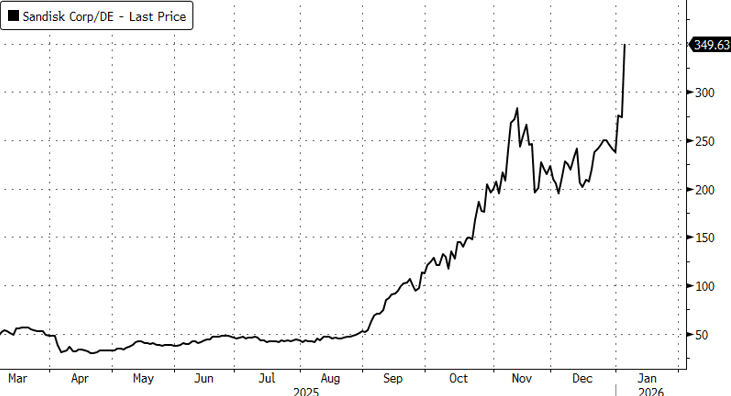
Chipmakers led gains on Tuesday after Huang highlighted storage as an “unserved market,” with SanDisk soaring as much as 28%. Storage companies Western Digital and Seagate Technology also posted double-digit percentage gains.
Mizuho trading-desk analyst Jordan Klein told MarketWatch that Huang’s comments are “bullish” for memory companies. He noted that Huang discussed “how important memory will be for AI use cases and inferencing, such as long reasoning and [key-value] cache to recall all user inquiries with agentic AI.”
SanDisk and other memory and storage companies are “key beneficiaries” of the push for “AI inferencing and AI at the edge” in 2026, Bank of America analysts led by Wamsi Mohan told clients recently.
Chatbots: soaking up all the world’s power, water and memory pic.twitter.com/L2mcdcLSko
— zerohedge (@zerohedge) October 24, 2025
Mohan expects tech firms to retain large amounts of data for training, analytics, and compliance purposes, with demand for storage “skyrocketing in tandem.” In particular, he noted the growing demand for EVs, drones, surveillance, and sports technology.
Also, last week, UBS analyst Nicolas Gaudois highlighted to clients the uptick in memory is expected to “turbo-charge earnings” for Samsung’s memory business. The report is available in full here.
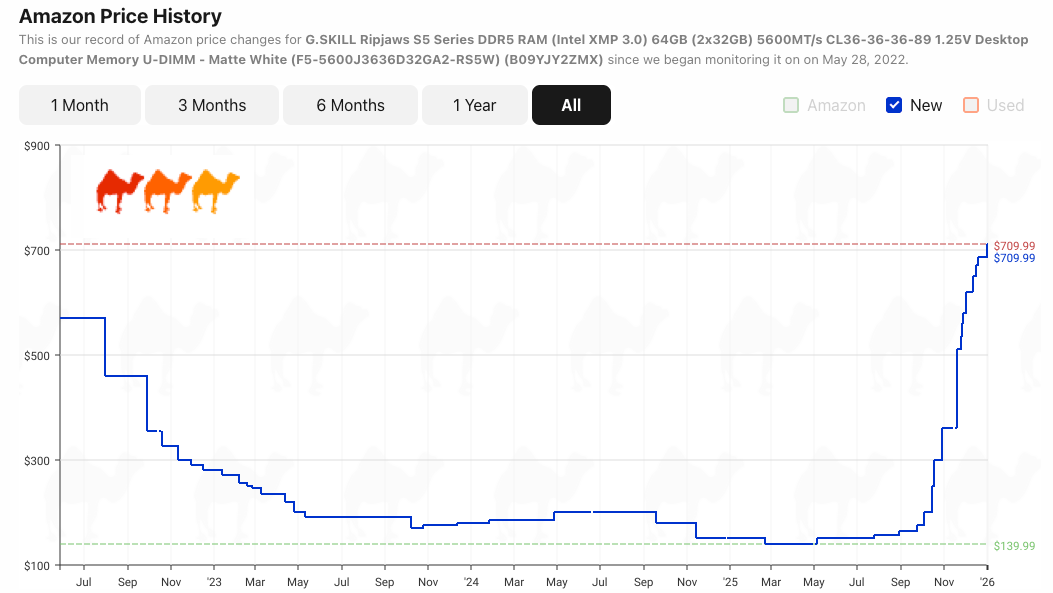
The latest DDR5 DRAM pricing on Amazon!
Last month, Goldman analyst Maho Kamiya told clients that mounting concerns about soaring memory prices pose new risks for Nintendo, which manufactures consumer electronics such as the popular Switch 2.
The great memory crunch has arrived.
Tyler Durden
Wed, 01/07/2026 – 11:55
https://www.zerohedge.com/ai/market-never-existed-nvidia-ceo-sparks-frenzy-memory-stocks

Hobart Mayor calls Amazon deal ‘record breaking,’ but skeptics remain
Hobart Mayor Josh Huddlestun called the $47 million upfront cash the city is poised to receive from Amazon, if plans go forward to build a data center at 61st and Colorado, “record breaking.”
“Hobart secured the largest publicly known upfront cash payment ever for a private development on private land in the country. The developer (Amazon) will pay $47 million in community enhancement payments. These dollars are not part of the levy and not part of any TIF (Tax Increment Finance) district. They go straight to the city and can be used to serve the whole community,” Huddlestun said.
Visitors hold signs during a Hobart Plan Commission meeting regarding a site plan fill permit for the proposed Hobart Devco Data Center on Thursday, Nov. 6, 2025. (Kyle Telechan/for the Post-Tribune)
Because of this agreement, Huddlestun said the city will not have to raise its income tax, meaning the city can fix roads, improve drainage, invest in parks, invest in its youth, and keep public safety departments strong without putting more pressure on residents, he said.
“This really should be celebrated,” he said.
The Hobart City Council at its meeting on Wednesday will consider a resolution that would declare a 72-acre economic revitalization area at 61st Avenue and Colorado Street the first step toward a tax abatement agreement with Amazon officials, who in late November announced plans to invest $15 billion in the city.
To accommodate a larger crowd, the city council meeting, which starts at 6 p.m., was moved to the Hobart High School auditorium, 2211 E. 10th St., door No. 21, on the east side of the school
Hobart resident Matt Wright speaks during a Hobart Plan Commission meeting regarding a site plan fill permit for the proposed Hobart Devco Data Center on Thursday, Nov. 6, 2025. (Kyle Telechan/for the Post-Tribune)
Huddlestun said the meeting was moved from Hobart City Hall to the high school auditorium at the request of the No Data Center group, which opposes building any data centers in the area of 61st Avenue and Colorado Street.
Angelita Soriano, a spokesperson for the group, confirmed a request was made to change the venue after more than 500 people packed a Nov. 6 plan commission meeting held at the PCC Building, 705 E. 4th St.
Soriano is one of four Hobart homeowners who last month filed a lawsuit seeking to vacate multiple actions by Hobart city officials that have “prepared” the way for the possible construction of an Amazon data center on farmland within city limits.
Soriano said her group requested a change of venue or that the resolutions expected to be presented get tabled until a site plan is presented
She finds it “deeply irresponsible” of city officials to go forward with accepting any financial gain such as the $47 million coming from Amazon prior to the presentation of a site plan.
“We still have no idea of how many buildings will be in that area … We haven’t been provided with any environmental, traffic or noise impact studies,” she said.
Soriano said she’d also like to see some figures presented, such as how much revenue the city would receive without the tax abatement versus with the tax abatement.
“Now I’m really going to question their (the city officials) ethics. Is the $47 million at no risk?” she said.
Huddlestun said $47 million upfront cash is crucial to the city in part as municipalities, schools and other taxing districts prepare for the property tax revenue cuts stemming from Senate Enrolled Act 1.
“Those cuts will significantly reduce revenue for cities across Indiana. We prepared early because we did not want to lay off employees or cut the services you depend on,” he said.
SEA 1 does not hit every community the same. Hobart will lose more, percentage-wise, than any city in Lake or Porter County. Some cities will raise income taxes, some will make deep cuts, while some will do both, Huddlestun said. While others are trying to grow their way out of it through development.
In addition, Huddlestun said the city will receive $10 million when the first building permit is issued and another $45 million when the first building walls go up. That means, in the first year alone, Hobart could receive more than $102 million with building permits. That’s over four times the cities general fund budget, Huddlestun said.
“The developer is also paying 100 percent of the infrastructure costs. These are improvements that would have eventually fallen on our utility customers and taxpayers as they needed to be done absent this development, but now they are fully covered by the developer,” he said.
The payments continue after that. In 2027, the city will receive $43 million. In 2028, it will receive $40 million. After that, Hobart will receive $2 million per building every year in community enhancement payments, he said.
Deborah Laverty is a freelance reporter for the Post-Tribune.

Column: The price of immigrant raids is senseless spending
We now know how much it cost to round up some 4,500 undocumented immigrants in Chicagoland last year. The figure is government excess at its greatest.
According to a Chicago Tribune report, the administration of President Donald Trump spent more than $59 million, some of it on federal agents as they traversed Lake County seeking “the worst of the worst” among those here without legal documentation. That’s a lot of federal funding that could have been spent in numerous other ways to make the lives of all Americans better.
Especially considering that an estimated 60% of those snatched by Border Patrol and Immigration and Customs Enforcement lawmen were peaceful and hard-working family folks. They were not bloodthirsty fugitives. The psychological cost over the years for families affected by the surge will surely be even higher.
That $59 million pricetag was charged to what is expected to be a blossoming and record federal debt of $38 trillion in 2026. The president has no appetite for raising taxes, instead preferring a menu of “free” money and tax breaks to buy votes in November’s mid-term elections, where control of Congress will be up for grabs.
Adding to the blooming debt was the action last weekend to bring Venezuelan strongman Nicolás Maduro to justice for alleged narco-terrorism. Still to be revealed is the cost of operating a fleet of Black Hawk helicopters, along with keeping Navy cruisers and aircraft carriers on station for months off the South American nation.
Right after beginning his second four-year term, Trump sought to slash the federal budget and shrink the size of government through DOGE (the Department of Government Efficiency), the special commission headed by Elon Musk, the richest man on the globe.
We’ve since found that no real money was saved while thousands of federal employees were furloughed. Then they were mostly rehired. After that, the entire federal system was interrupted as the government was shut down for 43 days, from Oct. 1 to Nov. 2, a record amount of time.
Yet, the administration during “Operation Midway Blitz” raids in the region beginning last fall had no qualms about dishing out that $59 million to purge the region of the 4,500 undocumented. That’s senseless spending and a poor return on investment, something one-time businessman Trump should realize.
Scratch that. It’s an awful return on investment considering most of the estimated nearly 80 Lake County residents picked up in immigration swoops paid taxes before they were plucked from work sites from Waukegan and Gurnee to Round Lake Beach and Mundelein. As did most of the 4,500 caught in the region as feds traveled willy-nilly originally from their base at Naval Station Great Lakes in North Chicago, like roving bands of masked brigands seeking human loot.
Scouring databases and reviewing various public records, the Tribune analysis on the front page of Monday’s News-Sun, determined that equipping and deploying the posse of hundreds of federal agents readily totaled that $59 million figure. Tear gas and rubber bullets are more expensive than I thought.
Also included in the sum was the cost of housing those picked up for immigration violations at the detention center in the western Cook County suburb of Broadview. Then there’s the pricetag for transporting detainees to other federal facilities and out of the country. Don’t forget the cost to Illinois taxpayers when Gov. JB Pritzker dispatched state troopers to protect the Broadview facility.
Of course, federal folks have failed to answer the Tribune’s queries for an official accounting. Perhaps government bean counters haven’t sharpened their pencils, or maybe there are outstanding bills still to be invoiced.
We may never get the full story from government minions on the entire pricetag. Officials say the immigration blitz will continue in the new year.
They certainly haven’t shared the true cost of operations with Illinois congressmen and our two senators, who have been seeking some transparency from the Trump administration. While it’s our tax dollars at work, it seems the administration likes to operate with abandon and in the shadows.
Some of the money spent on the authoritarian immigration crackdown could have been used to fund food banks after the slight lapse in Supplemental Nutrition Assistance Program payments for people in need. Or $158 million for gun violence prevention programs and $800 million to prevent violent crime, money the administration has held in abeyance.
That is, if “Operation Midway Blitz” was actually about promising to deport millions of undocumented criminals, “the worst of the worst,” offenders in the country. Many of us didn’t believe that presumption when the 64-day mission began on Sept. 1. We still have our doubts.
Charles Selle is a former News-Sun reporter, political editor and editor.
sellenews@gmail.com
X @sellenews
https://www.chicagotribune.com/2026/01/07/charles-selle-column-immigrant-raids/