Category: News

UK Government Video Game Warns Kids They May Be Terrorists For Questioning Mass Migration
UK Government Video Game Warns Kids They May Be Terrorists For Questioning Mass Migration
Authored by Steve Watson via Modernity.news,
In a chilling move, the UK government has rolled out a taxpayer-funded video game that paints every curious teenager as a potential far-right extremist. The “Pathways” game, backed by the Home Office’s Prevent counter-terrorism program, threatens young players with referrals to anti-terror experts simply for questioning unchecked mass migration or engaging with online debates about British identity.
This indoctrination tool assumes teens are one wrong click away from radicalisation, equating basic concerns over job competition or veteran housing with illegal hate groups. It’s a blatant assault on free thought, designed to stifle dissent and enforce globalist narratives in schools—exposing the state’s tightening grip on the next generation.
The game, developed by Shout Out UK with funding from Prevent, targets 11- to 18-year-olds. Players guide a character named Charlie—using “they” pronouns—through everyday scenarios that quickly spiral into warnings of extremism.
?INSIDIOUS: The UK government has developed a video game that INDOCTRINATES children by threatening to report them to counter-terrorism authorities for merely questioning mass migration or expressing concern about the erosion of British values. pic.twitter.com/YoEmqAOptd
— m o d e r n i t y (@ModernityNews) January 10, 2026
For instance, after being outperformed by a black student, Charlie faces a choice: accept it or blame immigrants for “stealing jobs.” Opting for the latter ramps up an in-game extremism meter.
One scenario involves a video claiming “Muslim men are stealing the places of British veterans in emergency accommodation” and “the Government is betraying white British people and we need to take back control of our country.” Engaging with it leads to a flood of “harmful ideological messages,” with the game stating, “Unfortunately, Charlie didn’t realise that some of the groups they were engaging in were actually illegal.”
This is where the UK is at. https://t.co/ZdxCPDM5qI
— m o d e r n i t y (@ModernityNews) January 9, 2026
Even researching immigration statistics online is portrayed as a gateway to danger, bombarding players with material on the “replacement” of white people. Joining a protest against “the changes that Britain has been through in the last few years and the erosion of British values” nearly ends in arrest, with the revelation that it “seemed to be more about racism and anti-immigration than British values and honouring fallen veterans.”
Pathways is an interactive game designed for 11- to 18-year-old pupils and funded by Prevent, a Home Office programme for tackling extremism.
Young players are directed to help their in-game characters – a white teenage boy and girl – to avoid being reported for “extreme… pic.twitter.com/fUkUdYRr4P
— Sick Of It Media…..???? (@SickOfItteo) January 9, 2026
As The Telegraph reports, bad choices within the game culminate in counseling for “ideological thoughts” or full Prevent referrals, complete with mentors to teach the “differences between right and wrong in expressing political beliefs.”
Matteo Bergamini, founder and CEO of Shout Out UK, defended the game, saying, “Teaching media literacy ensures that all those impacted by our programmes leave with life-long tools and skills to safeguard themselves from these threats. Our Pathways game is designed for the local threat picture in collaboration with the local authority and funded by the Home Office, to teach about the concept of extremism and radicalisation and illustrate the scope of online dangers and radicalisation routes.”
A Home Office spokesman added, “Prevent has diverted nearly 6,000 people away from violent ideologies, stopping terrorists and keeping our country safe. We provide funding to local authorities to tackle a range of threats, including Islamist extremism and Extreme Right Wing.”
Yet this comes amid growing scrutiny of Prevent’s overreach. GB News highlighted how the program now flags concerns about mass migration as a “terrorist ideology,” including “cultural nationalism” where Western culture faces threats from unchecked integration failures. Referrals for right-wing views hit 19% in 2024, outpacing Islamist cases despite MI5’s focus on the latter as 75% of threats.
This isn’t isolated. Recall our recent coverage where a teacher was branded a terrorist threat for showing Trump videos in a U.S. politics class. The educator recounted, “It was just terrifying; just mind-boggling. We were discussing the US election, Trump had just won and I showed a couple of videos from the Trump campaign. Next thing, I was accused of bias. One of the students said they were emotionally disturbed and claimed to have had nightmares.” The Local Authority Designated Officer warned his views “could constitute a hate crime” and risked “radicalisation.”
Such cases expose the left’s weaponization of Prevent against conservative ideas. Now, add in to this dystopian recipe the Labour government’s push to ban X entirely, with the frankly laughable excuse that images of people in bikinis can be created using Grok.
Prime Minister Keir Starmer raged, “This is disgraceful. It’s disgusting, and it’s not to be tolerated,” insisting “all options are on the table” over Grok AI’s image generation. Labour MP Lola McEvoy declared platforms like X “have no right to be accessed in this country” if non-compliant.
Leaked messages show MPs calling Elon Musk a “fascist” and urging abandonment of the platform. This aligns perfectly with “Pathways”—silencing online spaces where teens might encounter unfiltered views on migration or freedom.
There also exists a horrible double standard where schools freely indoctrinate kids with outright fabrications, such as pushing “non-fiction” books claiming Black people built Stonehenge, and were integral in other historical developments, part of a “decolonizing” push that insists Britain was “a black country for more than 7,000 years before white people came.”
The hypocrisy deepens with radical gender ideology flooding classrooms. Trans lobbyists from Stonewall are demanding over 300 schools scrap terms like “boys and girls,” opting for neutral language, gender-neutral bathrooms, and identical uniforms—all under the guise of “inclusion.” Schools paying into Stonewall’s scheme must embed LGBTQ+ propaganda across the curriculum, ignoring government guidance against promoting “gender identity ideology.”
This teacher-shaming fits into a broader, sinister trend: the UK government’s push to teach children how to “spot extremist content and misinformation” in schools, embedding “critical thinking” that suspiciously aligns with establishment narratives.
Under the Labour government, kids are being indoctrinated to analyse articles and websites and weed out “putrid conspiracy theories,” grooming the next generation to police thought.
Reform UK leader Nigel Farage has warned: “If the parameters that are set are to say to every kid, if you read a post that questions net zero and global warming, it will be extreme content, and a lie, if you read a post that even dares to question levels of immigration, legal or illegal into Britain, that that’s extremist, then you start to set a narrative for a future generation that is fundamentally undemocratic.” Farage has labeled Prime Minister Keir Starmer the “biggest threat to free speech” in British history.
Keir Starmer poses the biggest threat to free speech we’ve seen in our history. pic.twitter.com/AB9cdiQtue
— Nigel Farage MP (@Nigel_Farage) August 11, 2024
As X owner Elon Musk has warned, the British public simply have to come together and get on board with stopping this lurch toward tyranny dead in its tracks now, before it’s too late.
ELON MUSK: “All of the people of Britain have to fight for the future. If this doesn’t happen, there won’t be a future. You have to fight.” pic.twitter.com/yKC8T2Euph
— DogeDesigner (@cb_doge) January 9, 2026
Your support is crucial in helping us defeat mass censorship. Please consider donating via Locals or check out our unique merch. Follow us on X @ModernityNews.
Tyler Durden
Sun, 01/11/2026 – 08:10
Chicago Bears saved their wildest ending yet for the playoffs: Brad Biggs’ 10 thoughts on the wild-card win
Considering the Chicago Bears’ march to the NFC North crown this season was highlighted by a series of comeback victories, one seemingly greater than the next, it makes perfect sense the wildest of all was saved for the playoffs.
In a first half that almost could not have gone any worse, the Bears fell behind 21-3. They still chased an 11-point deficit with 6 minutes, 36 seconds remaining Saturday night before a raucous crowd at Soldier Field.
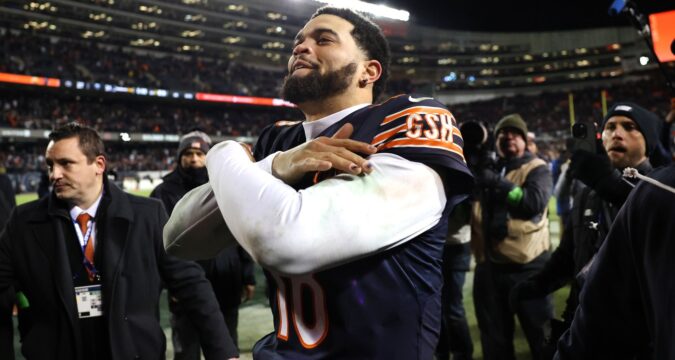
Yet there quarterback Caleb Williams was at the end, driving the Bears for a touchdown to lift them to a 31-27 victory, sending them to the divisional round of the playoffs next weekend, ending the season for the Green Bay Packers and quickly igniting a series of questions about the future of the coach up north, Matt LaFleur.
10 thoughts after the seventh fourth-quarterback comeback of the season by Williams and the team.
Want the latest Bears news? Subscribe to the Chicago Tribune to read it all — and sign up for our free Bears Insider newsletter.
1. General manager Ryan Poles wanted to add some pillars to the locker room for Ben Johnson to aid the rebuilding process, guys who could be the kind of examples the team hoped other players would follow.
A Kings of the North poster featuring Caleb Williams is seen hanging as fans take in the fourth quarter of an NFC wild-card game at Soldier Field on Jan. 10, 2026. (Chris Sweda/Chicago Tribune)
It can be expensive to find the right guys, and this wasn’t a mission the team undertook because there was a critical shortage of leadership on the roster. The club felt really good about some veterans in place but wanted to add more.
Left guard Joe Thuney came via trade from the Kansas City Chiefs, a guy to not only help transform the offensive line but a player who’s a four-time Super Bowl champion. Defensive tackle Grady Jarrett was targeted as a disruptive player for the interior who has been meticulous in preparation throughout his career.
It’s interesting coach Ben Johnson would throw on some film of maybe the biggest game of their careers way back during training camp. Johnson put up some highlights from Super Bowl LI when Jarrett’s Atlanta Falcons took a 28-3 lead over Thuney’s New England Patriots in the third quarter, only to watch as the game completely flipped. The Patriots won 34-28 in overtime, the first ring Thuney won and the only Super Bowl Jarrett has played in.
“We have two players on our roster that were part of both those teams,” Johnson said. “It was just great to get perspective from both of those players of how that game went down. I think it’s just a good lesson to be learned that it’s 28-3 in the middle of the third quarter and yet the game still is being played and there is a lot of time left.”
So, Johnson has that as a reminder for his team at halftime after the Bears had another slow start offensively and fell in a major hole, one that could have been worse after failing on fourth down for the third time and turning the ball over on their 37-yard line with 32 seconds remaining in the second quarter. Fortunately, Brandon McManus’ 55-yard field-goal attempt was wide left, the start of a bad night for him as he missed from 44 yards and missed an extra-point try.
“That was my message to the group,” Johnson said. “Just reminding them that this has been done before and rather than saying, ‘Woe is me,’ and ‘Oh, crap, we’re in a hole,’ it’s more, ‘This is a great opportunity for us to turn this around into a game we’ll never forget.’ That’s what they did.”
It certainly was one for the ages and unprecedented for the Bears in the postseason. The largest deficit they had rallied from previously in the playoffs to win was seven points, something that happened three previous times.
Dec. 29, 1963: Bears 14, New York Giants 10
Dec. 26, 1943: Bears 41, Washington Redskins 21
Dec. 14, 1941: Bears 33, Packers 14
Other than those games, the Bears have rallied from more than a field-goal deficit to win a game just one other time. They trailed the New York Giants by five on Dec. 17, 1933, before pulling off a 23-21 victory in what was the NFL’s first official championship game. So the inventory of Bears’ postseason comeback magic doesn’t run very deep.
It started great too. The Bears won the coin toss and chose to receive. Johnson wanted to jump-start his offense, which scored just three points total against the Packers in the first half of the two meetings between rivals last month.
Related Articles
How the Chicago Bears pulled off another improbable comeback win to KO the Green Bay Packers from the playoffs
‘We had to respond’: Defense’s 2nd-half rebound gives the Chicago Bears just enough for a playoff rally
Chicago Bears LB T.J. Edwards and LT Ozzy Trapilo will miss remainder of the playoffs, coach Ben Johnson says
Wild-card playoff game photos: Chicago Bears 31, Green Bay Packers 27
Vintage Chicago Tribune: Bears playoff appearances — including the ‘Sneakers Game,’ ‘Fog Bowl’ and ‘Double Doink’
Caleb Williams connected with rookie wide receiver Luther Burden III on third down to move the chains twice before rookie running back Kyle Monangai busted off a 9-yard run on third-and-1. It was a methodical drive, and Williams kept it rolling on third-and-12 from the Packers 26-yard line when he connected with DJ Moore cutting underneath, the fourth third down converted on the possession.
When things stalled out, Cairo Santos kicked a 27-yard field goal. No, the offense didn’t push it in the end zone, but the drive went 16 plays and 59 yards and took 7 minutes, 58 seconds off the clock. Ball possession would be a good way to protect the defense against the Packers offense, and they got points.
Well, the Packers blitzed the Bears for the remainder of the half. They moved downfield effortlessly with Jordan Love hitting Christian Watson for a 7-yard touchdown on third-and-2.
After converting a fourth down from their 38-yard line, the Bears turned it over on fourth down on the Packers 40 when Williams’ deep throw for Burden was intercepted by Carrington Valentine. There was a clear mix-up between the two on the play.
The Packers drove 87 yards for another touchdown and all of a sudden it was 14-3. Johnson kept his foot on the gas and three plays into the ensuing possession, it was fourth-and-5 on the Bears 32-yard line. The snap was high, and Packers linebacker Edgerrin Cooper broke up the throw.
With 5:15 remaining in the second quarter, the Packers were up 11 and nearly in the red zone.
“We were aggressive on some fourth downs,” tight end Durham Smythe said. “That was the game plan. We knew that going into the game. He told us we were going to be aggressive. So we knew, ‘All right, if we don’t pick it up, we’re just going to have to keep rolling.’”
It’s one thing to know that. But it didn’t look as if the Bears could do anything to slow it down. The defense forced Love into a fourth-and-1, and he found Watson wide open for what looked like a touchdown, but the receiver fumbled into the end zone and Romeo Doubs recovered. So, the Packers got the ball at the 1-yard line, and it took four plays before a touchdown pass to Doubs.
Now it’s 21-3 with 1:56 remaining in the second quarter and the Bears hadn’t done much of anything right since the opening drive. Johnson went for it on fourth down again and the Bears failed, but the Packers didn’t capitalize.
The running game produced only 44 yards on 15 carries in the first half. Meanwhile, the Packers had rushed for 93 yards and Love had thrown three touchdown passes. It was the biggest deficit the team has faced at halftime all season.
Bears quarterback Caleb Williams stands with coach Ben Johnson before playing the Packers in an NFC wild-card game on Jan. 10, 2026, at Soldier Field. (Armando L. Sanchez/Chicago Tribune)
That’s when Johnson put it simply to the group in the locker room.
“That we were going to have the greatest comeback in Bears history,” tight end Cole Kmet said. “And we did.”
Maybe a little something Thuney and Jarrett shared with the group back during training camp resonated just a little. The fact is the Bears have grown accustomed to winning this way, to clawing back into a game in the fourth quarter and finding ways to make plays in the decisive moments of the game. It happened in the Dec. 20 meeting here with the Packers. It nearly happened after the Packers led 14-3 at halftime of the first game at Lambeau Field on Dec. 7.
Williams set a franchise postseason record by throwing for 361 yards — he completed 24 of 48 passes — and rookie tight end Colston Loveland caught eight passes for 137 yards along with a grab on a two-point conversion.
The Bears were minus-2 in turnovers — they didn’t get a takeaway — and ran for only 93 yards but they chipped away in the third quarter, hung around and then exploded for 25 points in the fourth quarter with three lightning-quick touchdown drives of 2:30, 2:18 and 1:08. These weren’t short drives either — they were 66, 81 and 66 yards to the end zone.
What keyed the comeback was a total turnaround by the defense. Love had all sorts of time in the first half. Defensive coordinator Dennis Allen gambled repeatedly in the second half with pressure and it worked as the Packers punted on their first four possessions after halftime and appeared generally stunned.
That in a nutshell is how you put together the biggest postseason comeback in franchise history. The Bears will wait to see what happens Sunday to learn who’s next. If the Philadelphia Eagles defeat the San Francisco 49ers, the Bears will be host the Eagles at Solider Field in the divisional round next Saturday or Sunday. If the 49ers win, the Bears will host the Los Angeles Rams.
“Crazy,” right guard Jonah Jackson said. “I don’t even know what’s going on. Any given Saturday, right. It’s (expletive) nuts. They have a really sound defense. They’re good at what they do. They had a damn good game plan for that first half. We found a way.”
It wouldn’t be accurate to describe this as a roller coaster because it was like the ride just stopped in the second quarter when the Packers took total control and a crowd of 60,338 turned really quiet.
But the thing got going. The defense started pressuring Love, and the success the Packers had running the ball in the first half was completely stopped. They rushed seven times for 6 yards in the second half and the joint got rocking to the point that you could feel the building sway ever so slightly at times. For real. Williams and the offense did their thing and the Bears were ebullient afterward.
“It was just like relief, again, after you win,” Kmet said. “It’s emotionally exhausting. Man, it’s a lot of fun. Surely, we don’t want to keep doing it like this but if this is how we have to do it, it is what it is at this point.”
Bears quarterback Caleb Williams throws a pass in the fourth quarter of an NFC wild-card game against the Packers at Soldier Field on Jan. 10, 2026. (Chris Sweda/Chicago Tribune)
It’s the fourth time in league playoff history a team trailing by 15 points or more entering the fourth quarter — the Bears were down 21-6 — rallied to win and the first since that Patriots-Falcons Super Bowl. It’s the first time the Bears have won a postseason game — period — since a 35-24 victory over the Seattle Seahawks on Jan. 16, 2011.
“I think it’s our identity here at this point,” Johnson said. “Some people say it’s not sustainable. I don’t know. The takeaways are — that’s who we are on defense. On offense, it’s explosive plays. That’s kind of what we’ve done all year long and coming up in big moments.
“It’s just resiliency and knowing that late in the fourth quarter that’s really when we’re at our best as a team. We’ll keep striving to be better earlier in games and starting faster and all that, but that gives us something to work toward. I can’t be any more proud of that crew than I am now.”
2. A great place to dive into some of the nuts and bolts of this remarkable win — and you’d need twice as much space as I have here to cover it all — is the game-winning touchdown pass to DJ Moore.
Super creative play call in this situation.
The Bears had plenty of time with 1:25 on the clock after D’Andre Swift caught a short pass and weaved his way 23 yards down to the Green Bay 25-yard line. The Packers were ahead 27-24 so Ben Johnson had to feel he was easily in Cairo Santos’ range if things went wrong and he had to play for overtime. The Bears needed things to go right and being at the 25-yard line gave them a little more space than they’d have say from the 15 or so where the field starts to get compacted. Red zone issues have sort of come and gone for the Bears. Best to get a score when you can.
Johnson called for an unbalanced line to the far side of the field to give the Packers some eye candy. Right tackle Darnell Wright lined up at left tackle — on the outside of Theo Benedet, who had replaced left tackle Ozzy Trapilo on the previous snap. Tight end Cole Kmet became the right tackle on the other side, aligning next to right guard Jonah Jackson.
There was a trio of targets to the left — Moore, Luther Burden III and Colston Loveland — and the goal was to sell a screen at the line of scrimmage to Burden, similar to a pass that had been thrown earlier in the game.
“We haven’t called (an unbalanced line) in a minute,” Jackson said. “We had that one in the back pocket for a little while now. We’ve always got some gadgets. Never know when they’re coming.”
Wright fired off the line and toward Burden as if he was coming to block safety Javon Bullard.
“Darnell is a presence out there,” Benedet said. “I think we were able to kind of draw their eyes in with him.”
More than their eyes. Cornerback Carrington Valentine bit up and — poof! — Moore passed him down the sideline. There was zero chance for safety Evan Williams to close from the middle of the field and it was an easy throw for Caleb Williams.
“The aim was always to throw it up the sideline to DJ,” Benedet said. “It worked out. They were cocky too. They were yelling, ‘Screen! Screen!’ and then DJ just slipped through there.”
Moore said he knew the defense would trigger on Burden and for the second time in two games against Green Bay, he had a game-winning touchdown reception.
“We’ve been waiting to pull that one out,” Kmet said. “Sweet play.”
Back to my original point, I think Johnson was hunting for a play that could get in from the 25-yard line. There was plenty of time remaining but if the offense had gone with a couple of short gains, who knows what would have happened. The Bears were 2-for-5 in the red zone and the last thing Johnson wanted was to go into overtime with the Packers again.
“Perfect call,” Caleb Williams said. “Being able to have that play call that we worked for, I think the past three or four weeks, and just didn’t use it in those other games and then in the right moment at the right time, coach calls it just as he does.”
3. Dennis Allen isn’t much for game review by the time he is made available in the middle of the week.
Bears defensive coordinator Dennis Allen walks along the sideline in the third quarter of a game against the Lions at Soldier Field on Jan. 4, 2026. (Chris Sweda/Chicago Tribune)
Out of fairness to the defensive coordinator, he’s been that way after wins and losses.
It’s a shame because it would be fun and informative to get extra insight into how the Bears flipped the script, completely stuffing Green Bay in the second half. I alluded to some of it above. The Packers were able to rush for 93 yards in the first half and Love was 9 of 15 for 139 yards and three touchdowns. It felt like at least half the incompletions were balls he intentionally threw away. Green Bay was moving the ball at will, and was 5 for 7 on third down and 3 for 3 in the red zone. Remember, the Bears’ rally in the previous meeting was only possible because the Packers were 0 for 5 in the red zone.
This was an unmitigated disaster with everyone wondering why the secondary was locked in so much man coverage. As we reported last week, the Bears were actually worse in zone against Detroit than in man.
The Packers got the ball to begin the third quarter and the Bears needed a stop immediately. They were desperate and Allen showed it from the jump. He blitzed cornerback Nahshon Wright on the first play as Love was flushed out of the pocket and threw incomplete.
It wasn’t every time Love dropped back, but it sure felt like the Bears were sending more than four pass rushers on a whole bunch of his 31 pass attempts in the second half.
“DA got real aggressive,” free safety Kevin Byard III said. “Corner blitzes out there. Sending (safety Jaquan) Brisker. I think in coverage, we just covered a little better. Got some (pass breakups). Jaylon (Johnson) was making some really good plays out there. We just executed better. The belief in this team. Going into halftime, not where we wanted to be. But there was no panic.
“I think Matt LaFelur did a hell of a job in that first half. He kind of caught us in some coverages. J-Love was doing a great job of kind of reading what we were doing and was able to change into plays that were beaters. It was a hell of a chess match and in the second half, DA adjusted really well. We executed our defense a lot better. That was phenomenal.”
The Packers were just 1 of 8 on third down in the second half. Love didn’t look comfortable in the pocket and the big run-after-catch plays that Green Bay was easily drawing up in the first half were harder to come by. Allen had to get aggressive. The pass rush wasn’t getting home with four very often even with the Packers missing right tackle Zach Tom, their best lineman. He had to roll the dice a bit and risk giving up big plays to force the action. It worked as the Packers got just one first down on the first four possessions in the second half as the Bears hung on.
“Energy,” Johnson said when asked what keyed the comeback for the defense. “Effort. Desire. Hunger. That was it. We just had to tighten that (crap) up.
“On the back end we were covering and the front was getting home. That’s the same ball team that came out in the first half that came out in the second half. We just played better.”
Linebacker T.J. Edwards left early in the second quarter with a left ankle injury and will miss the rest of the playoffs. D’Marco Jackson filled in. He called the defense and was pressuring a lot. Practice squad linebacker Jalen Reeves-Maybin, signed on Friday, got some work in 4-3 sets and he blitzed too.
“We gave ourselves a chance each time we got a stop there in the third quarter,” Jackson said. “I feel like each person has got that dog in them. You don’t judge a dog by the size of him either. You judge a dog by what’s inside his heart. Each guy in here, they got that dog in them to keep going, keep fighting.”
The Packers offense couldn’t stay on the field, and frustration mounted on their sideline as the crowd roared back to become a factor.
Bears defensive end Montez Sweat knocks Packers quarterback Jordan Love to the turf in the fourth quarter of a NFC wild-card game at Soldier Field on Jan. 10, 2026. (Chris Sweda/Chicago Tribune)
“A lot of bad things happened,” LaFleur said. “I think a pivotal part was offensively, we come out in the second half, and just could not get anything going. You go three-and-out, three-and-out. I think we got a first down on the third drive, but it was just too many opportunities when you have the ball and you’re not scoring.
“There were certainly some things we did up front where they started bringing pressure, and we weren’t sliding out to it, we weren’t picking it up. Give them credit. And it’s unfortunate because we were doing so great in the first half. And then the second half was a different story.”
It was a much different story. While the Bears got just one sack from Austin Booker, they had eight QB hits with Montez Sweat getting three and Booker two. There were six pass breakups — two for Johnson and two for returning nickel cornerback Kyler Gordon. Wide-open throws in the first half became contested in the second half, and you cannot overstate the total difference in run defense in the second half. It was like two different defenses really.
Johnson says it was execution. Allen clearly dialed up more pressure and it was more successful. It would be interesting to hear him dive into some of the nuances if he wasn’t moved on to the divisional round opponent.
4. Not sure if you saw the handshake between Ben Johnson and Matt LaFleur after the game but, if you blinked, you missed it.
Packers coach Matt LaFleur celebrates after the Packers scored during the first quarter of a NFC wild-card game against the Bears at Soldier Field Jan. 10, 2026. (Armando L. Sanchez/Chicago Tribune)
We’re not turning back the clock 40 years to the kind of bad blood there was between Mike Ditka and Forrest Gregg, but clearly something’s up in the rivalry now and has been since Johnson made a remark about LaFleur in his introductory press conference nearly a year ago.
Maybe it’s good for the rivalry. Maybe it sparks the players a little bit. I’m willing to bet that’s the content George McCaskey is ready for on a daily basis.
“There was probably a little bit more noise coming out of their building up north to start the week,” Johnson said after the win. “Which we heard loud and clear, players and coaches alike. This one meant something to us.”
Maybe the Bears didn’t like the Packers being upset that Jordan Love had been knocked out with a concussion in the previous meeting. Maybe they thought the Packers didn’t take the loss at Soldier Field real well. Maybe the Bears just wanted to stir it up and make it clear they’re no longer going to be bullied by a team that’s dominated for, well, the better part of three decades. I’m not sure. But there’s some tension there that doesn’t exist when you’re talking about division foes like the Detroit Lions and Minnesota Vikings.
You have to at least wonder if this stunning defeat leads the Packers to consider change. I’d be a little surprised — and LaFleur would be in instant demand if he was on the open market — but this was a crushing defeat. It’s the second time the Packers have blown a game at Soldier Field, and LaFleur has a new boss as Ed Policy replaced Mark Murphy as team president.
LaFleur has one year remaining on his contract, so it’s likely time for an extension or time to move on from a guy who is 76-40-1 in the regular season and owns a .654 winning percentage that is fourth-highest in the league among coaches with at least 50 games. Think of all the firings the Bears have done for a long, long time. But they have never canned a guy who was four wins shy of being 40 games over .500.
Can you imagine how this chapter in the rivalry for the 212th meeting would be viewed if it was the final straw for LaFleur? The Packers lost their composure in the second half. They ripped through some timeouts when they shouldn’t have. They had a delay of game coming out of a timeout. There were some elements that you wouldn’t expect from a buttoned up operation.
At the same time, you can’t forget the injuries the team has been handling. They played down the stretch without the guy they traded for to get them over the top — Micah Parsons — and had 15 players on injured reserve. If it’s a roster built to win now, Policy has to answer if LaFleur is the coach for right now. If so, LaFleur is probably due a major raise the way coaching salaries climb.
We’ll see what shakes out. LaFleur deflected questions about his future. The Packers will start assessing what comes next while the Bears get ready to dive into another work week.
“They wanted us,” Caleb Williams said. “That’s what I heard. They wanted it and they got it.”
Just keep in mind this is miles and miles away from where it was when Ditka and Gregg had animosity for each other in the 1980s, something that dated back to their playing days.
Ditka lambasted Gregg after defensive end Charles Martin body slammed Jim McMahon after the play in a 1986 game.
“These things were after the play, after the fact,” Ditka said in 2011. “So either you are coaching that or your players are stupid. That’s what I’m going to say. In this case I believe they were coached. That’s why I never got along with Forrest Gregg. To this day I don’t respect him for that reason.
“When the play is over and you pick somebody up and slam them on the ground. Oh, big deal, Martin says. ‘I’m a tough guy.’ You’re not a tough guy. You’re a dumb guy.”
5. Something is off with the Bears running game. It’s not fine tuned as it was earlier in the year.
Bears running back D’Andre Swift scores a touchdown in the fourth quarter of an NFC wild-card game against the Packers at Soldier Field on Jan. 10, 2026. (Chris Sweda/Chicago Tribune)
For a team that was trampled for 307 yards by the Baltimore Ravens just two weeks ago, the Packers came in feeling like they were well equipped to slow the Bears down on the ground. That surprised me a little bit, but dig into what was going on and the belief was that, for some reason, the timing has been off in the Bears running game — and it’s been off for a couple weeks now.
It was a tale of two seasons for Green Bay’s run defense, something that didn’t just slip after losing defensive tackle Devonte Wyatt to a fractured left ankle in a Thanksgiving Day victory at Detroit on Nov. 27.
Seven times in the first 11 games, the Packers limited the opponent to 96 yards rushing or less. Since losing Wyatt, the Bears ran for 138 yards (90 in the second half) of the Week 14 game at Lambeau Field. Two weeks later, the Bears ran for 150 yards on 26 carries (5.8 per carry). In the following game, the Ravens went for 307 yards on 53 attempts, the fifth-most yards allowed by Green Bay in a regular-season game during the Super Bowl era.
A Packers run defense that ranked eighth in the NFL (98.3 yards per game) and sixth in yards per carry (3.9) entering the initial meeting with the Bears in Week 14 did a free fall. The Packers closed the season 18th in run defense (117.7) and 12th in yards per carry (4.2).
What happened here? The Bears ran for only 93 yards on 28 carries. Sure, they fell behind and were forced to sling it more, but there were 15 rushes for only 44 yards in the first half. I thought the offense was going to be poised for a big game running the ball too. D’Andre Swift had 54 yards on 13 carries in the win and Kyle Monangai ran eight times for 27 yards.
The line has been solid all season and it looked like there was at least some thought given to the backs’ workload in the last two weeks. Swift had 19 carries in the final two weeks (he averaged 13.9 per game on the season) and Monangai had 14 rushes in the last two games. That ensured both would be as fresh as possible for a playoff run.
“The run game was a little bit lacking today for whatever reason,”right tackle Darnell Wright said. “We’ll see on tape what exactly happened. I don’t know off the top of my head.”
Bears running back Kyle Monangai finds an opening in the defense in the first quarter of an NFC wild-card game against the Packers at Soldier Field on Jan. 10, 2026. (Chris Sweda/Chicago Tribune)
Said right guard Jonah Jackson: “It seems so much simpler when you’re watching it. But maybe there’s a linebacker holding back instead of reading. Like if we’re running wide zone and he’s holding in his spot and you overrun him and then he undercuts you and makes the play. There’s just a bunch of little nuances that people don’t really pick up on. They see it and say, ‘Oh! He blew past him!’ Green Bay was good at mixing things up and taking us off double teams and things like that.”
The offense had only 65 yards on 18 rushes in Week 18 against Detroit and 110 yards on 22 carries in Week 17 at San Francisco? Before that, it was humming along pretty good. Reason to be alarmed? I don’t think so, but I can tell you that the Packers were confident before the game that they could handle the run, and they accomplished that goal.
Ben Johnson indicated Ozzy Trapilo, who limped off the field in the fourth quarter, is likely done for the season. That means the team will probably turn to Theo Benedet, who has seven starts at left tackle. The team opened the return to practice window for veteran Braxton Jones last week. He’s been ready for some time to get back on the field after a knee injury. He could be an option too, but my first instinct would be Benedet plays.
“This year has been good for me,” Benedet said. “I got a lot of reps under my belt. So, I feel really comfortable right now.”
6. The Bears got Rome Odunze back and, boy, did Caleb Williams make a dynamite throw on his biggest catch of the game.
Bears wide receiver Rome Odunze misses a catch in the end zone during the first quarter against the Packers at Soldier Field on Jan. 10, 2026. (Armando L. Sanchez/Chicago Tribune)
It’s a big-time throw at any point in a ballgame. With the situation — fourth-and-8 with the Bears on their own 43 and trailing 27-16 with 5:37 to play, the stakes couldn’t get much bigger. Fail to convert there, and Green Bay is taking over on the plus side of the field with a chance to ice the game. The Packers only rushed four.
“He’s a guy that’s tough to contain,” Matt LaFleur said. “The whole plan was to try to especially eliminate his ability to go right. That’s what he likes to do. But certainly I mean, he made a heck of a play, heck of a throw.”
Linebacker Isaiah McDuffie was able to flush Williams out of the pocket to the left and hit him just as Williams threaded a pass deep down the sideline that Odunze ran under for a 27-yard gain.
“We had a great concept,” Odunze said. “Little bit of traffic and I was just trying to find my way to weave through there. That kind of delayed the pass a little bit. He escaped the pocket. He floated that up in the air.”
Odune played 54 snaps. It was his first game action since Nov. 28 at Philadelphia. He was targeted five other times and made one other catch for 17 yards.
Odunze originally popped up on the team’s injury report with a heel injury around the middle of the season. Later, NFL Media reported he had a stress fracture in one of his feet.
“There’s been a couple different things that have been going on with it honestly,” he said. “I don’t want to put it all out there. I wouldn’t be out there if I wasn’t good to go. The training staff did a great job and they understand where I’m at. I finally got to be out there and play ball a little bit. Obviously, I will go back and get my treatment and continue to rehab. I feel good though.”
Odunze’s five-game absence probably opened up opportunities in the passing game for rookies Luther Burden III and Colston Loveland. But overall, Odunze is clearly been the No. 1 target in the passing game.
Odunze (44 receptions, 661 yards in the regular season) is still tied with DJ Moore and Loveland for the team lead in touchdown receptions with six — and five of them came in the first four games of the season. What jumps out is that he led the team averaging 15.0 yards per reception. Since 2006, when Bernard Berrian averaged 15.2 yards per catch for the Super Bowl XLI team, that’s a mark Bears receivers (minimum 40 receptions) have reached only three times: Alshon Jeffery (15.8, 2016; 16.0, 2013) and Johnny Knox (18.8, 2010).
Odunze ranked sixth among wide receivers in the NFL, again, with a minimum of 40 receptions.
Alec Pierce, Colts: 21.3 yards per reception
Jameson Williams, Lions: 17.2
Nico Collins, Texans: 15.7
George Pickens, Cowboys: 15.4
Jaxon Smith-Njigba, Seahawks: 15.1
Odunze: 15.0
I think the Bears should be able to get more out of Odunze in 2026 with everyone familiar with the scheme. Instead of spending an offseason and training camp learning a complex system, players will be able to fine tune adjustments.
Odunze is a different kind of receiver than Detroit’s Amon-Ra St. Brown, so there isn’t a perfect parallel. But consider St. Brown was in his second season in the league in 2022 when Ben Johnson was in Year 1 as offensive coordinator. St. Brown caught 106 passes for 1,161 yards (11.0 average). In 2023, St. Brown broke out for 119 receptions for 1,515 yards (12.7). Odunze will be in his third season in 2026 and second with Johnson calling the plays.
The Year 2 bump should make the Williams-Odunze connection a lot more consistent, and that was an issue at times this year. For players with a minimum of 40 receptions, Odunze had the third-lowest catch percentage in the NFL at 48.9%, ahead of only Cleveland’s Jerry Jeudy (47.2%) and Tennessee rookie Elic Ayomanor (46.1%). Jeudy played with a trio of quarterbacks, including rookies Shedeur Sanders and Dillon Gabriel, and Ayomanor was paired with rookie QB Cam Ward.
I’d be confident in Odunze’s stock rising in 2026.
7. A trio of soft-tissue injuries — groin, hamstring and calf — for nickel cornerback Kyler Gordon created one of the biggest challenges for Dennis Allen this season.
Bears cornerback Kyler Gordon comes out in his Spiderman mask as players are announced before the start of an NFC wild-card game against the Green Packers at Soldier Field on Jan. 10, 2026. (Chris Sweda/Chicago Tribune)
Allen was excited to work with Gordon because of his versatility and playmaking ability. When Allen has had his best defenses over the years, he’s usually had a Swiss army knife safety. C.J. Gardner-Johnson, in the prime of his career with the New Orleans Saints, Tyrann Mathieu and Kenny Vaccaro are good examples of players Allen was able to deploy at safety, in the slot and as blitzers in the pressure package. They all had multidimensional skill sets to cover, blitz, play with range as well as tackle in space.
With Gordon missing 14 games and a ton of practice time dating back to the second week of August, it’s been disappointing for everyone. The Bears made Gordon a big part of the future in April when they signed him to a $40 million, three-year extension that made him the highest-paid nickel cornerback in the league. It’s one thing to handle the loss of a nickel cornerback for two or three weeks. It’s another thing to be playing with replacement(s) for the majority of the season.
The Bears used Nick McCloud at nickel before signing Gardner-Johnson Oct. 29. Jaylon Jones has also got a little run in the slot. That was before Saturday when Gordon returned from injured reserve for the second time this season and played 44 snaps. His return came at a critical time with Gardner-Johnson out with a concussion.
It struck me as a little odd that McCloud got the start as the nickel cornerback. McCloud wound up logging 20 snaps, with most of them coming on the first two defensive series. Packers QB Jordan Love completed some throws on Gordon, but he had three tackles and two pass breakups and looked like he was settling in. Remember, Gordon got only 117 snaps in the regular season. He’s going to have to make an impact in the secondary if the Bears want to continue advancing — and he’s an upgrade over Gardner-Johnson.
There’s some subjectivity involved in breaking down attempts/completions and yards allowed by defensive backs while in coverage. Looking at available numbers, there is a big split between Gardner-Johnson’s first five games with the Bears and the last five, according to Pro Football Reference.
Quarterbacks targeting Gardner-Johnson
First 5 games: 9 of 15 for 44 yards, 1 TD, 0 INT; 3 sacks, 5 QB pressures, 1 forced fumble
Last 5 games: 27 of 39 for 336 yards, 2 TD, 2 INT; 0 sacks, 0 pressures
Gardner-Johnson intercepted Jordan Love in the Week 14 game at Lambeau Field when the quarterback was fooled by a zone drop. He picked off Shedeur Sanders the next week when he sank and grabbed an underthrown ball for Browns tight end Harold Fannin along the sideline.
Of late, opposing quarterbacks have taken advantage of Gardner-Johnson, especially in man coverage when he has been unable to get his hands on the receiver and re-route him at the line of scrimmage. Gardner-Johnson is best when he can be disruptive around the line of scrimmage, but when he has to turn and run, he’s been isolated in disadvantageous positions.
As far as elsewhere in the secondary, Nahshon Wright was on the field for 70 of the 71 snaps and Jaylon Johnson, who looked better than he has the past couple games, had 58 snaps. Tyrique Stevenson rotated in and got 20 snaps as the defense went with some heavy DB looks at the very end.
8. Not only was 2018 the last time the Bears earned a home playoff game, it’s also the last time the franchise had a position player selected as first team All-Pro.
Bears guard Joe Thuney (62) celebrates after a touchdown by teammate D’Andre Swift in the fourth quarter at Allegiant Stadium in Las Vegas on Sept. 28, 2025. (Chris Sweda/Chicago Tribune)
Kickoff returner Cordarrelle Patterson was named All-Pro in 2019 and 2020, but otherwise the Bears have been shut out since 2018 as it’s difficult for good players on perennially bad teams to catch accolades unless it’s someone like Myles Garrett or Jeffery Simmons.
Left guard Joe Thuney was named first team All-Pro for the third consecutive season and free safety Kevin Byard III collected his third first team All-Pro — and first since 2021. Right tackle Darnell Wright was a second team All-Pro pick behind Detroit’s Penei Sewell, and they were the only two players to receive first-team votes.
The offensive line was the focus of general manager Ryan Poles’ offseason roster makeover. With Caleb Williams’ sacks being cut from 68 to 24 and the rushing offense finishing third in the league, Thuney and Wright were not the only linemen to get attention from the panel of voters for the Associated Press honors.
Right guard Jonah Jackson received seven votes for first team and finished fourth in balloting behind Denver’s Quinn Meinerz, Atlanta’s Chris Lindstrom and the Los Angeles Rams’ Kevin Dotson.
Center Drew Dalman garnered three votes for first team and finished fourth in voting after Kansas City’s Creed Humphrey, Miami’s Aaron Brewer and Baltimore’s Tyler Linderbaum.
Thuney and Wright gave the Bears two linemen named first or second team All-Pro for the first time since 1986 when left tackle Jimbo Covert was first team and center Jay Hilgenberg was second team.
The O-line turnaround cannot be overemphasized when analyzing this season considering how much space has been devoted over the years to the franchise’s shortcomings in the trenches. Poles set out to finally fix it as the Bears moved on from mid-tier free agents like Nate Davis and attempts at reclamation projects — remember Alex Leatherwood — and got serious. The Bears traded for Thuney and Jackson and then extended the contracts of both. The Bears made Dalman the third-highest paid center in the league. Then, the Bears drafted tackle Ozzy Trapilo in the second round and he went on to start six regular-season games on the left side.
“It starts with those guys up front,” Williams said in October. “Those guys up front have been awesome. Being able to get in rhythm with those guys, not having many guys down in a sense, being able to get multiple reps. I think I’ve said it multiple times from last year to now, it’s being able to figure out where their weaknesses are, because every player has some weaknesses or anything like that.
“So being able to figure out where their weaknesses are and play off of that in the pocket and being able to feel that and know where I need to set up or rollout or get out the pocket at certain times. It’s being able to have those guys’ back when things don’t go right. These guys are beasts up front.”
I went back to that quote because Williams was citing the durability of the linemen. That’s been a huge part of the success when you consider the massive turnover the team went through on the line in previous seasons, not year to year or month to month but often game to game.
Bears center Drew Dalman (52) and left guard Joe Thuney (62) work to protect quarterback Caleb Williams against the Bengals on Nov. 2, 2025, in Cincinnati. (John J. Kim/Chicago Tribune)
That was back in October and the core new additions — Thuney, Dalman and Jackson — continued to post week after week. Dalman played in all 1,154 snaps, according to Pro Football Reference. Thuney missed a grand total of five snaps, late in ballgames. Jackson was on the field for all but 21 snaps — 20 during the Nov. 23 win over Pittsburgh when he had to go to the locker room to have an eye injury examined before returning.
Gone are the gamedays of wondering how many quarters Teven Jenkins would play before he was injured. The former Bears’ second-round pick — now with Cleveland — left the Dec. 14 game at Soldier Field with a shoulder injury. The irony of the situation — not to minimize whatever Jenkins was going through — wasn’t lost on any observers.
“Now you know what we had to go through,” one team source said after the game.
The stability the interior of the line had and the toughness Wright showed — he suffered a torn ulnar collateral ligament in his right elbow in the Week 3 win over Dallas and only missed the following week — provided Williams and the running backs with a consistent base for the offense. Between the work of offensive line coach Dan Roushar, Thuney, Ben Johnson’s play calling and the work of the tight ends, the Bears were able to handle three starters — Braxton Jones, Theo Benedet and Trapilo — at left tackle.
The fifth-year option in Wright’s rookie contract is a formality now. The Bears will pick up that option for 2027 and probably, at some point in the offseason, work on brokering a multi-year extension.
There’s some youth in the mix with Trapilo, Benedet and rookie Luke Newman on the interior to build for the future. The Bears flipped arguably the greatest weakness of the roster into its finest strength in one offseason — and there’s proof in how four of the linemen received votes for All-Pro.
9. The vibe I have received while chatting with folks around the league this past week is that assistant general manager Ian Cunningham has a very good chance to land with the Atlanta Falcons.
Bears assistant general manager Ian Cunningham, left, and general manager Ryan Poles walk the field before their team faced the Ravens on Oct. 26, 2025, at M&T Bank Stadium in Baltimore. (Brian Cassella/Chicago Tribune)
Cunningham has been through the annual interview cycle for several years and turned down the Arizona Cardinals GM job in 2023.
The Falcons interviewed Cunningham on Friday for the newly created president of football position. On Saturday morning, former Atlanta quarterback Matt Ryan was hired for that job. One source predicts Cunningham will be hired as GM for the Falcons and that Josh Williams, currently the director of scouting and football for the 49ers, could become the assistant general manager. Williams also interviewed for the president of football job. Atlanta’s brass probably has a pretty good idea of who Cunningham is and what he could bring to the GM job after considering him for the president position.
Ever since Ryan emerged as a possibility to join Atlanta’s front office, there’s been buzz that Cunningham could be headed there. As I noted in this space last week, Matt Ryan is close friends with Bears GM Ryan Poles since their playing days together at Boston College.
Of course, the Bears’ rise to the top of the NFC North this season buttressed the resume of Cunningham, who previously worked for the Philadelphia Eagles and Baltimore Ravens, franchises noted for having strong front offices.
If the Falcons indeed hire Cunningham as GM, the Bears are considered unlikely to receive compensatory third-round draft picks in 2026 and 2027 as part of the Rooney Rule. The Bears would be in line for the picks if Cunningham is deemed to be the “primary football executive,” but right now the belief is the league will view Ryan as having that role in the Falcons organization.
I guess I would not rule out the possibility the Bears would get draft picks and it could come down to language in specific contracts. The league has come under regular criticism for a lack of diversity in top roles. It’s possible to think the NFL wants to do everything possible to give the appearance the system is working. Again, this is purely speculation, but there was buzz all week about Cunningham going to Atlanta and more of it at Soldier Field on Saturday night.
The Falcons GM job is the only one open after the Miami Dolphins hired Packers vice president of player personnel Jon-Eric Sullivan on Friday. Sullivan’s father Jerry was a wide receivers coach in the NFL for 25 years and spent another two decades at the college level. His father-in-law is Pete Hoener, the former Bears offensive line coach and a Peoria native.
10. The three-game run Colston Loveland is on is just a little teaser for the rest of the league for where the tight end could be next season.
Loveland was targeted 15 times and caught eight passes for 137 yards. From Week 17 through the wild-card round, he has 24 catches for 322 yards and two touchdowns.
Here’s the complete list of tight ends with eight or more catches and 135 or more yards in a playoff game:
Rob Gronkowski, New England: 8 catches, 144 yards on Jan. 24, 2016
Zach Miller, Seattle: 8-142 on Jan. 13, 2013
Gronkowski, New England: 10-145 on Jan. 14, 2012
Shannon Sharpe, Denver: 13-156 on Jan. 9, 1994
Steve Jordan, Minnesota: 9-149 on Jan. 6, 1990
Kellen Winslow, San Diego: 13-166 on Jan. 2, 1982
“We got a home run with him and that’s something Coach said the other day to me,” Caleb Williams said. “We were sitting in his office and everybody goes back to draft night. Why did we get Colston Loveland and why did we do this and why did we do that? It’s Colston Loveland, you know what I mean? That’s who he is. One of the hardest workers on this team. He’s there late, he’s there early. His body language when he’s on the field, all of that, is — I’m excited for what’s to come.
“I’m excited for what we got to show for these next couple weeks, and then what is to come in the future for our trust, our bond, seeing different route concepts and seeing different defenses and just being on the same page 99% of the time. I’m excited.”
Loveland doesn’t turn 22 until April and he’s got an entire offseason to devote to training. First, he’s got at least one more game and he’s putting up numbers of late.
10a. Cornerback Nahshon Wright, who had five interceptions, three fumble recoveries and two forced fumbles, received one first team vote for All-Pro. He finished 10th overall and there were some big names at the top: Derek Stingley Jr., Quinyon Mitchell, Patrick Surtain II and Devon Witherspoon. It was surprising Cincinnati’s D.J. Turner received only one point in voting. On a bad defense, he had some outstanding performances over the course of the season.
Thirteen kickoff returners received votes and Devin Duvernay received one first-place vote. He ranked sixth overall. On special teams, Josh Blackwell received one first-place vote and Jonathan Owens was also on some ballots. It’s an oversight that Daniel Hardy wasn’t named by any voters.
Sign up for our Bears Insider newsletter
10b. A lot of numbers jumped out at me from the box score. Here are three to consider.
First, Williams threw for a club record 361 yards in a postseason game. I’m sure you’ve caught on to this pretty quickly, but all sorts of Bears offensive marks figure to be replaced with Ben Johnson as coach. He’s sharp and in some cases, especially when it comes to throwing the football, there are some low bars to clear.
Second, two penalties for five yards. Johnson talked about being poised and channeling focus all week. Gone were the avoidable 15-yard penalties that plagued the team in the previous meeting with the Packers.
Third, zero punts for Tory Taylor. Part of that, of course, is going 2-for-6 on fourth down.
10c. The Bears do not know who they will be hosting at Soldier Field next weekend, but DraftKings has a head start on some early lines.
On Friday, DraftKings listed the Rams as a 4 1/2-point favorite over the Bears if they meet in the divisional round and had the Eagles as a 2 1/2-point favorite.
https://www.chicagotribune.com/2026/01/11/chicago-bears-brad-biggs-10-thoughts-packers-playoffs/

Minnesota’s Most Notorious Somali Daycare At Center Of Fraud Scandal Abruptly Shuts Down
Minnesota’s Most Notorious Somali Daycare At Center Of Fraud Scandal Abruptly Shuts Down
The Quality Learing Center is no more.
The Minneapolis child care center thrust into the spotlight by a viral YouTube exposé on Minnesota’s rampant day care fraud scheme has officially shut down. State records confirm Quality Learning Center requested its license closure, effective Tuesday.
Late last month, independent journalist Nick Shirley released a video in which he toured nearly a dozen centers, exposing them for pocketing public funds without delivering services. Quality Learning Center stood out for its sign bearing a glaring typo – “Learing” – that operators scrambled to fix after the clip went viral. The footage captured an empty-looking facade and zero activity, fueling suspicions in a state already reeling from massive welfare scams.
“Quality Learning Center closed on Tuesday, according to the Minnesota Department of Human Services’ licensing records. The Minnesota Department of Children, Youth, and Families [DCYF] said that the center requested closure of its license effective Tuesday,” CBS News reported.
The center raked in $1.9 million from Minnesota’s Child Care Assistance Program in fiscal 2025. DCYF got word on December 19 of a voluntary shutdown plan. Ten days later, an on-site check found operators reversing course, vowing to stay open.
By January 6, records showed otherwise—closed tight.
“The provider is unable to reopen without reapplying for a license,” DCYF reported
Shirley’s clip reignited fury over Minnesota’s social programs grift. Federal prosecutors have already nailed dozens for ripping off kid meal initiatives, autism therapy, and senior housing aid. Schemes ran deep, due to what appears to be intentionally lax oversight in Somali immigrant-heavy enclaves.
Federal prosecutors have charged dozens of people with allegedly defrauding state programs that offered meals to needy children, behavioral therapy for children with autism and assistance for seniors searching for housing.
The Trump administration deployed about 2,000 Department of Homeland Security agents to the Twin Cities earlier this week, with the stated goal of cracking down on fraud and undocumented immigration. DHS Secretary Kristi Noem joined the operation, which Minnesota Gov. Tim Walz called a “ridiculous surge” and a “show” for the cameras that has not been coordinated with the state.
President Trump’s Department of Health and Human Services announced late last month it would freeze all federal child care funding for Minnesota amid the fraud investigations. On Tuesday, the department said it planned to halt billions more in social services funding for Minnesota and four other states led by Democrats.
Walz, who abruptly ended his reelection bid earlier this week, lashed out at President Trump, accusing him of using fraud investigations as a pretext to target Minnesota. He claimed the state is “under assault like no other time in our state’s history,” blaming what he called a “petty, vile administration” that he said shows no concern for the well-being of Minnesotans.
The daycare’s closure follows a prior attempt to appear legitimate. Days after Nick Shirley’s video first went viral, the once-empty center suddenly filled up with a couple of dozen kids who appeared to have been bused in, while staff and the owner’s son offered unconvincing excuses and angrily rebuffed reporters, underscoring a likely cover‑up.
Neighbors explained that the center’s parking lot is usually empty, and they had “never seen kids go in there” before the controversy, raising suspicions that the facility was effectively non-operational despite supposedly serving dozens of children. Staff angrily denied fraud, with one worker telling a reporter to “get the f–k out of here.”
The Quality Learning Center is not the first daycare center under scrutiny for engaging in cover-ups since Shirley’s video went viral. Last month, a different Somali-run day care, suspected of fraud, conveniently claimed it had been burglarized. According to Nasrulah Mohamed, manager of the Nokomis Day Care Center, thieves broke into the center, ignored the cash and electronics, and instead made off with employee and child enrollment records.
Tyler Durden
Sun, 01/11/2026 – 07:35

Aurora considering loan program for sustainable upgrades to commercial buildings
Aurora is considering creating a lending program, to be run by a state agency, that would offer loans towards sustainability upgrades to commercial properties.
The proposal, as heard by a committee of the Aurora City Council on Tuesday, would allow the city to participate in the Illinois Finance Authority’s Commercial Property Assessed Clean Energy financing program, commonly called C-PACE. This type of lending has been available statewide since 2017, but individual local governments still need to approve its use within their boundaries.
“This really supports both economic development and sustainability at the city of Aurora,” Alison Lindburg, the city’s director of sustainability, said of the proposed C-PACE program at the Rules, Administration and Procedure Committee meeting on Tuesday.
Loans given through the program could fund certain upgrades to commercial, industrial, non-residential agricultural, nonprofit and multifamily properties, according to Lindburg’s presentation. In total, the loans could be for up to 100% of the project’s total cost, with a maximum amount no more than 25% of the property’s total value.
Upgrades that could be funded through the program include energy efficiency improvements like lighting, HVAC or insulation upgrades; the installation of renewable energy sources like solar or geothermal; the addition of water conservation systems; upgrades to improve resiliency like flood mitigation or infrastructure improvements; and the installation of electric vehicle charging stations.
City staff were recently talking to a property owner that needed to replace a large number of a building’s windows, and this financing tool could be a good option to help them do that, Lindburg said. That’s because replacing windows can help with energy conservation, making the project eligible for this type of financing.
The funding can also be used as a “gap” financing tool to support larger projects, she said, if they include energy efficiency or related improvements. Along with renovation projects, new construction is also eligible to receive this lending.
The loans will generally have a fixed, low interest rate and have terms as long as 40 years, although most will have terms of 10 to 30 years, according to her presentation. And unlike traditional loans, it is backed by the property, not through a personal guarantee by the owner, so it can be transferred to new owners if the property is sold.
In particular, C-PACE loans are repaid through a special “assessment lien” on the property, which is sort of like an additional tax on the property. However, the lenders bill and collect the payment separately from the property’s tax bill, according to Brad Fletcher of the Illinois Finance Authority.
After a property owner applies for C-PACE lending, the Illinois Finance Authority is the one that actually issues bonds or notes through private lenders, according to Lindburg. The Authority works with a variety of these private lenders, she said, which makes the process competitive so property owners can get a very low interest rate.
The city of Aurora wouldn’t be providing funding through the program and generally wouldn’t have much involvement in it, Lindburg said. However, the Illinois Finance Authority will be providing regular updates to the city, and the city would still get final approval over the loans, according to Fletcher.
Lindburg said the proposal would bring “another tool to our tool belt” for improving buildings within Aurora. Plus, it would also help to increase property values, lower the operating costs of buildings, encourage the reuse of older buildings, create jobs for local contractors and trades, support sustainability goals, reduce greenhouse gas emissions and help with long-term economic development, her presentation showed.
The C-PACE program was recommended for approval by the Aurora City Council’s Rules, Administration and Procedure Committee on Tuesday. It is now set to go before the Committee of the Whole before heading to the Aurora City Council for final approval.
According to the Illinois Finance Authority’s webpage on C-PACE, which can be found at www.il-fa.com/programs/c-pace, there are six counties and 16 cities already participating in its program.
Aurora staff in December presented early plans to bring funding programs like this one to the city. In addition to a C-PACE loan program, staff were also said to be working on a similar program for residential properties along with different financing options for small businesses and neighborhood improvements.
rsmith@chicagotribune.com
https://www.chicagotribune.com/2026/01/11/aurora-considers-c-pace-loan-program/

Africa’s Pipeline Rejects Climate Dogma And Foreign Control
Africa’s Pipeline Rejects Climate Dogma And Foreign Control
Authored by Vijay Jayaraj via American Greatness,
Political powers in the United Nations and European Union have spent decades lecturing Africa on climate “virtue.” Net-zero pledges, renewable targets, ESG frameworks, and more make up the ever-growing list of prescriptions for “healing the planet.”
Having already industrialized through the use of fossil fuels and enjoying full bellies, stable power grids, and unprecedented luxury, the so-called elite of the developed world present a “low-carbon” economy as morally superior. African nations are pressured to use “sustainable” energy sources—mostly wind and solar technologies—to effectively prevent the development of the Dark Continent’s rich deposits of coal, oil, and natural gas and engender dependence on foreign governments.
Now, when an African entrepreneur moves decisively to break the chains of this dependency, the climate crusaders are revealed not as guardians of the planet, but as guardians of geopolitical control.
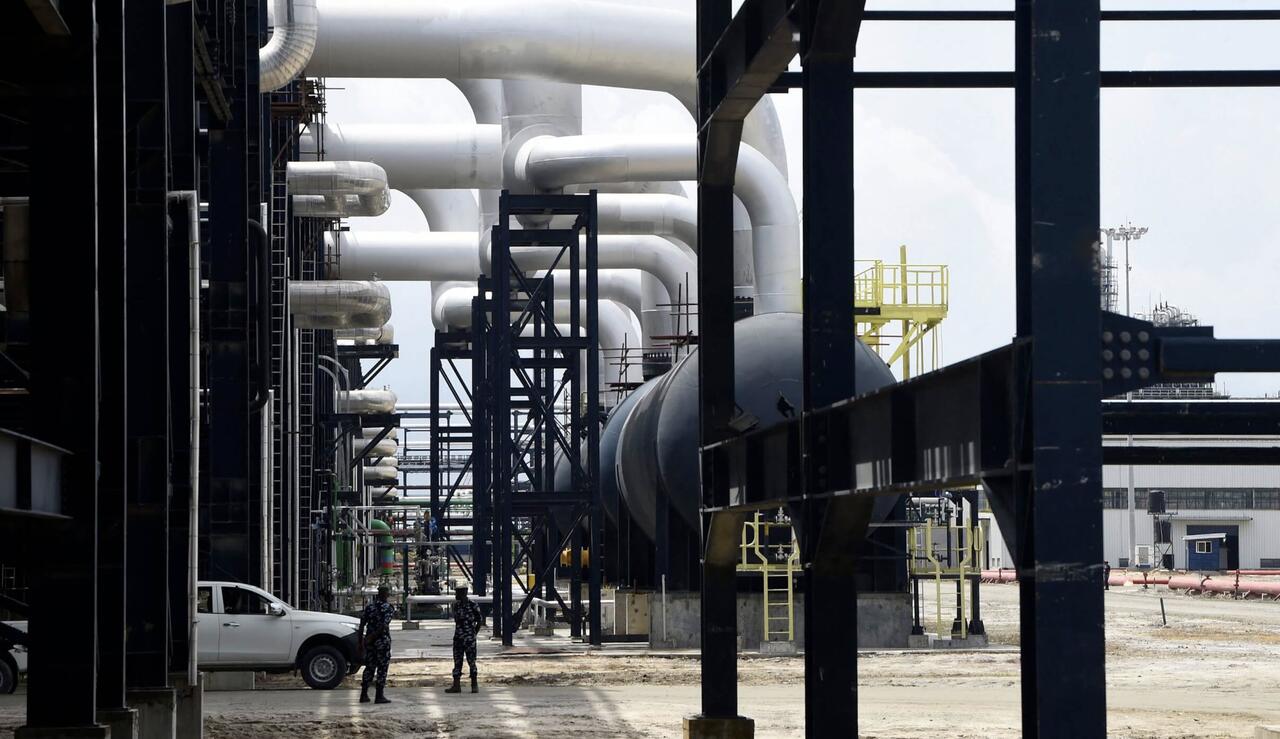
In November 2025, Aliko Dangote, Africa’s richest businessman, signed a $1 billion development agreement with Zimbabwe’s president, Emmerson Mnangagwa, to build a 1,300-mile fuel pipeline stretching from Walvis Bay in Namibia through Botswana to Bulawayo in Zimbabwe. Teams are working on routing, logistics, land procurement, and regulatory details.
The project is Zimbabwe’s government policy, and the pipeline has become the country’s moral imperative. To understand why, we must look at the catastrophe of the status quo.
Few modern economies have collapsed as swiftly as Zimbabwe’s did under the government of the late Robert Mugabe, which was known for corruption and disastrous land reforms. A nation that once fed Southern Africa became a cautionary tale.
Although Mugabe was forced from office in 2017, Zimbabwe still faces 18-hour daily power cuts, which cause the country to lose more than 6% of gross domestic product every year, according to World Bank estimates. Removing that economic drag would create space for actual growth.
Green activists want the government to rely on the Kariba Dam, a hydroelectric facility that environmentalists consider “renewable.” But nature is not reliable. An El Niño-induced drought has reduced Kariba to a pitiful 9% capacity. The dam is drying up, and with it, the economic future of a nation.
More promising is the pipeline. Its route—from the Atlantic coast of Namibia, through the stable democracy of Botswana, into Zimbabwe—creates a new strategic energy corridor for Southern Africa. It integrates the 10 economies of the Southern African Development Community in a way that decades of political summits failed to do.
There is an irony in the geopolitics of this pipeline deal. For years, the West has warned Africa of the dangers of “Chinese debt traps,” while offering no viable alternative for energy infrastructure. Now, a pipeline is creating Pan-African commercial cooperation that bypasses both Western climate lectures and Beijing’s loans.
Estimates of the project’s job opportunities range from 50,000 to 100,000 positions across the project’s construction phase and operational lifetime. In nations with unemployment exceeding 20%, these are transformative numbers.
The Dagonte pipeline offers attractive economics: Foreign contractors, anticipating the expenses of regulatory compliance and “green” tape, would likely quote tens of billions for a similar corridor. Dangote is delivering the pipeline, a cement plant, a fertilizer factory, and power infrastructure for a fraction of that cost.
The project will make Dangote’s refinery in Lagos one of the world’s largest single-site refining operations, growing from a current 650,000 barrels per day (bpd) to 1.4 million bpd by 2028.
These developments draw a new energy map in the region and threaten external interests. China and the West compete for influence over African resources. A regional fuel artery weakens their leverage. They cannot dictate terms to countries that supply their own energy.
For Zimbabwe, the implications are immediate. The economy pays punishing premiums for imported diesel delivered by truck. Every liter moves across multiple borders, each with tariffs and delays. Being landlocked leaves Zimbabwe exposed. The pipeline breaks that pattern. Once fuel flows from Walvis Bay to Bulawayo and onward to Zimbabwe’s capital at Harare, costs fall, and the manufacturing sector finally stops running on expensive fuel for running electricity generators.
This sends a terrifying signal to the climate czars that the developing world is waking up. Leaders like President Mnangagwa and industrialists like Dangote are realizing that the “Green Energy Transition” is a luxury good—likely a bogus one—they cannot afford. They are choosing the path of India and China—rapid industrialization fueled by whatever works. And what works, undeniably at this time, are fossil fuels.
Tyler Durden
Sun, 01/11/2026 – 07:00
https://www.zerohedge.com/geopolitical/africas-pipeline-rejects-climate-dogma-and-foreign-control
Presidente de Irán dice que autoridades escucharán a manifestantes, pero alborotadores intentan “destruir la sociedad”
DUBÁI, Emiratos Árabes Unidos (AP) — Presidente de Irán dice que autoridades escucharán a manifestantes, pero alborotadores intentan “destruir la sociedad.”
Neighbor opposes removing old oak trees to connect Crete forest preserve trails
The proposed course for a trail meant to connect Will County Forest Preserve District properties in rural Crete will require the removal of multiple oak trees that could be centuries old.
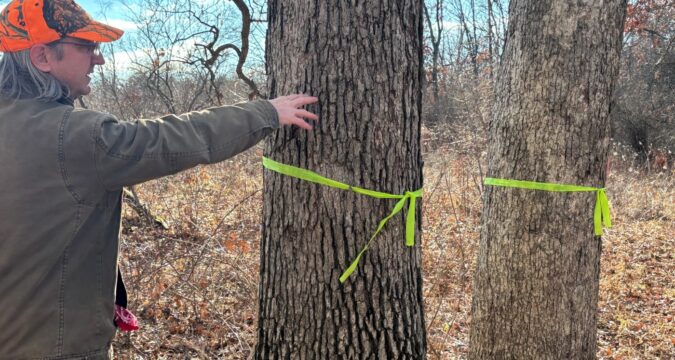
Keith Nowakowski, an advocate for the protection of native plants who lives near the property, said he was horrified when he saw which trees had been marked for removal.
“I was really appalled at what I was seeing, because it seemed like the trail was heading right for the biggest, most majestic oaks,” Nowakowski said. “And there aren’t that many oaks that you can’t avoid the biggest ones and still put in a trail.”
Nowakowski’s parents bought the property adjoining the woodland 46 years ago, he said, and he has spent decades exploring it.
“I measured several of them,” Nowakowski said. “An oak with a caliper of 25 inches across at breast height, which is roughly 5 feet off the ground, which is where you measure a tree, that could be a 200-year-old oak.”
The purpose of the planned trail is to connect existing Forest Preserve holdings and expand the trail network, Colleen Novander, director of planning and land preservation at Forest Preserve District, said in an email.
“Upon completion, the project will eliminate a gap in the existing trail system, resulting in a continuous greenway trail connection between Goodenow Grove Nature Preserve and the Plum Valley Preserve — Burville Road access,” Novander said.
The project plan also includes a bridge spanning Plum Creek.
The trail’s course has been designed to minimize the impact on the surroundings, Novander said, including wetlands, vegetation and sensitive habitats.
“While the trail alignment has been designed to avoid these features to the greatest extent practicable, limited tree removal will be required to accommodate construction and ensure the safe operation of the trail,” Novander said.
Keith Nowakowski stands Jan. 9, 2026, next to a large oak slated for removal on Will County Forest Preserve land between Goodenow Grove Nature Preserve and Plum Valley Preserve near Crete. (Evy Lewis/Daily Southtown)
Nowakowski said he wasn’t opposed to the trail, and that he was in favor when he first heard about the plan, which has been in development for years. However, he said the planned course seemed unnecessarily destructive.
“It just seems very unnecessary and very heartbreaking,” Nowakowski said.
He would also like to see the Forest Preserve District dedicate more energy to the ecological restoration of the property, which he said has not been well-maintained and is plagued by invasive species such as Amur honeysuckle and multiflora rose.
“They’ve done no restoration on that property,” Nowakowski said. “If they were working on that, and then said oh, we’d like to make a trail, that would be nice. But they’re just putting in a trail and I’m not sure they’re going to do any restoration.”
Novander said the trail project will include restoration of areas disturbed by the project, including potentially replacing felled trees.
“To offset these impacts, ecological restoration of disturbed areas is included within the project scope and will be completed in accordance with guidance from the Illinois Department of Natural Resources,” Novander said.
The Forest Preserve District had to file for an incidental take permit with the state because the planned trail crosses through a Kirtland’s snake habitat. Kirtland’s snake is listed as a threatened species in Illinois.
A pink marker marks the planned course of a trail running through Will County Forest Preserve land between Goodenow Grove Nature Preserve and Plum Valley Preserve, Crete. (Evy Lewis/Daily Southtown)
“They’re making the trail for the public, so the public can experience something that’s nice, but to me, what’s nice is what’s marked in green to be removed,” Nowakowski said, pointing at a trio of oaks marked for removal. “It’s like a cathedral.”
If the trees are felled, Nowakowski said, he plans to count the rings to determine their true ages, though he’d much prefer to see them spared.
“Unfortunately, at that point, they’ll be gone,” Nowakowski said.
Tree clearing is scheduled to begin this year, and construction on the trail is planned to be complete by the end of 2026, Forest Preserve public information officer Cindy Cain said.
elewis@chicagotribune.com
https://www.chicagotribune.com/2026/01/11/neighbor-opposes-oak-tree-removal-crete/

Give an old, tangled shrub a new start
Sometimes a shrub needs a chance to make a fresh start.
“An older bush can get so tangled and overgrown that you might think it’s beyond pruning,” said Sharon Yiesla, plant knowledge specialist in the Plant Clinic at The Morton Arboretum in Lisle. “What it often needs is a particular pruning technique called rejuvenation.”
To rejuvenate a shrub, cut all the stems back to within 2 to 4 inches of the soil. This is best done in winter or early spring, before growth starts.
Usually, the shrub will respond by sending up new stems from its roots in spring. Those new stems often grow to be 18 inches or 2 feet tall by early summer.
“It may take a couple of years for the shrub to regain its full height,” Yiesla said. “But the technique can save some gnarly, messy old plants that you might otherwise give up on.”
Once a shrub is rejuvenated, keep up with the pruning each year to make sure it doesn’t become another tangled mess. Remove some of the oldest, thickest stems regularly to make space for new growth.
Just make sure that in any year, you don’t remove more than one-third of any shrub’s branches overall. Let it keep enough stems to bear the leaves it needs to collect the energy that fuels its growth.
Midwinter is a good time to prune deciduous shrubs — those that lose their leaves in fall — because it’s easy to see the structure and judge which branches to remove. For evergreen shrubs, which keep their leaves or needles in winter, wait until spring to prune.
Most shrubs are best pruned selectively, using hand pruners, rather than with a power tool. Take out only those branches that need to go in order to control the shrub’s size, maintain a nice, natural shape, and keep it uncrowded so air can circulate freely. Hand pruning will keep most shrubs more attractive and healthier.
There are several pruning techniques, and rejuvenation pruning is not the right one for every kind of shrub. It works best on vigorously growing species such as forsythia, weigela, privet, honeysuckle, spirea and some kinds of hydrangea. To learn about the right kind of pruning for different shrub species, see mortonarb.org/pruning-deciduous-shrubs.
Be aware that if you rejuvenate a spring-flowering shrub such as lilac or forsythia, it will cost you one year’s bloom. You will be removing the flower buds along with the stems. The new stems that sprout this spring will not develop flower buds in time to bloom this year. Instead, they will develop buds this fall to bloom next spring.
Usually, it’s worth the sacrifice of a year’s flowers. “An old, crowded shrub often doesn’t bloom much anyway,” Yiesla said. “The dense mass of branches shades out many of the buds, and generally old wood doesn’t bloom as vigorously as new wood.”
Rejuvenating the shrub to make room for vigorous new growth, and keeping it pruned every year to make room and give sunshine to those younger stems, will help it bloom better in many spring-times to come.
For tree and plant advice, see the online resources of The Morton Arboretum at mortonarb.org/plant-care, or submit your questions online at mortonarb.org/plant-clinic or by email to
plantclinic@mortonarb.org. Beth Botts is a staff writer at the Arboretum.
https://www.chicagotribune.com/2026/01/11/shrub-garden-tangled-rejuvenate/

Clarence Page: Guess who fears impeachment? A guy who’s been through it twice.
President Donald Trump is afraid of getting impeached again.
He said as much earlier this week.
“You got to win the midterms, because if we don’t win the midterms, it’s just going to be — I mean, they’ll find a reason to impeach me,” he said. “I’ll get impeached.”
He spoke those words, coincidentally, on the fifth anniversary of the Jan. 6 Capitol attack, which formed the basis of his second impeachment.
It was a startling pronouncement from someone given to endless expressions of a hyper-inflated ego. This is a man who, throughout his long public and political life, has seldom been associated with such descriptors as modest, prudent or vulnerable.
Yet Trump admitted in a notable and rare acknowledgment of his own limitations, in his book “The Art of the Comeback,” that his past business difficulties, culminating in corporate bankruptcies in the 1990s, resulted from a “feeling of invincibility” that led him to become “a little cocky.”
Perish the thought.
Whether he arrived at the conclusion himself or at the urging of advisers, Trump understands he is in danger of being taken down by overconfidence. Not just his own but also that of his loyal MAGA movement.
It’s no surprise, then, that Trump in recent days has instituted something of a full-court press on the housing affordability crisis, calling for such measures as banning institutional investors from buying single-family homes. And if that succeeds in making housing more affordable for Americans, that might well save his bacon.
Yet Trump’s administration is also stumbling from crisis to crisis, as unwelcome surprises, such as the Jeffrey Epstein scandal, seem to inspire desperate political gambits.
That thought came to mind as Americans woke up on Jan. 3 to Trump’s announcement that the Army’s Delta Force had captured Venezuelan President Nicolás Maduro and his wife and were taking them to the U.S. for trial.
Remember his denunciations of “forever” wars and nation-building attempts? Well, it took MAGA influencers a matter of minutes to forget them.
Now it was time to celebrate the “Donroe Doctrine,” which unlike the Monroe Doctrine was not a doctrine at all but rather an attitude that the entirety of the Western Hemisphere is a collection of potential colonies that Trump can at will bring under the flag of the United States.
Trump seems to be on a tear, cramming as many issues as possible from “Project 2025” on the American public, at times seemingly contradicting his past principles and reversing laws and policies we associate with the so-called American Century.
Related Articles
Clarence Page: It’s hard to hide the dysfunction of the Trump White House
Clarence Page: President Donald Trump’s obsession with Somali immigrants takes a sinister turn
Clarence Page: Border Patrol decamps from Chicago to create disorder elsewhere
Clarence Page: Jeffrey Epstein case exposes divisions in MAGA unity
Clarence Page: When federal authorities disrupt the peace in the name of preserving it
What exactly is the objective in Venezuela? Taking the nation’s oil? Running its government? Helping it restore some semblance of democracy and good government? Hell if anybody knows, but Colombia and Cuba might be next if they’re not careful!
Yet, as much as he might seem to have been on a roll lately, Trump understands that his base, while it still supports him, is wobbly, and whatever moderate swing voters he was able able to pick up in 2026 are falling away, particularly in light of the shocking shooting by an immigration agent of a protester in Minneapolis.
Among the dark clouds on the horizon revealed in a recent NBC News poll is the finding that most voters feel the country is on the wrong track, particularly with regard to the economy. There’s much at stake in the November midterms for both parties, not least of which is a loss of control of Congress and then investigations into Trump and key political allies.
But nothing is certain, as D.C. veterans know. U.S. Rep. Maxine Waters of California, the most outspoken Democrat so far, has displayed a mix of caution and determination on another possible impeachment, saying in a statement that “even if Republicans refuse to act, Democrats cannot remain silent or passive in the face of actions this extreme from this Administration.”
This era will end. The only open question is whether it ends at the ballot box or through the very constitutional mechanisms Trump now openly fears.
Email Clarence Page at cptimee@gmail.com.
Sign up to receive Clarence Page’s column in your inbox each week.
Submit a letter, of no more than 400 words, to the editor here or email letters@chicagotribune.com.

Letters: Illinois deserves credit for asking questions about how to keep children safe and families together
I’m the CEO of Brightpoint, formerly Children’s Home & Aid, a child and family services organization that has served Illinois for more than 142 years. We partner with the Illinois Department of Children and Family Services on the nation’s largest guaranteed income pilot for families involved with the child welfare system.
The Jan. 2 op-ed by professors Sarah A. Font and Emily Putnam-Hornstein (“Does providing money to parents who have mistreated kids improve child welfare?”) criticizes this pilot and then broadens into a wholesale dismissal of cash assistance in child welfare.
Illinois deserves credit — not derision — for asking hard, testable questions about how to keep children safe and families together. That is precisely what this pilot is doing.
No one involved in this study claims that cash assistance is the only or even the best solution for child maltreatment. That argument was invented for the op-ed, not by the researchers actually running the pilot. The real question under examination is far more basic. If poverty contributes — directly or indirectly — to child neglect, what happens when families involved with the child welfare system receive unconditional cash support for a limited period of time?
If the link between poverty and neglect were settled science, this study would be unnecessary. It is not. And that uncertainty should invite curiosity, not premature certainty — especially from researchers.
Our pilot, led by researchers at the University of Illinois Urbana-Champaign and the University of Connecticut, follows 800 families. Half will receive an average of $500 per month for 12 months. All participating families already receive Intact Family Services, a voluntary prevention program designed to stabilize families before crises escalate and children enter foster care. The overwhelming majority of child welfare hotline reports involve neglect, not abuse.
Testing whether modest, time-limited cash assistance improves family stability alongside existing services is not reckless. Refusing to test it, despite unresolved evidence and persistent system failure, would be.
Since our founding in 1883, child welfare has advanced because people were willing to challenge assumptions and replace certainty with inquiry. Progress has never come from standing still while families struggle under conditions we only partially understand.
Progress depends on people willing to ask hard questions and follow the evidence where it leads. The data will speak. We should be prepared to listen.
— Mike Shaver, president and CEO, Brightpoint, Chicago
Influence of environment
All families have problems; every income level, tax bracket, ethnicity. The complexity of family problems for “the impoverished” are bundled into drivers such as not being employed full time and dealing with drug addiction, mental illness and family violence. Each of these drivers also occur in families that can keep their traumas private.
Why are two social work professors only thinking in terms of behaviors? Taking a closer look at the societal environments that overshadow low-income communities must be in the equation when sincerely working to stop child abuse. Social work needs to consider the community.
Have you ever not had enough? Not just to eat but to hope for? Have you ever been without? Not just material items but without connection? There is no such thing as being poor in a bubble. Lack of income is a contagion that infects self-worth, confidence and the ability to be present in life. Infected for generations, communities in poverty are drawn down into survival mode. Not flourishing, not thriving; just surviving.
According to a June 2021 CNBC article, when parents were given money during COVID-19 relief efforts, parents used it on basic needs. Food insufficiencies dropped by 42%, and financial insufficiencies dropped by 43% in households with children. Parents also used relief funds for educational and extracurricular supports and emergency savings. The article states that families’ mental health improved.
Money reduces the viral load of poverty and increases hope and connection, two elements that are needed in every family, every community.
Children need everything we can give to keep them safe. Giving people money means someone may not make the right decisions every time. That also applies when people earn money. We elect people to power over our tax dollars; they don’t make the right decisions every time and can still get reelected. It happens; we pick up the pieces and look at the progress we made, adjust and move forward.
The same thing can apply to financial assistance programs.
I have consulted with each national philanthropic organization mentioned; I know they talk to people who are experiencing situations in real time. It takes effort; heart work is hard work. To listen for understanding, you must be willing to set aside preconceived notions and dispose of as much implicit bias as possible. Professors, maybe there’s a class you can take. Or come to a Be Strong Families Café!
— Tecoria Jones, board secretary, Be Strong Families, Chicago
A confounding campaign
For many years, public policy efforts to support child welfare have received bipartisan support. During the first Donald Trump administration, for example, Congress passed the landmark Family First Prevention Services Act, leading to unprecedented federal funding for evidence-based interventions that would keep families together and prevent children from going into foster care. But now the American Enterprise Institute enters the fray, ignoring the evidence that mistreatment is often rooted in the lack of housing, food and other basic resources.
The recent op-ed by professors Sarah A. Font and Emily Putnam-Hornstein is part of a confounding national publicity campaign against cash and other support programs that would help some families stay on their feet and stay together. Such op-eds are popping up with the same anti-family messages delivered by different authors.
As a former foster parent who has worked in child welfare most of my adult life, and as an American who is as distressed by the national divisions as most other citizens, I am at a loss for why a think tank would want to fan flames of division over child well-being.
Is no area of public policy safe from this toxicity?
— Marrianne McMullen, Chicago
Program’s positive effects
The op-ed by the two professors claims that “a recently released evaluation found that recipients of the cash transfers (from the Rx Kids program) found that recipients of the cash transfers were no less likely to have allegations of child maltreatment during the first six months of life.” The authors don’t cite their source, so I went on Google Scholar and searched for RxKids. I found the study they were referring to, which is a preprint that has not been peer-reviewed. Other studies I found reported positive effects of the program, including a preprint that found that “after implementation of Rx Kids in 2024, the maltreatment allegation rate dropped to 15.5% in Flint, falling below the maltreatment allegation rate of 20.6% among the control cities.” Other studies found benefits such as reductions in preterm birth and low birthweight and diaper hardship.
— Michael Kaiser-Nyman, Chicago
Submit a letter, of no more than 400 words, to the editor here or email letters@chicagotribune.com.