Category: News

Immigrants often don’t open the door to ICE, but that may no longer stop officers
SAN DIEGO — Since coming to the United States 30 years ago from Mexico, Fernando Perez said U.S. immigration officers have stopped by his home numerous times, but he has never once answered the door.
“There are rules and I know them,” said Perez, speaking in a mix of English and Spanish in a Home Depot parking lot where he has routinely sought work as a day laborer from contractors and people renovating their homes.
Over the decades it has become common knowledge in immigrant communities across the country to not open the door for federal immigration officers unless they show a warrant signed by a judge. The Supreme Court has long held that the Constitution’s Fourth Amendment against unreasonable search and seizure prohibits the government’s forced entry into someone’s home.
As a result, immigration officers have been forced to adapt by making arrests in public, which often requires long hours of surveillance outside homes as they wait to nab someone walking to the street.
But an internal Immigration and Customs Enforcement memo obtained by The Associated Press states immigration officers can forcibly enter people’s homes without a judge’s warrant, marking a dramatic shift that could upend the legal advice given to immigrants for decades.
The shift comes as President Donald Trump’s administration dramatically expands immigration arrests nationwide under a mass deportation campaign that is already reshaping enforcement tactics in cities such as Minneapolis.
Perez said officers in the past would knock, wait and then move on.
“But if they are going to start coming into my home, where I am paying the rent — they are not paying the rent — that’s the last straw,” he said.
Most immigration arrests have been carried out under administrative warrants, documents issued by immigration authorities that authorize an arrest. Traditionally they do not permit officers to enter private spaces without consent. Only warrants signed by independent judges have carried that authority.
It is unclear how broadly the memo’s directive has been applied in immigration enforcement operations. AP witnessed ICE officers ramming through the front door of a Liberian man’s home in Minneapolis on Jan. 11 with only an administrative warrant, wearing heavy tactical gear and with their rifles drawn.
Democratic U.S. Sen. Richard Blumenthal of Connecticut is demanding congressional hearings on the ICE memo and calling on Homeland Security Secretary Kristi Noem for an explanation.
“Every American should be terrified by this secret ICE policy authorizing its agents to kick down your door and storm into your home,” Blumenthal said in a news release.
Supreme Court Justice John Paul Stevens wrote for the court in 1980 that the “physical entry of the home is the chief evil against which the wording of the Fourth Amendment is directed.”
The waiting game
For years, people have managed to evade arrest by skipping work and outings for days until agents move on. A senior ICE official once likened the surveillance experience to watching paint dry.
Related Articles
Iranians in Chicago still struggle to communicate with loved ones in Iran after deadly protests
Lawsuit over use of force by immigration agents in Midway Blitz officially dismissed
Federal officers detain a 5-year-old boy who a school official says was used as ‘bait’ in Minnesota immigration arrest
Chicago Bulls’ Tre Jones, a Minnesota native, saddened by ICE crackdown in home state: ‘It’s tough to watch’
Responding to resident concerns, St. Charles makes immigration enforcement proclamation: ‘Of course we care’
In July, the AP observed as immigration officers saw a Russian man enter his home in Irvine, California. They gave up when he didn’t leave after three hours. They waited longer for a Mexican man who never emerged from his house in nearby El Monte, though they caught up with him two days later at a convenience store.
ICE has tried what the agency called “knock and talks” to get people to answer the door by casually asking residents to step outside to answer a few questions, according to a 2020 lawsuit in which a federal judge found the practice illegal. In one case, they told a woman they were probation officers looking for her brother.
More often, immigration officers simply play the waiting game — a pace that is not conducive to Trump fulfilling his promise of mass deportations.
Not answering the door is a key part of know-your-rights trainings
Since shortly after ICE was created in 2003, advocacy groups and immigrant-friendly state and local governments have diligently spread the word that people should not open their doors for immigration officers unless they can show a warrant signed by a judge.
They’ve held know-your-rights trainings for communities, passed out flyers and posted videos on social media to teach immigrants how to protect themselves.
Ahilan Arulanantham, co-faculty director of the UCLA Law School’s Center for Immigration Law and Policy who has held such trainings, called the memo “quite disturbing.”
“Know-your-rights trainings have included that information for decades and even people who are only minimally aware of their rights learn that because it’s sort of the first and foundational elements of Fourth Amendment law,” he said. “They know to ask officers to slide the warrant under the door so they can see if it was signed by a judge or is an administrative warrant.”
In the predominantly Latino city of Santa Ana, where ICE agents were seen roaming the streets in recent days, several residents who did not want to give their names said they were well aware of that right. Jesus Delgado, a father of three, said the local elementary school sent out information to parents about what to do if ICE comes to your door.
“They send us bulletins, to not answer the door, to not answer any questions,” he said.
Another man said he learned that from TikTok.
Trump’s border czar Tom Homan has been highly critical of groups providing the information.
“They call it ‘know-your-rights,’” he said last year on CNN. “I call it ‘how to escape arrest.’”
Experts warn barging into homes could put all at risk
The memo says immigration officers can forcibly enter homes and arrest immigrants using solely a warrant signed by an immigration official if they have a final order of removal.
Officers must first knock on the door and share who they are and why they’re at the residence, and they can only go into the home after 6 a.m. and before 10 p.m. The people inside must be given a “reasonable chance to act lawfully.” But if that doesn’t work, the memo says, they can use force to go in.
Law enforcement and legal experts warn if more immigration officers barge into homes, everyone could be put at greater risk.
With stand-your-ground laws, people in many states have the right to shoot intruders, which could lead to officers being shot, or agents opening fire on someone coming at them with a baseball bat or other item they grab in the heat of a moment, Arulanantham said. ICE records often contain wrong addresses, which could further lead to confrontations and agents busting into homes of U.S. citizens.
Arulanantham said agents’ aggressive tactics have been building since the Supreme Court lifted a lower court’s order in September that barred federal agents in the Los Angeles area from indiscriminately stopping people because of their race, language, job or location.
“This would just be another step down that path,” he said. “Obviously it will be more significant because it suggests you’re not safe even in your own house.”
Associated Press writers Elliot Spagat in San Diego and Rebecca Santana in Washington contributed to this report. Taxin reported from Santa Ana, Calif.
https://www.chicagotribune.com/2026/01/23/immigrants-ice-open-door/
NatGas “Tightening Shock” Sparks Historic Weekly Rally As Major Winter Storm Imminent
NatGas “Tightening Shock” Sparks Historic Weekly Rally As Major Winter Storm Imminent
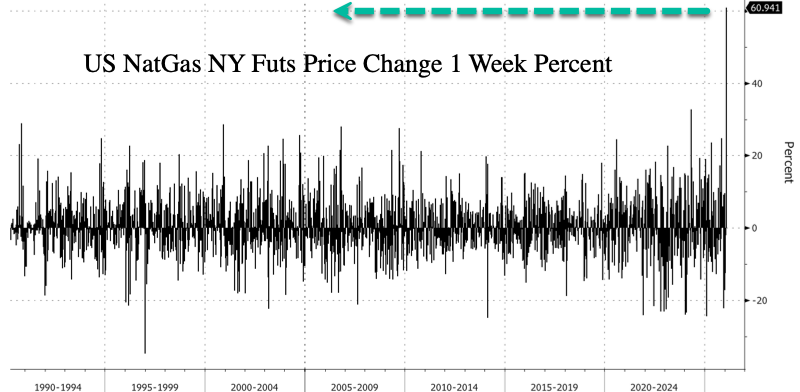
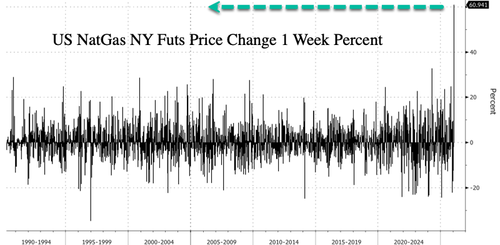
US natural gas futures surged as much as 75% over the past week, well above $5/mmBtu, driven by sharply colder weather forecasts (comparable to the 2021 Uri storm that paralyzed Texas’ power grid), ongoing production freeze-offs, and a vicious market trap for bears that unleashed epic short covering.
As of Friday morning, around 0645 ET, front-month NatGas contracts in New York fell 1.4% to $4.97/mmBtu, after surging 63% over the last three trading sessions.
Prices were still on track for the biggest weekly gain on record, with Bloomberg data going back to 1990.
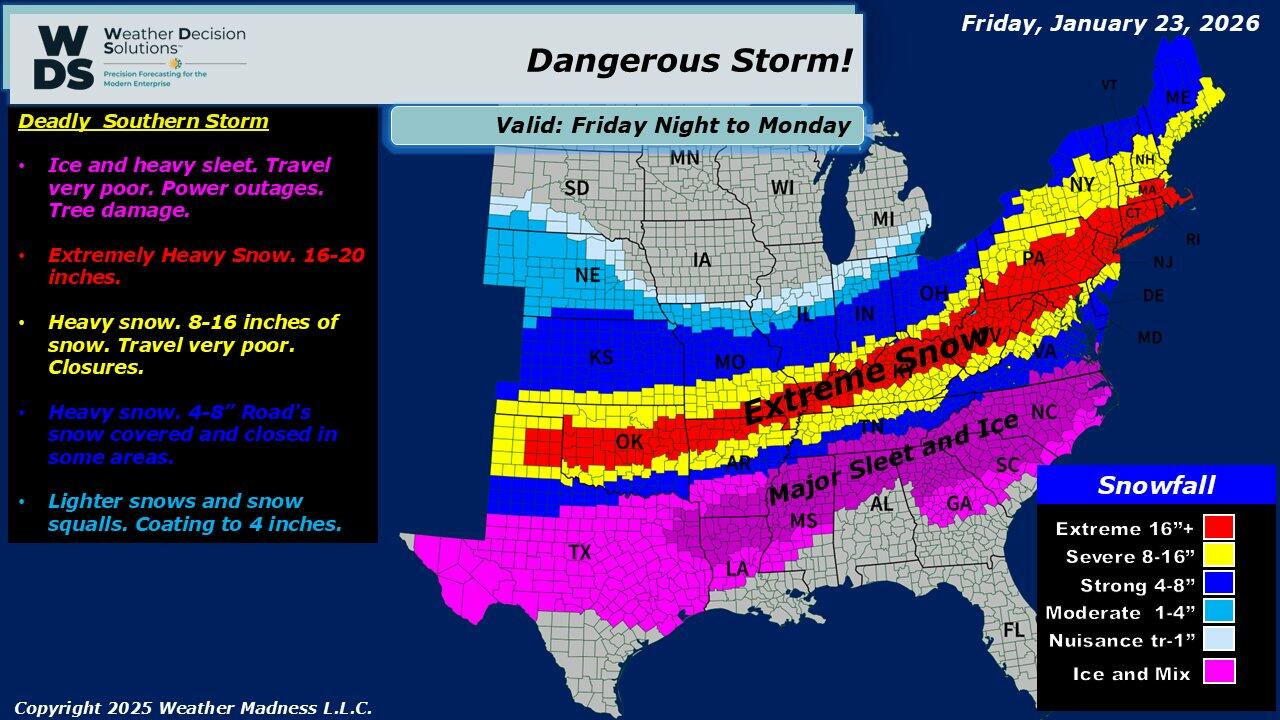
This week’s surge was largely fueled by below-average temperature forecasts across the Lower 48, combined with the threat of a potentially historic winter storm stretching from Texas to the Northeast.
Widespread winter activity across more than half the country has raised freeze-off risks, particularly in southern gas-producing states and Appalachia, while also stoking concerns about pipeline icing that could reduce volumes and pressure power grids this weekend and into next week.
Winter is Coming for Appalachia
This week’s Appalachian nat gas production is already down 1.1 Bcf/d versus last week, and the extreme cold is just getting started.
Pittsburgh overnight lows are headed to -6.8°F at their most intense levels next week, with this cold coming in… pic.twitter.com/l2oyl80cfe
— Criterion Research (@PipelineFlows) January 22, 2026
Our reporting this week:
Appalachian NatGas Output Faces “Intense Losses” As Arctic Blast Drives Power Grid Risk Higher
NatGas Jumps 75% As Extreme Cold, Blizzard Risks Threaten Appalachian Gas Supply
Samantha Dart, lead analyst on the Goldman Sachs commodities team, provided clients with critical color on the US NatGas market Thursday evening following a historic week of upside price action.
Dart was clear that the move in NatGas was purely weather-driven: prices surged amid sharply colder forecasts, production freeze-offs, and short covering. She said her desk views the spike as a near-term shock, with futures prices likely overshooting fundamentals rather than signaling a sustained rally.
She said that front of the curve rallied more than Summer 2026 (Sum26) contracts, highlighting two key risks:
Production outages might hit exactly when heating demand peaks and the system might fall temporarily short on gas
Storage path risks: Higher heating demand ultimately lowers overall storage levels, increasing the market’s vulnerability to tightening shocks during the 2026-27 winter.
Dart continued:
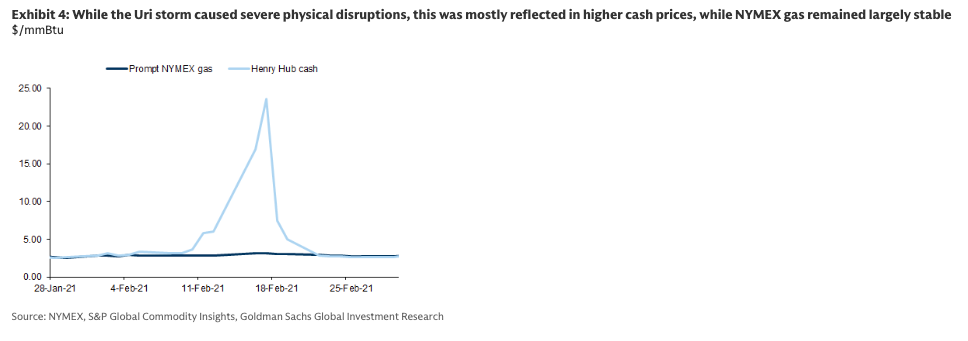
We estimate that near-term deliverability risks are meaningful, even taking into account mitigating factors like gas-to-coal switching and the re-sale of gas by liquefaction facilities back to the grid. That said, we think this would ultimately be a temporary physical imbalance, likely to be reflected in very high cash prices during the tightening shock, rather than in a sustained rally in NYMEX gas. We think this is especially the case given the potential for strong Northeast production to help rebuild Gulf storage levels in the spring, as observed last year. As a result, while weather forecast shifts can keep price volatility elevated, prompt NYMEX prices seem to have overshot fundamentals.
She added that the upcoming storm (peak cold on Jan 26) is expected to create a temporary tightening, reflected in higher cash prices than NYMEX futures, similar to the 2021 Uri event, when cash spiked to $25/mmBtu while prompt NYMEX stayed flat.
Dart’s view is that prices post-storm and post-winter blast will return to the medium-term target, but stay above $3.50, and not exceed $4.
The full note can be found in the usual place for ZeroHedge Pro Subs.
Tyler Durden
Fri, 01/23/2026 – 07:20

Today in Chicago History: ‘Tomorrow’s transit car is here’
Here’s a look back at what happened in the Chicago area on Jan. 23, according to the Tribune’s archives.
Is an important event missing from this date? Email us.
Front page flashback: Jan. 24, 1973
President Richard Nixon announced on Jan. 23, 1973, that an accord to end the Vietnam War had been agreed to by the United States and the Democratic Republic of Vietnam. (Chicago Tribune)
1973: President Richard Nixon addressed the nation about the end of the Vietnam War. An agreement — known as the Paris Peace Accords — was drafted by the United States and the Democratic Republic of Vietnam and would be signed days later.
Weather records (from the National Weather Service, Chicago)
High temperature: 65 degrees (1909)
Low temperature: Minus 18 degrees (1963)
Precipitation: 0.89 inches (1999)
Snowfall: 4.4 inches (1939)
1975: The State-of-the-Art Car (SOAC), produced by the U.S. Department of Transportation’s Urban Mass Transportation Administration and Boeing Veritol, arrived in Chicago for a two-week demonstration.
The stainless steel two-car system (one designed for 200 passengers and the other for 300) featured a plush interior design, carpeting and air conditioning (which probably wasn’t an impressive feature given it was here during the winter). The system, however, was too wide and too long to run on most Chicago Transit Authority lines, so it could only operate on the Skokie Swift (today’s Yellow Line). Engineers designed a retracting platform and other modifications to showcase SOAC’s capabilities.
Two “L” cars, which designers thought embodied the epitome of the dream railcar, is shown here on Jan. 23, 1975. They ran for two weeks on the CTA’s Skokie Swift Line. They only ran on the Skokie Line because they were too wide and too long for the subway and other “L” routes. (Arthur Walker/Chicago Tribune)
Though the mock-up was comfortable, it never took off. Despite demonstrations in New York, Boston, Cleveland, Philadelphia and Chicago, SOAC was never adopted.
The two demonstration vehicles now are housed at the Seashore Trolley Museum in Kennebunkport, Maine.
Want more vintage Chicago?
Subscribe to the free Vintage Chicago Tribune newsletter, join our Chicagoland history Facebook group, stay current with Today in Chicago History and follow us on Instagram for more from Chicago’s past.
Have an idea for Vintage Chicago Tribune? Share it with Kori Rumore and Marianne Mather at krumore@chicagotribune.com and mmather@chicagotribune.com
https://www.chicagotribune.com/2026/01/23/january-23-chicago-history/

How Norway’s ski jumping scandal led to new rules in place for the Olympics
The difference between winning an Olympic medal in ski jumping or being disqualified could come down to a bit of fabric.
A larger suit can extend a ski jumper’s flight by several meters but it could violate rules that have become more stringent after the Norwegian team was caught cheating at last year’s world championships by manipulating the crotch area in the uniforms of its top two male jumpers.
Regulators added new measures this season before the Milan Cortina Winter Games to ensure all competitors play by the same rules after the scandal rocked the sport in March.
“There have been disqualifications in the past, many. It’s part of the sport,” said Bruno Sassi, spokesman for the international ski federation, FIS, the sport’s regulatory body. “But there had never been that kind of a brazen attempt to not only bend the rules, but like downright do something … to cheat the system in a way that it is very different from simply having a suit that is a tad too long or a tad too loose.”
Ski jumping is as much a science as an art. Teams of experts test skis and clothing in wind tunnels to maximize the aerodynamics at play long before jumpers try to achieve the perfect takeoff, flying form and landing.
A study published in October in the journal Frontiers in Sports and Active Living showed that adding 1 cm (0.4 inches) of fabric to the circumference of the suit could increase a jump by 2.8 meters (9.2 feet) — enough to separate a winner from an also-ran.
“In most cases, enlargement of the suit is beneficial,” said co-author Sören Müller, who heads ski jumping research at the Institute for Applied Training Science in Leipzig, Germany. “However, the area stretched by the V-position of the legs in the crotch area is the most noticeable and also offers the greatest advantage.”
The scandal
Ski jumpers have often pushed the limits on the size of their suits but video shot by a whistleblower was stunning because it captured Norwegian team officials in the act of cheating.
Head coach Magnus Brevik, assistant coach Thomas Lobben and staff member Adrian Livelten were recently banned from the sport for 18 months for tampering with the suits before the men’s large hill event. Extra material had been sewn into the crotch to stiffen and add surface area that would help during takeoff.
The alterations could not be spotted and were only found when the seams were examined after the contest.
“We regret it like dogs, and I’m terribly sorry that this happened,” Brevik said at the time.
The violation cost defending Olympic large hill ski jump gold medalist Marius Lindvik a world championship silver medal and brought shame to the team from Norway, the nation that invented ski jumping and has historically dominated the sport.
Lindvik and teammate Johann André Forfang, a two-time Olympic medalist, accepted three-month suspensions that allowed them to compete in this season’s events. Neither was charged with knowing about the stitch witchery but FIS said they “should have checked and asked questions about the night-time adjustments.”
The discovery caused outrage in the tight-knit ski jumping community.
“This is doping,” former German Olympic champ Jens Weissflog told German newspaper Bild, “just with a different needle.”
The scandal led Norway to sack its men’s team leadership.
New Rules
In the wake of the cheating, FIS has modified its rules and brought in a coordinator to oversee screening of gear and hired former Austrian ski jumper Mathias Hafele to work as equipment expert.
“He used to make a make a living off of trying to make the most out of the rule book,” Sassi said. “Now he’s on our side putting together the new rule book.”
Before ski jumping events, two FIS controllers and a doctor will use improved 3-D measurements to evaluate athletes in their uniforms. The shape of the suits will make it harder to tamper with arm and leg cuffs and more difficult to lower the crotch to provide more surface area.
Shining a light on Illinois women athletes: Meet ski jumper Sandra Sproch
After suits pass the control checkpoint, tamper-proof microchips are affixed throughout the suit to prevent manipulation. Scanners will be able to tell before and after the jump if the chips are all in place.
A system like in soccer will also be applied so that anyone disqualified for an equipment violation will get a yellow card. A subsequent violation will lead to a red card and disqualification from the next event and a team will also lose a slot for a skier in the competition.
Eyes on Norway
After the scandal, Rune Velta, a former Norwegian team ski jumper, took over as head coach in June and was given the difficult task of restoring Norway’s reputation.
“It’s the hardest thing I’ve ever done,” Velta said. “We are building everything around the athletes from scratch. We started five months ago with zero and now we have a team around them to make them perform.”
Velta, who as Swiss coach last year had publicly criticized the cheating, feels that Norway is under more scrutiny this season.
During the summer ski jumping season when competitors slide down ceramic or porcelain tracks and land on bristly plastic mats, the team tried to adjust to the new ski suit dimensions.
“Acceptance for a kind of minor error and mistakes are really low,” Velta said. “We needed this summer to understand the standards and to learn kind of the line of the control and execution of the rules.”
https://www.chicagotribune.com/2026/01/23/norway-ski-jumping-scandal-new-rules-olympics/

Chicago Bears Q&A: Which players present GM Ryan Poles with the most difficult roster decisions?
An unexpected division-championship season is in the books for the Chicago Bears, who already are moving on to 2026 after Sunday’s overtime playoff loss to the Los Angeles Rams.
Many questions lie ahead for the offseason involving who will — and won’t — be back with the Bears next season. Brad Biggs addresses the first wave of them in his weekly Bears mailbag.
What current Bears will be the toughest decisions for Ryan Poles? — @tn5280
Poles and coach Ben Johnson have a lot of work ahead of them. Year 1 for Johnson was really about laying the groundwork for the future, and what made it so exciting was the Bears experienced so much success along the way.
As everyone knows, the Bears are more snug against the salary cap this year, and of course they won’t be armed with the same kind of draft capital they had in 2025, when they owned the 10th pick and three choices in Round 2.
The evaluation process will stretch from the top of the roster to the bottom. While everyone wants moves and names and creative ideas to create more cap space to build a bigger, better roster in 2026, that doesn’t happen overnight. The Bears are two weeks behind non-playoff teams in this process — and that’s a good thing. The first thing they need to do is take a deep breath, take a step back and give everyone time to clear their minds in order to complete an objective analysis.
“We’ll go back in the bunker here after a couple weeks and we’ll assess where we can get better,” Johnson said. “That’s our commitment to each other. That’s our commitment to this organization is that we’ve got to continue to clean up where we can find little edges that make us a little bit better over the course of the season. So that’s what we’ll do.”
When you talk about “toughest decisions,” I imagine you’re referring to those the Bears need to make on highly paid veterans. Which players do they go forward with? Would they be willing, in a few instances, to restructure contracts in order to create cap room? Is an extension, which could lower the cap hit, a possibility for one or two players? Are there players they would consider trading or releasing?
A lot of layers are involved in this process. For instance, if the Bears are on the fence about a veteran making good money at a position where they don’t see a lot of great options in free agency or the draft, do they think twice about it?
But you’re talking about taking a hard look at players earning a lot of money, especially those who have exhausted the guaranteed money in their contracts. But it’s really everyone with a large price tag.
There are 13 players, not including quarterback Caleb Williams, with a 2026 cap hit above $8 million, according to spotrac.com.
WR DJ Moore: $28.5 million
DE Montez Sweat: $25.1M
CB Jaylon Johnson: $25M
LG Joe Thuney: $21.5M
DE Dayo Odeyingbo: $20.5M
RG Jonah Jackson: $19.5M
DT Grady Jarrett: $19M
LB Tremaine Edmunds: $17.4M
C Drew Dalman: $14M
CB Kyler Gordon: $13.3M
TE Cole Kmet: $11.6M
LB T.J. Edwards: $10.8M
RB D’Andre Swift: $8.8M
Moore seems to be the player everyone is wondering about. The Bears signed him to a four-year, $110 million extension on July 31, 2024. There’s no cap savings if the Bears release Moore. The only way to clear room would be to trade him.
If the Bears pursue that angle, I doubt they would get a whole lot back in return because Moore has a $23.485 million base salary, per-game roster bonuses totaling $765,000 and a $250,000 workout bonus. So an acquiring team would be looking at paying him $24.5 million in 2026. But if the Bears can find a receiver-needy team to take him on, they would create $16.5 million in cap space. Again, they’d have to find a trade partner, but the way the contract is structured, it could be a one-year rental.
Related Articles
Bill aimed at attracting Chicago Bears to Indiana passes committee
NFL coaching and GM tracker: Bears’ Declan Doyle to interview with Eagles — and Al Harris talks to Packers
Chicago Bears’ Ben Johnson is a Coach of the Year finalist: See the other NFL award nominees
Ben Johnson on his Chicago Bears assistants getting opportunities with other teams: ‘I’m all for it’
Column: Chicago Bears coach Ben Johnson already locked in on 2026. ‘We go back to square one.’
Edmunds and Swift are the two players on the list entering the final year of their contracts. Going off the cuff, five days after the season ended, Edmunds looks like someone who could be caught in a jam. Releasing him would clear $15 million in cap space. Does the conversation become a little more nuanced after Edwards — who got a new contract last offseason — broke his fibula in the wild-card victory over the Green Bay Packers?
The conversation is a little more difficult with Swift. You can make a case he earned every bit of his contract this season, and if you let him go, all of a sudden you absolutely have to find a running back to pair with Kyle Monangai.
The Bears can look to restructure some of the highly paid veterans to create cap savings, but they would need to be shrewd. You only want to go that route with players you see definitely being a part of the team at least two years down the road.
“There’s some challenges and some big decisions we’ve got to make,” Poles said. “But I’m excited for that. Usually that means you’re in a good position and you’re having success, and the more success you have, the more challenges and hard decisions you’ve got to make — and those will be critical for us to sustain it.”
It’s complex and it will take some time for the team to work through evaluations.
How do you feel about the likelihood of keeping Jaquan Brisker and Kevin Byard? Feels like those are two keystone defensive pieces. Even if it means letting Nahshon Wright walk? — @frankfritzmann
Bears safety Elijah Hicks (22) puts his arm around safety Jaquan Brisker (9) after losing the NFC divisional playoff game to the Rams 20-17 in overtime Jan. 18, 2026, at Soldier Field. (Eileen T. Meslar/Chicago Tribune)
Ryan Poles made it clear the Bears would like to have Byard back. What helps them out is he will be 33 in August. If he were 27, coming off an All-Pro season and entering the marketplace, Byard would have no shortage of big-time offers. The list of teams lining up to pay a 33-year-old safety won’t be as long, but there could be teams in need that desire the kind of veteran impact he can make in the locker room.
I don’t see any way the Bears sign both Byard and Brisker. That would be pouring too much money into the safety position. Even if Byard departs, I’m a little skeptical the team would pony up for Brisker. He was fantastic in the divisional-round loss to the Los Angeles Rams. It was his best game of the season, maybe his best in four years. I just don’t feel like he made a major impact over the course of the regular season, and you can’t let recency bias cloud your judgment.
Brisker played in all 19 games, and that’s a credit to him. He missed time in each of his first three seasons because of concussions, including 12 games in 2024. That’s a major concern. Give him a lot of respect for how he played against the Rams, but it’s a little hard for me to envision him parlaying that into a new contract with a team that clearly needs to draft at least one safety and build the position back up. Maybe I’m wrong, but that’s my read on his situation.
Byard seems to like the idea of returning. My guess is the Bears might try to sign him to a two-year deal, perhaps three years if they want to spread out the cap hit a little bit. We’ll see if the sides can get something done.
What resources do you envision the Bears investing in left tackle this offseason? A budget veteran like Taylor Decker? Is the 25th pick a possibility? How do the Bears approach this situation in light of the Ozzy Trapilo injury? — @chicity3451
Bears left tackle Ozzy Trapilo leaves the field against the Packers during the fourth quarter of an NFC wild-card game Jan. 10, 2026, at Soldier Field. (Patrick McDermott/Getty Images)
That’s a great question. A couple of folks mentioned Decker, and it seems like he could choose retirement after battling through a series of injuries. If not, the Detroit Lions might release him, making him a free agent. However, if Decker chooses to continue his career, what makes you think he would see himself as a “budget” veteran? He’s on a three-year, $60 million contract in Detroit. Maybe he wouldn’t get $20 million for 2026 on the open market, but if he keeps playing, he’s not going to do it for cheap.
How the Bears attack the left tackle position will be interesting. They have to get one for sure, as Ryan Poles said Trapilo’s rehabilitation from a torn patellar tendon could carry “deep” into next season. The level of investment will be shaped by a couple of factors.
First, what’s available? Start in free agency and consider veterans who could be cut loose by other teams, and then look ahead to the draft. Are there potentially appealing options that could be available with the 25th pick? How do the grades for those players match up with grades for players at other positions?
Second, how do the Bears evaluate Trapilo’s 2025 season and what is their level of confidence he can return to full strength from the injury? If they believe he can be a long-term solution at left tackle when he’s back, maybe the investment is smaller. If they believe he was a stop-gap measure who will be at his best on the right side, the investment might have to be larger.
So many factors are involved right now that it’s too difficult to predict which direction it will go.
How secure is Cole Kmet on the 2026 team? Would there be any thought to cut him? Could they get anything in trade? I love a local kid and hate for the Bears to finally get good and then move on, but the front office may feel different. Tough to pay top-10 TE rate for 30 receptions and there is an out in the contract. — @gregfeltes
Bears tight end Cole Kmet makes the tying touchdown catch against the Rams in the final seconds of the fourth quarter Jan. 18, 2026, in an NFC divisional playoff game at Soldier Field. (Brian Cassella/Chicago Tribune)
As I said above, I expect the Bears to take a hard look at veterans earning high pay, especially those who no longer have guaranteed money remaining in their contracts. Kmet, who turns 27 next month, is in that mix.
He is due an $8.9 million base salary in 2026 and has a $1 million roster bonus due on the fifth day of the league year plus a $100,000 workout bonus for a total of $10 million. There’s no question Kmet would have trade value if the Bears considered moving him. Releasing him or trading him would create $8.4 million in cap space.
That being said, I’d be quite surprised if the Bears plotted a 2026 future without Kmet. Yes, he’s in the top 10 in pay for tight ends, but his dip in production as a receiving target the last two years isn’t due to a decline in play. He simply hasn’t been targeted like he was. You can’t just focus on statistics that are applicable to fantasy football. He brings a lot to the table in the running game and in leadership.
Kmet was on the field for 768 snaps this season. Besides Caleb Williams, the only skill-position player who played more was DJ Moore (979). Ben Johnson really leaned into 12 personnel (one running back, two tight ends, two wide receivers). Ditch Kmet and whom do you have to pair with Colston Loveland that can be productive in both the running and passing games (as both a receiver and blocker when needed)?
Trading or releasing Kmet would provide a good chunk of cap space but would create a larger hole in the depth chart, in my mind. He’s a valuable glue guy for the roster, and the combination of skill sets with Loveland gives the offense a lot of options. I think he’s pretty secure.
Last year, the Bears invested considerably on the defensive line with a second-round pick on Shemar Turner and free agents Dayo Odeyingbo and Grady Jarrett yet received very little return. How much will the offseason strategy rely on getting production out of these players next year versus making new investments? — Lee D.
Bears defensive end Grady Jarrett celebrates after he and teammate Montez Sweat sacked Lions quarterback Jared Goff on Jan. 4, 2026, at Soldier Field. (Chris Sweda/Chicago Tribune)
I believe the Bears will be banking on more from all three players while also looking to augment the talent and depth on the defensive line. Odeyingbo and Jarrett were signed to three-year contracts that pretty much guaranteed their pay through the first two seasons.
Odeyingbo has a $15.5 million base salary in 2026 with $500,000 available in a workout bonus. The base salary has $13 million fully guaranteed, and the remaining $2.5 million becomes fully guaranteed on the third day of the league year.
Jarrett has a $14.25 million base salary with another $425,000 that he can collect in a workout bonus. His base salary has $13 million fully guaranteed, with the remainder also fully guaranteed on Day 3 of the league year.
Odeyingbo is recovering from a torn Achilles tendon, and Turner is working his way back from a torn ACL. Jarrett, who had arthroscopic surgery on his right knee early in the season, gradually got stronger but won’t be 100% until some point in the offseason.
“There’s a lot going on there just in terms of we had some injuries going on that you have to overcome,” Ryan Poles said. “That’s an area we’re going to continue to press and get better. I look forward to Shemar getting back and Dayo getting back.”
I think the Bears are hoping healthy returns by these players with some additions will strengthen the defensive front. How those pieces come together, it’s too soon to say.
Has Ben Johnson self-scouted regarding his decisions to go for it on fourth down as much as he did? Does he feel he made the right decision every time? What are his criteria? Will he make any changes regarding fourth down next year? — @kag63
Bears wide receiver Luther Burden III can’t make a catch on fourth down as the Rams break up the pass in the fourth quarter Jan. 18, 2026, in an NFC divisional playoff game at Soldier Field. (Brian Cassella/Chicago Tribune)
The playoffs probably made it look like Johnson was more aggressive on fourth down than he truly was during the season. The Bears were 3 of 6 on fourth down in the loss to the Rams and 2 of 6 the week before against the Packers. During the regular season they were 15 of 29, and the 29 attempts tied for 12th in the league. For reference, only 10 teams had fewer than 25 offensive snaps on fourth down.
Some folks were clamoring for Johnson to take the points against the Rams early in the first quarter. The Bears went for it on fourth-and-2 from the Los Angeles 21-yard line on the opening possession, and Caleb Williams’ pass for Colston Loveland was intercepted by Cobie Durant.
I totally understand going for it at that point. The Rams had the league’s No. 1 offense and had yet to possess the ball, and the Bears probably figured they would need to score a lot of points to win. Trading field goals for touchdowns against a high-powered opponent early in the game is a good way to fall into a hole.
Of course, if Johnson knew his defense was going to limit the Rams to 17 points in regulation, maybe he kicks there. But I’m guessing he figured it would require 25 points — or more — to win. Williams to Loveland had been clutch on fourth down for much of the season too.
No one complained about the decision to go for it on fourth-and-goal from the 3 on the first play of the second quarter — a touchdown pass to DJ Moore. Later in the second quarter, with the score tied 7-7, the Bears failed on fourth-and-1 from the Rams 32. Johnson chose to go for it instead of attempting a 50-yard field goal in the tough conditions, and Kyle Monangai was stopped for no gain. I don’t believe you can quibble with that decision, considering how the Bears ran the ball this season. The issue was execution on that specific play.
On the first play of the fourth quarter, with the score tied at 10, Johnson elected to punt on fourth-and-2 from the Bears 45. With the Bears trailing by a touchdown, they failed on fourth-and-goal from the 2 with 3:06 remaining in regulation when a pass for Luther Burden III was incomplete.
I will circle back to what I said above: I believe the Bears expected they would need to score a lot of points to have a good shot. If that’s what you believe going in, the only thing you can do in those scenarios is go for it.
If Al Harris becomes the defensive coordinator of the Packers, would the Bears get compensatory draft picks? — @xsubco
Ben Johnson on his Chicago Bears assistants getting opportunities with other teams: ‘I’m all for it’
No. Compensatory picks are given to teams that lose a minority coach or executive who becomes the head coach or primary football executive for another team. There’s no compensation for losing an assistant to a coordinator role. Also, the rules stipulate that the coach or executive has to have worked for the previous team for at least two years. Harris has been with the Bears for one season. Similarly, the Bears won’t receive any compensation for the loss of running backs coach Eric Bieniemy, who is returning to Kansas City as the Chiefs offensive coordinator.
Assistant general manager Ian Cunningham has a second interview with the Atlanta Falcons for their open GM job. The Bears won’t receive draft picks if Cunningham is hired for that job because recently hired president of football Matt Ryan is deemed to be the “primary football executive” for the Falcons. Because of that distinction, the Bears could block Cunningham from leaving if they wanted to.
Do you see the Bears bringing strong competition for Cairo Santos next year? — @angrysteveworld
Bears kicker Cairo Santos celebrates after a field goal in the fourth quarter of the NFC wild-card game against the Packers on Jan. 10, 2026, at Soldier Field. (Armando L. Sanchez/Chicago Tribune)
I don’t know if “competition” is the word I would use, but I’d bet they will have a second kicker on the 90-man roster during the offseason. Whether it’s more than a camp leg — a player to handle some of the practice work so the primary kicker isn’t overworked — we’ll have to see.
Santos is 34, and when kickers reach that age, they’re often on more or less a year-to-year basis. The final guaranteed money in his contract was paid out this past season, so there are no financial obligations. He’s due to earn $3.1 million in 2026 with a $100,000 workout bonus.
If you’re asking me if replacing Santos is a priority for the Bears, I would say no. Just rewind a few weeks and recall how Ben Johnson declared his high level of trust in Santos. That’s not the kind of thing that’s handed out easily. Santos is very good at Soldier Field, and that was evident in a handful of bad-weather games late in the season.
https://www.chicagotribune.com/2026/01/23/chicago-bears-mailbag-ryan-poles-roster-decisions/
Column: Warm thoughts about the Cubs and White Sox to get you through the polar vortex
There’s nothing like a polar vortex to get you thinking about Cactus League baseball.
As you crank up the thermostat and wonder why you chose to live here, remember the Cubs and White Sox will meet one month from Friday at Sloan Park in Mesa, Ariz., and they’ll be playing baseball almost every day for at least the following 7½ months.
Here are a couple of warm things to think about this weekend until it’s safe to go back outside.
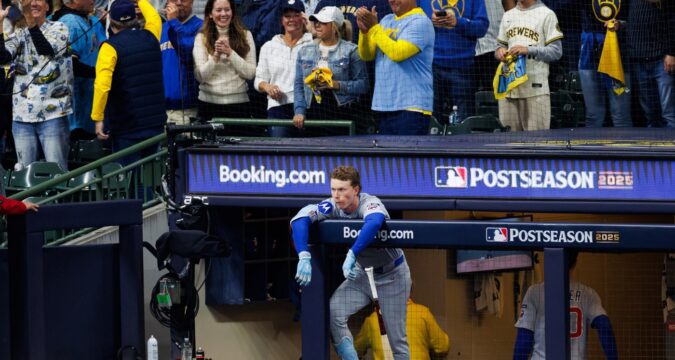
The new year keeps getting better for the Cubs, who added some star power to the lineup last week with the Alex Bregman signing and on Wednesday watched the Milwaukee Brewers shed their best pitcher in Freddy Peralta.
The Brewers ace was dealt to the New York Mets, along with swingman Tobias Myers, for right-hander Brandon Sproat and infield prospect Jett Williams.
“The reality is that we have one year left here with Freddy Peralta,” Brewers president of baseball operations Matt Arnold told reporters. “That’s always going to be a challenge for us.”
Reality bites when you’re a Brewers fan. The team overachieves every summer, only to see management say goodbye to a star, from trading Josh Hader, Corbin Burnes and Devin Williams to letting Willy Adames leave via free agency. Now Peralta was deemed too expensive to keep as he entered his walk year.
The Cubs already were the favorites to win the National League Central, and this move makes the Brewers even bigger underdogs. Since coming up in 2018, Peralta is 70-42 with a 3.59 ERA, and has a 9-3 record and 3.21 ERA in 22 games against the Cubs, including 17 starts. The Cubs did manage to beat Peralta in Game 4 of the National League Division Series at Wrigley Field, but more often than not he has dominated them.
The Brewers did what they had to do, and Arnold got a good return for his ace. But it shows once again how much of a financial advantage the Cubs have in the NL Central, where they are the only big-market team. Their payroll projection is $231 million, according to fangraphs.com, which dwarfs the payrolls of the Brewers ($126 million), CIncinnati Reds ($121 million), St. Louis Cardinals ($104 million) and Pittsburgh Pirates ($95 million).
The Brewers still have a solid lineup and a stronger bullpen on paper than the Cubs, who traded Andrew Kittredge back to the Baltimore Orioles and let Brad Keller become a free agent, and he signed a two-year, $22 million deal with the Philadelphia Phillies.
Brewers starter Freddy Peralta walks off the mound during a tough first inning against the Cubs during Game 4 of the NL Division Series on Oct. 9, 2025, at Wrigley Field. (Chris Sweda/Chicago Tribune)
So who will be the main high-leverage “out-getters” along with Daniel Palencia, the projected closer, and Caleb Thielbar, their top late-inning left-hander?
Phil Maton, Hunter Harvey, Jacob Webb and lefty Hoby Milner are the newly signed relievers, while Javier Assad and Colin Rea return as possible swingmen.
“Look, the bullpen is where the team has turned over the most,” manager Craig Counsell said. “It’s also, we know, an area of volatility on most teams. I don’t think we’ll have solid answers on that for a while. We brought what we think is a talented group to form a really good unit, but, roles? It’s going to be into the season before we establish (those). We’ll have to pick a way to finish a game on the first day, but then we’ll see.”
Kittredge didn’t even arrive until the trade deadline, and few expected Keller to become their most valuable reliever back in spring training. Building reliable bullpens has been President Jed Hoyer’s Achilles’ heel, but last year’s pen was perhaps his best unit, despite the struggles of Ryan Pressly, who retired last week.
Former Cubs ace Jon Lester thinks they still could use a little more pitching help.
“Not to step on Jed’s toes …” he said. “Palencia is incredible in the back end of the bullpen, but I think they need one more guy back there. Then maybe, not a big name, but somebody in the starting rotation. I know they’re getting (Justin) Steele back. I think they’re set up for really good success in their division. I tell people all the time, and it has backfired on me numerous times, but it’s not always the best team that wins the World Series. It’s the hottest team.”
White Sox outfielder Braden Montgomery attends photo day at Camelback Ranch on Feb. 20, 2025, in Glendale, Ariz. (Armando L. Sanchez/Chicago Tribune)
Top hitting prospect Braden Montgomery is the player most Sox fans want to see in right field on opening day. He has all the intangibles the Sox are looking for as they try to make the next step forward in Year 3 of the Chris Getz rebuild.
But whether Montgomery will make the jump from Double-A Birmingham to the majors is anyone’s guess.
Andrew Vaughn made the 2021 roster despite advancing only to High A ball, but the 2020 minor-league season was canceled because of the pandemic. The Sox did call up reliever Grant Taylor from Birmingham last year.
Related Articles
Josh Giddey’s return sparks Chicago Bulls to win over Minnesota Timberwolves. Can he revive a disrupted season?
Oliver Moore’s shootout goal on his 21st birthday gives Chicago Blackhawks a 4-3 win over Carolina Hurricanes
‘Heated Rivalry’ stars Hudson Williams and Connor Storrie to be torchbearers for Winter Olympics
Trinity Rodman agrees to record 3-year deal with Washington Spirit, making her the highest-paid female player
Chad Pinder makes leap to manage Triple-A Charlotte as Chicago White Sox announce player development staff
“I think it’s more and more common,” Taylor said in June of skipping Triple A. “(Jairo) Iriarte and Drew Thorpe both went from Birmingham to here, and Brooks Baldwin too. It’s becoming more common, how organizations are using their talent.”
But Montgomery played only 34 games at the Double-A level, and his season was cut short in early September because of a small fracture in his right foot.
Getz, however, seemed reluctant to push Montgomery when asked about him Wednesday while discussing the Luis Robert Jr. trade.
“Coming into Spring Training, I want him to come in and compete for a spot,” Getz said. “I think at some point he could come into the mix, so we are open-minded. We always are with young players. But I just want him to go out and focus and be the best player he can be. It’s really about the long term for Braden Montgomery and the White Sox, it’s not about Braden Montgomery making the opening-day roster.”
Baldwin is likely to be the starting right fielder for the Sox on opening day March 26 in Milwaukee, but Montgomery could make it a tough call with a strong spring.
With the wind chill below zero, it’s the kind of a thought that can warm the heart of any Sox fan.
https://www.chicagotribune.com/2026/01/23/chicago-cubs-white-sox-spring-polar-vortex/

Japan Left Waiting As $7.2BN US Arms Deliveries Stall, Ukraine Prioritized
Japan Left Waiting As $7.2BN US Arms Deliveries Stall, Ukraine Prioritized
After nearly four years of the Russia-Ukraine war, and the US having throughout poured billions into Kiev’s military and civic services sector, there are signs that other American allies are experiencing extreme delays in pre-scheduled arms shipments because Washington’s priorities are clearly elsewhere.
Israel over the past couple years has also been a high priority, amid its war in Gaza, which resulted in the US fast-tracking some bombs, ammo, and weapons deliveries. But countries like Japan are suffering from extreme delays, at a sensitive moment it is locked in an ongoing diplomatic standoff with China over the Japanese Prime Minister’s Taiwan stance.
E-2D Hawkeye airborne warning and control aircraft, via US Navy.
Nikkei has referenced a Japanese government internal investigation which found that “118 orders for U.S. military equipment worth 1.14 trillion yen ($7.21 billion) have not been delivered at least five years after the contracts were signed, in some cases forcing the Self-Defense Forces to use older equipment.”
These startling figures were uncovered by Japan’s Board of Audit, and revealed upon completing its formal investigation last Friday.
“The 118 cases pointed out by the Board of Audit include equipment that Japan added to its orders later, and not all of them are delayed deliveries,” the Japan’s Defense Ministry said, adding that “we will address each of the issues in Foreign Military Sales procurement one by one.”
However, the Japanese government has not speculated as to specific causes or made any accusations of its key arms partner in the West. The Nikkei report, for example cites instances of problems at manufacturing companies, resulting in serious delays of advanced weaponry.
But the report does bring up the question of Washington’s shifting priorities, which can come into play even long after deals with Tokyo are inked:
Even with FMS contracts, deliveries can be delayed if the U.S. side lacks the items in stock. Shipments to Japan can be postponed when Washington determines that delivering equipment would disrupt American military operations.
Japanese opposition parties had expressed concern that deliveries of air defense missiles and other equipment could be delayed due to the impact of Russia’s invasion of Ukraine. The government said it was difficult to comment on such a possibility.
Examples of major military hardware delayed for the island-nation include E-2D early warning and control aircraft. Much of what Japan seeks is indeed defensive in nature, also as it knows it would have to rely heavily on its American ally if some kind of hot conflict were to ever kick off with China.
China has earlier warned Japan will suffer a “crushing” defeat if it ever decided to directly intervene in the Taiwan dispute. Recent years have also seen Beijing’s anger grow after NATO briefly talked about opening an official office in Tokyo, but these plans were soon abandoned.
Tyler Durden
Fri, 01/23/2026 – 06:55

Chocolate Weekend at Morton Arboretum has everything you wanted to know — and taste — about cacao
There’s a popular quotation from writer Wayne Gerard Trotman: “As long as there is chocolate, there will be happiness.”
But how much does the average person really know about chocolate? The Morton Arboretum’s annual Chocolate Weekend expo, taking place Jan. 31 and Feb. 1, is an opportunity to indulge both the mind and the taste buds. Though the Lisle arboretum has no cacao trees — the Midwest isn’t a hospitable growing climate — there will be a number of workshops and plenty of chocolate on sale.
Some workshops are included with the price of admission to the arboretum. One such workshop, at 11 a.m. Jan. 31, will focus on sustainability issues and will be led by Matthew Krystal, a professor of anthropology at North Central College in Naperville. He is also North Central’s associate chair for something called the Coffee Lab, which is affiliated with the international organization Enactus, a nonprofit “dedicated to employing entrepreneurial action to promote social good,” Krystal said.
Despite the title, the coffee lab has a broader focus that includes textile making, ceramics and, yes, chocolate. “We started visiting Guatemala in 2005. Initially, the focus was on coffee. As we worked and built relationships, we encountered additional possible partnerships,” he said, hence the addition of a focus on chocolate production.
Too often, said Krystal, the conversation around sustainability focuses on ecology and the physical environment without taking into account what is financially sustainable over time. But money isn’t the only consideration. “If (an idea for sustainability) disrupts social relationships that are critical to a community’s well-being — for example, care for children and elders — it is not socially sustainable,” he said. “If it conflicts with a people’s shared values, beliefs, worldview, aesthetics and so forth, it is not culturally sustainable.”
Though Kyrstal’s focus is on chocolate from Guatemala, most chocolate comes from the west coast of Africa and there is currently a global chocolate crisis.
“Several factors seem to be driving up cacao prices, including climate change,” he said. “Folks from Chocolate Doña Pancha, our partner in Guatemala, inform us that they are paying significantly more for dried cacao beans. Apparently, Guatemalan cacao, normally consumed just in Guatemala, is now making its way into the global system. This seems to be a result of declining global supply and resulting higher export prices.”
And in the U.S., tariffs have created additional costs and uncertainty.
An array of chocolate confections and other treats with a chocolate twist made by local artisans and chocolatiers will be featured at the Morton Arboretum’s 15th annual Chocolate Weekend. (The Morton Arboretum)
A workshop at 1 p.m. Feb. 1 will focus on rare cocoa beans. It’ll be led by Kim Hack, founder of Cocoa + Co. Tastings, which she said “focuses on educating people about all things chocolate through tastings, events and classes.” Hack also founded the Cocoa + Co. Cafe in Old Town 10 years ago, but has since sold it; they are now separate operations.
For the non-connoisseur, chocolate tends to be thought of as a monolithic flavor, Hack said.
“But chocolate is made from a fruit, and just like wine, the flavor of chocolate varies based on factors like the varietal of cacao, where it’s grown and the harvest and post-harvest practices,” she said. “The French have a term for this uniqueness: ‘terroir,’ often translated as ‘the taste of place.’”
Hack’s workshop costs an additional $52 to attend because it includes tastings. “If you look at a flavor wheel for chocolate, you’ll see a ton of descriptors grouped loosely in categories like ‘fruity,’ ‘earthy,’ ‘spicy,’” Hack said. “Texture can vary too. Some bars are dry on the tongue, others are unctuous. It’s this unending variety of taste and texture that keeps it so interesting for me.”
Hack said most chocolate that we encounter is some form of the Forastero variety.
“It’s a favorite for mass-market producers because it’s a disease-resistant and higher-volume cacao,” she said. “And since most of the chocolate candy bars we’re all familiar with are made primarily from sugar and actually use very little cacao, the fact that many Forasteros are bitter matters little. That said, not all genetic variations of Forastero are bitter, or common. One of the bars we’ll be tasting is made from a very rare wild Brazilian cacao that is its own unique genetic cluster, and one of the most interesting bars I’ve encountered.”
As for the chocolate crisis, “Climate change is having a major impact, not just on the chocolate industry, but with many of our favorite foodstuffs,” Hack said. “And, when I say major impact, I don’t just mean skyrocketing prices. I mean likely near-term extinction if left unaddressed.
“Cacao is naturally an understory tree (which grows under the larger forest canopy of trees) that likes to keep its roots damp and protect its leaves from the sun,” she said. “But most of the industry’s fruit grown in West Africa uses mono-crop models that already strip the trees of their protection, stressing the trees and requiring the use of chemicals to compensate. Exacerbating the problem, unpredictable rainfall cycling between drought and floods further devastates the region. As climate changes the degree of heat these vulnerable trees are subjected to and causes wild swings in precipitation, yields will remain sharply reduced.”
The process of turning cacao into chocolate is difficult, she said, with tons of choices along the way that can each negatively impact flavor if you don’t get it right. “When you add all the challenges up, a craft chocolate bar is nothing short of amazing,” she said.
Chocolate Weekend, now in its 15th year, features local artisans, said the arboretum’s special events planner Kate Fitzgerald, and the lead-up to Valentine’s Day is the obvious peg.
Vendors this year will have some unexpected offerings, including chocolate-infused cheese, a cherry-chocolate mead, a hot sauce with chocolate in it and nonedible chocolate soap.
Krystal said his fascination with chocolate began in childhood and deepened as he was doing field work for his dissertation in Guatemala, where he “encountered hot chocolate as K’iche’ Maya people prepare it.”
At the time, he lived and conducted research in a large K’iche’ town called San Miguel Totonicapán, locally known as Toto. “Early in my fieldwork, as I was adjusting to life in Toto, I found that a cup of hot chocolate with breakfast boosted my energy and focus,” he said. “I later learned that the hot chocolate that I was consuming, because of its relatively high concentration of roasted cacao, had long been noted for positive mental effects.
“As I got to know the town better, I encountered hot chocolate served in diners, bakeries and homes,” Krystal said. “People served it in a variety of social and religious contexts.”
It’s a way of thinking about chocolate not only as an indulgence or treat, but as a cultural agent.
The Chocolate Weekend expo will be open from 9 a.m. to 4 p.m. Jan. 31 and Feb. 1 at the Morton Arboretum, 4100 Illinois Route 53, Lisle. More information at mortonarb.org.
https://www.chicagotribune.com/2026/01/23/chocolate-weekend-morton-arboretum/

Up To 25% Of US Colleges May Close Soon, Brandeis President Warns
Up To 25% Of US Colleges May Close Soon, Brandeis President Warns
Authored by Hanna Bechtel via The College Fix,
Higher education is approaching a period of profound disruption, and many colleges may not survive, Arthur Levine, the newly appointed president of Brandeis University, said during a recent event.
Levine estimated that between 20 and 25 percent of colleges will close in the coming years, while community colleges and regional universities move increasingly online.
He made these remarks during a recent American Enterprise Institute event titled “Tackling Higher Education’s Challenges: A Conversation with Frederick M. Hess and Brandeis University President Arthur Levine.”
Wealthier institutions may have the resources to withstand the transition, but many others do not. Levine said that elite schools, such as Harvard, can afford to wait out disruptions, while smaller institutions face immediate pressure to adapt.
“Higher education is undergoing a transformation. Our whole society is undergoing a transformation,” Levine said, pointing to the shift from a national, industrial economy to a global, digital, knowledge-based one.
That shift, he said, is driving demographic, economic, technological, and political change that universities have been slow to address.
The challenges facing higher education, Levine said, are not new. He pointed to three longstanding criticisms that date back to the early 19th century, including that colleges change slowly, resist change, and cost too much.
“Outcomes better be worth the price paid,” he said, adding that when society changes, higher education often lags behind and scrambles to catch up.
Levine also criticized the traditional model of higher education as a product of the Industrial Revolution, resembling an assembly line that advances students based on time rather than mastery.
“It doesn’t matter what was taught to you … We should care about what you learn,” he said.
Levine said he is attempting to respond to these issues through his “Brandeis Plan to Reinvent the Liberal Arts.”
The initiative seeks to overhaul the university’s general education curriculum, expand access to internships and apprenticeships, and provide students with micro-credentials tied to skills valued by employers.
“The liberal arts have always been practical,” he said, noting that early American higher education was designed to prepare students for professional and civic leadership.
Under the new plan, Brandeis aims to redesign general education to better align with the demands of a global digital economy.
The university’s website describes the initiative as one integrating “the values of a rigorous liberal arts education with career readiness, ethical grounding and lifelong learning.”
It features a redesigned course curriculum, as well as the development of a career-competency transcript “capturing the skills, experiences and competencies that students gain inside and beyond the classroom.”
A key component of the proposal is a shift toward competency-based education that measures students’ skills and knowledge instead of relying solely on grades.
Levine acknowledged the difficulty of the transition, saying that universities will not immediately agree on what constitutes competency, or even how it should be evaluated.
“We’re going to make mistakes. We’re going to get some things wrong,” he said.
The university president also addressed concerns about grade inflation and maintaining academic rigor, saying that grades have lost much of their meaning.
“Grades don’t mean much anymore, if everyone gets an A.” He emphasized the need for clearer standards and better assessment tools.
Levine also addressed the rise of antisemitism on college campuses, saying the university has been working with local school districts to understand better how this discrimination affects students. He has seen an increase in applications from students who no longer feel safe at other institutions.
Further, he said “diversity, equity, and inclusion” efforts are necessary, but criticized how they have been implemented and understood by higher education institutions.
Levine argued the term has become increasingly broad and unclear, limiting its effectiveness and failing to protect Jewish students and faculty. He said universities often address issues piecemeal, rather than through a comprehensive strategy, calling for clearer goals focused on access, support, and equal opportunity.
When asked about research effectiveness and institutional transparency, Levine cautioned against using research funding as a “political” tool.
He said that cutting federal support ultimately harms the country rather than just penalizing individual universities.
“Cutting research funding is not a fit penalty. It’s a penalty to the country,” he said.
He said that universities are increasingly targeted over political grievances rather than the quality of their research, calling such actions the “wrong remedy.”
Finally, Levine stressed the importance of protecting academic freedom, which he defined as the right to pursue and speak the truth, while noting it does not give faculty the license to say anything without accountability.
Tyler Durden
Fri, 01/23/2026 – 06:30
https://www.zerohedge.com/political/25-us-colleges-may-close-soon-brandeis-president-warns

Seúl impide salir del país a tres civiles por presuntos vuelos de drones a Norcorea
Por HYUNG-JIN KIM
SEÚL, Corea del Sur (AP) — Corea del Sur impuso prohibiciones para viajar al extranjero a tres personas dentro de una investigación sobre presuntos vuelos de drones sobre Corea del Norte que han intensificado las hostilidades entre las dos naciones rivales, dijeron las autoridades el viernes.
A principios de mes, Pyongyang amenazó con tomar represalias después de acusar a Seúl de realizar vuelos de vigilancia con aviones no tripulados en septiembre y enero. El gobierno surcoreano negó haber operado drones durante los períodos señalados por el Norte y comenzó a investigar la posible implicación de civiles.
Esta situación amenaza con reducir aún más las perspectivas de que el gobierno progresista de Corea del Sur impulse la reanudación de las conversaciones con su vecino, que llevan mucho tiempo estancadas.
Los tres civiles sancionados incluyen a un hombre apellidado Oh, quien dijo a la prensa surcoreana que voló drones para verificar los niveles de radiación en una instalación de uranio norcoreana, según un equipo conjunto de investigación militar y policial.
El equipo de investigación se negó a ofrecer detalles acerca de los otros dos civiles, excepto para decir que uno fue citado a un interrogatorio la semana pasada.
Los medios surcoreanos informaron que los tres implicados trabajaban juntos para un fabricante de drones y que Oh y la persona citada por las autoridades fueron empleados contratados por el gobierno durante el mandato del expresidente conservador Yoon Suk Yeol. El equipo de investigación se negó a confirmar los reportes.
Lee ha pedido una investigación exhaustiva alegando que las tensiones innecesarias con el Norte tendrían un impacto negativo en la economía. Lee asumió el cargo en junio luego de unas elecciones anticipadas convocadas tras la destitución de Yoon por imponer la ley marcial a finales de 2024.
Los analistas apuntan que las acusaciones norcoreanas acerca de los drones podrían haberse visto impulsadas por los esfuerzos de Pyongyang para aumentar la antipatía hacia su vecino antes del congreso del Partido de los Trabajadores, que se espera para finales de enero o febrero. Corea del Norte podría agregar la declaración de su líder, Kim Jong Un, de un sistema hostil de “dos estados” en la península de Corea a su Constitución durante el congreso, el primero de este tipo que se celebra en cinco años.
Las dos Coreas no mantienen contactos públicos desde 2019, y los vuelos de drones son una fuente de hostilidades entre los rivales.
___
Esta historia fue traducida del inglés por un editor de AP con la ayuda de una herramienta de inteligencia artificial generativa.