Category: News

Ex-Lake County Community Corrections officer charged after sexual relationship with inmate
Text messages appeared to show a former Lake County Community Corrections officer was in a sexual relationship with a work release inmate. She told him she was pregnant, according to an affidavit.
Andrea Rebeles, 24, of Whiting, was charged earlier this month with sexual misconduct by a service provider, a Level 5 felony, and official misconduct, a Level 6 felony.
She posted a $3,000 cash bond Wednesday. Her next court hearing is March 6.
Lake County Community Corrections Interim Director of Operations Brian Johns contacted Indiana State Police in September after the inmate “admitted” he had sex with her in two separate interviews, according to a criminal affidavit.
Rebeles resigned Sept. 8. She started at Kimbrough on May 28.
Indiana State Police Det. Christopher Campione wrote in charging documents that Lake County Community Corrections’ Kimbrough Work Release Center staff found the inmate’s iPhone on Sept. 13 on top of lockers.
Messages appeared to indicate he was out of the county, including in Illinois and “involved in relationships with former…staff members,” the affidavit alleges.
They found “conversations” between him and Rebeles, as well as with another now-former correctional officer. It is not clear from the affidavit if the inmate had a relationship with the second woman.
The Post-Tribune is not identifying her because she has not been charged with a crime. She worked there from May 14 till Aug. 18.
Kimbrough makes inmates sign a waiver allowing police to inspect their phones without a warrant, court documents state.
Rebeles sent a picture of an ultrasound on Sept. 18 and a selfie of the pair in front of a mirror.
In a string of texts in late September, Rebeles and the inmate spoke about their sexual relationship.
“Well, look where it got us, look,” she wrote in one exchange.
“Pregnant,” he responds. “You pregnant.”
Later on, he tells her if they have a daughter, “she gonna be so pretty. That’s (sic) be crazy, ain’t it.”
“Why you not happy you got a baby,” he texted. “You got a dog, like your own crib (home), your own (stuff) going on, chilling. You comfortable with life? You…mentally straight (OK), financially straight. Physically straight. You are happy. I’m not like, I’m the total opposite of all this.”
The next day, they talk about police having his phone.
At the end of one exchange, both said, “I love you.”
The affidavit also noted nearly 90 calls from Aug. 28 to Sept. 6. The inmate said he didn’t know if he was ready to be a parent.
“My gut told me you were gonna do this (and I’m) okay with that,” she responded, later adding, “(A)ll I ask is that you please don’t tell anyone. I’m not mad at you, either, I genuinely understand.”
By January, the inmate had been transferred to a state prison in Michigan City, where he told investigators that he had sex with Rebeles after she quit and was “possibly” the father, an account investigators rejected.
mcolias@post-trib.com

Donna Vickroy: Another bank branch closes, another human connection disappears
The bank branch that I patronize and love, as much as a person can love a bank, has closed its doors.
The shuttering makes me both sad and nervous.
Of course, I know how to bank online. It’s super convenient to be able to handle day-to-day tasks from the comfort of my home.
But I also know that, as we age, the financial issues we face become more complex, often necessitating the help and advice of a banker: setting up beneficiaries, opening and closing certificates of deposit, closing accounts of deceased family members, exchanging currency, exchanging coins for paper money, understanding new laws, and getting answers to the million questions you have when a check gets compromised or you think you’ve been hacked.
The automation that is increasingly taking over customer service is limited in scope and understanding and 100% devoid of compassion.
I am old enough to remember when going to the bank was a weekly task. And I remember when lines at the teller window were a given.
In exchange for handling the task in person, you came to know bank employees, who often were members of your community.
Alas, the chores that got us out of the house and into the circles of other humans are being relegated to machines.
Now, we move money around in the silence of our family rooms. We order groceries online and have a runner deliver them to the trunk of our car. We get our own gas, order movies direct to our TV, take our restaurant meals to go and shop for new clothes by an awkward system of website purchases and returns.
We can even buy a car without any human bargaining or bantering.
Sure, life is more convenient. But loneliness is an epidemic.
Banks are just the latest contributor to a trend that is isolating customers and deeming employees irrelevant.
According to the Wall Street Journal, more than 6,000 commercial bank branches across the country closed in the last five years. The downsizing, according to the American Bankers Association, can be attributed to people’s preference for banking online or through their mobile device.
Last September, CIBC Bank USA announced that, come Jan. 16, it would shutter several locations, including Tinley Park, St. Charles, Homer Glen and several Chicago branches, Mount Greenwood among them. A letter from the corporate office stated that only five Illinois locations would remain open.
Upon seeing my branch on the hit list, I panicked, for myself and for the dedicated employees who have invested their futures in this company. My local bank helped me through the most tumultuous chapter of my life.
I fired off a letter to the corporate office, expressing my disappointment over its decision and informing them of the many times I’d relied on its staff of longtime employees to handle my concerns. I complimented their professionalism and expressed concern for their welfare.
A few weeks letter, I heard back. Corporate thanked me for reaching out and reiterated the company’s “need” to, essentially, eliminate jobs and downsize human services.
It’s a familiar refrain in America today.
Save money by severing relationships.
Although I’ve been a CIBC customer for many years, I really came to know many of the employees in 2021 when my aging father needed help handling his bills. As I pulled back the curtain on his finances, I found a hot mess that had been bubbling unbeknownst to me for more than a year.
Several bankers at the Oak Lawn branch knew him by sight. Apparently he had been going there and calling them several times a day, every day, for months to ask about his balances. They helped me untangle the mess and navigate the crisis.
A few years later, when my father passed, the manager at the branch I frequent in Tinley helped me settle his accounts.
Over the years, she also helped my husband and I handle retirement issues, which can be complicated and emotional.
She and other personal bankers at this same location have imparted valuable counsel, advising us to do a regular check on beneficiaries because sometimes when banks go through transitions, those designated heirs “fall off” the system.
They encouraged us to get our own powers of attorney and have copies of the documents readily available.
And they told us about higher-yield accounts, which we had not even noticed were available to us.
When a CD matured, they always called to remind us it was time to either roll it over, cash it in or select another investment product.
Mostly, their courtesy, reliability and professionalism gave face to an otherwise cold collection of numbers.
We came to believe this bank actually cared about us as much as it valued our money, and that this concern also was extended to our entire community.
If that sounds like George Bailey’s Savings and Loan, perhaps that’s why I liked it.
Americans have a hard time talking about money with their friends or even family members. But money is the great enabler. It affords safety, security, and allows us to dream and do the things we value.
Being able to ask questions and talk candidly with someone who understands finances and who has regular office hours down the street has been priceless.
Unfortunately, America is losing many of the institutions that made life easy and pleasant, even if they required us to show up in person. We’re losing those regular meet-ups with familiar faces, those friendly hellos and casual inquiries into how we’re doing.
We give lip service to our need for better social skills as we eliminate the opportunities to develop them. And as we deposit countless dollars into technology, we withdraw resources from our own humanity.
Donna Vickroy is an award-winning reporter, editor and columnist who worked for the Daily Southtown for 38 years. She can be reached at donnavickroy4@gmail.com.
https://www.chicagotribune.com/2026/01/23/vickroy-bank-branch-closes-human-help/
Here Come Humanoid Robots: Industry Makes Clear Pivot Toward “Dedicated-Purpose” Commercial Deployments
Here Come Humanoid Robots: Industry Makes Clear Pivot Toward “Dedicated-Purpose” Commercial Deployments
Goldman analyst Jacqueline Du published her field trip notes after speaking with six C-level management teams at robotics companies across Hangzhou, Shanghai, and Shenzhen in recent days. The companies she met with include Unitree, Mechmind, Fourier, LimX Dynamics, UBTech, EngineAI, Paxini, and Orbbec.
“Overall, we see the humanoid robot industry is experiencing a clear pivot towards ‘dedicated-purpose’ commercial deployments,” Du told clients on Thursday morning.
Home humanoid robots are getting closer.
Shenzhen MindOne Robotics is testing their robot brain on the Unitree G1, and it looks like the G1 has already learned to do human-like household chores.
Watering plants, moving packages, cleaning mattresses, tidying up, etc.
Honestly,… pic.twitter.com/hPddAaQ0hd
— CyberRobo (@CyberRobooo) November 14, 2025
She continued: “This strategic focus leverages current, achievable task planning, mobility and interaction capabilities, leading to more reliable and immediate deployment in specific vertical applications. Examples include security patrolling, guiding/guest services in public venues, and logistics tasks such as pick-and-place and sorting simple items in factories.”
Du said humanoid robot shipments are set to accelerate from estimated 2025 global volumes of around 15,000 to 20,000 units to “multi-fold increases in shipment volumes into 2026-2027E.”
Here are more of Du’s key takeaways from the AI robotics field trip in China:
Targeting a multi-fold increase in shipment volumes into 2026-2027E
Based on the collective feedback from the major humanoid robot players and key supply chain companies we met on this trip, we believe global humanoid robot shipments in 2025 might have reached around 15,000-20,000 units vs. GSe of 20,000 (report link) and third-party data of 13,000-16,000 (see link and link), with Chinese players contributing to the bulk of these volumes at the moment, which came from scientific study, robotics AI training, education, entertainment/stage performance, and data factory demand last year. At such an early and nascent stage of the humanoid robot market, the exact shipment figures are less critical than the overall growth trajectory and the rapid pace of technological development in our view. For the 2026-2027 outlook, these leading humanoid robot manufacturers anticipate multi-fold increases in shipments. Following the 2025 figures, which range from several hundreds to thousands of units, their targets for 2026 and 2027 are set in the thousands to tens of thousands. This projected acceleration is underpinned by an increasingly mature supply chain, optimized cost curves, and expanding application opportunities. However, achieving these targets is anticipated to be challenged by the imperative for robust production consistency and the implementation of novel, multi-stage testing protocols inherent to this nascent industry.
Encouraging progress in motion control with rapid iterations
We watched the live demos of the published products of these humanoid robot makers, which in our view revealed significant advancements in motion control, exhibiting enhanced robustness and flexibility across both wheeled upper-body platforms and full bipedal systems. This represents a substantial improvement compared to their performance in the preceding year. One manufacturer asserted the achievement of ‘cerebellum-level’ whole-body control, substantiated by two practical evaluation criteria: the robot’s ability to navigate previously unmapped terrains and its capacity for comprehensive remote control of the entire body, rather than segmented upper or lower body control. Furthermore, insights from multiple companies indicate an accelerated product iteration cycle for humanoid platforms, now reaching approximately 6-8 months per generation. This rapid iteration is largely attributed to an 80-90% in-house component design capability, which is crucial for ensuring seamless hardware-software integration and optimizing their respective performance’ upper limits’ within condensed R&D and testing cycles.
Clear pivot towards “dedicated-purpose” commercial deployments
The current reliance on simulated and synthetic data for pre-training with a significant ‘sim-to-real’ gap remains a challenge, with simulated accuracies of 80-90% often collapsing to below 50% in real-world scenarios. As both large-scale high quality real-world data collection and world model approach requires time, leading Chinese humanoid robot developers are increasingly prioritizing “dedicated-purpose” commercial deployments. These applications, such as security patrolling and guest services in public venues (e.g., hotels, banks, museums, exhibition centers, auto dealerships, and supermarkets), effectively utilize existing task planning, mobility and interaction capabilities while circumventing the complexities of highly dexterous manipulation. Within industrial applications, the utility of humanoid robots requiring dexterous hands or grippers is presently confined to logistics tasks like box movement and simple item sorting, primarily due to AI limitations in addressing unpredictable corner cases in factory environments.
Advancing robot intelligence through hybrid AI and data strategies
In the near term, humanoid robot manufacturers are increasingly standardizing their approach by integrating with established Large Language Model (LLM) and Vision-Language Model (VLM) stacks, such as those offered by Alibaba (Qwen), Doubao, and Tencent. This strategic alignment positions proprietary data engines as the critical differentiator for developing deployable robotic intelligence. High-quality real-world data is identified as the primary constraint bridging the gap between mature hardware technologies and scalable, practical applications. Consequently, companies are engaged in a ‘data recipe’ arms race, with differentiation driven by their target end-applications. While all robot OEMs are pursuing data collection strategies, they converge on varying mixes of three primary data inputs: (1) teleoperated human or expert demonstrations, which offer high control but are typically expensive for imitation learning; (2) simulation, which is cost-effective per additional sample but suffers from imperfect realism; and (3) real-world video datasets, which provide the highest data availability but may exhibit poor translation to real-world accuracy. From this trip, increasingly we heard more mentions of the world model approach which may potentially empower robots with a form of common sense about their environment, moving them beyond reactive behaviors to proactive, intelligent agents capable of complex planning and adaptation.
Differentiated profit models for 2C and 2B markets
A range of profit models has emerged, broadly categorized by their target markets: 2C (business-to-consumer) and 2B (business-to-business) applications.
For companies targeting 2C applications, the primary focus is on delivering differentiated functionality and enhanced user experience. This often involves emphasizing “emotional value” and capturing specialized vertical niches where unique features or interactions can command a premium. The goal is to create a product that stands out through its capabilities and the user’s engagement with it.
In contrast, companies targeting 2B applications anchor their pricing strategies to the customer’s Return on Investment (ROI). This typically involves demonstrating how the robot can improve throughput, enhance efficiency, or reduce labor costs. For instance, UBTech has indicated that in sorting and logistics applications, customers are willing to invest in robots once they achieve approximately 50% of a human worker’s throughput. This level of performance can lead to a payback period of around two years, assuming a run-time of about 10 hours per day. Even a three-year payback period is considered acceptable by customers operating in particularly labor-constrained environments, highlighting the value proposition of automation in addressing critical operational challenges.
Investment implications: We recommend being selective; Buy Sanhua H and Sell Moon’s Electric
2026 overall may shape up to be a critical “proof-of-volume and expectation-reset” year, as we believe investors likely will continue to value key supply chain stocks on (i) whether milestone volume expectations (e.g., the “one million robots” narrative) get revised up or not, which is likely driven by the evolution pace of AI generalization capability or effective data/model strategies; and (ii) evolving market share and content per robot for individual supply chain companies. Given high market optimisms and long run expectations have been baked into the current share price per our tests (see Sanhua Intelligent Controls (002050.SZ): Downgrade Sanhua A to Neutral on recent outperformance; expectations for humanoid robots are too high, too soon and Moons’ Electric (603728.SS): D/G to Sell on continuously evolving dexterous hand technology roadmap and narrowed opportunity for coreless motor), we recommend staying selective. Among our coverage, we are Buy-rated on Sanhua H, Inovance and Shuanghuan, Neutral-rated on Sanhua A, LeaderDrive and Best Precision. We are Sell-rated on Moon’s Electric.
Separately, in the U.S., Tesla said it is on track to begin volume production of the Cybercab in 2026, with Optimus humanoid robot output “hopefully” starting toward the end of the year.
Next week, we are expected to conduct our own field trip of AI robotics and counter-AUS companies at undisclosed locations. We’ll see how that turns out – watching the rise of Skynet in real-time.
Tyler Durden
Fri, 01/23/2026 – 15:00

Chicago White Sox sign reliever Seranthony Domínguez to a reported 2-year, $20 million deal
In the aftermath of trading center fielder Luis Robert Jr. earlier this week, the Chicago White Sox found themselves in a position with some financial flexibility.
They put that to use Friday by signing reliever Seranthony Domínguez, a source confirmed to the Tribune. ESPN’s Jeff Passan reported it’s a two-year, $20 million deal.
Domínguez, 31, has a 23-23 record, 3.50 ERA, 40 saves and 360 strikeouts in 322 career relief appearances during seven seasons with the Philadelphia Phillies (2018-19, 2021-24), Baltimore Orioles (2024-25) and Toronto Blue Jays (2025).
The right-hander had a combined 3.16 ERA, two saves and 79 strikeouts in a career-high 67 outings for the Orioles and Blue Jays in 2025. He appeared in 12 postseason games in 2025 for the Jays, including five in the World Series in which he had a 1.93 ERA against the Los Angeles Dodgers.
During a videoconference call Wednesday, Sox general manager Chris Getz said the Sox had “some financial flexibility now to continue to bring in talent” following Tuesday’s trade that sent Robert to the New York Mets for infielder/outfielder Luisangel Acuña and minor-league right-handed pitcher Truman Pauley. Earlier in the offseason the Sox had exercised Robert’s $20 million club option.
The bullpen has been one of the offseason targets for the Sox, and Domínguez will aid in that department.
The Sox also aimed for rotation help and signed left-hander Anthony Kay to a two-year contract in December. Lefty Sean Newcomb, who signed a one-year deal in December, will be competing for a role as a starter. And the Sox picked up another lefty via a trade, acquiring Chris Murphy in November from the Boston Red Sox.
Offensively, they added pop by signing two-time Nippon Professional Baseball Japanese Central League Most Valuable Player Munetaka Murakami to a two-year contract in December. The slugger will play first base.
And now they’ve bolstered the bullpen with Domínguez, who could join Grant Taylor and Jordan Leasure as potential late-inning relief options.
https://www.chicagotribune.com/2026/01/23/chicago-white-sox-seranthony-dominguez-signing/

Oak Park River Forest League of Women Voters makes a pitch for fair maps
The Oak Park River Forest chapter of the Illinois League of Women Voters recently held an online forum on redistricting as well as Fair Maps Illinois, a nonpartisan group of citizens seeking to amend the Illinois Constitution as part of an effort to reform the way districts are drawn for the Illinois General Assembly.
“Redistricting has a long and complex history in the United States, from the earliest examples of gerrymandering in the 1800s to landmark Supreme Court decisions establishing one person, one vote,” said Barbara Laimins, co-chair of a LWV Illinois task force on misinformation and disinformation.
Laimins said the Fair Maps effort is limited to General Assembly districts. Districts for the U.S. House of Representatives are drawn by the General Assembly, as mandated by the U.S. Constitution.
“The Fair Maps Illinois effort is to create a fair redistricting process for our state government only,” she said.
The amendment question the group wants to place on the November 2026 ballot “establishes a redistricting commission that must follow clear legal standards,” according to theFair Maps’ website, fairmapsillinois.org.
Prerequisites of a Fair Map include no use of political party or voting history in drawing districts, maps must prioritize compactness and preserve communities and municipal boundaries, and legal protections for communities of interest and minority representation remain in place.
When the General Assembly is dominated by a supermajority, as it currently is, the danger is that district maps will be drawn for political reasons and not reflect legitimate changes in demographics or population growth, Laimins said.
“When politicians use redistricting to manipulate the outcome of elections, it’s called gerrymandering,” Laimins said, “a practice that undermines democracy and stifles the voice of voters. Voters should be picking their politicians, not the other way around.”
She pointed to the final map drawn after the 2020 census, a process complicated by COVID-19 and late census data from 2020.
The original map was approved in 2021 and was the result of a Democratically-controlled General Assembly.
“The general assembly was not transparent and maps were drawn behind closed doors without bipartisan input,” Laimins said. “Nor was there any information divulged by those drawing the maps regarding what data sources were used. Hearings were not well publicized and they were held on short notice. So the process of the current maps we are using was not transparent.”
Laimins also said that Gov. Jay Pritzker pledged during his campaign that he would create an independent commission and it was hoped that he would veto the map submitted by the General Assembly.
“But sadly, he broke his campaign promise and approved the General Assembly maps that were protested by various voting rights groups, including the League,” she said.
Laimins said there were some strangely-drawn districts as a result of the process, pointing to Illinois Senate District 21 as one that “snakes around” avoiding being both contiguous and compact-requirements of the Illinois Constitution.
District 21 runs from towns like Lombard in the north, down to Bolingbrook south and west to a large part of Naperville. The south/southwest villages are connected to the northern towns by a thin strip of area in the middle.
And that wasn’t the only problem.
“They create districts to ensure a Democrat-held seat in the General Assembly,” Laimins said. “You can see that they created a seat from Peoria to Bloomington and Springfield to Decatur in order to ensure that that seat would be held by a Democrat candidate.”
Laimins said the practice of partisan gerrymandering had a bipartisan history.
“I don’t want to seem like I’m picking on one party,” she said. “Throughout the history of Illinois redistricting, both parties have been guilty of drawing maps that are an advantage to their parties.”
Laimins spoke directly about the main problem with gerrymandering.
“Currently over half the legislative races in 2024 were uncontested. So voters had no choice at all. That means 50% of our elected officials were elected by simply turning in their paperwork. When politicians didn’t have to do anything to earn your vote, they stop listening … competitive elections keep elected officials more accountable and responsive to the voter.”
The Fair Maps Illinois effort has significant bipartisan support. Prominent supporters of Fair Maps include Bill Daley, former White House chief of staff for President Barack Obama and secretary of commerce under President Clinton, and Ray LaHood, secretary of transportation under President Obama and former Illinois 18th District U.S. Congressman.
In order to get the amendment question of the November ballot, the effort must gather 350,000 signatures by May 1. But the goal is to gather 600,000 signatures statewide just to be safe.
Laimins said that the current proposal was put together by a bipartisan legal team with extensive experience in Illinois election law.
“The proposal that we’re asking you to support will require districts to be drawn to maximize compactness,” she said. “No more splitting counties, no more splitting cities, no more splitting communities of interest for political gain.”
The proposal would also not allow political registration or voting history to be considered and mandate that maps be contiguous.
If the proposal succeeds, it will establish a 12-member bipartisan commission, to be created by the Illinois House and Senate leadership, with no more than six of the 12 being from the same party.
“This 12-member commission will be made up of four legislators and eight non-legislators — average citizens like you or I,” Laimins said. “If there is a deadlock between the 12, the Illinois Supreme Court will name two names and one will be the tie-breaker.”
After that, the map would go to the governor for his approval or veto.
Laimins summarized the forum by saying “this proposal will provide transparency and accurate, fair representation.”
Hank Beckman is a freelance reporter for Pioneer Press.
https://www.chicagotribune.com/2026/01/23/fair-maps-illinois-oak-park/

Indiana Senate OKs bill allowing police to enforce immigration laws
The Indiana Senate advanced an immigration bill on Thursday, on second reading, that would allow local and state police to enforce federal immigration laws and require Indiana law enforcement to cooperate with ICE.
Senate Bill 76, authored by State Sen. Liz Brown, states that the enforcement of federal immigration laws may be carried out by federal, state or local law enforcement. Under the bill, the Department of Correction will provide training to all sheriffs-elect on how to cooperate with the United States immigration and Customs Enforcement.
After the 2025 session, Brown was criticized by Attorney General Todd Rokita for killing a bill called the FAIRNESS Act: Fostering and Advancing Immigration Reforms Necessary to Ensure Safety and Security. State Rep. J.D. Prescott, R-Union City, filed House Bill 1039, which would revive the FAIRNESS Act, but it hasn’t been heard in committee yet.
Brown positioned Senate Bill 76 as the state’s FAIRNESS Act.
“This bill has been a long time coming,” Brown, R-Fort Wayne, said. “This is Indiana’s version of the FAIRNESS Act. This is Indiana’s FAIRNESS Act, forging American independence, restoring national exceptionalism safely and securely.”
If someone is detained under an immigration detainer request, the bill states that the governmental body should give the judge authority to either grant or deny the person’s release on bail as well as record in their file, comply with and inform the detainee of the immigration detainer request.
The bill prohibits an employer from recklessly or intentionally hiring or employing an unauthorized alien. If the attorney general or law enforcement agency finds probable cause that an employer has hired or employed an illegal immigrant, then the United States Department of Homeland Security will be notified, according to the bill.
Further, the bill requires the legislative council to receive a report with data about the number of Hoosiers who aren’t citizens and are enrolled in or receiving benefits through the Indiana Residential Care Assistance Program, public assistance and welfare programs, family assistance services, Medicaid and Community Mental Health Services.
If a law enforcement officer, government body or educational institution is sued, the attorney general shall defend the party, the bill states. It also removes mens rea standard — or criminal intent — when it comes to governmental or educational institutions for violating the citizenship and immigration status information and enforcement of federal laws.
Brown proposed an amendment to her bill when it was heard on second reading that allows the governor to withhold state grants or funding to a city that’s not complying with the law. The amendment also allows the Attorney General to sue employers who hire undocumented immigrants.
Brown said the section about employment of undocumented immigrants was “difficult” to write as she focused on following federal law and giving the Department of Labor more authority.
The amendment passed on a voice vote.
State. Sen. J.D. Ford, D-Indianapolis, proposed an amendment to the bill that a police officer can’t request verification of citizenship from someone who called 911 in response to a medical crisis. Ford said he filed the amendment because in his district an immigrant family didn’t call for medical help when needed because they were scared of being profiled and detained.
“Regulating immigration does not mean putting people’s lives at risk or obstructing first responders ability to address medical emergencies,” Ford said.
In response, Brown claimed that undocumented immigrants have harmed U.S. citizens, so “we don’t need” Ford’s amendment.
The amendment failed 10-35.
When the bill passed out of the Senate Judiciary Committee in December, Indiana Attorney General Todd Rokita criticized as a “watered-down, bizarro” version of an immigration bill that died last session, saying that it “takes all the enforcement teeth out” of House Bill 1531.
Rokita said Brown “single-handedly” killed House Bill 1531 during the 2025 session because she wouldn’t let the bill be heard in the Senate Judiciary Committee.
“Instead of just backing the FAIRNESS Act, which has already been reintroduced, Sen. Brown is desperately attempting to rewrite history and make it look like she cares about the illegal immigration issue. She doesn’t and has proven that time and time again,” Rokita said.
Senate Bill 76 moves forward for final consideration by the Senate.

Switching from starter to a reserve role, Maddie Kelly finds new purpose for Lincoln-Way East. ‘Help my team.’
A midseason slump forced Lincoln-Way East’s Maddie Kelly from the starting lineup to coming off the bench.
If the junior forward keeps playing like she did in a reserve role Thursday night, that slump might be coming to an end.
“When I’m on the bench, I get hyped to get ready to help my team,” Kelly said.
A hyped-up Kelly scored eight points and added five rebounds and a blocked shot to help the Griffins knock off Lockport for a 47-41 SouthWest Suburban Conference victory in Frankfort.
Kaitlyn Dykstra and Kennedy Johnson each scored 14 points to lead the Griffins (14-10, 4-5). A red-hot Dykstra dominated from the outside with four 3-pointers and Kennedy added inside muscle with five rebounds. Emerson Nilsson also had five rebounds.
The 5-foot-10 Kelly scored four of Lincoln-Way East’s seven points in the third to keep the Griffins afloat as Lockport shaved a 31-15 deficit early in the quarter down to 36-28 heading into the fourth.
Lincoln-Way East’s Maddie Kelly (43) goes in for a layup against Lockport during a SouthWest Suburban Conference game in Frankfort on Thursday, Jan. 22, 2026. (Steve Johnston / Daily Southtown)
“Maddie really came to play,” said retiring Lincoln-Way East coach Jim Nair, who recently picked up his 300th career win on Jan. 13 against Sandburg. “She really is a guard, and we’re kind of pushing her inside because we need some inside scoring. She really did a great job with that.”
Evelyn Ingram led Lockport (18-8, 9-3) with 11 points, while Molly Curtis hit three 3-pointers off the bench in the second half for nine points. Katie Peetz had 10 rebounds and seven steals.
The defending conference champion Porters are two games behind Homewood-Flossmoor in the loss column. They also were without coach Darien Jacobs, who missed the game due to National Guard duties. Assistant Anita Robinson stepped in.
Kelly, meanwhile, likes the direction Lincoln-Way East is heading. The Griffins had already lost twice to Lockport, with a 33-30 setback on Dec. 11 in the first conference meeting and 44-26 on Dec. 20 at the Oak Lawn Tournament.
Lincoln-Way East’s Kaitlin Dykstra (1) drives to the basket against Lockport’s Evelyn Ingram (55) during a SouthWest Suburban Conference game in Frankfort on Thursday, Jan. 22, 2026. (Steve Johnston / Daily Southtown)
Thursday’s turnaround was huge in more ways than one.
“Honestly, in this game, our rebounds were big,” Kelly said. “The midseason is the hardest, but we’re playing well because everybody is so close and there is so much chemistry on this team.
“We have stuck it out.”
Johnson, a senior forward who will forgo basketball in college, agreed that this win was big but all wins are big at this point of the season. She loves it when she can be on the court with Kelly.
Lincoln-Way East’s Emerson Nilsson (3) works the ball up court against Lockport during a SouthWest Suburban Conference game in Frankfort on Thursday, Jan. 22, 2026. (Steve Johnston / Daily Southtown)
“Maddie is a really good player, and sometimes when I can’t get the rebound, I know she has my back and she will get it for me,” Johnson said. “She’s a really good scorer in the paint.
“She works hard on her footwork and you can see it in the games. She’s a fun player to watch.”
Nair enjoys having both players on the court to give Lincoln-Way East a little extra power inside. He mixes in sophomore forward Samantha Hellrung for a boost both inside and outside.
“We have some very versatile players on the team,” Nair said.
Kelly got her start in basketball thanks in part to her mother, Jill, nee Fagan, a former player at Mother McAuley. Fagan was on the Mighty Macs’ team that finished second in the state in Class AA in 1995.
Lockport’s Katie Peetz (21) and Evelyn Ingram (55) try to defend Lincoln-Way East’s Maddie Kelly (43) during a SouthWest Suburban Conference game in Frankfort on Thursday, Jan. 22, 2026. (Steve Johnston / Daily Southtown)
“She has coached me forever,” Kelly said of her mom. “She was pretty good. She was a post, too.
“She taught me all of my moves. She taught me everything.”
Kelly also played softball and volleyball but concentrated on basketball when she hit high school.
“It’s all basketball,” she said. “I’m better at basketball, that’s for sure.
“I just love it. I love the team, the girls and the energy. It’s my favorite.”
Jeff Vorva is a freelance reporter for the Daily Southtown.

Homeland Security Seeks To Restrict Immigrants From Relying On Welfare
Homeland Security Seeks To Restrict Immigrants From Relying On Welfare
Authored by Sylvia Xu via The Epoch Times (emphasis ours),
The Department of Homeland Security (DHS) is seeking to change a rule that determines eligibility for permanent residency—commonly known as a green card—based on whether an applicant is considered a “public charge,” someone who is likely to depend primarily on public benefits.
That rule—known as the public charge ground of inadmissibility—generally applies to green card applicants, with the exception of certain categories such as refugees and asylum seekers.
In 2022, 54 percent of households headed by immigrants—naturalized, legal, and illegal—used one or more major welfare programs. That’s compared to 39 percent of U.S.-born households, according to Census Bureau data.
In November 2025, DHS issued a proposal to repeal existing public charge regulations and institute a broader, discretionary standard.
The proposed policy change would allow immigration officials to take into account the use of a wider range of public benefits—including food stamps, Medicaid, and housing assistance—to determine whether a green card applicant will become a public charge.
In its notice of proposed rulemaking, DHS states its goal is to encourage self-reliance and prevent public benefits from becoming an incentive for immigration.
Critics say the proposed policy change will lead to confusion and “decreased participation in public benefit programs” by people who need them.
The mandatory public comment period for the proposed rule ended on Dec. 19, 2025, drawing more than 8,800 comments, including a letter of objection signed by the attorneys general of 20 states. DHS has now entered a mandatory review phase in which it must read and address the substantive points raised by the public.
Once this review is complete, which can take months, the government may modify the rule based on the feedback received before a final rule is published and officially takes effect.
Here’s what we know about the proposed changes.
Key Changes
The changes are designed to undo what the proposal calls “unduly restrictive” public charge rules. Under the old rules, put in place under the Biden administration in 2022, officers couldn’t consider whether green card applicants used benefits such as food stamps (SNAP), the Children’s Health Insurance Program, Medicaid, or housing assistance.
The only benefits officers could take into account were cash benefit programs that provide direct, monthly payments intended to cover basic needs, such as Temporary Assistance for Needy Families and Supplemental Security Income, as well as long-term care in a facility such as a nursing home, when the government pays for it.
Under the new proposal, officers would also be empowered to consider all individualized, case-specific facts and any data relevant to a person’s self-sufficiency.
The changes will restore a process that “trusts in and relies on DHS officers’ good judgment and sound discretion as envisioned by Congress,” the proposal says.
The new DHS proposal also clarifies that receiving “any means‑tested public benefit” is considered a breach of the public charge bond—a monetary guarantee, made by a citizen or U.S. company, that a green card applicant will not become a public charge.
Under the new proposal, an affidavit of support also carries less weight.
Currently, officers must “favorably consider” any eligible affidavit of support—an agreement in which a U.S. citizen, a green card holder, or a company pledges to provide financial backing to the applicant, if needed.
The new rule would also eliminate protection for immigrants who used benefits while they were in certain exempt categories.
For some of those categories, there is a path to citizenship that is also exempt from the public charge rule. For others, there is not—including those with Temporary Protected Status, which is a temporary stay of deportation provided to nationals of certain countries that are undergoing armed conflict, disaster, or other extraordinary conditions.
Under the 2022 rule, people with Temporary Protected Status were shielded from having public benefits used against them, even if they later moved into a non-protected status. The new proposal would allow DHS to consider an applicant’s use of public benefits at any time, regardless of when those benefits were received.
Household Focus
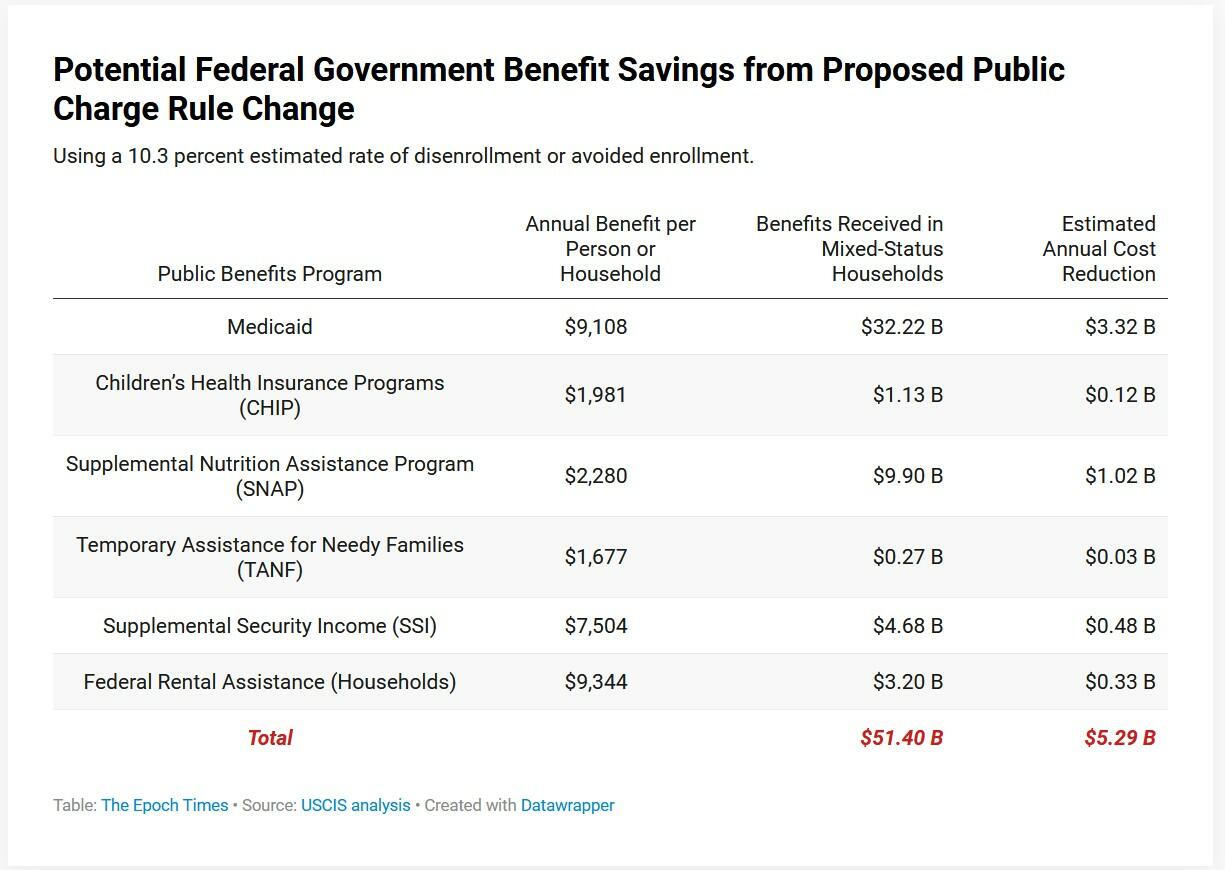
The new policy could cut government spending by about $8.97 billion each year because of people who would stop or avoid enrolling in public benefits, DHS stated in its proposal. That includes $5.29 billion less from the federal government and $3.68 billion less from states.
Under current rules, an applicant is mostly evaluated individually, whereas the new rule takes into account an applicant’s family members living in the same household, including a mixed-status household, which consists of people with different immigration and citizenship statuses.
There were an estimated 4.7 million mixed-status households in the United States in 2022, according to a Center for Migration Studies analysis. Mixed-status households receive more than $51 billion annually in public benefits, according to an analysis by The Epoch Times, based on DHS data.
However, public benefit use can’t be considered against immigrants in mixed-status households who entered the United States as refugees or asylum seekers. Between 1990 and 2022, the United States has welcomed more than 2.1 million refugees and accepted more than 800,000 asylees, according to data from the U.S. Department of Health and Human Services.
DHS said the new rule could impact some U.S. citizens who live in mixed-status households. It could penalize green card applicants if direct family members in the household, including U.S. citizens, receive public benefits. Those U.S. citizens may decide to avoid public benefits so the green card applicant isn’t penalized.
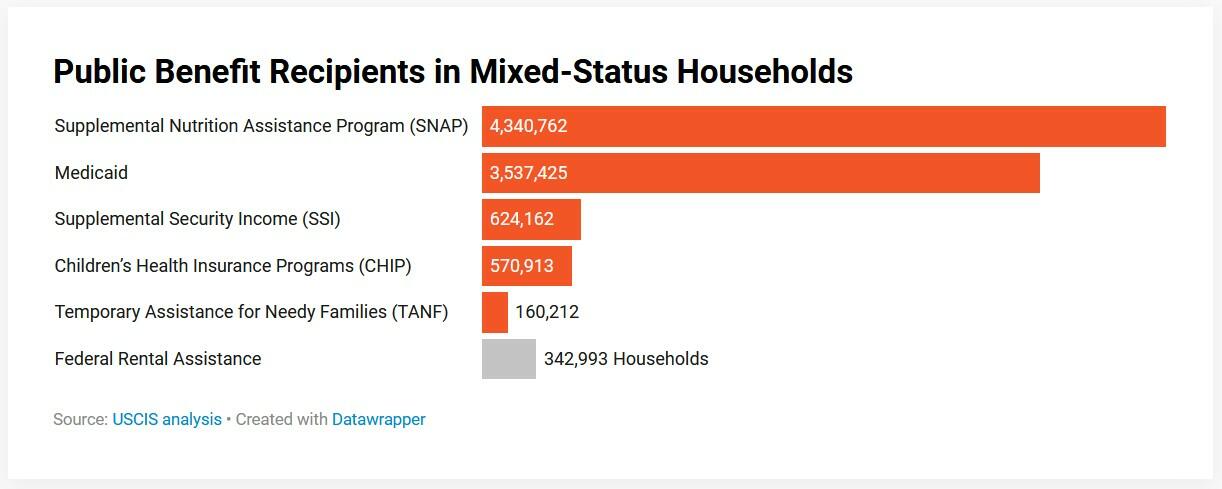
Within mixed-status households, roughly 9.2 million individuals receive food stamps, Medicaid, Children’s Health Insurance Program, Temporary Assistance for Needy Families, and Supplemental Security Income. And about 343,000 households receive Federal Rental Assistance, according to DHS data.
DHS estimated that about 950,000 individuals, or 10 percent, will likely stop participating in or choose not to apply for public benefit programs if the current proposal is implemented.
Studies found large drops in benefit enrollment after the 1996 welfare reform law, with decreases ranging from 21 to 54 percent, DHS noted.
The new proposal acknowledged the changes could also affect organizations that rely on public benefit funds. These include hospitals and nonprofits tied to Medicaid, companies that make medical supplies and drugs, grocery stores that accept SNAP benefits, farmers who supply SNAP-eligible foods, and landlords involved in federally funded housing programs.
Evolution of the Policy
The United States has used “public charge” as grounds for rejecting permanent residency applications since the 19th century. The Immigration Act of 1882 specified that aliens who became public charges within a year of arriving in the United States would be deported.
For more than a century, immigration officers were given broad discretion, known as the “totality of the circumstances” framework.
Then, in 1996, Congress set new requirements and policy goals. The Illegal Immigration Reform and Immigrant Responsibility Act of 1996 required officers to consider, “at a minimum,” five statutory factors: age, health, family status, financial situation, and education and skills.
Read the rest here…
Tyler Durden
Fri, 01/23/2026 – 14:40
https://www.zerohedge.com/political/homeland-security-seeks-restrict-immigrants-relying-welfare

Indianapolis Colts confirm FBI has opened an investigation into the death of former owner Jim Irsay
The FBI has opened an investigation into the death of former Indianapolis Colts owner Jim Irsay, team officials confirmed Friday.
When Irsay died in May, the team issued a statement saying he died “peacefully in his sleep.” But in late August, The Washington Post reported Irsay continued to battle a longtime addiction to painkillers and that he had overdosed three times in the five years preceding his death.
“We are aware of the investigation, but at this time, we’ve not been contacted by the FBI or been served with any subpoenas,” the Colts said in Friday’s statement.
NFL spokesman Brian McCarthy said the league would not comment on the report.
The Post reported Thursday that a federal grand jury subpoena it reviewed indicated the FBI is seeking records and information relating to Irsay’s death, his “substance (illegal and prescription) use,” and his “relationship with Dr. Harry Haroutunian,” an addiction specialist based in California. The subpoena was reportedly issued by the U.S. District Court for the Central District of California earlier this month.
The Associated Press left a message Friday seeking comment from Haroutunian, whom the Post reported had prescribed pain pills and ketamine to Irsay in the months before his May 2025 death.
In August, the Post reported Irsay was prescribed ketamine, which is most commonly used as a general anesthetic, in his final months and that police were called to the hotel room in Beverly Hills, California, where Irsay died. The Post’s earlier report said Haroutunian, was staying at the hotel and overseeing Irsay’s treatment and that Haroutunian signed the death certificate.
The Post wrote that Irsay’s official cause of death was listed as “cardiac arrest due to pneumonia and heart issues” but no autopsy was performed, and Beverly Hills police closed their investigation into the death days later.
When the first Post story was published in August, Irsay’s three daughters who now run the Colts — Carlie Irsay-Gordon, Casey Foyt and Kalen Jackson — issued a statement saying their father “never claimed to be perfect” and acknowledging he used his voice “to reduce the stigma” of addiction and mental health issues to advocate for those who fought similar battles.
AP Pro Football Writer Rob Maaddi contributed to this report
https://www.chicagotribune.com/2026/01/23/jim-irsay-death-fbi-investigation/

Doxing bill advances with minor amendment on second reading in Senate
An Indiana bill criminalizing doxing passed on second reading in the Senate Thursday with an amendment attached.
Doxing is when a person who knowingly or intentionally posts information, like address or phone number, of a targeted person in retaliation. Under Senate Bill 140, authored by State Sen. Vaneta Becker, doxing will become a Class A misdemeanor and a Level 6 felony if the posting of the personal information results in the targeted person or someone closely connected to the person suffering serious injury or death.
Under the bill, doxing would become a Level 5 felony if the posting of personal information of a specific person or someone close to the targeted person experienced catastrophic injury or death.
The bill defines a person closely connected to the targeted person as a child, parent, sibling, grandparent, person living in the same household and a person involved in a dating relationship with the targeted person.
The bill defines personal information as a person’s Social Security number, address, legal name, telephone number, and employer information.
Becker, R-Evansville, said in committee last week she filed the bill because of what many State Senators experienced with doxing and swatting, or false police reports to generate a large law enforcement response, amid the state’s discussion around mid-census redistricting.
State Sen. Aaron Freeman, R-Indianapolis, proposed an amendment Thursday to include language about intent “to simply make that the crime” when it comes to doxing.
“It’s abhorrent, and this should not happen,” Freeman said.
The motion to amend passed on a voice vote. It moves forward for final consideration by the Senate.
The bill was amended in the Senate Corrections and Criminal Law committee to remove a coworker as a person closely connected to the targeted person.
In committee, State Sen. Liz Brown, R-Fort Wayne, said she was concerned about the broadness of the bill as it relates to private communications being used as doxing incrimination. She voted against the bill in committee.
“I know the bill will pass, but I just need to preserve my reservations on this. It’s pretty broad right now, so I’m a ‘no’,” Brown said ahead of her vote.
The doxing bill was a reaction to a wave of threats toward Indiana Republican Senators when they expressed skepticism to President Donald Trump’s desire to redraw the state’s Congressional district boundaries in order to ensure two more Republican seats.
In November, Gov. Mike Braun called a special session to vote on redrawn maps, but Senate President Pro Tem Rodric Bray, R-Martinsville, initially said he would cancel the early December session because the chamber did not have the votes to pass the measure.
Two days after the cancellation announcement, Trump issued a statement on his social media site Truth Social calling out “RINO” Bray and Greg Goode, R-Terre Haute, “for not wanting to redistrict their state, allowing the United States Congress to perhaps gain two more Republican seats.” Hours after Trump posted his comment, Goode received a false swatting call. After Organization Day, when the Senate voted to reconvene in January, at least seven more State Senators — Dan Dernulc, Spencer Deery, Rick Niemeyer, Greg Walker, Kyle Walker, Linda Rogers and Andy Zay — received swatting calls.
Mid-census redistricting conversations and actions began in August when Texas redrew its Congressional map to give Republicans five more seats in the U.S. House of Representatives. In response, Democratic states, like California, have taken steps to redistrict to gain Democratic seats.
In early December, the Indiana legislature went into session to consider the maps, but after passing the House, the measure failed in the Senate, 19-31.