Category: News

Gary man convicted in Little Caesar’s slaying
A jury convicted a Gary man Friday for fatally shooting a man inside a Little Caesar’s on Garfield Street in Gary.
Jami Long, 24, was charged with murder and a gun enhancement in the June 14, 2024 death of Kejuan Patton, 26, of Gary. He argued the shooting was in self-defense and testified on his own behalf.
Prosecutors alleged Patton was part of a group that beat Long and stole his gun a month earlier.
His sentencing is April 3.
Jurors deliberated for about four hours. Long will be sentenced to murder, plus an agreed 10-year term for the gun enhancement, according to a prosecutor’s office spokeswoman.
In closing arguments Friday, Deputy Prosecutor Bernie Johnsen discounted that Long thought his life was in danger. He went back to a vehicle to get a gun before the confrontation with Patton, who wasn’t armed.
Long rode with his girlfriend’s cousin to the nearby gas station, then the pizzeria. He rejected Long’s testimony that he needed to be there to get the pizzas.
“It doesn’t make sense to risk your life for food you don’t pay for,” Johnsen said.
After the shooting, Long was extradited from Minnesota.
Defense lawyer Herb Shaps told jurors that Long’s fears were justified.
He argued Patton telling Stacy Haney — his ride — to leave was a sign he would get violent.
There was “no evidence” Long tried to track Patton down. It was a coincidence both men were there. His client testified he was afraid for his life.
“He had to take action, or he would be killed,” the lawyer said.
Johnsen retorted that Haney overheard Long say he would shoot Patton over the phone. Prosecutors again played a video showing Patton getting gunned down just inside the doorway.
Police responded at 7:20 p.m. on June 14, 2024 to the pizzeria, 2560 Garfield St.
Haney said she dropped off Patton and her daughter, 9, to get pizzas. Within a minute after Long and another man came back from the adjacent gas station, Patton sent the girl running back to the car to protect her.
When the woman called Patton, she overheard a “tense” conversation between Patton and Long. Patton said he would fight the man, but wouldn’t use a gun.
She left, then tried to call Patton again, who didn’t answer. By the time she came back, emergency vehicles were already there.
https://www.chicagotribune.com/2026/01/23/gary-man-convicted-in-little-caesars-slaying/

Philip Rivers interviews with Buffalo Bills for their head coaching vacancy
ORCHARD PARK, N.Y. — Philip Rivers interviewed with the Buffalo Bills for their head coaching job on Friday, the latest twist in a busy couple of months for one of the most prolific passers in NFL history.
Rivers, 44, has no previous NFL coaching experience, having worked since his initial retirement from the league as a high school coach in his native Alabama. Last month, he ended his five-year retirement and finished the season with the Indianapolis Colts. Rivers started three games — all losses — in a failed attempt to salvage the Colts’ playoff chances.
Rivers was the fourth candidate to interview since the Bills launched their search Wednesday. Sean McDermott was fired Monday after going 98-50 and reaching the playoffs eight times in nine seasons, making the Bills the 10th team to replace a head coach this cycle.
The Bills also have interviewed former New York Giants coach Brian Daboll, who previously served as the team’s offensive coordinator; current offensive coordinator Joe Brady; and Colts defensive coordinator Lou Anarumo. More meetings are scheduled through this weekend in a search process led by general manager Brandon Beane. Quarterback Josh Allen has been part of the search and is participating in meetings with candidates.
Owner Terry Pegula decided to fire McDermott after a 33-30 overtime road loss to the Denver Broncos in the divisional round of the playoffs. McDermott led the Bills to seven straight 10-win seasons but never took the team to the Super Bowl.
Pegula determined the Bills had hit what he called “the proverbial playoff wall” under McDermott. The Bills became the NFL’s first team to win a playoff game in six straight years without a Super Bowl appearance.
Rivers has been a mentor to Allen, and the two remain close.
“Philip’s one of the greatest to ever play the game,” Allen said last month when Rivers came out of retirement. “We’ll see how it works out. I’m rooting for him, though, because he’s another great human being.”
Rivers played 17 seasons before his initial retirement in 2021 and took a job overseeing the football program at St. Michael Catholic High School in Fairhope, Ala. His last playoff game was the Colts’ 27-24 loss to the Bills in the wild-card round of the 2020 season.
Rivers rejoined the Colts after Daniel Jones suffered a season-ending torn right Achilles tendon and with rookie backup Riley Leonard nursing an injured right knee.
Rivers spent his first 16 seasons with the Chargers and set franchise records with 59,271 passing yards and 397 touchdowns. His 63,984 yards passing rank eighth on the NFL’s career list, and he’s sixth with 425 TD passes.
https://www.chicagotribune.com/2026/01/23/philip-rivers-buffalo-bills-head-coaching-interview/

Crypto Takeaways From Davos: Politics And Money Collide
Crypto Takeaways From Davos: Politics And Money Collide
Authored by Yohan Yun via CoinTelegraph.com,
While geopolitical tensions and the Greenland standoff set the tone at Davos 2026, crypto resurfaced as a secondary but consequential theme.
US President Donald Trump used a few minutes of his Davos speech to double down on his ambition to turn the US into the world’s crypto capital and voice support for crypto-friendly legislation.
His tone was different from central banks. In a panel with crypto bigwigs, the governor of the Bank of France criticized private money and yield-bearing stablecoins while promoting central bank digital currencies (CBDC).
Crypto executives debated money sovereignty with France’s central bank governor at Davos 2026. Source: World Economic Forum
Crypto consensus did not emerge in Davos, but a visible point of disagreement did. US political messaging framed crypto as a geopolitical asset, while at least one major European central banker warned that private money threatens financial stability and sovereignty.
Here are the crypto takeaways from Davos 2026.
Trump frames crypto regulation as a geopolitical race
Donald Trump said in his Davos speech on Wednesday that he hopes to sign a crypto market structure bill “very soon.”
Also known as the CLARITY Act, the bill was due for a US Senate markup last week but was delayed after crypto giants like Coinbase pulled support.
Trump treated the US crypto regulation as a matter of geopolitical urgency.
“It is politically popular but much more importantly, we have to make it so that China doesn’t have a hold of it, and once they get that hold, we won’t be able to get it back. So I’m honored to have done it,” Trump said, referring to his signing of the GENIUS Act. He linked the bill to the importance of the pending market structure legislation.
The White House wants the US to be the crypto capital of the world and sees regulation as a competitive weapon. Trump acknowledged that the bill remains in Congress but spoke as if its passing were a matter of timing.
The US president’s special address was introduced by BlackRock’s Larry Fink, the CEO of the world’s largest asset manager. Trump spoke for more than an hour; crypto accounted for only a small section of his speech.
Trump’s soliloquy took up most of his time on stage, even though he was scheduled for a fireside chat with WEF CEO Børge Brende. Source: World Economic Forum
Coinbase CEO and French central banker clash over money sovereignty
One of the most widely shared crypto moments at Davos came when France’s top central banker pushed back against crypto, even as he praised tokenization in a Wednesday panel discussion.
Banque de France Governor François Villeroy de Galhau said tokenization and stablecoins are likely to be “the name of the game” in 2026, stating that they can modernize financial infrastructure. He acknowledged tokenization as a meaningful financial advance, particularly for wholesale markets, and cited Europe’s CBDC efforts as a global frontrunner.
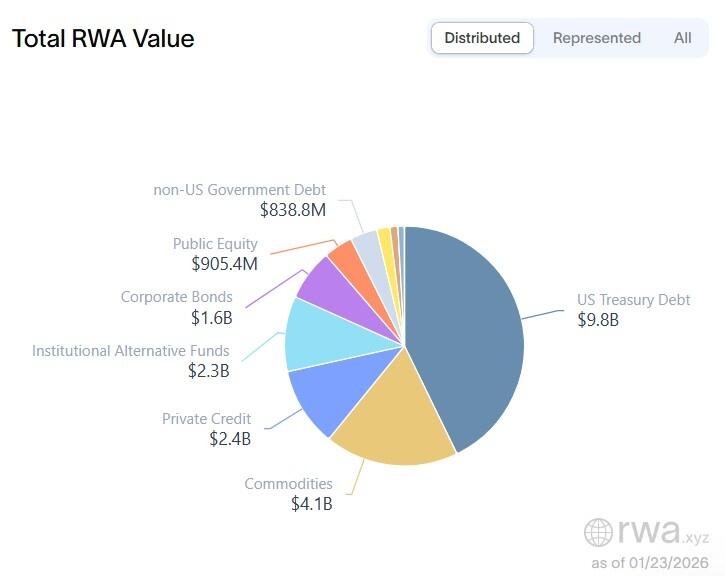
Real-world asset token value is closing in on $23 billion. Source: RWA.xyz
That enthusiasm faded as the discussion turned to monetary sovereignty. Coinbase CEO Brian Armstrong described Bitcoin as a modern successor to the gold standard and a check on democratic deficit spending.
Villeroy de Galhau clapped back by saying that money is inseparable from sovereignty. Handing monetary control to private systems would amount to surrendering a function of democracy, he said.
Armstrong responded by pointing to Bitcoin’s decentralized structure to claim that it is even more independent than fiat systems and called the tension a “healthy competition,” which got a chuckle from Villeroy de Galhau.
Villeroy de Galhau also drew a line against interest-bearing stablecoins, which he said could destabilize the existing financial system. US crypto executives argued that rewards are necessary to keep stablecoins competitive with China’s CBDC.
Binance leaves door open to US return
Binance co-CEO Richard Teng did not rule out a return to the US. He said the company is taking a “wait-and-see” approach in an interview with CNBC on the sidelines of the Davos forum.
Teng avoided commitments while leaving the door open, but Ripple CEO Brad Garlinghouse was more explicit in a separate interview with the outlet. Garlinghouse predicted that Binance would eventually return to the “very large” market.
Binance launched Binance.US in 2019 as a separate entity to serve US customers. But according to US regulators, Binance continued to service “VIP” customers through its offshore platform, leading to a 2023 Department of Justice settlement. Founder Changpeng Zhao pleaded guilty to failing to maintain an effective Anti-Money Laundering program, served a jail sentence and was later pardoned by President Trump.
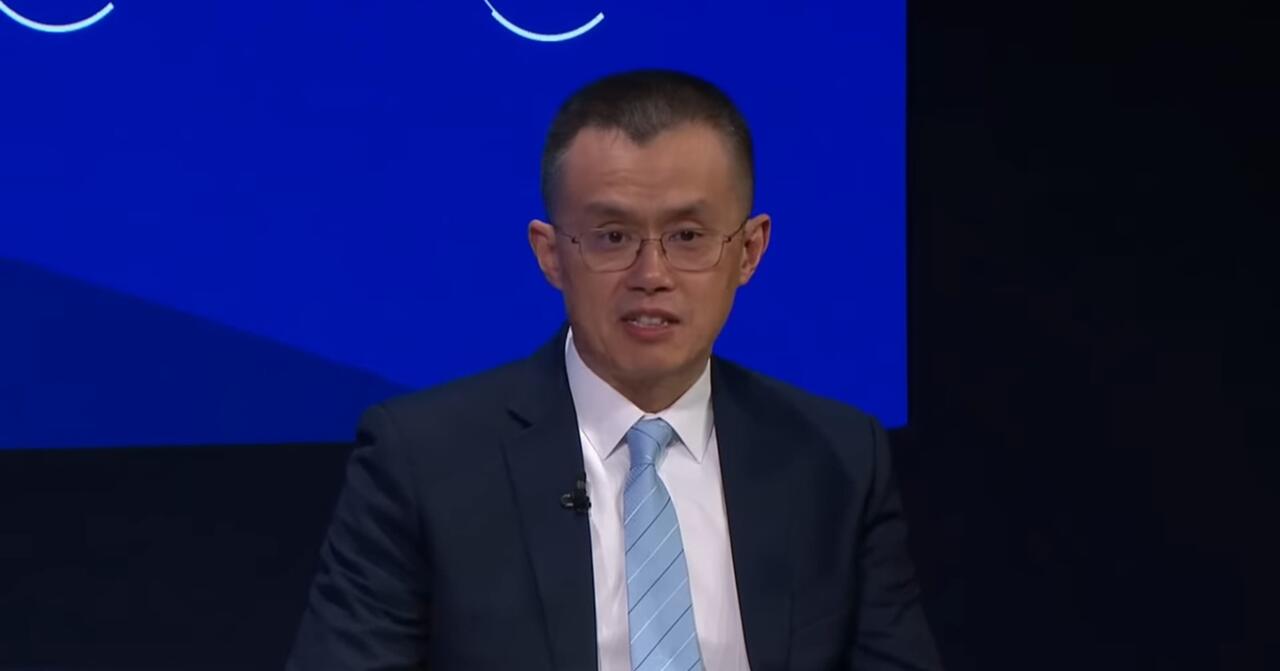
Zhao was also present at Davos and took part in a panel discussion on Thursday, where he claimed that crypto has proven that it is not going away.
Zhao claimed to be in talks with about a dozen governments about tokenizing assets. Source: World Economic Forum
Though they were in separate panels, Zhao aligned with Bank of France’s Villeroy de Galhau on tokenization, calling it the next phase of the industry, along with artificial intelligence and payments.
He said he is in discussions with multiple governments about tokenizing state-owned assets as a way to unlock value and reinvest it into economic development.
Circle’s Allaire calls bank run fears absurd
Circle CEO Jeremy Allaire dismissed fears that interest-paying stablecoins could destabilize the banking system in a Thursday panel in Davos.
Allaire called bank run concerns “totally absurd,” arguing that the incentives involved are too small to threaten monetary policy or drain deposits.
He added that interest payments function primarily as customer retention tools rather than systemic disruptors.
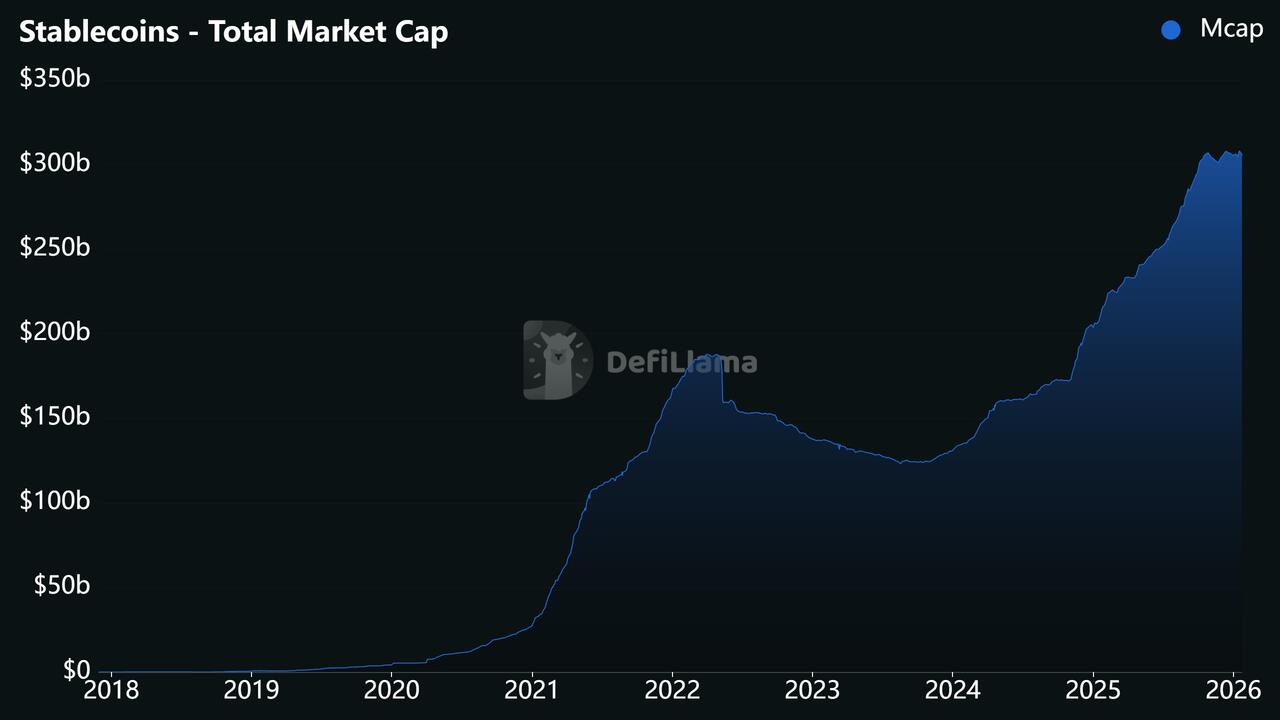
Stablecoins have an estimated market capitalization of over $300 billion. Source: DefiLlama
Allaire then cited government money market funds as a historical comparison. Despite repeated warnings over the years, roughly $11 trillion has flowed into money market funds without collapsing bank lending, he said.
Lending, he argued, is already shifting away from banks toward private credit and capital markets, independent of stablecoins.
What Davos revealed about crypto priorities
Public image for stablecoins was badly tarnished in 2022, when the Terra ecosystem suffered a multibillion-dollar collapse. The failure began with TerraUSD (UST), an algorithmic stablecoin backed by the network’s native token, LUNA.
Stablecoins have since flipped the narrative. It’s now an important topic in the annual meeting of the world’s most powerful voices in geopolitics and economy. Even central bankers who are generally critical of the crypto industry acknowledge them as core themes to watch alongside tokenization.
Davos 2026 reinforced stablecoins and tokenization as part of the year’s policy conversation. The US executive branch and Europe’s banking sector remain philosophically divided on approach, and regulatory developments are still constrained by domestic politics.
Tyler Durden
Fri, 01/23/2026 – 18:25
https://www.zerohedge.com/crypto/crypto-takeaways-davos-politics-and-money-collide
Levante vence a Elche y refuerza sus esperanzas de mantenerse en La Liga
VALENCIA, España (AP) — Levante anotó en el último minuto del tiempo de descuento para vencer el viernes al Elche por 3-2 en La Liga y lograr su primera victoria en casa, lo que aumentó sus posibilidades de evitar un rápido regreso a la segunda división de España.
El Granota llegó al partido como el único club que no había ganado en casa esta temporada, y no pareció cerca de romper esa condición al verse en desventaja desde los 11 minutos con un tanto del uruguayo Álvaro Rodríguez.
Sin embargo, Pablo Martínez igualó cinco minutos después del inicio de la segunda mitad con un toque brillantemente ejecutado.
Adrián de la Fuente puso a Levante arriba a mitad del segundo período, sólo para que Adam Boayar igualara por Elche en el tiempo de descuento con una impresionante chilena.
Eso parecía ser todo hasta los 96 minutos, cuando el uruguayo Alan Matturro apareció para rematar de cabeza desde un tiro de esquina y desatar escenas de delirio en el Estadio Ciutat de València.
Levante ha sumado siete puntos en los cuatro partidos transcurridos desde que el portugués Luís Castro reemplazó a Julián Calero como entrenador antes de Navidad. Se mantuvo penúltimo, pero estaba a cuatro puntos del último lugar, Oviedo, y a dos del Alavés.
Elche se mantuvo en el octavo lugar.
_____
Deportes AP: https://apnews.com/hub/deportes

Elgin News Digest: ‘Evening with Paul Lisnek’ watch party at Dundee Library; nominations being taken for Elgin’s preservation awards
‘Evening with Paul Lisnek’ watch party at Dundee Library
A watch party for “An Evening With Paul Lisnek” will be held from 7 to 8 pm. Tuesday, Jan. 27, at the Dundee Library, 555 Barrington Ave., East Dundee.
Lisnek is an analyst for WGN TV and radio and will provide an update on Illinois politics ahead of election season, according to the library’s website. It’s a live appearance but can also be viewed on Zoom.
Lisnek’s talk will kick off the 2026 Civic Awareness Series, a program being presented by the League of Women Voters of the Palatine, Schaumburg and Barrington Areas and various Illinois libraries dedicated to civic education and engagement.
Anyone who registers to attend will receive a reminder email prior to the event, but registration is not required, officials said. Zoom registration is available at www.schaumburglibrary.org/events) for those who would like to attend the event on Zoom instead.
Elgin Historical Society holding trivia fundraiser
The Elgin Historical Society will be holding a trivia night fundraiser from 7 to 9:30 p.m. Friday, Jan. 30, at the Elgin History Museum, 360 Park St., Elgin.
Participants can compete in teams as they learn facts and discover new details about a wide range of Elgin-related topics, according to the museum’s website.
Tickets are $20 for museum members and $25 for nonmembers and can be purchased at elginhistory.org/event/elgin-trivia-night-fun-raiser-2026.
D300 Food Pantry ‘Coldest Night of the Year’ walk
Registration is open for D300 Food Pantry’s “Coldest Night of the Year” fundraising walk, which will be held at 5 p.m. Saturday, Feb. 28, at Parkview Elementary School, 122 Carpenter Blvd., Carpentersville.
The family-friendly event invites people to walk together to raise funds for those experiencing hunger, hurt and homelessness, according to the pantry’s website.
“Coldest Night of the Year” is a nationwide effort held in more than 300 cities and towns across North America. The goal is to raise millions for local charities that provide food, shelter and support for those in need.
Participants can choose a 2K or 5K route, warm up at rest stops with hot drinks and celebrate at the finish line. Adults who raise $150 and youth who raise $75 will receive a winter hat.
To register, go to www.cnoy.com/carpentersville.
Nominations being taken for Elgin’s preservation awards
Elgin Heritage Commission is accepting nominations until 5 p.m. Friday, Feb. 20, for the annual Mayor’s Awards for Preservation.
The awards recognize Elgin residents, groups and organizations dedicated to preserving Elgin’s historic places and character and educating the community about Elgin’s architecture, neighborhoods and history, according to a news release.
This year’s awards presentation event will be held at 5 p.m. Tuesday, May 5, in The Lodge Performing Arts Center, 18 Villa Court, Elgin.
Nomination forms can be downloaded at elginil.gov/mayorsawards.
https://www.chicagotribune.com/2026/01/23/elgin-lisnek-dundee-trivia-fundraiser-pantry/
EEUU ataca lancha en el Pacífico que supuestamente llevaba drogas; mata a 2 personas
WASHINGTON (AP) — El ejército de Estados Unidos dijo el viernes que atacó una embarcación que supuestamente era usada para traficar drogas en el océano Pacífico oriental, el primer ataque de este tipo que se sabe que realiza desde que capturó al presidente venezolano Nicolás Maduro a principios de este mes.
El Comando Sur de Estados Unidos alegó en redes sociales que el barco estaba “involucrado en operaciones de narcotráfico” y que el ataque resultó en la muerte de dos personas y dejó un sobreviviente. Afirmó que notificó a la Guardia Costera para que lanzara operaciones de búsqueda y rescate para esa persona.
Un video que acompaña la publicación muestra un bote moviéndose por el agua antes de explotar en llamas. Desde que lanzó una incursión para capturar a Maduro y llevarlo a Nueva York, donde se le acusa de narcotráfico, el ejército de Estados Unidos se había centrado en incautar buques petroleros con conexiones a Venezuela.
Los últimos ataques estadounidenses contra lanchas se habían realizado a finales de diciembre, cuando el ejército afirmó que atacó cinco botes supuestamente usados para el tráfico de drogas en un lapso de dos días y mató a un total de ocho personas, mientras que otras se lanzaron por la borda. Días después, la Guardia Costera suspendió la búsqueda de esas personas.
Estados Unidos llevó a cabo un “ataque a gran escala” en Caracas, la capital de Venezuela, el 3 de enero en el que capturó Maduro y su esposa, quienes luego fueron trasladados a Nueva York para enfrentar cargos de narcotráfico.
Antes de su captura, Maduro señaló que las operaciones militares de Estados Unidos en la región eran un intento apenas velado de derrocarlo.
El presidente estadounidense Donald Trump ha dicho que los ataques de Estados Unidos contra presuntos contrabandistas están teniendo un enorme impacto en la desaceleración de las rutas de tráfico de drogas en el Caribe y el Pacífico oriental.
“Hemos detenido, prácticamente detenido casi el 100% de todas las drogas que entran por agua”, aseveró Trump el miércoles en el Foro Económico Mundial en Davos.
___
Esta historia fue traducida del inglés por un editor de AP con la ayuda de una herramienta de inteligencia artificial generativa.

Vistazo a los recursos militares de EEUU que se dirigen a Oriente Medio
Por KONSTANTIN TOROPIN
WASHINGTON (AP) — El Pentágono ha enviado activos militares de Estados Unidos a Oriente Medio esta semana, incluido un grupo de portaaviones con miles de soldados, luego de que el presidente Donald Trump señaló que no descarta la posibilidad de atacar a Irán a consecuencia de la represión que ha ejercido sobre manifestantes.
“Tenemos una flota masiva dirigiéndose en esa dirección, y tal vez no tengamos que usarla”, les dijo Trump a los periodistas el jueves, e hizo notar que iban “por si acaso”.
El mandatario ha amenazado con implementar una acción militar si Irán lleva a cabo ejecuciones masivas de prisioneros o mata a manifestantes pacíficos, pero recientemente se retractó, alegando que Teherán detuvo las ejecuciones de 800 manifestantes detenidos. No ha proporcionado detalles sobre la fuente de esta afirmación, que el principal fiscal iraní calificó de “completamente falsa”.
Sin embargo, Trump parece mantener sus opciones abiertas. Mientras volaba el jueves en el Air Force One, indicó que la acción militar con la que ha amenazado haría que los ataques del año pasado por parte de Estados Unidos a los sitios nucleares iraníes “parecieran insignificantes” si el gobierno de ese país procedía con las ejecuciones planeadas de algunos manifestantes.
Un portaaviones se dirige a Oriente Medio
El portaaviones Abraham Lincoln y tres destructores que lo acompañan partieron del mar de China Meridional y se encaminaron hacia el oeste hace unos días, indicó un oficial de la Armada. El oficial, que habló a condición de guardar el anonimato para poder declarar sober movimientos militares, dijo el viernes que el grupo de ataque del Lincoln estaba en el océano Índico.
Cuando lleguen a la región, esos buques de guerra se sumarán a tres barcos de combate litoral, que el viernes se encontraban en un puerto en Bahréin, así como a otros dos destructores de la Armada estadounidense, que estaban en el golfo Pérsico.
La llegada del grupo de ataque del portaaviones añadiría aproximadamente 5.700 soldados. Estados Unidos tiene varias bases en Oriente Medio, incluida la Base Aérea de Al Udeid en Qatar, que alberga a miles de efectivos estadounidenses y es el cuartel general de avanzada del Comando Central de Estados Unidos.
El movimiento del portaaviones ocurre después de que el gobierno de Trump trasladara algunos recursos de la región al mar Caribe como parte de una campaña de presión sobre el expresidente venezolano Nicolás Maduro.
Al portaaviones más grande del mundo, el Gerald R. Ford, se le ordenó en octubre navegar desde el mar Mediterráneo al Caribe junto con varios destructores. El portaaviones Nimitz, que ayudó a llevar a cabo los ataques de junio a los sitios nucleares de Irán, también salió de la región ese mismo mes.
Llegarán más aviones
El Comando Central indicó en redes sociales que ahora el F-15E Strike Eagle de la Fuerza Aérea tiene presencia en Oriente Medio, e hizo notar que el caza “mejora la preparación para el combate y promueve la seguridad y estabilidad regionales”.
De manera similar, el Ministerio de Defensa del Reino Unido señaló que desplegó sus aviones de combate Typhoon a Qatar “con capacidad defensiva”.
Analistas de datos de seguimiento de vuelos se han percatado de que decenas de aviones militares de carga de Estados Unidos también se dirigen a la región.
La actividad es similar a la del año pasado, cuando Washington desplegó hardware de defensa aérea —como un sistema de misiles Patriot— en anticipación de un contraataque iraní tras el bombardeo de tres sitios nucleares clave. Días después de los ataques, Irán lanzó más de una decena de misiles a la Base Aérea de Al Udeid.
Lo que está sucediendo en Irán
Desde finales de diciembre, Irán ha estado sumido en protestas y manifestaciones a nivel nacional, desatadas por la debilitada economía de la República Islámica. Las protestas han ejercido nueva presión sobre la teocracia que gobierna el país, la cual ha respondido con una represión mortal y el cierre de internet.
Activistas dicen que el número total de muertos por la represión ha aumentado a cuando menos 5.032 personas, con más de 27.600 detenidos en una campaña de arrestos en expansión. El número oficial de muertos que proporciona Irán es mucho menor: sólo 3.117.
Funcionarios iraníes señalaron la semana pasada que los sospechosos detenidos en las protestas enfrentarían juicios rápidos y ejecuciones, y prometieron una “respuesta decisiva” si Estados Unidos o Israel intervenían.
———
Esta historia fue traducida del inglés por un editor de AP con la ayuda de una herramienta de inteligencia artificial generativa.

Fire officials: 1 dead after Avondale fire
One person is dead after a fire broke out in an Avondale residence on the city’s Northwest Side Friday afternoon, fire officials said.
Fire crews responded to reports of a working fire in the 3000 block of West George Street just before 3:10 p.m., according to Larry Merritt, a Chicago Fire Department spokesperson.
Merritt confirmed one person was reported dead but couldn’t share any further details, including the nature of their injuries, their age or gender. Merritt was not aware of any other transports, he said.
The fire was out as of 3:50 p.m.
This is a developing story. Check back for updates.
https://www.chicagotribune.com/2026/01/23/fire-officials-1-dead-after-avondale-fire/
Horton: “Zionism Ultimately Is The Achilles Heel In America First”
Horton: “Zionism Ultimately Is The Achilles Heel In America First”
Last night, ZeroHedge hosted Scott Horton and former Trump NSC chief of staff Fred Fleitz for a wide-ranging discussion on the question: How successful has President Trump’s foreign policy agenda been so far in his second term? Much of the exchange revealed shared criticism of post-Cold War U.S. foreign policy’s belligerence towards Russia.
Horton and Fleitz diverged as the theatres of conflict expanded, most notably in the Middle East and principally on the American government’s relationship to Israel.
Here were the highlights for those who missed it, and check out David Rand’s Human Reaction Podcast who hosted last night’s debate:
“Zionism ultimately is the Achilles heel in America First… we cannot have an America first policy when it’s Israel instead.”
Horton argued that U.S. alignment with Israeli regional priorities undermines the very premise of America First by entangling Washington in conflicts that do not directly serve U.S. security interests.
“I think that Zionism ultimately is the Achilles heel in America first, because we really cannot be, and the last year I think shows, we cannot have an America first policy when it’s Israel instead.”
American Mid-East policy is schizophrenic, according to Horton. The U.S. policy supports Islamist factions in the name of countering “radical” proxies of Iran and Hezbollah, a tradeoff he views as strategically reckless:
“So often because of our Israel First policy, we end up supporting the Bin Ladenites… And so… we end up putting their priorities… ahead of our priority… which should really at this point only be one simple thing, keeping the Bin Ladenites down.”
Fleitz defended Israel as a central component of Trump’s America First approach, arguing that support for Israel is both strategically and morally justified and helps prevent broader U.S. military involvement:
“America first means standing strongly with Israel and fighting anti-Semitism… The enemies that fight over there means we don’t have to fight them.”
— ZeroHedge Debates (@zerohedgeDebate) January 23, 2026
Now for Venezuela…
“If any foreign nation tried to kidnap our president, we’d nuke their capital city.”
The capture of Maduro, at the time, was highly divisive for warring GOP factions. While things have been quiet on that front, it was obvious to anyone that Mario Machado’s gifting of the Nobel Prize to Trump was purely political in hopes that he will install her as Venezuela’s leader… meaning the forces behind Machado may not be finished with the regime change yet.
In regards to the operation in early January, Absolute Resolve, Horton warned that such operations can create dangerous incentives by reinforcing the belief that military action is low-cost and easily controlled:
“We saw the same thing happen in 1989 in Panama… quick and easy… And they got it done… Wars will be easy… War is fun. War is the solution.”
Fleitz responded that presidents have long exercised such authority to defend national security and that objections are often applied inconsistently:
“The president has the right under the constitution to use military force to defend the American people… I don’t remember most of the Democrats objecting when Obama was using drones…”
Fleitz went on to say that it technically was not an act of war, which Horton dismissed:
“‘If any foreign nation tried to kidnap our president, we’d nuke their capital city.”
— ZeroHedge Debates (@zerohedgeDebate) January 23, 2026
“You cannot have it both ways. Limited republic or world empire.”
If you don’t have time to watch the full debate, do yourself a favor and listen to Scott Horton’s barn burner closing rant: “We have to abandon the empire so that we can reinstate the republic.”
— ZeroHedge Debates (@zerohedgeDebate) January 23, 2026
Watch the full debate here or listen on Spotify.
Tyler Durden
Fri, 01/23/2026 – 18:00
https://www.zerohedge.com/geopolitical/horton-zionism-ultimately-achilles-heel-america-first

Judge rules Trump administration must keep funding child care subsidies in 5 states for now, including Illinois
A federal judge ruled Friday that President Donald Trump’s administration must keep federal funds flowing to child care subsidies and other social service programs in five Democratic-controlled states — at least for now.
The ruling Friday from U.S. District Judge Vernon Broderick extends by two weeks a temporary one issued earlier this month that blocked the federal government from holding back the money from California, Colorado, Illinois, Minnesota and New York. The initial temporary restraining order was to expire Friday.
Broderick said Friday that he would decide later whether the money is to remain in place while a challenge to cutting it off works its way through the courts.
The U.S. Department of Health and Human Services sent the five states notices in early January informing them it would require justifications for spending the money aimed at helping low-income families. It also said it would require more documentation, including the names and Social Security numbers of the beneficiaries of some of the programs.
The programs are intended to help low-income families
The programs impacted by the restrictions at the heart of this case are the Child Care and Development Fund, which subsidizes child care for 1.3 million children from low-income families nationwide; the Temporary Assistance for Needy Families program, which provides cash assistance and job training; and the Social Services Block Grant, a smaller fund that provides money for a variety of programs.
The states say that they receive a total of more more than $10 billion a year from those programs — and that the programs are essential for low-income and vulnerable families, including paying about half the cost of shelters for homeless families in New York City.
For TANF and the Social Service Block Grant, the request required the states to submit the data, including personal information of recipients beginning in 2022, with a deadline of Jan. 20.
Government lawyers said Friday that the department was working on more guidelines about what exactly was required before the initial restraining order was put in place.
The administration says it took action because of concerns about fraud
The U.S. Department of Health and Human Services said earlier this month that it was pausing the funding because it had “reason to believe” the states were granting benefits to people in the country illegally. At the time, it didn’t explain why.
But in Friday’s hearing, Mallika Balachandran, a federal government lawyer, said that the concerns were raised by media reports, though she told the judge she did not know which ones. Federal officials have previously cited a video by a right-wing influencer that claimed fraud by Minneapolis day care centers operated by people with Somali backgrounds.
Broderick asked whether the government picked the five states first and then did research into whether there were fraud claims there. Balachandran said she didn’t know that either.
Broderick said he didn’t understand why the government made it harder for the states to access money for the programs before any wrongdoing had been found.
“It just seems like the cart before the horse,” he said.
The states, which all have Democratic governors, say the move was instead intended to damage Trump’s political adversaries.
Around the same time as the actions aimed at the five states, the administration put up hurdles to Minnesota for even more federal dollars. It also began requesting all states to explain how they’re using money in the child care program.
States call the action ‘unlawful many times over’
In court papers last week, the states say what they describe as a funding freeze does not follow the law.
They say Congress created laws about how the administration can identify noncompliance or fraud by recipients of the money — and that the federal government hasn’t used that process.
They also say it’s improper to freeze funding broadly because of potential fraud and that producing the data the government called for is an “impossible demand on an impossible timeline.”
Jessica Ranucci, a lawyer in New York’s attorney general’s office arguing on behalf of the five states, told the judge that she was told only about a half-hour before the hearing that the government had been developing more information about what states needed to provide. That wasn’t mentioned in the court filings, she said.
The administration says it’s not a freeze
In a court filing this week, the administration objected to the states describing the action as a “funding freeze,” even though the headline on the Department of Health and Human Services announcement was: “HHS Freezes Child Care and Family Assistance Grants in Five States for Fraud Concerns.”
Federal government lawyers said the states could get the money going forward if they provide the requested information and the federal government finds them to be in compliance with anti-fraud measures.
The administration also notes that it has continued to provide funding to the states.
The lawyer for the states said that most of the funding, though, was not accessible until after the restraining order was entered.
This isn’t the only case where the federal government has threatened to cut off funding recently. Trump has said this month that “sanctuary cities” that resist his administration’s immigration policies — and their states — could lose federal funds.
This week, his budget office told other federal departments and agencies to collect information about money several states receive — but said it wasn’t to withhold money.
https://www.chicagotribune.com/2026/01/23/trump-administration-funding-child-care-subsidies/