
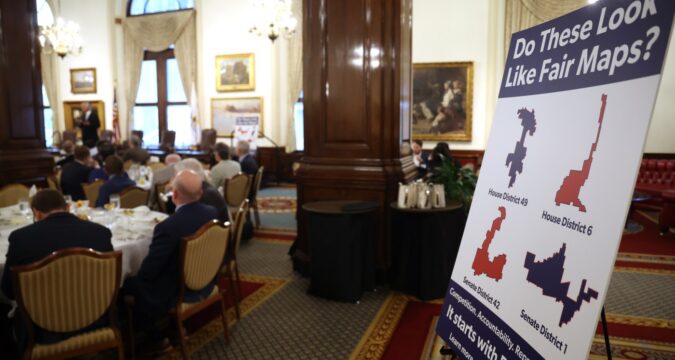
The Oak Park River Forest chapter of the Illinois League of Women Voters recently held an online forum on redistricting as well as Fair Maps Illinois, a nonpartisan group of citizens seeking to amend the Illinois Constitution as part of an effort to reform the way districts are drawn for the Illinois General Assembly.
“Redistricting has a long and complex history in the United States, from the earliest examples of gerrymandering in the 1800s to landmark Supreme Court decisions establishing one person, one vote,” said Barbara Laimins, co-chair of a LWV Illinois task force on misinformation and disinformation.
Laimins said the Fair Maps effort is limited to General Assembly districts. Districts for the U.S. House of Representatives are drawn by the General Assembly, as mandated by the U.S. Constitution.
“The Fair Maps Illinois effort is to create a fair redistricting process for our state government only,” she said.
The amendment question the group wants to place on the November 2026 ballot “establishes a redistricting commission that must follow clear legal standards,” according to theFair Maps’ website, fairmapsillinois.org.
Prerequisites of a Fair Map include no use of political party or voting history in drawing districts, maps must prioritize compactness and preserve communities and municipal boundaries, and legal protections for communities of interest and minority representation remain in place.
When the General Assembly is dominated by a supermajority, as it currently is, the danger is that district maps will be drawn for political reasons and not reflect legitimate changes in demographics or population growth, Laimins said.
“When politicians use redistricting to manipulate the outcome of elections, it’s called gerrymandering,” Laimins said, “a practice that undermines democracy and stifles the voice of voters. Voters should be picking their politicians, not the other way around.”
She pointed to the final map drawn after the 2020 census, a process complicated by COVID-19 and late census data from 2020.
The original map was approved in 2021 and was the result of a Democratically-controlled General Assembly.
“The general assembly was not transparent and maps were drawn behind closed doors without bipartisan input,” Laimins said. “Nor was there any information divulged by those drawing the maps regarding what data sources were used. Hearings were not well publicized and they were held on short notice. So the process of the current maps we are using was not transparent.”
Laimins also said that Gov. Jay Pritzker pledged during his campaign that he would create an independent commission and it was hoped that he would veto the map submitted by the General Assembly.
“But sadly, he broke his campaign promise and approved the General Assembly maps that were protested by various voting rights groups, including the League,” she said.
Laimins said there were some strangely-drawn districts as a result of the process, pointing to Illinois Senate District 21 as one that “snakes around” avoiding being both contiguous and compact-requirements of the Illinois Constitution.
District 21 runs from towns like Lombard in the north, down to Bolingbrook south and west to a large part of Naperville. The south/southwest villages are connected to the northern towns by a thin strip of area in the middle.
And that wasn’t the only problem.
“They create districts to ensure a Democrat-held seat in the General Assembly,” Laimins said. “You can see that they created a seat from Peoria to Bloomington and Springfield to Decatur in order to ensure that that seat would be held by a Democrat candidate.”
Laimins said the practice of partisan gerrymandering had a bipartisan history.
“I don’t want to seem like I’m picking on one party,” she said. “Throughout the history of Illinois redistricting, both parties have been guilty of drawing maps that are an advantage to their parties.”
Laimins spoke directly about the main problem with gerrymandering.
“Currently over half the legislative races in 2024 were uncontested. So voters had no choice at all. That means 50% of our elected officials were elected by simply turning in their paperwork. When politicians didn’t have to do anything to earn your vote, they stop listening … competitive elections keep elected officials more accountable and responsive to the voter.”
The Fair Maps Illinois effort has significant bipartisan support. Prominent supporters of Fair Maps include Bill Daley, former White House chief of staff for President Barack Obama and secretary of commerce under President Clinton, and Ray LaHood, secretary of transportation under President Obama and former Illinois 18th District U.S. Congressman.
In order to get the amendment question of the November ballot, the effort must gather 350,000 signatures by May 1. But the goal is to gather 600,000 signatures statewide just to be safe.
Laimins said that the current proposal was put together by a bipartisan legal team with extensive experience in Illinois election law.
“The proposal that we’re asking you to support will require districts to be drawn to maximize compactness,” she said. “No more splitting counties, no more splitting cities, no more splitting communities of interest for political gain.”
The proposal would also not allow political registration or voting history to be considered and mandate that maps be contiguous.
If the proposal succeeds, it will establish a 12-member bipartisan commission, to be created by the Illinois House and Senate leadership, with no more than six of the 12 being from the same party.
“This 12-member commission will be made up of four legislators and eight non-legislators — average citizens like you or I,” Laimins said. “If there is a deadlock between the 12, the Illinois Supreme Court will name two names and one will be the tie-breaker.”
After that, the map would go to the governor for his approval or veto.
Laimins summarized the forum by saying “this proposal will provide transparency and accurate, fair representation.”
Hank Beckman is a freelance reporter for Pioneer Press.
https://www.chicagotribune.com/2026/01/23/fair-maps-illinois-oak-park/


