Category: News
Heavily Shorted USA Rare Earth To Soar After US Govt Takes 10% Stake
Heavily Shorted USA Rare Earth To Soar After US Govt Takes 10% Stake
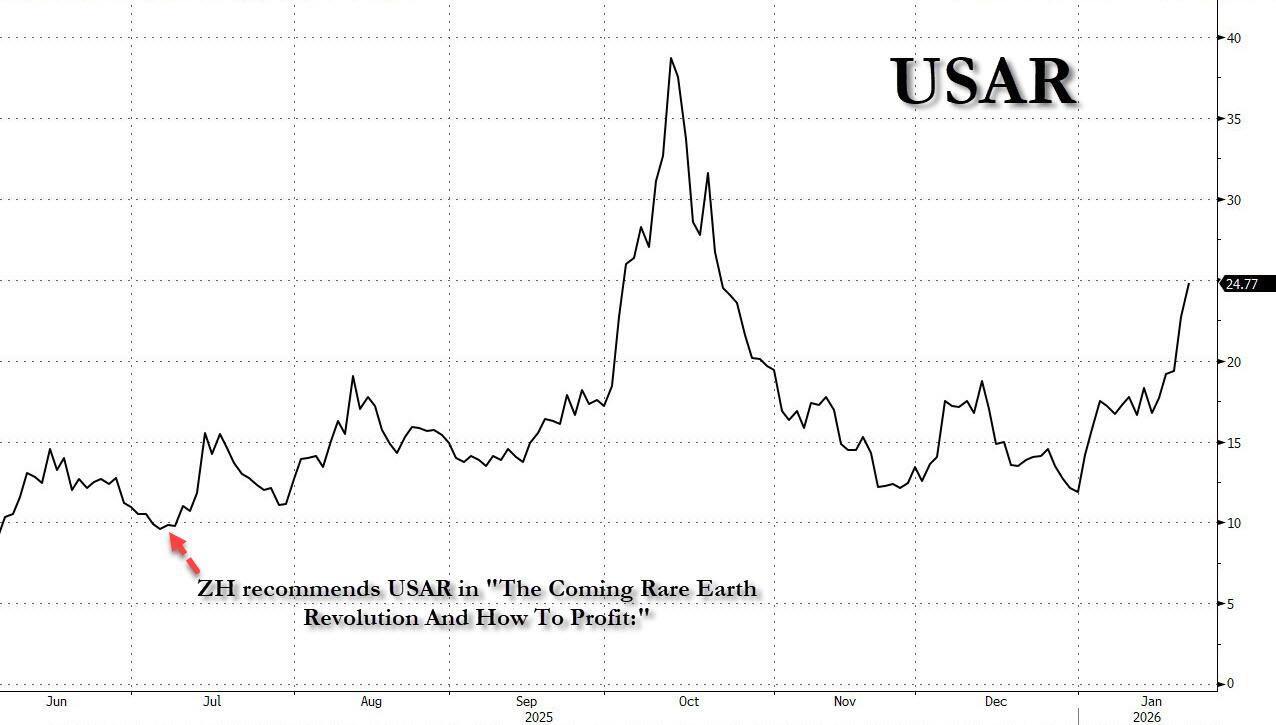
It was last July 9, when we told readers all about “The Coming Rare Earth Revolution And How To Profit: All You Need To Know About The “Ex-China Supply Chain.” It was here that we said MP Materials (and to a lesser extent USA Rare Earth Corp) was best positioned to capitalize as global rare earth trade flows and pricing adjust over the coming years (also, as a reference, that’s when USA Rare Earth was trading below $10/share).
One day later, anyone who listened to our advice made their year, when MP Materials soared 50% after the US shocked markets by announcing the Pentagon had become the largest shareholder in the rare earths company.
MP Materials Shares Surge 50% As Pentagon To Become Largest Shareholder https://t.co/qltUY1sHL3
— zerohedge (@zerohedge) July 10, 2025
Since then we had repeatedly pounded the table on USAR as the “other” major domestic REE company, pointing out repeatedly…
USA Rare Earth Shares Jump After Accelerating Timeline For Commercial Production By Two Years https://t.co/ufJ9i27s6e
— zerohedge (@zerohedge) December 10, 2025
… both that USAR is next on the Trump Capital, LP investment list, and warning the record number of shorts in the name to take cover while they have the chance, culminating with our note from Friday in which we pointed out abnormal buying activity in USAR calls.
USA Rare Earth (USAR) gamma squeeze (or just takeover bet): more than 8k of June $43 calls were bought for up to ~$3
— zerohedge (@zerohedge) January 22, 2026
Less than 48 hours later we hit jackpot, after the FT reported that in its second major rare earth investment, the Trump administration would inject $1.6BN into USA Rare Earths, just as we had said all along – surpassing the “mere” $400 million preferred stock investment by the Pentagon in MP Materials – the largest US investment in the sector to date, as it scrambles to shore up supplies of key minerals.
In exchange for the investment, the US government will receive a 10% stake in the Oklahoma-based USA Rare Earth, which controls significant US deposits of heavy rare earths.
The government investment and a separate $1bn private financing deal are expected to be announced on Monday.
According to FT sources, the government would get 16.1 million shares in USA Rare Earth and warrants for another 17.6 million, both at a price of $17.17. The government agreed to pay $277mn for the equity, giving it an implied gain of $490mn for the equity and warrants based on the current share price of $24.77.
The deal marks the latest example of the Trump administration’s efforts to intervene in parts of the private sector viewed as critical to US national security, including taking a 10% stake in Intel, which we also called ahead of time.
The Pentagon took a stake in US rare earth miner MP Materials… when will it do the same with Intel
— zerohedge (@zerohedge) August 7, 2025
USA Rare Earth will also receive $1.3bn in senior secured debt financing at market rates from the government. The money will come from a finance facility created for the commerce department as part of the CHIPS and Science Act passed in 2022. A commerce official said the department completed the transaction directly with the company.
While the commerce department declined to discuss the deal, an official in the Chips office – a part of the commerce department housed at the National Institute of Standards and Technology that led the negotiations – said it was “focused on onshoring critical and strategic mineral essential to the semiconductor supply chain and US national security”.
Or precisely what we said in July before the first MP Materials investment was disclosed
USA Rare Earth has separately tapped Cantor Fitzgerald, the Wall Street firm previously owned by commerce secretary Howard Lutnick and now run by his sons, to raise more than $1bn in fresh equity financing, the people said. It is not directly related to the deal with the government.
As the FT notes, a condition of the government investment in USA Rare Earth was that the company raise at least an additional $500mn from investors. It is on track to raise more than $1bn because of high demand for the financing deal, which uses a mechanism known as a private investment into a public equity, often called a “Pipe”.
Cantor’s involvement comes as the investment bank once led by Lutnick, one of Trump’s most prominent cabinet members, has expanded its investment banking capabilities to benefit from the president’s “America first” agenda. Cantor did not play a role in advising on the US government investment in USA Rare Earth.
USA Rare Earth, which has a market value of $3.7bn, is developing a huge mine in Sierra Blanca, Texas that it says contains 15 of the 17 rare earth elements underpinning production of cell phones, missiles and fighter jets. It also plans to open a magnet production facility in Stillwater, Oklahoma.
Last year, the Trump administration invested in at least six minerals companies, including MP Materials, Trilogy Metals and Lithium Americas. But its investment in USAR Is by far the biggest.
Shares in USA Rare Earth have more than doubled this year, helped by a 40% jump this week, and are up 150% since we first recommended the stock last July.
And now that the company has the explicit backing of the US government, if the Intel deal is any indication of what is coming, expect USAR stock to more than double from here, although when adding the record short interest in the equation…
… we just may see a historic surge in the stock when it opens for trading on Monday.
Tyler Durden
Sun, 01/25/2026 – 16:55
https://www.zerohedge.com/markets/heavily-shorted-usa-rare-earth-soar-after-us-govt-takes-10-stake
Santeros cubanos realizan rituales para pedir paz y salud en contexto de conflicto regional
Por ANDREA RODRÍGUEZ
LA HABANA (AP) — Al pie de un frondoso árbol de mango sacudido por la brisa fueron colocados en sacrificio una gallina, un gallo y una paloma. A su alrededor varias decenas de babalawos —sacerdotes de la santería cubana— entonaron oraciones una y otra vez para pedir permiso a Eggun, la divinidad de los ancestros.
Esa fue la primera parte de una ceremonia religiosa el domingo, en la que varios de los principales líderes de familias de la santería en la isla rogaron a sus deidades por la “sanación espiritual” del pueblo cubano, al igual que por un apaciguamiento de la violencia y los conflictos, que, según sus presagios anunciados a finales de diciembre, caracterizarían este año.
Repetidas veces entonaron “Sarayeye Eggun verucum layeo” (frase que significa “limpieza al pie de Eggun para alejar todo lo malo”) en lengua yoruba antigua, traída a la isla por los esclavos negros y transmitida oralmente.
Las tradiciones africanas y las de los españoles se sincretizaron en Cuba, dando lugar a la fuerte identidad afrodescendiente del país.
“Nosotros los religiosos practicantes consideramos que, a través de los sacrificios y las oraciones, podemos aliviar el impacto de las cuestiones dañinas”, dijo a The Associated Press Lázaro Cuesta, uno de los sacerdotes más conocidos, que organizó la ceremonia en el patio de una casa antigua en la popular barriada 10 de Octubre.
Sin embargo, “mientras los que gobiernan (el mundo), los que dirigen, que son los que tienen el poder de hacer o no hacer las cosas, no entiendan el mensaje de Ifa (el sistema de adivinación yoruba), no podremos evitar los desastres que están advertidos”, lamentó Cuesta.
El 2 de enero varios grupos de sacerdotes dieron a conocer la Letra del Año, el signo con el que cada final de diciembre estos religiosos pronostican el comportamiento que habrá en los siguientes meses.
Ese día, los babalawos informaron que la deidad regente sería Oggún, señor de los metales —o las armas—, los caminos y los conflictos. También es patrono de los herreros.
Al día siguiente, fuerzas de Estados Unidos ingresaron a Caracas y detuvieron al entonces presidente Nicolás Maduro. Venezuela es uno de los principales aliados políticos, ideológicos y comerciales de Cuba, por lo que el ataque generó conmoción entre la población de la nación caribeña.
Unos 6.000 colaboradores cubanos trabajan en el país sudamericano –-cientos de miles lo hicieron en las dos últimas décadas-—, y los envíos de petróleo venezolano son vitales para la isla, que no produce el volumen de crudo que su economía requiere. Treinta y dos soldados isleños de la seguridad personal de Maduro murieron en el operativo.
Actualmente Cuba enfrenta un endurecimiento radical de las sanciones que le aplica Washington, con las cuales asfixia su economía para presionar por un cambio de modelo político. El presidente estadounidense Donald Trump amenazó directamente a la isla.
“Nosotros como religiosos siempre tratamos de alejar un poquito lo que nos viene negativo a la vida”, dijo a la AP Yusmina Hérnandez, una ama de casa de 49 años, mientras participaba de la ceremonia y cocinaba en una enorme olla los platos de sopa que se ofrecerían a todos los que se acercaran durante la tarde.
Luego de pedir permiso a los ancestros en el patio junto al árbol, sacerdotes y feligreses se trasladaron a un amplio salón de la casa para la segunda parte de la ceremonia.
Con collares, tocados y vestimenta blanca, realizaron allí su ofrenda a Azowano (una de las formas que toma San Lázaro en esta religión): se colocaron de rodillas ante un enorme canasto rodeado de cuencos con frijoles de todos los tipos, maíz, habas y hasta dos huevos.
Posteriormente, en fila india varios cientos de personas que iban llegando dieron vueltas alrededor de la cesta para finalmente ser “limpiadas” con dos gallinas —se las hacían pasar a lo largo del cuerpo—, mientras los asistentes entonaban otros cánticos en lengua yoruba.
“Esto se está haciendo por el bien de la sociedad, para que no exista conflicto, violencia; para que haya armonía y salud”, comentó Eraimy Léon, un babalawo de 43 años.
——-
Andrea Rodríguez está en X como: https://x.com/ARodriguezAP
Alpine confirma que Christian Horner está interesado en comprar participación minoritaria
Associated Press
LONDRES (AP) — El equipo Alpine de la Fórmula Uno confirmó el domingo que el exjefe de Red Bull, Christian Horner, está entre las partes interesadas en comprar una participación minoritaria en el equipo.
“No es un secreto que Otro Capital ha mantenido conversaciones preliminares para vender su participación en el equipo. El equipo es regularmente abordado y contactado por posibles inversores, especialmente dado que Otro Capital ha declarado que se han llevado a cabo conversaciones exploratorias. Una de esas partes que ha expresado interés es un grupo de inversores que incluye a Christian Horner” afirmó Alpine en un comunicado.
Horner fue despedido por Red Bull en julio, poniendo fin a un período de 20 años que incluyó ocho títulos de pilotos de F1, pero también una agitación más reciente que sacudió al equipo dentro y fuera de la pista.
Alpine ha cambiado a motores Mercedes para una nueva era de regulaciones de F1 este año.
Alpine terminó último en la clasificación de constructores el año pasado.
Las pruebas de pretemporada comienzan el lunes en Barcelona.
___
Deportes AP: https://apnews.com/hub/deportes
California’s Billionaire Tax: A Mirror Of EU Green Socialism
California’s Billionaire Tax: A Mirror Of EU Green Socialism
Submitted by Thomas Kolbe
The mid-19th century Gold Rush earned California the nickname “Golden State.” Over generations, the region became a place of aspiration— a projection screen for ambition and prosperity. Here, the American Dream coalesced into tangible stories of social mobility. Today, the state has become the stage for a political experiment that mirrors Europe’s globalist ideology.
This year’s World Economic Forum in Davos was entirely overshadowed by Donald Trump’s speech. The U.S. President declared the centrally planned EU-style climate socialism a failure, sending a chill through those who had benefited economically from the past years’ policies and fully embraced the green transformation agenda.
A politician who seems particularly devoted to this European-style centralist approach is California Governor Gavin Newsom. The day after Trump’s grand Davos performance, Newsom had the chance to present his perspective—a performance that quickly struck observers as bizarre. He labeled the Western leaders’ response to Trump’s policies as pathetic, accusing them of cowardice and bowing to the Trump administration. Symbolically, he carried a pair of bright red Trump Signature Knee Pads as a political prop, claiming he should have brought a full set for every world leader.
This hardly reflects the conduct of a serious statesman, particularly as his policies at home have generated genuine economic problems and deep social upheavals.
California on a Green Course
Newsom, a prospective Democratic presidential hopeful, governs the world’s fourth-largest economy—if California were its own nation.
He stages himself as a champion of the supposedly progressive, preferring the role of climate activist over that of a sober governor. The 2024 California wildfire disaster was apodictically attributed by him, in a blunt “Basta-style,” to climate change—opportunistic, eager to push through his climate agenda in the immediate shock of catastrophe.
Repeatedly, the state-induced water shortages in California are stylized as consequences of extreme drought linked to CO₂ emissions. California finds itself trapped in a familiar argumentative loop: every storm, every hail event is reinterpreted as a climate catastrophe, while normal conditions recede behind a veil of media-induced panic.
Newsom would prefer to exclude skeptics of the CO₂ debate from political discourse—a faint echo of Daniel Günther, but in woke-American design. Under his governance, California has become North America’s LGBTQ mecca: gender politics over academic excellence, paternalistic state control replacing the principle of autonomous individual action. The American spirit of the minimal state, which respects private life, is disappearing piece by piece in Newsom’s California.
Since taking office in 2019, California has mirrored the European Union in textbook fashion. The state has become the U.S. model for the most radical implementation of the Green Deal. Regulatory codes for industry, agriculture, and transportation read like translations of Brussels’ bureaucratic playbook.
As in the EU, California’s green transformation and debt-financed subsidy machinery have rapidly driven up public debt: over the past three years, the budget deficit reached roughly $110 billion, and the total debt now stands at $1.8 trillion—including unfunded social obligations.
Debt King Newsom governs his ideal state on clay feet.
One wonders at the audacity of his Davos performance as a supposed savior of the American Dream. Of course, it was home turf. In the WEF halls, at the heart of globalist think tanks, there is still faith in a centrally planned Net-Zero economy—without crashing the existing economic model or provoking a severe societal crisis.
In California, CO₂ emissions are to end by 2045. The cult lives, beneath the state’s radiant sun, which has simultaneously spawned a veritable homeless industry alongside its green art economy.
During Newsom’s tenure, a hybrid system of state-funded private homelessness care emerged. The number of beneficiaries managed by California’s social complex has multiplied tenfold to 180,000. Much like in Minnesota, where a network of Somali immigrant-run daycares created a tax-extraction model, California has a comparable system: poverty is managed and monetized, with major beneficiaries being Democratic Party members—a vast political donation machine ensuring campaign financing for future elections.
Ever-Increasing Taxes
California’s increasingly centralist regulatory policies are matched by aggressive fiscal measures aimed at delaying the inevitable economic collapse. Alongside heavy burdens on the middle class, businesses, and rising social contributions, a so-called billionaire tax is nearing enactment—a populist instrument, mirroring Germany’s current policy moves. In the 2026 super-election year, Germany’s ruling coalition seeks moral credibility by blaming the wealthy for social and economic decay. Similarly, future inheritance taxes on mid-sized corporate assets are planned. It sells well, a sound of social justice, distracting from the true culprits of the crisis.
This is Newsom in full form. California — a slice of Europe on the American West Coast.
Of course, Newsom’s billionaire tax is a Trojan horse. Once codified, the initially one-time plunder of the private wealth of roughly 200 California billionaires will soon be recast as a recurring “public welfare” levy: five percent of total net worth, payable once, or stretched over five years.
As usual, politics disregards that this capital is often tied up in corporate investments, funding the future of the state and securing jobs. Newsom needs liquidity. The green transformation must be funded—especially as the Trump administration in Washington deregulates the energy sector, prompting businesses to flee California in droves. The Red States are in demand now more than ever.
California billionaires voice unified disapproval. Larry Page, former CEO of Alphabet/Google, spins off parts of his companies to Delaware. Elon Musk had long since relocated Tesla. Peter Thiel, co-founder of Palantir, moves capital to Miami, Florida. David Sachs of Craft Ventures also leaves California for Austin, Texas.
The green transformation chaos has become a boost for U.S. business locations that value private property and market freedom.
We know this industrial exodus from Germany—a near-identical outcome under the same policies. And, like the German government under Friedrich Merz, which layers media spectacles over economic decline alongside the EU Commission, Newsom stages his media skirmishes with Donald Trump. The NGO-prince Newsom rhetorically flees into moralism. His tax-funded social state shields him from economic reality, capital flight, and growing criticism over misplaced priorities.
In Europe, this sound is all too familiar. It preempts criticism that grows louder as Net-Zero policies produce severe collateral damage and social upheaval. The solutions preferred by Newsom and the EU complex follow the same controlled green socialism principle: social scoring models based on individual carbon footprints, a maximalist censorship apparatus in social media, and digital central bank currencies granting the state total power over the private sector. Society is forcibly molded to fit the political ideology—regardless of the cost. Woke softening rhetoric attempts to paint this new socialism in gentle tones, masking its brutal reality.
Tyler Durden
Sun, 01/25/2026 – 16:20
https://www.zerohedge.com/markets/californias-billionaire-tax-mirror-eu-green-socialism

Child one of 2 killed in Joliet, police say
Joliet police are investigating the deaths of a child and an adult as homicides, authorities said Sunday. A person of interest was in custody as of late morning.
Officers and detectives responded to the 700 block of Garnsey Avenue on the east side of the city Sunday morning.
No additional information was immediately available. Police said the investigation is active and evolving, and new details would be released as they become available.
https://www.chicagotribune.com/2026/01/25/joliet-double-homicide/

Republican calls are growing for a deeper investigation into the fatal Minneapolis shooting
WASHINGTON — A growing number of Republicans are pressing for a deeper investigation into federal immigration tactics in Minnesota after a U.S. Border Patrol agent fatally shot a man in Minneapolis, a sign that the accounting of events by President Donald Trump’s administration may face bipartisan scrutiny.
The chairman of the House Homeland Security Committee sought testimony from leaders at Immigration and Customs Enforcement, Customs and Border Protection and U.S. Citizenship and Immigration Services, saying “my top priority remains keeping Americans safe.”
Rep. Andrew Garbarino, R-N.Y., said in a statement that he takes oversight of the Department of Homeland Security seriously and that “Congress has an important responsibility to ensure the safety of law enforcement and the people they serve and protect.”
The push for more information was echoed by the committee’s former chairman, Rep. Michael McCaul of Texas, along with Sens. Thom Tillis of North Carolina, Bill Cassidy of Louisiana and Lisa Murkowski of Alaska. Their statements, in addition to concern expressed from several Republican governors, reflected a party struggling with how to respond to Saturday’s fatal shooting of Alex Pretti, a 37-year-old intensive care nurse at a VA hospital.
The killing has raised uncomfortable questions about the GOP’s core positions on issues ranging from gun ownership to states’ rights and trust in the federal government.
Cassidy, who is facing a Trump-backed challenger in his reelection bid, said in a social media post that the shooting was “incredibly disturbing” and that the “credibility of ICE and DHS are at stake.” He, too, was pushing for “a full joint federal and state investigation.” Tillis, who is not seeking reelection, urged a “thorough and impartial investigation” and said “any administration official who rushes to judgment and tries to shut down an investigation before it begins are doing an incredible disservice to the nation and to President Trump’s legacy.” Murkowski called for an investigation and added that “ICE agents do not have carte blanche in carrying out their duties.”
Administration officials remained firm in their defense of the hard-line immigration enforcement tactics in the Minnesota city, blaming Democrats in the state along with local law enforcement for not working with them. Many Republicans either echoed that sentiment or stayed silent. Trump made no public appearances Sunday, though issued a number of social media posts on topics including the ballroom he is constructing at the White House and further criticism of Canada.
The White House will likely face at least some GOP pushback
Trump has enjoyed nearly complete loyalty from fellow Republicans during his first year back in the White House. But the positions staked out in the wake of the shooting signal that the administration will face at least some pushback within the party in its swift effort to define Pretti, who protested Trump’s immigration crackdown, as a violent demonstrator.
Deputy White House chief of staff Stephen Miller issued social media posts referencing an “assassin” and “domestic terrorist.” Homeland Security Secretary Kristi Noem said Pretti showed up to “impede a law enforcement operation.”
At a minimum, some Republicans are calling for a de-escalation in Minneapolis.
Oklahoma Gov. Kevin Stitt told CNN’s “State of the Union” that the shooting was a “real tragedy” and Trump needs to tell Americans what the “end game” is.
“Nobody likes the feds coming to their states,” Stitt said. “And so what is the goal right now? Is it to deport every single non-U.S. citizen? I don’t think that’s what Americans want.”
He added: “Right now, tempers are just going crazy and we need to calm this down.”
Vermont Gov. Phil Scott said the shooting was “not acceptable.”
“At best, these federal immigration operations are a complete failure of coordination of acceptable public safety and law enforcement practices, training and leadership,” he said in a post. “At worst, it’s deliberate federal intimidation and incitement of American citizens.”
Echoing criticism that local law enforcement isn’t cooperating with federal officials, Rep. James Comer, R-Ky., suggested the administration focus its immigration efforts elsewhere.
“If I were President Trump, I would almost think about if the mayor and the governor are going to put our ICE officials in harm’s way and there’s a chance of losing more innocent lives or whatever, then maybe go to another city and let the people of Minneapolis decide do we want to continue to have all these illegals?” he told “Sunday Morning Futures” on the Fox News Channel. “I think the people of Minnesota would rebel against their leadership.”
A sensitive moment for the GOP
Pretti’s killing comes at a sensitive moment for the GOP as the party prepares for a challenging midterm election year. Trump has fomented a sense of chaos on the world stage, bringing the NATO alliance to the brink last week as he pushed Denmark to cede control of Greenland to the United States while also intensifying a dispute with Canada’s prime minister. Domestically, Trump has struggled to respond to widespread affordability concerns.
Meanwhile, approval of his handling of immigration — long a political asset for the president and the GOP — has tumbled in recent months. Just 38% of U.S. adults approved of how Trump was handling immigration in January, down from 49% in March, according to an AP-NORC poll.
The killing spurred notable tension with the GOP’s long-standing support for gun rights. Officials say Pretti was armed, but no bystander videos that have surfaced so far appear to show him holding a weapon. The Minneapolis police chief said Pretti had a permit to carry a gun.
Yet administration officials, including Noem and Treasury Secretary Scott Bessent, have questioned why he was armed. Speaking on ABC’s “This Week” Bessent said that when he has attended protests, “I didn’t bring a gun. I brought a billboard.”
Such comments were notable for a party where support for the Second Amendment’s protection of gun ownership is foundational. Indeed, many in the GOP, including Trump, lifted Kyle Rittenhouse into prominence when the then-17-year-old former police youth cadet shot three men, killing two of them, during a 2020 protest in Wisconsin against police brutality. He was acquitted of all charges after testifying that he acted in self defense.
In the wake of Pretti’s killing, gun rights advocates quickly noted that it is legal to carry firearms during protests.
“Every peaceable Minnesotan has the right to keep and bear arms — including while attending protests, acting as observers, or exercising their First Amendment rights,” the Minnesota Gun Owners Caucus said in a statement. “These rights do not disappear when someone is lawfully armed.”
In a social media post, the National Rife Association said “responsible public voices should be awaiting a full investigation, not making generalizations and demonizing law-abiding citizens.”
Rep. Thomas Massie, R-Ky., who is often critical of the White House, said “carrying a firearm is not a death sentence.”
“It’s a Constitutionally protected God-given right,” he said, “and if you don’t understand this you have no business in law enforcement or government.
The second-ranking Justice Department official said he was aware of reports that Pretti was lawfully armed.
“There’s nothing wrong with anybody lawfully carrying firearms,” Deputy Attorney General Todd Blanche said on “Meet the Press” on NBC. “But just make no mistake about it, this was an incredibly split-second decision that had to be made by ICE officers.”
Associated Press writer Michelle L. Price contributed to this report
https://www.chicagotribune.com/2026/01/25/republican-investigation-minneapolis-shooting/

Organización civil en Venezuela reporta 80 nuevas excarcelaciones de presos políticos
Associated Press
CARACAS (AP) — La organización civil Foro Penal reportó el domingo 80 nuevas excarcelaciones de presos políticos en Venezuela, en medio de divergencias con el gobierno sobre la cifra de liberados tras la acción militar estadounidense en la que el expresidente Nicolás Maduro y su esposa fueron capturados.
Gonzalo Himiob, vicepresidente del Foro Penal —una de las organizaciones civiles más prestigiosas del país—, indicó en la red social X que el número de excarcelados podría incrementarse mientras avanza el proceso de verificación en todo el territorio, y añadió que uno de sus abogados fue dejado en libertad.
La organización, que monitorea la situación de los presos en el país sudamericano, estima que más de 700 personas continúan recluidas por razones políticas. El oficialismo niega que haya presos políticos en Venezuela, y acusa a los detenidos de conspirar para desestabilizar al gobierno.
La presidenta encargada Delcy Rodríguez aseguró el viernes que “han sido excarceladas 626 personas”, y acusó a ciertos sectores de “maniobrar con las cifras a través de la mentira”. Agregó que le pedirá al Alto Comisionado de la ONU para los Derechos Humanos que verifique las listas de excarcelados, con el objetivo de poner fin a las discrepancias en las cantidades.
Tras la intervención estadounidense en Venezuela el 3 de enero, el gobierno de Rodríguez ofreció la liberación de “un número importante” de encarcelados como una señal, según dijo, para consolidar la paz. Pero el proceso enfrenta críticas de familiares y organizaciones civiles por la falta de celeridad e información.
Durante un discurso televisado el domingo ante trabajadores de hidrocarburos, Rodríguez instó a los ciudadanos a “luchar por la convivencia desde la diversidad”, y “a quienes piensen distinto, bienvenida la discusión con respeto”.
La mandataria encargada resaltó que la política del diálogo debe responder a las necesidades del pueblo. “Ya basta de las órdenes de Washington sobre políticos en Venezuela, que sea la política venezolana quien resuelva nuestras divergencias y nuestros conflictos internos”, puntualizó.
Además, Rodríguez destacó la propuesta de reforma a la Ley Orgánica de Hidrocarburos, la cual será definida en los próximos días en el poder legislativo. Dicha reforma flexibilizaría el control estatal sobre las operaciones petroleras y expandiría las posibilidades de inversión nacional y extranjera, señaló.
“Nos toca convertirnos en una verdadera potencia productora de petróleo, de gas, y no tener miedo a la agenda energética ni con los Estados Unidos ni con el resto de los países del mundo. Es un derecho de Venezuela la diversidad en sus relaciones”, apuntó.
Antes de que pueda ser publicada oficialmente, se requiere que la reforma sea aprobada en una segunda discusión y sancionada por la presidenta encargada.
El gobierno del presidente estadounidense Donald Trump ha dicho que planea controlar los futuros ingresos petroleros de Venezuela para asegurarse de que beneficien a su pueblo.
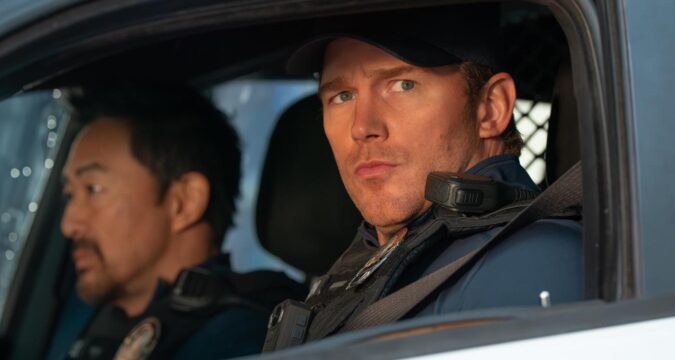
‘Mercy’ unseats ‘Avatar: Fire & Ash’ atop the box office on snow-blanketed weekend in theaters
NEW YORK — With a winter storm blanketing a large swath of the country, Hollywood had its quietest weekend of the year at the box office. The Amazon MGM sci-fi thriller “Mercy” dethroned “Avatar: Fire and Ash” from the No. 1 spot with $11.2 million in North America, according to studio estimates Sunday.
Some 250 theaters were forced to close, from Texas to Maine, according to data firm Comsore. More than 140 million Americans were under winter storm warnings, depressing moviegoing.
But the weekend was never going to be a blockbuster one, anyway. “Mercy,” a $60 million thriller starring Chris Pratt as a man in a near-future standing trial before an AI judge, was the top new release. It arrived with withering reviews (20% fresh on Rotten Tomatoes) and an equally poor reception (a “B-” CinemaScore) from audiences.
That was still enough to finally dislodge James Cameron’s third Pandora epic from its monthlong perch atop the box office. “Avatar: Fire and Ash” slid to second place with $7 million. While The Walt Disney Co. release is starting to peter out domestically, it remains a top draw overseas. It took in $28.1 million internationally in its sixth weekend.
“Avatar: Fire and Ash” isn’t going to come close to the box-office heights of the previous two “Avatar” movies. The 2009 original grossed $2.9 billion and the 2022 sequel, “The Way of Water,” tapped out at $2.3 billion. “Fire and Ash” has now cleared $1 billion internationally, but its domestic haul ($378.5 million) is well off the pace of the other two films.
The “Oscar bump” that films once saw following nomination is largely a thing of the past. The lead movies in Thursday’s nominations — “Sinners” and “One Battle After Another” — long ago completed their theatrical runs. But a handful of nominees saw strong business.
Chloé Zhao’s “Hamnet,” nominated for eight Oscars including best picture, collected $2 million in its first weekend of wide release. The Shakespeare drama, starring Jessie Buckley and Paul Mescal, has been in theaters for two months, steadily increasing its theatrical footprint. It’s up to $17.6 million domestically and $42.1 million worldwide.
Josh Safdie’s “Marty Supreme,” nominated for nine Oscars, earned $3.5 million in its sixth weekend of release. The A24 title, starring Timothée Chalamet, this week cross $100 million globally. It’s made $86.2 million domestically thus far.
But newer releases struggled. “Return to Silent Hill,” the third installment in a horror series kick-started with 2006’s “Silent Hill,” opened with $3.2 million. Though Sony released the 2006 film and Open Road distributed the 2012 follow up, the low-budget “Return to Silent Hill” was put out by Iconic Events.
In its second week of release, “28 Years Later: The Bone Temple” dropped swiftly. The Sony release, directed by Nia DaCosta, opened last week to a disappointing $13.3 million in sales despite good reviews. But its second weekend was even worse, dropping 71% with $3.6 million.
Other new releases flopped. Roadside Attractions’ “H Is For Hawk,” starring Claire Foy, took in just $150,000 from 472 theaters. Sony’s “Clika,” about a migrant worker with music aspirations, managed only $1.2 million in 522 locations.
Top 10 movies by domestic box office
With final domestic figures being released Monday, this list factors in the estimated ticket sales for Friday through Sunday at U.S. and Canadian theaters, according to Comscore:
1. “Mercy,” $11.2 million.
2. “Avatar: Fire and Ash,” $7 million.
3. “Zootopia 2,” $5.7 million.
4. “The Housemaid,” $4.2 million.
5. “28 Years Later: The Bone Temple,” $3.6 million.
6. “Marty Supreme,” $3.5 million.
7. “Return to Silent Hill,” $2.7 million.
8. “Hamnet,” $2 million.
9. “Lord of the Rings,” $2 million.
10. “Primate,” $1.7 million.
https://www.chicagotribune.com/2026/01/25/mercy-avatar-box-office/

Hoosiers and their fans brave a strong winter storm to celebrate Indiana’s 1st national college football title
The Indiana Hoosiers took one last stroll from Assembly Hall to Memorial Stadium on Saturday, waving to the crowd, signing autographs and trading fist bumps with the fans who lined the way.
Then the Hoosiers walked onto their home field for the first time as national champions.
This was a scene even the most loyal Indiana fans couldn’t have fathomed when Curt Cignetti was hired to coach major college football’s losingest program in 2023. A little more than two years later, here they were, folding chairs on the field, trophies lined up across the dais and a series of presentations to cap the celebration.
It was the perfect ending to a perfect season.
“From the bottom of my heart, thank you Hoosier Nation,” Heisman Trophy-winning quarterback Fernando Mendoza said just before the 35-minute ceremony ended with players, coaches and fans singing the school’s fight song together. “Playing here has been one of the greatest privileges of my life. Thank you so much and again, myself, my teammates are forever indebted to you guys. God bless. Go Hoosiers!”
Heisman Trophy Trust chief executive officer Jeff Price brought the trophy that will stay on campus permanently. University president Pam Whitten promised students at the half-filled stadium this wouldn’t be their last football championship. Some of the team’s seniors even helped local native John Mellencamp belt out “Hurts So Good” before, naturally, hearing “We Are The Champions” blaring across the public address system.
Column: Indiana’s epic run from losers to 16-0 national champs rivals the 2016 Chicago Cubs’ journey
“The greatest university in the country is now the home to the greatest football team in the United States of America,” Whitten said to loud roars.
But the fans, like this team, had to tough it out Saturday.
The temperature barely hovered above 10 degrees, wind chills were below zero and the forecast called for up to a foot of snow for the celebration of major college football’s first 16-0 season since the 1890s.
Players, many of whom came from warmer states such as Virginia or Florida, were bundled up, too, and wasted little time in making their remarks.
But some adverse weather wasn’t going to deter the players or these long-suffering football fans, who spent years just hoping the program could get back to respectability when it seemed like winning a championship — Big Ten or national — was unreachable.
Now, thanks in large part to Cignetti and the coaches and 13 players who followed him from James Madison, Indiana begins next season as the defending national champs, defending Big Ten champs and with both the nation’s longest winning streak and nation’s longest home winning streak.
“First of all, I can’t put into words what Indiana, the fans, my coach and my teammates have meant to me,” said All-American linebacker Aiden Fisher, one of those who followed Cignetti. “These two years have changed my life for the better and thank you, God, for making me a Hoosier.”
It didn’t take long for Cignetti to deliver on his promise to win. The Hoosiers posted a school-best 11-2 in mark in 2024. Yet many of these Hoosiers fans who had watched so many other promising starts unravel were skeptical the Hoosiers could replicate that success in 2025.
They didn’t. Indiana surpassed those numbers with a season for the record books.
The Hoosiers won games by huge margins, with late-game heroics and at sites that seemed impossibly challenging such as Oregon and Penn State. They beat traditional powers Ohio State and Alabama along with Oregon again as their storybook journey headed to Miami for the title game. And there, the school’s first Heisman Trophy winner finished off the 27-21 victory on Miami’s home field with one powerful, spinning touchdown run that encapsulated Indiana’s fight to the top.
It was so good Mendoza started making the television rounds this week, booking appearances on “The Tonight Show Starring Jimmy Fallon” and “Good Morning America” before announcing Friday that he would enter this year’s draft.
First, though, he wanted to make one more stop in Bloomington.
“The Heisman Trophy is the ultimate team award,” Mendoza told the crowd. “I want to thank God, thank the Heisman Trophy Foundation and thank IU.”
Then it was back to the usually stone-faced Cignetti, who appeared to genuinely cherish sharing this moment with his first national championship team as a head coach albeit briefly because he doesn’t want college football’s perfect story to end just yet.
“Chapter 3 begins tomorrow,” he shouted.
https://www.chicagotribune.com/2026/01/25/indiana-hoosiers-national-title-celebration-bloomington/
Mayors realistic, but hopeful, on cities’ fiscal outlook
A 2025 state law to throttle property tax revenue has mayors looking at what services might need to be reduced and whether to enact a municipal income tax to replace the lost income.
Crown Point Mayor Pete Land has invited the sponsors of Senate Enrolled Act 1 to speak with his city’s council and residents to share what their mindset was in proposing the drastic changes.
“There’s still a lot of unknowns, which is not fair to the city’s leadership and the city’s residents,” Land said during a mayors roundtable at Thursday’s Lake County Advancement Committee luncheon.
“We had hopes to add to our city’s workforce,” he said, but there were “painful choices” when drafting this year’s budget. “There’s more to come,” he warned.
This year’s “very, very conservative budget” passed with a 2.2% increase.
Hobart Mayor Josh Huddlestun said the story in his city is similar. At least half of the city’s budget is for public safety. “We’re just going back to good government,” he said, addressing basic issues like public safety, traffic and drainage. “What it means for us is quality of life for our residents,” he said.
Every community is affected differently, he noted. For Hobart, the response is to try to grow out of the difficulty so it can deliver the bare bones of city services residents demand.
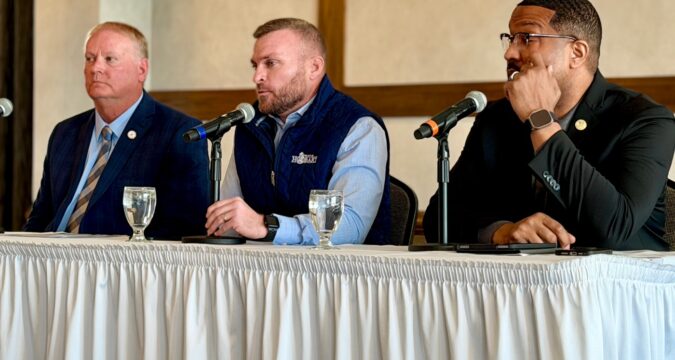
Hobart Mayor Josh Huddlestun, pictured during the Lake County Advancement Committee luncheon Thursday, Jan. 22, 2026. (Doug Ross/for Post-Tribune)
For Huddlestun, that means not looking the Amazon gift horse in the mouth.
With the data center complex Amazon is building in Hobart, part of a $15 billion investment in the region, the city negotiated a $47 million cash payment up front, which Huddlestun believes is the nation’s largest cash payment to a municipality for a private development on private property. Add in $10 million for permit fees and $45 million when the first building is completed, and the municipal revenue rolls in
“We could have $102 million by the end of the year,” he said. “That’s crazy.”
Outside Avalon Manor, where the luncheon was held, a handful of people protested against data centers.
“Either you grow or die, and that’s the reality,” Huddlestun said.
Gary Mayor Eddie Melton agrees. “Growing our way out of it is going to be very critical.”
Gary Mayor Eddie Melton, pictured during the Lake County Advancement Committee luncheon Thursday, Jan. 22, 2026. (Doug Ross/for Post-Tribune)
“Gary’s population for the first time has grown in 20 years,” he said. “We’ve seen more people acquiring properties through the county’s tax sales.”
“We have signs of growth, but how do we sustain it,” Melton said.
“Coming in as mayor, I knew we had to make some very difficult decisions,” he said. One of those was how to right the city’s financial ship.
“Imagine as if you don’t have 10% of your budget,” he told department heads. “I want to see how you operate with that 90%.”
Over the last two years, Gary has created a cash reserve for the first time in probably 20 years, Melton said.
“What you all are experiencing with SB 1 is what Gary has been experiencing every year in the Legislature,” he said. “I’m telling you as a former state senator. I’m not making stuff up.”
Melton was a state senator for nearly eight years before being elected mayor.
He knew the legislation was coming, “but that doesn’t protect us from anything that’s coming,” he said. “I think it’s concerning when you have to anticipate further, deeper service (cuts).”
“I think it’s only going to get worse as the rhetoric continues about property tax relief,” Huddlestun said.
Gov. Mike Braun campaigned on a pledge of property tax relief, and the General Assembly delivered on his promise with SEA 1. Municipalities are allowed to enact an income tax because their share of the county income tax will soon disappear.
Crown Point Mayor Pete Land, pictured during the Lake County Advancement Committee luncheon Thursday, Jan. 22, 2026. (Doug Ross/for Post-Tribune)
“It would be completely wrong” to say there is no chance of an income tax, Land said. “We’re going to do everything we can” not to do that. “I don’t want it for our constituents.”
The Crown Point council members agree, he said.
“Hoosier families and Hobart families are struggling,” Huddlestun said. “The last thing you want to do is pass an income tax on somebody,” but the city also has to provide essential services. “It’s on the table. I think our council has said the same thing.”
It’s challenging to tell residents, “Things are going up, and here’s your income tax on top of that,” Huddlestun said, but the city’s costs are going up right along with household costs.
Melton is hopeful that the law will be tweaked to give local government some relief “from what is looming right now.”
“We’re put in a position where you have to look at every tool in the toolbox,” he said. “I’m staying on my knees praying right now, hopeful.”
Unlike cities and counties, other units of local government can’t enact an income tax to make up for lost property tax revenue.
“Libraries, they’re really getting the brunt of this as well,” Land said.
Public education is on life support, Huddlestun said. “Our schools power our community. We’re relying on them.”
“That’s a huge thing for us. I’ve never been to a bad community with a really strong school and vice versa,” he said. Other than a referendum to increase the property tax, there’s no real help for schools, Huddlestun added.
The city often partners with the school district, he said. “I think that’s going to be critical in the future.”
“Partnerships have been critical for us,” Melton said.
Gary is the only Lake County city he’s aware of with a homeless shelter for men. “They’re getting dropped off in our city, and we have to figure out how to provide that service.”
Gary is looking for money to rebuild that shelter and hopes to find partners who will pitch in.
This comes at a time when funding for social services like Medicaid, SNAP and othersise being reduced.
South Shore Convention and Visitors Authority President and CEO Phil Taillon leads a panel discussion on municipal finances during the Lake County Advancement Committee luncheon Thursday, Jan. 22, 2026. (Doug Ross/for Post-Tribune)
South Shore Convention and Visitors Authority President and CEO Phil Taillon, who moderated the panel discussion, asked the mayors how they determine whether to grant tax abatements and other incentives to companies. “I heard there’s a local tourism organization that would also like to see the Chicago Bears come to Northwest Indiana right now,” he said.
“I want to be fair. (Hammond) Mayor Tom (McDermott)’s not here, so we’re not going to talk about it,” Melton said regarding the Bears. Hammond and Portage have also made pitches to attract the Bears to their cities.
Being a business-friendly state helps recruit businesses to Northwest Indiana, Melton said. So does the network of highways that forces east-west traffic through Northwest Indiana. Gary has the added advantage of an airport and the prospect of a deepwater port at Buffington Harbor, Melton noted.
“In the city, we don’t necessarily give traditional 10-year tax abatements and so forth,” Land said. Probably only two were approved in Crown Point in the last three years, he said.
“We’ll do economic development-backed bonds” for big developments, Land said. There’s a lot of public infrastructure” with these big developments, so the city puts them in a tax increment financing district, so the developer is responsible for paying bonds when they come due to pay for public infrastructure. “It’s their incentive to really make that development successful and work,” Land said.
Some people don’t understand why growth is needed and want the city to freeze as it is. But growth is needed, he said. “You have to have residential, that light industry and that business development to grow and prosper.”
“Each community is different, what they’re able to offer from a financial development perspective,” Huddlestun said.
It takes a balance of commercial, light industrial and residential growth. “We have to create that quality of life aspect so we can attract that individual, but we have to have the money to do it,” he said.
Gary isn’t in a position now to offer abatements, Melton said, but that’s not saying it won’t happen in the future.
“We’ve been blessed and lucky that we were able to hit the right deals at the right marks,” he said.
Gary didn’t have an economic development department for a number of years. “No one owned it,” Melton said. “We didn’t even have a city engineer for 15 years.”
“We’re literally rebuilding a city from the inside out,” Melton said. “It’s all gas, no brakes in the city of Gary right now.”
Doug Ross is a freelance reporter for the Post-Tribune.
https://www.chicagotribune.com/2026/01/25/mayors-realistic-but-hopeful-on-cities-fiscal-outlook/