
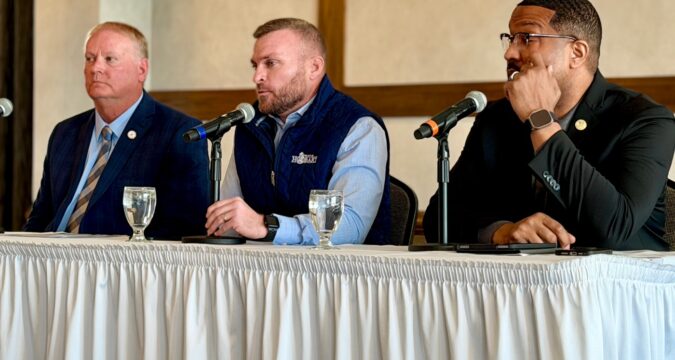
A 2025 state law to throttle property tax revenue has mayors looking at what services might need to be reduced and whether to enact a municipal income tax to replace the lost income.
Crown Point Mayor Pete Land has invited the sponsors of Senate Enrolled Act 1 to speak with his city’s council and residents to share what their mindset was in proposing the drastic changes.
“There’s still a lot of unknowns, which is not fair to the city’s leadership and the city’s residents,” Land said during a mayors roundtable at Thursday’s Lake County Advancement Committee luncheon.
“We had hopes to add to our city’s workforce,” he said, but there were “painful choices” when drafting this year’s budget. “There’s more to come,” he warned.
This year’s “very, very conservative budget” passed with a 2.2% increase.
Hobart Mayor Josh Huddlestun said the story in his city is similar. At least half of the city’s budget is for public safety. “We’re just going back to good government,” he said, addressing basic issues like public safety, traffic and drainage. “What it means for us is quality of life for our residents,” he said.
Every community is affected differently, he noted. For Hobart, the response is to try to grow out of the difficulty so it can deliver the bare bones of city services residents demand.
Hobart Mayor Josh Huddlestun, pictured during the Lake County Advancement Committee luncheon Thursday, Jan. 22, 2026. (Doug Ross/for Post-Tribune)
For Huddlestun, that means not looking the Amazon gift horse in the mouth.
With the data center complex Amazon is building in Hobart, part of a $15 billion investment in the region, the city negotiated a $47 million cash payment up front, which Huddlestun believes is the nation’s largest cash payment to a municipality for a private development on private property. Add in $10 million for permit fees and $45 million when the first building is completed, and the municipal revenue rolls in
“We could have $102 million by the end of the year,” he said. “That’s crazy.”
Outside Avalon Manor, where the luncheon was held, a handful of people protested against data centers.
“Either you grow or die, and that’s the reality,” Huddlestun said.
Gary Mayor Eddie Melton agrees. “Growing our way out of it is going to be very critical.”
Gary Mayor Eddie Melton, pictured during the Lake County Advancement Committee luncheon Thursday, Jan. 22, 2026. (Doug Ross/for Post-Tribune)
“Gary’s population for the first time has grown in 20 years,” he said. “We’ve seen more people acquiring properties through the county’s tax sales.”
“We have signs of growth, but how do we sustain it,” Melton said.
“Coming in as mayor, I knew we had to make some very difficult decisions,” he said. One of those was how to right the city’s financial ship.
“Imagine as if you don’t have 10% of your budget,” he told department heads. “I want to see how you operate with that 90%.”
Over the last two years, Gary has created a cash reserve for the first time in probably 20 years, Melton said.
“What you all are experiencing with SB 1 is what Gary has been experiencing every year in the Legislature,” he said. “I’m telling you as a former state senator. I’m not making stuff up.”
Melton was a state senator for nearly eight years before being elected mayor.
He knew the legislation was coming, “but that doesn’t protect us from anything that’s coming,” he said. “I think it’s concerning when you have to anticipate further, deeper service (cuts).”
“I think it’s only going to get worse as the rhetoric continues about property tax relief,” Huddlestun said.
Gov. Mike Braun campaigned on a pledge of property tax relief, and the General Assembly delivered on his promise with SEA 1. Municipalities are allowed to enact an income tax because their share of the county income tax will soon disappear.
Crown Point Mayor Pete Land, pictured during the Lake County Advancement Committee luncheon Thursday, Jan. 22, 2026. (Doug Ross/for Post-Tribune)
“It would be completely wrong” to say there is no chance of an income tax, Land said. “We’re going to do everything we can” not to do that. “I don’t want it for our constituents.”
The Crown Point council members agree, he said.
“Hoosier families and Hobart families are struggling,” Huddlestun said. “The last thing you want to do is pass an income tax on somebody,” but the city also has to provide essential services. “It’s on the table. I think our council has said the same thing.”
It’s challenging to tell residents, “Things are going up, and here’s your income tax on top of that,” Huddlestun said, but the city’s costs are going up right along with household costs.
Melton is hopeful that the law will be tweaked to give local government some relief “from what is looming right now.”
“We’re put in a position where you have to look at every tool in the toolbox,” he said. “I’m staying on my knees praying right now, hopeful.”
Unlike cities and counties, other units of local government can’t enact an income tax to make up for lost property tax revenue.
“Libraries, they’re really getting the brunt of this as well,” Land said.
Public education is on life support, Huddlestun said. “Our schools power our community. We’re relying on them.”
“That’s a huge thing for us. I’ve never been to a bad community with a really strong school and vice versa,” he said. Other than a referendum to increase the property tax, there’s no real help for schools, Huddlestun added.
The city often partners with the school district, he said. “I think that’s going to be critical in the future.”
“Partnerships have been critical for us,” Melton said.
Gary is the only Lake County city he’s aware of with a homeless shelter for men. “They’re getting dropped off in our city, and we have to figure out how to provide that service.”
Gary is looking for money to rebuild that shelter and hopes to find partners who will pitch in.
This comes at a time when funding for social services like Medicaid, SNAP and othersise being reduced.
South Shore Convention and Visitors Authority President and CEO Phil Taillon leads a panel discussion on municipal finances during the Lake County Advancement Committee luncheon Thursday, Jan. 22, 2026. (Doug Ross/for Post-Tribune)
South Shore Convention and Visitors Authority President and CEO Phil Taillon, who moderated the panel discussion, asked the mayors how they determine whether to grant tax abatements and other incentives to companies. “I heard there’s a local tourism organization that would also like to see the Chicago Bears come to Northwest Indiana right now,” he said.
“I want to be fair. (Hammond) Mayor Tom (McDermott)’s not here, so we’re not going to talk about it,” Melton said regarding the Bears. Hammond and Portage have also made pitches to attract the Bears to their cities.
Being a business-friendly state helps recruit businesses to Northwest Indiana, Melton said. So does the network of highways that forces east-west traffic through Northwest Indiana. Gary has the added advantage of an airport and the prospect of a deepwater port at Buffington Harbor, Melton noted.
“In the city, we don’t necessarily give traditional 10-year tax abatements and so forth,” Land said. Probably only two were approved in Crown Point in the last three years, he said.
“We’ll do economic development-backed bonds” for big developments, Land said. There’s a lot of public infrastructure” with these big developments, so the city puts them in a tax increment financing district, so the developer is responsible for paying bonds when they come due to pay for public infrastructure. “It’s their incentive to really make that development successful and work,” Land said.
Some people don’t understand why growth is needed and want the city to freeze as it is. But growth is needed, he said. “You have to have residential, that light industry and that business development to grow and prosper.”
“Each community is different, what they’re able to offer from a financial development perspective,” Huddlestun said.
It takes a balance of commercial, light industrial and residential growth. “We have to create that quality of life aspect so we can attract that individual, but we have to have the money to do it,” he said.
Gary isn’t in a position now to offer abatements, Melton said, but that’s not saying it won’t happen in the future.
“We’ve been blessed and lucky that we were able to hit the right deals at the right marks,” he said.
Gary didn’t have an economic development department for a number of years. “No one owned it,” Melton said. “We didn’t even have a city engineer for 15 years.”
“We’re literally rebuilding a city from the inside out,” Melton said. “It’s all gas, no brakes in the city of Gary right now.”
Doug Ross is a freelance reporter for the Post-Tribune.
https://www.chicagotribune.com/2026/01/25/mayors-realistic-but-hopeful-on-cities-fiscal-outlook/


