Category: News

Chicago Bulls’ Matas Buzelis makes his 3rd NBA Rising Stars team — but declines dunk contest invitation
Matas Buzelis is headed back to the NBA All-Star weekend.
The Bulls forward was announced as one of 28 players participating in the 2026 Rising Stars challenge during NBA All-Star weekend, which will take place at Intuit Dome in Los Angeles from Feb. 13-15. This year’s Rising Stars class is headlined by fellow young players such as Rookie of the Year front-runners Cooper Flagg and Kon Knueppel.
The Rising Stars team is comprised of standout G League, first-year and second-year players. This is technically Buzelis’ third time participating in the challenge after he was previously selected as an NBA rookie in 2025 and a pre-professional player with G League Ignite in 2024.
But although Buzelis was eager to participate in the Rising Stars challenge, he declined another invitation — to compete in the dunk contest.
Buzelis competed as one of four players in the 2025 dunk contest. It was an unfortunate outing — Buzelis missed every attempt on his opening dunk, finished last in the initial stage and did not advance to showcase his final dunks — a fact that Buzelis openly acknowledged.
“We know how that went,” Buzelis said with a laugh.
Related Articles
Column: Derrick Rose celebration gives Chicago sports fans what they love most — a reason to remember
Kevin Huerter’s buzzer-beater lifts Chicago Bulls past Boston Celtics before Derrick Rose’s jersey retirement
Column: Random thoughts on a budding Chicago sports bromance and other hot topics
Photos: Chicago Bulls retire Derrick Rose’s No. 1 jersey
Photos: Chicago Bulls 114, Boston Celtics 111
Despite last year’s results, Buzelis said the NBA invited him back to the dunk contest this year, but he ultimately declined to participate due to Chicago’s packed schedule ahead of the All-Star break. The Bulls will play nine games in the final 16 days before the All-Star break, including a stretch of five games in seven days this weekend due to a rescheduled game against Miami.
Buzelis only logged a handful of practices before last year’s dunk contest, which he believes played a crucial part in his overall performance. This year’s schedule offers even less time to practice — and the forward is playing a much larger role on the Bulls roster as a starter who averages 28 minutes per game. While Buzelis wants to redeem himself in a future iteration of the competition, he doesn’t feel that participating would be responsible as the Bulls push to improve their playoff positioning.
“I’m trying to listen to my body,” Buzelis said. “This stretch of games coming up is going to be very important for us. Hopefully I get invited again another year because I would love to do it, but this year I’m going to have to decline it.
“I just want to take care of my body. It’s a lot of work to prepare for the dunk contest. It takes a toll on your body. Especially in this stretch of games we have coming, it’s going to be very important for me to be fresh.”
After a tapered start to his rookie season, Buzelis has risen to become one of the most prominent players in the NBA’s sophomore class. He ranks fourth in scoring (14.9 points per game), 10th in rebounding (5.2 rebounds per game) and third in blocks (1.4 blocks per game) among 2025 draftees.
The Rising Stars challenge consists of a four-team tournament that will take place on Feb. 13. Three teams of first- and second-year players will be drafted by honorary coaches Carmelo Anthony, Vince Carter and Tracy McGrady while the final team will be rostered by G League players.
https://www.chicagotribune.com/2026/01/26/chicago-bulls-matas-buzelis-rising-stars/

Why Bitcoin’s Failing Its Role As A ‘Safe Haven’ Versus Gold
Why Bitcoin’s Failing Its Role As A ‘Safe Haven’ Versus Gold
Authored by Francisco Rodrigues via CoinDesk.com,
In theory, bitcoin should thrive during times of uncertainty as it’s sound money that’s censorship-resistant. In practice, it’s becoming the first thing investors sell when push comes to shove.
As geopolitical tensions flared over the past week, following Trump’s threats of tariffs against NATO allies over Greenland and speculation of potential military action in the Arctic, markets pulled back, and volatility spiked.
Since Jan. 18, after Trump first threatened tariffs in his push for Greenland acquisition, bitcoin has lost 6.6% of its value, while gold has moved up 8.6% to new highs near $5,000.
The reason lies in how each asset fits into portfolios during times of stress.
Bitcoin’s always-on trading, deep liquidity, and instant settlement make it an easy asset to offload when investors need to raise cash quickly.
Gold, despite being less accessible, tends to be held rather than sold.
This makes bitcoin behave more like an “ATM” during periods of panic, undermining its reputation as digital gold, according to NYDIG’s Global Head of Research, Greg Cipolaro.
“Under periods of stress and uncertainty, liquidity preference dominates, and this dynamic hurts bitcoin far more than gold,” Cipolaro wrote.
“Despite being liquid for its size, bitcoin remains more volatile and reflexively sold as leverage is unwound. As a result, in risk-off environments, it is frequently used to raise cash, reduce VAR, and de-risk portfolios regardless of its long-term narrative, while gold continues to function as a true liquidity sink,” he added.
Large holders aren’t helping either.
Central banks have been buying gold at record levels, creating strong structural demand. Meanwhile, long-term bitcoin holders are selling according ot NYDIG’s report.
Onchain data shows that vintage coins are continuing to move toward exchanges, suggesting a steady stream of selling. This “seller overhang” dampens price support. “The opposite dynamic is playing out in gold. Large holders, particularly central banks, continue to accumulate the metal,” Cipolaro added.
Adding to the mismatch is how markets are pricing risk. The current turbulence is seen as episodic, driven by tariffs, policy threats, and short-term shocks. Gold has long served as a hedge for that kind of uncertainty.
Bitcoin, by contrast, is better suited to longer-term concerns, like fiat debasement or sovereign debt crises.
“Gold excels in moments of immediate confidence loss, war risk, and fiat debasement that does not involve a full system break,” Cipolaro added.
“Bitcoin, by contrast, is better suited to hedging long-run monetary and geopolitical disorder and slow-moving trust erosion that unfolds over years, not weeks. As long as markets believe the present risks are dangerous but not yet foundational, gold remains the preferred hedge.”
Tyler Durden
Mon, 01/26/2026 – 20:55
https://www.zerohedge.com/crypto/why-bitcoins-failing-its-role-safe-haven-versus-gold

Republican On Health Committee Sells UNH Weeks Before Stock Tanks On Lower Payout Rates
Republican On Health Committee Sells UNH Weeks Before Stock Tanks On Lower Payout Rates
Shares of major health insurers – including UnitedHealth Group and CVS Health dropped like a rock on Monday following a Wall Street Journal report that the Centers for Medicare and Medicaid Services (CMS) plan to increase payments to insurance companies by just 0.09% on average next year – falling far short of analyst expectations of a 4% increase. For reference, insurers received a 5.06% increase for this year.
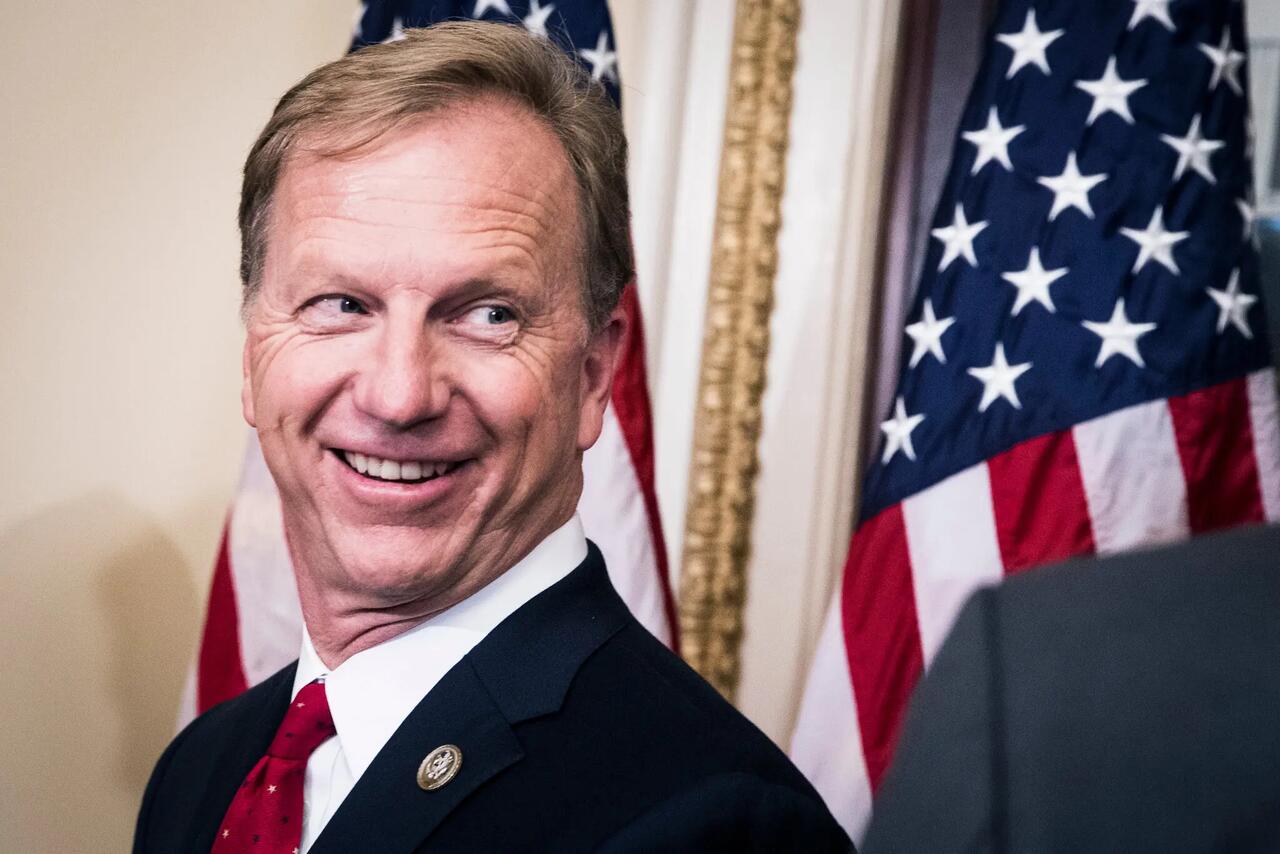
And while retail investors and other plebes are getting their mustaches punched off, Rep. Kevin Hern (R-OK), who sits on the House Subcommittee on Health (which works hand-in-glove with CMS on Medicare payment policy), had the amazing fortune to have sold his entire position in UnitedHealth on Dec. 23, valued between $250,000 and $500,000.
The House Ways and Means Subcommittee on Health is the House’s primary lawmaking body for federal health-care financing policy. In practice, it decides how the federal government pays for health care, who is eligible, and under what rules. One of its primary roles is oversight and legislation related to Medicare – governing payment policies for Medicare Parts A, B, C (Medicare Advantage), and D, including reimbursement rates for hospitals, physicians, insurers, and prescription drug plans.
To be clear, CMS proposes the annual rate proposals, while the House Ways and Means Committee and its Subcommittee on Health sets policy surrounding this. What typically happens is;
Senior CMS and HHS officials brief key committee staff (especially Ways and Means and Senate Finance) shortly before release.
These are staff-level or leadership-level heads-ups, not public meetings.
The purpose is political and institutional management, not authorization.
CMS would have likely briefed political leadership just before holiday recess so members aren’t blindsided in January – particularly members of Ways & Means.
UNITEDHEALTH SINKS MORE THAN 9% ON MEDICARE RATES REPORT
WHITE HOUSE PLANS FLAT RATES FOR MEDICARE INSURERS IN 2027: WSJ
Good sale Kevin Hern, who sits on the House Subcommittee on Health https://t.co/D2dSoBf8ul
— zerohedge (@zerohedge) January 26, 2026
What a lucky duck!
Tyler Durden
Mon, 01/26/2026 – 20:30

Maryland Jury Rules Walmart Liable For Selling Shotgun Used In Employee Suicide
Maryland Jury Rules Walmart Liable For Selling Shotgun Used In Employee Suicide
There is a notable torts verdict in Maryland where a jury handed down a multi-million dollar verdict against Walmart for selling a shotgun to an employee who used it to commit suicide.
The verdict raises difficult questions over Walmart’s responsibility for the suicide of Jacob Mace, who lied to store employees, under common law torts.
The family of Mace brought the lawsuit, alleging that Walmart employees knew that he was suicidal and struggling with mental health issues. They focused on his communications with a co-worker Christina O’Shea in which he wrote about feeling “broken” and “nothing helps. I just want it to end. Goodbye.” He also wrote that he intended to “Slit wrists. Buy a gun.”
O’Shea told assistant manager, Brennan Jones, about her concerns. Jones said that police should be called and, when Mace returned to work, spoke to Mace about the company’s counseling services and asked him how he was doing. He told him that “You know, we were worried about you,” but Mace assured him that he was fine.
Neither Jones nor O’Shea was involved in selling the gun to Mace. The sale was made by Eric McLaughlin, who testified that he had no idea of Mace’s mental health struggles. Mace told McLaughlin that the gun would be a present for his wife.
The family argued that Jones should have alerted other store managers about the conversation between O’Shea and himself. Moreover, the awareness of employees like Jones was then attributed to the company as a whole.
I find the verdict concerning on a number of levels.
First, employers have to straddle a difficult line between protecting employees’ privacy and addressing threats to employees or the public. In this case, Mace insisted that he was doing fine and Jones had taken steps to confirm his status.
Second, Mace lied to the Walmart employee. There was no reason why McLaughlin would refuse the sale.
The case reminds me of Tarasoff v. Regents of University of California, which I teach in my torts class. In the 1974 case, Prosinjit Podder, an Indian Graduate student at Berkeley, fell in love with Tatiana Tarasoff. When she stated that she wanted to date other men, Podder went to counseling at the University Health Service and was treated by psychologist, Dr. Lawrence Moore. When he told Moore that he wanted to get a gun and kill Tarasoff, Moore sent a letter to campus police, who interviewed Podder and decided that he was not a risk. Podder then went ahead and murdered Tarasoff.
Justice Mathew O. Tobriner held that “… the confidential character of patient-psychotherapist communications must yield to the extent that disclosure is essential to avert danger to others. The protective privilege ends where the public peril begins.”
As a result, the hospital was held liable for the criminal actions of a third party — something that usually (but not always) cuts off proximate causation. It also rejects strong arguments made by doctors that such liability would create a chilling effect on counseling. A large number of patients often express their anger by focusing it on individuals and stating an intent to “kill that guy.” In the vast majority of such cases, the open disclosure allows the matter to be addressed and defused. However, if the patient knows that the doctor will have to tell authorities, such feelings are less likely to be expressed and addressed.
In this case, you have a retailer with an employee who expressed suicidal ideations. Jones did the right thing in seeking police involvement and then personally speaking with Mace. According to this verdict, the store should have barred the purchase. But for how long? What steps are necessary to satisfy this duty?
As with Tarasoff, there is no clear line on what employers should do and when they should do it.
The Second Amendment protects the right to gun ownership, though that right is not absolute. Additionally, this employee has privacy rights. Indeed, a memo to all employees could have been the subject of a different tort action for the disclosure of embarrassing private information, negligent infliction of emotional distress, or other claims.
From the perspective of Jones, he had one employee who expressed concerns over another employee’s mental health. He spoke to the second employee, who assured him that he was doing fine. Under these circumstances, Mace could have purchased the gun from any other store.
This is a tragic case, and it may be difficult to overturn on appeal. I understand the family’s anger that more was not done to save Mace from himself. I am unsure of how far the store could have gone. Jones would have needed to tell all employees not to sell Mace, any sharp objects, guns, or products capable of inducing overdoses or harm. That could trigger a lawsuit. If he fired or suspended Mace, he might be sued under disability laws.
If he did fire or suspend Mace, it is not clear that a gun sale could be withheld without something more than the word of a friend when the individual is denying such ideations. The right move is to seek police intervention, which Jones suggested.
The complaint does allege that Walmart had a “blacklist” for individuals who were suspected of any mental problems. If so, that does raise a legitimate question about why Mace was not added to the list, at least as a precautionary matter. However, these are difficult and fluid circumstances for a manager to address, particularly in a relatively short time period.
The jury awarded approximately $2.5 million in economic damages and $8 million in non-economic damages. Those damages may be reduced due to state caps on non-economic damages.
Here is the complaint in the case: Brady v. Walmart
Tyler Durden
Mon, 01/26/2026 – 20:05

“Did The White House Just Blink?” Border Patrol Boss ‘Demoted’ As Minneapolis Mayor Says Feds Are Leaving
“Did The White House Just Blink?” Border Patrol Boss ‘Demoted’ As Minneapolis Mayor Says Feds Are Leaving
On the heels of President Trump’s reconciliatory statement earlier hailing his “very good call” with Governor Tim Walz, and decision to send Tom Homan to the frontlines in Minnesota…
“…we, actually, seemed to be on a similar wavelength,” Trump said.
“I told Governor Walz that I would have Tom Homan call him, and that what we are looking for are any and all Criminals that they have in their possession.
The Governor, very respectfully, understood that, and I will be speaking to him in the near future.
He was happy that Tom Homan was going to Minnesota, and so am I! “
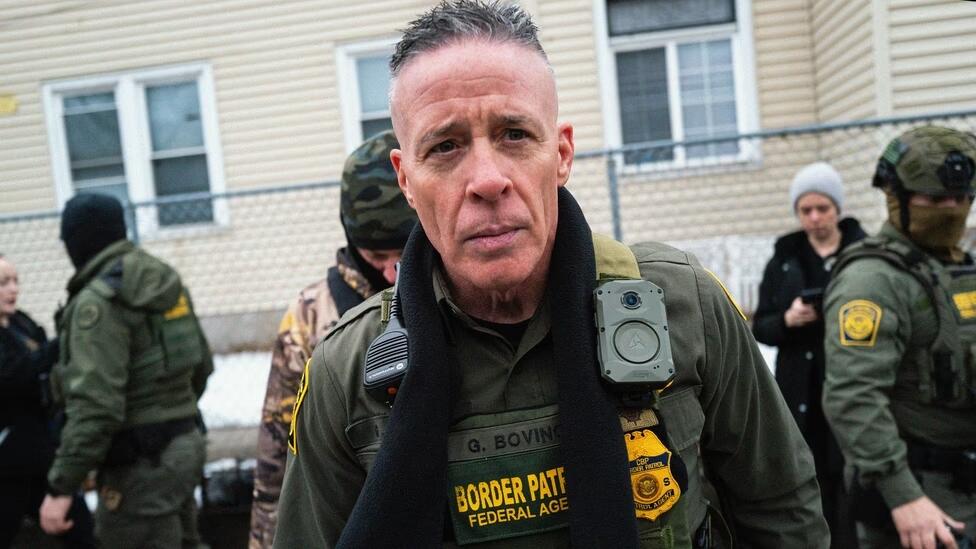
…The Atlantic reports that Gregory Bovino has been removed from his role as Border Patrol “commander at large” and will return to his former job in El Centro, California, where he is expected to retire soon, according to a DHS official and two people with knowledge of the change.
CNN’s Kaitlan Collins further confirms that DHS has suspended Gregory Bovino’s access to his social media accounts effective immediately.
He spent yesterday responding to people who were criticizing him and raising questions about his unverified claims about Pretti.
This reported decision follows pressure from Senate Democrats who refused to allow the current DHS funding bill to move forward, this threatening another federal government shutdown.
Additionally, Minneapolis Mayor Jacob Frey said after speaking with President Donald Trump that he expects that some federal agents will start leaving the city on Jan. 27.
“I expressed how much Minneapolis has benefited from our immigrant communities and was clear that my main ask is that Operation Metro Surge needs to end,” Frey wrote on X.
“The president agreed the present situation can’t continue.”
Trump said that the conversation with Frey was “very good” and that progress was made.
“Tom Homan will be meeting with [Frey] tomorrow in order to continue the discussion,” Trump posted on Truth Social.
The mayor said he would continue pushing for all federal agents to leave the city.
“Minneapolis will continue to cooperate with state and federal law enforcement on real criminal investigations—but we will not participate in unconstitutional arrests of our neighbors or enforce federal immigration law,” Frey stated on X.
Walz and Frey have repeatedly encouraged the public to protest and demonstrate against immigration operations taking place in the state, at some points using profanity to tell federal officers to leave.
Trump presented a three-point plan to Walz during the call, according to White House press secretary Karoline Leavitt.
The plan calls for Walz, Frey, and other Minnesota leaders to turn over all criminal illegal immigrants who are currently in custody in state prisons and jails to federal authorities.
Those with active warrants or known criminal histories would be immediately deported, Leavitt said during a press briefing on Jan. 26.
The plan also calls for state and local law enforcement to agree to turn over all illegal immigrants who are arrested by local police and for local police to help federal law enforcement in arresting and detaining illegal immigrants who are wanted for crimes, especially violent crimes, she said.
We give the last words to General Flynn…
Did the WH just blink? https://t.co/lyIJ3kQBSq
— General Mike Flynn (@GenFlynn) January 27, 2026
…good question.
Tyler Durden
Mon, 01/26/2026 – 19:59

With over 110,000 followers on social media, Lemont’s Cory Zator goes all in as wrestler. ‘What I love doing.’
Whether he’s competing on the mat or creating content to entertain his legion of online followers, Lemont’s Cory Zator has gone all in on wrestling.
After quitting football, Zator threw himself entirely into wrestling for his senior year. While he piles up championships and climbs the rankings, he’s also growing a large audience on social media, where he documents his wrestling journey and posts fitness videos.
He has 65,000 followers on Instagram and 47,000 on TikTok.
“I realized wrestling is what I truly love doing,” Zator said. “It’s what I want to do in college and what I want to pursue for my career with social media.
“I didn’t just fall in love with the sport, but I fell in love with the lifestyle. That’s why I love what I’m doing right here, right now.”
Zator is achieving plenty of success along the way. He rolled to the 126-pound championship Saturday at the South Suburban Conference Tournament at Shepard in Palos Heights.
Lemont’s Cory Zator, top, works over Oak Forest’s Jacob Sebek in the 126-pound final of the South Suburban Conference Tournament at Shepard in Palos Heights on Saturday, Jan. 24, 2026. (Steve Johnston / Daily Southtown)
Zator, ranked No. 3 in Class 2A at 126 by Illinois Matmen, faced off in the finals with Oak Forest junior Jacob Sebek, who is ranked No. 1 at 120.
Zator (26-4) dominated, winning by a 14-2 major decision.
“I faced him in our dual and I pinned him,” Zator said. “This time, I knew I could do more than pin him. I wanted to put on a show. I wanted to tech him.
“The last few weeks, I’ve been getting so much better and I’ve gained that confidence where I think I’m dangerous. I’m the best guy out here and I’m going to show it.”
Tinley Park’s Sebastian Sanderson, left, tangles with Oak Forest’s Andrius Vasilevskas in the 215-pound final of the South Suburban Conference Tournament on Saturday, Jan. 24, 2026. (Steve Johnston / Daily Southtown)
Zator was a starting defensive back for Lemont in football as a junior but made the decision to step away from that sport before his senior year.
“I’d be playing or practicing for football and in my head I’m thinking, ‘I need to be getting better at wrestling,’” Zator said. “I knew this was where my passion was.”
Lemont coach Egan Berta has seen how far that fervor has taken Zator.
“Once he fully devoted himself to wrestling and focused on his offseason training, the jump has been huge,” Berta said. “He’s wrestling with a lot more confidence and being a lot more aggressive. We really think he can take that top spot on the podium this year at state.”
Oak Forest’s Austin Perez, top, holds off Shepard’s Brandon Leech in the 150-pound final of the South Suburban Conference Tournament at Shepard in Palos Heights on Saturday, Jan. 24, 2026. (Steve Johnston / Daily Southtown)
As for his online work, content creation has long been a hobby for Zator. Merging that interest with his love for wrestling was a natural progression.
“I’ve been doing social media since I was young, doing niche accounts about different things,” Zator said. “But my niche became me. I started recording myself. I’ve been documenting my life and building a personal brand.
“Now, my niche is wrestling and fitness videos. It’s what I love to do.”
Zator hopes to take his followers along on a journey to state success. That’s also something he wants to do for his older brothers, Kyle and Jake, who both wrestled at Lemont.
“They were never able to get their name on the wall at school for being a state placer, so they’ve been putting that on to me,” Zator said. “But in a good way, not a lot of pressure or anything.”
Lemont’s Cory Zator, left, tries to pin Oak Forest’s Jacob Sebek in the 126-pound final of the South Suburban Conference Tournament at Shepard in Palos Heights on Saturday, Jan. 24, 2026. (Steve Johnston / Daily Southtown)
Lemont senior Judah Heeg, a defending state champion who won the 190-pound conference title Saturday, believes Zator will reach that goal to place at state — and more.
“Cory’s constantly working harder and harder every single day and you can see it’s showing up on the mat,” Heeg said. “His leg attacks are coming very easy for him. I definitely see him being a state champion.”
Of course, that would be a dream come true for Zator.
“This being my last year of high school wrestling, I really want to enjoy it,” Zator said. “But I also want to get that state title. I truly have high hopes.”
https://www.chicagotribune.com/2026/01/26/cory-zator-lemont-boys-wrestling/

‘Enough Of Washington’s Orders’ – Venezuela’s Interim President Tells Populace
‘Enough Of Washington’s Orders’ – Venezuela’s Interim President Tells Populace
Venezuela’s interim president Delcy Rodríguez has publicly pushed back against Washington in a rare first since the US military invasion and overthrow of Nicolás Maduro, assering she has had “enough” of US directives.
While President Trump initially declared that Washington would effectively “run” Venezuela, he later endorsed Rodríguez as a temporary caretaker during the transition, despite her being as hardcore a Leftist pro-Maduro figure as anyone.
“Enough already of Washington’s orders regarding politicians in Venezuela,” Rodríguez told oil workers gathered in Puerto La Cruz on Sunday, in remarks broadcast on state television.
She further urged that Venezuela’s political disputes be handled internally, saying: “Let Venezuelan politics resolve our differences and our internal conflicts” – and warned that the small oil-rich country has already paid a steep price confronting what she described as fascism and extremism.
Rodríguez soon after being sworn in had vowed that no “foreign agent” would rule Venezuela or reduce it to a “colony” – despite that Trump has made clear that his appointed team of American officials would effectively run the country and its oil.
Among the first US actions has been to cut off Venezuela’s oil supply to nearby ally Cuba, which threatens to sink the island-nation’s economy further, after it has endured many decades of Washington sanctions.
Despite this big talk of distancing herself from American interests, Rodríguez warmly greeted CIA Director John Ratcliffe this month, and there was even a photo op. Ratcliffe, as the first top US official to meet with her in the wake of the Jan.3rd military operation, reportedly delivering Trump’s conditions for resetting relations.
The fact that she has even remained in power this long suggests that she is playing ball behind the scenes, and that any anti-American public declarations are primarily for domestic consumption.
Domestic messaging: …has to pretend otherwise not to upset her support base:
Delcy continues to pretend like she is a tough anti-imperialist leader who defies Washinton while behind the scenes Trump can make her do whatever he want and she is only running Venezuela 🇻🇪 at his mercy
She knows this, but has to pretend otherwise not to upset her support base https://t.co/qvaPqqHLla
— Thomas van Linge (@ThomasVLinge) January 25, 2026
A fresh Monday report in the NY Times summarizes where things stand:
Three weeks after U.S. forces whisked President Nicolás Maduro away from Caracas, the capital, his vice president and replacement, Delcy Rodríguez, is rapidly liberalizing the economy without ceding any political control in an autocratic nation.
With President Trump’s blessing, Ms. Rodríguez has moved to redirect Venezuela’s oil exports from China to the much more lucrative market in the United States. Earlier this month she funneled the first tranche from these oil sales, $300 million, to Venezuela’s banking system, halting the collapse of the national currency and putting hyperinflation fears to rest.
She is rapidly rewriting laws to bring in foreign investment and boost wages, leading many economists to forecast double-digit economic growth in Venezuela this year. She is promising economic transparency and accountability, an implicit recognition of years of looting of state funds by the government that she has served for decades.
Anticipation of an economic windfall has sparked a rally on Caracas’s thinly traded stock exchange and driven a sharp jump in real estate prices, NYT also describes. The country’s long-defaulted bonds have climbed, fueled by speculation that the former Maduro number two could move to restructure the country’s debt, also in anticipation of Washington potentially rolling back sanctions.
Tyler Durden
Mon, 01/26/2026 – 19:40
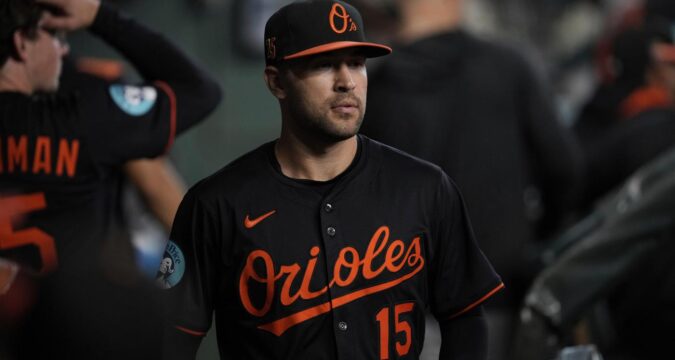
Chicago Cubs sign outfielder Dylan Carlson to a minor-league deal
The Chicago Cubs have signed outfielder Dylan Carlson to a minor-league deal that includes an invitation to big-league camp for spring training.
The Cubs announced the contract on Monday.
The 27-year-old Carlson is expected to compete for a backup job. He batted .203 with six home runs and 20 RBIs in 83 games with the Baltimore Orioles last season.
Carlson was selected by the St. Louis Cardinals in the first round of the 2016 amateur draft. He hit .239 with 34 home runs and 161 RBIs in 447 games with the Cardinals before he was traded to the Tampa Bay Rays in July 2024.
Carlson played for an Elk Grove (Calif.) High School team that featured future major-leaguers Nick Madrigal, Derek Hill, Rowdy Tellez and Dom Nuñez. They were coached by his father, Jeff Carlson.
The younger Carlson made his major-league debut in Chicago against the White Sox during the pandemic-shortened 2020 season, so there were no fans in attendance.
https://www.chicagotribune.com/2026/01/26/chicago-cubs-dylan-carlson-deal/

Trump Threatens To Raise Tariffs On South Korean Goods To 25%; Won Slides
Trump Threatens To Raise Tariffs On South Korean Goods To 25%; Won Slides
Here we go again.
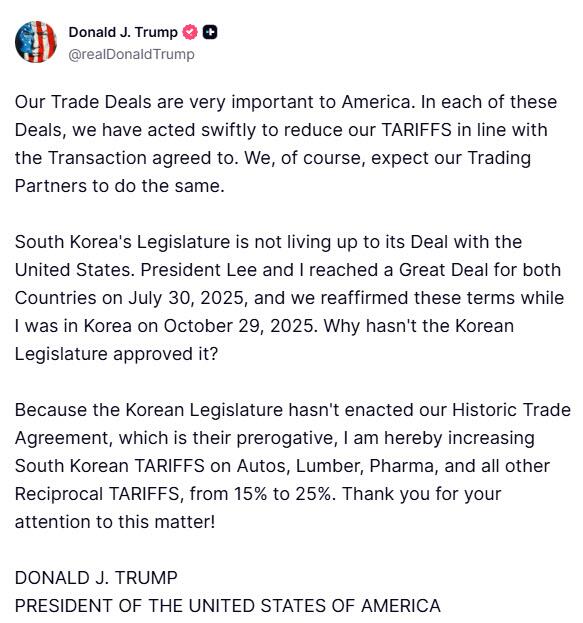
President Trump threatened to hike tariffs on goods from South Korea to 25% from 15%, citing in a Truth Social post what he said was the failure of the country’s legislature to codify the trade deal the two nations reached last year, a failure which was obvious from miles away as the terms of the trade deal require Korea to invest hundreds of billions – which it doesn’t have – in the US.
The new rate would apply to autos, lumber, pharmaceutical products and “all other Reciprocal TARIFFS,” he wrote in a social media post. It probably would not apply to memory chips which are already the most expensive thing on plant earth, at least until the RAM producing cartel starts to, well, producing RAM again.
The move, if implemented, could have wide-ranging effects on major South Korean companies that export to the US, such as Hyundai Motor.
The USDKRW gapped up 0.7% to 1452 on the news, amid thin liquidity before the local market open.
Tyler Durden
Mon, 01/26/2026 – 19:16
https://www.zerohedge.com/economics/trump-threatens-raise-tariffs-south-korean-goods-25-won-slides
The Fatal Limits Of The Technocrat Class
The Fatal Limits Of The Technocrat Class
Authored by Charles Hugh Smith via OfTwoMinds blog,
Goliath dies not because collapse occurs, but because scale mistakes itself for life. What survives was never his.
This guest essay by longtime correspondent 0bserver speaks to a dynamic woven into all of my work: the intrinsic impossibility of fixing what technocratic management broke with more technocratic management. Attempts to do so result in doing more of what’s failed, with fatal consequences for the systems being “fixed,” as the technocratic elite holds the power to impose policies but is immune to the consequences of the failure of those policies. Those fall on the system, which then veers into incoherence and Model Collapse.
I’ve been reading Luke Kemp’s Goliath’s Curse: The History and Future of Societal Collapse with care, because the book is serious, well-researched, and written from within institutions that spend their days thinking about systemic fragility. Kemp is not unserious, nor is he shallow. His diagnosis of elite failure, complexity, inequality, and institutional overreach aligns with much of what many of us have been warning about for years.
Where I think the book ultimately fails, however, is not in what it sees–but in what it cannot see from the altitude at which it operates.
Kemp’s collapse framework is managerial. Collapse is treated as a system-level pathology to be prevented through coordination, governance, and institutional reform. This makes sense given his professional formation and affiliations, but it creates a blind spot that becomes more consequential the longer one reads: continuity is assumed, not explained.
The book speaks fluently about sustainability, inequality, elite capture, and long-term risk. Yet it does not seriously engage with inheritance–not inheritance as wealth alone, but inheritance as transmission: skills, trades, family structure, norms, fertility, competence, and responsibility carried forward across generations. Sustainability is framed as system stability rather than generational renewal.
This omission matters, because collapse is not the absence of order. It is the failure of particular scales of organization. When large institutions fail, life does not disappear–it reorganizes. The question is not whether systems can be stabilized indefinitely, but whether anything capable of inheritance remains when stabilization fails.
Luke Kemp is excellent at identifying fragility in centralized systems. He is far less interested in, or perhaps less equipped to examine, the base-rate reality that most societies muddle through breakdowns via informal order, households, and local competence. This is where pessimism overweights evidence. Failure is dramatic and legible; endurance is quiet and distributed.
Where this becomes decisive is in Kemp’s proposed solutions.
When collapse looms, the remedies offered are more coordination, better governance, stronger institutions, improved global frameworks, and smarter management of risk. Complexity is to be handled by expertise; inequality by policy; instability by coordination. The scale that failed is asked to save itself.
This is the core problem.
The solutions operate at the same level as the failure.
Centralization is offered as the cure for overextension.
Governance is offered as the cure for institutional fragility.
Coordination is offered as the cure for complexity.
The very mechanisms meant to prevent collapse amplify its consequences when they fail.
Recent history supplies proof–not theory.
The financial collapse of 2008 rescued banks while households absorbed the loss. Large institutions were recapitalized immediately; families lost homes, savings, and years of accumulated effort. Recovery was declared long before household continuity returned.
The pandemic reinforced the same pattern. Large corporations were deemed essential, while small and local businesses were declared nonessential and shuttered. Compliance favored scale; capital consolidated upward; independent capacity quietly disappeared.
A third proof is now unfolding without crisis declarations. Large banks continue to grow while private equity consolidates trades and local services–plumbing, HVAC, electrical, veterinary clinics, small manufacturing. Businesses are bought, debt-loaded, stripped, and optimized for extraction. Ownership disappears, stewardship evaporates, and nothing is left to inherit when failure arrives.
These outcomes are not policy accidents.
They are the predictable result of scale-first solutions.
Systems are stabilized.
Households are tested.
Continuity bears the cost.
What troubles me most is that Goliath’s Curse critiques elites and inequality while failing to recognize how insulated analysis itself has become. Collapse expertise that cannot be lived becomes abstract. Risk is modeled without skin in the game. Moral urgency is asserted without moral grounding. The book makes moral claims–about obligation, responsibility, and injustice–without ever naming the source of those obligations.
This creates a quiet contradiction. Moral language is necessary to motivate coordination, but moral foundations are left ambiguous to preserve managerial flexibility. In the absence of grounding, obligation eventually collapses into power.
Nassim Nicholas Taleb has a name for one failure mode here: the intellectual yet idiot–not stupid, not malicious, but insulated from consequence. I don’t think Luke Kemp himself is the target. The framework is. Collapse theory that remains legible only to institutions will always propose institutional solutions, even when the problem has already migrated below that level.
The real threat is not collapse per se. Systems rise and fall. The real threat is the dissolution of the family and the erosion of inheritance.
Institutions can be recapitalized. Markets can reprice. States can fragment and re-form. Families cannot be substituted.
When families fail to reproduce competence, culture, and responsibility across generations, nothing downstream inherits. What follows is not collapse but vacancy.
Goliath dies not because collapse occurs, but because scale mistakes itself for life. What survives was never his.
That is the argument I think Goliath’s Curse gestures toward but cannot complete from where it stands. The book diagnoses fragility well. It does not yet explain endurance.
And in the end, endurance–not prevention–is what decides the future.
This is a guest essay by longtime correspondent 0bserver.
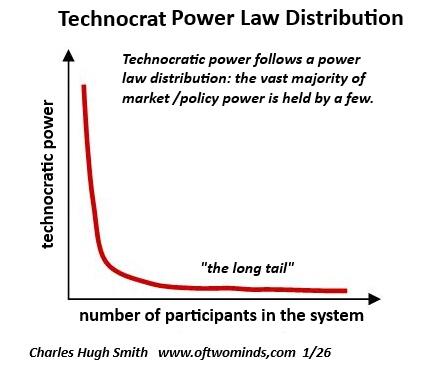
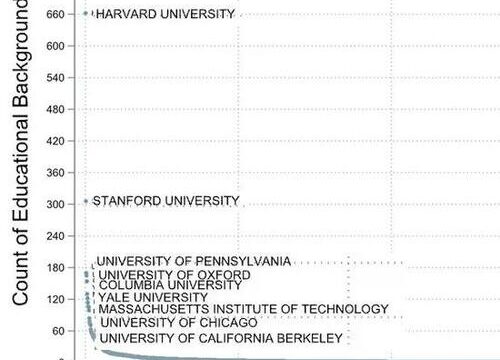
CHS here: note that the global technocrat elite follows a power law distribution in where they attended university:
…and the power they wield in markets and institutions:
* * *
My new book Investing In Revolution is available at a 10% discount ($18 for the paperback, $24 for the hardcover and $8.95 for the ebook edition). Introduction (free)
Check out my updated Books and Films. Become a $3/month patron of my work via patreon.com. Subscribe to my Substack for free
Tyler Durden
Mon, 01/26/2026 – 19:15
https://www.zerohedge.com/economics/fatal-limits-technocrat-class