Category: News

Kremlin Exasperated As Key Nuclear Treaty Expires Next Week, Crickets From US Side
Kremlin Exasperated As Key Nuclear Treaty Expires Next Week, Crickets From US Side
Russia says it has tapped Washington on the shoulder many times related the the last remaining nuclear treaty between to the well-armed superpowers, but there have been crickets.
Moscow on Thursday reaffirmed it hasn’t heard anything and is still eagerly awaiting a response from Washington to President Vladimir Putin’s proposal to informally extend New START for another year. Presumably even if Trump officials have publicly signaled their willingness, a firm bilateral commitment has to be reached, with clear and open communication.
Kremlin spokesman Dmitry Peskov warned reporters that the impending expiration of the pact on February 5 could create a “serious gap” in the legal framework controlling strategic nuclear weapons.
With the clock ticking, Moscow’s proposal underscores growing fears that, absent an extension, the world could face a nuclear arms vacuum between the world’s two largest arsenals. Peskov’s statement expressed some growing frustration and impatience:
“We keep waiting, but the deadline is approaching. There was no response from the United States,” he said at a news briefing.
Peskov added that “the Kremlin’s position is well known and it is consistent.”
The New Strategic Arms Reduction Treaty was signed in 2010 by Presidents Barack Obama and Dmitry Medvedev, and limits the number of deployed strategic warheads to 1,550 per side, and caps deployed delivery systems – including of missiles, bombers, and submarines – at 700.
The treaty is further designed to regulate targeting of each rival’s political and military centers in a potential nuclear conflict. The hope was that as Witkoff and Kushner have continued direct dialogue with Putin and top Kremlin officials, there would be a breakthrough on the nuclear issue, rapidly improving the bilateral relationship.
This was certainly one of the high bars set for last August’s Alaska summit. Putin had stated just before meeting Trump in person that the “next stages” of discussions with the administrations could include reaching “agreements in the area of control over strategic offensive weapons.”
Both leaders have shown willingness to reach a breakthrough on this issue, but alas nothing has materialized, and Russia appears genuinely surprised the US hasn’t jumped at the offer to extend it another year, giving more time for longer negotiations for what the future of New START might hold.
In August 2023 the US accused Russia of violating the treaty in disallowing US on-site inspections under its stipulations. In response, Washington halted Russian inspectors’ ability to do the same on American soil. The fact that the Ukraine war has been raging without end has also put pressure on the treaty toward unraveling.
Tyler Durden
Thu, 01/29/2026 – 17:20

Venezuelan lawmakers vote to ease state grip on oil, abandoning self-proclaimed socialist tenet
CARACAS, Venezuela — Venezuela’s legislature on Thursday approved opening the nation’s oil sector to privatization, reversing a tenet of the self-proclaimed socialist movement that has ruled the country for more than two decades.
The National Assembly approved the overhaul of the energy industry law less than a month after the brazen seizure of then-President Nicolás Maduro in a U.S. military attack in Venezuela’s capital.
The bill now awaits the signature of acting President Delcy Rodríguez, who proposed the changes in the days after U.S. President Donald Trump said his administration would take control of Venezuela’s oil exports and revitalize the ailing industry by luring foreign investment.
The legislation promises to give private companies control over the production and sale of oil and allow for independent arbitration of disputes.
Rodríguez’s government expects the changes to serve as assurances for major U.S. oil companies that have so far hesitated about returning to the volatile country. Some of those companies lost investments when the ruling party enacted the existing law two decades ago to favor Venezuela’s state-run oil company, Petróleos de Venezuela SA, or PDVSA.
The revised law would modify extraction taxes, setting a royalty cap rate of 30% and allowing the executive branch to set percentages for every project based on capital investment needs, competitiveness and other factors.
It also removes the mandate for disputes to be settled only in Venezuelan courts, which are controlled by the ruling party. Foreign investors have long viewed the involvement of independent courts as crucial to guard against future expropriation.
Ruling-party lawmaker Orlando Camacho, head of the assembly’s oil committee, said the reform “will change the country’s economy.”
Meanwhile, opposition lawmaker Antonio Ecarri urged the assembly to add transparency and accountability provisions to the law, including the creation of a website to make funding and other information public. He noted that the current lack of oversight has led to systemic corruption and argued that these provisions can also be considered judicial guarantees.
Those guarantees are among the key changes foreign investors are looking for as they weigh entering the Venezuelan market.
“Let the light shine on in the oil industry,” Ecarri said.
Oil workers dressed in red jumpsuits and hard hats celebrated the bill’s approval, waving a Venezuelan flag inside the legislative palace and then joining lawmakers in a demonstration with ruling-party supporters.
The law was last altered two decades ago as Maduro’s mentor and predecessor, the late Hugo Chávez, made heavy state control over the oil industry a pillar of his socialist-inspired revolution.
In the early years of his tenure, a massive windfall in petrodollars thanks to record-high global oil prices turned PDVSA into the main source of government revenue and the backbone of Venezuela’s economy.
Chávez’s 2006 changes to the hydrocarbons law required PDVSA to be the principal stakeholder in all major oil projects.
In tearing up the contracts that foreign companies signed in the 1990s, Chávez nationalized huge assets belonging to American and other Western firms that refused to comply, including ExxonMobil and ConocoPhillips. They are still waiting to receive billions of dollars in arbitration awards.
From those heady days of lavish state spending, PDVSA’s fortunes turned — along with the country’s — as oil prices dropped and government mismanagement eroded profits and hurt production, first under Chávez, then Maduro.
The nation home to the world’s biggest proven crude reserves underwent a dire economic crisis that drove over 7 million Venezuelans to flee since 2014. Sanctions imposed by successive U.S. administrations further crippled the oil industry.
https://www.chicagotribune.com/2026/01/29/venezuela-oil-industry-control/
Apple Rises After Shocking China Sales Beat Offsets US Revenue Miss
Apple Rises After Shocking China Sales Beat Offsets US Revenue Miss
Ahead of today’s AAPL earnings report, we’ve had a very mixed picture from Mag 7 earnings so far: first, there was Microsoft, which crashed after its capex forecast unexpectedly jumped, then there was META, which soared after its capex forecast unexpectedly jumped (only in this case the company made up for it by pretending its ad revenue will also increase almost dollar for dollar with the new capex), and then there was TESLA which first dropped, then jumped, then dropped as the market digested the company’s complete conversion from an auto company (now without the S and X models) and into a robotaxi “story” stock. As such, many are looking to AAPL to break the tie when it reports at 3pm today.
But before we look at the numbers, here’s what Wall Street is expecting:
Revenue estimate $138.4 billion
Products revenue estimate $107.69 billion
Mac revenue estimate $9.13 billion
IPad revenue estimate $8.18 billion
Wearables, home and accessories estimate $12.13 billion
Services revenue estimate $30.02 billion
Recall that during its fourth quarter conference call, Apple took the rare step of saying that it expects double-digit iPhone growth as well as 10-12% overall revenue growth. There was no way Apple would report such numbers unless it was 100% confident in that being the case.
As Bloomberg’s Mark Gurman notes, Apple is projecting a monster quarter yet given the current climate around its AI crisis, the future of the company really hangs in the balance here, as it may be fair to say that if Apple beats estimates – or least meets expectations today – the current management of the company and way forward has some staying power. If, for some odd reason, the company misses expectations, we’re in for an extremely tough news cycle and the potential of real change in the months ahead.
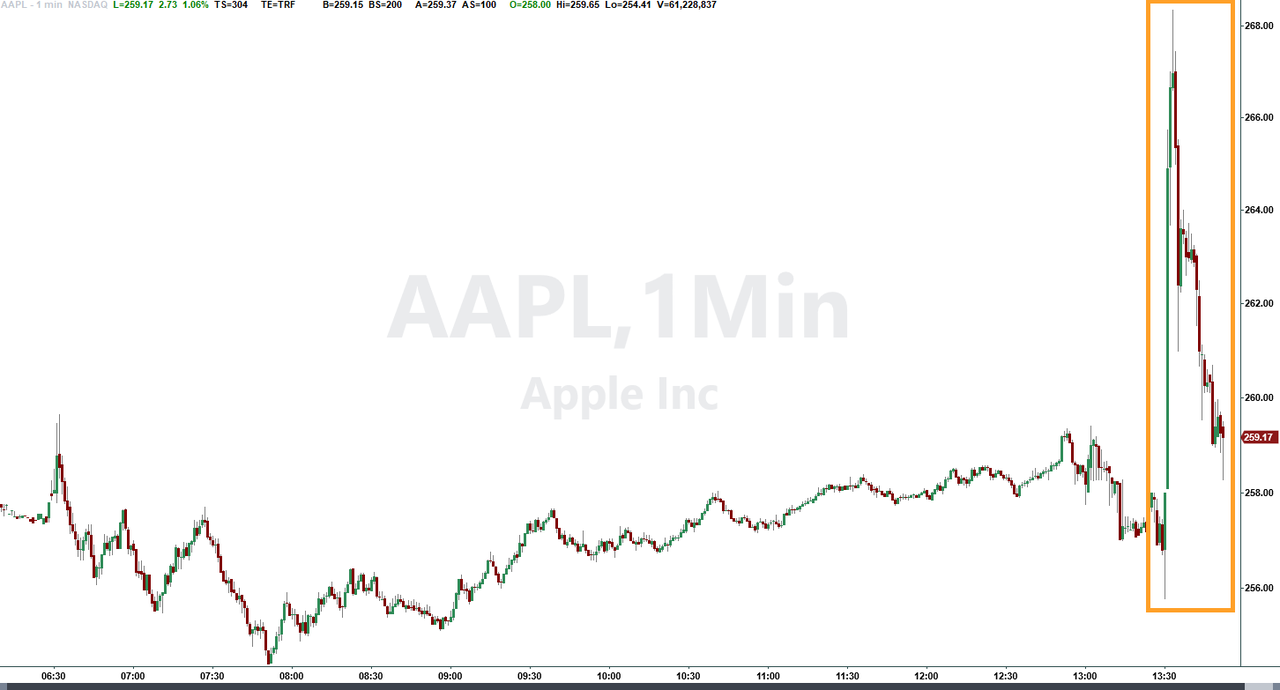
In retrospect, AAPL was not making it up, because the stock has moved higher (even if it has erased much of the gains) after the smartphone company reported earnings which beat many expectations, while the iPhone had its best ever quarter largely thanks to China.
Here are the details:
EPS $2.84 vs. $2.40 y/y, beating estimates of $2.68
Revenue $143.76 billion, +16% y/y, beating estimate $138.4 billion
Products revenue $113.74 billion, +16% y/y, beating estimate $107.69 billion
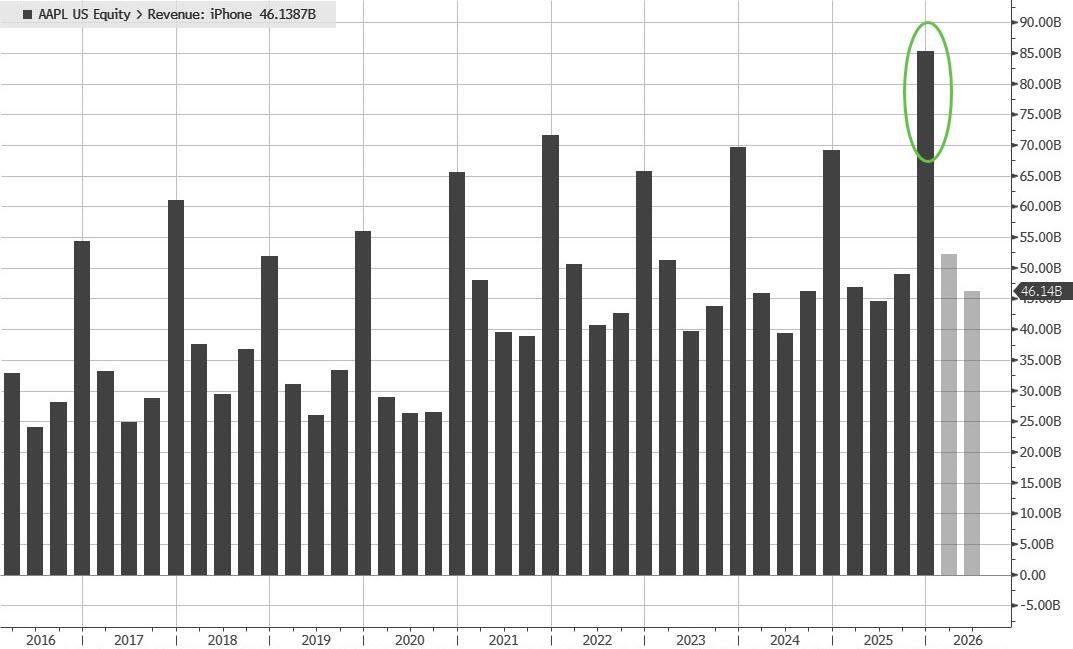
IPhone revenue $85.27 billion, +23% y/y, beating estimate $78.31 billion
Mac revenue $8.39 billion, -6.7% y/y, missing estimate $9.13 billion
IPad revenue $8.60 billion, +6.3% y/y, beating estimate $8.18 billion
Wearables, home and accessories $11.49 billion, -2.2% y/y, missing estimate $12.13 billion
Services revenue $30.01 billion, +14% y/y, missing estimate $30.02 billion
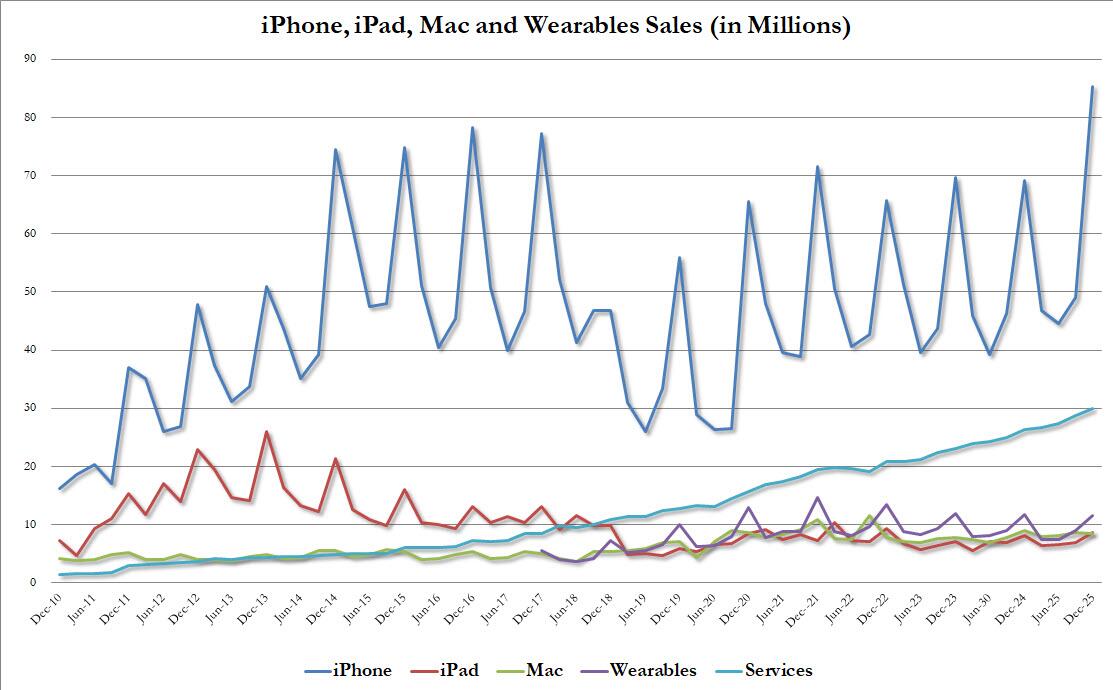
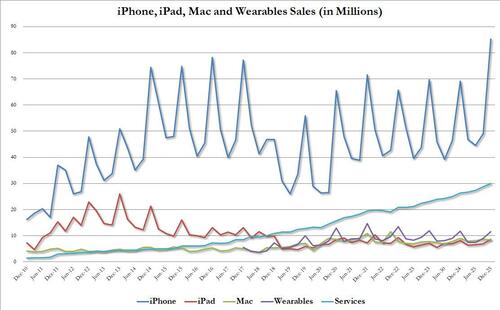
Broken down by product…
… show that iPhone revenue – which hit a record high in Q1 thanks to China – was the most notable:
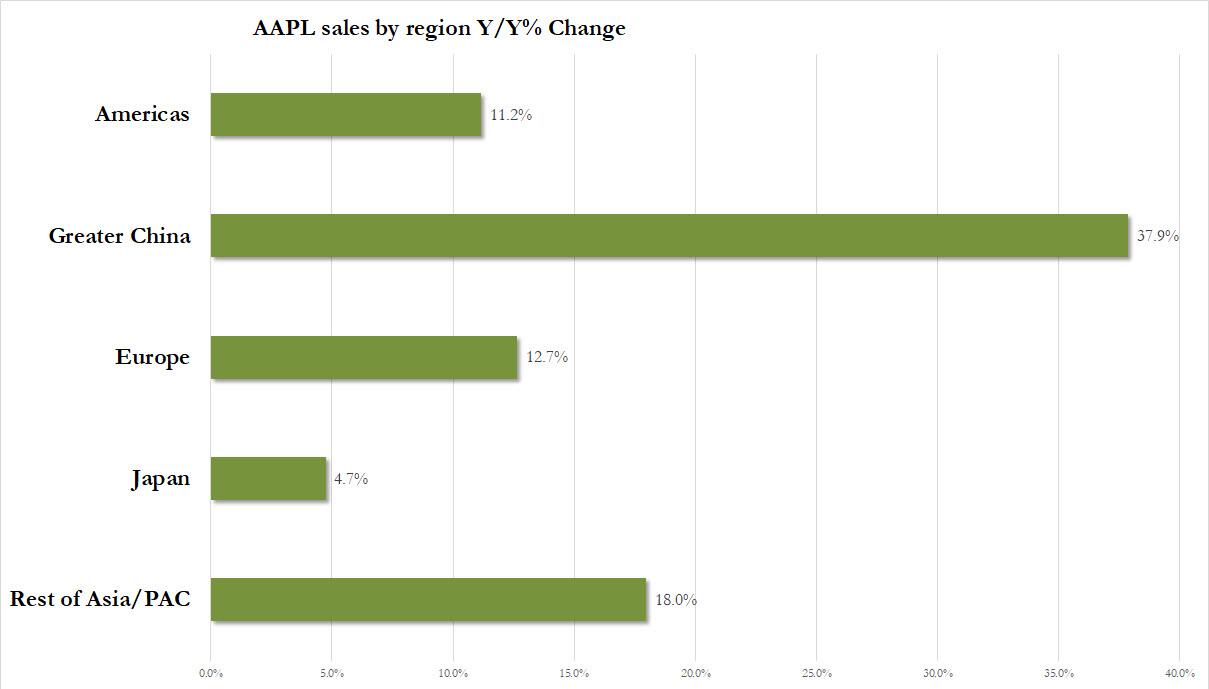
Taking a closer look at the Geographic breakdown, one region stands out:
Americas rev. $58.53 billion, +11% y/y, missing estimate $59.06 billion
Europe revenue $38.15 billion, +13% y/y, beating estimate $36.82 billion
Japan revenue $9.41 billion, +4.7% y/y, beating estimate $9.24 billion
Rest of Asia Pacific revenue $12.14 billion, +18% y/y, beating estimate $11.39 billion
and…
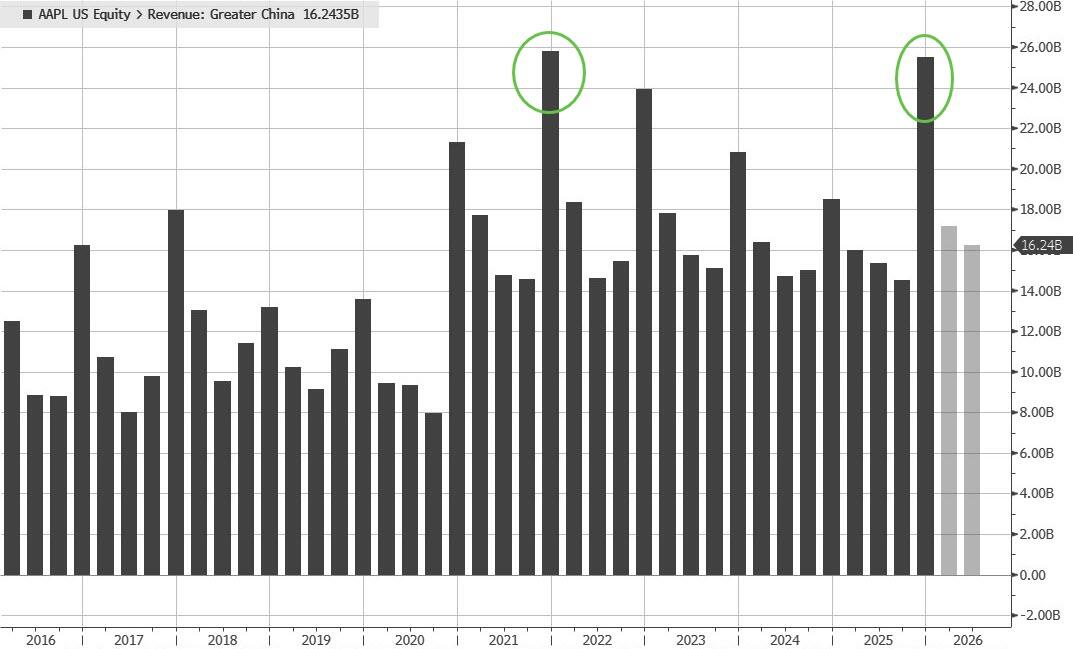
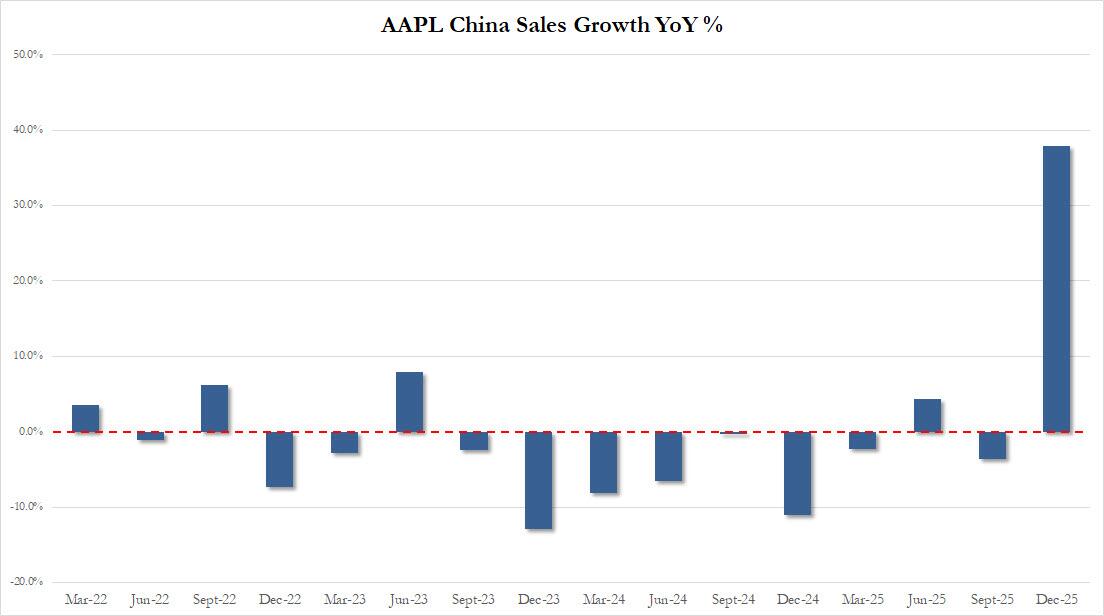
Greater China rev. $25.53 billion, +38% y/y, smashing estimate $21.82 billion
Yes: it was all about China, because while sales in the US actually missed, it was that country where no number is ever cooked – pardon the pun – where revenues (mostly iPhone revenues) grew a stunning 38% to $25.53bn, smashing estimates of a $21.82bn number…
… yet which in context seems very, very fishy, and makes one wonder if Cook cooked numbers with Xi’s help.
Going down the income statement:
Total operating expenses $18.38 billion, +19% y/y, above estimate $18.18 billion
Research and development operating expenses $10.89 billion, +32% y/y, above estimate $10.14 billion
SG&A operating expense $7.49 billion, +4.4% y/y, below estimate $8.03 billion
Gross margin $69.23 billion, +19% y/y, beating estimate $65.5 billion
Cash and cash equivalents $45.32 billion, +50% y/y, below estimate $49.73 billion
Some more details from the press release:
Installed Base Now Has More Than 2.5B Active Devices
Declares A Cash Dividend of $0.26 Per Share
Generated Nearly $54 Billion in Operating Cash Flow
Declared A Cash Dividend of $0.26 Per Share
Yet while the stocks spiked sharply higher on the news of the massive iPhone revenue beat, it has since faded much of the move once again, perhaps as investors inquire what the revenue/margin hit to iphone will be from buying RAM memory which has triple in price in recent weeks.
Tyler Durden
Thu, 01/29/2026 – 17:04

As Indiana legislature hits halfway point, bills advance quickly
The Indiana legislative session has almost reached the halfway point with major bills advancing at quick pace this week and shifting from one chamber to the other for consideration.
The Senate concluded its session Thursday with all bills on third reading passing. The House took the day off Monday, due to the inclement weather, so its deadlines for second reading approval was moved to Thursday and third reading approval was moved to Monday.
Any bills that haven’t been heard to this point won’t be heard in the rest of the session, though legislators could try to offer portions of their bills as amendments to existing bills before the session adjourns at the end of February.
Electric bill affordability
House Bill 1002 passed the House in an 89-4 vote Wednesday afternoon. State Rep. Alana Shonkwiler, R-Noblesville, authored the legislation, which offers solutions to rising electricity bills statewide.
If the bill passes the Senate, all residential ratepayers will be placed on budget billing plans on July 1 and utilities will be prohibited from disconnecting low-income customers’ services during periods with extreme heat warnings. House Bill 1002 also ties utility profits to performance metrics, including affordability and service restoration. Utilities will also use a three-year rate plan, which Shonkwiler said “provides predictability for the utility customer and the utility.”
“The core of House Bill 1002 is simple,” Shonkwiler said. “Utility regulation should reward performance that benefits Hoosiers and correct performance that does not.”
Doxing
A bill criminalizing doxing passed 44-0 in the Senate Monday and heads to the House for consideration.
Doxing is when a person who knowingly or intentionally posts information, like an address or phone number, of a targeted person in retaliation. Under Senate Bill 140, authored by State Sen. Vaneta Becker, R-Evansville, doxing will become a Class A misdemeanor and a Level 6 felony if the posting of the personal information results in the targeted person or someone closely connected to the person suffering serious injury. It would rise to a Level 5 felony if the targeted person experienced catastrophic injury or death.
State Sen. Aaron Freeman, R-Indianapolis, said the bill increases the penalty for the “new crime” of doxing from a misdemeanor to a felony. Freeman amended the bill on second reading to include language about intent “to simply make that the crime” when it comes to doxing.
In November, Senate Pro Tem Rodric Bray, R-Martinsville, announced he would cancel an early December session to take up mid-census redistricting because the chamber did not have the votes to pass the measure.
Two days after the cancellation announcement, President Donald Trump issued a statement on his social media site Truth Social calling out “RINO” Bray and Greg Goode, R-Terre Haute, “for not wanting to redistrict their state, allowing the United States Congress to perhaps gain two more Republican seats.”
Hours after Trump posted his comment, Goode received a false swatting call. After Organization Day, when the Senate voted to reconvene in January, at least seven more State Senators — Dan Dernulc, Spencer Deery, Rick Niemeyer, Kyle Walker, Greg Walker, Linda Rogers and Andy Zay — received swatting calls.
Ultimately, the Indiana legislature met in early December to take up redistricting. The measure passed the House, but failed in the Senate.
Indiana Crime Guns Taskforce
Senate Bill 148, authored by State Sen. Rodney Pol Jr., D-Chesterton, would add Porter and LaPorte counties to the Indiana Crime Guns Taskforce, which was created during the 2021 legislative session and currently has 10 county members.
The bill was amended in the appropriations committee to state that both counties would be added to the task force July 1, 2027.
The Senate approved the bill Tuesday, 46-0. The bill moves forward to the House.
In a statement after the bill passed, Pol said northwest Indiana’s proximity to Chicago as a reason to add Porter and LaPorte counties to the task force.
“Keeping our communities safe is a top priority,” Pol said in the statement. “Adding Porter and LaPorte counties to the Indiana Crime Guns Taskforce will provide law enforcement with more tools to solve crimes and strengthen public safety.”
Carbon sequestration
During Thursday morning’s session, Indiana senators passed legislation by state Sen. Rick Niemeyer, R-Lowell, that would place local regulations on carbon sequestration projects. Senate Bill 7 would require a carbon storage operator to receive approval from a county legislative body or plan commission if the sequestration project would transport or store carbon dioxide outside the county where it’s generated.
Various county commissioners have supported the bill, praising its ability to create more local control. Oil and gas advocates have said local governments don’t have the necessary expertise of carbon sequestration to make these decisions.
“If you have a carbon sequestration project in your own county, and it’s all planned in your county and on that footprint, (this bill) doesn’t apply to them,” Niemeyer said.
Encouraging new housing
A bill aimed at loosening local zoning guidelines to encourage new housing starts passed the Indiana House Tuesday, 76-15.
The bill, a House Republican priority for this session, addresses long permitting processes, zoning restrictions, and minimum parking requirements.
State Rep. Doug Miller, R-Elkhart, the bill author, said the goal is to expand the state’s housing supply and decrease the cost of homeownership by rolling back costly regulations that impede development.
When the bill was heard in the House Local Government Committee, Amy Krieg, government affairs director with Accelerate Indiana Municipalities, said the organization has concerns with the bill because it “extends beyond setting statewide guardrails into areas that remove local decision making in ways that have unintended consequences,” Krieg said.
Merging townships
The Indiana House will soon hear a bill that aims to merge townships statewide after it passed the Senate this week.
State Sen. Rick Niemeyer, R-Lowell, authored Senate Bill 270, which would require the Indiana Department of Local Government Finance to compile data on each township, except those in Marion County, by Dec. 31. The merit and data-driven plan will help merge townships statewide.
The bill passed in a 39-9 vote, and state Rep. Hal Slager, R-Schererville, will be the House sponsor.
According to the bill, the department will assign points to each township, and one with at least four points would merge with one that has less than four points. The department will assign points for various reasons, including if a township did not provide assistance in 2023 or 2024, if it doesn’t manage fire protection or emergency medical services on Jan. 1, 2025, or if it didn’t file an annual finance report to the State Board of Accounts in 2023 or 2024.

Ghislaine Maxwell Cites Dozens Of Men In Alleged Epstein ‘Secret Settlements’
Ghislaine Maxwell Cites Dozens Of Men In Alleged Epstein ‘Secret Settlements’
Authored by Luis Cornelio via Headline USA,
Convicted felon Ghislaine Maxwell claimed in December that at least 25 men with ties to Jeffrey Epstein entered “secret settlements” to serve charges over their alleged role in the late sex offender’s crimes.
Maxwell made the claim in a petition for a writ of habeas corpus filed on Dec. 17 in the U.S. Southern District of New York, according to Courthouse News.
She is serving a 20-year sentence for her role in Jeffrey Epstein’s sex-trafficking operation and is seeking to void her conviction.
Her filing comes amid renewed scrutiny surrounding the pending release of Epstein-related documents.
The petition references four alleged “co-conspirators” and 25 additional men who were never indicted despite, according to Maxwell, being similarly implicated in the crimes.
She said the government’s purported failure to charge those individuals showed she was selectively prosecuted.
In the filing, Maxwell acknowledged that a defendant moving to dismiss for selective prosecution “bears the heavy burden of establishing” that others similarly situated were not prosecuted for the same conduct while she was singled out, and that the government’s decision was discriminatory or made in bad faith.
“None of the 4 named co-conspirators or the 25 men with secret settlements were indicted,” Maxwell wrote.
Maxwell claimed the existence of the 25 men emerged through government disclosures and civil litigation materials that were never provided to her defense.
“New evidence reveals that there were 25 men with which the plaintiff lawyers reached secret settlements – that could equally be considered as coconspirators,” she added. “None of these men have been prosecuted and none has been revealed to Petitioner; she would have called them as witnesses had she known.”
Maxwell further alleged that her indictment followed Epstein’s 2019 death in federal custody and was driven by political expediency.
“New evidence reveals the reason why the Petitioner was indicted after having not been named and included in any of the earlier criminal indictments against Epstein or the Palm Beach Police Investigation, simply put it was for expediency and purely political motives following the death of Jeffrey Epstein in the care custody and control of the US Government,” she claimed.
Tyler Durden
Thu, 01/29/2026 – 17:00

Michigan City man gets 70 years for killing roommate in Gary apartment
A Michigan City man was sentenced to 70 years Thursday for beating his roommate to death with a sledgehammer at the Willows apartments in Gary.
Judge Samuel Cappas sentenced Jeremy Worley, 50, to 64 years for murder and an agreed 6-year term for a habitual offender enhancement. A jury convicted him in November for the Feb. 4 or Feb. 5, 2024, death of Deon Perry, 60, of Gary.
He said he would appeal.
Perry was “loved by many,” his son said in a letter read by Deputy Prosecutor Kasey Dafoe. “He never met a stranger.”
He asked for a maximum sentence.
Dafoe said Worley should go to prison, citing Perry’s advanced age and partial physical limitations as aggravating factors. There was no provocation and Worley was seen on the security camera the next morning throwing out a garbage bag with a bleach bottle, she said. It had his DNA, according to court records.
Defense lawyer Derrick Julkes said Worley fell into substance abuse at an early age.
He drank alcohol at 12 and was using cocaine by 15. Throughout his life, he managed to get sober for only four years, then relapsed due to “life stresses” and family deaths.
Both Worley and Perry used drugs, he argued.
Any prison term was “likely going to be a death sentence,” he said.
“I don’t think he’s a violent person, a bad person,” the lawyer said. If he survives prison, he would work to improve himself and be a better person.
Dafoe countered that half of his eight felony convictions involved violence and he had “35 years” to seek drug treatment.
In court, Worley offered his condolences to Perry’s family.
Cappas noted Perry’s death was “violent.” Worley was in the apartment for at least 12 hours after his death. Police found evidence he tried to clean the apartment, then fled Gary.
Gary police responded Feb. 5, 2024, to the apartment on the 400 block of Clark Road.
Perry’s sister Jetonne Whitehead last saw him around 11 a.m. Feb. 4 when she picked up his laundry. When she called back at 7 p.m., his roommate “Jay” answered Perry’s phone, claimed he was asleep and “would take care of him.”
The next morning, on Feb. 5 at 8 a.m., when she called, no one answered. She went back to drop off the laundry. She found Perry’s body on the bedroom floor. A sledgehammer was nearby. The apartment was “ransacked.”
Security footage from the apartment building showed a man, later identified as Worley, going into the unit around 9:38 a.m. with a garbage bag and suitcase, the affidavit states.
He was later seen throwing the garbage bag over a fence by 5th Avenue and Clark Road into a vacant lot. Police later found Perry’s pill bottle, a bloody bleach bottle and bloody medical pads.
Perry loved “fast cars,” singing, and was “somewhat of a ladies’ man,” according to his obituary. He “always had a smile on his face” and loved making people laugh. He is survived by six children.
At trial, Whitehead testified her brother had potential diabetes complications. He was blind in one eye and had neuropathy in his feet. He struggled to walk sometimes and sleep.
Post-Tribune archives contributed.
mcolias@post-trib.com

Trump’s border czar suggests a possible drawdown in Minnesota, but only after ‘cooperation’
MINNEAPOLIS — The Trump administration could reduce the number of immigration enforcement officers in Minnesota, but only if state and local officials cooperate, the president’s border czar said Thursday, noting he has “zero tolerance” for protesters who assault federal officers or impede the ongoing Twin Cities operation.
Tom Homan addressed reporters for the first time since the president sent him to Minneapolis following last weekend’s fatal shooting of protester Alex Pretti, the second this month by federal officers carrying out the operation. His comments came after President Donald Trump seemed to signal a willingness to ease tensions in the Minneapolis and St. Paul area and as the administration ended its “enhanced operations” in Maine.
Homan, who said he wouldn’t address the shootings, emphasized that the administration isn’t relenting on its immigration crackdown and warned that protesters could face consequences if they interfere with federal officers.
But he seemed to acknowledge there had been missteps.
“I do not want to hear that everything that’s been done here has been perfect. Nothing’s ever perfect,” he said.
A possible downsizing
Homan hinted at the prospect of pulling out many of the roughly 3,000 federal officers taking part in the operation, but he seemed to tie that to cooperation from state and local leaders and a reduction in protester interference.
“The drawdown is going to happen based on these agreements,” he said. “But the drawdown can happen even more if the hateful rhetoric and the impediment and interference will stop.”
He also said he would oversee internal changes in federal immigration law enforcement, but he gave few specifics.
“The mission is going to improve because of the changes we’re making internally,” he said. “No agency organization is perfect. And President Trump and I, along with others in the administration, have recognized that certain improvements could and should be made.”
Minneapolis Mayor Jacob Frey told reporters in Washington on Thursday he was “hopeful” that the number of federal officers in the city would be reduced. He said police would do their jobs but not “somebody else’s,” referring to federal law enforcement.
Despite Trump softening his rhetoric about Minnesota officials — he said this week they were on a “similar wavelength” — there has been no visible sign of any big changes to the operation. On Thursday, as the Justice Department charged a man accused of squirting vinegar on Democratic Rep. Ilhan Omar, a smattering of protesters braved the frigid temperatures to demonstrate outside of the federal facility that has been serving as the operation’s main hub.
Pretti, 37, was fatally shot Saturday during a scuffle with the Border Patrol. Earlier this month, 37-year-old Renee Good was shot in her vehicle by an Immigration and Customs Enforcement officer.
A plea for cooperation
Homan doubled down on the need for jails to alert ICE to inmates who could be deported, saying transferring such inmates to the agency is safer because it means fewer officers have to be out looking for people in the country illegally.
The White House has long blamed problems arresting criminal immigrants on so-called sanctuary jurisdictions, a term generally applied to state and local governments that limit law enforcement cooperation with the Department of Homeland Security.
Homan reiterated that, saying, “Give us access to illegal aliens, public safety threats in the safety and security of a jail.”
But Minnesota officials say this is already happening.
“At best, DHS fundamentally misunderstands Minnesota’s correctional system,” Paul Schnell, chief of the state Department of Corrections, told reporters last week, pushing back against the federal narrative. “At worst, it is pure propaganda.”
State prisons, he noted, always honor “detainers,” or federal requests to hold an arrested immigrant until agents can take custody of them.
“This occurs every time without exception,” he said, noting that “the vast majority,” of the state’s county sheriffs also cooperate with immigration authorities about immigrants in their jails.
Some do not, including the jails in Hennepin County, which serves Minneapolis, and Ramsey County, which serves St. Paul. However, both do hand over inmates to federal authorities if an arrest warrant has been signed by a judge.
A targeted approach to arrests
Homan, whose arrival followed the departure of the Trump administration’s on-the-ground leader of the operation, Border Patrol chief Greg Bovino, also seemed to suggest a renewed focus on what ICE calls “targeted operations” focused on apprehending immigrants who have committed crimes. He said the agency would conduct “targeted strategic enforcement operations” prioritizing “public safety threats.”
It remains to be seen whether ICE’s renewed focus on “targeted operations” might reduce tensions.
ICE and Homan have long said the Trump administration’s primary focus is to arrest people in the country illegally who have a criminal history or pose a threat to public safety. But they acknowledge they’ll also arrest anyone else found to be in the U.S. illegally.
They argue that ICE operations target specific people, as opposed to carrying out indiscriminate raids where officers round up everyone and demand their papers.
Sameera Hafiz, policy director with the Immigrant Legal Resource Center, said Homan’s comments seemed to reflect a recognition that public opinion has turned against ICE, but she questioned his argument that carrying out targeted operations would make the country safer.
“His comments still seem to be based on the false premise that deporting people or deportation will make our community safer,” she said. “All the evidence and data has shown that deportations don’t make our communities safer. They destabilize families, they tear communities apart, they hurt our economy.”
Homan didn’t give a specific timeline for how long he would stay in Minnesota.
“I’m staying until the problem’s gone,” he said, adding that he has met with community, law enforcement and elected leaders in the hopes of finding common ground and suggested that he’s made some progress.
Santana reported from Washington. Associated Press reporters Tim Sullivan in Minneapolis, Mike Catalini in Trenton, New Jersey, and Steven Sloan in Washington contributed.
https://www.chicagotribune.com/2026/01/29/minnesota-immigration-crackdown-border-czar-tom-homan/

Chicago Bears guard Joe Thuney among 6 finalists for inaugural NFL Protector of the Year award
Chicago Bears guard Joe Thuney is one of six finalists for the inaugural NFL Protector of the Year award.
The new award, which will be handed out at the NFL Honors ceremony Feb. 5, will be given annually to the league’s best offensive lineman as decided by a panel of former All-Pro offensive linemen.
Along with Thuney, the finalists for the 2025 award are Denver Broncos tackle Garett Bolles and guard Quinn Meinerz, Miami Dolphins center Aaron Brewer, Kansas City Chiefs center Creed Humphrey and Detroit Lions tackle Penei Sewell.
Thuney started all 17 regular-season games for the Bears at left guard. In the playoffs, he made the transition to left tackle for the divisional-round loss to the Los Angeles Rams after starting left tackle Ozzy Trapilo suffered a season-ending knee injury.
Thuney was a first-team All-Pro and a Pro Bowl selection in 2025. This was his fifth All-Pro season and his third time making first-team All-Pro.
The Bears traded for Thuney in March, one of three moves they made to rework the interior of their offensive line along with trading for right guard Jonah Jackson and signing free-agent center Drew Dalman.
Thuney, 33, won two Super Bowls each with the New England Patriots and Kansas City Chiefs. He gave the Bears a veteran presence they hadn’t had on the offensive line in recent years, and his teammates voted him a team captain in his first season in Chicago.
After overhauling the offensive line, the Bears ranked third in the league in rushing, and quarterback Caleb Williams was sacked 24 times after taking a league-high 68 sacks in 2024.
The Bears should have some needed continuity, too, because all five starting offensive linemen are under contract for next season — although general manager Ryan Poles said last week that Trapilo’s rehab process is likely to go “deep into next year.”
“Proud of the way that they moved this year,” Poles said of his offensive linemen. “(I) look forward to them getting back to work and continuing to improve.”
Thuney has appeared in 163 regular-season games over his 10-year career, missing just two starts. Not long after trading for him, the Bears signed Thuney to a two-year contract extension that keeps him under team control through the 2027 season.
Among the six nominees for Protector of the Year, Bolles, Thuney, Humphrey, Meinerz and Sewell were all first-team All-Pro selections. Brewer was a second-team All-Pro.
Criteria for the award include advanced metrics, durability, quality of competition, weekly consistency and video evaluation.
The NFL Honors ceremony, held annually during Super Bowl week, typically has not featured many offensive linemen. No offensive lineman has ever won the MVP or Offensive Player of the Year awards.
“The offensive line carries the weight of the game,” NFL executive vice president of football operations Troy Vincent Sr. said in a statement announcing the finalists. “Durability, endurance, leadership and consistency define their work, even when the spotlight rarely finds them. Protector of the Year is about recognizing the vital role these tremendous athletes play and celebrating excellence where it starts, up front.”
https://www.chicagotribune.com/2026/01/29/chicago-bears-joe-thuney-protector/
Venezuela aprueba flexibilizar control estatal de industria petrolera, un cambio significativo del gobierno socialista
CARACAS (AP) — Venezuela aprueba flexibilizar control estatal de industria petrolera, un cambio significativo del gobierno socialista.

Cook County loses road money suit as judge rules $243 million misspent
A circuit court judge ruled this week that Cook County had misspent hundreds of millions of transportation dollars, a win for the trade association representing construction firms statewide.
Judge Alison Conlon ordered Wednesday that the county’s use of $243 million in transportation tax revenues during the 2023 fiscal year violated the Safe Roads Amendment to the state constitution. The county unsuccessfully argued it could spend the tax dollars on other expenses tied to enforcing the rules of the road at offices like the sheriff, state’s attorney, public defender and circuit court clerk.
The Illinois Road and Transportation Builders Alliance, a trade group representing construction, design and maintenance firms, originally filed suit in 2018 opposing that policy. They hoped to bar the county from using tax revenues it expected to collect from gas, parking lots, garages, and car purchases on anything but direct transportation projects. The county’s diversion of those dollars threatened their livelihoods, they argued.
In a Wednesday interview, John Fitzgerald, the attorney for IRTBA, declared the order “a total and absolute victory” that “shows the county never even came close to meeting its constitutional obligation to spend these transportation funds” in line with the Safe Roads amendment. “It is a victory not just for the roadbuilders but for everyone who uses roads, streets and public transit in Cook County.”
Illinois voters overwhelmingly approved the so-called “lockbox amendment” mandating transportation-related revenues be spent only for transportation-related purposes in 2016. Backers said it was necessary to ensure Illinois governments were building and maintaining road and railway infrastructure. Critics said the language was too vague, potentially exacerbating budget problems by making certain revenues too inflexible.
Cook County Board President Toni Preckwinkle speaks, Dec. 14, 2022 during an event at the National Hellenic Museum to celebrate the completion of construction on the Jane Byrne Interchange. (Brian Cassella/Chicago Tribune)
In an emailed statement, Cara Yi, spokeswoman for Cook County Board President Toni Preckwinkle, said the county was “disappointed” with the ruling and had budgeted in good faith.
“The County remains committed to Safe Road Amendment compliance and utilizing the Transportation Fund to address all expenses allowable under the Amendment,” Yi said.
Even Conlon acknowledged the county’s efforts weren’t “unreasonable, given the relative lack of clarity of the Amendment’s application to the County budget.”
Cook County initially argued that as a “home rule” unit of government, it was essentially exempt, but the Supreme Court decided against them in 2022.
After that, the county came up with a methodology to justify spending a percentage of transportation tax dollars at several public safety departments, a process that included sampling how many young people were in the detention center for road violations, the number of state’s attorney investigations related to traffic offenses, and the number of rules of the road cases going through the clerk and courts compared to the offices’ overall caseload.
In court in September, Conlon worried aloud that under that methodology, the county would have to give “under-the-hood” guidance every budget year to ensure it was compliant with the lockbox amendment.
“Whatever the county can get from this court that will instruct us as to what is or is not a direct program expense relating to enforcement of the rules of the road will be extremely helpful,” county attorney David Morrison said then.
To Fitzgerald’s surprise, the judge did not grant that kind of budgetary wiggle room, instead finding every “single penny” IRTBA challenged was ineligible.
““Borrowing from the Appellate Court’s analogy, this Court ‘look[ed] under the hood’ at trial. While some components of the car may be operational, the Court found certain mechanical defects which prevent the car from running,” Judge Conlon wrote.
But Conlon didn’t grant IRTBA a permanent injunction banning future diversions of transportation tax revenue. She said the believed the county when it pledged in court to comply with her ruling.
The county did partially plan for a legal loss in this year’s budget. It took $179 million from its reserves to pay for “public safety expenses that are no longer allowable” under the safe roads amendment. But it set aside another $70 million in transportation dollars for public safety offices anyway in the hopes that the judge would agree with their methodology.
Asked what the county would do with that $70 million, Yi said officials were evaluating “next steps.”
“It is important to note that the County has emerged as a regional transportation leader with a focus on equitable transportation investment,” Yi said in her statement, including spending $1.36 billion on multimodal projects; securing hundreds of millions in grant funding for roadway, bike and transit improvements; and helping pass last year’s massive transit reform bill.
Asked whether IRTBA might use this case to go after other cities, counties or villages, CEO Mike Sturino suggested they didn’t need to. “Everyone we’ve looked at from city of Chicago to townships downstate have been in complete compliance. No one has attempted to thumb their nose the way Cook County has done.”