Category: News

“Clueless”, “Karate Kid” e “Inception” ingresan al Registro Nacional de Cine
Por JOCELYN NOVECK
Imposible dejar a “Clueless” (“Ni idea”) fuera de la lista.
Fans de Cher Horowitz, regocíjense: la comedia adolescente de 1995 de Amy Heckerling es una de las 25 películas clásicas elegidas este año por la Biblioteca del Congreso para su Registro Nacional de Cine.
Y si “Clueless” no era lo tuyo — ¡lo que sea! — tal vez esto te lleve a lo más profundo de tus sueños: “Inception” (“El origen”), la película de Christopher Nolan que desafía la mente, está en la mezcla. Otras películas elegidas para su preservación incluyen “The Karate Kid”, “Glory” (“Tiempos de gloria”), “Philadelphia” (“Filadelfia”), “Before Sunrise” (“Antes del amanecer”), “The Incredibles” (“Los Increíbles”) y “Frida” sobre la pintora mexicana Frida Kahlo, protagonizada por Salma Hayek. Hay cuatro documentales, incluyendo “Brooklyn Bridge” de Ken Burns. Del viejo Hollywood, está el musical de 1954 “White Christmas” (“Blanca navidad”) y “High Society” (“Alta sociedad”) de 1956, la última película de Grace Kelly antes de volverse miembro de la realeza.
Desde 1988, la Biblioteca del Congreso ha seleccionado 25 películas cada año para su preservación debido a su “importancia cultural, histórica o estética”. Las películas deben tener al menos diez años de antigüedad.
La más antigua de las selecciones de 2025 data de 1896, “The Tramp and the Dog” del cineasta William Selig. La más nueva del grupo es de 2014: “The Grand Budapest Hotel” (“El gran hotel Budapest”) de Wes Anderson, que, según el registro, involucró “una meticulosa investigación histórica en la Biblioteca del Congreso para crear escenarios visualmente impactantes”.
Turner Classic Movies presentará un especial de televisión el 19 de marzo para proyectar una selección de las películas.
A continuación, un vistazo a algunas de las selecciones de este año:
“The Tramp and the Dog” (1896): Alguna vez se consideró perdida, pero fue descubierta en 2021 en la Biblioteca Nacional de Noruega, la película muda de Selig cuenta la historia de un vagabundo que intenta robar un pastel de un rebajo en un patio trasero, y es frustrado por un perro. El registro señala que es un ejemplo temprano de “humor de pantalones” — “donde un personaje pierde (o casi pierde) sus pantalones durante un altercado”.
“The Maid of McMillan” (1916): Esta película muda de 15 minutos, un “romance mudo caprichoso” filmado por estudiantes de un club de teatro en la Universidad de Washington en St. Louis, cuenta la historia del capitán del equipo de atletismo, Jack, que está enamorado de Myrtle, “una bonita estudiante”, según la biblioteca de la universidad. Se conoce, dice el registro, como la primera película estudiantil registrada.
“Ten Nights in a Barroom” (1926): Una película muda con un elenco completamente afroestadounidense, está basada en un melodrama teatral adaptado de “Ten Nights in a Bar-room and What I Saw There”, una “novela de templanza” de 1854 escrita para disuadir a los lectores de beber alcohol.
“High Society” (1956): En lo que el registro llama “el último gran musical de la Edad de Oro de Hollywood”, Bing Crosby actúa junto a Frank Sinatra y Grace Kelly, quien se encontraba en su última película antes de retirarse y casarse con el Príncipe Rainiero de Mónaco. Louis Armstrong aparece con su banda. Kelly usó su anillo de compromiso de Cartier durante el rodaje, señala el registro.
“Brooklyn Bridge” (1981): El primer documental de Ken Burns transmitido en PBS, en el que el cineasta relató la construcción de ese famoso puente monumento. “Más que un cineasta, Burns se ha convertido en un historiador público de confianza”, dice el registro.
“The Big Chill” (“Reencuentro”) de 1983: La historia definitoria de la era de Lawrence Kasdan sobre un grupo de amigos que se reúnen después de un suicidio presenta a Glenn Close, William Hurt, JoBeth Williams, Kevin Kline, Jeff Goldblum y Meg Tilly en un conjunto que “retrata estereotipos estadounidenses de la época — el yuppie, el traficante de drogas, la estrella de televisión — y los humaniza hábilmente”.
“The Karate Kid” (1984): La primera película de la franquicia, protagonizada por Ralph Macchio y Pat Morita, es “tan estadounidense como se puede”, dice el registro — “un viaje del héroe, una película deportiva y una película adolescente — una película edificante, pero no sin garra”.
“Glory” (1989): Denzel Washington ganó un Oscar como el Soldado Trip en esta historia del 54º Regimiento, una unidad de soldados afroestadounidenses que lucharon en la Guerra Civil. El elenco también incluye a Morgan Freeman, Matthew Broderick, Cary Elwes y Andre Braugher.
“Philadelphia” (1993): Tom Hanks protagonizó — y ganó un Oscar — en una de las primeras grandes películas de estudio en enfrentar la crisis del VIH/SIDA. La película también es conocida por la canción ganadora del Oscar de Bruce Springsteen, “The Streets of Philadelphia”.
“Before Sunrise” (1995): La primera película de la profundamente romántica trilogía “Before” de Richard Linklater, protagonizada por Ethan Hawke y Julie Delpy. El registro destaca el “uso innovador del tiempo como una herramienta cinematográfica definitoria y recurrente” de Linklater.
“Clueless” (1995): La comedia adolescente de Heckerling, protagonizada por Alicia Silverstone, es una adaptación libre de “Emma” de Jane Austen y consagró para siempre la frase “¡As if!” (podría traducirse como ‘ni en tus sueños’) en la cultura popular. El registro celebra “su dinamismo en pantalla colorido, enérgico y centrado en la banda sonora de los años 90”.
“The Wrecking Crew” (2008): El documental de Danny Tedesco — no debe confundirse con la película de compañeros policías de 2026 del mismo nombre — examina a un grupo de músicos de estudio de Los Ángeles que tocaron en canciones exitosas de los años 60 y 70 como “California Dreamin’” y “The Beat Goes On”.
“Inception” (2010): En una película que pregunta si es posible influir en los pensamientos de una persona manipulando sus sueños, Nolan “una vez más desafía a las audiencias con múltiples capas narrativas interconectadas mientras ofrece emocionantes secuencias de acción y efectos visuales impresionantes”.
Lista completa de los filmes incorporados al Registro Nacional de Cine de 2025
“The Tramp and the Dog” (1896)
“The Oath of the Sword” (1914)
“The Maid of McMillan” (1916)
“The Lady” (1925)
“Sparrows” (1926)
“Ten Nights in a Barroom” (1926)
“White Christmas” (1954)
“High Society” (1956)
“Brooklyn Bridge” (1981)
“Say Amen, Somebody” (1982)
“The Thing” (1982)
“The Big Chill” (1983)
“The Karate Kid” (1984)
“Glory” (1989)
“Philadelphia” (1993)
“Before Sunrise” (1995)
“Clueless” (1995)
“The Truman Show” (1998)
“Frida” (2002)
“The Hours” (2002)
“The Incredibles” (2004)
“The Wrecking Crew” (2008)
“Inception” (2010)
“The Loving Story” (2011)
“The Grand Budapest Hotel” (2014)
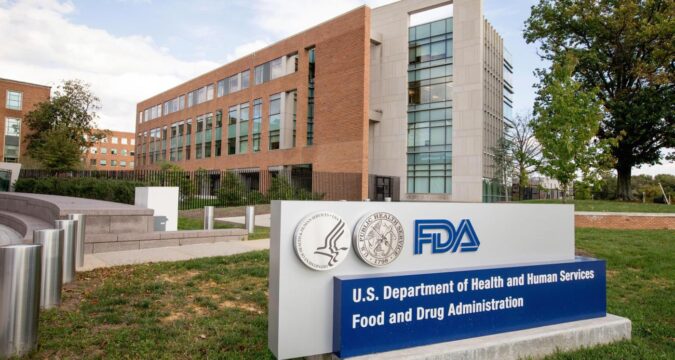
FDA issues recall for multiple products, including Cheerios, Advil and Nutella, after rodent and bird droppings found at distribution facility
CLEVELAND, Ohio – A massive food and product recall has been initiated because of the presence of rodent and avian contamination, according to the U.S. Food and Drug Administration.
Gold Star Distribution Inc. is recalling multiple FDA-regulated products, including Cheerios, Advil, Nutella, Mazola Corn Oil and many others. They are listed in this 44-page document at fda.org.
Persons handling or consuming the products could become seriously ill. The FDA determined the facility was operating under unsanitary conditions, including the presence of rodent excreta and bird droppings in areas where food (human and pet), medical devices, drugs and cosmetic products were held.
The products were distributed primarily to stores in Minnesota, where the company is based.
No illnesses have been reported to date. According to the FDA, consumers and retailers who purchased the affected products should destroy them. They should verify such destruction by receipt provided to Gold Star at 1000 N. Humboldt Ave., Minneapolis, Minnesota, 55411. Products should not be shipped back to Gold Star. The company will provide refunds upon request.
Contact Gold Star at 612-617-9800 from 9 a.m. to 6 p.m. seven days a week. Adverse reactions or quality problems experienced with the use of the product may be reported to the FDA’s MedWatch Adverse Event Reporting program online, by mail or by fax. Go to fda.gov or call 800-332-1088.
For details on recalls and food-safety questions, call the USDA meat and poultry hotline, 888-674-6854 or chat via Ask USDA 10 a.m. to 6 p.m. weekdays. Consumers can email questions to MPHotline@usda.gov. For those who need to report a problem with a meat, poultry or egg product, the electronic consumer-complaint monitoring system is online. Recalls are posted online.
https://www.chicagotribune.com/2026/01/29/fda-recall-cheerios-advil-nutella/

Fire in outdoor garbage bin spreads to Naperville house, causes $100,000 in damage
A Naperville house was deemed uninhabitable Thursday after a fire in an outdoor garbage container spread to the structure’s exterior, officials said.
Firefighters arrived about 11:40 a.m. to find the home in the 1800 block of Paxton Drive “actively burning, with flames extending into the attic area,” a Naperville Fire Department news release said.
The home’s only occupant exited without injury before the fire department arrived. No other injuries were reported.
Two dozen fire personnel and 10 pieces of fire apparatus were dispatched to the scene and extinguished the blaze in less than 10 minutes. The fire was found to be accidental, with damage estimated at more than $100,000, the release said.
The Naperville Fire Department was assisted by the Naperville Police Department, Lisle Woodridge Fire District, Aurora Fire Department, Naperville Electric Department and the Naperville Transportation, Engineering and Development department.
https://www.chicagotribune.com/2026/01/29/naperville-house-fire-garbage-container/

Tucker Carlson Accuses Tim Walz And Jacob Frey Of Orchestrating A ‘Color Revolution’ And Civil War
Tucker Carlson Accuses Tim Walz And Jacob Frey Of Orchestrating A ‘Color Revolution’ And Civil War
Tucker Carlson warns that Tim Walz and Mayor Frey are deliberately fueling chaos to spark a “color revolution.”
He asks:
“Why would a state refuse to protect American citizens from murder, refuse to give the names or whereabouts of murderers and child molesters, and refuse to use its own cops to keep riots under control?
What could possibly be the answer?”
“Because they want riots, that’s why,” Carlson answered.
Tucker Carlson warns that Tim Walz and Mayor Frey are deliberately fueling chaos to spark a “color revolution.”
He asks: “Why would a state refuse to protect American citizens from murder, refuse to give the names or whereabouts of murderers and child molesters, and refuse to… pic.twitter.com/yWu9OgWREa
— Vigilant Fox 🦊 (@VigilantFox) January 28, 2026
Carlson calls out Democratic party officials’ actions directly:
“What you’re watching are the beginnings of a color revolution, of a kind of insurrection against federal authority. And what you have to ask yourself…
Can you live with that?
Can you live in a country of 50 states that don’t agree on what the federal law should be and that allow Americans to get murdered in their cities because they have the wrong politics or they work for a politician they disapprove of?”
The drops the hammer:
“And if you are okay with that, have you thought through its implications? The number one implication is the country will fall apart. That’s civil war. It’s the definition of it.”
“You have regions and internal government states that don’t recognize federal authority, the authority of a government over them all, of Washington.
“And at that point, what you have is warring nations within the same borders. And then you have widespread violence, then you have killing at scale, then you have civil war.”
Is this really what they want?
Tyler Durden
Thu, 01/29/2026 – 18:25

“Bananas And Rice” Woman Arrested By DHS For Rioting In Minneapolis
“Bananas And Rice” Woman Arrested By DHS For Rioting In Minneapolis
In an effort to crack down on violent rioters in Minneapolis, MN, federal authorities have arrested 16 people identified as alleged participants who assaulted ICE agents in order to obstruct them from carrying out deportation arrests.
One of the suspects is Nasra Ahmed, 23, of Minnesota, who rose to national notoriety after remarks she made during a Jan. 21 news conference comparing Somali American identity to a cultural mix she described as “bananas and rice,” a phrase that quickly spread across social media.
A child of Somali migrants, Ahmed claimed during a press conference that she had been wrongly detained (kidnapped) by ICE agents simply for being Somali in the vicinity of an ICE operation. She also claimed that she had been held for two days without reason and that agents “brutalized” her and called her “racial slurs” during interrogation. Democrats and the far-left media seized on the story as evidence that ICE was “out of control” and using random “racial profiling” in Minneapolis.
Critics noted that there was no evidence to back Ahmed’s claims of abuse and that she seemed to be very excited to become the center of media attention, suggesting that she was going to “go down in history” for standing up to ICE. Immigration officials stated that Ahmed was not an innocent bystander and she was, in fact, detained for trying to interfere with an ICE arrest.
Ahmed took to the media stage to wax philosophical about her courageous fight against ICE and what it means to be a Somali in America. “It’s kind of like bananas and rice,” Ahmed said. “People don’t think you can eat bananas with rice, but that’s what it’s like to be Somali and American.”
Her bizarre “bananas and rice” analogy went viral as another example of the low-end IQ standards associated with Somali migrants, coupled with their now legendary overconfidence.
Today, the activist’s bananas and rice are back in hot water after she was arrested again by DHS for alleged participation in violent riots. Nasra Ahmed is charged with spitting on agents, throwing eggs at them and resisting arrest.
Rice and Bananas pic.twitter.com/du8oojETE8
— Jack Posobiec (@JackPosobiec) January 28, 2026
Attorney General Pam Bondi was on the ground in Minneapolis this week to oversee the arrests, largely based on video footage of identified activists engaging in attacks on agents.
“Federal agents have arrested 16 Minnesota rioters for allegedly assaulting federal law enforcement – people who have been resisting and impeding our federal law enforcement rights.”
“We expect more arrests to come,” Bondi added. “I’ve said it before, and I’ll say it again: NOTHING will stop President Trump and this Department of Justice from enforcing the law.”
The crackdown comes after the death of Anti-ICE activist Alex Pretti, who was also misrepresented as a “peaceful protester” by the media, only to be later exposed in video footage participating in violent attacks on ICE agents in the days leading up to the confrontation that ended in his shooting.
The pattern is becoming rather obvious: Activists and paid agitators interfere with ICE arrests (often violently). Activists face consequences. Journalists and Democrats cry foul and claim they were poor innocent victims. Then, new information comes to light which ultimately reveals the activists were not innocent at all.
The political left jumps on the headlines to spread anti-deportation sentiment, then retracts quietly when these headlines prove to be false. They know that a large percentage of the Democrat base does not independently investigate information and sources and will continue to believe the first media claims they see as if they are a proven fact.
It’s the reason why debating the political left has become a superfluous exercise – They live in an entirely separate and delusional universe based on completely fabricated conclusions.
Tyler Durden
Thu, 01/29/2026 – 18:00
https://www.zerohedge.com/political/bananas-and-rice-woman-arrested-dhs-rioting-minneapolis

Naperville residents receive college/university degrees, named to honor rolls and dean’s lists
The following Naperville residents have completed college/university degrees or have been named to their school’s dean’s list, honor roll or similar academic achievement list.
Names, degrees and honors appear below as provided by the respective schools.
GRADUATIONS
Hofstra University in Hempstead, New York: Lily Hoffman.
Iowa State University in Ames: Sebastian Perez Aburto, bachelor’s degree, Mechanical Engineering; Michael Steven Becker, bachelor’s degree, Cyber Security Engineering; Brandon Bloedorn, bachelor’s degree, Industrial Technology; Nicholas Casamassimo, bachelor’s degree, Supply Chain Management; Ethan Czyzewicz, bachelor’s degree, Aerospace Engineering; Nicholas Hayden Myers, bachelor’s degree, Mechanical Engineering.
Northern Illinois University in DeKalb: Leena Alam, bachelor’s degree, Accountancy; Leena Alam, bachelor’s degree, Political Science; Mihir Barve, master’s degree, Data Analytics; Joshua Bormann, bachelor’s degree, Accountancy; Catherine Fanthorpe, master’s degree, Education;
Allyson Hahn, doctorate, Mathematical Science; Elizabeth Hofemann, bachelor’s degree, Biological Sciences; Ayesha Khan, bachelor’s degree, Computer Science; Ben Kuefler, bachelor’s degree, Sport Management; Jayden Lowe, bachelor’s degree, Environmental Studies; Maegan Miller, bachelor’s degree, Nursing; Jeffrey Northrup, master’s degree, Public Administration; Mark Ragei, master’s degree, Electrical Engineering; Natalie Sayenko, bachelor’s degree, Nursing; Eric Schaschwary, bachelor’s degree, Accountancy; Karen Sung, master’s degree, Education; Peter Wong, master’s degree, Electrical Engineering; Zane Yu, master’s degree, Electrical Engineering; Brian Zhan, bachelor’s degree, Operations & Information Management.
ACADEMIC HONORS
Samford University in Birmingham, Alabama: Phillip Gaponenko, Bridget Bissegger.
University of Central Arkansas in Conway: Anna Jaworski.
Loras College in Dubuque, Iowa: Grace A. Skarbek.
St. Mary’s College in Notre Dame, Indiana: Sophia Bracken, Colleen Considine, Nicole De Guzman, Colleen Kacedan, Alexa Maul, Kailey Nichols, Grace O’Donnell, Allison Perrino, Catherine Rao, Mary Weber, Lauren Wincup.
College of Charleston in South Carolina: Abigail Mogg, Elizabeth Cerney, Sydney Wyllie.
St. Cloud State University in St. Cloud, Minnesota: Chloe Orlow.
Miami University in Oxford, Ohio: Mia Angel, Alexis Gregori, Molly Farrell, Madison Hackett, Maddie Townsend, Allison Schoeck, Lily Snyder, Emily Teets, Sam Johnson, Ryan Callahan, Lara Clifford, Luke Elsea, Libbey Fox, Anthony Galgano, Marilyn Janecek, Audrey Lovick, Kayla McNab, Libby O’Toole, Dominic Sanchez, Blake Stevens, Lauren Malko.
Wabash College in Crawfordsville, Indiana: Ayden Lutes.
South Dakota State University in Brookings: Jackson Kerstin.
Maryland Global Campus in Adelphi, Maryland: Haya Faruqui.
Quincy University in Quincy, Illinois: Kiet Truong.
Roger Williams University in Bristol, Rhode Island: Matthew Doolittle.
University of Wisconsin-Eau Claire: Kendall Lenz, Alex Montana, Madison Nottestad.
Abilene Christian University in Abilene, Texas: Allison Webb, Jacob Rose.
University of Illinois-Springfield: Jayden Dean, Michal Kaczorowski.
University of Illinois-Chicago: Matthew J. Miller.
https://www.chicagotribune.com/2026/01/29/naperville-residents-graduation-deans-list-college/
Perú nombra al brasileño Mano Menezes como técnico de la selección
LIMA (AP) — Mano Menezes, quien dirigió a la selección de Brasil hace 14 años con más pena que gloria, se convirtió el jueves en el nuevo entrenador de la selección de Perú que quedó penúltima en las eliminatorias para el Mundial 2026.
Menezes, quien fue presentado en una conferencia de prensa en Lima, venía de conducir al Gremio de Porto Alegre. Fue una etapa de casi ocho meses en la que el club gaucho terminó noveno en el Campeonato Brasileño, lo que le permitió conseguir una plaza para la Copa Sudamericana 2026.
“Sabemos que los últimos años no han sido tan brillantes en resultados, pero estamos aquí porque podemos hacer algo para retomar ese camino para que Perú vuelva a ser protagonista”, dijo Menezes hablando en portugués. Prometió que “en breve” hablará en español para entenderse mejor con la prensa.
Perú no consiguió un boleto al Mundial 2026 y acabó penúltimo con 12 puntos en las eliminatorias sudamericanas. La Blanquirroja apenas marcó seis goles y encajó 20. No anotó goles de visita.
El técnico de 63 años, llamado Luis Antonio Venker de Menezes, dirigió a Brasil entre 2010 y 2012.
No fue un ciclo de buenos resultados. La Verdeamarela sucumbió por penales ante Paraguay en los cuartos de final de la Copa América de 2011. Fue destituido tras la derrota de la selección Sub23 ante México en la finl de los Juegos Olímpicos de Londres 2012.
Menezes también ha comandado a otros importantes clubes brasileños, incluido Fluminense, Corinthians, Flamengo, Cruzeiro y Palmeiras.
Fuera de Brasil ha entrenado al Shandong Luneng de China y Al Nassr de Arabia Saudí
Los expertos coinciden en que Perú no ha tenido un recambio de jugadores tras clasificarse al Mundial de Rusia 2018, después de 36 años de ausencia, de la mano del argentino Ricardo Gareca. Tras ser eliminada en la primera ronda, el selecciondo logró el segundo lugar en la Copa América 2019.
Tras la salida de Gareca —quien entrenó a Perú por ocho años— la Blanquirroja estuvo dirigida por el peruano Juan Reynoso, el uruguayo Jorge Fossati, el argentino-peruano Óscar Ibáñez y el peruano Manuel Barreto.
___
Deportes AP: https://apnews.com/hub/deportes
Why The Next Recession Will Be The Catalyst For Depression
Why The Next Recession Will Be The Catalyst For Depression
Authored by Charles Hugh Smith via OfTwoMinds blog,
This is why a recession will catalyze a collapse of the credit-asset bubble-dependent economy down to its foundations.
Narrative control works by having a pat answer for every skepticism and every doubt. Boiled down, the dominant narrative holds that the Federal Reserve (central banking) and the central government have the tools to quickly reverse any dip in GDP, a.k.a. recession, and return the economy to expansion.
The unstated foundation of this narrative is that recessions are bad, as only permanent expansion is good. That this isn’t “free market capitalism” doesn’t bother anyone, because the whole point of central banking and government is to eliminate the rough edges of “free market capitalism” with the sandpaper of “state capitalism,” which creates or borrows as much money as needed to smooth over any spots of bother, a.k.a. recessions.
That recessions are essential market dynamics is not part of the narrative, which is conveniently binary: recessions bad, expansion good. Markets reflect human emotions, famously fear and greed, which manifest as debt and speculation, a.k.a. animal spirits: when we’re confident and feeding off an expansion that appears to have no limit, then we borrow more money (debt expands) and “allocate the capital” (i.e. place it at risk to reap a future gain) to increasingly risky speculative investments.
This allocation of borrowed money into speculative assets pushes the price of those assets higher, increasing the collateral to support further borrowing to fund more speculation. In this manner, debt, asset valuations, collateral and speculation all fuel one another in a seemingly endless expansion that makes every participant richer.
This pyramiding of debt and “wealth” generates two self-liquidating dynamics: interest and risk. All debt comes with interest, the compensation due those who put their money at risk by lending it to the borrower. This debt service rises as debt expands, and also as risk increases: the riskier the speculation and the borrower, the higher the interest rate paid by the borrower.
Central banks can play games to reduce interest rates even as risk and interest payment rise, but since central banks own only a fraction of the total outstanding debt, their ability to “corner the market” is nil.
Their gaming the system to enable further expansion of debt and speculation functions not by actually buying up the majority of the new debt, it functions as a signal: the Federal Reserve has our back, they will bail out / recapitalize any lender losses while suppressing interest rates below what the unfettered market would demand, and so the pyramiding of debt, speculation and “wealth” can continue, apparently indefinitely.
But signaling has intrinsic limits, for it doesn’t increase the income needed to service additional debt or guarantee speculations will pay off. These are the Achilles Heels of the central banking perpetual motion machine: for the vast majority of borrowers, both private and public, income doesn’t automatically increase as debt increases. Income is influenced by market factors (supply and demand), technologies, state interventions (subsidies, stimulus spending, etc.) and the expansion or contraction of debt, interest rates and speculative investments.
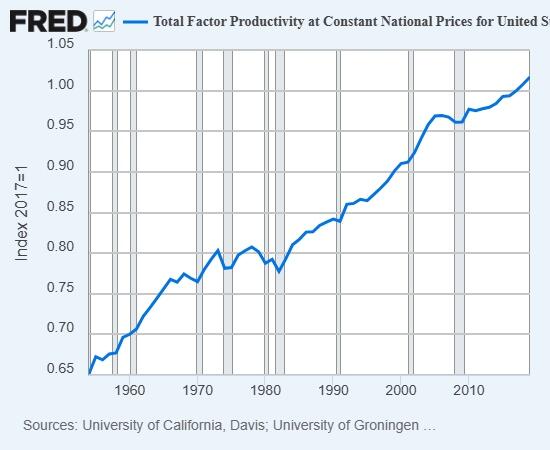
In the total-economy context, what matters are total factor productivity gains and the distribution of those gains to wage earners, enterprises, owners of assets and the state, which collects taxes from all three of the private-sector classes. This distribution changes with social, political and financial tides.
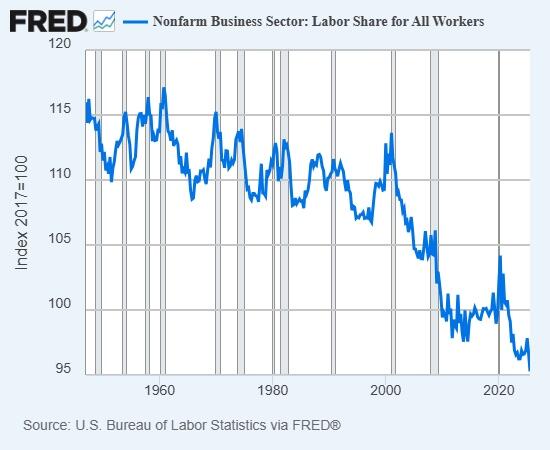
The past 50 years have seen productivity gains flow to capital (corporations and owners of assets) at the expense of wage-earners. This means households and small businesses must service debt from a shrinking share of the economy. As a result, borrowing more becomes increasingly risky for both borrower and lender.
As more of the output goes to corporations and owners of assets, their collateral, income and creditworthiness rise, meaning they can borrow more at lower rates of interest than wage earners and small enterprises. The more they can borrow, the more they can own and the more they can earn.
These are the core engines of extreme wealth and income inequality. The rich get richer because they have the means to borrow more income-generating assets at lower rates than wage earners. And unlike wages, this asset-generated income rises as assets increasing in value support additional borrowing as they serve as collateral.
On the most fundamental level, if economic expansion no longer increases the income of household borrowers enough to service more debt, the entire structure of expanding debt, collateral and speculation is destabilized. Ultimately, assets generate income from either 1) issuing more debt, 2) investing more in risk assets or 3) consumer spending. All three are interconnected, i.e. tightly bound, as any decline in the expansion of debt, investing or spending eventually bleeds through to reduced ability to service more debt and the end of the expansion of debt.
Since debt is inherently risky–borrowers can default, i.e. stop paying interest and principal on the debt–then depending on expanding debt for economic expansion is also increasing risk, especially if household earnings are stagnating while debt and interest payments are increasing.
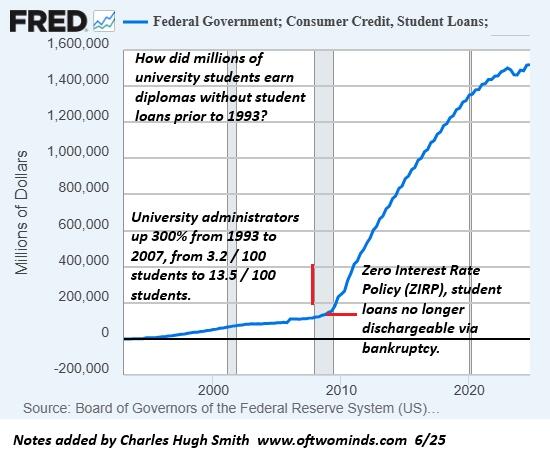
Since the percentage of output flowing to wages has been declining for 50 years, households have funded spending by borrowing more money. Prior to the 2000s, college students borrowed very little to fund their education. Now student loan debt is measured in the trillion-dollar range. Auto loans and credit card debt has also soared, along with shadow-banking debt that isn’t even tracked: pay-in-installments, etc.
Speculative investments are also inherently risky: the investment can fail to pay off. If the speculation was funded by debt, then both the borrower and the lender go broke when the speculation fails.
Stagnating earnings, increasing debt to fund spending and increasingly risky debt-funded speculation generate a credit-asset bubble-dependent economy: economic expansion is now dependent on debt expanding to fund spending and the speculation that pushes asset valuations higher, increasing the collateral for even more borrowing.
Once income is no longer rising fast enough to service higher debt loads, defaults cascade throughout the system, triggering avalanches of declining income for both assets and wage earners as households default on rent, auto loans, student loans, credit cards and mortgages, collapsing consumer spending and laying waste to lenders and employers, who respond by reducing borrowing and laying off employees.
Speculations that looked sound in expansion go broke as lenders pull risky loans, household spending dries up and collateral collapses as risk assets are sold off to reduce risk by raising cash and paying down debt.
Credit-asset bubble-dependent economies are tightly bound systems: any drop in income and valuations, any tightening of credit, any rise in interest rates and any decline in collateral (i.e. the valuations of risk assets) feeds back into every other part of the system, creating a self-reinforcing feedback loop of defaults, layoffs and sagging asset valuations.
In an economy saturated with debt, stimulus doesn’t generate expansion, it generates inflation which limits central bank stimulus. Without that signal that “the Fed has our back,” speculation and the borrowing that funded it both dry up. Once the inflow of new credit-funded investment falters, asset valuations enter a self-reinforcing free-fall.
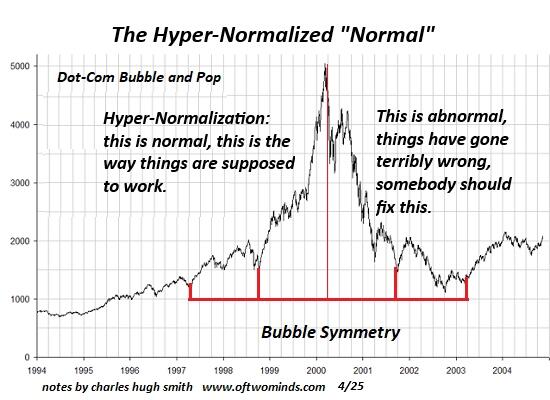
In a credit-asset bubble-dependent economy, this inevitable unwinding is viewed as an unexpected catastrophe:
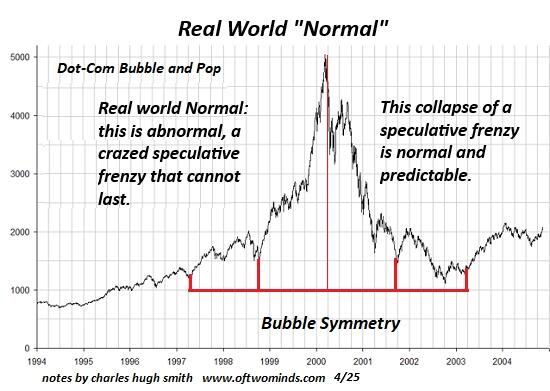
In an economy that allowed recessions to clear bad debt and excessive speculation, credit-asset bubbles popping is viewed as inevitable and normal.
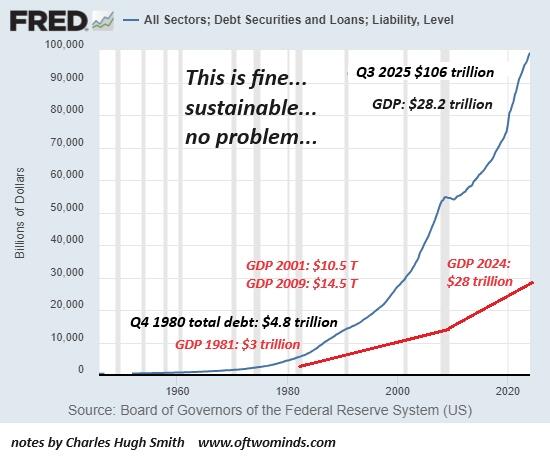
What few seem to understand is 1) the last “real recession” that cleared excesses of debt, leverage and speculation was 1980-82, 45 years ago and 2) the buffers that enabled the eventual recovery back then are gone. Where total debt was low in 1980–about 50% more than GDP–now it’s triple GDP. That means “borrowing our way to expansion” isn’t possible: borrowers are already unable to service existing debt, never mind more debt.
As for the Fed rescuing the debt bubble by dropping interest rates to zero: recall that the Fed isn’t buying more than a sliver of the $106 trillion debt; it’s only generating a false signal that risk is low. In the real world, risk is rising inexorably due to excessive debt, interest payments, leverage and speculation.
As for bailing the system out as in 2008, that is no longer possible, either. The system was “saved” by recapitalizing the financial sector–the source of new debt and speculation. But this time around, the economy is saturated with debt, income has stagnated and cannot support more borrowing, and the credit-asset bubbles in housing and financial assets has reached unprecedented heights of risk, i.e. fragility.
This is why a recession that clears the system of excessive debt, leverage and speculation leaves a devastated economy incapable of expansion: the system is now totally dependent on excesses of debt, leverage and speculation for its survival, never mind expansion, and once that collapses (as all bubbles do), the signaling, confidence and wealth that enabled the bubble will no longer exist.
As for saving the system by converting fiat money to precious metals or cryptocurrencies: the debt–and the income needed to service the debt–will also be converted, and that doesn’t change the inevitable collapse of credit-asset bubbles and all the economic activity that depended on the permanent expansion of that credit-asset bubble.
This is why a recession will catalyze a collapse of the credit-asset bubble-dependent economy down to its foundations. A re-inflation of a new credit-asset bubble will be viewed as the “solution,” but that unstable system will no longer be viable. The real solution will be re-arranging the economy to thrive not on credit-asset bubbles but on productivity gains that are widely distributed to all the productive elements, not just the wealthiest asset owners.
This process will be time-consuming and difficult, as all the “winners” in the current bubble economy will expect both a return to outsized gains and a continuation of their outsized share of the gains. Neither will be possible, as the changes will demand time, sacrifice and massive long-term investment in productive assets.
The systemic risks inherent to a credit-asset bubble-dependent economy cannot be extinguished, they can only be cloaked or transferred to others. These artifices enable the expansion of the bubble at a cost paid by everyone when the system’s self-liquidating dynamics pop the bubble.
* * *
My new book Investing In Revolution is available at a 10% discount ($18 for the paperback, $24 for the hardcover and $8.95 for the ebook edition). Introduction (free)
Check out my updated Books and Films.
Tyler Durden
Thu, 01/29/2026 – 17:40
https://www.zerohedge.com/economics/why-next-recession-will-be-catalyst-depression
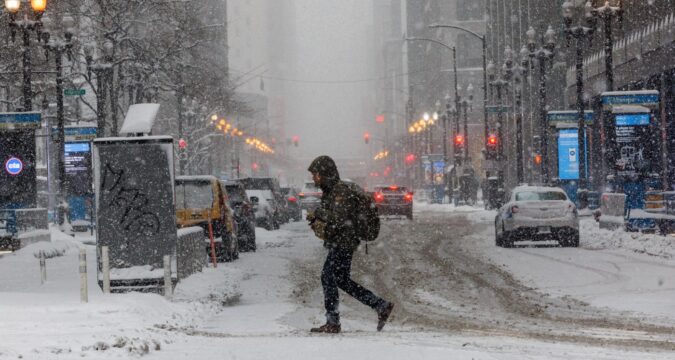
Slick roads in store as another round of snow sweeps across the Chicago area
Brace for another bout of snow, Chicago.
A winter weather advisory was set to go in effect Friday for much of the morning into the afternoon as a burst of accumulating snow sweeps through the Chicago area.
Issued for central and southern Cook County from 9 a.m. through 3 p.m., the advisory warns that snow could, at times, fall at a rate of up to an inch per hour and make for slick travel conditions, according to the National Weather Service. Total snow accumulations could reach 2 to 3 inches within just a few hours, weather officials say, noting heavy lake-effect snow could bring up to 6 inches near Lake Michigan.
Daytime highs Friday will hover around the mid- to upper teens. The brisk temperatures combined with snow could make it difficult for crews to treat roads for the inclement weather, according to Gino Izzi, a senior meteorologist with the National Weather Service in Chicago.
By Friday afternoon into the evening, an intense band of heavy lake-effect snow is expected to develop over southern Lake Michigan, which could affect portions of central and southern Cook County. Weather officials have issued a winter storm watch from 3 p.m. Friday through 6 a.m. Saturday.
Chicago’s Office of Emergency Management & Communications is alerting travelers to expect dangerous conditions for their morning and evening commutes on Friday. Visibility may dip below a quarter-mile between falling and blowing snow, the office said, urging travelers to slow down and use caution.
As of Thursday afternoon, more than 28 inches of snowfall had been observed at O’Hare International Airport, Izzi said. This time last year, O’Hare had accumulated 9.9 inches of snow, putting accumulations to date nearly three times higher so far this winter.
Last week, a massive winter storm hit over 200 million people across the country, covering the Chicago area with several inches of snow. The extreme weather hasn’t let up, with bitter cold gripping the region since.
Chicagoans can expect conditions to thaw — slightly — with forecasts calling for highs Saturday and Sunday in the high 20s. Through early next week, highs will remain just below freezing, as lows dip down to the high teens.
https://www.chicagotribune.com/2026/01/29/chicago-weather-winter-snow-slick-road-conditions/

Indiana unions: Chicago Bears stadium bill cuts us out
While Northwest Indiana waits to see whether the Chicago Bears will choose it for its new stadium, labor leaders are waiting to hear if the trades get to be involved at all.
Senate Bill 27, authored by State Senators Ryan Mishler, R-Mishawaka, and Chris Garten, R-Charlestown, which passed through the Indiana Senate Wednesday, contains language that effectively would prohibit the Bears from entering into any project labor agreements, labor leaders told the Post-Tribune. In a heavily labor-concentrated part of the state, the idea that PLAs wouldn’t be used is “not a good business model” at best.
The language is concerning enough that all three Northwest Indiana County Republican Chairs — Randy Niemeyer in Lake, Nathan Uldricks in Porter and Allen Stevens in LaPorte County — cosigned a letter imploring the legislature to remove the language.
“As conservatives, small ‘g’ government is best. Sensible regulations, fiscal responsibility, and policies creating work and wealth for all Hoosiers,” the letter read. “In particular, we believe each company and community should be free to negotiate their own best interests, both in fiscal and labor policy,” the letter reads. “Northwest Indiana is home to some of the most skilled tradesmen in the entire country … We will always encourage companies of scale to consider Union labor as an option.
“We call on the State legislature, Indiana Economic Development Corporation and Office of the Governor to prioritize the use of in-state labor for any project funded with Public dollars … As Republicans, it is our opinion that the issues of our working-class skilled tradesmen should be a top priority.”
“I think it’s important to consider the environment: Northwest Indiana is home to some of the strongest tradesmen and women in the country, so to write a bill that precludes them, that doesn’t match,” Niemeyer told the Post-Tribune. “I’m a blue-collar worker, and our people would do a tremendous job.”
Randy Palmateer, Business Manager for Northwest Indiana Building and Construction Trades Council, said he can’t believe the state would dare to tell a private business what to do, especially since the organization employs union labor already. He spent Tuesday getting documentation from the team to make sure that checks out.
“I have the (memorandum of understanding) from Arlington Heights, and it has a PLA, and the Bears have unions right now (at Soldier Field),” Palmateer said. “This anti-union sentiment will kill local support and open the floodgates for low-paid labor.”
Dave Fagen, financial secretary for the International Union of Operating Engineers Local 150, agreed.
“You’ll have workers coming from Alabama, Georgia, Pennsylvania, New Jersey, Mississippi, and what do they do? They take the money back to their states with them,” Fagen said. “We just invested $30 million for training for our guys, so why would the state deprive our workers for the chance to be part of this? It’s not a good business model, and the Bears are savvy enough to know that if they alienate labor, they’re going to lose a lot of season tickets from people who travel to Chicago right now.
“If the state is going to pass this bill, let the Bears decide (if they want a PLA). It’s as simple as that.”
State Senator Rodney Pol, D-Portage, was in discussions over the bill Tuesday and said legislators caught the PLA language “immediately.” It was taken from a bill written in 2019 for a soccer stadium in Indianapolis, he said. Currently, the future of the proposed Eleven Park stadium is in doubt since the City of Indianapolis withdrew its financial support.
“The bill came through as a vehicle bill that wasn’t created before the deadline. It was intended to be written more like the Lucas Oil stadium deal,” Pol said. “I filed an anti-PLA language removal, as did Senator (Mike) Bohacek, and in the five years I’ve been here, I’ve been able to get rid of anti-PLA language in several bills. I’m comfortable working with Senator Mishler to get it worked out, but yeah, it’ll never fly here.”
When the bill passed out Wednesday, however, the language was still included. Pol said it should be fixed in the House.
“It’s par for the course that the legislature forgets who we are sometimes, but if the Bears are considering over a billion dollars in investment, then by God, we should have the opportunity,” Niemeyer added.
As it stands now, SB 27 would establish a three-member authority: the director of the Office of Management and Budget, the public finance director or designee, and another member appointed by the Office of Management and Budget, the Post-Tribune previously reported. The authority would work toward acquiring, financing, constructing and leasing land and capital improvements.
It would also have the power to finance, improve, construct, reconstruct, renovate, purchase, lease, acquire, and equip land and capital improvements, according to the bill.
The bill would require a National Football League team to enter into a lease for the stadium for at least 35 years. After the term of the lease, the lessee would have the option to purchase the capital improvement for $1 if certain conditions are met. Under the bill, the authority could issue bonds, and the lease rental payments could be made from local excise taxes, food and beverage tax and innkeeper’s tax.
The Senate Appropriations Committee amended the bill to remove the authority’s goal of 15% participation by minority businesses and 5% participation from women’s businesses to participate in the procurement and contracting process.
On Jan. 10, Bears President and CEO Kevin Warren and Chairman George McCaskey took NFL Commissioner Roger Goodell on a tour of the Arlington Heights site the team owns, and two sites in Northwest Indiana, including one near Wolf Lake in Hammond, the Chicago Tribune reported.
The tour took place before the Bears’ epic come-from-behind victory over the archrival Packers. The visit is significant because the National Football League may loan $200 million or more for the stadium project, if it is approved by league owners, according to the Chicago Tribune.
In addition, Gary officials identified three “plug-and-play” sites: Gary West End Entertainment District near Hard Rock Casino, Buffington Harbor and Miller Beach, according to a press release.
During his state of the state address Jan. 14, Braun touted Indiana’s strong business environment as part of the reason that the Bears have looked to Northwest Indiana to build a stadium.
“We are working hard to bring the Chicago Bears to the Hoosier state so they can really see what a great place is to have a business. We’ll work hard to do it. Let’s get it across the finish line,” Braun said.
Post-Tribune reporter Alexandra Kukulka contributed.
Michelle L. Quinn is a freelance reporter for the Post-Tribune.
https://www.chicagotribune.com/2026/01/29/indiana-unions-chicago-bears-stadium-bill-cuts-us-out/