Category: News
Murray logra 27 puntos y Nuggets vencen 107-103 a Nets en el regreso de Porter a Denver
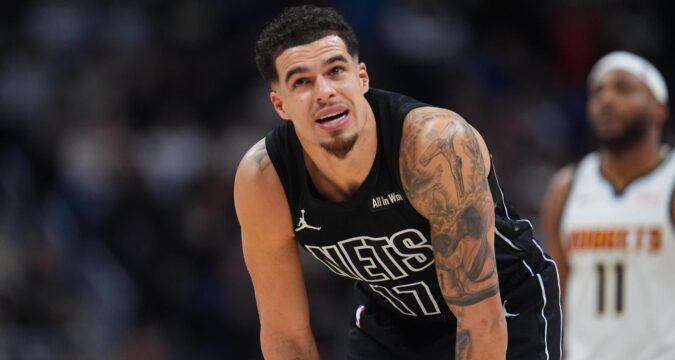
DENVER (AP) — Jamal Murray anotó nueve de sus 27 puntos en los últimos 2:26 minutos, y los Nuggets arruinaron el regreso de Michael Porter Jr. a Denver, al superar el jueves 107-103 a los Nets de Brooklyn.
Porter logró 38 puntos, su máximo número de la temporada. Capturó diez rebotes para Brooklyn, que ha perdido siete partidos consecutivos.
Tim Hardaway Jr. igualó su máxima cifra de la campaña, con siete triples, en su camino a un aporte de 25 puntos. Peyton Watson anotó 19 por Denver, que rompió una racha de tres derrotas consecutivas en casa.
Porter fue seleccionado en el 14to puesto del draft por los Nuggets en 2018 y jugó seis temporadas en Denver, ayudando a que la franquicia ganara su primer título de la NBA en 2023. Fue traspasado a Brooklyn en el receso entre campañas y lidera a los Nets en unidades.
Los Nuggets honraron a Porter con un video-homenaje en el primer tiempo muerto. El jugador reconoció a los fanáticos, quienes se pusieron de pie para ovacionarlo.
Ambos equipos tenían varios jugadores fuera por lesiones. Denver estaba sin cuatro titulares y el delantero de los Nets, Ziaire Williams, se ausentó por una contusión en la pantorrilla izquierda sufrida en una pelea al final de la derrota del martes en Phoenix.
_____
Deportes AP: https://apnews.com/hub/deportes

Struggling Chicago Blackhawks allow 4 second-period goals in another blowout loss to the Pittsburgh Penguins
PITTSBURGH — Those who live in Pittsburgh would tell you the city didn’t put up much of a fight against the heavy snow that fell a few days prior. Those who are Chicago Blackhawks fans would say the same about their team’s defense against the Penguins on Thursday night.
The last time the Hawks and the Penguins shared the ice, it was a nightmare for the home team Dec. 28 at the United Center. The game was decided during the Penguins’ three-goal first period.
Connor Bedard and Frank Nazar didn’t play in that matchup, but they were back for the Hawks in the rematch at PPG Paints Arena. It didn’t make a difference.
The Penguins score four times in the second period, quickly turning a tie game into a drubbing. The Hawks fell 6-2 for their fourth straight loss and seventh in nine games.
This time, the Hawks struck first, with defenseman Connor Murphy scoring off a Ryan Greene pass at 9:32 of the first period. But Connor Dewar tied the game less than two minutes later, the first of six unanswered Penguins goals.
Ben Kindel, Egor Chinakhov, Anthony Mantha and Ryan Shea led the second-period onslaught, and Dewar scored his second of the night at 13:59 of the third for a 6-1 Penguins lead.
Bedard’s 66th career goal — only his second in 10 games since returning from injury (the other was an empty-netter) — finished the scoring. He passed Eddie Olczyk for the most goals before turning 21 in Hawks history.
While the Penguins (27-14-11) won their fifth straight to continue their unexpected turnaround under first-year coach Dan Muse, the Hawks (21-24-8) are headed in the opposite direction in Jeff Blashill’s first season behind the bench.
“I didn’t think our compete level in the first was even to the level it was the other night, but then in the second, I just thought we didn’t compete hard enough,” Blashill said. “We just lost too many stick battles (and) just ended up defending way, way, way too much.”
The Hawks were outscored 13-5 in the two losses the Penguins, who outshot the Hawks 44-20 on Thursday.
A shot by the Penguins’ Ben Kindel gets past Blackhawks goaltender Arvid Söderblom for a goal during the second period Thursday, Jan. 29, 2026, in Pittsburgh. (Gene J. Puskar/AP)
“I think we did play pretty well early on, tried to defend hard against them, they’re really good off the rush and I think we did a good job in the first,” defenseman Matt Grzelcyk said. “They got momentum there in the second about halfway through, and then we just fell off the rails it felt like.”
The Hawks have lost in myriad ways in the last four games: A shootout, a blown lead and a pair of four-goal defeats have them in limbo as they inch closer to the Olympic break.
“I think anytime things go against you in the games and we’re not performing, it’s a character test for each one of us as a team and as an identity for our team to show that we can respond,” Murphy said. “We didn’t respond tonight, period to period, so the test now is respond tomorrow.”
The Hawks have a quick turnaround, playing host to the Columbus Blue Jackets on Friday at the United Center, then have games Monday and Wednesday before three weeks off for the Winter Games. Perhaps the struggling young team needs some time away.
“I think there are a number of individuals who aren’t feeling it right now, so that hurts your team’s confidence because of the individual makeup of your players aren’t as confident,” Blashill said. “We’ve got to get some swagger back, but the only way to get that back is to earn it.
“You can’t feel sorry for yourself. You got to earn that kind of swagger back (and) it starts by earning it individually as a guy and then kind of building it from the team perspective.”
Artyom Levshunov is one of the skaters who needs to find said swagger again. The defenseman found himself out of position all night, and the Levshunov-Wyatt Kaiser pairing was on the ice for five Penguins goals.
“I didn’t think he played good … he’s got to rebound and play better tomorrow night,” Blashill said. “That’s part of the roller coaster that we expected to see from young defensemen.”
Bedard’s milestone goal was but a footnote on an otherwise dreary night for the Hawks.
“I thought he had another night where he was really, really good,” Blashill said. “Good for him to get rewarded at the end, even though it was late in the game.”
https://www.chicagotribune.com/2026/01/29/chicago-blackhawks-pittsburgh-penguins-blowout-loss/

Dillon Brooks anota 40 puntos, un récord personal, y Suns doblegan a Pistons por 114-96
PHOENIX (AP) — Dillon Brooks estableció un récord personal con 40 puntos, Grayson Allen añadió 24 y los Suns de Phoenix doblegaron el jueves 114-96 a los Pistons de Detroit, líderes de la Conferencia Este.
Los Suns mantuvieron una ventaja cómoda durante gran parte del último cuarto, ganando por quinta vez en siete compromisos. Están diez juegos por encima del .500 por primera vez en esta temporada, con un récord de 29-19.
Brooks atravesó la cancha para una bandeja que puso el marcador 105-89 con 5:43 minutos restantes, anotando el último de sus 40 puntos. Terminó atinando 13 de 22 tiros de campo y capturó ocho rebotes en una noche en la que el equipo regaló a los primeros 5.000 aficionados que ingresaron a la arena una camiseta que decía “Dillon The Villain” — una referencia a su personalidad explosiva.
Los Pistons perdieron por tercera vez en 12 duelos. Cade Cunningham lideró a Detroit con 26 puntos, y Jalen Duran totalizó 23 tantos y 13 rebotes.
Brooks tenía 38 puntos al final del tercer cuarto, lo cual ya era un récord personal. La marca anterior del alero de 2,01 metros fue una actuación de 37 puntos para los Grizzlies de Memphis en 2021.
El canadiense de 30 años está en medio de la mejor campaña de su carrera, promediando más de 20 puntos por encuentro para convertirse en un candidato sorpresa para su primer Juego de Estrellas. Llegó a los Suns durante el receso previo a la temporada como parte del canje que envió a Kevin Durant a Houston.
_____
Deportes AP: https://apnews.com/hub/deportes
Caribes recortan distancia en la final de Venezuela
Por The Associated Press
Los Caribes de Anzoátegui respondieron en casa y recortaron distancia en la final de la Liga Venezolana de Béisbol Profesional, al remontar con un racimo de seis carreras en el quinto inning para imponerse el jueves 9-7 a los Navegantes del Magallanes, y poner la serie 2-1.
Magallanes había tomado el control temprano del juego. En el cuarto episodio armó un ataque de tres anotaciones, coronado por un doble de dos carreras de Tucupita Marcano para irse al frente.
La respuesta de Caribes llegó en la quinta entrada, cuando desataron su ofensiva ante el pitcheo naviero. Carlos Mendoza conectó un sencillo impulsor de dos carreras, Hernán Pérez sacudió un jonrón de dos anotaciones y Antonio Piñero añadió un doble remolcador para destacarse en el rally de seis carreras que cambió el rumbo del encuentro.
Con la victoria, los Caribes evitaron caer en un déficit mayor en la serie al mejor de siete y mantienen vivas sus aspiraciones de título, mientras que Magallanes dejó escapar la oportunidad de tomar una delantera más cómoda.
_____
Deportes AP: https://apnews.com/hub/deportes
https://www.chicagotribune.com/2026/01/29/caribes-recortan-distancia-en-la-final-de-venezuela/
Davos 2026: Acknowledging The End Of Pax Americana
Davos 2026: Acknowledging The End Of Pax Americana
Authored by Ret. Admiral Cem Gürdeniz via Michel Chossudovsky’s substack,
The end of the Pax Americana established after 1945 was officially acknowledged by both the leaders of finance capital and the elected leaders in Davos 26.
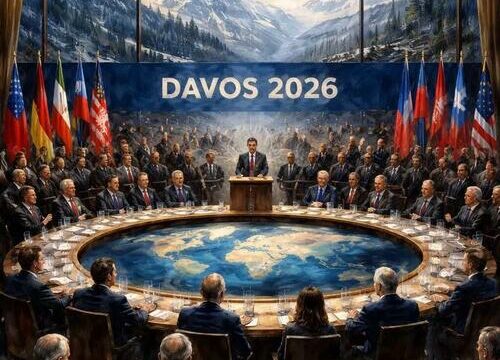
The World Economic Forum (WEF) 2026 in Davos, which has served as the vision and doctrine center of global capitalism for half a century, was held between January 19–23 under the theme “A Spirit of Dialogue.”
At what was arguably the most significant meeting in its history, the end of the Pax Americana established after 1945 was officially acknowledged by both the leaders of finance capital and the elected leaders of states inheriting Europe’s colonial-imperial legacy, notably France, Germany, and the United Kingdom.
Another point openly recognized was the end of globalization and neoliberalism.
Representatives of finance capital emphasized that political and economic elites had lost public trust and conceded that the neoliberal order had reached the stage of collapse due to the unsustainability of income inequality.
Politicians, for their part, admitted that law has increasingly been replaced by force and that the so‑called rules‑based international order is partly a fiction, as great powers suspend rules whenever it suits their interests. Among these statements, perhaps the most unsettling for Donald Trump came from Canada.
The Canadian Prime Minister, whom Trump had explicitly included within the Western Hemisphere in his revised national security doctrine and openly threatened, acknowledged that the narrative of a rules‑based order is fictional. He stated that finance, trade, energy, and supply chains no longer function as mechanisms of mutual benefit but as tools of pressure and weaponization, and that the Western world is not undergoing a transition but an open rupture. This was, in fact, an inevitable outcome of geopolitical realities and the interests of finance capital.
The Forced Acceptance of U.S. Withdrawal is Now Evident
The United States no longer possesses the geopolitical capacity to shape the entire globe. Its parity with China in military, technological, and industrial indicators, and in some areas its lagging position, demonstrates a structural break that makes the continuation of unipolar hegemony impossible. Trump has already been compelled to retract some of his threats. In the Greenland case, for example, he initially suggested the use of military force but later abandoned this option after nearly 800 billion dollars were wiped off U.S. stock markets on the eve of Davos.
In reality, the United States is attempting to reposition itself within a new world order. Its effort to bind the Western Hemisphere unconditionally to itself through a revival of the Monroe Doctrine is itself an admission of declining global capacity. Even within this framework, Washington cannot prevent Canada or Brazil from expanding relations with China, nor can it stop Argentina from maintaining comprehensive economic ties with Beijing. These cases, alongside BRICS and other Global South countries, demonstrate how a policy based on pressure and threats is counterproductive.
States increasingly seek balance with China, whose trade, infrastructure financing, and mutual‑benefit model creates attraction precisely because it does not rely on coercion. At Davos, China was discussed through the lens of controlled uncertainty rather than open rupture. While the United States draws a sharp line of systemic competition, European countries attempt to balance economic realities with geopolitical pressures. On one hand, they seek to maintain trade, investment, and market access with China; on the other, they pursue distancing in technology, security, and critical infrastructure. This reflects a European policy characterized by tactical flexibility rather than strategic clarity.
By contrast, the United States’ coercive approach generates rupture rather than loyalty. For Washington, multipolarity is no longer a strategic choice but the symptomatic outcome of weakening power and the forced acceptance of reality. The open acknowledgment by allies such as France, the United Kingdom, Germany, Canada, and Saudi Arabia that the U.S.‑centered order has ended is a direct result of this erosion. If this trajectory continues, the United States will eventually face the necessity of returning to a policy of peaceful coexistence with China, reminiscent of Cold War‑era coexistence with the Soviet Union. The alternative, of course, is war.
The End of the Rules-Based Order
The most evident common denominator of Davos 2026 was the recognition that the global order is undergoing a rupture rather than an evolution. For decades, the discourse of a rules‑based international system functioned as a narrative that concealed arbitrary exemptions and asymmetric practices by great powers. In Davos, this curtain was openly lifted. Selective application of law, the bending of trade rules in favor of the powerful, and the transformation of security into a bargaining instrument were no longer denied. The most striking political statement on this issue came from Canada’s Prime Minister, former financier Mark Carney. He stressed that finance, trade, energy, and supply chains have become instruments of pressure and coercion. By declaring that he no longer shared belief in the rules‑based order, Carney effectively dissolved the ideological legitimacy of the U.S.‑led liberal system. His declaration can be regarded as epoch‑making, signaling the collapse of the ideological foundation of the Western order sustained since the Cold War.
Yet this moment of truth also exposes hypocrisy: states that have supported imperial interventions from Libya to Iraq, and from Syria to Gaza, confront reality only when threats are directed at themselves, such as in the case of Greenland and Denmark.
Confrontation Against the Replacement of Law by Power
Participants at Davos 2026 broadly agreed that the world is rapidly drifting toward an order in which law recedes and power prevails. Although German Chancellor Friedrich Merz, French President Emmanuel Macron, and British Prime Minister Keir Starmer approached this development from different angles, the resulting picture was the same. These leaders, who had remained largely silent in the face of legal violations in Gaza, Israel’s attacks on Iran, the abduction of Venezuela’s president by the United States, or the harassment of civilian merchant vessels under the pretext of a “shadow fleet,” suddenly discovered the dangers of a world governed by raw power. Those now warning that even great powers become insecure when rules collapse were themselves active participants in power politics against weaker states only a year earlier. The outcome of their speeches revealed a clear confrontation between two camps: those who view power as the sole source of legitimacy, and those who seek to restrain power through law.
Trade is Now a Weapon
Nearly every economic discussion at Davos underscored that trade is no longer a neutral vehicle of prosperity. Tariffs have become negotiating tools, sanctions geopolitical punishment mechanisms, and supply chains zones of vulnerability. The efficiencies of global integration have evolved into advantages used by great powers to suppress competitors. Consequently, the concept of commercial security has moved to the forefront, particularly in middle and advanced economies, where free trade is increasingly replaced by selective, controlled, and politicized exchange. Davos also highlighted that the structural distance between the United States and Europe is no longer a temporary tension. Trade deficits, automotive and industrial exports, regulatory conflicts, and defense spending have become focal points of divergence. Washington views Europe as a bloc that benefits economically while failing to share security burdens, whereas Europe perceives the United States as unpredictable, unilateral, and cost‑imposing. The transatlantic relationship has shifted from a shared‑values partnership to a hard bargaining arena.
Breaking the Security-Economy Connection
Although NATO was not discussed explicitly at Davos, it loomed large in the background. The U.S. share of alliance defense spending is increasingly wielded as an economic and political lever. The United States accounts for roughly two‑thirds of NATO defense expenditures and about 16 percent of its annual budget. Trump’s longstanding criticism of Europe’s strategic complacency has evolved into a broader attempt to monetize the U.S. security umbrella through trade, energy, and strategic concessions. European states, however, increasingly interpret this as an assault on sovereignty and autonomy, thereby eroding the traditional balance between security and economics within NATO. Trump’s insistence that Greenland is vital to U.S. security, rather than NATO’s collective defense, further undermined alliance cohesion and symbolized a deeper crisis of trust.
The New Geopolitical Conjuncture and the Rise of the Middle Powers
The Davos 2026 process also strengthened the self‑confidence of medium powers such as Türkiye. Intensifying great‑power competition creates both risks and opportunities for states that avoid rigid alignment or outright rupture. Countries capable of building resilience in energy, food, critical minerals, finance, and diplomacy can redefine cooperation in a fragmenting global system. Europe’s gradual rapprochement with China, mirroring Russia’s earlier turn eastward, suggests a future in which the United States consolidates the Western Hemisphere while Europe increasingly recognizes itself as Eurasia’s western peninsula. Internal fragmentation within the United States, driven by competing interests among MAGA factions, neoconservatives, lobbies, the arms industry, finance capital, and think tanks, further undermines Washington’s strategic coherence.
Türkiye Lessons
For Türkiye, Davos 2026 offers stark lessons. No global order narrative is permanent. Concepts such as a rules‑based order, strategic partnership, or alliance solidarity can be suspended whenever they conflict with great‑power interests. Türkiye must therefore ground its security, economy, and foreign policy in concrete capabilities, deterrence, and multidimensional relations rather than abstract norms. Trade, energy, and finance have become security issues, making self‑sufficiency, diversification, and resilience imperative. Agriculture, water management, and critical resources demand urgent strategic reassessment. Security architecture can no longer rely on a single‑axis alliance logic; it must rest on national capacity, a robust defense industry, and layered deterrence.
Multipolarity, while risky, also expands room for maneuver. Türkiye’s path lies in flexible, principled, interest‑based balance rather than alignment or isolation. The harshest lesson of Davos is that in a world where power overrides law, those who truly need law are those capable of defending it. International law must be treated not as abstract morality but as a framework safeguarding sovereignty and national interest. Ultimately, the sources of security, prosperity, and prestige are internal capacity and strategic intelligence, not external references. In this new era, survival belongs to states that combine strong governance, productive economies, independent defense, and multifaceted diplomacy.
This is Türkiye’s lesson from Davos.
Views expressed in this article are opinions of the author and do not necessarily reflect the views of ZeroHedge.
Tyler Durden
Thu, 01/29/2026 – 23:25
https://www.zerohedge.com/geopolitical/davos-2026-acknowledging-end-pax-americana

Nuevo entrenador de Titans Robert Saleh quiere demostrar lo aprendido tras dirigir a Jets
Por TERRY McCORMICK
NASHVILLE, Tennessee, EE.UU. (AP) — Robert Saleh cree que los Titans de Tennessee eran la mejor opción para él entre los diez equipos que buscaban un entrenador en este ciclo.
Y Saleh, quien ha disfrutado de mucho éxito como coordinador defensivo pero fracasó en su primera experiencia como entrenador en jefe de la NFL, dijo el jueves que ha aprendido de lo vivido con los Jets de Nueva York.
“No hay un manual para la primera vez que haces algo, ¿sabes?… La pregunta adecuada sería, ¿qué no aprendí?”, dijo Saleh al ser presentado como el vigésimo entrenador en jefe en la historia de la franquicia. “Podría sentarme aquí y hablar contigo durante las próximas cuatro horas sobre todas esas cosas diferentes. Pero te puedo asegurar que hubo un crecimiento tremendo, a través de las oportunidades que tuve con los Jets y, a través de ese crecimiento, creo que estoy más preparado ahora que nunca”.
Hacia el final de la temporada, el tackle defensivo All-Pro Jeffery Simmons dijo que Tennessee necesitaba encontrar un líder que pudiera cambiar la cultura de la organización y responsabilizar a los jugadores. Los Titans creen que han encontrado a ese hombre.
“En última instancia, lo que queríamos era un líder para este equipo de fútbol americano que pudiera construir una cultura ganadora y conectar a todos en este edificio”, dijo el gerente general Mike Borgonzi. “Estábamos buscando un líder con un alto carácter, integridad y humildad, un líder con un alto coeficiente intelectual de fútbol americano y grandes habilidades de enseñanza”.
Saleh se ganó mucho respeto en la liga durante sus dos etapas como coordinador defensivo con los 49ers. Su tiempo en San Francisco estuvo intercalado con cuatro años con los Jets, durante los que Saleh tuvo un récord de 20-36 antes de ser despedido cuando habían transcurrido apenas cinco partidos de la temporada 2024.
Los Titans han terminado 3-14 en cada una de las últimas dos temporadas. Están apostando a que Saleh pueda dar un giro a una franquicia que tuvo su última temporada ganadora en 2021 y que ha despedido a un entrenador o gerente general en cuatro campañas consecutivas.
“¿Sabes?, en el momento en que entras en este edificio, va a haber un estándar”, dijo Saleh. “Lo diré un millón de veces, el objetivo de la vida es irte a la cama mejor de lo que te despertaste. Y si no tienes esa intención, si no tienes esa mentalidad, te estás haciendo un flaco favor. O les estás haciendo un flaco favor a tus compañeros de equipo”.
Más de una docena de jugadores de los Titans estuvieron presentes en la conferencia de prensa, incluidos Simmons y el mariscal de campo de Tennessee, Cam Ward, la primera selección general del draft de 2025.
Saleh contrató al exentrenador de los Giants de Nueva York, Brian Daboll, como coordinador ofensivo y le está confiando el desarrollo de Ward.
_____
Deportes AP: https://apnews.com/hub/deportes

Durant anota 31 puntos por Rockets, que dominan la 2da mitad y arrollan 104-86 a unos Hawks mermados
ATLANTA (AP) — Kevin Durant anotó 31 puntos y los Rockets de Houston arrollaron el jueves 104-86 a unos diezmados Hawks de Atlanta, que vieron cortada una seguidilla de cuatro victorias.
Los Rockets dominaron la segunda mitad después de irse al descanso con una delantera de apenas 43-42. Jabari Smith sumó 14 puntos y Reed Sheppard añadió 13.
Un triple de Sheppard les dio a los Rockets su primera ventaja de 20 puntos, 90-70.
Los Hawks dejaron fuera a dos titulares importantes debido a lesiones. El pívot Onyeka Okongwu se rompió un diente cuando recibió un codazo en la boca el miércoles, durante la victoria de Atlanta por 117-106 en Boston. El alero Jalen Johnson fue descartado por un tirón en la pantorrilla izquierda.
Atlanta informó que Okongwu se sometió a un procedimiento odontológico exitoso el jueves y también se perderá el partido del sábado en Indiana.
Los Hawks ya estaban sin el pívot Kristaps Porzingis (inflamación en el tendón de Aquiles izquierdo) y sin el alero Zaccharie Risacher (contusión ósea en la rodilla izquierda). El novato Asa Newell fue convocado de regreso de la G League College Park antes del partido. El pívot Christian Koloko, quien firmó con Atlanta el 17 de enero, hizo su primera aparición de inicio en su quinto encuentro con los Hawks.
CJ McCollum lideró a Atlanta con 23 puntos. Nickeil Alexander-Walker agregó 20 y Corey Kispert sumó 17.
_____
Deportes AP: https://apnews.com/hub/deportes

Nick Martinelli and Tre Singleton help Northwestern keep Penn State winless in the Big Ten with 94-73 rout
Nick Martinelli scored 34 points and Tre Singleton notched a massive double-double as Northwestern beat Penn State 94-73 on Thursday night in Evanston.
It’s the fourth time this season Martinelli has scored 32 points or more. He entered Thursday as the fourth-leading scorer in Division I at 23.4 points per game and has scored in double figures in all but one game. He was 13 of 19 from the field and made four 3-pointers.
Singleton racked up 17 points, 18 rebounds, four assists and two blocks for the Wildcats (10-11, 2-8 Big Ten). It was the freshman’s first career double-double. Angelo Ciaravino added 20 points off the bench and Jake West had 13 assists.
The Wildcats led 45-40 at the half and stretched that lead with an 11-2 run early in the second half, featuring five points from Martinelli and a pair of baskets from Ciaravino. The Nittany Lions drew back with an 8-0 run before allowing a 9-0 run from Martinelli and Singleton to fall into a 17-point hole.
Freshman Kayden Mingo led the Nittany Lions (9-12, 0-10) with 15 points, as the Big Ten’s youngest team remains winless in the conference. Ivan Jurić added 14 points and six rebounds, while Josh Reed and Freddie Dilione V each scored 11 points.
Northwestern shot 60% (38 of 63) overall and 55% (12 of 22) on 3-pointers compared with 49% and 33% for the Nittany Lions, respectively.
Up next
Northwestern: vs. Washington on Saturday.
Penn State: vs. Minnesota on Sunday.
https://www.chicagotribune.com/2026/01/29/northwestern-penn-state-big-ten/
Maine Is The ‘Oldest’ State, Utah The ‘Youngest’
Maine Is The ‘Oldest’ State, Utah The ‘Youngest’
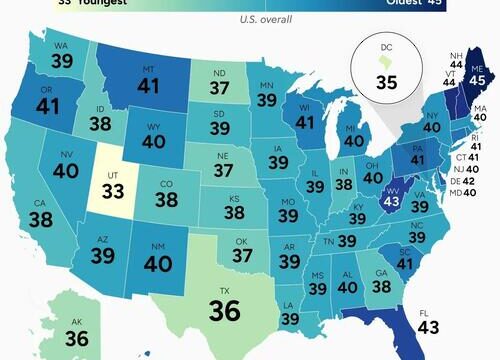
Across the U.S., age profiles vary widely by region.
This map, via Visual Capitalist’s Niccolo Conte, highlights those differences using the most recent nationwide estimates.
The data for this visualization comes from the U.S. Census Bureau’s American Community Survey (ACS) 2024 1-Year Estimates.
It reports the median age for each state and the District of Columbia.
The Oldest States Are Concentrated in the Northeast
The national median age stands at 39.2 as of 2024.
Rank
State
Median age overall
1
Maine
44.9
2
Vermont
43.9
3
New Hampshire
43.6
4
West Virginia
42.9
5
Florida
42.7
6
Delaware
42.1
7
Hawaii
41.5
8
Montana
41.3
9
Connecticut
41.2
10
Pennsylvania
41.2
11
Rhode Island
41.0
12
Oregon
40.8
13
South Carolina
40.7
14
Wisconsin
40.7
15
Michigan
40.4
16
Wyoming
40.2
17
Massachusetts
40.1
18
New Jersey
40.1
19
New York
40.1
20
New Mexico
39.9
21
Maryland
39.8
22
Ohio
39.8
23
Alabama
39.6
24
Nevada
39.5
25
Arizona
39.4
26
Illinois
39.4
27
Missouri
39.4
28
North Carolina
39.4
29
Virginia
39.4
30
Kentucky
39.3
31
Mississippi
39.3
32
Minnesota
39.2
33
Arkansas
39.1
34
Tennessee
39.1
35
Iowa
39.0
36
Louisiana
38.7
37
South Dakota
38.7
38
Washington
38.7
39
California
38.4
40
Indiana
38.3
41
Colorado
38.0
42
Georgia
38.0
43
Kansas
38.0
44
Idaho
37.8
45
Nebraska
37.4
46
Oklahoma
37.4
47
North Dakota
36.7
48
Alaska
36.3
49
Texas
35.9
50
District of Columbia
34.9
51
Utah
32.5
—
U.S. Median Age
39.2
New England and nearby states dominate the top of the ranking. Maine leads the country with a median age of 45, followed by Vermont and New Hampshire at 44. Several other northeastern states—including Pennsylvania, Connecticut, and Rhode Island—also exceed 41.
These older age profiles reflect long-term trends such as slower population growth, lower birth rates, and limited in-migration of younger workers.
The Sun Belt Shows a Mixed Demographic Picture
Many Sun Belt states cluster near the national average, but with some exceptions.
Florida stands out with a median age of 43, driven by its large retiree population. In contrast, Texas has a median age of 36, reflecting faster population growth and a younger workforce.
Meanwhile, states like Arizona, Nevada, and North Carolina sit close to 39.
Younger Populations Dominate the West and Plains
The youngest states are largely found in the West and Great Plains.
Utah is the clear outlier at 33, supported by higher fertility rates and larger households. The District of Columbia also skews young at 35, due in part to a concentration of working-age adults.
If you enjoyed today’s post, check out Ranked: Renters vs Homeowners by State on Voronoi, the new app from Visual Capitalist.
Tyler Durden
Thu, 01/29/2026 – 23:00
https://www.zerohedge.com/medical/maine-oldest-state-utah-youngest
Illinois Democratic hopefuls for US Senate agree Trump poses constitutional crisis but other differences emerge
The three leading Democratic candidates vying for the March 17 primary nomination to the U.S. Senate agreed Thursday night the nation is facing a constitutional crisis and hurled invectives at President Donald Trump, with each arguing they would be best equipped to rein in his administration if elected to Washington.
But in an hour-long debate, small yet distinct differences emerged among U.S. Reps. Raja Krishnamoorthi of Schaumburg and Robin Kelly of Lynwood and Lt. Gov. Juliana Stratton.
Stratton repeated her lone call to “abolish” the Immigration and Customs Enforcement agency, while Krishnamoorthi called for ending “Trump’s ICE” and Kelly, who launched an effort to impeach U.S. Homeland Security Secretary Kristi Noem, called for a complete overhaul of the department.
But Stratton and Kelly each vowed not to vote to confirm any new Trump appointees to the U.S. Supreme Court, while Krishnamoorthi said he would seek intensive vetting of nominees. Stratton also called for lifting the current $7.25 an hour federal minimum wage to $25 an hour, while Kelly said $17 an hour was more politically realistic in getting through Congress, and Krishnamoorthi agreed.
Krishanmoorthi was also the only one saying he supported term limits for members of Congress, while all three agreed there should be limits on the tenure of Supreme Court justices.
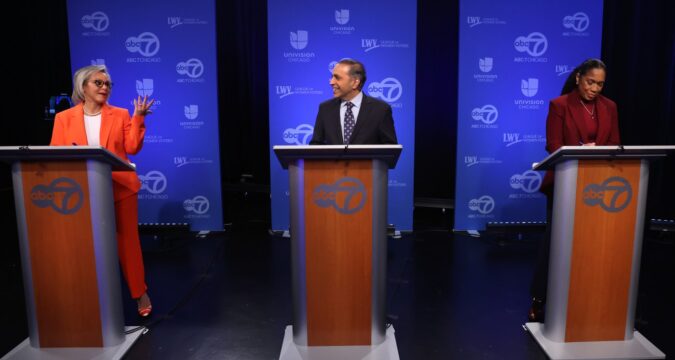
The debate, held at ABC-7’s Loop studios and cospsonored by the station, Univision Chicago and the League of Women Voters of Illinois and of Chicago, was the second such forum among the three in 72 hours, following an event at the University of Chicago’s Institute of Politics.
The latest debate lacked much of the aggressiveness Stratton had shown at the previous forum, possibly because the rules did not allow candidates to follow up on what others had said.
Stratton, the two-term running mate of Democratic Gov. JB Pritzker and who is backed by the governor, called Trump a “wannabe dictator” who “leads with bigotry and hatred.”
“We have a president that is stomping on the Constitution, a president that doesn’t believe that he has to follow the rule of law. We have a president, and now a court system, oftentimes especially the Supreme Court, that is rubberstamping his authoritarian agenda,” Stratton said. She called for reforms at the nation’s highest court “because we don’t see the checks we need.”
Krishnamoorthi said Congress needs to ban mid-decade redistricting, which he called a “chaos” that was pushed by Trump in Republican-led states to try to ensure the GOP’s continued House majority after the 2026 election.
“We have to reform the pardon power because he’s decided to auction off pardons to the highest bidders,” Krishnamoorthi said. “In addition, we have to reform our tariff laws so that he can’t create tariff chaos and trade chaos. And then finally, we have to probably amend the Constitution and make it very clear that there is no third term for a president.”
Kelly said Republicans in Congress “have ceded their power” to Trump and need to “slow him down, cut him off, hold him accountable, hold the minions accountable, like I’m trying to hold Kristi Noem accountable.”
As was the case in their earlier debate, the aggressive tactics of federal agents carrying out Trump’s immigration enforcement were a major topic, though the administration has scaled back its confrontational operations in recent days amid negative political fallout following the fatal shootings of Alex Pretti and Renee Good by immigration enforcement agents in Minneapolis earlier this month.
After the earlier debate, Stratton told reporters that Customs and Border Patrol could carry out immigration activities if ICE were abolished, even though CBP agents were involved in Pretti’s death. Krishnamoorthi seized on that comment Thursday night.
“I think that would be a grave mistake,” Krishnamoorthi said. “CBP employs Greg Bovino (who was the agency’s ‘commander in charge’ and had overseen the agency’s immigration enforcement before being removed from Minneapolis). CBP is who actually shot and killed Alex Pretti. We need to abolish Trump’s ICE and revamp CBP and all of DHS.”
Speaking to reporters after the debate, Stratton sought to clarify her earlier comment suggesting Border Patrol would remain in place if ICE were abolished.
“When I talk about security at the border, I’m saying that there should be security at the border. … I’m not talking about CBP, I’m not talking about having agents storming and walking down Michigan Avenue like we have seen,” Stratton said. “I’m talking about border security.”
U.S. Senate contender Lt. Gov. Juliana Stratton (right) prepares alongside fellow contenders U.S. Reps. Robin Kelly (third from right) and Raja Krishnamoorthi (second from right), before their debate on Jan. 29, 2026, at WLS-Ch. 7. (Chris Sweda/Chicago Tribune)
As for other responsibilities ICE currently handles, those could be delegated to other federal agencies, such as the Drug Enforcement Administration, for duties related to drug smuggling investigations, Stratton said.
Hours before the debate, Senate Democrats reached an agreement with the Trump administration and Republicans on a plan to forestall a long-term government shutdown by passing a two-week interim funding bill for Homeland Security. During that time, Democrats said they would negotiate on operational guardrails that immigration agents would have to follow.
“Noem has to be fired. If she’s not fired, then we have to impeach her,” Krishnamoorthi said of his proposal for a deal. “Masks have to come off. IDs have to go on. Body cameras have to go on. No more warrantless arrests. Third-party investigations must be mandatory for all use of force. And, no more roving gangs of ICE agents or CBP agents throughout our cities.”
Stratton said Senate Democrats should demand ICE and Border Patrol agents get out of American cities.
“We want to see not one single dime more of funding for ICE, and we need to make sure that we investigate and prosecute all of these agents for their crimes and make sure they’re held accountable,” she said.
Kelly said in addition to Noem’s departure, the entire Department of Homeland Security must be overhauled.
“Yes, dismantle ICE but also the Border Patrol, also the agency that looks over citizenship and asylum,” she said. “All of it needs to be dismantled and rebuilt so people are not terrorized by their own government agency. So, I do think we do need enforcement. There’s no question about that. But not the enforcement that we have now.”
After the debate, Kelly, who skipped taking questions from the press Monday night, told reporters Thursday that she hasn’t embraced either of the phrases — “abolish ICE” or “abolish Trump’s ICE” — that have come to highlight a subtle yet significant divide among Democrats, “because I’m real and realistic. I don’t just use a campaign slogan.”
The debate came as the Pew Research Center released nationwide survey results showing widespread disapproval of some tactics used by federal immigration agents.
The survey found 61% of Americans said it was unacceptable for agents to wear face coverings that hide their identities while working and 72% who said it’s wrong for agents to use a person’s appearance or the language they speak as a reason to check immigration status.
The survey of 8,512 U.S. adults, conducted Jan. 20-26, also found nearly three-quarters of Americans say ordinary people should be able to record video of immigration arrests and nearly six-in-10 said they supported the ability for people to share information about where enforcement actions are happening.
Leading up to the debate, the political action committee backing Stratton unveiled two new TV ads focusing on her vow to fight Trump and her call to abolish ICE. Stratton’s own campaign launched a similarly themed digital ad.
Krishnamoorthi, meanwhile, announced the endorsement of four downstate Democratic county chairs, joining a list of 15 others who previously backed his Senate bid. The campaign said it was a demonstration that Krishnamoorthi, who was raised in Peoria, is the “downstate candidate in this race.”