Category: News

Column: Aurora’s senior snow shovel program looking for more volunteers to ‘be great’
We may not be getting the kind of snowfall that’s literally freezing some parts of the country in their tracks, but Old Man Winter is certainly upon us. Which means if there’s more than two inches of snow on the ground, a merry band of Aurora volunteers spread out across neighborhoods to help seniors clear their sidewalks, stoops and driveways.
It probably comes as no surprise that Curtis Wilson, the city’s 2024 first-ever Volunteer of the Year, is among those “Snow Angels.”
Ever since Operation Senior Shovel was officially launched in December of 2021 by Katrina Boatright, who heads up the city’s Senior and Disability Services Division, Wilson has been putting in plenty of hours – on weekends and before or after his job as a clinical research analyst, to make sure the elderly or disabled have a clear path outside their homes.
Wilson is among about 20 such volunteers – a mix of working folks and retirees – who are serving around 240 residents this season, said Boatright.
“Their service is rooted in kindness, generosity and a shared commitment to caring for neighbors during the winter months,” she added. “One of the most touching things we consistently hear from seniors is their gratitude simply knowing the program exists. And many say that these volunteers, even if it is someone they have never met, give them peace of mind and reassurance they are not alone.”
Thinking about his own elderly relatives is one reason Wilson decided to sign up for the program when it launched four years ago. For him “it’s a way of honoring” our elders and “showing respect to our neighbors.”
Wilson says he usually gets to five or six homes, spending anywhere between 30 minutes to an hour at each one, depending on the driveway and sidewalk area that needs to be cleared.
“You really have 48 hours to get to it,” he pointed out, which for him means getting to some of those homes in the morning and going back later in the dark to finish his list.
The rewards, Wilson insisted, far outweigh the time spent with his snowblower and shovels.
“They will watch me work from the window, waving with a big smile on their face,” he said, adding that his “repeat seniors” often invite him in for hot chocolate and cookies — or even some good conversations.
“Part of the enjoyment is getting to talk to new folks,” Wilson said, adding that if the seniors want to visit – and many do – he’s more than happy to give them that extra time.
“I enjoy all of them so much.”
And there’s no question they appreciate the service.
Boatright noted that several in the program have told her they don’t know what they would do if the city did not have this service. It’s a sentiment, she said, that “captures the heart of Operation Senior Shovel — providing safety, dignity and care when winter conditions make daily life more difficult.”
It’s a reminder, Boatright added, that even in the “coldest conditions, community warmth still shows up. Our volunteers and the seniors they serve are a powerful example of neighbors caring for one another.”
And yes, with a waiting list for the program, more volunteers are not only welcome but needed.
As the number of participating seniors continues to grow, having more volunteers allows the program to expand the number of households, increase flexibility during larger snow events and support a safe and timely service across the city, Boatright said.
Residents interested in helping can learn more and sign up through the city of Aurora website at https://www.aurora.il.us/City-Services/Senior-and-Disability-Resources/Operation-Senior-Shovel
”Volunteering will give you a whole different perspective,” noted Wilson, who has been vocal throughout the past year about how our polarizing elections and political tribes have produced so much “ill will” toward each other.
“The biggest joy and way to grow is to contribute to others and take the focus off yourself. When someone has a need, it softens your resolve and your approach,” he insisted.
He pointed to the words of the Rev. Martin Luther King Jr. when it comes to volunteering.
“As Dr. King noted, everybody can be great because everyone can serve.”
dcrosby@tribpub.com

Chicago Reader, the city’s struggling alt-weekly, is going monthly under new owners
The Chicago Reader, the groundbreaking alternative weekly which has been on the brink of dissolution for years, will become a monthly in February under new owners, who are looking to reinvent the storied newspaper while turning red ink to black.
Noisy Creek, a startup publisher on a mission to restore alternative weeklies to their offbeat journalistic glory, took over operations at the Reader last fall, with plans to install a novel profit/nonprofit formula it has used since acquiring The Stranger in Seattle and the Portland Mercury in 2024.
“The vision is to bring an innovative business model to help support a trusted and beloved network of alt-weeklies around the country,” said Brady Walkinshaw, 41, a former Washington state representative and founder of Seattle-based Noisy Creek.
The Reader stopped the presses in December as part of a reboot that involves everything from a new editor-in-chief to a revised publication schedule belying the alt-weekly category it helped create more than a half-century ago.
The blueprint involves scaling back to a monthly publication and implementing a hybrid business model where the Reader reverts to a for-profit newspaper, backed by philanthropic support. The Reader will also pursue alternative income streams to advertising, including a Noisy Creek-owned ticket service.
So existential was the plight of the Reader, which has continued to lose money since converting to a nonprofit nearly four years ago, that its board handed over the keys to Noisy Creek in August in a complex ownership transfer that has yet to be consummated.
Issues of the Chicago Reader on a table inside the Reader office in the Douglas neighborhood, Jan. 26, 2026. (Eileen T. Meslar/Chicago Tribune)
“Noisy Creek is currently operating the Reader under an agreement with the board, which we moved quickly to establish to save the publication from shuttering,” Walkinshaw said. “We’re keeping it alive, and we’re investing a lot in it, far more than the actual value.”
Launched in 1971 by a group of Carleton College graduates as a free weekly, the Reader became known for its ambitious long-form journalism, arts news and unusual classified ads. Like many publications, the Reader struggled in the digital age, leading to a series of ownership changes, financial challenges and near-death experiences.
The Reader has changed hands a half-dozen times during the new millennium, fetching as little as $1 in 2018 before converting to a nonprofit in 2022. Operating as a 501(c)(3) under the banner of the Reader Institute for Community Journalism did not improve its fortunes.
In January 2025, with the Reader facing the “imminent risk of closure” amid mounting losses, the CEO resigned and the paper slashed costs, reducing its editorial ranks through layoffs. The Reader’s nonprofit board and foundational partners sought help from Noisy Creek, an upstart publisher bucking the trends and betting on the future of alt-weeklies.
Despite the closures of everything from the Village Voice in 2018 to most recently, the Pittsburgh City Paper, which abruptly shut down this month, Walkinshaw believes alternative newspapers — in print, no less — are ready for a renaissance.
“I think that people want to come back to things that they can touch and trust,” Walkinshaw said. “And I believe very strongly that the voice and kind of a reinvention of what alt-weeklies were is super relevant to the future.”
Under the terms of the purchase agreement, Noisy Creek is assuming the Reader’s debt and investing in its rebirth as a hybrid for-profit monthly publication supported by the new owner’s nonprofit arm, the Fund for Alternative Journalism.
It’s the same business model Noisy Creek has employed since acquiring Seattle alternative weekly The Stranger and its sister paper, the Portland Mercury, from Index Newspapers for an undisclosed price in July 2024. That deal also included events site EverOut and Bold Type Tickets, both of which will be imported to Chicago, Walkinshaw said.
“When you look at media models that work, I believe you need some sort of special sauce or innovation in different kinds of revenue,” Walkinshaw said. “I don’t believe that subscriptions and advertising are enough, that you need to have something else.”
While he hopes the Reader will become more self-sufficient through diversified revenue streams, it will still need philanthropy to fund investigative projects and long-form journalism, Walkinshaw said.
Since taking control of the Reader, Noisy Creek has installed longtime Index Newspapers executive Robert Crocker as interim publisher, and injected capital to keep the Chicago alt-weekly afloat. Under new management, the Reader is already undergoing significant changes.
“We’ve supported the operations since August,” said Crocker, 58. “We’re investing and concentrating on rebuilding it to a sustainable model.”
An essential part of the Noisy Creek hybrid model involves turning alternative weeklies into monthlies, a pathway paved by The Stranger and the Mercury.
The Reader, which moved from weekly to bi-weekly and back to weekly in recent years as it struggled financially under different owners, went on print hiatus after the Dec. 18 issue ahead of the new publishing cadence.
As part of the change, the Reader switched from Tribune Publishing to rival Chicago commercial printer Topweb to produce the new supertabloid monthly, with its first run of 63,000 copies set to hit the streets Feb. 4.
The monthly edition will be distributed the first Wednesday of each month, with weekly restocking to keep the Reader in circulation. The paper will remain free under the new model, with paid subscriptions available.
Overseeing the task of filling those pages is Sarah Conway, 39, a Pulitzer Prize-winning investigative journalist who joined the Reader as the new editor-in-chief in January.
“I think the Reader is going to retain its legacy, and then also, I really want to bring some of my approaches to doing investigative and feature work that centers on people, and is generative and expansive to the paper,” said Conway.
In 2024, as a senior reporter and special projects manager at the nonprofit City Bureau, Conway won the local reporting Pulitzer for co-authoring “Missing in Chicago,” a seven-part investigative series focused on how police mishandling of missing person reports disproportionately impacts Black women and girls.
At the Reader, Conway intends to bring her investigative chops and the alternative newspaper’s heritage of long-form journalism back to prominence on its pages. She is also leaning in on the Reader’s long-standing history as an arts and entertainment authority.
New features include a monthly curated calendar of music, film, performing arts and cultural events.
The March “Best of Chicago” issue will mark the return of longtime Reader film critic Jonathan Rosenbaum after nearly two decades to opine about cinema and life in the digital age. It will also introduce a new column by incarcerated writers across Illinois.
“We’re going to still have the heart of the classic Reader and move into this new, evolved place with Noisy Creek,” Conway said.
The Reader’s heart has needed something akin to multiple angioplasties to survive the new millennium.
The original ownership group sold the Reader in 2007 to Creative Loafing, a small chain of alternative weeklies based in Atlanta. Atalaya Capital Management, a New York-based hedge fund, acquired the Reader out of bankruptcy in 2009. Wrapports, a Chicago investor group that acquired the Sun-Times in late 2011, added the Reader to its portfolio in 2012 for about $2.5 million.
In 2018, Chicago attorney Len Goodman and real estate developer Elzie Higginbottom bought the Reader from the Chicago Sun-Times for $1 and the assumption of debt, rescuing it from dissolution and pumping more than $1 million each into the alternative newspaper to keep it afloat.
The Reader went nonprofit in 2022 under then-publisher Tracy Baim in a tumultuous process that pitted Goodman against Higginbottom before picketing employees helped push it over the finish line.
In 2024, the Reader lost close to a half million dollars and started 2025 by cutting staff and its $4 million budget, seemingly on the verge of its epilogue. Instead, Noisy Creek and the Reader are writing a new chapter in 2026, and a potential playbook for legacy alt-weeklies.
“I’d like to see us apply this model in a number of new places in 2026,” Walkinshaw said.
While Noisy Creek will be looking to expand into other cities to breathe new life into legacy alt-weeklies, it may be racing the clock, with Pittsburgh City Paper the latest on a growing list of casualties.
City Paper ceased operations in early January after 34 years as Pittsburgh’s alternative weekly, with Ohio-based owner Block Communications citing “economic realities facing news organizations.” Block Communications subsequently announced it was also shuttering the Pittsburgh Post-Gazette, the city’s legacy daily newspaper, in May.
The one-two punch in Pittsburgh reflects broader trends. The number of newspapers in the U.S. has declined by nearly 3,500 over the past 20 years, while the industry has lost more than three-quarters of its jobs, according to the 2025 State of Local News report by Northwestern’s Medill School of Journalism.
Walkinshaw, a Princeton graduate who previously ran Grist, a national nonprofit media outlet covering environmental issues, believes the decline of local newspapers makes saving alternative newspapers even more crucial.
“I believe there’s an opportunity for these alternative newspapers to fill a void that has been left by the decline in daily papers around America,” Walkinshaw said.
Conway, a graduate of New York University’s Arthur L. Carter Journalism Institute, spent nine years at City Bureau, a nonprofit news startup on the South Side. She has also contributed freelance work to the Reader.
In her new role, Conway now leads a downsized staff of 16 mostly remote journalists from a small South Michigan Avenue office on a mission to make the Reader relevant again.
For Chicagoans of a certain age, the Reader once meant an engaging journey into the otherwise untold stories of their city — from the seedy to the sublime — that made it a must-read, ink-smearing pickup every Thursday at the nearest bar, bookstore or bodega.
The new editor-in-chief understands the assignment.
“The Reader has a really special place in the hearts of Chicagoans,” Conway said. “It’s been for decades, a place that people go to find out about arts and cultural events, to find out about weird and wonky Chicagoans, and then also investigative journalism. I really want to revitalize that history.”
rchannick@chicagotribune.com
https://www.chicagotribune.com/2026/01/30/chicago-reader-alt-weekly-new-owners/
Redadas del ejército de Pakistán matan a 41 insurgentes en el suroeste
Associated Press
ISLAMABAD (AP) — Las fuerzas de seguridad de Pakistán allanaron dos escondites de milicianos en el suroeste del país y mataron a 41 insurgentes en enfrentamientos separados, dijo el ejército el viernes.
En la primera redada fallecieron 30 insurgentes en el distrito de Panjgur, en la provincia de Baluchistán, según un comunicado militar. Otros 11 extremistas fueron abatidos en una segunda operación en el distrito de Harnai, también en Baluchistán. Ambos cateos tuvieron lugar el jueves y no se reportaron bajas entre los soldados.
De acuerdo con el ejército, los insurgentes muertos contaban con el respaldo de la vecina India, pero no proporcionó pruebas que respaldaran su acusación. Los fallecidos estaban implicados en múltiples ataques contra las fuerzas de seguridad y en robos a bancos, agregó.
Las “operaciones de saneamiento” continuaban en ambos distritos para eliminar a cualquier militante restante, apuntó el comunicado.
En comunicados separados, el presidente del país, Asif Ali Zardari, y el primer ministro, Shehbaz Sharif, elogiaron a las fuerzas de seguridad por las redadas.
Pakistán ha experimentado un repunte en la violencia insurgente en los últimos meses, atribuida en gran medida a grupos separatistas baluchis y al Talibán paquistaní, conocido como Tehrik-e-Taliban Pakistán o TTP, que es un grupo independiente aunque está aliado con el de Afganistán, que regresó al poder en agosto de 2021.
Baluchistán, que comparte una gran parte de la frontera de Afganistán, ha sido durante mucho tiempo escenario de una insurgencia de grupos separatistas que buscan la independencia del gobierno central de Islamabad. Además, la provincia ha sido testigo de ataques del Talibán paquistaní y del ilegalizado Ejército de Liberación de Baluchistán, así como de otros grupos radicales, incluido el Estado Islámico.
Aunque las autoridades dicen que la insurgencia ha sido en gran medida contenida, la violencia ha continuado en Baluchistán.
___
Esta historia fue traducida del inglés por un editor de AP con la ayuda de una herramienta de inteligencia artificial generativa.
“Doomsday Clock” Ticks Closer To Midnight
“Doomsday Clock” Ticks Closer To Midnight
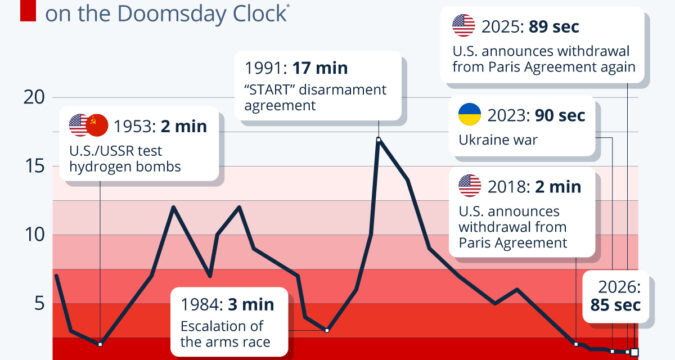
The hands of the symbolic Doomsday Clock now stand at 85 seconds to midnight – closer to global catastrophe than ever before.
The Doomsday Clock, or the Nuclear War Clock, represents how close we are veering towards global disaster at the hands of humans.
As Statista’s Anna Fleck reports, according to the Bulletin of the Atomic Scientists, the decision to move the clock forward from 89 to 85 seconds reflects escalating threats from nuclear weapons, accelerating climate change and the potential misuse of emerging technologies.
You will find more infographics at Statista
As Steve Fetter, a member of the Bulletin’s Science and Security Board, explains: “In every area, we have failed to take the steps that are necessary to reduce risks and there are new developments in every area that make the risks greater.”
At the announcement of the new setting, Bulletin representatives highlighted how the last remaining treaty governing nuclear weapons stockpiles between the United States and Russia is due to expire next week.
This means that for the first time in over half a century, there will be nothing preventing a “runaway” nuclear arms race. The scientists also voiced concern about the global rise of autocracies and how AI is “supercharging” mis- and disinformation.
It is believed that artificial intelligence could undermine nuclear deterrence in several ways. According to the Future of Life Institute, an international thinktank focused on existential risks from transformative technologies, this could include increased risk of error based on disinformation, as well as the fact that faster, AI-driven judgments may leave little time to verify information before irreversible actions are taken.
Despite these warnings, the Bulletin urges that the public has power beyond the ballot box.
Citizens, it argues, can also to take the opportunity to become more informed about these risks and to drive policy by showing political interest in their local districts.
Looking further back, the Doomsday Clock was first set below the two-minute mark (at “100 seconds” to midnight) in 2020.
That shift cited the Covid-19 pandemic, advancing climate change, the spread of fake news and a worsening geopolitical instability.
Russia’s invasion of Ukraine later intensified these concerns, prompting researchers to advance the Doomsday Clock from 107 to 90 seconds (1.5 minutes) before midnight in early 2023.
As this chart shows, 1953 was also considered a year of heightened tensions, when the U.S. and the USSR had tested hydrogen bombs.
Notably, however, the threat of catastrophe from the so-called Cuban Missile Crisis (1962) is not reflected on the clock.
This is likely because the issue of the Bulletin of the Atomic Scientists published near the time came out in November/December 1962, after the immediate danger of the crisis had largely subsided.
Tyler Durden
Fri, 01/30/2026 – 05:45
https://www.zerohedge.com/geopolitical/doomsday-clock-ticks-closer-midnight

Today in History: Sally Yates fired
Today is Friday, Jan. 30, the 30th day of 2026. There are 335 days left in the year.
Today in history:
On Jan. 30, 2017, President Donald Trump fired Acting U.S. Attorney General Sally Yates after she publicly questioned the constitutionality of his refugee and immigration ban and refused to defend it in court.
Also on this date:
In 1649, England’s King Charles I was executed for high treason.
In 1835, in the first-known attempt to assassinate a U.S. president, an unemployed house painter tried to kill President Andrew Jackson, but both of the attacker’s pistols misfired and he was tackled as Jackson was safely hustled away.
In 1933, Adolf Hitler was named chancellor of Germany.
In 1945, during World War II, a Soviet submarine torpedoed the German ship MV Wilhelm Gustloff in the Baltic Sea, killing over 9,000 people, most of them war refugees; roughly 1,000 people survived.
In 1948, Indian political and spiritual leader Mohandas K. Gandhi, 78, was shot and killed in New Delhi by Nathuram Godse, a Hindu extremist.
In 1968, the Tet Offensive began during the Vietnam War as Communist forces launched surprise attacks against South Vietnamese towns and cities.
In 1969, The Beatles staged an unannounced concert atop Apple headquarters in London that would be their last public performance.
In 1972, 13 Catholic civil rights marchers were shot and killed by British soldiers in Northern Ireland on what became known as “Bloody Sunday.”
Related Articles
Today in Chicago History: George Ryan leaves prison — 13 years after he declared a state moratorium on executions
Vintage Chicago Tribune: Tiki bars and tropical-themed restaurants
Today in History: Army helicopter and American Airlines plane crash midair
Today in Chicago History: Hadiya Pendleton, 15-year-old honors student at King College Prep, shot and killed
Today in History: ‘Pride and Prejudice’ published
In 2020, health officials reported the first known case in which the new coronavirus was spread from one person to another in the United States.
Today’s birthdays: Actor Vanessa Redgrave is 89. Musician Phil Collins is 75. Actor Charles S. Dutton (“Roc”) is 75. Golf Hall of Famer Curtis Strange is 71. Actor Ann Dowd (“The Handmaid’s Tale”) is 70. Comedian Brett Butler (″Grace Under Fire”) is 68. Singer Jody Watley is 67. U.S. House Speaker Mike Johnson is 54. Actor Christian Bale is 52. Actor Olivia Colman is 52. Actor Wilmer Valderrama (“That ’70s Show”) is 46. Rapper-musician Kid Cudi is 42. Pop singer Tyla is 24.
https://www.chicagotribune.com/2026/01/30/today-in-history-sally-yates-fired/
Today in Chicago History: George Ryan leaves prison — 13 years after he declared a state moratorium on executions
Here’s a look back at what happened in the Chicago area on Jan. 30, according to the Tribune’s archives.
Is an important event missing from this date? Email us.
Front page flashback: Jan. 30, 2000
Following a Tribune investigation that exposed the death-penalty system’s flaws, Illinois Gov. George Ryan blocks the execution of any Death Row inmate in Illinois. (Chicago Tribune)
2000: Illinois Gov. George Ryan declared a moratorium on executions, saying it would be in effect until he could be morally certain that no innocent person would face execution in the state. Three years later, Ryan commuted the sentences of 164 death row inmates to life in prison without parole, citing a system “haunted by the demon of error.”
Weather records (from the National Weather Service, Chicago)
High temperature: 55 degrees (1988)
Low temperature: Minus 23 degrees (2019)
Precipitation: 0.97 inches (1939)
Snowfall: 14.9 inches (1939)
A streetcar equipped with a snowplow clears the 3700 block of Broadway in January 1939, in Chicago. The Tribune wrote on Jan. 31, 1939, “Chicago and its suburbs worked last night and early today to dig out of one of the worst snowstorms in its history. No more snow is expected today. The storm, which spread over 13 states, partly paralyzed activity in Chicago. It was the most intense snowfall on record.” (Chicago Tribune historical photo)
1939: Illinois was one of 13 states affected by a brief storm, which dumped almost 15 inches of snow here in roughly 15 hours.
It was the most severe snowfall Chicago had experienced in a 24-hour period in duration and accumulation.
Chicago’s 10 largest snowfalls since 1886 — and how the Tribune covered them
The intense snowfall made it difficult for both the sick and the expecting to receive medical attention. After she and her husband’s vehicle became stranded in a drift, a pregnant Mrs. Thomas Galbraith climbed into a police car to make the 5-mile journey to a hospital in Joliet. When it could go no farther, a wrecking truck took her in. Thankfully, she was finally transferred to an ambulance and delivered a baby girl at the hospital.
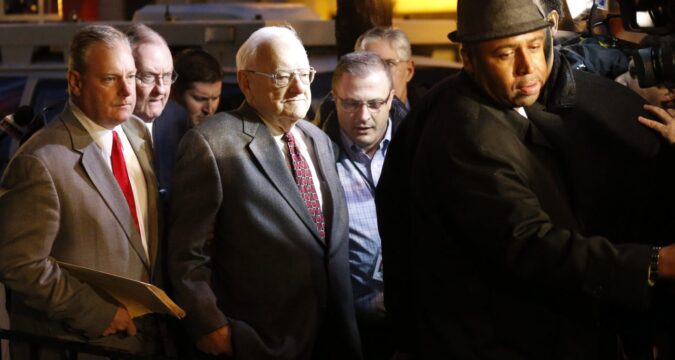
Former Illinois Gov. George Ryan spent more than five years in federal prison in Terre Haute, Ind., before he was released to a halfway house on the West Side on Jan. 30, 2013. He checked in and then on the same day was released to his home in Kankakee. (Chicago Tribune)
2013: Ryan was released from a federal prison in Terre Haute, Ind., and spent just hours at a halfway house on Chicago’s West Side before he was released and sent to his Kankakee home, where he remained on home confinement until July 2013.
Ryan entered prison on Nov. 7, 2007, after an April 2006 conviction for fraud, racketeering and other charges, which was the culmination of the federal Operation Safe Road investigation that exposed rampant bribery in state driver’s license facilities while he was secretary of state as well as misdeeds as governor. He had been sentenced to 6 ½ years in prison.
The sun rises on the Chicago skyline at North Avenue Beach on a cold and chilly morning, Jan. 30, 2019. (José M. Osorio/Chicago Tribune)
2019: Chicago observed its coldest temperature in 34 years — minus 23 degrees on Jan. 30, 2019, at O’Hare International Airport, the city’s official recording site. It was tied for the fifth coldest day since the National Weather Service began keeping records in 1872.
The polar vortex, a whirlpool of Arctic air typically perched atop the North Pole, dislodged and descended into the Midwest causing the bitter cold.
The week’s record-breaking cold snap spotlighted weaknesses in the region’s transit system. Problems like stuck train doors, cracked rails and minimal shelter for waiting passengers showed the need for more investment.
Chicago weather: A look back at our coldest recorded temperatures
Want more vintage Chicago?
Subscribe to the free Vintage Chicago Tribune newsletter, join our Chicagoland history Facebook group, stay current with Today in Chicago History and follow us on Instagram for more from Chicago’s past.
Have an idea for Vintage Chicago Tribune? Share it with Kori Rumore and Marianne Mather at krumore@chicagotribune.com and mmather@chicagotribune.com
https://www.chicagotribune.com/2026/01/30/january-30-chicago-history/
Germany’s PMI “Recovery” Is Built On Layoffs, Price Inflation, And State Expansion
Germany’s PMI “Recovery” Is Built On Layoffs, Price Inflation, And State Expansion
Submitted by Thomas Kolbe
Economic indicators suggest a stabilization in Germany’s services sector. Yet the apparent improvement in the corresponding index follows massive staff reductions and efficiency measures undertaken by companies responding to a political structural crisis.
In Berlin, the great tremor has begun. For almost exactly seven months now, the German economy has been pregnant with the federal government’s oversized debt package—and from an economic standpoint, it has delivered nothing so far. No growth in sight. Disappointment is spreading through the government quarter.
Any attempt to explain to politicians that artificial state demand creates no real value but merely beautifies GDP statistics would likely be pearls before swine. And yet Chancellor Friedrich Merz and his cabinet are hoping for positive economic headlines to somehow stumble across the finish line of the 2026 super-election year.
A Flicker of Hope
As if an early success story had been ordered at the push of a button, the HCOB Services PMI (Purchasing Managers’ Index) reported an increase in January from 52.7 to 53.3 points—a three-month high.
A figure that fuels false hopes in Berlin. Because what lies beneath the data is almost precisely the opposite of what would now be urgently required: Germany’s services sector is cleaning up its balance sheets, shedding staff on a massive scale in order to realize short-term efficiency gains. What we are witnessing is the forced reaction of the economy to ever-rising energy costs and higher input prices, which—made visible through the inflation index—are passed on to customers and artificially inflate the headline figures. Adjusted for prices, the downturn continues.
Meanwhile, the countless new regulations raining down on the economy from Brussels and Berlin ensure that this diagnosis will not change. A whole bundle of new emissions rules, border adjustment mechanisms, data-usage standards, and countless other ideas from the EU’s industrious bureaucratic think tanks are making life even harder for companies—presumably the much-praised “debureaucratization” that Friedrich Merz keeps fantasizing about.
Let us consider another data point that highlights the depth of Germany’s economic crisis. Current figures from the hospitality sector show that more than 97,000 applicants are now competing for just 19,000 open positions.
Last year, the sector lost roughly four percent of its real business volume, and layoffs are now following the sharp downturn. The hospitality industry crystallizes the collapse of German purchasing power, as households—after years of inflation and a deteriorating labor market—are forced to tighten their belts.
It cannot be emphasized often enough: the long-cultivated narrative of a German “skilled labor shortage,” promoted by politics and the media for years, was from the outset a political vehicle to flank open-border policies. Genuine skill shortages are addressed by companies through the international labor market—by the private sector, not through state-driven mass immigration into Germany’s welfare system. The political left has made the expansion of its voter base a strategic objective, and no reversal in migration policy is in sight.
Here, at the economic front line of the domestic economy, political deception is laid bare. Unemployment will become an economic reality in the coming years, and it will place a heavy burden on social life in Germany.
The State Creates a Buffer
Meanwhile, the inevitable is unfolding in the economy: companies are cutting staff and raising prices wherever possible, making overall economic indicators appear more positive than they truly are—without any real new demand emerging. At the same time, selected firms benefit from state-subsidized projects in areas such as climate policy or military production, further reinforcing the illusion of expansion.
The index figures obscure another crucial aspect of the labor-market debate. Last year, official unemployment in Germany rose by just over 100,000 people. This figure masks the reality that many workers were shifted into short-time work, the number of pensioners increased, and—contrary to the government’s political folklore—the state continued to systematically expand the public sector.
Over the past five years, the number of public employees has grown annually between 1.8 and 2.6 percent. Over the past decade, nearly one million new state employees have been added. Today, five and a half million people work in Germany’s public sector—a bloated machine of capital destruction.
Projecting this continuous expansion forward into 2025, the number of public employees will likely have increased by another 100,000. This is all the more plausible given that distributing the massive new debt package of more than €50 billion per year from the special fund requires a vast regional bureaucracy that far exceeds existing personnel capacities.
Through the costly expansion of its administrative apparatus, the state is masking rising unemployment—a consequence of regulatory policy and the energy crisis that can no longer be concealed—and has driven the German economy into progressive deindustrialization.
The Source of Prosperity
Germany’s economic policy debate lacks substance. It must be emphasized far more clearly that prosperity is exclusively the product of private investment and cannot be conjured up on the drafting tables of central planners in Berlin and Brussels. Only private investment, guided by free markets and consumer demand, expands an economy’s productive capacity.
The “special fund,” the largest state debt program in the history of the Federal Republic, is causing massive crowding-out effects in capital markets. Scarce resources are locked into subsidy schemes, free capital retreats, labor is tied up in unproductive sectors—and the state, in its desperation, fuels the general decline.
These trends are well documented. Figures from the ifo Institute in November show that the investment expectations index fell to −9.2 points. This means a growing number of companies plan to sharply reduce investment this year—especially in industry, where the long-observed trend of capital withdrawal continues. The situation is particularly dramatic in automotive manufacturing, where the index plunged to −36.7 points.
The chemical industry is also fighting for survival. With capacity utilization of only 70 percent, most energy-intensive firms are operating deep in the red. We are facing an economic depression that has manifested itself since 2018 in Germany’s declining industrial output. Overall corporate investment last year was around seven percent below the previous year’s level. Since 2018, German industry has lost more than 15 percent of its production volume.
The country is growing poorer—while poverty migration into the welfare system continues unabated. On a per-capita basis, the effect is even clearer. Germany’s enormous redistribution machine is attempting to conceal the emerging social conflict by intensifying its raid on the middle class through ever more aggressive taxation.
Germany reached its tipping point in 2018. Since then, the economy has stagnated, and overall productivity has declined—a clear indicator that the scaled-up interventionism of the state is crowding out investment capital while expanding a parasitic public sector.
This is a dramatic finding with regard to technological progress, which should have led to massive productivity gains but cannot materialize in Germany amid the flight of companies and capital.
Germany is heading toward growing distributional conflicts. Rising deficits in the social-security system are harbingers of an internal social storm that will unfold along ethnic and cultural lines.
That the state is now rapidly deploying a censorship apparatus to suppress debate about the consequences of these policies should deeply concern everyone. The hastily formulated thesis that “the crisis is the solution” cannot solve individual financial problems, nor can it alleviate fears about personal safety in a country of concrete barriers and knife-free zones.
The collapse of the welfare state shifts economic responsibility and social security back onto individuals. Recovery is possible. It begins when the state is no longer seen as the savior, but as the cause of the present crisis. Until then, the road ahead will be long and rocky.
* * *
About the author: Thomas Kolbe, a German graduate economist, has worked for over 25 years as a journalist and media producer for clients from various industries and business associations. As a publicist, he focuses on economic processes and observes geopolitical events from the perspective of the capital markets. His publications follow a philosophy that focuses on the individual and their right to self-determination.
Tyler Durden
Fri, 01/30/2026 – 05:00
Births Plummet In China As Population Growth Stalls
Births Plummet In China As Population Growth Stalls
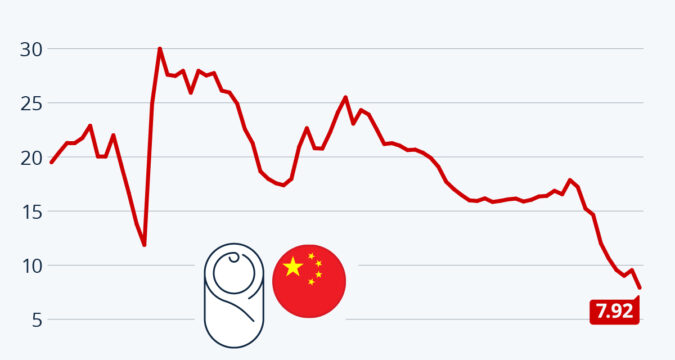
The number of new babies born in China dropped to 7.9 million in 2025, the lowest number in more than seven decades.
This marked a 17 percent decline from one year before, when it was 9.5 million.
As Statista’s Anna Fleck reports, according to the National Statistics Bureau of China (NBS), the country’s birth rate fell to 5.63 per 1,000 people in 2025.
This is the lowest level since 1949, when the Communist Party took power.
You will find more infographics at Statista
Meanwhile, China’s death rate rose to 8.04 per 1,000 people.
This resulted in last year being the fourth consecutive year for the country’s population to fall, reaching 1.4 billion.
Beijing has been trying to encourage its population to marry and have children.
The country’s fertility rate stood at 1.3 children per woman in 2020 and has been below the 2.1 threshold necessary for a stable population since the 1990s.
Despite the early warning signs, China only scrapped its long-standing one-child policy in 2016, as fear of overpopulation gave way to fear of aging societies.
The country has introduced other incentives since, including offering parents 3,600 yuan ($500) for every child under three years old, as well as a new tax on contraceptives introduced on January 1.
The latter has been criticized over risks of unwanted pregnancies and HIV rates.
Experts attribute the falling fertility rate to China’s economic and social development. Countries tend to experience lower birth rates in line with economic development as increased education access and concentration on careers become new priorities for the population.
That is certainly the case elsewhere in Asia, particularly in Japan and South Korea where birth rates have dropped significantly. The situation is especially concerning in South Korea where there were more deaths than births last year.
Tyler Durden
Fri, 01/30/2026 – 04:15
https://www.zerohedge.com/geopolitical/births-plummet-china-population-growth-stalls

Tensions Between Kiev & Budapest Ramp Up As Ambassadors Summoned Over Election Interference Claims
Tensions Between Kiev & Budapest Ramp Up As Ambassadors Summoned Over Election Interference Claims
Authored by Thomas Brooke via Remix News,
Hungary and Ukraine have summoned each other’s ambassadors amid a sharp escalation in diplomatic tensions, with Prime Minister Viktor Orbán and Foreign Minister Péter Szijjártó accusing Kyiv of attempting to interfere in Hungary’s upcoming parliamentary elections and Ukraine rejecting the claims as cynical and dishonest.
In a series of social media posts on Wednesday, Orbán alleged that Hungary had been subjected to “daily threats from Ukraine,” naming President Volodymyr Zelensky, Foreign Minister Andrii Sybiha, and Ukrainian security services. “This will continue until the elections,” Orbán wrote, claiming that Kyiv wanted “a pro-Ukrainian government in Hungary” and was targeting members of his government, including Szijjártó and himself.
“We did not seek conflict, yet Hungary has been the target for days,” Orbán said, as cited by Magyar Hírlap. He added that Hungary would not be distracted from defending what he described as national interests, stating: “We will not send money to Ukraine, because it is in a better place with Hungarian families than in the bathroom of a Ukrainian oligarch.” He also reiterated his opposition to banning Russian oil and gas imports and to Ukraine joining the European Union, arguing that accession would “also import war.”
“As long as Hungary has a national government, these issues will not be decided in Kyiv or Brussels,” Orbán wrote.
Szijjártó said that Ukraine had summoned Hungary’s ambassador in Kyiv earlier on Wednesday, adding that Budapest was “not surprised, neither by the fact, nor by what they said.” According to the foreign minister, Ukrainian officials again objected to Hungary’s national petition, which allows citizens to express views on what the government describes as Brussels’ and Kyiv’s plans to use Hungarian taxpayer money to fund and arm Ukraine.
The foreign minister said Ukraine offered no explanation for what he called President Zelensky’s “vulgar insults” of Orbán or for Sybiha’s claim that the Hungarian prime minister is acting like “one of Hitler’s henchmen.”
Szijjártó warned that Kyiv appeared set to escalate what he described as interference in Hungary’s April election in support of opposition leader Péter Magyar’s Tisza Party. “We understand that Ukraine wants the Tisza Party to win, but only the Hungarian people can decide Hungary’s future, and whether we choose peace or war,” he said.
❗️@FM_Szijjarto: Today the Ukrainians summoned our ambassador in Kyiv. We weren’t surprised, neither by the fact, nor by what they said.” FM Szijjártó said Ukraine once again objected to Hungary’s national petition, which lets citizens express their views on Brussels and Kyiv’s… pic.twitter.com/G03dHCLOO6
— Zoltan Kovacs (@zoltanspox) January 28, 2026
Hungary has also summoned Ukraine’s ambassador to the Ministry of Foreign Affairs in Budapest. “We will not tolerate any interference in Hungary’s elections, including Ukraine’s attempts to influence the outcome and to intervene in the electoral process in favor of the Tisza Party,” he said.
He accused President Zelensky and the Ukrainian government of conducting an “open, shameless and aggressive interference campaign” in recent weeks, adding: “That decision is made in Hungary, not in Brussels and certainly not in Kyiv. We will defend our sovereignty by every possible means.”
The Ukrainian leadership crossed a line.
We did not seek conflict, yet for days now Hungary has been in the crosshairs. Still, neither threats from the president, nor from the foreign minister, nor from extremist military groups will deter us from standing up for the interests… pic.twitter.com/dSRFERc93N
— Orbán Viktor (@PM_ViktorOrban) January 28, 2026
Szijjártó’s remarks echoed earlier comments by Orbán on Jan. 24, when the prime minister said Ukraine had “gone on the offensive” and was “issuing threats and openly interfering in the Hungarian elections.”
Ukraine has not responded directly to Szijjártó’s latest claims, but Sybiha addressed earlier accusations over the weekend, telling Hungarian officials “not to be afraid of Ukraine,” but of the Hungarian people. In a lengthy post on X, Sybiha accused Orbán of cynicism and historical manipulation, writing: “When Viktor Orbán says that he will not allow Ukraine to join the EU for the next 100 years, he is not really talking to the Ukrainian state. First and foremost, he is telling this to ethnic Hungarians in Transcarpathia.”
Let’s call a spade a spade, @FM_Szijjarto.
When Viktor Orbán says that he will not allow Ukraine to join the EU for the next 100 years, he is not really talking to the Ukrainian state. First and foremost, he is telling this to ethnic Hungarians in Transcarpathia.
This sounds… https://t.co/1SvwAuxSzZ
— Andrii Sybiha 🇺🇦 (@andrii_sybiha) January 24, 2026
Sybiha went on to accuse Orbán of using ethnic Hungarians in Ukraine as “hostages to his geopolitical adventures,” and claimed that blocking Ukraine’s EU accession amounted to “yet another crime against the Hungarian people and Hungary itself.”
Hungary has long been opposed to further rearmament for Ukraine in the ongoing conflict with Russia, accusing Brussels of carelessly spending European taxpayers’ cash in a desperate and unrealistic attempt to help Ukraine defeat Russia, allowing for the continuation of a war that has already claimed hundreds of thousands of lives.
Hungary heads to the polls on April 12 in a hotly contested election in what many in Budapest say will be the toughest test yet for Orbán and his governing Fidesz party.
Tyler Durden
Fri, 01/30/2026 – 03:30

Are foot spas good for your feet?
Are foot spas good for your feet?
When it comes to methods of relaxation, foot spas might not spring first to mind. But, these machines can soothe more than enough of the aches and pains that come from a long shift spent on your feet or from the symptoms of medical issues you may have. However, you have to use them appropriately to avoid harming your feet or worsening your symptoms. You also need to balance features you may or may not need to soothe specific problems with the increased price that often comes with them.
Size
Foot spas don’t come in a uniform size. Some are on the small side so they can be easily carried once filled. Others are larger to accommodate those with large feet. Before buying one, always double-check its dimensions against the width and length of your feet. Also, double-check what the given dimensions actually measure; some measure the total size of the spa while others measure the interior capacity.
Depth
Most foot spas are only deep enough to cover most of your foot. Some spas are a little deeper, though, to cover the ankles for those with ankle issues. A handful of foot spas are even deep enough to soak your calves; these should only be bought by those who truly need calf attention, as otherwise, they’re too large, unwieldy and difficult to fill to be worth the hassle.
Toe controls
The best foot spas have controls that are easily manipulated by a toe. This lets you adjust water temperature, massage settings and other aspects without having to bend over.
Noise
Most foot spas are fairly quiet, though there should still be some noise coming from the low-power massage features. Spas with high-power massage features can make more noise, though, enough to disturb someone else in your room or home.
FAQ
Q. What are the benefits of using a foot spa?
A. There are two main benefits. First, and simplest, it’s relaxing. It’s the same principle behind soaking in a hot bath; it relaxes the muscles and relieves tension. This can be taken further and become pain relief, especially for those suffering from arthritis. Secondly, it can prepare your feet for further care, such as softening calluses and nails for later removal.
Q. Is it ever dangerous to use a foot spa?
A. It can be under the right (wrong?) circumstances. The most common danger is getting an infection from not properly cleaning your spa after every use. Additionally, you shouldn’t use a foot spa at all under certain conditions, such as if you’re diabetic or pregnant. If you’re concerned that you have a condition that makes foot spa use dangerous, check with your doctor. Finally, you should never use a foot spa if you have fresh or still-healing wounds.
Best foot spas
Conair Soothing Vibration Foot Spa
The vibrations from this spa are gentle enough not to numb your feet but strong enough to still relax them. It can be controlled with a tap from a single toe.
This spa can maintain the warmth of any water added, though it can’t heat cold water. It has foot scrubbers, a pumice stone and blue lights to promote a calm atmosphere.
This is among the most affordable foot spas but it still has great features, such as a built-in pumice stone, raised massage nodes and massaging bubbles. It can also be controlled with your feet.
Homedics Shower Bliss Foot Spa
This spa can heat the water so you stay warm for the entire duration. It offers two main massage functions: bubble and waterfall. It also has a pumice stone for scrubbing.
Best hand towel sets
These decorative towels are perfect for putting underneath your foot spa if you want your water-catching towels to still look good. They measure 18 by 40 inches and come in 12 colors.
This collection of four towels measuring 14 by 29 inches is great for drying off your feet right after a spa treatment. They’re cotton, and each towel is a different color.
This collection of towels comes in a set of six or 72, for if you’re practically running your own spa. They measure 16 by 28 inches and come in 16 colors.
Prices listed reflect time and date of publication and are subject to change.
Check out our Daily Deals for the best products at the best prices and sign up here to receive the BestReviews weekly newsletter full of shopping inspo and sales.
BestReviews spends thousands of hours researching, analyzing and testing products to recommend the best picks for most consumers. BestReviews and its newspaper partners may earn a commission if you purchase a product through one of our links.
Distributed by Tribune Content Agency, LLC.
https://www.chicagotribune.com/2026/01/30/are-foot-spas-good-for-your-feet/