Category: News
From the Farm: History of hot beef Manhattan and ‘blue plate special’ not forgotten
One of the simple farm suppers we had last week was the hearty menu staple, hot beef Manhattans.
We already had leftover thick and rich brown gravy from another meal, along with leftover mashed potatoes, therefore most of our menu items for this easy supper were prepared and ready for assembly.
Our farm kitchen bread drawer had a loaf of wheat bread perfect for toasting, and after work, I’d stopped at our favorite deli counter for a pound of premium, shaved sirloin roast beef.
Voila!
Hot roast beef Manhattans consist of generous mounds of cooked roast beef slices served on either plain or toasted bread slices with an accompanying scoop of mashed potatoes, all of it slathered in brown gravy. (Mom served this entree with delicious leftover creamed corn, which she said helped to add ‘’some color to our plates.”
I mentioned our hot beef Manhattan menu to my colleague, 23-year-old Luke Miiller of Hammond, who is one of my former Purdue Northwest college class students. He was both baffled and curious.
A menu printed in 2025 for Liberty Bell Café in Liberty, Kentucky, prominently features Beef Manhattan as one of the restaurant’s signature favorites for hungry patrons. (Image courtesy of Liberty Bell Café)
I explained the simple nature of the dish and that it ranked as a family favorite for decades. Not only at the farm as a remedy for leftovers, but this was also a menu item we all liked to order at roadside restaurants.
Even during our annual summer family fishing trips, hot beef Manhattans held a special culinary distinction for our dining appetites.
During most of my youth, our annual summer fishing vacation was in Northern Minnesota at Richardson’s Shangri-La Resort, a tradition our family began shortly after 1960. In 1949, Ralph and Jan Richardson from our small town of San Pierre began building their dream of a quiet Minnesota fishing resort on the shores of Pelican Lake.
Today, this classic Northwoods retreat of nine quaint and rustic cabins in tiny Orr, Minnesota, not far from the border of Canada, is still owned and operated by the third generation of the Richardson Family, caring for the recently renovated cabins and landscape of birch trees and white pines. During these family fishing vacations, on Sunday afternoons, we’d have our family dinner at the only town diner where the Sunday menu special was always delicious hot beef Manhattans.
Until some research last week, I did not realize this “open-face sandwich” also has Hoosier roots. Since it has the name association with Manhattan, New York City, I thought it must have an East Coast tale of origin. As it turns out, it came to popularity and gained its name in the 1940s. It was the workers at the Naval Ordnance Plant in Indianapolis who gave the dish its name after having eaten it in cafeterias while stationed near Manhattan. When the men were sent back to Indiana, they brought the recipe request with them to a popular Indy deli (which has now closed), which vaulted it as a top menu specialty.
During my description chat with Luke, I also categorized hot beef Manhattan as “comfort food,” “affordable,” and common on the menus of diners and cafes as “a blue plate special,” the latter term which also confused him.
According to historians and likely due to wartime rationing and the need for frugal spending, the concept of diners, cafes and restaurants serving “blue plate specials” began in the 1920s and continued into the 1960s before fading. Dining establishments would promote a daily “blue plate special,” which meant a hearty multi-item meal with a generous portion at a very reasonable price. Inexpensive blue china plates, usually with three designated segmented areas on the plate, were divided by ridges to gauge portion control.
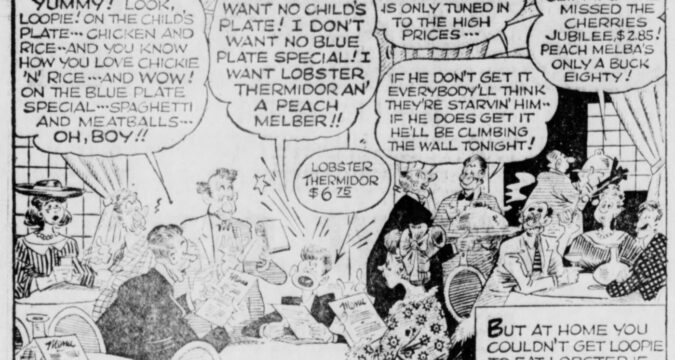
Newspaper comic strips like “Blondie,” launched in 1930 by Hearst King Features Syndicate, often liked to poke fun at blue plate specials, especially the strictly enforced rule by restaurants about “NO Substitutions!”
A rich yet delicate moist chocolate cake flavored with the hint of Irish cream liquor is a favored combination for a simple dessert recipe dreamed up by the older sister of columnist Philip Potempa. (Photo by Pamela Robinson)
The past two weeks of cold temperatures and snow have had my older sister Pam dreaming up new dessert recipes to test. A sure “keeper” is the easy pastry creation she’s dubbed “Pam’s Irish Cream Whip Cake.” Moist and decadent, it’s the perfect dessert to indulge in for this weekend’s arrival of February, makes a great Valentine’s Dinner sweet finale, and is an ideal option to savor before this year’s Feb. 18 Ash Wednesday date and the start of Lenten sacrifice.
Columnist Philip Potempa has published four cookbooks and is a weekly radio show host on WJOB 1230 AM. He can be reached at PhilPotempa@gmail.com or mail your questions: From the Farm, PO Box 68, San Pierre, Ind. 46374.
Pam’s Irish Cream Cake
Makes 14 slices
1 Devil’s Food or Chocolate (16-ounce) Cake Mix
1 Carton (8 ounces) frozen non-dairy whipped topping, thawed
1 Carton (4 ounces) non-flavored or flavored yogurt of choice
1/2 cup Irish cream liquor
Powdered sugar garnish as desired
Directions:
In a large mixing bowl, combine all ingredients.
Pour batter into a sprayed 9-inch-by-13-inch baking dish.
Bake at 350 degrees for 25 minutes or until a knife inserted into the center comes out clean.
Once cake has cooled, dust lightly with powdered sugar. When serving, a dollop of whipped cream can be added if desired.

Yesenia Escobar answers call on senior night for Larkin with game-high 22 points. Again? ‘Can get it going.’
Larkin’s Yesenia Escobar has been on varsity for four seasons and a starter for three.
But when longtime boys coach Deryn Carter took over the girls basketball program this season, he felt there was more to unlock in Escobar’s game and made his expectations to her clear.
Carter told the senior guard that he needed her to be an all-conference player for the Royals, something that initially surprised Escobar. Over time, though, that’s exactly what has happened.
“His confidence has grown mine,” Escobar said. “I feel like I’ve grown as a player and really expanded my game, not just shooting, but driving. It feels really great, especially after last season.
“We had a couple injuries, so coming into this season with a new opportunity, it feels good.”
Escobar was better than good Thursday night, putting on an epic senior night performance with a game-high 22 points for host Larkin in a 59-31 Upstate Eight West victory over West Aurora.
Larkin’s Yesenia Escobar (4) heads to the bench for a time out against West Aurora in the first quarter of an Upstate Eight West game in Elgin on Thursday, Jan. 29, 2026. (H. Rick Bamman / The Beacon-News)
Stepping up to be the second scoring option to Chicago State-bound senior guard Mia Carter, Escobar shot 6 of 6 from 3-point range in the first half as Larkin (17-9, 10-2) pulled away early.
Kenira Johnson and Mackenzie Wemken added eight points apiece for the Royals. Aniyah Stewart paced West Aurora (7-16, 4-7) with nine points.
When one of Escobar’s first 3-pointers hit the rim, bounced 10 feet into the air and still found the net, it was obviously going to be her night Thursday.
“She can get it going, man,” Deryn Carter said of Escobar. “She can make some shots for us. She just adds such an element for us.”
Larkin’s Yesenia Escobar (4) lines up a 3-point shot against West Aurora in the third quarter of an Upstate Eight West game in Elgin on Thursday, Jan. 29, 2026. (H. Rick Bamman / The Beacon-News)
The blistering-hot first half caught Escobar off guard.
“It felt really good,” Escobar said. “I surprised myself because in warmups none of my shots were falling. When it happened in the game, I was like, ‘OK.’”
Five of her 3-pointers came while Larkin built a 23-6 lead in the second quarter. An 18-1 run put the game away.
Escobar and Mia Carter have played together since fifth grade. Mia knew this would be possible.
Larkin’s Yesenia Escobar (4) reacts to teammate Mariah Chandler’s basket against West Aurora in the first quarter of an Upstate Eight West game in Elgin on Thursday, Jan. 29, 2026. (H. Rick Bamman / The Beacon-News)
“I feel like we tried to instill as much confidence in her as possible,” Mia Carter said. “I feel like that also came from her within. She started gaining more confidence as well.
“I played with her for years. I like to say I knew it was in her all along.”
Mia Carter is the playmaker and focal point for the Royals. One of the program’s all-time greats, she has helped Escobar reach her potential as well.
Carter’s ability to draw defensive attention her way and her court vision and willingness to create for teammates have helped Escobar shine.
“I don’t know if it’s our Junior Royals chemistry or what,” Escobar said. “I love playing with Mia. She always finds away to get us open. I don’t know. This season, our chemistry has grown a lot.”
Carter has a bond with the whole team. She only attempted two shots Thursday and was held scoreless, but it was for a reason on senior night — illustrating her style of leadership.
Larkin’s Yesenia Escobar (4) and West Aurora’s Telysa Newman (12) battle for position in the second quarter of an Upstate Eight West game in Elgin on Thursday, Jan. 29, 2026. (H. Rick Bamman / The Beacon-News)
Carter dished out five assists, grabbed seven rebounds and tallied two steals.
“I feel like everybody should have an opportunity to score, not just me,” Carter said. “I know I’m going to the next level, but some of these girls, this is their last time playing basketball.
“I just figured that I would try to get everybody involved.”
Carter’s playmaking — along with the ability of Escobar and Wemken to hit from the outside — has helped the Royals reach another level.
A win Wednesday over South Elgin would give the Royals their first conference title since 1979.
“With Yesi’s ability to shoot and Mackenzie’s ability to shoot, it’s hard,” Deryn Carter said. “If we put people in the right places and Mia makes the right plays, those girls are going to get open shots.”
Paul Johnson is a freelance reporter for The Beacon-News.
https://www.chicagotribune.com/2026/01/30/yesenia-escobar-larkin-west-aurora-girls-basketball/

Naperville ranks No. 12 in U.S. for number of remote workers, study finds
Do you love working from home in your pajamas? Or how about while munching on a pastry from a local coffee shop?
Naperville might just be the city for you.
The third largest city in Illinois was recently recognized for having one of the highest rates of remote workers in the country, according to a study by SmartAsset, a company that provides educational content for consumers to make better financial decisions.
SmartAsset ranked 357 of the largest U.S. cities based on the percentage of people working from home. The study used data from the 2023 and 2024 U.S. Census Bureau’s American Community Survey.
“The American Community Survey, or ACS, tracks remote work by asking respondents their primary means of commuting to work during the reference week,” SmartAssest spokesperson Toby Nelson said.
A man works from his laptop during a Coffee and Coworking event at Nichols Library in downtown Naperville on Mar. 7, 2024. A new study found that Naperville has one of the highest percentages of remote workers in the country. (Naperville Public Library)
Anybody who selects “worked from home” during the reference week is classified as a remote worker by the survey.
“In other words, this is capturing usual work location, not occasional or hybrid days,” Nelson said. “So when we talk about remote work for the purposes of this study, it reflects where people work most often, if they say they’re working from home, so it could also capture people who are maybe working a majority of the week at home, but maybe one or two days in the office.”
Naperville ranked No. 12 on the list. In 2023, 27.88% of Naperville’s working population were classified by the American Community Survey as remote workers. In 2024, that number dipped slightly to 25.59%. The number of remote workers in Naperville in 2024 was 20,251.
Frisco, Texas, took the No. 1 spot on the list, with 33.69% of its working population in 2024 made up of remote workers.
Berkeley, California, came in at No. 2 with a remote work population of 31.49%. Cary, North Carolina, ranked No. 3 at 30.58%.
Naperville was the only city in Illinois to crack the top 25. The only other Illinois city that made the top 100 was Chicago, which came in at No. 73, Nelson said, with a remote work prevalence of about 18%.
“I do think, at a very high level, the similarities we are seeing is that many of the top cities on the list do have a high percentage of workers who are in those professional, technical and knowledge sectors and those industries we find, in general, tend to be most amenable to remote work,” he said.
That appears to be true for Naperville. While Nelson did not have raw numbers for the city, he did note that according to the Argonne National Laboratory Economic Development Capacity Index, both DuPage County and Will County have a high concentration of people who work in STEM and analytical roles, fields that tend to be more friendly for remote work.
Specifically, the Economic Devleopment Capacity Index noted that a higher concentration of the workforce in DuPage County is in STEM and analytical roles compared to 97% of all counties in the U.S. For Will County, that number was 87%.
“Naperville’s remote work share is elevated most likely because its local workforce is concentrated in professional, technical and knowledge sectors that tend to be more amenable to remote and hybrid work. And that’s typical of cities in the Illinois Technology and Research Corridor.”
Nelson also noted that while the percentage of remote workers declined slightly in cities like Naperville, it is not necessarily a sign that remote work is going away any time soon.
“What we are seeing is that the return-to-office numbers are stabilizing right now,” he said. “I think in general, in areas with very high remote work prevalence like Naperville, this should probably be seen as a signal that flexible work is now a baseline expectation for that locality’s workforce.”
It is not the first time Naperville has been recognized for its remote work presence.
In 2024, LawnStarter named Naperville the 5th best city in the U.S. for remote workers in the U.S. To compile its ranking, LawnStarter evaluated 500 cities across the country on eight categories, including the number of remote job listings available, internet access, and quality and incentives for home workers. Naperville made the top five alongside Frisco, Sugar Land and Flower Mound in Texas and Carmel, Indiana.
In April 2020, Walter E. Smithe interior designer Alfred Beam did a composite design for a client’s master bedroom while working remotely at his home in Naperville. The pandemic forced a lot of people to work from home, and many continue to do so years later. (Antonio Perez/Chicago Tribune)
The Naperville Development Partnership has also tracked remote work in Naperville. According to a study released last year on the Interstate 88 corridor in Naperville, nearly one in four Naperville residents work from home, suggesting that the city has become a “community of choice” for many remote workers.
Some Naperville businesses have also benefited from the rise in remote work.
When Sparrow Coffee opened in downtown Naperville in 2018, general manager Megan Gottig said about 10% to 15% of its clientele visited the cafe Monday through to get a cup of coffee and work at their laptop. Their proximity to North Central College boosted those early numbers, she said.
Now the overall number’s closer to 20% to 25%, and it’s not just students, she said. Many of the people who come to Sparrow to work are now become regulars, building relationships with the staff and bringing their families on the weekends.
“Monday through Thursday for sure, we see a lot of our seats filled up with people on their laptops and working on something,” Gottig said.
And for Sparrow, the increase in remote workers since the pandemic has benefitted the cafe, increasing sales by about 10%, she said. On top of that, Sparrow was recognized last year as one of the best coffee shops for remote work by financial media company, MarketBeat.com.
Naperville Public Library has seen a similar uptick in remote workers at all three of its branches, according to Trente Arens, director of marketing and communications.
“Many will use our study rooms for Zoom calls or can be found at their ‘usual’ table in the library several days a week,” Arens said. “We have also seen an increase in the number of people choosing to work from their own laptops and other devices rather than our public computers. We updated our Wi-Fi at all three locations last year to better accommodate this increase in demand.”
cstein@chicagotribune.com
https://www.chicagotribune.com/2026/01/30/naperville-remote-workers-rank-study-top/

Gov. Walz And AG Ellison To Testify At March 4 Hearing On Fraud In Minnesota
Gov. Walz And AG Ellison To Testify At March 4 Hearing On Fraud In Minnesota
Tim Walz may no longer be seeking reelection as governor, but the questions surrounding the fraud that unfolded on his watch are not going away. Walz and Attorney General Keith Ellison are now headed to Capitol Hill to face a congressional investigation into welfare fraud in Minnesota. Both men are scheduled to testify on March 4 before the House Oversight and Government Reform Committee.
“Americans deserve answers about the rampant misuse of taxpayer dollars in Minnesota’s social services programs that occurred on Governor Walz’s and Attorney General Ellison’s watch,” Oversight Chairman James Comer (R-Ky.) said in a statement. “The House Oversight Committee recently heard sworn testimony from Minnesota state lawmakers who stated that Governor Walz and Attorney General Ellison failed to act to stop this widespread fraud and retaliated against whistleblowers who raised concerns.”
He added, “We look forward to questioning Governor Walz and Attorney General Ellison under oath about this scandal to ensure transparency and accountability for the American people, and to advance solutions to prevent waste, fraud, and abuse and impose stronger penalties on those who defraud taxpayers.”
In addition to their testimony, Comer has also demanded documents, communications, and internal records tied to the fraud scheme, and has made it clear that stonewalling will not be tolerated.
Comer has also asked the U.S. Department of the Treasury to turn over all relevant Suspicious Activity Reports to help the committee trace the money and identify how the fraud grew unchecked. In addition, the committee has scheduled transcribed interviews with several current and former Minnesota officials. Those interviews are set to wrap up in February, setting the stage for what could be a very uncomfortable reckoning for Walz, Ellison, and their allies.
The House Oversight Committee opened its investigation in early December after federal prosecutors exposed what lawmakers describe as sweeping fraud and money laundering embedded in Minnesota’s social services system.
Weeks later, independent journalist Nick Shirley posted his now-viral video of a visit to Minneapolis-area daycare centers that received millions of dollars in Medicaid funding. Each site appeared empty.
Federal prosecutors estimate that at least $9 billion in Medicaid funds were stolen by fraudsters.
Earlier this month, Aimee Bock, the convicted former head of Feeding Our Future at the center of Minnesota’s massive child-nutrition fraud scandal, alleged from jail that Walz and Ellison knew about widespread abuse long before federal prosecutors intervened and should be investigated for continuing to approve suspect claims despite her warnings.
“I have to believe that the governor’s office and Keith Ellison’s office were aware of this,” she said. “They’ve said they were involved in helping the FBI. They’ve said they were made aware, but apparently, I’m scary so that they couldn’t do anything.”
In addition to that, a resurfaced 2021 audio recording shows Ellison meeting with Somali community members later convicted in the scheme.
“The only way that we can protect what we have is by inserting ourselves into the political arena,” a man can be heard saying on the recording. “Putting our votes where it needs to be. But most importantly, putting our dollars in the right place. And supporting candidates that will fight to protect our interests.”
“That’s right,” Ellison told him.
Days after the meeting, Attorney General Keith Ellison took $10,000 in campaign contributions from individuals who would later be implicated in the fraud scheme.
Comer warned both Walz and Ellison earlier this month that if they don’t show up to the fraud hearing, it would be an “admission of guilt.”
“We’ve asked not only Gov. Walz, but also Attorney General Ellison, both of whom were in Congress, who I served with in Congress, so they know the rules of Congress,” he said. “They know how serious this is. This has gotten the attention of the national public… so they will have to show up and defend themselves.”
Tyler Durden
Fri, 01/30/2026 – 17:20
https://www.zerohedge.com/political/gov-walz-and-ag-ellison-testify-march-4-hearing-fraud-minnesota

Chicago Bears offensive coordinator Declan Doyle takes job as Baltimore Ravens play caller
After Declan Doyle backed out of the running to become the Philadelphia Eagles offensive coordinator Monday, the Chicago Bears had confidence he would stick around for one more season as their coordinator.
The Baltimore Ravens requested an interview with Doyle the same day, and although the Bears figured he probably would stay put, that changed Friday afternoon when the Ravens hired the fast-rising 29-year-old.
Bears coach Ben Johnson now needs to hire a new coordinator after the team made huge gains across the board on offense with second-year quarterback Caleb Williams, ranking sixth in yards, ninth in points and third in rushing.
Johnson supported Doyle pursuing an offensive coordinator job that offered the chance to call plays, and he drew the attention of many teams across the league. In Baltimore, Doyle will work for new head coach Jesse Minter and with quarterback Lamar Jackson.
Chicago Bears’ offseason priorities are open-ended. Brad Biggs’ 10 thoughts from the Senior Bowl.
“Declan has done a phenomenal job this year,” Johnson said before the divisional playoff game against the Los Angeles Rams. “He’s everything I thought he was going to be and some. He’s got tremendous presence in front of the players, extremely smart. He’s picked up the offense quickly throughout the spring and camp and has been able to augment it.
“We’ve got such a strong coaching staff, from the coordinators to position coaches to some of these young coaches as well. They’re going to continue to ascend, and I think the future’s bright for a guy like Declan. Hopefully we can keep him here for a long time, but I know he’s been an asset to me, he’s been an asset to our offense and all these players as well.”
Doyle was the Denver Broncos tight ends coach in 2023 and 2024 and before that an offensive assistant for the New Orleans Saints for four seasons. Johnson was drawn to Doyle because he’s highly organized and detailed, aspects the players were able to pick up on quickly.
A day after losing assistant general manager Ian Cunningham to the Atlanta Falcons, the Bears have more work to do than they thought might be necessary earlier in the week. A third team besides the Ravens and Eagles put out feelers this week regarding the possibility of hiring Doyle and was told he almost certainly would remain in Chicago.
That shifted, and how Johnson proceeds from here remains to be seen. Bears passing game coordinator Press Taylor was the offensive coordinator for three seasons in Jacksonville. Tanner Engstrand is available after the New York Jets fired him. Engstrand was the passing game coordinator in Detroit under Johnson in 2023 and 2024, and they worked together with the Lions for five seasons.
Johnson also needs to hire a running backs coach to replace Eric Bieniemy, whom the Kansas City Chiefs brought back as offensive coordinator. Former Bears assistant Eric Studesville and Duce Staley are believed to be possibilities. Johnson worked with Studesville in Miami and with Staley in Detroit.
https://www.chicagotribune.com/2026/01/30/chicago-bears-declan-doyle-baltimore-ravens/
Students get a chance to hear Court of Appeals case at IUN
Following their hearing of an appellate case Friday, three Indiana Court of Appeals judges encouraged students to pursue a career in law.
“We need lawyers in Indiana,” said Appeals Court Judge Paul Felix. “We see more and more people trying to represent themselves, and it’s not an easy process.”
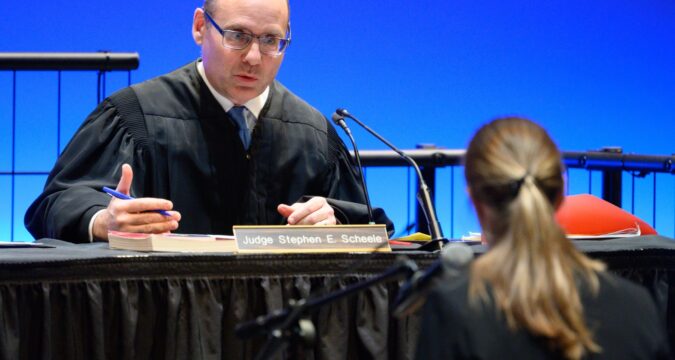
Indiana Court of Appeals judges, from left, Paul Felix, Nancy H. Vaidik, and Stephen E. Scheele, listen as the appellant’s lawyer, Stephen Gray, during an Appeals on Wheels event at Indiana University Northwest in Gary on Friday, Jan. 30, 2026. (Kyle Telechan/for the Post-Tribune)
Felix was one judge on a panel who heard oral arguments in an appeals case at Indiana University Northwest on Friday. He was joined by Judges Nancy Vaidik and Stephen Scheele, both of whom are from Northwest Indiana.
Appeals on Wheels is an educational program that travels to high schools, colleges, law schools and courtrooms throughout Indiana. Court of Appeals judges hear oral arguments in real cases and allow visitors to understand more of the judicial process.
Appeals on Wheels last came to IUN in February 2025, the program’s first visit to Gary since 2002. According to the court’s website, the program heard more than 400 cases between 2001 and 2013.
Following the hearing, the judges participate in a question-and-answer session with participants. Questions asked Friday included what the next steps in the appeals process are, how they deal with a statewide legal shortage, and how their job affects public policy.
East Chicago student Jonathan Hampton asks Indiana Court of Appeals judges a question during an Appeals on Wheels event at Indiana University Northwest in Gary on Friday, Jan. 30, 2026. (Kyle Telechan/for the Post-Tribune)
Judges cannot answer questions about the specific case.
Friday’s case was Bisel vs. State, an appeal for Dede Bisel, a Jay County woman who was charged with dealing in methamphetamine, battery by bodily waste, maintaining a common nuisance, possession of marijuana, and possession of paraphernalia.
Jay County Sheriff’s Office Lt. Tony Lennartz received information about possible drug activity at Bisel’s house, and he performed a “knock and talk,” which involves an officer knocking on the door to ask to speak with occupants or search the residence. The technique is used when the officer doesn’t have an arrest or search warrant, and it’s considered a consensual encounter, according to the Office of Justice Programs.
No one answered the door during Lennartz’s “knock and talk,” and he returned a few days later to see a man and woman enter the home through the back door. The woman — who was not Bisel — answered, and marijuana smoke came out of the home.
Indiana Court of Appeals judges Paul Felix, on left, and Nancy Vaidik listen during an Appeals on Wheels event at Indiana University Northwest in Gary on Friday, Jan. 30, 2026. (Kyle Telechan/for the Post-Tribune)
Lennartz was in his squad car, calling for backup and applying for a search warrant, when the two people left the house, so he asked if Bisel was inside. They said yes, Lennartz told them to return to the home and knock on the door.
Bisel answered, then tried to slam the door and go to the living room. Lennartz entered the home to detain her.
Bisel resisted, kicked and pushed him and other officers. Lennartz applied for a warrant that was granted the same day, and police found 34 grams of methamphetamine, 54 grams of marijuana, and paraphernalia that included scales.
Bisel’s case is still pending, according to online court records, and her notice of appeal was received on June 6, 2025. According to the case records, she filed motions to suppress, which the trial court denied.
Visitors listen during an Appeals on Wheels event at Indiana University Northwest in Gary on Friday, Jan. 30, 2026. (Kyle Telechan/for the Post-Tribune)
In her appeal, Bisel argues that the trial court made an error in denying her motions, claiming that the “knock and talk” and warrantless entry violated the Indiana and U.S. Constitutions.
Bisel’s attorney, Stephen Gray, argued during Friday’s Appeals on Wheels case, saying that he has not found a single case that allows police to continually use the “knock and talk” method after previous attempts have failed.
“The key is that he did it multiple times,” Gray said. “He did it at least three times, and two of them were within an hour. … I don’t know of a single case that allows police to continue to harass residents by continuing to do the ‘knock and talk.’”
Deputy Attorney General Jennifer Anwarzai argued Friday that Lennartz did not violate Bisel’s constitutional rights because evidence inside the home was obtained from a search warrant obtained prior to his entry into the home.
Indiana Court of Appeals judge Paul Felix, on right, shakes hands with attorney Stephen Gray after the Appeals on Wheels event at Indiana University Northwest in Gary on Friday, Jan. 30, 2026. (Kyle Telechan/for the Post-Tribune)
“The information was based on tips from the community,” Anwarzai said. “I believe that in determining whether or not the evidence should come in at trial, we have to look at whether or not the evidence was illegally obtained.”
The court will deliver an opinion on Bisel’s appeal at a later date. Opinions are typically released in 30 days, Vaidik said.

House Republicans To Introduce Voting Reform Bill With Voter ID, Proof Of Citizenship Rules
House Republicans To Introduce Voting Reform Bill With Voter ID, Proof Of Citizenship Rules
Authored by Aldgra Fredly via The Epoch Times (emphasis ours),
House Republicans on Jan. 29 said they plan to roll out a comprehensive election reform bill that would set requirements for elections, including for photo IDs and proof of citizenship.
House Administration Committee Chair Rep. Bryan Steil (R-Wis.) said the Make Elections Great Again (MEGA) Act aims to prevent election fraud and will be introduced during the House’s pro-forma session on Jan. 30.
“Americans should be confident their elections are being run with integrity – including commonsense voter ID requirements, clean voter rolls, and citizenship verification,” Steil said in a statement.
“These reforms will improve voter confidence, bolster election integrity, and make it easy to vote, but hard to cheat.”
The bill, if passed, would require voters to show photo identification when casting ballots and verify their citizenship during registration.
It would also mandate that mail-in ballots be received by the close of polls on election day and require states to use auditable paper ballots.
Under the legislation, it would be “unlawful for an individual to distribute, order, request, deliver, or possess” a ballot belonging to another person who is not an immediate family member or caregiver.
It would also prohibit people from delivering more than four mail-in ballots at a time, except for incidental possession by postal workers or election officials.
In addition, the bill would tighten routine voter list maintenance requirements, ban universal vote by mail, and prohibit states from using a voting system that allows voters to choose more than one candidate or rank multiple candidates for the same office.
Rep. Joe Morelle (D-N.Y.), the Democratic Party’s top lawmaker on the House Administration Committee, opposed the bill and accused House Republicans of trying to “rig the system so they can choose their voters.”
“This bill is their latest attempt to block millions of Americans from exercising their right to vote,” Morelle said in a statement. “I will fight this bill at every turn.”
The MEGA Act is backed by several election advocacy groups, including America’s First Policy Institute (AFPI), which said the bill includes requirements that will prevent noncitizens from voting in U.S. elections.
“As an American citizen, casting a ballot is a civic duty, a unique privilege, and a fundamental right to help determine who represents you in government and who will stand for your ideas, values, and freedom,” AFPI’s chair of election integrity, Kenneth Blackwell, said in a statement.
“And that right, which men and women have died on foreign battlefields to protect, is discarded when noncitizens are allowed to vote.”
Election Transparency Initiative National Chairman Ken Cuccinelli said the omnibus would make voting “accessible for eligible citizens while closing loopholes that invite abuse, by banning ballot harvesting, stopping taxpayer-funded partisan registration schemes, and requiring auditable paper ballots.”
Tyler Durden
Fri, 01/30/2026 – 17:00

Donald Trump’s wide ambitions for Board of Peace spark new support for the United Nations
UNITED NATIONS — President Donald Trump’s latest attempt to sidestep the United Nations through his new Board of Peace appears to have inadvertently backfired after major world powers rejected U.S. aspirations for it to have a larger international mandate beyond the Gaza ceasefire and recommitted their support for the over 80-year-old global institution.
The board to be chaired by Trump was originally envisioned as a small group of world leaders overseeing his plan for Gaza’s future. But the Republican president’s ambitions have expanded to envisioning the board as a mediator of worldwide conflicts, a not very subtle attempt to eclipse the Security Council, which is charged with ensuring international peace and security.
The board’s charter also caused some dismay by stating Trump will lead it until he resigns, with veto power over its actions and membership.
His secretary of state, Marco Rubio, tried to ease concerns by saying the board’s focus right now is only on the next phases of the Gaza ceasefire plan.
“This is not a replacement for the U.N., but the U.N. has served very little purpose in the case of Gaza other than the food assistance,” Rubio said at a congressional hearing Wednesday.
But Trump’s promotion of a broadened mandate and his floating of an idea that the Board of Peace “might” replace the U.N. have put off major players and been dismissed by U.N. officials.
“In my opinion, the basic responsibility for international peace and security lies with U.N., lies with the Security Council,” Secretary General Antonio Guterres said Thursday. “Only the Security Council can adopt decisions binding on all, and no other body or other coalition can legally be required to have all member states to comply with decisions on peace and security.”
In Security Council statements, public speeches and behind closed doors, U.S. allies and adversaries have dismissed Trump’s latest plan to overturn the post-World War II international order with what he describes as a “bold new approach to resolving global conflict.”
“The U.S. rollout of the much broader Board of Peace charter turned the whole exercise into a liability,” according to the International Crisis Group’s Richard Gowan, a U.N. watcher and program director. “Countries that wanted to sign on to help Gaza saw the board turning into a Trump fan club. That was not appealing.”
“If Trump had kept the focus of the board solely on Gaza, more states, including some more Europeans, would have signed up,” he said.
Key Security Council members haven’t signed on
The four other veto-wielding members of the Security Council — China, France, Russia and the United Kingdom — have refused or have not indicated whether they would join Trump’s board, as have economic powers such as Japan and Germany.
Letters sent this month inviting various world leaders to be “founding members” of the Board of Peace coincided with Trump’s vow to take over Greenland, a semiautonomous territory of NATO ally Denmark, and punish some European countries that resisted. That was met with stark rebuttal from Canada, Denmark and others, who said Trump’s demand threatened to upend an alliance that has been among the West’s most unshakeable.
Shortly after, Trump pulled a dramatic reversal on Greenland, saying he had agreed with the NATO secretary-general on a “framework of a future deal” on Arctic security.
Amid the diplomatic chaos, British Prime Minister Keir Starmer, who at the time had not responded to Trump’s Board of Peace invitation, met with Guterres in London and reiterated “the UK’s enduring support for the UN and the international rules-based system,” according to a statement.
Starmer emphasized the U.N.’s “pivotal role in tackling global problems which shape lives in the UK and all over the world.” The United Kingdom has expressed concerns about the board and declined to take part in Trump’s signing ceremony at the World Economic Forum meeting in Davos, Switzerland, last week but has not yet officially responded to the invitation.
France, Spain and Slovenia declined Trump’s offer by mentioning its overlapping and potentially conflicting agenda with the U.N.
French President Emmanuel Macron said last week that the board goes beyond “the framework of Gaza and raises serious questions, in particular with respect to the principles and structure of the United Nations, which cannot be called into question.”
Spain would not join because the board excluded the Palestinian Authority and because the body was “outside the framework of the United Nations,” Prime Minister Pedro Sánchez said.
Some countries are urging a stronger UN
America’s adversaries also have shunned the board.
“No single country should dictate terms based on its power, and a winner-takes-all approach is unacceptable,” China’s U.N. ambassador, Fu Cong, said at a Security Council meeting Monday.
He called for the United Nations to be strengthened, not weakened, and said the Security Council’s status and role “are irreplaceable.”
In a clear reference to the Board of Peace, Fu said, “We shall not cherry-pick our commitments to the organization, nor shall we bypass the U.N. and create alternative mechanisms.”
So far, about 26 of some 60 invited countries have joined the board, and about nine European countries have declined. India did not attend Trump’s signing ceremony last week but is reportedly still deciding what to do. Trump revoked Canadian Prime Minister Mark Carney’s invitation.
“It’s hardly surprising that very few governments want to join Trump’s wannabe-U.N., which so far looks more like a pay-to-play club of human rights abusers and war crimes suspects than a serious international organization,” said Louis Charbonneau, U.N. director for Human Rights Watch. “Instead of handing Trump $1 billion checks to join his Board of Peace, governments should work on strengthening the U.N.”
Eight Muslim nations that agreed to join the board issued a joint statement that supported its mission in Gaza and advancement of Palestinian statehood. Turkey, Saudi Arabia, Egypt, Jordan, Indonesia, Pakistan, Qatar and the United Arab Emirates made no mention of Trump’s global peacemaking plan.
The Crisis Group’s Gowan said their focus could be a way to “get a foothold in discussions of Gaza” at the start, as Trump’s ceasefire plan has already faced several setbacks.
“I remain unconvinced that this is a real long-term threat to the U.N.,” Gowan said.
https://www.chicagotribune.com/2026/01/30/trumps-board-of-peace-united-nations/

Basil Talbott Jr., Sun-Times political editor and longtime columnist, dies at 89
During a lengthy journalism career that involved covering bare-knuckled politics both in Chicago and Washington, Basil Talbott Jr. was the Chicago Sun-Times’ political editor for a decade before moving to the nation’s capital and working as a national correspondent in the paper’s Washington bureau.
“Basil was dogged, persistent and unflappable,” said longtime political strategist David Axelrod, a former Tribune reporter who went on to help advise Barack Obama’s successful presidential run in 2008 and later led the University of Chicago’s Institute of Politics. “He had the look and feel of a tweedy college professor, but understood the politics and the layers very well. I competed against Basil as a political writer and then, when I crossed over into politics, dealt with him as a subject. He always approached people in a spirit of inquiry, without betraying a point of view.”
Journalist Basil Talbott Jr. (Talbott family)
Talbott, 89, died on Jan. 28 after collapsing outside his stepdaughter’s home in Los Angeles, said his wife of 29 years, Susan Lubowsky Talbott. He had been a Santa Monica, California, resident for the past four years and previously had lived in Philadelphia, Iowa, Washington, D.C., and Chicago’s Near North Side.
Born in 1936 in Chicago, Talbott grew up in Old Town’s Marshall Field Garden Apartments. He was the son of Basil Talbott Sr., a longtime rewrite man and theater critic for the Chicago Herald and Examiner and Chicago’s American, and Mae Talbott, who in 1950 purchased and began running a biweekly newspaper in Old Town.
Talbott attended Northwestern University for a year before leaving for New York, where he worked for the New York Journal-American newspaper. He later joined Chicago’s City News Bureau. He also earned a bachelor’s degree in philosophy from the University of Chicago in 1961.
The Sun-Times hired Talbott in 1961 from City News Bureau. Early in his career, Talbott covered the overhaul of the Chicago Police Department in the wake of a 1960s cops-turned-burglars scandal in which a burglar broke into homes with the aid of eight officers assigned to the North Side Summerdale District. Later, in a first-person, front-page article in 1976, Talbott reported on the revelation of a longstanding spy operation on individual citizens by the Chicago Police Department — required to be made public by the order of Chicago’s federal district court — and told readers what the files contained about himself.
“My files date back 10 years to the time I was covering the late Dr. Martin Luther King Jr. and the civil rights movement,” Talbott wrote. “Much of what appears in the files is laughable. It could have been the work of a bungling Keystone Cops brigade. But the idea of the police tracking me down simply because I am a reporter is not just laughable — it’s outrageous.”
Indeed, Talbott had covered racial strife and the civil rights movement, including reporting on King’s 1966 move into a rundown apartment at 1550 S. Hamlin Avenue in the North Lawndale neighborhood to highlight Blacks’ poor living conditions, along with King’s march through ethnic neighborhoods in Chicago. In the political world, Talbott covered the 1968 Democratic National Convention, numerous mayors and governors, the Illinois General Assembly and state and local political campaigns. Talbott wrote about the scramble for mayor in the wake of Richard J. Daley’s death in 1976, including co-authoring a story about the City Council’s near-unanimous vote to make Michael Bilandic acting mayor.
Just a few weeks after intense reporting about city and county politicians maneuvering in the wake of Daley’s death, Talbott was named the Sun-Times’ political editor in January 1977. The role entailed coordinating coverage of all aspects of state and local politics along with writing a weekly column for the Sunday editorial page, which eventually expanded to appearing twice weekly.
Talbott moderated numerous political debates and became well-known for appearing as a guest and commentator on radio and TV political talk shows. For a decade, he was the most frequent panelist on the WTTW-Ch. 11 weekly news roundtable show “Chicago Week in Review.” He also was a regular panelist on WBEZ-FM and a commentator for WLS-Ch. 7 in the early 1980s.
“I haven’t lived in Chicago for 10 years, but on my holiday visit at Christmas, two people asked me: Wasn’t I on ‘Chicago Week in Review’?” Talbott told a Sun-Times reporter in 1998. “The imprint left from those weekly conversations is still in the Chicago mind.”
Former Tribune managing editor James Warren called Talbott “a central figure at a time when journalists worked, and played, hard,” and termed him “a somewhat unlikely but effective local TV presence as a pundit,” particularly on “Chicago Week in Review.”
“With his trademark mustache and a mop of curly, prematurely graying hair, he was a sophisticated and relentless journalistic force, who loomed especially large during the years of Chicago Mayor Richard J. Daley and Illinois Govs. Richard Ogilvie, Dan Walker and James Thompson,” said Warren, who was the Tribune’s Washington bureau chief while Talbott was based in D.C. “In an era of significant media competition, he routinely broke stories and gained respect while often deflating the high and mighty.”
In 1987, Talbott handed the reins as political editor to former Tribune political writer and columnist Steve Neal, and Talbott became chief political columnist.
Retired Tribune senior reporter Ron Grossman, a close friend, called Talbott “an outsider as a political commentator,” noting Talbott’s steadfast adherence to journalistic ethics.
“He wouldn’t accept a fancy luncheon and if a political figure was speaking where attendees had to pay for admission, Basil would pay for his admission rather than walk in on the arm of a politician,” Grossman said. “Because of that, for much of his term as a political commentator, politicians tried to get him fired. Finally, it worked. Basil was called in and told by his superiors that he was no longer going to cover politics. He had a couple of choices. He could remain in the paper’s Chicago headquarters as a member of the general staff. This would be essentially returning to a rookie position. Or he could work at the Washington bureau. He chose Washington, where he worked alongside Lynn Sweet, whom he had trained.”
After transferring to the Sun-Times’ Washington bureau in 1988, Talbott covered the rise of President Bill Clinton, the Republican Party’s takeover of Congress in 1994 and Clinton’s impeachment. The Tribune’s Mike Dorning in 1998 wrote that as Talbott had done as a political writer in Chicago, he had, while in Washington, “(plowed) through interviews and press conferences here like a bulldozer, at times bluntly challenging obfuscation and cutting off the long-winded mid-sentence.”
After leaving the Sun-Times in 1998, Talbott worked as a freelance writer for the National Journal’s Congress Daily insiders’ newsletter and also wrote political columns for the Daily Herald. Eventually, he moved with his wife to Iowa, where she took a job as director of the Des Moines Art Center. Talbott was the George Gallup Visiting Professor of Journalism at the University of Iowa from 1999 until 2005. He also wrote freelance articles for Government Executive magazine from 2005 until 2008.
Talbott also had been a member of the University of Chicago’s Committee on Public Policy, which is a committee of leading political scientists, sociologists and scholars. He served on the board of the Connecticut Humanities Council in the mid-2010s.
Longtime Chicago political consultant Don Rose, who mapped Jane Byrne’s victorious campaign for mayor in 1979, was a close friend of Talbott’s. He reflected on Talbott’s impartiality, even when covering friends. “He often had to cover me, but he did it fairly and when he felt he had to take me down, he took me down.”
Talbott was inducted into the Chicago Journalism Hall of Fame in 2002.
In addition to his wife, Talbott is survived by a stepdaughter, Maggie Mackay; two step-grandchildren; and a brother, Dennis.
A memorial event in Chicago is being planned.
Bob Goldsborough is a freelance reporter.

Macaulay Culkin, Meryl Streep and more pay tribute to Catherine O’Hara, who died at 71
The death of Catherine O’Hara at 71 prompted an outpouring from the actor’s co-stars and friends over the decades. O’Hara, whose legendary comic skills were on display in “Home Alone,” “Schitt’s Creek,” “Beetlejuice” and much more, died Friday in Los Angeles after a brief illness.
Catherine O’Hara, Emmy-winning comedian of ‘Schitt’s Creek’ and ‘SCTV’ fame, dies at 71
Macaulay Culkin
“Mama. I thought we had time. I wanted more. I wanted to sit in a chair next to you. I heard you. But I had so much more to say. I love you. I’ll see you later” — the actor, who played O’Hara’s son in two “Home Alone” movies, on Instagram.
Meryl Streep
“Catherine O’Hara brought love and light to our world, through whipsmart compassion for the collection of eccentrics she portrayed…such a loss for her family and friends, and the audience she graced as friends.” — the actor, who co-starred with O’Hara in “Heartburn,” in a statement.
Michael Keaton
“We go back before the first Beetlejuice. She’s been my pretend wife, my pretend nemesis and my real life, true friend. This one hurts. Man am I gonna miss her.” — the actor, on Instagram.
Seth Rogen
“Really don’t know what to say… I told O’Hara when I first met her I thought she was the funniest person I’d ever had the pleasure of watching on screen. Home Alone was the movie that made me want to make movies. Getting to work with her was a true honour. She was hysterical, kind, intuitive, generous… she made me want to make our show good enough to be worthy of her presence in it. This is just devastating. We’re all lucky we got to live in a world with her in it.” — “The Studio” creator and star, on Instagram.
Pedro Pascal
“Oh, genius to be near you. Eternally grateful. There is less light in my world, this lucky world that had you, will keep you, always. Always” — the actor, who worked with O’Hara on the second season of “The Last of Us,” on Instagram.
Kevin Nealon
“Catherine O’Hara changed how so many of us understand comedy and humanity. From the chaos and heart of Home Alone to the unforgettable precision of Moira Rose in Schitt’s Creek, she created characters we’ll rewatch again and again.” — the comedian and actor, on social media.
Craig Mazin
“I think she would prefer that we keep laughing somehow, or at the very least not cry. Not possible at the moment. As brutal as this feels for anyone who knew or worked with her, I know it is far more painful for her husband and sons and close family. I’m thinking about them right now too. It all hurts terribly. Goodbye, you legend… you wonderful, brilliant, kind, beautiful human being. We were lucky to have had you at all.” — the “The Last of Us” showrunner, on Instagram.
Christopher Guest
“I am devastated. We have lost one of the comic giants of our age. I send my love to her family.” — the actor and director, who collaborated with O’Hara on four films, in a statement.
Sarah Polley
“She was the kindest and the classiest. How could she also have been the funniest person in the world? And she was at the very top of her game. There won’t be another like her.” — the Canadian director and actor, on Instagram.
Ron Howard
“This is shattering news. What a wonderful person, artist and collaborator. I was lucky enough to direct, produce and act in projects with her and she was simply growing more brilliant with each year. My heart goes out to Bo & family.” — the actor and director, on Instagram.
Ike Barinholtz
“I never in a million years thought I would get to work with Catherine O’Hara let alone become friends with her. So profoundly sad she’s somewhere else now, So incredibly grateful I got to spend the time I did with her. Thank you Catherine I love you.” — the actor, a co-star in “The Studio,” on Instagram.
Rita Wilson
“Catherine O’Hara — a woman who was authentic and truthful in all she did. You saw it in her work, if you knew her you saw it in her life, and you saw it in her family. Bo, Luke and Matthew, our deepest sympathies. May Catherine rest in peace. May her memory be eternal. — the actor, director and producer, on Instagram.
https://www.chicagotribune.com/2026/01/30/macaulay-culkin-tribute-catherine-ohara/