Category: News
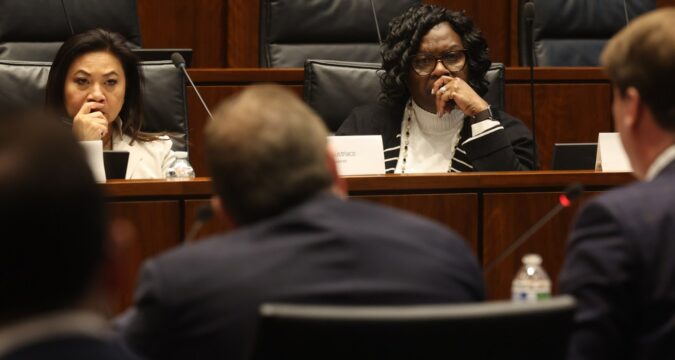
Experts describe overreach from federal immigration agents at Illinois commission hearing: ‘A masked monster’
Author and journalist Garrett Graff once called Border Patrol the “Green Monster, ”America’s most “out-of-control law enforcement agency.”
On Friday, he testified that Border Patrol has only grown more menacing since writing about the agency in a 2014 Politico article, in large part because they have recently focused on policing the country’s cities — such as Chicago — rather than the border.
“Today, we’re creating something even more dangerous to our country, a masked monster of a law enforcement agency, one uniquely unsuited for its new power, authority, reach and funding levels,” Graff said at the second public hearing of the Illinois Accountability Commission.
Gov JB Pritzker launched the commission in October to scrutinize federal immigration agents’ actions during Operation Midway Blitz, the monthslong aggressive immigration enforcement campaign waged in Chicago. Agents arrested thousands of immigrants, most of whom didn’t have a criminal record, and repeatedly deployed tear gas and pepper spray during the operation.
“Unjustified” use of chemical crowd-control weapons was the commission’s main topic of conversation at its December meeting. An ICE Accountability Project launched by former Chicago Mayor Lori Lightfoot and a commission helmed by faith leaders are also attempting to publicly document agents’ actions.
On Friday, about 50 residents and community leaders gathered downtown to hear from experts, such as Graff, on alleged overreach by agents. Graff testified that the Immigrations and Customs Enforcement and Customs and Border Protection agencies have long been “troubled.”
Author and journalist Garrett Graff speaks at a public hearing of the Illinois Accountability Commission, Jan. 30, 2026. (Antonio Perez/Chicago Tribune)
He cited a statistic, included in the 2014 article, that between 2005 and 2012 nearly one CBP officer was arrested for misconduct every single day. But until recently, agents managed to go about their work in a way that “didn’t cause ordinary law-abiding U.S. citizens to fear for their lives,” he said.
“Border Patrol and ICE are just not trained, prepared or accustomed to patrolling regular America and rolling through neighborhoods, school grounds and parking lots,” Graff said. “They’re not regular police, and they don’t know how to behave or navigate urban civilian environments.”
“They don’t have the muscle memory or de-escalation skills of dealing with angry citizens or innocent police,” Graff continued. “It’s clear that many of them lack real world policing skills. The fact that they’re instead approaching their work not as law enforcement, but as an occupation and military force is clear in the language officials are using.”
The commission, headed by former federal Judge Rubén Castillo, also released its preliminary report Friday which laid out issues it would like to address, such as limiting agents’ use of tear gas, pepper spray and masks that conceal their identity. The report said, for example, it would want to improve “existing federal standards for use of crowd control weapons.”
However, it offered little insight into how it would accomplish these goals. The commission is restricted by the state’s limited authority. It has no subpoena power and no direct law enforcement authority. It simply said it would be interested in hearing proposals from the public.
Members of the public are also now able to submit information on excessive force directly to the commission through an online interest form, which followed a Tribune report from last year highlighting a lack of one. The commission’s final report is expected by the end of April.
“We will have conversations with those in local law enforcement to suggest prosecutions that should be occurring even as we speak. That’s where we’re headed,” Castillo said Friday. He’s previously said “nothing is off the table” as far as recommendations the commission can make to the state.
Pritzker also requested this week that the commission examine the conduct of high-ranking Trump officials, such as U.S. Secretary of Homeland Security Kristi Noem and Greg Bovino, the face of Chicago’s operation who was reportedly ousted from his role of “commander at large” this week following the death of U.S. citizen Alex Pretti in Minneapolis.
“Bovino packing his bags cannot detract from our mission accountability,” Pritzker said in a news release. “Greg Bovino, Kristi Noem, and Donald Trump’s other lackeys should find lawyers because they must still be held responsible for the killings and the damage they’ve done to our country.”
Deborah Fleischaker, who previously was the Department of Homeland Security’s executive secretary, suggested at Friday’s hearing that forcing agents to reapply for their jobs might be a way to increase training and vetting among a force that’s rapidly swelled.
She testified that federal immigration agents have prioritized arrest quotas rather than public safety, inflaming tensions in Chicago and beyond. She acknowledged that immigration enforcement has never been perfect but said it was “constrained by internal guardrails.”
Throwing out policies that prevented enforcement at “sensitive locations” such as schools and hospitals has been particularly damaging, Fleischaker said.
“It should not be controversial to say that children should be able to attend school without fear that a parent will be arrested in the carpool line, that families should seek shelter during natural disasters without fear of immigration enforcement, or that parents should be able to take sick children to the hospital,” she said.
https://www.chicagotribune.com/2026/01/30/pritzker-illinois-accountability-commission-border-patrol/

Victor Hanson Asks: Are We Slouching Towards Ford Sumter?
Victor Hanson Asks: Are We Slouching Towards Ford Sumter?
Authored by Victor Davis Hanson via American Greatness,
In the months before the April 12, 1861, firing on Fort Sumter, there were lots of sharp divisions in the North about the proper reaction to the first seven Confederate states that had already left the Union.
Not all Unionists believed that war was inevitable. Some, in fact, were happy to be done with the departing South and thus see their stain of slavery gone from the Union. Similarly, others agreed that the emerging Confederacy was not worth the trouble and costs of war, and the secessionists could just form their own nation and stew in their own backward, servile juice.
But after Fort Sumter, Lincoln—who was hated as much by the Confederates as Trump is by the woke and socialist left—gained a consensus that the Constitution had no clauses about any lawful departure from the union. But it did operate under a clear supremacy clause that made state obstruction of federal law and occupation of federal property veritable sedition.
Lincoln and the preservationists felt that they easily had the moral high ground of abolition versus the continuance of slavery. Nor did they want a North America of fragmenting, warring nations in the manner of Europe.
Something similar is emerging over Minnesota, the South Carolina of our age.
Once sanctuary states, cities, and counties had established the precedent that, with impunity, they could nullify federal immigration law, then what followed was a logical and mounting descent into the current open defiance of the federal government. How odd that self-described progressives are now acting out the visions of prior kindred nullificationists and neo-Confederates from John C. Calhoun to George Wallace.
The reaction of the rest of the nation, especially its conservative half, to Minnesota resembles the 1861 disconnect in the North over the insurrectionary states.
Some believe that if Minnesota wants to protect its approximately 1,300 jailed illegal alien murderers, rapists, and assorted felons, so be it, and ICE should leave such a dysfunctional and dystopian state to its own self-destructive path.
In this way of “See ya, wouldn’t wanna be ya” thinking, Trump should stick to the red and purple states, clear them of criminal aliens with the help of local enforcement, but without the organized performance-art leftist resistance. Then he could contrast the nation with the difference between low crime, noncontroversial deportations, versus the blue-state model of protecting illegal alien criminals and their indifference to the mayhem they inflict on the innocent.
If Minnesota further wants to be a state like 1861 South Carolina that openly defies the federal government, then also so be it. But it should accordingly not expect federal funding for its pick-and-choose approach to federal law and property.
Has Minnesota forgotten that, like blue-state America, it cheered on Barack Obama’s DOJ when it successfully sued Arizona in 2010, insisting that it was Obama’s right as a federal custodian not to enforce federal immigration law at the border—and thus not legal for Governor Jan Brewer to use her state resources to enforce a federal law that derelict federal officers would not?
But on the other hand, contemporary Unionists objected that such live and let suffer is defeatist. Moreover, there are millions of Americans inside insurrectionary Minnesota who do not support their neo-Confederate leaders. Millions in Minnesota properly see themselves as Americans first and Minnesotans second.
In this line of argument, just as Lincoln refused to give up federal armories, property, and offices inside the South—most notably Fort Sumter in Charleston Harbor—to insurrectionists, so too the Trump administration has an obligation to protect federal property and offices in Minnesota and to enforce federal law throughout the nation, at least if it is to continue as a nation.
Very soon, Trump will have to decide which strategy is preferable and politically viable before the midterms.
Meanwhile, Minnesota’s highest elected officials have ordered local and state police not to protect federal immigration officers from the very street violence that they fuel. Indeed. Governor Walz, Mayor Frey, and Attorney General Ellison are actively encouraging Minnesotans to obstruct federal officers from enforcing federal laws—despite the mounting violence that follows their collective prompts.
The three know that organized and well-funded groups organize the protests and incite the violence. And perhaps the trio even welcomes would-be martyrs to use their vehicles to ram ICE officers or to arrive at protests armed with military-grade, semi-automatic pistols with plenty of magazines and ammunition to spare.
Walz and company further quietly accept that they could easily mitigate the violence by simply turning over roughly 1,300 criminal illegal aliens in various Minnesota jails to federal authorities. To do so would lessen the chances of violence, make Minnesota a safer place, and expedite the rotation of ICE out of Minnesota.
But, of course, Walz, Frey, and Ellison have no such intentions, given their schemes are elsewhere.
Given the failure of an increasingly socialist Democratic Party in 2024 to offer a more popular and convincing agenda than Trump’s, they believe their future lies in an increasingly redistributionist America, fueled by unlimited, unaudited immigration from the former Third World. They view as a political asset millions of arriving poor in dire need of massive federal health, food, housing, and education subsidies and entitlements, imbued with DEI victimhood, and nursed on America as toxic at its birth and ever more pathological ever since.
So for the Minnesota state officials, screaming for ICE “to get the f**k out of Minnesota” is more than mere braggadocio. It is a reminder that the Democratic Party wants a safe place for illegal immigration, the fuel of a future dependent constituency—as the architecture of the recent massive Somali frauds attests.
They also believe that the more turmoil, the more violence, the more resistance, and the more a general sense of chaos and unrest swirl around the Trump administration, the more they can drive down its popularity before the midterms.
They still cherish the months of riot, violence, and arson in the George Floyd “summer of love” in 2020 as critical in defeating Donald Trump.
Now as then, the left believes they can create a lose/lose dilemma for Trump: send in the National Guard to restore order, and he confirms that he is a “Nazi” and using the “Gestapo” to quell “peaceful” protests. Stand down, and the left owns the street, exasperating the MAGA base that mysteriously Trump has allowed the criminal left to nullify the enforcement of federal law in near-secessionist fashion.
There are other Democratic agendas, both short- and long-term.
The Minnesota Democrat apparatus either knowingly turned a blind eye to, protected, or silently partnered with the architects of likely the largest theft of federal welfare and entitlement monies in U.S. history—largely by the Somali community, both immigrants and their second-generation apparatchiks. The Democratic elite counted on the prophylactic cry of “racist!” to exempt the Somali community from any legal accountability. And so far, they seem right in that assumption.
And the public?
Polls reveal its trademark ambiguity. A majority voted for Trump to enforce immigration law, close the border, end illegal immigration, and deport those who broke federal law. But that hope and the reality of implementing it are two different things—especially when a state like Minnesota has not just institutionalized illegal immigration but nearly canonized foreign nationals illegally residing in the U.S.
To sum up public opinion, the proverbial people want all criminal illegal aliens deported as soon as possible, and they may even support the deportations of all 10-12 million illegal aliens who came en masse, unaudited, and with the de facto blessing of the Biden administration.
But that said, they want the act of deportation of the non-criminal to be out of sight, out of mind—as if magically they can simply disappear and thus either self-deport or assemble at ICE stations eager to be sent at no cost home.
For now, Walz, Frey, and Ellison are upping the rhetoric, fanning the violence, and talking openly about how best to nullify federal law and impede federal enforcement. They are convinced that they have galvanized national opposition to the hated Trump, smothered the Somali fraud scandal, and stopped ICE deportations of their constituents.
In all of those assumptions, they have little idea they are following the Confederate script to the letter. And like their spiritual forefathers of 1861, they grow ever more cocky, boastful, and defiant as they create martyrs, spread narratives of victimhood, and daily slouch toward another Fort Sumter.
Views expressed in this article are opinions of the author and do not necessarily reflect the views of ZeroHedge.
Tyler Durden
Fri, 01/30/2026 – 18:25
https://www.zerohedge.com/political/victor-hanson-asks-are-we-slouching-towards-ford-sumter

Donna Vickroy: ‘Bread Lady’ finds her zen selling sourdough from a driveway cart
Across the nation, sourdough is having a moment.
And at 20537 Timbermill Drive in leafy suburban Frankfort, homemade sourdough bread is selling like hotcakes.
Since October, Christie Baron has spent weekends stacking round loaves of her leavened, airy bread onto a cart in her driveway and inviting customers to buy the homemade goodness via the honor system.
Cottage industries are almost as old as the custom of baking bread. Both began millennia ago.
And while it may seem people today enjoy the convenience of supermarket shopping, the “Frankfort Bread Lady” is proving there’s plenty of market space for artisan businesses too.
“It’s been incredible,” said Baron, a part-time surgical nurse and mother of three.
“I love this neighborhood,” she said. “People have been so nice.”
While she believes most of her customers are local, she’s learning a good number of them are willing to travel.
“One lady called from Indiana,” she said. “If you come from far away and I know you’re coming, I will put a loaf aside.”
A sign outside Christie Baron’s Frankfort home advertises the sourdough bread she sells every Saturday and Sunday from a cart in her driveway. Customers use the “honor system” and leave her money to pay for their purchases. (Donna Vickroy/Naperville Sun)
Otherwise, it’s first-come, first-served from the cart her husband built to match their two-story home. Goods go out at 8 a.m. on Saturday and Sunday mornings. The cart closes at sunset.
Baron advertises through her Facebook page (www.facebook.com/profile.php?id=61586246814187), encouraging customers to check in frequently. Sometimes she sells out quickly. Sometimes she has new items, such as recently introduced baguettes and chocolate chip cookies or the turkey-shaped loaves she put out at Thanksgiving.
Homemade sourdough’s popularity is creating a growing industry of microbakers across the country. In addition to its tangy flavor, customers praise its health properties.
“There’s a bunch of good probiotics and good bacteria in it,” Baron said. What’s not in it is the alphabet soup of preservative enhancements that the health-minded crowd tries to avoid.
A plain loaf sells for $10. Italian and garlic-flavored bread costs $12 a loaf. Everything Bagel-flavored loaves are also $12. Plain baguettes are two for $12, while herb- and garlic-flavored are two for $14. Cookies cost $1 each.
If you know anything about sourdough, you know making it is a process. So was Baron’s journey to becoming a small businessperson.
Like a lot of new moms, Baron said her family income took a hit when she went part time after giving birth, first to her now-6-year-old daughter and later, her now-4-year-old twin sons.
At the same time, she longed for a hobby that could help her destress and be creative but let her stay home with her kids.
Gardening serves as her summer pastime and, these days, bread baking heats up the house on wintry days.
Though she comes from a long line of bakers, Baron said she never considered herself to be in the same class as her mother and grandmothers.
Then, a year and half ago, a friend suggested she try making sourdough, that it was the “big rage.”
“I made my first loaf and when I popped that lid I was like, ‘Oh, my gosh, I did it,’” she said.
Like dough on a mixer attachment, she was hooked.
Baron started small, making and giving loaves to family and friends. When she realized she loved the process and that her recipients loved the results, she expanded her goals. And overhauled her kitchen.
She enrolled in a food managers/food handlers course with the Will County Health Department.
“I wanted to make sure I did it the right way,” she said.
After she passed the exam in October, she received a cottage food license and created an LLC for insurance purposes.
The “baked on” date and registration number are featured on every item’s label, she said. “And every label and every recipe have to be approved by the health department.”
With her new passion established, Baron and her husband, Eric, installed two extra ovens on the patio and, after she burned out the motor on her KitchenAid, purchased a 20-quart industrial-size mixer, which she affectionately named for her grandmother, “Grandma K.”
The idea for an outdoor cart came from her sister, who runs a farm in Manhattan.
“Every fall they put out a cart of corn stalks and straw bales at the end of their driveway,” Baron said.
Now, she said, bread baking has become her zen, even if her life has become a whirlwind.
“There are so many steps,” she said. “Feeding the starter, making the dough, resting, stretch and folds every half hour for two hours, then bulk fermenting for hours, then shaping it, then it goes into bannetons, then into the fridge to cold proof, to get the gluten to solidify, then take it out and make the final shape.”
Then bake and cool completely.
“I love the science behind it,” she said. “I love losing myself in the process.”
Baron’s weekly production run begins on Sundays, when she puts the starter, which she quaintly named “Doughlores,” into the refrigerator. She takes it out on Wednesday, lets it get to room temperature and starts feeding it.
On Thursday, she starts making the dough.
“I try to make as much as I can,” she said.
The loaves go onto the cart first thing weekend mornings. Signs direct customers where to put the cash.
“Most people are very honest,” she said. “Someone even messaged me that they took an Italian loaf and didn’t realize they paid for a plain. They said they would leave an extra two bucks next time.”
Being able to create and share art that is also nutritious has been rewarding, Baron said.
“I’ve had stomach issues my whole life so I try to make everything homemade — butter, ketchup. I don’t want all that extra stuff in my kids’ food,” she said. “I love being able to do that for others too.”
Since the cart went out last fall, Baron said, her free time has become “very scheduled.”
“Now, I live by the timer,” she said. “But I love it.”
Donna Vickroy is an award-winning reporter, editor and columnist who worked for the Daily Southtown for 38 years. She can be reached at donnavickroy4@gmail.com.
https://www.chicagotribune.com/2026/01/30/vickroy-column-sourdough-bread-frankfort-baron/

Proposed Lake-Kenosha pipeline a sign of growing energy needs: ‘That’s where a lot of this need for power is’
A proposed 15-mile natural gas pipeline extension running from the Antioch area into Kenosha County in Wisconsin hints at the scale of ongoing developments in Lake County’s northerly neighbor, as data centers and new housing drive increasing power needs.
According to project maps shared with local officials, the pipeline would extend from an existing line in Lake County, branching off about halfway between Interstate 94 and Route 45, north of Rosecrans Road. Just two miles of the 24-inch pipeline, known as the North Extension or NEX, will be in Illinois.
The $410 million underground pipeline project could be in service as soon as the end of 2028, according to Allen Fore, vice president of Kinder Morgan. Although NEX is a Natural Gas Pipeline Company project, the company is operated by energy infrastructure company Kinder Morgan and jointly owned with Brookfield Infrastructure Partners.
Kinder Morgan says it has an interest in, or operates, 79,000 miles of pipelines across the country, including roughly 2,800 miles in Illinois. NGPL has about 9,100 miles of pipeline.
Fore is an Antioch-area resident himself, meaning this particular project is far closer to homes than other projects on which he’s worked. The project is still in its early stages, and Fore said officials haven’t yet filed with the Federal Energy Regulatory Commission, a requirement for an interstate project like NEX.
Currently, Kinder Morgan is surveying properties along potential routes to determine the best path, Fore said. To file with FERC, Fore said the company needed to show purpose, need and the ability to develop the project. Although surveying was being conducted along a roughly 300-foot-wide corridor, the pipeline will ultimately only need 50 feet, Fore said.
The surveying process is meant to gather information not readily available elsewhere or visible from the air, with Fore noting the many surprises that can come during the process.
According to a project overview, beyond the pipeline itself, NEX includes a new compressor station, compression additions and modifications at two existing stations, upgrades to existing pipeline facilities, as well as capacity leased on a third-party pipeline.
Lake County notice
Last year, Antioch-area residents were spooked by letters from Kinder Morgan notifying them about the project that included a reference to eminent domain. One resident spoke during a Lake County Board meeting, warning that such a project could exacerbate flooding issues for residents if unmarked underground drainage tiles were damaged.
Since then, residents have said they’re waiting to see where an updated route will go.
In response to those concerns, Fore said agricultural impact mitigation agreements take into consideration existing drain tiles, various soil factors and potential crop loss. Although more focused on agricultural land, these will also apply to any impacted Lake County residents, he said.
“We are responsible for anything we touch in this construction process,” Fore said.
On the Wisconsin side, the impacted properties for a previously proposed route range from longtime local farmers to two properties owned by Sharpless Ave.
According to Wisconsin Department of Financial Institutions data, the principal office for Sharpless Ave is in Chicago, at the same address and suite number that the Pritzker Group’s website had as its Chicago office. That webpage has since been taken down.
Attempts to get clarification from Gov. JB Pritzker’s office regarding the governor’s current ties with both the Pritzker Group and the Wisconsin properties were unsuccessful.
Fore said his company has not yet reached out to Wisconsin property owners, since the project’s potential route is still up in the air. He said residents can expect more answers about a new route and next steps in February.
Wisconsin developments
John Holloway, chairman of the town of Paris in Kenosha County, where the NEX pipeline would terminate, said they’ve currently got two power plant projects, the larger of which could be a potential customer for the new pipeline.
Holloway said the town has an under-construction 128 megawatt “peaker plant” — meant to address brief periods of high electricity demand — and a proposed 1,210 MW gas turbine power plant, to be built by Invenergy.
For comparison, the existing Paris power plant, built in 1995, has a total generating capacity of about 400 MW according to the We Energies website. A roughly 1,200 MW coal power plant was shut down in Pleasant Prairie in southeast Kenosha County in 2018, and has since been demolished.
Holloway said the energy push is, at least in part, to support the Mount Pleasant Microsoft data center developments in nearby Racine County, a multi-billion-dollar investment.
“That’s where a lot of this need for power is,” he said.
The Mount Pleasant Plan Commission recently approved site plans for expanding Microsoft’s data center footprint, Holloway said, and he’s heard talk about several more data center projects in the region from real estate people.
Additionally, We Energies has indicated a growing demand for gas because of a growing residential base in the region, he said.
The pipeline will provide up to 185,000 dekatherms per day of natural gas, an industry term that Fore admitted was difficult to explain for laymen.
“That’s not a huge amount, but it’s not an insignificant amount,” Fore said.
The size and scope of the project are based on customer needs, with capacity for additional future use for other entities, Fore said. By law, the pipeline is a “common carrier,” meaning it can’t be built for one entity and could provide gas to a variety of customers in the area.
Federal approvals
While Fore said other Kinder Morgan projects have been approved for the FAST-41 program, that was still to be determined for NEX. Fast-41 is a 2015 act meant to streamline the review and approval of infrastructure projects.
Although the program predates the current administration, President Donald Trump’s second term has seen a push for fossil fuel projects as well as cuts to clean energy efforts, including in Illinois.
Under the leadership of Trump-appointed Emily Domenech, the Federal Permitting Improvement Steering Council, which coordinates Fast-41 efforts, has boasted about a surge of projects, including those relating to natural gas and mining, saying it currently has its “largest portfolio” in the agency’s history.
In November, Domenech announced the Mississippi Crossing and South System Expansion 4 projects, both under Kinder Morgan, would receive Fast-41 coverage.
Illinois Environmental Council Chief Executive Officer Jennifer Walling raised potential concerns around natural gas pipeline projects, including contamination and leak issues, and the risk of explosions.
“Going through a community, there’s risk of explosion, there’s risk of leaking,” Walling said. “If something like that catches fire, it can be really hard to handle, which is why emergency responders need to be funded and understand how to deal with it.”
In response to such concerns, Fore argued that as a gas, any leak “goes up,” as opposed to petroleum or diesel, which contaminates the ground. Pipelines are the “safest way to transport energy,” Fore said, and their lines are operated in compliance with state and federal regulations.
The lines are also monitored around the clock from a gas control system in Houston, Fore said, where they can detect any pressure loss, and have equipment that can sense imperfections in the pipeline to find faults requiring repair.
More broadly, Walling argued efforts should be moved away from fossil fuel infrastructure and towards renewable energy.
“We know what fossil fuel is doing to our communities and our world in terms of climate change, in terms of pollution, in terms of other disruptions to our communities,” Walling said. “We need to get more renewables on the ground.”

Census Data Signals Deep Trouble for Democrats After 2030
Census Data Signals Deep Trouble for Democrats After 2030
Democrats are staring down a demographic nightmare that could keep them out of power for years.
Fresh Census Bureau estimates for 2025 paint a grim picture for the party. While red states are growing with new residents, blue states are losing population. As a result, experts predict that House seats and Electoral College votes will shift toward GOP turf after the 2030 Census.
Jonathan Cervas, a redistricting and apportionment expert at Carnegie Mellon University, projects significant gains for Florida and Texas, which would each add four seats. The blue states of California, New York, and Illinois take the hit under his model, losing a combined eight seats.
Cervas also projects that Georgia, North Carolina, Arizona, Utah, and Idaho will each add one seat. On the losing end, Oregon, Minnesota, Wisconsin, Pennsylvania, and Rhode Island would each lose one.
#NEW: 2030 Apportionment Forecast based on 2025 Census Bureau Population Estimates (January 27, 2026).
Forecast prepared by Dr. Jonathan Cervas (CMIST) at Carnegie Mellon University pic.twitter.com/DACPg0Nldf
— The Redistrict Network (@RedistrictNet) January 27, 2026
A separate projection from the Republican-aligned American Redistricting Project projects a similar, but less dramatic shift. Texas still picks up four seats, Florida gains two, and Georgia, North Carolina, Arizona, Utah, and Idaho each add one. California would lose four seats under this map, while New York, Illinois, Oregon, Minnesota, Wisconsin, Pennsylvania, and Rhode Island would each lose one.
🚨2030 Apportionment Forecast🚨
+4: TX
+2: FL
+1: AZ, GA, ID, NC, UT
-4: CA
-1: IL, MN, NY, OR, PA, RI, WI
* Based on the 2025 Census Population Estimates released January 27, 2026. pic.twitter.com/ugZPVCs6zw
— The American Redistricting Project (@AmerRedistrict) January 27, 2026
Both options are devastating for the Democrats. With House margins already tight, even modest shifts could reshape the 2032 presidential map and tip control of the House down the ballot.
The Electoral College math is particularly brutal for Democrats.
“The Rust Belt states and Sun Belt states will continue to be the battleground,” Adam Kincaid, head of the National Republican Redistricting Trust, told Politico. “The difference is that Republicans will be able to win the White House without a single Rust Belt state, whereas Democrats would have to sweep the Rust Belt and win in the Sun Belt.”
The only potential silver lining for the Democratic Party is that the exodus from blue states to red states could result in an influx of progressive voters.
That’s exactly what Marina Jenkins, the executive director of the National Democratic Redistricting Committee, believes will happen. “As these folks are moving, they’re bringing their politics with them.” She warns against assuming shifts won’t sway statewide tallies.
The problem with that theory is that these shifts are not new. Blue-to-red state population shifts have been observed for years, yet Florida and Texas have both become more red in recent elections, not blue.
The shifts also amplify fears from Democrats that Republicans will try and gerrymander urban areas and lessen those voters’ impact in House races, something Jenkins said is designed to “dilute the voices of these communities.”
“We’re going to find in states like Texas is that as those communities grow, it’s going to become harder and harder for [Republicans] to gerrymander their way out of the fact that those people live there, and they’re real people,” she said.
Jenkins said it’s important to understand the projections “in the context of this effort to gerrymander the country into oblivion,” pointing to the White House-initiated mid-cycle redistricting effort that swept the country last year.
Other experts agree that Democrats are in real trouble.
“I think the Democrats are in a bit of an existential crisis when it comes to winning the White House,” Republican strategist David Kochel told Fox News Digital. “I think it’s right that there’s going to be an 8-10 electoral vote shift” from blue to red states. Kochel, who has helped several Republican presidential campaigns, said he does not want to be “where the Democrats are.”
“The numbers don’t lie and the Democrats’ [Electoral College] hill is getting steeper and steeper to climb,” he said.
Veteran Democratic pollster Chris Anderson agreed that if the Census projections become electoral reality, “it would be a major barrier for Democrats” in winning the White House.
Anderson, the longtime Democratic partner on the Fox News Poll, called it a potential “game changer.”
Democrats reliably won the three working-class states of Pennsylvania, Michigan and Wisconsin, known as the “blue wall” states, in presidential elections for nearly a quarter-century before President Donald Trump narrowly carried them in capturing the White House in 2016.
Kochel sees Florida as the Democrats’ best chance to be competitive. He argued, “if you can’t put Florida in play, this thing is going to get away [from Democrats] and be much harder for them to be competitive nationally.”
Democratic strategist Andrew Mamo, however, is projecting confidence that Democrats can overcome the challenges. He argued that “our number one goal needs to be getting more competitive and winning in places where we’re not doing that right now.”
The Democratic Party has shown no signs of moving to the middle, so it’s unclear how they intend to win in red-leaning states.
Tyler Durden
Fri, 01/30/2026 – 18:00
https://www.zerohedge.com/political/census-data-signals-deep-trouble-democrats-after-2030

Olympic athletes bring gold medals, coach curling on the ice in Northbrook
Ford Long, a fifth grader at Meadowbrook School in Northbrook, had no idea the man he engaged in conversation at the Chicago Curling Club—Tyler George—was an Olympic gold medalist.
As they talked, Ford learned George was a former Olympic athlete. Ford asked if he won a medal and George asked if he wanted to see it. For a moment, Ford was in awe of the golden disk, then he asked if his friends could see it, too.
Ford brought Nathan Yehdego and William Chavez to view the medal, and teacher Audrey Cooke joined them. They were all in awe holding and viewing the medal George earned as part of the 2018 United States Olympic men’s curling team.
“I was stunned,” Ford said. “There was no way I’m seeing an Olympic gold medal. I was stunned he let me hold it. I couldn’t believe there was a gold medal here in Northbrook. I got to high five some of the (Chicago) Bulls once, but it was nothing like this.”
Ford Long, second from left, a fifth grader at Meadowbrook School in Northbrook, and Nathan Yehdego, also a Meadowbrook student, hold an Olympic gold medal won by Tyler George (at right) during the Olympic Celebration Tour Jan. 30, 2026 at Chicago Curling Club in Northbrook. (Steve Sadin/for Pioneer Press)
Ford was part of a group of approximately 60 Meadowbrook students participating in the Olympic Celebration Tour Friday at the Chicago Curling Club in Northbrook, meeting three former Olympians and getting a chance to take the ice in a sport they were learning at school.
Kevin Tibbles, a Highland Park resident and former NBC news correspondent who has covered the Olympics, said that with the XXV Olympic Winter Games starting Friday in Milan and Cortina D’Ampezzo, Italy, the tour is an opportunity for people to learn more about curling.
“Every four years the interest in curling just skyrockets,” Tibbles said. “The people see it on television and get interested. They learn it is a lot more than sweeping, throwing stones and yelling.”
Former Olympians, from left, Karri Willms, Tyler George and Joni Cotton answer questions for fifth graders from Meadowbrook School in Northbrook during the Olympic Celebration Tour Jan. 30, 2026, at Chicago Curling Club in Northbrook. (Steve Sadin/for Pioneer Press)
Tibbles said among other things the tour—it lasted all day Friday in Northbrook—gave the Meadowbrook students a chance to experience the game on the ice at the club. They had
completed two weeks of a three-week curling unit in physical education class.
Tyler Tampier, a physical education teacher at Meadowbrook and a Chicago Curling Club member, said curling was a three-week unit in the curriculum this year. The students used actual
equipment but honed their skills on the gym’s wood floor. Friday was their first time on the ice.
“It gives the kids a chance to learn a sport they can use for their entire life,” Tampier said. “It’s unique and very engaging. It gives the kids a chance to be successful in PE.”
Ford, who plays baseball and football, said he liked the opportunity to curl on the ice rather than on the hardwood at school. The speed was a lot different, as they moved on the ice as if they were skating in gym shoes with rubber “grippers” attached for safety.
“It was amazing using the broom and sweeping,” Ford said.
As impressed as he was seeing and holding the gold medal, Ford was also thrilled to meet an Olympic athlete. He saw it as an unique athletic achievement.
“There’s nothing else like it,” Ford said.
Yehdego was as impressed with George’s athletic achievements as he was with the opportunity to see and hold the medal. He was glad Ford brought him to meet George.
“Wow, I really met an Olympian,” Yehdego said. “This is an amazing life experience. I got to hold
and feel the medal.”
Cooke said she, too, was pretty amazed seeing George’s medal. She not only liked getting a chance to see the prize, but enjoyed watching the three boys get an opportunity to have a
significant moment.
“It was fun to see it and watch the boys with all their excitement,” Cooke said.
In some ways George, who will do the color commentary during the television coverage of this year’s winter Olympics, is still in awe of his gold medal performance as part of the four-person
U.S. curling team eight years ago.
“It was the first time the U.S. won gold,” George said. “You don’t know what to think. It’s been eight years and it hasn’t sunk in completely. It was surreal. There were four people and we all did it together.”
George was not the only Olympian on the tour in Northbrook. He was joined by Karri Willms, who earned a bronze medal in the 1992 games competing on the Canadian team in Albertville, France.
Joni Cotten of Mount Prospect, a member of the 2002 American team, also spoke to the students.
https://www.chicagotribune.com/2026/01/30/olympic-athletes-gold-medals-curling-northbrook/

CTU alleges rival union conspired with the boss in fight over low-wage CPS employees
In an escalation of an ongoing turf war over low-wage school district employees, the Chicago Teachers Union has accused the Chicago Board of Education of conspiring with a rival union to undermine its bargaining unit.
The allegation is the latest example of ongoing acrimony between the two once-allied progressive labor unions, a fracture with major implications for city politics and for Chicago Mayor Brandon Johnson. Local 73 of the Service Employees International Union called the accusation of conspiring with the boss “unfortunate, baseless, and unsupported by any evidence” and said its goal was only to improve the wages and working conditions of the workers.
A spokesperson for CPS said the district is “committed to transparent, good-faith cooperation with all our labor partners” and officials “unequivocally deny any allegation to the contrary.”
In November, SEIU Local 73 filed a petition to represent 1,600 “miscellaneous” school workers throughout the district. But the CTU contended that some of those workers are rightfully theirs, misclassified by the district under vague job titles.
Chicago Public Schools initially argued that the “miscellaneous” workers weren’t eligible to unionize at all — arguing in a Christmas Eve filing that the workers should not be allowed to join SEIU for a variety of reasons, including their unpredictable schedules and lack of benefits.
Both SEIU and CTU allege that the district takes advantage of the “miscellaneous” staffers by assigning them to perform union work but for less pay and no benefits.
But earlier this month the school district withdrew its objection to SEIU’s petition, paving the way for the miscellaneous workers to join Local 73. The reversal came weeks after the majority of the school board — including some members backed by CTU and Johnson — wrote to district management, urging them to respect the workers’ right to organize and “move the process forward without the current delays,” according to a letter obtained by the Tribune.
Chicago mayoral candidate Brandon Johnson greets members of SEIU Local 73 on Nov. 9, 2022, outside City Hall in Chicago. At left is SEIU Local 73 President Dian Palmer. (Erin Hooley/Chicago Tribune)
Shortly thereafter, CTU filed an unfair labor practice charge with the Illinois Educational Labor Relations Board in which it asked officials to delay action on SEIU’s petition.
In the filing, CTU argued that the school district has long misclassified miscellaneous workers who do jobs, like teacher assistants or school clerks, covered by CTU’s collective bargaining agreement, citing a history of grievances over the issue dating back to 2011. The union said specifically it had identified more than 130 “miscellaneous” staff members listed under job titles in the CTU bargaining unit on their schools’ websites.
“This is a widespread problem that CPS has been either willfully engaging in and creating, or turning a blind eye to,” said Thad Goodchild, CTU’s deputy general counsel.
In the filing, CTU also alleged the district’s withdrawal of its opposition to SEIU Local 73’s petition suggested the district and SEIU had “conspired to undermine the CTU bargaining unit,” saying that CPS only withdrew its objections after CTU had sought to participate in the case between SEIU and the district.
The CTU also argued that the district may have withdrawn its objection because it wants to keep using the “miscellaneous” classification “as an ill-defined catchall convenient for evading the requirement of its labor contracts” and “may have reason to believe Local 73 is willing to go along with that project if it gets some additional members out of the deal.”
SEIU Local 73 vehemently denied the allegations in a statement to the Tribune, calling them “baseless.” The union said that a group of miscellaneous workers had first reached out to the union a year ago. Since then, Local 73 said, it had met with hundreds of miscellaneous workers and won the support of more than 70% of their number.
“The time that Local 73 spent meeting with and organizing these workers had nothing to do with any other labor organization,” SEIU said.
“From the beginning, our goal has been to secure low wage workers representation and access to a better life. We desire only to win fair wages, benefits, and better working conditions for these employees,” the union’s statement read. “In the future, we hope that we can work together with our fellow CPS unions to advance the rights of all CPS workers.”
SEIU described CTU’s filing as “expressly an attempt to block” its representation petition but said it was “confident” the miscellaneous workers would eventually join their bargaining unit.
When the Tribune asked Goodchild, the CTU lawyer, if the teachers union had any evidence of a conspiracy between SEIU and the district, he pointed to the approximately 130 miscellaneous workers he said the union had determined to be misclassified workers who should be in the CTU’s bargaining unit.
“I’m not going to say that their entire motivation is to erode the CTU bargaining unit,” Goodchild said of SEIU’s bid to represent the workers. “But to the extent that, you know, it is undeniable that there are a very large number of folks in the miscellaneous employee classification who are clearly doing work covered by our contract … It’s hard to believe that any of the other parties interested in this situation are unaware of those facts.”
When asked if the union suspected anyone at the Board of Education specifically of conspiring with SEIU, Goodchild said, “I can’t speak to that.”
“The decision makers over there are who they are,” he said. “I think that the evidence and sequence of events speaks for itself.”
An attendee holds up a rally sign as Chicago Teachers Union President Stacy Davis Gates finishes addressing members at CTU headquarters on Jan. 27, 2026, in Chicago. (John J. Kim/Chicago Tribune)
A spokesperson for the school district said CPS withdrew its opposition to SEIU’s petition after determining that doing so was the right step for the miscellaneous workers, and the district denies any allegations of collusion.
The district will evaluate individual cases identified by CTU, according to the spokesperson.
“The ‘miscellaneous’ category is used to address specific, evolving needs within individual schools that may not fall under traditional headers,” the spokesperson said. “The District will continue to negotiate in good faith with both SEIU Local 73 and the CTU, and will continue to use established legal and contractual channels to resolve any disagreements regarding employee placements.”
CTU represents roughly 30,000 workers across CPS, most of them teachers. Local 73, meanwhile, represents about 13,000 support staff in the school district, including security officers and bus aides.
Tensions between the once-allied unions has its roots in a previous dispute over special education jobs in the district. In 2024, SEIU accused the teachers union of advancing a contract proposal it said would effectively take jobs away from SEIU — a characterization CTU denied.
CTU ultimately ratified a contract without the proposal, but not before SEIU threatened to sue CPS over the issue and then passed a statewide resolution declaring itself “under attack” by the teachers union.
The two politically powerful labor unions helped propel Johnson, a former CTU organizer and the self-styled “most pro-worker mayor” into office, and the labor fight has the potential to jeopardize his political firepower.
A labor-focused board
The dispute is unfolding as CPS transitions to a fully-elected school board. What was once a 7-member, mayoral-appointed board generally aligned with district leadership is now a 21-member hybrid body.
Many of the new appointees and elected members are former community organizers or educators, with deep ties to progressive labor movements, now accountable to newly drawn constituencies across the city.
A majority of the school board — 9 elected members, and two appointed by Johnson — wrote to district management shortly after SEIU filed its petition, to “express (their) strong support for the fundamental right of CPS employees to organize,” according to a letter obtained by the Tribune.
People speak in front of the Chicago Board of Education at a meeting on Aug. 13, 2025. (Antonio Perez/Chicago Tribune)
The letter, addressed to CPS CEO Macquline King and district leadership, did not name either union. It is dated Dec. 18, before the district first filed and later withdrew its objection, but reflects the emerging priorities shaping the board’s new era of governance.
“We are very concerned by reports that CPS miscellaneous employees who are seeking to unionize are dealing with unnecessary legal objections and procedural barriers from CPS designed to stall their right to organize,” board members wrote.
The letter was signed by elected members Yesenia Lopez, District 7B; Carlos Rivas, District 3B; Ellen Rosenfeld, District 4B; Jessica Biggs, District 6B; Therese Boyle, District 9B; Jenny Custer, District 1B; Che “Rhymefest” Smith, District 10A; Angel Gutierrez, District 8A; and Ebony DeBerry, District 2A.
It was also signed by appointed members Cydney Wallace, District 8B, and Norma Sierra Ríos, District 3A. The remaining members who did not add their names typically align themselves with Johnson and CTU.
“Allowing the union recognition process to proceed as intended is consistent with both the law and the values of dignity and respect for working people,” they wrote. “Honoring our employees’ rights means that workers can make their choice freely and fairly, without interference or intimidation.”
https://www.chicagotribune.com/2026/01/30/ctu-school-board-workers-conspiracy/

Expanded work requirements for the biggest US food aid program are kicking in for more states
Work requirements are kicking in for more older adults and parents of teenagers across the U.S. who get help with groceries through the Supplemental Nutrition Assistance Program.
The implementation dates vary by state: In some, people could lose benefits as soon as Sunday if they can’t show they’re working but many people have a month or more before their benefits are at risk.
Here’s what to know about the changes.
The law takes away exemptions for work requirements
A massive tax and spending bill signed into law in July by President Donald Trump expanded requirements for many adult SNAP recipients to work, volunteer or participate in job training for at least 80 hours a month. Those who don’t are limited to three months of benefits in a three-year period.
The work requirements previously applied to adults ages 18 through 54 who are physically and mentally able to work and don’t have dependents under age 18. The new law applies those requirements to those ages 55 through 64 and to parents without children younger than 14. It repeals work exemptions for homeless individuals, veterans and young adults aging out of foster care. And it limits the ability of states to waive work requirements in areas lacking jobs.
The new requirements are expected to reduce the average monthly number of SNAP recipients by about 2.4 million people over the next 10 years, according to the Congressional Budget Office.
The three-month clock is starting in some states and ending in others
When the requirements kick in depends on the state.
Texas started its requirement in October, so people there could have exhausted their three months of benefits by Jan. 1 and already been removed from the rolls.
Several states started the three-month clock in November, opening the possibility of people losing benefits in coming days. Among them are Alaska, Colorado, Georgia and Hawaii.
The requirements take effect Sunday in other states, including Illinois and Ohio. In those places, people could lose benefits in May. Ohio says people will have to show documentation of work starting in March.
Some states have exemptions because of relatively high unemployment rates, either statewide or in certain regions, that let them delay implementation. California’s waiver is scheduled to be in place until January 2027.
But most of those have ended or will soon. For most of New York, the work requirement is to start in March. But it began in October in Saratoga County.
Many SNAP beneficiaries already work
About 42 million people — or 1 in 8 Americans — receive the benefits. The majority are in households that have incomes below the poverty line, which is about $33,000 for a family of four.
An analysis from the left-leaning Center on Budget and Policy Priorities found that about 3 in 5 people who benefit from SNAP are in families with children and more than 1 in 3 are in households with older adults or people with disabilities. Nearly 2 in 5 people are in households that include someone with a job.
The average benefit per person is about $190 per month.
The work requirement isn’t the only change to coming to SNAP.
Starting in October, states will be required to cover three-fourths of the administrative costs. Currently, state and federal governments divide the states’ cost of running the program roughly equally. In late 2027, states with higher error rates in payments will be required to cover some of the benefit costs.
https://www.chicagotribune.com/2026/01/30/work-requirements-food-aid-program/

NBA trade deadline: While the Chicago Bulls remain focused on the future, is their patience wearing thin?
MIAMI — It takes time for the NBA to get up to full speed.
The final crush of the trade deadline typically takes on a whirlwind pace. But regardless of gossip and whispers and intrigue, the bulk of the action typically occurs in the final days before the deadline. Executives want to weigh their options. Agents need time to take scope of the market. And once the first domino falls, the rest of the table tumbles into place around it.
The Bulls are about to enter this dead sprint. The trade window closes at 2 p.m. Thursday. Executive vice president of basketball operations Artūras Karnišovas carries the heavy burden of managing seven expiring contracts while chasing the fleeting goal of “flexibility” to rebuild the Bulls roster toward a new vision of development. To understand a front office’s trade-deadline moves, it’s crucial to identify its priorities — both in the long and short term. And like always, the Bulls can be hard to read.
NBA trade deadline: Is Coby White the Chicago Bulls’ highest-value asset? ‘It’s good to be wanted.’
Although a few surprises cropped up — the Cleveland Cavaliers and Orlando Magic have underperformed deeply, the Boston Celtics are making every predictor and pundit eat their preseason rankings — the Eastern Conference remains a wide-open runway to the playoffs. Even at two games under .500, the Bulls (23-25) are still in play-in position with only 3½ games of separation from a playoff spot.
The Bulls could make a push for the playoffs and forgo a lottery pick in one of the stronger drafts in recent years. But do they want to?
At the start of the season, the answer was no. Kind of. During training camp, the party line within the front office was that the Bulls essentially were content to miss the playoffs if it meant setting up decent draft position, making a few trades to maximize the value of expiring contracts and giving hefty minutes to young players such as Matas Buzelis who need development. Karnišovas said as much in his season-opening news conference: “We have to be patient.”
The Bulls front office was not immune to the excitement of a 6-1 start, although executives and coaches alike were not surprised when that hot streak normalized within weeks. But once the season settled into mediocrity, the Bulls regrouped around their original grounding intentions for the season.
This might sound familiar. The Bulls will not make overly brash moves — for instance, dumping players at bargain prices — to force a nosedive into the lottery. But their ultimate hope for the season is to take another patient step toward building a young roster. While making the play-in tournament or even the playoffs isn’t fully ruled out as an option, the future is still the focus.
All right. So that’s the plan. But the Bulls still have to define one crucial aspect before they proceed: Who on this roster even qualifies as young? And who from that group is worth building around?
There are a few obvious answers. Buzelis is 21. Noa Essengue is 19. Both certainly qualify as young players. Josh Giddey still fits that bill at 23, although he is reaching the end of his “young player” tenure as he enters the second year of his second contract next season. Julian Phillips, 22, and Dalen Terry, 23, technically fit in this group, but neither plays enough to register as a priority in the conversation.
Bulls forward Matas Buzelis (14) and guard Coby White head to the bench against the Pacers on Dec. 5, 2025, at the United Center. (John J. Kim/Chicago Tribune)
Much of the rest of the roster is in a nebulous zone between 24 and 28 that separates young players from veteran status. Patrick Williams is 24 (and still failing to establish himself in the rotation). Coby White, Isaac Okoro and Jalen Smith are 25. Ayo Dosunmu and Tre Jones are 26. Kevin Huerter is 27 and Zach Collins is 28.
The Bulls roster can be lazily classified as “young” simply because of the absence of age. But this in-between group of players makes no sense when aligned with the timeline of a potential breakout from Buzelis. There’s no way to develop this group over the next four years without contracts ballooning unsustainably; and that same group lacks any of the star power necessary to lift the Bulls out of their current mediocrity.
Even coach Billy Donovan acknowledged that the Bulls don’t have enough truly young players on the roster to fill out their vision of a bottom-up rebuild.
“We have to keep building out with younger people,” Donovan said. “I don’t think there’s any question about that from a roster standpoint. … If you’re just talking about the guys that are here that are going to be under contract, they’re going to need more. So however those conversations take place, whether it’s in July or whether it’s in July or whether it’s at the trade deadline, I think the front office is looking to try to build it out as best they can.”
Related Articles
4 takeaways from the Chicago Bulls’ 116-113 loss to the Miami Heat, including Ayo Dosunmu’s 4th-quarter effort
After a terrifying fall, Red Panda retraces what went wrong — and the support that carried her back
3 takeaways as the Chicago Bulls collapse in a 113-110 loss to the worst team in the Eastern Conference
NBA trade deadline: Is Coby White the Chicago Bulls’ highest-value asset? ‘It’s good to be wanted.’
Chicago Bulls prepare for daunting stretch of 5 games in 7 days: ‘It just keeps going’
The Bulls clearly intend to build around Giddey and Buzelis, but they are still multiple pieces away from their vision of a young core. So what does this mean for the next week?
Six players — Nikola Vučević, Collins, Huerter, White, Dosunmu and Jevon Carter — are sitting on expiring contracts. Any of these players could be utilized as a mechanism to help another team looking to free up cap space. Phillips will be on a team option next season, which makes him similarly available. This mechanism is only valuable to the Bulls if they receive a reasonable return — multiple sources have made it clear the Bulls don’t intend to offload a player such as White just for the sake of moving him.
Although their contracts are longer term, both Jones and Smith have driven interest in recent weeks. While Jones could be a potential asset still in play, the Bulls’ interest in maintaining a larger presence due to the recent success of two-big lineups could dissuade any deals from prying the center away from the Bulls. That means the Bulls are mostly looking to deal their guards, which could begin the process of rebalancing the roster.
Ultimately, the Bulls should still be volume sellers at the deadline. But that effort still relies heavily on the market — and on Karnišovas’ willingness to accept the offers that come across his table. If his former reticence holds over the next week, the Bulls could end February on a quiet note once again.
https://www.chicagotribune.com/2026/01/30/chicago-bulls-nba-trade-deadline-status-quo/

Largest Power Project In US Approved For West Texas Amid Gas Plant And Data Center Buildout
Largest Power Project In US Approved For West Texas Amid Gas Plant And Data Center Buildout
Authored by Dylan Baddour via Inside Climate News (emphasis ours),
Texas’ environmental regulator this week issued the largest air pollution permit in the country to an enormous planned complex of gas power plants and data centers near the oilfields of the Permian Basin, according to an announcement from the project’s developers.
Pacifico Energy, a global, investor-owned infrastructure company, called its 7.65 gigawatt GW Ranch in Pecos County “the largest power project in the United States” in a press release this week.
It’s among a handful of similarly colossal ventures announced during 2025 that have made Texas the global epicenter of a gas power buildout, according to data released Thursday by Global Energy Monitor (GEM).
“Massive fossil fuel infrastructure is being developed, often directly at the source of gas supply, in order to feed speculative AI demand,” said Jenny Martos, project manager for GEM’s Global Oil and Gas Plant Tracker.
Developer Fermi America applied for air permits in August for 6 GW of gas power to supply data centers at its planned complex near Amarillo. In November, Chevron announced plans to build its first-ever power plant, which would produce up to 5 GW of power for artificial intelligence in West Texas.
These are enormous volumes of energy, enough to power mid-sized cities. During 2025, the pipeline of gas power projects in development in Texas grew by nearly 58 GW of generation capacity, according to the GEM report, more than the peak power demand of the state of California.
Only China, with 50 times the population and 15 times the land, has more gas power projects in development than Texas, the GEM report said. Nearly half of all upcoming gas power projects in Texas, totalling 40 GW of capacity, are planned to directly power data centers, the report said.
“There is just an explosion of these things,” said Griffin Bird, a research analyst who tracks gas plants for the nonprofit Environmental Integrity Project in Washington, D.C. “We’re having such a tough time staying on top of new projects.”
The planned hyperscale facilities of north and west Texas, if fully built out, could be among the largest emissions sources in both the country and the world, Bird said.
Pacifico’s GW Ranch in Pecos County is authorized to release more than 12,000 tons per year of regulated air pollutants, according to permitting documents from the Texas Commission on Environmental Quality, including soot, ammonia, carbon monoxide and volatile organic compounds.
The complex can also release up to 33 million tons per year of greenhouse gases, according to permitting documents, equal to nearly 5 percent of the total annual greenhouse gas emissions of Canada.
Gas plants planned at Fermi America’s Project Matador would release up to 24 million tons per year of greenhouse gas.
“I’d be hard-pressed to think of a bigger emitter,” Bird said.
Many gas power projects for data centers with up to 500 MW of capacity—enough to power more than 200,000 homes—have received permits from the Texas Commission on Environmental Quality within a month, Bird said.
For example, Misae Gas Power applied for permits to install 206 gas generators totaling 519 MW of capacity at a data center outside San Antonio on Dec. 23. TCEQ granted the permit on Jan. 14, authorizing emissions including 133 tons per year of toxic particulate matter and 10 tons per year of cancer-causing formaldehyde.
The TCEQ did not immediately respond to a request for comment sent Wednesday evening.
In the tiny town of Blue, about 50 miles east of Austin, the TCEQ issued a permit in October for the 1.2 GW Sandow Lakes Power Plant, which is located nearby North America’s largest Bitcoin mining facility.
Neighbors in the rural community organized a group called Move the Gas Plant and formally requested a hearing from TCEQ on the air pollution permit that would authorize 460 tons per year of ammonia emissions, 153 tons of soot, 76 tons of sulfuric acid and 18 tons of other “hazardous air pollutants”—substances known or suspected to cause cancer, birth defects, reproductive issues or other serious health problems. TCEQ denied their request and issued the permits at a public meeting in October.
“It took them literally 45 seconds to bring it up and deny our request for a hearing,” said Travis Brown, spokesperson for Move the Gas Plant and a retired state Department of Agriculture employee. “There was essentially zero discussion.”
Shortly after, Sandow began construction at the site, about four miles from the home where Brown and his wife feed deer and other wildlife in the woods of rural Lee County.
“They’re going gung-ho out there,” he said. “They’ve cleared that site and bulldozed trees, installed housing for workers and power lines.”
Texas currently has 11 gas power plant projects under construction, according to GEM data. It has 102 projects under preconstruction—acquiring land, permits and contracts. Another 28 projects have been announced.
If all those plants are built, it would more than double Texas’ current gas power generation capacity.
Pacifico’s GW Ranch, if operated at full 7.65 GW capacity, could consume between 1 and 2 billion cubic feet of gas per day, according to calculations by Gabriel Collins, a researcher at Rice University’s Baker Institute for Public Policy in Houston. That’s equal to between 4 and 7 percent of gas produced in 2025 from the Permian Basin, one of the world’s most prolific shale plays.
“Even for something like the Permian, that’s a very material chunk,” said Collins, a native of Midland.
Not every super-project announced in Texas will be built, he said. Some have slick public relations operations that oversell their technical and financial capacities, he said.
Even those that do get built won’t come online all at once, but slowly, 100 MW at a time, over several years. They might not ever reach their full capacity.
Still, he said, the gas-powered data center projects announced in Texas and elsewhere last year involve quantities of energy that are hard to comprehend and were seldom discussed just a few years ago.
“It’s important to help people keep a sense of perspective on these,” Collins said. “Even if they built just a small fraction of what that permit says, it’d still be a tremendous facility.”
Tyler Durden
Fri, 01/30/2026 – 17:40