
During a lengthy journalism career that involved covering bare-knuckled politics both in Chicago and Washington, Basil Talbott Jr. was the Chicago Sun-Times’ political editor for a decade before moving to the nation’s capital and working as a national correspondent in the paper’s Washington bureau.
“Basil was dogged, persistent and unflappable,” said longtime political strategist David Axelrod, a former Tribune reporter who went on to help advise Barack Obama’s successful presidential run in 2008 and later led the University of Chicago’s Institute of Politics. “He had the look and feel of a tweedy college professor, but understood the politics and the layers very well. I competed against Basil as a political writer and then, when I crossed over into politics, dealt with him as a subject. He always approached people in a spirit of inquiry, without betraying a point of view.”
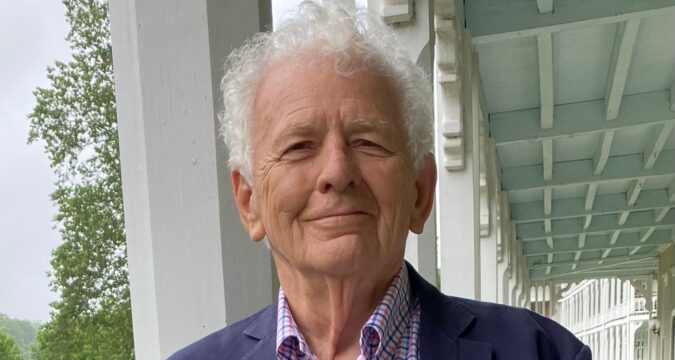
Journalist Basil Talbott Jr. (Talbott family)
Talbott, 89, died on Jan. 28 after collapsing outside his stepdaughter’s home in Los Angeles, said his wife of 29 years, Susan Lubowsky Talbott. He had been a Santa Monica, California, resident for the past four years and previously had lived in Philadelphia, Iowa, Washington, D.C., and Chicago’s Near North Side.
Born in 1936 in Chicago, Talbott grew up in Old Town’s Marshall Field Garden Apartments. He was the son of Basil Talbott Sr., a longtime rewrite man and theater critic for the Chicago Herald and Examiner and Chicago’s American, and Mae Talbott, who in 1950 purchased and began running a biweekly newspaper in Old Town.
Talbott attended Northwestern University for a year before leaving for New York, where he worked for the New York Journal-American newspaper. He later joined Chicago’s City News Bureau. He also earned a bachelor’s degree in philosophy from the University of Chicago in 1961.
The Sun-Times hired Talbott in 1961 from City News Bureau. Early in his career, Talbott covered the overhaul of the Chicago Police Department in the wake of a 1960s cops-turned-burglars scandal in which a burglar broke into homes with the aid of eight officers assigned to the North Side Summerdale District. Later, in a first-person, front-page article in 1976, Talbott reported on the revelation of a longstanding spy operation on individual citizens by the Chicago Police Department — required to be made public by the order of Chicago’s federal district court — and told readers what the files contained about himself.
“My files date back 10 years to the time I was covering the late Dr. Martin Luther King Jr. and the civil rights movement,” Talbott wrote. “Much of what appears in the files is laughable. It could have been the work of a bungling Keystone Cops brigade. But the idea of the police tracking me down simply because I am a reporter is not just laughable — it’s outrageous.”
Indeed, Talbott had covered racial strife and the civil rights movement, including reporting on King’s 1966 move into a rundown apartment at 1550 S. Hamlin Avenue in the North Lawndale neighborhood to highlight Blacks’ poor living conditions, along with King’s march through ethnic neighborhoods in Chicago. In the political world, Talbott covered the 1968 Democratic National Convention, numerous mayors and governors, the Illinois General Assembly and state and local political campaigns. Talbott wrote about the scramble for mayor in the wake of Richard J. Daley’s death in 1976, including co-authoring a story about the City Council’s near-unanimous vote to make Michael Bilandic acting mayor.
Just a few weeks after intense reporting about city and county politicians maneuvering in the wake of Daley’s death, Talbott was named the Sun-Times’ political editor in January 1977. The role entailed coordinating coverage of all aspects of state and local politics along with writing a weekly column for the Sunday editorial page, which eventually expanded to appearing twice weekly.
Talbott moderated numerous political debates and became well-known for appearing as a guest and commentator on radio and TV political talk shows. For a decade, he was the most frequent panelist on the WTTW-Ch. 11 weekly news roundtable show “Chicago Week in Review.” He also was a regular panelist on WBEZ-FM and a commentator for WLS-Ch. 7 in the early 1980s.
“I haven’t lived in Chicago for 10 years, but on my holiday visit at Christmas, two people asked me: Wasn’t I on ‘Chicago Week in Review’?” Talbott told a Sun-Times reporter in 1998. “The imprint left from those weekly conversations is still in the Chicago mind.”
Former Tribune managing editor James Warren called Talbott “a central figure at a time when journalists worked, and played, hard,” and termed him “a somewhat unlikely but effective local TV presence as a pundit,” particularly on “Chicago Week in Review.”
“With his trademark mustache and a mop of curly, prematurely graying hair, he was a sophisticated and relentless journalistic force, who loomed especially large during the years of Chicago Mayor Richard J. Daley and Illinois Govs. Richard Ogilvie, Dan Walker and James Thompson,” said Warren, who was the Tribune’s Washington bureau chief while Talbott was based in D.C. “In an era of significant media competition, he routinely broke stories and gained respect while often deflating the high and mighty.”
In 1987, Talbott handed the reins as political editor to former Tribune political writer and columnist Steve Neal, and Talbott became chief political columnist.
Retired Tribune senior reporter Ron Grossman, a close friend, called Talbott “an outsider as a political commentator,” noting Talbott’s steadfast adherence to journalistic ethics.
“He wouldn’t accept a fancy luncheon and if a political figure was speaking where attendees had to pay for admission, Basil would pay for his admission rather than walk in on the arm of a politician,” Grossman said. “Because of that, for much of his term as a political commentator, politicians tried to get him fired. Finally, it worked. Basil was called in and told by his superiors that he was no longer going to cover politics. He had a couple of choices. He could remain in the paper’s Chicago headquarters as a member of the general staff. This would be essentially returning to a rookie position. Or he could work at the Washington bureau. He chose Washington, where he worked alongside Lynn Sweet, whom he had trained.”
After transferring to the Sun-Times’ Washington bureau in 1988, Talbott covered the rise of President Bill Clinton, the Republican Party’s takeover of Congress in 1994 and Clinton’s impeachment. The Tribune’s Mike Dorning in 1998 wrote that as Talbott had done as a political writer in Chicago, he had, while in Washington, “(plowed) through interviews and press conferences here like a bulldozer, at times bluntly challenging obfuscation and cutting off the long-winded mid-sentence.”
After leaving the Sun-Times in 1998, Talbott worked as a freelance writer for the National Journal’s Congress Daily insiders’ newsletter and also wrote political columns for the Daily Herald. Eventually, he moved with his wife to Iowa, where she took a job as director of the Des Moines Art Center. Talbott was the George Gallup Visiting Professor of Journalism at the University of Iowa from 1999 until 2005. He also wrote freelance articles for Government Executive magazine from 2005 until 2008.
Talbott also had been a member of the University of Chicago’s Committee on Public Policy, which is a committee of leading political scientists, sociologists and scholars. He served on the board of the Connecticut Humanities Council in the mid-2010s.
Longtime Chicago political consultant Don Rose, who mapped Jane Byrne’s victorious campaign for mayor in 1979, was a close friend of Talbott’s. He reflected on Talbott’s impartiality, even when covering friends. “He often had to cover me, but he did it fairly and when he felt he had to take me down, he took me down.”
Talbott was inducted into the Chicago Journalism Hall of Fame in 2002.
In addition to his wife, Talbott is survived by a stepdaughter, Maggie Mackay; two step-grandchildren; and a brother, Dennis.
A memorial event in Chicago is being planned.
Bob Goldsborough is a freelance reporter.


