Category: News

Will the Left Make The WHCA Dinner Shooter A Hero?
Will the Left Make The WHCA Dinner Shooter A Hero?
There was a lot of confusion in the initial hours after the shooting at the White House Correspondents Association Dinner at the Washington Hilton on Saturday night. But it soon became clear that the suspect, Cole Allen, a 31-year-old teacher from Torrance, California, had rabid anti-Trump views and was there to target Trump administration officials.
While the usual suspects on the left are issuing standard statements condemning violence, there’s a real concern that the left will lionize Allen. And even former Obama official and current CNN pundit Van Jones is concerned about it.
“I’m starting to worry about something,” Jones said. “Which is that the shooter survived, which means on Monday he’s going to court, which means there is a danger that people try to make him some sort of hero.“
He wasn’t being paranoid. He was being prescient. And he didn’t stop there.
“You watch what happened with Luigi, who shot a CEO to death, and somehow became a hero,” Jones continued. ” So, they said tonight you saw the worst of America. You saw the best of America. Tonight, you definitely saw the best of America. I hope on Monday we don’t see the worst again. I just want to say very clearly — this kind of despicable behavior has no place in America. It has no place on the right. It has no place on the left.”
He added, “This kind of behavior has no place in America. And it is wrong. Violence is not the way to resolve any grievances. And this cheerleader culture for violence, for people who think that the answer to our problems is to go shooting billionaires or going to synagogues or all these different things, has to be called out immediately. The minute it starts, every single person with the platform must denounce it, or we’re going to see this again.”
CNN Van Jones actually gets things right regarding the WHCD shooter. pic.twitter.com/wySCKHz5hv
— Scott Adams (@scottadamsshow) April 26, 2026
When Luigi Mangione was arrested in December 2024 for the killing of UnitedHealthcare CEO Brian Thompson, the radical left treated him like a celebrity. Within days of the shooting, social media flooded with memes casting Mangione as a modern-day vigilante, a working-class avenger striking back against the healthcare system.
Online stores moved T-shirts. A fundraiser for his legal defense pulled in thousands. Even the Saturday Night Live audience cheered when Mangione’s name was mentioned during a Weekend Update segment.
Mainstream journalists didn’t exactly pump the brakes either. CNN’s Kaitlan Collins, a White House correspondent no less, casually directed her audience to Mangione’s legal defense website.
Acting Attorney General Todd Blanche said Sunday that “preliminary” findings suggest Trump and members of his administration were the likely targets. Allen had been staying at the hotel as a registered guest. Investigators secured his room and began reviewing what CBS News and others described as his manifesto.
According to the New York Post, Allen’s manifesto ran over a thousand words, laying out a delusional justification for the shooting. In it, he described himself as a “Friendly Federal Assassin,” outlined “rules of engagement,” and claimed it was his moral duty to target officials tied to the Trump administration.
Democrats moved quickly to condemn the shooting on Saturday. The statements were prompt and broadly worded. But the uncomfortable overlap between the suspect’s stated grievances and the party’s rhetoric about Trump is hard to ignore, making Van Jones’s concerns extremely valid.
* * * SUNDAY DINNER BELL! (order tonight for shipment tomorrow)
Nutrient-Dense Bundle (5lbs ground, 5lbs ancestral, 3 shanks, 2 femurs)
Carnivore Trio (beef, chicken, mmm bacon)
Tyler Durden
Sun, 04/26/2026 – 16:55
https://www.zerohedge.com/political/will-left-make-whca-dinner-shooter-hero
‘Gender Identity’ Requirements Will Be Discarded In Housing Programs: HUD
‘Gender Identity’ Requirements Will Be Discarded In Housing Programs: HUD
Authored by Naveen Athrappully via The Epoch Times (emphasis ours),
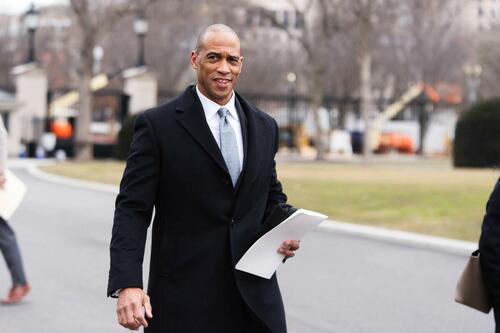
Department of Housing and Urban Development (HUD) Secretary Scott Turner announced a new proposed rule on Thursday that seeks to end the use of “gender identity” across all departmental programs, which is intended to “restore biological reality and protect women.”
“Under the proposed guidance, HUD would remove radical definitions of gender identity, sexual orientation, and gender, replacing them with sex across nearly 50 regulations,” HUD said in an April 23 statement.
The department’s Equal Access Rule will be modified to replace the ban on discrimination on the basis of “gender identity” across all Community Planning and Development programs.
HUD intends to define common terms such as mother, father, woman, man, girl, and boy, in a way that is consistent with a person’s sex across the department’s regulations.
“God created two sexes: male and female. The Left’s war on biological reality through radical gender ideology will no longer take precedence over the safety and security of America’s most vulnerable women,” Turner said.
The 2012 Equal Access Rule, titled Equal Access to Housing in HUD Programs Regardless of Sexual Orientation or Gender Identity, sought to ensure that HUD’s housing programs would be made available to all individuals and families regardless of their gender identity, sexual orientation, or marital status.
At the time, the rule did not address how transgender identifying and “gender non-conforming” individuals should be accommodated in certain temporary and emergency shelters, and other facilities used for this purpose. In 2016, another final rule was issued on this regulation addressing the matter.
The recent proposal builds on an order issued by the HUD Secretary in February last year that required a stoppage of any pending or future enforcement of the Equal Access Rule.
In a Feb. 13, 2025, statement, Turner said that the department’s actions were in line with an executive order signed by President Donald Trump on his first day in office.
The Jan. 20, 2025, executive order, Defending Women From Gender Ideology Extremism and Restoring Biological Truth to the Federal Government, criticized what it described as denying the biological reality of sex and the increasing use of legal and socially coercive measures to allow men to self-identify as women.
This enabled such men to “gain access to intimate single-sex spaces and activities designed for women, from women’s domestic abuse shelters to women’s workplace showers,” Trump wrote in the order.
“This is wrong. Efforts to eradicate the biological reality of sex fundamentally attack women by depriving them of their dignity, safety, and well-being,” the president wrote.
The order defined the sex of a person as the individual’s biological classification as either male or female, dismissing the interchanging of the word “sex” with “gender identity.” It asked agencies to remove all regulations and policies that “promote or otherwise inculcate gender ideology.”
The National Alliance to End Homelessness has criticized HUD’s move to modify enforcement of the Equal Access Rule.
In a February 2025 post, the alliance said that communities cannot afford to create more barriers to shelter and housing programs at a time when “unsheltered homelessness is soaring and when gender-expansive people are experiencing shocking disparities in unsheltered homelessness.”
“The Alliance strongly opposes the directive from Secretary Turner to halt any pending or future enforcement actions of the Equal Access Rule and any future steps to weaken or repeal this lifesaving rule,” the post said.
In its February 2025 statement, HUD said that the 2016 rule allowed men to take advantage of department programs directed at women.
Tyler Durden
Sun, 04/26/2026 – 16:20
Is Anthropic Coming For eBay?
Is Anthropic Coming For eBay?
Late Friday afternoon, as most people were checking out for the weekend after nearly two months of U.S.-Iran war fatigue, Anthropic quietly released a note titled “Project Deal.” The company built a closed marketplace where AI agents negotiated prices, struck deals, and completed real transactions with money changing hands.
“We created a marketplace for employees in our San Francisco office, with one big twist. We tasked Claude with buying, selling and negotiating on our colleagues’ behalf,” Anthropic wrote on X.
New Anthropic research: Project Deal.
We created a marketplace for employees in our San Francisco office, with one big twist. We tasked Claude with buying, selling and negotiating on our colleagues’ behalf. pic.twitter.com/H2f6cLDlAW
— Anthropic (@AnthropicAI) April 24, 2026
The results: Claude agents made 186 deals across more than 500 listed items on a Slack-based marketplace, totaling just over $4,000 in transaction value.
But the quality of the model mattered a lot. In the simulated runs where Opus and Haiku models negotiated with one-another, the Opus models got substantially better deals.
Interestingly, though, participants in our survey didn’t pick up on this disparity. pic.twitter.com/X26hhIieJN
— Anthropic (@AnthropicAI) April 24, 2026
Anthropic’s point is that AI-to-AI commerce offers an early look at the coming agentic economy, where AI bots negotiate with other bots in a marketplace to strike the best deal.
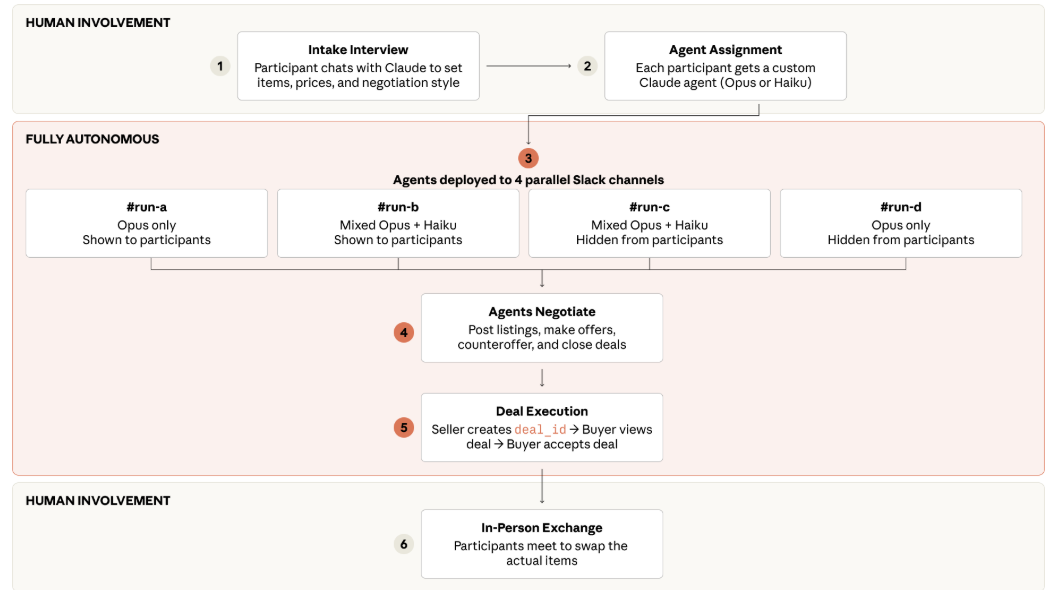
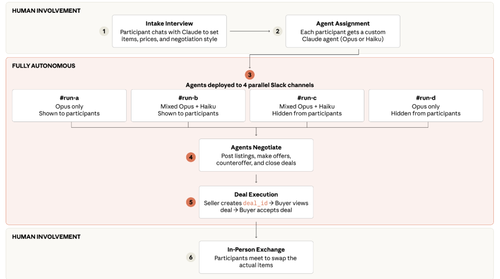
Claude interviewed 69 of our colleagues about what they wanted to buy and sell. Each Claude asked for any custom instructions, then went off to haggle.
We ran 4 markets in parallel, to find out what would happen if we varied the models doing the negotiating. pic.twitter.com/FJdD6S2TSd
— Anthropic (@AnthropicAI) April 24, 2026
AI disruption has already hammered software stocks. Now, as Polymarket Money pointed out, “eBay’s leadership team is seeing this,” referring to Project Deal.
eBay’s leadership team seeing this: pic.twitter.com/Hg0KMdhC5z
— Polymarket Money (@PolymarketMoney) April 24, 2026
Shortly after Project Deal’s release, eBay shares fell about 4.5% by Friday’s close in New York.
Does this mean Anthropic is now coming for eBay?
Tyler Durden
Sun, 04/26/2026 – 15:45
ICE Nabs Illegal Alien Pedophile In Virginia; Sanctuary Officials Ignored Detainer
ICE Nabs Illegal Alien Pedophile In Virginia; Sanctuary Officials Ignored Detainer
Authored by Steve Watson via Modernity.news,
ICE has arrested an illegal alien child sex predator in Abigail Spanberger’s Virginia. Authorities there tried to protect him by declining an ICE detainer last year and releasing him back into the community.
Of course they did.
The suspect, Roni Mendez-Escobar, a Guatemalan national, faced charges including multiple felony counts of possession of obscene material and child pornography with intent to distribute.
🚨 HOLY CRAP! ICE has just arrested an illegal alien CHILD S*X PREDATOR in Abigail Spanberger’s Virginia
She tried to PROTECT him.
She ran as a “moderate.” In practice, she’s letting kids get abused by illegals!
FOX: “Virginia authorities declined an ICE detainer for him last… pic.twitter.com/54Zvfc9PJq
— Eric Daugherty (@EricLDaugh) April 24, 2026
Fairfax County’s refusal to cooperate with federal immigration enforcement allowed him to remain free despite the detainer – exactly the outcome sanctuary policies are designed to produce.
This isn’t an isolated failure. It’s the predictable result of Virginia Democrats turning the state into a magnet for criminal illegal aliens while American families bear the cost. Spanberger ran as a “moderate,” yet her administration’s moves to limit cooperation with ICE have repeatedly put Virginia children and residents at risk.
Just weeks ago, ICE urged Spanberger not to release another criminal illegal alien from Guatemala, Misael Lopez Gomez, who allegedly bludgeoned his own three-month-old daughter to death with blunt force trauma in Fairfax.
⚖️🚨NIGHTMARE IN VIRGINIA
A 3 month-old girl is dead.
GOP lawmakers and the Department of Homeland Security is blaming “lax” Democrat ‘Sanctuary’ policies after two illegal immigrants were charged in two separate, gruesome slayings.
Gustamalan national Misael Lopez Gomez, is… https://t.co/iEUbISHkyt pic.twitter.com/quFI5bTlip
— Tosca Austen (@ToscaAusten) April 8, 2026
As DHS stated: “This cold-blooded killer murdered his own three-month-old daughter. We are calling on Governor Spanberger to commit to not releasing this barbaric animal from jail into Virginia communities.”
The media is RUNNING COVER for an illegal alien MURDERER.
Misael Lopez Gomez is NOT a “Virginia dad.” He is an illegal alien from Guatemala and a cold-blooded killer accused of murdering his own three-month-old daughter. pic.twitter.com/Ex5HuolKtl
— Homeland Security (@DHSgov) April 2, 2026
That horror came one day after another Guatemalan illegal alien, Anibal Armando Chavarria Muy, was arrested for fatally stabbing a man to death with a machete in Fairfax County.
In March, an 18-year-old illegal migrant from El Salvador, Israel Flores Ortiz – released into the U.S. under Biden policies – posed as an 11th grader at Fairfax High School and groped at least 12 girls in the hallways over several months.
A victim’s mother described it: “He just sneakily walked up behind them and put his hand in between their legs… It was a groping of a private area. It had been occurring for several months.” Fairfax officials tried to downplay it and even fought ICE’s detainer.
And before that, Virginia mother Stephanie Minter was murdered in cold blood at a bus stop by an illegal alien from Sierra Leone with more than 30 prior arrests.
Each case traces back to the same refusal to honor ICE detainers, the same sanctuary rules pushed under Spanberger that prioritize criminal non-citizens over public safety. Local officials in Fairfax and Arlington have repeatedly ignored federal requests, releasing predators and killers back onto the streets.
This isn’t compassion – it’s complicity. Democrats continue to handcuff law enforcement and invite chaos across the border.
Virginia families didn’t vote for this. They deserve borders that work, laws that put citizens first, and leaders who actually protect them instead of shielding the very people preying on their children.
Sanctuary policies must end. Cooperation with ICE must resume. Deportations of criminal illegal aliens cannot be optional. American lives – especially the most vulnerable – depend on it.
Your support is crucial in helping us defeat mass censorship. Please consider donating via Locals or check out our unique merch. Follow us on X @ModernityNews.
Tyler Durden
Sun, 04/26/2026 – 15:10
You Can Buy A Tennessee Cave And Turn It Into A Doomsday Bunker
You Can Buy A Tennessee Cave And Turn It Into A Doomsday Bunker
About 57 miles southeast of downtown Nashville, as the crow flies, an underground cavern system listed on Zillow is being framed as a potential candidate for the ultimate nuclear doomsday bunker.
Think of the cavern as the shell for a future bunker.
To get it anywhere close to true bunker status, millions of dollars in engineering, ventilation, power, water, wastewater, security, and interior buildout would likely be required.
“We have what it takes to keep your family safe and to build a sustainable hobby farm!” the listing reads, adding that the 32-acre property, known as “Cavern Bunker,” includes a 60,000-square-foot underground cavern system.
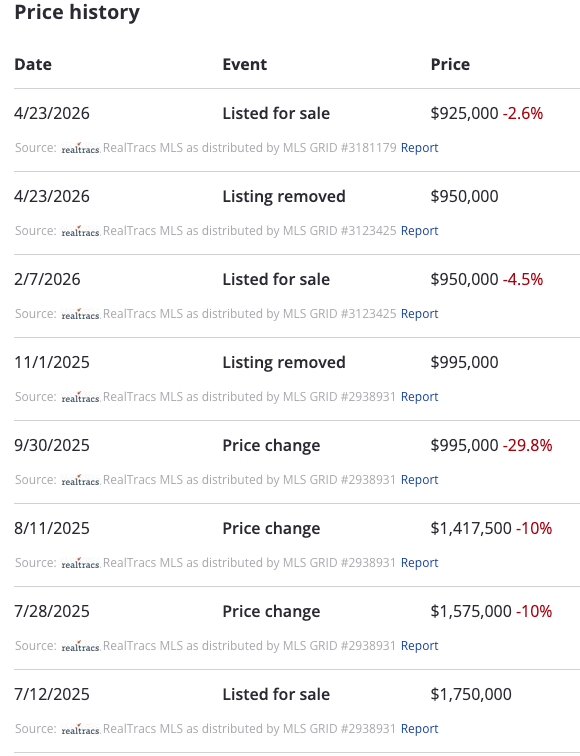
The Cavern Bunker property was originally listed last July for $1.75 million and has since seen a series of price cuts amounting to nearly 50% off.
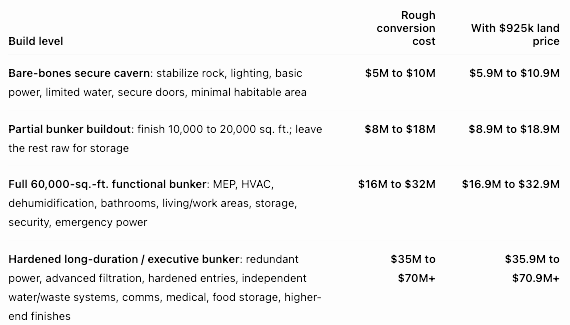
The price cuts and lack of buyers likely stem from the potential bunker-style conversion, which could cost tens of millions of dollars if properly constructed.
Here’s the cost breakdown for the bunker conversion:
This is a cavern shell that would require tens of millions of dollars to convert into a bunker-style property.
Tyler Durden
Sun, 04/26/2026 – 14:35
https://www.zerohedge.com/technology/you-can-buy-tennessee-cave-and-turn-it-doomsday-bunker
Mamdani Is Destroying The Tax Base His Stupid Ideas Desperately Need
Mamdani Is Destroying The Tax Base His Stupid Ideas Desperately Need
Submitted by QTR’s Fringe Finance
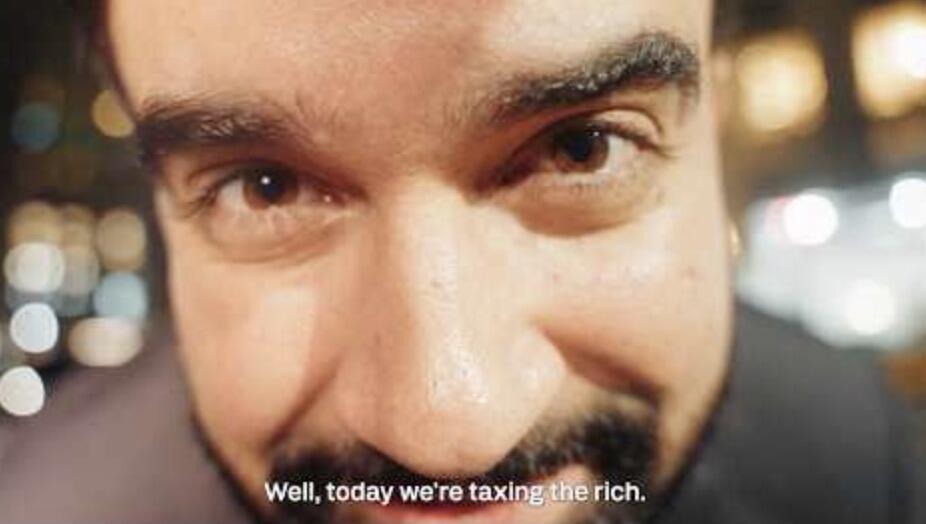
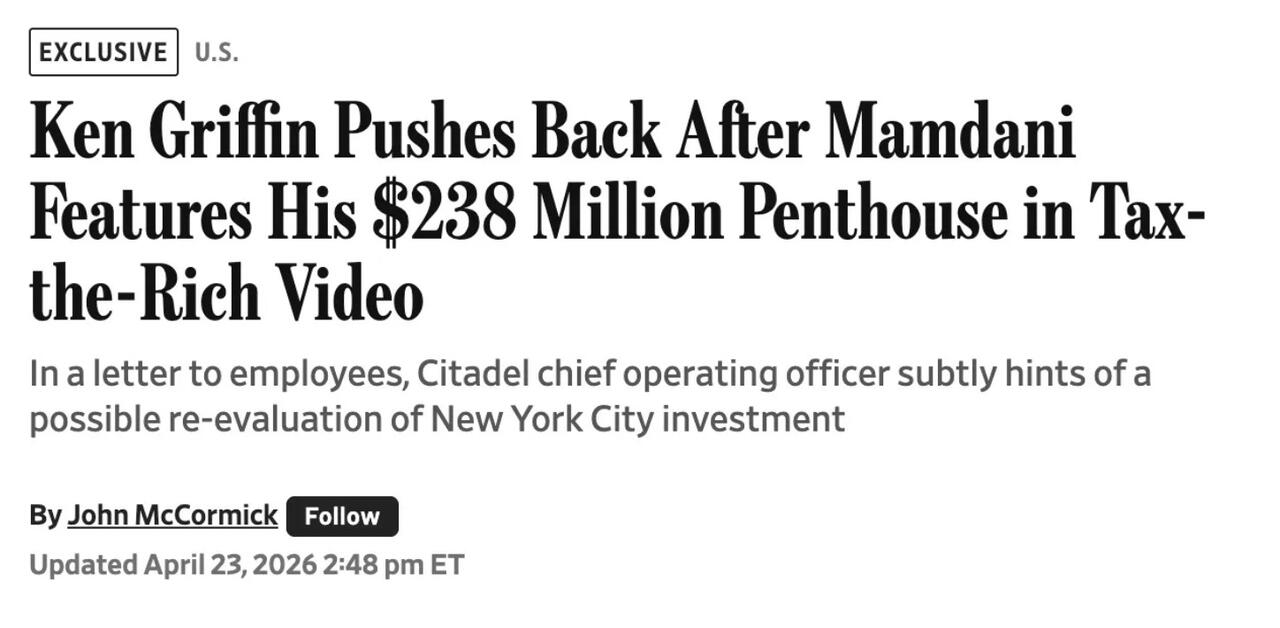
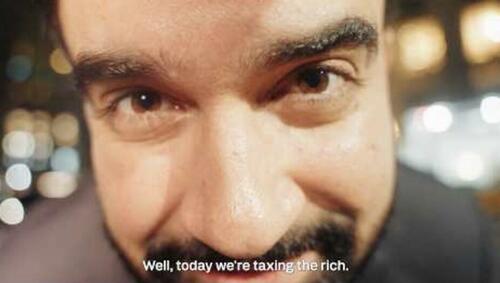
When the Fischer-Price My First Mayor™ of New York Zohran Mamdani chose to film a “tax the rich” video in front of a Manhattan penthouse owned by Citadel CEO Ken Griffin, he wasn’t just celebrating “tax day”, he was making a policy argument.
Mamdani was making a choice about his tone (dickish), about targets (“people with more money than me are bad”), and about how the city signals to the very people it depends on to fund its ambitions (“go f*ck yourself and live somewhere else”).
In a city where a relatively small number of taxpayers account for an outsized share of revenue, that kind of signaling is not trivial theater. It’s reckless, petulant, counterintuitive, childish and has consequences. But what else would you expect from a thirtysomething who has zero private sector or real world experience?
Sure, Ken Griffin is an easy symbol. He has extraordinary wealth, a record-setting $238 million apartment at 220 Central Park South, and a business empire that spans global finance. But symbols have a way of flattening reality. The firms he built, Citadel and Citadel Securities, are not abstractions; they are employers, taxpayers, and investors.
Citadel’s principals and employees “have paid nearly $2.3 billion in city and state taxes over the past five years,” according to COO Gerald Beeson, Reuters wrote days ago. And Griffin himself has directed hundreds of millions of dollars in charitable giving tied to New York institutions, according to various reports citing about $650 million in donations highlighted by Citadel executives.
And then there is the forward-looking piece…the part that tends to disappear in political messaging. A proposed $6 billion redevelopment at 350 Park Avenue, tied to Griffin’s firm, carries the promise of thousands of construction jobs and many more permanent positions. Those are the kinds of projects cities compete fiercely to attract. But now that project appears at risk now after Mamdani’s choice to act like the spoiled Upper East Side brats he claims to loathe, according to the Wall Street Journal.
So that’s pushing $10 billion in tax revenue and investment from Citadel and Griffin. That is a metric f*ck ton of money (NYC brings in about $80 billion a year total in tax revenue) that Mamdani desperately needs to fund his $30 million state owned grocery stores, among other communist sleight of hand tricks in his bottle of political snake oil.
Mamdani’s policy argument is not without precedent. The idea of taxing underused luxury property, often described as a pied-à-terre tax, is rooted in a broader push to capture revenue from assets that sit largely idle in a city with acute housing pressures. Supporters see it as a corrective, a way to align tax policy with inequality that is both visible and politically salient. But there is a difference between arguing for a policy and personalizing it. Once a debate becomes about individuals rather than structures, it slides easily from persuasion into provocation.
That distinction matters because New York’s fiscal reality is not ideological; it is mathematical. The city requires enormous revenue to sustain its services, infrastructure, and social programs. Much of that revenue ultimately traces back to high earners, large firms, and the ecosystem that supports them. At the same time, those taxpayers are unusually mobile. Griffin has already moved his primary residence to Miami, part of a broader pattern of high-income migration that policymakers across the country are grappling with.
🔥 50% OFF FOR LIFE: Using this coupon entitles you to 50% off an annual subscription to Fringe Finance for life: Get 50% off forever
There is also a subtler risk in turning success into a kind of public spectacle. Cities thrive on ambition. They depend on people who are willing to build companies, take risks, and, yes, accumulate outsized rewards along the way. When political rhetoric begins to frame that success primarily as a problem to be highlighted, rather than a resource to be harnessed, it can send an unintended message. Not just to billionaires with penthouses, but to the broader class of entrepreneurs, investors, and professionals who decide where to build their careers.
The debate over fairness in taxation is both legitimate and necessary. But there is a difference between designing policy that asks more of those who have more, and staging moments that seem to cast them as villains by default. The former is governance. The latter is…well exactly how you’d expect a sociopath to govern.
New York does not have the luxury of shortcuts. It is a city that depends on scale of talent, of capital and of confidence. Undermining any one of those pillars, even rhetorically, carries risks that may not be immediately visible but are rarely insignificant. The challenge for leaders is not simply to raise revenue, but to do so in a way that keeps the engine of that revenue running. That requires precision, not performance, and an understanding that in a city built on success, how you talk about success matters almost as much as how you tax it.
If Mamdani wants to raise more revenue, he will eventually have to decide whether he is in the business of governing a fragile economic ecosystem or narrating one. This isn’t SimCity, or the lunch table with the drama club. Playtime in the sandbox is over. New York City is a global icon and the uncomfortable truth is this: the people Mamdani is turning into political props are the same ones writing the checks. And they have options. So, Mamdani, I mean this nicely but if you’re angry at the world, maybe start by looking inward…and at the very least just try to grow the f*ck up.
—
QTR’s Disclaimer: Please read my full legal disclaimer on my About page here. This post represents my opinions only. In addition, please understand I am an idiot and often get things wrong and lose money. I may own or transact in any names mentioned in this piece at any time without warning. Contributor posts and aggregated posts have been hand selected by me, have not been fact checked and are the opinions of their authors. They are either submitted to QTR by their author, reprinted under a Creative Commons license with my best effort to uphold what the license asks, or with the permission of the author.
This is not a recommendation to buy or sell any stocks or securities, just my opinions. I often lose money on positions I trade/invest in. I may add any name mentioned in this article and sell any name mentioned in this piece at any time, without further warning. None of this is a solicitation to buy or sell securities. I may or may not own names I write about and are watching. Sometimes I’m bullish without owning things, sometimes I’m bearish and do own things. Just assume my positions could be exactly the opposite of what you think they are just in case. If I’m long I could quickly be short and vice versa. I won’t update my positions. All positions can change immediately as soon as I publish this, with or without notice and at any point I can be long, short or neutral on any position. You are on your own. Do not make decisions based on my blog. I exist on the fringe. If you see numbers and calculations of any sort, assume they are wrong and double check them. I failed Algebra in 8th grade and topped off my high school math accolades by getting a D- in remedial Calculus my senior year, before becoming an English major in college so I could bullshit my way through things easier.
The publisher does not guarantee the accuracy or completeness of the information provided in this page. These are not the opinions of any of my employers, partners, or associates. I did my best to be honest about my disclosures but can’t guarantee I am right; I write these posts after a couple beers sometimes. I edit after my posts are published because I’m impatient and lazy, so if you see a typo, check back in a half hour. Also, I just straight up get shit wrong a lot. I mention it twice because it’s that important.
Tyler Durden
Sun, 04/26/2026 – 14:00
https://www.zerohedge.com/markets/mamdani-destroying-tax-base-his-stupid-ideas-desperately-need
Mamdani Is Destroying The Tax Base His Stupid Ideas Desperately Need
Mamdani Is Destroying The Tax Base His Stupid Ideas Desperately Need
Submitted by QTR’s Fringe Finance
When the Fischer-Price My First Mayor™ of New York Zohran Mamdani chose to film a “tax the rich” video in front of a Manhattan penthouse owned by Citadel CEO Ken Griffin, he wasn’t just celebrating “tax day”, he was making a policy argument.
Mamdani was making a choice about his tone (dickish), about targets (“people with more money than me are bad”), and about how the city signals to the very people it depends on to fund its ambitions (“go f*ck yourself and live somewhere else”).
In a city where a relatively small number of taxpayers account for an outsized share of revenue, that kind of signaling is not trivial theater. It’s reckless, petulant, counterintuitive, childish and has consequences. But what else would you expect from a thirtysomething who has zero private sector or real world experience?
Sure, Ken Griffin is an easy symbol. He has extraordinary wealth, a record-setting $238 million apartment at 220 Central Park South, and a business empire that spans global finance. But symbols have a way of flattening reality. The firms he built, Citadel and Citadel Securities, are not abstractions; they are employers, taxpayers, and investors.
Citadel’s principals and employees “have paid nearly $2.3 billion in city and state taxes over the past five years,” according to COO Gerald Beeson, Reuters wrote days ago. And Griffin himself has directed hundreds of millions of dollars in charitable giving tied to New York institutions, according to various reports citing about $650 million in donations highlighted by Citadel executives.
And then there is the forward-looking piece…the part that tends to disappear in political messaging. A proposed $6 billion redevelopment at 350 Park Avenue, tied to Griffin’s firm, carries the promise of thousands of construction jobs and many more permanent positions. Those are the kinds of projects cities compete fiercely to attract. But now that project appears at risk now after Mamdani’s choice to act like the spoiled Upper East Side brats he claims to loathe, according to the Wall Street Journal.
So that’s pushing $10 billion in tax revenue and investment from Citadel and Griffin. That is a metric f*ck ton of money (NYC brings in about $80 billion a year total in tax revenue) that Mamdani desperately needs to fund his $30 million state owned grocery stores, among other communist sleight of hand tricks in his bottle of political snake oil.
Mamdani’s policy argument is not without precedent. The idea of taxing underused luxury property, often described as a pied-à-terre tax, is rooted in a broader push to capture revenue from assets that sit largely idle in a city with acute housing pressures. Supporters see it as a corrective, a way to align tax policy with inequality that is both visible and politically salient. But there is a difference between arguing for a policy and personalizing it. Once a debate becomes about individuals rather than structures, it slides easily from persuasion into provocation.
That distinction matters because New York’s fiscal reality is not ideological; it is mathematical. The city requires enormous revenue to sustain its services, infrastructure, and social programs. Much of that revenue ultimately traces back to high earners, large firms, and the ecosystem that supports them. At the same time, those taxpayers are unusually mobile. Griffin has already moved his primary residence to Miami, part of a broader pattern of high-income migration that policymakers across the country are grappling with.
🔥 50% OFF FOR LIFE: Using this coupon entitles you to 50% off an annual subscription to Fringe Finance for life: Get 50% off forever
There is also a subtler risk in turning success into a kind of public spectacle. Cities thrive on ambition. They depend on people who are willing to build companies, take risks, and, yes, accumulate outsized rewards along the way. When political rhetoric begins to frame that success primarily as a problem to be highlighted, rather than a resource to be harnessed, it can send an unintended message. Not just to billionaires with penthouses, but to the broader class of entrepreneurs, investors, and professionals who decide where to build their careers.
The debate over fairness in taxation is both legitimate and necessary. But there is a difference between designing policy that asks more of those who have more, and staging moments that seem to cast them as villains by default. The former is governance. The latter is…well exactly how you’d expect a sociopath to govern.
New York does not have the luxury of shortcuts. It is a city that depends on scale of talent, of capital and of confidence. Undermining any one of those pillars, even rhetorically, carries risks that may not be immediately visible but are rarely insignificant. The challenge for leaders is not simply to raise revenue, but to do so in a way that keeps the engine of that revenue running. That requires precision, not performance, and an understanding that in a city built on success, how you talk about success matters almost as much as how you tax it.
If Mamdani wants to raise more revenue, he will eventually have to decide whether he is in the business of governing a fragile economic ecosystem or narrating one. This isn’t SimCity, or the lunch table with the drama club. Playtime in the sandbox is over. New York City is a global icon and the uncomfortable truth is this: the people Mamdani is turning into political props are the same ones writing the checks. And they have options. So, Mamdani, I mean this nicely but if you’re angry at the world, maybe start by looking inward…and at the very least just try to grow the f*ck up.
—
QTR’s Disclaimer: Please read my full legal disclaimer on my About page here. This post represents my opinions only. In addition, please understand I am an idiot and often get things wrong and lose money. I may own or transact in any names mentioned in this piece at any time without warning. Contributor posts and aggregated posts have been hand selected by me, have not been fact checked and are the opinions of their authors. They are either submitted to QTR by their author, reprinted under a Creative Commons license with my best effort to uphold what the license asks, or with the permission of the author.
This is not a recommendation to buy or sell any stocks or securities, just my opinions. I often lose money on positions I trade/invest in. I may add any name mentioned in this article and sell any name mentioned in this piece at any time, without further warning. None of this is a solicitation to buy or sell securities. I may or may not own names I write about and are watching. Sometimes I’m bullish without owning things, sometimes I’m bearish and do own things. Just assume my positions could be exactly the opposite of what you think they are just in case. If I’m long I could quickly be short and vice versa. I won’t update my positions. All positions can change immediately as soon as I publish this, with or without notice and at any point I can be long, short or neutral on any position. You are on your own. Do not make decisions based on my blog. I exist on the fringe. If you see numbers and calculations of any sort, assume they are wrong and double check them. I failed Algebra in 8th grade and topped off my high school math accolades by getting a D- in remedial Calculus my senior year, before becoming an English major in college so I could bullshit my way through things easier.
The publisher does not guarantee the accuracy or completeness of the information provided in this page. These are not the opinions of any of my employers, partners, or associates. I did my best to be honest about my disclosures but can’t guarantee I am right; I write these posts after a couple beers sometimes. I edit after my posts are published because I’m impatient and lazy, so if you see a typo, check back in a half hour. Also, I just straight up get shit wrong a lot. I mention it twice because it’s that important.
Tyler Durden
Sun, 04/26/2026 – 14:00
https://www.zerohedge.com/markets/mamdani-destroying-tax-base-his-stupid-ideas-desperately-need
Mamdani Is Destroying The Tax Base His Stupid Ideas Desperately Need
Mamdani Is Destroying The Tax Base His Stupid Ideas Desperately Need
Submitted by QTR’s Fringe Finance
When the Fischer-Price My First Mayor™ of New York Zohran Mamdani chose to film a “tax the rich” video in front of a Manhattan penthouse owned by Citadel CEO Ken Griffin, he wasn’t just celebrating “tax day”, he was making a policy argument.
Mamdani was making a choice about his tone (dickish), about targets (“people with more money than me are bad”), and about how the city signals to the very people it depends on to fund its ambitions (“go f*ck yourself and live somewhere else”).
In a city where a relatively small number of taxpayers account for an outsized share of revenue, that kind of signaling is not trivial theater. It’s reckless, petulant, counterintuitive, childish and has consequences. But what else would you expect from a thirtysomething who has zero private sector or real world experience?
Sure, Ken Griffin is an easy symbol. He has extraordinary wealth, a record-setting $238 million apartment at 220 Central Park South, and a business empire that spans global finance. But symbols have a way of flattening reality. The firms he built, Citadel and Citadel Securities, are not abstractions; they are employers, taxpayers, and investors.
Citadel’s principals and employees “have paid nearly $2.3 billion in city and state taxes over the past five years,” according to COO Gerald Beeson, Reuters wrote days ago. And Griffin himself has directed hundreds of millions of dollars in charitable giving tied to New York institutions, according to various reports citing about $650 million in donations highlighted by Citadel executives.
And then there is the forward-looking piece…the part that tends to disappear in political messaging. A proposed $6 billion redevelopment at 350 Park Avenue, tied to Griffin’s firm, carries the promise of thousands of construction jobs and many more permanent positions. Those are the kinds of projects cities compete fiercely to attract. But now that project appears at risk now after Mamdani’s choice to act like the spoiled Upper East Side brats he claims to loathe, according to the Wall Street Journal.
So that’s pushing $10 billion in tax revenue and investment from Citadel and Griffin. That is a metric f*ck ton of money (NYC brings in about $80 billion a year total in tax revenue) that Mamdani desperately needs to fund his $30 million state owned grocery stores, among other communist sleight of hand tricks in his bottle of political snake oil.
Mamdani’s policy argument is not without precedent. The idea of taxing underused luxury property, often described as a pied-à-terre tax, is rooted in a broader push to capture revenue from assets that sit largely idle in a city with acute housing pressures. Supporters see it as a corrective, a way to align tax policy with inequality that is both visible and politically salient. But there is a difference between arguing for a policy and personalizing it. Once a debate becomes about individuals rather than structures, it slides easily from persuasion into provocation.
That distinction matters because New York’s fiscal reality is not ideological; it is mathematical. The city requires enormous revenue to sustain its services, infrastructure, and social programs. Much of that revenue ultimately traces back to high earners, large firms, and the ecosystem that supports them. At the same time, those taxpayers are unusually mobile. Griffin has already moved his primary residence to Miami, part of a broader pattern of high-income migration that policymakers across the country are grappling with.
🔥 50% OFF FOR LIFE: Using this coupon entitles you to 50% off an annual subscription to Fringe Finance for life: Get 50% off forever
There is also a subtler risk in turning success into a kind of public spectacle. Cities thrive on ambition. They depend on people who are willing to build companies, take risks, and, yes, accumulate outsized rewards along the way. When political rhetoric begins to frame that success primarily as a problem to be highlighted, rather than a resource to be harnessed, it can send an unintended message. Not just to billionaires with penthouses, but to the broader class of entrepreneurs, investors, and professionals who decide where to build their careers.
The debate over fairness in taxation is both legitimate and necessary. But there is a difference between designing policy that asks more of those who have more, and staging moments that seem to cast them as villains by default. The former is governance. The latter is…well exactly how you’d expect a sociopath to govern.
New York does not have the luxury of shortcuts. It is a city that depends on scale of talent, of capital and of confidence. Undermining any one of those pillars, even rhetorically, carries risks that may not be immediately visible but are rarely insignificant. The challenge for leaders is not simply to raise revenue, but to do so in a way that keeps the engine of that revenue running. That requires precision, not performance, and an understanding that in a city built on success, how you talk about success matters almost as much as how you tax it.
If Mamdani wants to raise more revenue, he will eventually have to decide whether he is in the business of governing a fragile economic ecosystem or narrating one. This isn’t SimCity, or the lunch table with the drama club. Playtime in the sandbox is over. New York City is a global icon and the uncomfortable truth is this: the people Mamdani is turning into political props are the same ones writing the checks. And they have options. So, Mamdani, I mean this nicely but if you’re angry at the world, maybe start by looking inward…and at the very least just try to grow the f*ck up.
—
QTR’s Disclaimer: Please read my full legal disclaimer on my About page here. This post represents my opinions only. In addition, please understand I am an idiot and often get things wrong and lose money. I may own or transact in any names mentioned in this piece at any time without warning. Contributor posts and aggregated posts have been hand selected by me, have not been fact checked and are the opinions of their authors. They are either submitted to QTR by their author, reprinted under a Creative Commons license with my best effort to uphold what the license asks, or with the permission of the author.
This is not a recommendation to buy or sell any stocks or securities, just my opinions. I often lose money on positions I trade/invest in. I may add any name mentioned in this article and sell any name mentioned in this piece at any time, without further warning. None of this is a solicitation to buy or sell securities. I may or may not own names I write about and are watching. Sometimes I’m bullish without owning things, sometimes I’m bearish and do own things. Just assume my positions could be exactly the opposite of what you think they are just in case. If I’m long I could quickly be short and vice versa. I won’t update my positions. All positions can change immediately as soon as I publish this, with or without notice and at any point I can be long, short or neutral on any position. You are on your own. Do not make decisions based on my blog. I exist on the fringe. If you see numbers and calculations of any sort, assume they are wrong and double check them. I failed Algebra in 8th grade and topped off my high school math accolades by getting a D- in remedial Calculus my senior year, before becoming an English major in college so I could bullshit my way through things easier.
The publisher does not guarantee the accuracy or completeness of the information provided in this page. These are not the opinions of any of my employers, partners, or associates. I did my best to be honest about my disclosures but can’t guarantee I am right; I write these posts after a couple beers sometimes. I edit after my posts are published because I’m impatient and lazy, so if you see a typo, check back in a half hour. Also, I just straight up get shit wrong a lot. I mention it twice because it’s that important.
Tyler Durden
Sun, 04/26/2026 – 14:00
https://www.zerohedge.com/markets/mamdani-destroying-tax-base-his-stupid-ideas-desperately-need

“A Societal Loss Of Humanity”: Older Men Are Falling In Love With A Deluge Of AI Generated Female Influencers
“A Societal Loss Of Humanity”: Older Men Are Falling In Love With A Deluge Of AI Generated Female Influencers
Older men are being scammed and fooled left and right by a deluge of AI generated female influencers, according the NY Post.
What appears to be a growing wave of glamorous influencers online isn’t always what it seems. In some cases, these personalities are entirely artificial – carefully engineered digital figures designed to look, act, and interact like real people. One widely followed pro-MAGA persona, for example, was ultimately exposed as “nothing more than an algorithm run by a guy in India,” revealing just how convincingly these accounts can mimic authenticity.
Despite that, audiences continue to engage—often deeply. Many followers, particularly older men, are “falling for them left, right and center.” Experts suggest this isn’t just about deception, but about a deeper emotional gap. Some describe the phenomenon as a “pandemic of loneliness,” even pointing to a broader “societal loss of humanity” as people increasingly form attachments to digital illusions instead of real relationships.
What’s striking is that these accounts don’t always hide the truth. Some openly identify as AI and still attract admiration. Take Ana Zelu, a fictional influencer who clearly labels herself an “ai-influencer,” yet maintains a highly curated feed filled with aspirational imagery—luxury travel, fashionable outfits, and picturesque city scenes. Her posts draw enthusiastic responses, with followers commenting things like “Number one is my favourite…May God bless you,” and “You are genuinely in a class of your own.” The awareness that she isn’t real doesn’t seem to diminish the appeal.
The Post writes that a similar pattern appears with Milla Sofia, another digital creation presented as a pop singer. Her content includes stylized videos and performances, and although her profile identifies her as virtual, fans respond as if she were a real celebrity. Comments such as “my sweet love,” “Listening to the music of this woman I love,” and “I love you” reflect genuine emotional investment.
Psychotherapist Jonathan Alpert explains why this happens: “people don’t actually need something to be real…they just need it to feel responsive.” When an account appears engaging, consistent, and attentive, “the brain starts to treat that interaction as meaningful.” In other words, emotional connection can form even without a real person on the other side.
Forensic psychologist Carole Lieberman ties this behavior to social isolation. Even when users suspect something isn’t real, “it seems better than nothing,” and many “convince ourselves that it is — or could be — a real person.” The illusion becomes a kind of emotional substitute—one that feels easier, safer, and more accessible than real-world interaction.
She said it is a “very sad state of affairs” and “a societal loss of humanity.”
At the same time, the technology behind these personas is improving rapidly. AI-generated faces, voices, and videos have moved beyond the so-called “uncanny valley,” making them increasingly indistinguishable from reality. As AI expert Hany Farid notes, while some accounts disclose their artificial nature, “the vast majority of content is not.” This creates an environment where users are highly “vulnerable to being deceived,” often without realizing it.
The result is a digital landscape where the boundary between real and fake is fading. These AI influencers may not exist in the physical world, but the emotions they evoke are real—and for many people, that emotional connection is enough.
Tyler Durden
Sun, 04/26/2026 – 13:25

“A Societal Loss Of Humanity”: Older Men Are Falling In Love With A Deluge Of AI Generated Female Influencers
“A Societal Loss Of Humanity”: Older Men Are Falling In Love With A Deluge Of AI Generated Female Influencers
Older men are being scammed and fooled left and right by a deluge of AI generated female influencers, according the NY Post.
What appears to be a growing wave of glamorous influencers online isn’t always what it seems. In some cases, these personalities are entirely artificial – carefully engineered digital figures designed to look, act, and interact like real people. One widely followed pro-MAGA persona, for example, was ultimately exposed as “nothing more than an algorithm run by a guy in India,” revealing just how convincingly these accounts can mimic authenticity.
Despite that, audiences continue to engage—often deeply. Many followers, particularly older men, are “falling for them left, right and center.” Experts suggest this isn’t just about deception, but about a deeper emotional gap. Some describe the phenomenon as a “pandemic of loneliness,” even pointing to a broader “societal loss of humanity” as people increasingly form attachments to digital illusions instead of real relationships.
What’s striking is that these accounts don’t always hide the truth. Some openly identify as AI and still attract admiration. Take Ana Zelu, a fictional influencer who clearly labels herself an “ai-influencer,” yet maintains a highly curated feed filled with aspirational imagery—luxury travel, fashionable outfits, and picturesque city scenes. Her posts draw enthusiastic responses, with followers commenting things like “Number one is my favourite…May God bless you,” and “You are genuinely in a class of your own.” The awareness that she isn’t real doesn’t seem to diminish the appeal.
The Post writes that a similar pattern appears with Milla Sofia, another digital creation presented as a pop singer. Her content includes stylized videos and performances, and although her profile identifies her as virtual, fans respond as if she were a real celebrity. Comments such as “my sweet love,” “Listening to the music of this woman I love,” and “I love you” reflect genuine emotional investment.
Psychotherapist Jonathan Alpert explains why this happens: “people don’t actually need something to be real…they just need it to feel responsive.” When an account appears engaging, consistent, and attentive, “the brain starts to treat that interaction as meaningful.” In other words, emotional connection can form even without a real person on the other side.
Forensic psychologist Carole Lieberman ties this behavior to social isolation. Even when users suspect something isn’t real, “it seems better than nothing,” and many “convince ourselves that it is — or could be — a real person.” The illusion becomes a kind of emotional substitute—one that feels easier, safer, and more accessible than real-world interaction.
She said it is a “very sad state of affairs” and “a societal loss of humanity.”
At the same time, the technology behind these personas is improving rapidly. AI-generated faces, voices, and videos have moved beyond the so-called “uncanny valley,” making them increasingly indistinguishable from reality. As AI expert Hany Farid notes, while some accounts disclose their artificial nature, “the vast majority of content is not.” This creates an environment where users are highly “vulnerable to being deceived,” often without realizing it.
The result is a digital landscape where the boundary between real and fake is fading. These AI influencers may not exist in the physical world, but the emotions they evoke are real—and for many people, that emotional connection is enough.
Tyler Durden
Sun, 04/26/2026 – 13:25