Category: News

Seed Swap event plants thoughts of spring in Aurora area gardeners
Therese Michels of Aurora loves gardening and welcomed the opportunity to network on Saturday with likeminded people at the annual Seed Swap at the Santori Public Library in downtown Aurora.
“I love this and last year when I came I couldn’t believe the crowd,” she said Saturday. “There were a lot of people here, so evidently, it’s more than me who enjoys gardening.”
The annual event, held at all three branches of the Aurora Public Library, allows “community members to exchange seeds, meet fellow gardeners and connect with local experts, including master gardeners from the University of Illinois extension,” according to a press release from the library.
Cailin Cullen, genealogy and community history librarian for the Aurora Public Library, said the swap has been held for almost a decade and began “at the West Branch before we started doing it throughout all the library locations around 2020.”
“I’ve been doing this over the past several years, and people are always so grateful and so surprised that they can just take seeds for free and it’s always sort of joyful because of the atmosphere. People are getting excited about spring,” she said. “This year, we are trying to make it more of a family event.”
Last year, Cullen noted that “community organizations were invited to the event,” something that the library “wanted to continue to grow.”
“These are all organizations that we think people who are interested in gardening would be interested in connecting with,” she said. “So, in addition to connecting to the U. of I. extension, we have the park district, Charity Blooms, Friends of the Fox and the Aurora Farmers Market. There will be lot of folks doing activities in front of people.”
Seeds are donated from several different companies as well as from individual gardeners who do their own swap. Leftover seeds are donated to the Marie Wilkinson Community Garden in Aurora.
Cullen acknowledged there was a surge in gardening interest following the COVID-19 pandemic and that seed swaps held since then suggest that interest has continued.
Aurora resident Kallie Pifko looks for native plants Saturday, Jan. 31, 2026, during the annual Seed Swap event at the Santori Public Library in downtown Aurora. (David Sharos/For The Beacon-News)
“There has been a revival and continued interest. Anecdotally, it does seem when I talk to people that they started during the pandemic and they are still showing up,” she said. “There definitely is some experimentation each year as all of our seeds are donated. We’re not putting out just tomatoes and cucumbers but all different kinds of things.”
Catherine Cyko of Aurora brought some of her own seeds to the event at the Santori Library that she offered to the swap including milkweed and basil and cilantro.
“This is my first time making a donation. I had to plan to bring something in and we just started saving our seeds last fall,” she said. “I grow all my own plants to set out in the spring. I’ve been gardening 40 to 50 years. My favorite thing to grow is flowers. The best things I’ve learned are that every year is an experiment, make sure you don’t give up and that you compost and amend your soil.”
Kallie Pifko of Aurora checked out some plants at the event and said she likes growing the native pollinators.
“I think this Seed Swap is wonderful. I actually live closer to the Eola (library) branch and we went there last year but there weren’t as many seeds like this, so it’s nice to meet more people,” she said Saturday. “I got into this about five years and I like to connect with people and grow and eat your own food.”
David Sharos is a freelance reporter for The Beacon-News.

Light At The End Of The Tunnel Emerges For US East After Weeks Of Winter Madness
Light At The End Of The Tunnel Emerges For US East After Weeks Of Winter Madness
A sharp reversal in US natural gas futures was seen early Monday after skyrocketing prices in the second half of January, when dangerously cold air and a major winter storm triggered freeze-offs across critical NatGas infrastructure. The weather-driven supply disruptions coincided with a spike in heating demand, unleashing stress on power grids across much of the eastern US and driving NatGas spot prices sharply higher before the pullback, as well as power prices…
The front-month NatGas contract plunged as much as 17% to $3.620 per million British thermal units in early Asian trading, erasing Friday’s 11% gain after weeks of record-breaking cold.
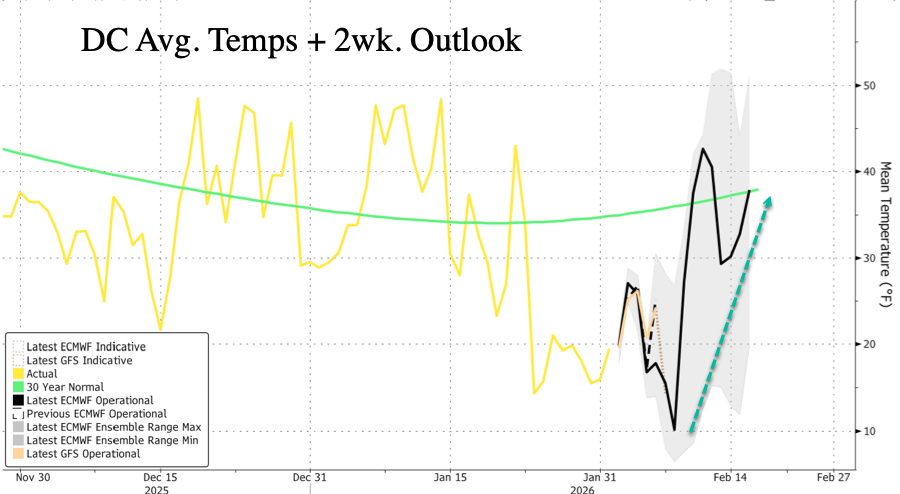
New weather models show milder conditions across parts of the Lower 48 over the next two weeks.
There’s some light at the end of the tunnel for the winter-weary East Coast.
A possible moderating trend during the week of Feb. 9! pic.twitter.com/DbflucI5qh
— Ben Noll (@BenNollWeather) February 1, 2026
By mid-month, temperatures in the US are expected to revert to 30-year seasonal norms.
For our readers in Washington, DC…
Let’s recap weather and energy reporting over the last few weeks, in which we led the discussion on NatGas freeze-offs and power grid stress. It’s clear that fossil fuel power generation saved many grids from collapse across the eastern US.
Recap:
Wild Few Weeks For NatGas. Goldman Weighs In With Post-Winter Storm Energy Commentary
NatGas Rips Higher As Arctic Blast Knocks 12% Of U.S. production Offline
Power Diverted From Data Centers To Households Across PJM Network Amid Historic Freeze
Our takeaway from the record cold and severe winter weather is clear: the Trump administration’s push to boost reliable fossil fuel power generation helped prevent grid collapse. Dispatchable coal and NatGas plants, some of which had been slated for early retirement under the Democratic Party’s insane green-energy policies, proved essential in stabilizing power systems under extreme winter stress.
With nuclear capacity additions unlikely to be added to the grid until the 2030s, fossil fuels remain the backbone of the US economy and grid reliability. This latest weather episode reinforces an optically displeasing reality for radical-left Democrats: energy policy must prioritize reliability and resilience over toxic green ideology that appears to do more to self-sabotage the nation than improve life for everyone. Just look at the mess Europe is in.
Tyler Durden
Mon, 02/02/2026 – 06:55
https://www.zerohedge.com/commodities/light-end-tunnel-emerges-us-east-after-weeks-winter-madness

George Saunders comes home to talk about his new book ‘Vigils’: ‘I could never not be a South Side of Chicago guy’
George Saunders stood listening for an encouraging word to crackle in the receiver of a payphone on Stony Island Avenue. It was 1984, decades before his ascension to the literary heights of best-selling books, national awards and presidential interviews. He was working as a roofer and dialing from a public phone once a week to the Field Museum, looking for a career change of sorts. If they hired him as a security guard, he thought, maybe he could work his way up to curator.
“The heartbreak was, I’d be standing there in my tar-blackened flannel shirt on the corner, and the woman was so nice and she said, ‘Oh, you know, you’re kind overqualified,’” he recalled in a Zoom video interview with the Tribune from his home in California. “I was kind of circling the drain and I couldn’t figure out how to not do that.”
Saunders would eventually write about his time with the roofing crew in 2003, in an autobiographical piece that ran in the New Yorker titled “Chicago Christmas, 1984.” The city where he spent the first six years of his life before his family moved to south suburban Oak Forest makes routine appearances in his writing. His Chicago upbringing continues to influence his work today — despite now splitting his time between Santa Cruz, California, and New York, where he teaches in the creative writing program at Syracuse University.
“I’ve lived in a lot of places, and I have the kind of nature that loves where I’m living,” he said. “But that time and that place was — you know you can’t escape it — it’s just the soil that you were nurtured in.”
Saunders will return to Chicago on Feb. 9 to promote his new book “Vigil,” his fourth novel and the latest addition to a body of work boasting dozens of short stories, essays, reportage and one children’s book. The Chicago Humanities will host the event at Francis W. Parker School in Lincoln Park.
“Vigil” tells of a dying oil company CEO as he’s guided into the afterlife and forced to audit his many moral failings. The social commentary won’t surprise those familiar with Saunders’ work. In his 2020 short story “Love Letter,” for example, Saunders wrote of a creeping authoritarian American government through the eyes of a loving grandfather penning a self-censored missive to his troubled grandson. He now considers this fictional version of America “timid” compared to the civil unrest seen across the country, including in cities like Chicago.
“I wish I had fictionalized a different reality — that might have been helpful,” he said with a weary laugh. “I remember at the time thinking, don’t get hysterical, if it did happen here, it would happen very quietly — and now I’ve been corrected.”
But Saunders said he remembers his 20 years in the Chicago area more like a Norman Rockwell painting than the political strife humming in the background of “Love Letter.” Though he was born in Amarillo, Texas, his family soon moved to the Gage Park neighborhood on Chicago’s Southwest Side, where they stayed until he was about 6 years old. They then settled in the suburbs.
“The thing that was unique about Chicago and I’m sure still is, is that it really is a crossroads,” he said. “You can get from the most sophisticated to the most guttural. … It’s always a kind of glow of something special happens there.”
His father owned two Chicken Unlimited franchises, one in Midlothian and another in Hazel Crest. His mother worked as a cashier.
“It was really wonderful to just watch the way he related to people. Such a charming guy and respectful, deeply respectful to everybody,” he said. “And my mom was the same. She worked as a cashier. Everybody who came in was ‘honey’ and was her friend. I’m sure I’m nostalgizing a little bit, but I really loved growing up there. It felt like you were constantly getting lessons on how to behave and how to treat other people.”
“Vigil” by George Saunders, published on Jan. 27. (Random House)
That nostalgia and wonder flows into his work as a writer, he said.
“I think also for me, the writing journey, has been in a certain way an attempt to try to figure out how to express in prose the way I felt when I was 5 or 6 in Chicago,” he said. “I always thought I’m trying to get back to the place where I find a prose style that can nail that combination of incredible beauty and looming darkness,” he said.
“It’s just so absolutely formative that I could never not be a South Side of Chicago guy.”
He gestured off the Zoom screen to confirm his allegiance to the Chicago White Sox. “I’ve got the hat right here,” he said.
He recalled once getting an autographed baseball from Sox shortstop Luis Aparicio at a car dealership on Archer Avenue.
“And then, being a complete idiot, there was one day where we needed a ball, and I’m like, OK, but you can’t drop it, so we took it out, and we got absorbed in the game,” Saunders said with a laugh. “And I still have it, but it’s almost illegible with scuff.”
A 1977 graduate of Oak Forest High School, Saunders is quick to honor the memory of his former geology teacher, Joe Lindbloom, as well as Joe’s wife, Sherry, whom he credits with getting him to college.
“I was just thinking so much about how one person, you know, changes your arc,” Saunders said. “And literally, I wouldn’t have had this life if it weren’t for him.”
Saunders wasn’t going to go to college, he recalled, but Lindbloom arranged for the “underperforming” nascent writer to be considered for the Colorado School of Mines, where Saunders would go on to acquire a bachelor’s degree in geophysical engineering.
Lindbloom was “the finest man I’ve ever met,” Saunders said. “I’ll be feeling that when I’m in Chicago — his absence, but also his presence.”
In the years since, Saunders has won the prestigious Booker Award, a Guggenheim Fellowship, a MacArthur Fellowship and the National Magazine Award for Fiction four times, among other honors, and most recently the 2025 Medal for Distinguished Contribution to American Letters. He’s interviewed former President Joe Biden, hipster darlings like Wilco’s Jeff Tweedy and Jason Isbell for GQ. But his work often looks back with wonder to the city that made him.
In 2009, his essay “The View from the South Side, 1970” was published in the literary magazine Granta. The prose reveals an undeniably intimate appreciation for Chicago.
“But because you were a kid, and Chicago was all you knew,” Saunders wrote. “It was in your heart, and stayed there forever, the yardstick against which the rest of the universe was judged.”
And all these years later, Saunders says, he still remembers the kindness of that woman at the Field Museum who let the tar-stiffened writer down easy.
“In that stage of your life, to have someone say you’re overqualified is kind of nice because it’s got the word ‘qualified’ in there,” he said.
Richard Ray is a freelance writer.
“George Saunders on ‘Vigil’” is 7 p.m. Feb. 9 at Francis W. Parker School, 330 W. Webster Ave.; sold out, more information at www.chicagohumanities.org

“Never Seen Risk Like This Before In My Career”, Ed Dowd Warns
“Never Seen Risk Like This Before In My Career”, Ed Dowd Warns
Via Greg Hunter’s USAWatchdog.com,
Former Wall Street money manager and financial analyst Ed Dowd of PhinanceTechnologies.com warned in December we were “At the Beginning of Credit Destruction Cycle.”
Renowned hedge fund BlackRock was the latest victim of credit destruction with this week’s headline that said, “BlackRock cuts value of private debt fund by 19%, waives fee.”
Dowd is right—again.
It’s going to get a lot worse, according to Dowd’s latest report called “US Economy Outlook 2026.” Dowd says, “This is a big call, and what is going to happen does not happen that often…”
” We will try to call the bottom in the future, but right now, I have never seen risk like this before in my career.
This has been unfolding. . .. I have not been wrong in the 2025 call. The stock market did go up 17%, but the rest of the economy imploded. Real estate started rolling over…
Unfortunately, because this is such a bubble because they kicked the can down the road . . . the odds of this happening fast have increased exponentially since the beginning of 2025.”
Dowd goes on to explain, “The three fundamental risks that we see for the US economy for 2026…”
“There are two internal risks and one external risk.
The first risk is US housing crisis/white swan event. Immigrants came in and filled the gap.
That’s now stopped. . .. Deportations are going to continue over the next year to two years, and that is going to continue to put pressure on homes.
Affordability is a disaster. Incomes do not allow people to buy homes at these prices.
The only way to correct this is home prices dropping 25% to 30% over the next two years. That would set us up for a recovery.”
Dowd continues, “The second risk to the US economy is a stock market bubble…”
“The valuations are as bad as the Dot Com bubble.
This is driven by the AI bubble, and we see the cracks are starting there.
We expect that to pop sometime this year.
The third risk is China.
It is entering into the acute phase of its economic crisis.
This is going to be a global contagion. It will hurt Japan and South Korea, and this will spill over to the US. . .. It will be a liquidity crisis, and that is why we are bullish on the US dollar.” (Dowd has new cutting-edge analysis on China for institutional investors. It has shocking new and never before released details about how much trouble China is really in.)
Dowd goes on to point out, “We have a lot of headwinds coming at us in 2026…”
“We think the first problems will begin in the shadow banking system, which is private equity, private credit funds and all these non-depository financial institution loans commercial banks made over the last two years. (See BlackRock story above.)
All their loan growth came from that source.
There was no loan growth in commercial and industrial. It was all in the shadow banking system.”
What is Dowd not worried about? Despite the big gut punch in the gold and silver market on Friday, Dowd says:
“I am still bullish on gold and silver, and my target on gold by 2030 is $10,000 per ounce.
It’s going to consolidate now. Is it the end? I don’t think so.
There is a veracious appetite from big banks for gold and, in the case of silver, industrial users for the metal.”
There is much more in the 44-minute interview.
Join Greg Hunter of USAWatchdog as he goes One-on-One with money manager and investment expert Ed Dowd where he previews his latest report called US Economy Outlook 2026 for 1.31.26.
To get Dowd’s latest red-hot report called “US Economy Outlook 2026,” click here.
Tyler Durden
Mon, 02/02/2026 – 06:30
https://www.zerohedge.com/markets/never-seen-risk-my-career-ed-dowd-warns

Waste Of The Day: NYC Healthcare Fund Is Out Of Cash
Waste Of The Day: NYC Healthcare Fund Is Out Of Cash
Authored by Jeremy Portnoy via RealClearInvestigations,
Topline: Former New York City Comptroller Brad Lander claims one of the city’s health insurance funds has “no path to solvency” after labor unions used it to cover pay raises, Weight Watchers and more.
Key facts: New York’s taxpayer-funded Health Insurance Stabilization Fund owes $3.1 billion to outside vendors and the city that it’s unable to pay. The actual amount is likely much higher because expenses from 2024 and 2025 have not been totaled yet, according to Lander’s Dec. 30 audit.
The fund was created in 1985 to help employees afford the city’s Group Health Insurance (GHI) plan, a more costly alternative to the older Health Insurance Plan (HIP).
The fund has since been used for several other purposes, which Lander claims is illegal. The city’s labor unions, in their response to the audit, argued the fund can be used for “any mutually agreed upon purpose” reached through collective bargaining.
From 2001 to 2024, the unions used $4.3 billion to fund pay raises, avoid layoffs and cover added benefits like dental and vision insurance. That included $1 billion in 2014 “to support wage increases and other economic items.”
In 2024, the fund spent $166 million on additional benefits like Weight Watchers, Teladoc virtual doctors’ appointments and a mental health subsidy. However, most of that sum —$131.4 million — was for the city’s Psychotropic, Injectable, Chemotherapy & Asthma program, the audit found.
The audit claims the unions have known since 2018 that the fund was insolvent.
Since then, the fund’s cash balance has depleted almost entirely. In fiscal year 2019, the fund had $1.1 billion in cash available. But only $3 million was available as of 2024, when considering the cost of health care that has been provided but not yet paid for.
The fund’s shortfall cost the city an estimated $612 million in fiscal year 2025, according to Lander.
Search all federal, state and local salaries and vendor spending with the world’s largest government spending database at OpenTheBooks.com.
Background: The GHI plan, run by Anthem Blue Cross Blue Shield, was replaced this year by a new plan run by UnitedHealthcare and EmblemHealth.
Lander was also replaced this year by newly elected Comptroller Mark Levine, who said on Jan. 2 that he was going to read the health-care audit “soon.” Mayor Zohran Mamdani said in a press conference that he takes the findings “seriously.”
Summary: There is no medicine that will be able to improve New York’s fiscal health if the city continues spending beyond its means.
The #WasteOfTheDay is brought to you by the forensic auditors at OpenTheBooks.com
Tyler Durden
Mon, 02/02/2026 – 06:30
https://www.zerohedge.com/political/waste-day-nyc-healthcare-fund-out-cash

Review: In ‘Mary Jane’ at Northlight Theatre, the mother of a sick child searches for answers
Amy Herzog’s “Mary Jane,” an excellent play now at Northlight Theatre about a single mother coping with a seriously ill child with cerebral palsy, is at its core a tribute to human resilience. Its titular character, a New Yorker, fights for her child with every fiber of her being, batting away her own needs to ensure that her very young child remains front and center as she navigates a sometimes cruel, but also often kind, maze of medical professionals.
I’ve seen this 90-minute play twice now — it premiered on Broadway a little under two years ago with a heart-stopping central performance from Rachel McAdams — and each time, it has set me off thinking about the inequity of life, what mothers routinely sacrifice, the necessity of nursing professionals, and also the communities that invariably spring up around shared experience, however difficult.
I should note that Herzog’s play, which is never maudlin, was born out of the writer’s own personal experience and it is thus clear-eyed and detailed in its observations of what caring for a very sick child is really like, day to day (we never see the child, although actually we do). “Mary Jane” is fundamentally an observational play without an agenda to push, but one senses a palpable feeling of longing, in that the medical establishment offers all kinds of help but never can answer the core existential question of “why,” however hard its dedicated professionals try.
Thus, you watch everyone scurrying around putting out metaphorical fires each and every day, but it’s on Mary Jane (played at Northlight by Lucy Carapetyan) to deliver true love to her kid, even if she is never entirely sure what he does and does not hear. Deliver she does, and that force of a mother’s love is what makes this play so moving.
Anyone in a comparable situation who walks into the theater will, I think, recognize this authenticity.
The best moments in director Georgette Verdin’s production, which is solid but not all it could be, occur when Carapetyan’s Mary Jane is interacting in the play’s many small scenes with caregivers and peers. These include Chaya (beautifully rendered by Dara Cameron), a fellow mom at the hospital; Dr. Toros (Elana Elyce), a nurse and Tenkei, the Buddhist hospital chaplain (Mary Beth Fisher). A last scene between Carapetyan and Fisher worked better than on Broadway, because one had more of a sense of searching in the everyday sense.
Elana Elyce and Lucy Carapetyan in “Mary Jane” at Northlight Theatre in Skokie. (Michael Brosilow)
Elsewhere, though, Carapetyan was still finding her way to real emotional vulnerability and a clear sense of a character’s journey on opening night. I suspect she will get there; this character is a tough lift.
She’d be aided, I think, by a better flow from scene to scene. This simply wrought production has a physically limited if workable design from A Inn Doo, but not everything moves through space and time with enough emotional resonance. The biggest element still needing work is the very rushed and uncertain ending, as we sit there wondering not so much what Mary Jane’s future will be, for we know no miracle cure is on the way, but how she will live on thereafter, as love inevitably turns to loss.
Lucy Carapetyan and Dara Cameron in “Mary Jane” at Northlight Theatre in Skokie. (Michael Brosilow)
Everyone here needs to take a lot more time and thought with that; the search for such answers is why most people choose to go to the theater.
Chris Jones is a Tribune critic.
cjones5@chicagotribune.com
Review: “Mary Jane” (3 stars)
When: Through Feb. 22
Where: Northlight Theatre at the North Shore Center for the Performing Arts, 9501 Skokie Blvd., Skokie
Running time: 1 hour, 35 minutes
Tickets: $46-$98 at 847-673-6300 and northlight.org
https://www.chicagotribune.com/2026/02/02/review-mary-jane-northlight/

Homewood’s Maple Tree Inn faced a fire and three location changes. Last year, it celebrated 50 years.
Maple Tree Inn in Homewood celebrated a huge milestone in 2025 that many restaurants don’t reach: 50 years in business.
The restaurant serves Cajun/Creole staples such as shrimp and grits and chicken, sausage and seafood jambalaya.
But for current owners Katie and Erich Wennberg, the Maple Tree Inn is more than a restaurant; it’s their life.
Born into it
Only two years after Charlie Orr, Katie’s father, opened the Maple Tree Inn, she was brought home from the hospital to their small apartment above the restaurant in Beverly in 1977.
After being inspired by a New Orleans chef making menudo on TV one New Year’s Eve, Orr changed the theme of the restaurant from American cuisine to Creole/Cajun in 1980.
While other kids were enjoying their weekends with friends or watching TV, Katie spent her time working at her family’s restaurant. At only 10 years old, she was cleaning the kitchen and bathrooms, washing dishes and busing tables. At 11, she received her first paycheck from the restaurant, earning $2.13 per hour.
“I felt it was unfair,” Katie said. “I was envious of my peers who had their weekends free.”
Her father was strict behind the scenes, but he needed help. At 12, she was a hostess while also learning the back office of the restaurant. At this point, it became second nature to her.
“Even by the age of 13, I felt very confident in the restaurant amidst the employees, doing whatever was asked of me,” she said.
By the time she was 16, she was the restaurant’s general manager, she said.
“I think a lot of people would look at that as being somewhat intimidating, as a 16-year-old, where some of the employees you’re working with are twice your age,” Katie said. “But for me, it didn’t feel that way. I knew the job that I had to do and I knew how to do it, and I knew how to do it well.”
Charlie Orr moved the restaurant to its historic Blue Island location in 1994.
After graduating from high school, Katie was working at the Maple Tree Inn and other restaurants full time to pay her way through Governors State University, where she graduated with a bachelor’s degree in psychology
Co-owning the Maple Tree Inn
“Has anyone ever told you that you have the most beautiful eyes?” a bouncer said to a then-23-year-old Katie as she was leaving a bar in 2000.
She brushed him off, thinking it was a line he said to every woman. But more than eight months later, she ran into that same bouncer again at the same bar. He looked at her and said, “You’re the girl with beautiful eyes.”
Even 25 years later, Katie is flattered as she recalls this story with her now-husband, Erich Wennberg. They celebrated nine years of marriage in December.
She stopped working at the Maple Tree Inn around 2005 to focus on her graduate studies at Lewis University. But around early 2007, Katie’s father called and she came back to help.
She would clock in sometimes at midnight and stay until 4 a.m. to set the employees up for the day after interning as a high school guidance counselor.
The Maple Tree Inn in Blue Island on Aug. 21, 2015. (Gary Middendorf/for the Daily Southtown)
After Katie’s graduation in 2008, the Wennbergs had to make a decision: Would Katie continue school and obtain a Ph.D. or would they purchase the Maple Tree Inn together?
Her father was sick and Katie was already running the restaurant while taking care of him, she said. After long talks, Katie and Erich agreed to buy a lease option with her father in 2008, which wasn’t a great deal, she said, since the restaurant was in desperate disrepair and business had dropped.
The couple was in a lease-to-buy arrangement with her father until his death in 2010, which made Katie the official owner of the restaurant.
“I think in my roughly 40 years in this working and owning the Maple Tree Inn, I think the biggest thing that we had to overcome was coming into a building in disrepair, a failing business and a handful of employees and making it work,” Katie said.
Erich had no experience in the business. At the time, he worked as a service writer for Nissan, but came in on the weekends to help Katie.
“The statistics said that I was 95% likely to fail within the first six months, and that if I didn’t fail, there was a 1% chance that I would match the success of the first generation, my father,” Katie said, her voice filled with emotion. “And then there was a less than 1% chance that I would be more successful than the first generation. And six months in, I doubled business. We had doubled business.”
In less than three years, the Wennbergs surpassed any level of success that her father had, she said, as more business was coming in.
The highs and lows
In 2018, about 10 years into owning the restaurant, OpenTable, an online reservation service, named the Maple Tree Inn one of the 50 best Southern restaurants in America.
The feeling was surreal for Katie; seeing the restaurant that she owned in conversations with others that she went to as a child.
“It felt like a fairy tale,” she said.
Erich felt more humbled than anything. For people to go to their restaurant and leave positive reviews was special.
“This is a testament to doing what we wanted to do, to surround ourselves with like-minded people and heart to serve and together we can move mountains, there’s the proof,” he said.
But weeks after being named one of the top 50 best Southern restaurants in the country, everything changed.
It was the night of Aug. 24, 2018. Katie said she remembers hearing a loud “boom” at about 11:30 p.m., but didn’t think much of it and went back to sleep.
Erich sleeps with a CPAP machine and noticed that it stopped working; the building had lost power. He went to check out what happened and noticed smoke coming into the apartment. He walked over to their office and saw light coming through the back door.
When he opened the door, a burst of flames came through, hitting the ceiling of the second-story apartment.
He yelled “get out” to Katie. She grabbed her dog and ran downstairs, where their neighbors were trying to get inside to help them.
Katie got outside, then turned back to look at her business and home being smothered in fire.
“Literally, two more minutes, we probably would not have survived,” Erich said.
Katie ran back into the building to retrieve her cat, Slick. Shortly after, a firefighter pulled her back outside because she was suffering the effects of smoke inhalation. She pleaded with firefighters to find her cat. About 10 minutes later a firefighter brought out Slick, who was originally brown and white, but was now black from soot.
Katie said over 80 firefighters were on the scene and took hours to put out the fire, which was ruled an accident. The Daily Southtown reported at the time that there were no injuries from the fire.
Naturally, it was heartbreaking for the owners.
“After all the work we put in, all the time, the blood, the sweat and tears, and I say that in a literal sense, that it was gone,” Katie said. “It was all just stripped away from us in one night.”
Now, they were without a home and a restaurant.
“It was one of the hardest days of our lives to watch everything that we had worked for, bled for and sacrificed for to just be eliminated in front of your eyes,” Erich said.
In under 90 days, they opened a temporary location in Blue Island and started serving food again. They operated out of the bistro for nearly a year until it closed in September 2019.
They were still focused on moving forward. They couldn’t rebuild a permanent location in Blue Island, Katie said, but Erich received a phone call from the mayor of Homewood offering assistance.
In February 2020, the Maple Tree Inn opened its current location in Homewood, serving hickory buttered barbecue shrimp, its signature dish, and other New Orleans-themed dishes.
50 years
The 50-year anniversary of the Maple Tree Inn was not easy to achieve for the Wennbergs. But when they processed what allowed them to celebrate half a century, they gave two answers: love and care.
Being able to serve people is the reason why he’s proud to still work at the restaurant.
“If you would have asked me six years ago ‘do you think that you’d go through this and be here?’ I would have told you you’re nuts, there’s no way,” he said. “But I can say, sitting here now, that I am truly grateful for all the experiences because it’s led us here. And here is being able to take care of people everyday and it’s something that we love to do.”
The interior of the Maple Tree Inn on Jan. 9, 2026, in Homewood. (Terrence Antonio James/Chicago Tribune)
The Maple Tree Inn in Homewood, Jan. 9, 2026. (Terrence Antonio James/Chicago Tribune)
Katie credits love for the half-century achievement. Loving what they do, loving the customers, the employees and most importantly, she said, loving each other.
“Erich and I love each other beyond measure and that allows us to face any adversity head on, from losing our home and our restaurant simultaneously in one night, to working tirelessly to reopen the Maple Tree Inn in Homewood, only to be open for five weeks before being forced to close due to COVID,” Katie said. “And then there’s all the things before, after and in between. So as sentimental as it may sound, love is the reason we’re still here after all these years.”
18849 Dixie Highway, Homewood, 708-388-3461, mapletreeinnrestaurant.com
https://www.chicagotribune.com/2026/02/02/homewood-maple-tree-inn-50-years/

Aurora to pay over half-million dollars to fix major water pipe underneath railroad tracks
Aurora will spend over half a million dollars to fix a leak in one of the city’s major water pipes, located under railroad tracks, after the City Council recently approved a contract for the repair.
City officials over the holidays discovered a leak in the city’s 36-inch southeast transmission main, which carries about 55% of the drinking water that leaves Aurora’s treatment plant.
While typically that wouldn’t be huge problem, as the pipe can be taken out of service for a short time for repairs, the location of the leak makes it “not an easy fix” because the city can’t just dig up the railroad tracks, Aurora Director of Public Works Jason Bauer told the Aurora City Council recently.
In addition to the railroad, the location is difficult because there’s a creek on the north side of the tracks and a hill on the south, Assistant Director of Public Works Kurtis Muth told the Aurora City Council’s Infrastructure and Technology Committee on Jan. 26.
There is lower demand for water at this time of year, so the pipe can be taken out of service temporarily to get the work done, according to Bauer. The transmission main connects to the city’s water network at many different points, so it can be bypassed for a time.
The leak is located under the southern-most track near Solfisburg Park, just west of where North Ohio Street passes over the railroad. While the leak hasn’t gotten any worse since city officials noticed it, they aren’t sure if it is a crack or a hole, or how bad it is, since they aren’t able to see it yet, Bauer has said.
Instead of spending two months going through the typical bidding process for a construction contract, the city will use an existing emergency repair contract to do digging and related work, plus staff reached out to several companies capable of fixing the leak to find one capable of doing it for the lowest price.
Vortex Infrastructure Services, Inc., was selected to repair the pipe, and a contract with the company for $558,470 was unanimously approved by the Aurora City Council on Tuesday.
In total, the repair is likely to cost at least $600,000 but could be up to $800,000, depending on what additional work the city wants done, Bauer previously said.
The city’s plan is to line the pipe. It will take three to four weeks for the company to manufacture the liner, Bauer has said, but in the meantime the construction company already under contract with the city for emergencies will be doing work to prepare the site for the installation of the liner.
The liner is already being fabricated, Muth said, and the repair is expected to take place in mid- to late February. It will take about a week to excavate for the repair, and then another week to actually line the pipe, he said.
Leaks happen all the time for a variety of reasons, including nearby soil or a defect in the pipe, but it is possible that traffic on the railroad tracks could have caused the leak, according to Bauer.
However, he has said that the pipe does have a casing that takes the brunt of the force when a train goes over the tracks.
Even if railroad traffic did have something to do with the leak, Bauer previously said, the company wouldn’t be responsible for the cost of repairs.
rsmith@chicagotribune.com

Hayden Thompson, a Chicago-area rockabilly musician who found success in Europe, dies at 87
Suburban-based rockabilly musician Hayden Thompson saw great success with European audiences, beginning with a rockabilly revival there in the late 1970s.
“Hayden’s voice was amazing,” said Spike Barkin, a longtime events organizer who over 30 years launched and produced the Roots of American Music Festival at Lincoln Center in New York — a production in which Thompson took part. “He put on a great show. And he was just a gentleman to work with — he was an absolute pleasure.”
Thompson, 87, died of pneumonia Dec. 31 at Endeavor Health Glenbrook Hospital in Glenview, said Georgia Thompson, his wife of nearly 60 years. Thompson had lived in Wheeling for 27 years and previously had been a longtime Highland Park resident.
Born in Mississippi in 1938, Thompson grew up in Booneville, Mississippi, about 120 miles southeast of Memphis. Thompson’s mother worked in a garment factory and his father was a truck driver and a sawmill worker.
Growing up, Thompson spent evenings listening to blues and R&B music on Nashville’s WLAC radio, he told the Tribune in 1990. His first group, the Southern Melody Boys, focused on country music, performing at parties and playing songs heard on Booneville’s WBIP radio. In 1954 — when Thompson was just 16 — the band released a single, “I Feel the Blues Coming On,” which it recorded in the radio station’s studio, on the tiny Von record label.
In July 1954, the Southern music world was transformed when a teenager named Elvis Presley recorded a cover of blues singer Arthur “Big Boy” Crudup’s song “That’s All Right, Mama” at Sun Studio in Memphis. Some consider that song the first rock ‘n’ roll record.
“I can remember hearing ‘That’s All Right, Mama’ for the first time like it was yesterday,” Thompson told the Tribune in 1990. “It was so different from the country music I had been listening to. He had the looks, the personality, and the timing was just right.”
Drawn to this new sound, Thompson persuaded the Southern Melody Boys to add some Elvis songs to their repertoire. After Thompson graduated from high school in 1956, the group toured the South with the musical film “Rock Around the Clock,” playing songs before and after showings of the movie.
With some of his bandmates less interested in playing rock ‘n’ roll, Thompson formed a new band with some Booneville friends, the Dixie Jazzlanders, in 1956.
“Everybody was trying to capture that sound,” Thompson told the Tribune in 1990. “All of a sudden rock ’n’ roll bands began appearing all over the South. All the record companies in Memphis were trying to find another Elvis.”
The Dixie Jazzlanders recorded four songs in 1956 at Sam Phillips’ Sun Studio in Memphis — which remained unreleased until the 1970s, when they were issued in Europe. Shortly after those recording sessions, Thompson’s band broke up, and he began working with another band, the Little Green Men, touring throughout the South. Thompson sang Presley tunes while bandmate Billy Lee Riley covered songs by Little Richard.
In the mid- to late 1950s, Thompson was squarely at the center of the influential but short-lived “rockabilly” music movement, which was a melding of country and bluegrass music with R&B, all at the start of the rock era. Presley, Jerry Lee Lewis and others popularized rockabilly’s sound, and later in 1956, Thompson returned to Sun’s studios to record a cover of the song “Love My Baby,” featuring a young Lewis on piano. Thompson’s slurring vocals mimicked Presley’s style.
Sun delayed the release of “Love My Baby” for 10 months. Once out, it was overshadowed by another Sun release that became a major hit. That disappointed Thompson.
“When that record (“Love My Baby”) finally came out I was so happy — it was like holding pure gold in my hands,” Thompson told the Tribune in 1990. “I thought I was going to be a star.”
Thompson remained in Memphis a little longer, singing in the regionally popular Slim Rhodes Band. Ultimately, however, he moved to Chicago’s North Shore, to join a friend who had bought Highwood’s Tally Ho Club.
Thompson led the house band at the Tally Ho for five years. He also sang country music in the house band on weekends at the Rivoli Theater Country and Western Club at 4380 N. Elston Ave. in the Irving Park neighborhood until the Rivoli closed in the late 1960s.
Thompson played three times on the stage of Nashville’s Grand Ole Opry in 1966, and he released his first solo album, “Here’s Hayden Thompson,” in 1967. Later, Thompson played package shows and released singles on obscure labels — including a cover of Presley’s “I’m Left, You’re Right, She’s Gone” — before walking away from music altogether in 1975 and focusing solely on working as a limousine driver.
“It just made me sick after a while,” he told the Tribune, referring to his diminished fortunes in the music business in the early 1970s. “I told my wife, ‘If this is the best I can do, I’ll just hang it up for a while.’”
However, rockabilly music remained popular in Europe, and starting in the early 1980s, concert promoters across the Atlantic started wooing Thompson to come to Europe for tours. He demurred, but other rockabilly performers began pressing him as well.
Thompson eventually agreed to a three-week tour of Holland, Sweden and Britain in 1984. At his first show, at a festival in Holland, Thompson received a rousing welcome.
“I’ll never forget this as long as I live,” he told the Tribune. “When they introduced me, I walked out there from behind the curtain, you’d have thought I’d sold 10 million records from the reception I got. I was just a small part of the Sun Records scene, but you’d never know it by the way they treated me. What makes the European trips so great is that I’m seeing the same types of audiences that I played to in the ‘50s: mostly kids in their early 20s. The guys have long sideburns and these crazy outfits, and the girls wear hoop skirts, ponytails and patent-leather shoes.”
In Europe, “Love My Baby” became a rock ’n’ roll standard.
“Here’s Hayden Thompson” was released by Kapp Records in 1967. (Kapp)
Back home, Thompson continued driving a limo, and a mid-1980s encounter ferrying Chicago-based filmmaker John Hughes nearly placed one of Thompson’s songs in Hughes’ film “Ferris Bueller’s Day Off.” During a casual conversation, Hughes revealed that he had wanted to use Presley’s song “Are You Lonesome Tonight?” for a scene, but the licensing fees were too high. Well familiar with recording Elvis’ songs, Thompson cut a demo of the song for Hughes, who initially declined.
Thompson then got together with a friend with whom he had recorded several singles, longtime audio recording engineer Timothy Powell, who employed a vintage microphone akin to what Presley had used. They recorded the song again.
“Hayden sang a perfect take (and) I remixed the song while referencing the original, making sure to get the reverb just right,” Powell recalled. “Hayden played the revised version for John. He loved it (and) … flew Hayden to Hollywood, where they re-recorded the song with some of the original musicians.”
“Are You Lonesome Tonight?” was to be used in a scene in which Bueller and his friends, seeking to duck his father while Bueller is cutting class, enter a nearby bar and play the song on a jukebox, with Bueller lip-syncing it. Ultimately, Hughes cut the entire scene from the film’s final version.
“Hayden was understandably sad, but he told me that he had a great time in California,” Powell said.
For the next two decades, Thompson continued touring in Europe and performing, often clad in a ‘50s getup of black slacks, black shirt, loud sport jacket and colorful tie.
“It’s like going back in time,” Thompson told the Tribune in 1994, referring to screaming crowds during his shows in Europe.
By 2005, Thompson had quit his job as a limo driver and was focusing on recording. He released a self-titled solo LP in 2007 and two more albums in the 2010s.
In all, Thompson claimed to have traveled to Europe 55 times to perform since 1985, sometimes sharing bills with other rockabilly figures like Riley and Sonny Burgess.
“I’ve been wanting to make a living with music and be a star since I was 15 years old,” Thompson told the Tribune in 1990. “I thought it was all over, and now here I am getting another chance.”
Into his 70s, Thompson continued playing gigs. In retirement, he enjoyed traveling, his wife said.
More than a decade ago, Thompson was inducted into the Rockabilly Hall of Fame.
In addition to his wife, Thompson is survived by a son, Keith; and two granddaughters.
There were no services.
Bob Goldsborough is a freelance reporter.
https://www.chicagotribune.com/2026/02/02/hayden-thompson-obituary-rockabilly-musician/

Acting CTA chief lays out priorities after dodging fiscal cliff
When she was named acting president of the Chicago Transit Authority, Nora Leerhsen made a call to the agency’s first female train operator.
Leerhsen, the first woman to lead the CTA, said she thanked Lena Phillips for breaking her own barrier on the rails in 1975. “Just being able to call her and tell her that there was a woman leading CTA was the most powerful aspect,” Leerhsen said.
Phillips, who is now 81 and still a CTA rider, said she wished Leerhsen well. “Being the first for everything, it’s a bit overwhelming at times,” Phillips said.
Leerhsen, 43, has been at the CTA for more than a decade, starting as a legal intern before working her way up to chief of staff under former President Dorval Carter in 2018. A year ago, she took the wheel from Carter, who left the agency under pressure as it faced a looming fiscal crisis and years of rider complaints about bus and train service in the aftermath of the pandemic.
Though Sunday marked a full year at the helm of the agency, Leerhsen has yet to receive a nod from Chicago Mayor Brandon Johnson to take the job on a permanent basis, and it remains unclear if he plans to tap her for the role.
Leerhsen sat down with the Tribune for a wide-ranging interview last week as she wrapped up her first year on the job.
The CTA’s future in many ways looks brighter than it did a year ago. Most notably, state lawmakers last fall approved a massive transit funding package that will raise $1.5 billion for public transportation each year, averting a fiscal catastrophe that could have required the CTA to institute drastic service cuts and lay off thousands of workers.
Tom Kotarac, a member of the RTA board, left, speaks to acting CTA President Nora Leerhsen before a City Club transit panel at Maggiano’s Banquets on Jan. 7, 2026. (Eileen T. Meslar/Chicago Tribune)
But though most daily riders would agree that CTA service has improved significantly since post-pandemic lows, many are still frustrated by the frequency and reliability of buses and trains and nuisance issues such as smoking on the system.
The CTA has also found itself in the crosshairs of the Trump administration, which froze nearly $2 billion in federal grant money for the agency’s marquee Red Line Extension project before seizing upon high-profile violence on the system in threats to withhold millions more in federal dollars.
And though CTA ridership has improved since the years immediately following the pandemic, it is still only about 70% of 2019 levels. Missing fares from riders that still haven’t returned to the system were a key contributing factor to the fiscal crisis the CTA almost fell prey to.
New York’s subway system, by contrast, reached 85% of pre-pandemic ridership in 2025.
Leerhsen said she sees matching the primacy of New York’s Metropolitan Transportation Authority as a goal in Chicago.
“CTA is fascinating in terms of where it sits in a city of our size, where car ownership is much more common than it would be in New York,” she said. “So people arguably have a choice that they don’t have (in New York).”
She said she wants Chicagoans to see the CTA as the same kind of “central, first transportation option” in the way New Yorkers see the subway.
“Getting Chicago to a place where CTA is that,” is a goal, she said.
Improving service
In the immediate post-pandemic years, a shortage of bus and train operators led to overpacked trains, long waits and dreaded “ghost” buses — buses that appeared on transit trackers but never showed up.
According to public data, the CTA has about 470 more bus operators than it did in 2019 and the same number of rail operators as it did that year — 880.
Leerhsen said that rather than staffing, the factors limiting service delivery now are “multidimensional.” She cited passenger disturbances and aging tracks that require trains to travel at crawling speeds in so-called slow zones.
When asked about riders who remain frustrated by the frequency and reliability of bus and train service — and who are clamoring for more in the wake of last year’s transit funding bill — Leerhsen cautioned that most of the new dollars expected to come in later this year will go toward sustaining current service levels.
Nora Leerhsen, acting president of the CTA, gets on a 1920s-era 4000-series railcar in the Loop on Oct. 1, 2025, where the CTA celebrated its 78th anniversary with Heritage Fleet Program rides for customers. (Eileen T. Meslar/Chicago Tribune)
When it comes to increases in service, she pointed to an announcement she made last fall of planned 24-hour service on the Orange Line to Midway International Airport. Currently, only the CTA’s Blue and Red lines run 24/7.
Leerhsen said there is no date for when overnight Orange Line service will start, although she suggested it won’t happen until after the new transit bill takes effect in the middle of the year.
Leerhsen also said the CTA would use additional transit bill funds to add six more bus routes, which have not yet been selected, to its frequent bus network. The CTA launched that program — which promises that certain bus lines will run every 10 minutes or less throughout the day — in 2025.
Leerhsen said that improvements on the Forest Park branch of the Blue Line — where slow zones now make up almost 82% of the branch, up from almost 63% in 2019 — are also a priority. “It’s not a secret that we have lost riders who feel the Blue Line is too slow,” she said. The agency plans to undertake design work this year to prepare to replace track in the future, according to the CTA.
Passengers wait for trains at the CTA Clark/Lake Blue Line subway stop on Nov. 19, 2026. (Dominic Di Palermo/Chicago Tribune)
Leerhsen previously said that in a post-transit funding world, the CTA hopes to decrease the time between trains across the system to eight minutes. That remains a goal, she said.
The CTA would also look to hire more operators above its current level to add additional rail service, Leerhsen said.
Smoking and safety
Leerhsen’s predecessor, Carter, was criticized by transit advocates for infrequently riding the system he led.
Leerhsen said she is a daily CTA rider who commutes on the Green Line.
She points to her personal experience as a rider as something that informs her work leading the mass transit agency, saying she understands the frustrations around issues such as smoking.
Under her leadership, the CTA has tried in various ways to address the problem — although riders can attest that cigarette smoke remains prevalent on trains.
“The environment on large urban transit systems really changed, and you had much lower ridership,” Leerhsen said, when asked why smoking has been so hard to address post-pandemic. “That may be a contributing factor in terms of some behavioral differences.”
A woman smokes a cigarette on a CTA Blue Line train to Forest Park on Dec. 16, 2025. (John J. Kim/Chicago Tribune)
Leerhsen also pointed to $1.6 million the agency socked away in its 2026 budget to pay for shelter beds. The money, which is to be administered by the Department of Family and Support Services, will go toward providing accommodations for homeless people who had been sleeping on the CTA and are open to accepting temporary shelter.
When asked if she thought funding shelter beds should be part of the job of a mass transit agency, Leerhsen said, “I think we have to play some role.”
“The reality is that we are a stage upon which these very complex issues play out,” she said. “And it has been important to me as someone that has been here for a while, and has seen an approach that might say that’s not our job, that it doesn’t work. It doesn’t work for our riders.”
Violent crime on the CTA is down 10% since 2022, but it remains elevated from pre-pandemic levels. High-profile incidents of violence — including a particularly horrific November incident in which a young woman was set on fire in an apparently random attack on a Blue Line train downtown — have led to renewed attention on CTA safety in recent months.
Some of that attention has come from the Trump administration, which has seized upon the November attack in threats to withhold millions in federal funding from the agency.
In December, the feds demanded the CTA quickly implement a plan to boost security to avoid losing federal dollars. The CTA upped the number of police and privately contracted K-9 security guards on the system. The feds swiftly rejected that plan, calling it “materially deficient,” and gave the agency until the middle of March to submit a new plan or risk losing $50 million.
A K-9 security officer talks with a homeless man moving in and out of a Blue Line train at the Forest Park station on Dec. 16, 2025. (John J. Kim/Chicago Tribune)
Leerhsen described the agency’s in-the-works safety plan as “a very specific exchange with a regulatory agency that’s asked for very specific information.”
“What we look at on a daily basis, much more broadly, in our focus on safety and security, is aspects like continued police visibility, and increased police visibility,” she said, pointing to a program launched in January that involves police officers traveling in groups across the CTA, getting on and off trains to interact with passengers.
Privately contracted K-9 security guards and police who volunteer to patrol the system on their days off work alongside members of CPD’s public transportation units, which number about 180 officers.
When asked whether she thought the CTA needed more police officers in that unit — a decision which would be the purview of the Police Department — Leerhsen demurred. “My focus is more on targeted, smart deployment of all the resources we have on our system,” she said.
Leerhsen, an attorney by training who also has a master’s degree from the University of Chicago, started working in mass transit after time spent teaching in underserved schools in Compton and Philadelphia.
In a recent speech in front of a packed luncheon hall, Leerhsen said her time as a teacher left her with “that kind of furious energy 20-somethings have, eager to investigate the historical roots of the poverty, segregation, and inequality” she’d witnessed.
When she was appointed to lead the CTA, Leerhsen said, she wanted to stay close to that version of herself.
“Age, and the grind of life, can make us stray from that side of ourselves,” she said.
In her interview, Leerhsen said the “mere existence” of the CTA “is an act of equity, and access, and justice, and opportunity,” referencing the ability of mass transit to connect people with jobs and health care.
Leerhsen also pointed to the agency’s planned Red Line Extension, which will run from 95th Street to 130th Street Officials have defended it as a long-overdue promise to enhance transit access on the Far South Side despite its price tag of $5.75 billion.
A CTA train sits parked beyond the southern terminus of the Red Line in the median of the Dan Ryan Expressway at 95th Street on Dec. 15, 2025. (Brian Cassella/Chicago Tribune)
But in October, the Trump administration froze $2.1 billion in grant funding awarded mostly for the Red Line Extension, citing the CTA’s diversity requirements for contractors as the reason for the freeze.
Early work on the project started last year. But the CTA risks running out of money to make project payments if the funding freeze isn’t resolved soon.
Last year, the federal government told the Tribune the CTA would need to “eradicate” diversity practices in contracting to unfreeze the funds. Leerhsen last week said the CTA is “being fully responsive” to the federal government and hopes to reach a resolution over the funding issue “soon.”
Leerhsen indicated that a lawsuit over the funding freeze — first floated as a possibility by Mayor Johnson in the fall — was likely off the table at this point. “Our focus is the exchange that we’re in with the federal government,” she said.
An interim title
Though she’s become popular with transit activists and insiders alike, it’s not clear if Johnson plans to appoint Leerhsen, who is one of just a few women leading a major U.S. transit agency, to head the CTA permanently.
Last year, the mayor tried to install his former chief operating officer, John Roberson, to the top job, but never brought Roberson’s appointment to the CTA board for approval, indicating he did not have the votes to do so.
Johnson also claimed last year his office had conducted a “national search” for the top CTA job — something transit advocates and some CTA board members had called for. Records obtained by the Tribune revealed that a national search never happened.
Acting CTA President Nora Leerhsen chats with Mayor Brandon Johnson while on board a CTA Green Line train on March 31, 2025. (Antonio Perez/Chicago Tribune)
Additional uncertainty abounds because of governance reforms mandated by the mass transit legislation, which takes effect June 1.
The legislation requires increased oversight of the CTA by a new body, the Northern Illinois Transit Authority, and takes away some of the Chicago mayor’s control over the CTA.
The new legislation requires NITA to be involved in any search or appointment process for the CTA president. Still, the mayor could choose to make a permanent appointment before the legislation takes effect. His office did not respond to a request for comment about the appointment.
When asked if her “interim” title had affected the agency’s work — and whether she wanted the top job — Leerhsen said she had “not looked at the position differently than the permanent position.”
“The agency deserves a leader that looks at it that way, given the variety of issues that we face and the opportunities that await us,” she said. “And I will continue to be committed to this job.”