Category: News

Alemania detiene a 5 hombres acusados de exportar bienes ilegalmente a empresas de defensa rusas
Associated Press
BERLÍN (AP) — Las autoridades alemanas detuvieron el lunes a cinco hombres acusados de formar parte de una red que exportaba ilegalmente bienes a empresas de defensa rusas después que Moscú lanzara su invasión a gran escala de Ucrania.
Las detenciones tuvieron lugar en Lübeck, en el norte de Alemania, y en el cercano distrito de Lauenburg, informaron los fiscales federales. Todos los hombres son ciudadanos alemanes; dos de ellos también son ciudadanos rusos y otro es ciudadano ucraniano. Las autoridades sospechan que pertenecen a una organización criminal y de violar la ley de comercio exterior y pagos de Alemania.
Se realizaron registros en propiedades en otras partes del país, y otros cinco sospechosos no han sido detenidos, indicaron los fiscales en un comunicado.
Uno de los hombres arrestados, un germano-ruso identificado sólo como Nikita S. de acuerdo con las normas de privacidad alemanas, posee una empresa comercial en Lübeck, según los fiscales. Alegaron que, al menos desde que comenzó la invasión a gran escala de Ucrania en 2022, él y los otros sospechosos utilizaron la empresa para adquirir bienes para la industria rusa y exportarlos a Rusia.
Se acusa a los hombres de utilizar al menos una empresa falsa en Lübeck y clientes falsos dentro y fuera de la Unión Europea, así como una empresa rusa con la que Nikita S. también estaba involucrado, para encubrir los tratos y eludir las sanciones de la UE.
Se sospecha que agencias estatales rusas estaban detrás de la red, y los clientes finales incluían al menos 24 empresas de defensa en Rusia, añadieron los fiscales.
Las investigaciones hasta ahora muestran que los sospechosos organizaron alrededor de 16.000 entregas a Rusia, y que los tratos ilícitos tenían un valor de al menos 30 millones de euros (35,5 millones de dólares), dijeron los fiscales. No detallaron qué bienes fueron enviados.
___
Esta historia fue traducida del inglés por un editor de AP con la ayuda de una herramienta de inteligencia artificial generativa.

EU Faces Hard Choices After LNG ‘Wake-Up Call’
EU Faces Hard Choices After LNG ‘Wake-Up Call’
Authored by Irina Slav, via OilPrice.com,
Europe is growing uneasy over its heavy reliance on U.S. LNG, with EU officials warning that energy security risks are shifting rather than disappearing.
Diversification options are limited: sanctions on Russian gas and strict EU methane regulations effectively rule out major suppliers like Russia, Qatar, and much of U.S. LNG.
Gas costs and policy contradictions are rising, as Europe pushes for diversification while remaining locked into record U.S. LNG imports
The European Union needs to diversify its natural gas sources, Brussels’ energy commissioner said this week, expressing a growing unease in European capitals that the EU has become too dependent on liquefied natural gas from the United States. Yet succeeding in that diversification drive will be tricky because of the bloc’s emissions-focused energy policies – and the sanctions on Russia.
“We are speaking to countries around the world that are able to deliver LNG to us,” Energy Commissioner Dan Jorgensen told media in Brussels this week, as quoted by Bloomberg.
“I definitely hear this when speaking to energy ministers and heads of state from all over Europe that there is a growing concern.”
The situation represents an interesting reversal of sentiment from just four years ago. Back in 2022, the European Union declared it would switch from Russian pipeline gas as punishment for the invasion of eastern Ukraine and start buying U.S. liquefied gas instead. EU officials hailed the decision as a big step towards energy independence and praised U.S. LNG producers—and the U.S. federal government—as a reliable business partner and energy supplier.
Now, the European Union is the biggest regional buyer of U.S. liquefied gas, which seems to have been the plan all along—but that gas is coming at a steep cost, and with the federal government very different from the one of four years ago, the image of the reliable business partner and energy supplier has changed quite radically.
It was the Greenland affair that played the role of the alarm clock that woke Brussels and national capitals up. Until that point, the European leaders had apparently assumed that Trump would keep doing business with their countries—and the EU—as Biden had before him, namely by continuing the security guarantees and preferential trade arrangements that had been the hallmark of trans-Atlantic relations for decades. Only Trump did not feel like that. Trump demonstrated early on that he was coming to collect—higher NATO spending, import tariffs, and, finally, Greenland.
The myth of the friendly American LNG that could replace all Russian gas and ensure energy security for a continent was, however, dispelled even before Greenland, by Trump’s top energy man. Secretary Chris Wright stated plainly that U.S. producers of liquefied gas have no intention of complying with the EU’s new methane regulation. The regulation requires constant monitoring, tracking, and reporting of methane leaks along the LNG supply chain—and U.S. LNG producers are not investing in that. Incidentally, neither is QatarEnergy.
During his talk with reporters, Commissioner Jorgensen said that European gas buyers were eyeing Qatar, Canada, and Algeria as potential avenues for gas supply diversification. But Qatar, for one, has made it as clear as the U.S. that it will not be doing methane tracking and reporting. And it has done so repeatedly. And with the world’s two biggest LNG exporters out of the methane-reporting experiment, the EU is really short on options—especially now that the top brass in Brussels approved the total ban on any and all Russian gas imports, beginning next year. Of course, it’s still January 2026, and a lot of things could change over the next 12 months, with some observers of the EU arguing that it will soon change its tune on Russian gas. Until this argument finds factual backing, however, the EU is off Russian gas—and unless it drops the methane regulation, it is also out of Qatari and most U.S. gas, too. Alternatively, U.S. gas will simply become even more expensive, raising the question of just how long the EU would be able to afford it.
The bigger question is what the realistic alternatives to U.S. LNG are. The answer, alas, is unpleasant. There is no large enough LNG supplier to step in and take the place of the United States, not economically, at least. This means gas buyers in Europe would be scouring the world for LNG from now on in a bid to advance the new diversification vision of the Brussels political establishment.
Meanwhile, however, there is that trade deal that Commission President Ursula von der Leyen signed with President Trump last year that calls for $250 billion worth of U.S. energy imports into the EU every year until 2027. One could argue whether Trump knew the EU could not physically buy so much U.S. energy, but wanted to make them buy more oil and LNG—which is what he got, by the way. European Union imports of American LNG hit an all-time high last year, though their price was nowhere near $250 billion.
Trump probably knew the Europeans couldn’t buy $250 billion worth of oil and LNG. But if the Europeans get really serious about that diversification, the Greenland deal may be canceled in favor of another, more direct option. If anything, President Trump has proven repeatedly that he follows his own rules.
Tyler Durden
Mon, 02/02/2026 – 10:20
https://www.zerohedge.com/energy/eu-faces-hard-choices-after-lng-wake-call

¿Qué está en juego y qué podría surgir de la reunión entre Trump y Petro tras meses de tensión?
Por ASTRID SUÁREZ
BOGOTÁ (AP) — Está previsto que el presidente estadounidense Donald Trump reciba el martes en la Casa Blanca a uno de sus mayores críticos en la región, el mandatario colombiano Gustavo Petro, un encuentro que podría marcar el futuro inmediato de las relaciones bilaterales.
Petro ha llamado a Trump “cómplice de genocidio” en la Franja de Gaza mientras el estadounidense lo ha tildado de “capo de las drogas”, un intercambio de dichos que se recalentó con sanciones para Petro, amenazas de aranceles mutuos y hasta la advertencia de una eventual incursión militar.
Pero la tensión bajó a inicios de enero cuando Trump aceptó una llamada de Petro, quien le explicó “la situación de las drogas y otros desacuerdos”.
La expectativa sobre el encuentro gira en torno a si mantendrán un tono cordial y lograrán acuerdos sobre temas clave como la seguridad regional y el comercio bilateral, siendo Estados Unidos el principal socio comercial de Colombia.
“El peor escenario es que la reunión se convierta en una constante fricción, que haya enfrentamiento entre los dos presidentes. Y el mejor, que acuerden mantener los canales abiertos y puntos de encuentro a trabajar”, dijo a The Associated Press María Claudia Lacouture, presidenta de la Cámara de Comercio Colombo Americana.
La lucha contra el narcotráfico
Colombia —el principal productor de cocaína del mundo— era considerado el aliado número uno de Estados Unidos en la región luego de décadas de combate conjunto a los cárteles y grupos armados ilegales de la nación sudamericana. Sin embargo, en el último año esa relación se ha puesto a prueba.
Ambos países tienen una visión opuesta sobre cómo se debe abordar el narcotráfico: Estados Unidos prioriza la erradicación y el control de la oferta, mientras Petro la interdicción, el control de la demanda y ofrecer oportunidades a pequeños cultivadores de hoja de coca —materia prima de la cocaína—.
Estados Unidos marcó el año pasado su descontento con la política antinarcóticos de Petro al descertificar a Colombia en el cumplimiento del control de las drogas.
Desde entonces Petro se ha enfocado en resaltar las incautaciones récord y que su gobierno ha logrado detener el crecimiento de los cultivos de hoja de coca, que según la última medición de la ONU en 2023 alcanzaron 253.000 hectáreas.
Gimena Sánchez-Garzoli, directora para los Andes de la Oficina en Washington para Asuntos Latinoamericanos (WOLA), dijo a AP que Estados Unidos podría ejercer presión para que Colombia vuelva a utilizar el herbicida glifosato con aspersión aérea, algo con lo que Petro no está de acuerdo.
Recientemente el gobierno colombiano aprobó la utilización de drones para rociar los cultivos ilícitos con glifosato de forma controlada y a baja altura para evitar contaminar a pobladores y ríos. Esta podría ser una medida a resaltar con Trump para demostrar que quiere hacer más por erradicar, dijo a AP Andrés Macías, investigador de conflicto y temas de paz de la Universidad Externado de Colombia.
El factor Venezuela
La llamada entre Petro y Trump se produjo después de que Estados Unidos capturara a Nicolás Maduro y a su esposa en Caracas el 3 de enero y los trasladara a Nueva York para procesarlos por tráfico de drogas y de que Trump dijera que le parecía bien la posibilidad de una intervención en Colombia, lo que Petro interpretó como una “amenaza real”.
Petro ha sido un crítico de la operación militar estadounidense en Caracas y la semana pasada instó a Trump a devolver a Maduro para que sea juzgado por tribunales venezolanos alegando que está “secuestrado”.
Sánchez-Garzoli considera que Trump aceptó la llamada de Petro en parte para calmar los cuestionamientos sobre la operación en Venezuela y la preocupación por las advertencias a Colombia y ve probable que ambos acuerden acciones contra el narcotráfico y la guerrilla Ejército de Liberación Nacional (ELN), que tiene su mayor incidencia en la frontera con Venezuela.
El ministro de Defensa colombiano, Pedro Sánchez, sugirió una posible acción conjunta contra el ELN en un reciente viaje a Washington para los preparativos del encuentro presidencial, pero se negó a dar detalles.
Petro suspendió hace un año la mesa de diálogo con el ELN, alzado en armas desde 1964, luego de una incursión violenta en la zona fronteriza con Venezuela.
Key Events This Week: Payrolls, ISMs, ADP And Many More Earnings
Key Events This Week: Payrolls, ISMs, ADP And Many More Earnings
Welcome to February with another big sell-off in Gold (-5%) and Silver (-10%) overnight, and a partial US government shutdown that isn’t as severe as the record one before Xmas, and is expected to get resolved soon. Nevertheless, as Jim Reid writes, it’s typical of the 2026 constant stream of complicated news flow. This follows a January that managed to both shock and awe in various ways, yet still delivered broad based gains across all global assets in our monthly performance review when measured in USD terms—a genuinely rare occurrence.
It was perhaps fitting then, that the month ended with extraordinary volatility: silver saw its largest daily fall on record (36% at the intraday lows, 26.3% at the close), while Gold recorded its biggest one day decline since 2013 ( 8.95%). With the overnight moves, Silver is now around $5 below its real adjusted level from 1790. Even incorporating the dramatic 1980 boom and bust and the recent surge, Silver has failed to outperform inflation over more than 230 years of data. So while Reid has long been a bit of a gold bug given his strong views on the inflationary consequences of fiat money, the recent run up in precious metals feels to have an enormous speculative element. Friday’s moves, almost certainly driven by positioning and margin dynamics, only reinforced that impression.
Anyway, turning our attention to the coming week, we will get a dense run of US macro releases, with the January jobs report set to dominate attention on Friday. We also have the ISM surveys, consumer sentiment and the latest Treasury’s quarterly refunding details.
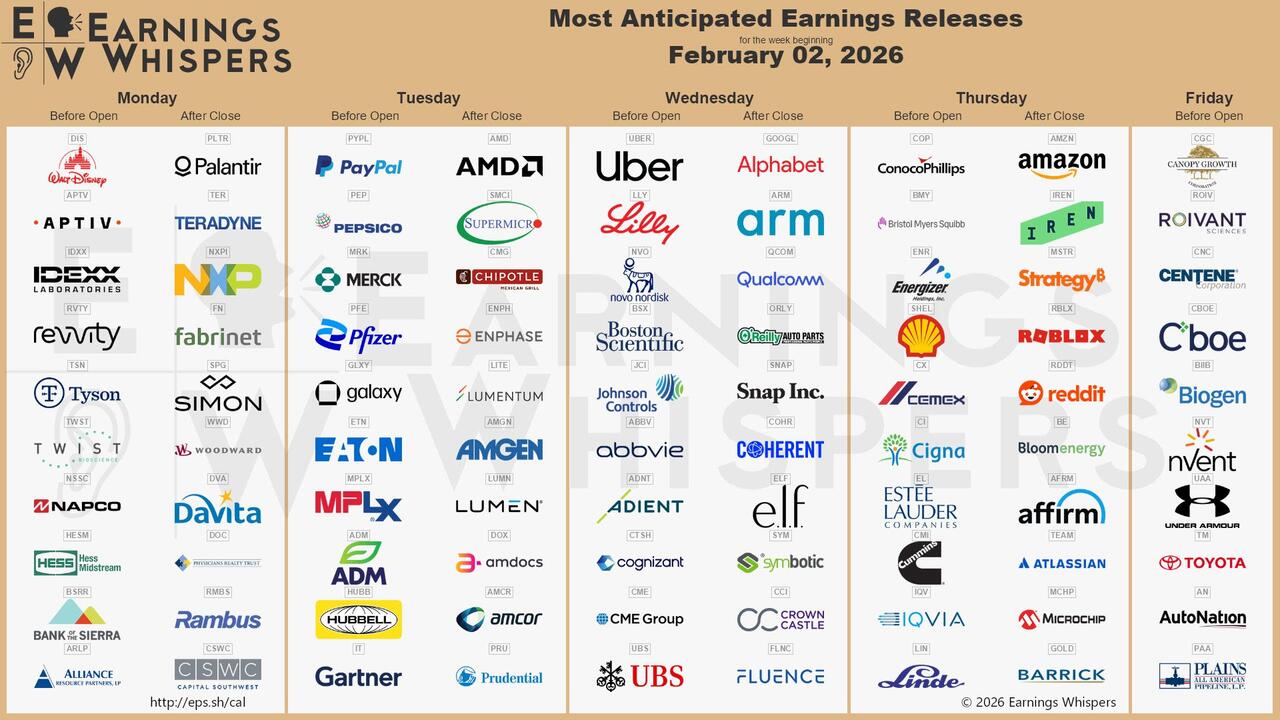
Central banks be in focus with decisions due from the ECB, the BoE (both Thursday) and the RBA (tomorrow). Elsewhere we have the latest global PMIs and inflation in Europe. Corporate earnings include Alphabet (Wednesday), Amazon (Thursday) and AMD (Tuesday). Remember that Meta (+6.56%) and Microsoft (-8.50%) saw big moves in either direction last week with both having a 10% plus intra-day rise and decline respectively.
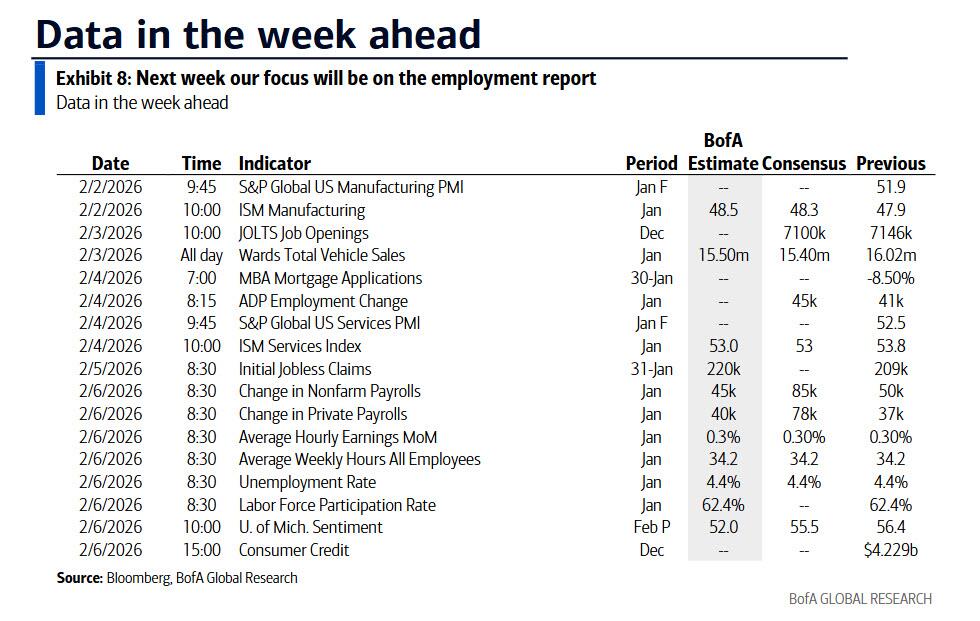
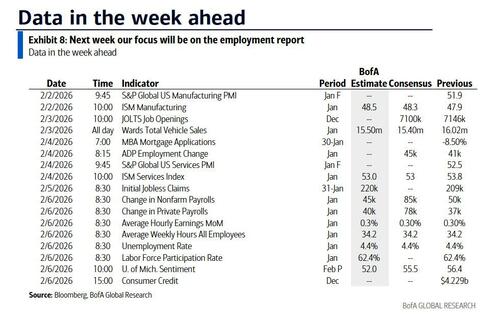
Looking at more detail into the week ahead, Friday’s employment report is the highlight, with forecasts pointing to another modest payroll gain (consensus at +50k and +37k for headline and private respectively) and no change in either the unemployment rate (4.4%) or the pace of hourly earnings growth. Ahead of that, the JOLTS data tomorrow and the ADP report on Wednesday will give early clues on labor market momentum. The week also brings the manufacturing ISM on Monday and the services ISM mid week, followed by the University of Michigan’s February sentiment survey on Friday. Fixed income investors will also be watching Wednesday’s quarterly refunding announcement and today’s Treasury borrowing estimate closely.
Central banks will remain a major theme as well. The ECB and Bank of England both meet on Thursday, and neither is expected to adjust policy, with the ECB likely extending its on hold stance for a fifth straight meeting and the BoE seen keeping Bank Rate unchanged once again. The Reserve Bank of Australia is also expected to stand pat tomorrow. Additional colour on financial conditions will come from the Fed’s senior loan officer survey today and the ECB’s latest bank lending survey tomorrow.
Across Europe, the flow of flash January inflation reports continues, with France tomorrow and Italy and the broader euro area following on Wednesday. Sweden publishes its CPI on Friday. Several Eurozone economies will also release December retail sales and trade figures, while Germany rounds out the week with its factory orders and industrial production numbers. It’ll be interesting to see if they show continued evidence of the fiscal stimulus.
The corporate earnings calendar remains active, with attention in the US turning to two members of the Mag-7, Alphabet on Wednesday and Amazon on Thursday — alongside a range of other tech firms such as Palantir, AMD and Qualcomm. Major healthcare names are also reporting, including Eli Lilly and AbbVie in the US and Novartis and Novo Nordisk in Europe. Broader US earnings include updates from PepsiCo, Walt Disney and Uber. In Europe, several banks are scheduled to report, while in Japan, Toyota, Sony and Tokyo Electron will be among the key companies releasing results.
Here is a day-by-day calendar of events, courtesy of DB:
Monday February 2
Data: US January ISM index, China January RatingDog manufacturing PMI, Germany December retail sales, Italy January manufacturing PMI, new car registrations, budget balance, Canada January manufacturing PMI
Central banks: Fed’s SLOOS, BoJ Summary of Opinions from the January meeting, Fed’s Bostic speaks, BoE’s Breeden speaks
Earnings: Palantir, Walt Disney, Intesa Sanpaolo, NXP Semiconductors, Teradyne
Auctions: US Treasury quarterly borrowing estimate
Tuesday February 3
Data: US December JOLTS report, January total vehicle sales, Japan January monetary base, France January CPI, December budget balance, New Zealand labour force survey
Central banks: RBA decision, ECB’s bank lending survey, Fed’s Bowman and Barkin speak
Earnings: AMD, Merck, PepsiCo, Amgen, Pfizer, Eaton, Nintendo, Emerson Electric, TransDigm, Mondelez, Chipotle, Electronic Arts, PayPal, Corteva, Take-Two, Super Micro Computer
Wednesday February 4
Data: US January ADP report, ISM services, China January RatingDog services PMI, UK January official reserves changes, Italy January CPI, services PMI, Eurozone January CPI, December PPI, Canada January services PMI
Earnings: Alphabet, Eli Lilly, AbbVie, Novartis, Novo Nordisk, Mitsubishi UFJ, Banco Santander, Uber, QUALCOMM, UBS, Boston Scientific, ARM, CME Group, GSK, Mitsubishi Heavy Industries, Equinor, Credit Agricole
Auctions: US Treasury quarterly refunding announcement
Thursday February 5
Data: US initial jobless claims, UK January new car registrations, construction PMI, Germany December factory orders, January construction PMI, France December industrial production, Italy December retail sales, Eurozone December retail sales
Central banks: ECB’s decision, BoE’s decision, Fed’s Bostic speaks, BoC’s Macklem speaks, BoE’s DMP survey
Earnings: Amazon, Shell, Linde, BBVA, Sony, ConocoPhillips, BNP Paribas, Bristol-Myers Squibb, KKR, Intercontinental Exchange, Barrick Mining, Vinci, Cigna, Fortinet, Siemens Healthineers, ROBLOX, Ares, Rockwell Automation, Assa Abloy, Saab, ArcelorMittal, Estee Lauder, AP Moller – Maersk, Reddit, Atlassian, Vestas, BT, Blue Owl, Illumina, Affirm, Neste
Friday February 6
Data: US January jobs report, February University of Michigan survey, December consumer credit, Japan December household spending, leading index, coincident index, Germany December industrial production, trade balance, France December trade balance, current account balance, Q4 wages, Canada January labour force survey, Sweden January CPI
Central banks: ECB’s survey of professional forecasters, ECB’s Cipollone and Kocher speak, BoE’s Pill speaks
Earnings: Toyota, Philip Morris International, Tokyo Electron, Societe Generale, Orsted, Telenor, Centene
Finally, looking at just the US, Goldman writes that the key economic data release this week is the employment report on Friday. There are several speaking engagements by Fed officials scheduled this week, including events with Governors Bowman and Cook and Vice Chair Jefferson
Monday, February 2
10:00 AM ISM manufacturing index, January (GS 48.5, consensus 48.5, last 47.9): We estimate that the ISM manufacturing index increased by 0.6pt to 48.5 in January, reflecting an increase in our manufacturing survey tracker (+2.0pt to 51.7).
12:30 PM Atlanta Fed President Bostic (FOMC non-voter) speaks: Atlanta Fed President Raphael Bostic will speak at the Atlanta Rotary Club. Moderated Q&A is expected. On January 30, Bostic said, “We should be waiting, and be more patient. We are still too high in inflation, so I think [policy needs] to be somewhat restrictive.”
Tuesday, February 3
08:00 AM Richmond Fed President Barkin (FOMC non-voter) speaks: Richmond Fed President Thomas Barkin will speak on the economic outlook. Speech text and Q&A are expected. On January 6, Barkin said, “Going forward, policy will require finely tuned judgments balancing progress on each side of our mandate.”
09:40 AM Fed Governor Bowman speaks: Vice Chair for Supervision Michelle Bowman will speak at the Wall Street Journal Invest Live event. Moderated Q&A is expected. On January 16, Bowman said, “Absent a clear and sustained improvement in labor market conditions, we should remain ready to adjust policy to bring it closer to neutral. We should also avoid signaling that we will pause without identifying that conditions have changed.”
10:00 AM JOLTS job openings, December (GS 7,300k, consensus 7,250k, last 7,146k)
05:00 PM Lightweight motor vehicle sales, January (GS 15.1mn, consensus 15.3mn, last 16.0mn)
Wednesday, February 4
08:15 AM ADP employment change, January (GS +40k, consensus +45k, last +41k)
10:00 AM ISM services index, January (GS 53.0, consensus 53.5, last 53.8): We estimate that the ISM services index declined 0.8pt to 53.0 in January, reflecting an improvement in our non-manufacturing survey tracker (+1.1pt to 53.3) but a headwind from potential residual seasonality.
06:30 PM Fed Governor Cook speaks: Fed Governor Lisa Cook will speak on monetary policy and the economic outlook at the Economic Club of Miami. Speech text and moderated Q&A are expected.
Thursday, February 5
08:30 AM Initial jobless claims, week ended January 31 (GS 210k, consensus 212k, last 209k); Continuing jobless claims, week ended January 24 (consensus 1,850k, last 1,827k): We forecast roughly unchanged initial jobless claims (210k) reflecting upward pressure from seasonal distortions that is offset by downward pressure from severe winter weather.
10:30 AM Atlanta Fed President Bostic speaks: Atlanta Fed President Raphael Bostic will speak. Moderated Q&A is expected.
Friday, February 6
08:30 AM Nonfarm payroll employment, January (GS +45k, consensus +68k, last +50k); Private payroll employment, January (GS +45k, consensus +75k, last +37k); Average hourly earnings (MoM), January (GS +0.35%, consensus +0.3%, last +0.3%); Unemployment rate, January (GS 4.4%, consensus 4.4%, last 4.4%): We estimate nonfarm payrolls increased 45k in January. On the negative side, we estimate that the birth-death model—which will be updated with this report, more details below—could contribute 30-50k fewer jobs to payroll growth (on a seasonally adjusted basis) than in recent months and big data indicators indicated a modest pace of private sector job growth. Additionally, we expect unchanged government payrolls—reflecting a 10k decline in federal government payrolls that is offset by a 10k increase in state and local government payrolls. On the positive side, the pace of layoffs—a particularly important determinant of net job growth in January—remained subdued. However, the seasonal factors have evolved to expect smaller declines in employment in recent Januarys, limiting the potential boost from this channel. At the industry level, we expect rebounds in retail trade employment—which saw less holiday hiring than usual that should correspond to fewer January layoffs—and construction employment—for which unusually poor weather likely contributed to a decline in December. We do not expect a drag from Winter Storm Fern, which formed about a week after the reference week. We estimate that the unemployment rate was unchanged at 4.4% in January, though see risks as skewed to a decline: the bar for rounding down to 4.3% is not high from an unrounded 4.38% in December and the January unemployment rate appears to suffer from modestly negative residual seasonality (the unrounded unemployment rate has declined in each of the last three Januarys). We estimate average hourly earnings rose 0.35% month-over-month in January, reflecting positive calendar effects.
This month’s report will be accompanied by the annual benchmark revision to the establishment survey and a methodological update to the birth-death model. The BLS’s preliminary estimate of the benchmark payrolls revision indicated that cumulative payroll growth between April 2024 and March 2025 would be revised 911k lower. We estimate that the final downward revision will likely be somewhat smaller—in the range of 750-900k—as job growth in the QCEW, which informs the revision, has been revised up since the BLS issued the preliminary estimate. The BLS will also update the net birth-death forecasts in the post-benchmark period (April 2025-December 2025) to incorporate information from the QCEW and the monthly payrolls survey. A downward revision to the post-benchmark period appears likely, reflecting the continued slowdown in the QCEW and weak private payroll growth during the post-benchmark period. Starting with this month’s report, the birth-death model will incorporate current sample information each month. This methodological change is intended to reduce the magnitude of annual revisions, as changes in employment at continuing establishments will provide a more timely signal about net job creation from firm births and deaths than the current methodology based on lagged QCEW data does. However, the methodological change could contribute to greater month-to-month volatility in payrolls readings, as the birth-death assumption will be impacted by the responses to the monthly survey.
10:00 AM University of Michigan consumer sentiment, February preliminary (GS 54.0, consensus 55.0, last 56.4) : University of Michigan 5-10-year inflation expectations, February preliminary (GS 3.2%, last 3.3%)
12:00 PM Fed Vice Chair Jefferson speaks: Fed Vice Chair Phillip Jefferson will speak on the economic outlook and supply-side inflation dynamics at the Brookings Institution. Speech text and moderated Q&A are expected. On January 16, Jefferson said, “In my view, the current policy stance leaves us well positioned to determine the extent and timing of additional adjustments to our policy rate based on the incoming data, the evolving outlook, and the balance of risks.”
Source: DB, Goldman
Tyler Durden
Mon, 02/02/2026 – 10:15
https://www.zerohedge.com/markets/key-events-week-payrolls-isms-adp-and-many-more-earnings

Chile oficializa candidatura de Bachelet a Secretaría General de la ONU con apoyo de Brasil y México
Por NAYARA BATSCHKE
SANTIAGO (AP) — El presidente chileno Gabriel Boric oficializó el lunes la candidatura de la expresidenta Michelle Bachelet a la Secretaría General de la Organización de las Naciones Unidas y adelantó que la postulación se realizará de forma conjunta con Brasil y México.
Desde el Palacio de La Moneda de Santiago, Boric afirmó que la candidatura de la exmandataria, anunciada el pasado septiembre, ya ha sido inscrita en las Naciones Unidas y agradeció el apoyo brindado por Brasil y México, los “dos países más poblados de América Latina”.
“Nuestras naciones, a través de este acto, manifiestan su voluntad común de contribuir a la gobernanza global y al fortalecimiento del multilateralismo”, dijo el jefe de Estado, a quien le queda poco más de un mes en el cargo.
“Esta candidatura expresa a la vez una esperanza compartida que América Latina y el Caribe hagan oír su voz en la construcción de soluciones colectivas a los tremendos desafíos de nuestro tiempo”, completó.
Boric había anunciado la postulación de Bachelet durante su último discurso ante la ONU, en septiembre del año pasado en Nueva York, en el que criticó duramente “el desequilibrio histórico de género en las Naciones Unidas”, en donde “nunca un secretario general ha sido mujer” en sus 80 años de historia.
Al oficializar la candidatura el lunes, el mandatario reiteró que Bachelet —quien estuvo al mando de Chile entre 2006 y 2010 y 2014 a 2018— “no es sólo una figura ampliamente conocida y respetada en el ámbito global” sino también “es una mujer con una biografía que es profundamente coherente con los valores que inspiran esta organización”.
Bachelet, de 74 años, cuenta con una larga carrera en organizaciones internacionales, en la cual destaca su labor como Alta Comisionada de las Naciones Unidas para los Derechos Humanos, cargo que desempeñó entre 2018 y 2022. Además, ejerció como directora ejecutiva de ONU Mujeres y secretaria general adjunta de la ONU entre 2010 y 2013.
La expresidenta chilena expresó desde La Moneda sentirse “muy honrada de ser candidata a la Secretaría General, no solo de Chile, sino también de Brasil y de México” y agradeció el respaldo de las respectivas naciones.
“Asumo la tremenda responsabilidad”, aseguró. “Me parece muy importante destacar lo que significa que esta candidatura sea inscrita por tres países, porque refleja un compromiso compartido y renueva la esperanza de que podemos trabajar juntos por objetivos comunes”.
Bachelet reconoció las “dificultades caracterizadas por un contexto geopolítico desafiante” que ha marcado la agenda global en los últimos años, pero sostuvo que, al frente del organismo, seguirá “apostando por fortalecer las herramientas del multilateralismo, modernizar las Naciones Unidas, reconociéndola como el espacio de encuentro, diálogo y búsqueda de soluciones comunes más importantes del mundo”.
Agregó que ante las “crisis múltiples” que azotan el mundo actual, la ONU “debe renovarse para seguir siendo legítima, más moderna, eficiente, transparente y orientada a resultados”.
En la misma línea se manifestó el presidente brasileño, Luiz Inácio Lula da Silva, quien alabó la trayectoria de la chilena y afirmó que “es con mucho honor que Brasil apoya” su candidatura.
“Su experiencia, liderazgo y compromiso con el multilateralismo la acreditan para conducir la ONU, en un contexto internacional marcado por conflictos, desigualdades y retrocesos democráticos”, manifestó el líder brasileño en X.
La candidatura de Bachelet se ha convertido en una de las prioridades de Boric antes de que deje el cargo el próximo 11 de marzo, cuando pasará las riendas del país al ultraderechista José Antonio Kast.
Kast y Bachelet llegaron a reunirse poco después de la victoria del presidente electo, quien dejó en el aire su apoyo a la postulación de la socialista a la secretaría general de Naciones Unidas. Tras conocer la oficialización, el ultraderechista volvió a esquivar el tema y dijo que no se pronunciará hasta que asuma la presidencia.
“Yo no tengo por qué pronunciarme si es acertado no acertado lo que ha hecho el presidente de la república”, dijo en declaraciones a periodistas en la costera localidad de Viña del Mar, a unos 120 kilómetros de Santiago.
Huge Surge In New Orders Sends US Manufacturing Activity Near 4 Year Highs
Huge Surge In New Orders Sends US Manufacturing Activity Near 4 Year Highs
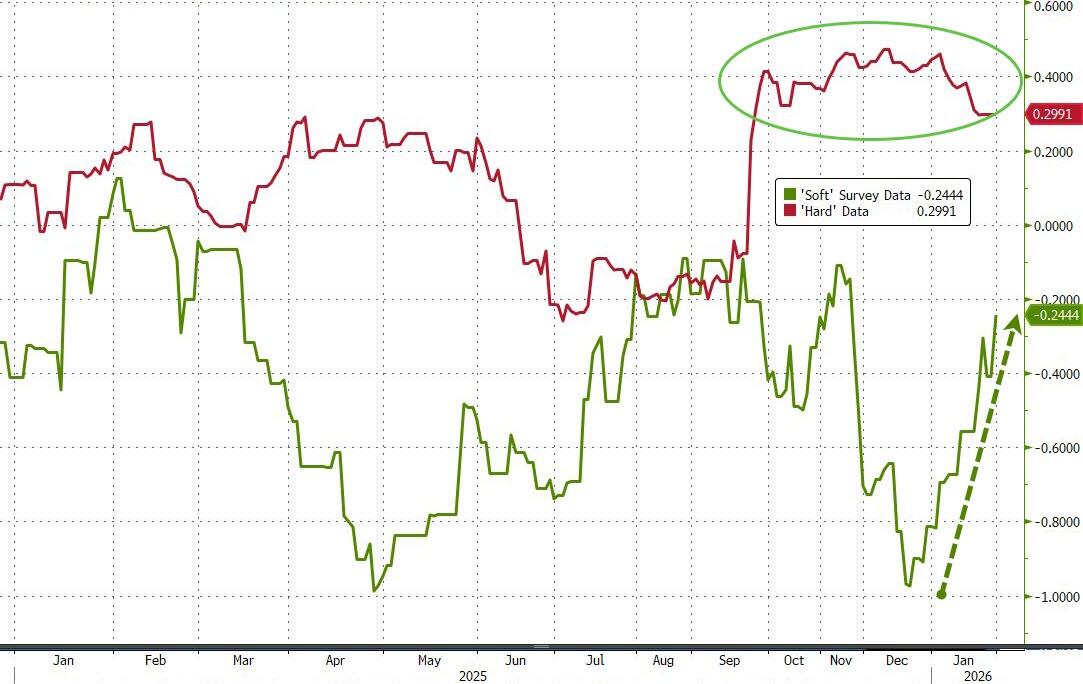
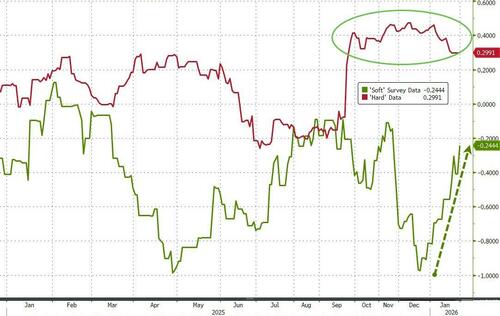
With ‘hard’ data sustaining signs of solid growth (e.g. factory orders and jobless claims), ‘soft’ survey data has been bouncing back since the start of the year
This morning we get the final Manufacturing PMI data from S&P Global and ISM for January.
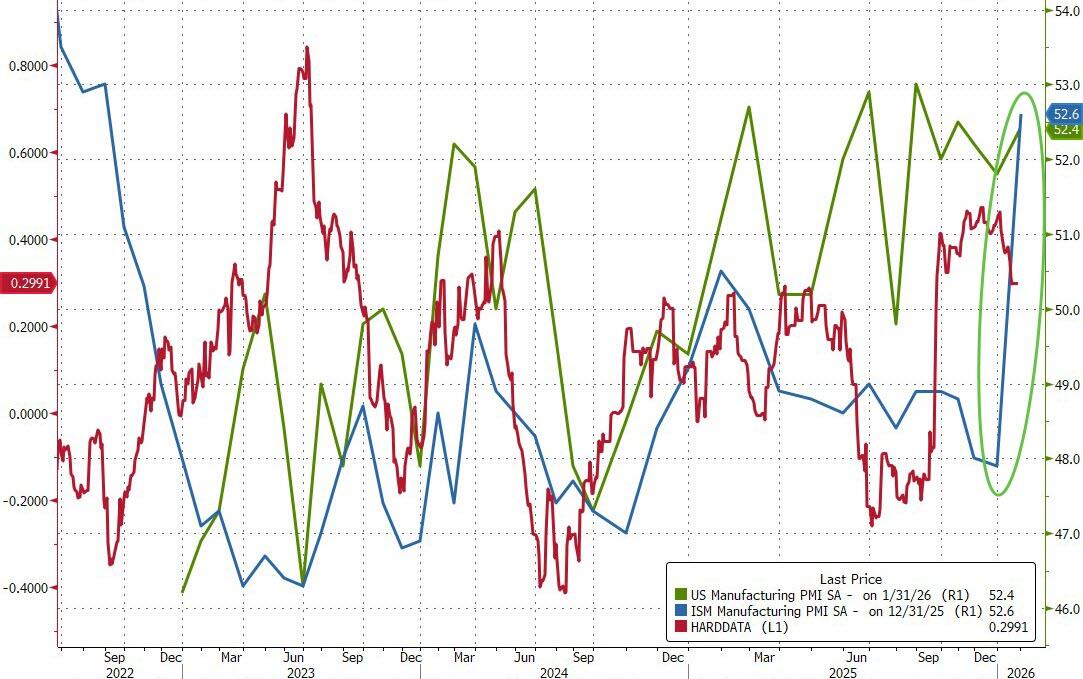
A solid and stronger improvement in US manufacturing sector operating conditions (52.4 vs 52.0 exp) was signaled by January’s S&P Global PMI data amid the joint-sharpest upturn in production since May 2022.
However, growth was in part driven by inventory building as new orders, despite returning to expansion in January, increased only modestly.
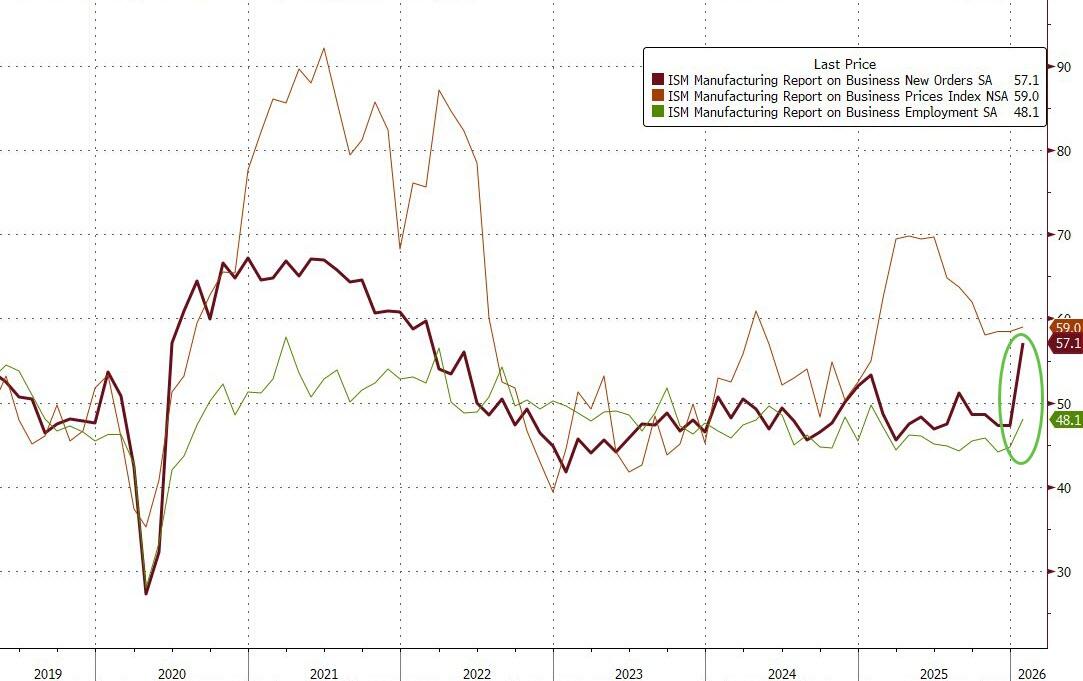
ISM’s Manufacturing was expected to rise from 47.9 to 48.5 in January but instead it soared to 52.6 – its highest since Aug 2022. This is the first print above 50 since January 2025.
Source: Bloomberg
This was the biggest MoM surge in the ISM print since April 2020 (COVID rebound), led by a huge surge in new orders and rise in employment (highest in a year) and prices (though elevated) are stable…
“News of the joint largest rise in factory production since May 2022 is tainted by reports of ongoing subdued sales growth,” says Chris Williamson, Chief Business Economist at S&P Global Market Intelligence.
“Production growth consequently significantly outpaced that of new orders at the start of the year, resulting in a further accumulation of unsold warehouse inventory.”
“Over the past three months, the survey indicates that factories have typically produced more goods than they have sold to a degree we have not previously seen since the global financial crisis back in early 2009.”
This highly unusual situation is clearly unsustainable, hinting at risks of a production slowdown and a potential knock-on effect on employment, unless demand improves markedly in the coming months.
Williamson adds that “sluggish sales and order book growth are being commonly linked to customer resistance to high prices, in turn often blamed on tariffs, as well as increased uncertainty over the economic outlook.”
While just below trend, business growth expectations for the year ahead are, however, holding up as firms anticipate improving demand, “thanks in part to lower interest rates, reduced import competition due to tariffs, and more government support.”
However, as Williamson concludes, “political uncertainty remains a key drag on business sentiment.”
Tyler Durden
Mon, 02/02/2026 – 10:07

Una mezcla de esperanza y temor prevalece en Venezuela tras cambio de gobierno impuesto por EEUU
Por REGINA GARCÍA CANO
CARACAS, Venezuela (AP) — El tiempo en Venezuela parece avanzar demasiado rápido y también demasiado lento. Los pilares del autoproclamado gobierno socialista del país están cayendo a un ritmo vertiginoso o no lo suficientemente rápido. El alivio económico finalmente está en el horizonte o ya es demasiado tarde.
Treinta días después de la incursión y captura del entonces presidente Nicolás Maduro por parte de Estados Unidos, tanto adultos como niños aún no están seguros de lo que está sucediendo exactamente a su alrededor. Y a medida que el shock inicial da paso a una mezcla de incertidumbre, esperanza y decepción, un miedo generalizado a otro ataque o a más represión gubernamental sigue presente.
En la capital, Caracas, donde vallas publicitarias y grafitis patrocinados por el gobierno exigen que Estados Unidos libere a Maduro, muchos residentes se preguntan si su sucesora, la presidenta encargada Delcy Rodríguez, tiene alguna autonomía o está capitulando ante las demandas de la Casa Blanca; si ella es Maduro con otro nombre, y —crucial para sus necesidades inmediatas— si deben creer, como ella ha indicado, que un aumento salarial largamente esperado está en el horizonte. Mientras tanto, líderes de la oposición que habían estado en silencio finalmente han emergido para hablar públicamente.
“Es un cambio importante, ciertamente, pero todo está igual, todo”, dijo el jubilado Julio Castillo, de 74 años, sobre la destitución de Maduro del cargo. “Me siento como que si no hubiese pasado mayor cosa”.
“Estamos actuando bajo coerción”
El gobierno de Venezuela y sus partidarios consideran la captura de Maduro y la primera dama Cilia Flores como un secuestro. Rodríguez y altos funcionarios han prometido luchar por la libertad de la pareja desde que el presidente de Estados Unidos, Donald Trump, anunció su captura en las primeras horas del 3 de enero.
El partido gobernante ha organizado manifestaciones para mostrar su lealtad a Maduro, a quien el temperamental Hugo Chávez nombró como portador de la antorcha de su autoproclamada revolución socialista antes de morir en 2013. También ha ajustado su mensaje de amenazar con una guerra al estilo de Vietnam con Estados Unidos a admitir estar militarmente superados y necesitar transformar la relación con Goliat.
Los partidarios —una minoría en comparación con las multitudes durante la presidencia de Chávez— ven a Rodríguez como carente de libre albedrío, pero confían en que ella puede llevar el chavismo, su movimiento político, a través de la próxima batalla diplomática.
“El Estado venezolano, y los venezolanos, estamos aceptando esta nueva situación en la que estamos actuando bajo coerción”, dijo José Vivens, un leal a Maduro, sobre la decisión de Rodríguez de permitir que la administración Trump controle el dinero del petróleo de Venezuela, el motor del país. “Nos secuestraron a nuestro comandante. Y tenemos que ceder para vivir para un nuevo combate”.
Vivens, un juez de paz, estaba en el estacionamiento de su apartamento en Caracas cuando escuchó un fuerte silbido, luego una explosión ensordecedora la noche del ataque. Se agachó detrás de su coche, y cuando miró hacia arriba, los helicópteros volaban inquietantemente cerca de su edificio.
“Ya nos invadieron”, fue el pensamiento inmediato de Vivens. No exactamente, pero unas horas más tarde, se enteraría de que la élite militar de Estados Unidos había capturado a Maduro en un complejo cercano y lo había subido a un helicóptero.
Abandonando un pilar del chavismo
Rodríguez ha utilizado eventos públicos y reuniones con el sector privado de Venezuela para asegurar a quienes la escuchan que ella, no la administración Trump, está gobernando el país sudamericano, incluso si luego reconoce tener una agenda mutua con Estados Unidos, lo cual era impensable hace unas semanas.
“El pueblo de Venezuela no acepta órdenes de ningún factor externo”, dijo durante una reunión con ejecutivos petroleros para discutir una reforma de la ley energética del país. “El pueblo de Venezuela tiene gobierno, y este gobierno obedece al pueblo”.
Su propuesta de reforma, que los legisladores aprobaron rápidamente y ella promulgó el jueves, abre el sector petrolero de la nación a la privatización, abandonando un pilar del chavismo.
Rodríguez presentó el proyecto tras la afirmación de Trump de que su administración tomaría el control de las exportaciones de petróleo de Venezuela y revitalizaría la industria en declive atrayendo inversión extranjera.
Testeando las aguas
Muchos dentro de la oposición habían esperado durante mucho tiempo que la destitución de Maduro, especialmente si era liderada por Trump, resultaría inmediatamente en que uno de los suyos tomara las riendas del país. La decisión de Trump de trabajar con Rodríguez, en lugar de la líder opositora y Premio Nobel de la Paz, María Corina Machado, los tiene perplejos.
Pero mientras los partidarios de Machado siguen buscando señales de que la Casa Blanca la incorporará de manera significativa en sus planes para su país, los venezolanos han comenzado a poner a prueba el compromiso de Rodríguez con lo que ella ha llamado “un nuevo momento político” para Venezuela.
Durante días, decenas de personas han mantenido una vigilia fuera de las prisiones exigiendo la liberación de seres queridos que creen fueron detenidos por razones políticas, incluidos periodistas, defensores de los derechos humanos y miembros del ejército. Un puñado de líderes de la oposición que no habían sido vistos en público en Venezuela ni hicieron declaraciones durante más de un año han hablado.
“Creo que el destino de Venezuela no puede ser un acuerdo petrolero y una dictadura encabezada por Delcy Rodríguez, porque sencillamente podríamos definir eso como una continuidad de la dictadura”, dijo el líder opositor Andrés Velásquez a los periodistas, reapareciendo después de más de un año en la clandestinidad.
Un canal de televisión de propiedad privada con alcance nacional incluso transmitió el miércoles un clip de Machado dirigiéndose a los periodistas en Washington. Ni los medios públicos ni privados habían mostrado un segmento similar en años.
Aun así, muchos venezolanos continúan autocensurándose, ya que siguen profundamente temerosos de la represión gubernamental. Sus publicaciones en redes sociales no mencionan la política. Los mensajes de texto o de audio en WhatsApp no critican al gobierno. Algunas videollamadas implican escribir y borrar información en pizarras blancas como una capa adicional de protección.
No ha habido grandes manifestaciones pidiendo un nuevo gobierno o una elección presidencial. Tampoco nadie se ha atrevido a celebrar públicamente la captura de Maduro, incluso si muchos desearon durante mucho tiempo verlo esposado.
Muchos líderes de la oposición permanecen en el exilio. Los carteles de “se busca” de Edmundo González, el candidato de la oposición durante las elecciones presidenciales de 2024, todavía están en exhibición en aeropuertos y oficinas gubernamentales.
Equilibrando la esperanza y el miedo
El hijo de Margaret García no pudo dormir durante días después del 3 de enero. Tampoco quería volver a la escuela por miedo a no saber qué hacer si ocurría otro ataque.
“Nosotros pensamos que nos íbamos a morir”, relata ella sobre el momento en que su familia escuchó un helicóptero abrir fuego cerca de su edificio de apartamentos de 15 pisos cerca de donde fue capturado Maduro.
El miedo de su hijo no es único. Algunos venezolanos todavía temen un segundo ataque si el gobierno de Rodríguez no cumple con las expectativas de Estados Unidos, incluso cuando Washington ha indicado que no tiene planes de una mayor escalada.
“Puedo decirles ahora con total certeza, no estamos preparados ni tenemos la intención o esperamos tener que tomar ninguna acción militar en Venezuela en ningún momento”, dijo el miércoles el secretario de Estado de Estados Unidos, Marco Rubio, a una comisión del Senado.
García, una maestra, dijo que no podía entender cómo alguien podría encontrar satisfacción en la operación de Estados Unidos que mató a decenas. Aun así, piensa que bajo la supervisión de Rodríguez, el país podría ver las mejoras económicas duraderas que los trabajadores han esperado durante más de una década.
Al igual que García, muchos trabajadores del sector público sobreviven con aproximadamente 160 dólares al mes, mientras que el empleado promedio del sector privado ganó alrededor de 237 dólares al mes el año pasado. El salario mínimo mensual de Venezuela de 130 bolívares (0,35 dólares), no ha aumentado desde 2022, situándose muy por debajo de la medida de pobreza extrema de las Naciones Unidas de 2,15 dólares al día.
“Vemos que un momento negativo nos ha traído cosas positivas”, dijo la maestra sobre los posibles cambios que Rodríguez ha señalado que vendrán con un esperado auge petrolero.
______
Esta historia fue traducida del inglés por un editor de AP con la ayuda de una herramienta de inteligencia artificial generativa.

New middle school social studies curriculum officially coming to Indian Prairie District 204
Indian Prairie School District 204’s old curriculum for middle school social studies is officially history.
Starting next fall, the school district is changing how it teaches social studies at the middle school level, after securing school board approval for the new curriculum last week.
Currently, middle school students at Indian Prairie School District 204 learn ancient history in sixth grade, world geography and culture in seventh grade and U.S. history in eighth grade.
But now, under the new curriculum, sixth-graders will learn world geography and culture, and United States history will be spread across seventh and eighth grades.
The seventh-grade U.S. history curriculum will cover things like the American Revolution and the forming of the nation and leave off with the nation’s expansion, officials have said. Eighth grade will pick up with the nation’s expansion and America in the mid-1800s and cover the Civil War, World War II and modern America, among other topics. The eighth-grade curriculum will also have a stand-alone financial literacy unit — which currently is part of the seventh-grade curriculum.
The curriculum is not entirely new to Indian Prairie, however. The district conducted a widespread pilot program for it this school year.
That pilot generated significant interest from middle school social studies teachers, who have cited challenges with teaching the existing curriculum, according to district leadership. Social studies is not the primary area of expertise for many district teachers, which has left them looking for more resources, the district’s director of middle school curriculum Barbi Chisholm previously said. And the district’s most recent curriculum for middle school social studies did not include a core resource, which many teachers felt was missing.
In addition to approving the curriculum change itself, the school board on Jan. 26 also approved the purchase of course materials for the new social studies curriculum, which is expected to cost the district $650,000.
Part of the rationale for the change also comes from state mandates related to teaching U.S. history, according to officials. Chisholm explained previously that most of the state’s instructional mandates are being covered in eighth grade, but the modified curriculum would allow those requirements to be distributed across two years.
As for eliminating ancient history in eighth grade, Chisholm has said that the sixth-grade curriculum will incorporate the study of world cultures, including their historical context.
District students can expect to see the new social studies curriculum starting in the fall.
mmorrow@chicagotribune.com
https://www.chicagotribune.com/2026/02/02/indian-prairie-middle-school-social-studies-curriculum/

Peak OnlyFans? Platform In Talks To Sell 60% Stake
Peak OnlyFans? Platform In Talks To Sell 60% Stake
Following the Wall Street Journal’s reporting last week, Bloomberg has provided additional color on OnlyFans’ plan to sell a 60% stake in a deal valued at about $3.5 billion. The report is based on people familiar with the matter and has not been confirmed by the company.
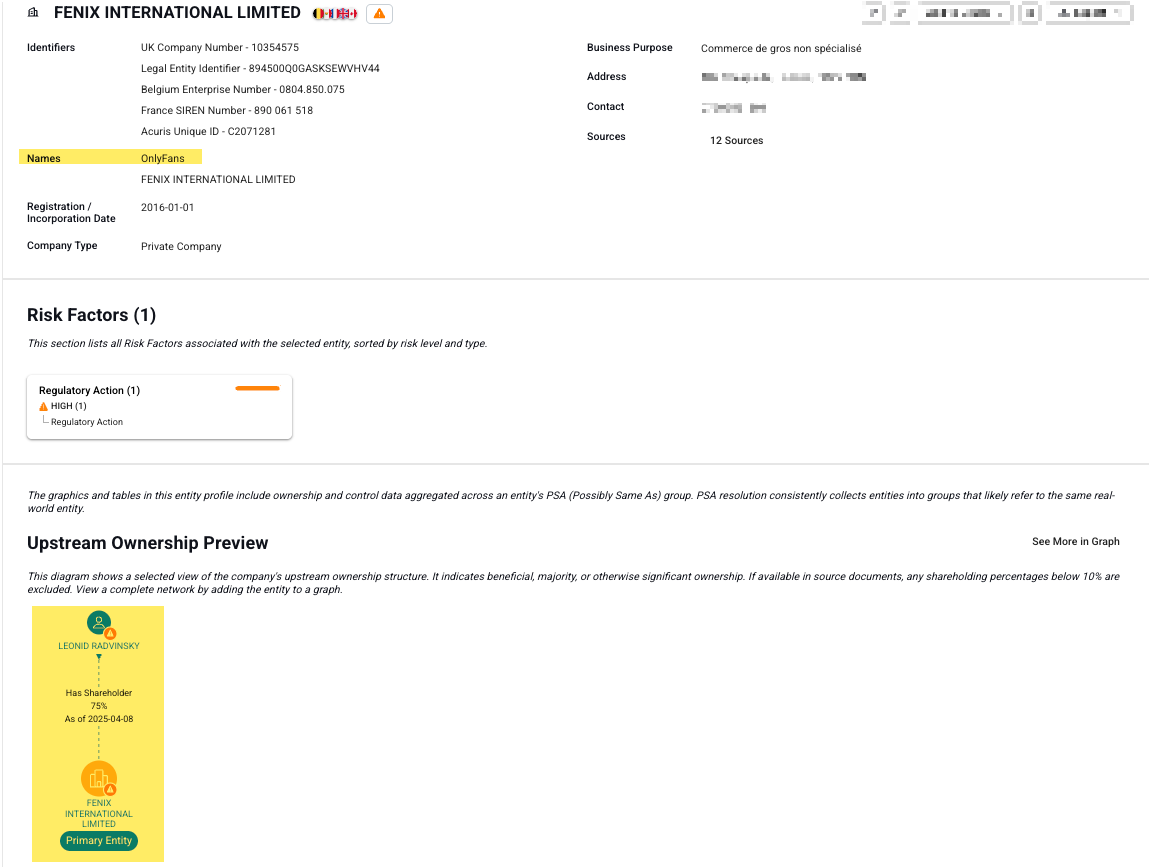
OnlyFans owner Fenix International Ltd. is in “early talks” with San Francisco-based Architect Capital to sell a 60% stake worth about $3.5 billion. The proposed structure includes roughly $2 billion of debt and may take months to formalize.
Architect Capital describes itself as an asset manager focused on improving businesses where it sees opportunities to build stronger financial infrastructure. Given OnlyFans’ heavy reliance on sexually explicit content, it remains unclear whether a shift away from sex creators is part of the video platform’s longer-term vision under potential new ownership.
OnlyFans has explored sale options since last spring, including a prior effort that valued the business at nearly $8 billion, as owner Leonid Radvinsky looks to monetize after pandemic-era growth.
According to publicly available data, Ukrainian-American Leonid Radvinsky owns Fenix.
British filings showed that Radvinsky had paid himself at least $1 billion in dividends since buying OnlyFans in 2018.
Meanwhile, Americans spend billions annually on OF subscriptions.
Peak OF?
OnlyFans Model Gets Baptized, Reconnects With Jesus After Sex Spree
The Wall Street Journal reported last week that, in a presentation to investors, Architect Capital said it sees value in offering “services” to OnlyFans content creators. It’s anyone’s guess at what these services could be, whether financial infrastructure or creator tools…
Tyler Durden
Mon, 02/02/2026 – 09:40
https://www.zerohedge.com/technology/peak-onlyfans-platform-talks-sell-60-stake
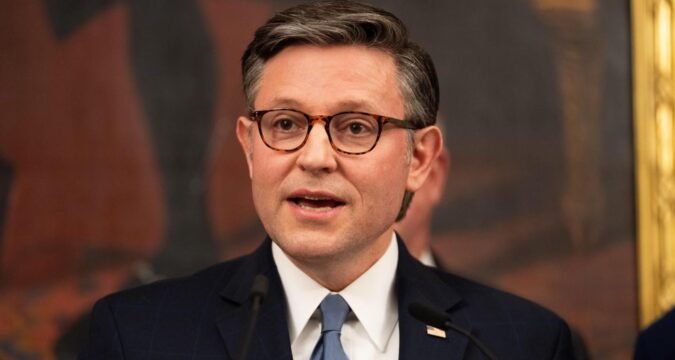
Speaker Johnson faces tough choices on partial government shutdown and debate over ICE
WASHINGTON — House Speaker Mike Johnson faces tough days ahead trying to muscle a federal funding package to passage and prevent a prolonged partial government shutdown as debate intensifies over the Trump administration’s sweeping immigration enforcement operations.
Johnson signaled he is relying on help from President Donald Trump to ensure passage. Trump struck a deal with senators to separate funding for the Department of Homeland Security from a broader package after public outrage over two shooting deaths during protests in Minneapolis against Immigration and Customs Enforcement. Under the plan approved by the Senate, DHS would be funded temporarily to Feb. 13, setting up a deadline for Congress to try to find consensus on new restrictions on ICE operations.
“The president is leading this,” Johnson, R-La., told “Fox News Sunday.”
“It’s his play call to do it this way,” the speaker said, adding that the Republican president has “already conceded that he wants to turn down the volume” on federal immigration sweeps and raids.
A first test will come Monday afternoon during a committee meeting when Johnson will need his own GOP majority to advance the package after Democrats refused to provide the votes for speedy consideration. Johnson said he is hopeful work can wrap up for a full House vote, at least by Tuesday.
Democrats dig in on ICE changes
Democrats are demanding restraints on ICE that go beyond $20 million for body cameras that already is in the bill and want to require that federal immigration agents unmask and identify themselves and are pressing for an end to roving patrols, amid other changes.
“What is clear is that the Department of Homeland Security needs to be dramatically reformed,” said House Democratic leader Hakeem Jeffries of New York on ABC’s “This Week.”
Jeffries said the administration needs to begin negotiations now, not over the next two weeks, on changes to immigration enforcement operations.
“Masks should come off,” he said. “Judicial warrants should absolutely be required consistent with the Constitution, in our view, before DHS agents or ICE agents are breaking into the homes of the American people or ripping people out of their cars.”
Republicans make their own demands
At the same time, House Republicans, with some allies in the Senate, are making their own demands, as they work to support Trump’s clamp down on immigrants in the U.S.
The House Freedom Caucus has insisted on fuller funding for Homeland Security while certain Republicans are pushing to include other measures, including the SAVE Act, a longshot Trump priority that would require proof of citizenship before Americans are eligible to participate in elections and vote.
Johnson said he would be talking to lawmakers over the day ahead to see what it will take to win over support.
Workers without pay if partial government shutdown drags on
Meanwhile, a number of federal agencies are snared in the funding standoff as the government went into a partial shutdown over the weekend.
Defense, health, transportation and housing are among those that were given shutdown guidance by the administration, though many operations are deemed essential and services are not necessarily interrupted. Workers could go without pay if the impasse drags on. Some could be furloughed.
Lawmakers from both parties are increasingly concerned the closure will disrupt the Federal Emergency Management Agency, which they rely on to help constituents in the states after storms and other disasters.
This is the second time in a matter of months that federal government operations have been disrupted as Congress is using the annual funding process as leverage to extract policy changes. Last fall, Democrats sparked what became the longest federal shutdown in history, 43 days, as they protested the expiration of health insurance tax breaks.
That shutdown ended with a promise to vote on proposals to extend the Affordable Care Act tax credits. But with GOP opposition, Democrats were unable to achieve their goal of keeping the subsidies in place. Insurance premiums spiked in the new year for millions of people.
Trump wants quick end to shutdown
This time, the administration has signaled its interest in more quickly resolving the shutdown.
Johnson said he was in the Oval Office last week when Trump, along with border czar Tom Homan, spoke with Senate Democratic leader Chuck Schumer of New York to work out a deal on immigration enforcement changes.
“I think we’re on the path to get agreement,” Johnson said on NBC’s “Meet the Press.”
Body cameras, which are already provided for in the package, and an end to the roving patrols by immigration agents are areas of potential agreement, Johnson said.
But he said taking the masks off and putting names on agents’ uniforms could lead to problems for law enforcement officers as they are being targeted by the protesters and their personal information is posted online.
“I don’t think the president would approve it — and he shouldn’t,” Johnson said on Fox.
Democrats, however, said the immigration operations are out of control, and must end in Minneapolis and other cities.
Growing numbers of lawmakers are calling for Homeland Security Secretary Kristi Noem to be fired or impeached.
“What is happening in Minnesota right now is a dystopia,” said Sen. Chris Murphy, D-Conn., who led efforts to hold the line for more changes.
“ICE is making this country less safe, not more safe today,” Murphy said on “Fox News Sunday.”
“Our focus over the next two weeks has to be reining in a lawless and immoral immigration agency.”
https://www.chicagotribune.com/2026/02/02/government-shutdown-ice/