Category: News
What’s The Warsh That Could Happen?
What’s The Warsh That Could Happen?
By Benjamin Picton, Senior Market Strategist at Rabobank
The DXY is dealing firmer this morning and precious metals continue to be flogged like the family silver after Donald Trump confirmed the nomination of Kevin Warsh as incoming Fed Chair. In defiance of the President’s oft-stated preference, markets are convinced that Warsh is a hawk. Consequently, zero-yield risk is taking a beating (bitcoin, ouch), equities are offered and US 5y5y inflation swaps have fallen by ~2bps since Wednesday of last week.
The Financial Times marked the occasion of Warsh’s nomination by saying ‘Arise, Shadow Fed Chair Stan Druckenmiller’, suggesting that the legendary hedge fund manager who counts both Kevin Warsh and Treasury Secretary Scott Bessent among his proteges is now the most powerful person in the global economy. The FT references ‘people familiar with the matter’ as describing Druck’s relationship with Warsh and Bessent as “akin to father-son relationships”, with Warsh in particular sometimes speaking with Druckenmiller “more than a dozen times a day”. Needless to say, markets will now be hanging off of Druck’s every utterance for direction on monetary policy.
While that will doubtless be the case, it seems absurd that much divination is actually required to determine where monetary policy in the United States is likely to go. The national debt burden is immense – soon to hit $39 trillion in dollar terms and now above 121% of GDP – and more than 3% of GDP is already dedicated to servicing interest expense. That – as Fed Chair Powell pointed out last week – comes at a time of healthy economic expansion with a labor market close to full employment.
With all the understatement of a career central banker, Powell described this cocktail as “unsustainable”. If something is ‘unsustainable’, logically it will not be sustained. So what is likely to change?
It won’t be the spending, as the largely futile efforts of DOGE and the fact that ‘mandatory spending’ (social programs, farm subsidies, student loan subsidies etc) plus interest expense plus defence spending accounts for almost 87% of US fiscal outlays. Interest expense will go up, not down, Trump wants to increase the defence budget by 50% and cutting entitlements is a practical impossibility that often gets talked about but never seems to happen. Besides, Trump campaigned on opposing cuts to programs like social security and Medicare.
What about the income side of the ledger? The Trump administration has already taken steps to increase taxes by introducing sweeping import tariffs, but if those tariffs prove effective over time in driving import substitution for domestically-produced alternatives it stands to reason that tariffs will become less and less effective as a revenue tool. Outright rises in direct taxation also seems unlikely given that Trump permanently extended his 2017 tax cuts that had been due to expire via the One Big Beautiful Bill in May of this year.
That leaves interest rates and growth as the only remaining levers to right the fiscal ship. Politicians always think that they are going to grow their way out of trouble, but in Trump’s case it seems likely that an inflationary boom is genuinely part of the fiscal strategy. All of the signs so far point to a willingness to ‘run it hot’ when it comes to the economy.
We have written previously about the strategy of driving adoption of US dollar stablecoins as a means to lower borrowing costs at the front end of the yield curve. Coupled with a sympathetic Fed Governor who is likely to reflect the President’s wish for a lower Fed Funds rate, this might be the best shot of the administration to move the fiscal needle. Indeed, in an era of fiscal dominance, the incoming Fed Chair may have little choice but to keep short rates low.
Along with moves to pressure mortgage relates lower through MBS purchases, threats of price caps (on credit card interest, for instance) and attempts to use tariffs as leverage to extract investment pledges from other countries, these sorts of measures veer into the realm of financial repression, where real interest rates are held negative and private savers carry the can for the government largesse.
Of course, some of these policy options are only available to the United States due to its status as the issuer of the global reserve currency. Abusing the “exorbitant privilege” of being the reserve currency issuer through erratic trade practices, financial repression and strategic currency devaluation is a high stakes gamble that could backfire spectacularly.
Xi Jinping is evidently well aware of the contradictions faced by the United States in attempting to leverage its position as reserve currency issuer without losing it. The FT yesterday reported on comments from Xi calling for the Chinese renminbi to become a global reserve currency by creating a “powerful (read: politicized) central bank” that would ensure a “strong currency” used widely in international trade, investment and foreign exchange markets.
The renminbi has been steadily strengthening against the dollar since Liberation Day last year, and the PBOC has accelerated its run stronger daily fixings from late November onwards. Xi was clear at the Shanghai Cooperation Organization summit last year that he wished to internationalize the role of the CNY and China has begun using its monopsony market power in commodities like iron ore to drive wider acceptance of its currency for trade settlement. Expect more of this in markets where China is the only buyer, or the only buyer of scale.
CNY is starting from a low base and still faces the Triffin Dilemma of not meeting the requirements of a reserve currency so long as China insists on running trade surpluses (there’s no sign of a change of heart on that score), but by boosting its adoption Xi could chip away at the reserve currency status of the dollar right at the moment when many other players in financial markets and the world economy are openly questioning whether the dollar’s writ still runs.
Though it still seems unlikely at this stage, if the reserve status of the dollar was genuinely threatened it would dramatically reduce the freedom to manoeuvre of US policy makers grappling with that “unsustainable” fiscal trajectory.
For the public finances of the United States, that might be the Warsh that could happen.
Tyler Durden
Mon, 02/02/2026 – 13:05

Trump Slashes India Tariffs After Modi Agrees To Drop Russian Oil, Go Full ‘BUY AMERICAN’
Trump Slashes India Tariffs After Modi Agrees To Drop Russian Oil, Go Full ‘BUY AMERICAN’
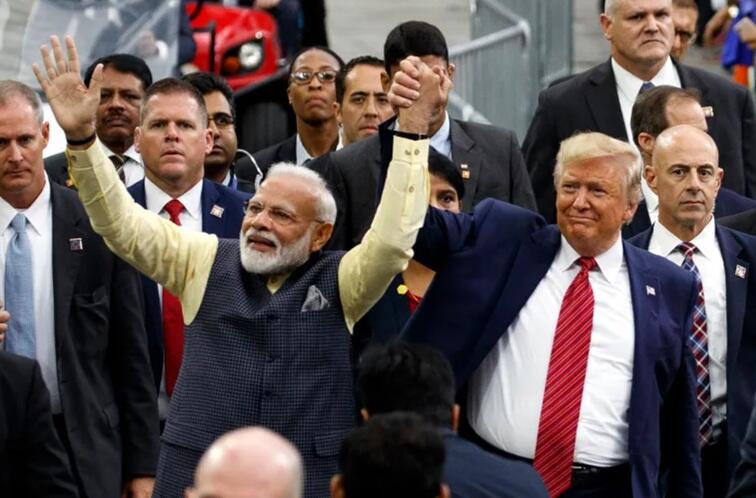
In a huge Monday development, President Trump has announced the US will trim its punitive 25% tariff on Indian imports to 18% after striking what he hailed as a new “trade deal” with Indian Prime Minister Narendra Modi. Crucially it hinges on New Delhi having reportedly ended its purchases of Russian crude and swapping them for massive US energy and goods buys.
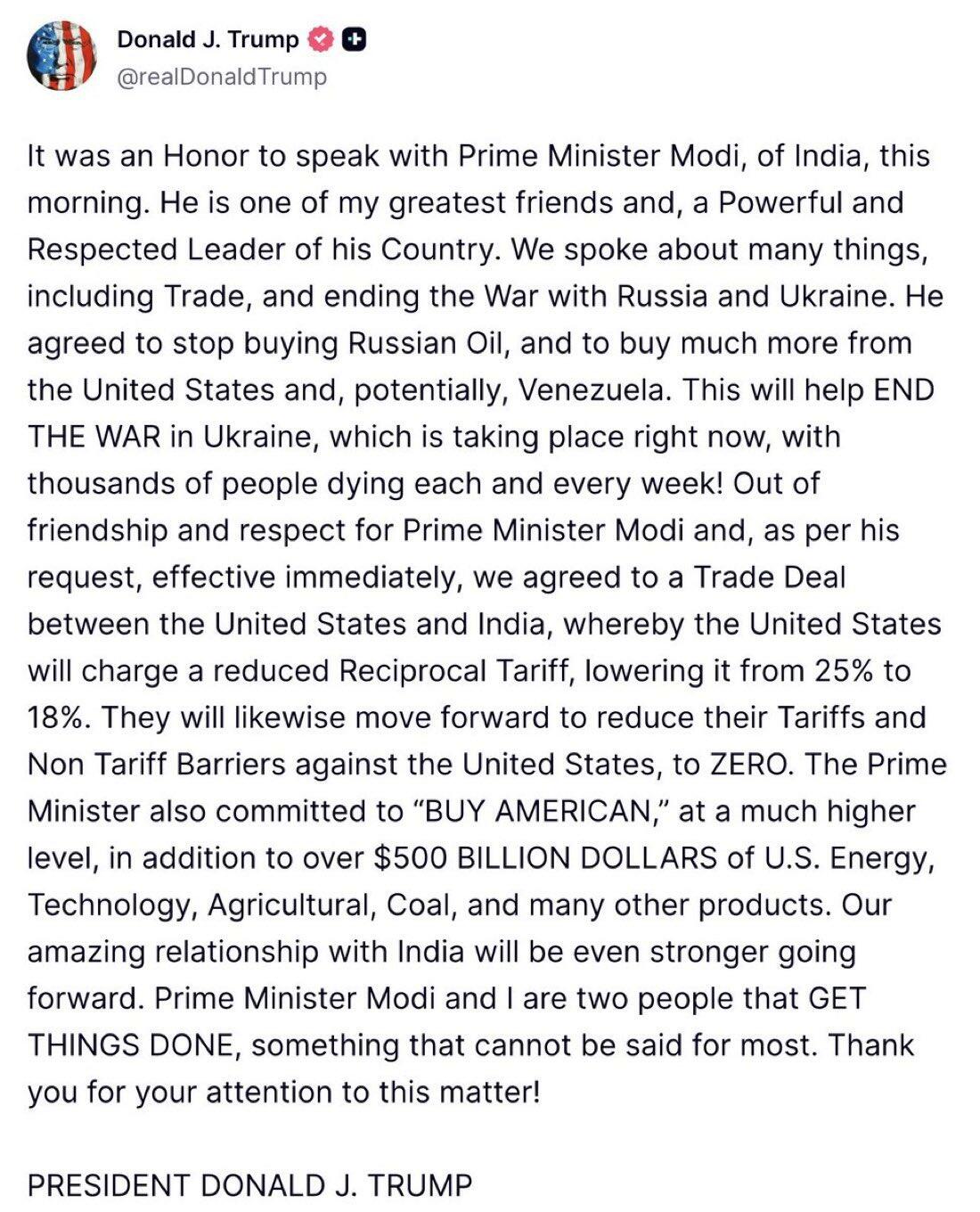
In a Truth Social post, Trump portrayed the agreement as a major geopolitical win, saying that India “agreed to stop buying Russian oil, and to buy much more from the United States and, potentially, Venezuela,” and crucially framing the move as helping “END THE WAR in Ukraine.”
Under the newly touted deal, according to breaking details.:
The United States will cut its “reciprocal tariff” on Indian goods from 25% to 18%, effective immediately.
India will slash its tariffs and non-tariff barriers on American products to zero.
Modi has pledged a gargantuan “BUY AMERICAN” commitment, including upwards of $500 billion in U.S. energy, technology, farm, coal, and other exports.
Trump cast the concessions as evidence of deep bilateral “friendship and respect,” insisting the deal marks a new chapter in US–India trade and energy ties. This will of course also be a blow to Moscow’s oil lifeline.
Bloomberg notes:
The White House did not immediately respond to a request for comment on if Trump was lowering the reciprocal tariff and eliminating the extra penalty over Russian oil purchases, or simply reducing one of the rates. India’s benchmark stock index Nifty 50’s futures traded at the Gujarat International Fin-Tec City surged as much as 3.8% in thin trading, while the US-listed iShares MSCI India ETF hit session highs and rose as much as 2.4%. The rupee rallied in ofshore trading, gaining 1% against the dollar.
The shift represents a dramatic retreat from the brash tariff escalation of 2025, when Washington first slapped India with steep levies, including a 25% penalty linked explicitly to Russian energy imports, in a bid to choke Delhi’s crude trade with Moscow. The pressure appears to be working, to say the least.
“Out of friendship and respect for Prime Minister Modi and, as per his request, effective immediately, we agreed to a Trade Deal between the United States and India, whereby the United States will charge a reduced Reciprocal Tariff, lowering it from 25% to 18%,” Trump posted. “Our amazing relationship with India will be even stronger going forward.”
Tyler Durden
Mon, 02/02/2026 – 12:50

Pony Clubs Convention brings equine enthusiasts to Lincolnshire: ‘So many families come with young kids’
Pony and horse lovers from across the country and around the world converged on Lincolnshire at the four-day United States Pony Clubs Convention that ended Sunday.
According to the group’s website, the club is the largest equine educational organization in North America.
The organization first held its annual meeting in 1975 in Philadelphia, according to Sarah Evers Conrad, its marketing and communications director.
“It was there and in New York City for a while, but of late, it’s been hosted by one of our 40 regions, so it bounces around the country,” Evers said. “This year, it is being hosted by our North Central Prairie Region and region volunteers help us organize the event through a local organizing committee.
“Lincolnshire and the Marriott Lincolnshire Resort met all of our specifications for what is needed to host the various components of the event,” she said.
Evers said the convention offers many activities, special events, educational opportunities and awards.
Aurelia Bonilla, 8, a third-grader from Menominee Falls, Wisconsin, with her pony Izzy in the Pony Paddock room on Jan. 31, 2026 at the 2025 USPC (United States Pony Clubs, Inc.) Convention at the Lincolnshire Marriott Resort. (Karie Angell Luc/Lake County News-Sun)
“I consider it one of the best events for horse lovers due to the wide range of topics and the number of presentations we have,” she said.
The convention was open to all horse lovers, and there was no requirement for attendees to be Pony Club members.
First-time convention attendees, Elliot and Tori Slowiczek of Avondal,e viewed science posters about horse education.
“Just trying to educate,” Tori Slowiczek said. “Just trying to learn everything we can. We’re relatively new to the horse world.”
It’s lunchtime and many participants are ready to listen to speakers and award presentations on Jan. 31, 2026 at the 2025 USPC (United States Pony Clubs, Inc.) Convention at the Lincolnshire Marriott Resort. (Karie Angell Luc/Lake County News-Sun)
“You can’t go into it thinking you know anything; you’ve got to be an open book,” Elliot Slowiczek said. “That’s kind of what we’re here for.”
Approximately 500 people were expected to attend the convention.
“We also love that it’s a family-friendly area since so many families come with young kids,” Evers said.
The supervised Pony Paddock for youths was busy on the third floor of the resort. Children watched educational videos of horsemanship and did crafts.
The ball from the polo activity is seen as players, from left, receive instruction from (unseen) Jennifer Carpenter, USPC center administrator from Round Hill, Virginia, participants Lydia Boucher, 9, a third-grader from Wauwatosa, Wisconsin, and Aurelia Bonilla, 8, a third-grader from Menominee Falls, Wisconsin, in the Pony Paddock room on Jan. 31, 2026 at the 2025 USPC (United States Pony Clubs, Inc.) Convention at the Lincolnshire Marriott Resort. (Karie Angell Luc/Lake County News-Sun)
Lydia Boucher, 9, a third-grader from Wauwatosa, Wisconsin, sat with her plush pony Misty, next to Aurelia Bonilla, 8, a third-grader from Menominee Falls, Wisconsin, who held her stuffed pony Izzy.
A popular Saturday morning activity right before lunch was a polo cross horse game, a hybrid of polo and lacrosse.
“You could learn about so many different disciplines,” said Aurelia’s mother Ashley, who owns a horse. “They obviously were just playing polo, and that’s not something we have that’s offered at our barn necessarily.
“It just kind of opens their eyes to different disciplines and learning about their horse and taking care of their horse,” she said.
Kimarie Boucher, the owner of two horses, said her two daughters, “have so much fun and they continue to learn” at the convention.
Mia Lullo, 17, of Naperville, part of the St. James Pony Club of Oswego, helped out in the Pony Paddock.
“I just hope kids learn how fun horses can be, and I’ve enjoyed my time at Pony Club learning not only how to ride a horse, but how to take care of a horse and learning how to really build that connection,” she said.
What else do kids get out of the Pony Paddock?
“I think that they get exposure to all of the amazing sports that we have in our organization,” Pony Paddock organizer Sedate Kohler of Madison, Wisconsin, said. “There are many options for kids, so we just want them seeing all of the different things we can do with horses, and just growing the strong riders.
“Grow the game,” Kohler said.
Like a horse might do its jump over fencing, Payton Adamson, 10, of Alberta, Canada, and a member of the Canadian Pony Club, made a leap over pool noodles in the fence shape of what one might find in the horse ring. Pool noodles were also craft items made into toy riding ponies.
“They should definitely do it again,” Payton said about hosting Pony Paddock at the convention.
https://www.chicagotribune.com/2026/02/02/lincolnshire-pony-convention/

The Market Cycles Potentially Driving 2026 Returns
The Market Cycles Potentially Driving 2026 Returns
Authored by Lance Roberts via RealInvestmentAdvice.com,
Market cycles are once again at the center of the investment narrative as we head into 2026. The optimism is familiar as earnings held up in 2025, the economy avoided recession, and big tech lifted the indexes. However, those victories are already reflected in the price. As we head into 2026, with valuations extended, the margin for error has narrowed. However, while analysts are very optimistic for this year, the case for another strong year leans heavily on historical patterns.
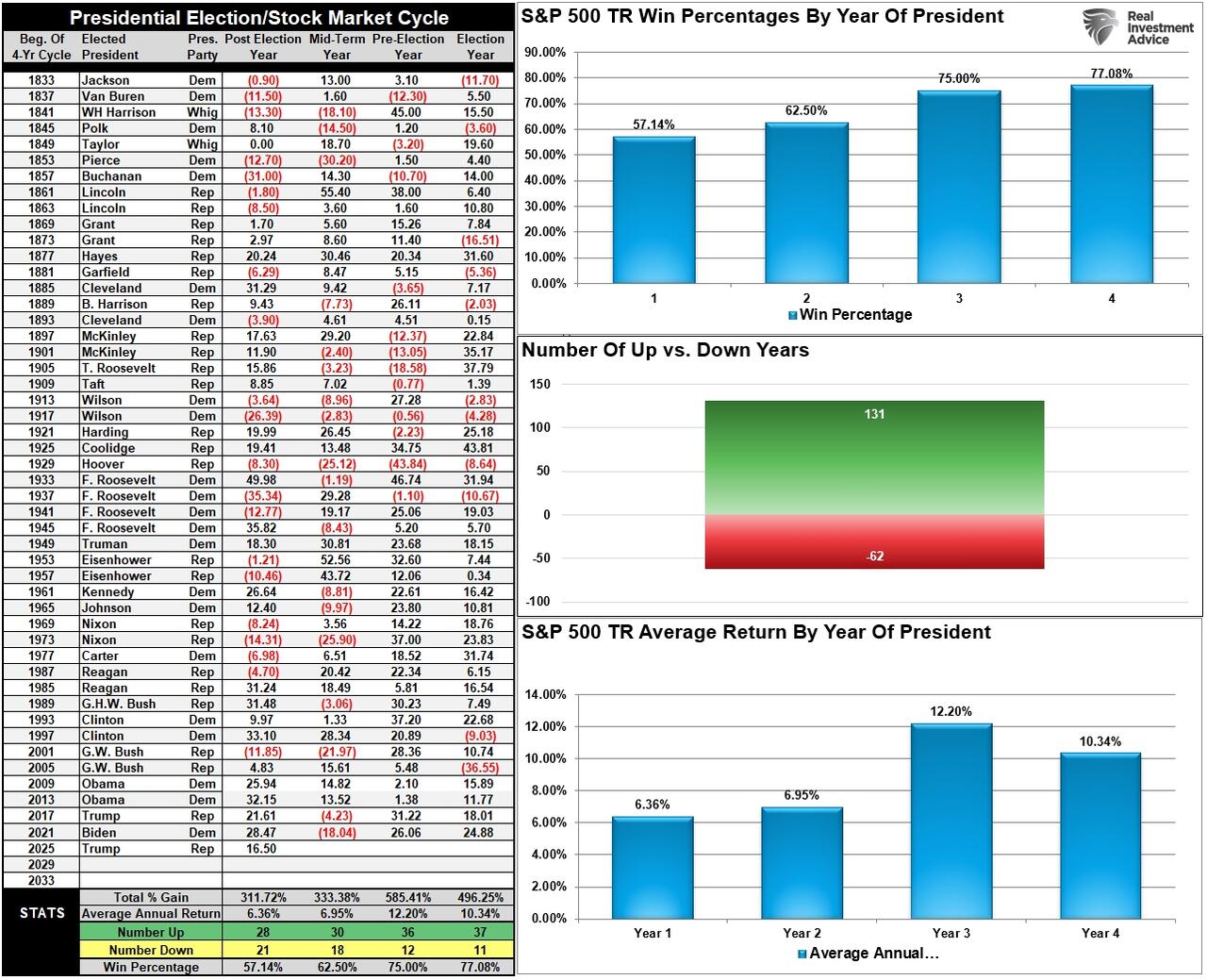
Let’s start with the Presidential Cycle. Market cycles tied to the presidential calendar suggest the second year of a new administration is often slower. Since 1948, years three and four of a presidential term have yielded the most substantial returns, while year two, or the post-election year, has shown weaker performance, with modest gains and lower win rates. The data is shown below, and while 2025 traded above historical norms, 2026 may not be as fortunate.
Since 1871, markets have gained in 30 of those years, with losses in only 18, resulting in a win rate of approximately 62%. While better than a “coin toss,” it falls well short of the win rate in years three and four. Another potential headwind to the markets in 2026 is the midterm elections, which could potentially result in a change of control in the House or Senate, leading to increased gridlock in Washington.
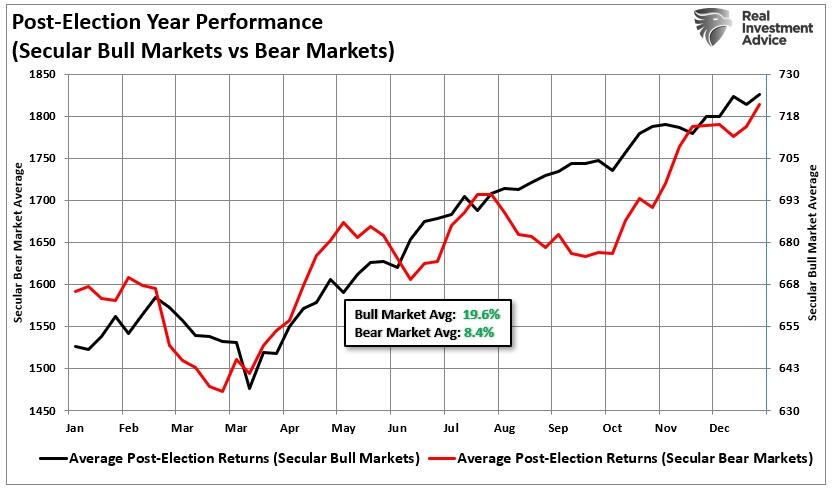
It is worth noting that since 1948, there have been seven instances of loss during the second year of the presidential cycle. Two of those losses occurred sequentially during the last two administrations, in 2018 and 2022. However, stocks have, on average, performed better during bull market cycles versus bear market cycles. The chart below illustrates the average market return during both bullish and bearish market cycles during the second year of a Presidential term.
With a “win ratio” of 62%, the media has been quick to assume the bull market will continue unabated. However, there is a 38% chance that a bear market will occur, which is not to be taken lightly. Furthermore, given the current duration, magnitude, and valuation issues associated with the market, a “Vegas handicapper” might increase those odds slightly.
Year 6 Of The Decennial Cycle
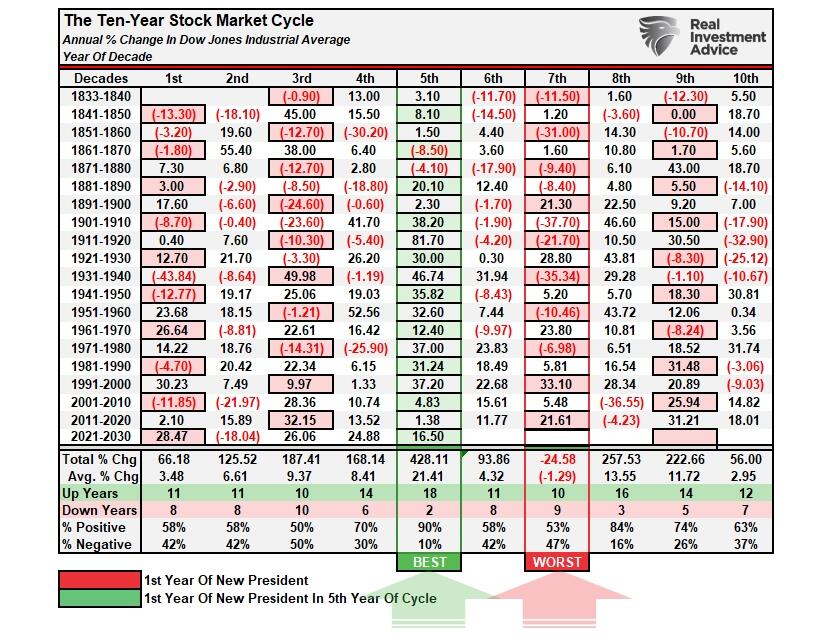
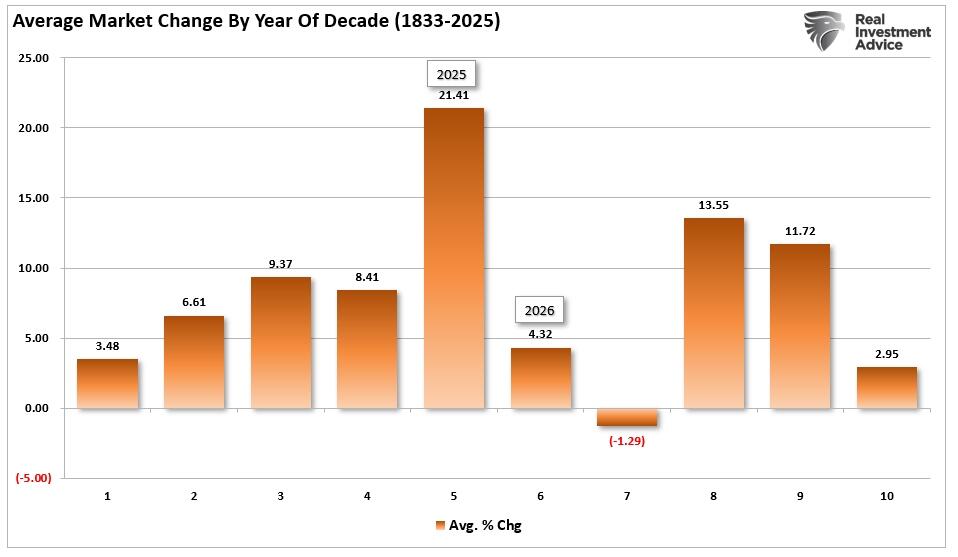
Then there’s the decennial trend. Market cycles built around decade shifts show the sixth year of each decade tends to underperform. In fact, only the 7th and 10th years have weaker returns. While 2025, the 5th year of the cycle, performed in line with historical averages, years 6 and 7 (2026 and 2027) suggest some caution. Average returns are 4% and -1.2% respectively, with the win/loss ratio barely better than a “coin toss.”
We can further assess the potential risk by examining the average market change by year of the decennial cycle. As noted while 2025 performed near historical norms, the risk of a lower return year in 2026 seems to be elevated.
While the Presidential and Decennial cycles are not guarantees of lower to negative returns in 2026, the analysis suggests that investors should at least exercise caution when it comes to risk management. With valuations elevated, risk-taking and speculation high, and sentiment very bullish, there seems to be a higher risk of disappointment than not.
A resurgence of interest rates that impact corporate profitability
Inflation rises, causing the Federal Reserve to halt rate cuts.
An economic slowdown, or mild recession, that results in a decline in forward earnings.
A financial or credit-related event that causes a repricing of market valuations.
You get the idea. The current setup reflects that with earnings growth rates slowing, the consumer is leveraged, and while inflation is lower, it remains sticky. The Federal Reserve is caught between weak growth and elevated prices. Betting on another strong year without acknowledging the weight of these market cycles is a dangerous assumption.
Cycles don’t dictate market direction. But they shape investor psychology, and when both primary market cycles suggest caution, it’s not the time to get aggressive.
The “Technical” Risk of Reversion
Market cycles work because they reveal investor behavior. Bull phases are driven by optimism, liquidity, and earnings growth. Bear phases follow when expectations exceed reality. Right now, we’re on the edge of that shift. The Shiller CAPE ratio is trading well above its long-term average, and market prices are outpacing profits by a wide margin. That’s a signal, not noise. Market cycles have always corrected this type of divergence. In 1999, the last time we saw a similar disconnect, the result was a steep and painful correction.
What’s worse is that earnings growth in 2025 leaned on familiar crutches: cost cuts, financial engineering, and suppressed wages. Margins held up, but revenue growth did not. Now, consumer wages are declining, resulting in slower spending, and forward guidance is being revised lower. That’s not a setup that aligns with the optimism baked into current prices. For example, Bank of America’s 2026 outlook clearly sees this. Their analysts project weaker consumer demand and downside risk to earnings. However, BNP Paribas is more bullish, projecting the S&P 500 at 7,500, but even they admit that it depends on strong economic momentum and falling rates.
This is where market cycles come back into focus. Every long-term chart illustrates the same lesson: when valuations outpace fundamentals, reversion is inevitable. It’s not always immediate. It’s rarely obvious. But it’s consistent. And 2026 is shaping up as a test of whether this time is different—or not.
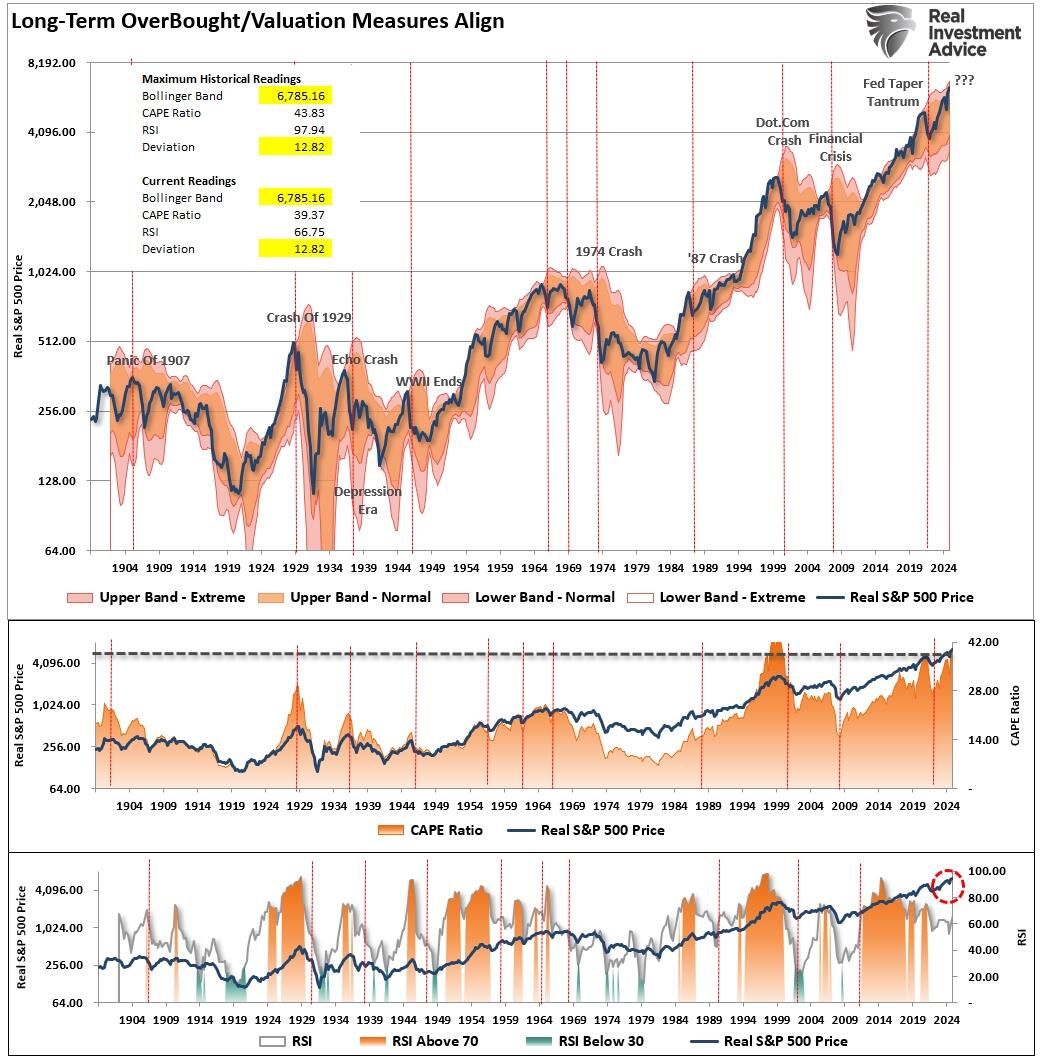
In September 2021, I produced the following chart stating:
“A market melting-up is exciting while it lasts. During melt-ups, investors rationalize why ‘this time is different.’ They start taking on excess leverage to try and capitalize on the rapid advance in prices, and fundamentals take a back seat to price momentum. Market melt-ups are all about ‘psychology.’ Historically, whatever has been the catalyst to spark the disregard of risk is readily witnessed in the corresponding surge in price and valuations. The chart below shows the long-term deviations in relative strength, deviations, and valuations. The previous ‘melt-up’ periods should be easy to spot when compared with the current advance.”
Of course, just three months later, the market began a nine-month correction that clipped roughly 25% off asset prices before bottoming in October 2022.
The chart has been updated through the end of 2025. It is worth noting that prices are again deviating from the long-term mean, valuations are extended, and relative strength is declining. Furthermore, investors are taking on increasing speculative risk and leverage, much like they did in 2021. Expectations for corporate earnings, the lifeblood of market performance, appear overly ambitious, and analysts are projecting another high double-digit increase in earnings for the year, a figure well above historical trends. However, these projections may not align with economic realities, particularly if consumer demand softens, the global economy slows further, or cost pressures persist.
The chart below uses quarterly data, so it is slow to move. It is worth noting that the current market is significantly deviated from its long-term mean, with the second-highest levels of valuation on record. While many claim that “this time is different,” long-term analysis suggests that it likely isn’t.
In 2025, actual earnings growth fell short of the original forecasts but remained decently strong overall. However, much of the market’s performance in 2025 was driven by valuation expansion rather than fundamental earnings growth. If this pattern continues, the risk of a correction increases. With all “experts” currently expecting above-average economic growth and earnings rates in 2026, investors should consider remaining more risk-conscious. As discussed in “Bob Farrell’s 10-Illustrated Rules:”
“Rule #9: When all experts and forecasts agree, something else will happen.”
Such certainly seems a risk to consider as we head into the new year.
Investors would be wise to treat this phase of the market cycle with discipline. The choice is yours.
“Chase returns, and you’ll likely end up paying for it. Manage risk, and you’ll still be around when the next true bull leg begins.“
How to Position for Market Cycles in 2026
I am always reticent to discuss taking a more “risk-averse” approach to the markets. This is because investors typically interpret such commentary as “sell everything and go to cash.”
While 2026 presents its share of challenges, the solution is not to abandon the market altogether. Instead, investors can take practical steps to navigate these uncertainties.
None of this means the next “bear market” is lurking. The data suggest that being overly aggressive, taking excessive risk, and increasing leverage may not yield the desired outcome. Since exceedingly bullish markets are primarily a function of psychology, they can persist longer and extend further than logic predicts. The requirement to “end” such a phase is an exogenous event that changes psychology from bullish to bearish. Such is when the stampede for the exits occurs, and prices can decline very quickly. As such, investors need guidelines to participate in the market advance. However, the real challenge is maintaining those gains when corrections inevitably occur.
Positioning for 2026 means respecting our current market position. This is not a time to lean into high-beta names or speculative stories. This is a time to manage risk, preserve capital, and focus on quality. With both the presidential and decennial market cycles signaling below-average returns, prudence is more valuable than prediction.
Tighten up stop-loss levels to current support levels for each position. (Provides identifiable exit points when the market reverses.)
Hedge portfolios against significant market declines. (Non-correlated assets, short-market positions, index put options)
Take profits in positions that have been big winners. (Rebalancing overbought or extended positions to capture gains but continuing to participate in the advance).
Sell laggards and losers. (If something isn’t working in a market melt-up, it most likely won’t work during a broad decline. It is better to eliminate the risk early.)
Raise cash and rebalance portfolios to target weightings. (Rebalancing risk regularly keeps hidden risks somewhat mitigated.)
Notice, nothing in there says, “Sell everything and go to cash.”
Investing in 2026 will require a blend of optimism and caution. With slowing economic growth, fiscal policy uncertainties, global challenges, overconfident sentiment, and ambitious earnings expectations, investors have numerous reasons to approach the markets with caution. There will be a time to raise significant cash levels. A good portfolio management strategy will ensure that exposure decreases and cash levels rise when the selling begins.
The most important thing to remember is that market cycles are not about exact timing. They’re about understanding the rhythm of investor psychology, capital flows, and fundamental trends. In 2026, that rhythm suggests caution. Stay liquid. Stay hedged. And don’t forget—every market cycle eventually resets. Your job is to be still standing when it does.
Remember, as Larry David might say,
“You don’t have to be a genius—just don’t be a schmuck.”
Tyler Durden
Mon, 02/02/2026 – 12:40
https://www.zerohedge.com/markets/market-cycles-potentially-driving-2026-returns

Indiana education bills on the move, or stalled at halfway point
The first half of the General Assembly included a spate of education bills, some adding new conservative input on what’s taught in the classroom, and a bipartisan measure on what shouldn’t be found in the classroom.
Senate Bill 78 might bring the most angst to students with its crackdown on wireless devices, including cell phones, personal laptops, and smart watches during the school day.
The bill effectively tightens regulations banning phones from classrooms and from use the entire school day.
Authored by Senate education chairman Jeff Raatz, R-Richmond, the bill gives school boards two options: establish a storage plan for the wireless devices or tell students to leave them at home.
It passed the Senate 28-19. Democrats didn’t object to the ban, but raised questions about its viability after Raatz said a locker would be a storage option, leaving students the temptation to peek at their phones.
Senate Bill 88 tasks educators with instructing students they can best avoid poverty by getting married before having children. It’s taken from the Heritage Foundation and Project 2025.
Some Republicans believe it should be a plank in Indiana’s citizenship values taught to students.
The so-called “success sequence” would advise students to avoid poverty by finishing high school, securing full-time employment and being married before having children.
Democrats bitterly fought the bill, authored by Sen. Gary Byrne, R-Byrneville, in southern Indiana. It passed, however, 39-9.
The bill also calls for public universities and colleges to accept the Class Learning Test just as they accept the SAT or ACT for admission.
The CLT tracks the works of Plato, Einstein, Shakespeare and other major figures.
House Bill 1004, a big education deregulation bill, would repeal 40 provisions in K-12 and higher education and change 15 other topics, including powers of school boards and public-private pacts by charters for construction or renovation.
It passed the House 69-26 and moves to the Senate.
House Bill 1137 would ban additives and food dyes from food served to students. It also requires schools post a menu with ingredients online.
It passed 83-7.
Senate Bill 182 would prohibit transgender students in K-12 schools and state universities from using restrooms or locker rooms based on their gender identity.
The bill requires students to use restrooms and locker rooms based on their reproductive biology at birth.
It passed 37-8.
Some bills watched closely didn’t have success.
The biggest is House Bill 1259, which offered a lifeline to Lake County school districts devastated by last year’s Senate Enrolled Act 1, which provided property tax relief at a steep cost to schools and municipalities.
Rep. Jeff Thompson, R-Lizton, offered the bill and took testimony on it on Jan. 20, but didn’t hold a Ways & Means committee vote. The bill never came back.
It would have allowed counties to distribute local income tax to school districts. Many school districts, including those in Porter County, already receive LIT money. Lake County schools do not.
“It appears to be dead at this point,” said Scott Bowling, executive director of the School Association of School Business Officials.
Schools in Lake County could have used the money, they said.
SEA 1 has forced Crown Point to end a popular preschool program, and it’s led to Hobart schools selling a school it had been leasing. Last week, the East Chicago school board voted to close its early education learning center.
Meanwhile, Senate Bill 211, to restore voting rights for Indiana University alumni to elect three members for the university Board of Trustees, didn’t get a hearing.
A bill last year took away the alumni’s voting rights and gave them to the state’s governor.
The bill was authored by IU grads Sen. Greg Walker, R-Columbus, and Sen. Susan Glick, R-LaGrange.
Senate Bill 133, authored by Sen. Mark Spencer, D-Gary, would have required public schools to present an informational video on water safety to K-12 students.
It didn’t get a hearing.
Carole Carlson is a freelance reporter for the Post-Tribune.
This Weeks Jobs, JOLTS Reports To Be Delayed Due To Govt Shutdown
This Weeks Jobs, JOLTS Reports To Be Delayed Due To Govt Shutdown
Here we go again.
The government shutdown, which should be lifted in 24-48 hours once the House votes (we reported yesterday that Mike Johnson allegedly has the votes to pass the vote), is again jamming the machinery of government data reporting.
The BLS has pushed back the January 2026 jobs report, originally set for Feb 6, along with December’s Job Openings and Labor Turnover Survey and Metropolitan Area Employment data.
“The release will be rescheduled upon the resumption of government funding,” Emily Liddel, an associate commissioner at BLS, said in a statement. “Due to the partial federal government shutdown, the Bureau of Labor Statistics will suspend data collection, processing, and dissemination.”
The Bureau of Labor Statistics will announce new release dates once funding is restored.
Tyler Durden
Mon, 02/02/2026 – 12:27
https://www.zerohedge.com/economics/weeks-jobs-jolts-reports-be-delayed-due-govt-shutdown

Apuesta de México por el gas natural enfrenta resistencia de comunidades y complica metas climáticas
Por JULIÁN TREJO BAX, TERESA DE MIGUEL y M.K. WILDEMAN
LOS ARRECIFES, México (AP) — El sol ya se ha metido y un manto violáceo empieza a teñir las nubes cuando Mauricio Contreras y su hija Eunices salen a pescar en Los Arrecifes, en el sureño estado mexicano de Veracruz. Eunices se encarga de tirar al agua la pesada red para capturar pargo, abadejo o cabrilla mientras su padre conduce la pequeña lancha por el Golfo de México.
Con la piel curtida por el sol y una cadena con un ancla colgando del pecho, Contreras cuenta que lleva dedicándose a la pesca más de 40 años, pero ahora teme que el principal sustento de su familia esté en riesgo por un ducto submarino construido el año pasado para transportar gas natural desde Estados Unidos.
“Cuando empezaron a ponerlo nos afectó porque los barcos botaban explosivo y se oía hasta acá, hasta la orilla”, recuerda. Ahora que ya ha entrado en operación, lo que más le preocupa es una posible fuga. “Es un peligro constante que va a estar ahí y es un riesgo para todo el sector pesquero”.
El gasoducto, conocido como Puerta al Sureste, fue construido por la empresa canadiense TC Energy en alianza con la paraestatal mexicana CFE. Se conecta con un ducto que ya unía el sur de Texas con Tuxpan, en Veracruz, y lo extiende otros 700 kilómetros por el fondo del mar hasta Paraíso, en Tabasco. Ya está alimentando la electricidad que requieren las operaciones de la refinería Dos Bocas, pero su principal objetivo es llevar gas hasta la península de Yucatán por medio de la expansión de otro gasoducto que todavía está en construcción.
La obra es parte de una oleada de proyectos en todo el país que pretende ampliar la infraestructura existente para importar más gas natural de Estados Unidos. Con ello, México —que ya es el mayor comprador de gas estadounidense del mundo—, busca tanto satisfacer la demanda interna de electricidad como reexportar parte de ese gas hacia los mercados asiáticos y europeos.
Sin embargo, la apuesta se está encontrando cada vez con más resistencia por parte de las comunidades en las que pretenden instalarse esos proyectos, desde Los Arrecifes hasta el Golfo de California. Además, se enfrenta a las críticas de los principales grupos ambientalistas del país que afirman que la estrategia aumenta el uso de un combustible fósil que contamina el aire y aleja a México de sus compromisos climáticos.
La resistencia en Veracruz
Contreras habla de la pesca como una forma de vida. En su comunidad es casi la única fuente de trabajo y en todo el estado de Veracruz más de 40.000 personas viven del mar. Él fue uno de los habitantes de 15 comunidades costeras que presentaron una demanda en junio del año pasado en contra del gasoducto. Aunque en un primer momento fue desechada, sigue en disputa en los tribunales tras haber presentado un recurso de queja.
La demanda alega que esas comunidades, mayoritariamente indígenas nahuas y nuntajiiyi’, no fueron consultadas sobre el proyecto antes de que iniciase la construcción, como lo exige la Constitución mexicana. “No estamos de acuerdo con este megaproyecto del gasoducto porque nunca se nos informó. Nunca se nos consultó y por consiguiente nosotros no sabemos las consecuencias que tiene”, dice Maribel Cervantes, quien también firmó la querella, desde el patio de su casa en la comunidad de San Juan Volador.
El gobierno argumentó que se trataba de una obra de seguridad nacional y mantuvo bajo secreto buena parte de la información del gasoducto, incluyendo el trazo exacto por el que pasa. Al ser preguntada sobre el caso en una de sus conferencias matutinas el año pasado, la presidenta Claudia Sheinbaum dijo que “vale mucho la pena que llegue el gas natural a esa zona”.
Cuando se planteó la construcción del gasoducto, la organización ambientalista Greenpeace alertó que las obras de dragado para soterrar el ducto podrían afectar arrecifes de aguas profundas. Ese tipo de arrecifes, llamados mesofóticos, son capaces de vivir a profundidades de más de 150 metros y son el hogar de muchas especies marinas, incluyendo algunas que no se pueden encontrar en otros tipos de arrecifes.
Pablo Ramírez, coordinador del programa de energía y cambio climático de Greenpeace, alerta además que este tipo de infraestructura “comúnmente fuga metano y la fuga de este tipo de gas afecta la química del agua y los ecosistemas que están próximos”. Ramírez recuerda que los arrecifes de Veracruz “son el hogar de muchas especies de flora y fauna marina”, entre ellas tortugas verdes, carey y lora, que dependen de ellos para alimentarse y anidan en las playas de comunidades como Los Arrecifes.
En un video publicado en septiembre TC Energy aseguró que “expertos analizaron minuciosamente el entorno marino para asegurar que la ruta fuera diseñada para conservar ecosistemas”. La empresa canadiense declinó la solicitud de entrevista de Associated Press, pero aseguró en un comunicado que el gasoducto creó 4.000 puestos de trabajo durante su construcción y cumplió con todos los requisitos de la Agencia de Seguridad, Energía y Medio Ambiente de México. Además, recalcó que la obra “lleva gas natural al sureste de México por primera vez, lo que abre oportunidades para el desarrollo económico y social en una de las regiones más pobres del país”.
El empuje mexicano por el gas natural
La apuesta de México por el gas natural estadounidense se remonta a más de una década, tras la reforma de 2013 que abrió la puerta a la inversión privada y extranjera en el sector energético mexicano, explica Víctor Ramírez, socio director de la firma de consultoría P21Energía. “Habría dos razones: la primera disminuir el uso de otro tipo de combustibles como el combustóleo y el carbón, mucho más contaminantes”, dice. “Y la otra aprovechar los precios bajos del gas natural de Estados Unidos”.
Ahora que el vecino del norte busca nuevos mercados para el gas natural que extrae por medio de la fracturación hidráulica en la Cuenca Pérmica de Texas, México ofrece no solamente una posición geográfica estratégica para reexportar ese gas, sino también mejores relaciones políticas con algunos mercados a los que Estados Unidos no podría acceder tan fácilmente, dice Wilmar Suárez, analista energético de Ember. Por su parte, México puede vender ese gas a precios más elevados a otros países, dice Suárez.
Puerta al Sureste actualmente sólo está suministrando gas a la refinería de Dos Bocas, uno de los proyectos insignia del expresidente Andrés Manuel López Obrador con un coste superior a los 20.000 millones de dólares. Pero el gasoducto podría transportar más de 1.300 millones de pies cúbicos de gas al día si se completan los ambiciosos planes del gobierno mexicano.
Entre ellos se encuentra completar otro gasoducto que conecte Puerta al Sureste con Salina Cruz, en Oaxaca, donde prevé construir una planta de licuefacción para reexportarlo hacia Europa y Asia. En ese tipo de plantas el gas se enfría para volverlo líquido, lo cual reduce su volumen para poder transportarlo en buques. El proceso involucra la quema de parte de ese gas para dar energía a la planta, lo que genera emisiones contaminantes, dice Claudia Campero, de la organización Conexiones Climáticas.
Precisamente los planes para construir plantas de licuefacción han sido los que más oposición han generado en los últimos tiempos en el país. Uno de los casos más sonados ha sido el proyecto Saguaro, que busca construir un gasoducto de 800 kilómetros desde Texas hasta la comunidad pesquera de Puerto Libertad, en Sonora. Allí, la empresa estadounidense Mexico Pacific prevé construir una planta para licuar 15 millones de toneladas de gas al año para enviarlo por barco hasta Asia.
El problema, alerta Campero, es que esos buques pondrían en peligro a las ballenas porque circularían por el Golfo de California, un área clave para su reproducción.
El proyecto actualmente se encuentra detenido por un aluvión de demandas interpuestas por algunas de las comunidades que cruzaría el gasoducto y donde se instalaría la planta.
La primera planta de licuefacción para exportar gas natural licuado en México empezó a operar en 2024, pero hay planes en la mesa para muchas más. Si todas ellas llegasen a entrar en operación, México tendría nueve, la mayor parte ubicadas en la costa del Pacífico, según los datos de Global Energy Monitor. Estados Unidos cuenta actualmente con ocho.
Los expertos consultados dicen que la apuesta de México por el gas natural estadounidense hace peligrar su soberanía energética. Actualmente más del 60% de la electricidad en México proviene de plantas que se alimentan con gas y alrededor del 70% de ese gas viene de Estados Unidos.
Según un informe de la calificadora Fitch publicado en febrero del año pasado, la dependencia de México del gas procedente de Estados Unidos “seguirá aumentando”, impulsada por el crecimiento de la demanda, las limitaciones de la producción nacional y la expansión de la infraestructura de gasoductos.
“Entonces es muy fácil para Estados Unidos imponer ciertas condiciones a México, en el sentido de que tiene una posición dominante sobre el suministro del gas, que es su principal energético en este momento”, dice Suárez.
La Secretaría de Energía no respondió a las solicitudes de entrevista por parte de la Associated Press.
Compromisos climáticos en riesgo
En noviembre pasado, México se comprometió a reducir sus emisiones netas de dióxido de carbono entre un 31 y un 37% para 2035. Pero Pablo Ramírez, de Greenpeace, duda que eso sea posible si siguen adelante todos los proyectos de gas en el país.
Además, el enfoque en el gas natural hace difícil que México pueda alcanzar su objetivo de generar el 45% de su electricidad con energías renovables para 2030, como lo prometió la presidenta Sheinbaum en su discurso inaugural, dice Wilmar Suárez, de Ember. Actualmente, las renovables representan alrededor del 20% de la generación eléctrica del país.
El gobierno de Sheinbaum heredó la mayoría de las obras de gas natural proyectadas actualmente “y tienen que cumplir con esos compromisos porque ya están firmados, ya hay dinero metido, ya hay infraestructura desarrollada”, dice Ramírez, de P21Energía. Pero el experto ve como un “giro importante” que la Secretaría de Energía aprobase en diciembre pasado 20 proyectos de energía renovable en todo el país.
Lejos de los despachos de la Ciudad de México donde se toman las decisiones de política energética, en su patio rodeado de cocoteros, Maribel Cervantes pide a las autoridades que tomen en cuenta a las comunidades antes de autorizar este tipo de proyectos. “Como pueblos indígenas tenemos derecho de exigir que se respete nuestro derecho a la autonomía y a la libre determinación”, dice. “No queremos que vengan a imponernos sus megaproyectos”.
___
De Miguel reporteó desde la Ciudad de México. La periodista de datos M.K. Wildeman contribuyó desde Hartford, Connecticut.
___
La cobertura climática y ambiental de The Associated Press recibe apoyo financiero de múltiples fundaciones privadas. AP es la única responsable de todo el contenido. Vea los estándares de AP para trabajar con organizaciones filantrópicas, una lista de los donantes y las áreas de cobertura que reciben fondos en AP.org.

World’s Nuclear Club Will Grow If US Doesn’t Act By Thursday, Medvedev Warns
World’s Nuclear Club Will Grow If US Doesn’t Act By Thursday, Medvedev Warns
We reported earlier that the last major nuclear arms control treaty between superpower rivals Russia and the United States is set to expire this week.
Former Russian president Dmitry Medvedev, now deputy chairman of the country’s Security Council, has throughout the Ukraine war been the top official issuing the Kremlin’s ‘unofficial’ nuclear warnings and threats. But now the outspoken Russian hawk is urgently offering an olive branch, arguing that the New Strategic Arms Reduction Treaty (New START) must be quickly extended.
The Kremlin has made clear Russia is willing to extend it for another year, to allow more robust negotiations and for a longer deal to be finalized. Unless it is renewed, the landmark treaty will expire on Thursday, February 5.
But with just days away, the Trump White House has yet to issue anything official. Of course, President Trump is also known for making key decisions at the last moment, building suspense and leverage, based on also on his notorious unpredictable decision-making style.
Medvedev on Monday made clear that Russia’s offer to quickly extend “remains on the table, and the treaty has not even expired yet, and if the American side wants to extend it, then this can be done.”
He also confirmed that Moscow has received no response on this offer from Washington:
Medvedev told the newspaper Kommersant that Moscow might have to wait until the expiry of the treaty on February 5 for a U.S. response to the Russian initiative.
When contacted for comment, a White House official told Newsweek Monday: “The president will decide the path forward on nuclear arms control, which he will clarify on his own timeline.”
Medvedev explained Russia’s point of view, as summarized in Newsweek:
Medvedev said the New START treaty had played a positive role in curbing the nuclear arms race, and that both Russia and the U.S. had stuck to its main restrictions.
However, the most important thing was for ties between the U.S. and Russia to be restored, with relations at their lowest since the Cuban missile crisis of 1962, Medvedev said. He said Trump’s “Golden Dome” and statements about resuming nuclear testing complicated any potential strategic dialogue between Russia and the United States.
He further warned that letting the treaty expire would mark the first time since 1972 that there are no legal limitations on strategic weapons between the two rivals, which are both well-armed with atomic warheads.
Medvedev is predicting that more countries will join the nuclear club if New START’s safeguards aren’t in place by the world’s two foremost nuclear powers.
Former President Obama chimes in…
If Congress doesn’t act, the last nuclear arms control treaty between the U.S. and Russia will expire. It would pointlessly wipe out decades of diplomacy, and could spark another arms race that makes the world less safe. This piece is worth the read. https://t.co/NPtKyjYRml
— Barack Obama (@BarackObama) February 2, 2026
According to Monica Duffy Toft, professor of international politics and director of the Center for Strategic Studies at The Fletcher School, “By providing transparency into the world’s two largest nuclear arsenals, New START has lowered the risk that either side will misinterpret normal military activity as preparation for a nuclear strike.”
It was signed in 2010 by Presidents Barack Obama and Dmitry Medvedev, and limits the number of deployed strategic warheads to 1,550 per side, and caps deployed delivery systems – including of missiles, bombers, and submarines – at 700. There’s also a mutual inspection regimen, allowing each side to monitor the other’s sites.
Tyler Durden
Mon, 02/02/2026 – 12:20

Column: Slow growth continues to nag the Land of Lincoln
The good news from the latest U.S. Census Bureau figures: Population in the Land of Lincoln remains about the same.
The bad news from the same data: The population in Illinois is about the same.
Some see the information that we grew by a mere 16,108 people as a rosy win for the state, indeed, the Midwest. That despite frigid temperatures, lake-effect snowstorms, job losses, an anti-business climate, traffic gridlock, low birth rates, tornadoes, sky-high taxes, corruption and crime.
Illinois continues to grow, reaching an overall citizenry of 12.7 million, keeping its status as the sixth-largest state in the union for now.
Those who think a 16,000 increase in population is a win-win must subscribe to fictional detective Nero Wolfe’s description of pessimists, who get “nothing but pleasant surprises.” Considering that the fastest-growing state, according to figures gleaned by the July 2024 to July 2025 population estimates from the Census Bureau, gained almost 80,000 new residents.
That state would be South Carolina, whose population rose through domestic net migration over the past year. The Palmetto State was followed by four other states increasing more, much more, residents than Illinois: Idaho, North Carolina, Texas and Utah.
A sibling lives in Utah on the outskirts of Zion National Park and is always crowing about trekking hiking paths during sunlit mornings during fall and winter, with temperatures in the 70s. That is while we suffer in Northeast Illinois with below-zero actual temperatures and icy windchills.
In truth, Illinois is a slow-growth state, being bypassed by those seeking warmer weather, affordable housing and low property taxes. Those moving to Idaho, a mid-sized state, apparently don’t mind that cold weather out West.
North Carolina’s population recently topped 11 million, with new residents behind the state’s growth, and is nipping at the heels of Illinois’ population and could surpass it by the next national census. Officials estimate nearly 140,000 people moved to North Carolina in 2024, the highest net migration in the Southeast.
Other states attracting masses of new residents, many from Illinois, include Arkansas, Georgia and Tennessee. Loser states continue to be California, Louisiana and New Jersey, which the United Van Lines 2024 National Movers Study pegged as the state with the highest share of outbound moves. The company said 64% of New Jersey’s residents moved out, compared with 36% of new move-ins.
There are various reasons for people leaving one state for another, and the U.S. has always been a nation of those seeking utopia. Job markets, taxation, remote work options, family and lifestyles are pushing Americans into migrating.
Yet, growth in Illinois has been flat for a number of years, with high outbound migration rates. One analysis places us among states with the largest total net outbound migration from 2020 to 2024. In that timeframe, according to a Coastal Moving Services analysis of data, about 139,399 people left Illinois; 56,000 alone pulling up stakes last year.
Among nearby Midwest states, Illinois continues to trail Indiana, Wisconsin and Missouri vying for new residents. Job growth follows those moving to other states.
Over the decades, the state, especially Chicagoland, has been a magnet for immigrants, some certainly undocumented. With the federal crackdown on immigration, Chicago may lose its place as the country’s third-largest city during the next census, being overtaken by Houston in high-growth Texas.
As for immigrants, it looks like we need those folks to make sure we get our fair share of government funding from Washington, D.C., when census numbers eventually are crunched, depending on the presidential administration. The current one likes to punish Illinois and other blue states.
Illinois has been losing its regional status to adjoining states that have cherry-picked businesses and native Illinoisans over the years. With fewer new Illinois residents replacing those already here, the tax burden hits those remaining hard in their pocketbooks.
Illinois lawmakers for decades have neglected to take into account losing populations as they protect their realm. Fewer residents means fewer congressional seats and clout in Congress. Make no mistake, gaining 16,000 people is a population loss when other states close by and far away continue to gain new citizens rapidly.
With a less-than-promising growth cycle in Illinois, one also has to wonder who will be buying homes in new housing developments in Lake County. Such as the 800-acre mega-plan in Mundelein offered by the Wirtz family, owners of the Chicago Blackhawks hockey team.
Massive proposals such as the Wirtz plan may have to be curtailed if state population growth continues at a flat rate. That seems to be the case for the near future and beyond.
Charles Selle is a former News-Sun reporter, political editor and editor.
sellenews@gmail.com
X @sellenews
https://www.chicagotribune.com/2026/02/02/charles-selle-census-growth/

“100% Preventable”: FAA Accepts Its Failures Led To Fatal Midair Collision Near Reagan National Airport
“100% Preventable”: FAA Accepts Its Failures Led To Fatal Midair Collision Near Reagan National Airport
Authored by Tom Ozimek via The Epoch Times,
Federal Aviation Administration (FAA) Administrator Bryan Bedford said on Feb. 1 that the agency accepts the findings of the National Transportation Safety Board (NTSB) that a series of systemic failures by the FAA led to a January 2025 midair collision, the deadliest U.S. aviation disaster in more than two decades.
Speaking to reporters on the sidelines of an aviation conference in Singapore, Bedford said the FAA did not dispute the NTSB’s conclusions on the collision between an American Airlines regional jet and a U.S. Army Black Hawk helicopter near Ronald Reagan Washington National Airport, which killed all 67 people aboard both aircraft.
“We don’t disagree with anything that the NTSB has concluded from their investigations,” Bedford said. “Many of the recommendations have already been put into action. Those that haven’t, we’re going to evaluate.”
The NTSB revealed the probable cause of the crash on Jan. 27, citing the FAA’s decision to allow a helicopter route to operate close to a runway approach path at Reagan National, along with multiple other “systemic failures” at the agency.
“This was 100 percent preventable,” NTSB Chair Jennifer Homendy said during the agency’s nine-hour probable-cause hearing, which capped a year-long investigation.
The NTSB said that the executive branch’s decision to permit helicopter traffic so close to commercial aircraft operations created unacceptable risk.
“Number one, this helicopter route shouldn’t have been there in the first place. This was terrible design of the airspace,” Homendy said toward the end of the Jan. 27 hearing.
Data and Procedural Lapses
Investigators also faulted the FAA for failing to adequately review its own data indicating elevated midair-collision risk around the Potomac airspace and for allowing controllers to rely heavily on “visual separation”—a practice in which pilots are responsible for seeing and avoiding other aircraft—to maintain traffic flow.
“The question is, should the FAA have known there was a problem, and should something have been done? Absolutely, the data was there. The data was in their own systems,” Homendy said, adding that the NTSB had worked with the FAA to flag more than 15,000 close-proximity events over several years, including 85 classified as serious.
Salvage crews work on recovering wreckage near the site in the Potomac River of a midair collision between an American Airlines jet and a Black Hawk helicopter at Ronald Reagan Washington National Airport, in Arlington, Va., on Feb. 6, 2025. Jose Luis Magana/AP Photo
The NTSB also cited staffing and human factor issues at the Reagan National control tower, noting that a single controller was handling both helicopter and airplane frequencies on the night of the crash. While the board concluded that staffing levels technically met FAA requirements, it said extended shifts likely reduced alertness and vigilance, increasing operational risk.
The safety board also criticized what it described as the FAA’s long-standing resistance to safety recommendations under previous administrations.
A visitor walks toward flowers and a letter left in memorial to the victims of a midair collision of an American Airlines jet and a Black Hawk helicopter near the Potomac River at the base of the Titanic Memorial in Washington, on Feb. 1, 2025. Carolyn Kaster/AP Photo
The U.S. Army was also cited for failing to fully implement a safety management system that could have addressed altitude risks on Washington helicopter routes. Investigators said the Black Hawk’s altimeter likely misreported altitude by about 100 feet, contributing to the crew’s belief that they were flying within authorized limits.
Federal Response
The FAA said in a Jan. 27 statement that it “values and appreciates the NTSB’s expertise and input” and that it has acted on urgent safety recommendations issued in March 2025, adding it would carefully consider additional measures outlined in last week’s findings.
Amid the fallout from the 2025 crash, U.S. Transportation Secretary Sean P. Duffy recently announced that the FAA had formalized permanent restrictions on helicopters operating near Reagan National unless they are carrying out essential operations.
The rules move helicopter routes farther away from Reagan National and require all military aircraft to broadcast their locations during flight, and prevent air traffic controllers from relying on visual separation.
“After that horrific night in January, this Administration made a promise to do whatever it takes to secure the skies over our nation’s capital and ensure such a tragedy would never happen again. Today’s announcement reaffirms that commitment,” Duffy said in a Jan. 22 statement. “The safety of the American people will always be our top priority. I look forward to continuing to collaborate with the NTSB on any additional actions.”
The Trump administration on Jan. 26 unveiled a major overhaul of the FAA to bolster modernization efforts and enhance safety, including the installation of a new air traffic control system and advanced aviation technologies.
Tyler Durden
Mon, 02/02/2026 – 12:05