Category: News

Gold Investors: Remember 1933
Gold Investors: Remember 1933
Authored by Michael Wilkerson via The Epoch Times,
Investors have been rightly impressed by the remarkable run of gold, which in dollar terms has doubled in price over the past year.
This performance vastly outpaces the stock markets (which are also sitting near all-time highs) and bitcoin (trading sideways to down for months), the cryptocurrency challenger touted as a “digital gold” safe-haven alternative to depreciating fiat currencies such as the U.S. dollar.
The gold euphoria should be tempered by an uncomfortable recognition.
Gold’s meteoric performance is a troubling sign that something is profoundly wrong—or at least brewing—in the global geopolitical, economic, and monetary environment.
Investors are reaching for safety at the same time that risky investments continue to rise in dollar-terms value. Central banks are accumulating and hoarding gold and reducing their U.S. dollar reserves, as all the while they prepare for economic, technologic, and kinetic war. Gold is a safe haven for individual investors so long as they can legally hold, buy, and sell it. Most of us take that as a given.
But Americans should never forget that the U.S. government, under then-President Franklin Delano Roosevelt’s (FDR’s) Executive Order 6102 (April 1933), moved with coercive force (including massive fines and threat of up to 10 years’ imprisonment) to confiscate the estimated $1.5 billion in gold coins, bullion, and certificates held by ordinary Americans. This represented about 5 percent of the money supply, equivalent to about $1.1 trillion in liquidity terms in today’s financial system.
Then, in the midst of the Great Depression and related banking crisis, the U.S. dollar was convertible into gold at an artificially low fixed rate of $20.67 per ounce. Anyone could walk into their bank and demand their paper currency be redeemed for gold. Because of the loss of confidence in the banking system, that is exactly what they were doing, as were foreign governments and banks that had a claim on gold held in the United States, draining the U.S. government and banks of their reserves.
Because the dollar was 100 percent backed by gold, and with the fixed conversion rate, the Federal Reserve couldn’t increase the money supply to help ease the credit crisis and stop the deflationary spiral the country was facing … because it didn’t hold the gold.
So FDR simply declared a national emergency, confiscated citizens’ gold for $20, and then, the next year, “presto,” simply changed the official conversion rate upward by 67 percent to $35 per ounce, enabling money supply expansion, reducing the value of the dollar in foreign currency terms, and thus supporting U.S. exports.
This was done in the context of rising geopolitical tensions, tariff wars, rumors of rearmament in Europe, competitive currency devaluations, and a scramble by governments around the world to shore up their gold reserves.
Sound familiar?
Today, we are in a similar—but also very different—geopolitical environment. What is analogous is that the nations of the world are transitioning into a “war economy.” The central banks are once again buying as much gold as they can get their hands on. Protectionism and resource nationalism are the orders of the day. Fiat currencies are on a path toward debasement, an environment in which governments deprive their citizens of purchasing power and use inflation as stealth taxation.
I’m not suggesting that the U.S. government is considering gold confiscation. I’m reminding all of us that “black swan” events happen unexpectedly and suddenly. A kinetic intervention into Iran would potentially be one such event, with economic and financial ramifications likely much greater than the restrained response to U.S. action in Venezuela. When a black swan lands, the shock waves move in patterns difficult to anticipate. In perceived national emergencies, governments reach into their bags of tricks for unprecedented solutions. This was true in 1914 (the onset of the cataclysm of World War I), in the 1930s Great Depression, in 1971 when then-President Richard Nixon “temporarily” suspended dollar convertibility into gold by foreign banks and governments to stem the outward flow of reserves (temporarily lasting 55 years), and in 2008’s global financial crisis. The long list of government interventions during this period resulted in distortions to the monetary and financial markets—and the real economy—that ripple to this day.
We are in times that are not business as usual. I continue to view gold as an important part of a financial umbrella. Over millennia, gold has proven to be real money when fiat (paper) currencies inevitably fail. But I keep one eye open to the possibility that in a national emergency, all bets are off. History shows that no action is beyond the consideration of governments attempting to extricate themselves from an apparently intractable strategic predicament.
Views expressed in this article are opinions of the author and do not necessarily reflect the views of The Epoch Times or ZeroHedge.
Tyler Durden
Wed, 02/04/2026 – 08:05
https://www.zerohedge.com/precious-metals/gold-investors-remember-1933

Hombres armados matan al menos a 13 personas en Nigeria
Por DYEPKAZAH SHIBAYAN
ABUYA, Nigeria (AP) — Hombres armados mataron al menos a 13 personas en el norte de Nigeria, informó la policía el miércoles en el más reciente episodio de violencia en el país africano.
Los atacantes, “armados con armas peligrosas, comenzaron a disparar esporádicamente” el martes en el pueblo de Doma, en el estado de Katsina, en el noroeste, afirmó el portavoz de la policía Abubakar Sadiq Aliyu en un comunicado.
Se estaban llevando a cabo investigaciones para determinar las circunstancias e identificar a los responsables, añadió.
En un ataque por separado el martes, hombres armados mataron a varias personas en las comunidades de Woro y Nuku en el estado de Kwara, en el centro-norte, manifestó el gobernador AbdulRahman AbdulRazaq en un comunicado. No precisó el número de personas asesinadas, pero según reportes locales, fueron más de 30. La policía estatal no ha comentado al respecto.
AbdulRazaq calificó el ataque como una “expresión cobarde de frustración por parte de células terroristas” en respuesta a las operaciones antiterroristas en curso en el estado.
Nigeria está atrapada en una compleja crisis de seguridad, con una insurgencia islamista en el noreste junto con un aumento de secuestros para pedir rescate en las regiones del noroeste y centro-norte en los últimos meses.
La semana pasada en el noreste, extremistas armados mataron al menos a 36 personas en ataques separados en un sitio de construcción y en una base militar.
El martes, el jefe del Comando África de Estados Unidos dijo que Estados Unidos había enviado un pequeño equipo de oficiales militares a Nigeria, en respuesta a la crisis de seguridad. En diciembre, las fuerzas estadounidenses lanzaron ataques aéreos contra una célula local afiliada al grupo Estado Islámico.
Nigeria ha estado en el punto de mira diplomático de Estados Unidos tras las amenazas del presidente Donald Trump de atacar al país, alegando que no está haciendo lo suficiente para proteger a sus ciudadanos cristianos.
_________
Esta historia fue traducida del inglés por un editor de AP con la ayuda de una herramienta de inteligencia artificial generativa.
https://www.chicagotribune.com/2026/02/04/hombres-armados-matan-al-menos-a-13-personas-en-nigeria/

United Nations Warns That It’s Going Broke Without US Financial Support
United Nations Warns That It’s Going Broke Without US Financial Support
Officials at the United Nations are pleading for relief this week after admitting that the premier globalist organization is going broke because of US cuts and changes to their budgeting rules which require them to pay back some “unspent funds”. Unpaid dues from member states are also building.
As the Trump administration slashes support over criticism that the U.N. has failed to promote U.S. interests, the United Nations is warning it could face a cash crisis by July. U.N. Secretary-General António Guterres warns that outstanding dues reached a record $1.568 billion at the end of 2025 and that collections covered only 76.7% of assessed contributions, leaving the organization dangerously exposed.
Unless collections “drastically improve,” the secretary-general warned, the U.N. will not be able to fully implement its 2026 budget and could face a liquidity crisis by mid-year.
In 2024, US taxpayers funded around 25% of the United Nations core budget and peacekeeping operations, along with 40% of all humanitarian assistance. As with the revelations surrounding institutions like USAID and NATO, when we look at the raw financial data for the UN we find that Americans have been paying for the rest of the world for quite some time and without US cash the house of cards quickly starts to fall apart.
Furthermore, taxpayer dollars have been flowing into organizations and countries that are explicitly hostile to US values and constitutional freedoms.
In January 2026, the United States formally withdrew from the World Health Organization and began exiting dozens of international bodies, including multiple U.N. entities, citing misalignment with American priorities. The funding squeeze has already forced the United Nations to tighten spending across several agencies. Reports show that U.N. bodies, including the World Food Programme and refugee agencies, are preparing layoffs and program reductions as overall contributions fall to the lowest level in a decade.
“Either all member states honour their obligations to pay in full and on time – or member states must fundamentally overhaul our financial rules to prevent an imminent financial collapse,” Secretary-General Guterres wrote.
In his final yearly speech this month, Guterres, who will step down at the end of 2026, outlined his goals for the year, saying that the world was riven with “self-defeating geopolitical divides (and) brazen violations of international law.” The UN chief also denounced “wholesale cuts in development and humanitarian aid”. In other words, the UN admits it cannot survive without constant handouts from the US.
However, Guterres never addresses the obvious problem: Why should Americans continue to fund an international organization that is ideologically opposed to everything they stand for? Why should they fund an organization that helped to fund and plan the third-world invasion of the US through mass immigration? In fact, why wouldn’t most Americans cheer for the financial ruin of the UN?
Tyler Durden
Wed, 02/04/2026 – 07:45

Daywatch: McDonald’s embraces caviar McNugget trend
Good morning, Chicago.
It’s a tale as old as time, or at least as old as TikTok: chicken nuggets lovingly topped with a dab of caviar.
McDonald’s is embracing the trend this Valentine’s Day with a limited-time McNugget Caviar kit. The free kit pairs a one-ounce tin of Paramount’s Siberian sturgeon caviar with a $25 McDonald’s gift card to buy McNuggets. McDonald’s is even throwing in some crème fraiche and a caviar spoon.
Here are the top stories you need to know to start your day, including a step toward state wetland protection, who does what in the Chicago Bears organization and our picks for where to eat and drink during the Super Bowl.
Today’s eNewspaper edition | Subscribe to more newsletters | Asking Eric | Horoscopes | Puzzles & Games | Today in History
President Donald Trump smiles after signing a spending bill that ends a partial shutdown of the federal government in the Oval Office of the White House, Feb. 3, 2026, in Washington. (AP Photo/Alex Brandon)
What Democrats are demanding in the fight over ICE funding
Despite rare negotiations between Democrats and President Donald Trump, a bipartisan agreement on new restrictions for federal immigration enforcement in the next two weeks will be exceedingly difficult — or even “an impossibility,” as Republican Senate Majority Leader John Thune said.
Here’s a look at Democrats’ demands and what Republicans are saying about them.
Marimar Martinez speaks during a public forum on violent use of force by Department of Homeland Security agents on Capitol Hill on Feb. 3, 2026, in Washington. Martinez was shot five times by a Border Patrol agent after an encounter in Chicago last fall. (Win McNamee/Getty)
Marimar Martinez recounts shooting by immigration agent at Washington forum
When Marimar Martinez noticed a carload of U.S. Customs and Border Protection agents driving through Chicago last fall at the height of Operation Midway Blitz, she thought she had little to fear from following them.
While testifying at a public forum on the actions of immigration agents in Washington yesterday, Martinez, 30 and a U.S. citizen from a family of Mexican immigrants, recalled how as she turned onto South Kedzie Avenue in Brighton Park, the federal vehicle she’d been tailing swerved into the side of her car. She froze and slammed her brakes. The agent who had been driving got out of his car.
“It seemed like time stopped,” she said.
Mayor Brandon Johnson answers questions during a news conference on the fifth floor of City Hall, Feb. 3, 2026. (Eileen T. Meslar/Chicago Tribune)
Mayor Brandon Johnson says it’s up to Cook County state’s attorney to prosecute federal agents
Mayor Brandon Johnson yesterday said it’s now up to Cook County state’s attorney Eileen O’Neill Burke to decide whether to prosecute federal immigration agents for crimes they committed in Chicago, after he signed an executive order he said lays the groundwork for the unprecedented move.
Mayor Brandon Johnson, right, shakes hands with Matthew Brewer, interim chairman of the Chicago Housing Authority, during a ribbon-cutting event for the Edith Spurlock Sampson Apartments in the Lincoln Park neighborhood on Feb. 27, 2025. (Eileen T. Meslar/Chicago Tribune)
Chicago schools, transit, public housing remain rudderless under Mayor Brandon Johnson
Chicago’s schools, its train and bus system and its public housing agency have all been without permanent leaders for at least a year now under Mayor Brandon Johnson, complicating their mission to deliver essential services without someone setting clear goals and funding priorities at the top.
The Indiana Statehouse appears on May 5, 2017, in Indianapolis. (AP Photo/Michael Conroy)
Indiana firing squad bills fail to advance into second half of session
Two bills pertaining to firing squad executions for death row inmates won’t advance further this session unless the authors propose them as amendments to other bills.
Ban on gratuities for public officials approved by Indiana House
Paul Botts, president and executive director of the Wetland Initiative, walks across the ice on Feb. 2, 2026, at Indian Ridge Marsh Park on Chicago’s Far South Side. The wetlands, frozen in the winter, have been restored in recent years from past industrial use and are open to the public via walking trails. Indian Ridge Marsh is public land so it is not at risk of being developed. But it is the kind of wetland that is no longer protected by federal regulations. (Brian Cassella/Chicago Tribune)
Illinois Rewilding Law, first in US, a step toward state wetland protection
As sweeping changes to the federal Clean Water Act in recent years have weakened protections for wetlands, Illinois has become the first state in the nation to officially recognize a conservation tactic known as rewilding.
The Illinois Rewilding Law, which took effect last month, empowers the Illinois Department of Natural Resources to pursue projects that restore land to its natural state, said Illinois Rep. Anna Moeller, an Elgin Democrat and primary sponsor of the bill.
Chicago Bulls center Nikola Vučević (9) drives the lane against Atlanta Hawks’ Onyeka Okongwu (17) in the third quarter, Oct. 27, 2025, at the United Center in Chicago. (Dominic Di Palermo/Chicago Tribune)
Chicago Bulls’ flurry of deadline activity includes trading Nikola Vučević and acquiring Jaden Ivey
The Bulls are taking a more aggressive approach to the NBA trade deadline this year.
After years of muted activity at the midseason, executive vice president of basketball operations Artūras Karnišovas kickstarted a flurry of activity Tuesday — first cementing a three-team trade to acquire Jaden Ivey from Detroit, then offloading Nikola Vučević to the Boston Celtics.
Milwaukee Bucks snap a 5-game skid with a 131-115 win over the Bulls
Column: A well-timed escape for Bulls’ Nikola Vučević and other thoughts while waiting for Bad Bunny
The exterior of Halas Hall on Monday, Jan. 1, 2018 in Lake Forest. (Brian Cassella/Chicago Tribune)
Who does what in the Chicago Bears organization? Here’s a breakdown.
The 2025 season was one of great transition for the Chicago Bears. For the first time since 1922, Virginia Halas McCaskey wasn’t alive to witness it. The team’s principal owner and matriarch died Feb. 6 at age 102.
The Bears also went through significant change on the football side. They hired Ben Johnson as head coach on Jan. 21, 2025, and he led the team to its first playoff appearance in five years and its first playoff victory since the 2010 season.
Bears Q&A: Is a game in Spain in the works? How about a trade for Maxx Crosby?
The wing tray from Bub City. (Lindsay Eberly)
Super Bowl 2026: Restaurant and bar specials in Chicago
Local bars and restaurants are hosting gatherings and offering packages to go, so you can easily provide your friends and family with enough snacks and drinks to last until the final play. Just make sure to book in advance to avoid fumbling your Super Bowl Sunday.
Football, Bad Bunny and ICE: This year’s Super Bowl comes at a pivotal moment in the US
Turning Point USA plans Super Bowl alternative to Bad Bunny with Kid Rock
Shenise Brown as Sara and Monique Marshaun as Sandra in “Confederates” at Redtwist Theatre. (Aaron Reese Boseman)
Review: ‘Confederates’ at Redtwist Theatre asks, can trust survive racism?
John C. Calhoun, a powerful South Carolinian politician and one of the most outspoken defenders of slavery in the first half of the 19th century, popularized the phrase “peculiar institution” as a euphemism for the brutal practice then thriving throughout the southern United States, writes Emily McClanathan. In Dominique Morisseau’s 2022 play “Confederates,” now onstage at Redtwist Theatre, one enslaved woman’s experiences of this peculiar institution are juxtaposed with those of a modern-day Black woman navigating another institution, less overtly insidious but still thorny: higher education.
https://www.chicagotribune.com/2026/02/04/daywatch-mcdonalds-embraces-caviar-mcnugget-trend/

Naperville North freshman Lila Zitko ‘kind of flies under the radar.’ Her breakout game may change that.
Naperville North freshman Lila Zitko was understandably nervous when the basketball season started.
Zitko didn’t know what to expect, but she eagerly listened to the advice she received from various people, including her brother Jack, who is a junior guard on the boys basketball team. Another was her teammate Sydney Smith, a sophomore guard who played on the varsity team last season.
Both told Zitko to play with confidence.
“’Don’t be scared,’” Smith said she told Zitko. “I was definitely scared when I started playing, and I could tell that her and the other freshmen were nervous.
“Lila especially has come a long way, especially tonight. I can tell she’s coming out of her shell, and I’m really proud of her, and I’m proud of all of them.”
Zitko has been in the playing rotation all season and is getting more minutes. The 5-foot-7 guard’s production is rising too.
Naperville North’s Lila Zitko (22) goes for a layup against Metea Valley’s Arabella Bucher during a DuPage Valley Conference game in Naperville on Tuesday, Feb. 3, 2026. (Jon Cunningham / Naperville Sun)
But Zitko was at her best Tuesday night, when she came off the bench and hit five 3-pointers en route to a career-high 20 points during the Huskies’ 63-42 DuPage Valley Conference victory over Metea Valley in Naperville.
Zitko, whose previous high this season was eight points, said the most she had ever scored in a game was 19 in middle school. She made 7 of 10 shots against the Mustangs, and 14 of her points came in the first half as the Huskies (19-7, 3-5) sprinted to a 40-14 lead.
“It’s so crazy,” Zitko said of playing on the varsity team. “I’m so thankful to play on a team like this. I couldn’t ask for better teammates, and I’m just so glad I get an opportunity to play.”
Naperville North coach Aly Miller inserted Zitko into the game five minutes into the first quarter and got immediate results. Zitko took an entry pass from sophomore forward Katie Walker, was fouled and split a pair of free throws.
Senior guard Sam Kelly then made a steal, and Walker again fed Zitko, who scored inside to complete an opening 14-0 run by the Huskies.
Zitko made three consecutive 3-pointers at one point. Smith assisted on the first one, and Walker set up the second.
“It felt really nice,” Zitko said. “Right from the start, after I hit the first three, it brought my confidence up and overall allowed me to have a great game.
“I feel like I’ve been in a good headspace, and I feel like this game has really brought up my confidence. It felt so great, and I feel like the energy in our bench really helped us.”
Naperville North’s Lila Zitko shoots from 3-point range in front of teammates on the bench during a DuPage Valley Conference game against Metea Valley in Naperville on Tuesday, Feb. 3, 2026. (Jon Cunningham / Naperville Sun)
Indeed, the Huskies got 38 points and 15 rebounds from their bench against the Mustangs (6-20, 0-8).
“I think it’s a testament to how hard they practice every day,” Miller said. “Our bench kids are going just as hard as our starting kids, and you see it out there.
“They know exactly what we want, and they play at the same energy level. It’s only going to help us for years to come.”
Naperville North’s bench includes four freshmen. The others are guards Savannah Shufelt, who had eight points, five rebounds and two steals against Metea Valley, and Keira Leen and forward Camille Hendren.
Like Smith was last season, Zitko is eager to learn.
“I love that she’s always ready to score, and I love that whenever we tell her to do something, she just does it,” Smith said. “She’s so coachable, and she’ll always take advice from anyone.
“At the start of the season, she would start off nervous, and now she does whatever, and she seems happy to play and has so much confidence.”
Naperville North’s Sam Kelly (12) and Lila Zitko (22) defend against Metea Valley’s Haylie Wisch during a DuPage Valley Conference game in Naperville on Tuesday, Feb. 3, 2026. (Jon Cunningham / Naperville Sun)
Miller is happy to see that from Zitko too.
“She’s a great kid,” Miller said. “She’s been great off the bench for us. She’s going to be a four-year player for us, for sure.
“We kind of laugh. She’s very low-key and not flashy and kind of just does what we ask and kind of flies under the radar.”
But probably not for long, if Zitko’s performance, which came with her brother in attendance, is any indication.
“I look up to so much of the older girls,” she said. “I feel like they’ve set a good example for me, and I feel like that gave me a lot more confidence.”
Matt Le Cren is a freelance reporter.
https://www.chicagotribune.com/2026/02/04/naperville-north-high-school-basketball-lila-zitko/

What Democrats are demanding in the fight over ICE funding
WASHINGTON — Despite rare negotiations between Democrats and President Donald Trump, a bipartisan agreement on new restrictions for federal immigration enforcement in the next two weeks will be exceedingly difficult — or even “an impossibility,” as Republican Senate Majority Leader John Thune said.
Congress is discussing potential new rules for Immigration and Customs Enforcement and U.S. Customs and Border Protection after officers shot and killed two Minneapolis protesters in January. The negotiations come amid some bipartisan sentiment that Congress should step in to de-escalate tensions over the enforcement operations that have rocked Minnesota and other states.
President Donald Trump last week agreed to a Democratic request that funding for the Department of Homeland Security be separated from a larger spending bill and extended at current levels for two weeks while the two parties discuss possible requirements for the federal agents. House Speaker Mike Johnson, R-La., said this weekend that he was at the White House when Trump spoke with Senate Democratic leader Chuck Schumer of New York and that they were “on the path to get agreement.”
But it’s unclear if the president or enough congressional Republicans will agree to any of the Democrats’ larger demands that the officers unmask and identify themselves, obtain judicial warrants in certain cases and work with local authorities, among other asks. Republicans have already pushed back.
And House GOP lawmakers are demanding that some of their own priorities be added to the Homeland Security spending bill, including legislation that would require proof of citizenship before Americans register to vote. South Carolina Sen. Lindsey Graham and other Republican senators are pushing for restrictions on sanctuary cities that they say don’t do enough to crack down on illegal immigration. There’s no clear definition of sanctuary jurisdictions, but the term is generally applied to state and local governments that limit cooperation with federal immigration authorities.
It’s also uncertain if Democrats who are furious over the Trump administration’s increasingly aggressive immigration enforcement operations would be willing to compromise.
“We don’t need promises. We need law,” Schumer said, adding that Democrats would present Republicans with a “serious, detailed proposal” soon.
A look at Democrats’ demands and what Republicans are saying about them:
Agreement on body cameras
Republicans say they are open to officer-worn body cameras, a change that was already in the underlying Homeland Security spending bill. Homeland Security Secretary Kristi Noem backed that up on Monday when she ordered body-worn cameras to be issued to every Homeland Security officer on the ground in Minneapolis, including those from ICE. She said the policy would expand nationwide as funding becomes available.
The bill already directed $20 million to outfit immigration enforcement agents with body-worn cameras.
Gil Kerlikowske, who served as commissioner of U.S. Customs and Border Protection from 2014 to 2017, said that most agents are “very supportive” of cameras because they could help exonerate officers. But he added that complex questions remain, including when footage should be released and when cameras must be activated.
“When do you turn it on? And if you got into a problem and didn’t have it on, are you going to be disciplined? It’s really pretty complex,” he said.
Related Articles
East Aurora students walk out from class Tuesday to protest against ICE
‘It seemed like time stopped’: Marimar Martinez recounts shooting by immigration agent at Washington forum
Mayor Brandon Johnson says it’s up to Cook County state’s attorney to prosecute federal agents
Football, Bad Bunny and ICE: This year’s Super Bowl comes at a pivotal moment in the US
Don Lemon says a dozen agents were sent to arrest him even though he offered to turn himself in
Schumer said Tuesday that the body cameras “need to stay on.”
Disagreement on masking
As videos and photos of aggressive immigration tactics and high-profile shootings circulate nationwide, agents covering their faces with masks has become a flashpoint. Democrats argue that removing the masks would increase accountability. Republicans warn it could expose agents to harassment and threats.
Related Articles
East Aurora students walk out from class Tuesday to protest against ICE
‘It seemed like time stopped’: Marimar Martinez recounts shooting by immigration agent at Washington forum
Mayor Brandon Johnson says it’s up to Cook County state’s attorney to prosecute federal agents
Football, Bad Bunny and ICE: This year’s Super Bowl comes at a pivotal moment in the US
Don Lemon says a dozen agents were sent to arrest him even though he offered to turn himself in
“State law enforcement, local folks don’t do it,” said Rep. Bennie Thompson, the top Democrat on the Committee for Homeland Security. “I mean, what’s so special about an ICE law enforcement agency that they have to wear a mask?”
But Republicans appear unlikely to agree.
“Unlike your local law enforcement in your hometown, ICE agents are being doxed and targeted. We have evidence of that,” Johnson said on Tuesday. He added that if you “unmask them and you put all their identifying information on their uniform, they will obviously be targeted.”
Immigration officers are already required to identify themselves “as soon as it is practical and safe to do so,” according to federal regulations. ICE officials insist those rules are being followed.
Critics, however, question how closely officers adhere to the regulations.
“We just see routinely that that’s not happening,” said Nithya Nathan Pineau, a policy attorney with the Immigrant Legal Resource Center.
Judicial vs. administrative warrants
Democrats have also demanded stricter use of judicial warrants and an end to roving patrols of agents who are targeting people in the streets and in their homes. Schumer said Tuesday that they want “arrest warrants and an end to racial profiling.”
Most immigration arrests are carried out under administrative warrants, internal documents issued by immigration authorities that authorize the arrest of a specific person but do not permit officers to forcibly enter private homes or other non-public spaces without consent. Traditionally, only warrants signed by judges carry that authority.
But an internal ICE memo obtained by The Associated Press last month authorizes ICE officers to use force to enter a residence based solely on a more narrow administrative warrant to arrest someone with a final order of removal, a move that advocates say collides with Fourth Amendment protections.
Democrats have not made clear how broadly they want judicial warrants used. House Democratic leader Hakeem Jeffries of New York said that Democrats want to see “an end to the targeting of sensitive locations like houses of worship, schools and hospitals.”
Johnson said Tuesday that Democrats are trying to “add an entirely new layer” by seeking warrants signed by a judge rather than the administrative warrants that are signed by the department. “We can’t do that,” he said.
The speaker has said that an end to roving patrols is a potential area of agreement, but he did not give details.
Code of conduct and more accountability
Democrats have also called for a uniform code of conduct for all ICE and federal agents similar to that for state and local law enforcement officers.
Federal officials blocked state investigators from accessing evidence after protester Renee Good was shot and killed by an ICE agent on Jan. 7. Gov. Tim Walz, a Democrat, demanded that the state be allowed to take part, saying that it would be “very difficult for Minnesotans” to accept that an investigation excluding the state could be fair.
Hoping for a miracle
Any deal Democrats strike on the Department of Homeland Security is unlikely to satisfy everyone in the party. Rep. Ayanna Pressley of Massachusetts said she would never support an agreement that didn’t require unmasking.
“I ran for Congress in 2018 on abolish ICE,” Pressley said. “My position has not changed.”
Thune, of South Dakota, has repeatedly said it’s an “impossibility” to negotiate and pass something so complicated in two weeks. He said any talks should be between Democrats and Trump.
“I don’t think it’s very realistic,” Thune said Tuesday about finding quick agreement. “But there’s always miracles, right?”
Associated Press writer Rebecca Santana contributed to this report.
https://www.chicagotribune.com/2026/02/04/congress-democrats-ice-funding/

EU vs. Elon Musk: The Battle Over Free Speech Escalates In Paris
EU vs. Elon Musk: The Battle Over Free Speech Escalates In Paris
Submitted by Thomas Kolbe
A raid on Elon Musk’s company X in Paris: On Tuesday morning, the French public prosecutor gained access to the company’s offices. The stated purpose of the investigation is the dissemination of child pornography and violations of personal rights through the spread of Deepfakes.
The French prosecutor’s office carried out the search Tuesday morning at Elon Musk’s X offices in Paris. Officially, the raid targets suspicions of distributing child pornography, according to a statement from the authority. As a further justification, the “Internet and Cybercrime” division cited the recently criticized so-called sexual Deepfakes.
These photo and video manipulations are generated using the AI of the Grok application, which the X platform provides to its users. Another allegation against the platform’s operators concerns the distribution of material denying the Holocaust.
The French prosecutor’s office is thus deploying maximum heavy artillery against X at the next escalation level. These appear to be politically motivated accusations, as the operator of a communication platform ethically cannot be responsible for content published by individual users.
Different Stage
Clearly, there is more at stake. At the center is the conflict between the European Union and the U.S. government. The recurring point of contention: enforcing European censorship laws under the Digital Services Act (DSA)—now using a morally escalated strategy. Child pornography, Holocaust denial—hardly worse can be imagined. Such content is commercially damaging. And this aligns precisely with the French government’s strategic line, acting here as the executing arm of the EU Commission.
The fight for free speech in Europe has now shifted to a moral battlefield, where rule of law, freedom of expression, and responsibility for certain content are merged into a politically exploitable attack vector.
The message is clear: Those who do not comply with our censorship framework will be pelted with dirt until something sticks. The framework covers the entire conceivable range of direct and indirect censorship—from chat monitoring to editorial oversight of forum content, to post deletion or algorithmic reach limitations.
There is no other way to interpret it: rising criticism from the European public regarding EU Commission policies, open borders, and the green transition has gone too far for the leadership circles. Political fractures loom, seemingly irreparable.
The raid at the Paris office also resembles a classic political smoke screen. France, one of the many fading stars in the EU sky, would have every reason to debate other pressing topics rather than media-staged raids on X in the style of classic police states. Over all government action—or more precisely, inaction—hangs a veritable fiscal crisis. The welfare state is overstretched, the migration crisis forces the country into ever-expanding social programs, and debt is rising again this year by a dramatic five percent of GDP. France is approaching 120 percent debt-to-GDP, nearing de facto insolvency.
Wouldn’t even this visible plunge into the debt spiral alone warrant a deeper debate and new elections, Monsieur le Président?
That a president without a popular mandate, Emmanuel Macron, with approval ratings around 15 percent, chooses to engage in an escalating conflict with Elon Musk on a side front to distract from fundamental problems may be politically understandable. Yet it also exposes the full impotence of France and European politics in general.
The European Union presents itself as a political paper giant, now seeking open conflict with perceived internal and external enemies: internally corroded, lacking trust from the public, economically in decline, and an energy parasitic actor that has shot itself in the foot multiple times by entering a conflict with its most important supplier, Russia, blindly. The colossus staggers toward its end like a mindless schoolyard bully.
Against this backdrop, the rising pressure on opposition voices must be understood. Open resistance is forming in the digital space against the Euro-regime, now fighting back against the unraveling of its climate and power complex, which can no longer be saved. That efforts are being intensified to suppress dissenting opinions fits seamlessly into this logic of decline.
In the case of platform X, the conflict culminates with the disliked American government under President Donald Trump, alongside whom Elon Musk stands as a vocal defender of free speech—and against whom EU elites are now aggressively focusing their attacks. Whether one likes it or not: Trump remains one of the last relevant actors actively defending core Western values like free speech and market economy, while the EU mutates into a substantial control leviathan across all levels of society.
Eerie Silence
In Europe, it has become eerily quiet around proponents of enlightened politics, those who would defend individual freedoms against an increasingly repressive state apparatus. Tuesday’s actions by French authorities fit perfectly into the EU’s general line: gradually undermining civil rights and freedom of speech through the growing censorship apparatus of the DSA.
And the more cohesive, powerful, and vocal the opposition in Eastern Europe and beyond the Atlantic becomes, forming a strategically acting unit against Brussels’ centralism, the more aggressive—and simultaneously defensive—the Brussels body reacts. Its gestures resemble a staggering boxer sensing the next punch could switch off the lights.
Repeated references to child pornography or alleged copyright violations to justify censorship appear as crude deception maneuvers that even the last supporter of the von der Leyen-Macron EU can see through. These are classic issues for which existing criminal law would suffice.
Yet this finding does nothing to change the central fact: Europe still lacks a firm, decisive confrontation of the bourgeois remnants of our society with this increasingly despotic pseudo-elite.
* * *
About the author: Thomas Kolbe, a Germany a graduate economist, has worked for over 25 years as a journalist and media producer for clients from various industries and business associations. As a publicist, he focuses on economic processes and observes geopolitical events from the perspective of the capital markets. His publications follow a philosophy that focuses on the individual and their right to self-determination.
Tyler Durden
Wed, 02/04/2026 – 07:20
https://www.zerohedge.com/political/eu-vs-elon-musk-battle-over-free-speech-escalates-paris
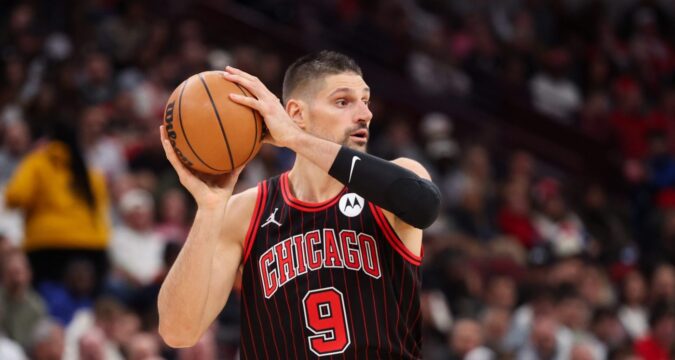
Column: A well-timed escape for Chicago Bulls’ Nikola Vučević and other thoughts while waiting for Bad Bunny
If your vestibule resembles a salt mine and wet boots are stacked up on a mat like planes at O’Hare, it’s important to remember spring training starts next week and you’ve survived the worst of winter.
It can only get better from here on out.
While we await the NBA trade deadline, the Bad Bunny Super Bowl halftime show, the start of the Cactus League and March Madness, rest assured, many mellifluous moments are just around the corner.
Here are some thoughts to ponder while the boots dry.
I think the Chicago Bulls have got it. They’ve finally got it. In a real moment of clarity, the Bulls gave Nikola Vučević his escape from the Groundhog Day existence he’s lived in for the past four seasons.
Vučević, who was dealt to the Boston Celtics on Tuesday for wing Anfernee Simons and a swap of second-round draft picks, was the ultimate team player in an organization that never could seem to pick a lane between contending and rebuilding. “Vooch” never complained about it, even as he watched teammates DeMar DeRozan, Zach LaVine, Alex Caruso and Lonzo Ball get to escape, making him the last man standing from the 2021-22 team that made us believe for a second that the Bulls’ future was bright.
Chicago Bulls center Nikola Vučević drives the lane against Atlanta Hawks’ Onyeka Okongwu on Monday, Oct. 27, 2025, at the United Center in Chicago. (Dominic Di Palermo/Chicago Tribune)
Executive vice president Artūras Karnišovas, who has a recurring habit of looking at the final month of a lost season and projecting a short window of success into next year’s team-building plan, finally succumbed to reality. Better late than never.
Simons will probably be gone after this season, and so will Jaden Ivey and Mike Conley Jr., the other acquisitions on Tuesday in a three-team trade that saw Kevin Huerter and Dario Šarić, the Bull who never was, go to the Detroit Pistons.
And as the Bulls took the floor at Milwaukee, everyone wondered whether Coby White and Ayo Dosunmu would be next.
Is this any way to run an iconic NBA franchise? Or does it even matter as long as the United Center is filled every year?
At least Vooch has finally been freed and can make plans for the postseason again. He gave Chicago everything he had, even if it was never enough to change the trajectory of a franchise stuck in never-neverland.
Before Northwestern’s game with Michigan at Wrigley Field last November, an NU student reporter sitting next to me in the press box suddenly began clapping.
“Uh, what are you doing?” I politely asked.
“It’s Pat Ryan,” he said, referring to the billionaire NU alum whose name had been announced over the public address system.
“Yeah,” I said. “And …?”
“He’s paying for our stadium,” the student reporter said, referring to the new Ryan Field in Evanston that bears the family’s name. “He deserves our applause.”
Workers continue their construction of Northwestern’s Ryan Field, Nov. 21, 2025, in Evanston. (Dominic Di Palermo/Chicago Tribune)
There is no cheering in the press box, as former Tribune baseball writer Jerome Holtzman used to remind young reporters back in the day when they got giddy over a Chicago team. I was going to pass that advice on, but you can’t tell Gen Z what to do without triggering them, so I just shook my head and let it go.
But I was thinking about that young reporter on Tuesday when I heard that the opening of the new Ryan Field won’t be until the third home game of the 2026 season, on Oct. 2 against Penn State. Hopefully, he was applauding Pat Ryan in his dorm room.
The Wildcats will now play their first two home games at Martin Stadium, aka “the mini-Mart,” so we’ll have to wait a bit longer for what Ryan’s son, Pat Ryan Jr., called “the best place to watch football in America.”
I have no doubt that will be the case. Yet I wonder why it took them so long to announce the stadium wouldn’t be ready for the start of the season. Martin Stadium, located on the lakefront, is a nice, little place to watch a game. But it’s not exactly the kind of stadium befitting a real Big Ten team, and it was supposed to be a temporary home until the start of the ’26 season.
Pat Ryan Jr. said in a press release the construction work was “on track to deliver the new Ryan Field on time, despite the unexpected number of weather days that we’ve experienced.” Well, it does get chilly in the winter in Chicago, and in Evanston, too.
Ryan Jr. told the Sun-Times the new Ryan Field would be ready by mid-September. That suggests the home opener on Sept. 5 against South Dakota State was out of the question, and meant it was not “on track to deliver the new Ryan Field on time.” It also doesn’t explain why the Sept. 19 game against Colorado couldn’t have been the stadium’s debut instead of the Penn State game.
Oh well. We’ll just have to reserve our applause until Oct. 2. Just not inside the press box, kids.
If you’re a Cubs fan and an experienced social media brand manager, you might want to look into the latest job opening at Wrigley Field. According to LinkedIn, the Cubs are searching for a Social Media Manager to work in the marketing department. The job description says part of your day-to-day responsibilities will be to “keep your finger on the pulse of real-time trends, adapting content to stay fresh, authentic, and at the center of the cultural conversation.” No one has their finger on the pulse like Crane Kenney and the Cubs business operations department. Among the perks of the job are free access to EV charging stations and a free subscription to the Marquee Sports Network. There was no mention of working closely with the team mascot, Clark the Cub, who was so difficult to work with that former President Theo Epstein once threw a ceremonial first pitch at his head.
New Chicago White Sox player Munetaka Murakami walks onto the field at Rate Field on Monday, Dec. 22, 2025, announcing his acquisition. (Eileen T. Meslar/Chicago Tribune)
Kudos to White Sox Chairman Jerry Reinsdorf for keeping up with the times after new Sox slugger Munetaka Murakama noticed the White Sox clubhouse was missing something that would tie the room together — a bidet. “One thing he did notice is we didn’t have a bidet in our locker room,” general manager Chris Getz told MLB.com’s Scott Merkin. “That’s new to him. It was like, ‘OK, that’s new. We can do that.’” So a new Sox-sanctioned bidet was added to the budget, and we’ll soon find out whether it’s a change that can help the Sox flush away the last four crappy seasons. One press box wag asked: “Will they install it behind the mound to clean up that mess?” For that, he deserves a round of applause.
https://www.chicagotribune.com/2026/02/04/chicago-bulls-nikola-vucevic-escape/
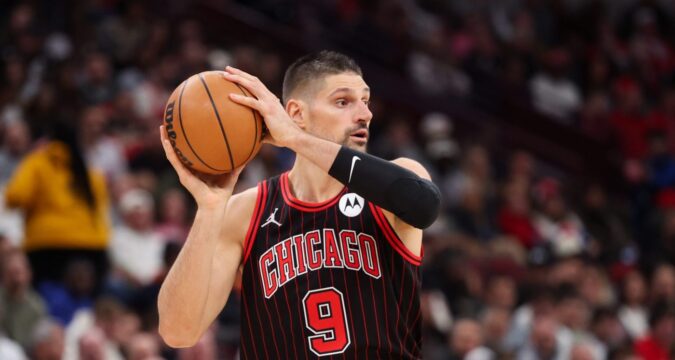
Column: A well-timed escape for Chicago Bulls’ Nikola Vučević and other thoughts while waiting for Bad Bunny
If your vestibule resembles a salt mine and wet boots are stacked up on a mat like planes at O’Hare, it’s important to remember spring training starts next week and you’ve survived the worst of winter.
It can only get better from here on out.
While we await the NBA trade deadline, the Bad Bunny Super Bowl halftime show, the start of the Cactus League and March Madness, rest assured, many mellifluous moments are just around the corner.
Here are some thoughts to ponder while the boots dry.
I think the Chicago Bulls have got it. They’ve finally got it. In a real moment of clarity, the Bulls gave Nikola Vučević his escape from the Groundhog Day existence he’s lived in for the past four seasons.
Vučević, who was dealt to the Boston Celtics on Tuesday for wing Anfernee Simons and a swap of second-round draft picks, was the ultimate team player in an organization that never could seem to pick a lane between contending and rebuilding. “Vooch” never complained about it, even as he watched teammates DeMar DeRozan, Zach LaVine, Alex Caruso and Lonzo Ball get to escape, making him the last man standing from the 2021-22 team that made us believe for a second that the Bulls’ future was bright.
Chicago Bulls center Nikola Vučević drives the lane against Atlanta Hawks’ Onyeka Okongwu on Monday, Oct. 27, 2025, at the United Center in Chicago. (Dominic Di Palermo/Chicago Tribune)
Executive vice president Artūras Karnišovas, who has a recurring habit of looking at the final month of a lost season and projecting a short window of success into next year’s team-building plan, finally succumbed to reality. Better late than never.
Simons will probably be gone after this season, and so will Jaden Ivey and Mike Conley Jr., the other acquisitions on Tuesday in a three-team trade that saw Kevin Huerter and Dario Šarić, the Bull who never was, go to the Detroit Pistons.
And as the Bulls took the floor at Milwaukee, everyone wondered whether Coby White and Ayo Dosunmu would be next.
Is this any way to run an iconic NBA franchise? Or does it even matter as long as the United Center is filled every year?
At least Vooch has finally been freed and can make plans for the postseason again. He gave Chicago everything he had, even if it was never enough to change the trajectory of a franchise stuck in never-neverland.
Before Northwestern’s game with Michigan at Wrigley Field last November, an NU student reporter sitting next to me in the press box suddenly began clapping.
“Uh, what are you doing?” I politely asked.
“It’s Pat Ryan,” he said, referring to the billionaire NU alum whose name had been announced over the public address system.
“Yeah,” I said. “And …?”
“He’s paying for our stadium,” the student reporter said, referring to the new Ryan Field in Evanston that bears the family’s name. “He deserves our applause.”
Workers continue their construction of Northwestern’s Ryan Field, Nov. 21, 2025, in Evanston. (Dominic Di Palermo/Chicago Tribune)
There is no cheering in the press box, as former Tribune baseball writer Jerome Holtzman used to remind young reporters back in the day when they got giddy over a Chicago team. I was going to pass that advice on, but you can’t tell Gen Z what to do without triggering them, so I just shook my head and let it go.
But I was thinking about that young reporter on Tuesday when I heard that the opening of the new Ryan Field won’t be until the third home game of the 2026 season, on Oct. 2 against Penn State. Hopefully, he was applauding Pat Ryan in his dorm room.
The Wildcats will now play their first two home games at Martin Stadium, aka “the mini-Mart,” so we’ll have to wait a bit longer for what Ryan’s son, Pat Ryan Jr., called “the best place to watch football in America.”
I have no doubt that will be the case. Yet I wonder why it took them so long to announce the stadium wouldn’t be ready for the start of the season. Martin Stadium, located on the lakefront, is a nice, little place to watch a game. But it’s not exactly the kind of stadium befitting a real Big Ten team, and it was supposed to be a temporary home until the start of the ’26 season.
Pat Ryan Jr. said in a press release the construction work was “on track to deliver the new Ryan Field on time, despite the unexpected number of weather days that we’ve experienced.” Well, it does get chilly in the winter in Chicago, and in Evanston, too.
Ryan Jr. told the Sun-Times the new Ryan Field would be ready by mid-September. That suggests the home opener on Sept. 5 against South Dakota State was out of the question, and meant it was not “on track to deliver the new Ryan Field on time.” It also doesn’t explain why the Sept. 19 game against Colorado couldn’t have been the stadium’s debut instead of the Penn State game.
Oh well. We’ll just have to reserve our applause until Oct. 2. Just not inside the press box, kids.
If you’re a Cubs fan and an experienced social media brand manager, you might want to look into the latest job opening at Wrigley Field. According to LinkedIn, the Cubs are searching for a Social Media Manager to work in the marketing department. The job description says part of your day-to-day responsibilities will be to “keep your finger on the pulse of real-time trends, adapting content to stay fresh, authentic, and at the center of the cultural conversation.” No one has their finger on the pulse like Crane Kenney and the Cubs business operations department. Among the perks of the job are free access to EV charging stations and a free subscription to the Marquee Sports Network. There was no mention of working closely with the team mascot, Clark the Cub, who was so difficult to work with that former President Theo Epstein once threw a ceremonial first pitch at his head.
New Chicago White Sox player Munetaka Murakami walks onto the field at Rate Field on Monday, Dec. 22, 2025, announcing his acquisition. (Eileen T. Meslar/Chicago Tribune)
Kudos to White Sox Chairman Jerry Reinsdorf for keeping up with the times after new Sox slugger Munetaka Murakama noticed the White Sox clubhouse was missing something that would tie the room together — a bidet. “One thing he did notice is we didn’t have a bidet in our locker room,” general manager Chris Getz told MLB.com’s Scott Merkin. “That’s new to him. It was like, ‘OK, that’s new. We can do that.’” So a new Sox-sanctioned bidet was added to the budget, and we’ll soon find out whether it’s a change that can help the Sox flush away the last four crappy seasons. One press box wag asked: “Will they install it behind the mound to clean up that mess?” For that, he deserves a round of applause.
https://www.chicagotribune.com/2026/02/04/chicago-bulls-nikola-vucevic-escape/
Chicago Bears Q&A: Is a game in Spain in the works? How about a trade for Maxx Crosby?
The New England Patriots and Seattle Seahawks are preparing for Sunday’s Super Bowl. For the 30 other NFL teams — including the Chicago Bears — the focus has moved on to the offseason, potential roster moves and the 2026 season.
Not surprisingly, those are the themes of Brad Biggs’ Bears mailbag this week, beginning with the possibility of an overseas game next season.
Do you think the Bears will play an international game in 2026? — Murray P., North Side
This is a topic I poked around on early in the season, and the answer I got at the time was that the Bears were not expected to be the home team for an international game in 2026. That, of course, didn’t rule out the possibility they could be deemed the visiting team for an international game. This was all subject to change.
With the announcement Monday that the NFL will return to Spain in 2026, my antenna is up again that it’s possible the Bears could be headed abroad next season. The league announced it will return to Madrid to play at Bernabéu Stadium — home of Real Madrid — as part of a multiyear commitment to playing regular-season games in Spain.
The NFL played its first game in Spain this season when the Miami Dolphins defeated the Washington Commanders 16-13 in overtime in front of 78,610 fans at Bernabéu Stadium.
Here are seven factors to consider:
Three teams have international marketing rights in Spain to grow brand awareness as part of the league’s Global Markets Program: the Bears, Dolphins and Kansas City Chiefs.
NFC teams will play nine home games and eight road games in 2026. AFC teams will have eight home games and nine road games. On the surface, I’d guess it’s unlikely the Dolphins or Chiefs would play a home game in Spain (or anywhere else overseas) in 2026. But never say never. The Chiefs were the designated visitor this season for a Week 1 game against the Los Angeles Chargers in São Paulo.
The game in Spain doesn’t necessarily have to include teams with home marketing rights in that country.
The Bears probably are amenable to league requests as they want to remain in good graces while seeking support in their bid to build a new stadium. Does that mean the league has asked the Bears or is planning to? I don’t know.
There will be nine international games in 2026. If you don’t like this, well, you best get used to it because the ultimate goal that Commissioner Roger Goodell reiterated Monday is to get to 16 international games each season, meaning eventually every team would play abroad once per season. The NFL views international markets as vital revenue streams.
The other eight games include the Los Angeles Rams playing in Melbourne, Australia, and the New Orleans Saints playing at Stade de France in Paris. There also will be games in Rio de Janeiro, Munich, Mexico City and three in London. With nine international games — provided no teams play two (the Minnesota Vikings played in Dublin and London in consecutive weeks this season) — 18 of the 32 teams will be involved.
The Bears have been active in Spain the last couple of years working to establish a fan base. They’ve conducted flag football clinics, sent former offensive lineman Roberto Garza to Spain multiple times and done other work to grow their brand in that country.
Cap question about signing bonuses and actual cash flow. When a portion of a contract is converted to a signing bonus, are those hard dollars that are paid out to the player? Those are some big checks to write if so. Or is it just a reallocation of guaranteed money? — @halfadrink
The dollars converted to a signing bonus are real, and it’s a mechanism to spread out a cap hit into future seasons. Let’s use center Drew Dalman, who is signed for two more seasons, as a potential example. (I’m not saying Dalman’s contract will be restructured.)
Dalman currently has an $11 million base salary in 2026 and 2027 with a cap hit of $14 million each season. If the Bears converted $6 million of his 2026 base salary into a bonus this year, they would reduce his base salary to $5 million and his cap hit for 2026 to $11 million. That would raise his cap hit for 2027 to $17 million. The upshot would be an additional $3 million in cap space for next season and then a larger hit in 2027.
The Bears restructured cornerback Jaylon Johnson’s contract in September to create $8 million in cap space. The more years a player has remaining on his contract, the more space can be created. Maybe cornerback Kyler Gordon would be a candidate for a restructure to create space this year. Teams generally want to choose players they are confident will be part of their future when restructuring deals to avoid having a big hit if they part ways after a year or two.
I fully expect the Bears to do some combination of releasing veterans and restructuring contracts to create cap space before the new league year starts March 11.
I believe Maxx Crosby is too much risk for the Bears — injuries, cost to get him and age. Do you agree there are better moves the Bears could make for a pass rusher? — @tellus32
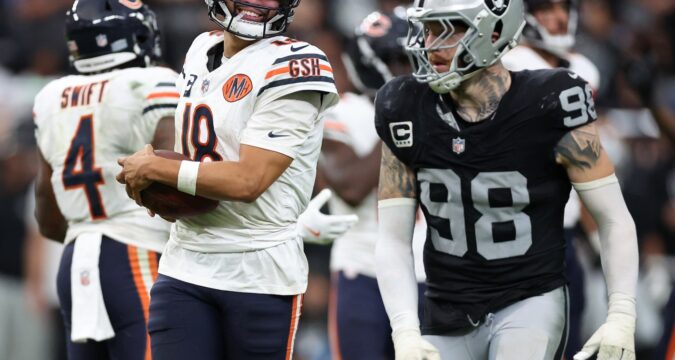
Raiders edge rusher Maxx Crosby eyes Chargers quarterback Justin Herbert on Sept. 15, 2025, in Las Vegas. (Rick Scuteri/AP)
Crosby, who turns 29 in August, is an elite, disruptive player who has one of the most incredible motors you’ll ever see on a man who is 6-foot-5, 255 pounds. He’s tremendous theater for the NFL, and while, from a distance, he looks like the kind of guy who should spend his entire career in a Raiders uniform, Crosby’s potential availability via trade will be a huge story this offseason. Does Las Vegas, with a new coach and the No. 1 draft pick, go full teardown and ship off the face of the franchise to the highest bidder?
Last week at the Senior Bowl, I chatted with a handful of veteran personnel men about the possibility that Crosby could be available. They said what you’d expect: Nothing would surprise them. They also were in agreement that, given the choice between Crosby and Cincinnati Bengals free-agent defensive end Trey Hendrickson, they would choose Crosby. It’s not an apples-to-apples comparison, though, because Crosby would require trade compensation.
Would Las Vegas consider moving Crosby? One thing the Raiders do not need this offseason is cap space. They’re No. 2 in the league right now in available space with close to $90 million. A trade would be to add draft capital (or players), and I’d imagine they would have to be blown away by an offer.
The feeling I got was people aren’t concerned that the knee surgery Crosby had at the end of this season will negatively affect his production moving forward. But these people haven’t had their team doctors examine medical records or Crosby himself. He’ll be entering his eighth season, so any team acquiring Crosby objectively would be getting a guy who’s probably a tick below his prime.
Saying that, he’s still an elite, disruptive player. One thing Crosby probably has to do is reduce his playing time. He hates coming off the field, and in games he was active this season, he played 94% of the defensive snaps. He was at 97% in 2024 and 95% in 2023. In order to remain effective, especially late in games, that figure probably needs to dip into the low to mid 80s.
The Bears would need to have legitimate internal conversations about any player of Crosby’s ability who is available — if any are available. But my intuition is that general manager Ryan Poles would have a hard time bundling two first-round draft picks or something close to that to acquire Crosby. If the price is lower, then it would be an intriguing option.
Please don’t think current Bears players who might not be great salary-cap fits could be valuable trade pieces in a bid to acquire Crosby. I firmly believe if the Raiders shop Crosby, they’ll be looking for a big-time return in draft capital.
How are they under water on the cap considering Caleb Williams is on a rookie deal and the overall roster is fairly marginal? — @unisourceg
I have news for you. There’s not necessarily a correlation between cap health and a team’s record. The Bears have been a regular player in free agency over the last few years, which, gauging by regular mailbag questions, is something readers fully support. Right now, they project to be about $10 million over the cap.
The league informed teams that the 2026 salary cap is expected to fall somewhere between $301.2 million and $305.7 million. The higher it is, the better for the Bears. Business is booming in the NFL, as the cap was $279.2 million in 2025 and $208.2 million in 2022. It will have risen nearly $100 million in just four seasons.
While the Bears have more “constraints” this year, as GM Ryan Poles said, they’ll be able to create the room they need to rework the roster this offseason, and the books will be in pretty good shape when they get to 2027. A lot of the contracts they’ve handed out are relatively flat in terms of cap hits, and they can make a series of moves after next season to create additional space.
While free agency is the next big event in the NFL offseason, the draft will be more important, in my opinion. The Bears have a handful of exciting young players on offense: Williams, tight end Colston Loveland, wide receivers Rome Odunze and Luther Burden III, running back Kyle Monangai and maybe left tackle Ozzy Trapilo, depending largely on how he recovers from a torn patellar tendon in his left knee. That’s as many as six core players on rookie contracts.
If the 2026 draft produces some prospects for the defense, the Bears will have a nucleus of young talent that can help sustain the roster and provide contributors on controlled rookie salaries.
Who, in your opinion, are a few priority re-signings for the Bears this offseason? — @justinhamelin86
Bears cornerback Nahshon Wright (26) and safety Kevin Byard III (31) celebrate after Wright recovered a fumble by Giants quarterback Jaxson Dart on Nov. 9, 2025, at Soldier Field. (Eileen T. Meslar/Chicago Tribune)
A handful of players coming out of contract are worth keeping an eye on. Free safety Kevin Byard III and cornerback Nahshon Wright are the two biggest names that jump out. The Bears’ ability to re-sign one or both likely depends on what kind of market those players believe they can generate in free agency. Sometimes teams encourage players to gauge their value on the open market as part of the negotiation. There’s a risk of losing the player by going that route, but it also makes the player feel like he’s getting what he’s worth.
In terms of other pending free agents to keep an eye on, I’d list tight end Durham Smythe, left tackle Braxton Jones (more on him in a little bit), guard Jordan McFadden, receiver/returner Devin Duvernay, defensive end Daniel Hardy, linebacker D’Marco Jackson and long snapper Scott Daly. Maybe the team wants to run it back with third quarterback Case Keenum, too, so throw his name in the mix as well.
What are the best options at left tackle? Theo Benedet and Kiran Amegadjie are on the roster and Ozzy Trapilo is out until late 2026 at least. Braxton Jones is a free agent. This seems critical to me. Free agents like Trent Brown, Rob Havenstein and others do little for me and are right tackles. No, I won’t be asking about moving Darnell Wright to left tackle. Draft one? — @themaxconnor1
It will be really interesting to see what shakes out here because there is a hole on the depth chart right now. Whatever move the Bears make likely will give us a glimpse at how they feel about Trapilo’s tape from his rookie season. If they use a first-round draft pick on a left tackle, that would signal they’re looking for a new future at the position. While I think that’s a little unlikely, we can’t rule it out. If they do believe Trapilo is a viable option at left tackle — when healthy — then they probably will be in the market for a bridge option.
That’s where it gets a little tricky — and where I believe Jones could be an option at least worth considering. I wrote about that last week after my trip to the Senior Bowl (item No. 6). Jones’ market value isn’t real hot right now after he played in basically 3½ games. So a one-year deal could give him a chance to boost his profile and give the Bears someone they’re familiar with at the position.
The coaching staff never has seen Jones completely healthy. Finding a decent, experienced left tackle who is healthy won’t be cheap, and, as we know, the Bears won’t have a ton of cap space. This is an important piece of business for the offseason and one to monitor for sure.
Is there a path for the Bears to challenge the NFL’s ruling on compensatory picks for the Falcons’ hiring of Ian Cunningham? If so, will they? — @dominicpelc
Falcons general manager Ian Cunningham speaks during his introductory news conference Tuesday, Feb. 3, 2026, in Atlanta. (Jason Getz/Atlanta Journal-Constitution via AP)
I suppose anything is possible. I can tell you, without equivocation, that after Atlanta hired Matt Ryan as president of football and before it launched its search for a general manager, the league deemed Ryan to be the franchise’s “primary football executive.”
Not every team has the same organizational flow chart. The Falcons created a new position for Ryan. Like the Bears, the Falcons also have a president/CEO. In New England, Eliot Wolf is considered the Patriots’ primary football executive and has the title of executive vice president of player personnel. In Cincinnati, Duke Tobin is the Bengals’ primary football executive and is listed as director of player personnel.
For the vast majority of teams, including the Bears, the general manager is considered the primary football executive. In essence, the league considers the GM job in Atlanta to be a secondary football executive, akin to the assistant GM position with the Bears. Therefore, the Bears could have blocked Cunningham from taking the Falcons GM job.
The Bears were aware of this before Cunningham interviewed for the GM job in Atlanta. If Ryan wasn’t going to be in a role in which he was over the football operation, the Falcons might have come up with some other type of title, such as an adviser to owner Arthur Blank. This isn’t the Falcons trying to work the system. It’s not like they would have lost draft picks. The compensatory picks are added to the end of the round.
In the spirit of the Rooney Rule — and this goes way beyond two third-round compensatory picks for the Bears — it’s a curious and confusing situation because you can make a case Cunningham received a promotion from his role at Halas Hall. The Rooney Rule was a big topic for Commissioner Roger Goodell on Monday in Santa Clara, Calif. The focus was on this year’s hiring cycle for head coaches. Ten teams changed coaches, and no Black coaches were hired with only one minority candidate — the Tennessee Titans’ Robert Saleh, who’s of Lebanese descent) — getting a job. Goodell stressed that the NFL always is evaluating hiring protocols.
It’s my understanding that the league, in consultation with the team, determines which title is considered the primary football executive. Unless we hear differently, that role belongs to Ryan in Atlanta. Would the league take a second look at the Falcons situation in an evaluation of the Rooney Rule? Maybe that’s possible, but my hunch is the NFL will be more forward-looking.
What do you think Ryan Poles is prioritizing in Round 1? Left tackle, defensive tackle, defensive end? — @joe_vizo
I’d bet Poles is hunting for an impact player at No. 25, and that could come from a lot of positions. I don’t think anyone viewed tight end as the Bears’ top need before they drafted Colston Loveland in the first round last year. Similarly, they weren’t in need of a wide receiver when they selected Luther Burden III in Round 2. Both will be core building blocks for the future.
You probably can cross off a few positions, but I’d add safety, linebacker and cornerback. Heck, if there’s a running back the Bears believe is electric, that wouldn’t be a stunner. It’s more important to get impact players, especially early in the draft, than it is to draft for need.
When teams get hyperfocused on a position on Day 1 or Day 2 of the draft and force a pick at a position when better players at other positions are available, you know what happens? They generally are staring at the same need two or three years later and they don’t have impact players. My advice is to have an open mind and hope the Bears do likewise with their draft board.
What’s up with Ruben Hyppolite II? He was a fourth-rounder yet hardly played even when the defense was totally depleted. Was it a wasted pick? He was supposed to be speedy but Ryan Poles overreached badly per most analysts. — @blueridge3
Bears linebacker Ruben Hyppolite II (47) keeps his eyes on Steelers running back Jaylen Warren (30) on Nov. 23, 2025, at Soldier Field. (John J. Kim/Chicago Tribune)
Hyppolite was one of the few draft picks who didn’t make an impact in 2025. It’s fair to say his rookie season didn’t go as planned. He appeared in seven games with one start against the Pittsburgh Steelers in Week 12 and played 31 snaps on defense and 82 on special teams. He was inactive 10 times.
He suffered an AC joint sprain in his right shoulder against the Steelers when tight end Darnell Washington — who is generously listed at 6-foot-7, 264 pounds but said this season he was playing at 311 — came in motion to kick Hyppolite out on a running play.
“It starts with getting my body right,” Hyppolite said last month on locker-room cleanout day. “It’s been a long season. Really for me, it’s been longer than I’ve ever experienced. It’s just about getting my body back right, feeling good so you can put the work in and get the gains, whether it’s getting stronger, faster, whatever the case may be.
“It’s been great being in the room with the guys I was with — Tremaine (Edmunds), T.J. (Edwards) and Noah (Sewell) — learning from those guys. Experiencing how the league works in terms of personnel, preparation, things of that nature. I feel like I learned a lot as far as how to be a pro. Just knowing what to expect.”
Hyppolite called the play against Washington a good “welcome-to-the-NFL moment.”
“That was a lot of weight to one shoulder,” he said.
He hoped to be more active on special teams, but the Bears were playing well in that phase and used players with more experience such as Amen Ogbongbemiga.
“It definitely motivates me,” Hyppolite said about the string of inactives. “I’ve gotten to this point and I want to play. I want to contribute. That’s what it’s about for me. I am blessed to be in this position. I want to play football. I want to help the team win.
“Definitely was upset about that, but all I can do now is go back to the drawing board. I can only control what I can. That was to show up every day, and I was ready to go if needed. I performed in practice well.”
Hyppolite should have a clean slate in his second season, and if he can build off the things he learned as a rookie, he at least should challenge for a core role on special teams. If he can’t achieve that in Year 2, the Bears will have to consider moving on.
What are the chances D’Andre Swift is back? — @nflchikennugget
Bears running back D’Andre Swift celebrates a victory over the Packers in an NFC wild-card game Jan. 10, 2026, at Soldier Field. (Chris Sweda/Chicago Tribune)
Swift is in decent position to return to the Bears for the final year of his contract. He’s on the books to earn a $6.39 million base salary with a $500,000 roster bonus due March 15 and as much as $510,000 available in per-game roster bonuses plus a $100,000 workout bonus. Considering Swift’s value to the offense, I’d say the Bears feel confident he would provide value at that price. He rushed for a career-high 1,087 yards and nine touchdowns this season and caught 34 passes for 299 yards and another score.
Swift, 27, will be motivated to have another strong season in a contract year. Releasing him would create $7.47 million in cap space. It also would create a need in the backfield after Swift played 621 snaps (58%) in 2025. The Bears did well with their pairing of Swift and Kyle Monangai.
The Bears will require conversations about all of their veterans under contract who are making solid money, especially the ones who no longer have guaranteed money in their deals. Swift is in that group. I would guess they will lean toward running it back with him in 2026, but a lot needs to be discussed internally.
https://www.chicagotribune.com/2026/02/04/chicago-bears-mailbag-spain-maxx-crosby/