Category: News

Wilmette Super Bowl Sunday blood drive to honor 23-year-old’s memory
A Wilmette Catholic church is hoping it, and patients who need blood donations, will be winners Sunday by the time the Seahawks and the Patriots take the field for the 2026 Super Bowl.
Saints Joseph and Francis Xavier Parish in Wilmette is hosting the 8 a.m. to 2 p.m. blood drive to honor the life and memory of Kevin Joseph Smith Burke, who passed away in 2017 at age 23 due to a rare heart condition, according to the Archdiocese of Chicago.
Extreme winter weather in the past two weeks has contributed to a drop of about 35% in the blood supply, according to published news reports.
Burke grew up attending the parish and its elementary school. After he died, an Archdiocese news release said, a family friend who had been organizing a blood drive at the parish approached Burke’s parents about renaming the event in his honor. They agreed and the donor count tripled.
Blood donors will get some perks for rolling up their sleeves. Each donor will receive a certificate for a pint of Culver’s frozen custard, and they can enter to win a top prize of a $200 gift card from Ballyhoo.
While parents are donating blood, kids can enjoy an arts and crafts table. Wilmette Fire Department personnel will also be on hand to greet families.
The parish has collaborated with the Wilmette Fire Department, Our Lady of Perpetual Help parish in Glenview and the R. Scott and Rebecca J. Falk Memorial Blood Drive to form the North Shore Alliance of Blood Donors. The goal is to help each drive raise more awareness of the need to donate blood.
The blood drive is located at the St. Francis Xavier Campus gym and atrium, 524 Ninth St., Wilmette.
Organizers recommend calling 1-800-RED-CROSS or visiting redcrossblood.org to schedule a time to donate. The drive runs from 8 a.m. to 2 p.m.
Donors should bring a government-issued ID, such as a driver’s license, or their Red Cross donor card or two other forms of identification.
Donations of non-perishable food for the food pantry will also be appreciated.

Trump Warns Of ‘Bad Things’ If No Iran Deal Reached As Venue Moves To Oman
Trump Warns Of ‘Bad Things’ If No Iran Deal Reached As Venue Moves To Oman
Trump had kicked off the week by warning Iran that “bad things” would probably happen if a deal could not be reached. “We have ships heading to Iran right now, big ones – the biggest and the best – and we have talks going on with Iran and we’ll see how it all works out,” Trump told reporters in the Oval Office. “If we can work something out, that would be great and if we can’t, probably bad things would happen.”
“I’d like to see a deal negotiated. I don’t know that that’s going to happen,” he added. So far, Iran seems a willing participant, though at this point the reality is it has little to lose by risking such direct engagement.
The only thing which has remained up in the air is the venue. Initially widespread reports said the talks would be hosted by Turkey in Istanbul, but now the sides have their sights set on Oman.
Axios writes that these changes threaten to derail the talks before they even begin. “The Iranians want to move the talks from Istanbul to Oman,” the Wednesday report says.
“They also now want to hold them in a bilateral format, only with the U.S., rather than with several Arab and Muslim countries attending as observers,” it adds.
But Axios says that the Trump administration has agreed to the request from Tehran to hold the talks in Oman.
The bigger issue is going to be the scope of the talks. Iran is willing to engage on the nuclear issue, but will not negotiate over its ballistic missiles, seen as essential for national security and in any future war with Israel.
“A source with knowledge said that’s because the Iranians want to limit the talks to nuclear issues and not discuss things like missiles and proxy groups that are priorities for other countries in the region,” states Axios.
On Tuesday Trump had followed with more comments:
“They had a chance to do something a while ago, and it didn’t work out. And we did ‘Midnight Hammer’, I don’t think they want that happening again,” he said.
This time, Tehran is warning that it is ready to strike back hard if attacked, even if this means all-out war. It says its military forces and ballistic missiles are on high alert, and also that Tel Aviv will be again targeted in the event of US aggression.
NEW: Direct talks not currently on agenda as Iran-US set to resume negotiations in Oman. Qatari PM may join, no word yet on other regional officials. Also potentially joining: Jared Kushner.
Apart from differences over substance, concern that indirect talks won’t cut it. pic.twitter.com/1bCWoymsiY
— Mohammad Ali Shabani (@mashabani) February 4, 2026
Israel meanwhile is said to be lobbying Washington for regime change in Tehran, but the White House reportedly isn’t ready for such a drastic option – also amid reports the Pentagon would need more time to put assets in place.
Tyler Durden
Wed, 02/04/2026 – 09:00
Reino Unido publicará archivos sobre el exembajador en EEUU, Peter Mandelson, amigo de Epstein
Por JILL LAWLESS
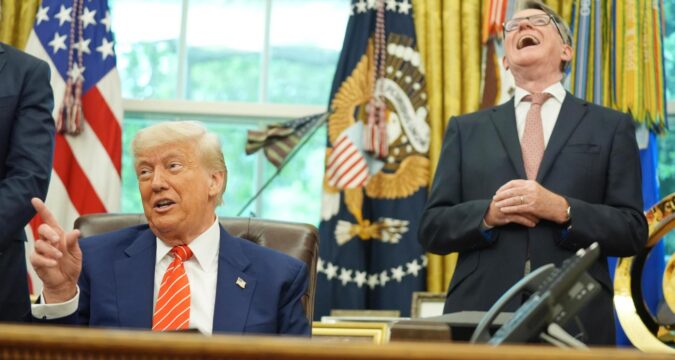
LONDRES (AP) — El gobierno británico acordó el miércoles publicar correos electrónicos y otros documentos que arrojan luz sobre la decisión de nombrar a Peter Mandelson como embajador en Estados Unidos, a pesar de su amistad con Jeffrey Epstein.
La medida se produjo después de que el opositor Partido Conservador anunció que forzaría una votación en el Parlamento para solicitar la publicación de correos electrónicos y otros mensajes relacionados con el nombramiento de Mandelson en 2024. Los críticos dicen que nunca debió haber recibido el cargo porque su relación con Epstein —aunque no su alcance— ya se conocía en ese momento.
“Tengo la intención de asegurarme de que todo el material se publique”, declaró el primer ministro Keir Starmer a los legisladores, excepto los documentos que comprometan la seguridad nacional británica, las relaciones internacionales o la investigación policial sobre las actividades de Mandelson.
Starmer afirmó que Mandelson “mintió repetidamente” a los funcionarios sobre su relación con Epstein y “traicionó a nuestro país, nuestro Parlamento y mi partido”.
“Lamento haberlo nombrado”, expresó Starmer en la Cámara de los Comunes. “Si hubiera sabido entonces lo que sé ahora, él nunca habría estado cerca del gobierno”.
La líder conservadora Kemi Badenoch dijo que el gobierno debería publicar todos los archivos relevantes, “no solo los que el primer ministro quiere que veamos”.
Mandelson, de 72 años, fue destituido en septiembre de su cargo como enviado en Washington, después de que se publicaron correos electrónicos que mostraban que mantuvo su amistad con Epstein tras la condena en Estados Unidos del difunto financiero en 2008 por delitos sexuales que involucraban a una menor. Epstein murió por suicidio estando en la cárcel en 2019, mientras esperaba juicio por estar acusado de abusar sexualmente de decenas de niñas.
Mandelson renunció a la Cámara de los Lores y enfrenta una investigación policial por presunta mala conducta en el cargo público. Documentos publicados hace unos días por el Departamento de Justicia de Estados Unidos sugieren que Mandelson podría haber compartido información sensible con Epstein cuando era ministro del gobierno hace década y media.
En 2009, parece haberle dicho a Epstein que presionaría a otros miembros del gobierno para reducir un impuesto sobre las bonificaciones de los banqueros, y le pasó un informe interno del gobierno que discutía una posible venta de activos del gobierno del Reino Unido. Al año siguiente, parece haber advertido a Epstein sobre un inminente rescate de la moneda única europea.
Los archivos recién publicados también sugieren que en 2003-2004, Epstein envió tres pagos que suman 75.000 dólares a cuentas vinculadas con Mandelson o su pareja Reinaldo Avila da Silva.
La mala conducta en el cargo público puede sentenciarse incluso con cadena perpetua. Abrir una investigación no significa que Mandelson será arrestado, acusado o condenado.
Starmer dijo que el gobierno estaba trabajando en una legislación para eliminar el título nobiliario de lord que el exembajador aún posee. También será removido del Consejo Privado, un comité de altos funcionarios que asesora al rey Carlos III, por haber “desprestigiado la reputación del Consejo Privado”, dijo Starmer.
La Unión Europea también está investigando posibles irregularidades de Mandelson cuando fue comisario de comercio del bloque entre 2004 y 2008. El Reino Unido fue miembro de la UE hasta 2020.
“Estaremos evaluando si, a la luz de estos documentos recién disponibles, podría haber violaciones de las respectivas normas con respecto a Peter Mandelson”, informó el portavoz de la Comisión Europea, Balazs Ujvari. “Tenemos reglas en vigor, emanadas del tratado y del código de conducta que los comisarios, incluidos los excomisarios, deben seguir”.
______
Sam McNeil colaboró desde Bruselas.
______
Esta historia fue traducida del inglés por un editor de AP con la ayuda de una herramienta de inteligencia artificial generativa.

2 arrested after 12-year-old boy grazed by gunfire in Austin, police report says
When gunfire sounded as a 12-year-old boy rode through the Austin neighborhood Tuesday evening with his parents and infant sister, his mother told the whole family to duck.
Her 12-year-old old son suffered a graze wound to his head and was taken to a hospital in Maywood where he was listed in fair condition, Chicago police said.
Two persons of interest were later arrested after being captured on video running into a house nearby the scene.
According to a police report obtained by the Tribune, the boy and his family had just gotten off I-290 and were driving up North Leamington Avenue on their way to visit a relative nearby around 7 p.m. As the family sped away from the sound of the shots, the boy told his parents that he was OK, but bleeding, the report stated. Per the report, none of the rest of the boy’s family was hurt in the shooting, which the police later determined had happened on the 900 block of North Leamington Avenue.
The report said an Oak Park ambulance met the family near Oak Park Avenue and Augusta Boulevard and took the boy to Loyola Hospital, where Chicago police said he was in fair condition. A doctor who saw the child just after the shooting found that he had a fracture in his head, the report stated.
Austin District (15th) police found two bullet holes on the family’s car, which also had a shot-out driver’s side window and later arrested two men who appeared on surveillance footage running into the house on the block where the shooting took place, the report stated.
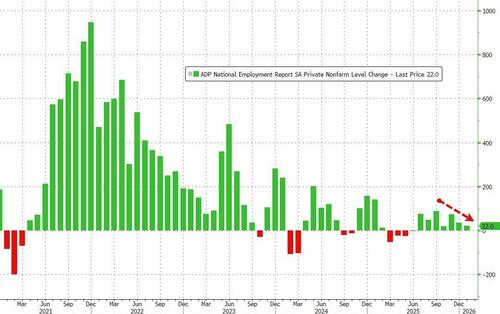
ADP Employment Report Confirms ‘No Hire, No Fire’ Labor Market
ADP Employment Report Confirms ‘No Hire, No Fire’ Labor Market
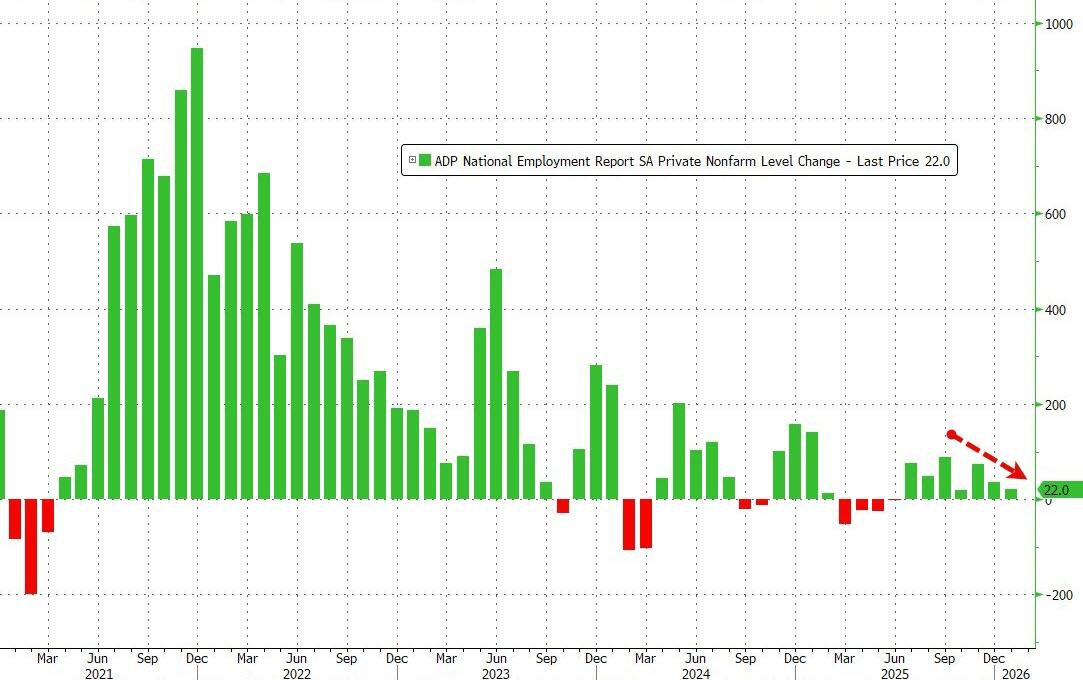
While we will not be getting the payrolls report this week (due to a very brief govt shutdown), ADP’s Employment report paints a poor picture for hiring (even if jobless claims paints a healthy picture for ‘not firing’) adding just 22k jobs (well below the 45k expected).
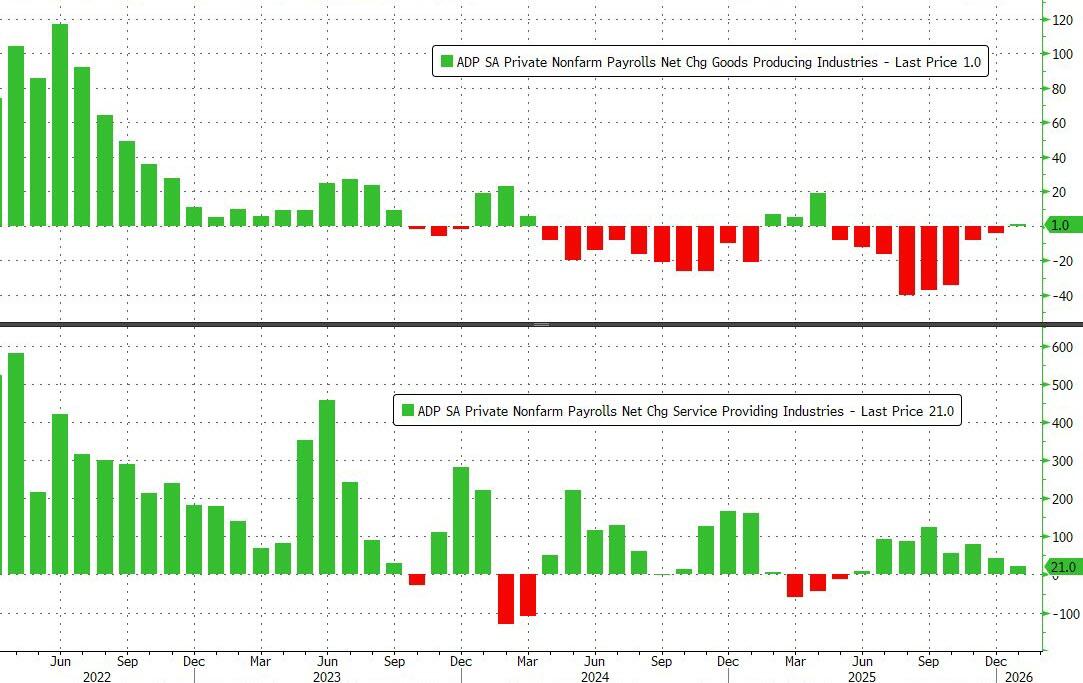
Goods producing firms added just 1k jobs (Construction +9k, Manufacturing -8k – which has lost jobs every month since March 2024) while Services firms saw only 21k jobs added (with health care a standout, adding 74k job, while Profesional Services lost 57k jobs)
“Job creation took a step back in 2025, with private employers adding 398,000 jobs, down from 771,000 in 2024,” said Dr. Nela Richardson Chief Economist, ADP.
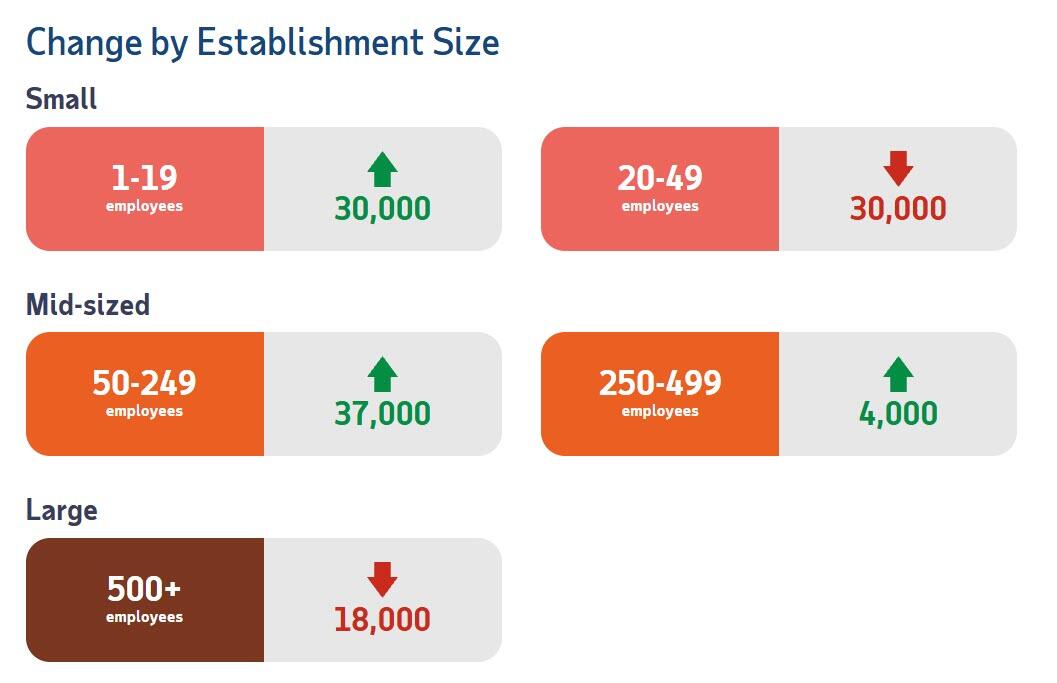
Interestingly, Small firms saw joib additions while large firms saw job losses…
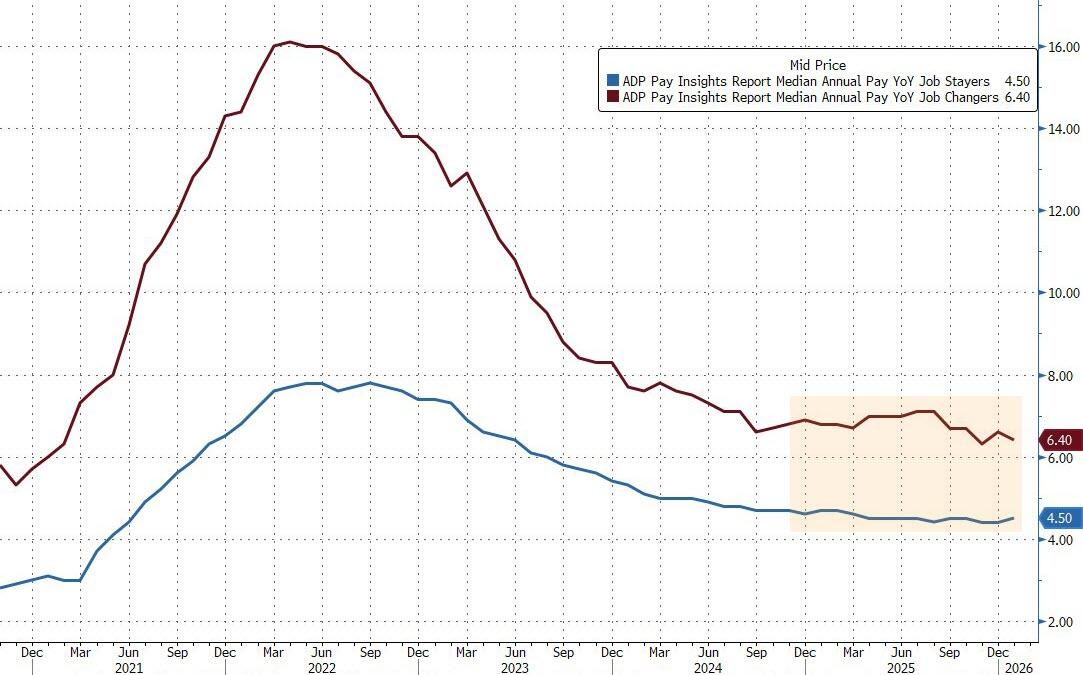
The ADP report, published in collaboration with the Stanford Digital Economy Lab, showed workers who changed jobs saw a 6.4% increase in pay, decelerating from the prior month. Those who stayed put saw a slight pickup in pay gains.
“While we’ve seen a continuous and dramatic slowdown in job creation for the past three years, wage growth has remained stable.”
So, in summary, the ‘no hire, no fire’ labor market keeps chugging along, despite considerable optimism over economic growth.
Tyler Durden
Wed, 02/04/2026 – 08:55

Enviados de EEUU promueven plan para poner fin a la guerra de Rusia en Ucrania
Por THE ASSOCIATED PRESS
El empeño liderado por Estados Unidos para poner fin a la guerra de casi cuatro años de Rusia en Ucrania tomó fuerza a finales del año pasado y avanza en 2026, con mandatarios, diplomáticos y enviados involucrados en una serie de reuniones para discutir un posible acuerdo.
A continuación se presentan algunos momentos clave:
2025
19 de noviembre: El presidente ucraniano Volodymyr Zelenskyy viaja a Turquía en lo que llamó un esfuerzo por reactivar las negociaciones para terminar la guerra. Poco después, surgen reportes de un plan de paz de 28 puntos redactado por Estados Unidos y Rusia que, según los críticos, favorece en gran medida a Moscú.
20 de noviembre: El secretario del Ejército estadounidense Dan Driscoll viaja a Kiev, la capital ucraniana, para informar a Zelenskyy sobre la propuesta de paz respaldada por Estados Unidos.
23 de noviembre: El secretario de Estado estadounidense Marco Rubio se reúne con una delegación ucraniana encabezada por el entonces jefe de gabinete presidencial Andrii Yermak para conversaciones en Ginebra. Ambas partes reportan avances pero proporcionan pocos detalles.
24-25 de noviembre: Driscoll se reúne con funcionarios rusos en Abu Dabi, Emiratos Árabes Unidos. El asesor de política exterior del presidente ruso Vladímir Putin, Yuri Ushakov, dice que las partes no discuten a detalle el nuevo plan de paz.
30 de noviembre: Una delegación ucraniana encabezada por Rustem Umerov se reúne con funcionarios estadounidenses en Florida. Umerov reemplaza a Yermak, que renunció en medio de un escándalo de corrupción que involucra al sector energético de Ucrania.
1 de diciembre: Zelenskyy viaja a París para informar al presidente francés Emmanuel Macron sobre el resultado de las conversaciones en Florida, al tiempo que una delegación estadounidense se dirige a Moscú para sostener conversaciones allí.
2 de diciembre: Putin se reúne en el Kremlin durante cinco horas con Witkoff y el yerno del presidente estadounidense Donald Trump, Jared Kushner. También estuvieron presentes el enviado ruso Kirill Dmitriev y Ushakov, quien describe la reunión como constructiva, pero advierte que aún queda mucho trabajo por hacer.
2 de diciembre: Zelenskyy se reúne en Irlanda con la delegación ucraniana que regresa de Florida. El mandatario señala que Ucrania espera señales de la delegación estadounidense tras su reunión en Moscú.
4-6 de diciembre: Una delegación ucraniana regresa a Florida para reunirse con delegados estadounidenses.
14-15 de diciembre: Funcionarios ucranianos, incluido Zelenskyy, viajan a Berlín para conversaciones con Witkoff y Kushner. Autoridades estadounidenses indican posteriormente que Washington ha acordado proporcionar a Kiev garantías de seguridad no especificadas.
20-21 de diciembre: El enviado ruso Dmitriev sostiene varios días de conversaciones con Witkoff y Kushner en Miami. Por separado, los estadounidenses se reúnen además con una delegación ucraniana que también se encuentra en Florida.
28 de diciembre: Zelenskyy vuela a Florida para reunirse con Trump, quien contacta a Putin antes de sentarse con el presidente ucraniano.
___
2026
6-7 de enero: Zelenskyy y otros funcionarios ucranianos asisten a una cumbre de la “coalición de los dispuestos” en París y mantienen conversaciones con Witkoff y Kushner. Los aliados de Kiev destacan un gran avance sobre cómo defender a Ucrania si se logra a un acuerdo de paz, afirmando que están listos para proporcionar garantías internacionales para disuadir a Rusia de atacar de nuevo.
17 de enero: Una delegación ucraniana llega a Estados Unidos para conversaciones al tiempo que Rusia vuelve a atacar la red eléctrica de Ucrania, cortando la electricidad y el calor en temperaturas heladas.
20 de enero: El enviado ruso Dmitriev se reúne con Witkoff y Kushner en el Foro Económico Mundial en Davos, Suiza. No se revelan detalles sobre lo que se discutió.
21 de enero: Umerov dice que la delegación ucraniana en Davos se reunió allí con Witkoff y Kushner.
22 de enero: Zelenskyy se reúne con Trump en Davos durante aproximadamente una hora. Trump describe las conversaciones como “muy buenas”, y Zelenskyy las califica de “productivas y significativas”.
22-23 de enero: Putin recibe a Witkoff y Kushner en Moscú durante casi cuatro horas. Ushakov reafirma que “no se puede esperar llegar a un acuerdo a largo plazo sin resolver el tema territorial”, pero anuncia que se llevarán a cabo más conversaciones al día siguiente en los Emiratos Árabes Unidos.
23 de enero: Delegados rusos, ucranianos y estadounidenses sostienen conversaciones en Abu Dabi, la primera instancia conocida en que funcionarios del gobierno de Trump se han sentado con ambos países para intentar detener la guerra. Zelenskyy dice que es probable que se discuta el complicado tema de las concesiones territoriales, al tiempo que el Kremlin llama a la reunión un “grupo de trabajo sobre cuestiones de seguridad”.
31 de enero: El enviado del Kremlin Dmitriev visita Miami antes de más conversaciones en Abu Dabi.
4 de febrero: Negociadores rusos, ucranianos y estadounidenses inician el primero de dos días de conversaciones en Abu Dabi.
___
Esta historia fue traducida del inglés por un editor de AP con la ayuda de una herramienta de inteligencia artificial generativa.
Lo que los demócratas exigen para financiar al ICE
Por MARY CLARE JALONICK y JOEY CAPPELLETTI
WASHINGTON (AP) — A pesar de las raras negociaciones entre los demócratas y el presidente Donald Trump, un acuerdo bipartidista sobre nuevas restricciones sobre la policía migratoria en las próximas dos semanas será extremadamente difícil, o incluso “una imposibilidad”, como dijo el líder de la mayoría republicana en el Senado, John Thune.
El Congreso está discutiendo posibles nuevas reglas para el Servicio de Inmigración y Control de Aduanas (ICE) y la Oficina de Aduanas y Protección Fronteriza después de que agentes mataran a dos manifestantes en Minneapolis en enero. Las negociaciones se producen en medio de un sentimiento bipartidista de que el Congreso debería intervenir para bajar las tensiones sobre las redadas migratorias que han estremecido a Minnesota y otros estados.
El presidente Donald Trump acordó la semana pasada una solicitud demócrata de que la financiación para el Departamento de Seguridad Nacional se separe de un proyecto de ley de gastos más amplio y se extienda a los niveles actuales durante dos semanas mientras las dos partes discuten posibles requisitos para los agentes federales. El presidente de la Cámara de Representantes, el republicano Mike Johnson, dijo este fin de semana que estaba en la Casa Blanca cuando Trump habló con el líder demócrata del Senado, Chuck Schumer, de Nueva York, y que estaban “en el camino para llegar a un acuerdo”.
Pero no está claro si el presidente o suficientes republicanos en el Congreso aceptarán alguna de las demandas más amplias de los demócratas de que los agentes se desenmascaren e identifiquen, obtengan órdenes judiciales en ciertos casos y trabajen con las autoridades locales, entre otras solicitudes. Los republicanos ya han rechazado estas propuestas.
Y los legisladores republicanos están exigiendo que algunas de sus propias prioridades se agreguen al proyecto de ley de gastos de Seguridad Nacional, incluida una legislación que requeriría prueba de ciudadanía para votar. El senador Lindsey Graham y otros senadores republicanos están presionando por restricciones a las ciudades santuario que, según ellos, no hacen lo suficiente para frenar la inmigración ilegal. No hay una definición clara de jurisdicciones santuario, pero el término generalmente se aplica a los gobiernos estatales y locales que limitan la cooperación con las autoridades federales de inmigración.
También es incierto si los demócratas, que están furiosos por las agresivas redadas migratorias de la administración Trump, estarían dispuestos a ceder.
“No necesitamos promesas. Necesitamos respeto a la ley”, declaró Schumer, agregando que los demócratas presentarán a los republicanos una “propuesta seria y detallada” pronto.
Un vistazo a las demandas de los demócratas y lo que dicen los republicanos sobre ellas:
Acuerdo sobre cámaras corporales
Los republicanos dicen que están dispuestos a aceptar las cámaras corporales para los agentes, un cambio que ya estaba en el proyecto original. La secretaria de Seguridad Nacional, Kristi Noem, respaldó eso el lunes cuando ordenó que se emitieran cámaras corporales a cada policía de Seguridad Nacional en el terreno en Minneapolis, incluidos los del ICE. Dijo que la política se expandiría a nivel nacional a medida que la financiación esté disponible.
El proyecto ya dirigía 20 millones de dólares para equipar a los agentes con cámaras corporales.
Gil Kerlikowske, quien se desempeñó como comisionado de la Oficina de Aduanas y Protección Fronteriza de 2014 a 2017, apuntó que la mayoría de los agentes son partidarios de las cámaras porque podrían exonerarlos en caso necesario. Pero agregó que quedan preguntas complejas, incluyendo cuándo se debe publicar el video y cuándo deben activarse las cámaras.
“¿Cuándo la enciendes? Y si te metiste en un problema y no la tenías encendida, ¿vas a ser disciplinado? Es realmente bastante complejo”, señaló.
Schumer dijo el martes que las cámaras corporales “necesitan permanecer encendidas”.
Desacuerdo sobre agentes enmascarados
A medida que circulan a nivel nacional videos y fotos de tácticas agresivas y disparos contra civiles, ha estallado una pugna sobre si los agentes deben permanecer enmascarados. Los demócratas argumentan que quitarse las máscaras aumentaría la rendición de cuentas. Los republicanos advierten que podría exponer a los agentes al acoso y las amenazas.
“La policía estatal, la policía local no lo hacen”, indicó el representante Bennie Thompson, el principal demócrata en el Comité de Seguridad Nacional. “Digo, ¿qué tiene de especial un agente del ICE que tiene que usar máscara?”
Pero es poco probable que los republicanos accedan a eso.
“A diferencia de la policía local, los agentes del ICE están siendo doxeados y atacados. Tenemos evidencia de eso”, sostuvo Johnson el martes. Agregó que si “los desenmascaras y pones toda su información identificativa en su uniforme, obviamente serán atacados”.
A los oficiales de inmigración ya se les requiere identificarse “tan pronto como sea práctico y seguro hacerlo”, según las regulaciones federales. Los funcionarios del ICE insisten en que esas reglas se están siguiendo. Los críticos dicen que no es así.
“Simplemente vemos rutinariamente que eso no está sucediendo”, afirmó Nithya Nathan Pineau, abogada del Immigrant Legal Resource Center.
Órdenes judiciales vs. administrativas
Los demócratas también han exigido un uso más estricto de las órdenes judiciales y el fin de las patrullas itinerantes que apuntan a personas en las calles y en sus hogares. Schumer dijo el martes que quieren “órdenes de arresto y el fin del perfil racial”.
La mayoría de los arrestos de inmigración se llevan a cabo bajo órdenes administrativas, documentos internos emitidos por las autoridades de inmigración que autorizan el arresto de una persona específica pero no permiten a los policías entrar por la fuerza en hogares privados u otros espacios no públicos sin consentimiento. Tradicionalmente, solo las órdenes firmadas por jueces tienen esa autoridad.
Pero un memorando interno del ICE obtenido por The Associated Press el mes pasado autoriza a los elementos de esa agencia a usar la fuerza para entrar en una residencia basándose únicamente en una orden administrativa más estrecha para arrestar a alguien con una orden final de deportación, algo que los defensores dicen choca con las protecciones de la Cuarta Enmienda.
Los demócratas no han dejado claro cuán ampliamente quieren que se usen las órdenes judiciales. El líder demócrata de la Cámara de Representantes, Hakeem Jeffries, expresó que los demócratas quieren ver “el fin de las redadas en lugares sensibles como templos, escuelas y hospitales”.
Johnson se quejó el martes que los demócratas están tratando de “agregar una capa completamente nueva” al buscar órdenes firmadas por un juez en lugar de las órdenes administrativas que son firmadas por el departamento. “No podemos hacer eso”, aseguró.
El presidente de la Cámara ha dicho que el fin de las patrullas itinerantes es un área potencial de acuerdo, pero no dio detalles.
Código de conducta y más responsabilidad
Los demócratas también han pedido un código de conducta uniforme para todos los agentes del ICE y federales similar a los policías estatales y locales.
El gobierno de Trump le impidió a los investigadores estatales acceder a las pruebas después de que Renee Good fuera asesinada a tiros por un agente del ICE el 7 de enero. El gobernador Tim Walz, un demócrata, exigió que se permitiera al estado participar, diciendo que sería “muy difícil para los habitantes de Minnesota” aceptar que una investigación que excluya al estado pueda ser justa.
Esperando un milagro
Cualquier acuerdo sobre el Departamento de Seguridad Nacional probablemente no será aceptado por todos los demócratas. La representante Ayanna Pressley de Massachusetts, por ejemplo, aseveró que nunca apoyaría un acuerdo que no requiriera desenmascaramiento.
“Me postulé para el Congreso en 2018 para abolir el ICE”, manifestó Pressley. “Mi posición no ha cambiado”.
Thune, de Dakota del Sur, ha dicho repetidamente que es una “imposibilidad” negociar y aprobar algo tan complicado en dos semanas. Destacó que cualquier conversación debería ser entre los demócratas y Trump.
“No creo que sea muy realista”, indicó Thune el martes sobre encontrar un acuerdo rápido. “Pero siempre hay milagros, ¿verdad?”
___________________________________
La corresponsal Rebecca Santana contribuyó a esta nota.
___________________________________
Esta historia fue traducida del inglés por un editor de AP con ayuda de una herramienta de inteligencia artificial generativa.
https://www.chicagotribune.com/2026/02/04/lo-que-los-demcratas-exigen-para-financiar-al-ice/
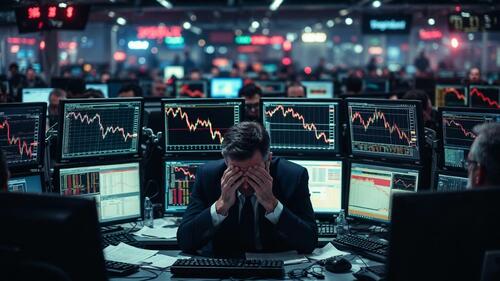
‘No One Is Buying The Dip’: Traders React As Tech Wreck Continues
‘No One Is Buying The Dip’: Traders React As Tech Wreck Continues
‘It was the best of times, it was the worst of times’ is how one big bank trader described yesterday’s price action as Dickens’ Tale Of Two Cities intro perfectly described the to-ing and fro-ing with the US Tech sector as the once one-way trade in anything TMT has dispersed aggressively with winners and losers being ‘picked’ as Anthropic reminded investors that AI disruption risk is no longer theoretical.
“This year is the defining year whether companies are AI winners or victims, and the key skill will be in avoiding the losers,” said Stephen Yiu, CIO of Blue Whale Growth Fund.
“Until the dust settles, it’s a dangerous path to be standing in the way of AI.”
And the selling pressure is not abating…
The selloff in software stocks spread to Asia on Wednesday…
Asian software stocks also slid, with shares of Indian information technology companies the latest to buckle.
Bellwether Tata Consultancy Services Ltd. sank as much as 6%, while Infosys Ltd. dropped 7.1%. Cloud-based accounting software maker Xero Ltd. fell as much as 16% in Sydney trading, the most since 2013.
…and is yet to come to a halt in Europe.
A UBS basket of European companies seen at risk of AI disruption fell another 2.1%, a day after plunging 8%. SAP SE and Sage Group Plc are among stocks extending losses.
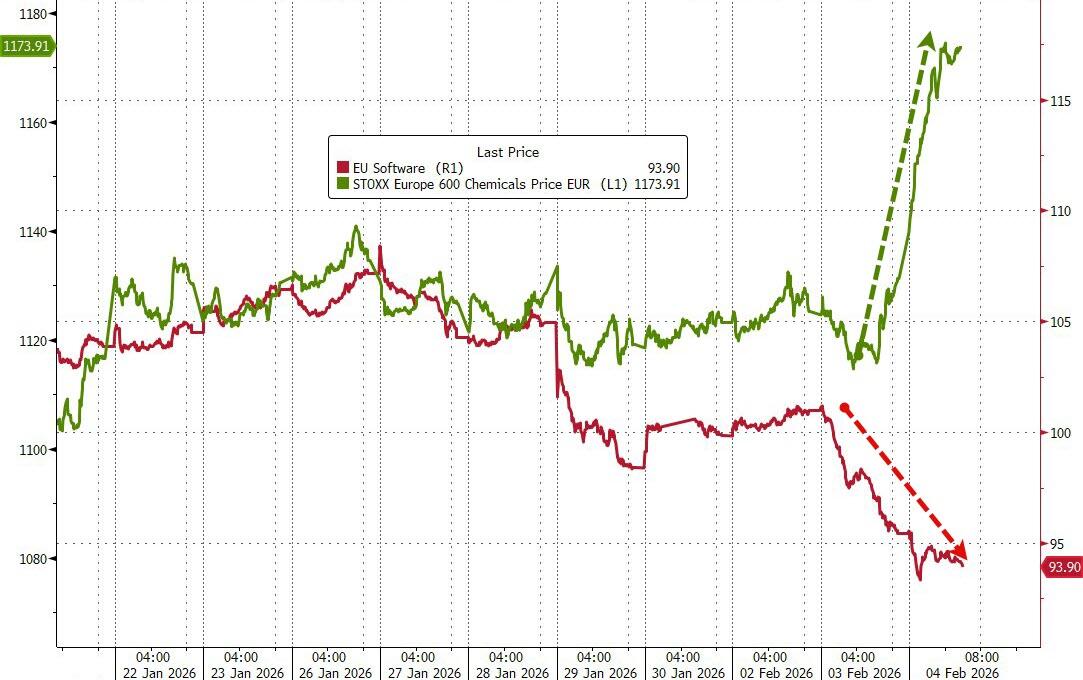
Interestingly, to hedge against the disruptive nature of AI, investors have instead flocked to companies that have factories and infrastructure. Chemicals, telecommunications and automobiles were the best-performing sectors within Europe’s benchmark Stoxx 600 on Wednesday.
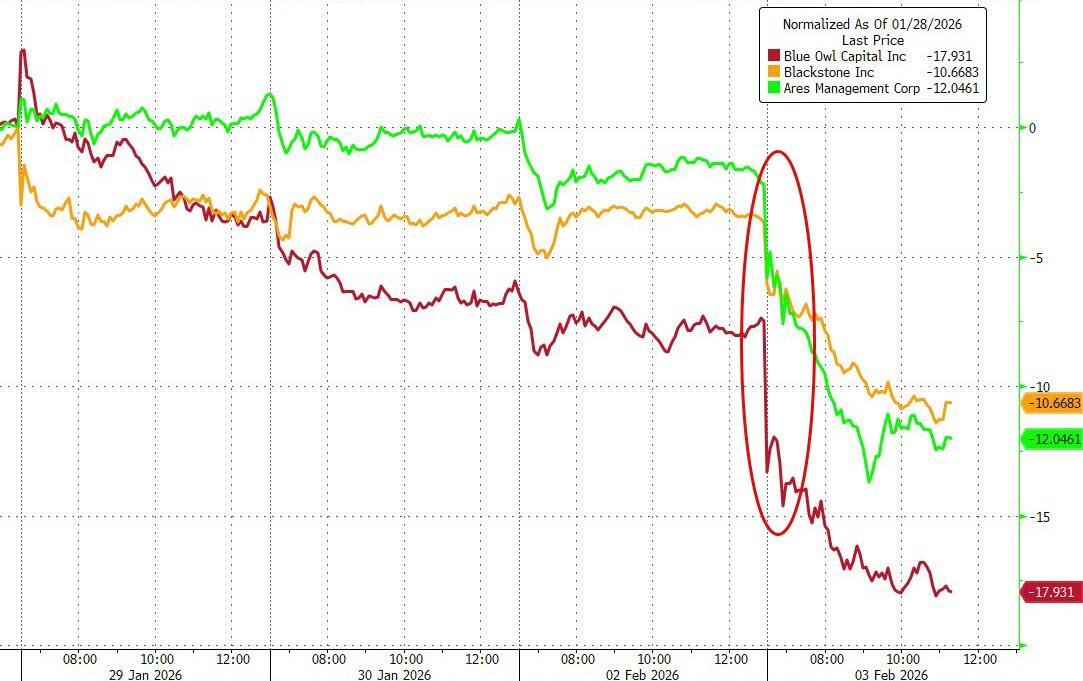
But, as we detailed here, here, here , and here yesterday, the pain was not just in tech, as Alts and BDCs suffered significant losses as the strain of lower marks on loans to losing software firms weighed on these private credit providers (which was exacerbated by the fact that a group of banks led by Deutsche Bank has been unable to sell about $1.2 billion of loans backing the acquisition of a software provider).
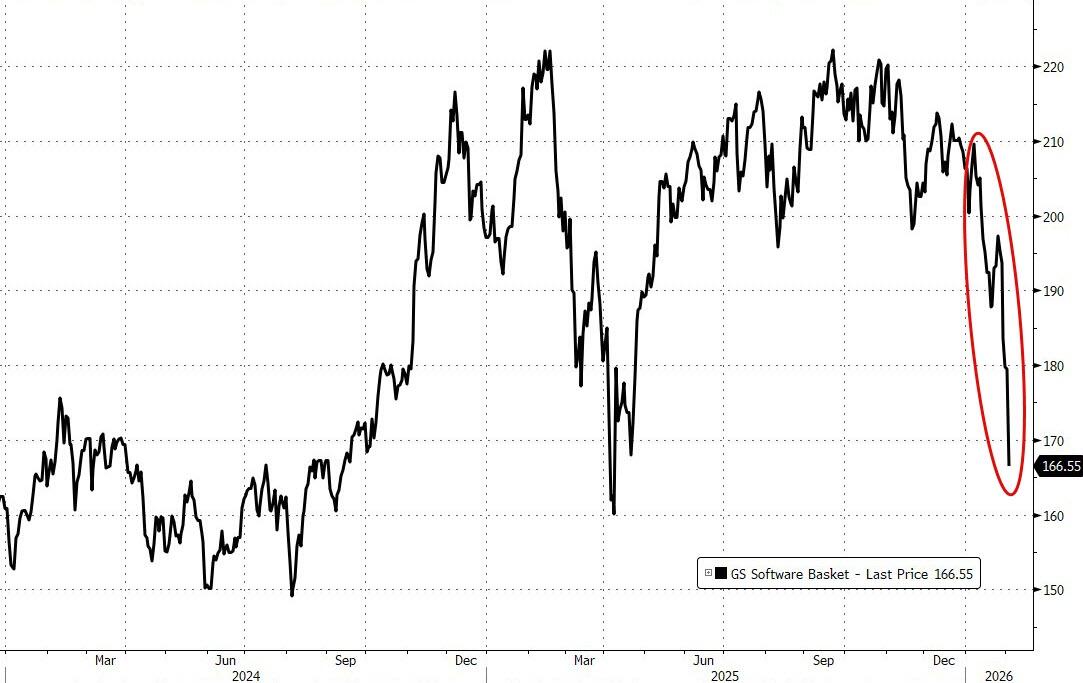
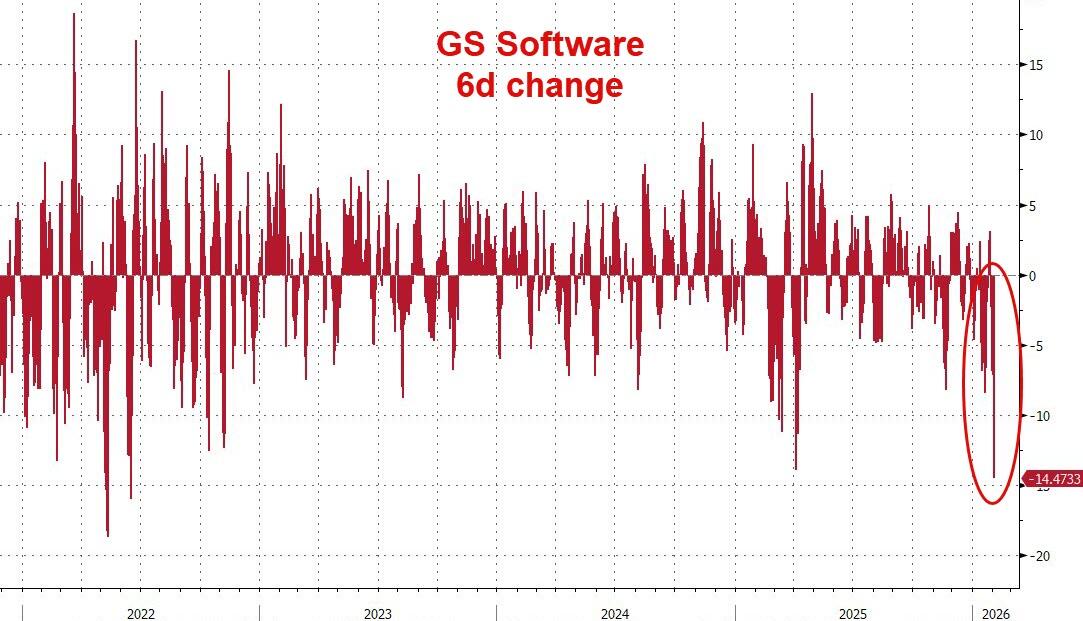
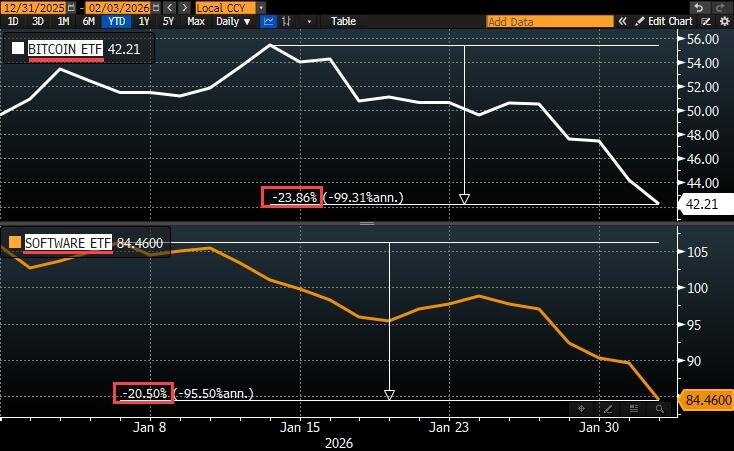
Software trading at its lowest since Liberation Day…with its biggest down-day since then too…
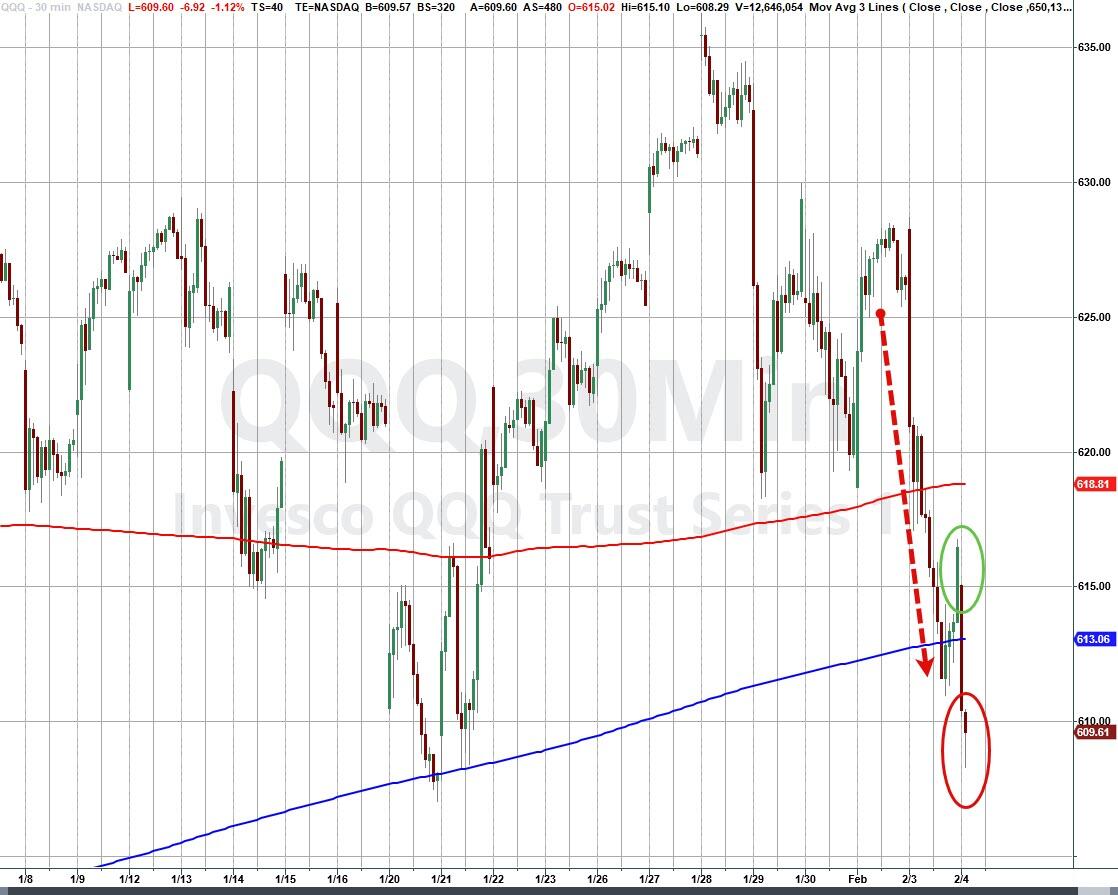
The pain is extending this morning with Nasdaq futures down below yesterday’s lows (and breaking back below the 100DMA)…
“There’s clearly indiscriminate selling across the entire software cluster,” said Karen Kharmandarian, senior equity investment manager at Mirova in Paris.
“There’s no floor, the downward momentum is too strong. It looks a bit like capitulation.”
As Goldman’s Nelson Armbrust confirmed, jitters forming over the past few days have quietly built a tinderbox that suddenly exploded to the downside, with AI and Software concerns significantly broadening out across names & sectors that previously had been immune to the narrative.
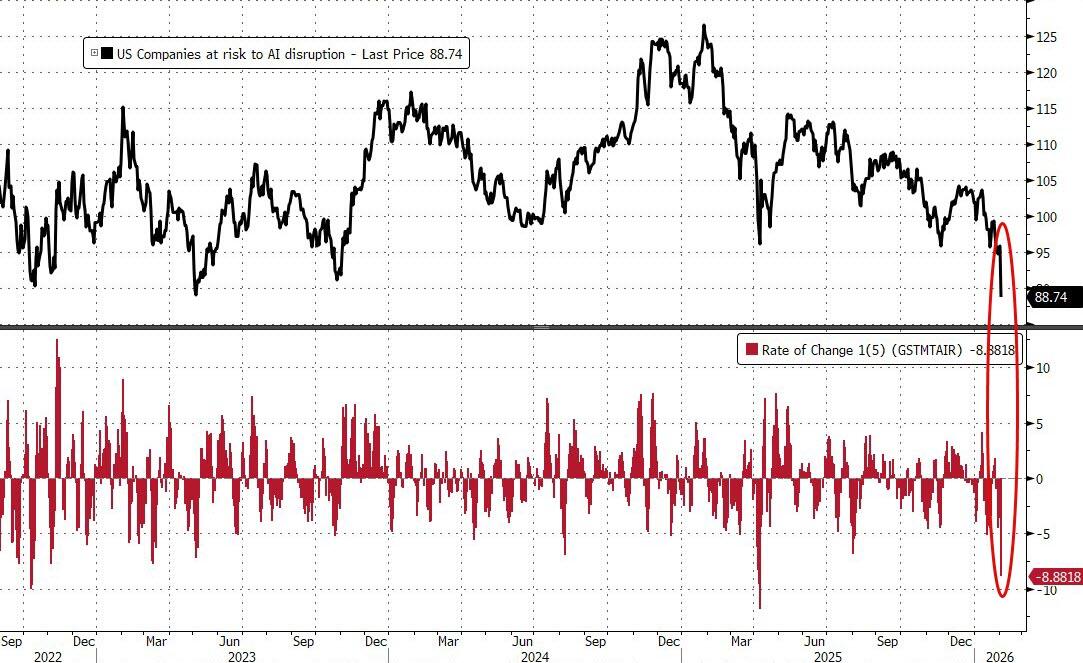
Also, Goldman’s Louis Miller highlighted that AI At Risk had its worst day in nearly 5 years and third worst day on record.
Software was hurting across the board and our Broad Software Basket has now lost $2tn of value from the highs, ~30% drop in market cap. Even though software is now in a bear market and has entered oversold territory, no one is stepping in to defend the complex yet and buyers continue to beware.
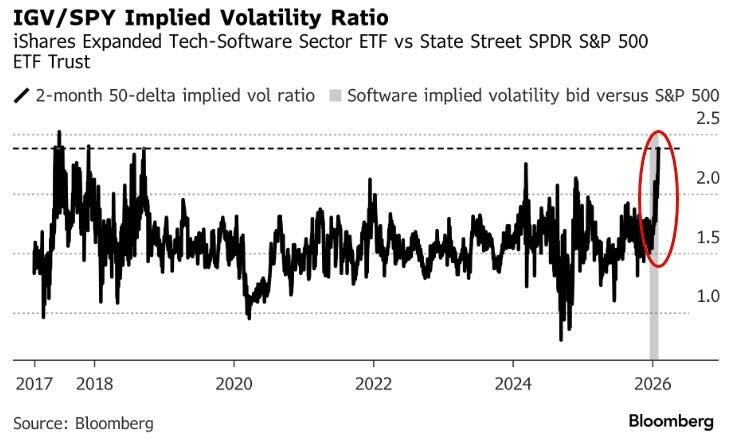
In options-land, the implied volatility of software stocks is blowing out versus the S&P 500 ETF…
So what happened?
Handful of things people are pointing to:
1) Anthropic launched a AI Legal Tech tool,
2) IT earnings (IT earnings in the past had catalyzed some concerns on AI),
3) our EU desk pointed to PUB numbers missing, and
4) the two names US investors try to ‘fight the AI narrative’ in, Adyen and LSEG, were both notably underperforming overnight – which we think had rattled many in the info services space prior to market open.
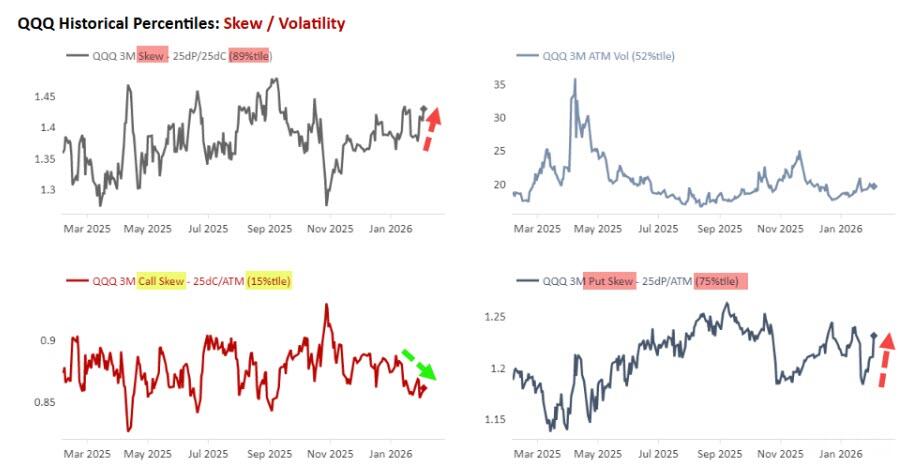
Vol, vVol, Gamma and Skew all moving higher on some Downside hedging (and frankly, ongoing healthy demand for Tails in both S&P and VIX), as the AI trade perversely “eats it own” inside Tech, with the Software “existential crisis” really picking-up velocity, knocking-into Credit space-concerns and causing some serious “Dispersion / Rotation” within Equities Leadership, out of “Expensive” legacy Growth and into “Cheap” Value
Nomura’s Charlie McElligott points out that there is a fair bit of the US Equities “From Tailwind to Headwind” potential of the AI story going from ’25 into ’26 is the now well-socialized implications of:
1) the “Cashflow for Capex Burn” and even more expansive funding needs for the AI Hyperscalers this year, with major implications for Credit issuance as a rare “Spread widener” impulse just on $magnitude alone…
…along with 2) said “Cash Burn” then too having tangible negative implications as a “flow” change of Corporate Stock BUYBACKS as well.
The Macro “Real Assets over Fiat” -story has obviously been a 30k foot theme in recent months, with regard to “Fiscal Dominance” and big deficits being run global, piling onto the “dis-ease” of US policy volatility overall feeding the white-hot performance of Metals (Precious primarily, but a little bit of Base as well) relative to the “Fiat Debasement” and De-Dollarization” -narratives trending in the market over recent months….
But it’s actually quite interesting now where too on the Equities / Corporate level, there’s a derivative -theme of said “Real over Digital” playing-out in violent fashion: If the nature of the business you’re in is selling Digital goods and services as the “profit model” (SaaS and BITCOIN even, lol) vs selling “Real Things,” you’re getting cooked on the Anthropic / “AI Disruption” implication fears hitting meaningfully ahead of schedule, i.e. Anthropic / Clawdbot almost single-handedly launching the Software sector into oblivion in recent weeks…
No one is interested in buying the dip…
…according to JPMorgan analyst Toby Ogg, and even good earnings won’t be enough, since AI disruption is a long-term issue.
“We are now in an environment where the sector isn’t just guilty until proven innocent but is now being sentenced before trial,” he said.
Bloomberg reports that Ogg met more than 50 investors across Europe and the US over two weeks and said he found that they had significantly reduced software holdings over the past 12 to 18 months.
Even after the latest pullback, “the general appetite to step in remains generally low,” he said in a client note.
For software companies, “better-than-expected results are no longer enough to convince the market,” Ogg wrote.
That’s unless “they can demonstrate irrefutably that AI is a sustainable tailwind to growth rather than a longer-term headwind,” he said.
What’s more, if software companies use their own AI tools to adapt products, their previous revenue models would face transition risks. Eventually, any new launches from leading AI platforms, such as the latest legal offering by Anthropic, will exacerbate investor concerns around the sector, Ogg said.
Morgan Stanley’s Quant Desk offers some insights into today’s action: Lots of questions on how such a seemingly rotational market is ending up in broadly lower equities today.
While there are big gaps between winners and losers (dispersion is in 99th %ile), part of the issue is that the other natural side of Software – i.e. Semis – is already very, very full per MS PB content – and so is failing to rally (MSXXSEMI at -4% is underperforming it’s beta by almost 1%).
In addition, HFs are coming off one of the biggest days of long adds over the last year per MS PB Content, and investors have been quick to reverse recent flows this year when there is volatility. The retail bid also slowed some since noon (although showing some signs of life in the last few minutes) which is weighing on broader markets.
With equities lower, supply from systematic macro strategies (CTAs, vol control, risk parity) has the potential to grow given elevated equity leverage sitting in the 90th %ile vs the last 5 years. If SPX ends the day at -1%, equity supply in the next week is modest at -$8bn (-0.3 z-score magnitude), but at -1.5%, that grows to $20bn (-0.8 z-score magnitude), and at -2% that grows to $35bn in the next week (-1.1 z-score magnitude), some today but mostly spread over the next few days.
QDS flagged earlier that S&P 500 option dealers are long ~$8bn of gamma / 1% move at spot and marginally longer on down moves (or about $10bn of delta demand with SPX at -1.4%), which can provide some intraday cushion to US equities…
…but levered ETF rebalancing flow is expected to be larger, given much of the levered ETF short gamma is benchmarked to Tech, which is underperforming. With NDX -2.3% and SPX -1.4%, levered ETF rebalancing supply is est. to be over $11bn today (with $8.5bn of that supply in NDX/Semis/Tech). $11bn of levered ETF supply would be in the top 50 largest days on record on QDS’s estimates.
What’s the credit market saying?
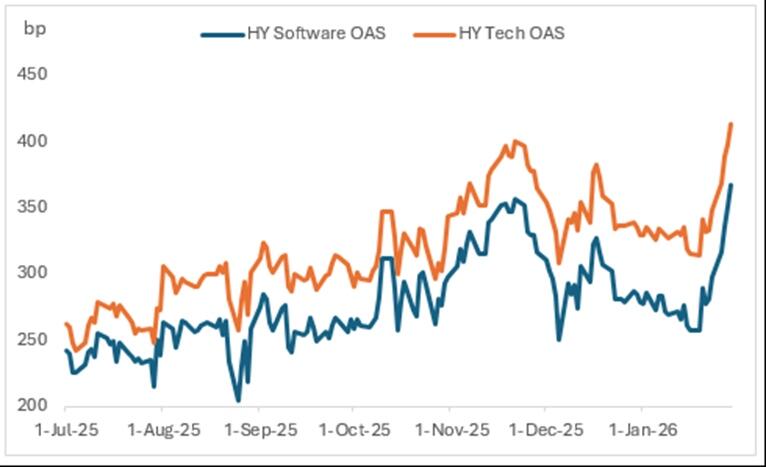
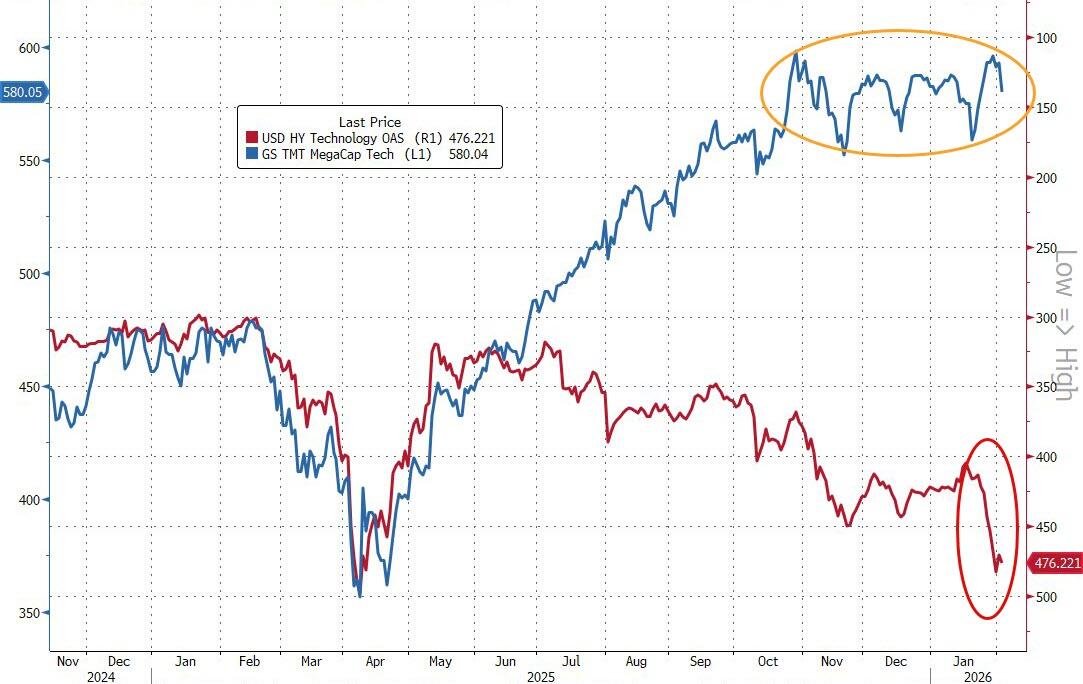
Spreads in High yield software and tech are both moving higher.
Further, as we detailed here, Goldman’s Christian Degrasse notes that software loans make up ~16% of the leveraged loan markets.
KEEP AN EYE ON SPREADS HERE, as Goldman’s credit team is noting that software’s ~16% mix of the leveraged loan market is similar to energy in ‘15/16, or Utilities post ’02.
Could we get a bounce?
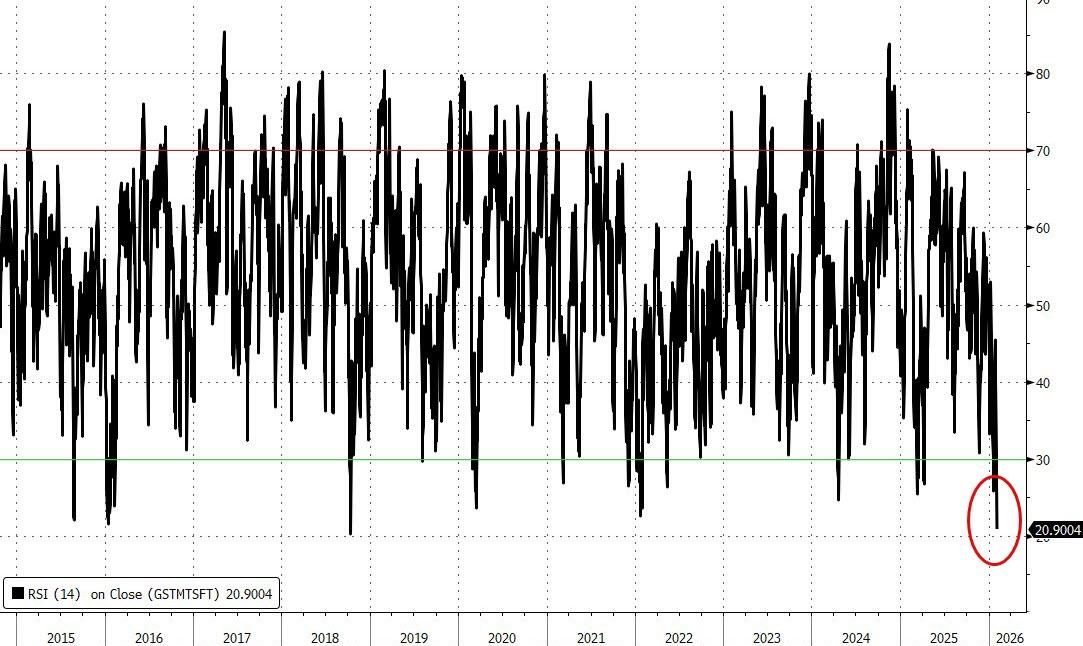
The RSI of the Software sector is at 20 – massively oversold – the most oversold since 2018…
…but, as Goldman notes, flows continue to be skewed to selling with no buyers stepping in…
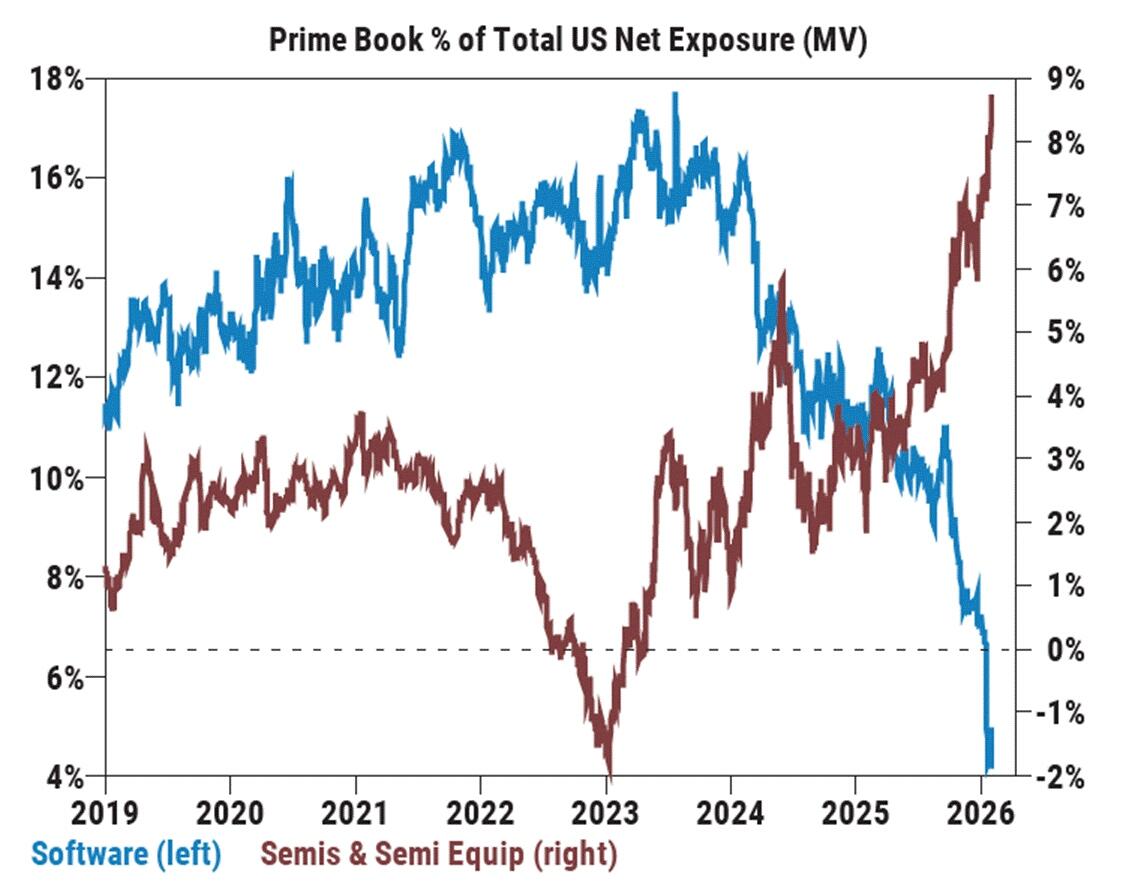
Software is by far the most $ net sold subsector across all sectors YTD. Software net exposure (as % of total US net MV) finished at a new record low of 4.2% (vs. 7% at start of 2026 and historical peak of 17.7%) last week.
Where is capital flowing to?
Single-Stocks – Goldman’s desk continues to see signs of asset manager buying across cyclicals (transports & trucking names stand out with SAIA, ODFL, and JBHT some of our desks favorite names, as well as pockets of materials), & defensive pockets of REITs and Telcos. We are not seeing panicked/bid-wanted type supply on the desk.
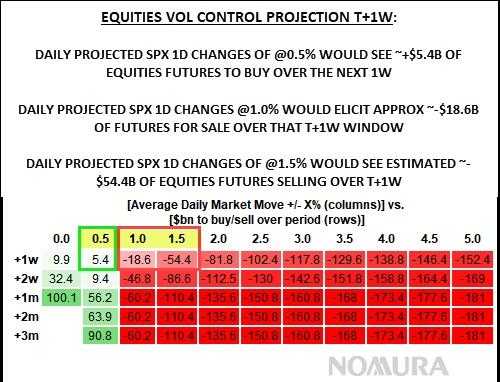
Vol – Flow-wise from here, Nomuras Charlie McElligott notes that Vol Control is a “de-risking flow” potential in the case of a sustained expansion in the Vol move, as currently 1m rVol (10.6 / 33%ile) and 3m rVol (29%ile) have just kinda languished sideways… not wildly low or ready for a shock per-se, but in the case we were to continue sustaining these iVol levels over the next week and 1d projected changes > 1.0% daily, there’s gonna be $exposure reduction (1% daily over next 1w = -$18.6B; 1.5% daily over next 1w = -$54B.4B over next 1w)
Goldman’s top TMT Specialist, Peter Callahan, noted that the market moves were ‘zero sum’:
illustrative of high-single stock volatility and dynamic subsector rotations against a stoic index ….. YTD, the NDX is +30 bps (and ~50 names are up, ~50 names down) … on a 3-month look back, the NDX is -2% (and exactly, 50 names up, 50 names down). Still feels like a lot of single-stock & subsector vol, but not much movement at and index level as rotational trading continues …
Callahan also suggests ‘where to go’
Fair bit of tension out there on ‘where to go’ / ‘what is durable’ as pockets of the long-side look a bit extended to the upside (if only judging by RSIs or YTD performance)…
…whereas, names on the under-side of the portfolio also appear stretched to the downside (yes, lots of SMID/Large-caps down 10-30% YTD).. as such, perhaps not overly surprising to see GARPy or Quality names start to bounce a bit – think: WMT or ADI or CSCO or AAPL or MA in recent days …. Something to watch (and, a thread to pull at to try and expand the list of ‘durable’ long ideas).
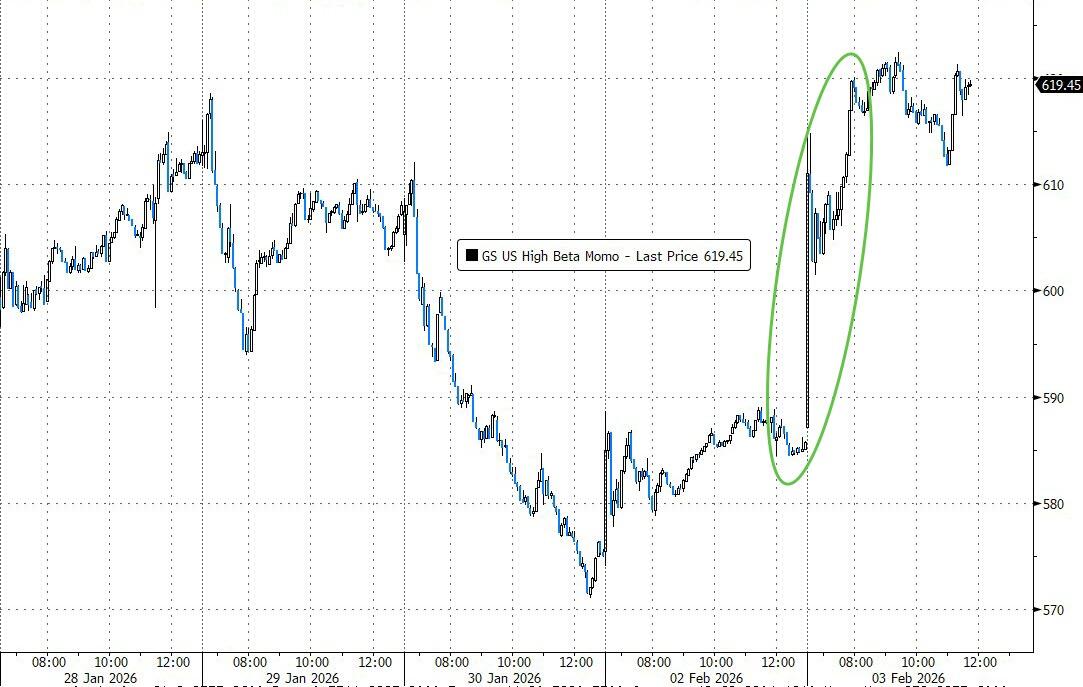
One potential avenue for flows is the rebound in momentum stocks,which were at the top of the leaderboard today…
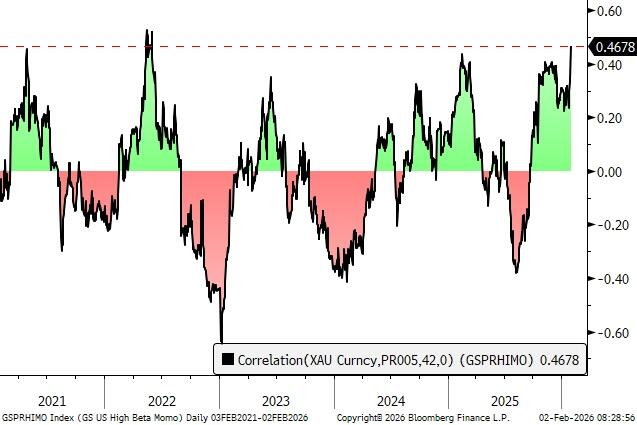
Goldman recently highlighted the correlation between Momentum and Gold is at multi-year highs which is driven by the surge in mining stocks.
The Metals and Mining Industry is at the highest weight in their Unconstrained Long/Short Momentum in years.
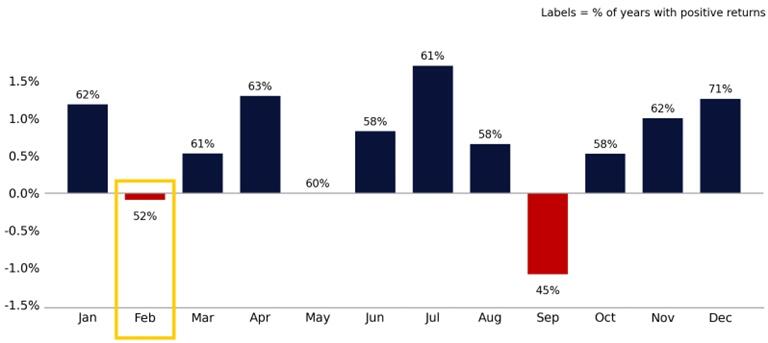
Finally, as we detailed yesterday, historically, February has been the second weakest month of the year, with the S&P 500 averaging -9bps since 1928 and posting the second-lowest hit rate of any calendar month.
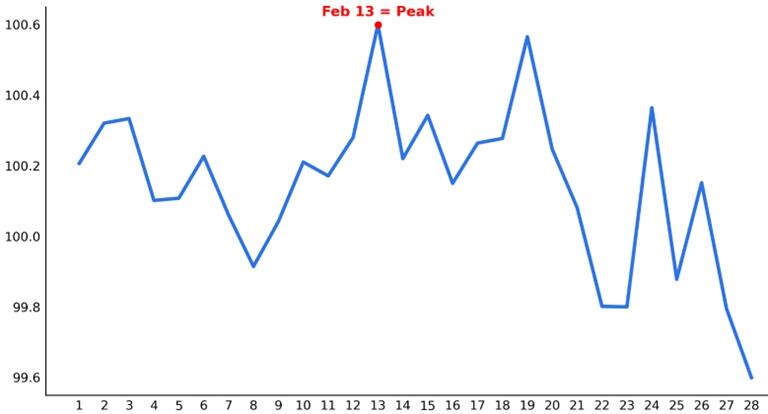
2H February has historically seen more uneven price action, with early gains often giving way to consolidation or pullbacks as early-year positioning settles.
Which is one of the reasons behind Citadel’s Scott Rubner’s call that he has “higher first, then lower vibes for US equities” in February.
Professional subscribers can read much more from Goldman’s Sales & Trading team here at our new Marketdesk.ai portal
Tyler Durden
Wed, 02/04/2026 – 08:35
https://www.zerohedge.com/markets/no-one-buying-dip-traders-react-yesterdays-chaos
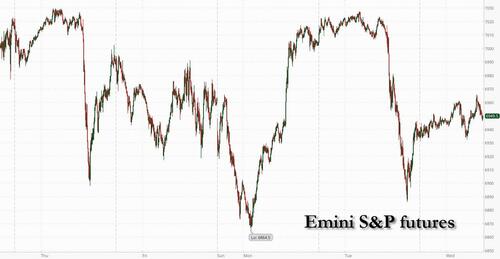
Futures Rise Despite Software, AMD Rout Ahead Of Google Earnings
Futures Rise Despite Software, AMD Rout Ahead Of Google Earnings
US stock futures are up small with Tech lagging on rotation fears, though major indices are off their overnight lows. The AI narrative has been flipped upside down, with traders focused on perceived losers, most of which are in the Software sector, where “there’s no floor” according to one investment manager. As of 8:00am ET, S&P futures are up 0.2%, well off session lows; Nasdaq futures rise 0.2%, pressured by weakness in AMD which tumbled 8% after projections which disappointed Wall Street; Alphabet is set to report after the close. Pre-market, Mag7 are mixed with AAPL, AMZN, and GOOG higher with Semis under pressure (AMD -7%, AVGO -0.8%, NVDA -0.1%). Both Cyclicals and Defensives are mixed without a clear leader. The USD is bid as bond yields are higher by 1-2bps.Commodities are stronger led by Energy and Metals, with gold blasting off back over $5k, and silver rising above $90. Today’s macro data focus is on ISM Services where an in line / stronger print may create a renewed bid for stocks.
In premarket trading, Mag 7 stocks are mostly higher: Alphabet +1% ahead of earnings due after the market close (Microsoft +0.1%, Amazon +0.3%, Apple +0.3%, Nvidia +0.3%, Meta little changed, Tesla -0.06%)
AMD (AMD) slides 9% after the chipmaker’s sales forecast underwhelmed investors, a sign that it’s not making the AI inroads that some on Wall Street anticipated.
Boston Scientific (BSX) falls 9% after the maker of medical devices gave a profit and sales growth forecast for 2026 that fell short of Wall Street’s expectations.
Chipotle (CMG) falls 5% after the restaurant chain operator’s underwhelming annual comparable sales forecast.
Eli Lilly & Co. (LLY) rises 7% after providing an upbeat sales forecast for the year as strong demand for its weight loss drug cemented its position at the top of the obesity market.
Emerson Electric (EMR) rises 4% after the automation technology provider reported 9% growth in underlying orders in its first quarter. Citi said orders and other results show a “largely healthy demand environment.”
Johnson Controls (JCI) rises 8% after the HVAC company boosted its adjusted earnings per share forecast for the full year to a figure above what analysts expected.
Lumen Technologies (LUMN) falls 4% after the wireline telecommunications company’s results and outlook prompted a downgrade from Raymond James.
Lumentum (LITE) rises 10% after the maker of optical and photonic products posted stronger-than-expected second-quarter results and gave a robust forecast.
Match Group (MTCH) jumps 7% after the dating service provider reported revenue for the fourth quarter that beat the average analyst estimate.
Silicon Laboratories (SLAB) jumps 53% after agreeing to be acquired by Texas Instruments for $231 per share in cash.
Sonos (SONO) rises 12% after the speaker company’s first-quarter results beat expectations on key metrics.
Take-Two Interactive (TTWO) rises 5% after the video game publisher raised its fourth-quarter bookings forecast. Analysts are positive about the company reiterating the launch date of its highly anticipated Grand Theft Auto VI.
Uber Technologies Inc. (UBER) falls 6% after giving a weak profit outlook and promoted an outspoken driverless-vehicle bull to be its new chief financial officer, signaling further investment in a closely watched area of the ride-hailing company’s business.
Economically sensitive shares were Wednesday’s biggest gainers, with futures for the Russell 2000 index of small caps advancing 0.4%, while tech treaded water after a historic rout for SaaS/Software names. The rotation into cyclical stocks persisted as renewed fears over AI-driven disruption weighed on markets. Tuesday’s selloff was sparked by a new automation tool from Anthropic PBC, with losses spilling into financial services and asset managers. Caution lingered on Wednesday, with a European basket of stocks seen at risk from AI disruption falling another 1.1%.
“I don’t think the market has fully resolved whether this move was based on fear or fundamentals. What’s clear is that we’ve had a confidence break, really, at the category level,” said Stephanie Niven, portfolio manager at Ninety One. “Before convictions can be rebuilt at that really important company level, we are seeing this kind of indiscriminate selling.”
Disruption fears have added a new layer of complexity in distinguishing winners from losers in AI. With valuations stretched and earnings season under way, investors have already punished companies that failed to live up to elevated expectations. The mood among investors about software stocks and other sectors deemed at risk of AI advances is grim, according to JPMorgan Chase & Co. analyst Toby Ogg. Ogg met more than 50 investors across Europe and the US over two weeks and said he found that they had significantly reduced software holdings over the past 12 to 18 months. Even after the latest pullback, “the general appetite to step in remains generally low,” he said in a client note.
No one is interested in buying the dip, according to JPMorgan analyst Toby Ogg, and even good earnings won’t be enough, since AI disruption is a long-term issue. “We are now in an environment where the sector isn’t just guilty until proven innocent but is now being sentenced before trial,” he said.
“There’s clearly indiscriminate selling across the entire software cluster,” said Karen Kharmandarian, senior equity investment manager at Mirova in Paris. “There’s no floor, the downward momentum is too strong. It looks a bit like capitulation, which could offer opportunities selectively once things stabilize”.
The pain isn’t just in equities, with banks unable to sell a software loan deal. In options, the implied volatility of software stocks is blowing out versus the S&P 500 ETF.
Another test looms for the AI trade when Alphabet reports after the close. The stock has been the top performer among the Magnificent Seven megacaps since the beginning of 2025. Peers Microsoft Corp. and Meta Platforms Inc. saw divergent reactions to their results last week, reflecting views over whether heavy AI spending is paying off.
“The biggest risk regarding tonight’s publication is the fact that there is a decoupling between Google’s long-term stature as an AI winner, thanks to its vertically integrated approach, and short terms trends in search and monetization, which might prove more erratic,” said Jacques-Aurélien Marcireau, co-head of equities at Edmond de Rothschild Asset Management.
European stocks reverse an earlier decline as an initial extension of the Anthropic-sparked software selloff eases. Stoxx 600 now up by 0.3% as gains in telecoms and chemicals offset mixed results from the financials sector and a large drop for drugmaker Novo Nordisk, which sank 16% after a disappointing sales outlook. Here are some of the biggest movers on Wednesday:
Handelsbanken gains as much as 4.4% after posting a top-line beat in its full-year report.
DNB Bank shares rise as much as 3.5% after the Norwegian bank reported net profit ahead of expectations, driven by beats in net interest income and fees.
Mediobanca shares rise as much as 7.8% after MF daily reported that the board of the Banca Monte Paschi di Siena is begining to tilt toward a delisting of the taken over bank.
Wendel shares rise as much as 7% after Germany’s Henkel agreed to buy Stahl Parent from Stahl Group, which is majority-owned by the French investment firm. BASF and Clariant also have stakes.
AMS Osram shares rise as much as 13% after agreeing to offload its sensor business to Infineon for €570m in cash.
Novo Nordisk shares plunge as much as 20% in Copenhagen after the drugmaker forecast a steep decline in sales this year that was also wider than analyst expectations.
Software, IT, data services, ad agencies and exchanges are among the equity sectors leading losses in the European session on Wednesday, as they extend a selloff following persistent investor concerns over potential disruption from AI tools.
UBS shares dropped as much as 5.5% despite a beat on 4Q earnings as it announced a below-expected $3 billion buyback program for 2026 that could increase during the year and maintained its financial targets for 2028.
Santander shares drop as much as 5% after the Spanish lender announced the acquisition of Webster Financial in a $12 billion deal.
Watches of Switzerland tumbles as much as 5.1% after the watch retailer cut the midpoint of its margin goal, countering the improved outlook for sales growth.
DSV falls as much as 4.5% after the Danish shipping and logistics group guidance for 2026 disappointed, overshadowing decent 4Q figures.
Novartis shares drop as much as 3.1% after the Swiss drugmaker reported net sales for the fourth quarter that missed expectations, while its 2026 Ebit forecast was also below estimates.
Atalaya Mining Copper shares fall as much as 8.9% to 937 pence, slipping below the offering price after holder Trafigura Group sold 14 million shares at 945 pence per share.
Earlier in the session, Asian stocks slipped in another session dominated by technology concerns, after a broad selloff in the US on fears of disruption from artificial intelligence. The MSCI Asia Pacific Index fell as much as 0.6%, with software makers among the biggest decliners after Anthropic’s launch of a new automation tool. Hong Kong led losses and Japan’s Nikkei 225 also dropped, while stocks rose in South Korea, Australia and Thailand.
Eli Lilly, Uber and Yum! Brands are among companies expected to report before the market open. Lilly investors will be looking for guidance on how the company sees the obesity market expanding following a deal with the Trump administration to widen access for some patients with Medicare. Rival Novo Nordisk’s guidance fell well short.
In FX, the dollar is stronger and the yen extended losses for a 4th session as traders anticipated a victory for Prime Minister Sanae Takaichi’s Liberal Democratic Party in this weekend’s poll.
In rates,treasuries are slightly cheaper across the curve, with yields around 1bp higher vs Tuesday’s close and lagging European bonds, which are higher after euro-area January inflation data and services PMIs. US session includes ISM services gauge, following Treasury quarterly refunding announcement at 8:30am. US 10-year yield near 4.28% is more than 1bp cheaper on the day while German counterpart is richer by about 2bp; UK 10-year is higher by less than 1bp European bonds rising and outperforming gilts and Treasuries. Euro-zone inflation cooled to the lowest level in more than a year.
In commodities, gold moves back above $5,000/oz and silver up to around $89/oz. Oil prices up, Brent above $67/barrel. Bitcoin hovered near $76,000.
The dollar and Treasuries were little changed.
US economic calendar includes January ADP employment change (8:30am), January final S&P Global US services PMI (9:45am) and January ISM services index (10am).Fed speaker slate includes Governor Cook on monetary policy and the economic outlook at the Economic Club of Miami (6:30pm)
Market Snapshot
S&P 500 mini little changed
Nasdaq 100 mini little changed
Russell 2000 mini +0.3%
Stoxx Europe 600 little changed
DAX -0.1%, CAC 40 +0.7%
10-year Treasury yield +1 basis point at 4.28%
VIX -0.1 points at 17.94
Bloomberg Dollar Index +0.2% at 1189.69
euro little changed at $1.1814
WTI crude +0.7% at $63.66/barrel
Top Overnight News
Donald Trump reiterated that the US and Iran are maintaining diplomatic talks, even after an American warplane shot down an Iranian drone in the Arabian Sea. BBG
Trump’s Federal Reserve chair nominee Kevin Warsh faces a battle in the Senate after lawmakers threatened to hold up his confirmation until the DoJ halts its probes into Jay Powell and Lisa Cook. FT
Nvidia is nearing a deal to invest $20 billion in OpenAI as part of its latest funding round, people familiar said. BBG
Prime Minister Sanae Takaichi should not count on the Bank of Japan’s help in taming sharp bond yield rises given the huge cost of intervention, including the significant risk of igniting unwelcome yen falls, sources say. RTRS
Hedge funds are using leverage to reap 28% returns from the safest of bonds. A key ingredient is their use of borrowed cash to juice returns, in some cases amplifying positions up to 15 times their initial investment. BBG
Investors are ramping up bets on higher long dated Treasury yields and a steeper yield curve as incoming Federal Reserve Chair Kevin Warsh is expected to press for interest rate cuts while shrinking the U.S. central bank’s balance sheet. Warsh’s preference for a materially smaller Fed balance sheet, currently around $6.59 trillion, implies a withdrawal of meaningful government demand for Treasuries, a move which tightens financial conditions because the central bank is not providing liquidity to the market. RTRS
Euro-area inflation slowed to 1.7% in January, the weakest reading in more than a year and further below the ECB’s 2% target. BBG
Novo shares plunged after the drugmaker forecast sales decline of up to 13% in 2026, amid price pressure in obesity drugs. But Eli Lilly LLY is now +8% in the pre on Strong 4Q GLP-1 Momentum + Guidance Ahead of Street Quelling Last Minute Fear from NVO Guide. BBG, GS Trading
NVDA CEO Jensen Huang dismissed fears that artificial intelligence will replace software and related tools, calling the idea “illogical”, after a significant selloff in global software stocks on Tuesday. RTRS
Department of Labor said all agencies will fully resume to normal operations from the 4th of February 2026.
Trade/Tariffs
US Senators push for USD 70bln funding deal to support US President Trump’s critical minerals agenda, FT reported.
Indian Trade Minister said the US trade deal will offer a competitive advantage to Indian exporters and our priority is to energy security for our citizens. Need to bolster capabilities in many sectors including nuclear energy and data centres. India will raise trade with the US.
A more detailed look at global markets courtesy of Newsquawk
APAC stocks were ultimately mixed as the region partially shrugged off the downbeat handover from Wall Street, where sentiment was mired by renewed tech-selling, while participants in the region also reflected on the latest Chinese PMI data and the end of the partial US government shutdown. ASX 200 climbed higher with the upside led by outperformance in miners as metal prices continued their recovery, but with gains in the index capped by heavy losses in the tech sector. Nikkei 225 slumped at the open but is off worst levels, while risk appetite was pressured following recent earnings, including disappointing results from Nintendo, which saw its shares suffer a double-digit percentage drop. Hang Seng and Shanghai Comp saw two-way price action as participants digested stronger-than-expected Chinese RatingDog Services PMI data, and after the PBoC drained liquidity, while it was also reported that NVIDIA AI chip sales to China are stalled by a US security review and that Chinese customers are meanwhile not placing H200 chip orders with the company.
Top Asian News
China’s market regulator unconditionally approves CATL (3750 HK), Chery (9973 HK) and others joint venture formation.
China’s Vice Finance Minister said China is facing persistent headwinds and policy uncertainty.
New Zealand ANZ Commodity Price Index MM (Jan) +2.0% (Prev. -2.1%).
European bourses (+0.1%) are broadly firmer across the board, though the DAX 40 (-0.1%) has been pressured by post-earnings losses in Infineon (-2.3%). European sectors hold a positive bias. Telecoms and Chemicals leads whilst Healthcare is the clear laggard, hampered by post-earning losses in Novo Nordisk (-17.6%) and Novartis (-1%). The former reported strong headline metrics, though its 2026 guidance disappointed.
Top European News
Germany sold EUR 3.197bln vs exp. EUR 4.0bln 2.50% 2032 Bund: b/c 1.51x (prev. 1.2x), average yield 2.60% (prev. 2.33%), retention 20.1 (prev. 23.87%).
Germany’s VDA announces that 2025 EV production comes out at 1.67mln vehicles, +23% Y/Y.
Europe’s safest corporate bond spreads drop to its lowest level since 2007.
Central Banks
Fed Governor Miran resigned on Tuesday from his position as Chair of Council of Economic Advisers, Barron’s reported citing a White House official.
BoJ won’t come to the rescue of a Takaichi-driven bond rout, with sources stating that Japanese PM Takaichi should not count on the BoJ’s help in taming sharp yield rises given the high cost of intervention including risk of igniting unwanted yen declines.
PBoC announces plan to build a multi-level financial service system to support domestic demand, tech innovation and SMEs. To continue to support debt risk resolutions for financing platforms, back local government in market oriented reforms and guide financial institutions to provide services based on marker and legal principles.
Riksbank Minutes: President Thedeen said “at present I assess that monetary policy is following a stable and reasonable course, and we can tolerate minor deviations in data outcomes without immediately needing to adjust the course we have set.
FX
DXY resides within a narrow range within Tuesday’s 97.298-97.692 range after seeing weakness yesterday against most major peers, giving back some of the post-ISM spoils, while JOLTS data was delayed, and there were several comments from Fed speakers, but failed to move the dial. Overnight, US President Trump signed the USD 1.2tln spending bill to end the government shutdown, as expected, and thus NFP will likely be released next week (TBC). Today, however, desks are eyeing the private ADP and ISM Services PMIs.
JPY is the underperformer vs the USD, EUR, and GBP, as the Japanese currency continued to lag amid the ongoing expectations for a landslide victory by Japanese PM Takaichi’s ruling LDP at the snap election on Sunday. USD/JPY topped yesterday’s 156.08 peak to print a current high of 156.59, but is still some way off the 23rd Jan high of 159.23.
EUR/USD trades flat with little notable action seen on the Final Services and Composite PMIs. Little move also seen on the EZ HICP metrics, which were broadly in-line / cooler-than-expected. A report which will have little impact on policymakers at the ECB, who are set to meet on Thursday – as a reminder, the Bank is expected to keep its deposit rate steady at 2.00%.
GBP/USD sees modest gains and narrowly gains despite the revisions lower in Final PMIs, but likely lifted by the GBP/JPY pair testing highs from 23rd Jan as the cross looks to test 215 to the upside, residing at levels last seen in 2008.
Antipodeans are mixed with the Aussie buoyed by rebound in gold prices, whilst the NZD posts losses following ultimately mixed employment and labour cost data from New Zealand.
Fixed Income
USTs are essentially flat in quiet trade and currently trading in a narrow 111-17 to 111-21+ range. Focus overnight was on the end of the US shutdown after the House voted (217-214) to pass the USD 1.2tln spending package to fund the government. Following this, the Department of Labor announced that all agencies will fully resume normal operations from the 4th of February 2026; there are currently no further details or guidance on whether the NFP due on Friday will be released.
Nonetheless, focus turns to US data later; the monthly ADP national employment data will be released, where analysts expect 48k from the prior 41k. The ISM services PMI headline is expected to ease to 53.5 from 54.4, where employment is seen nudging up a little, but prices and new orders are seen easing a touch. From the supply front, the QRA is also due today.
Bunds initially held a downward bias but then gradually picked up as the morning progressed; currently at the upper end of a 127.72-127.88 range. There have been a number of Final PMI metrics this morning, with the EZ figure revised a touch lower; the accompanying report suggested that the ECB may highlight growing services inflation in its policy decision this week. EZ HICP printed in line with expectations, and cooled from the prior; core metrics were a touch short of expectations. Overall, a report which will not shift much ahead of the ECB confab on Thursday. As a reminder, the Bank is expected to keep its deposit rate steady at 2.00% and largely reiterate that rates are at a good place. Next up, a 2032 Bund auction.
Gilts are essentially flat and trade within a 90.88-91.06 range. Action has been fairly choppy this morning, but has moved off its best levels in recent trade. Aside from the UK’s PMI (revised a touch lower), catalysts for the benchmark are incredibly light. Focus now on the BoE on Thursday, where rates are expected to be kept unchanged.
UK DMO plans to hold a programmatic gilt tender for a long conventional gilt on February 11th.
Australia sold AUD 1.1bln 4.25% 2036 bonds, b/c 3.73, avg. yield 4.9012%.
Commodities
Crude benchmarks initially held onto the gains seen in the latter end of Tuesday’s session, which came from reports that the US shot down an Iranian surveillance drone approaching the USS Abraham Lincoln. WTI and Brent peaked at USD 64.16/bbl and USD 68.25/bbl, respectively, early in the APAC session, just shy of Tuesday’s high, before steadily paring back and retracing to the key USD 63/bbl and USD 67/bbl handle.
Spot XAU continues to rebound, with the yellow metal returning above the USD 5k/oz handle after hovering just shy of the level throughout Tuesday’s session. Gold rose throughout the APAC session, peaking at USD 5092/oz, before oscillating in tight c. USD 40 range. Similarly, spot silver has gradually bid higher and briefly held above USD 90/oz before falling back below the level as European trade continues.
3M LME Copper has thus far traded on both sides of the unchanged mark, fluctuating in a USD 13.29k-13.52k/t band, as risk tone overnight was mixed. Heightened concerns over AI weighed on the tech-heavy NQ during Tuesday’s trading day, and this followed through into Asia-Pacific equities.
Morgan Stanley raises near-term Brent forecasts as geopolitical risk premium is likely to persist, but expects prices to fall below USD 60/bbl later this year.
Ukraine’s Naftogaz said Ukraine has received a delivery of 100MCM batch of US LNG, making it the first delivery expected in 2026.
Venezuela’s top Economic Advisor Ortega said he wants Venezuela to be known as a country with one of the highest oil production levels.
China expands subsidies for energy storage industry as it seeks to support the country’s green transition and ensure reliable electricity supplies.
Geopolitics
Ukrainian peace negotiators have arrived in Abu Dhabi and have started their first meetings, IFX reported.
Russia’s Kremlin said it will defend its interest in the Arctic, via Sky News Arabia.
Russia’s Kremlin said it has not seen any new developments when it comes to India and Russian oil.
Russia’s Kremlin said Russia will continue its Special Military Operation until the relevant decisions are made by Ukraine.
Ukraine’s Naftogaz said Ukraine has received a delivery of 100MCM batch of US LNG, making it the first delivery expected in 2026.
China’s President Xi is to hold a video call with Russian President Putin, CCTV reported.
Iran is to announce major structural and administrative decisions in the defence sector to respond to new threats, Iran’s Noor News reported.
“Deputy Speaker of Iran’s Parliament: Iran and the United States likely reached preliminary understandings before sitting down at the negotiating table”, Sky News Arabia reported.
Israeli artillery shelling reported in central Gaza, via Al Jazeera news.
Israeli army announces airstrikes and tank shelling on militants after an Israeli officer was seriously injured, according to Sky News Arabia. IDF said shooting at our forces is a violation of the ceasefire agreement in Gaza, according to Al Arabiya.
US President Trump said we are still negotiating with Iran and that there is more than one meeting with Iran.
US Event Calendar
7:00 am: United States Jan 30 MBA Mortgage Applications, prior -8.5%
8:15 am: United States Jan ADP Employment Change, est. 45k, prior 41k
9:45 am: United States Jan F S&P Global US Services PMI, est. 52.5, prior 52.5
9:45 am: United States Jan F S&P Global US Composite PMI, est. 52.9, prior 52.8
10:00 am: United States Jan ISM Services Index, est. 53.5, prior 54.4, revised 53.8
6:30 pm: United States Fed’s Cook Speaks on Monetary Policy and Economy
DB’s Jim Reid concludes the overnight wrap
It was a pretty brutal day in markets yesterday that wouldn’t be obvious with a quick glance of the screens, as a majority of the S&P 500’s constituents rose on the day. The reason was that Anthropic launched a new AI automation tool servicing legal work, which was perceived as a big threat to software firms and related stocks. So in Europe, RELX Plc, Wolters Kluwer, Experian, Thomson Reuters, and the LSE all fell around -10 to -15%, while in the US Gartner (-20.87%), Paypal (-20.31%) and Expedia (-15.26%) led the declines in the S&P 500. In turn, the overall US Software index (-4.60%) saw 104 decliners and only 9 risers, and its 6th successive decline to put the index back to April levels. Even the blue-chip Microsoft was down -2.87% and is now down -24% from its peak on October 28 last year.
So yesterday marked a dramatic acceleration of the trend we’d seen of late, and it means the 9 worst-performing companies in the S&P 500 YTD are all in the software and related services sectors, having now seen declines of 25% or more. While the question over the end-winners from AI is unlikely to be answered in 2026, recent months have seen a clear shift in markets from AI euphoria towards more differentiation between companies, and growing concern about its disruption to existing business models.
Those huge moves helped push the S&P 500 (-0.84%) down, despite being on course for another record high at the US open. The Nasdaq (-1.43%) and Mag-7 (-1.53%) clearly suffered more. And they’re still struggling for momentum this morning, with futures on the S&P 500 (+0.04%) basically flat.
To be fair, it wasn’t all bad news yesterday, with most of the S&P 500 constituents moving higher on the day. The ongoing rotation meant materials (+2.00%) and consumer staples (+1.71%) sectors extended Monday’s post-ISM gains, while energy stocks (+3.29%) were boosted by a renewed rise in oil. Those gains included Walmart (+2.94%), which became the 11th US company to reach a $1trn valuation. And the small cap Russell 2000 rose by +0.31% despite being down -1.30% at the day’s lows. Meanwhile in Europe, the STOXX 600 (+0.10%) just about managed to hit another record high, whilst Italy’s FTSE MIB (+0.90%) closed at its highest level since 2000, despite the broader struggles among tech stocks.
Another beneficiary of yesterday’s session were precious metals, which finally showed signs of stabilising after their recent slump. In fact, gold prices (+6.12%) posted their biggest daily gain since 2008, moving up to $4,947/oz, whilst silver (+7.43 %) was back up to $85.16/oz. Clearly they’re still a long way from the highs, but it was clear that dip buyers were coming back in after the biggest slump in decades. And that trend has continued overnight, with gold (+2.72%) now back up to $5,081/oz. The volatility was also visible in Bitcoin (-2.96%), which fell by as much as -7% to below $73k intra-day, which was its lowest level since Trump’s election victory in November 2024.
By contrast, it was a very steady day for US Treasuries, which saw little movement in either direction. In the end the risk-off backdrop sent yields lower, with the 2yr yield (-0.2bps) down to 3.57%, whilst the 10yr yield (-1.3bps) fell to 4.27%. But there were few concrete drivers behind that. Admittedly, we did hear from Richmond Fed President Barkin, who acknowledged the persistence of above-target inflation, and said “I take this sustained miss seriously”. But market pricing for the Fed was little changed yesterday either.
Those moves came as the latest US government shutdown came to end after four days, with the House passing the funding package that had been approved by the Senate last Friday. The legislation, which was then signed by Trump, will fund most government agencies through September, though Congress still faces a showdown over funding for the Department of Homeland Security which was extended only until next Friday (February 13) amid partisan tensions over immigration enforcement.
The market backdrop wasn’t helped by the continued geopolitical noise, with oil prices spiking after news that the US shot down an Iranian drone that approached a US aircraft carrier. Oil marginally pared its gains as the White House said that US-Iran talks led by Steve Witkoff were still scheduled for Friday, with Trump himself saying that “We are negotiating with them right now”. But Brent crude still closed +1.55% higher at $67.33/bbl, and has risen another +0.76% this morning to $67.84/bbl as we go to print.
Earlier in Europe, it was a bit more eventful as the 30yr German yield (+3.4bps) hit a post-2011 high of 3.55%. That comes as investors are increasingly focused on the fiscal stimulus, with higher debt issuance having pushed up long-end bond yields in recent months. Those moves for long-end German yields were part of a wider selloff across Europe, with yields on 10yr bunds (+2.2bps), OATs (+1.7bps) and BTPs (+1.7bps) all moving higher, not helped by the latest rebound in oil prices. To be fair, we did get a downside surprise in the flash CPI print from France yesterday, which fell to just +0.4% in January, thus raising hopes that today’s Euro Area-wide print would come in on the softer side. But the commodity rebound ultimately offset that, and the RBA’s rate hike earlier in the day further added to the sense that hikes elsewhere could eventually be back on the agenda.
Overnight in Asia, we’ve seen a mixed performance this morning. On the positive side, the KOSPI (+1.39%) is at another record high, and the Shanghai Comp (+0.01%) has eked out a modest gain. However, other indices have moved lower, including the CSI 300 (-0.05%), the Hang Seng (-0.17%) and the Nikkei (-0.83%). We’ve also started to see some of the services and composite PMIs from the region, with China’s RatingDog Services PMI up to a 3-month high of 52.3 (vs. 52.0 expected), whilst Japan’s final services PMI reached to an 11-month high of 53.7. However, the Japanese yen has continued to weaken a bit ahead of this weekend’s election, down -0.33% to 156.27 per dollar.
Looking at the day ahead, US data releases include the ISM services index for January and the ADP’s report of private payrolls for January, whilst in the Euro Area we’ll get the flash CPI print for January. Otherwise, we’ll get the final services and composite PMIs for January for the US and Europe. The US Treasury will also be releasing its quarterly refunding announcement, detailing the breakdown of planned issuance. Elsewhere, central bank speakers include the Fed’s Cook, and today’s earnings releases include Alphabet.
Tyler Durden
Wed, 02/04/2026 – 08:29
https://www.zerohedge.com/markets/futures-rise-despite-software-amd-rout-ahead-google-earnings

Olivia Esquivel’s 4 sisters played for Griffith too. ‘They always push me.’ Like she pushes the Panthers.
Olivia Esquivel acknowledges she bears a certain weight as a basketball player at Griffith.
The 5-foot-7 junior point guard is the youngest of five sisters to play for the Panthers.
“I definitely feel like it’s a lot of pressure because they did a lot of good things here,” Esquivel said. “It’s a lot because I feel like I have to meet the standard.”
But Esquivel has been hitting that mark. She averaged 8.5 points, 4.6 rebounds and team highs of 2.3 assists and 3.7 steals during the regular season and scored a team-high 13 points during Griffith’s 50-24 win over West Side in the first round of the Class 3A Calumet Sectional on Tuesday night.
Esquivel is in her third season as a starter for the Panthers (11-11), who will play Greater South Shore Conference champion Bishop Noll (12-10) in the sectional semifinals on Friday, and is carving her own path.
Esquivel’s sisters include Ariel, a 2021 graduate who set the program record for career points, and Marisa, a 2022 graduate who broke that record and became the program’s first player to eclipse 1,000 points. Esquivel’s sisters Briana, who graduated last year, and Jasmine Alvarez, a 2014 graduate, also made an impact.
“They all keep me motivated,” Esquivel said. “They all show up to the games all the time. So any time I feel like I had a bad game or even a good game, they always push me and tell me I did good.”
Olivia Esquivel’s contributions are obvious to Griffith coach Kevin Ballard.
“Liv is my best ball handler, hands down,” Ballard said. “Her basketball IQ is phenomenal. She’s going to look to make a play. Her role is to make sure that she makes plays for other people and scores and plays defense. She plays great defense.
“She passes up shots sometimes for her teammates to make sure they score, but Liv knows she has the green light to get a bucket whenever she wants to. But her game is to make sure that she’s deceptive in terms of making sure other people touch the ball so you can’t figure out what she’s doing every time down.”
Griffith’s Olivia Esquivel passes the ball during a Class 3A Calumet Sectional first-round game against West Side on Tuesday, Feb. 3, 2026. (John Smierciak / Post-Tribune)
Esquivel embraces a pass-first approach.
“I’ve been getting the ball around a lot,” she said. “Ball-handling is my main job on the court, bring it down. I create good opportunities for everyone else as well as getting my own amount a little bit.
“I have more confidence overall this year, just being on the court in general, in everything I do. I feel like I’m more confident. I’m more used to it now.”
Ballard is in his first season as Griffith’s coach. But he said he has known Esquivel since she was in kindergarten. Ballard’s daughter Savannah is a junior at Highland.
“When they had the girls league up here, we used to play up here all the time,” Ballard said. “Our daughters even played AAU one year together in her father’s AAU program. So I’ve known Liv a long time.”
Esquivel is a team captain along with senior guard/forward Morgan Von Ogden and sophomore guard/forward Toni Escobedo.
“She has stepped up her leadership role this year, just making sure she talks to her teammates, getting them in the proper positions,” Ballard said of Esquivel. “And she’s communicating with me, like, ‘What do you need me to do out there?’ Although I’ve told her, ‘If you can read the defense, you can call the play.’
“I ultimately trust her at the end of games. She’s the one player I ultimately trust to have the ball in her hands because I know she’s going to make the right decision.”
Griffith’s Olivia Esquivel (13) drives past West Side’s Noelle Kuykendall during a Class 3A Calumet Sectional first-round game on Tuesday, Feb. 3, 2026. (John Smierciak / Post-Tribune)
Esquivel was a captain last season too.
“She’s really knowledgeable,” Von Ogden said. “If you have questions at all about basketball, whether it’s the rules or the best plays to be doing or even the best defense, she will have the answers. She’s just very knowledgeable.
“She’s also a very good leader. She won’t make you feel bad about asking a question. She’ll just explain it to you. She’s just a really good leader.”
Von Ogden is the lone senior on a roster that includes six freshmen.
“Whenever we’re doing drills or learning new plays, I try to do whatever I can,” Esquivel said. “If they have any questions, I’m always there to push them to go harder.
“We’re all really close to each other. That helps us a lot on the court. We jell really well together as a team.”
https://www.chicagotribune.com/2026/02/04/griffith-high-school-basketball-olivia-esquivel/