Category: News
Futures, Bitcoin, Gold All Tumble As Momentum Liquidations Accelerate
Futures, Bitcoin, Gold All Tumble As Momentum Liquidations Accelerate
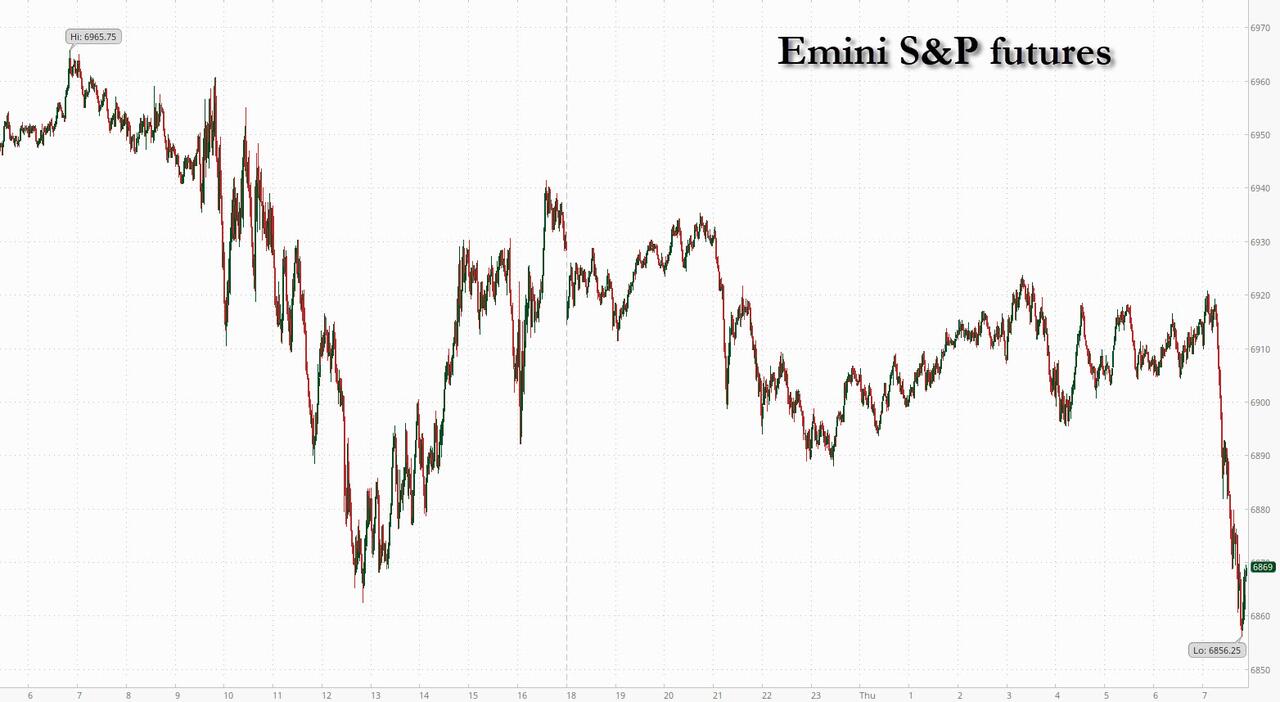
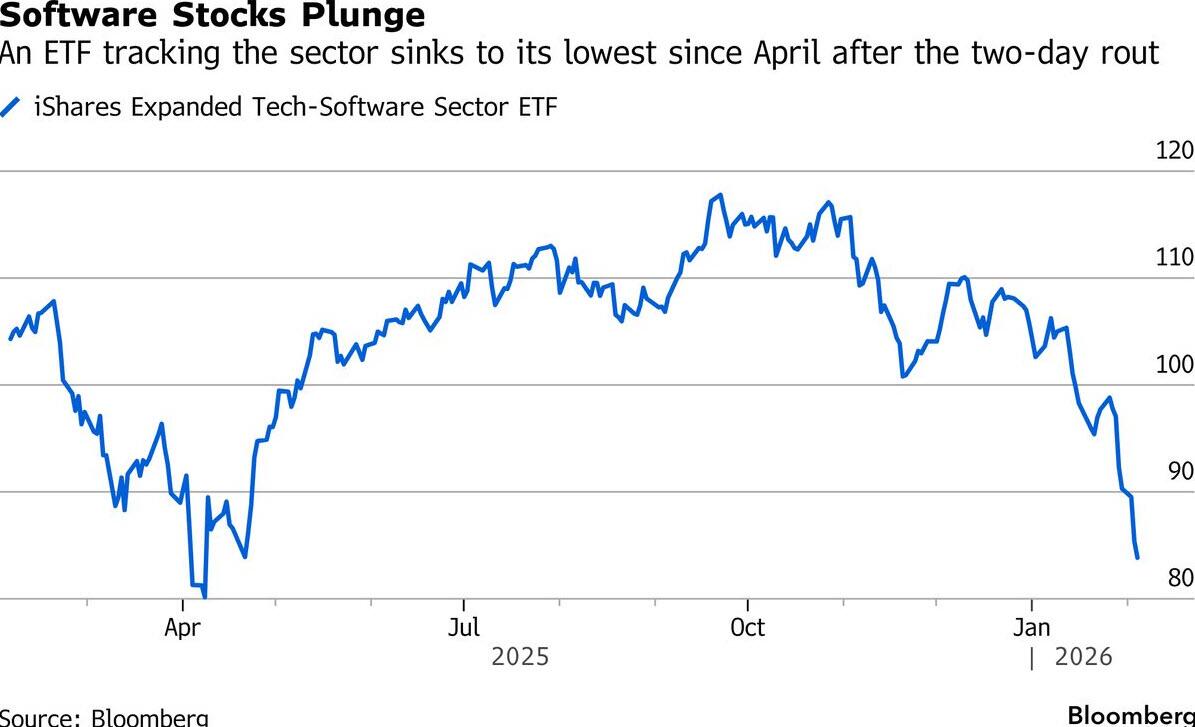
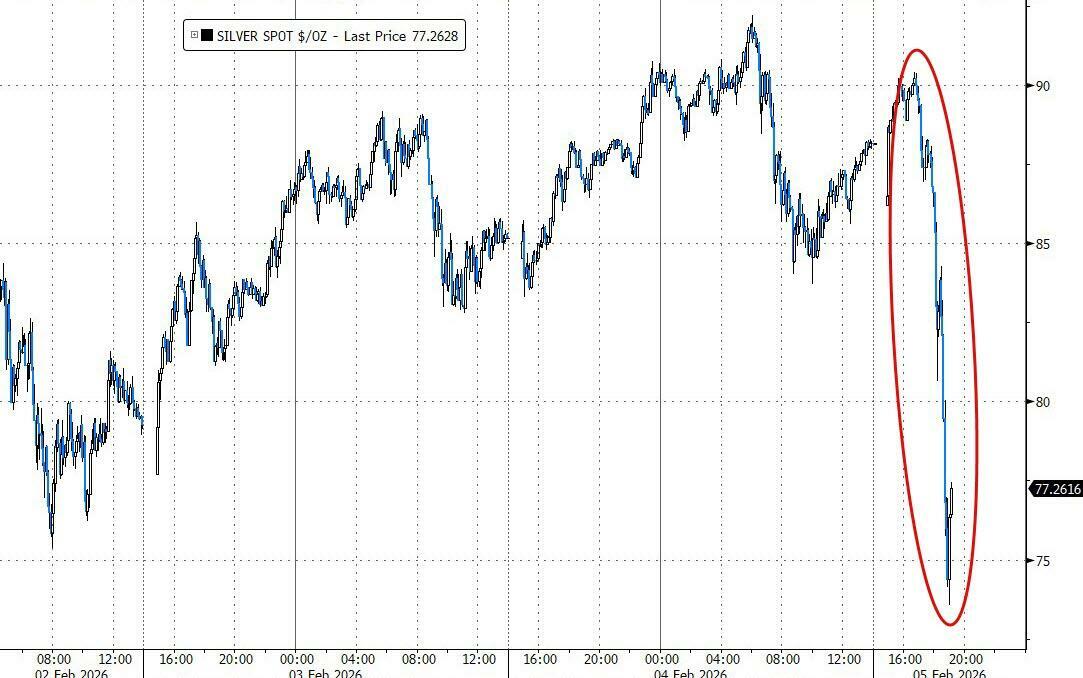
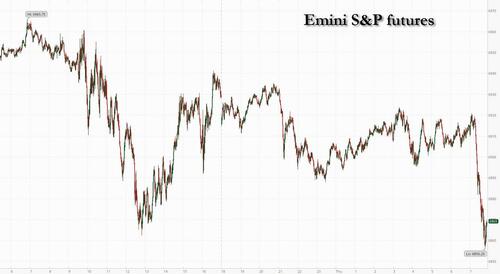
Stock futures slide, hitting session lows just after 7am ET, after a two-day drop that saw an ETF tracking software stocks sink to its lowest since April. As of 8:00am ET, S&P 500 futures have slumped to session lows, down 0.7% following a sharp slide just after 7am ET; Nasdaq 100 futures are also sharply lower, dropping 0.8% after the index wiped out its gains for the year over the prior two sessions. Alphabet is lower in after it said capex will reach as much as $185 billion this year, double what it was in 2025 and far more than the $120 billion analysts had predicted. Pre-market, Mag7 are all lower but GOOG’s capex guidance is boosting some semis who will benefit from the extra spending. This morning, the tech selloff was joined by a resumption in the precious metal liquidation as silver plunged -15% during China hours, and gold slid 3% following yesterday’s Momentum unwind (which continues today). The USD reversed all gains and traded near session lows as 10Y yields also dropped to session lows just over 4.25%. Today’s macro focus is on the jobs including claims and Challenger job cuts. We get Amazon earnings after the close.
In premarket trading, Mag 7 stocks are all lower: Alphabet (GOOGL) falls 4% after the Google parent forecast full year 2026 capital expenditures of up to $185 billion, far exceeding consensus estimates. Analysts said the jump in spending may concern some investors, while others said it underscored the company’s confidence with AI (Nvidia drops 0.1% alongside AI infrastructure peers; Tesla -1%, Amazon -1%, Meta -1%, Apple -0.2%, Microsoft -1.8%)
Align Technology (ALGN) climbs 11% after the medical devices firm reported adjusted earnings per share for the fourth quarter that surpassed Wall Street’s estimates.
ARM Holdings (ARM) falls 7% after the company’s sales forecast disappointed investors, who are concerned about a slowdown in the smartphone market.
Carrier Global (CARR) falls 6% after the HVAC company forecast full-year sales below what analysts expected. The company said it expects market conditions from the second half of 2025 to continue this year in its Americas residential business, which has struggled with weak demand.
Elf Beauty (ELF) jumps 4% after the cosmetics company boosted its adjusted Ebitda guidance for the full year, beating the average analyst estimate. Analysts highlight strong performance in its newly-acquired Rhode, Hailey Bieber’s beauty and skincare brand.
Estée Lauder Cos. (EL) tumbles 12% after its outlook boost failed to reassure some investors about the pace of the cosmetics conglomerate’s turnaround.
Fluence Energy (FLNC) drops 17% after the energy storage technology company’s fiscal first quarter revenue fell shy of analyst estimates.
Hershey Co. (HSY) rises 3% after offering a better-than-expected 2026 outlook as higher prices and new products bolster the candymaker’s performance.
KKR & Co. (KKR) slips 2% after agreeing to acquire sports and secondaries investor Arctos Partners in a $1.4 billion deal, in a major push into a booming industry.
Qualcomm (QCOM) falls 11% after the chipmaker’s revenue forecast was weaker than expected. The company said its “near-term handsets outlook is impacted by industry-wide memory supply constraints.”
Symbotic (SYM) is up 5% after the technology firm forecast total revenue for the second quarter that topped the average analyst estimate.
In other company news, HSBC is said to be preparing to hand some bankers little or zero bonuses in a move to get some underperforming staff to depart. Shell profits slumped in the fourth quarter, hit by lower crude prices and a weak oil-trading performance.
Traders are weighing whether the flight from tech has been excessive, driven by concerns over disruption from artificial intelligence, lofty valuations and vast capital outlays. Sectors that stand to gain from faster economic growth have been the main beneficiaries of the shift. As for the biggest losers, the answer is easy: software, which the market has convinced itself will not exist thanks to AI agents.
“Three quarters of software stocks are in oversold territory, and the momentum trade that has been the way to play tech and software last year is under severe pressure,” said Andrea Gabellone, head of global equities at KBC Securities. “I expect reason to come back to the table and a rebound shortly,
AI remains top of mind, with one Wedbush trader saying that “Alphabet’s mic drop capex highlights haves versus have nots in AI capabilities, commitment and balance sheet.” There are only a few companies that have the ability to spend more on AI and see ROI across their entire ecosystem, said Joel Kulina, managing director for TMT trading at Wedbush Securities. Alphabet, Meta and Anthropic are on his list.
The impacts of AI are rippling elsewhere. Shares of Qualcomm and Arm are sharply lower on concerns that a shortage of memory chips will limit phone production. Traders are looking for the floor for AI losers, with Jefferies’ trading desk predicting the group is due for a “vicious rally” but Morgan Stanley’s Quants warning that the selling is just starting.
Futures for the Russell 2000 small cap index continued to outperform those for the S&P 500. In another sign that appetite for diversification remained strong, the rolling four-week average inflows into consumer staple stocks have reached a record, according to Bank of America analysts. These inflows hit the highest level on an absolute basis and by percentage of market capitalization since the bank started tracking client fund flow data in 2008, Jill Carey Hall, an equity and quant strategist, said in a Wednesday note.
“We don’t see it as a big plummet in tech stocks, we see it more as the rest catching up in terms of earnings,” Shanti Kelemen, co-chief investment officer at 7IM, told Bloomberg TV.
Overall positioning in equities remains elevated, despite a broad unwind in crowded trades, leaving stocks vulnerable to downside moves in the near term, according to JPMorgan’s cross-asset indicator. Positioning changes across many assets were largely modest this past week with the exception of a severe reduction in long positions in silver. And speaking of silver, a sudden 17% plunge wiped out a two day recovery, as the commodity struggled to find a floor following a historic rout. Gold traded near $4,900 an ounce. Bitcoin slumped below $70,000, a level last seen in 2024 amid wider cross-asset stress.
This morning, the Bank of England came within a vote of cutting interest rates as policymakers split 5-4 in favor of holding at 3.75%. The pound extended losses after the decision, having been under pressure as a fresh round of political turbulence weighed on UK assets. Shorter-end gilts jumped as traders ramped up bets on a rate cut in March, sending two-year yields eight basis points lower to 3.62%.
In geopolitics, China is asking state firms to halt talks over new projects in Panama. The Trump administration hosted a critical minerals summit with 55 countries to reduce dependence on China, with the US pitching price floors and US private equity investment.
Out of the 254 S&P 500 companies that have reported so far in the earnings season, 79% have managed to beat analyst forecasts, while 17% have missed. ConocoPhillips, Bristol-Myers Squibb and KKR are among companies expected to report before the market open. ConocoPhillips heads into 4Q against a softer crude backdrop, with trimmed volumes and leaner capital spending. Earnings from Amazon and Microchip follow later in the day: as usual, AI spending plans will be the main focus.
Europe’s Stoxx 600 fell 0.4% to 615.69. Trading in Europe signaled that the rotation away from tech into economically sensitive stocks was slowing. The Stoxx 600 headed for its worst day in more than two weeks as the auto sector led losses, while chemical and retails stocks also underperformed. Here are some of the biggest movers on Thursday:
BNP Paribas shares rise as much as 4.7% after the French lender reported net income for the fourth quarter that beat the average analyst estimate and raised some targets, with KBW analyst saying earnings are solid and JPMorgan noting that new targets imply upside.
Pandora rises as much as 8.2%, driven by a plunge in the spot silver price and after reporting its full-year 2025 results.
Rational shares rise as much as 16% after the German manufacturer of catering appliances impressed analysts with its fourth quarter profits and cost discipline.
Danske Bank shares rise as much as 4.5% to a record high as the Danish lender’s quarterly profits and revenues beat expectations.
Rheinmetall shares fall as much as 9.5% after the German maker of tanks and ammunition hosted a pre-close call with analysts which implied downgrades to consensus numbers for 2026.
Siemens Healthineers shares drop as much as 2.7% after the German medical equipment maker reported sales for the first quarter that missed expectations, hurt by its diagnostics business, while earnings were better than expected.
Shell slips as much as 2.6% after delivering fourth-quarter earnings below analyst expectations, with Morgan Stanley saying that estimates had already come down ahead of the report.
Maersk falls as much as 8.2% after the Danish shipping group provided an outlook for 2026 in which it expects earnings to fall as the reopening of the Red Sea shipping route leads to lower rates.
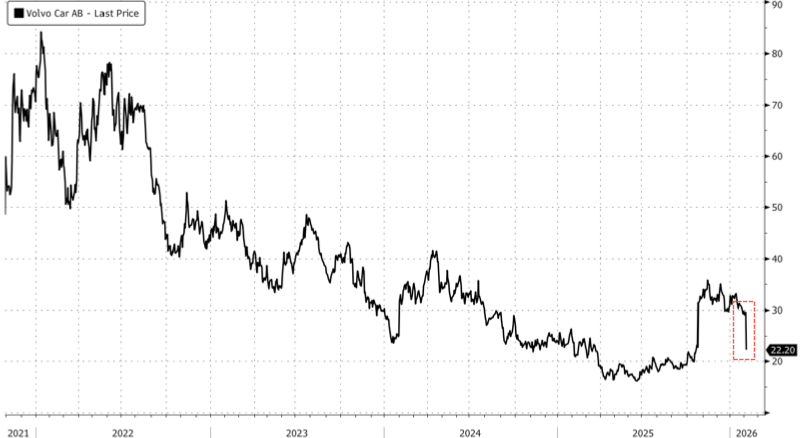
Volvo Car shares fall as much as 24%, their biggest drop on record, after the automaker reported weaker-than-expected fourth quarter earnings, dragged down by poor demand and pressure on prices.
Saab shares fall as much as 4.6% after full-year results as Morgan Stanley says a midterm guidance raise only implies limited upgrades to consensus.
Vestas shares fall as much as 7% after the Danish wind company forecast revenue for 2026 of €20 billion to €22 billion. Analysts at RBC Capital and JPMorgan blame a weaker services segment for dragging revenue.
In fx, the dollar rose 0.2%, hitting the highest level in two weeks amid the selloff in precious metals. The pound tumbled after the Bank of England came within a vote of cutting interest rates as policymakers split 5-4 in favor of holding at 3.75%; the currency was under pressure as a fresh round of political turbulence weighed on UK assets. Shorter-end gilts jumped as traders ramped up bets on a rate cut in March, sending two-year yields eight basis points lower to 3.62%.
In rates, treasury yields fell as US companies announced the largest number of job cuts for any January since 2009, according to data from Challenger, Gray & Christmas Inc. The 10-year rate slipped two basis points to 4.52%. The European Central Bank is expected to stand pat on rates later on Thursday. The euro was little changed.
In commodities, oil prices decline for the first time in three days after Iran confirmed it would hold negotiations with the US, easing tensions in the region. Spot silver is down over 10% while Bitcoin falls almost 4% below $70,000.
Challenger job cuts for January are due at 7:30 a.m. ET, followed by JOLTS job data for December at 10 a.m. Fed’s Bostic is scheduled to speak at an event at 10:50 a.m.
Market Snapshot
S&P 500 -0.4%
Nasdaq 100 mini -0.6%
Russell 2000 mini -0.5%
Stoxx Europe 600 -0.6%
DAX -0.5%
CAC 40 little changed
10-year Treasury yield -1 basis point at 4.27%
VIX +0.9 points at 19.54
Bloomberg Dollar Index +0.2% at 1194.43
euro -0.2% at $1.1783
WTI crude -1.5% at $64.19/barrel
Top Overnight News
Warsh believes that the AI boom is the “most productivity enhancing wave of our lifetimes – past, present and future,” leaving the Fed space to cut rates without stoking inflation. FT
Republican Senator Hawley is circulating a bill around Congress that would ensure the costs of data centre’s energy use is not passed onto consumers: Axios
President Trump commented that Fed is in theory an independent body, adds looking at tariff rebate checks very seriously, but hasn’t committed to tariff rebate checks yet, while he discussed expanding immigration operations to five cities.
December’s delayed JOLTS report is expected to show a modest rebound in job openings after recent declines, but slow hiring, cautious worker churn and weak quits suggest the labor market remains subdued. BBG
Most Chinese provinces are targeting lower economic growth this year, in what many economists believe is a signal Beijing will set a historically low range of 4.5-5% for its official goal in 2026. FT
A landslide win for Japan’s ruling Liberal Democratic Party (LDP) at Sunday’s election may be the best outcome for bonds and the yen, even as Takaichi’s spending pledges have repeatedly rocked markets. Analysts say an overwhelming LDP victory may in the end be positive for bonds, as it would eliminate the need for Takaichi to negotiate with opposition parties, who are touting even deeper tax cuts and broader fiscal spending. RTRS
Japan’s 30-year bonds gained after an auction of that tenor drew stronger demand, easing immediate concerns about longer-maturity debt just days from a closely watched election. The yield on 30-year bonds fell as much as seven basis points to 3.565% after the bid-to-cover ratio at the Ministry of Finance’s sale rose from last month’s auction. BBG
German factory orders unexpectedly rose at the fastest pace in two years, supporting expectations of a recovery in the key manufacturing sector. Factory orders for December come in very strong at +7.8% M/M (vs. the Street -2.2%). FT
UK political turmoil weighed on sterling and gilts as fresh doubts emerged over PM Keir Starmer’s grip on power. The gap between two-year and 10-year gilt yields steepened to the widest since 2018, while sterling was the worst-performing currency among peers. BBG
Lisa Cook said the Fed must maintain its credibility by returning inflation to target in the near future. BBG
Volodymyr Zelenskiy called on Trump to send more weapons for his military, according to an interview with France 2. Kyiv also said meetings between Ukraine, the US and Russia in Abu Dhabi were “meaningful and productive.” BBG
Trade/Tariffs
India’s Foreign Ministry said they are looking to explore commercial merits of any crude supply, including from Venezuela.
India’s Trade Ministry Officials said that India will need to import USD 300bln annual worth of goods and the US will be one of the key suppliers of energy, aircraft and chips.
Indian Trade Minister said we will announce the first tranche of a trade deal agreed with the US.
China’s Foreign Ministry said we oppose any country forming small groups to disrupt international economic and trade order.
A more detailed look at global markets courtesy of Newsquawk
APAC stocks were mostly lower following the continued tech selling stateside and flip-flopping regarding US-Iran talks, while commodities were pressured overnight with silver prices dropping by a double-digit percentage. ASX 200 was dragged lower by weakness in mining and resources stocks after underlying commodities prices took a hit, but with the losses in the index stemmed by resilience in financials and consumer stocks. Nikkei 225 saw early indecision but eventually slipped below the 54,000 level alongside the downbeat mood in the region. Hang Seng and Shanghai Comp declined with notable weakness in miners, property names and insurers, while an increased liquidity effort by the PBoC and reports of an ‘excellent’ call between Trump and Xi failed to spur risk appetite.
Top Asian News
Chinese provinces set lower growth targets for 2026, according to FT.
China is said to pause Panama deals after CK Hutchinson’s (1 HK) port operations were nullified.
European equities (STOXX 600 -0.6%) are broadly lower, though the AEX is mildly firmer, boosted by strength in ASML (+1.1%). The chip giant has been boosted after Google noted it would boost AI spending. European sectors hold a negative bias. Basic Resources underperforms given the pressure in the metals complex, whilst Shell (-2%, Q4 metrics light) weighs on the Energy sector. Other key movers include Volvo Car (-22%) after poor results and a dire outlook.
Top European News
Maersk (MAERSKB DC) Q4 (USD) EBITDA 1.8bln (exp. 1.84bln), Revenue 13.3bln (exp. 12.9bln).
Shell (SHEL LN) Q4 (USD): Adj. Profit 3.26bln (exp. 3.51bln), EPS 0.57 (exp. 0.63), Adj. EBITDA 12.79bln (prev. 14.77bln Y/Y), announces USD 3.5bln share buyback programme.
FX
DXY is kept afloat as it continues to claw back losses seen towards the end of January. That being said, the upside is limited following mixed data releases stateside and with plenty of focus on geopolitics amid reports that US-Iran talks scheduled for Friday were off, and on again. DXY has topped resistance seen around the 97.70-97.75 area to reach a current high of 97.83, still some way off the 23rd Jan high at 98.481.
GBP/USD is among the laggards heading into the BoE, but likely more on political factors at the moment, with UK PM Starmer’s premiership coming under scrutiny for his decision to appoint Peter Mandelson as the US ambassador despite links to Epstein. Back to the BoE, the Bank Rate is expected to be maintained at 3.75%, with some mixed views on the vote split. GBP/USD resides towards the bottom end of a 1.3576-1.3664 range.
EUR/USD resides in a narrow 1.1783-1.1809 range ahead of the ECB announcement and presser. The ECB is expected to keep its rates on hold, a view held by the likes of Goldman Sachs and Morgan Stanley. Data developments play in favour of keeping rates steady; inflation dipped below the Bank’s target in January, but largely due to base effects. Focus this meeting will be on any commentary surrounding the stronger EUR, trade/geopolitical uncertainty and higher gas prices.
USD/JPY continues rising amid the firmer USD, with the pair back above 157.00, with yen weakness persisting throughout the week ahead of the snap elections on Sunday. Elsewhere, Antipodeans are softer with AUD the G10 laggard amid headwinds from the subdued risk appetite and selling pressure in commodities.
Central Banks
Fed’s Cook (voter) said she will continue to carry out duties at the Fed and she looks forward to getting to know Warsh. said:Hopes that goods inflation will dissipate quickly, and once they do, should be back on the disinflation path.
Fed’s Cook (voter) said she is focused on inflation risks and noted that when considering the proper stance of monetary policy, she sees risks to both sides of the dual mandate. said:. Progress on inflation has stalled, while such a plateau is frustrating after seeing significant disinflation in the preceding few years. It is essential we maintain credibility by returning to a disinflationary path.
Federal Reserve finalizes big bank stress test criteria, votes to keep current capital buffer; Bowman said freezing bank capital levels allows Fed to correct any “deficiencies” in stress test models.
Westpac’s Ellis said can’t rule out the RBA raising interest rates for a second consecutive time in March, according to Bloomberg.
China Securities Daily reported that analysts now expect PBoC RRR ‘cuts’ in Q2.
Fixed Income
USTs are currently firmer by a couple of ticks and trade within a narrow 111-18+ to 111-24 range. Not much driving things for the benchmark this morning, but the focus has been on geopolitics. On Wednesday, it was reported that the US-Iran talks were cancelled, but are now back on and set to happen on Friday. Back to the US, the BLS provided an updated data schedule following the recent partial shutdown. JOLTS is set to be released today; NFP on Feb 11 and CPI on Feb 13. That aside, Jobless Claims is due today, with traders looking to see if the labour market remains in its recent “low hiring – low firing” environment.
Bunds trade steady and in a narrow 127.88-128.07 range. Really not much driving things for the benchmark this morning aside from EZ Construction PMIs and Retail sales, which had a limited impact on price action. Ahead, the ECB is set to keep its deposit rate at 2.00% and is likely to reiterate that the Bank is in a good place. Focus will be on the recent strength of the EUR and any comments related to potentially undershooting inflation.
Gilts are underperforming this morning, currently lower by around 40 ticks. Initially gapped lower by around 19 ticks, and then extended lower to make a trough of 90.13. The underperformance in Gilts today can be attributed to the increased pressure that PM Starmer is facing for his decision to appoint Peter Mandelson as the US ambassador, despite knowing about his links to Epstein. As it stands, several MPs are calling for Starmer to resign whilst others are calling for the sacking of Chief of Staff McSweeney; MP Turner said if he does not sack him, then his own back will be “up against the wall… soon” – nonetheless, the did suggest that there is still support for the PM adding that MPs do not want him to go. As it stands, Polymarket odds of Starmer to be out the door by June 30th have risen to 47% (vs 23% yesterday).
Commodities
Crude benchmarks continued to trade with a lack of clear direction. The pressure seen at the start of the week (following plans of US-Iran talks) was completely reversed in Wednesday’s session over reports that the talks have been cancelled due to Tehran’s demands to change the location and talk format. Late in Wednesday’s session, Iran’s Foreign Minister reconfirmed that talks are back on in Oman for Friday. Prices dropped at the end of the US session. As the European session got underway, benchmarks reversed overnight losses, with Brent returning above USD 68.50/bbl. Today is the expiration day of the New START Treaty. This outcome was expected amid a lack of effort from both sides to renew the agreement.
Spot gold ended Wednesday’s session below the USD 5,000/oz handle but attempted to regain above the level at the start of the APAC session, but failed to do so. The yellow metal fell to a low of USD 4,790/oz, weighed on by the plunge in silver prices, before slightly paring back losses as European trade gets underway.
Spot silver wiped out the entirety of the two-day recovery the metal attempted to stage as trade at the Shanghai Metals Exchange got underway. The metal kissed USD 90/oz before slipping to a trough of USD 73.55/oz, with losses seen as much as 16%. Dip-buyers took advantage of the lower prices, with silver prices currently trading around USD 80/oz.
China gold consumption reportedly fell by 3.6% to 950 tons in 2025 and total gold production rose 3.35% Y/Y to 552 tons.
3M LME Copper continued the selloff seen throughout the US session, with the red metal dipping below USD 13k/t to a trough of USD 12.86k/t. This comes following continued worries that AI will become a bigger factor within business models. The tech sector has been weighed on in recent sessions, as in turn, dragged copper prices lower
Geopolitics: Ukraine
US Envoy Witkoff said that discussion between US, Ukraine and Russia were productive but “significant work remains”; talks will continue, with additional progress anticipated in the coming weeks; Ukraine and Russia agreed to exchange 314 prisoners.
Russia’s Kremlin spokesperson confirms the New START Treaty ends today.
Russian Envoy Dmitriev said Russia-US meetings in Abu Dhabi are positive; progress on a peace deal despite pressure from the EU and UK; active work ongoing to restore Russia-US relations.
Geopolitics: Middle East
Israeli security assessments note Houthis may attack Israel if Washington launches a strike against Iran, according to Sky News Arabia.
Palestinian media reported Israeli artillery shelling targeting the Al-Bureij camp in the central Gaza Strip.
US Event Calendar
8:30 am: United States Jan 31 Initial Jobless Claims, est. 212k, prior 209k
8:30 am: United States Jan 24 Continuing Claims, est. 1850k, prior 1827k
10:00 am: United States Dec JOLTS Job Openings, est. 7250k, prior 7146k
10:50 am: United States Fed’s Bostic Speaks with Dean of Clark Atlanta University
DB’s Jim Reid concludes the overnight wrap
Morning from Paris as the global tour continues. There’s plenty to talk about as 2026 continues to develop in a fascinating way and Tuesday’s software sell-off broadened into a wider tech rout yesterday, as concerns about AI disruption pushed the NASDAQ (-1.51%) and the Mag 7 (-1.75%) to further declines, which in turn meant the S&P 500 (-0.51%) fell back for a second day running. However, it wasn’t all bad news, as the ongoing rotation out of tech meant the equal-weighted S&P 500 (+0.88%) closed at a record high, as did Europe’s STOXX 600 (+0.03%). So there’s a pretty divergent narrative at the minute, whereby tech stocks are being squeezed sharply, but a lot of broader indices are still holding up for the most part. If that’s not enough excitement for you, Silver has fallen -14% overnight and Alphabet has stunned the world with a capex spending plan of as much as $185bn this year, 55% more than expected. With tech in a current state of flux it’s not clear whether that’s a good or a bad thing. Alphabet has been the brightest star in the tech space in the last 6 months so this is a big story for markets.
I explored the tech story in my chart of the day yesterday (link here), looking at various stocks and how far they were beneath their 52-week high. It shows how recent months have seen a shift from the “every tech stock is a winner” mindset to a more brutal landscape of winners and losers. There are lots of losers but note that Alphabet has added $1.7tn market cap over the last 6 months (adding over 70% of its value), offsetting a lot of other losses and helping the S&P 500 to still be only -1.37% beneath its all-time high.
Last night Alphabet’s results delivered a solid revenue beat, with Google Cloud revenue growing 48% to $17.7bn in Q4 (vs $16.2bn expected). However, this was accompanied by a surge in the company’s CAPEX plan to $175-185bn in 2026, effectively doubling its 2025 spend and well above the average analyst estimate of $120bn. Alphabet’s shares saw some sizeable volatility in after-hours trading (falling -7% at one point) but were little changed in the end after falling by -1.96% in the regular session. This morning, S&P 500 (+0.03%) and NASDAQ 100 (+0.14%) futures have been fluctuating between gains and losses.
Yesterday’s sell-off was led by a fall in AMD (-17.31%), which was the second-worst performer in the S&P 500 after the company’s latest outlook disappointed investors. So that marked its worst daily performance since 2017. That weighed on chipmakers, with the Philadelphia Semiconductor index down -4.36% including a -3.41% retreat for Nvidia, and the news fed into the wider narrative of tech weakness in recent days. Moreover, we saw the impact in other asset classes too, as Bitcoin (-4.61%) fell back to its lowest level since November 2024, at $72,627.
Despite the headline losses, there were an impressive 363 advancers in the S&P 500, which was actually the most in two weeks. Energy stocks (+2.25%) led the gains as Brent crude rose +3.16% amid renewed concern over US-Iran escalation. Oil spiked after Axios reported that plans for nuclear talks with Iran were at risk of collapse and as President Trump said that Iran’s supreme leader Ayatollah Khamenei “should be very worried”, though it pared back some of the rise on news that Friday’s talks were still set to go ahead with Brent down -2.16% to $67.96/bbl overnight as I type.
Prior to that, other newsflow yesterday leant on the more positive side for markets, including the news that Presidents Trump and Xi had another telephone conversation. According to a post from President Trump, they discussed various topics, and he said China had committed to purchasing 25mn tonnes of soybeans for next season. So that meant soybean futures (+2.49%) posted their biggest jump since November, and it added to hopes that the trade truce between the two sides would remain in place.
Meanwhile, the US data yesterday continued to paint a broadly positive picture. The ISM services print came in at 53.8 (vs. 53.5 expected), which is its highest level since late-2024. However, some of the details were a bit more mixed, as the subcomponents for new orders (53.1 vs 56.5 expected) and employment (50.3 vs 51.7 expected) missed expectations. Moreover, the prices paid component ticked back up to 66.6 (vs. 65.0 expected), and that’s been a strong leading indicator for US inflation, which added to concern on that front. Meanwhile, the ADP’s report of private payrolls also came out weaker than expected in January at 22k (vs. 45k expected), with a slight downward revision to prior months. Normally that would be followed by the jobs report tomorrow, but given the partial government shutdown, the BLS confirmed yesterday that it was being postponed to Wednesday next week.
Lastly in the US, we had the Treasury’s quarterly refunding announcement, which came out unchanged in line with expectations. Treasury yields were mixed in response, with the 2yr yield falling -1.6bps amid the risk-off mood but 10yr (+1.0bps to 4.28%) and 30yr (+2.3bps to 4.92%) yields continuing to rise. Indeed, that brought the 2s10s slope up to 71.6bps, its steepest since January 2022, before the Fed started its post-Covid hiking cycle. Overnight, 10yr USTs are -1.0bps lower trading at 4.26% as we go to print.
Over in Europe, attention will be all on central banks today, as both the ECB and BoE are announcing their latest decisions. The ECB is widely expected to keep its deposit rate on hold at 2%, and our European economists think that it’ll continue to emphasise two-sided risks to growth and inflation. However, the risk is that the ECB sounds more dovish than before, given heightened geopolitical uncertainty and the recent appreciation in the euro. You can see their full preview here. Meanwhile for the BoE, our UK economist also expects no change in Bank Rate (3.75%), with a 7-2 vote tally to keep policy on hold (see his preview here). Indeed it’s worth keeping a closer eye on the UK with PM Starmer under considerable domestic pressure given the handling of the Peter Mandelson story. 10yr Gilts were up +2.9bps yesterday bucking the international trend as concerns grew that he could be replaced. So one to watch.
Asian equity markets are lower this morning with the KOSPI (-3.98%) standing out as the largest underperformer, having surged to record highs in the previous two sessions, with major index constituents Samsung Electronics and SK Hynix both falling by over -5.0%. The index is still up over +22% in 2026 so far. Chinese stocks are also lagging behind, as evidenced by the Hang Seng (-0.68%), the CSI (-0.52%), and the Shanghai Composite (-0.59%), all of which are trading significantly lower. In other markets, the Nikkei (-0.85%) is also trading lower, retreating from the record highs it reached earlier this week.
Ahead of today’s ECB decision, yesterday we received the Euro Area flash CPI print for January, with headline inflation in line with expectations at +1.7%, marking its lowest level since 2021. Core CPI was still higher at +2.2%, but a bit below expectations for a +2.3% print. So that added to expectations the ECB might still cut this year, and yields on 10yr bunds (-3.1bps), OATs (-1.9bps) and BTPs (-2.9bps) all moved lower. Moreover, the 30yr German yield also fell -2.5bps to 3.52%, down from its post-2011 high the previous day. Meanwhile for equities, things were modestly positive, with record highs for the STOXX 600 (+0.03%) and the FTSE 100 (+0.85%), although the German DAX (-0.72%) struggled amidst a sharp fall in industrial stocks.
Looking at the day ahead, in addition to the ECB and BoE decisions, we’ll hear the Fed’s Bostic speak, BoC Governor Macklem speak, and get the BoE’s DMP survey. In terms of data, we’ll get the US initial jobless claims, UK January new car registrations, construction PMI, Germany December factory orders, January construction PMI, France December industrial production, Italy December retail sales, Eurozone December retail sales. Finally, earnings include Amazon, Shell, BBVA and Sony.
Tyler Durden
Thu, 02/05/2026 – 08:15
https://www.zerohedge.com/markets/futures-bitcoin-gold-all-tumble-momentum-liquidations-accelerate
“Challenging External Environment”: Volvo Crashes Most On Record After Earnings Miss
“Challenging External Environment”: Volvo Crashes Most On Record After Earnings Miss
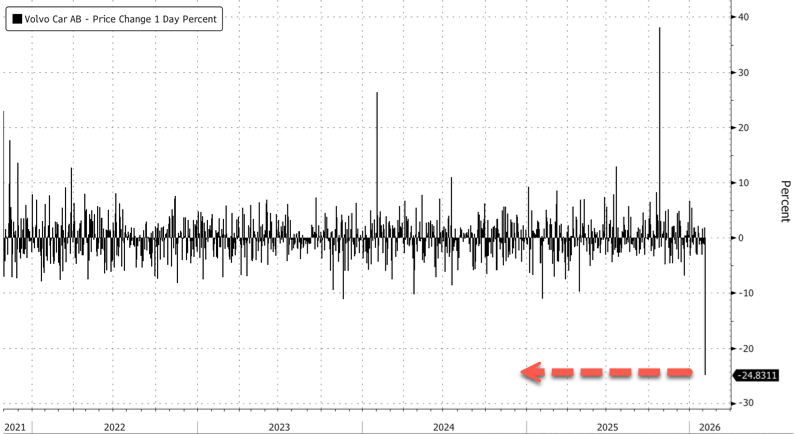
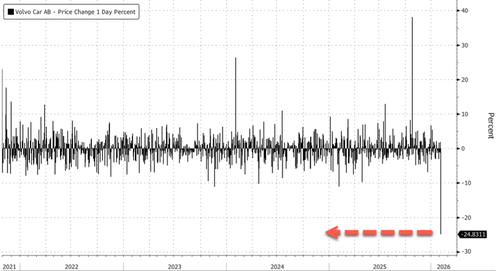
Shares in Volvo Cars crashed the most on record in Stockholm, with Bloomberg data going back to late 2021, after it reported fourth-quarter earnings that missed analyst expectations.
A toxic blend of higher US tariffs, cuts to EV subsidies, a stronger Swedish krona versus a weaker dollar, and an intensifying price war in China all squeezed fourth-quarter profitability, the Swedish-origin automaker detailed in its earnings release.
It reported an Ebit margin of just 2% and an operating income that came in well below Bloomberg Consensus estimates.
Here’s a snapshot of fourth quarter estimates (courtesy of Bloomberg):
Revenue SEK94.38 billion, estimate SEK101.83 billion (Bloomberg Consensus)
Operating income SEK1.89 billion, estimate SEK4.6 billion
Ebit margin 2%, estimate 4.56%
EPS SEK0.43, estimate SEK1.24
Sales volume 195,700, estimate 196,850
Europe retail sales volume 90,000 units, estimate 93,693 (2 estimates)
China retail sales volume 44,200 units, estimate 42,956 (2 estimates)
US retail sales volume 30,900 units, estimate 33,350 (2 estimates)
Others retail sales volume 30,600 units, estimate 27,965 (2 estimates)
BEV Vehicles sales volume 46,700 units
Volvo wrote in the earnings release that “results reflect a challenging external environment.”
“We have a very tough market,” CEO Hakan Samuelsson told Bloomberg Television earlier. He said the removal of EV incentives in the US and tough competition in China have all hampered sales.
The shares plunged as much as 25% in Stockholm, the steepest intraday drop on record since the stock started trading in late 2021.
Shares have been down and to the left since trading began in October 2021.
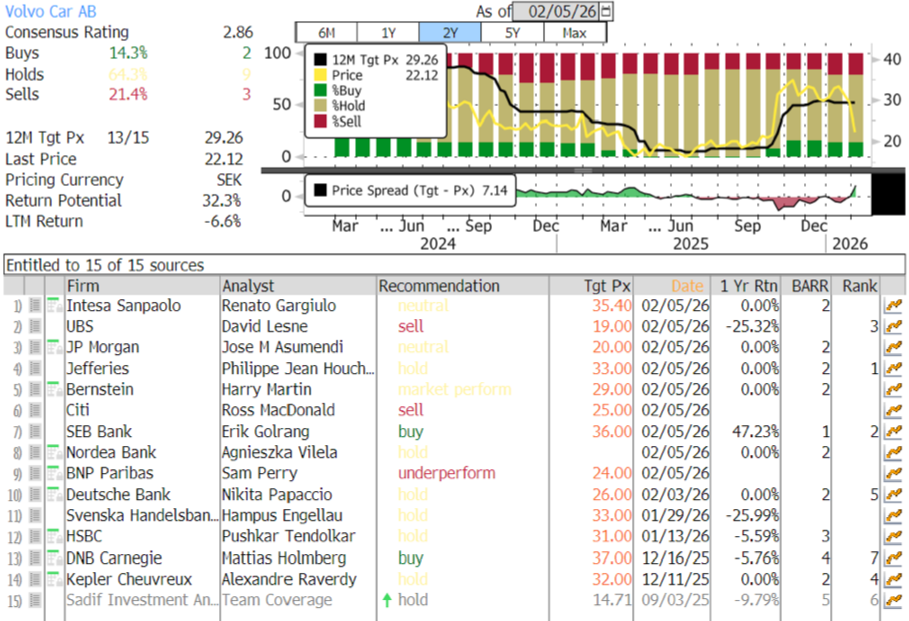
Wall Street analysts are mixed to bearish on Volvo. There are only 2 “buys,” with 9 “holds,” and 3 “sells.”
EU industry chief Stephane Sejourne recently issued a warning, saying Europe’s auto industry is “in mortal danger.”
The obvious question is how Brussels elites managed to screw up so royally. Because once the auto industry collapses, so does the backbone of wartime manufacturing capacity.
Tyler Durden
Thu, 02/05/2026 – 08:05
Memory Shortage Fears Spread, Raising Alarm At Qualcomm And Arm
Memory Shortage Fears Spread, Raising Alarm At Qualcomm And Arm
Consumers are about to learn that one of the most frustrating side effects of the AI boom will be the “great memory crunch.” Surging data center demand is siphoning high-bandwidth memory (HBM) supply away from consumer devices, setting the stage for slower growth across the electronics industry this year.
We have been vocal about this HBM crunch, even citing industry insiders who say shortages are only set intensify. “If you want to buy any consumer goods, PCs, or smartphones … do it now,” one industry insider told Nikkei Asia last week. Read the report here.
On Wednesday, Qualcomm and Arm Holdings also confirmed that the HBM shortage will cap smartphone production and slow near-term growth.
For context, Qualcomm is the largest maker of smartphone processors, and Arm derives much of its revenue from royalties on technology used in the industry.
“Industrywide, memory shortages and price increases are likely to define the overall scale of the handset industry,” Qualcomm CEO Cristiano Amon told Wall Street analysts on an earnings call.
Amon warned that Chinese customers have already said they’ll build fewer handsets this year because of this emerging crunch.
Last week, Goldman analyst William Chan warned clients:
Memory shortage is real and accelerating due to the AI infra demand, leaving a significant shortage for the conventional side of the industry, think smartphones, PCs and other consumer electronics which require high-bandwidth memory:
Micron Technology Inc. said an ongoing memory chip shortage has accelerated over the past quarter and will last beyond this year due to a surge in demand for high-end semiconductors required for AI infrastructure.
On Friday, Chinese media outlet Jiemian reported that major Chinese smartphone makers including Xiaomi Corp., Oppo and Shenzhen Transsion Holdings Co. are trimming their shipment targets for 2026 due to rising memory costs, with Oppo cutting its forecast by as much as 20%. All three did not respond to requests for comment.
Nintendo emerged as an early casualty of surging memory costs. The company’s shares have sagged as rising component prices, especially HBM, are set to dent margins. Goldman analysts first warned about Nintendo’s HBM woes in late December (read here).
Other companies have warned about the memory crunch. Chipmaker MediaTek told analysts in a call this week that the situation is “evolving.”
Intel CEO Lip-Bu Tan warned the shortages could persist for years: “There’s no relief as far as I know.”
Also, Goldman’s Allen Chang recently had to lower his global PC shipment forecasts for 2026-2028 due to the memory crunch.
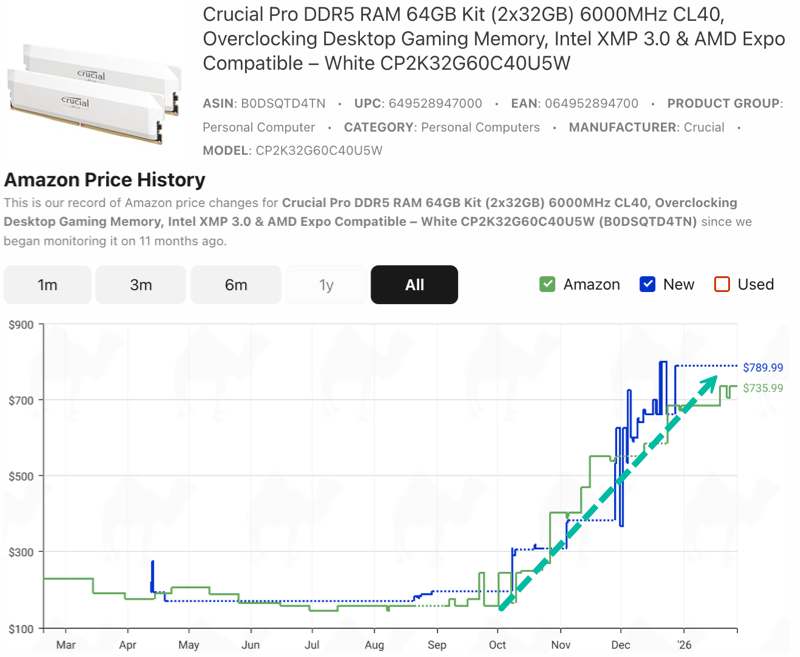
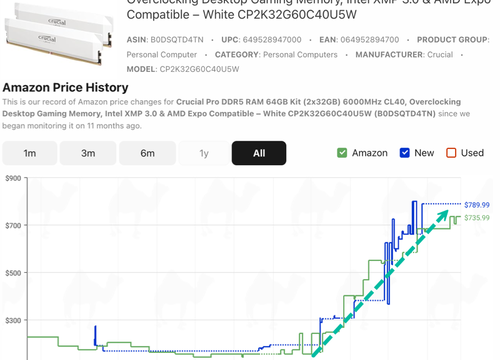
A look at the Amazon price-tracking site CamelCamelCamel shows a parabolic surge in the price of Crucial Pro DDR5 64GB RAM, which has jumped from $145 to $790 in just six months.
TrendForce expects 70% of high-end memory chips produced this year will be consumed by data centers.
Professional subscribers can learn more about the memory industry on our new Marketdesk.ai portal.
Tyler Durden
Thu, 02/05/2026 – 07:45
https://www.zerohedge.com/ai/memory-shortage-fears-spread-raising-alarm-qualcomm-and-arm

Daywatch: What to know about the upcoming primary election
Good morning, Chicago.
Illinois Democratic and Republican voters will soon decide their party’s nominees for races at the federal and state levels, as well as in a few local races, during the March 17 primary election. Early voting kicks off today. Winners of the party primaries will advance to the general election on Nov. 3.
Four top Republican candidates are vying to unseat Gov. JB Pritzker, who is seeking a rare third term. The last governor in Illinois to have served at least three terms was Republican Gov. Jim Thompson, who completed four between 1977 and 1991. Pritzker, who has no competition in the primary, would be the first Democrat in Illinois history to win three terms as governor.
Excitement for Democrats exists elsewhere on the primary ballot.
Read the full story from the Tribune’s Jack O’Connor and Kori Rumore.
Here are the top stories you need to know to start your day, including: the latest on Mayor Brandon Johnson’s public market plan, friends remember a slain Momence bar owner and what’s next for the Bulls after trading Coby White.
Today’s eNewspaper edition | Subscribe to more newsletters | Asking Eric | Horoscopes | Puzzles & Games | Today in History
People walk past a mural of Iryna Zarutska in the 2400 block of West Montrose Avenue in Chicago’s North Center neighborhood on Jan. 22, 2026. An idea to paint murals of Zarutska on buildings around the country was initiated by CEO Eoghan McCabe of Intercom, with financial backing from businessman Elon Musk. The murals are designed to honor Zarutska, 23, a Ukrainian refugee who was fatally stabbed on a train in Charlotte, North Carolina, in August 2025. (Josh Boland/Chicago Tribune)
Mural of slain Ukrainian refugee draws sympathy, skepticism from its North Center neighbors and Chicago artists
The newly painted mural over a restaurant is part of a nationwide project by Remember Iryna, which has also overseen installations in New York City, Los Angeles, Miami and Washington, D.C., according to its website.
The killing of Iryna Zarutska, who fled the Russian-Ukrainian war for the U.S. in 2022, drew national attention and reignited right-wing critiques of “soft-on-crime” policies in Democratic-led cities. President Donald Trump called for Zarutska’s killer to receive the death penalty, and Elon Musk, who has financially backed the mural campaign, posted on X that Zarutska was killed “just for being a ‘white girl.’”
Policy chief Jung Yoon, left, Chicago Mayor Brandon Johnson, center, and Budget Director Annette Guzman, far right, clap as Ald. Desmon Yancy, 5th, is introduced onstage during a town hall on Feb. 3, 2026, at the South Shore Cultural Center. (Josh Boland/Chicago Tribune)
Mayor Brandon Johnson heads to budget opponent’s ward to continue fight over 2026 package
Mayor Brandon Johnson held a South Side town hall Tuesday evening to again hammer the city budget, the latest score-settling between him and the City Council bloc that passed its own plan in December after rejecting key parts of his proposal.
Mayor Brandon Johnson arrives to speak after a City Council meeting on Jan. 21, 2026, at Chicago City Hall. (Brian Cassella/Chicago Tribune)
Mayor Brandon Johnson’s public market plan slows to a crawl
Mayor Brandon Johnson’s marquee plan to increase access to fresh groceries on the city’s South and West sides — a plan that initially called for a city-owned grocery store and later evolved into a proposed year-round market — appears to have slowed to a crawl.
A student walks toward the entrance of Chamberlain University in Chicago, Feb. 4, 2026. Adtalem Global Education is changing its name to Covista, which has five health-care-focused institutions, including Chamberlain University. (Josh Boland/Chicago Tribune)
Adtalem changes its name, after move toward health care education
Chicago-based Adtalem Global Education is again changing its name, this time to Covista, to reflect the for-profit company’s pivot toward health care education.
The company was previously called DeVry Education Group before changing its name to Adtalem in 2017, following years of scrutiny and government enforcement directed toward for-profit colleges.
Chicago police work at the scene of a shooting and car fire in the Near West Side neighborhood near the White Castle restaurant at West Roosevelt Road and North Western Avenue, Feb. 3, 2026. (Brian Cassella/Chicago Tribune)
Police probe link between West Side shootings, possible gang involvement
Belmont Area detectives are investigating possible links between a pair of shootings that wreaked havoc up and down the Near West Side over a few hours Tuesday afternoon, where the same group of gunmen may have shot at a total of six people in three cars, leaving three of the victims dead.
Courtney Drysdale, 30, was shot to death Monday at the bar she owned in Momence in Kankakee County. (Hailey Gershon)
Friends remember ‘amazing’ Momence bar owner; Indiana man arrested in slaying
Courtney Drysdale, 30, was found shot to death at The Line, a bar she owned in Momence near the Illinois/Indiana state line in Kankakee County, shortly before noon on Monday, according to the Kankakee County sheriff’s office. An Indiana man was arrested this week in connection with the fatal shooting and is being held after waiving extradition at a court appearance.
Bulls guard Coby White smiles after they defeated the Jazz 128-126 on Jan. 14, 2026, at the United Center. (Armando L. Sanchez/Chicago Tribune)
Chicago Bulls trade Coby White to the Charlotte Hornets, ending his 7-year tenure with the team
After seven years with the team, Coby White no longer will wear a Bulls jersey.
The Bulls traded White to the Charlotte Hornets yesterday along with Mike Conley Jr., getting back Collin Sexton, Ousmane Dieng and three second-round draft picks.
With Coby White’s trade, the Bulls cut ties to the past — and gave up the heart of their locker room
NBA trade tracker: Bulls trade Coby White and Nikola Vučević before the deadline. Who will be next?
The Minnesota Frost’s Kendall Coyne Schofield stands on the ice during a game against the Torronto Sceptres on March 30, 2025, at the Xcel Energy Center in St. Paul, Minn. (Stacey Wescott/Chicago Tribune)
Chicago Blackhawks’ Teuvo Teräväinen and Palos Heights’ Kendall Coyne Schofield embrace Olympic experience
While Blackhawks star Connor Bedard wasn’t selected to Canada’s roster, Hawks forward Teuvo Teräväinen will play for defending Olympic champion Finland.
In the women’s competition — which begins today, one day before the opening ceremony — Team USA has three Illinois-born players, headed by four-time Olympian Kendall Coyne Schofield of Palos Heights.
Blackhawks share their Olympic break mindset after a shutout loss to the Columbus Blue Jackets
Director Robert Falls speaks to the cast on stage, Jan. 30, 2026, during rehearsal for “Holiday,” at the Goodman Theatre. Assistant director Hannah Todd is at right. (Josh Boland/Chicago Tribune)
‘Holiday’ comes to the Goodman, directed by Bob Falls and no longer a zany comedy
Ed Greenberg, who now supervises his late brother’s estate, will be in Chicago on Monday for the opening of Robert Falls’ Goodman homecoming production of “Holiday,” the last Richard Greenberg play to be completed during his lifetime (although Ed said there were “four or five things on Richard’s computer,” yet to be mined).
Harry Melling and Alexander Skarsgård in a scene from “Pillion.” (A24/TNS)
Review: ‘Pillion’ is an amusing and daring kink-positive romance
Harry Lighton’s “dom-com,” “Pillion,” is an amusing, illuminating and daring romance about a dominant/submissive relationship that proves revelatory for our young protagonist, writes Katie Walsh. Based on the novella “Box Hill” by Adam Mars-Jones, the film follows a relationship between the sheltered Colin (Harry Melling) and stoic biker Ray (Alexander Skarsgård), who meet in a pub one Christmas Eve.
https://www.chicagotribune.com/2026/02/05/daywatch-what-to-know-about-the-upcoming-primary-election/

Sand Ridge Nature Center offers a lesson of history, nature and activism
A quarter mile walk through the winter woods at the Sand Ridge Nature Center now tells the story of thousands of freedom seekers on their way toward a new home, toward something better.
For Black History Month, the southern Cook County Forest Preserve has a series of 24 signs along a walking trail, noting some local stops and supports for formerly enslaved people who walked through the area heading toward Detroit and, ultimately, Canada.
Between 3,000 to 4,500 men, women and children might have walked through the area, around the lake and up through Indiana into Michigan, according to the research website, illinoisundergroundrailroad.info. Even in the North, these people, formerly enslaved, were not necessarily free, even if slavery was outlawed. Slave catchers could capture them, kidnap them and drag them back South.
The route to freedom took them right through the forest preserve area and the signs on the trail note nearby churches and families that helped freedom seekers along the way.
Credell Walls, the director of the nature center, along with two volunteers spent the morning Feb. 1 posting the signs. He said he hopes visitors to the come away both with a sense of history but also a sense of nature — what life was like for these people as they walked through the woods and the prairie.
“Illinois does have a role in freedom seekers and the underground railroad passed through here,” he said.
Walls said they would have relied on the natural world to feed and protect them, and he hopes visitors take that all in.
“We want people to know more about the environment, to show respect for themselves and for nature,” he said.
Walls said the signs are part of an annual tradition, though this year they’re wooden as opposed to laminated paper signs. The new signs came courtesy Jeff Christiansen and Marlee Christiansen, who volunteer with Jane Goodall’s Roots and Shoots program, a worldwide youth organization that emphasizes local volunteering and the outdoors.
Jeff and Marlee Christiansen work Feb. 1 with Cook County Forest Preserve District employee Credel Walls, erecting signs for a self-guided tour. Feb. 1, 2026, South Holland. (Jesse Wright/for the Daily Southtown)
Besides that program, Marlee said she’s gone to the Museum of Science and Industry camp since she was in fourth grade — she’s now in high school — and got good with laser cutting and photo printing and manufacturing.
“We thought this was a good time to highlight how people care about other people,” she said.
Walls said they also relied on help from two other volunteers, Patrick McCarthy and Manny Juarez, who weren’t on hand to erect the displays. Nevertheless, on a clear if cold day the three walked through several inches of snow, screwing in the new signs.
Walls reflected on the freedom seekers then and those who helped along the way. He noted the dozen or so known residences and churches nearby that helped the Southern refugees and compared all of that to the current situation in Minneapolis and Chicago, where U.S. citizens work to help undocumented people, often in the face of danger and state oppression.
For Black History Month, the Sand Ridge Nature Center offers a self-guided tour on Underground Railroad history. Feb. 1, 2026, South Holland. (Jesse Wright/for the Daily Southtown)
“There is strength in numbers,” Walls said. “I think the difference between what happened then and what’s happening how is back then you helped out in private but now in this current situation everyone is making noise.”
Jeff Christiansen agreed there is strength in numbers and the more people who act up now and stand up against injustice can make a difference.
“It’s the sheer number of people involved and its people doing little things every day,” he said. “There are a lot of people taking a lot of personal risk.”
Christiansen said the local historic precedence of antebellum community activism should help inspire people today.
“How crazy was it that this happened here,” he said. “How did this happen? These were people who decided to take a stand because they didn’t like what was happening and they knew it was morally wrong.”
The display will remain for the rest of Black History Month. Visitors can take a self-guided tour any day and the last two Saturdays in February will include programs for visitors. The center will offer “If Walls Could Talk: Stories of the Underground Railroad” part one and part two, beginning at 11 a.m. on Feb. 21. It will offer “Local Stories of the Underground Railroad” at 1 p.m. on Feb.28. Registration is required for both programs.
Sand Ridge Nature Center is at 15891 Paxton Ave., South Holland.
Jesse Wright is a freelance reporter for the Daily Southtown.
https://www.chicagotribune.com/2026/02/05/sand-ridge-nature-center-underground-railroad/

Naperville Central’s Trinity Jones is only player in Illinois selected for 2026 McDonald’s All-American Games
Naperville Central basketball star Trinity Jones was at home on her lunch break when she got the news.
Jones, a 6-foot-2 senior guard, is one of 24 girls chosen to play in the McDonald’s All-American Game.
“I was really excited,” she said. “I saw my mom really excited, elated, jumping up and down, and so then I kind of did the same thing.
“I’m just blessed and highly favored.”
But not surprised. The Clemson-bound Jones, who is averaging 28.5 points, 8.2 rebounds, 2.8 steals, 2.3 assists and 1.5 blocks for the Redhawks (21-5) this season, has been dreaming of this moment for a long time.
“We talked before the season when she was a freshman, and one of her goals was to be a McDonald’s All-American, so this is a goal of hers that’s realized,” Naperville Central girls basketball coach Andy Nussbaum said.
“It’s really special. You’re talking about 24 players in the United States. That’s just very special recognition. I’m so happy for her, and I’m proud of her.”
On Monday, Jones became the second girl in program history and just the third from Naperville to earn McDonald’s All-American honors.
Former WNBA star Candace Parker, who is Naperville Central’s career scoring leader, played in the 2004 McDonald’s All-American Game in Oklahoma City. Former Naperville North star Greta Kampschroeder, who played at Michigan and plays professionally in Germany, was selected for the 2021 game, which was not held due to the coronavirus pandemic.
“It was something on my bucket list,” Jones said. “I’m very grateful I can scratch that off.”
Naperville Central’s Trinity Jones (10) brings the ball up the court against Naperville North during a DuPage Valley Conference game in Naperville on Friday, Jan. 30, 2026. (Troy Stolt / Naperville Sun)
Jones, who will play for the West team, is the only player from Illinois, among both girls and boys, picked for the 2026 games, which will be played at Desert Diamond Arena in Glendale, Arizona, on March 31.
“I watched quite a few of them, especially last year’s,” Jones said. “I knew a couple girls on the team. I know everybody this year. I’m really excited to get out there and showcase my skills and things that I’ve learned over the last few months.”
Naperville Central senior guard Colette McInerney has known Jones since they were in kindergarten, when they first played together at the YMCA.
“I think it’s awesome,” McInerney said. “Me and Trinity have played with each other since we were little, so to see her grow as a player and as a person has been really cool.”
Nussbaum and the Redhawks anticipated Jones achieving McDonald’s All-American status.
“They already had a pretty high opinion of what Trinity can do in basketball, so it’s sort of like, ‘Well, we knew that. She should be McDonald’s All-American,’” Nussbaum said. “That’s kind of my reaction. I think she’s very deserving.”
Naperville Central’s Trinity Jones (10) shoots from 3-point range over Waubonsie Valley’s Maya Pereda (0) during a DuPage Valley Conference game in Naperville on Thursday, Jan. 15, 2026. (Sean King / Naperville Sun)
Jones, who played for Bolingbrook as a sophomore and missed all but a few minutes of her junior season after suffering a torn ACL, still scored more than 1,000 career points in a Naperville Central uniform.
Jones said her focus is on helping the Redhawks, who are ranked No. 6 in Class 4A in the poll by The Associated Press, prepare for the state playoffs and that her accolades have no bearing on that effort, although McInerney thinks the team might get a bump from the latest one.
“It’s really cool that she’s gotten the All-American award, and other teams will view us and see that,” McInerney said. “It gives us a little bit of a boost to have her have that title.
“This is such a great accomplishment, and she’s just so deserving.”
What does Jones think of joining Parker and Kampschroeder on such a short list of Naperville greats?
“It’s so cool,” Jones said. “I’ve put in the hard work. So have those girls, so have my teammates, so it’s cool to be able to be a part of that.”
Matt Le Cren is a freelance reporter.

What Goes Around: The EU’s Extralegal Sanctions Regime
What Goes Around: The EU’s Extralegal Sanctions Regime
Submitted by Pascal Lottaz
It has come as a shock to many of us in the alternative media sphere when, on December 15, the EU put the esteemed analyst, political commentator, and former Swiss Army colonel Jacques Baud, on its Russia-Sanctions list. He was one of several newly sanctioned individuals (alongside, for instance, the popular French journalist, Xavier Moreau). Baud is already the second Swiss to be sanctioned. In June 2025, the EU announced that Nathalie Yamb, a Swiss-Cameroonian activist against neocolonialism, would be sanctioned.
Being on the EU sanctions list is a devastating event for the people concerned, especially if they reside in an EU country or a closely associated state like Switzerland, Norway, or the UK. It means banks will freeze their accounts, credit companies will cancel their cards, they are not allowed to enter into contracts with EU-affiliated companies or private persons, and no business in the EU is allowed to have dealings with them, which, in theory, even precludes them from buying bread and other necessities of life. Furthermore, many international businesses will cancel all their services to them, including mail providers, social media platforms, etc. Even Swiss banks freeze or cancel accounts, out of fear they might get in trouble if they don’t comply with EU regulations. I recently interviewed two sanctioned people, Nathalie Yamb and Hüsseyin Dogru, and their testimonies are heartbreaking. For an equally harrowing account by Jacques Baud, see the most recent interview with him on Nima Alkhorshid’s ‘Dialogue Works’ channel. Nathalie also posted the short video below, in which she gives an overview of the ordeal (post in French, subtitles in English).
Pour tous ceux qui veulent savoir ce que ça signifie être placé sous sanctions de l’Union européenne et quels seront les impacts pour Jacques Baud ou Xavier Moreau, je partage d’expérience, puisque je suis la première suissesse sanctionnée (depuis le 26 juin 2025).
Pour Xavier,… pic.twitter.com/nzooxL0WsS
— Nathalie Yamb (@Nath_Yamb) December 16, 2025
Are Sanctions Against EU Citizens and Residents Illegal?
As of early January 2026, there were 59 private individuals on the EU’s Russia sanctions list. Originally, this tool was levied only against Russian businessmen and people living in Russia (which was already problematic in my view), but since 2024, the EU has begun using sanctions as a political sledgehammer to crack down on various forms of dissent. Yamb, for instance, was sanctioned mostly for her activism against France’s neocolonial behavior in Africa, and Dogru for being a vocal German journalist for the Palestinian cause. The little text snippets that serve as justifications for the decision to include them in the sanctions list even mention those non-Russia-related activities for their listing.
Naturally, one would assume that in a free and liberal society, based on the rule of law, sanctions against citizens and residents must be illegal. Right? In fact, the EU parliamentarian Michael von der Schulenburg has commissioned a report that is very clear in its verdict. Sanctions, it holds, break existing EU law on individual freedoms (see my interview with him here).
However, the problem we have is that while sanctions are doubtlessly a breach of some EU law, there is other EU law that allows the Council to take these measures. Procedurally, the EU is not in breach of its competences because sanctions are not a domestic policing matter but a foreign policy decision.
Foreign Policy, For Domestic Purposes
I will not go into the details of the accusations against the sanctioned individuals. That would be beside the point. Whether the reasons given for the sanctions have merit or not is not the issue. The problem everyone should understand is that the accusations don’t need to constitute illegal behavior. There are no laws in the EU or its member states that forbid doing what the people on the Russia-Sanctions list have been doing. On the contrary. Many of the activities, including civil activism (Nathalie Yamb), journalism (Hüsseyin Dogru), or the publication of geopolitical analysis (Jacques Baud) are explicitly protected liberties.
That’s the point. Since the acts committed are not crimes, the sanctions against them are not judicial measures, either. The EU explicitly says so on its sanctions explainer homepage:
Restrictive measures or ‘sanctions’ are an essential tool of the EU’s Common Foreign and Security Policy. They allow the EU to respond to global challenges (sic) and developments that go against its objectives and values.
Decisions on sanctions are taken by the Council of the European Union by unanimity.
EU sanctions are targeted and aim at those responsible for the policies or actions the EU wants to influence. They do not target a country or population.
Sanctions are not punitive (sic) and instead seek to bring about a change in the policy or conduct of those targeted, with a view to promoting the objectives of the EU’s Common Foreign and Security Policy.
Great. Isn’t it?
The EU has managed to create a system under which the executive branch is within its legal rights, under its foreign policy arm to designate behavior of its citizens as “undesirable” and then impose the most draconian measures imaginable—all without trial or conviction. Everything Baud, Yamb, Dogru, and others did (and still do) is perfectly legal in the EU. But the Council of the European Union has the power to impose coercive measures on them to “encourage” a change of behavior. And because member states are treaty-bound to implement EU sanctions, there is no recourse to domestic courts for the victims.
What an accomplishment. The EU has sneakily outmaneuvered the legal safeguards of its member states against arbitrary political persecution.
Not illegal. Extralegal.
So, I think this is key to understanding what’s happening: the sanctions are not illegal in the sense of a breach of protocol. They are part of the powers the Lisbon Treaty grants the EU Council, and they have a set and well-defined process behind them. They are legal in a purely formal sense of the word (leaving aside the questions of conflict with other branches of EU law that the von der Schulenburg’s Report raises). What the sanctions do is they create a regime that allows the circumvention of safeguards against political persecution. In this sense, they must be understood as extralegal measures. They create a space for the persecution of people not subject to the legal system as we know it.
That is why all the usual principles of justice do not apply to the sanctions question. Due process, the assumption of innocence, the right to be heard before conviction, etc. All of these fundamental bedrocks of the legal system don’t come into play because the sanctions themselves are not judicial measures.
The only recourse victims of this system have is to appeal to the European Court of Justice (ECJ). But—and here comes a very big but—the ECJ will only check if the sanctions decision is formally consistent. It will not check whether the accusations and the imposed sanctions regime are proportional or infringe on basic rights of the sanctioned individuals. The ECJ will only make sure the rationale given is correct. What this means is that only if the victims can show that the little blurb in the sanctions database is factually incorrect, the ECJ might issue an order for the EU Council to delist them. However, if the accusations are consistent, then the ECJ will uphold the sanctions. Hence, as long as the Council doesn’t lie in the sanctions rationale, more or less anything goes. The ECJ will defer to the EU Council regarding the political importance of sanctioning someone. It does not interfere with the logic of taking sanctions. Sounds incredible, but I talked to a sanctions law scholar, Alexandra Hofer, from the University of Utrecht, and she explains the situation in these terms.
And to make matters worse, even when the ECJ finds that the Council used an incorrect rationale (aka the accusations are lies), the Council, at any time, can simply list the individuals again with an adjusted rationale. Then, the legal circus begins anew for the victims, as they have to bring a new case to the ECJ. This happened, for instance, to Petr Aven and Mikhail Fridman, two Russian businessmen who won their case against the EU Council in 2024, but remain on the sanctions list until today with an adjusted rationale. The EU Council has effectively absolute and infinite power over who gets sanctioned.
Turning the Weapons Inward
I wish I could say that this is the first time a Western institution has pulled such a dirty trick on civil society. But it is not. As Nathalie Yamb, in my interview with her, pointed out, EU countries and the USA have been using sanctions for decades to put extralegal pressure on activists and journalists in Africa and elsewhere. In fact, this is standard neocolonial behavior. This is why we cannot discuss sanctions without addressing Europe’s unresolved colonial mindset.
The USA, too, has been using sanctions as a tool to crack down on legal behavior, for instance, with its attack on personnel from the International Criminal Court (ICC) or, most recently, the sanctions on the UN Special Rapporteur on the occupied Palestinian territories, Francesca Albanese.
Just as the Patriot Act after 9/11, suddenly gave the US government the ability to use security services internally that were meant to protect the nation from external enemies only, the expansion of EU sanctions against people within the EU (or Schengen area) is transforming a dirty foreign policy tool into an even uglier domestic policy tool.
The weapons to fight dirty outside are being turned inward. This is a prime example of why being silent when our states commit crimes overseas will, in the end, come to haunt us domestically. The chickens are coming home to roost. Unfortunately, as always, the first ones to suffer this are the people who fought against the injustices abroad already. Nathalie Yamb being the prime example.
Right now, there are various pundits in the blogosphere and in mainstream media who more or less argue along the lines of “deserves them right, traitors.” These people, too, one day will understand what this system means if it is allowed to foster and grow in its draconian scope. By then, it will be too late. Either this stops now, or the future for freedom and democracy in the EU is bleak.
The right of the sanctioned individuals to appeal to the ECJ is at best a paper-thin fig leaf for the EU to pretend that proper legal recourse is possible. In fact, granting the victims this form of fake access to the ECJ makes it (probably) even harder for them to win in other courts. For instance, since the sanctions create a severe infringement on their human rights, there is no question that human rights courts (there are several) might be used to challenge the regime. However, for the courts to act, one of the largest hurdles is proving that all domestic remedies have been used up. Hence, before the ECJ has been addressed, the chances for the victims to have a human rights court pick up their case seem relatively slim (it is, nevertheless, an avenue the victims should probably explore with their legal teams).
Journ. der “liberalen” ZEIT nennt Journalist Roger Köppel “traitor”. Das ist das “Diskurs-“Niveau, mittlerweile… Die intellektuelle Entkernung im Journalismus schreitet voran.@ulrikeguerot @Weltwoche @KoeppelRoger pic.twitter.com/K3IH2CCrQX
— Marcus Klöckner (@KlocknerMarcus) December 28, 2025
The Eurocratic Death of Democracy
The only hope I have is in popular uproar against this sanctions regime of doom. Political repression needs political answers. However, it will take a lot to put this genie back in the bottle. Even on a national level, the member states seem pretty happy with the new tool.
Florian Warweg, a courageous German journalist who was on my show before, actually asked his government spokespeople at the Federal Press Club (Bundespressekonferenz) on December 17 about the case of Jacques Baud and the legality thereof. The smug answer he got from Martin Giese of the German Foreign Ministry tells us most of what we need to know about how these gray bureaucrats perceive their actions and what they have in store:
(…) people who do such things can be sanctioned if the legal grounds exist and if there is a corresponding decision by the Council of the European Union. That happened this Monday, it will continue to happen, it has happened in the past, and anyone operating in this field must expect that it could also happen to them. (…)
All those who do not agree with their sanctioning have all possible legal means to challenge it. They can appeal to the Council, and they can also bring the case before the European Court of Justice.
What a blatant intimidation attempt. Seems like a pretty straightforward admission that there is more to come. After all, as I established above, the sanctions do have legal grounds in the purely formal sense, and the victims can indeed call on the very institution that took the sanctions decision and its rubber-stamp court that will only check the formalities. Seems very fair, right?
Here you go. This is how democracy dies (again). By executive decree and bureaucratic smug. Well done, European Union.
Tyler Durden
Thu, 02/05/2026 – 07:20
https://www.zerohedge.com/political/what-goes-around-eus-extralegal-sanctions-regime
El hambre se extiende a más ciudades en la región de Darfur, Sudán, mientras continúa la guerra
Associated Press
EL CAIRO, Egipto (AP) — La hambruna se está extendiendo en la región occidental de Darfur, devastada por la guerra en Sudán, y ya ha alcanzado dos ciudades más, informó el jueves un grupo global de monitoreo del hambre. El anuncio se produjo solo meses después de que el grupo dijera que la población en la ciudad principal de Darfur, El Fasher, estaba sufriendo hambruna.
La Clasificación Integrada de Fases de Seguridad Alimentaria, o IPC, dijo en un nuevo informe que se ha detectado hambruna en las ciudades de Umm Baru y Kernoi en Darfur. En noviembre, el grupo dijo que El Fasher sufría hambruna, al igual que la ciudad de Kadugli en la provincia de Kordofán del Sur. En ese momento, señaló que otras 20 áreas en todo Sudán estaban en riesgo de hambruna.
El informe se presentó después de que un ataque el jueves por parte de las fuerzas paramilitares a un hospital militar matara a 22 personas, incluido el director médico del hospital y otros tres miembros del personal médico, y dejó ocho heridos en la ciudad de Kouik en Kordofán del Sur, según informó la Red de Médicos de Sudán, un grupo de profesionales médicos que documenta el conflicto.
Desde abril de 2023, la guerra ha afectado gran parte de Sudán después de que estallara una lucha de poder entre el ejército del país africano y las poderosas Fuerzas de Apoyo Rápido paramilitares. El conflicto ha desencadenado lo que Naciones Unidas llaman la peor crisis humanitaria del mundo.
___
Esta historia fue traducida del inglés por un editor de AP con la ayuda de una herramienta de inteligencia artificial generativa.
La hambruna se extiende a dos pueblos en Darfur, Sudán, tras detectarse en la ciudad de El Fasher, según expertos
Associated Press
EL CAIRO (AP) — La hambruna se extiende a dos pueblos en Darfur, Sudán, tras detectarse en la ciudad de El Fasher, según expertos.

With Coby White’s trade, the Chicago Bulls cut ties to the past — and gave up the heart of their locker room
TORONTO — The night before he was traded to the Charlotte Hornets, Coby White couldn’t hide the fact that he was grappling with change.
As he spoke with reporters following a Chicago Bulls loss to the Milwaukee Bucks, White remained as taciturn as always about his future ahead of the trade deadline. He reiterated his commitment to the Bulls and his desire to remain in Chicago for the long term. He mourned the loss of Nikola Vučević and Kevin Huerter via trade only hours prior. But even as White squared his shoulders to assume the stalwart stance of the team’s leader, the frustration and exhaustion of the trade deadline won out.
“It’s part of the business, so we’re supposed to be robots about it, I guess,” White said, his voice adopting a sarcastic sharpness that cut through his otherwise level demeanor.
White didn’t know that he would be traded less than 24 hours later, sent to his home state to play for a Hornets team on the rise in the Eastern Conference. But he knew, of course, that his time with the Bulls could be nearing its end. Speculation and rumors dominated the ecosystem around the guard for months. And even if he wanted to stay, White also understood the positive potential of leaving Chicago for good.
That didn’t make any of this easier. White spent most of this season battling calf injuries that first cropped up during midsummer workouts and missed a total of 22 games. It took weeks for his shot to come back, for his fitness to catch up to the rest of the league. By that time, White was embroiled in trade talks that ultimately sparked his exit from the team. At the time of his trade, the guard was still averaging nearly three points below his career-high scoring production of 20.4 points per game from the prior season.
But despite that frustration, White’s feelings about the Bulls were the same at the end of his tenure as they were at the beginning: he just wanted Chicago to win.
Chicago Bulls guard Ayo Dosunmu hugs Chicago Bulls guard Coby White after beating the Atlanta Hawks on Monday, Oct. 27, 2025, at the United Center in Chicago. (Dominic Di Palermo/Chicago Tribune)
“I want this team to do nothing but succeed,” White said. “Whatever they feel is best for the team, you know what I’m saying? I just want to see everybody here win.”
When the Bulls traded White to the Hornets, they officially severed the final tie to the former administration under Gar Forman and John Paxson. White was the longest-tenured player on the roster, spending nearly seven years in Chicago since his draft day in 2019.
Those years were hard. The Bulls went 22-43 before his rookie season was cut short by the COVID-19 pandemic. White weathered the firing of his general manager and coach, the introductions of Billy Donovan and Artūras Karnišovas, the passage of DeMar DeRozan and Alex Caruso and Zach LaVine and, now, Vučević. In the process, he found himself.
His growth came as the byproduct of scant success. White experienced only a single playoff run in 2022, a short-lived series against the Bucks. But those losses — and White’s relative ineffectiveness within them — served as a catalyst for the guard.
White set an intention after the 2021-22 season to better himself as a player and teammate, drilling his physique and ball handling in the offseason to transform into a well-rounded combo guard. It took two years, but that breakout finally came in the 2023-24 season, when the guard doubled his points and assists to finish second in Most Improved Player voting. By the time the Bulls traded LaVine last February, White felt fully ready to take the reins.
But White was never going to be The Guy in Chicago. Even in the midst of his MIP campaign, Bulls executives privately held the belief that he would always be a piece to build with, not around. The front office responded to that breakout season by immediately acquiring Josh Giddey and recalibrating their plans around the point guard. White was a constant, a touchstone, a captain. But he was never the future.
Related Articles
NBA trade tracker: Chicago Bulls trade Coby White and Nikola Vučević before the deadline. Who will be next?
Are the Chicago Bulls finally tanking? How their deadline trades could plot a path to a lottery pick.
Column: A well-timed escape for Chicago Bulls’ Nikola Vučević — and other thoughts while waiting for Bad Bunny
Chicago Bulls’ flurry of NBA trade deadline activity includes moving ‘always available’ Nikola Vučević
After seven years of investment from both sides, the Bulls have to ask themselves what it all meant. White grew significantly in Chicago, from a promising scorer out of North Carolina to a genuine playmaker capable of anchoring a starting lineup. But for all that effort, the Bulls only managed a few second-round draft picks, Collin Sexton’s expiring contract and a flyer on 22-year-old forward Ousmane Dieng in their trade for White.
The front office heavily pursued a first-round draft pick in exchange for White, per a league source. That desire never came to fruition. The Bulls likely missed the hottest market on White last season, when he still had a year left on his most favorable contract, when his value hadn’t been tainted by the lingering uncertainty of his injury status. It’s unclear what they gained in return for that extra year with the guard.
Now, the Bulls face a roster missing an intangible asset: its leader.
For years, White held the Bulls together. He was hard on himself and kind to others. He pranked teammates during media days. He squared up when games got chippy. He raised his voice in a locker room often known for being quiet. In media interviews, he made time to praise each teammate by name. His booming laugh became a consistent soundtrack in the Bulls locker room.
For seven years, the Bulls had a heartbeat. It will take a long time to replace as the franchise digs into the messy, complicated work of a rebuild.
That’s not a reason to keep a player. Emotion can’t win on its own. But White’s devotion to the Bulls is something this team — and its fan base — will miss long after No. 0 has left Chicago.
https://www.chicagotribune.com/2026/02/05/coby-white-chicago-bulls-trade/