Category: News

Today in Chicago History: ‘Grease’ performed for the first time — at June Pyskacek’s Kingston Mines Theatre Co.
Here’s a look back at what happened in the Chicago area on Feb. 5, according to the Tribune’s archives.
Is an important event missing from this date? Email us.
Front page flashback: Feb. 4, 1980
Chicago Public Schools teachers went on strike for five days starting on Feb. 4, 1980. (Chicago Tribune)
1980: By a 3-to-1 margin, Chicago Public Schools teachers voted to go on strike. The strike continued a work stoppage that began the previous week to protest the fact that school employees had not been paid as part of the district’s financial crisis (though checks to remedy the situation had been issued since then).
102 days on strike: Take a look back at Chicago’s 11 teacher strikes since 1969
How it was resolved: After some 35 people attended a bargaining session called by Mayor Jane Byrne on Feb. 10, 1980, the strike came to an end. Teachers agreed to give up one day of pay instead of two as required by an earlier plan; 504 jobs were restored and occupational training instructors were permitted to work eight hours a day instead of six as required by an earlier plan.
Weather records (from the National Weather Service, Chicago)
High temperature: 56 degrees (1946)
Low temperature: Minus 17 degrees (1979)
Precipitation: 0.81 inches (1909)
Snowfall: 7 inches (1907)
Tribune critic Claudia Cassidy loved the production of Mozart’s “Don Giovanni” that opened Lyric Theater of Chicago on Feb. 5, 1954. “That it was conjured out of the air by a company which really did not exist until the curtain rose was a kind of authentic miracle, for miracles are born of love,” she wrote. (Chicago Tribune)
1954: Lyric Theater of Chicago (later Lyric Opera) debuted to a sold-out audience with a performance of Mozart’s “Don Giovanni” at the Civic Opera House with Nicola Rossi-Lemeni in the starring role. The show repeated the next night. The success of those first two performances made possible a three-week autumn season consisting of 16 performances of eight operas; 12 of those performances sold out.
Tribune critic Claudia Cassidy called it “a big, bold performance with the full quota of stage bands, a performance so Mozartean in its play of light and shadow that it spun all of a piece the splendor of Eleanor Steber’s Donna Anna, the silky textured tenor Leopold Simoneau bestowed on Don Ottavio, the mischievous glint of Bidu Sayao’s Zerlina, and the other sides of the comic face, from the rue of Irene Jordan’s Elvira, the peasant not quite bumpkin that was Lorenzo Alvary’s Masetto, and the knowing Leporello of John Brownlee, who used to sing the Don.”
Tribune critic Will Leonard wrote “this has to be one of the most screamingly funny shows in town” in his review of “Grease,” which was staged by June Pyskacek’s Kingston Mines Theatre Company in Chicago in February 1971. (Chicago Tribune)
1971: “Grease” was performed for the first time — at Kingston Mines Theatre, 2356 Lincoln Ave., Chicago, in a building that was a converted trolley barn.
The musical was later adapted for Broadway and the 1978 movie, which Tribune critic Gene Siskel gave three stars.
Anthony Porter is in his mother’s South Side home after being released from prison in February 1999. (Heather Stone/Chicago Tribune)
1999: Anthony Porter, who had come within 48 hours of execution, became the 10th exonerated death row prisoner in Illinois, thanks in part to Northwestern journalism students.
Want more vintage Chicago?
Subscribe to the free Vintage Chicago Tribune newsletter, join our Chicagoland history Facebook group, stay current with Today in Chicago History and follow us on Instagram for more from Chicago’s past.
Have an idea for Vintage Chicago Tribune? Share it with Kori Rumore and Marianne Mather at krumore@chicagotribune.com and mmather@chicagotribune.com
https://www.chicagotribune.com/2026/02/05/february-5-chicago-history/
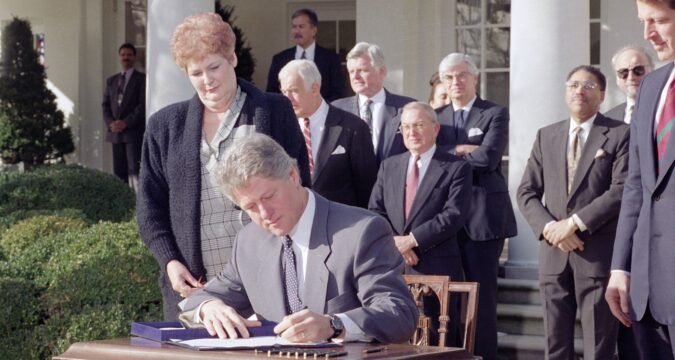
Today in History: Family and Medical Leave Act signed
Today is Thursday, Feb. 5, the 36th day of 2026. There are 329 days left in the year.
Today in history:
On Feb. 5, 1993, President Bill Clinton signed the Family and Medical Leave Act, granting workers up to 12 weeks of unpaid leave for family emergencies.
Also on this date:
In 1917, the U.S. Congress passed the Immigration Act of 1917 over President Woodrow Wilson’s veto, an act that severely curtailed Asian immigration and mandated immigrant literacy testing.
In 1918, more than 200 people were killed during World War I when the Cunard liner SS Tuscania, which was transporting over 2,000 American troops to Europe, was torpedoed by a German U-boat off the coast of Ireland.
In 1971, Apollo 14 astronauts Alan Shepard and Edgar Mitchell stepped onto the moon’s surface in the first of two lunar excursions.
In 1973, services were held at Arlington National Cemetery for U.S. Army Col. William B. Nolde, the last official American combat casualty in the Vietnam War before a ceasefire took effect.
In 1994, white separatist Byron De La Beckwith was convicted in Jackson, Mississippi, of murdering civil rights leader Medgar Evers in 1963 and was sentenced to life in prison.
In 2008, an outbreak of 87 tornadoes fired up across nine states, killing 57 people in Arkansas, Tennessee, Kentucky and Alabama during a span of 12 hours. One Arkansas twister left a 122-mile path of damage along the ground.
In 2017, Tom Brady led one of the greatest comebacks in NFL history, highlighted by a spectacular Julian Edelman catch that helped lift New England from a 25-point deficit against the Atlanta Falcons to the Patriots’ fifth Super Bowl victory, 34-28; it was the first Super Bowl to end in overtime.
In 2020, the Senate voted to acquit President Donald Trump in his first impeachment trial. Most senators expressed unease with Trump’s pressure campaign on Ukraine that prompted the impeachment, but just one Republican, Mitt Romney of Utah, broke party ranks and voted to convict. In 2021, the Senate acquitted Trump in a second trial for allegedly inciting the violent Jan. 6 siege of the Capitol.
Related Articles
Today in Chicago History: CTA derailment in the Loop during rush hour kills 11 people
Today in History: TheFacebook launched
Today in Chicago History: Heather Mack tells Tribune from Bali jail, ‘I loved my mom’
Today in History: 15th Amendment ratified
Today in History: Philip Seymour Hoffman found dead
In 2023, Beyoncé won her 32nd Grammy to become the most decorated artist in the history of the award.
Today’s birthdays: Tony-winning playwright John Guare is 88. Football Hall of Famer Roger Staubach is 84. Film director Michael Mann is 83. Racing Hall of Famer Darrell Waltrip is 79. Actor Barbara Hershey is 78. Actor-comedian Tim Meadows is 65. Actor Jennifer Jason Leigh is 64. Rock musician Duff McKagan (Guns N’ Roses) is 62. Golf Hall of Famer Jose Maria Olazabal is 60. Actor-comedian Chris Parnell is 59. Actor Michael Sheen is 57. Country singer Sara Evans is 55. Actor-singer Darren Criss is 39. Actor Henry Golding is 39. Soccer star Neymar is 34.
https://www.chicagotribune.com/2026/02/05/today-in-history-family-and-medical-leave-act-signed/
EU Inc: Can Brussels’ Latest Corporate Reform Escape Bureaucracy’s Grip
EU Inc: Can Brussels’ Latest Corporate Reform Escape Bureaucracy’s Grip
Submitted by Thomas Kolbe
The European Commission is responding to mounting criticism of over-bureaucratization with the introduction of a new corporate legal form. “EU Inc” is intended to create a uniform legal structure that applies across the entire European Union economic area. A charming idea—but one that quickly sinks in the general bureaucratic madness.
The European Union has reached a point where it is considered lucky if a handful of days pass without new regulatory initiatives from the Brussels central apparatus.
To ease some pressure and deflect growing criticism of the EU’s bureaucratic jungle, Commission President Ursula von der Leyen presented the idea of a Europe-wide corporate legal form during the World Economic Forum in Davos.
The proposed new pan-European company type is called EU Inc. It would become the 28th European legal form, alongside national corporate types such as GmbH, SA, or Limited.
What von der Leyen pitched as an innovative project aims to simplify company formation for startups and scale-ups. The goal is to operate cross-border in all 27 member states of the Single Market without needing to create additional subsidiaries to comply with each nation’s legal requirements.
EU Inc is intended to enable a uniform, fully digitalized formation and administration process. Companies could be registered online within 48 hours—without a notary and without cumbersome paperwork.
The Commission also plans to introduce a central EU register, functioning as a one-stop shop and providing transparency on company formations, capital increases, and ownership structures. The project is currently in the early parliamentary consultation phase and could take effect in national law no earlier than 2027.
The Commission’s idea is attractive. Besides facilitating fast and simple company formation, it would be the first substantial initiative in years moving beyond mostly repressive regulation—truly aimed at deepening the European Single Market.
Faster market entry, simplified mergers, and potentially easier venture capital financing could follow—if national tax deregulation also occurs. That, however, seems unlikely given European regulatory practices.
The politically oft-cited capital markets union would thus receive its first, modest boost—a real-world link to the situation of entrepreneurs. Evidently, fragments of criticism from the business world occasionally reach Commission circles—who would have thought?
Where Are the Entrepreneurs?
As always with Brussels initiatives, the devil is in the details. First, national adoption of this new legal form must be achieved.
It is expected that powerful lobbying groups—from tax advisors to auditors—will work intensively to protect their interests, which are largely derived from the complexity of tax law, capital requirements, and formation procedures.
Over any supposed liberalization of economic activity looms the long shadow of European regulatory policy.
This is the real crux of European politics. Considering the economic structure of the European economy, one inevitably asks: where are the entrepreneurs who would even be willing or able to utilize this new EU Inc framework?
A single number illustrates the grotesque regulatory work of Brussels: last year alone, the European economy was flooded with over 1,400 new EU legal acts. That’s four new regulations per day. Directives, regulations, delegated acts, implementing acts—companies are drowning in an ideologically driven Brussels regulatory swamp.
CO₂ policies and supply chain directives are often in focus, scrutinizing every economic activity in detail and generating immense bureaucratic costs. Entrepreneurs increasingly work to fund administration—less to serve their markets.
What we see in Brussels is classic bureaucracy: once established, politically nurtured, and treated as a political vanguard, it develops a life of its own. Cynically, the production of legal acts is the only “good” keeping it alive.
The truth of this bureaucratic phenomenon often reveals itself openly—when politicians proudly list the laws they initiated, without any understanding of real economic life. It is the work record of a gravedigger, carving a path through the increasingly paralyzed productive sector of society.
Political and media support for EU climate regulation has created a self-referential bureaucracy now spreading into member states. With state quotas beyond 50%, the Rubicon of economic imbalance is crossed. Europe risks becoming a purely administrative hub while productive economy steadily shrinks.
The parasitic body consumes its host, accelerating its decay. Europe is degenerating into an administrative site with declining production activity.
Centrifugal Forces Gain Momentum
EU Inc could indeed be a charming solution for deepening the Single Market—if one day an orderly regulatory turnaround is initiated.
It is quite likely that the accelerating downward spiral of high public debt, falling productivity, rising unemployment, and a dramatic geopolitical decline of the continent will eventually pave the way for a conservative, market-oriented shift.
For Brussels central planners, particularly in Eastern Europe, a political storm is brewing that, once unified, could one day shatter the regulatory chains.
From a German perspective, however, it seems likely that the driving forces of climate-socialist transformation—undoubtedly concentrated in Berlin—will marshal their forces to continue the fatal path toward a command economy after breaking with the opposition.
* * *
About the author: Thomas Kolbe, a Germany a graduate economist, has worked for over 25 years as a journalist and media producer for clients from various industries and business associations. As a publicist, he focuses on economic processes and observes geopolitical events from the perspective of the capital markets. His publications follow a philosophy that focuses on the individual and their right to self-determination.
Tyler Durden
Thu, 02/05/2026 – 05:00
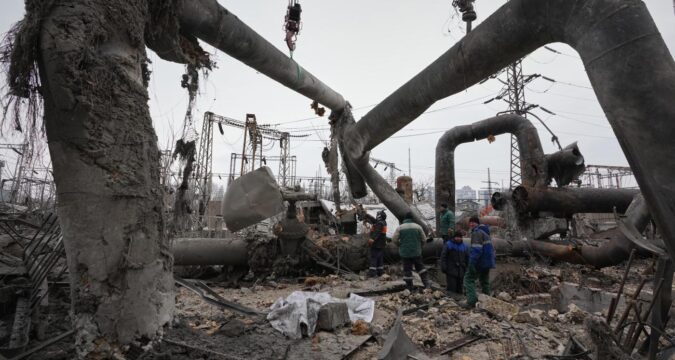
Rusia y Ucrania celebran segundo día de conversaciones de paz mediadas por EEUU en Abu Dabi
Por KAMILA HRABCHUK
KIEV, Ucrania (AP) — Negociadores de Moscú y Kiev mantuvieron el jueves un segundo día de conversaciones en Abu Dabi mediadas por Estados Unidos para poner fin a su guerra en medio de una escalada en los ataques invernales rusos a la red eléctrica de Ucrania y tras un fuerte aumento el año pasado en el número de civiles ucranianos muertos en los combates.
“Estamos trabajando en los mismos formatos que ayer: consultas trilaterales, trabajo en grupo y una mayor sincronización de posiciones”, dijo Rustem Umerov, jefe del Consejo de Seguridad Nacional y Defensa de Ucrania, quien estuvo presente en la reunión.
Las delegaciones de Moscú y Kiev estuvieron acompañadas en la capital de los Emiratos Árabes Unidos por el enviado especial de Estados Unidos, Steve Witkoff, y el yerno del presidente estadounidense Donald Trump, Jared Kushner, según Umerov. También estuvieron en las conversaciones del mes pasado en el mismo lugar, mientras el gobierno de Trump intenta guiar a los dos países hacia un acuerdo.
El general Alexus Grynkewich, Comandante Supremo Aliado de la OTAN en Europa, también estuvo presente en las conversaciones, según un portavoz del general que habló bajo condición de anonimato para discutir asuntos delicados.
El presidente ucraniano, Volodymyr Zelenskyy, instó a los países aliados a presionar a Moscú para que ponga fin a su invasión total, que comenzó hace casi cuatro años el 24 de febrero de 2022, y dijo que su país necesita garantías de seguridad para disuadir cualquier ataque ruso posterior a la guerra.
Zelenskyy señaló en las redes sociales el miércoles por la noche que los ucranianos deben sentir que hay un progreso genuino hacia la paz y “no hacia un escenario en el que los rusos exploten todo a su favor y continúen sus ataques”.
Los combates han continuado en paralelo con las conversaciones. Rusia ha golpeado la red eléctrica de Ucrania, con el objetivo de negar a los civiles el suministro de energía y minar su moral, mientras una guerra de desgaste continúa a lo largo de la línea del frente de aproximadamente 1.000 kilómetros (600 millas) que serpentea por las partes orientales y meridionales de Ucrania.
El año pasado se registró un aumento del 31% en las bajas civiles ucranianas en comparación con 2024, según un informe publicado el miércoles por el grupo de defensa Human Rights Watch.
Casi 15.000 civiles ucranianos han sido asesinados y poco más de 40.000 heridos desde el inicio de la guerra hasta diciembre pasado, según la Misión de Monitoreo de Derechos Humanos de las Naciones Unidas en Ucrania.
___
Emma Burrows en Londres contribuyó a este despacho.
___
Esta historia fue traducida del inglés por un editor de AP con la ayuda de una herramienta de inteligencia artificial generativa.
Maestra india que creó cientos de centros educativos gana el Premio Global a la Enseñanza
Associated Press
DUBÁI, Emiratos Árabes Unidos (AP) — Una profesora y activista india conocida por crear cientos de centros de enseñanza y pintar murales educativos en vecindarios marginales ganó el jueves el Premio Global a la Enseñanza, dotado con un millón de dólares.
Rouble Nagi aceptó el galardón en la Cumbre Mundial de Gobiernos, un evento anual en Dubái, Emiratos Árabes Unidos, que reúne a líderes de todo el mundo.
Su Fundación de Arte Rouble Nagi ha abierto más de 800 centros educativos en toda India. Su objetivo es que los niños que nunca han asistido a la escuela comiencen a tener una enseñanza estructurada. También enseñan a los que ya están escolarizados.
Nagi también pinta murales que enseñan a leer y escribir, ciencia, matemáticas e historia, entre otros temas.
El premio lo concede la Fundación Varkey, cuyo fundador, Sunny Varkey, creó la empresa con fines de lucro GEMS Education, que gestiona docenas de escuelas en Egipto, Qatar y Emiratos Árabes Unidos.
Nagi tiene previsto destinar el millón de dólares a construir un instituto que ofrezca formación profesional gratuita.
Nagi es la décima galardonada desde que la fundación comenzó a otorgar los premios en 2015.
El listado de ganadores anteriores del Premio Global a la Enseñanza incluye a un profesor en una aldea remota de Kenia que donó la mayor parte de sus ingresos a los pobres, una maestra de primaria palestina que enseña a sus estudiantes la cultura de la no violencia y un educador canadiense que daba clase a estudiantes inuit en una aldea remota del Ártico. El año pasado se reconoció al educador saudí Mansour al-Mansour, conocido por su trabajo con los pobres en su país.
GEMS Education, o Global Education Management Systems, es uno de los mayores operadores de escuelas privadas del mundo y se cree que su valor asciende a miles de millones. Su éxito ha ido en paralelo al de Dubái, donde solo las escuelas privadas ofrecen clases a los hijos de los extranjeros que impulsan su economía.
___
Esta historia fue traducida del inglés por un editor de AP con la ayuda de una herramienta de inteligencia artificial generativa.

How Fast Is The Asian Population Ageing?
How Fast Is The Asian Population Ageing?
The latest revision of UN World Population Prospects reveals that demographic shift is no longer a distant projection but an accelerating reality across parts of Asia, with the share of people aged 65 and over rising fast in several countries.
As Statista’s Tristan Gaudiaut reports, this trend poses a significant challenge in the region for labor markets, public finances and care systems within a single generation.
The figures (UN medium-scenario projections) show Japan already far ahead, as older adults made up already around 29 percent of the population in 2020, and are projected to surpass 30 percent in the coming years: 31.1 percent by 2030 and 35.4 percent by 2040. But, as our infographic shows, the more striking story is the pace of change elsewhere.
You will find more infographics at Statista
South Korea and China are among the standout accelerators.
Both countries are expected to see their 65+ population shares more than double between 2020 and 2040. In South Korea, this figure is projected to surge from 15.8 percent (2020) to 33.8 percent (2040), while in China, it is expected to rise from 12.7 percent to 26.6 percent.
Those trajectories mirror intensifying national concerns about future labor supply and pension burdens, amid persistent low fertility and a shrinking workforce.
Meanwhile, rapid ageing is not confined to the region’s richest economies. Thailand and Vietnam start from lower baselines, yet both trend sharply upward by 2040.
Both South-East Asian countries are projected to see their 65+ population shares double in twenty-years: Thailand to 25.6 percent and Vietnam to 15.8 percent.
Tyler Durden
Thu, 02/05/2026 – 04:15
https://www.zerohedge.com/geopolitical/how-fast-asian-population-ageing
Maestra india que creó cientos de centros educativos y pintó murales en barrios pobres gana Premio Global a la Enseñanza
DUBÁI, Emiratos Árabes Unidos (AP) — Maestra india que creó cientos de centros educativos y pintó murales en barrios pobres gana Premio Global a la Enseñanza.
Qué saber sobre los ataques que dejaron más de 160 muertos en Nigeria
Por DYEPKAZAH SHYBAYAN y MARK BANCHEREAU
ABUYA, Nigeria (AP) — Hombres armados mataron a decenas de personas en dos aldeas en el oeste de Nigeria, en uno de los ataques más letales en el país de África Occidental en los últimos meses.
El asalto, perpetrado el martes por la noche, tuvo como objetivo las aldeas vecinas de Woro y Nuku, en el estado de Kwara. Un legislador que representa a la zona reportó la muerte de al menos 162 personas, mientras que Amnistía Internacional afirmó que los atacantes abatieron a más de 170 personas, arrasaron casas y saquearon tiendas. El grupo de derechos humanos condenó “un asombroso fallo de seguridad”.
Los ataques mortales y secuestros cometidos por insurgentes islamistas y bandas armadas han repuntado en Nigeria en los últimos meses, mientras su sobrepasado ejército ha tratado de hacer frente a una serie de desafíos en materia de seguridad.
A continuación, lo que debe saber acerca de los letales ataques.
Nigeria enfrenta crisis de seguridad superpuestas
Nigeria está sumida en una compleja crisis de seguridad, que incluye una insurgencia de militantes islámicos y un aumento de los secuestros para pedir rescate por parte de bandas criminales.
Durante años, los llamados “bandidos” han actuado principalmente en el noroeste del país, pero recientemente se han desplazado a otras regiones, incluyendo el estado de Kwara.
Los insurgentes también han incrementado su actividad en Kwara, mientras la insurgencia que comenzó décadas atrás y que hasta hace poco afectaba en su mayoría al noreste, se ha extendido a las regiones del oeste y el centro.
Los más conocidos son los de la milicia local Boko Haram, que tomó las armas en 2009 para luchar contra la educación occidental e imponer su versión radical de la ley islámica. La semana pasada, Boko Haram mató al menos a 36 personas en el noreste del país en varios ataques separados.
Entre los grupos armados extremistas en Nigeria hay también al menos dos afiliados al Estado Islámico: una escisión de Boko Haram llamado Estado Islámico – Provincia del África Occidental y Estado Islámico – Provincia del Sahel, conocido localmente como Lakurawa, que tiene más presencia en el noroeste.
Grupos extremistas, sospechosos de los ataques
Ningún grupo se ha atribuido por el momento la autoría de los incidentes del martes.
Mohammed Omar Bio, representante de la zona en el parlamento, dijo que los ataques fueron perpetrados por Lakurawa,
James Barnett, un investigador del Instituto Hudson de Washington, indicó que es más probable que el ataque haya sido obra de Jama’atu Ahlis Sunna Lidda’awati wal-Jihad, una facción de Boko Haram responsable de otras masacres recientes en el lugar.
El gobernador del estado de Kwara, AbdulRahman AbdulRazaq, apuntó que el asalto del martes podría ser una respuesta a las recientes operaciones antiterroristas en la región.
Según AbdulRazaq, fue un intento de distraer a las fuerzas de seguridad “que han cazado con éxito a varias bandas de terroristas y secuestradores en muchas partes del estado”.
EEUU intensifica su respuesta a la crisis de seguridad
Los ataques se produjeron días después de que Estados Unidos emprendiera acciones militares contra grupos armados en Nigeria.
El jefe del Comando de África de Estados Unidos dijo el martes que Washington envió un pequeño equipo de oficiales militares a Nigeria. El general Dagvin R.M. Anderson explicó que el despliegue se realizó a petición del gobierno de Abuya y se centró en el apoyo a los servicios de inteligencia.
Nigeria lleva meses en el punto de mira diplomático de la Casa Blanca. Donald Trump amenzó con atacar el país alegando que no hace lo suficiente para proteger a sus ciudadanos cristianos.
Aunque los cristianos han estado entre los objetivos, los analistas afirman que la mayoría de las víctimas de los grupos armados son musulmanes del norte de Nigeria, una región donde son mayoría y donde se producen la mayoría de los asaltos.
Pero las tensiones diplomáticas se han transformado en cooperación entre Abuya y Washington: las fuerzas estadounidenses lanzaron ataques aéreos contra insurgentes afiliados al Estado Islámico en Nigeria en diciembre.
El mes pasado, el gobierno nigeriano anunció que Estados Unidos se había comprometido a enviar los equipos militares pendientes de entrega adquiridos por el país en los últimos cinco años, que incluyen drones y helicópteros. Parte de los equipos se demoraron en los últimos años debido a las preocupaciones por posibles abusos de los derechos humanos por parte de las fuerzas de seguridad locales.
___
Banchereau informó desde Dakar, Senegal.
___
Esta historia fue traducida del inglés por un editor de AP con la ayuda de una herramienta de inteligencia artificial generativa.
Netherlands To Tax Unrealized Gains: EU Wealth Grab And Global Implications
Netherlands To Tax Unrealized Gains: EU Wealth Grab And Global Implications
Submitted by Thomas Kolbe
A fiscal storm is brewing in the Netherlands. With the potential introduction of a tax on unrealized capital gains, The Hague is set to become a testing ground for the systematic transfer of wealth from the private sector to the state. Across all government levels, the European Union is increasingly transforming into an aggressive parasitic system.
A fundamental clash between the public and private sectors is intensifying across the EU. In March, both chambers of the Dutch parliament will decide on the implementation of an annual tax on unrealized gains. Going forward, all increases in value—from real estate and stocks to bonds and cryptocurrencies—would fall under this fiscal framework.
This move significantly accelerates the extraction of capital from the private sector, constituting a political rule violation. Already taxed income and assets would be hit again based on hypothetical gains, severely impeding private wealth accumulation.
Support for this measure spans both right- and left-wing parties. It reflects a form of fiscal horseshoe logic, apparently anticipating a severe national financial crisis.
For the EU as a whole, this is disastrous. That a nation with a debt ratio of just 46% and new borrowing of slightly over 2% of GDP would effectively declare war on private capital signals profound economic distortions in one of Europe’s most successful economies. One naturally asks: if this is happening in the Netherlands, what does it say about the rest of the European Union?
The End of the Productive Economy
A glance at Eurozone manufacturing suggests a storm is brewing. Deindustrialization in Germany, the largest industrial base in Europe, began in 2018 and has accelerated ever since, with massive capital flight. What applies to Germany applies even more so to the fragile peripheral European economies.
For decades, Europe’s economy has shifted from production toward financial and wealth-rentier models. As financialization advances, production and value creation increasingly relocate abroad. This mirrors a process the United States underwent for decades and attempted to reverse under President Donald Trump.
European states see no escape from the economic death spiral created by expanding welfare systems, uncontrolled migration, and slowly shrinking core industrial productivity. Politicians are buying time through the expropriation of citizen savings to evade growing reform pressure.
Once societal patience reaches a tipping point, Europe may witness scenes similar to those currently unfolding in the U.S., where the government has effectively declared war on illegal immigration amid a media-driven defensive battle coordinated by far-left forces, globalist media, and foreign foundations.
The pressing question for Europe: how long will native populations tolerate financial assault from the state without demanding corresponding migration and welfare reforms?
Several EU states already levy progressive inheritance and gift taxes. Norway recently introduced a wealth tax of roughly 1% on net assets above €160,000 per person, raising eyebrows in one of Europe’s richest nations. Spain applies a progressive wealth tax up to 3.5%, plus a solidarity wealth levy for assets above €3 million—“solidarity,” a political buzzword used to rhetorically justify impending fiscal expropriation.
This expropriation is imminent. Coalition parties have spent the past year laying the groundwork for a massive expansion of inheritance taxes. It would be unwise to rule out Germany’s politically influenced Constitutional Court approving a national wealth tax in the future.
Building the Command Economy
Germany is driving Europe toward socialism. Capital formation and independent family structures, which could form a powerful societal opposition, are increasingly despised by political elites.
There is no longer any denying it: the EU’s economic model and the manic drive to transform it into a green command economy reflect growing panic in Brussels, Berlin, and Paris. Every attempt to mask economic collapse with debt fails—the collateral damage of centrally planned green “artificial” economies seeps into public awareness.
The economic plight of weaker Southern European nations hardly needs detailed exposition. It is well known that the Eurozone has failed as a currency union attempting to integrate economies with wildly divergent productivity, such as Germany and Greece.
Now, cracks are visible, and states are defending their power through systematic extraction of private capital. Europe is on the defensive.
Europe in the U.S.
Wherever the European model has been adapted, politics is employing similar tools. The election of socialist Zohran Mamdani as New York City mayor last year drew attention. His victory was fueled by politically guided settlement of Muslim migrants, allied with the financial-left establishment, orchestrating a successful campaign.
With Mamdani’s election, vast capital is now politically—literally—trapped. Those who fail to relocate face massive taxation. Mamdani, campaigning on free public transit, rent caps, and public markets, announced plans this week to close a $10 billion budget gap with a wealth tax.
New York is now a Democratic Party campaign hub, positioned against the heart of the conservative resurgence initiated by Donald Trump’s deregulation and tax cuts.
In California, the most European-leaning U.S. state, the “Billionaire Tax Act” was introduced, with Governor Gavin Newsom planning a one-time 5% wealth levy on net assets above $1 billion. Outmigration from the Golden State has already begun, along with tens of thousands of jobs relocating elsewhere. The shortsightedness of this policy is only surpassed by its childish aggressiveness.
Worldwide, it remains vital to preserve economic centers that defend market principles and private wealth accumulation—the torchbearers of civilization. Meanwhile, the EU’s descent into socialist barbarism seems all but inevitable.
* * *
About the author: Thomas Kolbe, a Germany a graduate economist, has worked for over 25 years as a journalist and media producer for clients from various industries and business associations. As a publicist, he focuses on economic processes and observes geopolitical events from the perspective of the capital markets. His publications follow a philosophy that focuses on the individual and their right to self-determination.
Tyler Durden
Thu, 02/05/2026 – 03:30
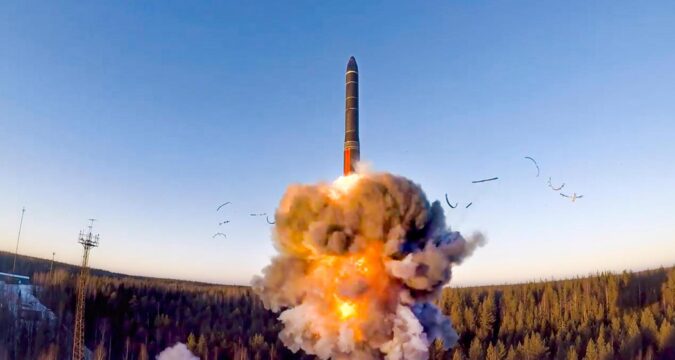
El último pacto nuclear entre EEUU y Rusia expira, generando temores a una carrera armamentista
Associated Press
MOSCÚ (AP) — El último acuerdo sobre armas nucleares que quedaba entre Rusia y Estados Unidos expiró el jueves, eliminando cualquier límite a los dos mayores arsenales atómicos por primera vez en más de medio siglo.
El fin del Nuevo START podría preparar el escenario para lo que muchos temen podría ser una carrera armamentista nuclear sin restricciones.
El presidente ruso, Vladímir Putin, declaró el año pasado su disposición a adherirse a los límites del tratado por un año más si Washington hacía lo mismo, pero el presidente de Estados Unidos, Donald Trump, no se ha comprometido a extenderlo.
Putin comentó la expiración del pacto con el líder chino Xi Jinping el miércoles, según el asesor del Kremlin Yuri Ushakov, señalando que Washington no ha respondido a su propuesta de extensión.
Ushakov afirmó que Rusia “actuará de manera equilibrada y responsable basada en un análisis exhaustivo de la situación de seguridad”.
El Ministerio ruso de Exteriores dijo el miércoles por la noche en un comunicado que “bajo las circunstancias actuales, asumimos que las partes del tratado Nuevo START ya no están obligadas por ninguna obligación o declaración simétrica dentro del contexto del Tratado, incluidas sus disposiciones fundamentales, y son fundamentalmente libres de elegir sus próximos pasos”.
El Nuevo START, firmado en 2010 por el entonces presidente Barack Obama y su homólogo ruso, Dmitry Medvedev, restringía a cada lado a no más de 1.550 ojivas nucleares en no más de 700 misiles y bombarderos, desplegadas y listas para su uso. Originalmente debía expirar en 2021, pero se extendió por cinco años más.
El pacto preveía amplias inspecciones in situ para verificar el cumplimiento, aunque se detuvieron en 2020 debido a la pandemia de COVID-19 y nunca se reanudaron.
En febrero de 2023, Putin suspendió la participación de Moscú, diciendo que Rusia no podía permitir inspecciones estadounidenses de sus instalaciones nucleares en un momento en que Washington y sus aliados de la OTAN han declarado abiertamente que la derrota de Moscú en Ucrania es su objetivo. Al mismo tiempo, el Kremlin enfatizó que no se retiraba del pacto por completo, comprometiéndose a respetar sus límites sobre armas nucleares.
Al ofrecer en septiembre adherirse a los límites del Nuevo START por un año para ganar tiempo para que ambas partes negocien un acuerdo sucesor, Putin dijo que la expiración del pacto sería desestabilizadora y podría fomentar la proliferación nuclear.
El Nuevo START siguió a una larga sucesión de pactos de reducción de armas nucleares entre Estados Unidos y Rusia. Esos también se han abandonado.
___
Esta historia fue traducida del inglés por un editor de AP con la ayuda de una herramienta de inteligencia artificial generativa.