Category: News
The Chicago Municipal Device is the city symbol few Chicagoans know about
For all its ills, social media can also be an entry point for anyone interested in Chicago history and the city’s varied eccentricities.
This became apparent when the writer and photographer Cristen Brown recently posted a pair of cufflinks featuring what most might assume is the letter “Y” in a circle.
But for Chicagoans with a deeper awareness, the symbol is recognizable as something else: The Chicago Municipal Device, a graphic design that can be found dotted around the city, from building facades to lampposts to the occasional manhole cover.
Depending on your depth of knowledge, it is either an obscure if delightful artifact that has an insidery “if you know, you know” quality to it, or something you were never aware existed.
“Chicagoans are completely obnoxious about … well, everything,” Brown wrote in the caption accompanying her photo. “But especially our glorious municipal device. I made this pair of cufflinks for my husband a few years ago.”
If the name is tripping you up — “municipal device” sounds as if it could be a gas meter or something else mechanical — that’s because it’s using the less commonly employed definition of “device” meaning heraldry, such as a coat of arms. Or as Merriam-Webster puts it: “An emblematic design used especially as a heraldic bearing.”
A pair of cufflinks designed by Cristen Brown for her husband, feature the Chicago Municipal Device. (Cristen Brown)
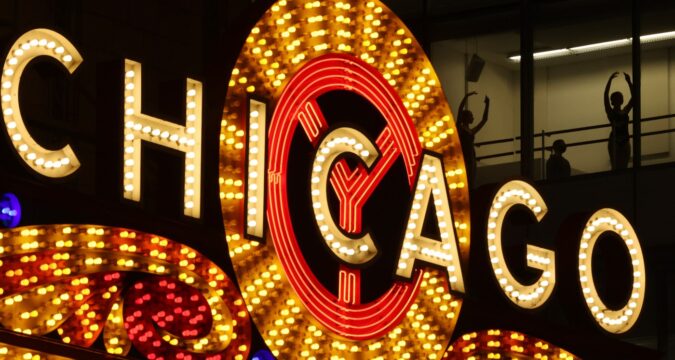
There’s something so perfectly humble-braggy and not immediately intuitive about calling it a device. Which is also what makes it so perfectly Chicago. It’s featured prominently, if sideways, on the Cook County flag (along with the iconic red stars that also appear on the city flag) and perhaps is most easily spotted — once you realize it’s there — in the marquee of the Chicago Theatre on State Street, especially when it’s lit up at night. The device can be clearly seen radiating like a sun behind the “ICA” of the word “CHICAGO.”
The origins of the Chicago Municipal Device date back to 1892, when the Tribune ran a contest a year ahead of the World Columbian Exposition. Dangling a $100 prize, the paper asked readers to choose the best city color, or combination of colors, to represent the idea of a unified Chicago. Even 134 years ago, the power of visual branding was ever-present.
The contest’s winner, a Danish architect and recent Chicago transplant named Alfred Råvad (sometimes spelled Roewad), suggested the color scheme of white and red. That was subsequently tweaked by the Citizens’ World’s Fair committee to white and terra cotta, to better reference the prevalence of the non-flammable clay-based building material used in the rebuilding of the city after the Great Chicago Fire of 1871.
But Råvad also added something extra to his submission: An idea for a graphic design which mimics the path of Chicago River — specifically where the main stem splits into two branches at Wolf Point, hence the “Y” shape — a shape which would eventually become known as the Chicago Municipal Device.
Here’s Råvad’s reasoning for creating a city logo: “I think it right to give a heraldic and graphic expression of Chicago, as it is and always will be divided by the river in three sides — North Side, West Side and South Side.”
“The idea is that people would create their own banners, flags, whatever, with this symbol in these colors,” says Robert Loerzel, a freelance journalist and historian and Tribune contributor. He frequently photographs his journeys around the city — recently posting a photo of the device he unexpectedly encountered on Western Avenue — and he has researched and written about the origins of both the Chicago flag and the device.
In its call for submissions, the Tribune noted that “Chicago’s unparalleled progress has been in no small degree due to the intense local pride of its citizens of all classes. ‘Shoulder to shoulder, close ranks’ has always been the watchword, and the consequence is a vast amount of justifiable civic pride which would doubtless welcome a chance to display itself in the display of a ‘municipal color.’”
Which is poetic hyperbole, Loerzel points out in a blog post: “Describing Chicagoans as a unified bunch was wishful thinking. The city’s factions often seemed to be at war with one another, whether it was moralists denouncing the people who frequented saloons and brothels, or captains of industry battling against unions.”
Alfred Jensen Roewad, the winner of a $100 prize in the Tribune’s contest for “municipal colors” to be displayed at the World’s Columbian Exposition of 1893, suggested terra cotta and white be displayed in banner and shield styles at the fair. Artist F.D. Millet took Roewad’s suggestions and in 1892 used them to create a flag using the same municipal colors. (Chicago Tribune)
Because the city’s divisions were (and still are) not only geographic but ideological, there was good reason to create a counter-narrative of unity ahead of the world’s fair. That’s because there had been some dispute as to where it should be based. Some people wanted it in what is now Grant Park. Others argued for Lincoln Park or Garfield Park. Ultimately, Jackson Park would win out.
“There had been a nasty fight over where it should be located, so part of this was about pulling Chicago back together,” says Patricia Morse, who has also written about the device. Her focus is in the history of Chicago’s South Side, and she writes for her own website in addition to a column for the Hyde Park Herald.
She suspects a desire to put the previous fractiousness to bed was why Råvad’s design was appealing. “It takes the different slides of the city and puts a circle around all of them, pulling them together and focuses on what made Chicago important, which at the time was the river.”
Morse first became aware of the device a few years ago when she was doing research on the fair. “I was helping give Friends of the White City tours of Jackson Park and where the fair was, so I was really immersed in that and looking for things that connected to it.”
A number of newspapers in town held similar contests, Morse says, including the now-defunct Chicago Inter Ocean, which published from 1865 to 1914. “They ran a contest for a figure that they called ‘Miss I Will’ that would symbolize Chicago for all the people coming to the fair. The fair was full of these metaphorical ladies; there was Britannia and Germania and so on.”
Morse describes Miss I Will in a blog post: “I learned about Miss I Will in the 1970s in the Eagle, a wonderful bar in Hyde Park. In the middle room, there were two large murals from the 1930s facing each other across the room. On the south wall was the 1930s skyline of New York with Miss Liberty front and center. On the north wall was the skyline of Chicago with Miss I Will looking like a chorus girl from the ‘Gold Diggers of 1933.’ Her marcelled hair was bottle blonde. She was smiling, close up, from somewhere out in the lake in front of the skyline of Chicago. I always liked the face-off. Turns out, she was invented for the 1893 Chicago World’s Fair.”
People ice skate past a Chicago Municipal Device on a light post in Millennium Park on Jan. 29, 2026. The symbol consists of a “Y” shape inscribed inside a circle. (Josh Boland/Chicago Tribune)
A version of the Chicago Municipal Device on the ceiling of Chicago City Hall. (Josh Boland/Chicago Tribune)
But it would be decades until Morse would learn about the Chicago Municipal Device. “Suddenly, you notice it’s on manhole covers, it’s in ironwork, it’s on old fire stations. The light posts in Grant Park have it, and those are relatively new.” Tribune archival photos from the early 20th century show the device in the logos of athletic association uniforms.
But you almost never see it on more contemporary buildings. Perhaps that’s because modern architecture rarely has the kind of adornments that might prompt a builder to consider including a Chicago Municipal Device somewhere in the external design. More than a century after its adoption, it’s become a niche interest.
Initially, the device only appeared on posters and advertisements before gaining more permanent traction. “In 1917, when the Chicago flag was adopted, they also passed an ordinance affirming this as the Municipal Device,” says Loerzel. Here’s how it is described: “The municipal device, for use by the varied unofficial interests of the city and its people, shall show a Y-shaped figure in a circle, colored and designed to suit individual tastes and needs.”
The ordinance also includes this detail: “All automobiles and other vehicles which are owned by the city, except those used by the commissioner of police, and the detective bureau of the department of police, shall be distinctly marked as the property of the city by painting or placing thereon in a conspicuous place, in such a manner that the same cannot be removed, the municipal device, together with the words ‘City of Chicago.’”
The device usually shows up as a “Y,” right-side up. But occasionally it’s inverted and there’s no definitive explanation, but some speculate that it is to represent the reversal of the Chicago River, which took place in 1900.
A Chicago Municipal Device symbol appears in a mosaic on the ceiling of the Chicago Cultural Center. (Josh Boland/Chicago Tribune)
A Chicago Municipal Device is part of the railing on the Franklin-Orleans Street Bridge, here on Jan. 30, 2026. (Josh Boland/Chicago Tribune)
“I think first and foremost, it’s just damn good design at its most basic level,” says Brown, who found inspiration for her husband’s cuff links by riffing on the old logo for the Chicago North American Soccer League club, which is indeed the Chicago Municipal Device.
“There probably are people who are like, ‘Why are there all these random “Ys” all over the city?’ But once you are introduced to it and you understand it, it becomes a friend that you start to recognize and the entire city just opens up like a giant scavenger hunt,” she says. “It’s simple, it’s eye-catching, it’s memorable, it’s versatile, it’s timeless. It’s as cool today as when they first introduced it. It also hits a lot of nerd points for people like me and that elevates it from just ‘This looks really cool’ to ‘This has all these connections to nerdly things.’ And when I say ‘nerds,’ I don’t mean that pejoratively; these are my people. And the nerdiest thing in the world is a map and that’s basically what this is. It’s a simplified map.”
Ultimately, she says, “it’s a very evocative symbol that you can unambiguously point to as being ours. When you see it, you can’t help but celebrate it. We’re all Chicago boosters, even as we recognize its imperfections and its warts. But we love our city and this is a symbol of that spirit.”
Morse echoes that sentiment.
“We are apparently the only city that has a device,” she says. “The people who voted for it in 1917 totally remembered the fair, so it was a celebration of the times we did good.”
Maybe we don’t do that enough.
“It’s this idea that we may fight with each other,” says Morse, “but when the world comes to us, we’re a unified Chicago.”
https://www.chicagotribune.com/2026/02/11/chicago-municipal-symbol/
Germany’s Decline Is A Warning Canada Should Heed Now
Germany’s Decline Is A Warning Canada Should Heed Now
Authored by Gwyn Morgan via The Epoch Times,
Germany was postwar Europe’s greatest economic success story.
Today it is a cautionary tale.
Once the continent’s industrial engine, Germany has spent the past decade dismantling the foundations of its prosperity through energy and immigration policies driven more by ideology than evidence or good sense. The results have been rising costs, falling competitiveness, social disorder, and political backlash.
Canada should study this record closely—because we are pursuing many of the same policies.
Energy has played a leading role in Germany’s decline. Reliable, affordable power is the lifeblood of any advanced economy. In 2002, Germany’s 11 nuclear power plants supplied more than one-quarter of its electricity, with coal providing most of the remainder and natural gas filling in when needed. “Renewable” energy played only a minor role. The country had a stable, economically efficient grid that supported one of the world’s most productive industrial bases.
That balance was abandoned. Driven by an ideological campaign against nuclear power, successive governments committed to replacing reliable baseload electricity with intermittent wind and solar. The goal shifted from reducing emissions to shutting down all nuclear plants, at any cost. After Japan’s Fukushima disaster in 2011—caused by a tsunami, not reactor failures—Germany accelerated these closures. Within six months, eight nuclear plants were taken offline. The rest would eventually follow. Not even Vladimir Putin’s invasion of Ukraine would throw Germany’s anti-nuclear zealots off-track.
The consequences were predictable. Electricity demand rose as Germany pushed consumers and industry to electrify, but wind and solar output could not keep pace. Germany turned instead to imported natural gas, much of it from Russia, replacing energy independence with geopolitical vulnerability. Had Germany kept its nuclear plants operating, a PricewaterhouseCoopers study concluded, 94 percent of its power generation would now be emissions-free and electricity prices roughly 23 percent lower.
Instead, Germans now face some of the world’s highest electricity prices plus declining reliability. They even coined a new word, “Dunkelflaute,” to describe calm, dark periods when wind and solar produce no power at all. High energy costs have hollowed out German industry. Its world-leading chemicals sector has shrunk dramatically. Family-owned manufacturers—a pillar of German industry for centuries—are closing by the hundreds.
The damage is most visible in Germany’s auto sector, which once provided livelihoods for millions and anchored its export economy. Today it is in retreat. Production fell by 29 percent between 2017 and 2024. Chinese manufacturers—benefiting from scale, subsidies, and lower energy costs—are flooding European markets with affordable electric vehicles. German firms are losing market share and laying off workers in large numbers for the first time since the World War II.
This should sound uncomfortably familiar to Canadians. Canada is also driving up domestic energy costs while betting heavily on electrification and electric-vehicle manufacturing. We have fewer industrial buffers than Germany and higher transportation costs. If Europe’s industrial powerhouse cannot absorb these shocks, Canada’s position is even more precarious.
Germany’s second self-inflicted wound was mass immigration. During the Syrian civil war, Chancellor Angela Merkel opened her country’s borders, blithely declaring “Wir schaffen das” (“We can do this”). By the end of 2015, Germany had taken in 1.2 million refugees. Integration systems were overwhelmed while schools, housing, social services and policing struggled to cope. Despite these clear warning signs, Germany kept right on going, bringing in hundreds of thousands of migrants year after year from troubled Asian and African countries.
The fiscal cost has been staggering. In 2024 alone, Germany spent nearly 30 billion euros, or about C$48 billion, on refugees and asylum-seekers, not including costs associated with crime and security. Social cohesion frayed further. Public spaces required ever-heavier security. Terrorist attacks and sexual assaults rose. Political backlash followed.
Only now is Germany putting on the brakes, deporting tens of thousands of rejected asylum seekers or criminal migrants and cutting benefits.
The same government that once insisted open borders were a moral imperative now acknowledges limits.
Germany’s energy and immigration failures have a common cause: policymaking driven by moralistic certitude rather than empirical recognition of practical constraints. In both cases, dissent was dismissed, costs were minimized, warnings ignored, and course-corrections refused even after damage became impossible to deny.
Canada should take note. We are raising energy prices while maintaining immigration at near-record levels—including hundreds of thousands of barely-if-at-all vetted refugees—amid a housing shortage, stagnant productivity, and strained public services. Germany shows how quickly good intentions can morph into economic and social decline.
Canada still has time to change course. Whether we choose to learn the lesson is another matter.
* * *
Gwyn Morgan devoted three decades to building North America’s leading oil and gas company. He has served as a director of five global corporations, and was appointed a Member of the Order of Canada in 2011.
The original, full-length version of this article was recently published in C2C Journal.
Views expressed in this article are opinions of the author and do not necessarily reflect the views of The Epoch Times or ZeroHedge.
Tyler Durden
Wed, 02/11/2026 – 06:30
https://www.zerohedge.com/geopolitical/germanys-decline-warning-canada-should-heed-now
Editorial: Jeff Walter for Illinois 11th Congressional District Republican primary
Represented by Democrat Bill Foster, the 11th is a suburban, exurban and rural district ranging from Lemont and Naperville in the western suburbs through part of Aurora and northwest to Woodstock and Belvidere. Foster is unopposed.
There are four running in the GOP primary. The two leading candidates are Jeff Walter, who last year won his third term as mayor of Elburn, and retired Army Lt. Col. Michael Pierce of Naperville.
Both Walter and Pierce strike us as solid Republican choices, but we give the nod to Walter, 65, who has run unopposed in two successive elections for Elburn mayor and holds some moderate positions that we think could make him viable against the moderate Democrat Foster. Chief among those are Trump’s tariffs, the enormity of which this page has criticized as anti-competitive. “If I had the authority to reverse Donald Trump’s tariffs,” Walter told us, “I would evaluate them individually: I would keep or modify those that demonstrably protect U.S. workers or address unfair practices, and roll back those that primarily raise costs at home.”
Pierce, by contrast, approves of Trump’s tariffs without qualification.
Also running is Charlie Kim of Aurora, who in 2024 said in a voter guide that he didn’t believe Joe Biden won the 2020 election legitimately. Tedora Brown of Palos Park is subject to a judicial ruling that she didn’t collect enough valid signatures to qualify for the ballot. (That ruling has been appealed).
Walter is more likely to appeal to the moderate Democrats and independents any GOP candidate will need to unseat Foster. He has our endorsement.
Read all of the Tribune Editorial Board’s endorsements for the 2026 Illinois primary election here.
Submit a letter, of no more than 400 words, to the editor here or email letters@chicagotribune.com.
Editorial: Brad Schneider for Illinois’ 10th Congressional District Democratic primary
Rep. Brad Schneider has represented this north suburban district since 2017. He faces Morgan Coghill, 46, a political neophyte who is challenging the moderate Schneider from the left. Coghill’s campaign didn’t respond to our questions, but his campaign positions him essentially as a socialist and calls for ending all military aid to Israel, among other stances in the furthest left reaches of the Democratic Party.
We think Schneider, 64, ably represents his district and, while his firm support for Israel’s right to exist and defend itself led to a hateful protest at his home in the wee hours of a summer night in 2024, which we condemned, he contributes common sense to his party in the House.
Brad Schneider is endorsed.
Read all of the Tribune Editorial Board’s endorsements for the 2026 Illinois primary election here.
Submit a letter, of no more than 400 words, to the editor here or email letters@chicagotribune.com.

Editorial: In the 6th Congressional District, Sean Casten for Democrats and Niki Conforti for GOP
The 6th District, which includes southern Cook County and eastern DuPage County, as well as part of the Far Southwest Side of Chicago, is the domain of 54-year-old Sean Casten, a principled, Dublin-born Democrat who rightly notes that “the era of Donald Trump has scared people.”
When it comes to bringing home the district bacon, Casten has been effective; he notes that he “brought tens of millions of dollars directly back to the 6th District in specific congressional authorizations, ranging from storm-sewer repairs to a playground for children experiencing homelessness.” But we also find him a substantial thinker, a political pragmatist who understands both the current frailty of this nation and its promise.
“Tribalism is easy to release but hard to put back in the bottle,” he told us. “Any of us who have ever thought differently of a neighbor because of the yard sign they put up in the last election knows that temptation. America’s strength comes from our size and diversity, but it is also our weakness — since that very diversity risks ripping us apart, and once that polarization starts, it feeds on itself.” It sure does.
Casten’s Democratic challenger is Joey Ruzevich, a 28-year-old technology engineer who lives in Chicago’s Mt. Greenwood neighborhood and gave us full answers to our questions, most reflecting policy positions in line with other progressive young Democrats in the congressional races (he is running, such as it is, to Casten’s left).
He seems genial and smart, but Ruzevich does not have any meaningful political experience and has not mounted what we judge to be a competitive campaign. We endorse Casten.
Republican primary
There are two Republicans running to take on Casten: Niki Conforti and Skylar Duensing.
At 25, Duensing is a new generation of Republican and he touts his connection to the late Charlie Kirk, who motivated many young conservatives to get into politics. Duensing is the founder of (and employed by) The United States Patriots Society, a nonprofit organization he describes as “restoring America’s Founding Principles by raising awareness and understanding of the importance of the values of Faith, Family and Freedom.” He also has experience as a guest on many conservative-leaning media outlets.
Duensing answered our questions in impressive detail and most of his positions probably would land him somewhere in the middle of the Republicans in Congress. He also expressed a willingness to work across the aisle.
Niki Conforti participates in a candidate forum in Countryside, May 4, 2022. (Antonio Perez/ Chicago Tribune)
We have some areas of agreement with Duensing when it comes to taxation, the benefits of competition and worries about the future of Social Security. We admire his desire to run for office as part of Kirk’s legacy. And we don’t doubt his appeal to young voters.
The 62-year-old Conforti, though, has more relevant, real-world experience and is the better choice for Republicans.
A longtime resident of the district, Conforti argues that affordability is the most critical issue to the residents of the 6th District and she places the blame on energy and health care, which is a reasonable argument. She says she’ll push for legislation in the energy space that cuts regulations, thus “pushing speed to power, making energy more resilient and more affordable.” She also said she opposes gerrymandering.
Conforti has our endorsement.
Read all of the Tribune Editorial Board’s endorsements for the 2026 Illinois primary election here.
Submit a letter, of no more than 400 words, to the editor here or email letters@chicagotribune.com.
WTTW’s new season of ‘Firsthand’ hopes to show that democracy is ‘a participatory sport’
For seven seasons, the people behind WTTW’s “Firsthand” documentary series have gathered to figure out what subject to focus their efforts. In previous years, executive producer Dan Protess and his team have centered such topics as segregation, coronavirus, poverty, homelessness and life after prison. This season is about the state of American democracy and how people in the Chicago area are fighting for democracy in one way or another.
“My framing device is that chant you often hear at protests: ‘This is what democracy looks like!’” Protess said. “Unless you’re a political scientist, it’s a bit hard to wrap your brain around what democracy does look like. We’re taught in school that democracy is your role as a citizen, and democracy is to show up and vote once every two or four years. We wanted to look at, what are the other faces of democracy? What are other roles that citizens can take to participate?”
“Firsthand: Democracy” features five people filmed over the course of last summer and fall, including Isabel Aquilar, a naturalized U.S. citizen from Mexico who volunteers as a tutor for immigrants; Maryanne Colter, who teaches people how to tone down toxic partisanship; Julee Mortensen, a 72-year-old suburban grandmother who organizes and participates in protests; Miten Patel, an Evanston Township High School teacher and British-born Indian immigrant who encourages his students to engage with the political process; and Camille Williams, whose mother was murdered when she was 6 years old, and who works to ensure those impacted by the legal system know their rights, including the formerly incarcerated.
Protess is hoping that, given the nation’s 250th anniversary, this season will draw audiences from other cities. The one thing he wants people to take away: “That democracy is a verb, a participatory sport. I’m hoping these stories will provide people with models of roles that they might be able to play, whether it’s facilitating dialogue, maybe not on a mass scale like Maryanne, but maybe within their family or their workplace, or as educators doing their part.
“We all have a role to play if we want to have a healthy, thriving democracy,” he added. “I think most people do, but they’ve forgotten, in no small part because of social media, what their role is beyond shouting in the comments section.”
Patel teaches AP government and politics. He found education after banking and journalism didn’t hold his attention. When he began his role as educator, things like books and history weren’t points of contention, whereas now there’s greater control over what can and cannot be done inside the classroom. But in a glimpse of Patel in front of his class in the series, his enthusiasm is palpable as he engages in conversations with his students, sparking dialogue that makes them think. Executive orders and actions on the Congressional floor are debated and students question those in power in their workplace or at school, including local legislators.
Right now, Patel is looking forward to the Illinois primary on March 17, showing underclassmen what it is to vote, so they’re not only seeing it when they experience it at age 18.
Miten Patel, a teacher at Evanston Township High School, teaches AP govenment and politics to students on Feb. 4, 2026, in Evanston. The discussion involved the First Amendment and whether or not it was constitutional for students for be punished for participating in a walkout. (Stacey Wescott/Chicago Tribune)
“There’s no way to sugarcoat it,” Patel said. “You need to know what’s happening, where you fall in, in terms of what is happening and what you can do if something disrupts or violates your constitutional rights. How do I impress upon these young adults not to be so disenfranchised, so apathetic that they don’t take that huge civic right that they have to vote when the time is appropriate? I keep saying it and not moving away from it, because I truly believe in it. Understanding that triangle relationship between legislative, executive and judicial is probably one of the most important things I could impress upon these young adults.”
Colter “solves democracy one conversation at a time,” by volunteering with the nonprofit Braver Angels, an organization created in 2016 to show individuals how to disagree on topics like politics without changing one’s views on issues. She does that by conducting workshops on how to talk with one another.
“One of our new phrases that we’re using is: how can we choose connection over domination?” Colter said. “Since the last election, my phone’s been ringing off the hook with churches, colleges, high schools, and now middle schools. The temperature is rising and we need to rise with it. Listening to somebody is not the same as agreeing with them. It’s OK to disagree. How do we make that constructive? How can we get in front of more people to teach them how to have respectful dialogue and understanding?”
Moderator Ralph Becks, center, talks with a small group, including Maryanne Colter, from left, James Cappleman, Steve Starr and Suzanne Lyhus, during a workshop about family and politics with the Chicago chapter of Braver Angels, an organization aimed at building trust and understanding across political differences, at St. Pauls United Church of Christ, Feb. 7, 2026. (John J. Kim/Chicago Tribune)
The situation is so pervasive that a Northwestern University psychology professor created a research-backed game to equip people with a method for teaching productive disagreement. The goal is to understand each other’s reasoning well enough that players can visualize “why” they disagree. A 2025 study by Northwestern University and the University of North Carolina at Chapel Hill revealed it is possible to change an opinion of someone with an opposing view by bridging identity divides, viewing another person’s perspective, and utilizing personal narratives. Researchers found that those who emphasized their political knowledge or bombarded folks with facts to prove them wrong wasn’t effective.
Colter says Braver Angels Illinois has at least four events a month. Protess said regardless of avenue, the conversation is not mediated by an algorithm that surrounds us with people who agree with us.
“Sometimes it’s more what you need to unlearn than what you need to learn,” Colter said. “There’s no substitute for sitting down across the table and having a one-on-one conversation with somebody that you know sees something differently. We always tell people, listen for values and concerns, and therein, you’ll find the common ground of the issue.”
WTTW is partnering with Braver Angels of Illinois, Illinois America 250, Illinois Humanities, and Mikva Challenge to host community conversations on democracy, the first in its studios on Feb. 16, when at 5:30 and 10 p.m., “Chicago Tonight” will present the first “Firsthand” episode. Visit wttw.com/events for more information.
https://www.chicagotribune.com/2026/02/11/wttw-firsthand-series/

Editorial: Mike Quigley for Illinois 5th Congressional District Democratic primary
Having served 17 years, Congressman Mike Quigley, 67, is well known to us, as he is to his constituents, and we’ve discussed a wide range of issues with him, from Donald Trump’s unhelpful tariffs to the egregious actions of Immigration and Customs Enforcement and the Border Patrol. We know him to be a genial and effective congressman of this district, both principled and pragmatic. And his experience as a U.S. House appropriator certainly has benefited a district that includes much of Chicago’s affluent North Side (the likes of Wrigleyville, Lakeview and Lincoln Park) and moves on to suburbs like Des Plaines, Elmhurst and Arlington Heights.
“Everything costs too much,” Quigley told us on his most recent visit. “And I am adding government to that list.”
Quigley occupies a more centrist lane than many Chicago-area Democrats, but we also find him principled. Democratic voters also should be aware that Quigley has “soft launched” a run for mayor of Chicago. How that will go remains to be seen.
All of Quigley’s challengers are politically inexperienced but impassioned Democrats running to the incumbent’s left. None are credible challengers; Matt Conroy is the more reasoned and moderate of the three.
Conroy is currently unemployed although he notes his experience “across manufacturing, real estate technology, real estate and financial services.” He told us he supports Medicare for All because health care should be a basic right for all Americans and that he would “never vote to fund genocide or illegal wars.” He also said he wants universal childcare, a “carefully designed” national wealth tax and believes that U.S. immigration policy should reflect “our values, our history and our humanity.” Indeed. Conroy has never held elected office, but did answer our questions in impressive detail. As a biographical note, Conroy, now a Chicagoan, was born in Brooklyn, New York; his father was killed in the attacks on Sept. 11, 2001.
The very progressive Ellen Corley, a former teacher and first-time politician, is funding her own campaign. She expressed opposition to what she called “neoliberal policies” on the grounds that they have “benefited foreign corporate powers associated with the national security state, which has resulted in increased militarized policing and abuse of power by ICE, Homeland Security and Chicago Police Department counterintelligence forces abusing their illegal surveillance and violation of human rights by giant global monopolies like Palantir.” That gives you a flavor of the Georgia-born Corley’s style.
Anthony Michael Tamez, a 26-year-old Native American, is a member of the Chicago Police District Council, representing District 17. He did not respond to our questions and has not mounted what we judge to be a substantial campaign.
Republican primary
On the Republican side, Barry Wicker, 75, is an engineer without political experience. He did not give sufficiently detailed answers to our questions. Kimball Laveen is an eccentric, perennial candidate who also had nothing to say to us.
That leaves Tommy Hanson, a small-business owner in the realm of commercial real estate and another perennial candidate. Hanson is the best of these three noncredible candidates for our very conservative readers (he emphasizes law and order and opposes both reproductive rights and women serving in combat). But we cannot endorse any of them; Republican voters are, to our minds, without a viable candidate in this safe Democratic district.
Quigley is endorsed.
Read all of the Tribune Editorial Board’s endorsements for the 2026 Illinois primary election here.
Submit a letter, of no more than 400 words, to the editor here or email letters@chicagotribune.com.

Flossmoor’s Peter Jordan brings his love for jazz full circle with Logan Center show
Giving back – through his music, his work, his service – is what drives Peter Jordan.
And every stop along the winding road of his life, from musical wunderkind to business and community leader, has shaped how this Flossmoor resident approaches life.
“When I’m creating music, my soul speaks sounds that cannot be expressed in words,” said Jordan, a saxophonist who has played alongside many legendary artists of jazz and R&B over the past half century. In paying tribute to some of them, he’s helping a new generation of artists start on their journeys.
A native of Cincinnati – “a place that shaped both my roots and my rhythm” – Jordan was drawn to music as a third grader. “I fell in love with the sound of the saxophone and the coolness of the musicians who I saw playing the instrument,” he recalled. “As a kid, I would don dark sunglasses and play my imaginary sax around the house, until fifth grade, when I was finally able to start band class in school.”
Jordan excelled at his passion through his teens, receiving a prestigious music scholarship to attend college. Even so, he was discouraged from pursuing a career in music. “My parents feared it wouldn’t provide a stable path for supporting a family,” he said. “That being said, I did start gigging in high school, predominantly for weddings.”
Due to that parental pressure, Jordan enrolled at the University of Cincinnati as a biology and pre-med/mortuary science major, and eventually graduated from the Cincinnati College of Mortuary Science.
But music stayed in his life, which next took Jordan to the Baltimore-Washington, D.C., area. “I continued to gig whenever I could,” said Jordan, who found a mentor in an older pianist called Sir Andre. “He showed me the ropes and encouraged me … I could hold my own playing among seasoned professionals.”
His other influences? “Grover Washington Jr. stands at the center of my musical inspiration,” Jordan said. “Beyond that, I was shaped by a rich mix of jazz and R&B — groups and voices that filled my home and imagination while growing up.”
Those artists included Earth Wind & Fire, Roberta Flack, Marvin Gaye, the Gap Band, “all the Motown greats,” and jazz legends John Coltrane, Dizzy Gillespie and Sarah Vaughn.
Jordan performed in a wide range of venues, including Washington’s legendary Blues Alley, the oldest continuing jazz supper club in the United States. “Those experiences eventually opened the door to performing with legendary artists, including Ben E. King and Major Harris, among many others,” he said.
In fact, Jordan toured regularly with King, as well as R&B legends Archie Bell, Percy Sledge, and Bill Pinckney & the Original Drifters. That led to him touring worldwide for more than a decade with the multiplatinum R&B funk band Heatwave, known for hits like “Always and Forever,” “Boogie Nights” and “Mind Blowin’ Decisions.”
“Growing up in Ohio, I was deeply influenced by the R&B bands of the 1970s and 1980s. I never imagined that one of my most inspirational groups would eventually invite me into their musical legacy,” Jordan said. “The group’s lead singers Johnny and Keith Wilder were both from Dayton, Ohio. I developed a close friendship with Keith Wilder while in D.C., which opened the door for me to working alongside original members Ernest ‘Bilbo’ Berger, Billy Jones and Tim Haupe.”
In 2000, Jordan was a featured soloist when Heatwave performed on “Motown Live: Superstars of Seventies Live,” a PBS television special hosted by Patti Labelle and the late Isaac Hayes.
In 2013, at the invitation of the Obama administration, Jordan performed for the U.S. Presidential Proclamation honoring Buffalo Soldier Col. Charles Young. A composer as well, Jordan’s original music has been featured on the TV soap opera “Days of Our Lives,” NBC’s “Saturday Night Live” and the Warner Bros. animated TV series “Batman Beyond.”
Peter Jordan, of Flossmoor, credits his wife, Lori, who also is his manager and creative director, for giving him “the freedom to do what I love, which is collaborate with other talented artists to touch people’s souls through music.” (Peter Jordan)
Joining Heatwave influenced Jordan’s life in other ways as well. His future wife, Lori, was the band’s manager at the time.
Peter and Lori went to have seven children, the youngest of whom attends Homewood-Flossmoor High School. The family relocated here from Seattle in 2020.
“It’s been a wonderful experience,” Jordan said. “The community is close-knit, diverse and rich with educational opportunities for our daughter. There’s space here for artists of all genres to thrive.”
Jordan is thriving in business as well. He draws parallels between music and his “day job,” managing partner of Lain-Sullivan Funeral Directors in Park Forest.
“As a funeral director, I have the privilege of building relationships with people from every walk of life. Being a musician offers the same gift. In many ways, the two callings are similar — both are about presence, compassion, listening and connecting with the human story in others,” he said. “I enjoy taking the gift of music to senior living facilities near Flossmoor, and occasionally a family will ask me to play at their loved one’s service. I don’t do that often, but when I do, it’s a special feeling.”
The family has settled into Flossmoor’s history and spirit of community service. Jordan serves on the Southland Arts Council, is president of the Chicago Heights-Park Forest Rotary, has been nominated as a Red Cross Hero for the past two years, and in 2024 received a Park Forest “Emmy” and was recognized by the Village of Flossmoor for his lifetime of achievement in music.
Following three well-received concerts in the Southland area, including shows at Prairie State College and Freedom Hall in Park Forest, Jordan was selected as a community partner by the University of Chicago’s Logan Center for the Performing Arts for the 2025-26 season.
After years of touring with acclaimed musicians, Jordan will be making his Chicago premiere as a headliner in “A Candlelight Jazz Tribute to Luther Vandross,” a Valentine’s Day performance at Logan Center, with a portion of the proceeds going to support local high school musicians.
Jordan – performing on soprano, alto, tenor and baritone saxophones – will be backed by Chicago-based musicians including Alan Burroughs, Bruce Furlow, Andre Henry, D’Kobie Knight, Michael Manson and Felix Pollard.
This will be Jordan’s latest Candlelight Jazz event, which he’s been doing for nearly three years, starting with a tribute to Grover Washington Jr., “a full-circle moment that honored the artist who inspired me so deeply,” he said.
“At this stage, my performances are centered on growing audiences through collaboration with other world-class artists and making people rethink what a jazz concert can be,” Jordan explained. “The response in Chicago has been incredibly encouraging, and we’re excited about expanding into other major markets.”
Jordan credits his wife, Lori, who also is his manager and creative director, for giving him “the freedom to do what I love, which is collaborate with other talented artists to touch people’s souls through music.”
More information on Jordan’s Feb. 14 performance is at https://peterjordansax.ticketspice.com/candlelight-jazz-tribute-to-luther-vandross-feat-peter-jordan-saxophonist.
Jim Dudlicek is a freelance reporter for the Daily Southtown.
https://www.chicagotribune.com/2026/02/11/flossmoor-jazz-peter-jordan-saxophone/

Laura Washington: SNAP junk food bans punish poor families
Major changes to the Supplemental Nutrition Assistance Program, courtesy of President Donald Trump and his GOP-controlled Congress, have arrived across the nation. The reforms to the food assistance program for the needy come via the 2025 “One Big Beautiful Bill Act.”
The law mandates that SNAP recipients aged 18 to 64, and parents who don’t have children under 14 must document that they are working or volunteering for a total of 80 hours a month. If they don’t, they risk losing benefits.
In Indiana and other states, other reforms of SNAP should delight the Fat Nag. The Fat Nag, that is, yours truly. I have railed for decades against sugar, fast foods and other edible evils. My alter ago has lectured, pleaded and begged my readers to run for their lives from Doritos, Ding Dongs and Sprite.
America is drowning in fat. In 2023, around 40% of adults were defined as obese, according to data from Centers for Disease Control and Prevention.
So, you might conclude that the Nag is delighted that residents of Indiana, Iowa and three other states are now forbidden from using SNAP food assistance for soda, candy and other foods, after waivers approved by the U.S. Department of Agriculture that began Jan. 1.
Not.
Information about SNAP benefits at a grocery store in Cedar Rapids, Iowa, Jan. 7, 2026. Some stores are alerting customers on the new restrictions and train employees on how to inform shoppers that certain items in their carts may no longer be allowed. (Thalassa Raasch/The New York Times)
At least 18 states will enact federal waivers prohibiting the purchase of certain foods this year. The new restrictions vary from state to state but are being promoted by the Trump administration’s Make America Healthy Again campaign (MAHA). It’s “part of a push by Health Secretary Robert F. Kennedy Jr. and Agriculture Secretary Brooke Rollins to urge states to strip foods regarded as unhealthy from the $100 billion federal program — long known as food stamps — that serves 42 million Americans,” the Associated Press reports. SNAP benefits are provided through an electronic transfer, like a debit card, and accepted at most grocery stores.
MAHA is encouraging states to ban SNAP recipients from purchasing items like pop, candy, energy drinks and highly processed desserts.
Drinking sugar-loaded beverages can increase the risk of Type 2 diabetes, high blood pressure, heart disease, cancer and other maladies. High consumption of sugary beverages has been linked with an increased risk of premature death, according to the study, “How Sweet is it?” from the Harvard University T.H. Chan School of Public Health.
For example, a Fanta Orange pop contains 45 grams of sugar, the equivalent of 13 teaspoons, the Harvard study found.
However, the Nag is not cheering these new SNAP restrictions. In fact, the Nag is incensed. I cannot abide this so-called MAHA ploy. It is a sham, a fraud and just another Trump “policy” that is just so much political flim-flam.
First off, Trump has dispatched a man with absurdly low credibility, Robert F. Kennedy Jr., to lead the effort. Kennedy has endowed America with new dietary guidelines that prioritize red meats and cheeses, which are high in saturated fats, instead of plant-based proteins. Health experts are alarmed.
I love a juicy bone-in ribeye, but how does loading up on that high-fat food make us healthy again?
Related Articles
Laura Washington: Black politicians are eager to preserve Rep. Danny Davis’ seat as demographics shifts
Laura Washington: Politicians should respond to voter dissatisfaction with authenticity
Laura Washington: Political goings-on in 2025 reflect anything but comity
Laura Washington: Chance the Rapper’s CTA campaign is fun but won’t soothe our fears
Laura Washington: I love to host Thanksgiving but can’t cook
Last year, Trump’s Agriculture Department eliminated two programs that provided schools and food banks funds to buy food from local farms and ranchers, halting more than $1 billion in federal spending for the programs, Politico reported.
Get out the fat? Take a gander at Trump, the ultimate symbol of eating hypocrisy. He is certainly not practicing what his administration pretends to preach. The president is notorious for his penchant for Kentucky Fried Chicken and Big Macs.
This ban on sweet SNAP purchases is being handed down from Trump’s malevolent mountain. It is aimed at punishing low-income, struggling families.
That “One Big Beautiful Bill Act” is delivering $1 trillion in tax cuts to the top 1% of wealthy Americans, while cutting more than $1 trillion from SNAP, Medicaid and other health programs the poorest Americans rely on, shows an analysis by the Center for American Progress.
Trump’s “healthy eating” mandates undermine and humiliate the low-income and working families who struggle to access healthy and fresh eating options. The message is that poor and working-class families don’t deserve to make their own choices or pursue even the small joys of a soda or sweet. It’s insulting and demeaning.
If this administration were serious about improving health outcomes for the poor, it would be plowing more federal funding into eliminating food deserts and supporting more health education programs for the families who have paltry options. Providing more education to help them shun processed foods, saturated fats and sugar in their daily diets. And boosting, not slashing, anti-hunger programs.
Not.
Laura Washington is a political commentator and longtime Chicago journalist. Her columns appear in the Tribune each Wednesday. Write to her at LauraLauraWashington@gmail.com.
Submit a letter, of no more than 400 words, to the editor here or email letters@chicagotribune.com.
https://www.chicagotribune.com/2026/02/11/column-snap-junk-food-ban-maha-washington/

Old Town’s Progressive Dinner Wednesdays serve $5 dishes across 16 local restaurants
January and February are traditionally slow months for Chicago restaurants. Cold weather, post-holiday budgets and Dry January can empty dining rooms across the city. In Old Town this winter, however, Wednesday nights have taken on new life thanks to a neighborhood-wide experiment: Progressive Dinner Wednesdays.
Running weekly through the end of February, the event invites diners to hop from restaurant to restaurant, sampling $5 food specials at participating Old Town establishments between 5 and 8 p.m. Organizers said the idea is simple, and intentionally affordable, encouraging guests to build their own multicourse meal down Wells Street.
Restaurants included in the promotion are Benchmark, Cal’s Corner, Declan’s Irish Pub, Fireplace Inn, Glunz Tavern, Happy Camper, Kamehachi, Moon Star Kitchen & Bar, Old Town Pub, Orso’s, Rabbit Hole, The VIG, Winnie’s, Woodie’s Flat and The Scout.
Priyanka Acharya, 23, opted to start the night at Moon Star Kitchen & Bar with her friends for appetizers. As a group, they ordered two flatbreads, one topped with kale, Parmesan and truffle, and the other with pear, whipped feta and caramelized onions. Each were $5.
“That’s really cheap for all of us,” Acharya said. “We’re kind of just looking at this as a way of exploring a new area, exploring new restaurants.”
The program is run by the Old Town Merchants & Residents Association, which serves as both a chamber of commerce and community development organization. Executive Director Marcy Huttas said the concept was born out of inspiration from a friend who lives near Estes Park, Colorado, where a similar restaurant special is held.
A diner reaches for a slice of flatbread with kale, Parmesan and truffle at Moon Star Kitchen & Bar at 1617 N. Wells St., Chicago, as part of the $5 Old Town Progressive Dinner event on Feb. 4, 2026. (John J. Kim/Chicago Tribune)
“This has been a particularly cold winter, so we wanted to do something to get people outside, support local restaurants and give residents a special reason to come out,” Huttas said.
Each participating restaurant offers a $5 course or specialty item, with menus rotating weekly. Every Saturday, OTMRA publishes a list of each restaurant’s offerings for the following Wednesday on social media and on their website.
Huttas said feedback from both diners and business owners has been overwhelmingly positive, with participation growing week to week as word spreads.
For lesser-known restaurants, the progressive dinner has served as a visibility boost during an otherwise challenging season. Moon Star, which opened in August, has seen some of its busiest nights thanks to the event.
“The progressive dinner has been really good for our new business,” said Halle Grotewold, the restaurant’s general manager. “We’ve seen college-age kids, parents with kids — demographics we don’t usually get.”
Two weeks ago, the upscale restaurant and bar served wagyu cheeseburger sliders. According to Grotewold, every table and bar seat was filled with people ordering multiple rounds of the normally $25 dish.
“Some people are on a mission to hit multiple spots, and others just come in to hang out. That’s exactly what this is for,” Grotewold said.
At Declan’s Irish Pub, owner Dave Miller admitted he was initially unsure how much traction the promotion would get.
“You never know how these things are going to go,” Miller said. “But it’s been above and beyond what we thought — 100% success for us, we love it.”
Server Megan Johns balances plates of chicken Caesar wraps at Declan’s Irish Pub as part of the $5 Old Town Progressive Dinner event on Feb. 4, 2026, in Chicago. (John J. Kim/Chicago Tribune)
Declan’s has featured rotating $5 entrées and large plates, including chicken nachos, wraps and burgers that normally cost $16 or $17. Other restaurants serving generous portions include Old Town Pub, which featured personal pizzas (regularly $15-$19) throughout January, and the Rabbit Hole, which has consistently offered a smashburger that isn’t on their regular menu.
“A $5 item is a little unusual in this day and age with food costs so high,” Miller said. “It gets people in, lets them see what we do well and hopefully brings them back.”
Miller has noticed that many diners are following the intended model, stopping at several locations in one night.
As part of the promotion, customers can request a punch card at any participating restaurant. Each $5 dish earns a punch, and once diners complete all 10 spots, they can enter a raffle for gift cards to local Old Town businesses.
Acharya’s final stop for dessert was Orso’s, a family-owned Italian restaurant and one of the oldest establishments in Old Town. For the progressive dinner, owner Agnese Milito chose to feature the house-made tiramisu, one of her longtime favorites.
“January is gray and depressing, and people are tight on money,” Milito said. “This gives them an excuse to build a little experience in Old Town, restaurant hopping instead of bar hopping.”
Diners share plates of tiramisu at Orso’s at 1401 N. Wells St., Chicago, as part of the $5 Old Town Progressive Dinner event on Feb. 4, 2026. (John J. Kim/Chicago Tribune)
Milito said the impact has been tangible.
“We’ll have 15 to 20 extra people just eating tiramisu who maybe wouldn’t have come in at all,” she said. “It keeps our servers busy, keeps the kitchen busy and gives people something fun to do until spring.”
Across the board, restaurant owners reported repeat customers and strong staff feedback. Several said it fosters a sense of community and that they would eagerly participate again if the event returns next winter.
The Old Town Progressive Dinner event runs Wednesdays through Feb. 25; more information at oldtownchicago.org.
Big screen or home stream, takeout or dine-in, Tribune writers are here to steer you toward your next great experience. Sign up for your free weekly Eat. Watch. Do. newsletter here.
https://www.chicagotribune.com/2026/02/11/old-town-wednesday-dinner-special/