Category: News

Las pruebas de la F1 comienzan en Bahréin con nueva tecnología y nuevas reglas
SAKHIR, Bahréin (AP) — Las pruebas de la Fórmula 1 comenzaron el miércoles en Bahréin al acelerarse los preparativos para la nueva temporada.
Los equipos dispondrán de unas ocho horas de tiempo en el circuito de Sakhir, mientras los pilotos se familiarizan con los monoplazas con los que competirán durante la campaña de 2026, con cambios en la tecnología y en el reglamento.
La fiabilidad de los autos se pondrá a prueba durante un total de seis días en pista a lo largo de las próximas dos semanas. La primera carrera de la temporada se disputará en Australia el próximo mes.
Estas pruebas podrían ser cruciales, dadas las amplias modificaciones de los autos este año, que los hacen más cortos, más estrechos y más ligeros. Todo está relacionado con la aerodinámica, con neumáticos más estrechos y cambios en los alerones y en los pisos de los autos.
Hay un botón de “adelantamiento”, que puede usarse cuando los autos están a menos de un segundo del vehículo de delante. La F1 indica que les da a los pilotos “acceso a energía eléctrica adicional”.
El botón de potencia máxima ha sido rebautizado como el botón “boost”.
Los motores ahora se reparten aproximadamente 50-50 entre gasolina y electricidad, lo que, según la F1, los hace “más relevantes para los autos de calle”.
Lando Norris, al volante de un McLaren, conquistó su primer título de Fórmula 1 la temporada pasada y registró el tiempo más rápido con una vuelta de 1 minuto y 34.669 segundos que logró en la sesión de la tarde.
Max Verstappen, de Red Bull, registró el mejor tiempo de la sesión matutina: 1 minuto y 35.433 segundos.
El mexicano Sergio Pérez se subió a su Cadillac durante la tarde y marcó 1 minuto y 38.828 segundos para figurar en el puesto 14. Cadillac, que se estrenará en la F1 en la próxima temporada, superó las 100 vueltas entre Pérez y Valtteri Bottas.
En tanto, el argentino Franco Colapinto sufrió con su Alpine durante la mañana. Apenas completó 28 vueltas con un tiempo de 1 minuto y 40.330 segundos para quedar en la última posición entre los 18 pilotos que salieron al circuito el miércoles.
___
Deportes AP: https://apnews.com/hub/deportes

Bernini y el papa que lo impulsó, celebrados al cumplirse 400 años de la basílica de San Pedro
Por NICOLE WINFIELD
ROMA (AP) — Una nueva exposición en Roma celebra una de las relaciones mecenas-artista más importantes de la historia europea, una que impulsó a un joven prodigio llamado Gian Lorenzo Bernini hasta convertirlo en una figura imponente del arte y la arquitectura barrocos.
“Bernini y los Barberini”, que abre el jueves, explora la compleja relación entre Bernini y el papa Urbano VIII, quien gobernó de 1623 a 1644. A Urbano se le atribuye haber descubierto a Bernini y, junto con él, haber emprendido un proyecto para convertir a Roma en el centro artístico de la civilización cristiana.
El Vaticano celebra a Urbano en una serie de iniciativas este año, mientras la Santa Sede conmemora el 400º aniversario de su consagración de la nueva Basílica de San Pedro, en 1626. Aunque la basílica tardó un siglo en construirse, Urbano dio los toques finales a su interior, entre ellos al encargar a Bernini la construcción de su famoso baldaquino sobre la tumba del santo.
Sin embargo, incluso antes de ser papa, el entonces cardenal Maffeo Barberini identificó en el joven Bernini un talento que superaba incluso al de su padre Pietro, en cuyo taller de artista Gian Lorenzo aprendió el oficio.
Después de convertirse en papa, Urbano encargó una serie de obras a su joven protegido e “inmediatamente se dio cuenta de que Bernini podía convertirse en el Miguel Ángel de su siglo”, declaró el miércoles el cocurador Andrea Bacchi en una conferencia de prensa en el Palazzo Barberini, donde se presenta la muestra.
En el proceso, Bernini ayudó a Urbano a afirmar la primacía de la Iglesia católica en Europa en un momento en que su poder estaba siendo cuestionado, añadió la cocuradora Maurizia Cicconi.
“Urbano VIII tuvo la intuición de gobernar a través de la cultura, apoyándose en las capacidades de los artistas más talentosos”, indicó el ministro de Cultura, Alessandro Giuli, en un comunicado. “No hay duda, sin embargo, de que Gian Lorenzo Bernini fue su favorito, un hijo perdido a quien confió los grandes proyectos constructivos de la Basílica de San Pedro, junto con la imagen y la memoria de su pontificado”.
La exposición se limita a las dos décadas que duró la relación entre Bernini y Urbano, y por ello excluye algunas de las obras más conocidas de Bernini que, aún hoy, definen el paisaje urbano de Roma y del Vaticano.
Tras la muerte de Urbano, el papa Inocencio X encargó a Bernini el diseño de las fuentes de la Piazza Navona, incluida la notable “Fuente de los Cuatro Ríos”, que sigue siendo uno de los ejemplos más importantes de la escultura barroca en la Ciudad Eterna.
Después de Inocencio, el papa Alejandro VII encargó a Bernini en 1656 el diseño y la construcción de la enorme columnata que rodea la Plaza de San Pedro.
Pero la exposición, que incluye préstamos de museos y colecciones privadas de todo el mundo, explora los orígenes de la experiencia de Bernini como artista y arquitecto papal. Y atribuye a Urbano el haberle dado sus primeras obras, incluido el baldaquino, que apenas el año pasado fue restaurado y limpiado a tiempo para el Año Santo del Vaticano de 2025.
Los historiadores no siempre han tratado con benevolencia a Urbano, quizá más conocido por haberse negado a indultar a Galileo Galilei, quien fue condenado como hereje por la Inquisición por sus creencias de que la Tierra gira alrededor del Sol. En 1992, el papa Juan Pablo II dijo que la Iglesia se había equivocado al condenarlo.
También fue Urbano quien ordenó retirar las vigas de bronce del pórtico del Panteón para fabricar cañones. La exposición recuerda las críticas a Urbano en aquella época: “Lo que no hicieron los bárbaros, lo hicieron los Barberini”, se decía. Pero la muestra lo celebra por haber identificado un genio en Bernini.
Las piezas expuestas incluyen esculturas, bocetos, bustos y pinturas. Algunos objetos no han estado en Italia durante siglos, y algunos son pares de obras que nunca antes se habían visto juntas. Procedente del Vaticano se presenta en préstamo un modelo del revestimiento de bronce que Bernini diseñó para la cátedra de San Pedro.
La muestra, la segunda de una serie en el Palazzo Barberini tras la exposición de Caravaggio en 2025, estará abierta hasta el 14 de junio.
___________________________________
El periodista visual Francesco Sportelli contribuyó con esta nota.
___________________________________
La cobertura de temas religiosos de la Associated Press cuenta con apoyo de The Conversation US, con fondos de la Lilly Endowment Inc. La AP es la única responsable del contenido.
___________________________________
Esta historia fue traducida del inglés por un editor de AP con ayuda de una herramienta de inteligencia artificial generativa.
Historic Negative Jobs Revisions: 1 Million Fewer Jobs Added In 2025, Only 15,000 Avg Jobs Added Monthly
Historic Negative Jobs Revisions: 1 Million Fewer Jobs Added In 2025, Only 15,000 Avg Jobs Added Monthly
Ahead of today’s jobs report, we warned that (another) massive negative revision was coming to the US labor market, predicting it would be “1 million plus.” We were right.
Recall that alongside today’s jobs report, the BLS would release its annual benchmark revision to the establishment survey and a methodological update to the birth-death model (as a reminder, the BLS’s preliminary estimate of the benchmark payrolls revision indicated that cumulative payroll growth between April 2024 and March 2025 would be revised 911k lower).
More importantly, the BLS would also update the net birth-death forecasts in the post-benchmark period (April 2025-December 2025) to incorporate information from the QCEW and the monthly payrolls survey. We said that a sharp downward revision to the post-benchmark period “appears likely”, reflecting the continued slowdown in the job growth measured by the QCEW and weak private payroll growth measured by the establishment survey during post-benchmark period, something we had been warning about for years.
Sure enough, in its report today, the BLS announced that “the establishment survey data released today have been benchmarked to reflect comprehensive counts of payroll jobs for March 2025. These counts are derived principally from the Quarterly Census of Employment and Wages (QCEW), which counts jobs covered by the Unemployment Insurance (UI) tax system. The benchmark process results in revisions to not seasonally adjusted data from April 2024 forward. Seasonally adjusted data from January 2021 forward are subject to revision. In addition, data for some series prior to 2021, both seasonally adjusted and unadjusted, incorporate other revisions.”
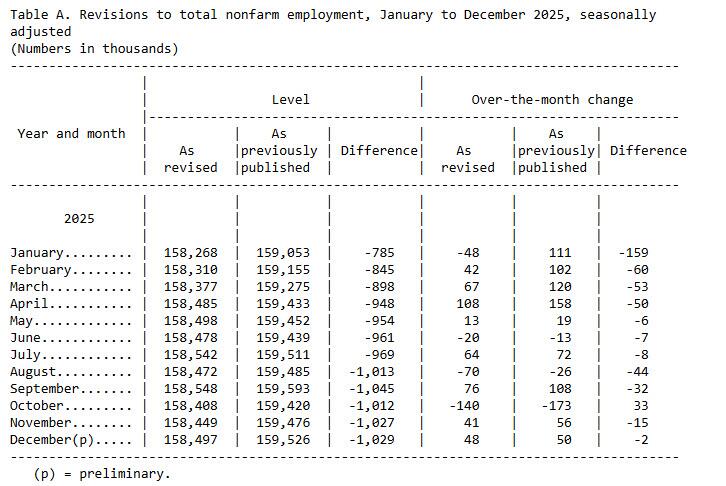
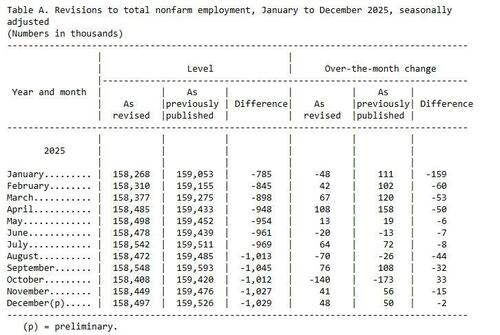
And here is the summary table the BLS published to adjust for the revised Birth-Death model (there is much more data to today’s revisions which we summarize below).
With that introduction aside, this is how the revised payrolls numbers looked.
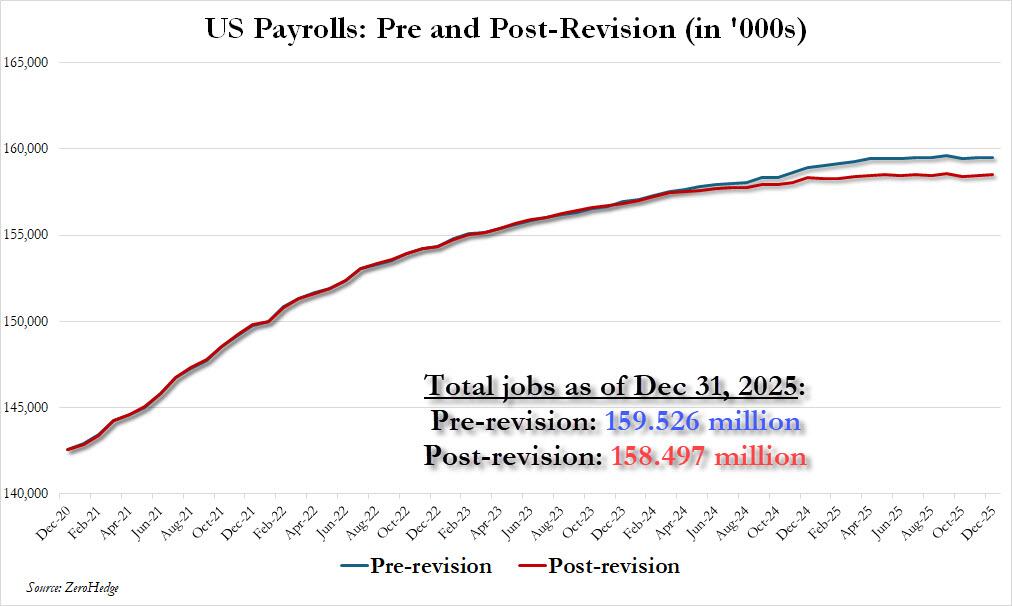
Starting at the top, total US payrolls were revised dramatically lower starting with the Jan 2021 data and every month since, and net of the cumulative changes December 31, 2025 total nonfarm employment was revised lower by 1.029 million from 159.546 million to 158.497 million.
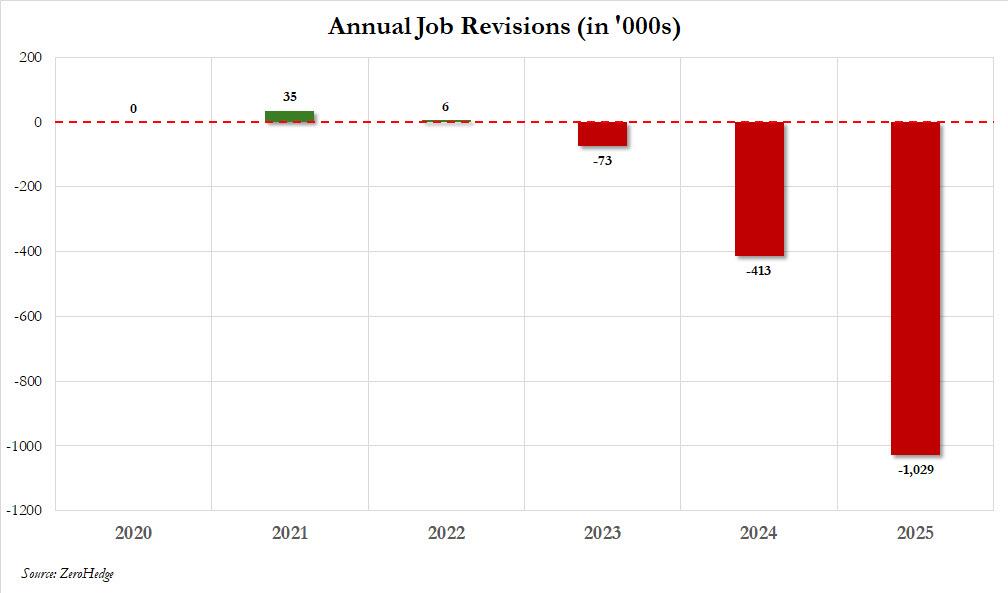
As expected, the bulk of the negative revisions took place in 2025, with negative revisions to 2024 amounting to -413K, 2023 was just -73K while 2021 and 2021 were revised modestly higher.
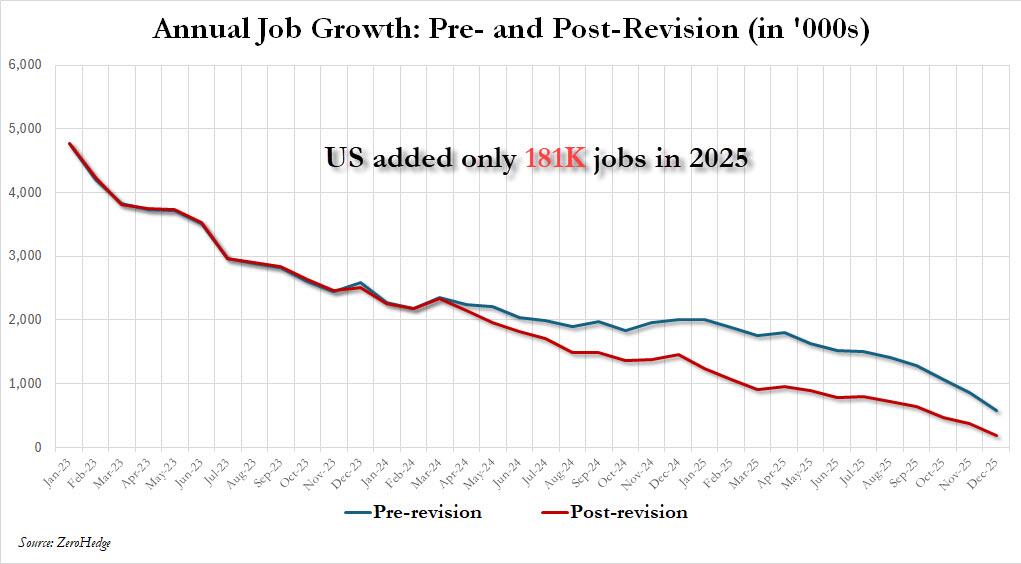
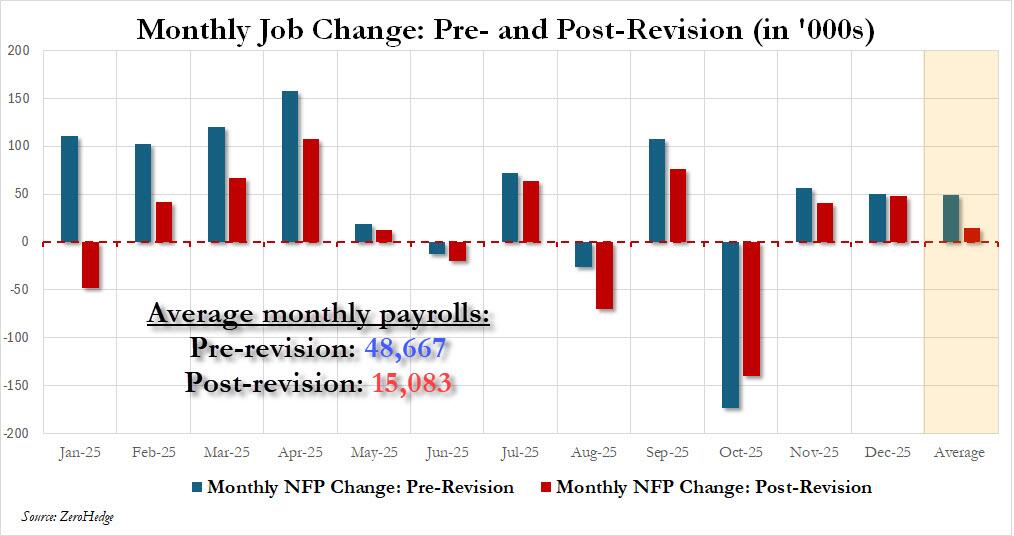
Focusing on 2025, the negative revisions to both the year and previous years, meant that the change in total jobs for 2025 was revised from an already low +584,000 to a shockingly low +181,000.
Finally, net of the aggressive revisions to 2025 monthly payrolls, what was previously an average increase of 48.7K jobs in 2025, has now been revised to just 15.1K!
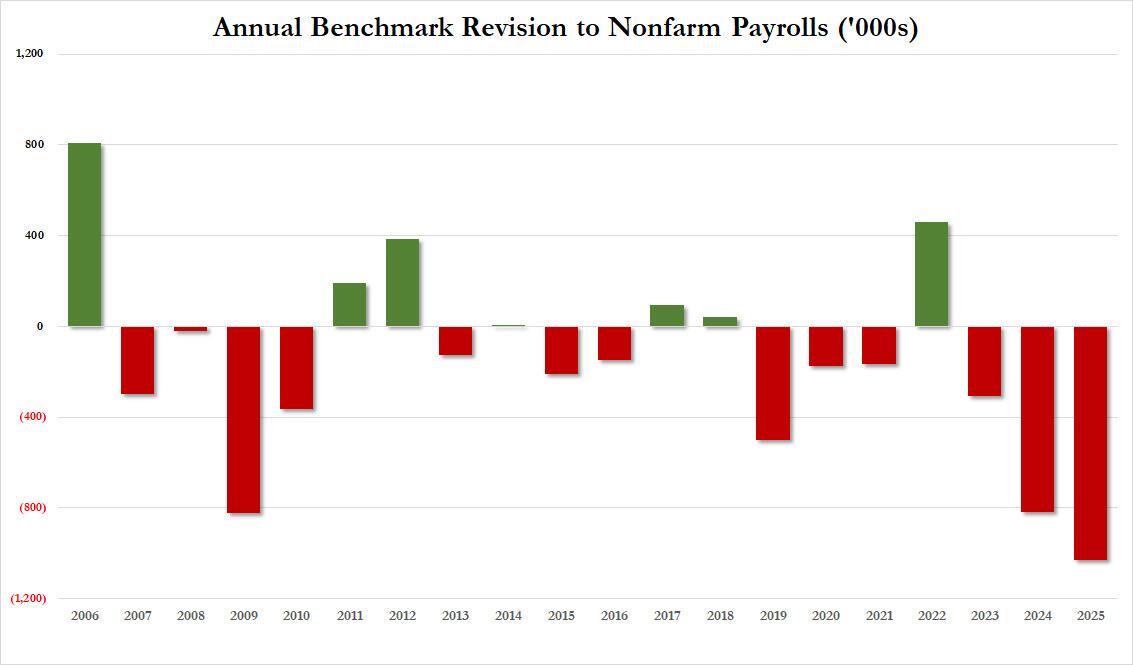
Of course, this is not the first time the Dept of Labor confirmed it has massively revised jobs lower due to erroneous adjustment factors and birth-death additions. Recall, it was last September when we first warned the April 2024 – March 2025 period would be revised massively lower (we now know it was). But it followed another huge revision for 2024 which subtracted 818K jobs and also a 306K revision to 2023.
Putting it all together, we now know with certainty that the flawed Birth-Death model (as well as other smaller seasonal adjustments), led to 2.5 million jobs being revised away since 2019, with negative revisions in 6 of the past 7 years (only 2022 saw a modest positive adjustment)
Last but not least, more revisions are coming: while the January jobs report usually incorporates new population estimates from the Census Bureau into the household survey, those figures were delayed by one month due to last year’s record-long government shutdown. Officials from the Trump administration in recent days have tried to reset expectations for upcoming jobs numbers due to deportations and slower population growth. As a result, expect even more negative revisions next month.
Appendix:
Those curious how the BLS changed its entire birth-death model methodology to incorporate current sample information each month (which follows the same methodology applied to the April through October 2024 forecasts during the 2024 post-benchmark period) should read question 9 in the CES Birth-Death Model Frequently Asked Questions.
Additionally, a BLS article that discusses the benchmark and post-benchmark revisions and other technical issues is available here.
Tyler Durden
Wed, 02/11/2026 – 11:15

Trump Holds Off On Option To Seize Iranian Tankers, Fearing Sharp Oil Rise
Trump Holds Off On Option To Seize Iranian Tankers, Fearing Sharp Oil Rise
Another big piece of leverage that Washington is holding over Tehran is the potential seizure of Iranian oil tankers. The US intercepting and boarding tankers on the high seas has been a trend related to Venezuela of late, as well as Russia’s so-called dark fleet, ratcheting tensions with Moscow.
But President Trump is said to be holding off for now when it comes to the Iranians, as the process of indirect negotiations based in Oman plays out, also as Israel’s Netanyahu is received at the White House on Wednesday.
Fresh reporting in The Wall Street Journal indicates “Trump administration officials have discussed whether to seize additional tankers involved in transporting Iranian oil but have held off, concerned about Tehran’s near-certain retaliation and the impact on global oil markets, U.S. officials said.”
But there have been US naval interdictions involving Iranian energy related to the Venezuela blockade: “The U.S. has seized several ships that have carried Iranian oil as part of its two-month-old blockade of sanctioned tankers serving Venezuela,” continues WSJ. “The tankers, which make up the so-called shadow fleet, help transport illicit oil from numerous sanctioned countries to China and other buyers.”
The report notes that “A move by the U.S. to block other sanctioned ships from loading oil in Iran would squeeze Tehran’s main source of revenue, expanding the aggressive strategy the White House put in place in December in the Caribbean.”
So there remains this big card to play, but Trump is so far hesitant on concerns of rapidly driving up the price of oil.
Sanctions have been slapped on Iranian tankers, but action has yet to follow, as WSJ explains further:
But the option of stopping tankers, one of several the White House has been debating to coerce Tehran to reach a deal restricting its nuclear program, faces many obstacles, some of the officials said.
Iran is likely to respond to a stepped-up U.S. crackdown by seizing tankers carrying oil from U.S. allies in the region or even by mining the Strait of Hormuz, the narrow exit from the Persian Gulf through which as much as 25% of the world’s petroleum supply passes. Either move is likely to drive up oil prices sharply, risking a political firestorm for the White House.
More than 20 ships that transport Iranian oil have been sanctioned by the Treasury Department this year, making them possible seizure targets, officials say.
This would likely be a next big step of escalation Washington has in its pocket, before any potential US military (or Israeli) action targeting Tehran.
Oil prices are rising this morning as U.S.–Iran tensions stay elevated.
The Trump administration reportedly weighed seizing additional Iranian oil tankers, but backed off over retaliation and market impact fears.#OOTT pic.twitter.com/uKq7r9fram
— OilPrice.com (@OilandEnergy) February 11, 2026
Despite the recent weeks of alarming Iran-related headlines, oil prices have by and large not reacted dramatically, given reports that Trump favors negotiated settlement to Iran’s nuclear program.
Vice President JD Vance has also clarified the ball is in Iran’s court, and that talks are still ongoing:
JD Vance on Iran:
If the Iranian people want to overthrow the regime, that’s up to the Iranian people.
What we’re focused on right now is the fact that Iran can’t have a nuclear weapon. pic.twitter.com/lsUXZfS7FC
— Clash Report (@clashreport) February 11, 2026
Iran meanwhile has made clear that its missile program is not up for negotiation, despite Washington’s insistence that this be on the table.
Ali Shamkhani, an adviser to Iran’s supreme leader, reiterated Wednesday that missile capabilities are “non-negotiable” but that Tehran is open to nuclear limits in exchange for sanctions relief.
Tyler Durden
Wed, 02/11/2026 – 11:00
https://www.zerohedge.com/energy/trump-holds-option-seize-iranian-tankers-fears-sharp-oil-rise
Column: State needs a commemorative President U.S. Grant Day
Illinoisans celebrate our 16th president and defender of the Union on Feb. 12, a state holiday. The rest of the nation remembers Lincoln, along with George Washington, on Presidents’ Day on Feb. 16.
In Illinois, Honest Abe, who began his political rise in Springfield after moving to the area in 1830, is not the only president we embrace as one of our own. Lincoln is also celebrated by Indiana, where his family moved in 1816, and Kentucky, where he was born on Feb. 12, 1809, a native son. But then Kentucky also claims Jefferson Davis, president of the Confederate States of America.
The revered Lincoln, who spent a night in Waukegan a few weeks before he was nominated for president in 1860, is buried in Springfield. He is honored in Waukegan with his bust on the west side of the Lake County Building, Lincoln Avenue and the Waukegan Unit School District’s Lincoln Center on North Sheridan Road at Glen Flora Avenue.
Also beloved in Illinois is Ronald Reagan, the nation’s 40th president, who originally hailed from Dixon before heading west to Hollywood and filmdom lore, along with our 44th president, Barack Obama, who was a state and U.S. senator from Illinois before his presidential elevation.
The Obama Presidential Center in Jackson Park, seven miles south of Chicago’s Loop and home to the 1893 World’s Fair, is set to finally open this June. Its architecturally stunning centerpiece overlooks the park’s 19-acre campus, which is expected to become a tourism draw.
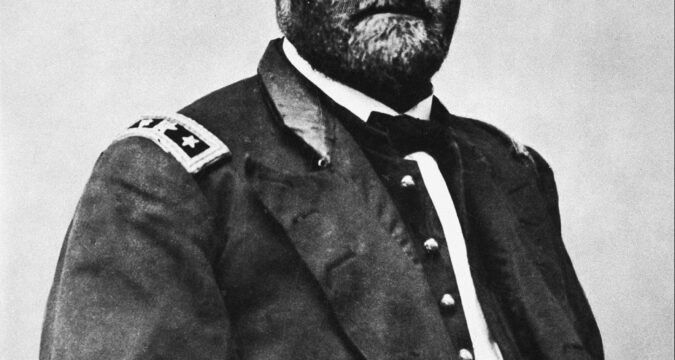
Missing out on all this presidential love in Illinois is our 18th president, Ulysses S. Grant, who lived for a time in Galena in Jo Daviess County. Before he defended the Union against seceding traitors from the South, Grant resided in the Driftless Area of northwest Illinois from spring 1860, following his first stint in the U.S. Army, until the outbreak of the Civil War.
Absent his home in Galena, a 1865 gift from grateful Illinoisans bestowed on then-Gen. Grant to celebrate his return to the city after the war, Illinois does little to recognize this president, who actually wanted to be buried in Galena, according to his will. Sure, there’s Grant Township in far west Lake County, Grant Park on Chicago’s Lake Michigan doorstep and the tall Grant Towers dorms at Northern Illinois University in DeKalb.
Compared to Lincoln, there is little else here for the man who graces the $50 bill. The Illinois Historic Preservation Agency does manage the U.S. Grant Home State Historic Site in Galena, as the house is listed on the National Register of Historic Places.
Grant visited the red brick Italianate-style house, purchased by Galena boosters for $2,500, occasionally during his lifetime, and lastly in 1880. It was first given to Galena by his children, and the city in 1931 deeded the home to the state, which has been its caretaker over the decades.
Perhaps one reason Grant has been ignored is that his family decided against burying him in Galena because it was an area not easily accessible to the general populace. They also rejected Springfield, historians say.
Instead, he is buried at the General Grant National Memorial, aka Grant’s Tomb, along with his wife, Julia, in New York City, where he spent his final days. His resting place after his death in 1885 at age 63 is the largest mausoleum in the U.S. so far.
To make amends, Illinois needs a President Grant Day. We have Casimir Pulaski Day, which will be observed on March 2 this year. All the Polish émigrés did was get a rag-tag Continental Army into shape during the Revolutionary War.
Pulaski didn’t command an Army, defeat Confederate forces, or be president for eight years. He didn’t protect Black civil rights or found the first national park, Yellowstone. Although Grant’s policies toward Native Americans rankle some.
President Grant Day doesn’t need to be an official or legal holiday where Illinois state employees get the day off, like Lincoln’s Birthday. It can be just a “commemorative” day.
Ohio, the state where Grant was born, held its first Ulysses S. Grant Day in 2024 on April 27, the date of his birth. The state will hold a four-day Grant Days from April 23 to 26 this year.
Ohio followed Grant Day with James A. Garfield Day to honor another president from the Buckeye State on the date of his Nov. 19 birth. If this is a trend, they have six other presidents born in the state to consider and perhaps a vice president, J.D. Vance, who is eyeing a presidential run.
Although Grant’s roots aren’t as deep in Illinois as they are in Ohio, where he lived until he entered West Point as a young man, a day set aside in the Land of Lincoln wouldn’t take for granted the state’s gratitude for his profound leadership in an era of conflict.
Charles Selle is a former News-Sun reporter, political editor and editor. sellenews@gmail.com. X @sellenews.
https://www.chicagotribune.com/2026/02/11/charles-selle-column-ulysses-grant/
Empeorarán los déficits y la deuda en EEUU en la próxima década, dice estudio
Por FATIMA HUSSEIN
WASHINGTON (AP) — Los déficits federales a largo plazo y la deuda de Estados Unidos aumentarán en la próxima década debido en gran medida al mayor gasto en programas como el Seguro Social y el Medicare y los pagos por servicio de deuda, vaticina una dependencia no partidista del Congreso.
El análisis de la Oficina de Asuntos Presupuestarios del Congreso muestra un panorama fiscal levemente peor que el estudio realizado en esta fecha del año pasado.
El informe más reciente, publicado el miércoles, incorpora los principales acontecimientos del último año, incluida la medida republicana de impuestos y gastos, aranceles más altos y la ofensiva del gobierno de Trump contra la inmigración, que incluye la deportación de millones de inmigrantes.
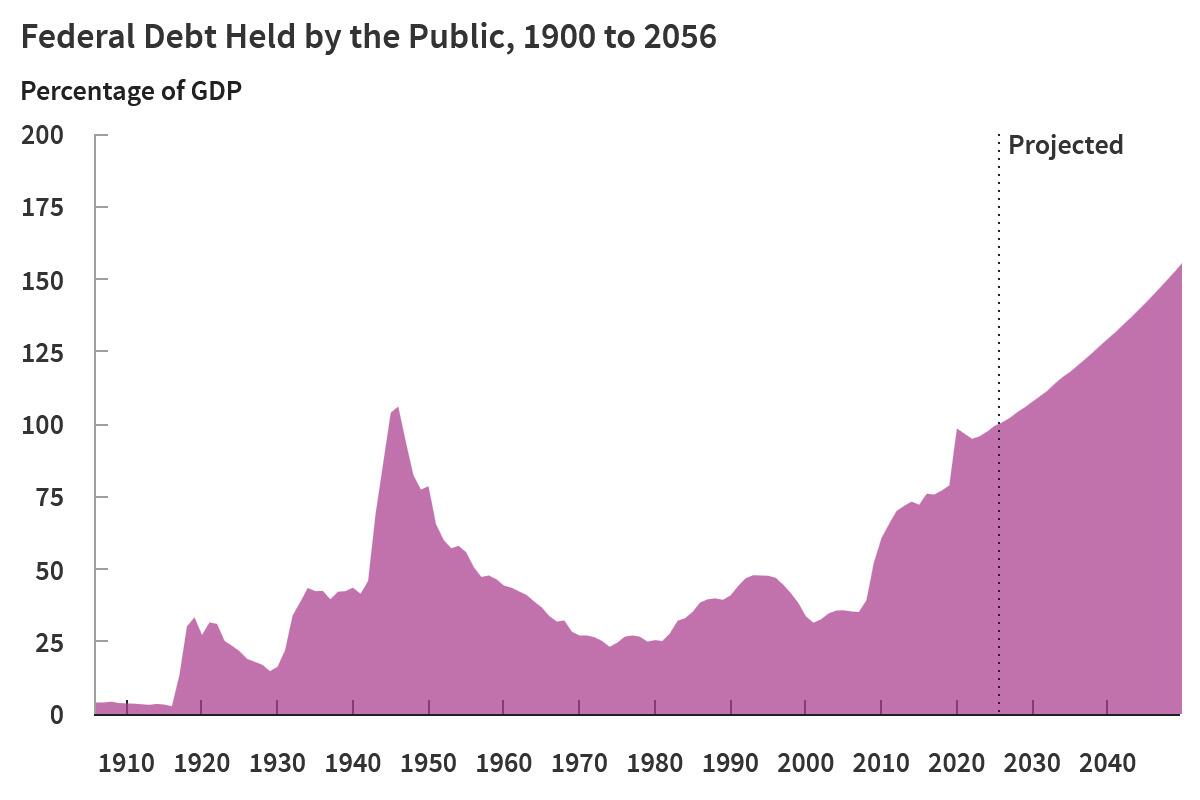
Como resultado de estos cambios, el déficit proyectado para 2026 es aproximadamente 100.000 millones de dólares mayor, y los déficits totales de 2026 a 2035 son 1,4 billones de dólares más altos, mientras que la deuda en manos del público está prevista a aumentar de 101% del PIB a 120%, superando máximos históricos.
Cabe notar que la oficina señala que los aranceles compensan parcialmente algunos de esos incrementos al elevar los ingresos federales en 3 billones de dólares, pero eso también conlleva una inflación más alta de 2026 a 2029.
El aumento de la deuda y del servicio de deuda es importante porque reembolsar a los inversionistas por el dinero prestado desplaza el gasto público en necesidades básicas como carreteras, infraestructura y educación, que permiten inversiones para el crecimiento económico futuro.
Las proyecciones también indican que la inflación no alcanzará la meta de 2% de la Reserva Federal hasta 2030.
Jonathan Burks, vicepresidente ejecutivo de política económica y de salud del Bipartisan Policy Center, afirmó: “Los grandes déficits no tienen precedentes para una economía en crecimiento y en tiempos de paz”, aunque “la buena noticia es que todavía hay tiempo para que los responsables corrijan el rumbo”.
“Alentamos a los legisladores a trabajar juntos para explorar opciones para aumentar los ingresos, recortar el gasto y desacelerar el crecimiento de los principales factores de costo”, manifestó Burks. “El Congreso y el gobierno deberían aprovechar la oportunidad de actuar ahora, antes de que las opciones disponibles de reduzcan”.
Los legisladores han abordado recientemente el aumento de la deuda y los déficits federales principalmente mediante topes de gasto específicos y suspensiones del límite de deuda, así como recurriendo a “medidas extraordinarias” cuando Estados Unidos está cerca de alcanzar su límite legal de gasto, aunque estas medidas a menudo han ido acompañadas de nuevas políticas de gasto o tributarias a gran escala que mantienen niveles elevados de déficit.
Y el presidente Donald Trump, al inicio de su segundo mandato, puso en marcha un Departamento de Eficiencia Gubernamental, que se fijó como objetivo equilibrar el presupuesto recortando 2 billones de dólares en despilfarro, fraude y abuso; sin embargo, analistas presupuestarios estiman que DOGE recortó entre 1.400 millones y 7.000 millones de dólares, en gran medida mediante despidos de personal.
Michael Peterson, director ejecutivo de la Peterson Foundation, declaró que la más reciente proyección presupuestaria “es una advertencia urgente para nuestros líderes sobre el costoso rumbo fiscal de Estados Unidos”.
“En este año electoral, los votantes entienden la conexión entre el aumento de la deuda y su situación económica personal. Y los mercados financieros están observando. Estabilizar nuestra deuda es una parte esencial de mejorar la economía y debe ser un componente central de las campañas en el 2026”.
___________________________________
Esta historia fue traducida del inglés por un editor de AP con ayuda de una herramienta de inteligencia artificial generativa.

CBO Director Warns US Fiscal Path Is ‘Not Sustainable’ ; Projects Additional $1.4T Deficit Swell Under Trump Agenda
CBO Director Warns US Fiscal Path Is ‘Not Sustainable’ ; Projects Additional $1.4T Deficit Swell Under Trump Agenda
The Congressional Budget Office raised its 10-year deficit estimate by $1.4 trillion, citing Trump’s 2025 reconciliation act, higher tariffs and lower immigration.
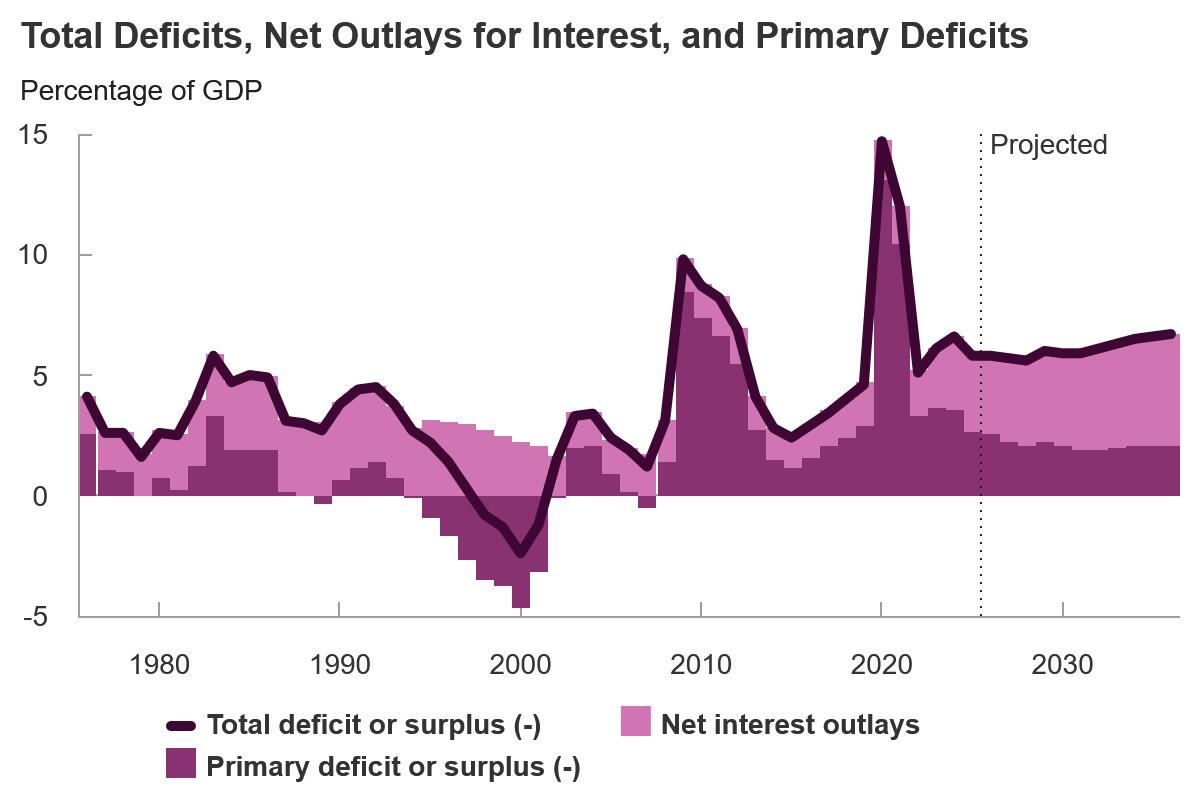
Annual deficits are projected to remain historically large, totaling $23.1 trillion from 2026 to 2035 and reaching 6.7% of GDP by 2036.
The 2025 tax law is the single largest driver, adding $4.7 trillion to deficits over the decade, partially offset by roughly $3 trillion in tariff revenue.
Federal debt held by the public is projected to rise to 120% of GDP by 2036, surpassing the post-World War II record by 2030.
Interest costs are expected to double over the next decade, climbing from $1 trillion in 2026 to $2.1 trillion in 2036 as debt and rates rise.
Economic growth is projected to strengthen in 2026 but slow to 1.8% thereafter, falling short of the administration’s 3% growth target despite productivity gains from artificial intelligence.
The federal government is barreling toward a decade of historically large budget deficits, according to a new report from the (arguably partisan) Congressional Budget Office (CBO), which said on Wednesday in a new report that recent tax and immigration policies have sharply worsened the long-term outlook.
The CBO increased its estimate of cumulative deficits for the 2026-35 period by $1.4 trillion, citing President Donald Trump’s 2025 tax law and the cost of stepped-up immigration enforcement. The agency now projects total deficits of $23.1 trillion over the decade, underscoring what it called an “unsustainable fiscal path.”
At the center of the revision is last summer’s tax package, which extended the 2017 tax cuts and added new breaks. The CBO estimates the law will increase deficits by $4.7 trillion over 10 years. Immigration enforcement actions are expected to add another $500 billion. Those costs, the agency said, will more than offset revenue gains from higher tariffs, even as import duties rise to levels not seen since the mid-20th century. The CBO estimates tariff revenue will reduce deficits by about $3 trillion over the period.
Since its last long-term outlook in January 2025, the agency said three developments have materially altered its baseline projections: enactment of the 2025 reconciliation act, a sharp rise in tariffs, and lower immigration. Together, those changes have pushed projected deficits for the coming decade $1.4 trillion higher, to a cumulative $23.1 trillion from 2026 through 2035.
“The budget projections continue to indicate that the fiscal trajectory is not sustainable,” CBO Director Phillip Swagel said in prepared remarks accompanying the report.
For fiscal 2026, the deficit is projected at $1.9 trillion, or 5.8% of gross domestic product, roughly unchanged as a share of the economy from 2025. By 2036, the annual deficit is expected to widen to $3.1 trillion, or 6.7% of GDP – levels the agency described as “historically unusual,” particularly with unemployment projected to remain below 5%.
The latest outlook reflects the effects of President Donald Trump’s 2025 tax law, which extended the 2017 tax cuts and added new provisions. The CBO estimates the reconciliation act will raise deficits by $4.7 trillion over the 2026–35 period, once higher debt-service costs and macroeconomic effects are included. Higher tariffs are projected to reduce deficits by about $3 trillion, while lower immigration adds roughly $500 billion.
Revenues are projected to remain broadly stable as a share of the economy, rising modestly from 17.5% of GDP in 2026 to 17.8% in 2036. Outlays, however, are expected to climb from 23.3% to 24.4% of GDP as spending on Social Security, Medicare and interest costs grows faster than economic output.
Debt held by the public is projected to rise from 99% of GDP at the end of 2025 to 120% by 2036. Under current law, the CBO expects debt to surpass the previous postwar record of 106% of GDP—set in 1946—by 2030. Over a 30-year horizon, debt climbs to an estimated 175% of GDP. The Social Security Old-Age and Survivors Insurance Trust Fund is now projected to be exhausted in 2032, a year earlier than previously forecast.
Rising debt feeds directly into higher interest costs. Net interest outlays are projected to double over the next decade, increasing from $1 trillion in 2026 to $2.1 trillion in 2036 and rising from 3.3% to 4.6% of GDP.
Those projections undercut the administration’s stated goal of reducing the deficit toward 3% of GDP by the end of Mr. Trump’s term, a target repeatedly cited by Treasury Secretary Scott Bessent. The CBO now expects deficits of 5.8% of GDP in 2026 and about 6% in 2028.
On the economic front, the agency projects stronger real GDP growth in 2026, as the pro-growth elements of the tax law outweigh the drag from tariffs and reduced immigration. Growth is then expected to slow to 1.8% from 2027 onward, reflecting offsetting forces: stronger incentives to work and invest on one hand, and larger deficits and slower labor-force growth on the other.
The outlook also incorporates a modest boost from generative artificial intelligence, which the CBO estimates will add roughly 10 basis points a year to productivity growth, raising nonfarm business output by about 1% by 2036.
Even so, the growth dividend is not enough to materially improve the fiscal picture. While stronger growth lifts revenues, it also pushes up interest rates, and the latter effect dominates. “That result highlights how the nation’s large stock of debt influences the way that changes in the economy stemming from legislation affect the federal budget,” Mr. Swagel said.
The forecast also assumes the Federal Reserve cuts its benchmark rate by 25 basis points in 2026, with the yield on 10-year Treasury bonds rising gradually to about 4.3% by late 2027 and then stabilizing. Upward pressure from growing federal debt is expected to be offset by slower labor-force growth.
Federal Reserve Chair Jerome Powell has echoed the CBO’s warning in recent remarks, saying that while today’s debt level is manageable, the long-term path is not. “We’re running a very large deficit at essentially full employment,” Mr. Powell said last month. “The fiscal picture needs to be addressed – and it’s not really being addressed.”
On the other hand…
Perhaps CBO is just talking shit because they’re #resistance?
According to some economists, CBO might be understating the deficit-reducing potential of tariffs by assuming sharper declines in import volumes than recent experience suggests. Economist Andrew Rechenberg and analyses by the Coalition for a Prosperous America point to tariff revenues collected since 2018 that remained resilient even as trade patterns shifted. In many cases, imports were rerouted through alternative supply chains rather than eliminated, while demand proved more inelastic than expected in categories such as intermediate goods and energy inputs. Under those conditions, sustained tariff enforcement – particularly with limited exemptions – could generate revenues above baseline projections.
Other analysts contend that the CBO’s long-term outlook may be overly cautious in its assessment of how tax certainty and trade policy interact with domestic investment. Permanent tax provisions and trade barriers that favor domestic production, they argue, can reinforce incentives for reshoring and capital formation in ways that are difficult to fully capture in baseline projections. Former CBO Director Douglas Elmendorf has previously acknowledged that long-run investment and productivity responses to permanent policy changes are inherently uncertain and may unfold gradually, suggesting that modest but persistent gains in domestic output could meaningfully improve fiscal outcomes over time.
Meanwhile, some economists question whether higher projected deficits will translate as directly into rising interest costs as the CBO assumes. They point to continued global demand for U.S. Treasurys, demographic forces that suppress real interest rates, and the dollar’s role as the world’s primary reserve currency as factors that weaken the link between debt levels and borrowing costs. From this perspective, fiscal sustainability is less about historical deficit benchmarks and more about market tolerance – specifically whether rising debt triggers inflation expectations or capital flight – conditions that, thus far, have not materialized.
Tyler Durden
Wed, 02/11/2026 – 10:45
Senado argentino debate reforma laboral impulsada por Milei; sindicatos protestan frente al Congreso
Associated Press
BUENOS AIRES (AP) — El Senado argentino inició el miércoles el debate de una ambiciosa reforma laboral impulsada por el presidente ultraliberal Javier Milei que propone modernizar las relaciones de trabajo y reducir el poder de los sindicatos y los costos laborales, mientras gremios y partidos de oposición se movilizaban contra la iniciativa en las afueras del Congreso
Para asegurarse los 37 votos necesarios para su aprobación en el Senado, el oficialismo –que cuenta con 20 senadores propios– accedió a modificar algunos artículos a pedido de la oposición más dialoguista. No obstante, habrá que aguardar la votación tras un largo debate, dados los antecedentes de un oficialismo que muchas veces dio por descontado el apoyo de otros bloques y luego vio naufragar muchas iniciativas.
De ser aprobado, el proyecto deberá ser debatido en la Cámara de Diputados en marzo.
“Es la reforma más importante de los últimos 50 años”, destacó la senadora Patricia Bullrich, líder del bloque del partido oficialista La Libertad Avanza. “Ningún gobierno lo ha logrado y creo que nosotros lo vamos a lograr”.
En las afueras del Congreso sindicatos, organizaciones sociales y partidos de izquierda planean movilizarse para resistir la iniciativa.
Aunque hubo actualizaciones, la normativa laboral vigente rige desde mediados de la década de 1970. Dictaduras militares y gobiernos de distinto signo político naufragaron en sus intentos por introducir cambios profundos en un mercado laboral en el que actualmente casi la mitad de los trabajadores son informales.
Empoderado por su triunfo en las elecciones de medio término de octubre, que le permitió sumar más legisladores en ambas cámaras del Congreso, Milei propone un nuevo régimen laboral que entre sus puntos principales redefine la base de cálculo de las indemnizaciones y limita el derecho a huelga.
“La legislación laboral por sí sola no crea empleo. La generación de trabajo depende de muchos factores. Pero es clave empezar por un marco normativo previsible que permita revertir más de 15 años sin crecimiento del empleo privado formal. Esta ley es el inicio del cambio”, destacó el presidente de la Unión Industrial Argentina (UIA), Martín Rappallini, antes del inicio del debate.
UIA y otras entidades empresarias vienen reclamando desde hace tiempo bajar los costos laborales. La reforma es también una de las exigencias del Fondo Monetario Internacional (FMI) en el marco de un programa de ayuda financiera que firmó con Argentina el año pasado.
“No es modernización, es ajuste sobre las y los trabajadores”, advirtió la Confederación General del Trabajo (CGT), la principal central sindical del país, que convocó a movilizarse frente al Congreso.
Según la entidad, el proyecto “transfiere recursos del Estado a los sectores privados más concentrados, ataca el sistema de jubilaciones y recorta ingresos que corresponden a las provincias” al reducir cargas sociales que pagan los empleadores por sus trabajadores.
La tasa de informalidad laboral en Argentina es de 43,2%, según los últimos datos oficiales. Los expertos en mercado laboral sostienen la necesidad de una modernización de la legislación que contemple las nuevas formas de empleo, como el remoto o de apliaciones, y que permita financiar el sistema previsional, hoy en crisis por la gran catidad de trabajadores informales que no aportan a ese régimen.

Qué saber sobre el tiroteo mortal en una escuela de Canadá
VANCOUVER, Canadá (AP) — Diez personas murieron tras los tiroteos ocurridos en una escuela y una vivienda en una remota zona del norte de Columbia Británica.
Las autoridades canadienses informaron que siete personas murieron y más de 25 resultaron heridas el martes en el tiroteo ocurrido en la escuela secundaria Tumbler Ridge. Otras dos personas fueron halladas muertas en una vivienda cercana, y una mujer que, según la policía, sería la autora de los disparos, también fue hallada sin vida, aparentemente por una herida autoinfligida.
Esta es la masacre más mortífera en Canadá desde 2020, cuando un hombre armado mató a 13 personas y provocó incendios que provocaron otras nueve muertes en Nueva Escocia.
Esto es lo que hay que saber sobre el tiroteo:
Qué ocurrió
La policía llegó a la escuela en menos de dos minutos, dijo a los periodistas el primer ministro de Columbia Británica, David Eby. La Real Policía Montada de Canadá indicó que los agentes encontraron a seis personas muertas y a más de 25 heridas, entre ellas, dos en estado crítico.
Una séptima persona falleció mientras era trasladada a un hospital, y otras dos fueron halladas muertas en una vivienda que, según las autoridades, estaba vinculada al ataque. Al parecer, una sospechosa murió por una “lesión autoinfligida”.
En un video, varios estudiantes aparecen saliendo de la escuela con las manos en alto mientras vehículos policiales rodeaban el edificio y un helicóptero sobrevolaba la zona.
Dónde ocurrió
Tumbler Ridge, con una población de 2.700 habitantes, está en las Montañas Rocosas canadienses, a más de 1.000 kilómetros (600 millas) al noreste de Vancouver y cerca de la frontera provincial con Alberta. La escuela secundaria Tumbler Ridge tiene 175 estudiantes de 7mo a 12do grado, según el sitio web del gobierno provincial.
El alcalde Darryl Krakowka calificó a la comunidad como “una gran familia”.
“Me derrumbé”, relató Krakowka. “He vivido aquí durante 18 años. Probablemente conozco a cada una de las víctimas”.
Quién es responsable
Los investigadores han identificado a una sospechosa, pero no han divulgado su nombre. Señalaron que el móvil sigue sin estar claro, y la policía continúa investigando la relación entre la atacante y las víctimas.
La respuesta del primer ministro
El primer ministro de Canadá, Mark Carney, suspendió un viaje previsto a Halifax, en Nueva Escocia, y a Múnich, en Alemania.
Manifestó en una publicación en redes sociales que estaba devastado por el tiroteo.
“Me uno a los canadienses en el duelo con quienes han visto cómo sus vidas han cambiado hoy de manera irreversible, y en el agradecimiento por el valor y la entrega de los equipos de primera respuesta que arriesgaron sus vidas para proteger a sus conciudadanos”, escribió.
Canadá tiene leyes estrictas sobre armas
El gobierno de Canadá ha respondido a tiroteos masivos anteriores con medidas de control de armas. Ha prohibido más de 2.500 marcas y modelos de armas de fuego de estilo militar desde mayo de 2020, y en octubre de 2022 entró en vigor una congelación nacional de la venta y compra de armas cortas.
Según funcionarios del gobierno, más de 12.000 armas de estilo militar fueron recogidas y destruidas como parte de un programa de compensación para empresas que se desarrolló entre noviembre de 2024 y abril de 2025. El mes pasado se inició un programa similar para particulares con el fin de compensar a los propietarios que entreguen voluntariamente armas prohibidas antes del 31 de marzo.
Quienes no participen deberán deshacerse de sus armas prohibidas o desactivarlas de forma permanente antes de que finalice un período de amnistía el 30 de octubre.
___
Esta historia fue traducida del inglés por un editor de AP con la ayuda de una herramienta de inteligencia artificial generativa.
https://www.chicagotribune.com/2026/02/11/qu-saber-sobre-el-tiroteo-mortal-en-una-escuela-de-canad/
WTI Slides On Biggest Crude Build In A Year, Production Rebound; But…
WTI Slides On Biggest Crude Build In A Year, Production Rebound; But…
Oil prices continued their recent rally this morning as traders hiked its risk premium as Israeli PM Netanyahu arrived in Washington to pressure President Trump to take a hard line in talks with Iran, even as the API report overnight showed a huge rise in US inventories last week.
“Oil trades firmer, with Brent back above USD 69 as Middle East tensions sustain a modest risk premium. The US signaled it is considering seizing tankers carrying Iranian oil, while President Trump threatened to deploy another aircraft carrier should nuclear talks with Iran fail,” Saxo Bank noted.
The threats of violence in the Persian Gulf – a region that supplies about a fifth of the world’s daily oil consumption – comes even as signs supply remains well ahead of demand.
“While rhetoric remains belligerent at times, there are no signs, at least for now, of escalation, and the U.S. President believes that Iran will ultimately want to strike a deal on its nuclear missile programme,” PVM Oil Associates analyst Tamas Varga said in a note.
If API’s huge build is confirmed by the official data, the battle between geopolitical risk premia and over-supply gets harder (but admittedly this is very much affected by the freezing storms).
Expect another volatile week of EIA data with “significant winter freeze noise,” Macquarie energy strategist Walt Chancellor said referring to last month’s storm.
API
Crude +13.4mm
Cushing
Gasoline +3.3mm
Distillates -2.0mm
DOE
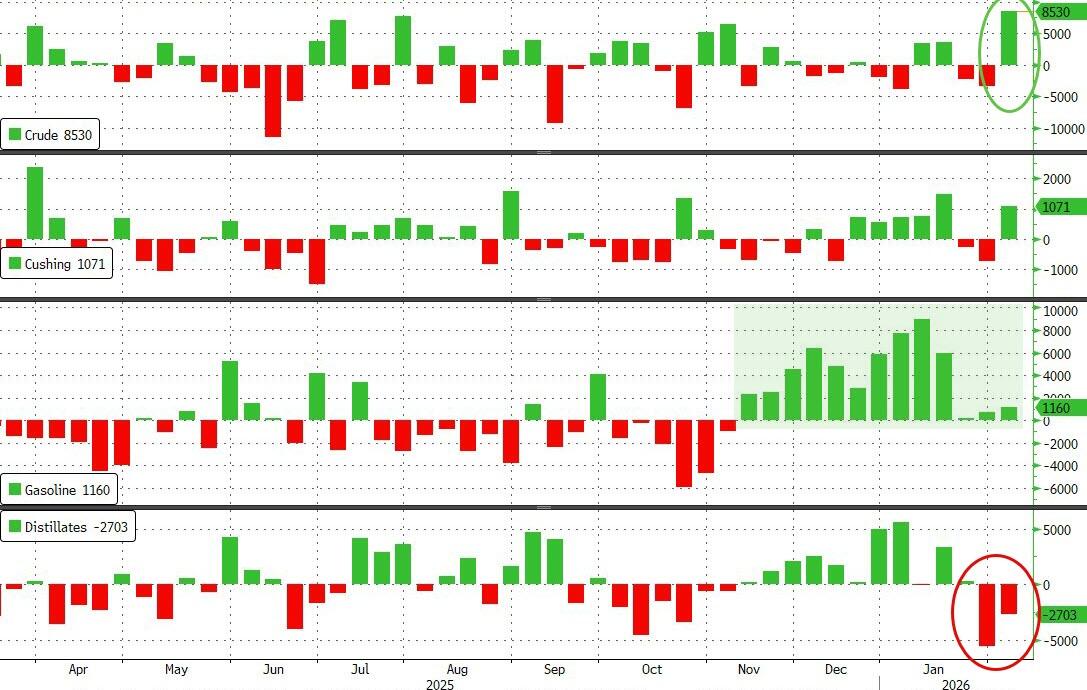
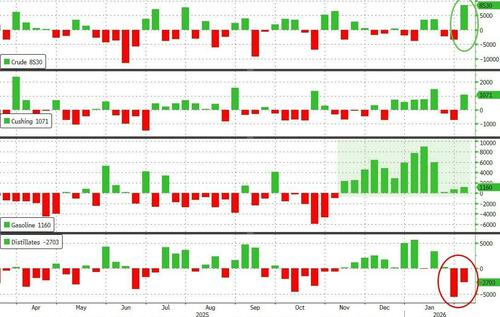
Crude +8.53mm (-400k exp) – biggest build since Jan 2025
Cushing +1.07mm
Gasoline +1.16mm
Distillates -2.70mm
The official data confirmed a large crude build (largest since Jan 2025), but smaller than feared from API. Gasoline stocks rose for the 13th straight week while Distillates saw stocks fall for the second week…
Source: Bloomberg
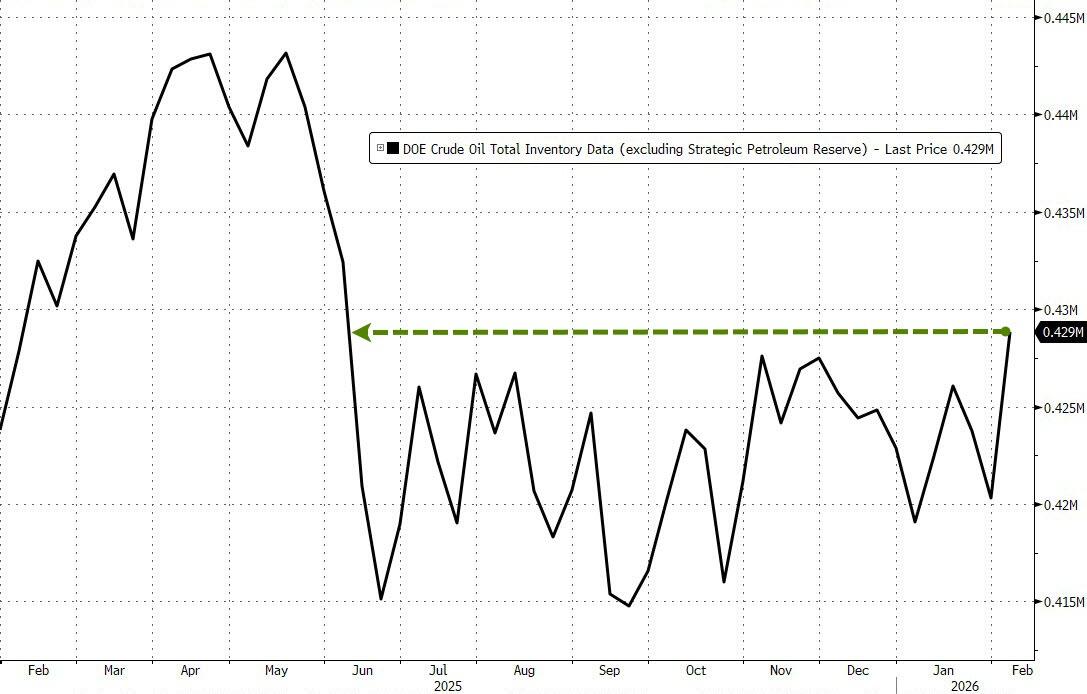
This build pushed total crude stocks up to their highest since June…
Source: Bloomberg
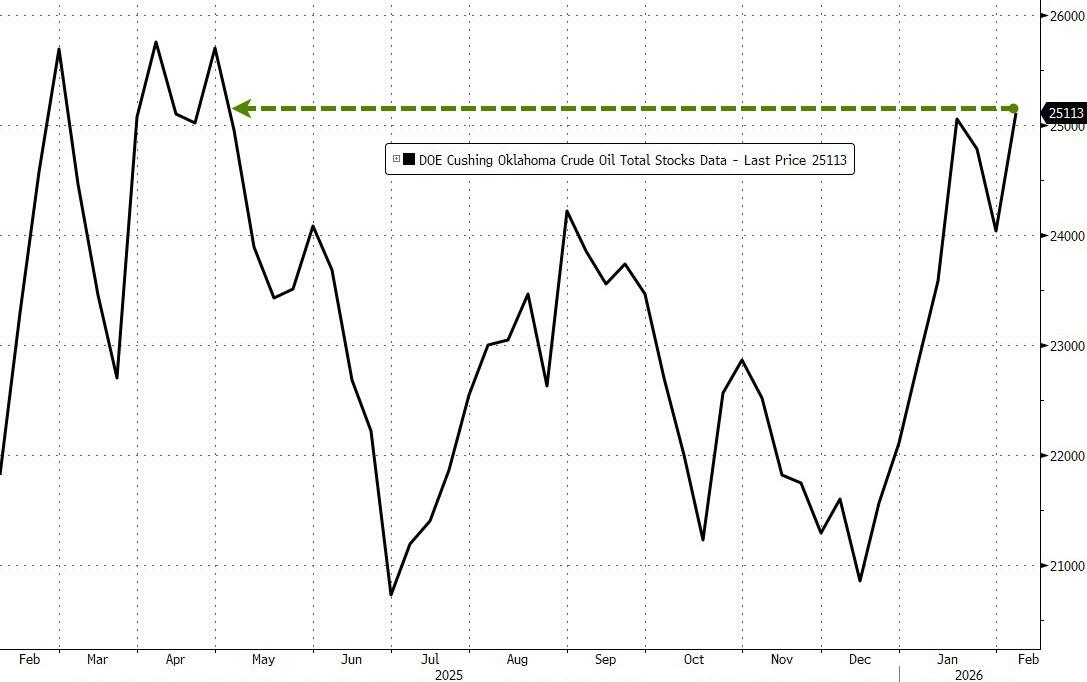
Stockpiles at Cushing, Oklahoma, rose to 25.1 million barrels, the highest level since April 2025. The weekly build is the largest in almost a month, and the first increase on inventories since the week ending Jan. 16.
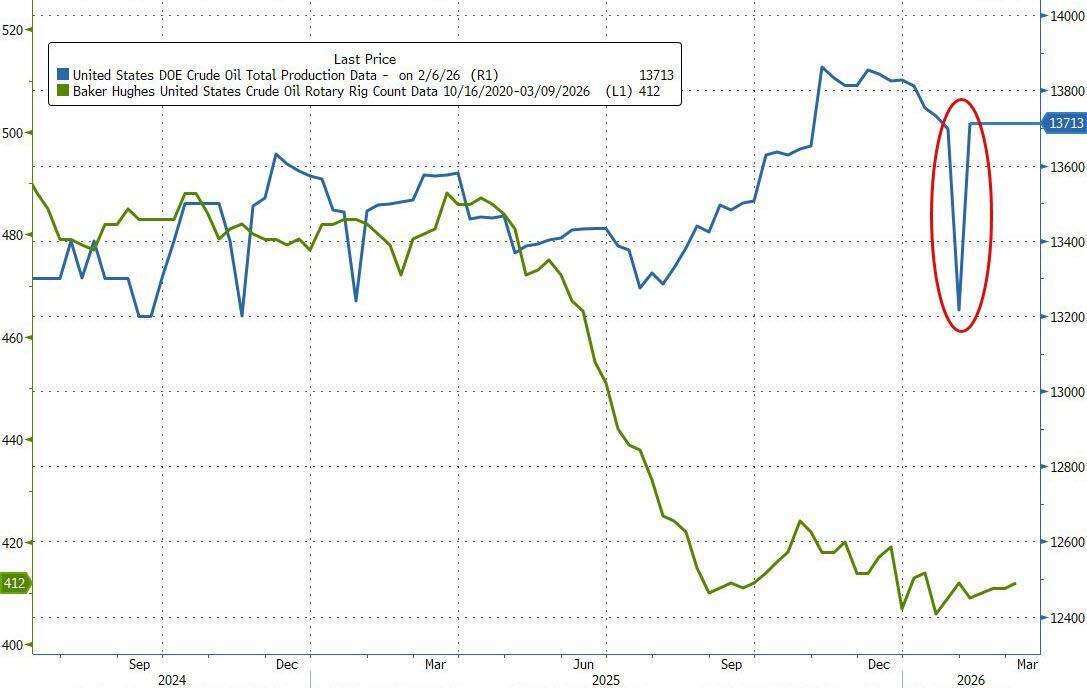
US Crude production rebounded as expected from its winter storm plunge…
Source: Bloomberg
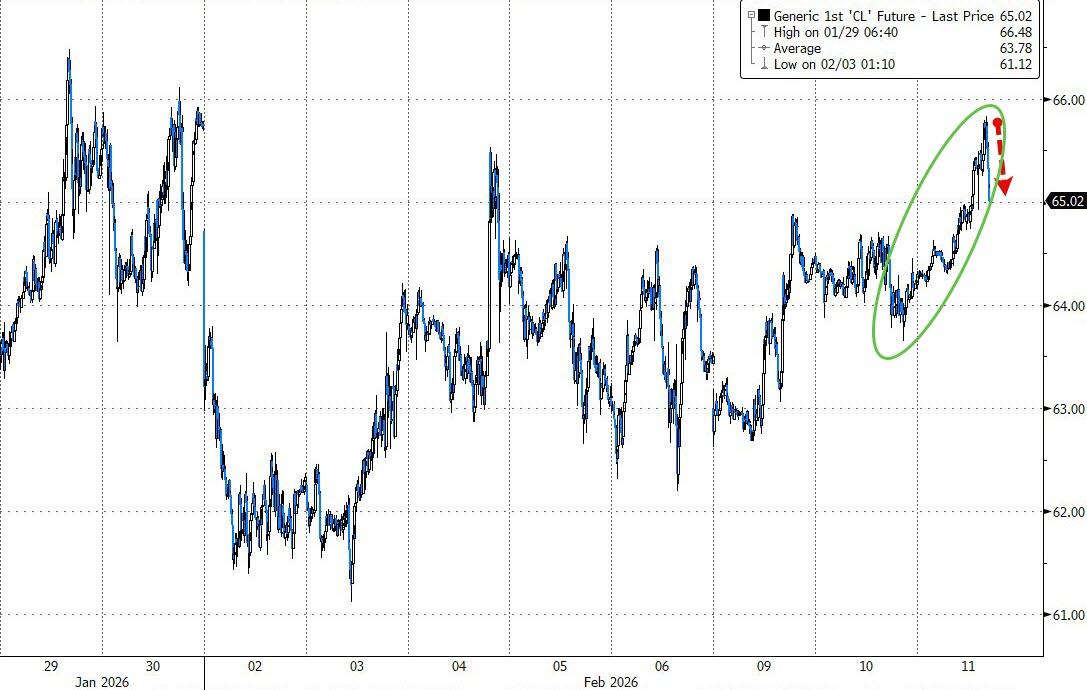
Crude prices started giving some back before the inventory data as stocks tumbled following the ‘good’ jobs news. However, WTI remains higher on the day (back near its highest since January)…
Source: Bloomberg
Finally, in its monthly Short-Term Energy Outlook released Tuesday, The EIA again warned global inventories will rise this year and next on high output from OPEC+ and producers in the Americas.
“Despite near-term tightness from disruptions, we assess that strong global oil production growth will continue to outpace oil consumption over our forecast, driving our assessment that global oil inventories will increase. We expect this trend to continue in both 2026 and 2027. We forecast that global oil inventory builds will average 3.1 million b/d in 2026, compared with an average build of 2.7 million b/d in 2025, before decreasing to average of 2.7 million b/d in 2027,” the agency said.
In the wider market, OPEC left its supply-demand expectations for the oil market largely unchanged in its monthly report, but highlighted that global oil demand for the wider group’s crude will drop by 400,000 bpd in the second quarter compared to the first.
Tyler Durden
Wed, 02/11/2026 – 10:35
https://www.zerohedge.com/energy/wti-slides-biggest-crude-build-year-production-rebound