Category: News

It Just Keeps Happening Over And Over Again…
It Just Keeps Happening Over And Over Again…
Authored by Steve Watson via modernity.news,
Another illegal migrant, handed legal status under Biden-era policies, is charged with brutally murdering two women in New York — one a hardworking mother of two, the other his own roommate.
The victims were stabbed multiple times in the neck and torso in what authorities describe as an anger-fueled rampage.
Open borders policies didn’t just fail these women. They enabled their killer to stay here legally and strike.
BREAKING: Two women stabbed to death by illegal immigrant in New York.
Bruce Blakeman, Nassau County Executive and a candidate for governor of New York, SLAMMS open-border policies after two woman were killed by an illegal immigrant from El Salvador on Long Island this week.… pic.twitter.com/v12sexjtjj
— I Meme Therefore I Am 🇺🇸 (@ImMeme0) May 2, 2026
The suspect, 22-year-old Rony Yahir Alvarenga Rivera, entered the United States illegally as an unaccompanied minor at age 12 roughly a decade ago. He was released into the country with no supervision.
In 2022, the Biden administration granted him legal status through a program that automatically handed papers — believed to be in the form of a green card — to unaccompanied minors already here.
Say her name: Ana Maria del Aguila-Cordova.
Ana (42) worked at Wendy’s and was stabbed to death while taking out the trash. She was a mother of two, including a one-year-old baby.
Her killer, Rony Alvarenga-Rivera (22) is an illegal immigrant from El Salvador who was later… https://t.co/oPvuyjTUUI pic.twitter.com/SL1UsRMyRI
— I Meme Therefore I Am 🇺🇸 (@ImMeme0) May 2, 2026
Now he stands charged with first- and second-degree murder in the killings of Eddy Raquel Hernandez Castillo, 32, and Ana Maria del Aguila-Cordova, 42.
Both attacks happened early Friday morning on Long Island. Ana Maria del Aguila-Cordova, a mother of two young children including a one-year-old, was stabbed to death outside a Wendy’s in Island Park while taking out the trash. She was Rivera’s coworker.
Hours later, his 32-year-old roommate Eddy Raquel Hernandez Castillo was found dead in their shared apartment building in Valley Stream. Nassau County Police Chief Patrick Ryder confirmed: “Both females were killed by multiple stab wounds to the neck and torso.”
Nassau County Executive Bruce Blakeman, who is also a candidate for governor of New York, did not hold back. In a press conference covered widely on X, he directly blamed failed immigration policies:
“This didn’t have to happen. This is a policy that has resulted today in two women being killed. They could’ve gone on to have very productive and happy lives. But they’re no longer with us because of failed policies in the past.”
Blakeman continued, “Why are we letting people who aren’t documented into our country?” Noting that this “unaccompanied minor” was able to “run around without any supervision whatsoever,” and then automatically get legal status.”
He highlighted the absurdity of the 2022 federal program that handed legal status to unaccompanied minors already in the U.S. and praised Nassau County’s use of the 287(g) program, a federal partnership with ICE that has removed over 2,000 illegal migrants with criminal records. Blakeman noted that New York Governor Kathy Hochul wants to abolish it.
This isn’t an isolated tragedy. It is the direct, predictable result of years of open borders insanity that prioritizes foreign invaders over American safety.
Recent examples are highlighted below:
Each time the same story plays out: an illegal migrant, often with no prior record that would have flagged him under narrow enforcement priorities, commits unspeakable violence. Officials express “shock.” Media downplays the immigration angle. And nothing changes — until the next victim.
Blakeman is right. These women did not have to die. Their killer did not have to be here. The policies that let him stay were a choice. A choice made by politicians who value open borders and cheap political power over American lives.
President Trump’s border policies have proven that this can be stopped.
Mass deportations of criminal illegals and an end to catch-and-release are not extreme. They are the bare minimum required to protect communities.
Your support is crucial in helping us defeat mass censorship. Please consider donating via Locals or check out our unique merch. Follow us on X @ModernityNews.
Tyler Durden
Wed, 05/06/2026 – 12:45
https://www.zerohedge.com/political/it-just-keeps-happening-over-and-over-again

“Data Centers Require Reliable And Predictable Energy”: Riot Partners With Terrestrial Energy
“Data Centers Require Reliable And Predictable Energy”: Riot Partners With Terrestrial Energy
Riot platforms announced a collaboration with Terrestrial Energy to pair future data centers with co-located nuclear reactors. The two companies are evaluating deploying Terrestrial’s Integral Molten Salt Reactor (IMSR) plants to existing Riot facilities in Texas and Kentucky, as well as multiple other potential sites.
The headline comes on the same morning as reactor development peer NANO Nuclear announced a strategic MOU with Supermicro…
NANO Nuclear Soars On Strategic MOU With Supermicro For Powering AI Data Centers https://t.co/8evwYdhjZC
— zerohedge (@zerohedge) May 6, 2026
Following deals that have been announced recently from hyperscalers like Meta, Amazon, Google, and Microsoft, data center developers are now being more vocal than ever about their needs for reliable energy.
“Our data centers require reliable and predictable energy at the scale demanded by today’s hyperscale customers,” said Jason Les, CEO of Riot Platforms. “Partnering with Terrestrial Energy positions our facilities at the forefront of data center deployment, utilizing clean energy and benefitting both our customers and the communities we operate in. The consistent baseload of power required by data centers presents an ideal pairing for development alongside Terrestrial’s IMSR Plants.”
The press release is notably lacking on any sort of timeline description for Terrestrial actually making any progress towards reactor construction. Terrestrial is significantly behind almost all of its market peers, including Oklo and NANO Nuclear.
Oklo has made significant progress with constructing a sodium-cooled reactor at INL with the potential to take the reactor critical as early as this summer.
NANO Nuclear has begun early site work and recently submitted a construction permit application to the NRC for deployment of their KRONOS reactor in Illinois.
Terrestrial only has some recent document approvals from the NRC and agreements in place with the DOE. No meaningful progress has been made on constructing a pilot reactor or first-of-a-kind commercial-scale deployment.
Tyler Durden
Wed, 05/06/2026 – 12:35
Give Peace A Chance
Give Peace A Chance
By Benjamin Picton, senior market strategist at Rabobank
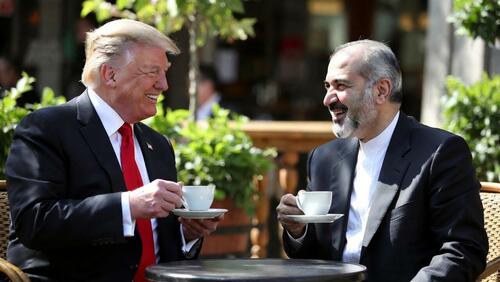
It was TACO Tuesday again in the United States this week as President Trump announced that he was pausing Operation Freedom “for a short period” after it had been underway for just one day. Channelling John Lennon, Trump indicated that progress in negotiations with Iran had convinced him to ‘give peace a chance’, but that the US blockade of Iranian ports would remain in place for now.
The Dow Jones, S&P500 and NASDAQ all closed higher and US stock futures are pointing to further gains. Asian stocks are mostly higher with the KOSPI breaching 7000 for the first time and Samsung joining the USD 1 trillion market cap club. Bond yields are mostly lower but UK Gilts are a conspicuous outlier in that respect, with the 10-year up 9.7bps to 5.06% and the 2-year rising even further. The Dollar is down, the VIX is down, spot gold is a little over 1% higher and Brent crude (July contract) has fallen to $108.46/bbl at time of writing.
Trump characterized the pause as coming in response to requests from Pakistan and others and told media that the indefinite ceasefire was still in effect despite Iranian strikes on the UAE port of Fujairah, commercial shipping, and US destroyers engaged in guiding commercial ships through the Strait over the last 24 hours.
Secretary of War Pete Hegseth said that the operation which began on Monday was purely defensive, stating that “we’re not looking for a fight”. Trump had earlier characterized the effort as a “humanitarian gesture” to free trapped merchant mariners who were running short of provisions, but there is undoubtedly an added element of seeking to ease the squeeze on commercial shipping supply chains by bringing the 1,600 vessels trapped in the Persian Gulf back into the active shipping fleet.
As Operation Freedom was put on hold, Secretary of State Marco Rubio told a White House news briefing that Operation Epic Fury had already concluded, thereby sidestepping a legal requirement for Trump to seek congressional approval to extend military action beyond 60 days. Given that fire was still being exchanged with Iran as recently as yesterday, many will see this as little more than a legalistic wheeze – which it may be – but the administration is clearly content to keep up the pressure on Iran through Scott Bessent’s ‘Economic Fury’ initiatives of direct sanctions, naval blockade, disruption of the Iranian shadow fleet, and secondary sanctions on countries providing support to the Iranian military. The US has also imposed sanctions on five Chinese ‘teapot’ refineries believed to be engaged in trade of Iranian crude.
Trump’s announcement on Operation Freedom coincides with Iranian Foreign Minister Araghchi today travelling to Beijing to meet with counterpart Wang Yi. This comes ahead of Trump’s planned trip to China next week to meet with President Xi, where discussions over the Iran war and reopening the Strait of Hormuz are sure to be at the top of the agenda.
Might we expect some kind of grand bargain whereby China takes more assertive action to rein in its Iranian allies, aided perhaps by Vladimir Putin’s willingness to provide enrichment services for civilian purposes on Iran’s behalf and to take custody of Iran’s existing stocks of near-weapons-grade uranium? Might this also involve a Ukraine war component foreshadowed by recent unilateral ceasefire announcements from both Moscow and Kiev, at the prompting of the US?
Araghchi – along with President Pezeshkian and House Speaker Ghalibaf – is a member of the civilian government and viewed as a moderate in comparison to the hardliners of the IRGC. IRGC leader Vahidi has previously been critical of Araghchi for being too willing to do a deal with the US to end the war and re-open the Strait. As the US blockade remains in place and Iranian oil is prevented from flowing to market, storage capacity is filling up and raising the prospect that Iranian wells will need to be capped, with risks of permanent damage to oil production.
Effectively, Iran and the US are playing chicken with global energy supply chains. Iran is enduring damage directly from Economic Fury but is holding a metaphorical gun to the heads of US allies in Europe and Asia, who are facing looming shortages of key commodities and the consequent negative effects on growth, employment and inflation. The question remains: who will blink first?
This hostage dynamic is not lost on RBA Governor Michele Bullock who yesterday told journalists in Sydney that “Australian’s are poorer because of this shock to oil prices… We are poorer, and there’s no way out of that.” Bullock delivered this grim prognosis after the RBA lifted the Australian policy rate by 25bp to 4.35%. This was the third-consecutive rate hike from the RBA and brings the cash rate equal to the previous cycle high that was reached in the aftermath of the COVID-19 and Ukraine War supply shocks.
Bullock characterized the new posture of monetary policy in Australia as “a bit restrictive” and indicated that the Board feels that it has given itself a bit of breathing space to pause and assess the unfolding impacts of the Iran war, and what the implications will be for growth and inflation. However, she also noted that the RBA’s updated economic projections are predicated on the war ending “soon”, and the Strait of Hormuz reopening. If that doesn’t happen, markets will start to ponder whether recession risks or rising inflation expectations will dominate RBA rate-setting decisions in the months ahead.
Australia was carrying substantial inflation momentum into the Iran shock as three rate cuts in 2025 and continued strong government spending conspired to pump up demand growth in late 2025 and saw the economy quickly hit the rev limiter. With one more 25bp rate hike priced into the futures curve Australia now faces the prospect of a cash rate cycle peaking higher than the previous cycle for only the second time in more than 30 years.
This reflects what is happening in the 10-year bond yield where the 40-year bull market than ran from the early 1980s through to 2022 looks to be well and truly over and the new cycle might be higher highs and higher lows, like it was during the 1970s when oil shocks, trade protectionism and great power competition characterized the international environment. Sound familiar?
For her part, Bullock will be hoping that Trump and the Iranians do ‘give peace a chance’ so she can avoid those adverse scenarios and stick to the comparatively benign but still far from ideal baseline outlook that the RBA has adopted.
Tyler Durden
Wed, 05/06/2026 – 12:15
Lutnick Testifying Today On Epstein Ties After Dems Demand Subpoena
Lutnick Testifying Today On Epstein Ties After Dems Demand Subpoena
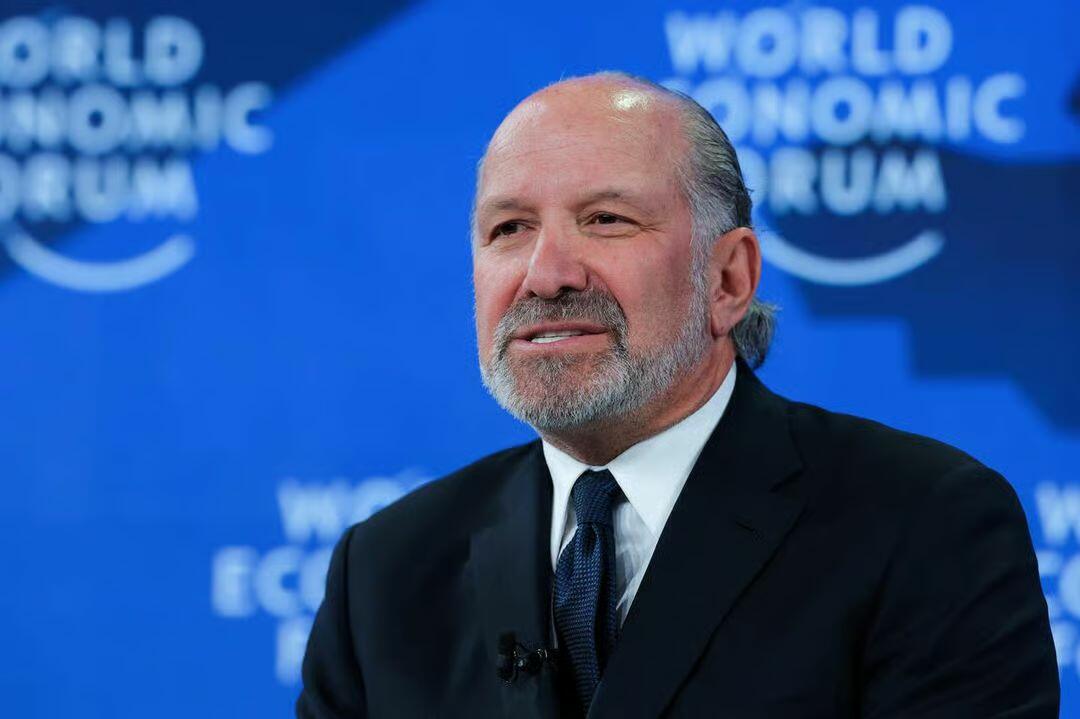
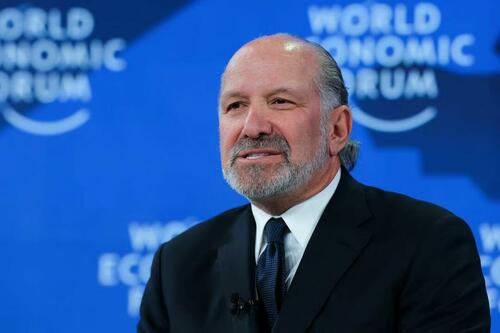
Commerce Secretary Howard Lutnick – a former neighbor and pal of Jeffrey Epstein who emailed the sex offender about visiting his Caribbean island (and then said it was ‘nice to see him’ in a subsequent email) – will provide closed-door testimony today in front of the US House committee investigating the Epstein’s crimes and possible lapses in the law enforcement response.
While Lutnick initially claimed he barely knew Epstein (like everybody else), emails and other documents released earlier this year by the DOJ reveals he’s full of shit.
About That Trip
As we noted in February, the trip, planned in 2012, came years after Lutnick claimed he cut all ties with the pedophile. Yet in December of that year, Lutnick sent an email to Epstein saying that he had a group of people, including his wife and children and another family, who were visiting the Caribbean – and inquired as to where Epstein was located and whether they could visit for a meal.
Epstein, replying through an assistant, set up a lunch gathering.
When reached for comment, Lutnick told the NY Times “I spent zero time with him,” before hanging up.
The documents suggest the visit did occur. The gathering was set for Dec. 23, 2012. A day later, an assistant to Mr. Epstein forwarded Mr. Lutnick a message from Mr. Epstein: “Nice seeing you,” it said.
In a podcast interview last year, Mr. Lutnick claimed that around 2005, he and his wife had been so revolted by Mr. Epstein that they decided not to associate with him again.
Mr. Lutnick said in the interview that Mr. Epstein invited them to tour his Upper East Side mansion, next door to Mr. Lutnick’s own home. When they noticed a massage table in the middle of a room, Mr. Lutnick recalled, Mr. Epstein explained that he received “the right kind of massage” every day. Mr. Lutnick said that he and his wife quickly left and decided to “never be in a room with that disgusting person ever again.”
Except, that was complete bullshit of course.
Lutnick’s connection to Epstein isn’t a huge surprise after a 2019 Crain’s investigation found that sex offender had significant links to the property next to his infamous Manhattan townhouse at 9 East 71st Street.
Crain’s investigation found that Epstein’s history at the address is entangled with the adjacent property, 11 E. 71st St., now home to billionaire Howard Lutnick—as well as with 301 E. 66th St., a building belonging to Epstein’s brother.
An entity called the SAM Conversion Corp. purchased 11 E. 71st St. in 1988, more than a year before the Nine East 71st Street Corp. bought the former school that would become Epstein’s domicile. At the time, both companies used a Columbus, Ohio, address associated with Limited Brands founder Leslie Wexner, Epstein’s mentor and client.
In 1992 SAM Conversion Corp. sold 11 E. 71st St. to the 11 East 71st Street Trust for “ten dollars and other valuable consideration paid by the party of the second part,” records show. Martha Stark, former commissioner of the city Department of Finance, told Crain’s that the $10 figure is a placeholder used in many real estate sales—a holdover from a period when the value of property transactions was not publicly disclosed.
…
In 1998 Comet Trust sold 11 E. 71st St. to Lutnick, again for “10 dollars and other valuable consideration.” The real estate transfer tax payment came to $106,400, from which Stark estimated the actual price to have been $7.6 million.
Lutnick, now the CEO of financial services firm Cantor Fitzgerald, took out a $4 million mortgage on the property the same day as the sale. His spokesperson did not reply by press time to requests for comment on the property’s history and his relationship with his next-door neighbor.
Related:
Latest Epstein Release Catches Goldman’s Top Lawyer In Massive Lie
Latest Epstein Emails Reveal Bill Gates Slipped Wife Antibiotics For STD He Got From Russian Hookers
Palmer Luckey One-Shots Jason Calacanis Over Epstein Ties
In February, Lutnick told the Senate Appropriations Committee that he “barely had anything to do” with Epstein.
SEN. VAN HOLLEN: Why do the Epstein files show you coordinating a meeting and planning a visit with Jeffrey Epstein on his private island in December 2012?
HOWARD LUTNICK: I barely had anything to do with that person, okay?
pic.twitter.com/6wFAyKYQYR
— Lucas Sanders 👊🏽🔥🇺🇸 (@LucasSa56947288) February 10, 2026
Right…
Tyler Durden
Wed, 05/06/2026 – 11:55
https://www.zerohedge.com/political/lutnick-testifying-today-epstein-ties-after-dems-demand-subpoena
China Wants Iran War End, Pushes ‘Immediate’ Hormuz Reopening During Araghchi Visit Ahead Of Trump-Xi Summit
China Wants Iran War End, Pushes ‘Immediate’ Hormuz Reopening During Araghchi Visit Ahead Of Trump-Xi Summit
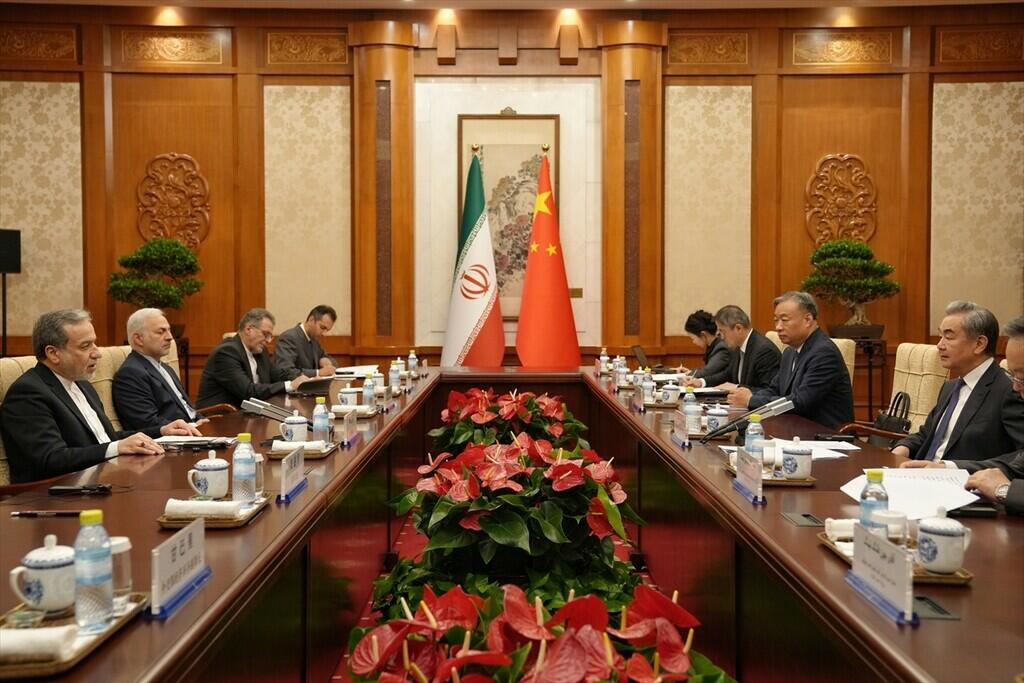
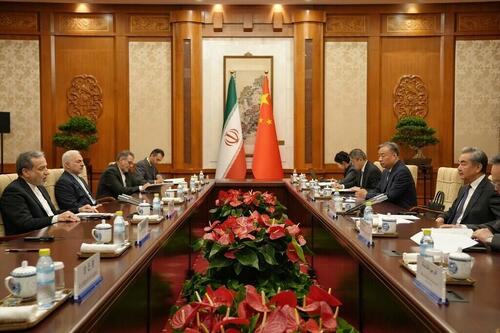
Iranian foreign minister Abbas Araghchi is currently in Beijing meeting with his Chinese counterpart, FM Wang Yi, and the timing of the visit sends a resounding message to Washington and the West. The highly anticipated Trump-Xi meeting is still scheduled for next week, expected for May 14-15, though there has been ample speculation the ongoing events of the unpredictable Iran war and Hormuz Strait crisis could derail the trip at the last minute.
Of course, Iran and the question of peace will be high on the agenda as Trump visits – and currently it seems the White House is desperate to set in place some kind of final offramp, given the Tuesday night ‘pause’ in Project Freedom operations in the Gulf.
Upon the occasion of Araghchi’s visit, Foreign Minister Wang has taken the opportunity to again call for the immediate opening of the strait. And the Iranian top diplomat seconded this at a moment the US Navy has imposed an effective blockade of Iranian ports, which of course severely impacts Iranian oil going to China. “Currently, it is possible to resolve the issue of reopening the Strait of Hormuz as soon as possible,” Xinhua quoted Araghchi as saying.
Source: Iranian Foreign Ministry
Wang during the meeting also called for a “comprehensive ceasefire,” saying his country is deeply distressed by the war. Xinhua further quoted him as saying:
“The international community shares a common concern for restoring normal and safe passage through the Strait, and China hopes the relevant parties will respond as quickly as possible to the strong calls from the international community.”
The two sides are clearly coordinating their messaging to some degree, given Wang also expressed that China “appreciates Iran’s pledge to not develop nuclear weapons.”
Tehran has for years insisted its program is only for peaceful nuclear energy development and for domestic needs, but has amid Trump’s Operation Epic Fury made clear it will never given up its right to enriched uranium. It has said this is as “sacred as the soil” and sees it as a matter of national sovereignty. This in the face of US demands that it transfer all nuclear material out of the country.
More out of Beijing on Wednesday:
“We believe that a comprehensive ceasefire brooks no delay, a resumption of hostilities is inadvisable, and persisting with negotiations is particularly important,” Wang told Araghchi at the start of their meeting, according to footage released by Hong Kong-based Phoenix TV.
…Earlier, US Secretary of State Marco Rubio urged China to press Iran to ease its blockade of the Strait of Hormuz, through which roughly one-fifth of the world’s oil and gas passes.
As for what China gains in this high-level diplomacy and engagement with Tehran at a moment it could face more US and Israeli bombs, Associated Press presents the following:
Some noted that the Iranian foreign minister visited at Beijing’s initiative. “It’s China exercising their leverage… to summon the Iranian foreign minister,” said Hoo Tiang Boon, a professor of Chinese foreign policy at Nanyang Technological University.
“By holding the talks with the Iranians, you can’t fault for them not putting in any effort,” Hoo said.
As for some further specifics to come out of the Araghchi-Wang meeting, Iran “expressed appreciation for China’s four-point proposal” – according to a readout in semi-official Iranian Students’ News Agency (ISNA).
Hilarious that the message Rubio is asking China to give Iran during Araghchi’s Beijing visit is that Iran is “globally isolated” when the very fact he’s invited to China (and that China is now fighting US sanctions on Iran’s oil) proves they aren’t.pic.twitter.com/UUGmfrL2d1
— Arnaud Bertrand (@RnaudBertrand) May 6, 2026
“Iran supports the formation of a new framework for the post-war period in the region” the readout adds. As for the ‘four points’ – these were issued by Beijing earlier in the conflict and are quite broad. These official points are featured below in their entirety, via Chinese state sources:
Stay committed to the principle of peaceful coexistence. The Gulf states in the Middle East are close neighbours that cannot move away. It’s important to support the Gulf states in improving their ties, work to build a common, comprehensive, cooperative and sustainable security architecture of the Middle East and the Gulf region, and consolidate the foundation for peaceful coexistence.
Stay committed to the principle of national sovereignty. Sovereignty serves as a foundation for all countries, especially developing countries, to survive and thrive, and it must not be violated.
Stay committed to the principle of international rule of law. We should safeguard the authority of international rule of law, reject selective application, and prevent the world from returning to the law of the jungle. It is important to firmly uphold the international system with the United Nations at its core, the international order based on international law, and the basic norms governing international relations underpinned by the purposes and principles of the UN Charter.
Stay committed to a balanced approach to development and security. Security is a prerequisite for development and development serves as a safeguard of security.
If negotiations between the US and Iran don’t proceed, and if they stay at ‘square one’, this could weaken any big leverage President Trump hopes to have entering his meeting with Xi Jinping. This is perhaps why American officials are scrambling to cobble something together, to at least cite progress toward resolving the Hormuz situation. Still Trump has insisted he has “all the cards” when it comes to Iran.
Tyler Durden
Wed, 05/06/2026 – 11:20
ABC Reporter Fabricated Trump Call, Made Himself The Focus After Assassination Attempt
ABC Reporter Fabricated Trump Call, Made Himself The Focus After Assassination Attempt
Authored by Steve Watson via Modernity.news,
President Trump has slammed ABC News chief Washington correspondent Jonathan Karl for what he calls outright dishonest reporting after Karl inserted himself into the story of the latest assassination attempt on the president.
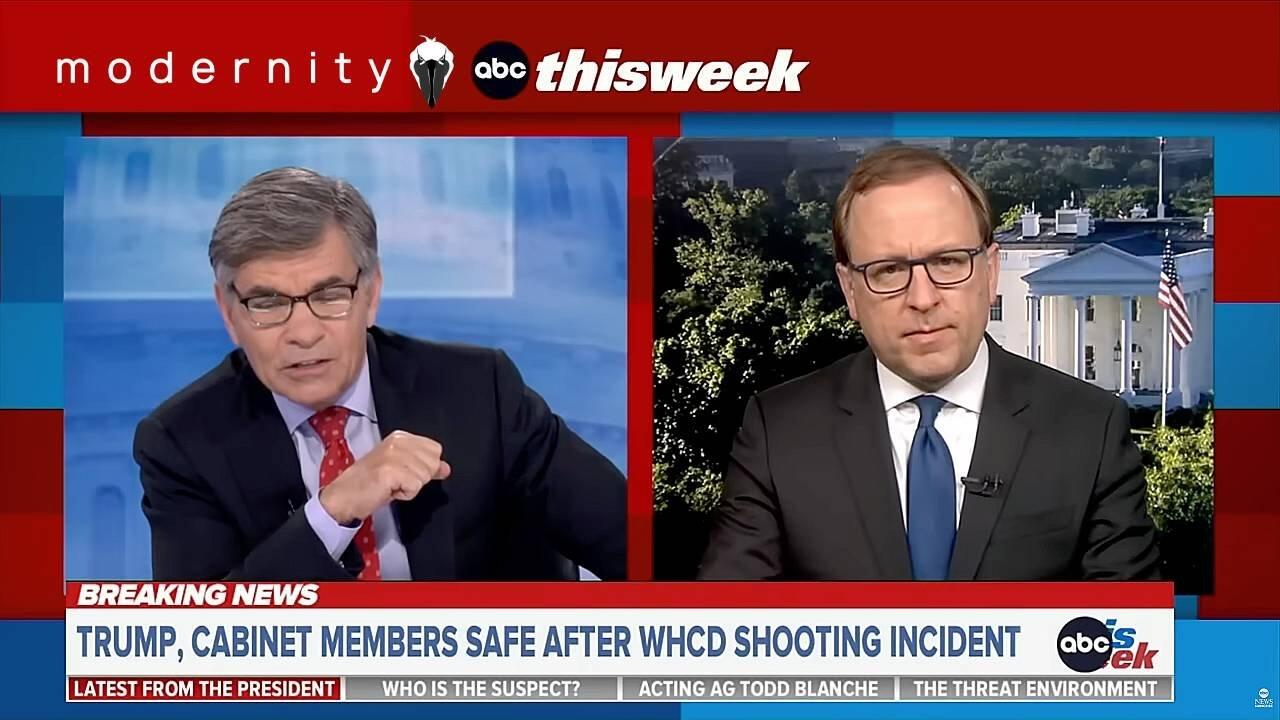
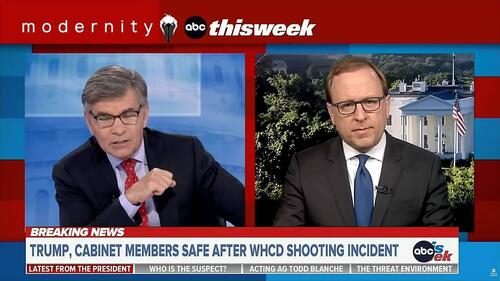
Karl appeared on ABC’s This Week shortly afterward and claimed Trump had reached out to him personally. “My phone rang shortly after 7 a.m., my landline, George actually. A number that few people call and it was President Trump calling,” Karl told host George Stephanopoulos.
Karl further claimed that Trump “said at first he was calling to see if I was okay with what happened last night. ‘Are you OK?’ And then he reiterated many of the things he said in his press conference last night emphasizing the unity that he felt in that moment that he felt at the dinner before the shooting and certainly after with people who reached out to him… And he was quite firm about this: That dinner must be rescheduled.”
NEWS: President Trump BLAST ABC News’ Jonathan Karl: “Jonathan Karl, of ABC Fake News, made a statement that I called him early in the morning, the day after the assassination attempt, to ask whether or not HE was OK. No, this was a hit on ME, not HIM, and I didn’t make such a… pic.twitter.com/Xh9chkU2S2
— RedWave Press (@RedWavePress) May 4, 2026
This week, Trump responded directly on Truth Social, blasting the claim as pure fabrication designed to center Karl rather than the president who had just survived another attempt on his life.
“Jonathan Karl, of ABC Fake News, made a statement that I called him early in the morning, the day after the assassination attempt, to ask whether or not HE was OK. No, this was a hit on ME, not HIM, and I didn’t make such a call, why would I do that?” Trump remarked.
The president added, “He called me, but I didn’t take his call — He just confirmed that to me when he called again. I would say that’s very dishonest reporting. He’s trying to make himself look important but, I’m not surprised, because it comes from ABC Fake News!”
This appears to be somewhat deranged behavior from a legacy media figure desperate to remain relevant. Instead of focusing on the security failures, the gunman’s motives, or the president’s resolve, Karl turned the story into a narcissistic fantasy about himself – the brave reporter Trump supposedly felt compelled to check on at 7 a.m. the morning after an attack aimed squarely at the commander-in-chief.
This latest episode fits a long pattern of tension between Trump and ABC News. Readers will recall our earlier coverage of Trump calling out Karl and other ABC figures for biased and obnoxious questioning.
Trump also torched an obnoxious ABC fake news reporter over misleading boat strike video:
And of course, ABC was forced to pay out a massive $15 million settlement last year after falsely calling Trump a rapist:
The derangement doesn’t stop with the press. In a related development that perfectly captures the upside-down priorities in Washington, a D.C. judge has now apologized to the alleged assassin himself over his treatment in custody.
U.S. Magistrate Judge Zia Faruqui expressed “grave concerns” about conditions at the D.C. jail, including solitary confinement and suicide watch protocols for Cole Allen, telling the suspect directly he was “very troubled” by the reported treatment.
While security for Trump and the public remains under scrutiny after multiple attempts on the president’s life, the system bends over backward to ensure the accused gunman feels comfortable.
This is the same media and institutional class that spent years demonizing Trump, only to now feign shock when violence follows their rhetoric.
The fake news machine keeps exposing itself, and each time it does, trust in legacy outlets like ABC erodes further.
Your support is crucial in helping us defeat mass censorship. Please consider donating via Locals or check out our unique merch. Follow us on X @ModernityNews.
Tyler Durden
Wed, 05/06/2026 – 10:50
WTI Holds Rebound Gains As US Fuel Exports Hit Record High, Production Dips, Huge SPR Drain
WTI Holds Rebound Gains As US Fuel Exports Hit Record High, Production Dips, Huge SPR Drain
Oil prices are lower overnight (but dramatically off their lows) amid on-again, off-again optimism of an imminent US-Iran peace deal.
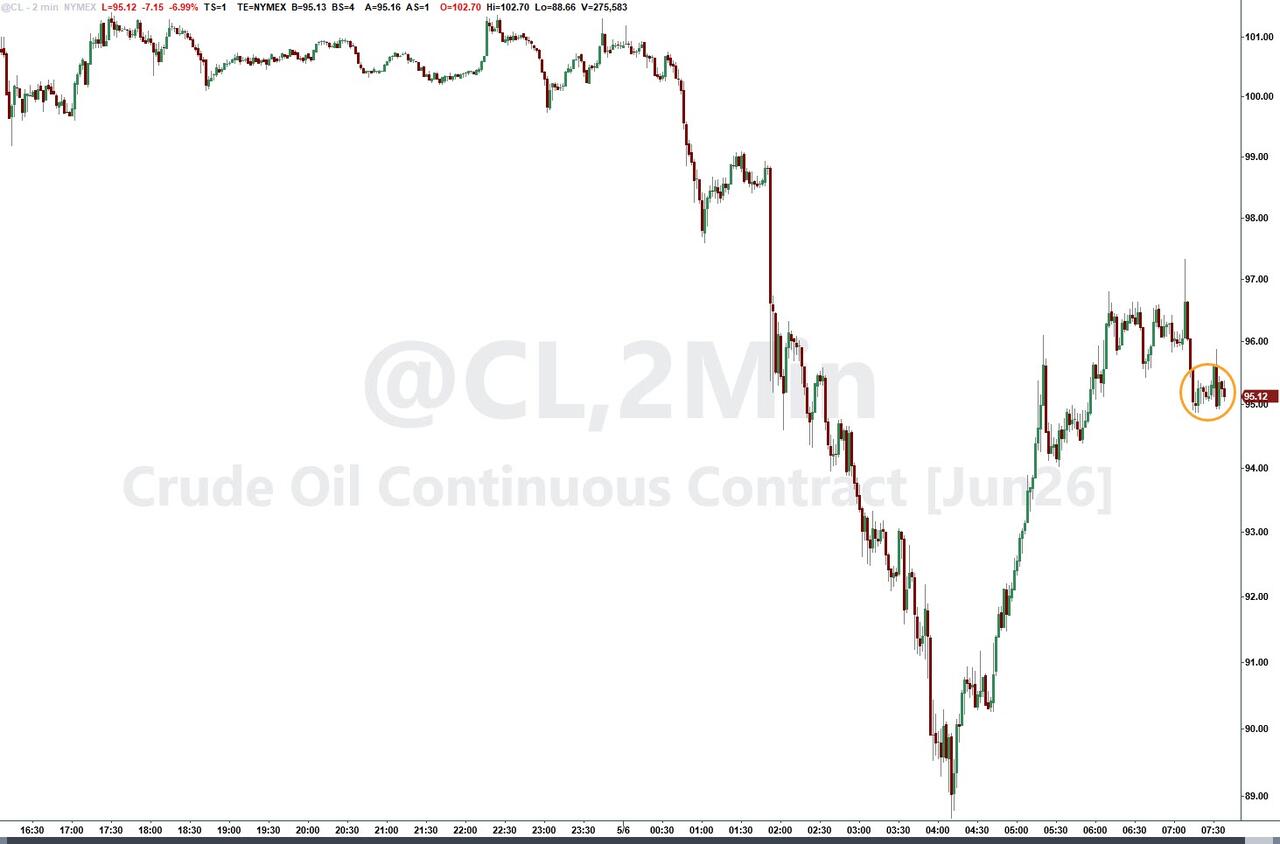
Benchmark Brent fell as much as 12% to $96.75 a barrel in London, while West Texas Intermediate dropped up to 13%. European natural gas plunged as much as 14%.
Oil and gas later pared about half of those losses after Trump said in a Truth Social post on Wednesday that if Iran doesn’t agree, “the bombing starts.”
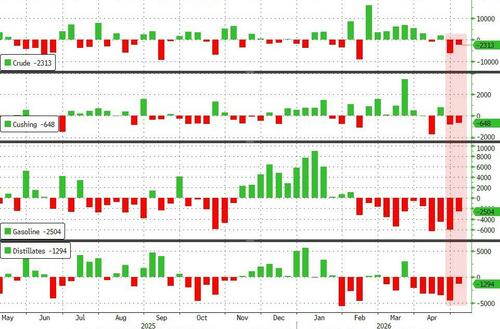
Overnight we saw huge across the board drawdowns in US energy inventories reported by API (and a huge SPR drain). All eyes on the official data this morning…
API
Crude -8.1mm (-2.8mm exp)
Cushing -1mm
Gasoline -6.1mm
Distillates -4.6mm
DOE
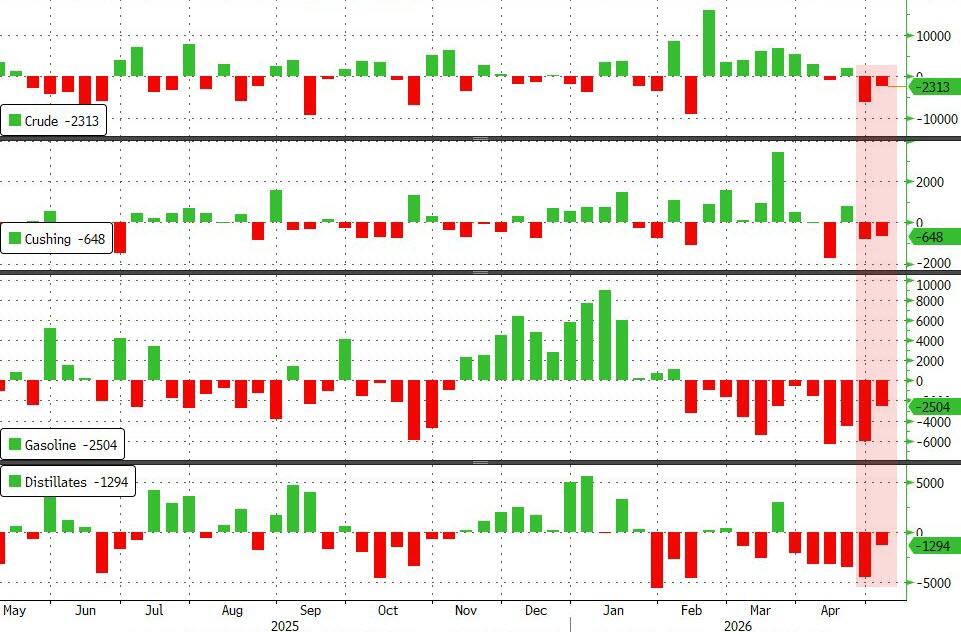
Crude -2.313mm (-2.8mm exp)
Cushing -648k
Gasoline -2.504mm
Distillates -1.294mm
For the second week in a row, US inventories saw significant declines across the board with products seeing the biggest draws. Crude’s drawdown was a modest disappointment (especially after API’s big report)…
Source: Bloomberg
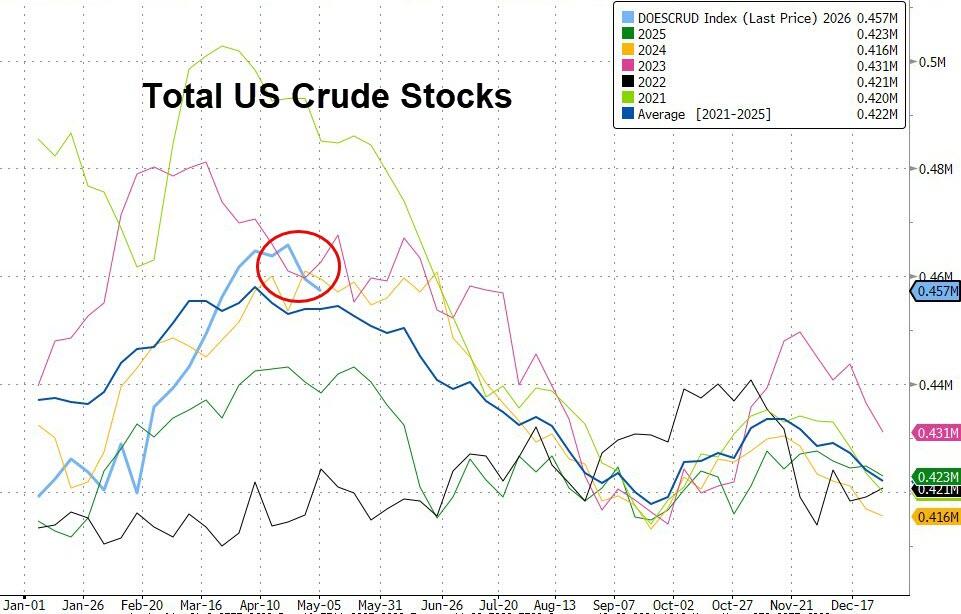
Overall, crude stockpiles remain elevated (but are drawing down)…
Source: Bloomberg
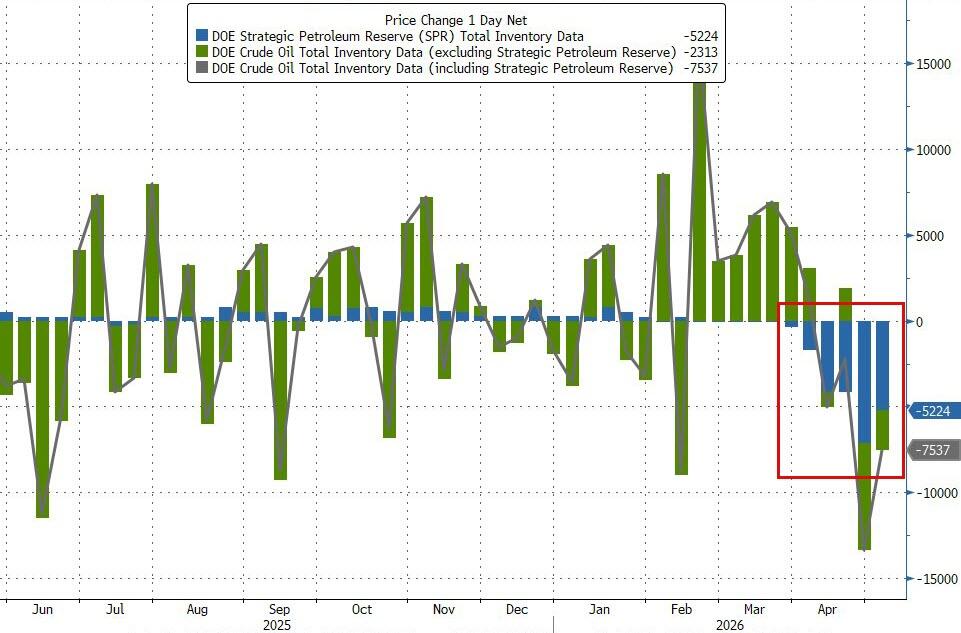
Perhaps most notably, the Strategic Petroleum Reserve (SPR) is seeing massive drawdowns to support the global loss of supply from Hormuz.
Source: Bloomberg
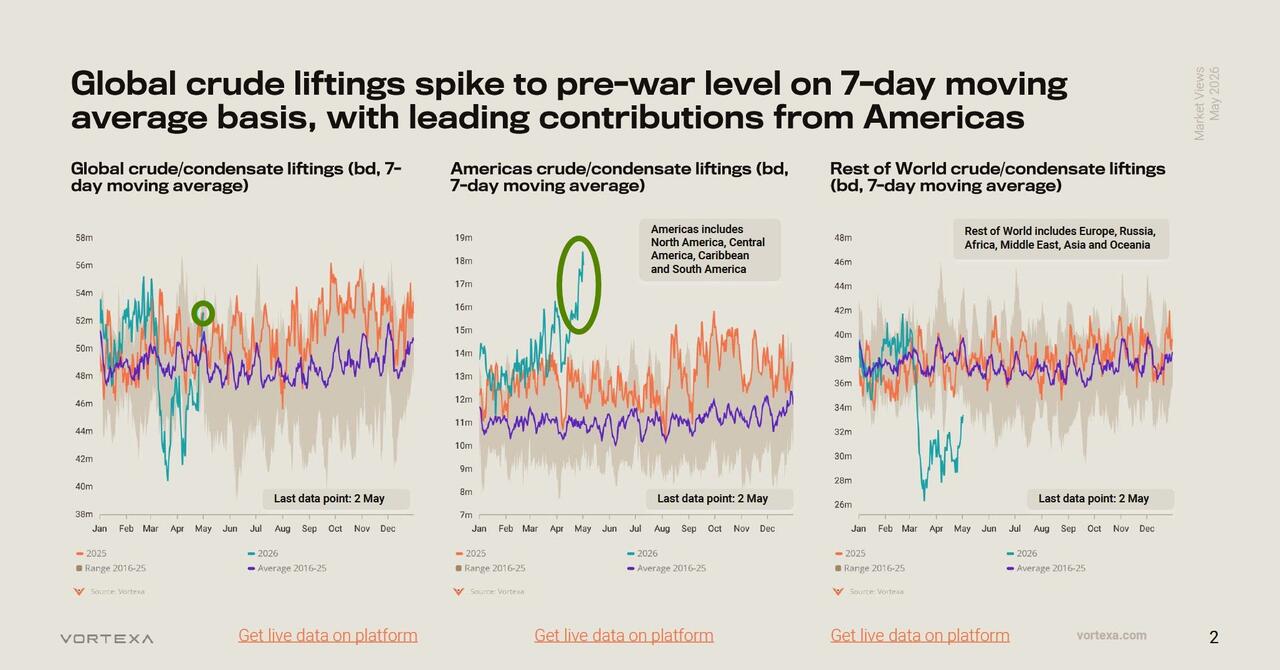
On the back of that draw, Bloomberg’s energy guru, Javier Blas, dropped this stunning chart showing that, on a 7-day moving average, global oil liftings (into tankers) have recovered to their pre-war level due to a surge in liftings in the Americas. Of course, that’s helped by massive stock drawdowns / SPR drain, but still…
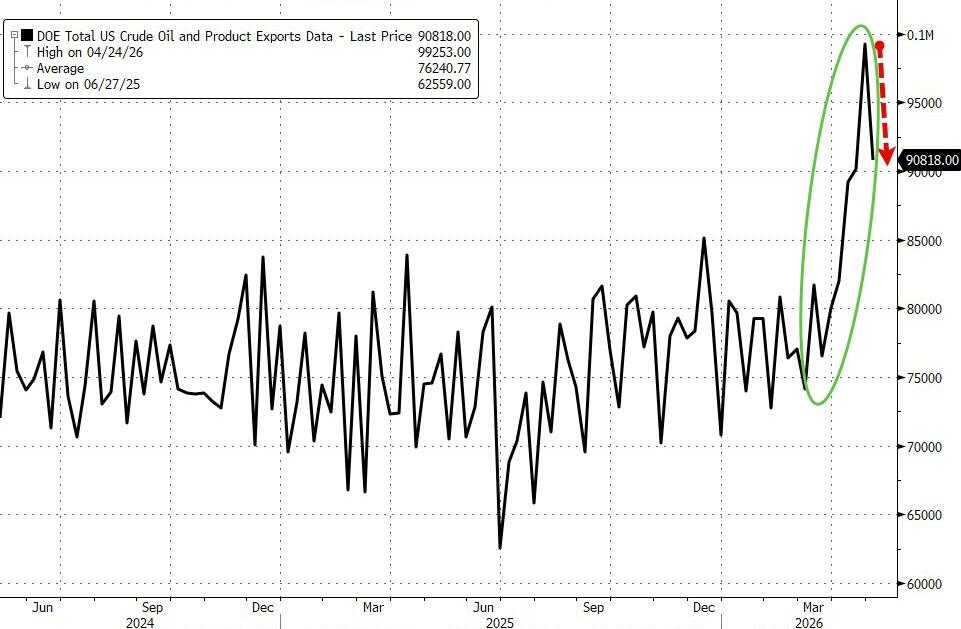
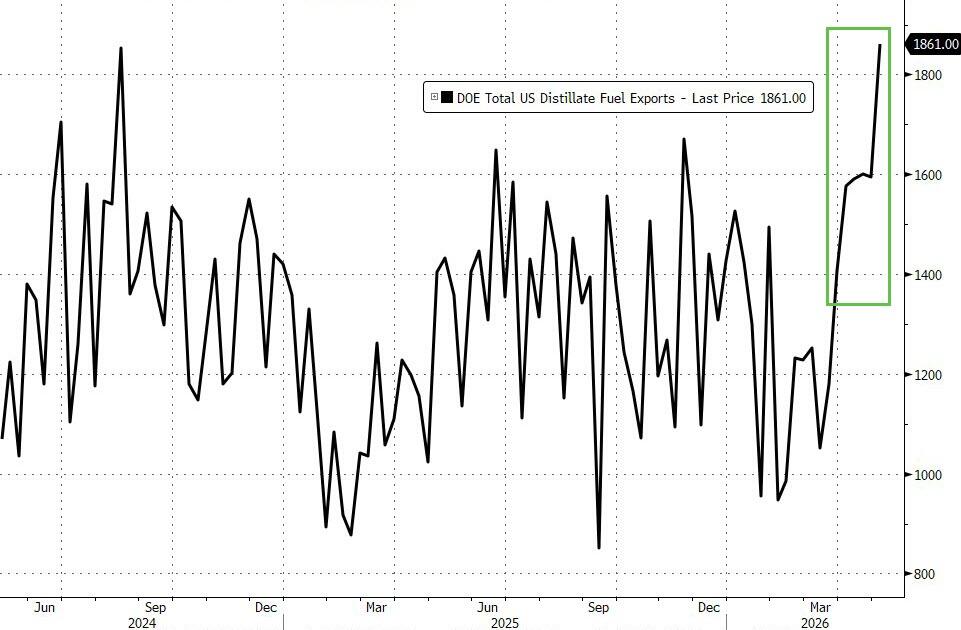
Additionally, last week saw US crude exports actually decline (after nearing the unprecedented level of 100 million barrels in 7 days). The decline in crude cargoes headed overseas pulled down overall US oil and fuels exports from record high levels also set the week earlier, even as fuel exports rose to the highest weekly level ever.
Source: Bloomberg
The US has sent out at least 1.5 million barrels of diesel a day since the week of April 3.
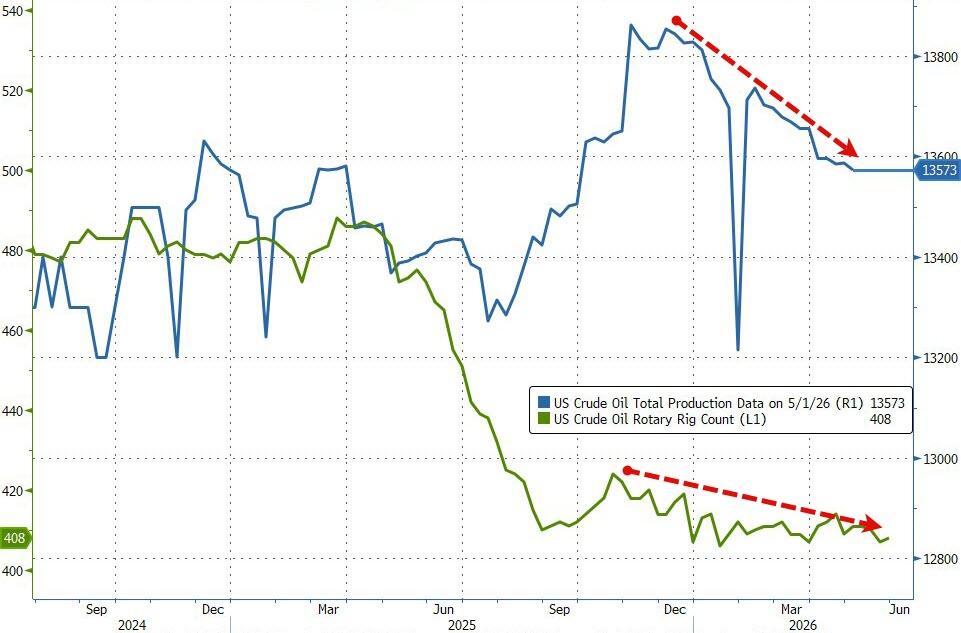
US crude production continued to trend lower…
Source: Bloomberg
WTI fell dramatically below $100 overnight but amid Trump’s ‘bombastic’ comments and Iranian denials, pries are well off their lows
“The oil price is reacting on shift in sentiment instead of market balances, driven by news of a potential deal between the US and Iran,” said Giovanni Staunovo, an analyst at UBS Group AG in Zurich.
“It remains unclear when flow through the strait would resume.”
Still, any breakthrough in peace talks will take much longer to filter through to energy markets.
“When the Strait opens we do believe it will take half a year for oil to get back to normal,” Equinor Chief Financial Officer Torgrim Reitan said on the company’s quarterly earnings conference call.
“For gas, it will take much longer.”
And that’s important for the Midterms…
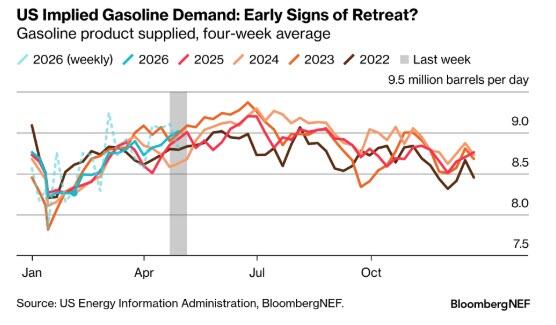
The 4-week moving average for US gasoline implied demand ticked higher week-on-week, but the more volatile weekly data showed a weekly decline and dipped below the 5-year average.
It is too early to tell, but elevated gasoline prices could be finally eating into demand.
Trump has repeatedly claimed prices will come down rapidly once the Strait is reopened – we shall see.
Tyler Durden
Wed, 05/06/2026 – 10:40
UBS Says Transport Stock Rout Is “Overdone” After Amazon News
UBS Says Transport Stock Rout Is “Overdone” After Amazon News
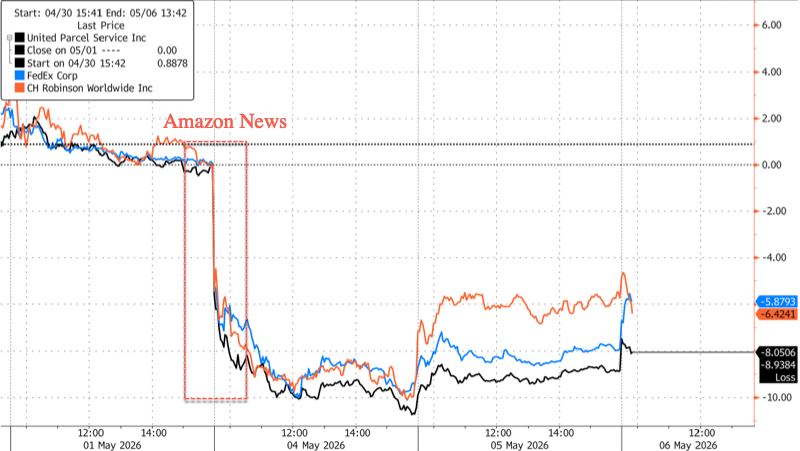
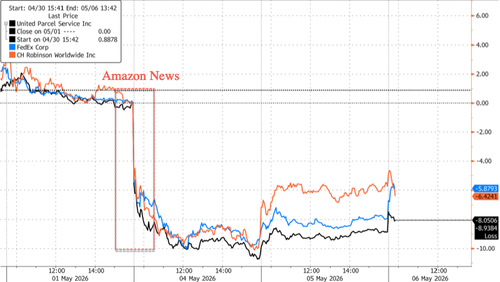
UBS senior analyst Tom Wadewitz, who covers freight transportation, told clients that Amazon’s latest push to open its supply chain network to businesses beyond its own marketplace triggered an “overdone” sell-off in transport names, including UPS, FedEx, and C.H. Robinson.
Wadewitz said the risk is not new, noting that Amazon’s supply chain service has been around since 2023. He said the pullback has created attractive entry points in select transport stocks, particularly UPS, FedEx, and C.H. Robinson.
“While we view AMZN’s strategy of selling transportation services as a negative for transports generally, it is not a new risk and the supply chain service is also not new. We believe the significant sell-off in transport names was overdone,” Wadewitz said.
The main risk is in B2B parcel, Wadewitz said, adding that Amazon’s growing third-party shipping ambitions could pressure UPS and FedEx over the medium term.
However, he said the threat is not a surprise, since Amazon has been active in parcel delivery for years. He also noted that there is limited near-term risk in international express because Amazon’s air fleet is mostly domestic narrow-body aircraft.
The immediate market reaction in transport stocks, including UPS, FedEx, and C.H. Robinson, to Amazon’s news was a roughly 10% drop at the start of the week. Some of those losses had been recovered by mid-week.
Wadewitz explained to clients why the “pullback creates attractive entry points for UPS, FDX, and CHRW” …
We believe the cost reduction and network efficiency initiatives of UPS and FDX support margin improvement and EPS growth on a multi-year basis. While AMZN’s focus on growing in transport markets is a risk, we also don’t view it as a new risk.
In our view, investors already assume that the addressable domestic parcel market for UPS and FDX is a slow growth market (eg in part due to impact of AMZN).
We view the ~10% pullbacks in UPS and FDX as providing attractive entry points.
With respect to CHRW, we do not expect AMZN’s supply chain initiative to have a noticeable impact on the brokerage market which is already a highly competitive market. We expect the combination of an upcycle in truckload pricing and acceleration in labor productivity for CHRW in 2H26 to support attractive EPS growth and support upside for the stock. We would also recommend buying CHRW on the pullback in the stock.
Professional subscribers can read the full transport note here at our new Marketdesk.ai portal.
Tyler Durden
Wed, 05/06/2026 – 10:30
https://www.zerohedge.com/markets/ubs-says-transport-stock-rout-overdone-after-amazon-news

Israel Says Preparing For Escalation With Iran, Didn’t Know Deal Was Close: ‘Series Of Targets Ready’
Israel Says Preparing For Escalation With Iran, Didn’t Know Deal Was Close: ‘Series Of Targets Ready’
Wednesday saw yet another early morning Axios ‘scoop’ that within hours of being issued proved premature and too out front, given talk of Iran and the US being ‘close’ to a deal was quickly denied by Tehran and even President Trump quickly acknowledged it’s “too soon” to plan peace talks with Iran.
But the headline of “US and Iran closing in on one-page memo to end war” was enough to raise alarm bells in Israel, which has insisted that the conflict must end with a nuclear-free Iran.
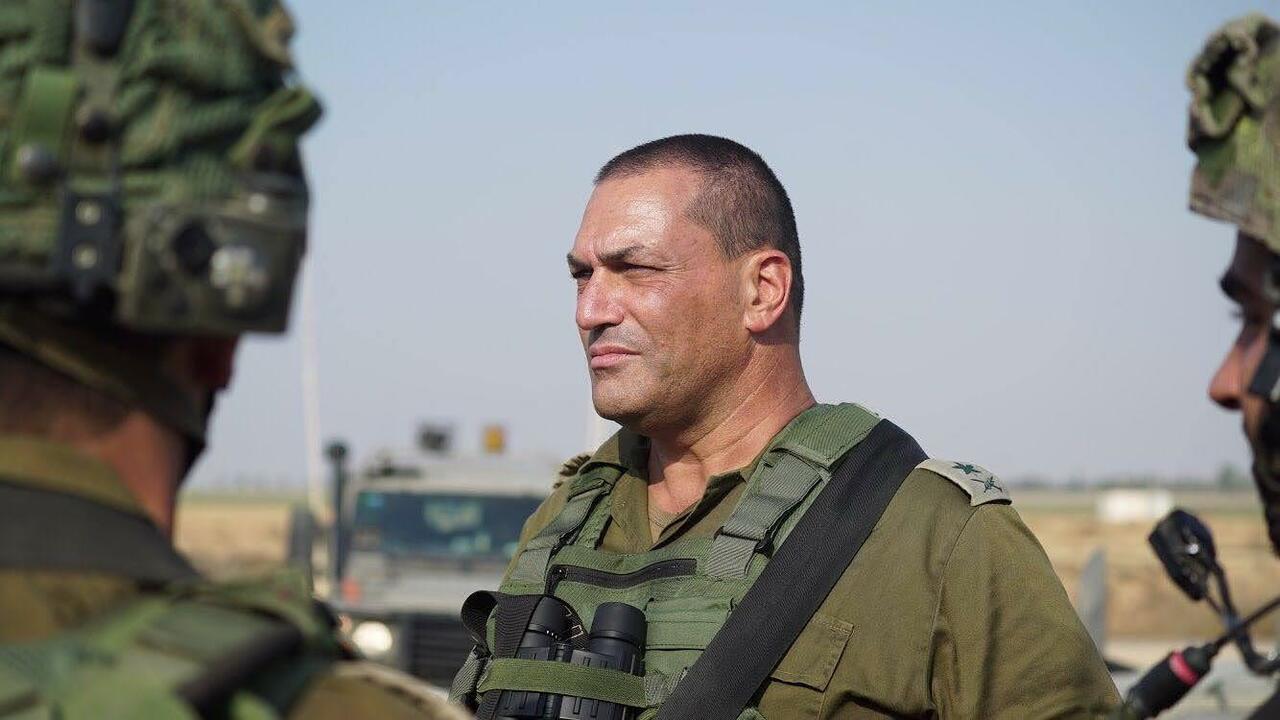
Maj. Gen. Eyal Zamir, via IDF/TOI
“Israel was unaware that US President Donald Trump was close to reaching an agreement with Iran to end the fighting and open the Strait of Hormuz,” an Israeli official told Army Radio soon after the optimistic peace deal headlines went international.
“We were preparing for an escalation,” the official said. Indeed the last couple weeks of stalled Pakistan-mediated talks have seen several reports out of Israel saying the Netanyahu government is waiting for the ‘green light’ from Washington to renew the aerial bombing campaign, which took place over prior 38 days as part of Operation Epic Fury.
But as of Tuesday Secretary of State Marco Rubio announced that Epic Fury was ending, and that Project Freedom – to open the Strait of Hormuz – is the new focus. But even after that President Trump in the evening announced a ‘pause’ to allow negotiations to proceed.
So there has been much confusion and contradictory signaling out of Washington to say the least. Tehran has meanwhile made clear its “finger is on the trigger” – but Israel is also saying the same thing.
For example, IDF Chief of Staff Lt. Gen. Eyal Zamir on Wednesday made it known that military has a “series of targets” ready to strike in Iran at the moment the war resumes.
“Cooperation with the United States military and coordination continue at all times, and we are monitoring the situation,” he stated during a visit to southern Lebanon, where Israel ground forces are occupying territory.
“In Iran, we have a further series of targets ready for attack. We are on high alert to return to an intense and broad campaign that will allow us to deepen our achievements and further weaken the Iranian regime,” Zamir said further.
Kind of wild that Barak Ravid has predicted seven of the last zero peace deals between the US and Iran.
— Justin Logan (@JustinTLogan) May 6, 2026
As for anti-Hezbollah operations, and despite the Lebanon ceasefire officially in effect, the top military general said: “We will seize every opportunity to deepen the blow to Hezbollah and its continued weakening.”
None of this bodes well for a lasting ceasefire in Lebanon, also as the broader Iran ceasefire is certainly on shaky ground, given this week’s cross-Gulf attacks on UAE out of the Islamic Republic.
Tyler Durden
Wed, 05/06/2026 – 10:15
U.S. Gasoline Tops $4.50 As “Shock & Awe” Level Approaches
U.S. Gasoline Tops $4.50 As “Shock & Awe” Level Approaches
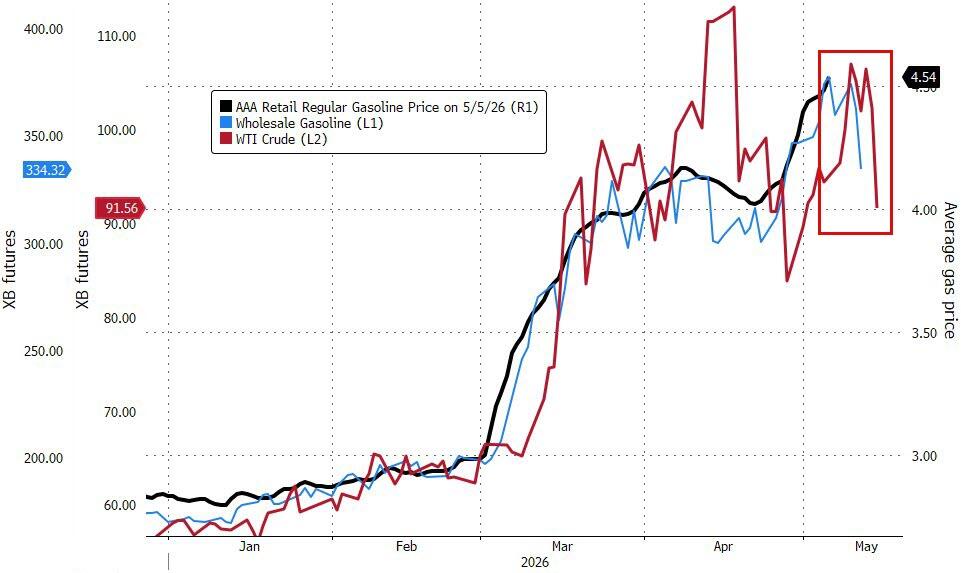
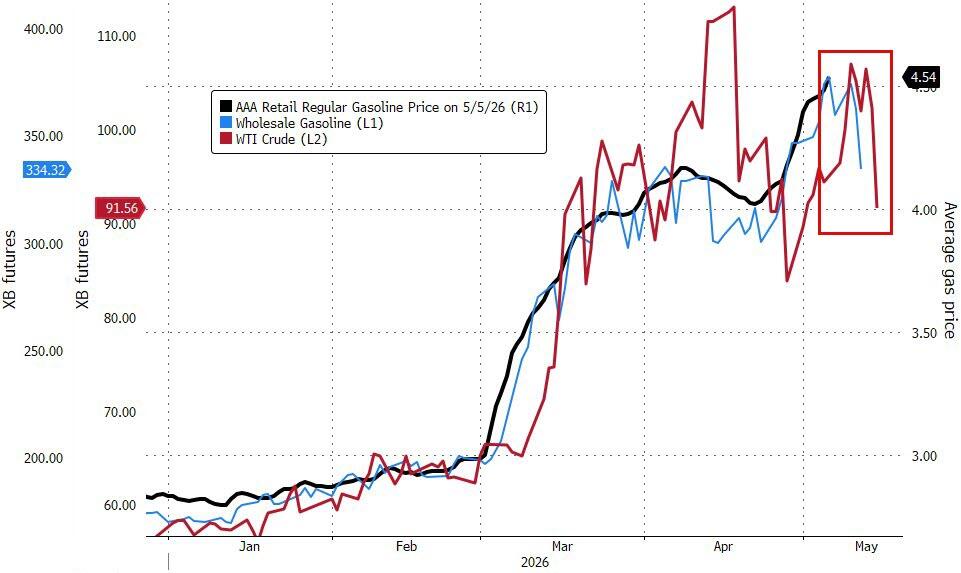
WTI futures plunged more than 11% to the $90-a-barrel level after Axios reported earlier this morning that the U.S. is nearing a preliminary agreement with Iran to end the war. The sharp decline suggests traders are beginning to price in a potential geopolitical de-escalation and the potential reopening of the Hormuz chokepoint.
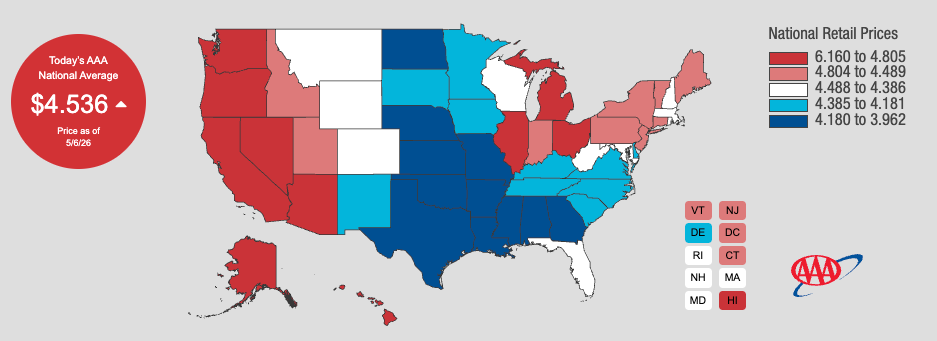
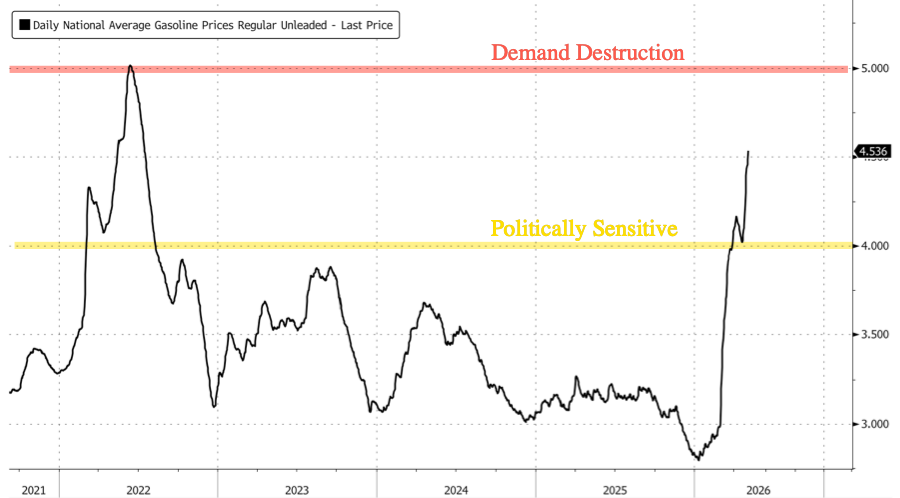
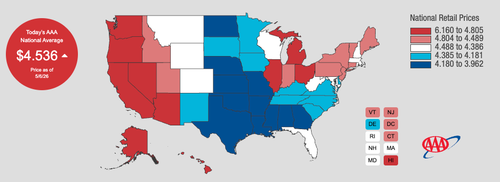
At the pump, however, the latest AAA data as of Wednesday morning show that the national average for regular 87-octane gasoline has climbed to $4.50 a gallon, the highest level since July 2022.
There will be a lag. Even if the Trump administration and Tehran formalize a deal in the near term, the immediate result will not be a collapse in gas and diesel pump prices, but rather an approaching peak.
Lower crude prices typically take a few weeks to work through wholesale markets, inventories, distribution networks, and retail outlets before meaningful declines in gas and diesel are visible at pump stations to consumers.
During a Monday press conference, Trump said he expects the price of gasoline to drop “substantially” following the end of the US-Iran war.
“I see it going down very substantially when this is over, I think very rapidly too, at levels that you’ve never seen because there’s a lot of energy out there, ships all over the world that are loaded up with it,” Trump said.
“They can’t do much with it because they got kidnapped by a pretty evil place. But we’re taking care of it.”
Last week, Trump said pump prices would “come crashing down as soon as this war is over.”
GasBuddy analyst Patrick De Haan warned that the $5-a-gallon threshold is typically the “shock and awe” level that triggers demand destruction.
With the national average for gas already near $4.50 a gallon, and California prices above $6, the political and consumer pressure backdrop for the Trump administration has intensified in recent weeks.
The administration now appears to be pushing hard for a near-term Iran resolution ahead of Memorial Day weekend, one of the largest U.S. driving periods of the year after Thanksgiving.
Tyler Durden
Wed, 05/06/2026 – 09:40
https://www.zerohedge.com/energy/us-gasoline-top-450-shock-awe-level-approaches