Category: News

Estados de EEUU que dependen del río Colorado incumplen plazo para alcanzar consenso
PHOENIX (AP) — Los siete estados del oeste de Estados Unidos que dependen del río Colorado incumplieron el sábado por segunda vez el plazo para acordar un plan que aborde la sequía récord y la escasez de agua.
La gobernadora de Arizona, Katie Hobbs; el gobernador de California, Gavin Newsom, y el gobernador de Nevada, Joe Lombardo, emitieron un comunicado conjunto en el que instaron a los estados de la cuenca alta a ofrecer más concesiones. Esos estados son Colorado, Nuevo México, Utah y Wyoming.
“El río Colorado es esencial para nuestras comunidades y economías, y nuestros estados han conservado grandes volúmenes de agua en los últimos años para estabilizar los suministros de agua de la cuenca en los años venideros”, manifestaron los gobernadores. “Nuestra postura se mantiene firme y justa: los siete estados de la cuenca deben compartir la responsabilidad de la conservación”.
Arizona, California y Nevada han ofrecido reducir la asignación de agua que les corresponde del río Colorado en 27%, 10% y 17%, respectivamente, según esos estados.
John Hickenlooper, senador de Colorado que ayudó a negociar un plan de contingencia del río en 2019 cuando era gobernador, calificó de “terrible” la situación en la cuenca del río, e hizo notar que la capa de nieve en el estado es baja.
“Si no abordamos este problema juntos —de frente y rápido—, nuestras comunidades, granjas y economías sufrirán. El mejor camino a seguir es el que recorremos juntos. Los litigios no resolverán el problema de esta aridificación a largo plazo”, expresó Hickenlooper en un comunicado.
John Entsminger, gerente general de la Southern Nevada Water Authority —agencia encargada de atender las necesidades de agua en el sur de Nevada—, también manifestó frustración por la falta de avances.
“Las medidas que hemos tomado en las últimas dos décadas tienen menos que ver con elevar el nivel del lago Mead que con protegernos si las cosas empeoran”, señaló Entsminger en un comunicado.
Los estados ya habían dejado pasar un plazo que venció en noviembre —establecido por la Oficina de Recuperación del Departamento del Interior— para que idearan una estrategia que enfrente la escasez de agua después de este año, cuando expirarán las directrices actuales.
Más de 40 millones de personas en estos estados, al igual que México y tribus indígenas estadounidenses, dependen del agua del río Colorado. El río es crucial para la agricultura, así como para el agua y la electricidad de millones de hogares y negocios. Gran parte del agua se genera a partir de nieve invernal en las montañas de la cuenca alta, que de esa forma acumula mucho más de lo que consume. Los estados de la cuenca baja, incluidas regiones de gran peso agrícola, son mayores consumidores.
Grandes ciudades como Denver, Salt Lake City, Albuquerque, Las Vegas, Phoenix y Los Ángeles también consumen enormes cantidades de agua. El uso excesivo crónico, la sequía y el aumento de las temperaturas vinculadas al cambio climático han reducido los caudales.
La forma en que se asigna el agua —especialmente en periodos secos— y se conserva ha sido el centro de acuerdos entre los estados a lo largo de las décadas. El Pacto del Río Colorado de 1922 se calculó con base en cantidades de agua que hoy no existen, especialmente debido a la sequía prolongada.
La actual ronda de negociaciones entre los estados se ha extendido más de dos años.
Si no se logra un consenso, el gobierno federal podría intervenir y elaborar un plan que deje insatisfechas a las partes y que incluso derive en litigios.
Recientemente, los científicos hallaron que la cobertura y la profundidad de la nieve en el oeste del país están en sus niveles más bajos en décadas. Algunas zonas han registrado su diciembre más cálido hasta principios de febrero. Normalmente, la cobertura de nieve en esta época del año abarca 1.190.000 kilómetros cuadrados (460.000 millas cuadradas), aproximadamente el tamaño de California, Utah, Idaho y Montana. Pero este año es sólo del tamaño de California, unos 400.000 kilómetros cuadrados (155.000 millas cuadradas), según el Centro Nacional de Datos de Nieve y Hielo.
———
Esta historia fue traducida del inglés por un editor de AP con la ayuda de una herramienta de inteligencia artificial generativa.

Volodymyr Zelenskyy says questions remain for allies over security guarantees for Ukraine
KYIV, Ukraine — Ukraine’s President Volodymyr Zelenskyy thanked his international allies for their support but suggested there was still questions remaining over the future security guarantees for his country.
Speaking at the Munich Security Conference in Germany, Zelenskyy repeatedly thanked American and European allies for helping Ukraine by providing air defense systems that protect infrastructure like power plants and “save lives.”
Previous U.S.-led efforts to find consensus on ending the war, most recently two rounds of talks in Abu Dhabi, the capital of the United Arab Emirates, have failed to resolve difficult issues, such as the future of Ukraine’s Donbas industrial heartland that is largely occupied by Russian forces.
Later with reporters, Zelenskyy questioned how the concept of a free trade zone — proposed by the U.S. — would work in the Donbas region which Russia insists Kyiv must give up in order to get peace.
He also said the Americans want peace as quickly as possible and that U.S. team wants to sign all the agreements on Ukraine at the same time whereas Ukraine wants guarantees over the country’s future security signed first.
European nations, including the U.K. and France, have already said they will commit troops to Ukraine to guarantee its future security. The U.S. is also expected to be involved and discussions are currently ongoing about the nature of America’s support.
Russian officials are opposed to any foreign troop presence in Ukraine, Zelenskyy suggested, because Russian President Vladimir Putin wants to have the opportunity to attack Ukraine again.
Zelenskyy also said he was surprised that Moscow had replaced the head of its negotiating team before another round of U.S.-brokered talks and suggested the move was deliberately aimed at delaying negotiations.
The talks take place against a backdrop of continued fighting along the roughly 1,250-kilometer (750-mile) front line, relentless Russian bombardment of civilian areas of Ukraine and the country’s power grid, and Kyiv’s almost daily long-range drone attacks on war-related assets on Russian soil.
During negotiations, Russian officials have insisted Ukraine give up more territory in the east of the country to end the war. But Zelenskyy told The Associated Press that it was “a little bit crazy” to suggest Ukraine withdraw from its own territory or exchange it.
Thousands of Ukrainians have been killed defending the country’s Donbas region, he said, pointing out that 200,000 people also live there and it would not be acceptable to effectively hand them over to Russia.
Zelenskyy also questioned how the concept of a free economic zone would work.
“Imagine,” he said, if foreign soldiers patrolled the zone and Putin provoked them and they left. In that case, he said, there could be a “big occupation” of Ukraine and a lot of losses.
If Putin is given any opportunity for victory “we don’t know what he will do next,” Zelenskyy said.
Such a model, Zelenskyy told the AP, would have “big risks” for Ukraine and for any country which committed to guaranteeing Ukraine’s security. But he said he was ready to discuss it as it could be important as a compromise in exchange for securing support to reconstruct Ukraine.
During negotiations, Moscow has to accept monitoring of a ceasefire and return some 7,000 Ukrainian prisoners of war in exchange for more than 4,000 Russian prisoners held by Ukraine, Zelenskyy said.
Earlier on Saturday, drone strikes killed one person in Ukraine and another in Russia, Ukrainian officials said, ahead of fresh talks next week in Geneva aimed at ending the war.
An elderly woman died when a Russian drone hit a residential building in the Black Sea port city of Odesa, Ukraine’s State Emergency Service said.
In Russia, a civilian was killed in a Ukrainian drone strike on a car in the border region of Bryansk, regional Gov. Alexander Bogomaz said.
Russia-installed authorities said a Ukrainian airstrike on a village Saturday wounded 15 people in Ukraine’s partially occupied Luhansk region.
The attacks came a day after a Ukrainian missile strike on the Russian border city of Belgorod killed two people and wounded five, according to regional Gov. Vyacheslav Gladkov.
Burrows reported from Munich, Germany and Morton reported from London.
https://www.chicagotribune.com/2026/02/14/zelenskyy-allies-security-guarantees-ukraine/

Jack Eichel and Brady Tkachuk rally unbeaten U.S. men’s hockey team past Denmark 6-3 at Winter Olympics
MILAN — Sitting on the bench with the U.S. surprisingly trailing Denmark at the Milan Cortina Olympics, Jack Eichel and linemates Brady Tkachuk and Matthew Tkachuk talked about wanting to make a difference.
Then they did just that.
Eichel scored off his own faceoff win a minute after setting up Brady Tkachuk’s first of two goals the same way, and the U.S. rode its top line to a 6-3 defeat of Denmark on Saturday night, keeping pace with also-unbeaten Canada for the top seed in the men’s hockey tournament.
2026 Winter Olympics: Meet the medalists from the United States
“(We were) just sticking with it, trusting each other,” Brady Tkachuk said. “That’s what shows the character in our room is the trust and belief with one another that if we stick with it, we’ll like the result at the end of the day.”
The U.S. bounced back from goaltender Jeremy Swayman getting beaten by a shot from 95 feet away, just inside the center red line, 11 minutes in. Swayman won’t have to kick himself too badly for the blunder after some of his most talented teammates stepped up to make the long-distance goal from Nicholas B. Jensen and another soft one from Phillip Bruggisser with 2.6 seconds left in the second period moot.
“I’m really proud of this group for staying even-keeled,” Swayman said. “The confidence never left the group, and that’s a serious trait at this stage in the tournament. The guys rallied, and we got it done”
The goals by Tkachuk and Eichel — two-thirds of the top line along with Brady’s brother, Matthew — midway through the second period tied it and gave the U.S. the lead. Defenseman Noah Hanifin added another when his shot got through Mads Sogaard and trickled over the goal line a bit later, providing some breathing room that proved necessary.
Jake Guentzel fired a one-timer past Sogaard with a little more than 12 minutes left, and Brady Tkachuk scored his second off a feed from Jack Hughes after Sogaard exited with injury and was relieved by Frederik Dichow.
Captain Auston Matthews made the pass to Guentzel, and Zach Werenski — who accidentally knocked the puck into his own net on Denmark’s first goal credited to Nick Olesen — had the secondary assist to get some retribution.
“U-S-A! U-S-A!” chants from the very red, white and blue crowd filled the arena at the opening puck drop and after all the goals. Some fans in the stands had flags of Greenland, in light of recent rhetoric from U.S. President Donald Trump about taking control of the semiautonomous island overseen by Denmark.
None of the geopolitics reached the ice, and multiple Denmark players last week downplayed any connection between the Greenland situation and the game against the U.S. as heavy underdogs.
“We battled hard and tried everything we had,” Bruggisser said. “Unfortunately, it wasn’t enough, but they’re an all-star team and we gave it what we had.”
After cruising past Latvia 5-1 in their opener on Thursday night behind two goals from Brock Nelson, the Americans have six points in the standings, the same as Canada, going into the final day of the preliminary round.
The U.S. wraps up round-robin play against Germany, Canada faces 0-2-0 France and if they each win in regulation, the No. 1 spot in the single-elimination knockout round would come down to goal differential.
Slovakia wins by losing to Sweden by two goals
Dalibor Dvorsky’s goal with 39 seconds left sent Slovakia to the quarterfinals as the winner of the group in a tiebreaker even after losing to Sweden 5-3. Slovakia won Group B when Finland crushed host Italy 11-0 later in the day because of goal differential among the three tied teams.
“It’s probably the best loss I ever had,” Slovakia’s Juraj Slafkovsky said. “It’s crazy, but we take it.”
Dvorsky, who plays for the St. Louis Blues in the NHL, also called it the best loss of his life. His goal on the power play after a penalty on Lucas Raymond made it happen.
Sweden, which played much better than it had in its 4-1 loss to archrival Finland on Friday, was left to lament a missed opportunity even after winning the game.
“Tough pill to swallow,” alternate captain Victor Hedman said. “But we will regroup. We’ll be ready for our next challenge.’’
Jacob Markstrom stopped 29 of the 32 shots he faced and may have supplanted Filip Gustavsson as Sweden’s starter moving forward. Sweden is locked into the seventh seed and will have to play in the qualification round Tuesday just to make it into the quarterfinals Wednesday.
Finland beats host Italy 11-0
Sebastian Aho, Kaapo Kakko, Joel Kiviranta and captain Mikael Granlund each scored twice for Finland in an 11-0 beatdown of host Italy. The 11-goal margin made it the most lopsided men’s hockey game at the Olympics since 1988, when Sweden beat France 13-2.
Because of goal differential, the Finns were incentivized to run up the score on an overmatched opponent. At one point, Finland had eight goals and Italy had eight shots.
Coach Antti Pennanen and his staff told players about the tiebreaker before puck drop.
“They knew that, and then we told them honestly what is the situation,” Pennanen said. “We had a plan. First plan: Win the game. And then do goals as much as you can.”
Barring something incredibly unforeseen Sunday, Finland is into the quarterfinals as the No. 4 seed.
Latvia upsets Germany
Eduards Tralmaks and Renars Krastenbergs scored just more than three minutes apart, and Latvia defeated Germany 4-3. Arturs Silovs of the Pittsburgh Penguins stopped 26 of the 29 shots he faced.
“We’re a good team,” said Zemgus Girgensons of the Buffalo Sabres, one of 10 NHL players on Latvia’s roster. “We believed it. I don’t think we go into the game thinking it’s going to be any other way. We came in today thinking we’re going to win. And that’s what we did.”
Germany’s Philipp Grubauer, who was excellent in an opening win against Denmark when he and his teammates were badly outshot, allowed four goals on 22 shots in the loss.
AP reporters John Wawrow and James Ellingworth contributed.
https://www.chicagotribune.com/2026/02/14/us-mens-hockey-denmark-winter-olympics/

El local Cerúndolo chocará ante el italiano Darderi en la final del Abierto de Argentina
Por MARCELO R. ANDROETTO
BUENOS AIRES (AP) — Francisco Cerúndolo espera que la tercera sea la vencida en su país.
El argentino, 19no del ranking, quedó a las puertas de conquistar el Abierto de Argentina, al derrotar el sábado 6-3, 7-5 a su compatriota Tomás Etcheverry, quien ocupa el 52do puesto.
Perdió la final de 2021 ante su compatriota Diego Schwartzman y la de 2025 ante el brasileño Joao Fonseca. Su rival en esta ocasión sobre la arcilla del Buenos Aires Lawn Tennis Club será Luciano Darderi, quien nació en suelo argentino, pero compite bajo la bandera italiana.
Será un duelo entre los dos primeros preclasificados de este torneo ATP 250.
“Mi objetivo era darme una nueva oportunidad de jugar una final en casa, de hacerlo mejor. Voy a tratar de salir con todo, quiero ganar”, afirmó “Fran”, de 27 años y el preferido de la afición de su país en este torneo.
Francisco es hijo de Alejandro Cerúndolo, extenista profesional y hermano de Juan Manuel, quien también compite en el circuito.
En segundo turno, Darderi, raqueta número 22 del escalafón de la ATP, venció al argentino Sebastián Báez por 7-6 (2) y 6-1 y buscará convertirse en el segundo italiano en consagrarse en Buenos Aires, tras el título conseguido por Marco Cecchinatto en 2019, ante el local Schwartzman.
Nacionalizado italiano, “Luli” nació en la localidad argentina de Villa Gesell y precisamente este sábado cumplió 23 años.
“Estoy muy feliz. Fue especial jugar en esta cancha en mi cumpleaños. Me la banqué (soporté) por momentos, tuve la hinchada en contra. Mañana seguramente será una gran batalla”, declaró Darderi, quien lleva 17 partidos consecutivos sin caer sobre arcilla.
La pista central “Guillermo Vilas” será escenario el domingo de una final entre tenistas de ranking muy cercano, especialistas en la superficie, y que además están igualados 2-2 en el historial de enfrentamientos entre sí.
En su séptima vez como finalista, Cerúndolo buscará su cuarto título en el circuito, tras los obtenidos en Bastad (2022, arcilla), Eastbourne (2023, hierba) y Umag (2024, arcilla).
Para Darderi se yergue la posibilidad de levantar su quinto trofeo, tras sus consagraciones en Córdoba (2024, arcilla) y Umag, Bastad y Marrakech (2025, arcilla). Un detalle: el italiano tiene saldo perfecto en finales disputadas en el circuito, jamás perdió una.
La primera semifinal fue pareja, más allá de que Cerúndolo consiguió alzarse con la victoria sobre Etcheverry en sets corridos, en 1:51 horas de juego.
En la primera manga, Cerúndolo hizo diferencia con un quiebre en el cuarto game, para ponerse 3-1 y sostener su saque hasta el final.
El segundo set fue más reñido todavía. Etcheverry salvó un break point en el noveno juego, pero no consiguió llevar la contienda hasta el tiebreak: su rival quebró para 6-5 e inmediatamente después se alzó con el set y el match.
La segunda semifinal tuvo dos instancias bien diferenciadas y se dirimió en 1:18 horas de juego. El primer set fue muy reñido y recién en el desempate Darderi impuso condiciones con dos miniquiebres para estampar un resultado de 7-2 en el tiebreak.
A partir de entonces, Báez, número 34 del mundo y todavía sin títulos en el circuito, se derrumbó. El italiano lo aprovechó con facilidad, quebrando tres veces para llevarse la manga por 6-1, en apenas 27 minutos.
La definición del certamen de dobles tendrá sabor a clásico sudamericano de fútbol. Por un lado, estarán los brasileños Orlando Luz y Rafael Matos, y por el otro, los argentinos Andrea Collarini y Nicolás Kicker. Se espera una fuerte rivalidad en las gradas, teniendo en cuenta la fuerte presencia de “torcedores” durante toda la semana.
Luz y Matos se impusieron en semis a la pareja conformada por el argentino Guido Andreozzi y el francés Manuel Guinard por 6 (4)-7, 7-6 (5) y 10-6. En tanto, Collarini y Kicker derrotaron a sus compatriotas y máximos favoritos Máximo González y Andrés Molteni, por 1-6, 6-3 y 10-5.
_____
Deportes AP: https://apnews.com/hub/deportes

Trump Promises Voter ID “Whether Congress Approves Or Not”
Trump Promises Voter ID “Whether Congress Approves Or Not”
The SAVE America Act squeaked through the House this week by five votes.
The final tally was 218-213, with Rep. Henry Cuellar of Texas standing as the lone Democrat to cross party lines.
On Friday, Sen. Susan Collins (R-Maine) gave Republicans their 50th vote late Friday afternoon, telling Maine Wire the revised bill strikes an appropriate balance between election security and voter access.
“The law is clear that in this country only American citizens are eligible to vote in federal elections. In addition, having people provide an ID at the polls, just as they have to do before boarding an airplane, checking into a hotel, or buying an alcoholic beverage, is a simple reform that will improve the security of our federal elections and will help give people more confidence in the results,” she told Maine Wire.
“Requiring voters to produce passports or birth certificates on Election Day — as opposed to just a state-issued ID — would have placed an unnecessary burden on the voters. That provision is no longer in the bill, and dropping this requirement was key to getting my support.”
With Will Collins on board, Republicans have enough support to pass the bill even without additional backing, with Vice President JD Vance ready to break any tie.
Unfortunately, 50 votes only get the GOP so far. The legislation still lacks the 60 votes needed to overcome a Democratic filibuster, and Senate Minority Leader Chuck Schumer has made clear the bill is “dead on arrival.”
And Collins herself opposes scrapping the filibuster to ram the measure through.
“I oppose eliminating the legislative filibuster,” Collins said.
“The filibuster is an important protection for the rights of the minority party, that requires Senators to work together in the best interest of the country. Removing that protection would, for example, allow a future Congress controlled by Democrats to pass provisions on anything they want — DC Statehood, open borders, or packing the Supreme Court — with just a simple majority of Senators.”
President Trump, however, is promising that requiring a photo ID to vote will get done with or without Congress.
In a post on Truth Social, he accused Democrats of opposing Voter ID and citizenship verification because “they want to continue to cheat in Elections.”
He said this “was not what our Founders desired” and promised to present an “irrefutable” legal argument on the issue soon.
Trump vowed that “There will be Voter I.D. for the Midterm Elections, whether approved by Congress or not,” and stated that Americans demand “Citizenship, and No Mail-In Ballots, with exceptions for Military, Disability, Illness, or Travel.”
Trump also slammed Democrats as “horrible, disingenuous CHEATERS” for opposing Voter I.D., claiming they “boldly laugh in the backrooms” while opposing it.
He called the lack of Voter I.D. “even crazier, and more ridiculous, than Men playing in Women’s Sports, Open Borders, or Transgender for Everyone.”
Trump urged Republicans to make it “a CAN’T MISS FOR RE-ELECTION IN THE MIDTERMS, AND BEYOND,” noting that “Even Democrat Voters agree, 85%, that there should be Voter I.D.”
He called Democratic leaders “Crooked Losers like Schumer and Jeffries,” who label it “racist,” and promised to present legal arguments for action via an Executive Order.
Trump warned that if Democrats regain power, they will “PACK THE COURT with a total of 21 Supreme Court Justices” and warned the country “will never be the same if they allow these demented and evil people to knowingly, and happily, destroy it.”
Trump previously signed an executive order attempting to impose proof-of-citizenship requirements on federal voter registration forms.
That effort crashed into multiple legal challenges and has been systematically dismantled by the courts.
Tyler Durden
Sat, 02/14/2026 – 19:15
https://www.zerohedge.com/political/trump-promises-voter-id-whether-congress-approves-or-not

Daily Horoscope for February 15, 2026
General Daily Insight for February 15, 2026
A fresh, wide view could be hard to handle today. With the emotional Moon entering Aquarius at 1:17 am EST, we may feel pulled toward community conversations that spark inventive ideas and build kinder bonds. That said, changing the status quo often requires letting go of dynamics we find comfortable. When Luna conjoins intense Pluto, our feelings about such shifts might burst out in unpleasant ways! There’s more to life than logic, but overwrought emotions are likely to pass if we let them.
Aries
March 21 – April 19
A social media fracas could be more complicated than it looks today. As the caring Moon meets life-and-death Pluto in your 11th House of Community, you may feel compelled to launch into action to defend an ally who has been mistreated. Maybe you can’t not do it, even if you aren’t totally sure of some of the facts. Your desire to be a protector is probably very powerful! Try to step back from it long enough to see whether it’s what this situation genuinely needs.
Taurus
April 20 – May 20
Making big professional decisions could be risky at the moment. While the moody Moon blurs with powerful Pluto in your 10th House of Career, clarifying your role and long-term direction may be difficult. You might be drawn to a particular outcome for emotional reasons, but that energy doesn’t necessarily blend well with the need to price a project realistically or ask for a fair rate. It’s okay to enjoy a grand heroic fantasy — just recognize it for what it is!
Gemini
May 21 – June 20
Getting too bored is a bad idea at the moment. Curiosity widens your world as the intuitive Moon enters your 9th House of Higher Learning, stirring questions about subjects and plans that reach beyond your daily routine. However, as Luna encounters shady Pluto, you might become a little obsessive in trying to find out about the dark side of life. The lure of hidden information is powerful, but keep whatever you discover in perspective — weigh it against your own real-world experiences.
Cancer
June 21 – July 22
Comfort grows when truths breathe in safety. The nurturing Moon unites with intense Pluto in your 8th House of Intimacy, encouraging honest talks about deep issues. You might review a shared account or open up about a sensitive worry with a loved one. Even when everyone is doing their best to be caring, these discussions often aren’t easy. If someone overreaches, calmly state boundaries and propose a fair plan for moving forward. Clarity paired with kindness heals misunderstandings faster than silence.
Leo
July 23 – August 22
Leo, your warmth lights rooms and hearts. Relationship dynamics could shift as the emotional Moon meets intimate Pluto in your 7th House of Partnership, inviting you to build agreements that honor both voices. If a partner, collaborator, or client pushes for control, reflect your generous nature by naming shared goals and suggesting fair roles, because clear structure protects affection. Plan a heartfelt check-in, and then offer appreciation that feels sincere, since praise opens doors that pressure often closes. Build balance now so love feels spacious.
Virgo
August 23 – September 22
Meaningful course corrections are possible at this time. Your 6th House of Work gets a reset as the temperamental Moon enters, asking you to notice habits and timelines that need practical upgrades. A co-worker might drop a task, or a system glitch could slow you, exposing the weak links — and possibly really rattling you in the process. If health routines feel off, prep a nourishing lunch or take a brief walk, because order creates steady calm. Tend the basics so your day flows smoother.
Libra
September 23 – October 22
A break from routine can support your relationships today. Play invites honest feeling as the unconscious Moon enters your 5th House of Romance, highlighting simple moments of joy that bring hearts closer. Plan a lighthearted date or a family game, and let your diplomatic tone set easy rules so everyone feels seen. If someone fishes for attention, offer praise while naming your need for equal give and take, because harmony grows when kindness and clarity share space. Love breathes more freely when you’re having fun!
Scorpio
October 23 – November 21
When depth calls, your focus sharpens naturally. Your 4th House of Home becomes a deep well as the nurturing Moon conjoins unearthing Pluto there, encouraging you to cleanse closets and clear emotional dust. If a family member reveals a buried worry, listen closely, name what is true, and suggest a practical change that restores peace. Rearranging a room or taking a quiet walk together could also help break up an atmosphere cramped with heavy feelings. Create safety now so tenderness can unfold.
Sagittarius
November 22 – December 21
Which horizon tempts your curious steps now? Your 3rd House of Communication buzzes when the instinctive Moon enters, inspiring quick messages and neighborly chats that brighten your day. If a plan changes, your upbeat flexibility is equipped to turn detours into discoveries. You might become very interested in a subject that you just happen upon by accident. That said, don’t uncritically accept every piece of mental clutter that comes your way — try to have a sense of your basic priorities.
Capricorn
December 22 – January 19
Capricorn, your steady plans deserve support. Figuring out how to get it might be a challenge while the moody Moon conjoins turbulent Pluto in your 2nd House of Resources. Pricing a project realistically or asking for a fair rate may be difficult. Whether you go too high or too low, an unmet emotional need is likely the culprit. Try to get at the bigger fears that your feelings are pointing toward. Change is probably needed, but think things all the way through first..
Aquarius
January 20 – February 18
You’re likely to feel magnetic today. The unconscious Moon fuses with dark Pluto in your 1st House of Identity, and their meeting in your sign amplifies your presence. You might as well seize the opportunity to craft a bold introduction, update a profile, or enter a room with a clear intention that sets the tone. If someone projects old expectations, kindly correct the label and show who you are now, because growth deserves breathing room. Own your story, and choices will follow naturally.
Pisces
February 19 – March 20
Quiet spaces could call loudly to you now. The intuitive Moon enters your 12th House of Spirituality, guiding you to rest, dream, and sort feelings that hide behind busyness. You might even notice old worries surfacing while washing dishes or listening to music. Try to write any anxieties down to get them out of your mind. A journaling session doesn’t have to be long and involved, though — sometimes it’s enough to just jot down the name of the problem and a gentle, compassionate next step!
https://www.chicagotribune.com/2026/02/14/daily-horoscope-for-february-15-2026/
Se prevén “grandes afectaciones a viajes” tras aviso de tormenta invernal en el norte de California
Por SARA CLINE
En un fin de semana festivo en Estados Unidos en el que mucha gente suele viajar, gran parte del norte de California está bajo un aviso de tormenta invernal, y las comunidades se preparan para recibir decenas de centímetros de nieve.
El Servicio Meteorológico Nacional advirtió a quienes viajen hacia y desde la Sierra Nevada y sus populares centros de esquí que anticipen “importantes impactos en los desplazamientos” y actúen con “extrema precaución”.
Pero todavía hay tiempo para que la gente llegue a sus destinos en el fin de semana del Día de los Presidentes.
Dakari Anderson, analista del Servicio Meteorológico Nacional en la oficina de Sacramento, le dijo a The Associated Press que la “mejor ventana para viajar” será desde el sábado hasta el domingo por la mañana antes de la llegada del sistema de aire frío.
Aunque cayó algo de nieve en la semana, las condiciones se mantuvieron tranquilas el sábado, indicó Anderson. Pero se prevé que el clima cambie el domingo por la tarde, y se calcula que las comunidades situadas a altitudes de entre 915 y 1.220 metros (3.000 a 4.000 pies) reciban entre 30 y 60 centímetros (1 y 2 pies) de nieve.
“Nuestras mayores acumulaciones (de nieve) van a darse en esos lugares algo más difíciles de alcanzar, pero de todas formas veremos algunas de esas cantidades más fuertes en comunidades pobladas”, manifestó Anderson.
Las localidades a mayor altitud podrían recibir mucha más nieve, posiblemente de 1,8 a 2,4 metros (6 a 8 pies). Entre ellas, señaló Anderson, podría estar Blue Canyon, una comunidad no incorporada y poco poblada que se encuentra a 1.430 metros (4.695 pies) de altitud y a unos 82 kilómetros (51 millas) al oeste del lago Tahoe.
La ciudad de South Lake Tahoe publicó en su página de Facebook una advertencia a los residentes de que, si conducen el lunes, deben “anticipar demoras, posibles cierres de carreteras y condiciones de visibilidad nula por ventisca”.
La policía del condado Shasta instó a los residentes a aprovechar el clima despejado del sábado y prepararse para la tormenta. “Gran parte de 2026 ha dado la impresión de ser ‘primaveral’, pero el invierno está listo para demostrar que aún no ha terminado del todo”, publicó la agencia.
Se prevé que el episodio invernal se extienda varios días, y también podría afectar partes del oeste de Nevada y del sur de Oregon.
——
Cline informó desde Baton Rouge, Luisiana.
——
Esta historia fue traducida del inglés por un editor de AP con la ayuda de una herramienta de inteligencia artificial generativa.

Brasileños celebran ‘carnaval en la nieve’; Pinheiro logra presea olímpica histórica
Por MAURICIO SAVARESE y STEFANIE DAZIO
RÍO DE JANEIRO (AP) — Justo cuando Brasil comenzaba a expresar el júbilo del Carnaval, el esquiador Lucas Pinheiro Braathen le dio el sábado al país otro motivo para festejar: una medalla olímpica.
Nunca en la historia un país latinoamericano había conseguido una presea de ningún color en los Juegos Olímpicos de Invierno.
Y ésta no fue cualquier medalla, sino nada menos que un oro en esquí alpino, en la prueba del eslalon gigante.
La victoria del deportista de 25 años, conocido en Brasil como “O cara do ski” —el tipo del esquí—, se produjo en el primer día completo del célebre Carnaval de Río de Janeiro. Aunque muchos brasileños estaban más pendientes de esa juerga, la gloria del oro de Pinheiro Braathen desplazó las noticias del festejo tradicional de los lugares más prominentes en los principales sitios Web de noticias.
Fue otro en una serie de logros recientes de Brasil en los grandes escenarios globales que, según algunos, han aportado un reconocimiento largamente esperado.
“Ésta se ha convertido en una de mis cinco principales medallas de oro de Brasil en la historia olímpica, sin duda”, le comentó a The Associated Press el locutor de radio y fanático del deporte Thiago Varella, de 41 años, desde Campinas, una ciudad donde Pinheiro Braathen tiene familiares y pasó varias vacaciones durante su infancia. “Será nuestro tipo del esquí para siempre. Incluso la gente que no entiende el deporte ahora llegará a admirar su historia y su condición de brasileño”.
En Milán, cientos de aficionados abarrotaron la Casa Brasil, sede de una reunión organizada por su comité olímpico. Estallaron en celebración, brindando con sus botellas de cerveza y entonando cánticos al estilo del fútbol con el nombre de Lucas.
El chef brasileño Raphael Rego, con estrella Michelin, repartió pan de queso caliente, un desayuno tradicional en su país, antes de bailar samba junto a Bruno Fratus, nadador que ganó bronce en los Juegos de Verano de Tokio en 2021. Vestidos de verde y amarillo, muchos se sumaron a una conga encabezada por Ginga, la mascota del equipo olímpico brasileño.
“Estamos acostumbrados a esta sensación muchas veces en el fútbol, a veces en el voleibol, pero, ya sabes, es un deporte de invierno, es un deporte de nieve”, manifestó Aline Fialho, de Recife, en el noreste de Brasil. “No tenemos nieve en Brasil, así que es un poco surrealista, pero me siento muy orgullosa”.
El presidente de Brasil, Luiz Inácio Lula da Silva, celebró en sus redes sociales.
“Este resultado sin precedentes muestra que el deporte brasileño no tiene límites. Es el reflejo del talento, la dedicación y el trabajo continuo para fortalecer el deporte en todas sus dimensiones”, expresó Lula. “Felicitaciones a Lucas Pinheiro y a todo el equipo involucrado en este logro histórico, que inspira a nuevas generaciones y amplía el horizonte del deporte brasileño”.
Despertar con una victoria
La nación futbolera de 213 millones de habitantes destaca en deportes en los Juegos Olímpicos de Verano, pero jamás lo había hecho en hielo y nieve. Así que Pinheiro Braathen y el esquí difícilmente habrían estado en la mente de la mayoría de los brasileños, ni siquiera en un fin de semana en que no hubiera Carnaval.
Aun así, el país empezó a entusiasmarse al despertar con la posibilidad de su hazaña. A las 6 de la mañana hora local del sábado, la principal cadena de televisión del país, Globo, transmitía esquí alpino junto con la cobertura del Carnaval.
Tras su segundo y último descenso, Globo puso una canción que muchos hombres, mujeres y niños brasileños conocen, subrayando la importancia de su triunfo. “Tema da Victoria” era la música que sonaba después de cada triunfo del piloto de Fórmula 1 Ayrton Senna, héroe nacional y tricampeón mundial que a menudo desafiaba y derrotaba a rivales europeos.
“¡Hay un Carnaval brasileño en la nieve italiana!”, exclamó el comentarista de TV Globo Paulo Andrade.
En Rio de Janeiro, la gente se dividía entre la curiosidad y la celebración.
El conductor Alexandre Novais había oído hablar del esquiador que competía en Italia, pero no sabía su nombre. Al detenerse en una gasolinera en el acomodado barrio de Ipanema, en Rio, le impresionó que alguien de Brasil pudiera competir en la nieve, muy lejos de los 30 grados Celsius (86 Fahrenheit) de Rio.
Pinheiro Braathen compitió por Noruega hasta 2023. La temporada pasada hizo el cambio para representar a Brasil y añadió el apellido de su madre.
“Había oído hablar de él, me alegra que haya ganado”, señaló Novais, de 35 años. “Soy más fan del fútbol, pero cualquiera que elija ser brasileño merece nuestro apoyo”.
Nathalia Martínez, colombiana de 25 años que visitaba Rio por el Carnaval, estaba en el vestíbulo de su hotel cuando la gente empezó a gritar de alegría. Contó que se sintió orgullosa al ver al brasileño llorar mientras intentaba cantar el himno nacional.
“Eso es 100% Latinoamérica. Ningún atleta noruego sería tan emotivo en el podio. Puedo decir que yo también me sentí un poco representada por él”, afirmó Martínez. “Tengo mucha curiosidad por ver si los brasileños empezarán a usar ropa de esquí como disfraces de Carnaval”.
Otra gran victoria para Brasil en un escenario global
Pinheiro Braathen, de 25 años, ha abrazado su herencia brasileña, concediendo entrevistas en portugués y decorando su casco con “Vamos Dançar” —“Vamos a bailar”—. Ha dicho que su inicio en el deporte vino en el fútbol, no en el esquí, y que su primer héroe fue Ronaldinho.
La búsqueda de la gloria olímpica por parte de Pinheiro Braathen forma parte de los logros recientes del país en los mayores escenarios del mundo. Muchos brasileños han lamentado que el país, su composición cultural y su producción han sido subvalorados durante mucho tiempo.
Incluso existe un término infame que durante décadas encapsuló lo que el escritor Nelson Rodrigues percibía como el sentimiento de inferioridad de Brasil frente a otras naciones: el “complejo de mestizo”. Lo acuñó en 1950, tras la humillante derrota de la selección nacional de fútbol ante Uruguay en la final mundialista en Maracaná.
Eso ha ido cambiando. El largometraje “I’m Still Here” tuvo éxito de taquilla en el país y en el extranjero, y su nominación a tres premios Óscar desató una especie de frenesí antes de la ceremonia de premiación del pasado marzo. Ganó el premio a mejor película internacional, dándole a Brasil su primer Oscar.
Este año, la película “The Secret Agent” ha sido nominada a cuatro premios Oscar más, incluidos mejor película y mejor actor.
Los seguidores de Pinheiro Braathen en Milán dijeron que ha ayudado a que Brasil gane reconocimiento más allá de sus habituales motivos de fama.
“Estamos mostrando que somos más que samba y fútbol”, sostuvo Giovana Biondo, de Sao Paulo, que trabaja como voluntaria en los Juegos. “Amamos ambos y seguimos siendo muy buenos en ambos. Pero creo que realmente está enviando un mensaje a todo el planeta de que somos más que el Carnaval”.
Tras su victoria, Pinheiro Braathen le dijo a Globo que quería compartir su triunfo con todos los que lo alentaban en Brasil.
“Esto puede ser un punto de inspiración para la próxima generación de niños, mostrándoles que nada es imposible. No importa de dónde seas. Lo que importa es lo que hay dentro. Lo que hace el corazón”, declaró. “Traigo la fuerza brasileña hoy para llevar esta bandera al podio. Esto es de Brasil”.
___
Dazio informó desde Milán. El periodista de The Associated Press David Biller contribuyó.
_____
Deportes AP: https://apnews.com/hub/deportes

Munetaka Murakami fitting in at Chicago White Sox camp as MLB journey begins: ‘He’s going to be pretty special’
GLENDALE, Ariz. — Munetaka Murakami had some nerves when he arrived at Chicago White Sox camp.
That quickly disappeared.
“Teammates, the locker room staff, even the coaches, everyone’s really, really nice and welcoming,” Murakami said through an interpreter on Saturday afternoon at Camelback Ranch. “So I’m getting used to it now and really happy to be here.”
The two-time Nippon Professional Baseball Japanese Central League Most Valuable Player is fitting right in as he begins his first spring in the big leagues after signing a two-year deal with the Sox in the offseason.
While the first full-squad workout is Sunday, Murakami already has displayed some of his prodigious power during batting practice over the past few days as one of the many position players arriving early to camp.
“He has a really good understanding of his swing and his process,” shortstop Colson Montgomery said.
Murakami also has been a hit off the field.
“He’s really impressive,” Sox assistant general manager Josh Barfield said Thursday at spring training media days in Scottsdale. “The first thing that sticks out is the personality. He’s already quickly adjusted to the clubhouse, he’s laughing and joking. His English is really solid too.
“So really excited to have him. And just on the field, he’s special. He lost a lot of balls in BP. We are excited to get to know him better and watch him play. I think he’s going to be pretty special.”
After spending the last eight seasons with the Tokyo Yakult Swallows, with whom he hit 246 home runs, Murakami is adapting to the “span of the practices and the routines.”
“In Japan compared to the majors here, it’s a bit more short term,” Murakami said. “So I have to get used to that going in. But it’s more about the routine and going through each day in practices and getting used to it.”
White Sox infielder Munetaka Murakami takes a swing during batting practice at spring training Tuesday, Feb. 10, 2026, in Glendale, Ariz. (AP Photo/Ross D. Franklin)
Saturday’s workout included Murakami rocketing a ball off the wall during live batting practice.
“It’s real power, whatever ballpark or whatever ball he’s hitting,” Barfield said. “I don’t think there’s any questions about how that’s going to translate. One of the knocks on him was the miss, and I think that’s something we feel he’s going to be able to make some adjustments.
“We’ve already started to attack some things in the swing. I know (director of hitting Ryan) Fuller and (hitting coach Derek) Shomon have identified some things. Coming over, those guys don’t face the same velocity on a day to day basis, so there’s going to be a little bit of that adjustment period. He’s a competitor, he does a lot of things really well at the plate. I expect him to make that adjustment fairly quickly.”
Asked about transferring the power, Murakami said, “It’s about going into games and seeing what I can do and can’t do. It’s so early in this stage to figure that out.”
Murakami, 26, also is working on his defense at first base.
“He looks good,” manager Will Venable said Saturday. “He’s extremely committed to improving on defense. He’s going to play mostly at first base, there’ll be some third base.
“He’s very passionate about playing third base but wants to do anything that he can to help our team win and is extremely committed to improving over there.”
White Sox infielder Munetaka Murakami throws the ball during a spring training workout at Camelback Ranch on Feb. 12, 2026, in Glendale, Ariz. (Chris Coduto/Getty Images)
Murakami said the defensive priority so far has been “doing the normal basic stuff, backhands, forehands, just getting used to it, getting all the balls so that I can make the basic plays.”
As for the possibility of seeing some time at third, Murakami added, “Third base was always obviously one of my positions to play and anything I can do to help the team win and to push my fullest potential is why I have to keep doing it.”
The team bonding has included helping others learn Japanese.
“To be honest, everybody is coming with Japanese to me as well,” Murakami said.
Related Articles
Hard-throwing Grant Taylor aims to build on solid rookie season for Chicago White Sox — and prove he belongs
UCLA’s Roch Cholowsky embraces his status as projected No. 1 MLB draft pick — which Chicago White Sox own
Column: Like other Chicago White Sox unforced errors, GM Chris Getz’s ‘switch hitter’ blunder will pass
Pitching prospects Noah Schultz and Hagen Smith are focused on the present at Chicago White Sox camp
Column: Spring training renews optimism for the Cubs and White Sox — no matter where you’re watching
Murakami also got a kick out of the initial misspelling of his name on the nameplate in the clubhouse.
“It was completely funny,” he said. “I thought it was a joke. No hard feelings to the organization. It was crazy funny.”
That went viral on social media, as did the addition of a bidet to the Sox clubhouse.
“Basically what I did was told them how great the bidet is,” Murakami said. “It’s good for the environment too, right? Everybody uses too much toilet paper.”
Overall, Murakami is enjoying “just the everyday life” of Sox camp. He’s trying to soak up as much as he can before joining Team Japan for the World Baseball Classic.
“By extending (his stay with the Sox) to the 27th (of February), I get more at-bats, get into games more,” Murakami said. “It helps more both Team Japan and the White Sox, and this is what I really wanted to do — get used to the games and get the most at-bats.”
https://www.chicagotribune.com/2026/02/14/chicago-white-sox-munetaka-murakami-spring-training/

Indian Scrapyards Welcome Growing Number Of Dark Fleet Tankers
Indian Scrapyards Welcome Growing Number Of Dark Fleet Tankers
By Tsvetana Paraskova of OilPrice.com
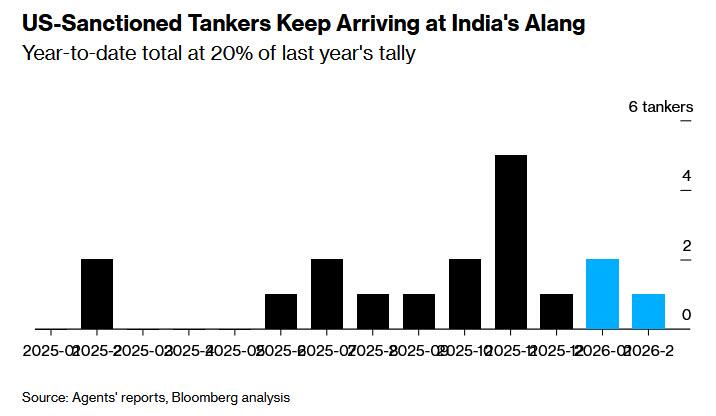
At least three vessels sanctioned by the United States have arrived in recent weeks at the demolition hub of Alang on India’s west coast, following a record 15 dark fleet tankers sent to these scrapyards last year, as the business rebounds despite concerns about dealing with sanctioned ships.
The Woodchip, built in 1993 and sanctioned by the U.S. in 2021 under one of its previous names, is the third tanker to have arrived at Alang in less than a month, Bloomberg reported on Friday, citing vessel-tracking data, agent reports, and sources with knowledge of the deals.
The Woodchip Suezmax ship. Source: MarineTraffic
The arrivals reflect changes to the shape of the fleet that ferries sanctioned or sensitive crude around the world, as more aged vessels begin to edge toward retirement at a time of plentiful supply, and US officials embrace Venezuelan crude – ultimately reducing the number needed to serve a trade previously off-limits. According to shipbroker Braemar Plc, some 128 dark tankers once served Caracas exports.
The total number of the U.S.-sanctioned tankers that have arrived at India’s Alang so far this year already accounts for 20% of the 15 vessels of the dark fleet welcomed in 2025, according to Bloomberg’s analysis.
Dark fleet tankers are much older than legit vessels and could pose environmental threats if left to service sanctioned oil deliveries for too long.
The increase in tracked arrivals at India’s scrapyards signals that some of the oldest ships of the global shadow fleet are now finally being retired.
Moreover, the U.S. intervention in Venezuela and the now legit Venezuelan oil sales under U.S. control have reduced the number of vessels needed to haul sanctioned oil.
The U.S. took control of Venezuela’s oil sales in early January and authorized two of the world’s biggest independent traders, Vitol and Trafigura, to market the crude to buyers in the U.S., Europe, India, and China.
Before the U.S. ousting of Nicolas Maduro, about 128 tankers of the dark fleet served the oil exports of Venezuela, per data from shipbroker Braemar Plc cited by Bloomberg.
Previously, most Venezuelan exports were going to China, as they were under U.S. sanctions, and used sanctioned vessels to deliver crude mostly to the independent refiners, the so-called teapots, in the province of Shandong.
Tyler Durden
Sat, 02/14/2026 – 18:40
https://www.zerohedge.com/political/indian-scrapyards-welcome-growing-number-dark-fleet-tankers