Category: News

Teenage boy wounded in Loop shooting
A 14-year-old boy was wounded while he was standing outside Monday night in the Loop neighborhood, Chicago police said.
Officers responded to a call of a person shot shortly after 8:30 p.m. in the first block of East Washington Street where the victim was outside when someone pulled out a weapon and opened fire in his direction.
The boy suffered a gunshot wound to the left foot, and was taken to Lurie Children’s Hospital where he was listed in fair condition, police said.
No one was in custody for the Loop shooting, and detectives were investigating.

Crown Point sophomore MJ Wilson’s 33-point game is ‘a glimpse of a couple of years down the line.’ Or sooner.
Crown Point sophomore MJ Wilson may not be an X factor anymore.
After Wilson scored 33 points in less than 17 minutes against Valparaiso on Friday, Crown Point coach Clint Swan said the 6-foot-5 guard/forward is “really starting to come into his own.”
“He’s had a really good three or four games in this stretch lately,” Swan said. “In the Chesterton game, he was really active. Against Andrean, he was really good.
“Before, he was pinning his successes and failures on shot-making. He was determining whether or not he played well based on how many points he scored. Now he realizes he doesn’t have to score. He can just go out and play and just impact the game in so many other ways besides scoring, and then when he starts doing that, the basket starts getting so much bigger. That’s what happened against Valpo.”
Wilson made 13 of 16 shots, including 4 of 4 from 3-point range, off the bench during the Bulldogs’ 78-51 Duneland Athletic Conference win over Valparaiso. He also had six rebounds, three assists and three steals for Crown Point (17-1, 6-0), which is ranked No. 3 in the state coaches poll and has lofty aspirations as the postseason approaches.
“My teammates just found me at the right time in the right spots, and I knocked down some shots,” Wilson said. “My type of game, I’m an energy player. So if you see one go down, it just makes things flow, and from there, it’s game over.
“It feels amazing because you put in so much work and my teammates put so much effort into me to make me great. I promise you, I couldn’t do it without any of them. They all push me to be what they think I can be.”
Teammates such as star senior guard/forward Dikembe Shaw, an Illinois Chicago recruit, believe in Wilson.
“It gave me a glimpse of a couple of years down the line,” Shaw said. “He was amazing. He stepped up big time.
“You can always see a flash in games. But for him to go out there and score 33 off the bench, it’s surreal. He definitely brings it every day in practice, and he’s super competitive. He’s amazing. He’s such a great player at a young age.”
MJ Wilson, who has helped Crown Point win 17 of 18 games this season, scored 33 points against Valparaiso on Friday. (Michael Osipoff / Post-Tribune)
Wilson, who has increased his averages to 8.1 points and 2.4 rebounds, played primarily on the junior varsity team as a freshman last season. He appeared in three varsity games and scored two points.
Wilson showed promise at both levels but suffered a broken right thumb near the end of May. He missed about six weeks, including all of the team’s summer activities, before he returned in early July.
“He had a great year on JV and got to dress varsity and got some spot minutes at the end of the year for us,” Swan said. “We were noticing he had a chance to be really good, and we were excited about June to really work with him, and then he missed everything for us in the summer. He missed every workout, every practice, every game. We played 10 or 11 games during the summer, and he missed every one — and then he got cleared for AAU in July. I was the only one who didn’t get to coach him.
“The first time he really got to work with the varsity guys full time was in the fall. He made up for lost time very quickly. We could tell he was going to be fine and be a really good player. But it would’ve been nice to have him in the summer.”
Wilson has gained about 25 pounds since he started high school. He has also made strides in other areas.
“Freshman year, I was athletic and a little uncoordinated at times,” Wilson said. “I’m always playing 100%, so just being in this program, it slows down the game a little bit. It makes it so much easier. I improved on rebounding. I used to stand around a lot, and now I don’t stand around. I’ve stopped reaching. My jump shot is better.
“From the start of the season, I know I’m not a main scorer on this team. So what I’m going to do, I’m going to crash the offensive boards every time, and that’s a way I can score. I’m going to take pride in my defense.”
Shaw emphasized Wilson’s efforts on that end of the court.
“MJ’s incredible,” Shaw said. “He didn’t play during the summer because he was hurt, so we didn’t know how he’d come back and how it would be with him. But when he came back, you could tell how impactful MJ is on defense, on offense.
“Beforehand, he wasn’t really hitting shots at the clip he would want. But right now, he has his groove. You can tell the game’s really slowing down for him a lot more. He’s picking his spots. It’s become easier for him to score, and he’s really effective on defense. Some nights, he’s going against some of the best scorers in the Region, and MJ’s out there locking them up. He’s blocking their shots, getting rebounds. You can tell his confidence is up there too.”
Crown Point’s MJ Wilson (4) blocks a shot attempt by Merrillville’s Charles Hardiman (14) during a Duneland Athletic Conference game in Crown Point on Friday, Jan. 16, 2026. (Mandy Coppinger / Post-Tribune)
Wilson also expressed confidence in the Bulldogs, whose only loss this season has come against 21st Century. They’ve won back-to-back regional titles and reached a semistate final last season. A victory against Lake Central on Friday would net Crown Point’s first outright DAC title after sharing the past two.
“I love how everyone’s all so supportive,” Wilson said. “Just because I’m so young, it makes my job so much easier. Especially since we’re such a senior-laden team and I have low experience, it makes it so much easier.”
Wilson has fit in neatly with this experienced group.
“He’s an awesome kid,” Swan said. “He’s a great kid from a great family. Those guys are very easy to coach.
“He cares. He cares a lot. At the start of the year, maybe he cared almost too much. He was a little tight. We had to tell him he needed to think a little bit less while he was out there and just react. Once he started doing that, you could just see him get more comfortable out there, and now we’re starting to see what he can do.”
https://www.chicagotribune.com/2026/02/17/crown-point-high-school-basketball-mj-wilson/

Ayatollah To Trump: US Warships Can Be Sent “To Bottom Of The Sea” As 2nd Round Of Talks End
Ayatollah To Trump: US Warships Can Be Sent “To Bottom Of The Sea” As 2nd Round Of Talks End
The second round of indirect negotiations between the United States and Iran concluded in Geneva, Iran’s semi-official Students’ News Agency (ISNA) reported Tuesady. Delegations from both sides left the venue following the talks, however, the Iranian side says it’s ready to stay in Switzerland for days or even weeks if needed, in order to reach a deal and stave off military attack by Washington.
US envoy Steve Witkoff and Trump’s son-in-law Jared Kushner represented the US side in the talks, with Trump having told reporters aboard Air Force One that he would “indirectly” participate. Iran’s Foreign Minister Abbas Araghchi is leading the Iranian side.
Iran has insisted on its nuclear program being the sole focus of discussions, and not limitations on its ballistic missile arsenal (as the US and Israel are demanding) – and this holds of the possibility of derailing talks before they get further underway.
In the meantime the temperature is rising in the Gulf region, after Iran’s military announced Tuesday that sections of the Strait of Hormuz would be closed for several hours for what it called “security measures”.
This comes on the second day of IRGC naval drills, which semi-official Fars news agency described as designed to ensure the safety of maritime traffic during a military exercise. Iranian authorities stated the move formed part of the broader drill launched the day earlier.
Oil Prices Rise as Iran Closes Parts of the Strait of Hormuz for Naval Drills:
Iran’s state broadcaster reported that the “main phase’ of a naval exercise conducted by the Islamic Revolutionary Guard Corps began Tuesday.
Iran tested large missiles in the Persian Gulf on Tuesday, footage shows:
⚡️BREAKING
The Iranian Revolutionary Guards fired Anti-Ship Missiles into the Strait of Hormuz
Parts of the Strait are now closed for military activity pic.twitter.com/ZkJuthNLaD
— Iran Observer (@IranObserver0) February 17, 2026
Supreme Leader Ayatollah Ali Khamenei has warned in a speech before an event Tuesday (and afterward his office posted it to X), the following:
The Americans constantly say that they’ve sent a warship toward Iran. Of course, a warship is a dangerous piece of military hardware. However, more dangerous than that warship is the weapon that can send that warship to the bottom of the sea.
This ‘counter-threat’ and warning was in response to remarks by Trump in which the president said the United States had not been able to destroy the Islamic Republic.
“In one of his recent speeches, the US president said that for 47 years America has not succeeded in destroying the Islamic Republic… I tell you: you will not succeed either,” Khamenei said.
USS Gerald R. Ford now just days away from Mideast waters and entering the eastern Mediterranean…
NEW — 🇺🇸 The U.S. aircraft carrier USS Gerald R. Ford has entered the Strait of Gibraltar and is now heading toward the Mediterranean Sea. pic.twitter.com/avg9IwxzL3
— UK Report (@UK_REPT) February 17, 2026
Trump has also threatened Iran with “traumatic” consequences and has raised the possibility of imposing regime change amid his ratcheting rhetoric, and the deployment of no less than two aircraft carrier groups to regional waters.
“What is not on the table: submission before threats,” Iran FM Araghchi said in a post on Monday, stating that he was in Switzerland “with real ideas to achieve a fair and equitable deal.”
Tyler Durden
Tue, 02/17/2026 – 08:20

Manifestantes bloquean carreteras en Beirut en protesta contra aumentos de impuestos
Por ABBY SEWELL
BEIRUT (AP) — Manifestantes bloquearon carreteras principales en Beirut y sus alrededores el martes, después de que el gabinete libanés aprobara aumentos de impuestos sobre el combustible y otros productos para financiar aumentos salariales del sector público.
El gabinete aprobó el lunes un impuesto de 300.000 libras libanesas (unos 3,30 dólares) por cada 20 litros (5,3 galones) de gasolina. El diésel quedó exento del nuevo impuesto, ya que la mayoría en Líbano depende de él para hacer funcionar generadores privados y compensar la grave escasez de electricidad estatal.
El gobierno también acordó aumentar el impuesto al valor agregado sobre todos los productos ya sujetos al gravamen del 11 al 12%, algo que el parlamento aún debe aprobar.
Los aumentos de impuestos buscan respaldar incrementos salariales y mejoras de pensiones para empleados públicos, después de que los sueldos perdieran valor con el colapso monetario de 2019, lo que les otorgaría el equivalente a seis meses adicionales de salario. El ministro de Información, Paul Morcos, indicó que los aumentos salariales costarían unos 800 millones de dólares.
Aunque el país mediterráneo se asienta sobre una de las mayores reservas de oro de Oriente Medio, sufre una inflación persistente y una corrupción generalizada. El país también registró unos 11.000 millones de dólares en daños en la guerra de 2024 entre Israel y el grupo Hezbollah.
Ira por el alza del combustible
Ghayath Saadeh, uno de los taxistas que bloqueó una carretera principal en Beirut, afirmó que los líderes del país “nos consideran a los taxistas como basura”.
“Todo se está encareciendo, la comida y las bebidas, y se acerca el Ramadán”, expresó. “Bloquearemos todas las carreteras, si Dios quiere, si no nos responden”.
Cuando el gobierno libanés propuso nuevos impuestos en 2019, incluida una tarifa mensual de 6 dólares por usar llamadas por internet a través de servicios como WhatsApp, estallaron protestas masivas que paralizaron el país durante meses. Los manifestantes exigieron que los líderes del país renunciaran por la corrupción generalizada, la parálisis gubernamental y el deterioro de la infraestructura, y pidieron el fin del sistema sectario de reparto de poder del país.
Líbano ha estado bajo presión internacional para realizar reformas financieras durante años, pero hasta ahora ha logrado pocos avances.
Plan para desarmar a milicias
El gabinete también recibió el lunes un informe del ejército libanés sobre sus avances en un plan para desarmar a grupos no estatales como el Hezbollah.
El mes pasado, el ejército anunció que había completado la primera fase del plan, que abarca el área al sur del río Litani, cerca de la frontera con Israel. La segunda fase del plan cubrirá tramos del sur de Líbano entre los ríos Litani y Awali, lo que incluye la ciudad portuaria de Sidón.
Morcos, el ministro de Información, declaró tras la sesión del gabinete que la segunda etapa debe tomar cuatro meses, pero podría ampliarse “dependiendo de los recursos disponibles, la continuidad de los ataques israelíes y los obstáculos en el terreno”.
El plan de desarme llega después de que un alto al fuego mediado por Estados Unidos pusiera fin nominalmente a una guerra entre Hezbollah e Israel en noviembre de 2024. Desde entonces, Israel ha acusado a Hezbollah de rearmarse y ha continuado lanzando ataques casi diarios en Líbano, además de ocupar varias colinas del lado libanés de la frontera.
Hezbollah ha insistido en que el acuerdo solo le exige desarmarse al sur del Litani y que no debatirá el desarme en el resto del país hasta que Israel detenga sus ataques y se retire de todo el territorio libanés.
___________________________________
El corresponsal Hussein Malla contribuyó con esta nota.
___________________________________
Esta historia fue traducida del inglés por un editor de AP con ayuda de una herramienta de inteligencia artificial generativa.
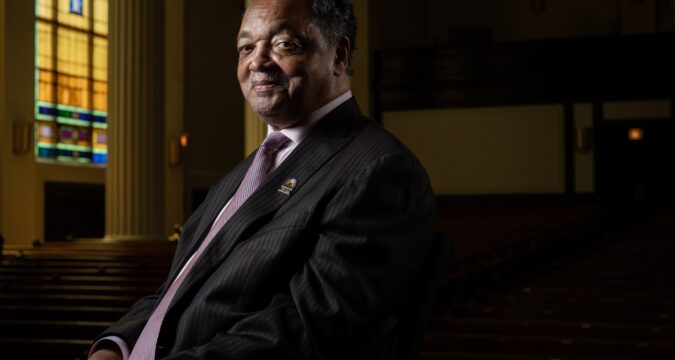
Editorial: The Rev. Jesse Jackson was a formidable Chicago activist and achiever
In 1988, the power brokers of the Democratic Party watched a Chicago civil rights leader, a maverick with a movement he called a “Rainbow Coalition,” start to threaten the presidential candidacy of Massachusetts Gov. Michael Dukakis. They’d expected him to do well with Black voters, but not to win easily the state of Michigan or make major inroads within Americans of all stripes.
As CNN’s Abby Phillip noted in her recently published book, “A Dream Deferred,” the rise of Jesse Louis Jackson was viewed with considerable alarm by party pundits and consultants. They feared having no choice but to nominate Jackson for president if he secured the most convention votes (by not doing so, they certainly would alienate the Black voters the party needed). Defeat, they thought, would surely follow his nomination.
It is easy to forget, of course, that Jackson was only the second Black candidate to seek a major political party’s presidential nomination following Shirley Chisholm in 1972. But Jackson had figured out better than most white candidates how to secure small donations from supporters or, more broadly speaking, how to get buy-in from ordinary Americans. And when the subsequently disappointing primary results in Wisconsin put an end to Jackson securing that nomination, he knew how to pivot and use his newfound national power to successfully push for an overhaul of Democratic Party rules. They were changes that Phillip argues probably made it possible for another outsider from Chicago, Barack Obama, to become president of the United States.
In later years, Jackson never stopped fighting for causes large and small. The small stuff rarely made national news.
In 2019, this editorial board wrote about his efforts to bring natural gas to Pembroke Township, population about 1,800, in Kankakee County. Jackson did not want the residents there, who had seen one broken promise after another, to have to continue to rely on space heaters. This quest was hardly akin to negotiations in the Middle East or the kind of civil rights efforts that made him famous, but it made a big difference if you happened to live in Pembroke Township.
The year before, Jackson had been involved in a demonstration that closed part of the Dan Ryan Expressway, a mass expression of frustration over gun violence. Shortly thereafter, Jackson visited this editorial board.
“I saw the broadest cross section of people,” he said of the march, organized by the Rev. Michael Pfleger. “It was nonviolent. It was disciplined. People stood in the hot sun and waited. There was an unusual spirit at that march Saturday.”
Wherever Jackson went, an unusual spirit usually was not so far away.
He’d risen to prominence as one of the Rev. Martin Luther King Jr.’s inner circle (he’d met King in Selma after Bloody Sunday in 1965) and as a member of the Southern Christian Leadership Conference, but in the end, he was the head of not just one but several movements, from Operation Breadbasket and Operation PUSH (People United to Save Humanity) to his National Rainbow Coalition, established in the mid-1980s to campaign for human rights.
Chicago, where he first arrived in 1964 to attend the Chicago Theological Seminary and died Tuesday at age 84, was always at the center of his life and work.
When the SCLC first came to Chicago in 1965, after wanting to expand its work to a Northern city, Jackson was already organizing on the city’s South Side and volunteering at the West Side Christian Parish. Jackson’s local standing, especially with Black clergy, helped Jackson become a pivotal part of the Chicago Freedom Movement, which was focused on housing discrimination with the aim of putting an end to the city’s slum housing. Only after the the Freedom Movement threatened to march into Cicero was an agreement reached with Mayor Richard J. Daley and City Hall that resulted in the demolition of hundreds of abandoned buildings, with many hundred others brought up to city code.
King and the SCLC moved on, but Jackson remained based in Chicago. In 1966, King chose Jackson as the head of the Chicago chapter of its Operation Breadbasket, an activist group that set about organizing Black purchasing power to pressure white businesses to hire Black people and buy goods and services from Black contractors. By 1971, Ralph Abernathy was running the SCLC and was at odds with Jackson, whom he had accused of “administrative improprieties.” That conflict led Jackson to establish his own Chicago beachheads, including Operation PUSH, which eventually became the Rainbow PUSH Coalition, carving out a much broader vision than Operation Breadbasket, working in the arenas of social justice and civil rights.
Jackson, of course, got up in people’s faces, and there were some who did not appreciate his work. He had an uneasy relationship with the Black Panthers, not least because Jackson’s aims were reformist first and (contrary to the stereotype) radicalist second. He mounted an anti-abortion rights campaign after Roe v. Wade, which proved controversial. And he was often a thorn in the side of the white establishment, which sometimes labeled him as an opportunist, or someone whose machinations led to cronyism at best and corruption at worst.
Those criticisms waned over time. For there can be no doubt that Jackson improved life immeasurably, and in concrete ways, for Black Americans and for Black Chicagoans in particular.
Jackson and his allies hit the airwaves, handed out awards and persuaded big business to hire more Black managers and buy more of the things they needed from Black-owned companies. Many of their boycotts won results, especially the 1982 boycott of Anheuser-Busch. Jackson won his own show on CNN. He even hosted an episode of “Saturday Night Live!”
Jackson raised his children on Chicago’s South Side in a large Tudor-style home in Jackson Park Highlands, a home frequently filled with activists, diplomats and other international guests, often coming to Chicago specifically to see Jackson and sticking around to learn more about the city, valuable in itself. His children — Jesse Jr., Yusef, Jonathan, Ashley, Jacqueline and Santita — clearly felt the pressure of their father’s fame. (Branden Jacobs-Jenkins’ hit play “Purpose,” first staged in Chicago and then on Broadway, was a thinly veiled version of the challenges of life in the intense and famously competitive Jackson family.) “You must get children in the environment of achievers,” Jackson told Chicago magazine in 2012. “The environment of achievers can be contagious.” And difficult, he might have added.
Indeed, Jackson himself was contagious. Across decades.
Few Chicagoans can claim they were a famous civil rights activist, a human rights activist and a presidential candidate who came close to winning the nomination of the Democratic Party, and then got a lot of people across the world out of jail.
“Everything that I’ve done has been in some context,” Jackson said on his 65th birthday in 2007 when asked to weigh his achievements and failings, “and I’m convinced that we look back like the true judge and ultimately you judge yourself by your cumulative box score. It’s not the home run you hit one inning; it’s not the strikeout the next inning. It is the box score. And our box score — my batting average — has been one I can accept.”
We should all agree with that, given that we are unlikely to see his like anytime soon.
Submit a letter, of no more than 400 words, to the editor here or email letters@chicagotribune.com.
https://www.chicagotribune.com/2026/02/17/editorial-jesse-jackson-chicago-activisit/

When Cash Disappears, So Does Something Else
When Cash Disappears, So Does Something Else
Authored by Mollie Engelhart via The Epoch Times,
Last Sunday, I held a book signing at Pearl in San Antonio, the kind of place magazines love to feature. Old brick buildings have been transformed into beautiful restaurants, boutiques, apartments, and bookstores. It feels curated yet charming, historic yet modern, a vision of how we’re told that cities should look and feel.
My signing happened during the farmers market, so there was music in the air, families strolling, dogs on leashes, linen dresses, and heirloom tomatoes. It was lovely. Before I sat down, I stopped into the trendy grocery store nearby. Everything inside looked like how food should look: thoughtfully sourced, artfully displayed, and priced closer to what real food actually costs when someone grows it with care. I ordered a coffee and a pastry and pulled a $20 bill from my wallet.
“We don’t take cash,” the cashier said politely.
I nodded. I’ve worked in restaurants, and I understand the argument. With employees, cash can be seen as a liability, with risks of theft, accounting errors, and end-of-day discrepancies. Cards feel cleaner, easier, and more trackable. Still, something in me tightened. Every time we stop accepting cash, we normalize a world where every transaction is recorded, categorized, stored, and potentially scrutinized. Every purchase becomes a data point. Every cup of coffee leaves a digital trail.
I took my coffee, found my seat at the bookstore, and started signing books. Between conversations, I could hear the sizzle and chatter from a nearby empanada booth at the farmers market. The smell of warm pastry finally got me. I walked over, cash already in hand.
“Can I get a potato empanada?” I asked.
The woman at the booth said, with an apologetic smile, “We don’t take cash.”
Not a brick-and-mortar store with layers of management, a pop-up tent at a farmers market. That’s when it really hit me. This isn’t just about convenience or speed at checkout. Cash itself is becoming strange, inconvenient, outdated, and almost suspicious. We’re being trained to accept that every exchange must be mediated, approved, and recorded by a third party, and that third party isn’t free.
Most of the vendors there were using Square to process payments. The typical fee is about 3 percent to 4 percent per transaction. That might not sound like much, but that percentage is shaved off every single time money changes hands digitally.
If I hand $20 in cash to the empanada vendor, and he hands that same $20 to the barber who cuts his hair, and the barber gives it to a babysitter, and the babysitter uses it to buy a pizza, that same $20 bill keeps moving through the community at full value. No one skims anything off the top.
But in the digital system, that cut happens again and again, and the effect compounds. At a 3.5 percent fee, after one transaction, that $20 becomes $19.30. After two, $18.62. After three, $17.97. After four, $17.34. After five digital transactions, only about $16.74 remains in circulation. More than $3 of the original $20 has quietly disappeared in just a handful of everyday exchanges. That money didn’t go to the farmer, the barber, the babysitter, or the pizza shop. It left the community entirely.
It’s a quiet drain on small communities, a friction we barely see because it’s spread out, invisible, and normalized. There’s also a common belief that businesses are required to accept cash because it’s legal tender. The truth is more complicated. In most places, private businesses can choose what forms of payment they accept unless a local or state law says otherwise. So no, they aren’t necessarily breaking the law. But legality and wisdom are not the same thing.
Every digital transaction comes with processing fees and interchange costs. Small businesses quietly lose a percentage of every sale, and customers pay more over time as those costs are baked into prices. In return, we give up privacy, independence, and the simple resilience of being able to transact even when systems go down. Cash works during power outages. Cash works when the internet is down. Cash works without a corporate intermediary. Cash is anonymous, direct, and final.
When everything becomes digital, spending can be tracked, restricted, frozen, or flagged. We may not feel that pressure today when we’re buying coffee and pastries in beautiful spaces, but systems built for convenience can easily become systems of control.
What struck me most that morning was the irony. I was at a farmers market, a place that represents local food, small producers, and community resilience, and yet even there, we’ve accepted the idea that every transaction must flow through the same centralized financial rails. We tell ourselves that it’s about ease, but what we’re really trading is privacy, resilience, and a small but meaningful piece of our sovereignty over how we spend the fruits of our labor.
It happened so gradually that most of us didn’t even notice. Until one day you’re standing at a farmers market, cash in hand, and realize that the future has arrived quietly, and that it doesn’t include the simplest form of freedom we used to carry in our pockets.
Views expressed in this article are opinions of the author and do not necessarily reflect the views of The Epoch Times or ZeroHedge.
Tyler Durden
Tue, 02/17/2026 – 08:05
https://www.zerohedge.com/personal-finance/when-cash-disappears-so-does-something-else
LA Mayor Bass joins calls for 2028 Olympics head Casey Wasserman to leave over Jeffrey Epstein ties
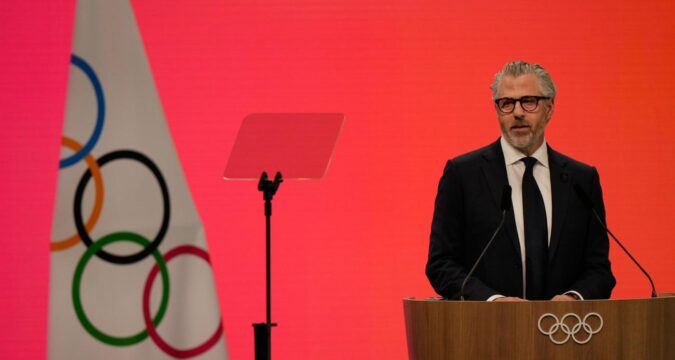
MILAN — Pressure built Tuesday on Casey Wasserman as head of the 2028 Los Angeles Olympics organizing team after the city’s mayor urged him to leave over his historic ties to Jeffrey Epstein’s former girlfriend.
L.A. Mayor Karen Bass told CNN late Monday “my opinion is that he should step down” despite Wasserman getting support last week from the games organizing board to stay.
The issue has been a distraction for the International Olympic Committee this month since Wasserman’s flirtatious emails from 2003 with Ghislaine Maxwell were published in a release of United States government files days before the Milan Cortina Winter Games opened.
The IOC had consistently deflected questions in Milan about Wasserman, saying it was a matter for the LA28 board, though its language shifted slightly Tuesday.
“I understand there are many conversations happening at this moment but I will not make any further comment,” IOC spokesman Mark Adams said Tuesday at the Olympic body’s daily news conference in Milan.
“This is obviously a matter for the board of LA28 still at this stage,” Adams said.
Mayor Bass noted of Wasserman that “I cannot fire him” in a studio interview with CNN’s Dana Bash but publicly stated she thought he should leave.
Fallout at Wasserman agency
Wasserman has looked more embattled since the entertainment and sports agency he founded and bears his name lost clients in the fallout from the emails release including pop star Chappell Roan and Abby Wambach, the former world’s best player in women’s soccer. He is now in the process of selling the agency.
Scrutiny on Wasserman has escalated despite the LA Olympics board last week backing him to stay based on a review, which he cooperated with, by outside legal counsel of his contacts with Epstein and Maxwell.
“I think that decision was unfortunate. I don’t support the decision. I do think that we need to look at the leadership,” Bass said.
“However, my job as mayor of Los Angeles is to make sure that our city is completely prepared to have the best Olympics that has ever happened in Olympic history,” she told CNN.
The mayor and California Gov. Gavin Newsom have key roles to play in the success of the L.A. Olympics and Paralympics by ensuring all layers of government support the complex logistical challenges that will take over the city in July and August of 2028.
Key Olympic figure for 11 years
Wasserman has been a driving force of the L.A. Olympics since the bid was launched in 2015. Questions about his status have swirled since before he arrived in Milan two weeks ago to meet with IOC members and attend the Winter Games opening ceremony.
The L.A. organizing team gave IOC members at their annual meeting an update of the hosting plan.
Wasserman and other officials were quizzed on issues such as visa processing for global visitors to the U.S., though not on personal matters. They did not meet later with international media which officials from other future Olympic hosts did.
He has not been accused of any wrongdoing in connection with Epstein and Maxwell.
In a statement issued before coming to Milan, Wasserman said “I deeply regret my correspondence with Ghislaine Maxwell,” which was “long before her horrific crimes came to light.”
Maxwell was convicted in 2021 on five counts of sex trafficking and abuse of minors, and is serving a 20-year prison sentence.
https://www.chicagotribune.com/2026/02/17/casey-wasserman-olympics-epstein-ties/
BHP’s Copper Pivot Pays Off With Surprise Dividend Bump, Record-High Stock Price
BHP’s Copper Pivot Pays Off With Surprise Dividend Bump, Record-High Stock Price
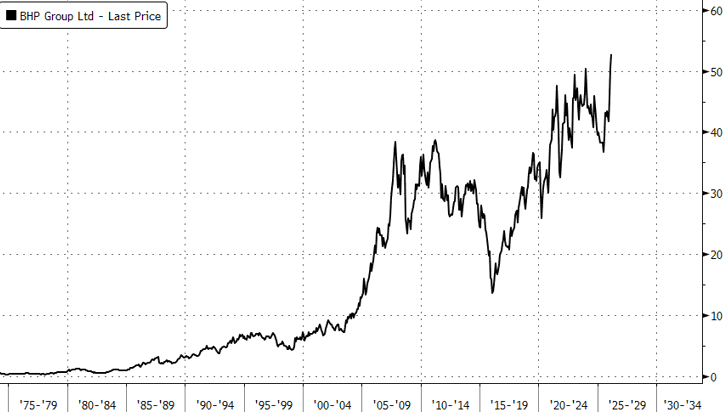
Shares of BHP Group, the world’s largest miner, jumped to a record high in Australia after it posted earnings at the top end of Wall Street expectations. The miner’s pivot into copper, aided by a surging rally in industrial metals, offset softer conditions in its iron ore unit.
BHP chief executive Mike Henry reaffirmed to investors earlier on a call that the miner is pivoting toward “future-facing” metals. In other words, he explained that the world’s largest miner’s shift away from operations focused on serving China’s steel mills has paid off, as copper has soared.
Henry said that acquisitions began to bear fruit, as did the improvements at Escondida, the world’s largest mine, all of which were helped by a record surge in the price of the industrial metal used heavily for power grids and AI-related applications.
“This is the result of our deliberate actions to grow our copper business,” Henry told analysts, adding, “Now, BHP is, by design, a diversified miner rather than focused on a single commodity.”
At the time of writing, iron ore futures on the Dalian Commodity Exchange were trading at depressed levels below $100 per ton, while copper on the London Metal Exchange was trading around $12,850 per ton.
BHP earnings highlights:
Underlying attributable profit rose 22% to $6.2 billion for the six months to end December. Shares in Australia jumped as much as 7.6% to a record.
Copper contributed more than half of the profit for the first time, motly because of higher copper prices and steady output. Copper division underlying EBITDA climbed 59% to $8 billion.
Iron ore earnings edged 4% higher and still make up close to half of the total, though BHP is dealing with “tough” negotiations with China’s state buyer, China Mineral Resources Group.
The Jansen potash project in Canada remains on track for first production in the middle of next year, though first-phase capex has risen to $8.4 billion.
On M&A: Recent gains include the 2023 purchase of OZ Minerals and the Vicuna joint venture with Lundin Mining. Attempts to buy Anglo American (and efforts around its tie-up with Teck Resources) were unsuccessful, so BHP is emphasizing organic growth and being more disciplined in deal-making.
Reiterated its plan to unlock up to $10 billion through asset sales and other transactions. It announced a $4.3 billion long-term silver streaming agreement with Wheaton Precious Metals tied to byproduct silver from the Antamina mine in Peru (BHP owns 33.75%). It also recently sold a $2 billion stake in the power network supporting Pilbara operations.
Declared an interim dividend set at 73 cents, equal to a 60% payout ratio
UBS analyst Dominic Ellis commented on BHP’s earnings, indicating “BHP Surprises With Dividend Bump.”
Ellis told clients:
BHP’s EBITDA beat by 3% in the first half of its financial year while EPS beat by 4%, but the surprise was the 16% increase in the dividend, on a 60% payout versus the baseline of 50%. Net debt stood at $14.7 bn, at the midpoint of the guided range, capex in line and guidance unchanged. Group EBITDA from copper was 51%, more than half of EBITDA for the first time. The stock has been a funding short for specialists, and while shares are performing well on these resutls, feedback from clients recently has been on the disconnect between iron ore (down sharply, now below $100/t) and iron ore equity resilience. BHP’s spot free cash flow yield is 3.5% this year versus Rio Tinto on 6.4%.
Reminder about the copper market:
Copper’s Breakout Is Built On Much More Than Fundamentals
Copper Hits Record High; Goldman Warns A “Circular Melt-Up” Is Now Driving Global Market
Strong earnings and a copper-led pivot that’s cushioning a softer iron ore business have rewarded shareholders with record-high share prices in Australia.
“In the last five years, the BHP CEO has set the business up with options,” said Glyn Lawcock, head of metals and mining research at Barrenjoey Markets Pty in Sydney. “Clearly, growth to 2030 is really potash and iron ore, but you hit the start of the new decade, it’s pretty much all copper.”
Tyler Durden
Tue, 02/17/2026 – 07:45

On your mark, get set, paczki: Bennison’s Bakery in Evanston hosts eating contest
Fat Tuesday came early this year, and with a lot more powdered sugar.
At Bennison’s Bakery in downtown Evanston, crowds gathered to watch the 15th annual paczki-eating contest, where pairs of contestants raced against the clock to consume as many paczki — a Polish pastry similar to doughnuts — as they could in five minutes.
Paczki, pronounced “pownch-key,” or “poonch-key” (both are acceptable according to the bakery’s website) are traditionally eaten on Mardi Gras, the final day of indulgence before the Christian season of Lent.
Polish immigrants brought them to the Chicago area, where they have become a local favorite. Poles also eat the delectable treats on Fat Thursday, which always falls the Thursday before Mardi Gras.
Bennison’s paczki always feature unique filling flavors – the fillings for this year’s contest included lemon cream, apricot, blueberry and chocolate custard.
Greg Pressling and his teammate Tate Nudo, four-year competitors, said they came prepared for the race.
“We brought our own milk, our own gloves, we’re ready to go,” Pressling said.
Each team received a tray of 30 paczki and cups of water to help wash it down, with some teams opting for milk instead.
Twelve teams competed for this year’s title, but Teddy Delacruz and Tim “Timmy” Brown took the crown. The race was Delacruz’s fourth year competing and second win.
“We won, but we should have done better,” Delacruz remarked with a laugh. “Instead of worrying about [Timmy], I should have just kept eating. I slowed myself down.”
Although Brown, Delacruz’s partner, became ill midway through the race, he stayed in the contest long enough to finish as part of the winning team.
All participants paid $25 to enter the contest, but left with a free Bennison’s paczki contest t-shirt and a $25 bakery gift card. The winners received a $200 cash prize.
Jory Downer, the owner of Bennison’s Bakery, said the eating contest originally began as a fundraiser to raise money for Haitian relief following Hurricane Tomas’ hit in 2010.
Downer said this year’s competition is in honor of Steve “The King” Bartlebaugh, a close friend of the Downer family and the original emcee of the contest for many years, who’s tasked with donning the signature purple cape and golden crown to resemble the royal “King of Carnival,” who leads the Mardi Gras celebrations in New Orleans.
Bartlebaugh died of complications from Alzheimer’s disease last July. As a dedication to him, all proceeds from this year’s competition will be donated to the Alzheimer’s Association.
“The [Downer family] helped us bring medicines to Steve, getting me things to bring to where he was; they were always helping,” said Helene Shapiro, Bartlebaugh’s wife.
“So when he passed, they decided it should be the Alzheimer’s Association, honoring Steve. It’s kind of like a final goodbye,” or a “continuation of his memory,” Shapiro added.
Downer, this year’s emcee, said that for every paczek sold in the last month, a dime has also been donated towards the Alzheimer’s Association.
“It’s just a beautiful day. I think somebody looked down on us because we have done this in the negatives,” Shapiro said. “Long live the King,” family members of Bartlebaugh shouted in the crowd.
https://www.chicagotribune.com/2026/02/17/2026-paczki-eating-contest/

Daywatch: Remembering civil rights icon Rev. Jesse Jackson
Good morning, Chicago.
The Rev. Jesse L. Jackson, the Chicago-based Baptist minister, political figure and two-time presidential candidate whose soaring oratory and knack for capturing media attention made him a central figure in the Civil Rights Movement and national politics for more than six decades, died today. He was 84.
Jackson battled Parkinson’s disease since 2017, and in April, he was diagnosed with progressive supranuclear palsy, a neurological disorder.
“Our father was a servant leader — not only to our family, but to the oppressed, the voiceless, and the overlooked around the world,” the Jackson family said in a statement. “We shared him with the world, and in return, the world became part of our extended family. His unwavering belief in justice, equality, and love uplifted millions, and we ask you to honor his memory by continuing the fight for the values he lived by.”
A public memorial service will be held in Chicago and announced at a later date, according to the family.
Read the full obituary and see a timeline of Rev. Jesse Jackson’s life.
Here are the top stories you need to know to start your day, including Tom Pritzker stepping down as Hyatt’s executive chair, Chicago Cubs’ Tom Ricketts shares his expectations for 2026 season and how Black wine visionaries in Chicago are reimagining wine culture.
Today’s eNewspaper edition | Subscribe to more newsletters | Asking Eric | Horoscopes | Puzzles & Games | Today in History
Shenita Muse, left, of the Hope Center Foundation, and Jeff Bartow, of the Southwest Organizing Project, navigate security fencing surrounding a plot of land in the 7400 block of South Talman Avenue, Feb. 12, 2026, in Chicago. They are part of an umbrella organization called United Power for Action and Justice, whose initiative, Reclaiming Chicago, was awarded the Pritzker Traubert Foundation’s Chicago Prize, which will help fund the development of a 125-unit affordable living community on the vacant property. (John J. Kim/Chicago Tribune)
Initiative to boost affordable homeownership on South and West sides wins Chicago Prize
An initiative designed to boost affordable homeownership across the South and West sides was recently awarded the third Chicago Prize, a $10 million grant competition established by the Pritzker Traubert Foundation to help revive neighborhoods that historically suffered from disinvestment.
Thomas J. Pritzker announces a $75 million commitment from the Pritzker Foundation to support the new Pritzker School of Molecular Engineering at the University of Chicago on May 28, 2019. (Antonio Perez/Chicago Tribune)
Tom Pritzker, citing Epstein connection, steps down as Hyatt’s executive chair
Thomas J. Pritzker, a billionaire heir to the Hyatt Hotels fortune, stepped down from his role as executive chair of the Hyatt Hotels Corp., becoming the latest person felled by an association with disgraced financier Jeffrey Epstein.
Pritzker, 75, cousin to Illinois Gov. JB Prtizker, said in a letter to the Hyatt board that he was retiring, effective immediately, adding: “Good stewardship also means protecting Hyatt, particularly in the context of my association with Jeffrey Epstein and Ghislaine Maxwell which I deeply regret.”
GOP candidate for governor Darren Bailey, center, speaks with attendees during a Lincoln Day dinner hosted by the Logan County Republican Central Committee at the American Legion on Feb. 5, 2026, in downstate Lincoln. (Armando L. Sanchez/Chicago Tribune)
Illinois Republican governor candidate Darren Bailey rebukes national GOP for post mocking Pritzker’s weight
In an unorthodox political move, Republican candidate for governor Darren Bailey is rebuking his political party’s national leaders for posting a meme on social media mocking Democratic Gov. JB Pritzker’s weight.
The Feb. 14 posting on X by the Republican National Committee was designed as a cartoon Valentine’s Day card, declaring, “My love for you is bigger than JB Pritzker.”
Visitors to Chicago’s Portage Park enjoy a walk during balmy temperatures on Feb. 16, 2026. (Antonio Perez/Chicago Tribune)
At 65 degrees, Chicago breaks century-old record for warmest Feb. 16 in history
After a snow-steeped and sometimes bone-chilling January, Chicago is enjoying a downright balmy — even record-setting — start to the week.
But don’t pack up your sweaters just yet.
Chicago trading card magnate Matthew Bayer and his wife, Joyce, are trying to sell their penthouse condominium on the 46th floor of Streeterville’s One Magnificent Mile building. (Kim Quillen)
Chicago trading card magnate lists condo in One Magnificent Mile building
Chicago trading card magnate Matthew Bayer and his wife, Joyce, who are the mystery buyers who paid $14.25 million in 2024 for a seven-bedroom, 15,000-square-foot Lincoln Park mansion, are trying to sell their penthouse condominium on the 46th floor of Streeterville’s One Magnificent Mile building.
Players stretch during the first day of the Chicago Cubs full-squad workout at spring training at Sloan Park on Feb. 16, 2026, in Mesa, Ariz. (Armando L. Sanchez/Chicago Tribune)
‘We have to win more World Series’: Chicago Cubs’ Tom Ricketts has high expectations for 2026 and beyond
As players started to trickle out of the clubhouse with bats and gloves in for the Cubs’ first full-squad workout yesterday, Chairman Tom Ricketts stood off to the side, taking in the scene. The Ricketts family enters its 17th season owning the franchise and coming off the Cubs’ first playoff appearance since 2020, the long-term vision remains the same.
“We have to win more World Series,” Ricketts said. “I mean, it’s about winning. All this other stuff, it all leads to one thing, and that’s about winning. We just have to put the kind of teams on the field that can be in the playoffs every year and get back on top.”
Cubs’ Matt Shaw gets ready for the outfield — while 2 players are still delayed by visa issues
Photos: An inside look at Cubs spring training
White Sox infielder Munetaka Murakami takes batting practice during spring training at Camelback Ranch on Feb. 16, 2026, in Glendale, Ariz. (Eileen T. Meslar/Chicago Tribune)
What drew assistant GM Carlos Rodriguez to Chicago White Sox? ‘A lot of momentum’ heading into 2026.
Carlos Rodriguez listed tradition, legacy and the fan base as some of the appealing factors in joining the White Sox as an assistant general manager.
“It’s an organization with tremendous legacy, and I’m hoping to really be able to contribute in whatever way we can make the city proud of their organization,” Rodriguez said yesterday at Camelback Ranch.
Photos: An inside look at White Sox spring training
Co-owners Charlette Stanton-Thomas, left, and Jacare Thomas are seen at their restaurant Park Manor 75 on Feb. 10, 2026, in Chicago. (Josh Boland/Chicago Tribune)
Black wine visionaries in Chicago are reimagining wine culture
The arrival last October of a wine and charcuterie bar was an unexpected addition to the quiet stretch of low-lying brick storefronts in Park Manor, the historically Black, residential neighborhood of Chicago’s South Side.
But Park Manor 75, founded by Jacare Thomas and Charlette Stanton-Thomas, was “a much-needed third space” for the South Side, says Thomas. Not merely a wine bar, but a gathering place beyond work and home, centered on community, conversation and the joy of Black social life.
Chicago Reader covers are displayed in honor boxes at the publication’s office on Aug. 25, 2025. (Antonio Perez/Chicago Tribune)
Column: The Chicago Reader bursts back in a ’50 Years’ book and a lively new issue
“Free Chicago: 50 Years of the Reader” is a big, beautiful book, delivered to some 1,600 supporters who helped fund its publication through a Kickstarter campaign launched in 2024. This book coincides, serendipitously, with the “rebirth” of the Reader itself, writes Rick Kogan.
Students from a Columbia College Chicago Media Production class walk through the “MoCP at Fifty: Collecting Through the Decades” collection at the Museum of Contemporary Photography, Feb. 12, 2026. (Josh Boland/Chicago Tribune)
From Muslim portraiture to a nose punch: Photography exhibits to see this spring
Two Chicago-area collegiate museums are using photography this season to explore how images shape cultural memory.
https://www.chicagotribune.com/2026/02/17/daywatch-remembering-civil-rights-icon-rev-jesse-jackson/