Category: News

Editorial: Scott Doody for Illinois 118th House District Republican primary
State Rep. Paul Jacobs, the Republican who currently holds this seat, is hoping to move to the Senate. As a member of Springfield’s minority party, Jacobs has long fought for fiscal responsibility and pushed back against tax hikes, two issues that need champions in the statehouse.
Looking to succeed him are Republican candidates Scott Doody, Dayton Loyd and Harold Visser.
Visser, Loyd and Doody are a lot alike on the issues. They oppose tax hikes, support school choice and would like to reform the SAFE-T Act. Doody, 62, is a former radio host and author who comes across as serious and measured, and told us he has “always prided (himself) on being a conservative voice, but one that was willing to think independently.” Visser, 41, is an entrepreneur and homeschool dad with six kids. Loyd, 60, is a U.S. Army and National Guard veteran whose son, Joshua Loyd, earned our endorsement in the Republican primary for U.S. Congress in the 13th District. Folks familiar with this race acknowledge it’s a strong field, but Doody stands out as someone who could navigate Springfield.
Our support in this House primary race goes to Scott Doody.
Read all of the Tribune Editorial Board’s endorsements for the 2026 Illinois primary election here.
Submit a letter, of no more than 400 words, to the editor here or email letters@chicagotribune.com.
Televisora estatal iraní dice que el estrecho de Ormuz estará varias horas cerrado para maniobras militares
GINEBRA (AP) — Televisora estatal iraní dice que el estrecho de Ormuz estará varias horas cerrado para maniobras militares.
Editorial: Dave Severin for Illinois 116th House District Republican primary
Incumbent GOP Rep. Dave Severin, 67, represents this sprawling district north of Carbondale.
We don’t love that he voted for a massive gas tax hike in a state that imposes a lot of pain at the pump — in fact, it’s why he didn’t earn our endorsement in 2020. His opponent in the March Republican primary is Angela Evans, 48, who has defined herself as “pro-Trump, pro-life and a lifelong member of the NRA.” She also ran against the more moderate Severin unsuccessfully in 2024.
We endorsed Severin over Evans in 2024, and our opinion remains the same.
Dave Severin is endorsed.
Read all of the Tribune Editorial Board’s endorsements for the 2026 Illinois primary election here.
Submit a letter, of no more than 400 words, to the editor here or email letters@chicagotribune.com.

In Defense Of Sir Jim Ratcliffe
In Defense Of Sir Jim Ratcliffe
Authored by Charles Johnson via TheCritic.co.uk,
Far more energy has gone into condemning his phrasing than confronting the questions he raised…
Sir Jim Ratcliffe’s statement that Britain has been “colonised by immigrants” has sparked a fierce reaction.
From Starmer to Bluesky, to the Athletic and all the football social media pundits in between, the co-owner of Manchester United has been bombarded with the same attack lines repeatedly.
He has been called a tax dodging, racist immigrant hypocrite.
Such an uproar has flared up in such a short space of time because Ratcliffe is radically different from those who have issued similar statements before. Ratcliffe is not a political figure: you do not see billionaires nor football club owners voicing discontent like this. The pushback has been fierce because Ratcliffe has no political incentive to say any of this. He isn’t running for office, seeking favour, or chasing votes — which makes his intervention harder to dismiss. Part of the backlash, too, reflects an unease that his diagnosis may be accurate.
The remarks came from an initial conversation regarding the economic challenges Britain faces in general, not solely on immigration. The snippet that has been so widely shared is merely part of a wider statement of the economic problems Britain faces; Ratcliffe refers to the issues of “immigration” and “nine million people” on benefits simultaneously.
Manchester United part-owner has told @EdConwaySky the UK has been “colonised” by immigrants, who are draining resources from the state, as he warns of the country facing profound political, social and economic challenges.
🔗 https://t.co/bie6uFZ1Tp pic.twitter.com/qFpiO0HkfO
— Sky News (@SkyNews) February 11, 2026
Colonised is a strong opening salvo for a figure such as Ratcliffe, who is not known for any previous anti-migration stance. This generated responses of tone policing from his critics – cries that his choice of words were “disgraceful and deeply divisive” and that “this language and leadership has no place in English football” from Kick It Out, a notable “Anti Racism” football pressure group. There was no attempt to argue or debate: this was no more than tone policing, of “mate mate mate, you can’t say that mate”. It did not engage with the substantive point. It was not an argument.
The Prime Minister has pushed for Ratcliffe to apologise. Less than a year ago, Starmer was referring to Britain as an ”Island of Strangers”; he has little argument here. Sir Ed Davey has stated that Ratcliffe is “totally wrong” and is “out of step with British Values”. Once again this is weak tone policing, not an argument. Regardless, which British values are being violated in particular? What are British values precisely meant to mean here?
The fact is that Ratcliffe’s vocabulary choice is nowhere near as divisive as the impacts of mass migration in the last quarter century.
Mass migration is the most important issue in British political debate. It has bought sectarianism, Bengali and Palestinian politics swinging both local council and Parliamentary elections, a deepening of housing crisis, the rape and murder of British women from taxpayer funded hotels and programs which bloat the welfare state even further. It is undeniable mass migration has defined British politics of the 2010s onwards. It has been much more harmful and divisive than any comment made by Sir Jim Ratcliffe. His words are nothing compared to the actions of Deng Chol Majek, or Hedash Kebatu, to name a couple of examples.
Critics have also cried that Ratcliffe is “an immigrant himself, dodging tax in Monaco”. The difference between Ratcliffe and migration into Britain is so different they are almost incomparable. In the 2017/18 tax year Ratcliffe was the fifth highest taxpayer in the country, footing a bill of £110.5 million. With such an extraordinarily high bill, it is no wonder that he has since moved to Monaco. Meanwhile, the average salary of of a migrant entering Britain in 2023 (which has fallen by £10,000 since 2021) was £32,946, according to a report by the Centre for Migration Control. From this we can estimate a migrant would pay about £5,000 in income tax. That means it would take over 22,000 (statistically average) migrants to foot the tax bill that Ratcliffe paid in one year alone. Ratcliffe has been an exceptional cash cow to the British state. He has been taxed incredible amounts and contributed more to this country than almost anyone currently living; to call him hypocritical since he dared to criticise migration and its impact on the welfare state is simply not fair.
Census data from the ONS in 2021 shows that migrants from four nations – Somalia, Nigeria, Jamaica and Bangladesh – head over 104,000 social homes in London alone. With such incredible numbers of subsidised housing going to foreign born nationals, it is absolutely correct to state that mass migration is costing the British economy a fortune. The same census states that over 70% of Somali born households are in social housing in England and Wales, whilst also being of lowest contributors to income tax in the nation – paying well under the £5,000 stated per head previously. The increase and sheer scale of benefit reliance for many immigrants in Britain is not sustainable, and it is a problem that is right to be addressed.
Perhaps the most nonsensical argument presented by some is that as co-owner of Manchester United he employs a significant number of immigrant players. Bruno Fernandes is not living in social housing in Wythenshawe. Benjamin Sesko is not in a single bed council flat in Hulme. When he arrived in Manchester last year, the first thing Senne Lammens did was not register for Universal Credit. Not a single foreign player is a drain on the state. They are, as elite athletes in the most lucrative league in the world, very clearly exceptions to the norm of British migration. The difference between Bruno Fernandes, who earns a reported £300,000 a week, and the over 40% of Bangladeshi immigrants who are economically inactive should really not need spelling out. We are referring to just 17 foreign senior team players who all earn more in a week than the average migrant – or Brit – will earn in a year. It is ludicrous to even attempt to compare the two. Regardless, employing or working with immigrants does not mean you waive your right to criticise the state of affairs in Britain. As an Englishman, Sir Jim Ratcliffe has a given and inalienable right to comment on the affairs of his country.
Ratcliffe’s critics have entirely focused on his choice of the word “colonised”, and how they consider it inflammatory. This choice of phrase was not entirely accurate or intentional by Ratcliffe – proved by the fact he issued an apology over his “choice of language”, rather than the substance and argument behind his critique of the broader economic challenge of Britain.
The bottom line is, Ratcliffe was right to raise a perfectly reasonable concern. He is directionally correct, and close enough to the truth that the obsessive focus around his phrasing is both absurd and clearly no more than a tactic to dodge the substance of his argument entirely.
His critics have been intentionally evasive around the underlying subject: it is a harsh, necessary truth they have no reply too.
They avoid the debate because, despite his wording being wrong, Ratcliffe is right.
Tyler Durden
Tue, 02/17/2026 – 06:30
https://www.zerohedge.com/geopolitical/defense-sir-jim-ratcliffe

Column: The Chicago Reader bursts back in a ’50 Years’ book and a lively new issue
I find myself, rewardingly, in a Reader state of mind.
It’s the result of spending time savoring the 300 pages of a book that some thought might never be created. “Free Chicago: 50 Years of the Reader” is a big, beautiful book, delivered to some 1,600 of us who helped fund its publication through a Kickstarter campaign launched in 2024. It is also available for purchase at chicagoreader.com.
This book coincides, serendipitously, with the “rebirth” of the Reader itself. A few weeks ago, under the headline “Chicago Reader, the city’s struggling alt-weekly, is going monthly under new owners,” my colleague Robert Channick interviewed its new editor, Sarah Conway, a 39-year-old Pulitzer Prize-winning investigative reporter, who said, “I think the Reader is going to retain its legacy, and then also, I really want to bring some of my approaches to doing investigative and feature work that centers on people, and is generative and expansive to the paper.”
On Feb. 4, some 63,000 copies arrived at outlets and newspaper boxes across the city and suburbs, the paper’s Instagram page announcing, “The Chicago Reader is back in print beginning today. … We put an egg on the cover to symbolize rebirth as we enter a new era.”
The new issue has a yellow tabloid-sized cover with a large white egg with a small crack and the words “Free and freaky since 1971.”
And that is where the book takes us, back to a time when four young Carleton College alums — Bob Roth, Robert E. McCamant, Thomas J. Rehwaldt and Thomas K. Yoder — gave Chicago the first issues of the Reader, all 16 pages of it, on Oct. 1, 1971. As Roth says in the book, “At the very beginning, I think it was almost entirely motivated out of a crazy notion that we had that this was going to be fun.”
The new issue of the Chicago Reader is shown on the publication’s Instagram page. (Chicago Reader)
And that it was, great fun. And also important, innovative, entertaining, informative and useful, especially if you were into its voluminous classified listings for finding a place to live, a job, a used car, or a person to love. It has become one of the country’s longest surviving free city papers, with emphasis on free. As independent press expert Richard Karpel wrote in 2007, “the most significant historical event in the history of the modern alt-weekly (was)… when the Chicago Reader pioneered the practice of free circulation.” It was so coveted that copies were stolen from the printing plant before they were to be distributed and sold for $1.
Piecing together interviews from various sources with dozens, maybe hundreds, of writers, editors and other principals, the editor and designer Christopher Hass has been able to capture it all. The main historical text is written by my former Tribune colleague, Mark Jacob, who compiled a history of the Reader for its anniversary issue published on Oct. 13, 2021, at the behest of then editor/publisher Tracy Baim.
Last year, Hass asked him to update it.
“I was happy to do it but wasn’t sure when, or if, the book would come out,” says Jacob, who now writes books and the Substack weekly newsletter “Stop the Presses.” “It is a gorgeous coffee table book, the reproduction of the covers, the pages and the artwork is spectacular.”
He was able to get an interview with publicity-shy Fred Eychaner, now a big-money Democratic donor and philanthropist, who printed the Reader from its birth at his Newsweb facility. He told Jacob, “The Reader owed Newsweb far more than whatever our meager net worth was then.”
Jacob tells me, “If he had called for them to pay the bill, the Reader would have had to close immediately.”
Such stories enrich the book, and Jacob artfully captures the chaos at the Reader since it was sold to an outfit called Creative Loafing in 2007. There have been other owners since, an unsuccessful switch to nonprofit status, staff upheavals, and changes in format and frequency of publishing.
The latest? It was, as Channick put it, taken over “in a complex ownership transfer” in August by Noisy Creek, a Seattle-based media company.
Old front pages of the Chicago Reader in the publication’s offices on Jan. 26, 2026. (Eileen T. Meslar/Chicago Tribune)
Albert Williams joined the Reader in 1985 and was a writer, editor and theater critic until 2007. Over the weekend, he told me, “I am so happy this book has happened. It’s often said that journalism is the first draft of history, and the Reader was so tied to that, not just our cultural history, but politics and gay life, and more.”
He praises Hass (who also has an essay in the book, “Epilogue: What Was the Alt-Weekly”): “I appreciate the passion (he) brought to the project.” A recent former editor, Salem Collo-Julin, contributed an afterword, in which she writes affectionately of the paper and shares her hope for its future.
The foreword is by Chris Hayes, known for MS NOW’s “All In with Chris Hayes” and somewhat lesser known as a Reader contributor and son-in-law of former WLS-TV political reporter Andy Shaw. It’s a celebratory piece: “The Reader was more than a publication, more than a platform for journalism. It was a running conversation about the city. … Thank god it’s still alive.”
It’s been a struggle to remain so, and I have observed it closely since the beginning, wherever I picked up that first issue, likely some tavern on Lincoln Avenue. I have known and been friends with a number of its writers and editors. I wrote its Hot Type media column for a short time when I was between other newspaper jobs, played tennis on Saturdays with Bob Roth and, most recently and sadly, wrote the obituary for writer/editor Mike Miner, a friend who had a story in the Reader’s first issue and worked there for nearly 50 years.
Thanks to this book, I remembered John Conroy’s brave work detailing the horrors of police torture; the coverage of Harold Washington that help propel him to the fifth floor at City Hall; the distinctive work of such writers as Neil Tesser, David Moberg, Pat Colander, Grant Pick, Mike Lenehan, Lee Sandlin, Ben Joravsky and many others; the photos of Paul Natkin, Marc PoKempner and many others.
Now, 50 years is a long time, and 54 and counting is even longer. I do not want to gather the names of newspapers and magazines that have vanished in that time, though it’s impossible for me not to think of the Chicago Daily News, because I worked there on March 4, 1978, when it folded after 102 years.
The Reader lives!
rkogan@chicagotribune.com
https://www.chicagotribune.com/2026/02/17/chicago-reader-history-book/

Editorial: Margaret Croke for Illinois Comptroller Democratic primary
Illinois’ comptroller manages the state’s checkbook. While the office publishes financial reports and ensures transparency, its core function is paying the bills. This is not an ideological role but a fiduciary one, requiring responsibility, numeracy and integrity. Comptroller Susana Mendoza has performed admirably in this job, particularly in building the state’s rainy day fund and expanding public transparency around Illinois’ finances.
Running in the Democratic primary to replace Mendoza, who is contemplating a potential run for Chicago mayor, is an experienced and knowledgeable field of candidates. They are state Rep. Margaret Croke of Chicago, 34, Lake County Treasurer Holly Kim, 45, state Rep. Stephanie Kifowit, 54, of Oswego, and state Sen. Karina Villa, 47, of West Chicago.
This race is notable for the political muscle behind the candidates. Croke has earned the backing of Gov. JB Pritzker and the Cook County Democrats, and has the biggest war chest of any candidate in this race. Villa, on the other hand, is a progressive who has the support of state Senate President Don Harmon and U.S. Rep. Delia Ramirez. The Chicago Teachers Union also supports Villa, a signal that she is the most progressive option. Kifowit has the backing of labor, too, including United Steelworkers District 7 and others, as well as some of her peers in the legislature. Kim has the support of U.S. Rep. Brad Schneider, Evanston Mayor (and current congressional candidate) Daniel Biss and Personal PAC, among others.
Kim expressed admiration for Mendoza’s work and a commitment to preserving a healthy rainy day fund. As a state lawmaker, Kifowit won renown for her brave willingness to stand up against former House Speaker-now-felon Michael Madigan, going so far as to challenge him for speaker in 2020. But we’re concerned that the No. 1 priority she shared with us is adding a new department within the office to enforce the Prevailing Wage Act. We’d like the state’s comptroller to stick to the office’s primary task.
Villa takes Kifowit’s activist approach to an extreme. She shared with us her vision of using “procurement as leverage” by, for example, refusing to pay any vendor that does “business with ICE, DHS or CBP.” We would be hard-pressed to see how a comptroller would even enforce such a policy and believe this goes far beyond what is appropriate in this office. “I refuse to treat this office like a bookkeeper when communities are under attack,” she told us. Unfortunately her, that’s precisely what this office is — a bookkeeper.
Croke shared with us a list of priorities, including modernizing software and improving vendor processes, that shows she understands the scope of the job and the need to run an efficient operation. We have been impressed by her service in the General Assembly — Croke led the charge in 2024 to protect Chicago’s selective-enrollment schools from threats emanating Mayor Brandon Johnson — and at the Illinois Department of Commerce and Economic Opportunity, and believe she would bring the same competence and professionalism to this role, serving as a capable successor to Mendoza during a time of federal funding uncertainty.
Margaret Croke is endorsed.
Read all of the Tribune Editorial Board’s endorsements for the 2026 Illinois primary election here.
Submit a letter, of no more than 400 words, to the editor here or email letters@chicagotribune.com.
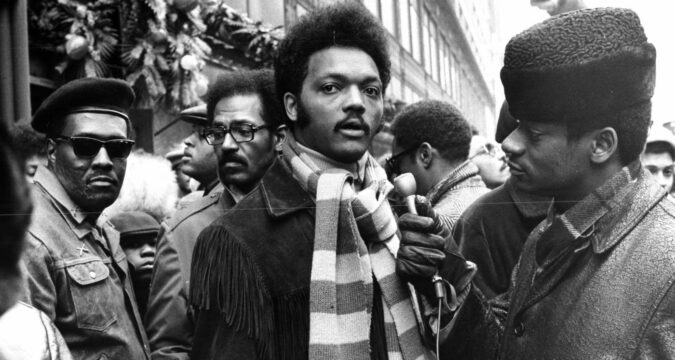
Rev. Jesse Jackson: Minister, civil rights advocate, politician, intermediary and social justice proponent
The Rev. Jesse Jackson Sr. The civil rights leader and founder of the Rainbow/PUSH Coalition spent the last 60 years of his life in front of cameras advocating for social justice. He died Tuesday at age 84, according to his family.
“His legacy is a profound leadership that aided in moving America forward and aided in addressing the question of racism and discrimination,” said U.S. Rep Maxine Waters about Jackson’s legacy. “It was Jesse Jackson’s leadership, along with other greats that really created change, and the movement toward opening up America to all.”
As the world mourns his passing, here’s a look at Jackson’s remarkable life.
Oct. 8, 1941
Jesse Louis Burns is born in Greenville, South Carolina. (He would take the last name Jackson from his adoptive stepfather Charles Jackson in 1957.)
1959
Graduates from Sterling High School in Greenville, South Carolina.
Jesse Jackson as a child. (Chicago Tribune archive)
1959-60
Attends the University of Illinois at Urbana-Champaign.
July 16, 1960
Participates in a sit-in at the whites-only Greenville County Public Library as one of the Greenville Eight. When asked to leave, they stay, only to be arrested by police for disorderly conduct. The library becomes integrated as a result of public demonstrations by the Black community.
1961
Transfers to North Carolina Agricultural & Technical College.
1962
Jackson marries Jacqueline Lavinia Brown on New Year’s Eve. The two will have five children together: Santita Jackson, Jesse L. Jackson Jr., Jonathan Luther Jackson, Yusef DuBois Jackson and Jacqueline Lavinia Jackson Jr.
Jacqueline Jackson picks up her husband from a police station in Chicago on Sept. 12, 1969.
1963
Jackson continues protests, leading civil rights demonstrations in Greensboro, North Carolina. Arrests for protesting ensues and the acting president of North Carolina A&T threatens to expel students, like Jackson, who participate in the protests.
1964
Jackson, a quarterback for the college, graduates from North Carolina A&T and enters Chicago Theological Seminary, but leaves school before acquiring a degree.
1965
Jackson heads to Selma, Alabama, after watching violent protests on television. Meets the Rev. Martin Luther King Jr. Becomes a full-time organizer for the Southern Christian Leadership Conference, or SCLC.
1966
Jackson becomes head of the Chicago chapter of the SCLC’s economic arm, Operation Breadbasket, a program promoting better employment for the Black community by combating discriminatory hiring practices. The same year Jackson would be one of the leaders of King’s open housing marches in Chicago.
Martin Luther King Jr., third from left, talks with Jesse Jackson, second from left, as they walk outside after a morning summit meeting at the St. James Episcopal Cathedral parish house at 666 N. Rush St. in Chicago on Aug. 17, 1966.
Mahalia Jackson, far left, sings “We Shall Overcome” with civil rights leaders the Rev. Martin Luther King, third left, Jesse Jackson, second from right, and Albert Raby, right, on Aug. 4, 1966. The event happened at 844 W. 71st St. in Chicago.
1967
Jackson becomes national director of Operation Breadbasket.
Donald Perkins, of Jewel Company, second from left, huddles with ministers of Operation Breadbasket in Chicago on April 28, 1967. With Perkins are, left to right, the Rev. Stroy Freeman, the Rev. Martin Luther King and the Rev. Jesse Jackson. (UPI Telephoto)
1968
King is assassinated in Memphis, Tennessee.
Jackson and the SCLC gather on the National Mall in Washington, D.C., for the Poor People’s Campaign. The six-week, live-in demonstrations took place in a protest camp, called Resurrection City, on the Mall to confront poverty and economic inequality as a national human rights issue. Jackson was elected the “mayor” of the tent city. It is in Resurrection City that we hear Jackson’s “I Am Somebody” poem. A chant that will follow him throughout his civil rights career.
Jackson is ordained as a Baptist minister.
The Rev. Martin Luther King Jr., second from right, stands with other civil rights leaders on the balcony of the Lorraine Motel in Memphis, Tennessee, on April 3, 1968, a day before he was assassinated at approximately the same place. From left are Hosea Williams, Jackson, King and Ralph Abernathy.
1969
Jackson leads a “Black Monday” protest before an estimated 3,000 people at Chicago’s Daley Plaza on Sept. 22, 1969. The protesters then march in objection to discriminatory union hiring practices. Jackson recently recounted his remembrances from that day to The New York Times.
The Rev. Jesse Jackson address the crowd at a “Black Monday” demonstration near the Civic Center in Chicago on Sept. 22, 1969. More than 3,000 people attended the protest rally. The demonstration coincided with rallies being held in various cities across the nation protesting job discrimination.
Then Rev. Jesse Jackson, the the director of Operation Breadbasket, leaves jail after signing his own cognizance bond on Sept. 12, 1969, at the central police building in Chicago. Jackson was accompanied by Larry Patterson and Robert Weathers, who had been arrested and jailed with him. Jackson’s wife, Jacqueline, is in the front.
1970
He helps negotiate the surrender of Johnnie Veal, one of two young men suspected in the sniper deaths of Chicago police officers Sgt. James Severin and Anthony Rizzato at Cabrini-Green public housing project.
Later, Veal and George Knights are convicted in the shooting deaths. Both are serving 100-to-199-year sentences.
The Rev. Jesse Jackson, center, walks past Chicago police officers from the 18th District at Cabrini-Green on July 22, 1970. Two policemen were shot there the prior week.
Jackson proposes the elimination of voter registration and suggests people, instead, show their birth certificates to prove their age.
The Rev. Jesse Jackson, center, registers 18 year-olds to vote at Wendell Phillips High School in Chicago on Sept. 12, 1972.
1971
Jackson resigns from SCLC, founds Operation PUSH (People United to Save Humanity, later changed to “Serve” Humanity) at 47th Street and King Drive in Chicago. PUSH is about economic empowerment and expanding educational, business and employment opportunities for the disadvantaged and people of color.
Under Jackson, the first Black Expo is held at the International Amphitheater in Chicago. The five-day trade fair draws Black businesspersons from dozens of states fortifying Jackson’s assertion that economic development is the way to Black power.
The Rev. Jesse Jackson speaks at the kickoff for the Black Expo in 1971.
June 30, 1972
Jackson and Chicago Ald. William Singer unseat Richard J. Daley’s delegate slate at the Democratic convention in Miami.
The Rev. Jesse Jackson yells to the chairman to get attention about the demand for a 2/3rd vote while on the floor of the Democratic National Convention in Miami on July 11, 1972. Jackson was part of a group that managed to prevent a number of Illinois delegates controlled by Chicago Mayor Richard J. Daley from being seated.
1975
PUSH for Excellence Inc. (PUSH Excel) is founded by Jackson and educators to inspire students to strive for excellence in education.
Trying to get in to the Board of Education Building to meet with school Superintendent Joseph Hannon, the Rev. Jesse Jackson and followers clash with police barring them from the door near LaSalle Street and Wacker Drive on Dec. 15, 1975. Jackson and followers were arrested on charges of disorderly conduct after they refused to leave and a shoving match took place.
1977
David Duke, left, the grand wizard and national director of the Ku Klux Klan, and the Rev. Jesse Jackson, right, during a taped discussion with Steve Edwards, center, the host of WLS-TV on Sept. 8, 1977, in Chicago.
1979
Jackson visits Palestinian leader Yasser Arafat in the Middle East. Jackson also visits South Africa speaking out against apartheid.
1982
Jackson leads a group to boycott ChicagoFest, during the tenure of Mayor Jane Byrne. The protest of ChicagoFest, a predecessor of the Taste of Chicago, was carried out in anger over Byrne’s replacement of three black Chicago Housing Authority board members with three whites. This boycott turned out to be the first step in the successful campaign to elect Harold Washington, the city’s first black mayor, months later.
Jackson leads a national boycott of major U.S. corporations like Coca-Cola and Anheuser-Busch to sign economic covenants agreeing to PUSH’s demands for more blacks in management and ownership roles in those companies.
The Rev. Jesse Jackson, left, and actor Mr. T protest ChicagoFest in August 1982.
Nov. 3, 1983
The rally cry: “Run, Jesse, Run!” is popular; Jackson runs for the Democratic Party’s nomination for president of the United States at the Washington, D.C., Convention Center.
The Rev. Jesse Jackson with his wife, Jacqueline, at Operation PUSH headquarters. “We must, in my judgement, assume a new course, organize a new coalition under a new leadership.”
1984
Jackson delivers his “Our Time Has Come” speech at the Democratic Party National Convention in San Francisco. Many commentators consider this speech his best performance. It was the first time a speech at a national convention mentioned the LGBTQ community.
The Rev. Jesse Jackson acknowledges the applause on July 28, 1984, as he makes his first PUSH appearance since addressing the Democratic National Convention in San Francisco.
Jackson secures the release of U.S. Navy pilot Lt. Robert Goodman from a Syrian prison after his plane was shot down in the Middle East. (Some called it a publicity stunt for his election campaign.)
Jackson also secures the release of 48 Cuban and Cuban American prisoners in Cuba and brings them back to the United States — most of the Americans released had been jailed on drug-trafficking charges.
Gov. Jim Thompson, left, and Mayor Harold Washington, right, share in presenting the Rev. Jesse Jackson with the Chicago Medal of Merit on Jan. 10, 1984, at a City Hall reception. Washington honored Jackson for securing the release of navy Lt. Robert Goodman from Syrian captivity.
Jackson places third in Democratic primary voting behind Sen. Gary Hart and former U.S. Vice President Walter Mondale, who took the nomination. Jackson earned more than 3 million votes during the primaries.
Jackson also founds the National Rainbow Coalition, whose mission is to protect, defend and gain civil rights by leveling the economic and educational playing fields, and to promote peace and justice around the world.
1985
Jackson leads demonstration in London’s Trafalgar Square to protest apartheid in South Africa and call on the South African government to free Nelson Mandela.
1988
Jackson makes his second bid for the Democratic Party’s nomination for president. He wins the Michigan primary, but eventually loses to Massachusetts’ Michael Dukakis. (Both presidential bids would help lay the groundwork for Barack Obama’s presidential run.)
Jackson and 75 leaders convene in Chicago to discuss national Black agenda, wherein Jackson says Black Americans adopt to be called African American. The term “puts us in our proper historical context.”
The Rev. Jesse Jackson gives the thumbs up and yells out for people to vote as he leaves the polls at the Bryn Mawr Church at 7000 S. Jeffery in Chicago on Nov. 8, 1988.
A quiet moment for Democratic presidential candidate the Rev. Jesse Jackson as he sits on the press bus after arriving at Midway Airport from Houston on March 9, 1988. The previous day, Jackson campaigned on Super Tuesday, had a late night at a campaign rally, he was up early for interviews and had an early morning press conference in Houston before leaving for Chicago.
1989
Jackson is awarded the NAACP’s Spingarn Medal, the organization’s highest achievement for his ongoing political and civil rights work.
The Rev. Jesse Jackson plays basketball with residents during a visit to the Ida B. Wells housing project in Chicago on April 3, 1989.
The Rev. Jesse Jackson embraces one of the jail inmates as he greets them on his walk around the stands after holiday festivities on Dec. 25, 1989, in Chicago.
1990
Jackson was elected to a six-year term as a shadow senator in Washington, D.C. The role is an elected one and the job is about lobbying members of Congress for D.C. statehood. Shadow senators have no standing in Congress, and the job is unpaid. (D.C. statehood would come up for a vote in 1993, but not reach fruition with, 153 yes votes to 277 no votes.)
1991
Jackson wins the release of foreign nationals being held in Kuwait after meeting with Iraqi leader Saddam Hussein.
Jackson is honored by the U.S. Postal Service with a pictorial envelope cancellation. He becomes only the second living person to receive this honor. The other is astronaut and U.S. Sen. John Glenn.
1995
Jackson gives a speech at the Million Man March in Washington, D.C.
Kent Dent, of Passaic, New Jersey, 28, along with other Black men react to the speech of the Rev. Jesse Jackson during the Million Man March in 1995.
1996
Jackson returns to Operation PUSH and the Rainbow Coalition to merge the two to form the Rainbow/PUSH Coalition.
1997
Jackson is appointed by President Bill Clinton and Secretary of State Madeleine Albright as the special envoy of the president and secretary of state for the promotion of democracy in Africa.
Jackson launches the Wall Street Project, a challenge to corporate America to end the multibillion-dollar trade deficit with minority vendors and consumers. The project works to ensure equal opportunity for diverse employees, entrepreneurs and consumers.
1998
Jackson acts as “spiritual adviser” to Bill Clinton in the aftermath of the president’s affair with Monica Lewinsky.
President Bill Clinton and the Rev. Jesse Jackson listen to Dennis Hastert on Nov. 5, 1999, in Chicago. Clinton visited the Englewood neighborhood.
1999
Jackson goes to Yugoslavia during the Kosovo war to negotiate the release of three U.S. prisoners of war captured on the Macedonian border while part of a peacekeeping unit.
Jackson comes to the aid of the “Decatur 7? — seven teens who, after a fight at a high school football game in Decatur, Illinois, were expelled for two years by the school board under a “zero tolerance” policy. The students who were expelled were Black. One student, Courtney Carson, was under the impression that he’d been given a 10-day suspension with other students involved in the brawl. When he returned to school on the 11th day, he was told of his two-year expulsion, arrested for trespassing and taken to the Macon County Jail. Jackson followed with busloads of protesters. Decatur’s public high schools were closed and a federal lawsuit was filed on the situation that became a public debate on race. Jackson stayed the course with the young men for almost two years. Eventually, then-Gov. George Ryan helped broker a compromise. The school district reduced the expulsions to a year for six of the teenagers and permitted them to enroll in alternative schools. Carson, a member of PUSH, would eventually serve on the Decatur Public Schools school board.
The Rev. Jesse Jackson, center, holds onto one of the expelled students, Roosevelt Fuller, right, while marching on to Eisenhower High School property on Nov. 8, 1999, in Decatur, Illinois.
2000
Jackson receives the Presidential Medal of Freedom (the highest U.S. civilian honor) from President Bill Clinton.
Jackson is awarded a master of divinity degree from the Chicago Theological Seminary because his life experiences more than fulfill the requirements for his missing courses in pastoral care, preaching and international relations.
The Rev. Jesse Jackson, founder and president of the Rainbow/PUSH Coalition, left, points out his family members to President Bill Clinton after Jackson was awarded the Presidential Medal of Freedom, during ceremonies on Aug. 9, 2000, at the White House in Washington, D.C.
2012
Jackson appeals to President Yahya Jammeh for the release of two Americans serving prison sentences for treason in Gambia.
The Jesse Jackson Sr. held the annual Operation PUSH conference in Chicago on July 11, 2012.
The Rev. Jesse Jackson hugs veterans as they participate in an anti-war march and rally on Cermak Road in Chicago on May 20, 2012, during the NATO 2012 Summit.
2017
Jackson announces he has been diagnosed with Parkinson’s disease.
Dominique Jones weeps while being comforted by the Rev. Jesse Jackson at the start of the walk for peace down the streets of Englewood along with Cardinal Blase Cupich, elected officials and activists on April 14, 2017.
2018
Jackson wins the lifetime achievement award from the National Urban League.
The Rev. Jesse Jackson gives a tour of memorabilia at Rainbow/PUSH headquarters in Chicago on March 6, 2018, after giving an interview about the assassination of his friend and colleague the Rev. Martin Luther King Jr. in 1968.
2019
Jackson writes a letter to President Donald Trump asking for a full pardon of former Illinois Gov. Rod Blagojevich. (Blagojevich’s sentence was commuted in 2020.)
The Rev. Jesse Jackson gets in his vehicle after speaking on behalf of Bernard Kersh after Kersh bonded out of Cook County Jail in Chicago on Dec. 6, 2019. Kersh was charged with aggravated battery to a peace officer after allegedly spitting at a police officer, apparently prompting the officer to body slam Kersh to the ground.
The Rev. Jesse Jackson greets inmates after leading a Christmas service in the Cook County Jail in Chicago on Dec. 25, 2019.
2021
Jackson receives his first COVID-19 vaccine shot, then raises his fist in the air and appears to smile behind his protective face mask.
The Rev. Jesse Jackson Sr, makes a fist after Dr. Kiran Chekka, right, of Roseland Community Hospital injected him with the Pfizer/BioNTech COVID-19 vaccine in the parking lot of Roseland Community Hospital on Jan. 8, 2021.
Jackson and Rainbow/PUSH are called into a housing situation at Concordia Place Apartments in Chicago’s Eden Green neighborhood. Residents attest to pest infestation, mold and mildew in their units at the 297-unit apartment complex — privately owned but federally subsidized. Rainbow/PUSH Coalition civil rights group step into the conversation between residents and Capital Realty Group, the New York-based owners of the complex, the Chicago Housing Authority, the U.S. Department of Housing and Urban Development and Chicago’s Department of Housing to rectify living concerns. “We’re a part of this process so people don’t feel alone,” Jesse Jackson said of PUSH’s involvement with Concordia. We’re trying to make this project a model for the country. We want the standards raised.”
Jackson receives Legion d’Honneur from French President Emmanuel Macron. The award is one of the country’s highest honors.
French President Emmanuel Macron escorts the Rev. Jesse Jackson to the Legion of Honor ceremony at the Elysee Palace in Paris on July 19, 2021. Jackson was given the rank of Commander of the National Order of the Legion of Honor, the highest of all French military and civilian honors.
A month later, Jackson and his wife are hospitalized after testing positive for COVID-19. Jackson is discharged from the Shirley Ryan AbilityLab in Chicago after his hospitalization.
The Rev. Jesse Jackson jokes with his physician, Dr. Leslie Rydberg, right, and physical therapist Talia Shapiro, center, as he is released from therapy at the Shirley Ryan Abilitylab after recovering from COVID on Sept. 22, 2021.
Check out the Tribune’s archives at your fingertips at Newspapers.com.
Sources: Chicago Tribune archives and reporting
https://www.chicagotribune.com/2026/02/17/jesse-jackson-timeline/

District 230 gymnasts and board disagree with IHSA rule on co-op sports
Addison Hartman, a sophomore on a cooperative gymnastics team made up of athletes from three Orland Park area high schools, said the team enabled her to continue the sport when the commute for club practices got to far, at least 20 minutes after school every day.
She said the team, created because the sport did not have enough participation for independent teams at each school, allows her to practice with teammates who live close to her. She said she has already learned a lot of new skills and made friends in her first year.
But Hartman said she was recently unsure what to tell other club athletes interested in joining the team because of an Illinois High School Association policy approved in December.
The policy prohibits cooperative teams from competing for team awards and in the IHSA state series if combined enrollment at the high schools in the co-op exceeds 3,500 students.
This rule applies to all six cooperative teams across Carl Sandburg, Amos Alonzo Stagg and Victor J. Andrew high schools beginning July 1, said District 230 Superintendent Robert Nolting. The teams are girls gymnastics, girls wrestling, girls and boys lacrosse and girls water polo.
Nolting said there are financial issues continuing the co-ops programs without IHSA support.
If the district split programs into independent programs, that could potentially double the cost to the district, to the tune of about $40,000, with the cost of increased coaching stipends, transportation, official costs, supplies and uniforms, he said in a statement.
He said some student athletes may lose opportunities because their school cannot continue supporting their team.
“We’d like to see if we can, pardon the expression, minimize the damage to some of the student athletes because, as we’ve heard from our parents and students, whatever the sport is, if it doesn’t matter to us, it matters to them dearly,” Nolting said.
Matt Troha, IHSA associate executive director, said Friday he was unaware of funding concerns throughout the process of approving the policy. He said the policy will affect 107 cooperative teams across 19 sports in the state.
Troha said a school representative, not an IHSA official, wrote the policy aiming to address large cooperative teams, or “super teams,” that may have a high rate of success due to team size. He said cooperative teams are meant to eventually split into individual school teams, but some school officials fear these teams may choose to stay together due to success.
The High School District 230 gymnastics team stands together after winning regionals and setting a new school records Feb. 6. The team placed third at the sectionals tournament on Feb. 11 and qualified for the state championship, scheduled for 2 p.m. on Feb. 20 at Palatine High School. (School District 230)
Troha said the policy went through several town hall meetings and was ultimately added to the December ballot by the IHSA legislative commission, based on town hall feedback.
The policy passed with 488 school representatives voting in favor, 172 representatives voting against it and 66 representatives voting no opinion, meaning the policy passed with about 67% support.
“I will be frank, I do understand some of the intentionality of the bylaw because you don’t want to create super teams and that’s what some districts might be accused of doing,” Nolting said. “But cooperatives are really about developing sports so that you could down the road break up into, or in our case schools having their own program.
Several District 230 co-op teams have achieved state success in recent years, with the District 230 wrestling team winning the state championship last year. The girls gymnastics team won its regional competition with a team record Feb. 6.
Orland High School District superintendent Robert Nolting speaks at a district board meeting Jan. 29, 2026. (Addison Wright/Daily Southtown)
Nolting asked the district board Jan. 29 for guidance on responding to the policy, clarifying it might not affect all sports the same.
He said gymnastics and wrestling programs qualify as individual sports and could still compete individually. He said these sports could possibly keep their program, and athletes could qualify individually for state championships, but the teams would not qualify for a team trophy or team recognition.
The other four co-op programs, he said, are team sports and are barred from competing in state tournaments. He said they can compete against other schools during their season but not at the IHSA tournament level.
He said four other superintendents told him informally that if they decided to keep their co-ops, they would be interested in participating in an alternative state series tournament, apart from IHSA.
But board member Tim Danlow said he was concerned some schools may not want to compete with the co-op teams because these teams would no longer count toward ranking for the state tournament.
“IHSA could look back at this and go, we really screwed this up here, we’re taking away opportunities from student athletes, which is not what we’re about, and reverse course,” Danlow said. “I don’t see any reason we need to jump the gun and even think about taking away opportunities from our students just because of a really bull-headed decision that could get turned around again.”
Nolting and Danlow also expressed concern that if sports with already low participation at the state level lose the co-op teams, the sport could be discontinued for low participation.
“There’s always concerns about some of these sports that maybe don’t have quite as much participation and maybe their long-term viability when things come up with things that could potentially limit participation,” Troha said.
The IHSA discontinued the boys gymnastics state tournament after the 2023 season due to low participation, marking the first sport dropped since the early 1980s. Participation had dropped to 40 teams, far below the threshold, with many schools relying on co-ops to maintain programs.
Nolting said he is particularly worried about state participation numbers for girls lacrosse, girls water polo and girls gymnastics teams.
The board informally agreed Jan. 29 to offer the co-op teams the option to compete individually, or for team sports against other teams outside of state tournaments, but not achieve a trophy, leaving the decision to the athletes.
Nolting said district athletic directors, principals and financial staff are working together to develop more formal proposals.
He also said district officials are interested in writing a reverse bylaw, but said under IHSA policy that cannot be written within the first year of the policy’s implementation.
District 230 sent two letters to the IHSA board opposing the policy and that were both denied, Nolting said. One letter requested IHSA delay implementing the bylaw by pushing it back to the legislative commission until schools, like those in the District 230, could have more time to adjust and make decisions, but was denied.
The policy was reviewed and discussed at the education committee on Feb. 4, Waterman said.
Waterman said administrators plan to review the policy with each school’s athletic directors, who she said will then speak with coaches, parents, and athletes.
“District 230 is finalizing its options, hopes to better define opportunities for teams vs. individuals, and is trying to determine thresholds needed to combine or sustain sports,” Waterman said.
awright@chicagotribune.com
https://www.chicagotribune.com/2026/02/17/orland-district-230-ihsa-coop-sports/
Editorial: Norine Hammond for Illinois 94th House District Republican primary
Incumbent Norine Hammond, 73, a Republican from Macomb, will be competing in the Republican primary against two challengers, Joshua Higgins, 40, and Bailey Templeton, 30.
This district borders Iowa and is home to Western Illinois University; Hammond has served this area since 2010. Hammond is chief budgeteer for the Republicans, and she told us there’s plenty of opportunity to rein in spending, which she’ll continue to fight for, in the hopes that someone on the other side of the aisle shows the political will to take action.
Templeton is a homeschooling mom of three and an advocate for children and families. Higgins is an Air Force veteran who has the backing of U.S. Rep. Mary Miller, one of President Donald Trump’s most reliable allies in Congress, known for hard-line conservative positions and an unwavering alignment with Trump’s agenda, hardly the role model we’d recommend for an aspiring state representative here in Illinois.
In a state where Republicans are scrambling to improve their numbers, strong, steady leadership shouldn’t be overlooked. The incumbent is the clear choice in this primary. We’ve endorsed Hammond in the past, and we endorse her again.
Norine Hammond is endorsed.
Read all of the Tribune Editorial Board’s endorsements for the 2026 Illinois primary election here.
Submit a letter, of no more than 400 words, to the editor here or email letters@chicagotribune.com.
Diplomats: Chicago was the setting for Ireland’s arrival on the world stage — thanks to the Fellowship Club
As the United States marks the 250th anniversary of the signing of the Declaration of Independence this year, the Embassy of Ireland and Ireland’s consulates in the U.S. are reflecting on the role played by Irish communities in the making of America. Three of the signatories to the 1776 Declaration of Independence were born on the island of Ireland, and many others were of Irish descent, while the first person to print the Declaration of Independence was John Dunlap from County Tyrone. The declaration’s powerful assertions of rights and liberties reverberated across the globe and are clearly echoed in the 1916 Proclamation of the Irish Republic, which is the foundational document of the modern Irish state.
Although Chicago was not incorporated as a city until 1837, the city’s Irish community is also marking a significant milestone this year as the Irish Fellowship Club of Chicago — one of Chicago’s oldest and most influential Irish organizations — celebrates its 125th anniversary.
In addition to playing a central role in Irish community life in Chicago, the Fellowship Club has long been important to Ireland’s international engagement. As early as 1919, Irish Fellowship Club founder Edward Fitzsimmons Dunne — who served as Chicago’s 38th mayor and the 24th governor of Illinois — was one of three Americans who traveled to France to make the case for Irish independence at the postwar Paris Peace Conference. This group ensured that neither America nor Britain could altogether ignore the Irish question, while also influencing public opinion on Ireland in the U.S.
The Fellowship Club was an important partner after Ireland secured independence in 1922. An invitation from Chicago brought about the first official visit to the U.S. of the leader of an independent Ireland: William T. Cosgrave, the first president of the Executive Council of the Irish Free State, forerunner to the taoiseach, visited in 1928. It proved to be highly significant for Ireland’s subsequent diplomacy in the U.S., setting the template for decades to come.
After the establishment of the Irish Free State in 1922 and the conclusion of the Irish Civil War in 1923, many in the government focused on enhancing bilateral ties with the U.S. and cultivating the support of Irish American communities. In 1924, Ambassador Timothy A. Smiddy became Ireland’s first-ever diplomatic representative to the U.S. He encouraged Cosgrave’s 1928 visit, which Fellowship Club members Michael J. Faherty and Kevin Kelly prompted by asking the president to address the club. Smiddy assured his colleagues in Dublin that the Fellowship Club was “one of the most respected clubs in Chicago” and that the organization had hosted such distinguished guests as President William Howard Taft and President Theodore Roosevelt.
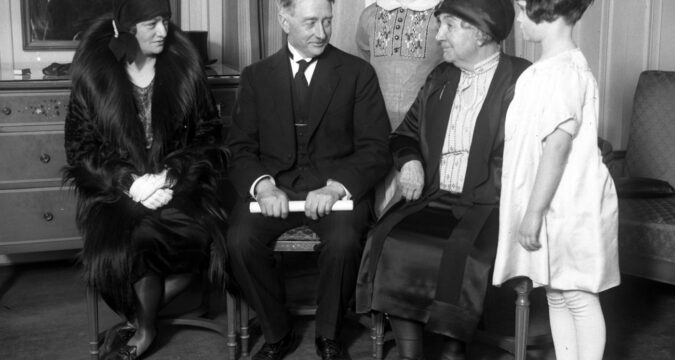
Cosgrave and his delegation arrived at the train station at LaSalle Street on Jan. 21, where they were greeted by Mayor William “Big Bill” Hale Thompson and a large group of aldermen, as well as Chicago police Capt. Patrick Collins, a brother of Irish revolutionary leader Michael Collins.
Chicago Mayor William “Big Bill” Hale Thompson, center, in fur, shakes hands with William Cosgrave, the first president of the Irish Free State, at the LaSalle Street train station after Cosgrave arrived on Jan. 21, 1928. The Tribune reported that Thompson shook Cosgrave’s hand enthusiastically and “fairly enveloped him in the fur coat he wore.” (Chicago Tribune historical photo)
Big Bill brought Cosgrave for a ride in his open-top car, before the mayor hosted a luncheon for the Irish delegation at the Drake Hotel. This was followed by a visit to Tribune Tower, where Cosgrave met with publisher Robert R. McCormick and viewed the city from the tower’s rooftop.
That evening, Cosgrave addressed a crowd of 4,500 at a dinner organized by the Fellowship Club at the Stevens Hotel (now the Hilton). In his remarks, broadcast on the radio across the nation, Cosgrave expressed thanks for the United States’ support and spoke of the Free State’s achievements, emphasizing in particular its economic development.
Cosgrave made a call for Chicagoans to experience Irish independence for themselves, encouraging tourism and investment from his American audience. “We want all of you to … judge for yourself what use we are making of our freedom,” Cosgrave proclaimed.
The visit marked an arrival of sorts for Ireland on the world stage, with the Fellowship Club giving Cosgrave a remarkable platform to connect with Irish America.
Cosgrave attended Mass at Old St. Pat’s on Sunday morning before traveling to Washington, D.C., where he met with President Calvin Coolidge, senior members of the Coolidge administration and members of Congress. These engagements served as powerful symbols of the Free State’s legitimacy. Cosgrave’s itinerary also included stops in New York and Philadelphia, as well as Ottawa and Montreal in Canada. Everywhere he went, Cosgrave called on everyone who would listen to support Ireland, visit Ireland and buy Irish.
The Ireland-U.S. relationship has deepened immeasurably since Cosgrave’s visit. Today, Ireland is a modern European country with a global outlook, connected to the world in ways that Cosgrave and his contemporaries could only have imagined. Ireland has transformed into a high-tech, globalized economy. It is now the fifth-largest source of foreign direct investment in the United States, with Irish companies employing some 200,000 people around the country. In Illinois alone, around 12,000 people work for Irish companies.
More than 30 million Americans claim Irish heritage today, including over 1.3 million in Illinois and over 200,000 in Chicago. Over 1.7 million American tourists traveled to Ireland in 2023, and half a million Irish visitors traveled to the U.S. that same year, including the thousands of young students and graduates who work in Chicago on J-1 visas each year.
William Cosgrave, the first president of the Irish Free State, center left, and the Rev. William J. McNamee, of Old St. Patrick’s Church at Desplaines and Adams streets, shake hands during Cosgrave’s visit to Chicago on Jan. 22, 1928. Old St. Pat’s was undergoing a beautification project at the time, directed by McNamee, to add Celtic art to the historic church. (Chicago Tribune historical photo)
As Ireland-U.S. ties have grown, so, too, has Ireland’s footprint across the United States. Along with the embassy in Washington and the consulate in Chicago, Ireland is now also represented at consulates in Atlanta, Boston, Miami, New York, Los Angeles, San Francisco and Austin, Texas.
Last year, the Irish government opened Ireland House Chicago on Michigan Avenue, which brings Ireland’s diplomatic and economic teams together under one roof to create a hub for diplomacy and trade promotion.
Despite the evolution of the U.S.-Ireland relationship over the years, many of the early themes and partner organizations involved in Cosgrave’s 1928 visit to Chicago are as important as ever.
Illinois remains a key location for the promotion of Ireland’s trade and foreign policy priorities. Countless Irish dignitaries have visited Chicago over the years to engage with the city’s business, civic and political leaders, as well as to experience the iconic turning of the Chicago River green each March.
The Irish Fellowship Club of Chicago is also still a close partner of the consulate. The club has been a valuable source of advice and friendship for successive Irish diplomats in Chicago and has hosted senior Irish government representatives for decades, including the taoiseach in 2010, 2012 and 2019.
Mary Robinson and Mary McAleese, former presidents of Ireland, have also addressed gatherings of the Irish Fellowship Club; in 2024, the club supported the transfer of Robinson’s literary collection to DePaul University.
As the Fellowship Club prepares to mark its 125th anniversary, and as communities throughout the United States reflect on the 250th anniversary of the signing of the Declaration of Independence, Ireland is proud to celebrate our deep ties to Chicago and the contributions that our people have made — and continue to make — in this great city.
Brian Cahalane is the consul general of Ireland in Chicago. Pádraig Manning is the vice consul.
Submit a letter, of no more than 400 words, to the editor here or email letters@chicagotribune.com.
https://www.chicagotribune.com/2026/02/17/opinion-irish-fellowship-club-chicago-history/