Category: News

Rey de Noruega recibe alta de hospital español tras tratar infección cutánea
Associated Press
OSLO, Noruega (AP) — El rey Harald V de Noruega recibirá el alta de un hospital en las Islas Canarias, en España, tras recibir tratamiento por una infección cutánea que motivó su ingreso a principios de esta semana, informó el jueves el palacio real.
El palacio indicó que Harald, quien cumplió 89 años el fin de semana pasado, será dado de alta del hospital en Tenerife a lo largo del día. Agregó que el rey y la reina Sonia continuarán sus vacaciones privadas y que aún no se ha tomado ninguna decisión sobre cuándo regresarán a Noruega.
El rey ingresó al hospital el martes y el médico personal del monarca, Bjørn Bendz, viajó a Tenerife el miércoles. Bendz explicó que estaba siendo tratado por una infección cutánea en una de sus piernas.
El comunicado del jueves señaló que Harald respondió bien y se recuperó rápidamente. Añadió que Bendz permanecerá en Tenerife durante unos días para vigilar la evolución.
Hace dos años, el rey enfermó durante unas vacaciones privadas con la reina en Malasia y allí recibió un marcapasos temporal. Harald regresó a Noruega a bordo de un avión medicalizado, donde le colocaron un marcapasos permanente.
Harald es monarca de Noruega desde 1991. Su hospitalización se produjo en un momento turbulento para la familia real noruega.
La princesa heredera Mette-Marit —casada con el heredero al trono, el príncipe heredero Haakon— ha enfrentado un renovado escrutinio en las últimas semanas por sus contactos con el fallecido delincuente sexual Jeffrey Epstein.
Por su parte, el hijo de Mette-Marit de una relación anterior está siendo juzgado actualmente en Oslo por múltiples presuntos delitos, incluyendo acusaciones de violación.
___
Esta historia fue traducida del inglés por un editor de AP con la ayuda de una herramienta de inteligencia artificial generativa.
Solicitudes de ayuda por desempleo en EEUU suben levemente
Por MATT OTT
WASHINGTON (AP) — Un número ligeramente mayor de estadounidenses solicitó prestaciones por desempleo la semana pasada, mientras los despidos se mantienen en niveles relativamente saludables.
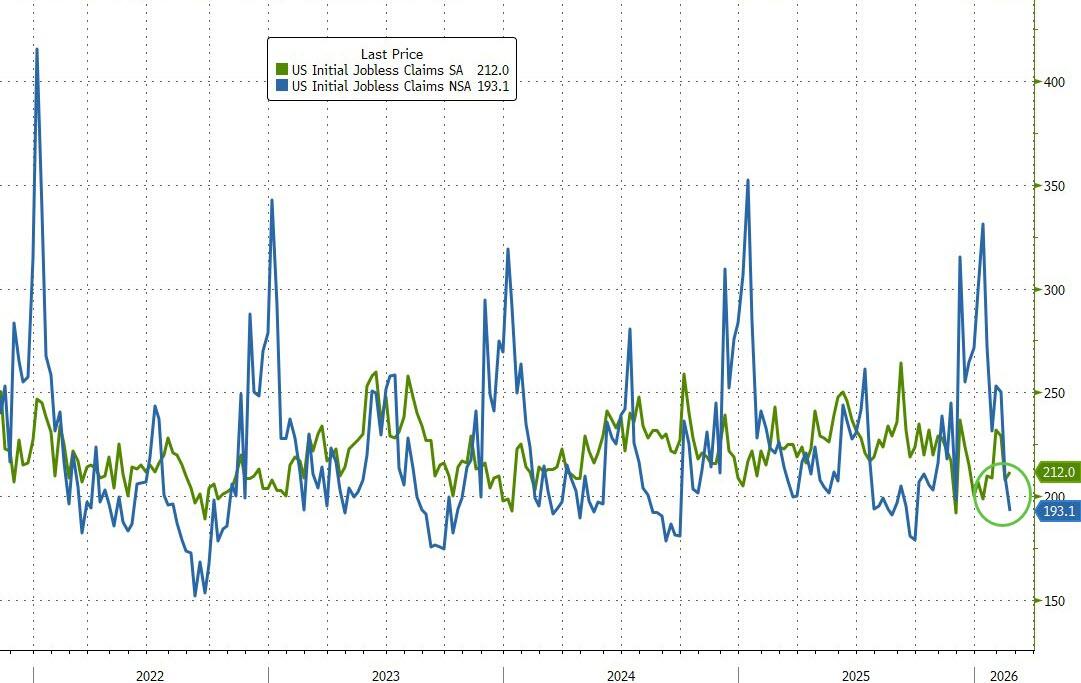
La cifra de estadounidenses que presentaron solicitudes de ayuda por desempleo en la semana que terminó el 21 de febrero aumentó en 4.000, hasta 212.000, frente a la semana anterior, informó el Departamento de Trabajo el jueves. Eso coincide con los pronósticos de los analistas encuestados por la firma de datos FactSet.
Las solicitudes de prestaciones por desempleo se consideran representativas de los despidos y se acercan a un indicador casi en tiempo real de la salud del mercado laboral.
El Departamento de Trabajo informó a principios de este mes que los empleadores añadieron unos 130.000 empleos en enero y que la tasa de desempleo bajó a 4,3% desde 4,4%. Sin embargo, revisiones del gobierno recortaron las nóminas de 2024-2025 en cientos de miles, reduciendo el número de empleos creados el año pasado a apenas 181.000. Eso equivale a cerca de un tercio de los 584.000 reportados previamente y es el dato más débil desde el año de la pandemia, 2020.
Aunque los despidos semanales se han mantenido en un rango históricamente bajo, en su mayoría entre 200.000 y 250.000 durante los últimos años, varias empresas de alto perfil han anunciado recortes de empleo recientemente, entre ellas UPS, Amazon, Dow y The Washington Post en las últimas semanas.
El Departamento de Trabajo también informó recientemente que las vacantes de empleo cayeron en diciembre al nivel más bajo en más de cinco años.
Por ahora, el mercado laboral parece estancado en lo que los economistas llaman un estado de “ni contratamos ni despedimos”, que ha mantenido la tasa de desempleo en niveles históricamente bajos, pero ha dejado a quienes están sin trabajo con dificultades para encontrar un nuevo empleo.
Los datos del último año han revelado, en términos generales, un mercado laboral en el que la contratación se ha desacelerado claramente, lastrada por la incertidumbre avivada por los aranceles del presidente Donald Trump y por los efectos persistentes de las altas tasas de interés que la Reserva Federal impulsó en 2022 y 2023 para contener un repunte de la inflación inducida por la pandemia.
Los economistas están divididos sobre si las ganancias de empleo de enero son un hecho aislado o posiblemente la primera señal de un mercado laboral en recuperación, lo que podría llevar a la Reserva Federal a retrasar aún más nuevos recortes de su tasa de interés clave.
El gobierno publicará su informe de empleo de febrero la próxima semana.
Algunos funcionarios de la Reserva Federal han sostenido específicamente que la débil contratación del año pasado muestra que los costos de endeudamiento están pesando sobre el crecimiento y desalentando a las empresas a expandirse. Un repunte sostenido en la contratación podría debilitar esa teoría.
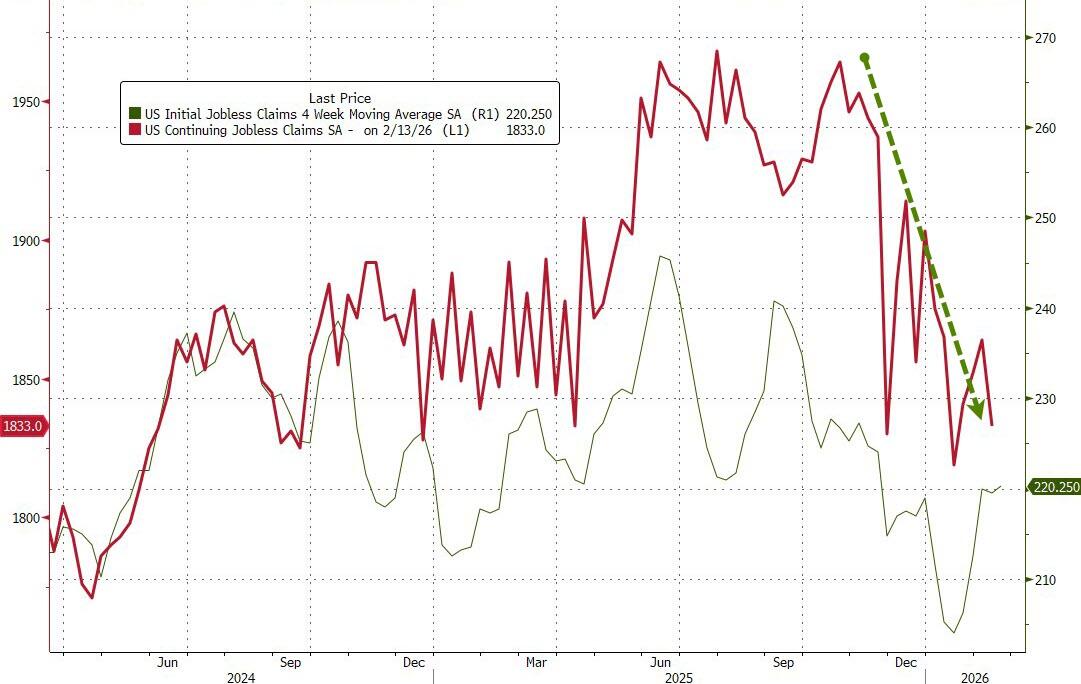
El informe del Departamento de Trabajo del jueves mostró que el promedio móvil de cuatro semanas de las solicitudes de subsidio por desempleo, que suaviza parte de la volatilidad semana a semana, subió en 750, hasta 220.250.
El número total de estadounidenses que recibían prestaciones por desempleo en la semana anterior, que terminó el 14 de febrero, bajó en 31.000, hasta 1,83 millones, informó el gobierno.
___________________________________
Esta historia fue traducida del inglés por un editor de AP con ayuda de una herramienta de inteligencia artificial generativa.

Cristiano Ronaldo compra el 25% del Almería de la segunda división de España
ALMERÍA, España (AP) — Cristiano Ronaldo adquirió una participación en el club Almería, de la segunda división española, informó el jueves una firma de consultoría que representa al astro portugués del fútbol.
Brunswick Group señaló en un comunicado que Cristiano compró el 25% del club, que tiene un propietario saudí.
Cristiano, de 41 años, se fue a Arabia Saudí para jugar con el Al Nassr a finales de 2022.
“Siempre he tenido la ambición de contribuir al fútbol más allá de la cancha. La UD Almería es un club español con bases sólidas y un claro potencial de crecimiento”, dijo Cristiano en un comunicado.
Según Brunswick Group, el cinco veces ganador del Balón de Oro, adquirió la participación en el Almería a través de su filial CR7 Sports Investments.
Almería ha estado bajo el control de propietarios saudíes durante más de seis años. Mohamed Al-Khereiji se convirtió en el nuevo propietario y presidente del club en el verano de 2025, cuando lo compró a Turki Al Alsheikh.
“Estamos muy satisfechos de que Cristiano haya elegido nuestro club para invertir. Conoce muy bien las ligas españolas y entiende el potencial de lo que estamos construyendo aquí, tanto en lo que respecta al equipo como a la academia”, señaló Al-Khereiji en el comunicado.
No se dieron a conocer los detalles financieros.
Almería no respondió de inmediato a una solicitud por correo electrónico de The Associated Press en la que se pedían más detalles sobre el acuerdo.
Almería ocupa actualmente el tercer lugar en la segunda división de España. Su presencia más reciente en la primera división fue en la temporada 2023-24.
___
Deportes AP: https://apnews.com/hub/deportes
Futures Flat Despite Blowout Nvidia Earnings
Futures Flat Despite Blowout Nvidia Earnings
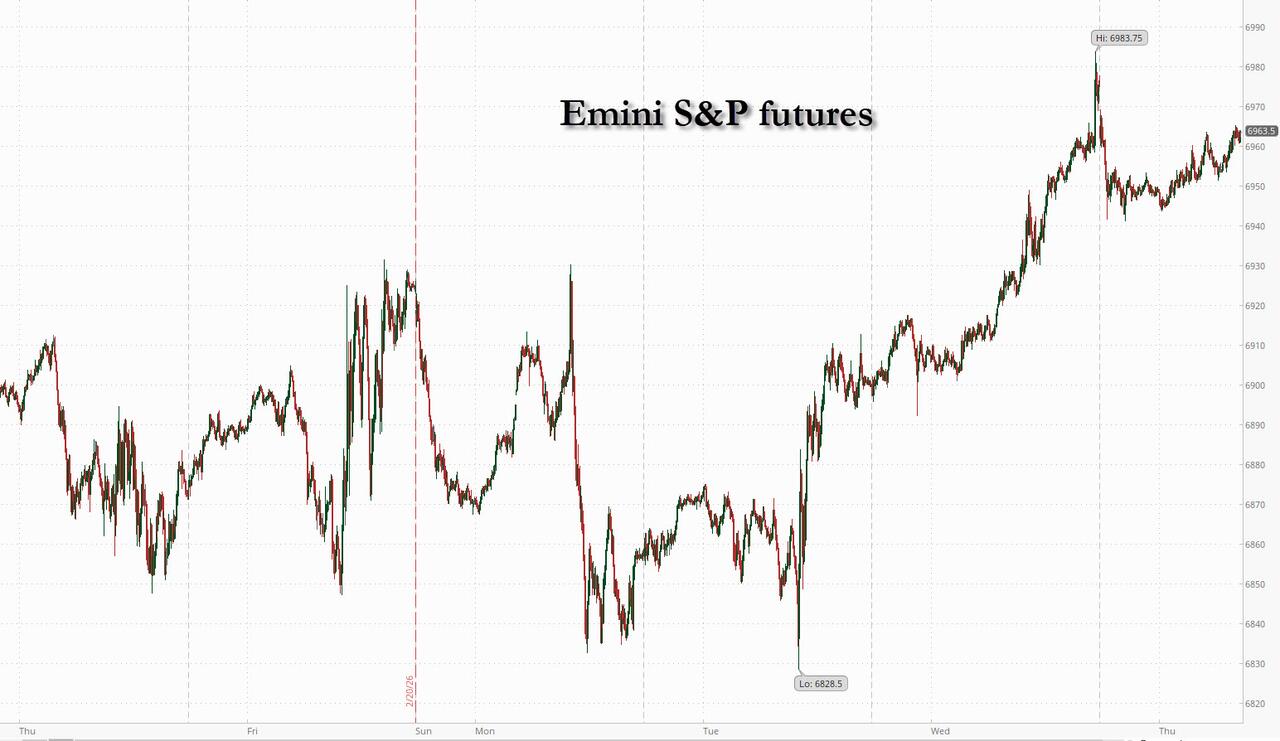
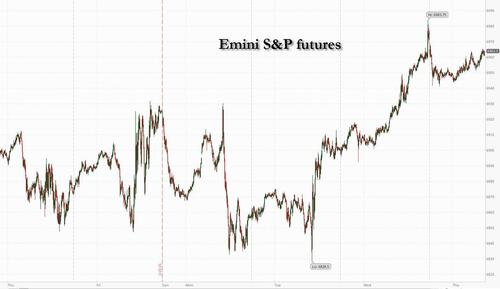
US equity futures managed to erase overnight losses and were trading flat after Nvidia and Salesforce failed to assuage fears about an overheated AI economy while traders awaited color from today’s round of US / Iran talks. As of 8:00am S&P futures were unchanged and nasdaq futures were down 0.1%, with NVDA up 1% premarket but well off overnight highs after its earnings report and guidance smashed expectations while CEO Jensen Huang talked about “exponentially” growing computing demand and “skyrocketing” adoption of AI agents. It wasn’t enough, especially as software companies Salesforce and Snowflake both provided lukewarm sales guidance to an already-nervous market. “Aside from fireworks, champagne and dancing robots, we are not quite sure what more Nvidia could have done on the 4Q call to get the market re-excited,” said Jim Fontanelli, co-founder of Arete Research. Discretionary, Financials, and Industrials are outperforming with notable weakness in Energy and Materials. In premarket trading, Mag7 names were mostly weaker ex-NVDA though, as JPM says, bulls should not panic as we await Long Only demand once the market opens. AI-related plays are higher pre-mkt. Bond yields are flat, the USD is flat; in commodities lithium prices surged after Zimbabwe, one of the world’s top producers, suspended concentrate exports. Brent crude edged lower as nuclear talks take place between the US and Iran while silver stalled as it reached nearly $90/oz. Today’s macro data focus is on jobless claims, KC Fed, and several Fed speakers.
In premarket trading Nvidia Corp. (NVDA) rises 1.3% after its latest sales forecast drew a muted response from investors. Other Magnificent Seven stocks are mixed (Amazon -0.1%, Apple -0.04%, Microsoft -0.06%, Alphabet -0.06%, Tesla -0.6%, Meta -0.6%)
Array (ARRY) drops 22% after the renewable energy company’s 2026 adjusted Ebitda guidance missed the average analyst estimate.
C3.ai (AI) slumps 25% after the AI company cut its revenue guidance for the full year, missing the average analyst estimate.
Celsius Holdings (CELH) rises 12% after posting sales which more than doubled from a year earlier following its acquisition of Alani Nu, allaying concerns that a change in distribution channels would disrupt sales.
FTAI Aviation (FTAI) falls 4% after the aerospace company reported total revenue for the fourth quarter that missed the average analyst estimate.
GoodRx Holdings (GDRX) falls 15% after the health-care platform forecast revenue for 2026 that fell short of Wall Street’s expectations. It also gave an estimate for the lower bound of 2026 Ebitda that would be below expectations. Multiple analysts said they were surprised by the scale of margin deterioration implied by the profit outlook.
IonQ (IONQ) rises 13% after the quantum computing company reported fourth-quarter results that beat expectations.
Janus Henderson Group (JHG) climbs 6% after Victory Capital offered to acquire the company for $57.04 per share.
Krispy Kreme Inc. (DNUT) climbs 15% as the company expects leverage to decline further this year as it advances its turnaround plan following the end of its US partnership with McDonald’s Corp.
Nubank (NU) slips 2% after the lender reported higher costs and provisions that analysts say offset net income increase in the fourth quarter.
Nutanix (NTNX) rises 18% after Advanced Micro Devices said it will buy $150 million in the software company’s stock as part of a new partnership. The news was seen as overshadowing a reduced full-year forecast.
Papa John’s (PZZA) falls 5% after the pizza chain reported weaker-than-expected sales results, which reflect a “weak consumer backdrop and elevated promotional environment.”
PROCEPT BioRobotics (PRCT) sinks 24% after the medical equipment maker forecast revenue for 2026 that fell short of Wall Street’s expectations. The firm also posted results for the fourth quarter that Leerink Partners called a “painful miss.”
Salesforce Inc. (CRM) falls 3% after the company gave a lukewarm outlook for sales growth in the new fiscal year, fueling investors’ worries that the software giant will lose out to new competitors in the age of AI.
Synopsys (SNPS) falls 3% after the electronic design automation software company’s Design IP revenue came in below expectations. The company also forecast weaker-than-expected free cash flow for the full-year.
Trade Desk (TTD) declines 14% after the advertising technology company gave a first-quarter forecast that was weaker than expected. The report is adding to concerns about competition from Amazon and AI-related disruption.
In corporate news, Apollo and BNP Paribas are said to be nearing a deal to partner up in Europe’s private credit market. Apple is in discussions with key Indian banks and global card networks in preparation to start Apple Pay in the world’s most populous country. American Airlines will invest $1 billion in a concourse expansion at Miami International Airport to bolster its position at its top international gateway.
Despite Nvidia’s estimate-busting guidance, and CEO Jensen Huang talking about “exponentially” growing computing demand and “skyrocketing” adoption of AI agents, it wasn’t enough, especially as software companies Salesforce and Snowflake both provided lukewarm sales guidance to an already-nervous market. Yet there is one group of winners: memory chipmakers Samsung and SK Hynix jumped in Asian trading. A huge jump in supply-related commitments by Nvidia “likely reflects a deliberate effort by Nvidia to tie up valuable components,” according to Vital Knowledge analyst Adam Crisafulli.
Nvidia’s shares “not doing much was quite instructive, especially within the context of one of the other companies that reported — Salesforce,” said Gary Paulin, chief investment strategist at Northern Trust Asset Management. “The concern is that the more success Nvidia has, the more concern there is in the market that there is more disruption.”
For Mohit Kumar, chief strategist for Europe at Jefferies, markets are being “too sanguine” about risks of a limited strike by the US on Iran and an increase in short-term tensions. While a long-drawn war is unlikely, the issue could weigh on markets over the coming days.
“We have reduced our risk profile into the weekend,” Kumar wrote. “Our medium-term view remains bullish and we would be looking to add at better levels.”
Private credit continues to be rattled by the software selloff, with Marathon AM Chairman Bruce Richards saying the asset class is way too exposed to the sector, though he sees little risk of contagion to the wider market. The Fed’s Bowman, meanwhile, said banks need “flexibility” to compete with non-bank financial institutions, which continue to increase their share of the total lending market.
In tariffs, the US vowed to maintain high duties on China hours after Beijing warned against any future hikes. Canadian PM Mark Carney’s visit to India this week will cement a diplomatic reset and unlock a wave of new trade opportunities, including in nuclear power, oil and critical minerals, India’s top diplomat to Canada said.
In earnings, out of the 453 S&P 500 companies that have reported so far in the earnings season, 74% have managed to beat analyst forecasts, while 21% have missed. Royal Bank of Canada, Vistra and Warner Bros. Discovery are among companies expected to report results before the market open. Bloomberg Intelligence expect to see continuing wealth growth and sustained profitability in capital markets at RBC, offsetting muted personal and commercial loan growth. Earnings from Dell, Intuit and Monster Beverage follow later.
In Europe, the Stoxx 600 inches higher and is on course for a record close. Financial services stocks outperform while miners and construction shares lag. Here are the biggest movers Thursday
Rolls-Royce shares rise as much as 8.4%, hitting a record high, after the UK-based engine maker said it was planning a major share buyback and raised its mid-term earnings targets
Engie shares rose as much as 7.6% after it agreed to buy the UK’s largest power-distribution network for £10.5 billion ($14.2 billion) from Hong Kong billionaire Victor Li’s CK Group
Indra shares soar as much as 20%, to its highest intraday level on record, after the Spanish defense company’s fourth-quarter results “beat across the board,” according to Morgan Stanley
Howden Joinery shares surge as much as 11%, the most since July, on what Panmure Liberum analysts call “impressive” full-year results by the kitchen seller that beat the average analyst estimate for profit
Puma gains as much as 9.1% after the German sporting goods and apparel retailer posted results that showed early signs of a long-awaited recovery, particularly driven by a strong performance in its Asian market
Syensqo fell by a record after the chemicals maker reported fourth-quarter earnings that missed estimates with an outlook for this year that points to more struggles
Hikma Pharmaceuticals sinks as much as 18%, the most since February 2016, after the drugmaker’s 2026 core operating profit guidance came in below expectations
Freenet drops as much as 12%, most since May, after its fourth-quarter results missed expectations. Citi said this can be attributed to impact from a single mobile network operator agreement in which the firm fell short of a gross profit commitment
Scout24 drops as much as 7.8% amid disappointment over a lack of earnings upgrades as fears of AI-driven displacement continue to weigh
Asian stocks extended gains to a fourth-straight day as South Korean chipmakers extended their rally, offsetting investor caution in the wake of Nvidia’s results. The MSCI Asia Pacific Index climbed as much as 1.1%, on course to close at another record, with Samsung and SK Hynix among the biggest boosts. South Korea’s Kospi index jumped as much as 3.8% closing at an all-time high, buoyed by the chip heavyweights. Japan’s Topix and Australia’s S&P/ASX 200 also climbed, while benchmarks fell in Hong Kong and Singapore. Nvidia’s results and outlook failed to impress investors amid concerns about an overheated AI economy, and some analysts also flagged concerns over competition. While the Korean memory makers gained, most Asian chip-related stocks slipped. Beyond tech, Asian markets largely shrugged off a US threat to raise global tariffs to 15% “where appropriate” in the coming days. The region’s stocks have been resilient this year, with the key MSCI APAC index up about 15%, far outpacing global peers.
Emerging-market stocks continued their outperformance, with MSCI’s gauge of EM equities up 15% in dollar terms this year. Rallies in memory chipmakers such as Samsung Electronics Co. and SK Hynix Inc. fueled gains on Thursday, pushing South Korea’s Kospi index up more than 50% in dollar terms so far in 2026.
A report from Citigroup Inc. found that money managers had added to long positions in emerging markets across Asia, Latin America, as well as Europe, the Middle East and Africa. They also favor emerging currencies against the dollar.
In FX, the yen is the best-performing G-10 currency, rising 0.2% against the greenback after some hawkish BOJ remarks.
In rates, treasuries are steady, with US 10-year yields near flat at 4.05% as US trading day begins, after plying narrow ranges during Asia session and European morning. US 10-year yield is near 4.05% with curve spreads likewise little changed. Gilts outperform as the pound weakens, with UK yields 1bp-2bp richer across maturities. This week’s Treasury auctions conclude with $44 billion 7-year notes at 1pm New York time; Wednesday’s 5-year sale tailed by 0.7bp
The Bloomberg Dollar Spot Index is little changed.
In commodities, US crude futures fall 1.6% to their lowest level this week as the US and Iran start a third round of nuclear talks in Geneva. Some major Middle Eastern producers have also been boosting exports, as concerns about a potential conflict in the region create uncertainty about future supply. Precious metals are mixed with silver down nearly 2% while gold is slightly higher. Lithium prices surged after Zimbabwe, one of the world’s top producers, suspended concentrate exports. Brent crude edged lower as nuclear talks take place between the US and Iran. Bitcoin falls 1%.
US economic data slate includes weekly jobless claims (8:30am) and February Kansas City Fed manufacturing activity (11am). Fed speakers scheduled for the session include Miran (8:45am), Bowman (10am) and Goolsbee (2:30pm)
Market Snapshot
S&P 500 mini little changed
Nasdaq 100 mini little changed
Russell 2000 mini +0.2%
Stoxx Europe 600 little changed
DAX +0.1%, CAC 40 +0.8%
10-year Treasury yield little changed at 4.05%
VIX +0.1 points at 18.01
Bloomberg Dollar Index little changed at 1187.55
euro -0.1% at $1.1796
WTI crude -1.3% at $64.55/barrel
Top Overnight News
The US and Iran kicked off nuclear talks in Geneva with days to go until Donald Trump’s deadline for a deal. Satellite images show Iran is already rebuilding nuclear facilities damaged by American and Israeli attacks last June. BBG
The Pentagon asked two major defense contractors on Wednesday to provide an assessment of their reliance on Anthropic’s AI model, Claude — a first step toward a potential designation of Anthropic as a “supply chain risk”: Axios
Iran’s atomic program hasn’t advanced significantly since the U.S. and Israel struck its three main nuclear sites last June, according to experts and diplomats, despite Washington’s top negotiator saying Tehran could make fissile material for a bomb within days. WSJ
Pentagon officials and Hill lawmakers are increasingly warning that prolonged Iran strikes could stress U.S. military stockpiles to the brink and make the country more vulnerable. Politico
The US will maintain high tariffs on China, at a range of 35% to 50%, according to USTR Jamieson Greer. Beijing warned it would take “all necessary measures” if new levies are imposed. BBG
Suppliers to U.S. aerospace and semiconductor firms face worsening rare earth shortages, with two turning away some clients, industry insiders said, weeks before U.S. President Donald Trump is expected to meet his Chinese counterpart Xi Jinping for a summit in Beijing. RTRS
With deflation now firmly in the rearview mirror, the path is clear for the Bank of Japan to raise interest rates sooner rather than later, said policy board member Hajime Takata. WSJ
Christine Lagarde repeated that the ECB has succeeded in taming consumer prices, while cautioning that policymakers must watch elevated perceptions of inflation. BBG
The UK’s top banks are resisting a regulatory initiative to boost lending by lowering their capital levels, people familiar said. BBG
Nvidia CEO Jensen Huang said Wednesday markets have miscalculated the AI threat to software companies, hours after the chip behemoth issued an upbeat sales forecast on strong AI demand. Instead, he expects a broad swath of software firms to use agentic AI to develop their software and boost efficiency. CNBC
Trade/Tariffs
German Chancellor Merz on his conversation with Chinese President Xi, said there are many challenges to overcome; Economic Minister will conduct a follow up visit.
India’s Trade Minister after hosting US Commerce Secretary Lutnick, said both parties engaged in “very fruitful” discussions to expand trade and economic partnership
A more detailed look at global markets courtesy of Newsquawk
APAC stocks are mostly positive as the majority of the region took its cue from gains on Wall Street, where tech led the advances and NVIDIA posted stronger-than-expected earnings after hours. ASX 200 mildly gained as the outperformance in tech, telecoms and healthcare offset the losses in energy and industrials, while better-than-expected private capex data also provided some encouragement. Nikkei 225 initially rallied to a fresh all-time high north of the 59,000 level but then pulled back from record levels as the yen gradually strengthened and after BoJ hawkish dissenter Takata called for gradually hiking rates. Hang Seng and Shanghai Comp were ultimately mixed with the Hong Kong benchmark the laggard amid weakness in tech, consumer discretionary and insurers, while the mainland was indecisive as price action was contained with very little in the way of fresh catalysts.
Top Asian News
Japanese Coincident Index Final (Dec) 114.3 (Prev. 114.9).
Japanese Leading Economic Index Final (Dec) 111 vs. Exp. 110.2 (Prev. 109.9).
Australian Private Capital Expenditure for 2025-26 (AUD)(Estimate 5) 199.3B (Prev. 191.3B).
Australian Private Capital Expenditure for 2026-27 (AUD)(Estimate 1) 158.4B.
Australian Private Capital Expenditure QoQ (Q4) Q/Q 0.4% vs. Exp. 0.0% (Prev. 6.4%).
New Zealand ANZ Activity Outlook (Feb) 52.6 (Prev. 51.6).
New Zealand ANZ Business Confidence (Feb) 59.2 (Prev. 64.1).
European bourses (STOXX 600 +0.1%) are mixed, with France’s CAC 40 (+0.4%) leading its peers while the IBEX 35 (-0.3%) lags. European sectors do not offer any additional bias. Financial Services (+1.3%) and Retail (+1.0%) top the sector list, while Basic Resources (-2.0%) suffer as silver prices fall. LSEG (+6.7%) supports the Financial sector, as the Co. unveiled a new GBP 3bln share buyback programme. For Retailing, Howden Joinery (+7.5%) released a positive FY report, with pretax profit rising annually. However, the boost in the Co.’s shares comes from the announcement of a GBP 100mln share buyback.
Top European News
EU Consumer Confidence Final (Feb) -12.2 vs. Exp. -12.2 (Prev. -12.4).
EU Consumer Inflation Expectations (Feb) 25.8 (Prev. 24.2, Rev. From 24.1).
EU Economic Sentiment (Feb) 98.3 vs. Exp. 99.8 (Prev. 99.3, Rev. From 99.4, Low. 98.5, High. 100).
EU Selling Price Expectations (Feb) 11.5 (Prev. 10.0).
EU Services Sentiment (Feb) 5.0 vs. Exp. 7.5 (Prev. 7.2, Low. 6.8, High. 7.9).
Italian Consumer Confidence (Feb) 97.4 vs. Exp. 97.2 (Prev. 96.8).
Italian Business Confidence (Feb) 88.5 (Prev. 89.2).
Swiss Non Farm Payrolls (Q4) 5.544 (Prev. 5.532).
Swedish Consumer Confidence (Feb) 96.3 (Prev. 95.3).
FX
DXY is modestly firmer after finding support around the 97.50 mark overnight before attempting to recoup some of yesterday’s losses, with macro newsflow on the lighter side as US-Iran nuclear talks get underway. So far, Omani Foreign Minister said Iran and the US have welcomed proposals in the Geneva talks. On the data front, the Chicago Fed will release its labour market indicators; weekly jobless claims are seen at 215k from 206k; continuing claims (which coincide with the traditional BLS survey window for the February jobs report) are seen at 1.86mln from 1.869mln. DXY currently trades within a 97.49-97.72 range, vs Wednesday’s 97.62-98.00 parameter.
JPY is the current outperformer as USD/JPY continued to pull back overnight after climbing to its best levels in over two weeks, on Wednesday, following the Takaichi government’s reflationist picks for the BoJ board. The pair was not helped by the lack of fresh drivers and the absence of tier-1 data from Japan, while there were comments from BoJ Governor Ueda, who reiterated the hiking bias, and hawkish dissenter Takata also stated that they must conduct further rate hikes in a gradual manner.
GBP takes a breather after advancing in tandem with high-beta FX. Newsflow for the UK has been on the lighter side, with price action fitting with the subdued/cautious tone. UK focus will likely be on the Gorton and Denton by-election: analysts suggest that a heavy defeat for the ruling Labour Party could trigger volatility in Sterling. Some suggest a loss in what has been a safe Labour seat for nearly 100 years could re-ignite speculation regarding UK PM Starmer’s leadership.
Antipodeans are subdued following the recent outperformance that was facilitated by their high-beta statuses. Overnight, quarterly capex data from Australia topped forecasts, which feeds into next week’s GDP release.
Central Banks
ECB’s Lagarde said we continue to expect inflation to stabilise at the 2% target in the medium term, will continue to follow data-dependent and meeting-by-meeting approach.
BoJ’s Governor Ueda said basic stance is to continue hiking interest rates if the likelihood of our economic, price forecasts materialising heightens, according to Yomiuri. Underlying inflation has not yet fully reached 2% and policy will be guided to get underlying inflation to around 2%, while avoiding it exceeding 2% on a sustained basis.
BoJ’s Takata said no preset pace for rate hikes and future moves depend on economic environment and data.
BoJ Board Member Takata said fears of Japan’s economy returning to deflation have been dispelled and believes it’s necessary to move the BoJ’s focus more to upswing in prices. Proposed a rate hike in January on the view that BoJ must continue adjusting real interest rates, which remain significantly lower than the rates seen overseas.
Bank of Korea keeps base rate unchanged at 2.50%, as expected. Raises 2026 GDP growth forecast to 2.0% from 1.8% sees 2027 growth at 1.8%. Raises 2026 CPI forecast to 2.2% from 2.1% and sees 2027 CPI at 2%.
BoK said rate decision was unanimous and median projections show base rate is seen at 2.5% in six months. Said the Bank will make policy decisions supporting a recovery in economic growth. Growth momentum is to remain favourable. Strong chip exports supporting growth.
BoK Governor Rhee said no board member expects rates to be increased in three months time, also noted that US tariff ruling is to have a limited impact on exports for now.
Fixed Income
USTs are flat and currently holding within a 113-04+ to 113-09 range. Really not much driving things for US paper this morning, and this has been reflected by the lacklustre price action. After-market on Wednesday, saw the release of stronger-than-expected NVIDIA earnings, with the name a touch firmer pre-market – but had little follow through from a sentiment perspective. On the data front, the Chicago Fed will release its labour market indicators; weekly jobless claims are seen at 215k from 206k; continuing claims (which coincide with the traditional BLS survey window for the Feb jobs report) are seen at 1.86mln from 1.869mln. From a geopolitical perspective, US-Iran talks have reportedly begun in Geneva. A breakdown in talks could spur some haven inflows in USTs, given the increased likelihood of a US strike on Iran.
Bunds follow the sideways action across global peers, and hold within a 129.57 to 129.69 range. Lack of catalysts for German paper this morning, with commentary from ECB President Lagarde also failing to spur action. She reiterated the usual data-dependent and meeting-by-meeting approach.
Gilts ditto peers. Currently flat and within a narrow 92.82-92.90 range. Markets were expecting some remarks via BoE’s Lombardelli, though nothing thus far. UK focus will likely be on the Gorton and Denton by-election, with some analysts suggesting that a Labour loss, in what has been a safe seat for nearly 100 years, could re-ignite speculation regarding UK PM Starmer’s leadership. Hence, this could weigh on Gilts in the short-term.
Italy sells EUR 6.5bln vs exp. EUR 5.5-6.5bln 2.85% 2031 and 3.45% 2036 BTP & EUR 2.5bln vs exp. EUR 2.0-2.5bln 1.468% 2035 CCTeu.
Abu Dhabi is set to issue two benchmark USD bonds, Bloomberg reported. 5-year note offered at a spread +50bps over USTs. 10-year note offered at a spread +55bps over USTs.
UK government debt sales are anticipated to decline for the first time in four years as large banks forecast GBP 247bln of gilt issuances in the approaching fiscal year amid Chancellor Reeves seeks to rein in borrowing, according to FT.
Commodities
Crude benchmarks traded lower on the commencement of the US-Iran talks in Geneva. As updates from that meeting got announce, WTI and Brent dipped to fresh session lows and now trade off by around 1.5% and 1.3% respectively. Two main takeaways from the meeting, including the Omani Foreign Minister suggesting that Iran and the US have welcomed proposals in the Geneva talks. Elsewhere, Al Jazeera reported that the “Iranian negotiating delegation meets IAEA director” – this would be necessary for a market-friendly sustainable deal. Brent May’26 is now shy of USD 70.00/bbl, with the low currently a moving a target at the time of writing.
Precious metals are trading mixed this morning, with spot gold trading firmer and silver lower. XAU and XAG trades within a narrow range of USD 5155.59-5205.58/oz and USD 86.33-90.34/oz, respectively.
Base metals are lower this morning, tracking headwind from its largest buyer, China, which saw mixed to weak sentiment, pinning down price action for base metals. Sentiment in Europe has done little to shake off sentiment in the base metal complex, with European equities trading mixed this morning. 3M LME copper trades within the lower range of USD 13.23-13.35k/t.
Nordic countries investigate a threat to the region’s energy infrastructure, according to TV4 citing sources. “According to the threat, the actor may strike in the near future,” says an informant.
Geopolitics: Middle East
Omani Foreign Minister says Iran and the US have welcomed proposals in the Geneva talks.
“Iranian negotiating delegation meets IAEA director at the headquarters of the negotiations in Geneva”, via Al Jazeera.
Omani mediator in Geneva said that US and Iran are open to new and creative ideas, AFP reported.
Iran’s Foreign Ministry spokesperson said the country will move to the nuclear negotiation site in half an hour, our negotiating team has reasonable amount of flexibility in the US nuclear talks in Geneva.
“Reported in Iran that the Omani foreign minister, who is in Geneva, conveyed to the American side the Iranian proposal for an agreement.”, according to journalist Kais.
White House officials reportedly argue it would be best if Israel makes the first move regarding striking Iran, according to POLITICO.
US Secretary of State Rubio said Iran poses a grave threat and seeks nuclear capability, adds talks on Thursday will focus on the nuclear programme and that Iran also poses a conventional weapons threat designed to target the US.
US VP Vance said we see evidence that Iran is trying to build a nuclear weapon.
Geopolitics: Ukraine
Russian Foreign Minister says they do not have a deadline for reaching a Ukraine settlement, but does confirm they are working to resolving them.
Geopolitics: Other
South Korea’s presidential office states it will continue working towards peaceful coexistence with North Korea, according to News1.
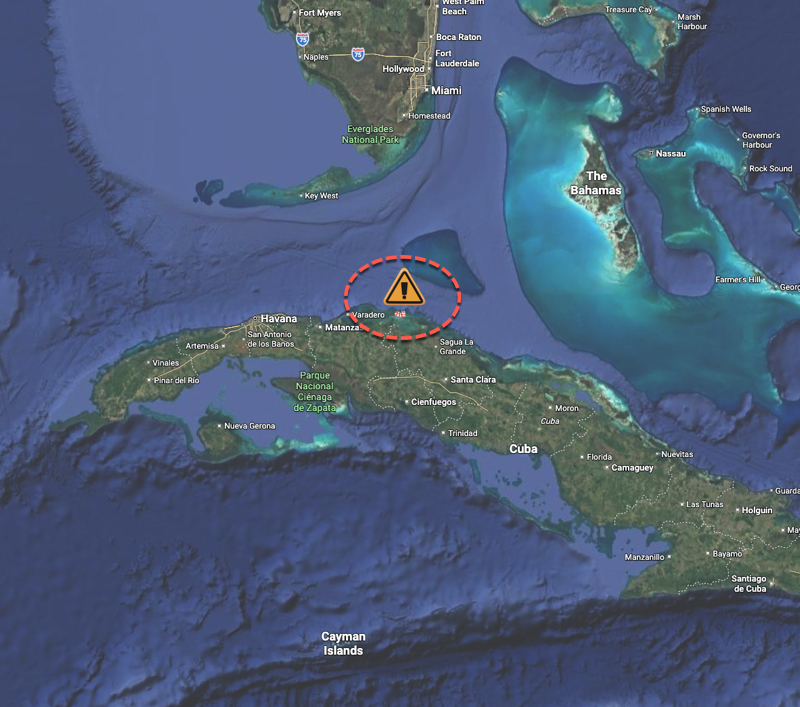
US Secretary of State Rubio said the US will investigate a deadly speedboat shooting off Cuba after the Cuban Interior Ministry reported its forces killed four people who allegedly opened fire from a Florida-tagged vessel.
US Event Calendar
8:30 am: United States Feb 21 Initial Jobless Claims, est. 216k, prior 206k
8:30 am: United States Feb 14 Continuing Claims, est. 1858k, prior 1869k
8:45 am: United States Fed’s Miran on Fox Business
10:00 am: United States Fed’s Bowman Testifies Before Senate Banking on Regulation
2:30 pm: United States Fed’s Goolsbee Appears on Fox News
DB’s Jim Reid concludes the overnight wrap
After 4 months of non-stop rain, we had a mini heatwave in London yesterday. I hope you’ve survived the highs of 16 degrees Celsius if you were in the UK and parts of Europe. Even before this “heatwave”, I’ve been on maximum strength hay fever tablets for weeks now as it’s unfortunately that time of year for me again. There were no streaming eyes for the markets yesterday though as we saw another decent session, with the S&P 500 (+0.81%) closing within half a percent of its record high last month, whilst the STOXX 600 (+0.69%) hit a new all-time high. That was primarily driven by easing fears around AI, which meant that software and other tech stocks continued their rebound from Monday’s sell-off. Indeed, software stocks in the S&P were up +3.05% on the day, and the VIX index (-1.62pts) fell to a two-week low of 17.93pts. But the recovery in risk appetite was clear more broadly, with Bitcoin (+7.65%) bouncing back to $68,945, whilst US IG and HY spreads tightened back in from their YTD highs.
The tech mood did fade a bit after the US close though even as Nvidia’s results delivered a stronger-than-expected revenue guidance for the current quarter ($78bn s $72.8bn est.). The initially positive reaction faded as the company’s conference call offered limited detail on the revenue outlook, leaving the chipmaker’s shares little changed by the end of extended trading. So perhaps a sign of investors’ increased anxiety over AI valuations, even as the world’s most valuable company delivered a remarkable 73% year-over-year revenue growth with 75% gross margins. Meanwhile, we saw mediocre results from Salesforce, whose guidance for $46bn of revenue in the current year just about met analysts’ expectations but failed to assuage lingering worries over the outlook for software revenues. The company’s shares fell by about -4.5 % in extended trading. This has left futures on the NASDAQ down -0.34% overnight, with those on the S&P 500 a more modest -0.20% lower.
Ahead of those results, it had been a decent session on both sides of the Atlantic, with Nvidia (+1.41%) itself up to a 3-month high. That came alongside a broader recovery in the tech space, with the NASDAQ (+1.26%) and the Magnificent 7 (+1.53%) both advancing, alongside Europe’s STOXX Technology index (+1.48%). There wasn’t a single headline driving that, but the rebound came amidst growing scepticism about the scenario painted by Citrini Research, which outlined a situation where US unemployment reached double digits by mid-2028. Indeed, as Adrian and I outlined in our Tuesday note (link here), even our own AI tool said it was “a work of persuasive, emotional rhetoric”, with a reliance on emotional framing to create a sense of alarm.
Yesterday’s equity gains were also helped by some of the other names that had slumped following the Citrini paper, such as Doordash (+5.28%) and Capital One (+4.70%). Blue Owl (+5.78%) recovered for a second day from Monday’s two-and-a-half year low, with an improved credit market mood also seeing US IG and HY credit spreads narrow by -1bp and -4bps from YTD highs. However, the breadth of equity gains was narrower than on Tuesday, with the equal-weighted S&P essentially unchanged (+0.03%). The S&P homebuilder index (-3.69%) was a notable laggard, weighed on by underwhelming earnings from home improvement retailer Lowe’s (-5.59%) and the absence of new housing measures in President Trump’s State of the Union address the previous evening.
Still, the growing optimism on the near-term outlook (and diminishing fears of mass unemployment) led to a clear risk-on move for several asset classes. A notable feature yesterday was that investors kept dialling back the likelihood of an H1 rate cut. The odds of a cut by the June meeting (the first with a new Chair) fell beneath 50% for the first time this year to end the day at 48%, suggesting more doubt about an immediate rate cut by Kevin Warsh, particularly now core PCE is back to 3.0%. And with investors pricing out rate cuts, that meant US Treasuries struggled across the curve. So the 2yr yield (+0.9bps) was up to 3.47%, whilst the 10yr yield (+2.3bps) rose to 4.05%. The moves in the belly and at the long-end also weren’t helped by a soft 5yr auction that saw $70bn of bonds issued +0.7bps above the pre-sale yield, with primary dealer take up rising to its highest since last March. So some signs of a softening in Treasury demand after the recent rally, with a 7yr auction today the next test. Having said that, yields have edged back down just shy of a basis point this morning across the curve.
Earlier in Europe, sovereign bonds had put in a stronger performance, with a fresh tightening in sovereign bond spreads too. So yields on 10yr Italian BTPs (-0.6bps) hit their lowest since December 2024, and those on French OATs (-1.2bps) fell to their lowest since July. By contrast, 10yr bund yields (+0.1bps) were steady, but that also meant France’s 10yr spread over Germany fell to just 55bps, the tightest since Macron called the snap legislative election back in June 2024.
Looking forward, UK politics will be back in the spotlight today, as a by-election is taking place in the Greater Manchester seat of Gorton and Denton. That’s a significant one, because the governing Labour Party won it convincingly at the general election in 2024 but opinion polls suggest they could lose it today, which would put Prime Minister Starmer’s position under growing pressure. That matters for gilt markets because of concerns about a new PM easing the fiscal rules and borrowing more. So there’s been a clear pattern of gilt sell-offs when questions around Starmer’s survival have resurfaced, and today’s vote represents another moment where that could happen.
Asian equity markets continue to rise overnight with the KOSPI (+3.11%) again leading the way, and again achieving another record high, primarily driven by chipmakers Samsung and SK Hynix. It’s just over a percentage point shy of +50% YTD before the end of February! Elsewhere, Japanese stocks are also at fresh record highs, with the Nikkei (+0.10%) and the Topix (+0.94%) continuing to build on gains from the previous session as investors have adjusted their expectations regarding further interest rate increases by the Bank of Japan. The S&P/ASX 200 (+0.50%) is also performing well, reaching a record high due to ongoing strength in mining and banking shares. Conversely, mainland Chinese equities are experiencing slight declines, with the CSI (-0.17%) and the Shanghai Composite (-0.08%) both dipping marginally, taking a moment to consolidate after significant rallies in the last two sessions. The Hang Seng (-0.81%) is also in negative territory as local technology stocks have retreated after gains earlier this week.
In monetary policy action, the Bank of Korea (BOK) kept its benchmark interest rate unchanged at 2.50% while signalling that policy would stay unchanged for the next six months as a chip boom in exports and steady inflation allow policymakers more time to assess financial stability risks. Meanwhile, the central bank raised its growth forecast for 2026 to 2.0% from a previous estimate of 1.8% citing stronger-than-expected chip exports. Following the decision, yields on the policy-sensitive 3yr government bonds fell -4.6bps to trade at 3.12% as we go to print.
Over on the tariff front, there hasn’t been much in the way of concrete news, but we did get a few comments from US Trade Representative Greer on the path forward yesterday. He said that President Trump would raise the current 10% rate to 15% “where appropriate”, and when it came to the deals already agreed, he said they wanted “to give continuity and be able to be in a position where we can honor the deals”. So that suggested that a country like the UK, which agreed a 10% tariff deal with the US last year, might not be affected by a rise in the global rate to 15%. That had been a concern earlier in the week, as the new global rate had raised fears of fresh retaliation, with the EU already having paused ratification of the deal they agreed with the US last year.
Looking at the day ahead now, data releases include the US weekly initial jobless claims, the Euro Area M3 money supply for January, and the European Commission’s economic sentiment indicator for the Euro Area in February. From central banks, we’ll hear from ECB President Lagarde and the ECB’s Dolenc, along with the Fed’s Bowman and the BoE’s Lombardelli. Finally in the UK, there’s a parliamentary by-election in Gorton and Denton.
Tyler Durden
Thu, 02/26/2026 – 08:40
https://www.zerohedge.com/markets/futures-flat-despite-blowout-nvidia-earnings
Jobless Claims Continue To Show No Signs Of Labor Market Stress
Jobless Claims Continue To Show No Signs Of Labor Market Stress
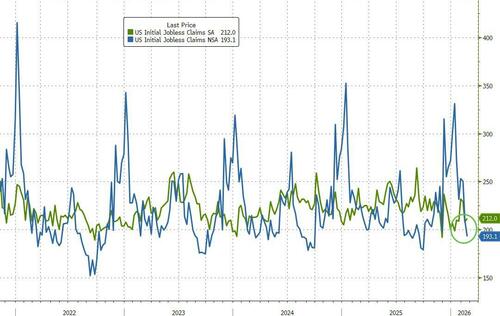
Initial jobless claims continue to hover near multi-decade lows, refusing to show any signs of labor market stress.
Last week saw 212k American file for jobless benefits for the first time (below the 216k expected). Unadjusted claims tumbled to the lowest since September…
Source: Bloomberg
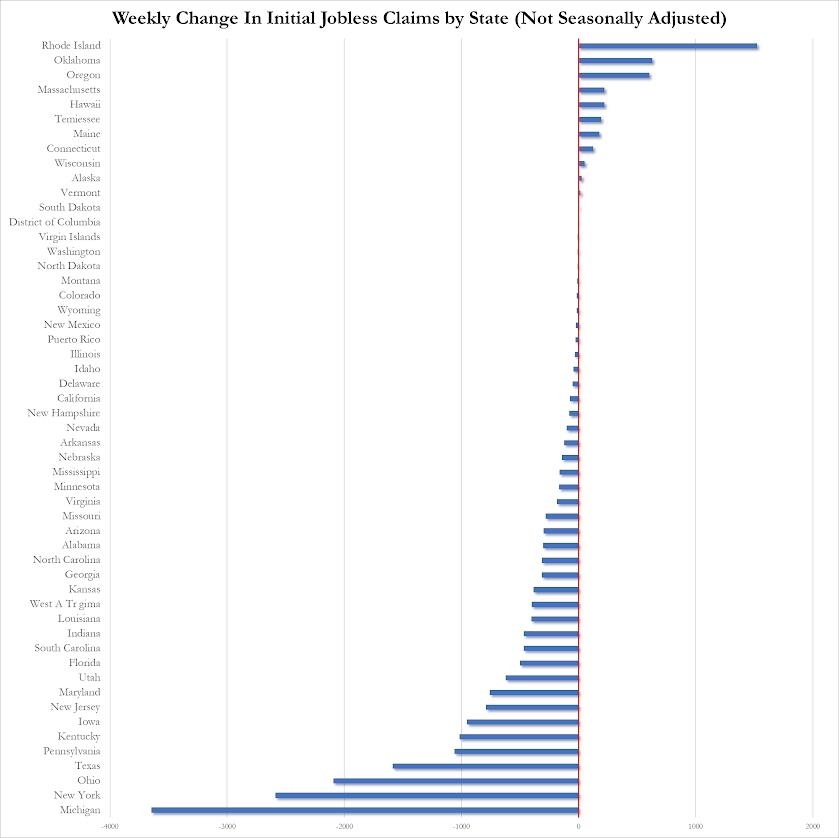
Michigan and New York saw the largest drop in initial jobless claims last week while Rhode Island and Oklahoma saw the bigger rise in claims…
The number of Americans filing for continuing jobless claims also dropped last week to 1.833 million (well below the 1.9mm Maginot Line)…
Source: Bloomberg
It seem the ‘no fire’ side of the ‘no fire-no hire’ economy continues to support trend growth.
Tyler Durden
Thu, 02/26/2026 – 08:37
https://www.zerohedge.com/personal-finance/jobless-claims-continue-show-no-signs-labor-market-stress
Ecuador anuncia otro incremento de aranceles aduciendo inacción de Colombia en seguridad fronteriza
Associated Press
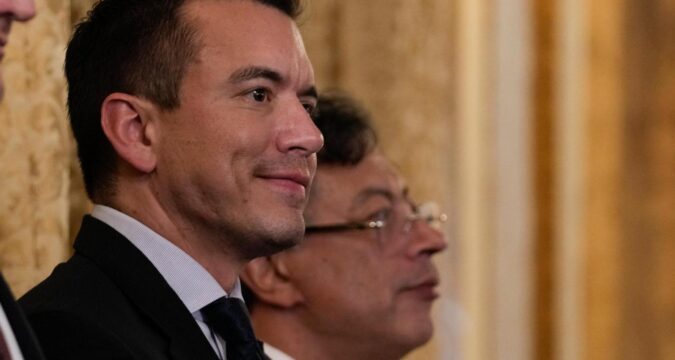
QUITO (AP) — El gobierno de Ecuador anunció el jueves un nuevo aumento de los aranceles para Colombia de 30% a 50% aduciendo que ese país no ha realizado acciones concretas para controlar la seguridad en la frontera binacional.
Un comunicado del Ministerio de Producción, Comercio Exterior e Inversiones argumentó que “tras constatar la falta de implementación de medidas concretas en materia de seguridad fronteriza” por parte de Colombia, Ecuador se ve en la obligación de “adoptar decisiones soberanas” que entrarán en vigencia desde el 1 de marzo.
Es una resolución que “responde a criterios de seguridad nacional para fortalecer la corresponsabilidad”, aseguró.
La medida del gobierno ecuatoriano contrasta con las declaraciones que dio la víspera la canciller Gabriela Sommerfeld, quien señaló que los diálogos con el vecino país continúan.
“Se mantiene el diálogo, nuestro embajador en Colombia tiene permanente comunicación en Colombia con las autoridades y lo propio hacemos aquí”, aseguró.
A fines de enero se desató la tensión entre ambos países tras la imposición unilateral del gobierno ecuatoriano de aranceles del 30% a todas las importaciones colombianas en reclamo por una supuesta falta de control de la seguridad fronteriza, donde por el lado colombiano operan con relativa libertad grupos de narcotraficantes que envían grandes cantidades de droga a Ecuador.
Ecuador también alegó una balanza comercial bilateral deficitaria en unos 850 millones de dólares.
Delegaciones binacionales, incluso dos reuniones a nivel de cancilleres, han buscado llegar a acuerdos por vía diplomática a fin de solucionar las diferencias, pero los acercamientos no han dado resultados.
Aunque los aranceles de Ecuador están vigentes desde inicios de febrero, el gobierno colombiano impuso hace dos días una medida que equipara en 30% los aranceles a un grupo de productos de Ecuador.
Ambos países también han recurrido este mes a la Comunidad Andina, en la que Colombia acusó a Ecuador de incumplir los acuerdos de Cartagena de 1969 por lo que denominó aranceles no permitidos, mientras los ecuatorianos presentaron tres reclamos por incumplimientos de las autoridades colombianas en temas comerciales.
Empresarios de ambos países han expresado preocupación y advirtieron que los aranceles afectan a empresas, trabajadores y consumidores de ambos lados de la frontera.
Transportistas, comerciantes y ciudadanos de la zona limítrofe han realizado protestas sobre el Puente Internacional Rumichaca, en la frontera común, en demanda de que ambos gobiernos suspendan la imposición de aranceles que aseguran afecta al comercio bilateral.

Fuerzas del gobierno sirio y combatientes drusos intercambian reos capturados en choques de verano
Por GHAITH ALSAYED
AL-MATUNA, Siria (AP) — Las fuerzas del gobierno sirio y milicianos drusos que controlan zonas de la provincia sureña de Sweida intercambiaron prisioneros el jueves, capturados en enfrentamientos del verano pasado, un paso poco común hacia una posible resolución política de las tensiones latentes en el país.
El intercambio fue la primera gran señal de avance en los intentos de Estados Unidos y Jordania por mediar un acuerdo político entre ambas partes.
El gobierno sirio entregó a 25 prisioneros y las autoridades locales en las zonas de Sweida administradas por los drusos liberaron a 61 en un puesto de control en el área de al-Matuna, en el norte de Sweida. El canje fue facilitado por el Comité Internacional de la Cruz Roja (CICR).
El portavoz del Ministerio del Interior sirio, Noureddine al-Baba, dijo a los periodistas que el acuerdo de intercambio se alcanzó “mediante los esfuerzos combinados de partes internacionales y locales, y refleja el compromiso del Estado sirio con todos sus ciudadanos, de todos los orígenes y afiliaciones y en todas las provincias”.
Stephan Sakalian, jefe de la delegación del CICR en Siria, subrayó “la esperanza de que esta operación allane el camino hacia posibles liberaciones adicionales y el diálogo entre todas las partes sobre otras preocupaciones humanitarias”, incluido el destino de las personas que desaparecieron en los hechos de violencia.
A mediados de julio, grupos armados afiliados al líder druso jeque Hikmat al-Hijri se enfrentaron con clanes beduinos locales, lo que impulsó la intervención de las fuerzas gubernamentales, que en la práctica se alinearon con los beduinos.
Cientos de civiles, en su mayoría drusos, murieron, muchos a manos de combatientes del gobierno. Decenas de miles de personas, tanto drusas como beduinas, fueron desplazadas por los combates.
Desde entonces, un gran grupo de milicias se unió bajo el mando de al-Hijri, creando una zona de facto anónima en amplias franjas de la provincia, respaldada por el vecino Israel.
Desde que el expresidente sirio Bashar Assad fue derrocado en una ofensiva encabezada por insurgentes islamistas en diciembre de 2024, las nuevas autoridades en Damasco han tenido dificultades para unificar el país y consolidar el control sobre el territorio.
Un acuerdo alcanzado el mes pasado con las Fuerzas Democráticas Sirias (FDS), lideradas por kurdos, que han controlado gran parte del noreste del país, fue un paso significativo hacia la consolidación —y también dejó a Sweida como la principal zona que permanece fuera del control del gobierno.
La secta religiosa drusa surgió como una escisión del ismailismo del siglo X, una rama del islam chií. Más de la mitad de los cerca de un millón de drusos en todo el mundo vive en Siria. La mayoría de los demás drusos vive en Líbano e Israel, incluidos los de los Altos del Golán, que Israel arrebató a Siria en 1967 y posteriormente anexó.
___
Esta historia fue traducida del inglés por un editor de AP con la ayuda de una herramienta de inteligencia artificial generativa.
Ten Cuban Nationals Aboard U.S.-Linked Speedboat Intended “Armed Infiltration For Terrorist Purposes,” Cuba Claims
Ten Cuban Nationals Aboard U.S.-Linked Speedboat Intended “Armed Infiltration For Terrorist Purposes,” Cuba Claims
The Cuban Embassy’s official X account says a Florida-registered speedboat carrying 10 Cuban nationals residing in the U.S. entered Cuban territorial waters armed with assault rifles, body armor, improvised explosive devices, camouflage uniforms, and telescopic sights, in what the government says was a “foiled armed infiltration” into the Caribbean island nation.
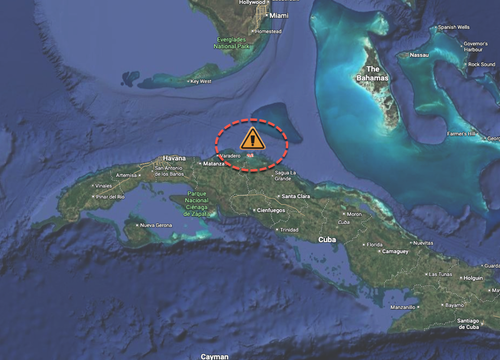
Late Wednesday afternoon, the embassy’s account reported that Cuban border guards aboard a vessel had fired on a U.S.-linked speedboat off Cuba’s north coast, killing four people and injuring six others.
By late Wednesday, the embassy provided additional details about what the group of “Cuban nationals residing in the United States” was allegedly attempting to do, describing it as an effort to “carry out an infiltration for terrorist purposes.”
Here’s what the embassy said:
Participants in Foiled Armed Infiltration in Villa Clara Identified
As part of the ongoing investigation into the armed attack against a patrol vessel of the Border Guard Troops of the Ministry of the Interior, in the northeastern area of the El Pino channel, at Cayo Falcones, municipality of Corralillo, Villa Clara province, the following update is provided:
Authorities have confirmed that the intercepted speedboat, registered in the State of Florida under number FL7726SH, was carrying 10 armed individuals who, according to preliminary statements by those detained, intended to carry out an infiltration for terrorist purposes.
The following items were seized: assault rifles, handguns, improvised explosive devices (Molotov cocktails), body armor, telescopic sights, and camouflage uniforms.
. . .
All participants are Cuban nationals residing in the United States. Most have prior records involving criminal and violent activity…
Participants in Foiled Armed Infiltration in Villa Clara Identified
As part of the ongoing investigation into the armed attack against a patrol vessel of the Border Guard Troops of the Ministry of the Interior, in the northeastern area of the El Pino channel, at Cayo Falcones,… pic.twitter.com/s9IFmUkqvk
— Cuban Embassy in US (@EmbaCubaUS) February 26, 2026
U.S. Secretary of State Marco Rubio commented on the incident, saying, “What I’m telling you is we’re going to find out exactly what happened and who was involved. We’re not going to just take what somebody else tells us. I’m very confident we will be able to know the story independently.”
SECRETARY RUBIO on CUBA: What I’m telling you is we’re going to find out exactly what happened and who was involved. We’re not going to just take what somebody else tells us.
I’m very confident we will be able to know the story independently. pic.twitter.com/965ul2lC8b
— Department of State (@StateDept) February 26, 2026
The Trump administration’s current posture toward Cuba is geared toward increasing pressure on Havana and ridding the island of communism. As noted yesterday, the key question is how the administration frames the narrative around the maritime incident, whether it uses it to shape public opinion, and whether this marks the early stages of a new narrative that supports future intervention to topple the communists in Havana.
Tyler Durden
Thu, 02/26/2026 – 08:25

Big Ten and SEC study: Pooling TV rights ‘dangerously unworkable’ and not as profitable as suggested
A study commissioned by the Southeastern Conference and the Big Ten concluded that allowing conferences to pool their media rights — a key proposal among some looking to solve money problems in college sports — would generate less revenue than if the leagues continue the decades-old practice of selling their own games.
The idea of pooling media rights has been touted by some lawmakers and sports leaders as the best way to supercharge revenue and ensure college sports remains solvent in a new, more-expensive era brought on by name, image and likeness (NIL) payments to college players.
The study, a copy of which was shared Thursday with The Associated Press, estimated that at the rate leagues like the SEC, Big Ten, Atlantic Coast Conference and Big 12 are increasing the value of their media rights, they would outperform one much-cited projection that said schools could add $7 billion in worth over the next decade or so by pooling the rights.
“The … proposal not only fails to produce more revenue than the current conference structure but also introduces a dangerously unworkable model and new risks to the college sports landscape,” the paper said.
The $7 billion projection is the brainchild of Cody Campbell, the billionaire head of the board of regents at Texas Tech, who established a nonprofit called Saving College Sports, which is the focal point of the paper’s analysis.
Both Campbell and a Democrat-backed bill in the Senate, called the SAFE Act, have proposed rewriting the 1961 Sports Broadcasting Act, which bars the conferences from combining their TV rights.
Campbell has acknowledged that the unspooling of TV contracts that have varying expiration dates between the league and broadcasters would take years. The SCS proposes creating an independent entity charged with maximizing revenue, with options to sign on to what could be a reworked Sports Broadcasting Act within 12 years.
He has been critical of conference commissioners, saying that rather than looking at the big picture, “all they care about is what happens to them. And I think that is fundamentally the problem.”
The SEC’s Greg Sankey shot back at that by saying Campbell’s views “reflect a fundamental misunderstanding of the realities of college athletics.”
Sankey and Big Ten commissioner Tony Petitti hired the FTI Consulting Firm, which pokes holes in virtually all of Campbell’s assumptions, including the idea that college sports could replicate NBA and NFL revenues by pooling their games.
The study said the NBA’s recent $6.9 billion-a-year deal spread across a number of national networks and streamers “reflect a number of market dynamics and are not simply the result of ‘aggregation.’”
“Instead, the NBA was successful in selling smaller packages of games to larger numbers of distributors thereby increasing market demand and adding additional media partners for smaller packages,” the report said.
The relatively small number of NBA (30) and NFL (32) teams compared to the 136 that would be part of a college pool (if every school agreed to participate) makes those deals more manageable, according to FTI.
The study also took a historical perspective, including a reference to a seismic shift in college football TV rights in the early 1980s.
After the Supreme Court declared that the NCAA’s pooling of games violated antitrust laws, schools formed the College Football Association to package games. The study said that arrangement produced less revenue: $43.6 million, compared to $69.7 million under the NCAA package.
That spurred Notre Dame to leave the group, followed by a steady exodus by the conferences, which led to the system that is in place today in which all the leagues parcel out their own media rights, mostly to ESPN, CBS, Fox and NBC.
“Decentralization also helps preserve the unique character of college sports — an incredibly important brand attribute,” the study said.
https://www.chicagotribune.com/2026/02/26/college-tv-rights-pooling-profits/

Naperville North’s Carson Loughlin champions his teammates. Right to the end. ‘Everyone brought something.’
Naperville North senior guards Carson Loughlin and Max Steele made a lot of great plays this season.
They made a few more against Yorkville in a playoff opener on Wednesday. There just wasn’t enough of them.
“Yorkville played better basketball today,” Loughlin said. “They were more physical. They won the 50-50 balls. If we had a do-over, we would do that differently, and we would come back. But we didn’t do that tonight.”
Indeed, the fourth-seeded Huskies fell just short as the 13th-seeded Foxes pulled a 46-40 upset in a Class 4A Naperville North Regional semifinal.
Joey Jakstys, a 6-foot-8 forward who is considered one of the top sophomores in Illinois, led all players with 21 points, including four 3-pointers, and seven rebounds for Yorkville, which outscored the Huskies 13-5 down the stretch.
Loughlin scored on a layup off a feed from Steele that gave Naperville North (23-9) a 35-33 lead with 4:30 left in the fourth quarter, but the Foxes (15-12) responded with a 7-0 run to take the lead for good. Steele’s 3-pointer off a pass from senior guard Miles Okyne pulled the Huskies within 40-38 with 1:02 to go, but they could get no closer.
Naperville North’s Miles Okyne (4) takes the ball to the basket against Yorkville during a Class 4A Naperville North Regional semifinal on Wednesday, Feb. 25, 2026. (James C. Svehla / Naperville Sun)
“Yorkville is obviously a great team,” Loughlin said. “I hope they go far and make a run.”
It was the end of the line for a senior class that led the Huskies to 40 wins over the past two seasons. Okyne scored a team-high 14 points against Yorkville. Loughlin added 12 points, and Steele had six points.
That trio and senior forward Will Harvey started together the past two seasons. The senior class also included reserves Antonio Brown, Jake Victor, Jake Ryan, Daniel Ispahany, Darian Azarbad and Ethan Brock.
“I love these boys,” Loughlin said. “A lot of us grew up playing basketball and other sports together. It’s been fun growing up with each other, and it was a great team. It didn’t end how we wanted, but it was still fun, and we had a great time.”
So did Naperville North coach Gene Nolan.
“It’s been a great two years with these guys,” Nolan said. “In terms of basketball, from the moment we met them in the summer going into their junior year, it’s as special, as cohesive and as intentional a group of kids that I’ve ever been around.
“This speaks to how great a group of kids they are — I could not wait to get to practice every single day because they are such positive young people. It was a really fun group to coach.”
The Huskies finished with the most wins in Nolan’s eight-year tenure. They reached the championship game of the Jacobs Holiday Classic and were runners-up to Neuqua Valley in the DuPage Valley Conference.
Naperville North’s Max Steele shoots from 3-point range during a Class 4A Naperville North Regional semifinal against Yorkville on Wednesday, Feb. 25, 2026. (James C. Svehla / Naperville Sun)
“Twenty-three wins, obviously a really successful season,” Loughlin said. “Just coming to practice every day, that’s what started it.
“However many people on our roster, everyone brought something that someone else didn’t. It was a complete team. Everyone helped each other out.”
That’s what Steele will remember most.
“It was just like a brotherhood,” Steele said. “Every day, we all looked forward to coming to practice, spending time together, and we’re all going to miss it like crazy.
“I’m going to miss coming to practice every day, joking around with the team, working hard with the team, seeing my coaches every day. So it will be hard not to be able to do that again.”
Especially after this season with this roster. What the Huskies lacked in high-profile, college-bound players, they more than made up for in cohesiveness.
“Just the team chemistry, on the court and off the court, I think everyone feels it,” Loughlin said. “It feels like a second family, and I’m going to miss them.”
Naperville North’s Carson Loughlin, center, soars to the basket between Yorkville’s Braydon Porter, left, and Frankie Pavlik, right, during a Class 4A Naperville North Regional semifinal on Wednesday, Feb. 25, 2026. (James C. Svehla / Naperville Sun)
As will Nolan. While there were plenty of tears after the game, regrets were few.
“They don’t need to win a game for me to be proud of them,” Nolan said. “I’m proud of them no matter what, and they were an awesome group to coach.
“Most importantly, they’re young men of high character and integrity, and their futures are so bright, and that’s what this is all about. We’re really going to miss this group, and they’ve definitely left a legacy of Naperville North basketball.”
Matt Le Cren is a freelance reporter.