Category: News

Willie Wilson: Gov. JB Pritzker’s budget does little to help Black and brown Illinoisans
Gov. JB Pritzker’s proposed $56 billion maintenance budget for 2027 does little to address the emergency of disparities that exist in Black and brown communities.
As Pritzker and elected officials know, the problems in these neighborhoods predate President Donald Trump. There is no doubt the administration’s policies have exacerbated long-standing issues.
However, Pritzker, who is running for a third term with an eye on the presidency, should channel state resources into closing the widening disparities in Black and brown neighborhoods.
Budgets are viewed as moral documents that reflect the government’s values and priorities. Pritzker’s budget should address systemic barriers to equity. These communities do not have the luxury of waiting for the new Congress or the next presidential administration.
Black and brown residents do not need play-it-safe budgets. They need budgets that transform communities and lead to entrepreneurship and investment in education, trade programs, jobs, health care and homeownership. Budgets that guarantee safe neighborhoods free of gun violence, smash-and-grab robberies and assaults.
The Black youth unemployment crisis in Illinois has become normalized. Eighty-one percent of Black 16- to 19-year-olds in Chicago were jobless in 2024, according to a recent report from the University of Illinois Great Cities Institute. The jobless rate among Black adults 20 to 24 years old was 46.5%, more than double the 18.9% rate for their white peers. The highest rate of joblessness is pervasive on the South and West sides of Chicago.
The Black homeownership rate today is virtually the same as it was when mortgage discrimination was legal. The Fair Housing Act of 1968 prohibited discrimination concerning the sale and financing of housing based on race, religion or national origin. In 58 years, the homeownership rate for African Americans has remained stagnant.
In 2025, the Black homeownership rate in Chicago was 43%, well below the 70% rate of white people. Latino homeownership has seen record growth in 2025. In Illinois, Latinos were responsible for 56% of homeownership growth over the last 10 years, and the current rate sits at 58.8%.
Homeownership is important for building long-term generational wealth and stable communities. A 2024 “Color of Wealth in Chicago” report noted the median net worth for Black households in Chicago is $0. The same report showed a net worth of $40,500 for U.S.-born Mexican families in Chicago, $24,000 for Puerto Rican families and $210,000 for white people.
During a recent visit to the Cook County Department of Corrections, I found out that the population of detainees had increased to more than 6,000. The Chicago Crusader reported that between January 2020 and November 2025, 54% of the 61 people who died while in custody in Cook County were Black.
With veterans sleeping under viaducts and the unhoused population using CTA trains, buses and libraries as their shelter, how can Pritzker’s budget cut funds for people who are unhoused? Black people account for 53% of the unhoused population, despite making up less than one-third of the city’s total population. Latinos account for 35% of the homeless population.
According to the Chicago Coalition to End Homelessness, Pritzker’s proposed cuts to the HOME Illinois program, as well as decreases to supportive housing and emergency and transitional housing line items, will likely halt progress made toward ending homelessness. High prices for rents, groceries, health insurance and other costs could drive more citizens into homelessness.
Pritzker’s budget also does not address the achievement gap. In Illinois, there are still wide gaps in proficiency rates between white, Black and Latino students in both English language arts and math.
A failure to address the education achievement gap could exacerbate the school-to-prison pipeline.
The following are suggestions to bring equity to Black and brown citizens:
• Illinois House Speaker Emanuel “Chris” Welch and Senate President Don Harmon should determine why Black homeownership is stuck at less than 50% and pass solutions to improve it.
• Welch, Harmon and Pritzker should fix the unfair property tax system that harms Black and brown communities.
• Pritzker and the Illinois legislature should opt into the Federal Tax Credit Scholarship program.
• Pritzker and the legislature should invest in job training and bring employment opportunities to vulnerable neighborhoods on the South and West sides of Chicago.
• Welch, Harmon and legislative leaders should close the 20-year life expectancy gap in West Garfield Park through significant state investment.
• Pritzker, Welch and Harmon should use Illinois state procurement contracts to stabilize Black and brown communities.
Illinois legislators can amend the governor’s maintenance budget and provide real investment in Black and Brown communities. The question is: Will they do the work or go along to get along?
I will convene clergy leaders to meet with Pritzker, legislative leaders and legislators to ensure the needs of low-income families and the working class are addressed in this budget.
I write this commentary to make those comfortable with withholding investments in Black and brown communities uncomfortable.
Willie Wilson is a business owner, philanthropist and former mayoral candidate.
Submit a letter, of no more than 400 words, to the editor here or email letters@chicagotribune.com.
https://www.chicagotribune.com/2026/02/26/opinion-jb-pritzker-budget-black-hispanic-illinoisans/

More than a week of celebration and funeral services for Rev. Jesse Jackson begins Thursday in Chicago
By Wednesday afternoon, the day before the first public visitation for the Rev. Jesse Jackson, long rows of barricades stretched throughout the parkway in the middle of Drexel Boulevard, where thousands are expected to gather Thursday and Friday to honor one of America’s most enduring civil rights leaders.
More than a week of services and funerals in memory of Jackson will begin Thursday morning at the Rainbow/PUSH Coalition, the civil rights organization he founded on the South Side in 1971. The visitation will begin at 10 a.m. and end at 10 p.m. on Thursday and Friday at the coalition’s headquarters at 930 E. 50th Street.
A titan of civil rights: Remembering Rev. Jesse L. Jackson
On Wednesday, a small group of workers prepared the grounds and the park across the street for those who will come to celebrate and to mourn. A small stage had been erected in the park near the coalition’s front entrance, along with the crowd-control barricades that lined the sidewalks for hundreds of yards in either direction.
Thursday is the beginning of a three-city, nine-day memorial tour, of sorts, that will also end in Chicago. After he lies in repose Thursday and Friday at the Rainbow/PUSH Coalition, Jackson, who died earlier this month at age 84, will lie in state on Monday at the South Carolina state capitol in Columbia. He was born about 100 miles away, in Greenville, S.C., in 1941.
Jackson ascended to national prominence not long after his arrival in Chicago in 1964 to attend the Chicago Theological Seminary. A year later he participated in the Selma to Montgomery marches, and he became a close friend and protege of Martin Luther King, Jr.
Jackson’s family has scheduled a formal service in his honor for next Wednesday in Washington, D.C. The mourning and celebration will continue the next day in Chicago, where Rainbow/PUSH will host a service for the organization and its alumni. A public funeral is scheduled for Friday, March 6, at House of Hope at 752 E. 114th St.
His family has invited President Donald Trump and every living former president to attend.
A private funeral service, which Jackson’s family is describing as a “homegoing celebration,” is scheduled for next Saturday, March 7, at the Rainbow/PUSH Coalition.
https://www.chicagotribune.com/2026/02/26/rev-jesse-jackson-chicago-services-begin/

CEO of Northfield-based Medline talks tariffs, IPO following company’s first earnings call
The CEO of Northfield-based Medline cheered the company’s successful initial public offering late last year while discussing how tariffs have taken a bite out of its profits, in an interview with the Tribune following the company’s first earnings call Wednesday.
Medline is a massive medical supply company that was owned privately for decades before its initial public offering in December raised more than $7 billion. It was the largest initial public offering of the year.
Medline CEO Jim Boyle told the Tribune that much of the impact of tariffs hit the company in the second half of last year. Tariffs cost the company about $290 million in 2025, which was less than the $325 million Medline had expected.
Medline’s earnings report Wednesday showed that sales increased nearly 15% in the fourth quarter of last year to $7.8 billion, compared with the fourth quarter of the previous year, fueled by new customer signings. But the company saw its net income drop 38% to $180 million in that same time because of tariffs and the costs of its initial public offering, among other factors. For all of 2025, sales increased by 11.5% compared with the previous year, and net income decreased by 3.6%.
Medline’s stock was down 3.6% at market close Wednesday.
To mitigate the effects of the tariffs, Medline adjusted its sourcing locations, used its U.S. manufacturing facilities and imposed a “modest” price increase in August, Boyle said.
“We actually chose to either absorb or mitigate the vast majority of the tariffs, which meant we took a pretty hefty hit to our margin because we wanted to be in the boat with our customers,” Boyle said. “We felt like we had to feel some of the pain with them.”
The company had projected that tariffs would cost it another $200 million in 2026, but that was before last week when the U.S. Supreme Court shot down the tariffs imposed by President Donald Trump. The Trump administration has since reimposed worldwide tariffs of 10%.
“We are currently evaluating the impact of the ruling, are aware that new tariff rates have been implemented and believe there’s a high likelihood that additional tariffs actions could take place,” Mike Drazin, Medline chief financial officer, said during the earnings call Wednesday. “… We do not intend to react immediately. Instead, we will take the time to thoughtfully assess the situation and determine the best course of action for our customers and for Medline.”
Boyle said Medline will seek tariff refunds if a pathway becomes available to do so.
Despite the impact of tariffs, Boyle expressed optimism about the company’s future and initial public offering late last year.
“It was a tremendous learning experience,” Boyle told the Tribune of the initial public offering, noting that the company held more than 300 meetings with investors. “We were the largest company, candidly, that no one had ever heard of. … It took a little while for us to educate the market as to who we are.”
Though Medline is a huge company — employing more than 45,000 people worldwide, including nearly 6,100 in Cook and Lake counties — most of the products it offers are hardly flashy. Medline sells hundreds of thousands of products, including medical supplies and instruments, patient gowns, personal protective equipment, Curad bandages and the iconic blue- and pink-striped blankets hospitals wrap around newborns.
Maria Cuenca adds a cap and gloves to a grouping of protective gear at Medline in Mundelein on Oct. 15, 2014. (Stacey Wescott/Chicago Tribune)
Of the money raised in the initial public offering, Medline put $4 billion toward paying down debt and is putting another $1 billion toward potential mergers and acquisitions moving forward, Boyle said.
Medline is looking to acquire businesses that can help it expand its product offerings, enter into new types of health care markets or offer new types of services or technology solutions, Boyle said.
What Medline will pursue specifically depends on what becomes available, Boyle said. “We’re opportunistic,” he said.
Also looking forward, Boyle said it’s possible cuts to Medicaid under Trump’s “One Big Beautiful Bill” could affect the company. The Congressional Budget Office has estimated that the new law will reduce federal Medicaid spending by $911 billion over 10 years, according to an analysis by KFF, a nonprofit organization focused on health policy.
“I think there is a potential for reduced volume because people won’t have access to health care,” Boyle told the Tribune. “I don’t expect it to be a robust reduction in volume, but there could be a moderate adjustment over time.”
He also expects the cuts to lead to more consolidation among health care providers, as they work to run their businesses more efficiently. Medline, however, is well positioned to take advantage of that consolidation, given that it sells products for all types of care, he said.
Despite the changes at Medline, Boyle said the company is growing and he doesn’t expect its headquarters to leave the Chicago area.
“Chicago has been our home for a long time and I don’t anticipate that changing,” Boyle said.
Brothers Jim and Jon Mills founded the company in 1966, building on the legacy of their grandfather A.L. Mills, who made surgeons gowns and uniforms during World War I at his company Mills Hospital Supply.
In 2021, the family agreed to sell a majority stake in the company to funds managed by private equity firms Blackstone Group, Carlyle Group and Hellman & Friedman. At the time of the sale, family members told the Tribune they went forward with the sale to raise cash for family members and to strengthen the company.
Boyle has been CEO of Medline since 2023, and first joined Medline in 1996 as a sales representative in Texas.
https://www.chicagotribune.com/2026/02/26/medline-tariffs-ipo-earnings-northfield/

Letters: President Donald Trump delivered more of the usual nonsense at his State of the Union
I watched the State of the Union address filled with hope that President Donald Trump would deliver a strong message. He did not disappoint!
He began with some of his most often-repeated half-truths and outright lies. Throughout the speech, there were the expected bits of misinformation and misdirection. And what would a Trump speech be without the childish taunts and insults?
Trump went above and beyond this time. He used Purple Heart and Medal of Honor recipients as props, as if the event was a campaign rally. Of course, these heroes deserve their honors, but what did that have to do with the State of the Union? Aren’t those honors more suitably given in White House ceremonies?
There were several other campaign props, none more notable than the Olympic gold medal-winning U.S. men’s hockey team. I love hockey, the fastest and most intense team sport there is, and I’m a huge Blackhawks fan. The Olympics, winter and summer, are must-see TV in our house. Connor Hellebuyck, goaltender for the Winnipeg Jets, is a decorated NHL stalwart. Trump pointed out, correctly, that several athletes have been awarded the Presidential Medal of Freedom. Those athletes were honored when their playing days were over and were tapped for their social and philanthropic efforts as well as their physical skills. Hellebuyck isn’t there yet.
I wonder: How many of those singled out by Trump awoke the next day with the realization that they had been used?
Beyond Trump vowing to continue the wildly unpopular immigration tactics and going around the Supreme Court tariff decision, no policy initiatives were offered.
The president delivered, all right. It was just more of the usual nonsense.
— Len Levy, Glenview
For shame, Democrats
In 2019, Joe Biden launched his presidential campaign focusing on uniting the country, rebuilding the middle class and offering an alternative to political, social and racial divisions.
So, what did he do? He and his party divided our country and failed the middle and lower classes with his rocketing increase in inflation. Now, years later, the Democrats continue their drive toward division.
They were elected and paid to represent their constituents in the federal government. Defaming the president and boycotting a State of the Union address are despicable!
— John Skaritka, Hampshire
Duckworth’s absence
I may not agree with everything the president does, but I am very disappointed Sen. Tammy Duckworth did not attend the speech. I voted for Duckworth to represent me; the least she can do is attend the biggest speech to Congress the president gives every year.
I am also very disappointed with the current candidates to replace Sen. Dick Durbin, I want to send someone to Washington with ideas and the ability to reach across the aisle to create solutions to America’s problems — not just fight, fight, fight or hurl expletives at the president.
— Rob Scharf, Mundelein
Campaign promise
I listened to President Donald Trump’s State of the Union speech that contained many truths but also had many misleading or dishonest statements. What is sad is how he left out the campaign promise he made to the voters that if elected, he would quickly resolve the Ukraine-Russia war. In reality, he has put Ukrainians in a position of weakness by cutting military weapon support. Increasing that support would put Ukraine in a strong position of bargaining a peace treaty.
Trump has no intention of strongly challenging Russia’s invasion; thus, he won’t fully arm the Ukrainians so they can bargain from a point of strength.
— Raymond Hubbard, Sandwich
Undemocratic actions
In President Donald Trump’s State of the Union address, his comments toward bipartisanship were: “These people are crazy, I’m telling you. They’re crazy. … Boy, oh boy. We’re lucky we have a country, with people like this. Democrats are destroying our country. But we’ve stopped it just in the nick of time, didn’t we?”
The majority of voters disagree with the president’s assessment. The political polls show that many Republican candidates running for office in the midterm elections this fall are lagging behind their Democratic opponents. Trump is truly aware of these findings and is doing everything in his power to destabilize that election. His undemocratic actions greatly undermine what happened 250 years ago: 56 delegates to the Second Continental Congress voted to approve the Declaration of independence on July 4, 1776.
— Sam Solomon, Deerfield
Dishonor to medal
Let’s not underestimate the trivialization of the Medal of Honor at Tuesday night’s State of the Union address.
The Medal of Honor is our nation’s highest military honor, which is awarded sparingly. It is given for actions while engaged in combat against an enemy of the United States, for the highest level of bravery, sacrifice and integrity while exhibiting a deep love of country and a desire to always do what is right. “All recommendations require thorough reports on the act itself, the battlefield and its setting; at least two sworn eyewitness statements; and any other compelling evidence that can be gathered. Recommendation packets must be approved all the way up the military command structure,” the Medal of Honor website states.
I do not mean to diminish the actions of the Army pilot or Navy captain awarded the Medal of Honor at President Donald Trump’s State of the Union address; they gave more than I did during my brief tour in the Navy years ago. Awards may well be appropriate — at a minimum, a Purple Heart — but for someone wounded in a Trump-ordered raid less than 60 days ago and a centenarian veteran who fought 74 years ago, it seems to be insincere, improper, and both politically premature and politically manipulative.
It’s another attack by this administration on a deeply respected, time-honored American institution.
The Medal of Honor deserves our highest respect.
— Joe Szczepaniak, Wheaton
Trump’s reality show
President Donald Trump turned the State of the Union address into a reality show with all his guests and the presentations for them. More political showmanship than the state of the union
Democrats should have countered on their response with Jeffrey Epstein survivors and the families of citizens killed by federal agents while protesting in Minneapolis, along with those shot and brutalized in Chicago.
— Stephen T. White, Buffalo Grove
Diminishing a victory
Regarding the editorial “Team USA showed America at its best” (Feb. 24): The Olympics were, once again, glorious. The achievement of the U.S. men’s hockey team was breathtaking. That feeling of national pride was undone by none other than the president of the United States.
During a call into the locker room of the men’s team, he once again showed his true feelings by making a joke about having to invite the women’s gold medal-winning hockey team or he “would be impeached.” The men’s team thought that funny, along with the beer-guzzling director of the FBI (on a business trip using taxpayer funds). Truth be told, eight of America’s 12 gold medals were won by women. The women’s team declined the president’s invitation to visit.
This was a cheap and disgraceful end to a wonderful sporting event designed to bring the world closer together, not alienate half of the globe’s population.
— Joe Friedman, Chicago
Submit a letter, of no more than 400 words, to the editor here or email letters@chicagotribune.com.
https://www.chicagotribune.com/2026/02/26/letters-022626-state-of-the-union/

Bill Quinlan: The city should offer concessions to the Bears — but not at the expense of taxpayers
Like many Chicagoans, I have been watching the latest round of drama unfold as the Chicago Bears seek concessions from the city and state to keep their stadium here.
Sadly, this is not the first time we have seen this movie.
In the 1970s, amid disputes over Soldier Field and stadium conditions, the Bears raised the possibility of leaving Chicago and explored alternative sites — including options outside the city — as leverage in negotiations.
At the time, my father, William R. Quinlan, was corporation counsel under Chicago Mayor Richard J. Daley. When asked about the Bears potentially leaving, the mayor’s response was to say that if the team left, it could not take the “Chicago” name with it. The name belonged to the people of Chicago. The mayor then gestured to my father and said, “Isn’t that right, Bill?”
The Bears didn’t leave then. And they shouldn’t leave now.
No one wants to wake up one day to the “Chicago Bears of Hammond.” It makes me a little sick even typing that.
But the question remains: Should taxpayers subsidize a plan to keep the team?
The city has already given the Bears a favorable lease at Soldier Field. Now the team says it wants more — its leaders want to be the landlord, not a tenant, and they want financial assistance.
But Chicagoans already pay too much in taxes and fees. Raising them further is not just unpopular — it’s counterproductive. We might keep the Bears but drive more of our own residents to watch games from the suburbs, or worse, from some more tax-friendly state such as Florida or … Indiana.
The city should be willing to offer the Bears some concessions to keep them in Chicago but not on the backs of taxpayers. No property tax hikes. No sales tax increases. If there are concessions, they should be targeted as entertainment taxes on corporations buying premium suites or hotel-related revenues tied directly to games and events.
More importantly, if the public gives something to keep the Bears, the public should certainly get something of value in return.
My proposal, which is informed by touring city neighborhoods and listening to residents in my campaign outreach through Leading a Better Chicago, is simple and strategic: In exchange for any meaningful concessions, the Bears should agree to move Halas Hall and their football operations from Lake Forest to the city of Chicago.
Put the Bears’ headquarters, practice facilities and day-to-day operations in the city and make it a fan destination. What that would look like in action:
• Real economic development in the city.
• Tourism opportunities for year-round activity from practices, camps and special events.
• Players actually living in Chicago instead of commuting from the northern suburbs.
This kind of proposal is what a deal for the people of Chicago should look like: creative and rooted in long-term value, not short-term political wins or two-year plans built around the next election or the next ambition.
The Bears want something from us, but we should be just as clear about what we want from them.
Just a thought from the son of someone who helped deal with this issue one of the last times the Bears threatened to head east.
Bill Quinlan is a Chicago attorney and the founder of civic advocacy group Leading a Better Chicago.
Submit a letter, of no more than 400 words, to the editor here or email letters@chicagotribune.com.
https://www.chicagotribune.com/2026/02/26/opinion-chicago-bears-stadium-leaving-chicago/
Editorial: Illinois confronts its housing shortage — at last
Affordability, or the lack of it, was the primary talking point of nearly every candidate with whom we met during our weekslong endorsement conversations.
That buzzword was largely tied to the cost of groceries during the 2024 campaigns, and while food costs still are a serious concern, the affordability discussion today is centered more on the lack of reasonably priced housing.
Thankfully, new ideas are emerging on how to solve this problem, and we’re all ears.
We endorsed newcomer Nick Uniejewski in Illinois’ 6th Senate District Democratic primary. He has mastered the housing affordability issue and would offer up not only fresh energy to the state’s Democratic supermajority but also new ideas to increase housing supply.
More recently, Gov. JB Pritzker in his Feb. 18 budget address unveiled a housing abundance package and called for state legislation to incentivize the construction of far more new housing. We suspect Uniejewski and his YIMBY peers are thrilled.
It didn’t take long for a bill to emerge. There’s a lot to like about the legislation (House Bill 5626, filed by state Rep. Kam Buckner shortly after Pritzker’s address).
We like that it would speed up permitting, which today often is a painfully slow process. Municipalities would be required to complete their permitting processes more expeditiously. If that doesn’t happen, it would allow for “third party review,” essentially letting applicants hire their own private inspector — a licensed architect or engineer — instead of waiting on the government. States like Florida, Tennessee and Texas have adopted this policy to expedite development, with some success.
The legislation would require municipalities across the state to allow construction of accessory dwelling units (ADUs), often referred to as granny lots, in areas currently zoned for single-family homes. This page is a proponent of granny flats, and we appreciate, too, that that bill doesn’t require new such units to be built by union members, a needless impediment added last year to Chicago’s granny flats ordinance. If a project passes inspection, who cares who built it? Here’s hoping labor doesn’t tack that onto this statewide legislation.
These reforms won’t make homes cheaper or flip a switch on development overnight, but they will go a long way to foster more housing supply, which is how we’ll eventually lower those costs. Illinois has a shortage of 142,000 homes and needs to build 227,000 units over the next five years to keep up with demand, according to research from the Illinois Economic Policy Institute and the Project for Middle Class Renewal at the University of Illinois Urbana-Champaign.
In general, we don’t like the state ordering localities around on matters as sensitive as development within their borders, but the steps discussed above strike us as justified given the magnitude of the problem. There are parts of this bill that go too far, though.
This bill effectively bars single-family-only zoning for lots over a certain size.
State preemption at this sweeping level is a radical departure from the current system. Yes, municipalities could still write their own zoning rules, but only within tight guardrails set by the state. That’s not going over well with local officials.
“Illinois communities vary widely in geography, population density, infrastructure capacity and housing demand. Uniform statewide standards cannot adequately reflect those differences or the planning efforts underway or completed in many municipalities,” the Illinois Municipal League said in a statement after the governor’s announcement.
We are also well aware that local authority often has proved to be too much of an impediment when it comes to new housing, with trustees and boards that gate-keep what gets built. When local governments serve more as an exclusive HOA than officials tasked with embracing housing development that promotes strategic growth and affordability, that’s a problem. By and large, local control has yielded insufficient supply.
Certainly, there are avenues for compromise. New Jersey recently came close to adopting its own statewide housing guidance before Gov. Phil Murphy used a pocket veto to halt the effort. That bill would’ve allowed the state to incentivize local governments to adjust zoning regulations to support additional housing. Carrots rather than sticks make sense to us.
Illinois lawmakers could also consider carving out municipalities under a certain size or tying rule changes to areas within close proximity to public transportation, major highways or central business districts. There is precedent for the latter in the way Chicago changed its parking requirements last July (eliminating minimum parking requirements for new residential and commercial developments within a quarter mile of CTA bus corridors or half a mile of rail stations). This is already the way many major suburbs have zoning set up already, yielding a growing number of multiunit buildings in high-demand places such as Arlington Heights.
We understand that we’re unlikely to achieve large-scale development and a widespread shift in mindset on important policies to encourage new housing without elevating the conversation to this level, but we hope the governor brings locals to the table before ramming this down their throats. Most villages don’t have enough incentive to change on their own, but they don’t deserve to have their authority completely undermined, either.
We’ll add that no housing reform conversation can ignore Illinois’ exceptionally high property tax burden, which continues to discourage development and homeownership. This legislation doesn’t touch that essential component of affordability.
Property taxes aside, Pritzker’s plan has all of the right red-tape-cutting ideas baked in, and we are pleased to see the governor championing this issue. In fact, many of the proposals in this bill offer an excellent blueprint for local reforms. Smart leaders would be wise to take heed and adopt many of these ideas voluntarily and preemptively.
Submit a letter, of no more than 400 words, to the editor here or email letters@chicagotribune.com.

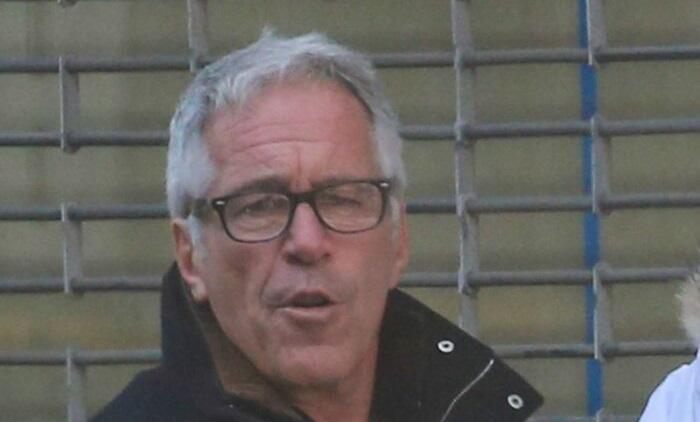
‘Nude Photos, Video Tapes & Sex-Slave Manuals’: Epstein Rushed Evidence Into Secret Storage Unit Before Raid
‘Nude Photos, Video Tapes & Sex-Slave Manuals’: Epstein Rushed Evidence Into Secret Storage Unit Before Raid
Jeffrey Epstein paid private detectives to remove items from his Palm Beach property and store them in a secret storage locker shortly before he was raided by police in 2005. The storage unit contained three computers, 29 address books, a three-page list of Florida masseuses.
The stash also included nude photographs believed to be of Epstein’s victims, VHS tapes, DVDs ‘eroticising teenagers’ and porno mags, The Telegraph reports.
An 8mm video cassette tape was also locked away in the storage unit, apparently containing footage of someone in the shower and a woman in lingerie, as well as a 2005 calendar, greeting cards, letters and laboratory results.
The investigators also hid sex toys, body massagers, lingerie, cash, a concealed weapon permit, and a Harvard ID card. The inventory was emailed to Epstein and his lawyers in August 2009, a month after he was released from jail for soliciting a minor for prostitution.
Also interesting, some of the computer material ‘appeared to be missing,’ including ‘equipment that would have linked to surveillance cameras.’
That fuelled speculation that Epstein might have been recording explicit covert material without people’s knowledge, either for his own sexual gratification or for blackmail purposes.
And what do we have here? A guy who was installing recording equipment on Epstein’s island in 2014, and was named as a $1 million beneficiary in Epstein’s trust.
Ruan worked for Epstein on the island property known as “LSJ” and was the primary technology person handling cameras and networking. He later transitioned the island to Ubiquiti equipment starting in late 2017.
Ruan was also named as a $1 million beneficiary in Epstein’s trust…
— IredcapI (@IredcapI) February 26, 2026
According to the report, the FBI did have copies of the two computer drives.
The Palm Beach storage unit was just one of at least six such lockers across the United States that Epstein used to store files, computers and other items from his multiple properties – but search warrants reviewed by The Telegraph “suggest that US authorities never raided these lockers, raising the possibility that they contained unseen evidence relating to Epstein and his associates.”
US authorities have long suspected that Epstein was tipped off before the October 2005 raid at his Palm Beach mansion, with former Palm Beach police chief Michael Reiter commenting that “the place had been cleaned up.”
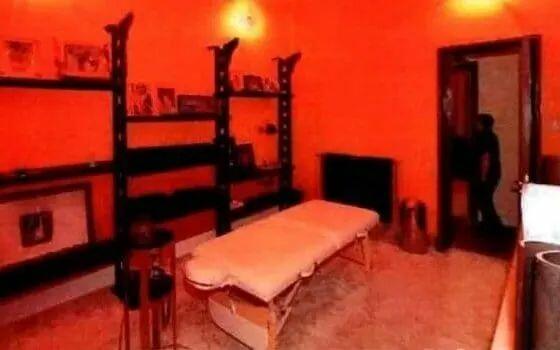
Meanwhile, French Police have released previously unseen pictures from Epstein’s Paris apartment, including one featuring a massage table and pictures of naked women hanging on the wall.
Pictures released by police show Epstein’s Paris home
Many victims have long alleged that Epstein secretly recorded encounters inside his homes, possibly for blackmail.
Yet an internal FBI memo released in a later document tranche stated that investigators found no evidence supporting the theory that Epstein maintained video recordings of abuse involving other powerful figures.
“We are aware of the theories circulated in the media and online that Epstein video recorded the abuse of his victims, including by other men, but we have found no evidence to support that theory,” the memo said.
The agency added that if such material had existed, it would have been used in criminal prosecutions.
Copies of two hard drives from the Palm Beach locker were eventually recovered at Epstein’s New York residence following his 2019 arrest, but the original computers are believed to have never been found. An FBI forensic analyst later testified that the drives contained photos of Epstein and Ghislaine Maxwell and a job advertisement written by “GMax” seeking a massage therapist – but no explicit recordings of abuse.
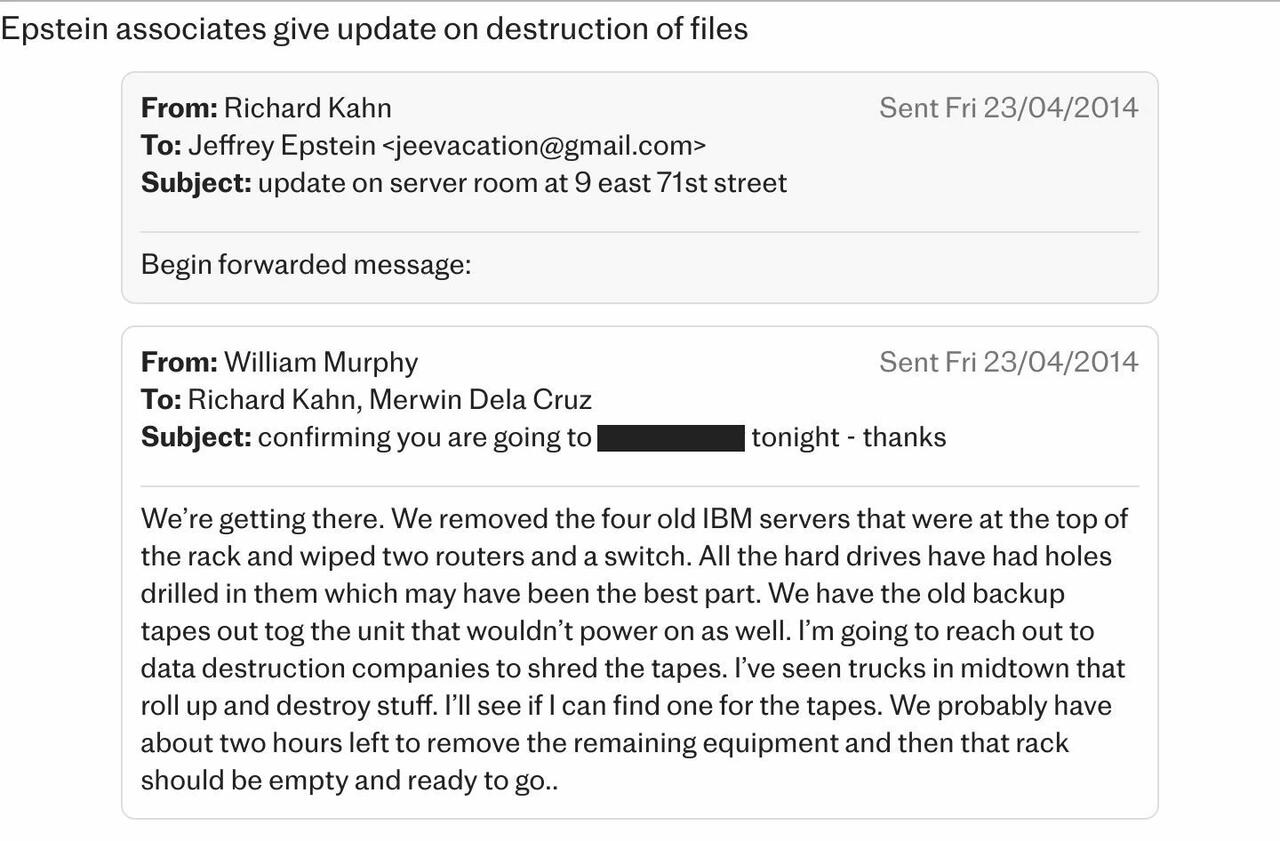
Meanwhile, emails show Epstein repeatedly ordered staff and associates to wipe computers and shred tapes in the years leading up to his death.
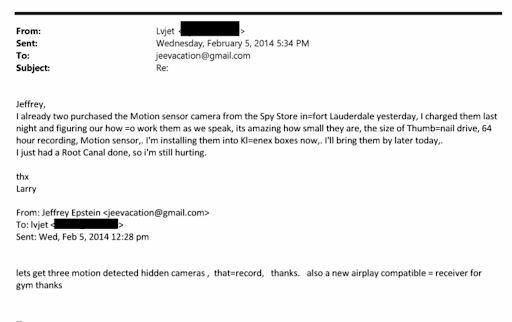
In a 2014 email, associates discussed destroying computer equipment housed in a server room at his Manhattan mansion. That same year, according to previously reported emails, Epstein allegedly directed staff to install hidden cameras inside Kleenex boxes – with one message noting, “The Russians may come in handy.”
Tyler Durden
Thu, 02/26/2026 – 05:45

Today in History: Texas cattlemen’s lawsuit against Oprah Winfrey’s talk show rejected
Today is Thursday, Feb. 26, the 57th day of 2026. There are 308 days left in the year.
Today in history:
On Feb. 26, 1998, a jury in Amarillo, Texas, rejected an $11 million lawsuit brought by Texas cattlemen who blamed Oprah Winfrey’s talk show for a price fall after a segment on food safety that included a discussion about mad cow disease.
Also on this date:
In 1815, Napoleon Bonaparte escaped from exile on the island of Elba, sailing back to France in a bid to regain power.
In 1919, President Woodrow Wilson signed an act making the Grand Canyon a national park.
In 1952, Prime Minister Winston Churchill announced that Britain had developed its own atomic bomb.
In 1987, the Tower Commission, which had probed the Iran-Contra affair, issued its report, which rebuked President Ronald Reagan for failing to control his national security staff.
In 1993, a truck bomb built by Islamic extremists exploded in the parking garage of the North Tower of New York’s World Trade Center, killing six people and injuring more than 1,000 others, mainly due to smoke inhalation. (The bomb failed to topple the north tower into the south tower, as the terrorists had hoped; both towers were destroyed in the 9/11 attack eight years later.)
In 2008, the New York Philharmonic performed in North Korea as part of a historic cultural exchange in a feat of musical diplomacy. It was the first American orchestra to ever perform in the isolated communist nation.
In 2012, Trayvon Martin, 17, was shot to death in Sanford, Florida, during an altercation with neighborhood watch volunteer George Zimmerman, who said he acted in self-defense. (Zimmerman was later acquitted of second-degree murder.)
In 2013, a hot-air balloon burst into flames during a sunrise flight over the ancient Egyptian city of Luxor and plummeted 1,000 feet to earth, killing 19 tourists.
Related Articles
Today in Chicago History: Eight night games approved by City Council for the Cubs at Wrigley Field
Today in History: Baruch Goldstein opens fire inside the Tomb of the Patriarchs
Today in Chicago History: The 1893 World’s Fair awarded to the city
‘We will win.’ Local Ukrainian Americans pray for war-torn nation, marking 4 years since Russia’s full-scale invasion.
Today in History: Harvey Weinstein convicted
In 2017, at the Academy Awards, “Moonlight” won three Oscars, including best picture of 2016; in a startling gaffe, the musical “La La Land” was mistakenly announced as the best picture winner before the error was corrected.
Today’s birthdays: Singer Mitch Ryder is 81. Singer Michael Bolton is 73. Hockey Hall of Famer Joe Mullen is 69. Actor Greg Germann is 68. Democratic Sen. Tim Kaine of Virginia is 68. Singer Erykah Badu (EHR’-ih-kah bah-DOO’) is 55. Filmmaker Sean Baker is 55. Football Hall of Famer Marshall Faulk is 53. Olympic swimming gold medalist Jenny Thompson is 53. Singer Corinne Bailey Rae is 47. Tennis Hall of Famer Li Na is 44. Singer Natalia Lafourcade is 42. Actor Teresa Palmer is 40. Actor Taylor Dooley is 33. Rapper Yeat is 26.
https://www.chicagotribune.com/2026/02/26/today-in-history-oprah-beef-lawsuit/

Orban Deploys Troops To Guard Energy Sites After Accusing Ukraine Of Sabotage
Orban Deploys Troops To Guard Energy Sites After Accusing Ukraine Of Sabotage
Hungarian Prime Minister Viktor Orbán on Wednesday again accused Ukraine of plotting to sabotage Hungary’s energy infrastructure, following a Ukrainian drone attack on a key Transneft oil pumping station in the Russian republic of Tatarstan early Monday, which was further detrimental to the Druzhba oil pipeline.
But Orban has now upped the ante, sending a powerful message to Ukraine and its EU backers, having newly ordered troops to protect key energy sites. He has also been denouncing “blackmail” over Hungary’s Russian energy purchases and dependency, vowing “we will not give in”.
“I have heard the briefings of the national security services and see that Ukraine is preparing further actions aimed at disrupting the operation of Hungary’s energy system,” Orbán stated in a video posted on X.
He then issued the following: “I have ordered the strengthening of the protection of critical energy infrastructure,” before articulating, “This means that soldiers and the equipment necessary to repel potential attacks will be deployed near key energy facilities.”
Politico has further detailed some the aspects of what this will look like, based on the Hungarian leader’s words:
Additional police will patrol designated power plants, distribution stations and control centers, Orbán said. A flight ban has also been imposed in Szabolcs-Szatmár-Bereg county in northeastern Hungary on the border with Ukraine.
The accusation adds fuel to a conflict Orbán has stoked with neighboring Ukraine as well as Brussels ahead of an April 12 parliamentary election in which he faces the prospect of defeat.
Slovakia has also leveled similar charges against Kiev of late, as the damaged Druzhba pipeline is also among its own key transit hubs of vital Russian oil.
The reality is that Ukrainian media and officials have positively boasted of recent actions which harm the two EU members Hungary and Slovakia.
For example, one Ukrainian official on Monday described, “Tonight, long-range SBU drones caused a ‘bavovna’ (explosion) at the main oil pumping station ‘Kaleykino’ near Almetyevsk in Tatarstan. It receives oil from Western Siberia and the Volga region and mixes it before sending it for export. The station is a key hub for supplying raw materials to the ‘Druzhba’ oil pipeline.”
Russian oil shipments to Hungary and Slovakia via Druzhba were first halted after a Jan. 27 airstrike on equipment in western Ukraine.
We will not give in to blackmail ❗️
I have ordered increased security for critical energy infrastructure.
The Ukrainian government is exerting pressure on the Hungarian and Slovak governments through an oil blockade. They will not stop there, as they are preparing further… pic.twitter.com/bulICvhy1m
— Orbán Viktor (@PM_ViktorOrban) February 25, 2026
Ukraine blamed the attack on Moscow, while Hungary is blaming Kiev for deliberately not repairing the pipeline because it doesn’t want it to supply Budapest, or Slovakia, with Russian oil. A political firestorm has ensued ever since.
The controversy led the Orban government to early this week block the EU’s proposed €90 billion loan package for Ukraine and also it vetoed the 20th round of anti-Moscow sanctions. This has in turn infuriated EU leadership.
Tyler Durden
Thu, 02/26/2026 – 05:00

Policía de Kenia arresta a un hombre acusado de reclutar combatientes para Rusia en Ucrania
Por EVELYNE MUSAMBI y VIVIANNE WANDERA
NAIROBI, Kenia (AP) — La policía de Kenia detuvo a un hombre implicado en la presunta trama que engañó a kenianos con promesas de trabajo cualificado en Rusia, que terminaran combatiendo en el frente en Ucrania.
Festus Omwamba fue arrestado por supuesta trata de personas en Moyale, una localidad del norte del país, cerca de la frontera con Etiopía, y será trasladado a la capital, Nairobi. Omwamba huía tras regresar de Rusia, explicó el portavoz de la policía, Michael Muchiri.
Omwamba, que fue identificado por tres reclutas kenianos que hablaron con The Associated Press, había desaparecido después de que las familias comenzaron a protestar por la desaparición y la muerte de sus seres queridos en la guerra en Ucrania.
El gobierno de Kenia dijo la semana pasada que más de 1.000 kenianos fueron reclutados para combatir por Rusia en Ucrania y que al menos 89 seguían en el frente, 39 estaban hospitalizados, 28 estaban desaparecidos en combate y otros habían regresado al país. Las autoridades confirmaron el fallecimiento de al menos una persona.
Un informe de inteligencia presentado ante el Parlamento por el líder de la mayoría, Kimani Ichung’wah, señaló que funcionarios gubernamentales de Kenia y Rusia se confabularon con agencias de reclutamiento laboral deshonestas para llevar a kenianos a primera línea de combate.
La embajada de Rusia en Nairobi negó las acusaciones y afirmó en un comunicado el jueves que nunca emitió visas a nadie que tuviera intención de viajar a Rusia para combatir en Ucrania. “La Federación de Rusia no impide que ciudadanos de países extranjeros se alisten voluntariamente en las fuerzas armadas”, agregó.
El ministro de Exteriores de Kenia, Musalia Mudavadi, dijo a la AP el 9 de febrero que viajaría a Rusia, para lo que calificó como un “enfoque diplomático para poner freno a cualquier entidad dudosa que se esté aprovechando de alguien en esta desventura”.
Mudavadi agregó que los esfuerzos para lograr la liberación de kenianos presos en Ucrania seguían en marcha, así como para la repatriación de los que están en Rusia.
“Recordarán que incluso al más alto nivel, el presidente hizo un llamado: si en efecto hay kenianos que se han encontrado del lado equivocado de la ley, se pidió al gobierno ucraniano que viera cómo pueden ser procesados y traídos de vuelta”, explicó.
El arresto de Omwamba es un avance importante en la iniciativa gubernamental para detener el reclutamiento de kenianos para la guerra en Ucrania, que acaba de cumplir su cuarto aniversario.
John Kamau, que escapó de la línea del frente en Ucrania, buscó refugio en la embajada de Kenia en territorio ruso y fue enviado de vuelta a la nación africana, contó a la AP que conoció a Omwamba en una casa en Nairobi, donde mantenían a otros reclutas que esperaban viajar a Rusia.
Otro recluta, que pidió hablar bajo condición de anonimato por temor a ser localizado por Moscú, indicó que Omwamba evitaba contactar con los reclutas por mensajes de texto y, en su lugar, los llamaba o se reunía con ellos en persona.
Él se inscribió cuando le dijeron que conseguiría un trabajo de plomería en Rusia, pero al llegar le quitaron el pasaporte y lo llevaron a un campamento militar durante unos días antes de ser enviado al frente.
Todos los reclutas contaron que Omwamba supervisó sus solicitudes de visa de turista y la compra de boletos, y que dos semanas después del primer contacto recibieron la documentación y viajaron a Rusia.
___
Esta historia fue traducida del inglés por un editor de AP con la ayuda de una herramienta de inteligencia artificial generativa.