Category: News
“Unknown Projectile” Strikes Container Ship In Strait Of Hormuz As Maritime Crisis Explodes
“Unknown Projectile” Strikes Container Ship In Strait Of Hormuz As Maritime Crisis Explodes
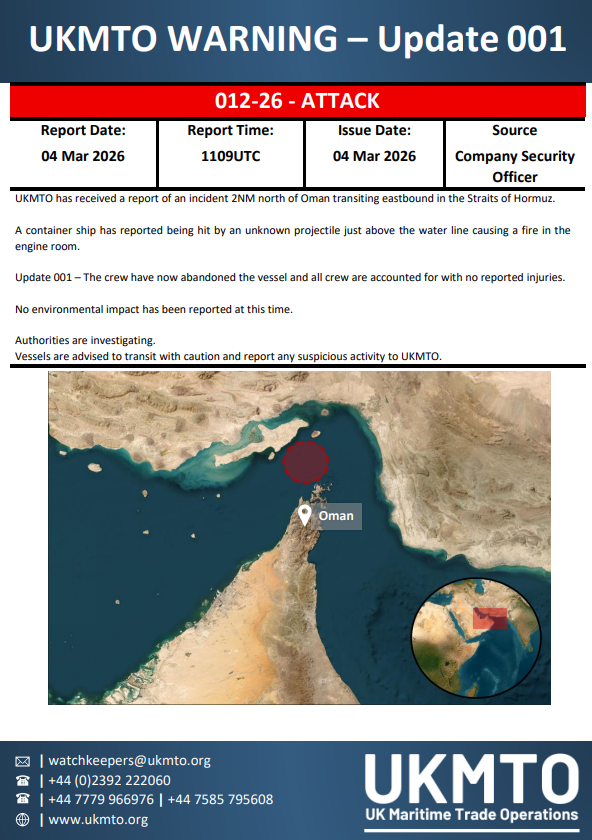
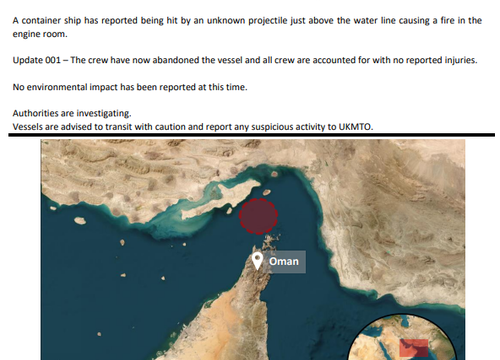
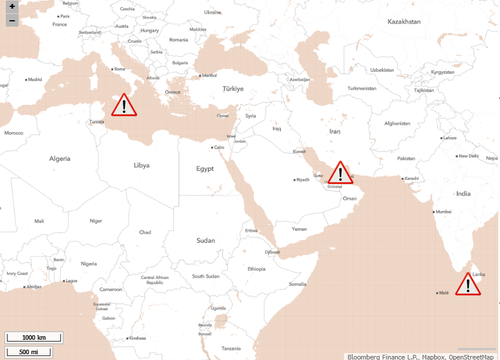
This morning has been very active on the maritime security front. The latest incident involves a container ship that was struck by a projectile while transiting the Strait of Hormuz.
United Kingdom Maritime Trade Operations reports that a container ship about two nautical miles off Oman, transiting eastbound through the critical and narrow waterway, was “hit by an unknown projectile just above the waterline, causing a fire in the engine room.”
“The crew have now abandoned the vessel and all crew are accounted for with no reported injuries,” the maritime security center wrote in an update on X.
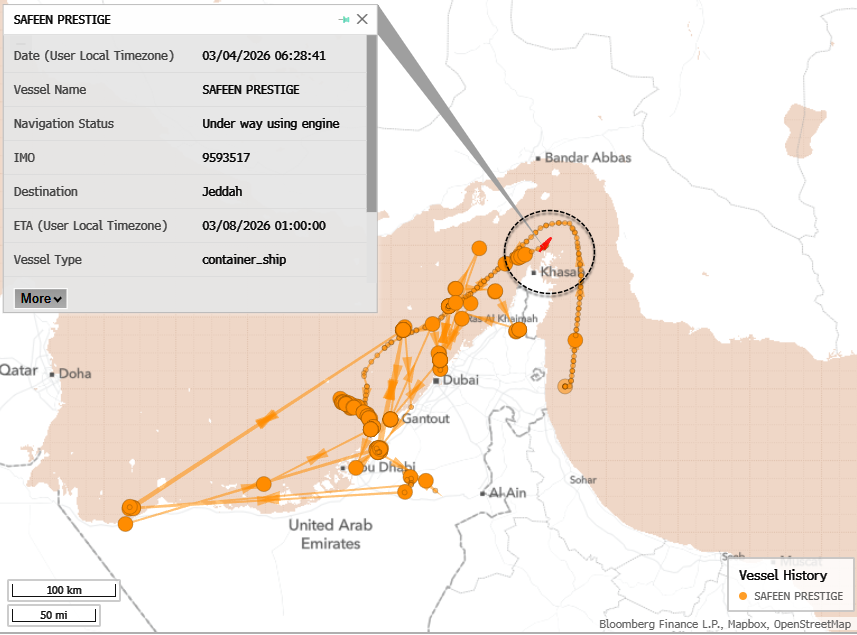
UKMTO’s alert did not identify the container ship by name, but there are currently three transiting the paralyzed waterway. We suspect that the vessel hit was “Safeen Prestige,” though there is no official confirmation.
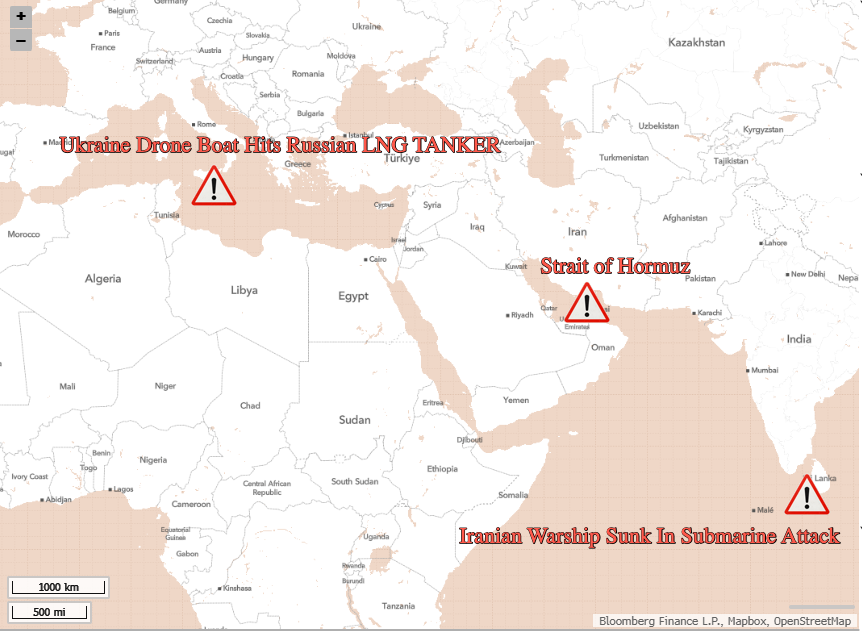
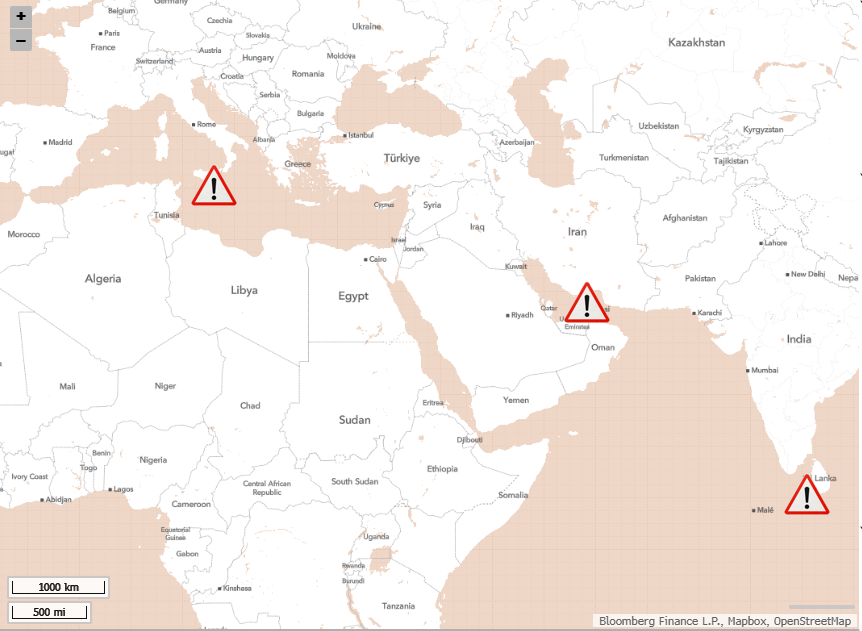
Latest maritime incidents we are tracking:
UBS analyst Cristian Nedelcu provided clients with a clearer picture of the logistical nightmare unfolding due to disruptions in the Strait of Hormuz:
Rising uncertainty, however a potential prolonged disruption could push rates up
We note that since the end of November, the EU logistics and shipping sector share prices were up on average ~18%, outperforming Stoxx 600 by ~5%. We believe this mainly reflects expectations for an improvement in the European and US economies in 2H 2026. In the context of the escalation in the Middle East, a potential prolonged and significant increase in oil prices could represent a headwind to demand raising question marks around global freight volume growth going forward.
Nevertheless, we believe a potential prolonged disruption could also bring upwards pressure on ocean and air freight rates on some routes. We believe a scenario of continuous disruption in the Strait of Hormuz and Middle Eastern air space would bring upwards pressure to ocean and air freight rates touching Middle East and Asia-Europe, with potential for temporary incremental profits for ocean carriers, dedicated freighters operators (DHL Express), and increased complexity that could lead to some benefits for freight forwarders operating on these routes.
A potential prolonged disruption could lead to upwards pressure on ocean rates
According to CTS c.3.5% of global container capacity is using the Strait of Hormuz. In particular, the large transshipment hub Jebel Ali could be affected. In a scenario of prolonged closure of the Strait of Hormuz or capacity restrictions it is likely that cargo would be moved via alternative transhipment hubs leading to potential congestion in other major transhipment hubs. The few services passing through the Red Sea have been directed back to Cape of Good Hope leading to further small declines in effective container capacity to reflect longer voyages. Altogether we expect this could lead to upwards pressure on ocean rates, mainly on: i) routes touching Middle East/Indian subcontinent (c.13.8% of global container according to Linerlytica); ii) on Asia-Europe (c.24.5% of global container movements). According to Linerlytica, Maersk and Hapag Lloyd deploy circa 15% of total container capacity to routes touching Middle East/Indian subcontinent and ~25% of capacity on Asia – Europe routes. Zim deploys circa 3% of capacity on routes touching the Middle East and 15% on Asia – Europe.
Prolonged potential constraints at Middle Eastern airports could push rates up
Air space closure during this weekend for Middle Eastern airports also brings disruption for air freight touching the Middle East or air freight transiting from Asia to Europe. According to IATA, Middle Eastern carriers operate circa 13% of global air freight capacity while Asia – Middle East represents 7.4% of cargo tonne km transported globally and Middle East – Europe 5.7% (in 2024). In a scenario of prolonged disruption, we expect to see upwards pressure on air freight rates for routes touching Middle East and Asia-Europe. In a scenario of capacity constraints for passenger/cargo flights at Middle Eastern airports, we expect constraints related to freedom of the skies agreements and longer distance journeys to lead to a reduction in effective capacity.
In particular, we believe owners of dedicated freighter capacity (DHL Express) are likely to benefit as cargo flows are redirected. Air cargo will also become an alternative for some of the ocean cargo impacted by the disruptions. Increased complexity of moving cargo may bring benefits for large freight forwarders that have access to capacity. Looking at direct exposure to Middle East we note – DSV recognised 7% of 2025 Group EBIT from MEA region and 36%/42% of air /ocean volumes on Asia-Europe; DHL recognised 5.3% of FY24 revenues in Middle East/Africa.
The latest and most critical maritime incidents and developments over the last 24 hours:
Russia Says Ukrainian Drone Boat Blew Up Shadow LNG Tanker In Mediterranean
World At War: Iranian Warship Reportedly Sunk Off Sri Lanka In Submarine Attack
Trump Gives Assurances To Tankers Passing Through Hormuz
Expect more maritime attacks. Also, supply chain snarls could materialize.
Tyler Durden
Wed, 03/04/2026 – 08:30
Ecuador y Estados Unidos inician operaciones militares conjuntas contra el crimen organizado
Associated Press
QUITO (AP) — Efectivos militares de Ecuador y Estados Unidos iniciaron operaciones conjuntas contra grupos del crimen organizado, pero hasta el miércoles se mantenían en reserva las acciones y su ubicación.
En la cuenta de X del Comando Sur se publicó la noche del martes un vídeo en el que observa a un helicóptero sobrevolando a un grupo de hombres que caminan, pero la grabación se detiene sin revelar lo ocurrido posteriormente.
Junto al vídeo, el organismo afirmó que las fuerzas militares ecuatorianas y estadounidenses “lanzaron operaciones contra organizaciones terroristas designadas en Ecuador” y destacó que tales acciones ”son un ejemplo poderoso del compromiso de los socios en América Latina y el Caribe para combatir la lacra del narcoterrorismo”.
Añadió que se están tomando “medidas decisivas para enfrentarnos a los narcoterroristas que durante mucho tiempo han infligido terror, violencia y corrupción a los ciudadanos en todo el hemisferio”.
The Associated Press pidió detalles sobre las primeras operaciones conjuntas a la cancillería y el Ministerio de Defensa, pero no obtuvo respuesta de inmediato.
El anuncio se produce después de que el lunes el presidente Daniel Noboa revelara que su gobierno había iniciado una nueva fase de la lucha contra el crimen organizado con acciones conjuntas con países aliados mientras Ecuador atraviesa una sostenida ola de violencia vinculada con el narcotráfico, la minería ilegal y otras actividades ilícitas.
“Ecuador exige seguridad, nuestro pueblo necesita vivir en paz”, dijo Noboa, quien aseveró que en las operaciones intervendrán militares y policías.
Ecuador mantiene una buena relación con Estados Unidos, Israel e Italia, entre otros países, que han entregado donaciones y suelen colaborar en temas de seguridad.
El país es considerado por las autoridades como un centro logístico del narcotráfico donde se acopia, almacena y distribuye la droga que ingresa especialmente desde la frontera norte con Colombia. Los alijos son transportados desde sus puertos hacia Centroamérica, Estados Unidos y Europa.
El año pasado Ecuador incautó 214 toneladas de drogas, especialmente cocaína, una cifra por debajo de las casi 295 toneladas decomisadas un año antes, según las autoridades.
La semana pasada Noboa ratificó la vigencia de un estado de excepción por 30 días en nueve de las 24 provincias del país, entre ellas las más violentas como Guayas, Manabí y Los Ríos, que restringe derechos como la inviolabilidad de domicilio y correspondencia.
Futures Bounce, Oil Slides After Report Of Iran Backchannel Outreach
Futures Bounce, Oil Slides After Report Of Iran Backchannel Outreach
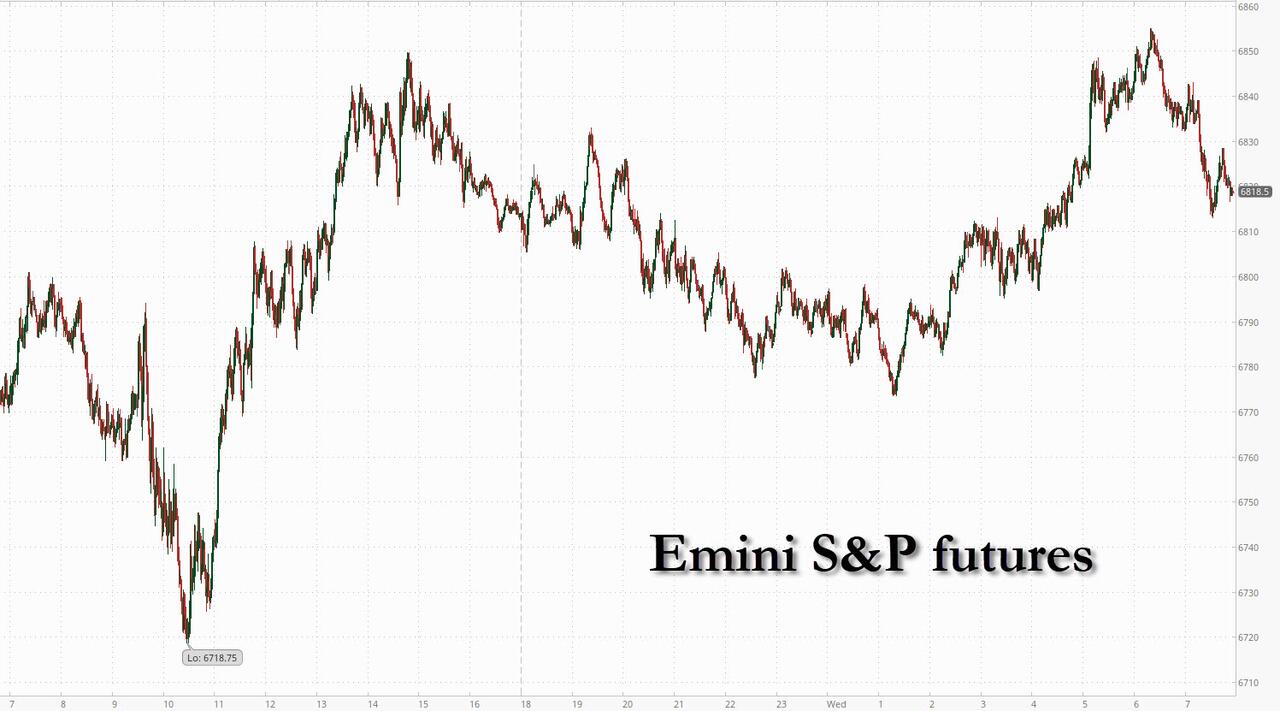
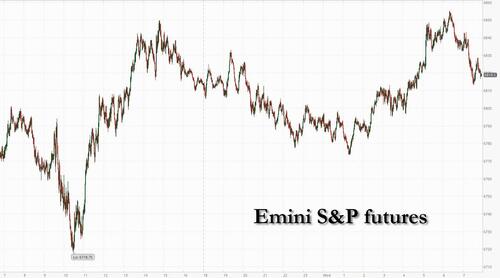
It was shaping up as a catastrophic, margin-call driven Wednesday session after Japan’s Nikkei tumbled about 4% and Korea’s Kospi suffered its biggest drop ever, plunging by a record 12%. But after initially plunging overnight, S&P futures rose as much as 0.4% after the New York Times reported that operatives from Iran’s Ministry of Intelligence used backchannels to contact the Central Intelligence Agency a day after US-Israeli attacks began. The report also stated that US officials are skeptical that either the Trump administration or Iran is ready for an offramp. Then futures faded modestly after Treasury Secretary Scott Bessent said a proposed 15% global tariff may take effect this week, bringing trade tensions back into focus as traders followed developments in the Middle East. As of 8:00am ET, futures for the S&P 500 – extremely illiquid and jittery – were little changed after rising as much as 0.4%, while Nasdaq futures were also modestly in the green with Mag7 and Semis leading in premarket trading, and Cyclicals outperforming Defensives. Asia’s benchmark index plunged the most in nearly a year, led by a record selloff in South Korean equities which crashed 12% in one session. The yield curve is bear steepening with yields +1-2bp and USD sees some profit-taking following its best 2-day gain since Apr 2025. In the commodity space, crude prices are higher by 1-2%, WTI and Brent, as natgas sees a slight pullback; precious & base metals are surging on the US pullback with Ags adding to gains. The Energy complex seems to be reflecting a view that markets need more information before finding a level as there are mechanical reasons why the US commerce guarantee will not reverse recent price gains. Aside from US / Iran update, the macro data focus is on ADP, Mtge Applications, and ISM-Srvcs.
In premarket trading, Mag 7 were mixed: Nvidia rose 0.6% after billionaire Leo KoGuan said he bought 1 million shares of the semiconductor giant and that he is “convinced AI is NOT a bubble, it is only the beginning.” (Tesla +1.1%, Meta +0.05%, Microsoft -0.5%, Alphabet -0.4%, Amazon -0.3%, Apple -0.4%)
Cryptocurrency-linked stocks are rallying as Bitcoin rebounds after a selloff spurred by the escalating conflict in the Middle East.
Gitlab (GTLB) drops 8% after the software company’s forecast for fiscal 2027 adjusted EPS fell short of the average analyst estimate.
Latham Group (SWIM) jumps 20% after the swimming pool designer’s net sales forecast for the full year surpassed the average analyst estimate.
Moderna (MRNA) rises 11% after the biotechnology company agreed to pay Genevant, a subsidiary of Roivant Sciences, and Arbutus $950 million to settle litigation related to the delivery technology behind its Covid shot. Analysts note that the settlement value was better than feared and that this should lift some litigation overhang on the stock.
SSR Mining Inc. (SSRM) rises 8% after entering into an agreement to sell its 80% ownership stake in the Çöpler mine in Turkey to Cengiz for $1.5 billion in cash.
Staar Surgical (STAA) falls 10% after the health care supplies firm reported net sales for the fourth quarter that missed Wall Street’s estimates.
Webtoon (WBTN) declines 13% after the storytelling platform reported revenue for the fourth quarter that missed the average analyst estimate
In other corporate news, the architect of Alibaba’s AI model has surprisingly quit as tech lead for Qwen. Anthropic is on track to generate annual revenue of almost $20 billion, more than doubling it run rate from late last year. The CEOs of Nvidia and Microsoft deliver keynote speeches at the Morgan Stanley TMT conference later today in San Francisco. And a billionaire Tesla ‘whale’ says he bought shares in Nvidia, convinced AI is not a bubble. Novo Nordisk shares are higher after the FDA issued 30 warning letters to telehealth companies for “making false and misleading claims regarding compounded GLP-1 products offered on their websites.” Sinclair’s The Tennis Channel is added to Amazon as part of a broader push into the online TV market. Intel says Craig Barratt, a board member since November, to become chair following the annual shareholders meeting on May 13.
Markets have endured days of volatility after the US-Israeli attack on Iran destabilized the Middle East, curbing energy supplies and damaging infrastructure. The main focus remains on crude as traders weigh President Donald Trump’s plan to insure and escort tankers passing through the Strait of Hormuz, with traffic in the vital waterway all but halted.
“We’re in a headline market,” said Guillermo Hernandez Sampere, head of trading at asset manager MPPM. “Rapid movements with higher volatility will remain for a longer period until supply chains are secure again. It will take some time to calm markets.”
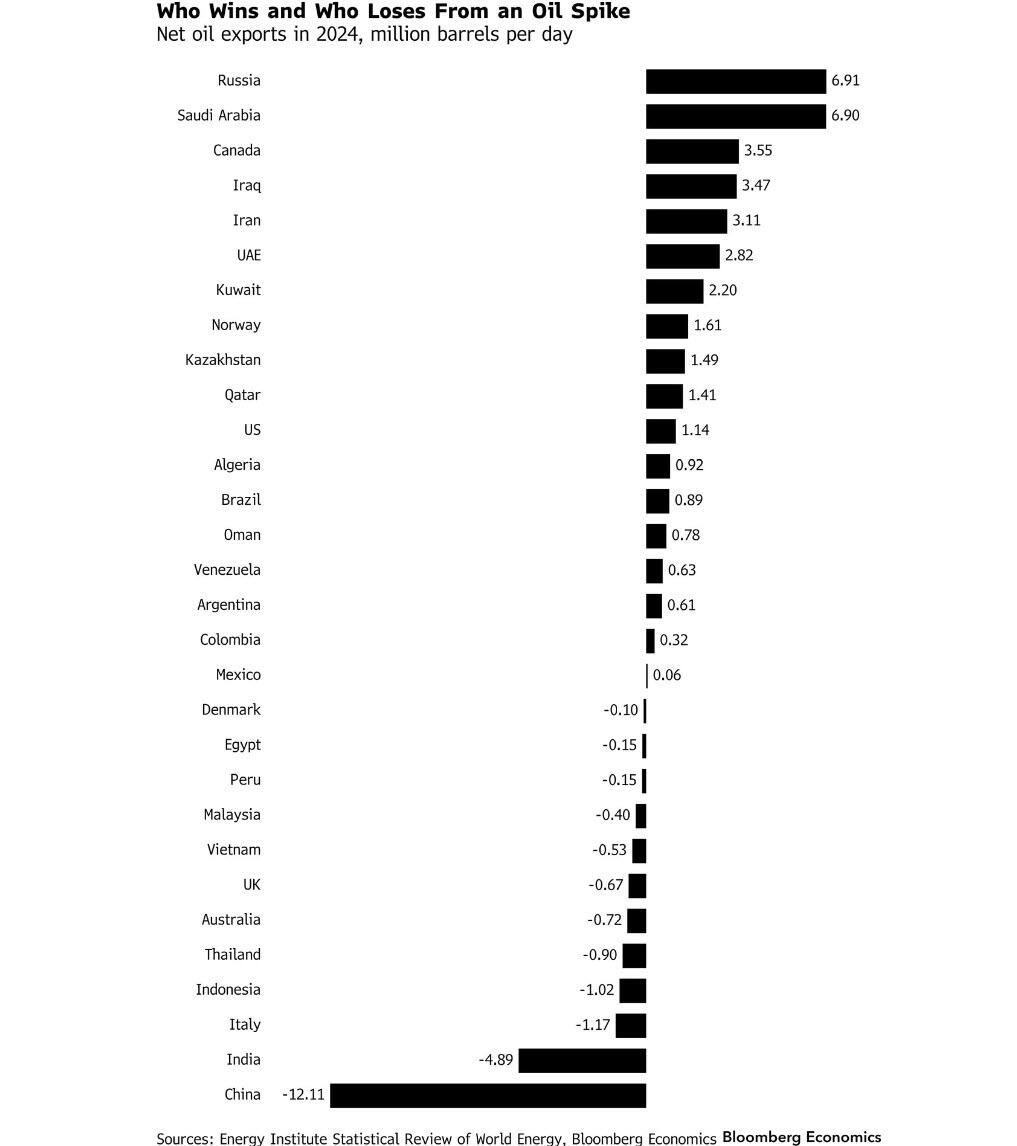
Trump on Tuesday said the US will ensure the free flow of energy through the Persian Gulf with insurance guarantees and even naval escorts. But the shipping industry sees it at best as only a partial solution to a historic crisis. Meanwhile, China may need to lean on US gas supplies to cover potential shortfalls. South Korea imports nearly all of its oil and gas, and Asia’s dependence on oil is illustrated in the table below. Indeed, while the US is relatively immune as a “gigantic energy superpower,” according to Barclays’ global chairman of research Ajay Rajadhyaksha, Asian economies like China, India, South Korea and Japan are more dependent on oil flow through the Strait of Hormuz.
Goldman’s David Solomon said he wasn’t surprised to see volatility measures climb. “It’s going to take a couple of weeks for markets to really digest the implications,” he said. Meanwhile, derivative strategists note a shift higher at the front end of the VIX futures curve signaling a market that is rapidly pricing short-term risk, without an escalation to full-on panic. Although risk assets face a “significant headwind” from rising geopolitical tensions and AI disruption, underlying growth and earnings growth mean the depth and extent of a correction will be limited, note Goldman strategists led by Peter Oppenheimer.
Mohit Kumar, chief strategist for Jefferies in Europe, said the firm’s US clients are generally more optimistic than those in Europe and Asia. The gap reflects US investors’ greater focus on Trump’s actions, which could lead them to underestimate Iran’s response. For Aneeka Gupta, director of macro-economic research at Wisdomtree, the real test for markets will be whether oil and the dollar remain higher long enough to significantly change the behavior of central banks.
“If the shock is short-lived, energy settles, and dollar strength doesn’t become persistent, then the macro impact is mostly a risk premium event — volatility up, but growth intact,” she said.
In geopolitics, German Chancellor Merz says the EU won’t accept US trade deal on worse tariff terms. Several Chinese financial firms are scaling back exposure to Middle Eastern debt, while regulators are stepping up oversight as the conflict raises concerns over the nation’s extensive lending in the region.
In Europe, the Eurostoxx 50 is up some 1.6% posting a modest rebound from the worst two-day decline since April triggered by shocks from the Middle East conflict. Stocks turned green for the year following the NYT report that Iran is trying to backchannel with the US. Positive earnings news also buoys sentiment. The sector breakdown shows a preference for tech, industrial and financials.Here are some of the biggest movers on Wednesday:
ASM International shares rise as much as 5.8% after the chip equipment firm guided 1Q revenue ahead of expectations, driven both by strong demand from advanced chipmakers amid AI infrastructure rollout, and a rebound in sales from Chinese clients.
Scor shares gain as much as 4.8% following its fourth-quarter report, with net income coming in significantly ahead of expectations and analysts highlighting solvency “reassuringly ahead.”
Galliford Try shares rally as much as 6.8% after the UK construction firm beat expectations in the first half and raised its guidance for the full year, stating it has improved confidence from its high level of revenue visibility over the coming years.
Bayer shares drop as much as 4.2% after the German conglomerate forecast little change in profit and sales in 2026.
Adidas shares fall as much as 7.8% after the German sportswear maker’s 2026 operating profit forecast missed analysts estimates.
Continental shares fall as much as 3.2% with analysts disappointed by aspects of the German auto supplier’s 2026 guidance following a pre-release earlier in the year.
Aroundtown drops as much as 4.9% as Jefferies says the German real estate firm’s funds from operations “landed at the low end of guidance.”
Redcare Pharmacy shares slide as much as 17% after the online pharmacy reported earnings that missed expectations and gave cautious guidance for this year that disappointed across the board, according to analysts.
Vistry shares plunge as much as 25% to the lowest since 2016 as the UK homebuilder guides to a lower margin following increased sales incentives to generate cash in a challenging market.
Traton shares dive as much as 5.8% after the truck maker issued broad growth and margin targets for this year that fell significantly short of expectations at the midpoint.
Weir Group shares fall as much as 9% after the British engineering company reported adjusted operating profit for the full year that met the average analyst estimate.
Earlier in the session, Asia looked like a missile crater as stocks extended their selloff for a third straight day. The MSCI Asia Pacific Index dropped as much as 4.5%, the most since April 7, driven by sharp losses in Korean equities and regional tech heavyweights including TSMC, Samsung Electronics and SK Hynix. Korea’s benchmark Kospi plunged 12%, its biggest drop ever, as the Iranian war triggered the biggest-ever selloff in what had been the world’s hottest stock market. The Kospi’s rout triggered a 20-minute trading halt early in the session. Benchmarks in Taiwan and Japan slid around 4% each, with virtually all major regional equity indexes in the red. China’s onshore CSI 300 Index wiped out its year-to-date gains.
Taking a quick look at earnings, Out of the 481 S&P 500 companies that have reported so far in the earnings season, 73% have managed to beat analyst forecasts, while 22% have missed.
In FX, the improvement in sentiment has weighed on the greenback with the Bloomberg Dollar index down 0.2%, snapping a two-day run of gains. The yen gained during APAC trade amid intervention talk from Japan’s Katayama.
In rates, a selloff in global bonds eased, with the yield on 10-year Treasuries rising two basis points to 4.08%.
In commodities,WTI crude trimmed gains after the New York Times reported that Iranian operatives made an offer to the US to discuss terms for ending the conflict a day after attacks began.
Treasuries are down a handful of ticks with yields up 1-2bps across the curve. Spot gold and silver are higher by 2% and 5.1%. Bitcoin has also marched higher, up 4.4%. Brent crude retreated from an intraday high to trade near $82 a barrel. Bitcoin jumped to nearly $70,000, suggesting some return of risk appetite.
Looking at the day ahead, data releases include the final services and composite PMIs for February from the US and Europe. In the US there’s also the ISM services index and the ADP’s report of private payrolls for February, whilst in the Euro Area we’ll get the unemployment rate for January. From central banks, we’ll hear from ECB Vice President de Guindos, the ECB’s Muller, Cipollone and Villeroy, along with Bank of Canada Governor Macklem. Otherwise, the Fed will release their Beige Book.
Markets Snapshot
S&P 500 mini +0.1%
Nasdaq 100 mini +0.2%
Russell 2000 mini +0.3%
Stoxx Europe 600 +1.1%
MSCI Asia Pacific Index fell 4%
Japan’s Nikkei Index fell 3.6%
China’s CSI 300 Index fell 1.1%
Hong Kong’s Hang Seng Index fell 2%
Taiwan’s Taiex Index fell 4.4%
South Korea’s Kospi Index fell 12%
Australia’s S&P/ASX 200 Index fell 1.9%
New Zealand’s S&P/NZX 50 Gross Index fell 0.7%
India’s NSE Nifty 50 Index fell 1.8%
DAX +1.3%
CAC 40 +0.9%
10-year Treasury yield +2 basis points at 4.08%
VIX -0.6 points at 23.02
Bloomberg Dollar Index -0.2% at 1200.93
euro +0.2% at $1.1636
WTI crude +1.6% at $75.79/barrel
Top Overnight News
A day after the attacks began, operatives from Iran’s Ministry of intelligence reached out indirectly to the CIA with an offer to discuss terms for ending the conflict. US officials are skeptical – at least in the short term – that either the Trump administration or Iran is really ready for an offramp. NYT
Oil edged higher near $83 a barrel, with traffic in the Strait of Hormuz all but halted. Donald Trump’s plan to protect vessels with insurance backstops and naval escorts is only a partial fix, shippers said. BBG
The CIA is working to arm Kurdish forces with the aim of fomenting a popular uprising in Iran. The Trump administration has been in active discussions with Iranian opposition groups and Kurdish leaders in Iraq about providing them with military support. CNN
The son of former Iranian Supreme Leader, Mojtaba Khamenei, has emerged as his most likely successor, suggesting the country is moving in a hardline direction. NYT
China’s legislature signaled a desire for steady relations with the US as the countries prepare for a planned summit between Xi Jinping and Trump in the coming weeks. BBG
US shale drillers cannot increase production quickly enough to solve an oil supply crisis caused by the war in Iran, industry bosses have warned, saying a big rise in output would take months to materialize. FT
Gauges of China’s manufacturing and services activity sent mixed signals about the economy, showing pockets of weakness alongside improvement as markets wait for the country’s leaders to set growth targets for the year ahead.
Bank of Japan Gov. Kazuo Ueda reaffirmed his commitment to further interest-rate increases amid deepening concerns over instability in the Middle East. WSJ
Anthropic is on track to generate annual revenue of almost $20 billion, more than doubling its run rate from late last year, people familiar said. Separately, OpenAI CEO Sam Altman told employees that the company has no say over what the Pentagon does with its AI software. BBG
Trade/Tariffs
Japan and the US are reportedly working to include nuclear power, copper smelting and refining facility projects in the second round of deals under the USD 500bln investment package.
Japanese Trade Minister Akazawa is to travel to the US on Thursday to discuss Japan-US investment and will meet with US Commerce Secretary Lutnick.
A more detailed look at global markets courtesy of Newsquawk
APAC stocks extended losses with markets roiled by the widening conflict in the Middle East, with the UAE considering taking military action to stop Iranian missile and drone strikes on the country, while it was also estimated that Saudi Arabia could attack Iran soon. ASX 200 slumped with the index dragged lower by underperformance in the commodity-related sectors, while better-than-expected Australian GDP data for Q4 failed to inspire a turnaround. Nikkei 225 dipped beneath the 54,000 level with mining and materials the worst performers amid disruption concerns. KOSPI saw a double-digit percentage drop and had triggered a circuit breaker with declines led by shipbuilders and shipping firms, while large exporters such as Samsung, SK Hynix and Hyundai Motor also suffered. Hang Seng and Shanghai Comp conformed to the bloodbath in the region as participants digested mixed Chinese PMI data in which the official NBS Manufacturing and Non-Manufacturing PMIs disappointed, but the private sector RatingDog PMI accelerated to multi-year highs, while attention is also on the Two Sessions, which began today in Beijing, while the focus will be on the Work Report on Thursday.
Top Asian News
China NPC spokesperson said will continue to expand domestic demand this year. Will foster new growth points in services consumption. Will promote high-quality employment this year. To reduce residents’ concerns about expanding consumption. Will promote the allocation of more resources to areas related to people’s livelihood, enabling people to consume, dare to consume and be willing to consume.
Chinese banks reportedly halt Abu Dhabi loans as creditors cut Middle East, Bloomberg reported; most Asian banks are currently adopting a wait-and-see approach but there are early signs some are mulling pausing deals.
Abu Dhabi Ports confirms the continuation of all its operations in light of regional developments; expect a decrease in the number of arriving ships with the decline in shipping traffic in the Strait of Hormuz, Al Arabiya reported.
Cosco Shipping (1919 HK) suspends new bookings on relevant routes amid escalating Middle East conflict.
European bourses (STOXX 600 +1.2%) have broadly rebounded following this week’s selloff, with the IBEX 35 (+1.6%) and DAX 40 (+1.6%) outperforming this morning, which was boosted following the New York Times report (see below). On the data front, EZ and UK final composite PMIs failed to move indices. In addition, Swiss inflation for February came in hotter-than-expected but the SMI didn’t react much to the data on the open. Sectors display a positive picture. Technology (+2.5%) sits clearly at the top after ASM International (+6.5%) beat Q4 revenue and Q1 revenue outlook estimates. Regarding China, the Co. also anticipates a rise in sales, showing notable improvement from the earlier forecast of a double-digit decline. Energy (-0.6%) is the worst-performing sector. Consumer Products and Services (+0.8%) was initially softer, after being on by Adidas (-6.9%), but reversed higher on the broader risk tone. Adidas reported Q4 revenue that missed expectations, while an operating profit of “around” EUR 2.3bln in 2026 fell short of analyst estimates.
Top European News
German VDMA Engineering Association said January orders -6% Y/Y (domestic -8% and foreign at -5%).
French Finance Minister said they will hold a meeting of G7 Finance Ministers and Central Bankers early next week.
FX
DXY is choppy within a 98.90-99.33 range and well within Tuesday’s 98.44-99.68 parameters. Focus remains on the Middle Eastern conflict, which continues to expand across the region. Analysts at ING highlight that near-term drivers of risk will probably be whether energy prices can reverse lower if the Strait of Hormuz can somehow reopen, and also whether central banks will be able to cut rates to support activity, or at least not tighten policy. Elsewhere, the data calendar for the US is very light, although ISM Services is scheduled later, while there were recent Fed speakers, in which the main message was that policy was well-positioned, and it is too soon to gauge the impact of the war in Iran on inflation. USD eased on NYT reports that Iran reached out to the US a day after the war started, although US officials are reportedly sceptical that either the Trump administration or Iran is ready for an off-ramp in the short term at least.
EUR is flat against the USD and trades on either side of 1.1600, with the single currency not helped by President Trump threatening to halt all trade with Spain, citing the country’s refusal to allow American military forces to use joint air bases for operations against Iran. Meanwhile, no EUR move was seen on the final PMIs, which are outdated amid the geopolitical developments since the survey period.
GBP holds above 1.3300 vs the USD following recent underperformance, not helped by President Trump publicly expressing frustration with UK PM Starmer, stating “I’m not happy with the UK” and “This is not Winston Churchill that we’re dealing with,” after Britain refused to join offensive strikes.
CHF is off best levels in choppy trade, with USD/CHF recouping from intraday lows of 0.7790 in the aftermath of hotter-than-expected Swiss CPI and ahead of the SNB meeting on March 19th. On that note, SNB Vice Chair said they are ready to intervene in the FX market – echoing similar commentary on Monday.
JPY outperforms amid the ongoing geopolitical woes. USD/JPY was choppy overnight amid a quiet calendar for Japan and ongoing uncertainty regarding the Iranian conflict and effects on inflation, as well as the ramifications for BoJ monetary policy. The pair is subdued within a 157.16-157.86 range vs yesterday’s 157.15 low. USD/JPY saw some volatility following NYT reports that US officials are sceptical of either Iran’s or the US’ willingness to off-ramp in the short term, relating to Iran’s Intelligence Ministry reportedly reaching out to the CIA indirectly a day after the conflict started with an offer to discuss terms.
Fixed Income
Mixed trade at the time of writing, with USTs bearish while peers are firmer but only modestly. Benchmarks recouped some ground late US and during the early APAC session. However, they then faded again as energy prices continued to climb.
USTs at the low end of 112-27 to 113-05+ parameters. Focus remains on the geopolitical front with the conflict still ongoing and showing no sign of letting up in the near-term at least. An event of focus is the funeral of Khamenei, after which we may get the formal appointment of his successor, widely expected to be Mojtaba Khamenei, the second eldest son. Elsewhere, the US day is headlined by ISM Services and then numerous mega-cap presentations at a Morgan Stanley conference.
Bunds were in line with USTs late-US and into the early APAC session. Thereafter, the benchmark waned from best but remains just about in the green. Specifics for the space have been light, aside from geopols. No move to Final PMIs. For the most part, Europe is waiting for further clarity on the energy situation, Trump’s displeasure with Spain and the Hungarian opposition to Ukraine amid the Druzhba closure. Currently, the benchmark holds just below the 129.00 mark in a 128.80 to 129.32 band.
Gilts gapped higher by 37 ticks before climbing a handful more to a 91.91 peak. A bounce that wasn’t too surprising, given the overnight moves in peers. However, one that leaves it shy of Tuesday’s opening level/high of 92.47 and still a significant distance from the week’s 93.55 open. For the UK, focus is firmly on the above events. Note, Goldman Sachs has stuck to its BoE call of three 25bps cuts this year, but has pushed out the timing by one month; as such, they now expect the first move in April not March.
Upside was seen across benchmarks as energy prices (namely nat gas) fell on reports that Operatives from Iran’s Ministry of Intelligence reached out indirectly to the CIA a day after the conflict began, with an offer to discuss terms for ending the conflict, New York Times reports citing sources. US officials are reportedly sceptical that either the Trump administration or Iran is ready for an off-ramp in the short term at least.
Germany sold EUR 0.96bln vs exp. EUR 1.0bln 2.30% 2033 Green Bund: b/c 1.76x (prev. 3.57x), average yield 2.53% (prev. 2.39%), retention 4.0% (prev. 15.6%)
Australia sold AUD 900mln October 2037 bonds, b/c 3.74, avg. yield 4.8573%.
Commodities
Crude benchmarks are firmer this morning as geopolitical tension in the Middle East continues to underpin the complex, with WTI (+1.1%) and Brent (+1.6%) trading at the upper ranges of USD 74.37-77.23/bbl and USD 81.28-84.48/bbl, respectively. Saudi Arabia announced that there was an attempt to attack Ras Tanura refinery, however, there was no damage reported at the refinery.
European Nat Gas has slipped some 7% following reports that Iran’s Ministry of Intelligence reached out to the CIA indirectly a day after the conflict began with an offer to discuss terms for ending the conflict, although US officials are reportedly sceptical that either the Trump administration or Iran is ready for an off-ramp in the short term at least. Crude futures dipped modestly on these reports.
Spot gold continued its rebound, shrugging off recent USD strength that hampered price action yesterday for the yellow metal, trading just below the USD 5,200/oz mark. Haven demand has underpinned gold prices as the conflict in the Middle East reaches its fifth day. Modest upside was seen on the aforementioned NYT reports as the USD eased.
Copper prices are trading higher thus far in the European session, tracking mild tailwinds following China’s manufacturing PMI data, which showed the greatest improvement in manufacturing conditions in more than five years. At the time of writing, 3M LME copper trades at the upper range of 12.94-13.1k/t.
Saudi Aramco’s Ras Tanura refinery (550k BPD) was reportedly struck again by an unknown projectile, according to sources; no damage was reported.
UKMTO receives report of an incident 10NM east of UAE’s Fujairah, according to an advisory note; an oil tanker in the Gulf suffered an explosion and the wreckage of an unknown projectile was found on its deck and all crew members are fine.
IRGC say they have complete control of the Strait of Hormuz, according to AFP.
Russia’s Deputy PM Novak said we are ready to increase oil supplies to China and India in case of additional demand.
Shanghai Futures Exchange are to adjust price limits and margin ratios for FU2604 fuel oil futures contract.
Goldman Sachs said Brent could reach USD 100/bbl if the Strait of Hormuz remains closed for 5 more weeks.
Qatar Gulf International Services noted stoppage of certain operations and services related to energy sector activities.
US Private Energy Inventories (bbls): Crude +5.6mln (exp. +2.3mln), Distillate +0.5mln (exp. -2.6mln), Gasoline -3.3mln (exp. -0.8mln), Cushing +1.5mln.
Central Banks
Fed’s Hammack (2026 voter) says it is too soon to determine the economic impact of the Middle East conflict, NY Times reports. Supports holding rates steady for “quite some time.”
Fed’s Kashkari (2026 voter) said Fed can sit tight as war clouds the outlook, via WSJ interview; 1 or 2 cuts later this year could be appropriate if inflation cools, but war in the Middle East could also create conditions that would justify extended pause.
BoJ Governor Ueda said wages are expected to rise for a broad range of sectors in this year’s wage negotiations, and that annual real wages to gradually turn positive.
BoJ Governor Ueda said the central bank communicates closely with the government. Added that wages need to increase significantly for Japan to sustainably achieve BoJ’s price target. Mechanism in which wages and prices rise in tandem becoming embedded in Japan’s economy. Exchange rate fluctuations are now more likely to influence corporate behaviour. The impact of FX movements on prices is being closely watched. If economic activity and inflation align with forecasts, interest rate increases will continue. A rate hike would be appropriate if the economic outlook evolves as expected. General views on the economy were exchanged with Takaichi last month. The BoJ will carefully assess how Middle East developments affect domestic and global economic conditions. Persistently high oil prices could lift underlying inflation by pushing up medium- and long-term household and corporate inflation expectations. The BoJ will closely monitor the economic implications of the Middle East conflict. Developments in the Middle East could significantly affect both the global and Japanese economy through energy prices and market channels. Higher energy prices may also influence inflation expectations. Elevated oil prices worsen Japan’s terms of trade, weighing on the economy and underlying inflation dynamics. Oil prices have been rising sharply.
SNB Vice Chair said they are ready to intervene in the FX market.
CNB’s Deputy Governor Frait said the development over the past week may lower space to reduce interest rates and cannot say today how he will vote at next meeting.
Bank of Korea Governor Rhee said to hold meeting to review markets, adds to closely monitor for excessive moves in FX and interest rates, will respond if needed on the forex market to prevent herd-like behaviour.
Goldman Sachs expects the BoE to cut by 25bps in April, July and November 2026 (prev. forecast March, June and September 2026).
Geopolitics: Middle East
US officials are sceptical of either Iran’s or the US’ willingness to off-ramp in the short term, relating to Iran’s Intelligence Ministry reportedly reaching out to the CIA indirectly a day after the conflict started with an offer to discuss terms, NYT reports.
A number of Iranian media reported that an explosion was heard in Karaj, Iran International reported.
Former Iranian Supreme Leader’s top aide said Iran has no intention of conducting negotiations with the US, Al Jazeera citing Iranian TV.
Iran launched over 40 missiles at Israeli and US targets a few hours ago, according to Iranian press.
Iran has hit more than 10 tankers that ignored warnings and warns ships against transiting the Strait of Hormuz, according to FARS.
Heavy explosions heard in east Tehran, Iran, local media reported.
Plume of smoke rising from the US Consulate in Dubai, Iran’s IRNA reported.
US and Israeli forces have targeted Tehran, Urmia, Isfahan, and Karaj with heavy air strikes.
Israeli army advances further into Lebanese territory, Al Jazeera reported.
Israeli Defence Minister Katz said that any leader appointed in Iran will be an explicit target.
IDF identifies missiles fired by Iran towards Israel and is working to intercept them.
IDF said it has started a wave of attacks against missile launch sites, defence systems, and infrastructure belonging to the Iranian regime.
Defence executives are to meet at the White House on Friday as strikes on Iran reduce stockpiles, according to Reuters.
US Central Command said they destroyed 17 Iranian ships and no Iranian ships sailing in the Gulf or Strait of Hormuz or Gulf of Oman today.
CIA is working to arm Kurdish forces to spark uprising in Iran, according to sources cited by CNN.
US and Israel are seeking to foment an armed uprising inside Iran using an armed Kurdish fighting force, according to ITV News citing sources. ITV News understands since last year, weapons have been smuggled into Western Iran to arm thousands of Kurdish volunteers. They are expected to begin a ground operation within days. ITV have been told by Kurdish sources that American and Israeli forces have been asked to provide air cover when any such ground operation begins. ITV sources do not know if that request has been approved.
Iran’s Assembly of Experts elected Ali Khamenei’s son Mojtaba as the next Supreme Leader under pressure from the Revolutionary Guards, Iran International reported citing sources.
Two drone attacks targeted a US military base and a hotel in Iraq’s Erbil early on Wednesday.
Suspected Iranian drone attack hits CIA station in Saudi, according to WaPo reporter.
Geopolitics: Ukraine
Russian President Putin will hold a call with Hungary’s Foreign Minister later today to discuss Ukraine, according to Russia’s Kremlin.
Russia’s Deputy PM Novak said we are ready to increase oil supplies to China and India in case of additional demand.
Russian gas tanker reportedly attacked in Mediterranean Sea; Ukrainian naval drones attacked Russian gas tankers from Libya’s coast, according to the Russian Transport Ministry.
US Event Calendar
7:00 am: United States Feb 27 MBA Mortgage Applications, prior 0.4%
8:15 am: United States Feb ADP Employment Change, est. 50k, prior 22k
9:45 am: United States Feb F S&P Global US Services PMI, est. 52.3, prior 52.3
9:45 am: United States Feb F S&P Global US Composite PMI, est. 52.3, prior 52.3
10:00 am: United States Feb ISM Services Index, est. 53.5, prior 53.8
DB’s Jim Reid concludes the overnight wrap
Timing is everything in financial markets and what I thought would be a fascinating pack and create a lot of interest when I finished it on Friday has been overtaken by events. However, I still had a few great meetings yesterday in New York on the “Innovation, Jobs and Inflation: Lessons from 250 Years of Disruption” pack. Lots of debate around it. See it here. Once the Iran situation calms (assuming it does) this will be the main topic in markets again. So feel free to delve in as you wait for the next Iran headlines.
Indeed, we are in the headline-watching business at the moment, with competing stories shifting market sentiment an hourly basis yesterday. Moreover, the selloff has yet to find a floor, as fears of a more protracted Middle East conflict have led to mounting concern about a serious energy shock. So overnight, South Korea’s KOSPI (-11.13%) is currently on track for its biggest one-day fall since 2001, and futures on the S&P 500 (-0.55%) are pointing to further declines as well. That all follows a highly volatile 24 hours in markets, with the VIX index up to a 3-month high of 23.57pts, whilst Europe’s STOXX 600 (-3.08%) saw its largest daily slump since the Liberation Day tariff turmoil last April. Elsewhere, an aggressive slump in bonds saw 10yr gilts post their worst 2-day move in two years, and the EM FX carry index (-1.64%) had its worst day since Russia’s February 2022 invasion of Ukraine.
Of course, oil prices have been the main focus given the direct impact, and yesterday saw Brent crude up another +4.71% to $81.40/bbl. So that now makes it the biggest 2-day jump for oil prices (+12.31%) since the pandemic recovery in 2020, and this morning they’re up another +1.51% to $82.63/bbl. However, prices did come off their intraday peak above $85/bbl in European hours, stabilising after Trump said that the US “will begin escorting tankers through the Strait of Hormuz, as soon as possible” if necessary and that it would provide political risk insurance for ships travelling through the Gulf to “ensure the FREE FLOW of ENERGY to the WORLD”. That said, with little detail on the plan, the reversal in oil proved short-lived, with Brent falling back to $78.40/bbl before rising again, moving back above $82/bbl this morning. That came as Iran’s IRGC said in a statement that vessels sailing through the Strait of Hormuz “could be at risk from missiles or rogue drones”.
From a market perspective, the main issue is that there’s no sign of either side de-escalating, and if anything it looks as though things are still ratcheting up. For instance, the WSJ reported that Trump was open to supporting armed militias in Iran, although it said he hadn’t made a final decision. Meanwhile on the energy side, the supply issues continued to deteriorate, as Bloomberg reported that Iraq had started to shut down oil production that could halt 3mn barrels per day if the crisis persisted. And in addition to the renewed IRGC warning over the Strait of Hormuz, airstrikes have continued, with Israel carrying out a “broad wave of strikes” against Iran overnight, while we’ve seen reports of blasts in Doha and Dubai and missiles intercepted by Saudi Arabia.
This backdrop has meant energy prices have kept climbing across the board. In addition to the rise in oil, European natural gas futures soared yesterday, up another +21.98% to €54.29/MWh, building on their +39% gain on Monday. Interestingly though, if you look at the long-term history of oil prices, WTI is still a little below its 2024 average, and there’s still a long way to go before it compares to some of history’s bigger crises. So much as things are deteriorating, we’re still some distance from recessionary territory and a full-scale market correction. I looked at that in my chart of the day yesterday (link here), and Henry also put out a note (link here) looking at the criteria that have traditionally led to meaningful selloffs when an oil shock happens, none of which have occurred yet. Indeed, for all the volatility, the S&P 500 is within 2.5% of its peak, and the STOXX 600 within 5%. So despite everything that’s happened, we haven’t got to correction territory yet, let alone a bear market.
For now at least, the most obvious impact has been in the rates space, where the conflict has led to growing concern about inflation and whether central banks will be forced back into rate hikes. So in Europe, investors have priced in a growing probability of an ECB hike this year, with the chance up to 34% by last night’s close. Similarly in the US, the amount of rate cuts priced by December came down another -5.4bps on the day to 46bps. So all that pushed sovereign bond yields higher on both sides of the Atlantic, with yields on 10yr bunds (+4.0bps), OATs (+8.5bps), BTPs (+10.1bps) all spiking, whilst 10yr Treasuries (+2.5bps) saw a smaller move up to 4.06%. That’s continued overnight too, with the 10yr Treasury yield up another +0.2bps.
Meanwhile for equities, the selloff accelerated yesterday, with the US and Europe seeing even deeper losses relative to Monday. So in the US, the S&P 500 (-0.94%) gave way after holding up on Monday, though it did partially recover from an intraday low of -2.49% shortly before Europe went home. Even so, all eleven major sector groups ended the day lower, including energy. Paradoxically, software & services stocks (+1.58%) were one of the few outperformers. Then in Europe, the STOXX 600 (-3.08%) posted its biggest daily decline since the Liberation Day turmoil last year, with even deeper losses for the DAX (-3.44%) and the CAC 40 (-3.46%). And unlike on Monday, even the energy and defence names weren’t immune, with the STOXX Aerospace & Defense index (-2.74%) posting its biggest decline so far this year.
One of the big themes in yesterday’s market turmoil were sharp reversals for several recent winning trades. For instance, 10yr gilts, which had rallied by -33bps in just over three weeks, have sold off by +24bps over the past two sessions (+9.7bps yesterday). Meanwhile, gold (-4.38%) and silver (-8.23%) plunged despite the risk-off mood. Indeed, the dollar (+0.68%) was one of very few assets other than oil that were in the green yesterday.
Likewise, another 2026 winner to see a sharp reversal has been the Kospi, which is down -11.13% this morning, which would be the index’s worst daily slump since markets returned after the 9/11 attacks in 2001. Indeed, trading was paused earlier after a circuit breaker was triggered, and only yesterday the index saw a -7.24% decline as well. It was only last Thursday that I’d noted in my CoTD (see here) how the Kospi had moved from cheap to expensive after a near +50% YTD gain. Remarkable how quickly things can turn in markets.
Those declines have been echoed across Asia, albeit not quite to the same extent. That said, the Nikkei (-3.76%) is currently on course for its biggest daily decline since the Liberation Day turmoil last April, right before Trump announced the 90-day tariff extension that sparked the market rebound. And other indices are also falling significantly, with declines for the Hang Seng (-2.90%), the CSI 300 (-1.16%) and the Shanghai Comp (-1.09%). The moves also come after the PMIs in China were a little weaker than expected, with the manufacturing PMI down to 49.0 (vs. 49.2 expected), whilst the non-manufacturing PMI only rose to 49.5 (vs. 49.7 expected).
Clearly the Middle East was totally dominating attention yesterday, but there were a few other stories to look out for. Notably in the Euro Area, the flash CPI print for February surprised on the upside, which exacerbated investors’ energy-driven inflation fears. So headline CPI was up to +1.9% (vs. +1.7% expected), whilst core CPI rose to +2.4% (vs. +2.2% expected), raising expectations that the ECB might still need to hike this year.
Separately in the UK, the government also announced their Spring Statement, including the OBR’s latest economic forecasts. According to those, it showed that the headroom against the fiscal rules now stood at £23.6bn, slightly higher than the November budget. However, the forecasts were made before the latest surge in energy prices, so clearly that will change the picture. See our UK economist’s recap here
Looking at the day ahead, data releases include the final services and composite PMIs for February from the US and Europe. In the US there’s also the ISM services index and the ADP’s report of private payrolls for February, whilst in the Euro Area we’ll get the unemployment rate for January. From central banks, we’ll hear from ECB Vice President de Guindos, the ECB’s Muller, Cipollone and Villeroy, along with Bank of Canada Governor Macklem. Otherwise, the Fed will release their Beige Book.
Tyler Durden
Wed, 03/04/2026 – 08:20
https://www.zerohedge.com/markets/futures-bounce-oil-slides-after-report-iran-backchannel-outreach
World At War: Iranian Warship Reportedly Sunk Off Sri Lanka In Submarine Attack
World At War: Iranian Warship Reportedly Sunk Off Sri Lanka In Submarine Attack
The latest escalation, with at least ten tankers burning in or around the Strait of Hormuz, an overnight kamikaze drone boat strike on a Russian shadow-fleet LNG tanker in the Mediterranean Sea, and the reported sinking of an Iranian warship off Sri Lanka in what local officials described as a submarine attack, only suggests to any seasoned military strategist that the conflicts tied to the Middle East and Eastern Europe are expanding beyond their traditional theaters.
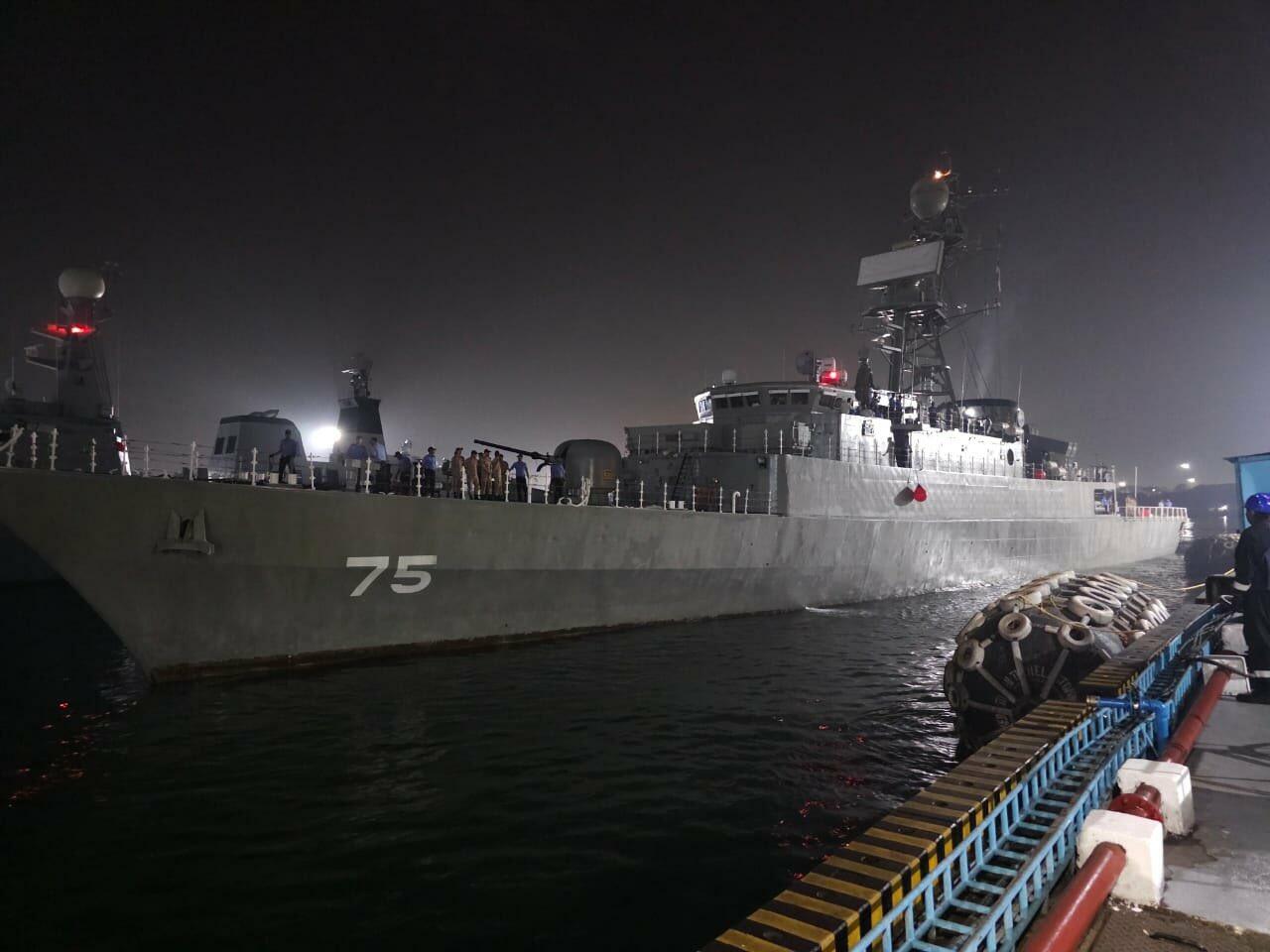
Reuters reports that Iran’s Navy Mowj-class frigate Dena was sunk by a US submarine off Sri Lanka’s Indian Ocean coast. According to a source in Sri Lanka’s navy and defense ministry, the submarine attack left 32 personnel rescued by Sri Lankan authorities, while 101 remain missing.
Defense sources explained to the media outlet that it was unclear who attacked the Iranian warship.
Here’s more from Reuters:
The navy received a distress call from an Iranian ship and informed the Sri Lankan air force, and both launched a search and rescue operation, the spokesman said.
Sri Lankan forces were focused on saving lives on the Iranian ship and will investigate the cause of the incident later, he said.
Sri Lankan forces had also not observed any other ship or aircraft in the area of the incident, he added.
“We are hopeful we can rescue more people and will continue (operations) until we are sure,” he said.
Related:
Russia Says Ukrainian Drone Boat Blew Up Shadow LNG Tanker In Mediterranean
Trump Gives Assurances To Tankers Passing Through Hormuz
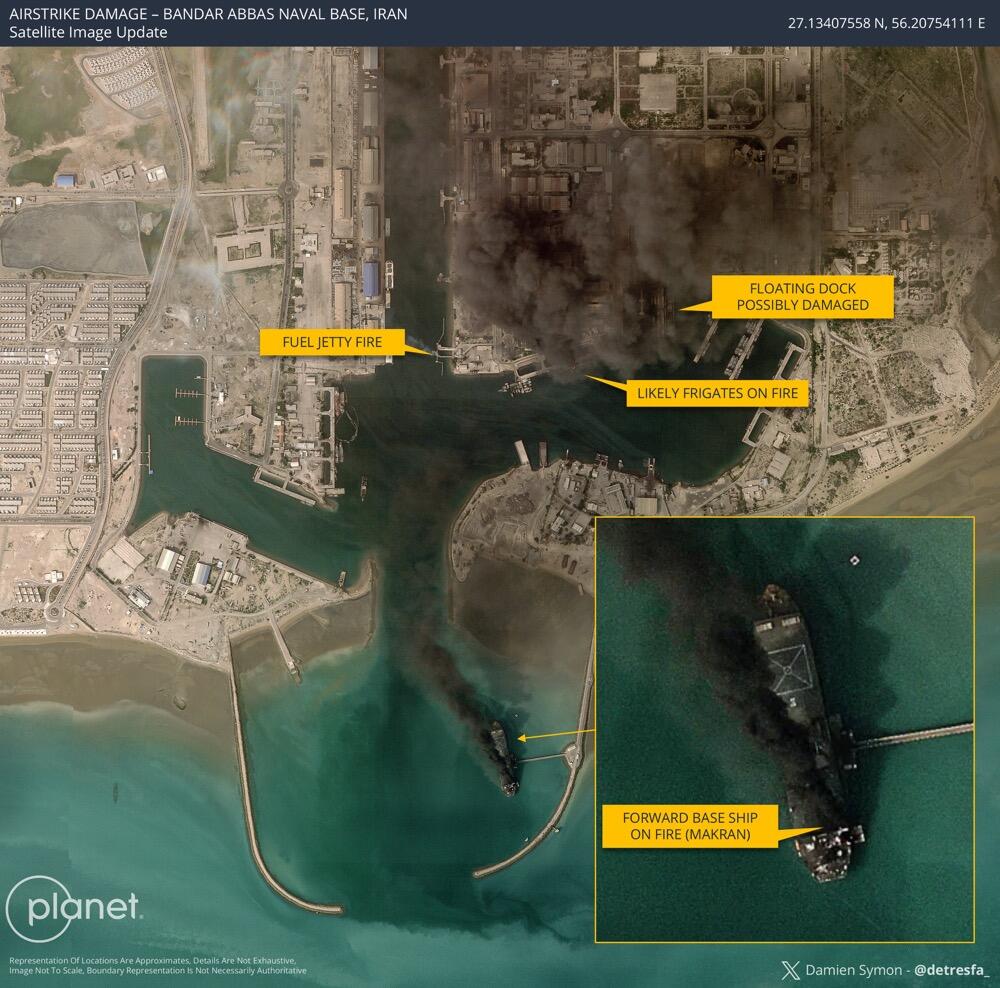
Let’s not forget that US forces in Operation Epic Fury have destroyed the headquarters of the Iranian naval fleet in the port of Bandar Abbas, while Ali Shamkhani, an admiral in Iran’s Revolutionary Guard Corps, was killed by an airstrike. The US-Israeli strikes have reportedly wiped out Iran’s air force and navy.
“They have no navy; it’s been knocked out. They have no air force; it’s been knocked out. They have no air detection; that’s been knocked out,” President Trump said on Tuesday afternoon during a news conference at the White House with German Chancellor Friedrich Merz.
.@POTUS touts the UNBELIEVABLE success of Operation Epic Fury. 🇺🇸
“They have NO NAVY, it’s been knocked out. They have NO AIRFORCE, it’s been knocked out. NO AIR detection—that’s been knocked out. Just about everything has been knocked out…We have a great military.” 🙏 pic.twitter.com/b9Uazk6rkA
— Townhall.com (@townhallcom) March 3, 2026
Without a credible air force or navy, the IRGC’s ability to sustain any meaningful blockade of the Strait of Hormuz will be limited. However, its capacity to wage asymmetric warfare through drones is still unsettling to shipowners, which helps explain why President Trump has offered insurance backstops and naval escorts for tankers transiting the narrow waterway.
Tyler Durden
Wed, 03/04/2026 – 07:45

Daywatch: Trial over Abbott Laboratories’ formula for premature babies set to begin
Good morning, Chicago.
The latest chapter in an ongoing legal battle between Abbott Laboratories and parents of babies born prematurely is slated to play out in Chicago this week — with the beginning of a trial that could have implications for the company and families across the country.
North suburban-based Abbott has been entangled in litigation with parents for years over whether its specialized, cow’s milk-based formulas for infants born prematurely cause a life-threatening intestinal disease called necrotizing enterocolitis.
Now, for the first time in Cook County Circuit Court, cases over the matter are scheduled to go to trial, with jury selection set to start today.
Read the full story from the Tribune’s Lisa Schencker.
Here are the top stories you need to know to start your day, including questions mounting in Congress over Iran war’s costs, how Gov. JB Pritzker and Mayor Brandon Johnson are keeping up Bears stadium pitches and the latest on the trial that could lead to the breakup of Ticketmaster’s parent company.
Today’s eNewspaper edition | Subscribe to more newsletters | Asking Eric | Horoscopes | Puzzles & Games | Today in History
Secretary of State Marco Rubio speaks to reporters as he arrives for an intelligence briefing with top lawmakers on Iran, at the Capitol in Washington, March 2, 2026. (AP Photo/J. Scott Applewhite)
Questions mount in Congress over Iran war’s costs, risks and exit plan
Tensions flared as questions mounted at the U.S. Capitol yesterday over the Trump administration’s shifting rationale for war with Iran as lawmakers demand answers over the strategy, exit plan and costs to Americans in lives and dollars in what is quickly becoming a widening Middle East conflict.
Israel targets Iran’s security forces and leadership as Iran presses attacks across the region
President Trump says ‘someone from within’ Iranian regime might be best choice to lead once war ends
Keshia Golden weeps as her attorney Julie Koehler, right, speaks to the media following an unsuccessful call for the dismissal of charges against Golden at the Leighton Criminal Court Building on March 3, 2026. (Antonio Perez/Chicago Tribune)
Lawyers for woman accused of killing abusive ex-boyfriend call for case to be dropped
Lawyers and advocates for a woman charged with killing her abusive ex-boyfriend railed against prosecutors’ offer of a plea deal and probation and renewed their calls for the Cook County state’s attorney’s office to drop the charges altogether.
Students head toward the main entrance of The Chicago High School for the Arts on West Augusta Boulevard on March 3, 2026, following a press conference demanding that CPS stop its current transition plan for the school. (Antonio Perez/Chicago Tribune)
ChiArts families, teachers protest proposed changes to conservatory model
ChiArts is known for its conservatory model, which allows students to dedicate three hours each afternoon to their chosen arts discipline. But next year, Chicago Public Schools will assume management of the Humboldt Park contract school — and its current 8 a.m. to 5 p.m. schedule will likely change.
Susan Battaglia, center, mother of Brittany Battaglia, leaves court following a lunch break in the trial of Genesis Silva, who is charged with concealing his girlfriend’s nearly-decapitated body in a duffel bag. Brittany Battaglia, 33, had been missing for days when her body was found with stab wounds in Silva’s Logan Square apartment in a duffel bag along with a machete and bags of cleaning equipment in June 2023. (Antonio Perez/Chicago Tribune)
Trial begins for man accused of killing woman, putting her in duffel bag in Logan Square
After Brittany Battaglia had been missing for several days, Chicago police officers made a gruesome discovery at the the Logan Square apartment of her boyfriend, Genesis Silva, on June 5, 2023, prosecutors said yesterday. Her body was found in a duffel bag, nearly decapitated, police said.
Crews move soil for environmental remediation in The 78 development on Feb. 16, 2026, before construction begins on the Chicago Fire stadium in the South Loop. (Brian Cassella/Chicago Tribune)
Gov. JB Pritzker, Mayor Brandon Johnson keep up Bears stadium pitches
Mayor Brandon Johnson and Gov. JB Pritzker yesterday continued mounting their public pitches for where the Chicago Bears should build their next stadium in Illinois, even as the NFL franchise keeps up its flirtation with a move to Indiana.
What to know about the Chicago Bears’ possible move from Soldier Field
Chicago White Sox starting pitcher Anthony Kay throws during the first inning of a spring training game against the Seattle Mariners, Feb. 24, 2026, in Peoria, Ariz. (AP Photo/Charlie Riedel)
‘Stacking days together’: Chicago White Sox’s Shane Smith, Anthony Kay and Davis Martin assess recent starts
Shane Smith, Anthony Kay and Davis Martin are among the Sox pitchers to recently make their second starts this spring.
As the trio continues to build up for the upcoming season, here’s how each assessed their most recent outings.
3 takeaways at White Sox camp, including Sean Newcomb competing for a spot in the rotation
Chicago Cubs players stand during the national anthem before the Cubs play the Texas Rangers in a Cactus League game at Sloan Park on Feb. 21, 2026, in Mesa, Ariz. (Armando L. Sanchez/Chicago Tribune)
Chicago Cubs opening day roster projection: Bullpen and bench spots up for grabs
For a group that returns the majority of its 92-win squad from last year, the Cubs have the necessary pieces to replicate another playoff season. There aren’t many question marks surrounding the Cubs’ opening-day roster three weeks before they are back in Chicago to begin the season.
But there are a couple of roster battles in camp for the bullpen and bench that are starting to take shape, giving a little clarity on the direction the Cubs could go to put their 26-man roster together.
A mural depicting slain Ukrainian refugee Iryna Zarutska in the 2400 block of West Montrose Avenue shows black paint defacing the mural in Chicago’s North Center neighborhood on March 3, 2026. (Chris Sweda/Chicago Tribune)
Controversial Elon Musk-funded mural of slain Ukrainian refugee vandalized in North Center
Splatters of paint now dot the mural of Iryna Zarutska, the slain Ukrainian refugee, after an unknown vandal defaced the building at the corner of North Western and West Montrose avenues.
In this May 11, 2009 file photo, Ticketmaster tickets and gift cards are shown at a box office in San Jose, Calif. (AP Photo/Paul Sakuma)
Trial that could lead to the breakup of Ticketmaster’s parent company gets underway
A high-stakes antitrust trial that could lead to the possible breakup of Live Nation, the parent company of Ticketmaster, got underway yesterday in a case over whether the entertainment giant’s dominance of the concert industry amounts to an illegal monopoly.
Librarian and author Jarrett Dapier sits for a conversation with Chicago Teachers Union project organizer and former teacher Nora Flanagan about his graphic novel, “Wake Now in the Fire,” at The Book Cellar, 4736 N. Lincoln Ave., Feb. 3, 2026, in Chicago. The book is based on a true story about high school students working to overturn a book banned at Chicago Public Schools in the 2010s. (John J. Kim/Chicago Tribune)
In 2013, CPS tried to ban a book. It didn’t go well. A new graphic novel tells the tale.
Thirteen years ago, at Lane Tech College Prep High School on Addison Street, a school administrator approached an English teacher and told her that he needed all of her copies of “Persepolis,” the widely beloved, best-selling 2000 graphic novel from Marjane Satrapi about her childhood under the oppressive regime in Iran during the Islamic Revolution. Turns out, as often happens with a case of book banning, a single person had a problem with a single page in a book — in this case, a drawing of the torture of political prisoners.
Thirteen years later, Jarrett Dapier turned the Lane Tech controversy into “Wake Now in the Fire: A Story of Censorship, Action, Love and Hope,” a sweeping 463-page graphic novel with art by A.J. Dungo.

Braylon Walker puts Warren on his shoulders in the ‘best game of his career.’ With the season on the line.
Warren senior guard Braylon Walker saved his best for last, at least at the high school level.
During the Blue Devils’ Class 4A Rockton Hononegah Sectional semifinal game on Tuesday, Walker reached deep when he was needed most.
“In a game like this, I knew from the get-go that I had to come out and leave it all on the floor,” he said.
But Walker became even more important for the Blue Devils when star junior guard Jaxson Davis, the 2025 Mr. Basketball of Illinois, seemingly started to feel the effects of a head injury suffered during a practice on Monday. Davis, who was cleared to play before the game and again at halftime, according to Warren coach Zack Ryan, scored just nine points, more than 15 below his average.
The 6-foot-3 Walker responded by scoring 33 points, but second-seeded Rockford Auburn pulled out an 84-76 win over the top-seeded Blue Devils, who reached the state championship game last season.
“Unfortunately, we couldn’t get the win,” Walker said. “That’s what’s ultimately the most important.”
Warren’s Braylon Walker (11) goes for a layup against Rockford Auburn during a Class 4A Rockton Hononegah Sectional semifinal game on Tuesday, March 3, 2026. (H. Rick Bamman / News-Sun)
Warren (30-4) was climbing uphill throughout the game, but Walker wasn’t fazed. He scored the first 11 points of the third quarter for the Blue Devils, who turned a 46-36 halftime deficit into a 54-53 lead.
The Knights (26-8) answered with a 10-0 run, however, to regain control and will play Rockford Guilford — which beat Waukegan 65-57 — in the sectional championship game on Friday.
“We had a really good stretch in the third quarter when we came back, and I thought we had them,” Walker said. “But we just ended up falling short.”
After his big third quarter, Walker went into the fourth with 999 career points, and he surpassed 1,000 soon enough.
“That definitely feels good,” he said. “But I wish we could have gotten the win. It shows you not to take any moment for granted because stuff like this could happen.”
Losses were few and far between for the Blue Devils, who certainly haven’t taken Walker’s contributions for granted. He usually plays off the ball but ran the offense quite a bit on Tuesday. He dished the ball to teammates and was 7 for 8 from the free-throw line. His active hands on defense also resulted in a bevy of tipped balls and several steals.
“Today, he probably played the best game of his career,” Ryan said. “He kept us in the game, guarded their best guy.
“He had a great career and will go down as one of the winningest players ever at Warren. It’s a credit to him and all the work he’s put in. His best days of basketball are ahead of him.”
Warren’s Braylon Walker (11) heads up the court after stealing the ball during a Class 4A Rockton Hononegah Sectional semifinal game against Rockford Auburn on Tuesday, March 3, 2026. (H. Rick Bamman / News-Sun)
But where Walker plays next has not been determined. He said he has received interest from Milwaukee and is considering a postgraduate year at a prep school.
“It might be good to get another year to get looked at,” he said. “With the transfer portal, it’s tougher to get a look straight out of high school unless you’re a top-ranked guy.”
Walker, who averaged a team-high 5.9 rebounds this season, knows what he can offer college coaches.
“I want them to see an all-around player who’s a vocal leader who builds the team up and is solid at everything,” Walker said. “I can play a role defending, play point guard, knock down shots — being able to do a little of everything.”
Walker has a message for younger teammates too.
“I tell the other guys who are coming back to leave it all out there, play your heart out, and every day go hard,” he said, “and hopefully win the state championship next year.”
Steve Reaven is a freelance reporter.
https://www.chicagotribune.com/2026/03/04/4a-high-school-basketball-auburn-warren-braylon-walker/
“Hace demasiado calor”: Pescadores en Groenlandia, bajo la amenaza del cambio climático
Por EMMA BURROWS, KWIYEON HA y EVGENIY MALOLETKA
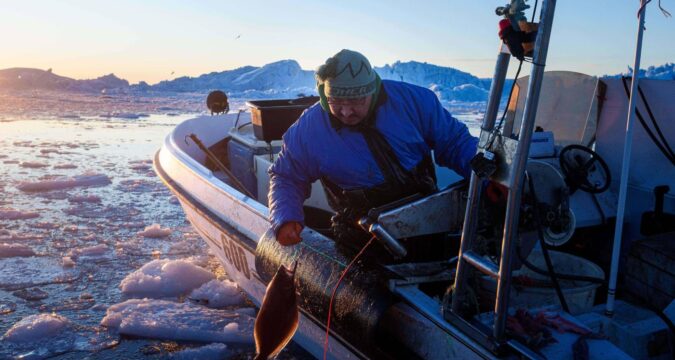
ILULISSAT, Groenlandia (AP) — El pescador Helgi Áargil ya no sabe qué esperar en los fiordos de Groenlandia, donde pasa hasta cinco días seguidos en su barco con su perra, Molly, y las siempre cambiantes auroras boreales en el cielo como compañía.
El año pasado, su embarcación quedó atrapada en hielo que se desprendió del glaciar cercano. Este año, en cambio, ha sido muy lluvioso. Sus ingresos son igual de impredecibles: una salida puede reportarle unas 100.000 coronas danesas (alrededor de 15.700 dólares), o nada en absoluto.
El clima del Ártico, que cambia con rapidez, plantea cada vez más dudas para Groenlandia, un territorio semiautónomo danés que se ha visto sacudido por el interés del presidente de Estados Unidos, Donald Trump, en asumir su control.
Aunque el enfoque de Trump hacia Groenlandia ha cambiado, el mundo no ha logrado frenar los efectos del cambio climático. El Ártico se está calentando más rápido que cualquier otra región del planeta debido a la quema de petróleo, gas y carbón.
Se desconoce qué significado tiene esto para la industria pesquera, que es uno de los pilares de la economía groenlandesa. La pesca representa hasta el 95% de sus exportaciones, muchas hacia su mayor mercado, China, además de a Estados Unidos, Japón y Europa.
Desaparición del hielo marino
Envuelto en un suéter de lana para protegerse del gélido viento, Áargil explicó cómo pesca fletán y bacalao. Entre sus principales capturas están también el camarón y el cangrejo de las nieves, que, incluyendo las patas, puede superar el metro (3 pies) de longitud.
Los pescadores tradicionales en hielo, que constituyen la mitad de la industria local, están experimentando los cambios más drásticos en su forma de trabajar.
“Mi padre pescaba desde hielo marino” de un metro y medio (alrededor de 5 pies) de grosor, recordó Karl Sandgreen, director del Icefjord Center, que documenta el cambio climático en la región y tiene su sede en la localidad de Ilulissat.
Según Sandgreen, ese hielo marino empezó a desaparecer alrededor de 1997, y los pescadores que antes perforaban el hielo para pescar se pasaron cada vez a embarcaciones. El uso de barcos les permite llegar a zonas más grandes, pero eso puede implicar costos adicionales y una contaminación que acelere el calentamiento.
La pesca ha dado forma a las comunidades de Groenlandia. El puerto al que los pescadores regresan a vender sus capturas es el corazón de cada ciudad o poblado. Antes de zarpar, algunos pescadores recogen las cajas de las empresas pesqueras de la isla para empacar una captura, que, en la capital, Nuuk, se iza directamente del barco a la fábrica de pescado.
Toke Binzer, director ejecutivo de la mayor empresa del territorio, Royal Greenland, afirmó que cada vez le preocupa más un futuro en el que no quede mucho hielo marino. Eso podría empujar a los pescadores tradicionales a trasladarse comunidades más grandes y a engrosar las filas de la pesca comercial.
Según Binzer, el reto ahora es cómo apoyar a los pescadores tradicionales cuando a veces hay “demasiado hielo para navegar pero demasiado poco para salir”. Esa imprevisibilidad ya ha causado un problema “enorme”, agregó.
Binzer explicó que Royal Greenland realiza préstamos a los pescadores para la compra de barcos, que ellos devuelven con lo que obtienen al vender sus capturas.
Boris Worm, experto en biodiversidad marina de la Universidad Dalhousie, en Canadá, advirtió que, si todos se pasan a la pesca desde embarcaciones, podría suponer una ayuda económica, pero derivar en sobrepesca.
En Groenlandia hay ya señales que apuntan a un exceso de pesca cerca de la costa, donde el fletán es cada vez más pequeño, indicó Binzer. Worm se mostró de acuerdo y lo calificó como un indicio clásico de sobrepesca: se capturan los ejemplares más grandes y quedan los más pequeños y jóvenes.
El problema podría agravarse a medida que el retroceso del hielo facilite el acceso a los peces. Según Worm, las poblaciones de peces podrían aumentar porque un clima más cálido provoca más lluvia y el deshielo aporta más nutrientes para el plancton, del que se alimentan los peces.
Pero advirtió que los peces podrían no comportarse de forma tan “predecible” como en el pasado, quizás guiados por la búsqueda de nuevas fuentes de alimento si ya no pueden recurrir a las algas que crecen bajo el hielo marino.
Pocas salidas más allá de la pesca
En su barco cerca de Nuuk, Áargil analizó otro reto: el clima cálido está haciendo que algunos peces sean más difíciles de capturar, ya que descienden a una mayor profundidad en busca de aguas más frías.
“Hace demasiado calor”, manifestó mirando las colinas alrededor del fiordo. “No sé a dónde se están los peces, pero ya no hay tantos”.
En Groenlandia, las opciones más allá de la pesca siguen siendo escasas. El turismo está aumentando, pero está lejos de representar una parte significativa de la economía.
La tradición también es motivo de preocupación en relación con el cambio climático: los trineos tirados por perros han quedado ya confinados a tierra firme cuando no hay hielo marino.
“Para muchos groenlandeses es realmente importante tener la posibilidad de salir y navegar”, manifestó Ken Jakobsen, gerente de la fábrica de Royal Greenland en Nuuk. La pesca es lo “más importante”.
El puerto de la capital, añadió, alberga en verano más de 1.000 embarcaciones en un territorio cuya población total es de poco más de 50.000 personas.
___
Esta historia contó con el apoyo de financiación de la Fundación Walton Family. La AP es la única responsable de todo el contenido.
___
Esta historia fue traducida del inglés por un editor de AP con la ayuda de una herramienta de inteligencia artificial generativa.
The Watches Of Operation Epic Fury
The Watches Of Operation Epic Fury
From Washington to Tel Aviv to Tehran, the timepieces worn by the leaders directing a historic escalation.
On the morning of 28 February 2026, the United States initiated Operation Epic Fury, a sustained air campaign targeting Iranian-linked assets and infrastructure, conducted amid escalating tensions between Washington and Tehran. According to the administration, the objectives were to dismantle Iran’s nuclear program, destroy its ballistic missile and UAV capabilities, and degrade its proxy networks across the region.
Authorized by President Trump, the operation was framed as an effort to neutralize immediate threats to US allies while potentially increasing pressure on the Iranian regime internally.
It is difficult to overstate the significance of this operation, with early reporting indicating Iran’s Supreme Leader, Ayatollah Ali Khamenei, was killed along with other senior regime officials and Iranian military leadership by US and Israeli airstrikes.
For us at Watches of Espionage, news like this means it’s time to get to work. What watches are on the wrists of the players involved, and what do they tell us about them?
To be clear, this exercise does not minimize the significance of the events. At the time of writing, at least four US servicemembers have lost their lives, and violence has spread throughout the region. Inevitably, there will be civilian loss of life. By comparison, the watches are insignificant, but they serve as our prism to view and understand history, current events, and national security. Let’s get started.
Chairman of the Joint Chiefs of Staff, General “Razin” Caine – Rolex Datejust
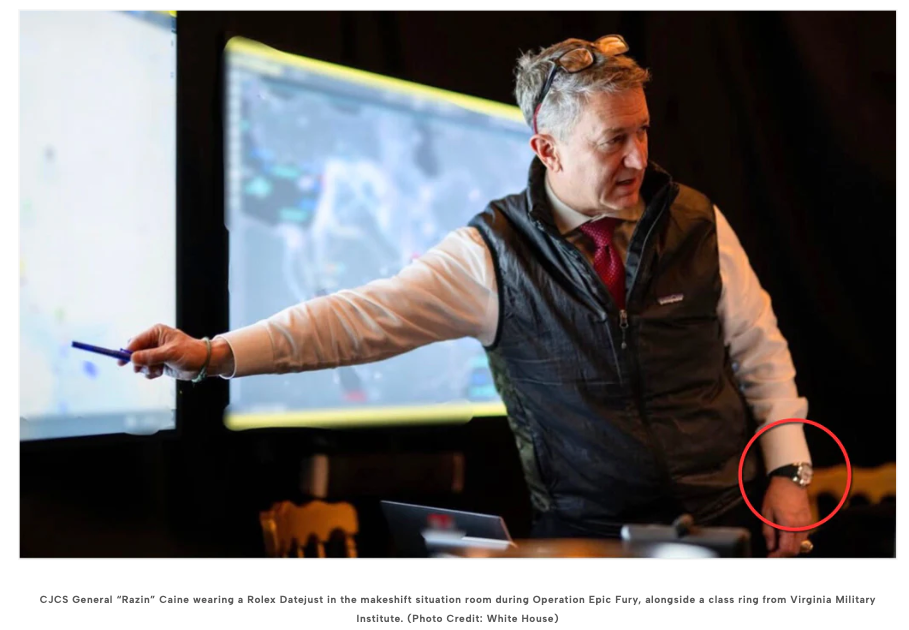
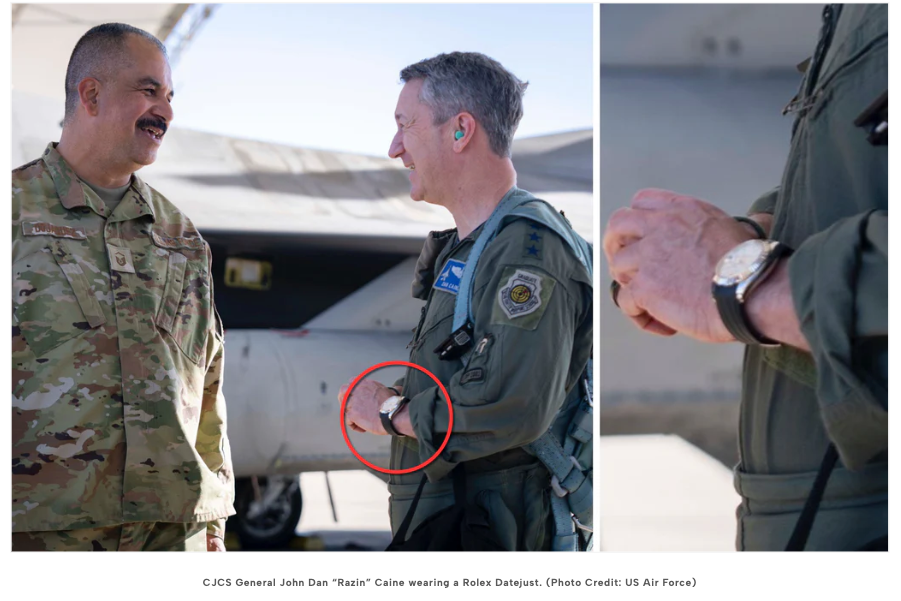
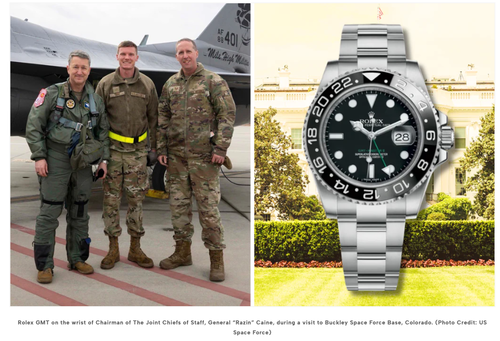
Shortly after the operation began, the White House released photos from the makeshift situation room at Mar-a-Lago. We were quick to notice something new on CJCS General John Dan “Razin” Caine’s wrist. At first, we thought it was a Sky-Dweller, but it appears to be a Datejust, with a fluted bezel, white dial, and an aftermarket rubber strap.
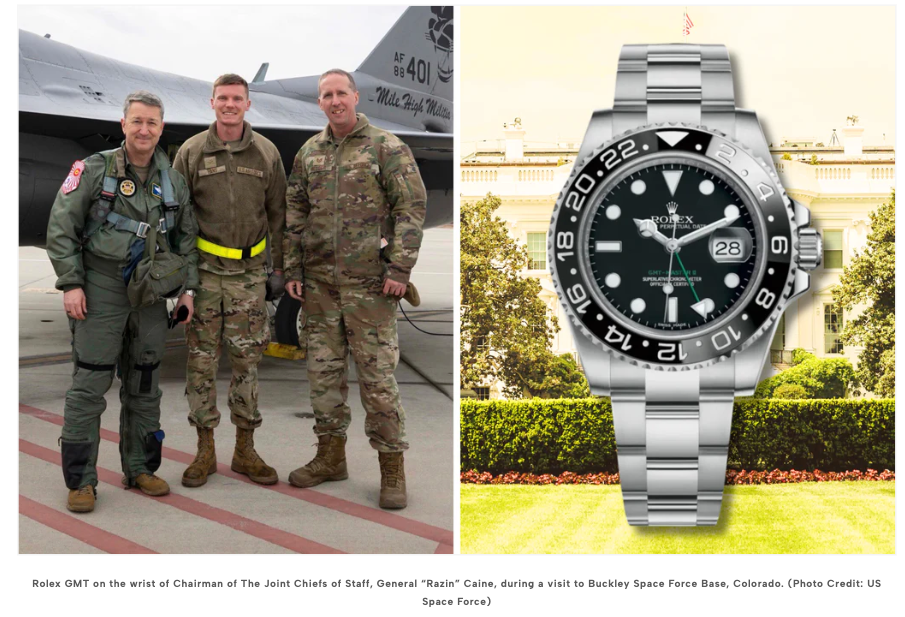
A former F-16 pilot who ascended to become the most senior military officer in the United States, Caine has an impressive watch collection, including a Breitling and Tudor Pelagos, but for the most part, he wears a Rolex GMT-Master II reference 116710LN.
This additional piece cements him as a certified watch nerd. Of note, Caine served as the associate director for military affairs (ADMA) at the CIA from 2021 to 2024, and it’s safe to say: “He’s one of us.”
US Air Force Unit Watches
While the vast majority of US military pilots today rely on Digital Tool Watches while in the air, pilots were the leaders in customized squadron or “unit” watches, which have been a significant aspect of cockpit culture since taking off in the 1990s and early 2000s.
According to press reporting, the full gamut of air platforms has been either directly involved in or supported Operation Epic Fury, including F-18 Super Hornets, F-15s, and F-22 and F-35 fifth-generation fighters. If I were a betting man (which I am), I would bet at least a couple squadron watches were on the wrists of these pilots in the air.
We have previously documented (read HERE) several watches made for the B-2 Stealth Bomber pilots after the June 2025 Operation Midnight Hammer targeted Iranian nuclear facilities, including a Breitling B-1 and Aerospace, a Bremont ALT1-B2 GMT, and small-batch Omega X-33 commissions tailored to the stealth bomber community.
Israeli Air Force Chief Maj. Gen. Tomer Bar – Breitling Aerospace
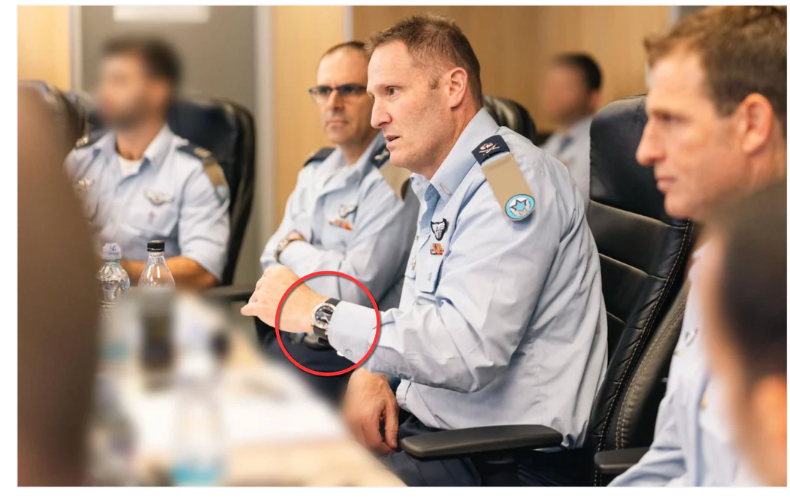
Israeli Air Force Chief Maj. Gen. Tomer Bar has led Israel’s attacks against Iran, dubbed Operation Rising Lion. In addition to a Garmin, Bar wears a Breitling Aerospace on a rubber strap, as seen above in IAF’s underground operations center during the June 2025 operations targeting Iran’s nuclear facilities.
Breitling has long adorned the wrists of military personnel in both Israel and Arab nations and has produced custom editions for both, including a limited edition Aerospace produced for the 50th and 70th anniversaries of Israel’s founding.
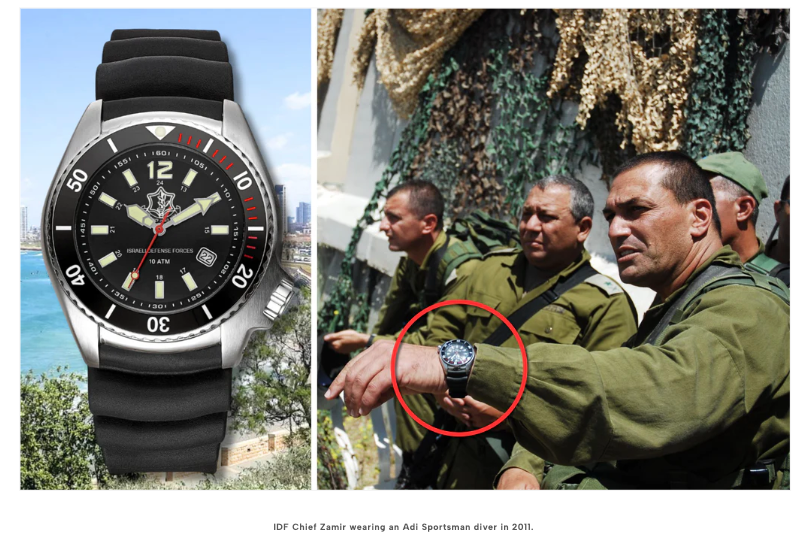
Chief of the General Staff of the Israel Defense Forces – Eyal Zamir – Adi IDF Sportsman
IDF Chief Eyal Zamir has played a central role in shaping Israel’s operational planning against the Iranian military and has also led the recent offensive against Hezbollah in Lebanon, noting, “We are not just on the defensive, now we go on the offense.”
A career Armored Corps officer, Zamir previously commanded the IDF Southern Command, overseeing operations along the Gaza border and managing responses to Hamas, and earlier led the 36th Armored Division.
In 2011, then Brig. Gen. Zamir wore a seldom-seen dive watch from a brand called Adi, which is claimed to be the only watch brand built in Israel. Borrowing elements from popular Seiko and Citizen models, Adi’s collection includes numerous models bearing IDF insignia, as well as a version produced for the Mossad, Israel’s foreign intelligence service. The watches appear to be commercially available, though it appears some may have been issued to certain IDF units.
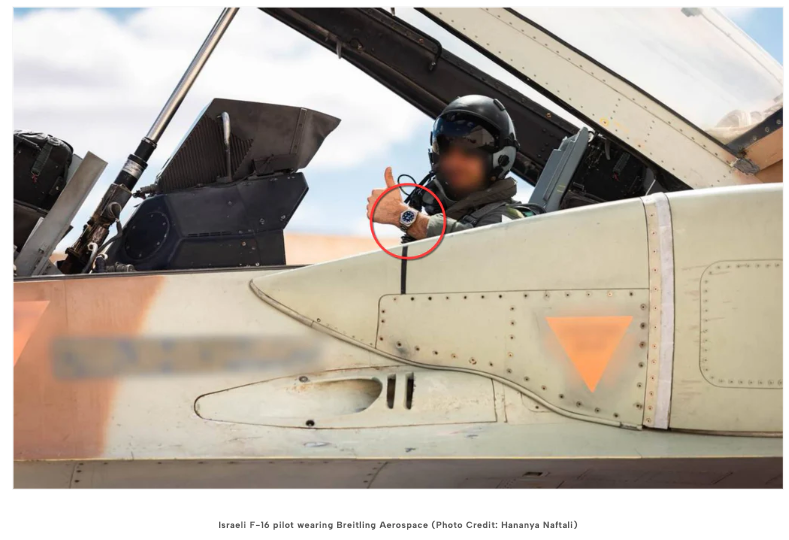
Israeli F-16 Pilot – Breitling Aerospace
Formed in 1948 in the aftermath of Israel’s independence, the Israeli Air Force has grown into one of the region’s most capable air arms, centered on F-15, F-16, and F-35 fighter platforms. Pictured above is an Israeli pilot wearing a potential Breitling Aerospace unit watch, with an insignia and aircraft frame visible on the dial.
In recent years, IAF has conducted several direct strikes on Iranian military and nuclear-linked infrastructure, including large-scale coordinated operations in June 2025. As a part of Operation Epic Fury, IAF reportedly deployed approximately 200 aircraft against missile sites, air defense networks, and Iranian leadership.
Chief of Staff Susie Wiles – Whoop & Rolex Datejust
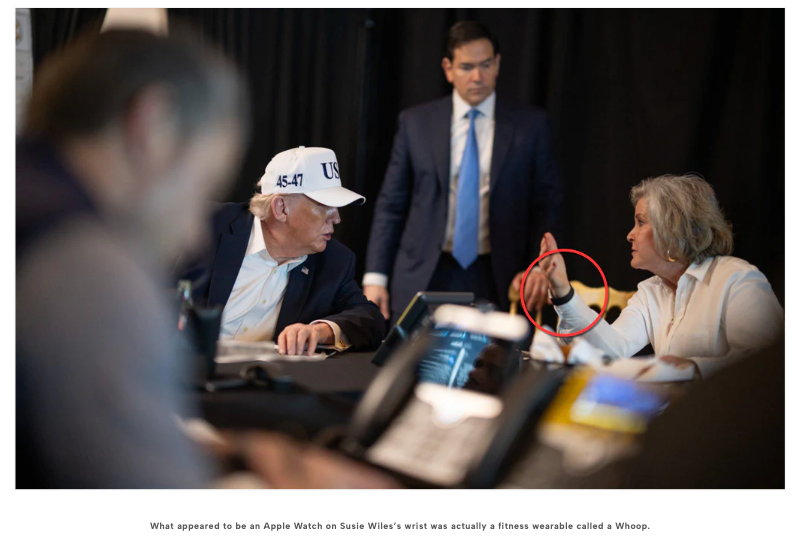
After the White House released photos of senior officials monitoring military operations in Iran, some observers were quick to claim that Chief of Staff Susie Wiles was wearing an Apple Watch or other smartwatch, which could be a potential security issue.
The device on her wrist is actually a Whoop, a screenless fitness tracker that monitors recovery, strain, and sleep without some of the location-tracking and connectivity features of a traditional smartwatch. While still not allowed in all US Government facilities, according to publicly available information, the Whoop is on approved personal electronic device lists and does not contain a microphone, GPS, or similar capabilities that increase counterintelligence risks.
We have been critical of senior government officials, including Vice President JD Vance, for wearing Apple Watches, and it is irresponsible for individuals who are priority collection targets to wear devices with advanced connectivity. While the Whoop does not represent the same risks, senior officials should still be wary of any connected device.
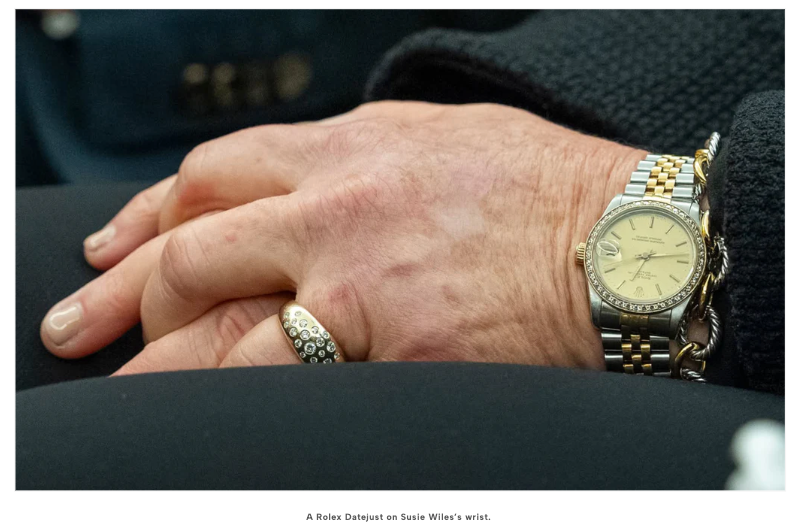
In addition to the Whoop, Wiles also wears a Rolex Datejust.
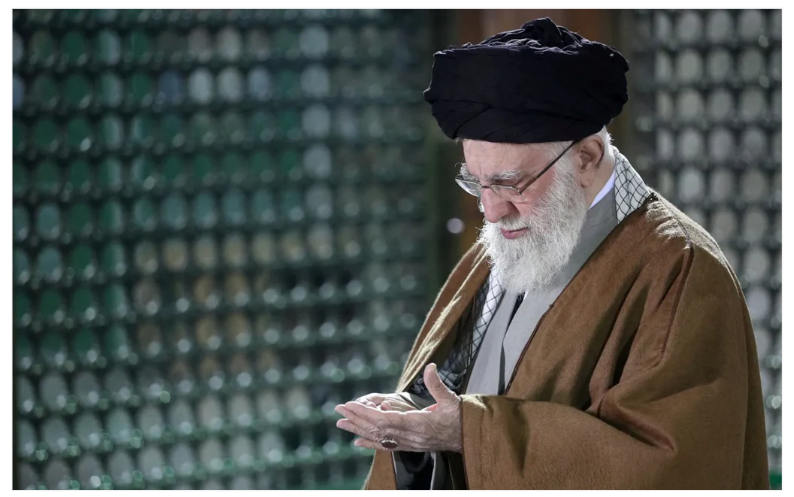
Iran – Ayatollah Khamenei – Pocket Watch? (DECEASED)
Iran is a unique country when it comes to watches, and most of its leaders are modest, with very few examples of “expensive” watches since the Shah, and that in itself is an indicator. While there is some reporting that Ayatollah Ali Khamenei carried a pocket watch, details are limited.
Khamenei served as the Supreme Leader of Iran from 1989 until his death and was a central figure in Iranian politics since the 1979 Islamic Revolution. Khamenei was killed in one of the initial Israeli strikes.
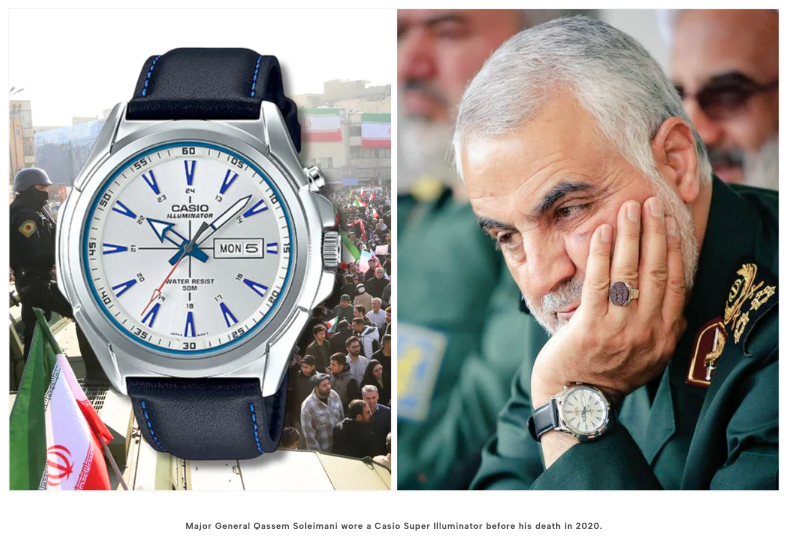
Qassem Soleimani – Casio “Super Illuminator” (DECEASED)
Major General Qassem Soleimani was the longtime commander of Iran’s Islamic Revolutionary Guard Corps Quds Force, the IRGC’s external operations arm tasked with expanding Tehran’s influence through proxy militias and covert action across the region. On his wrist, he wore a modest Casio “Super Illuminator” MTP-E200L, an unassuming watch for a man who wielded significant power beyond Iran’s borders.
Regarded by many inside Iran as a national hero and by critics abroad as a key architect of regional instability, he played a central role in backing proxy forces and overseeing operations targeting US interests. On 03 January 2020, Soleimani was killed in a US drone strike near Baghdad International Airport, a pivotal moment that sharply escalated tensions between Washington and Tehran.
Iranian President Masoud Pezeshkian – Citizen (Alive at Time of Writing)
A cardiac surgeon by training, Masoud Pezeshkian was elected to Iran’s parliament before winning the presidency in 2024. Over the years, he built a reputation as a relatively pragmatic figure within the Islamic Republic’s political structure, often speaking about reform and easing tensions both domestically and abroad. On his wrist, he wears a modest quartz Citizen BF2011-01EC, a straightforward, utilitarian watch that aligns more with a technocrat than a strongman.
Early reporting indicated he was killed in the strikes, but as of writing, he is considered alive.
Final Thoughts
The past few days mark a watershed moment in the history of the Middle East, American power projection, and world order. As expected, “analysis” of Operation Epic Fury has fallen along political lines, and it is way too early to say how this will play out and what the implications will be.
We will leave much of that to others. What we can do, and what we will continue to do, is document the human details that often get lost in the headlines. The watches worn in war rooms, cockpits, and command centers are not trivial. They reflect culture, identity, and tribe. Watches will not explain why nations go to war, but they offer a tangible connection to the people making and executing decisions with far-reaching geopolitical and national security implications.
* * *
If you enjoyed this article, please consider signing up for our weekly free newsletter for further updates HERE.
Tyler Durden
Wed, 03/04/2026 – 07:20
https://www.zerohedge.com/technology/watches-operation-epic-fury
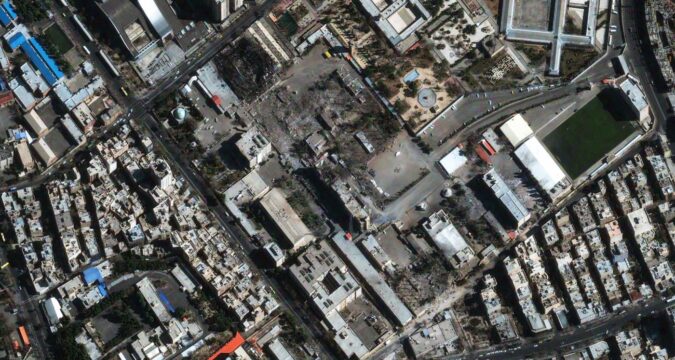
Israel targets Iran’s security forces and leadership as Iran presses attacks across the region
DUBAI, United Arab Emirates — The United States and Israel hit Iran’s capital and other cities in multiple airstrikes on Wednesday, the fifth day of the war with Iran. Israel targeted the Iranian leadership and security forces as the Islamic Republic responded with missile barrages and drone attacks on Israel and across the region.
Iran’s paramilitary Revolutionary Guard issued its most-intense threat yet as the war escalated, saying it was prepared for the “complete destruction of the region’s military and economic infrastructure.”
Questions mount in Congress over Iran war’s costs, risks and exit plan
Tehran residents woke to dawn blasts, and Iranian state television showed the ruins of building in the center of the capital. The Shiite seminary city of Qom and multiple other cities were also targeted.
With fighter jets roaring overhead, those still in Tehran looked anxiously to the skies. One man, who ran a clothing shop, said he didn’t know what to do.
“If I leave the city, how am I supposed to earn money and survive?” he said, speaking on condition of anonymity for fear of reprisals.
The Israeli military said one of its F-35 stealth fighter jets shot down a piloted Iranian Air Force YAK-130 fighter over Tehran on Wednesday. It also said Israeli air defenses were activated to intercept Iranian missiles fired at targets around the country, and explosions were heard around Jerusalem.
The tempo of the strikes on Iran was so intense that authorities postponed the mourning ceremony for Iranian Supreme Leader Ayatollah Ali Khamenei, who was killed in the conflict, according to Iranian state television.
Meanwhile, Turkey’s Defense Ministry said NATO defenses intercepted a ballistic missile launched from Iran before it entered Turkey’s airspace. And an Iranian naval frigate sank off the coast of Sri Lanka. Authorities there rescued 32 people, though others died, Sri Lankan officials said.
It was not immediately clear what happened to the ship, which Sri Lankan authorities identified as the IRIS Dena, and is armed with heavy guns, surface-to-air missiles, anti-ship missiles and torpedoes and can carry a helicopter. The U.S. military said earlier it had already destroyed 17 Iranian vessels and that its goal was sinking “the entire navy.”
US Embassies and oil in the crosshairs
With Iran’s stranglehold on tanker movement through the Strait of Hormuz, the narrow mouth of the Persian Gulf through which about a fifth of the world’s oil is shipped, Brent crude prices hit $84 a barrel, up more than 15% since the start of the conflict and at its highest price since July 2024.
Global stock markets have been hammered over worries that the spike in oil prices may grind down the world economy and sap corporate profits.
Iran has also attacked regional infrastructure. Saudi Arabia said Wednesday its Ras Tanura oil refinery, one of the world’s largest, was again targeted after an unsuccessful drone attack on it earlier in the week. The kingdom’s oil ministry said the latest attack did not cause any damage and supplies were not affected.
Anxious travelers scramble as Iran war strands tens of thousands across the Middle East
The American Embassy in Saudi Arabia and the U.S. Consulate in the United Arab Emirates came under drone attacks Tuesday, and the U.S. State Department said Wednesday it had authorized non-emergency government personnel to evacuate the kingdom.
U.S. Navy Adm. Brad Cooper, the head of U.S. Central Command, said Iran has launched more than 500 ballistic missiles and 2,000 drones so far.
“We’ve already struck nearly 2,000 targets, with more than 2,000 munitions. We have severely degraded Iran’s air defenses and destroyed hundreds of Iran’s ballistic missiles, launchers and drones,” Cooper said in a prerecorded message shared online Wednesday.
Five days into a war that U.S. President Donald Trump suggested could last a month or longer, more than 1,000 people have been killed in Iran, including some Trump said he had considered as possible future leaders of the country.
Both sides are unrelenting in attacks
Air sirens sounded in the morning across the island kingdom of Bahrain, home to the U.S. Navy’s 5th Fleet, and Qatar’s Ministry of Defense said Iran launched two ballistic missiles against it. One hit Al-Udeid Qatari Base but didn’t cause casualties.
Lebanon was hit in multiple strikes and Israel said it’s retaliating against Hezbollah militants after the Iran-backed group fired on Israel. More than 50 people have been killed in Lebanon and more than 300 wounded, according to the Health Ministry.
Iranian-linked militant groups in Iraq have also been launching attacks.
Israeli military spokesman Brig. Gen Effie Defrin reported a decline in launches from Iran as the country’s military capabilities are degraded. In airstrikes overnight, the Israeli military said it hit a missile storage and production plant in Isfahan.
The spiraling nature of the war raised questions about when and how it would end. Trump’s administration has offered various objectives, including destroying Iran’s missile capabilities, wiping out its navy, preventing it from obtaining a nuclear weapon and ensuring it cannot continue to support allied armed groups.
Israel presses attacks on Iranian forces and leadership
While the initial U.S.-Israeli strikes killed Khamenei and Trump urged Iranians to overthrow their government, senior administration officials have since said regime change was not the goal.
Trump on Tuesday seemed to downplay the chances of the war ending Iran’s theocratic rule, saying that “someone from within” the Iranian regime might be the best choice to take power once the U.S.-Israel campaign is finished.
Israel’s defense minister, Israel Katz, said Wednesday on X that whoever Iran picks as the country’s next supreme leader, he will be “a target for elimination.”
The Israeli military also said it hit buildings in Tehran associated with the Basij, the all-volunteer force of Iran’s paramilitary Revolutionary Guard that conducted the bloody crackdown on protesters in January that killed thousands and saw tens of thousands detained in the country.
Iran’s judiciary chief, Gholam Hosseini Mohseni Ejehei, threatened Wednesday anyone who supports the U.S.-Israeli campaign, saying on Iranian state television that they are “on the enemy’s side and must be dealt with on revolutionary, Islamic principles and in accordance with the time of war.”
Iran’s leaders are scrambling to replace Khamenei, who ruled the country for 37 years. It’s only the second time since the 1979 Islamic Revolution that a new supreme leader is being chosen. Among those considered as possible candidates is Mojtaba Khamenei, a son of the late ayatollah.
Defrin, the Israeli military spokesman, said the military struck a building in the Iranian city of Qom on Tuesday where clerics were expected to meet to discuss selecting a new supreme leader. He said the army was still assessing whether anyone was hit.
The semiofficial Fars and Tasnim news agencies, both believed to be close to the Guard, said Wednesday there was no meeting there at the time of the attack.
Hundreds have died, including children
The U.S.-Israeli strikes have killed at least 1,045 people, Iran’s Foundation of Martyrs and Veterans Affairs said Wednesday, saying it represented the number of bodies so far identified and prepared for burial.
Eleven people in Israel have been killed since the conflict began.
Kuwait, which had previously reported a single death, said Wednesday that an 11-year-old girl was killed by falling shrapnel as Kuwaiti forces were intercepting “hostile aerial targets.” In addition, three people were killed in the United Arab Emirates and one in Bahrain.
Six U.S. Army Reserve soldiers were killed Sunday in Kuwait.
Rising reported from Bangkok, and Magdy from Cairo. Associated Press writer Elena Becatoros in Athens, Greece; Melanie Lidman in Tel Aviv, Israel; Bassem Mroue in Beirut; Elaine Kurtenbach in Bangkok; Simina Mistreanu in Taipei, Taiwan, and Giovanna Dell’Orto in Miami contributed to this report.
https://www.chicagotribune.com/2026/03/04/israel-iran-attacks-security-forces-leadership/
Guardia Revolucionaria de Irán amenaza con la plena “destrucción de la infraestructura militar y económica de la región”
DUBÁI, Emiratos Árabes Unidos (AP) — Guardia Revolucionaria de Irán amenaza con la plena “destrucción de la infraestructura militar y económica de la región.”