Category: News
Sri Lanka recupera 87 cuerpos de un buque de guerra iraní hundido por un submarino de EEUU
Por BHARATHA MALLAWARACHI
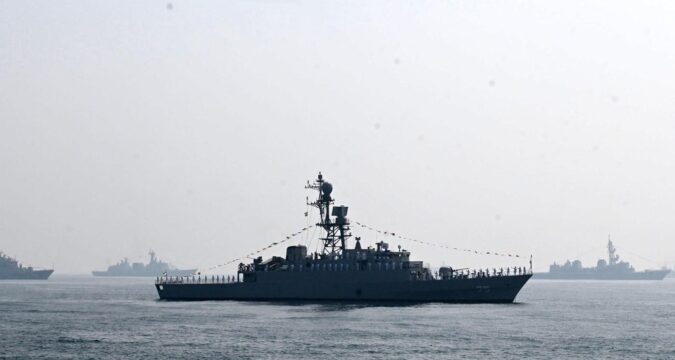
COLOMBO, Sri Lanka (AP) — Un submarino de Estados Unidos hundió un buque de guerra iraní frente a la costa de Sri Lanka, y la marina de esrilanquesa informó el miércoles que recuperó 87 cuerpos y rescató a 32 personas.
El buque iraní hundido en el océano Índico era el “buque insignia” de la República Islámica, manifestó el secretario de Defensa de Estados Unidos, Pete Hegseth, en una rueda de prensa en el Pentágono. El funcionario señaló que era el primer hundimiento de un barco enemigo con un torpedo estadounidense desde la Segunda Guerra Mundial.
El ministro de Relaciones Exteriores de Sri Lanka, Vijitha Herath, declaró ante el Parlamento que su Marina recibió información de que el IRIS Dena, con 180 personas a bordo, estaba en apuros y se hundía. La nación insular envió barcos y aviones de la fuerza aérea en una misión de rescate, indicó.
El portavoz de la marina, el comandante Buddhika Sampath, explicó que, cuando los buques de la Marina llegaron al lugar, no había rastro del barco y “solo había algunas manchas de petróleo y balsas salvavidas. Encontramos personas flotando en el agua”.
Agregó que las 32 personas rescatadas fueron ingresadas en un hospital de la localidad costera de Galle, en la costa sur de Sri Lanka. Los cuerpos recuperados estaban siendo trasladados a tierra, precisó.
El doctor Anil Jasinghe, un alto funcionario del Ministerio de Salud, dijo que una de las personas rescatadas se encuentra en estado crítico, siete reciben tratamiento de emergencia y las demás fueron atendidas por lesiones menores.
El IRIS Dena —uno de los buques de guerra más nuevos de Irán— es una fragata de la clase Moudge que patrulla en aguas profundas para la Marina iraní. Está armada con cañones pesados, misiles tierra-aire, misiles antibuque y torpedos. También transporta un helicóptero.
La fragata fue la pieza central de una gira internacional de dos buques en 2023 que incluyó escalas en puertos de países como Sudáfrica y Brasil. La acompañó el buque de apoyo IRIS Makran, un petrolero convertido.
El Departamento del Tesoro de Estados Unidos incluyó a ambos buques en una lista sanciones en febrero de 2023, junto con ocho ejecutivos de un fabricante iraní de drones que suministró las armas a Rusia para su uso contra objetivos civiles en Ucrania.
Al menos 17 embarcaciones navales iraníes han sido hundidas durante la guerra en curso, afirmó el almirante estadounidense Brad Cooper, quien dirige el Comando Central de Estados Unidos.
“También estamos hundiendo a la Marina iraní, a toda la Marina”, expresó en un mensaje de video.
______
Los periodistas de The Associated Press Adam Schreck en Bangkok y Jon Gambrell en Dubái contribuyeron con este reporte. ______
Esta historia fue traducida del inglés por un editor de AP con la ayuda de una herramienta de inteligencia artificial generativa.

Novo Nordisk Finally Catches Bid After FDA Warns Telehealth Companies
Novo Nordisk Finally Catches Bid After FDA Warns Telehealth Companies
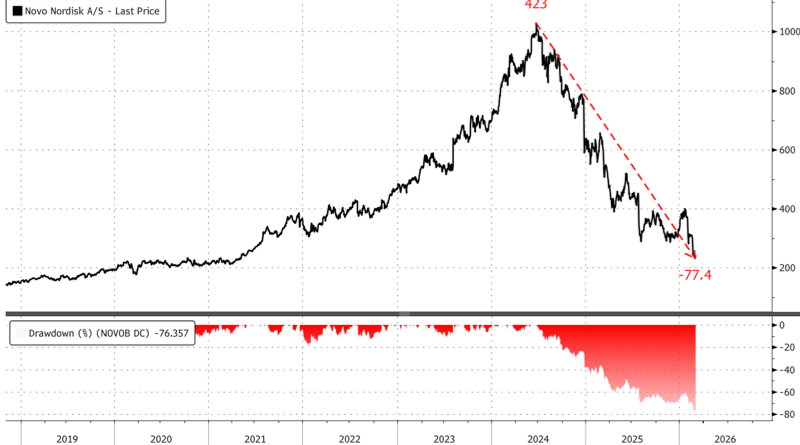
Novo Nordisk shares in Copenhagen finally caught a bid after the U.S. Food and Drug Administration issued 30 warning letters to telehealth companies for making false and misleading claims regarding compounded GLP-1 products (otherwise known as copycat GLP-1s) offered on their websites.
FDA has warned 30 telehealth companies about misleading drug ads.
Consumers should not be fooled into thinking that unapproved, compounded GLP-1 drugs—marketed by telehealth companies—are generic versions or the same as FDA-approved products.
— Dr. Marty Makary (@DrMakaryFDA) March 3, 2026
Citi analyst Geoff Meacham told clients that a quick scan of some of the warning letters “shows the agency is taking issue with telehealth companies calling their compounded products’ generic Zepbound’ or ‘generic Mounjaro’ when these products are not FDA-approved.”
“It’s a new era. We are paying close attention to misleading claims being made by telehealth and pharma companies across all media platforms—and taking swift action,” FDA Commissioner Marty Makary wrote in a statement.
Makary noted, “Compounded drugs can be important for overcoming shortages or meeting unique patient needs—but compounders should not try to compound drugs in a way that circumvents FDA’s approval process.”
Novo and the telehealth firm Hims & Hers have been locked in a GLP-1 battle over the firm’s copycat GLP-1 drugs. Sagging demand, lower prices, and copycat GLP-1s have pressured Novo’s outlook for the year.
Hims & Hers
Novo Wegovy
Shares of Novo caught a bid in Copenhagen, rising about 5%, but the key question is: who is stepping in to catch this falling knife?
The latest on Novo and the GLP-1 feud:
“Big Miss”: Wall Street Disappointed After Dismal Novo Nordisk GLP-1 Sales Outlook, Shares Plunge
GLP-1 Feud: HIMS Fires Back At Novo Nordisk, Slams Lawsuit As “Blatant Attack” By Big Pharma
“Worst-Case Scenario”: Novo Nordisk Plunges After Next-Gen Obesity Drug Falls Short Of Lilly Rival
Novo Nordisk Extends Slide After Announcing Price-Cuts For Blockbuster Obesity Drugs
Meanwhile, Novo’s biggest bull, Goldman analyst James Quigley, downgraded the stock from “Buy” to “Hold” earlier this week. Quigley’s full note can be viewed here and is available to pro subs.
Tyler Durden
Wed, 03/04/2026 – 10:40
Hegseth admite que defensa de EEUU “no significa que podamos detenerlo todo”
Por KONSTANTIN TOROPIN y DAVID KLEPPER
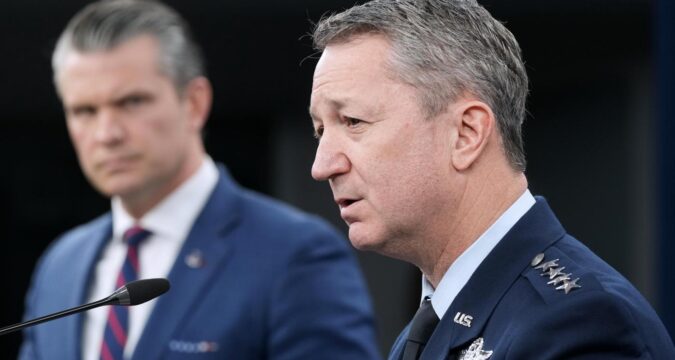
WASHINGTON (AP) — El secretario de Defensa, Pete Hegseth, reconoció el miércoles que algunos ataques aéreos iraníes aún podrían alcanzar sus objetivos, aun cuando afirmó que la superioridad militar de Estados Unidos le está dando rápidamente el control del espacio aéreo de la República Islámica.
Estados Unidos no ha escatimado “en gastos ni capacidades” para reforzar los sistemas de defensa aérea con el fin de proteger a las fuerzas estadounidenses y a sus aliados en Oriente Medio, manifestó Hegseth a los periodistas en el Pentágono, días después de que Estados Unidos e Israel atacaran a Irán en una guerra que se ha extendido por toda la región.
“Esto no significa que podamos detenerlo todo, pero nos aseguramos de que se estableciera la máxima defensa posible y la máxima protección posible de la fuerza antes de pasar a la ofensiva”, declaró Hegseth.
El reconocimiento de que ataques adicionales con drones o misiles en la región podrían causar daños y herir a militares se produce mientras el presidente Donald Trump y los principales líderes de defensa han advertido que podría haber más bajas en un conflicto que podría durar meses.
“Los miembros del servicio de Estados Unidos siguen en peligro, y debemos tener claro que el riesgo sigue siendo alto”, indicó el general Dan Caine, presidente del Estado Mayor Conjunto, en la misma conferencia de prensa.
Seis soldados murieron cuando un ataque iraní con drones impactó el domingo un centro de operaciones en el corazón de un puerto civil en Kuwait, a kilómetros de la principal base del Ejército. El esposo de una de las soldados fallecidas, quien formaba parte de una unidad de abastecimiento y logística con base en Iowa, afirma que el centro era un edificio tipo contenedor de carga y no tenía defensas.
Hegseth también insinuó un posible plazo más largo para el conflicto de lo que se había planteado anteriormente, al decir que podría durar ocho semanas, pero que Estados Unidos cuenta con las municiones y el equipo para derrotar a Irán en una guerra de desgaste. Rechazó fijar un periodo específico y sostuvo que la duración concreta de la guerra dependería de cómo se desarrolle.
“Puedes decir cuatro semanas, pero podrían ser seis, podrían ser ocho, podrían ser tres”, expresó. “En última instancia, nosotros marcamos el ritmo y el tempo. El enemigo está desequilibrado, y vamos a mantenerlo desequilibrado”.
Siguen llegando más fuerzas a la región, incluidos cazas y bombarderos, indicó Hegseth, y Estados Unidos “se tomará todo el tiempo que necesite para asegurarse de ganar”.
Teherán ha prometido destruir por completo la infraestructura militar y económica de Oriente Medio, lo que indica que la guerra está lejos de terminar y podría ampliarse aún más.
Trump dijo esta semana que es probable que la campaña dure de cuatro a cinco semanas, pero que estaba preparado “para ir mucho más allá de eso”.
___________________________________
Contribuyeron a esta nota los corresponsales Ben Finley y Meg Kinnard.
___________________________________
Esta historia fue traducida del inglés por un editor de AP con ayuda de una herramienta de inteligencia artificial generativa.
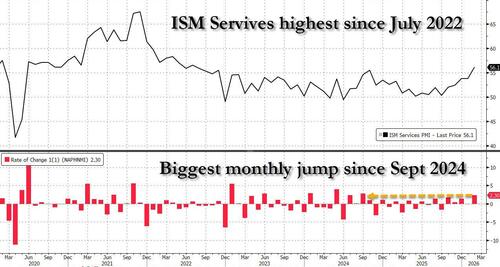
Services ISM Smashes Estimates, Prints At 56.1 Highest Since 2022, As Prices Paid Tumble
Services ISM Smashes Estimates, Prints At 56.1 Highest Since 2022, As Prices Paid Tumble
After the Manufacturing ISM print earlier this week came modestly stronger than expected (albeit with the Prices Paid component spiking and sending 10Y yields higher), some were expecting a similar improvement in today’s Services ISM print. What they got instead, was a blowout number, and one suggesting that whatever weakness the US economy was in for much of the latter part of 2025, is now over.
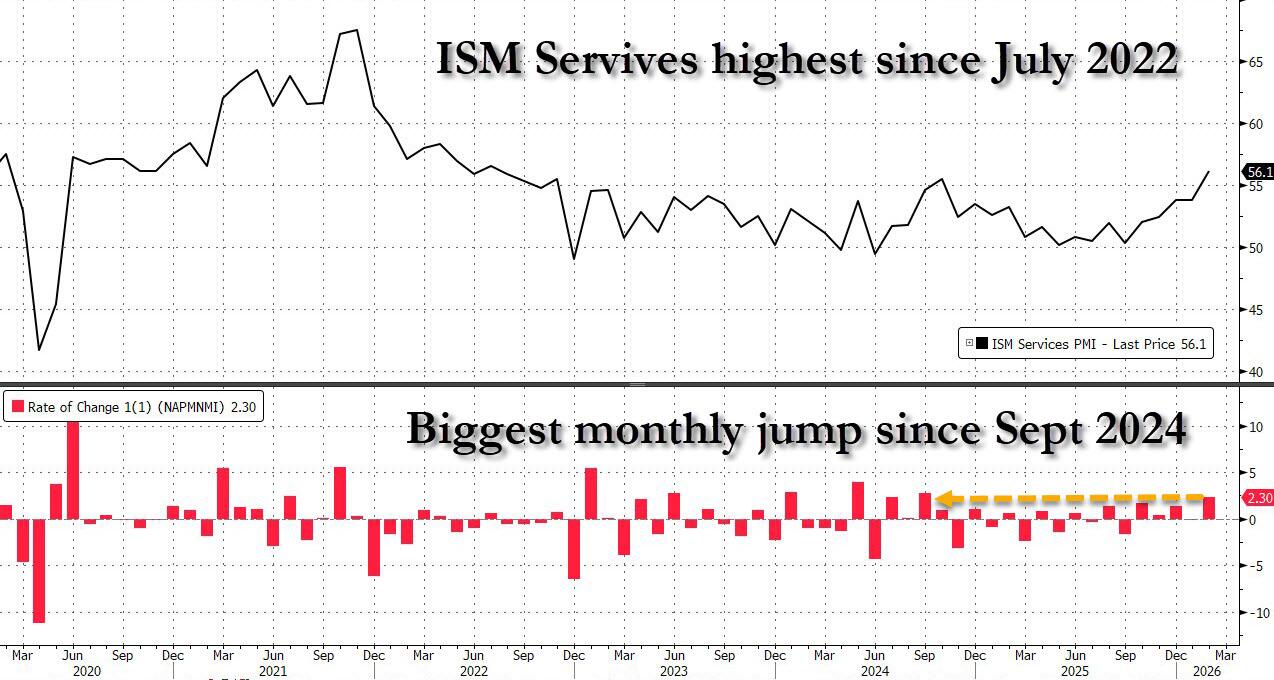
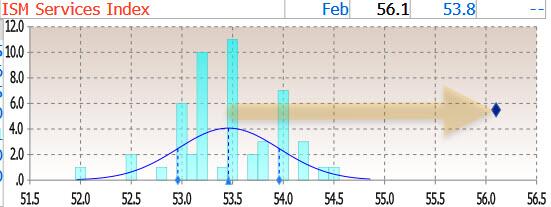
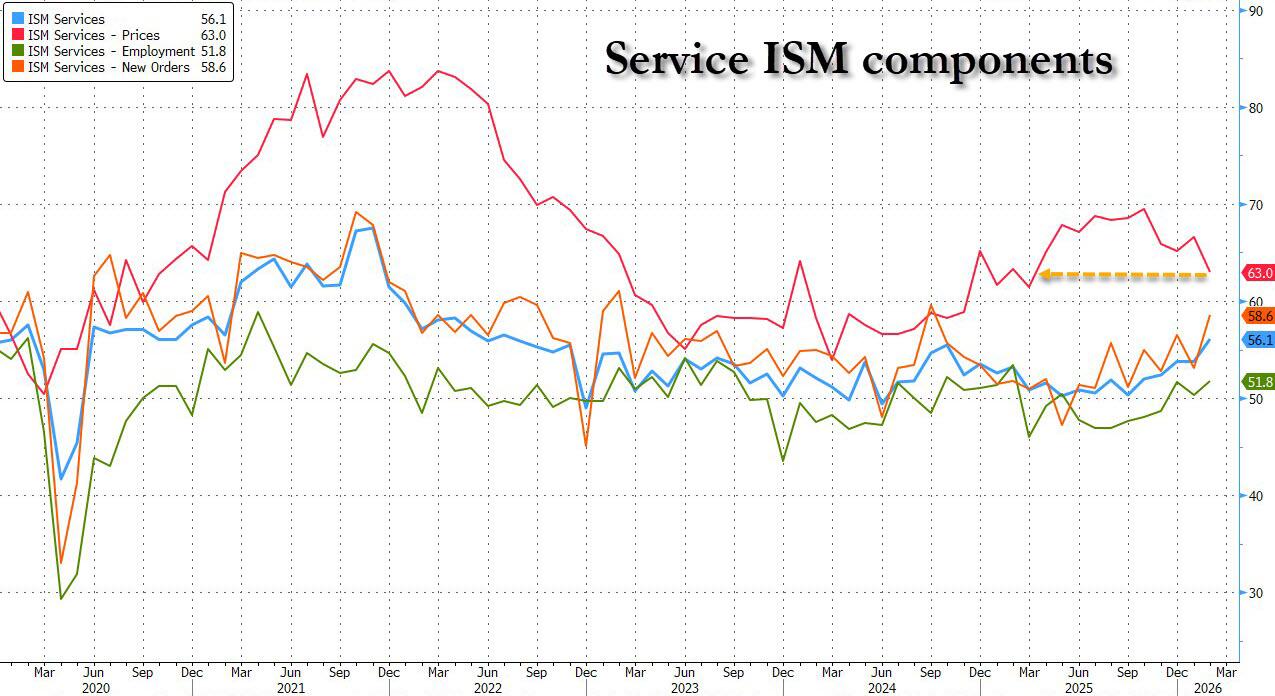
At 10:00am ET, the ISM Services print came out at 56.1, the highest print since July 2022, and was 2.3 higher than the 53.8 reported in January – the biggest monthly increase since Sept 2024
Economists expected a print of 53.5. Not only did the number come above the highest estimate, it was a six-sigma beat to the consensus estimate.
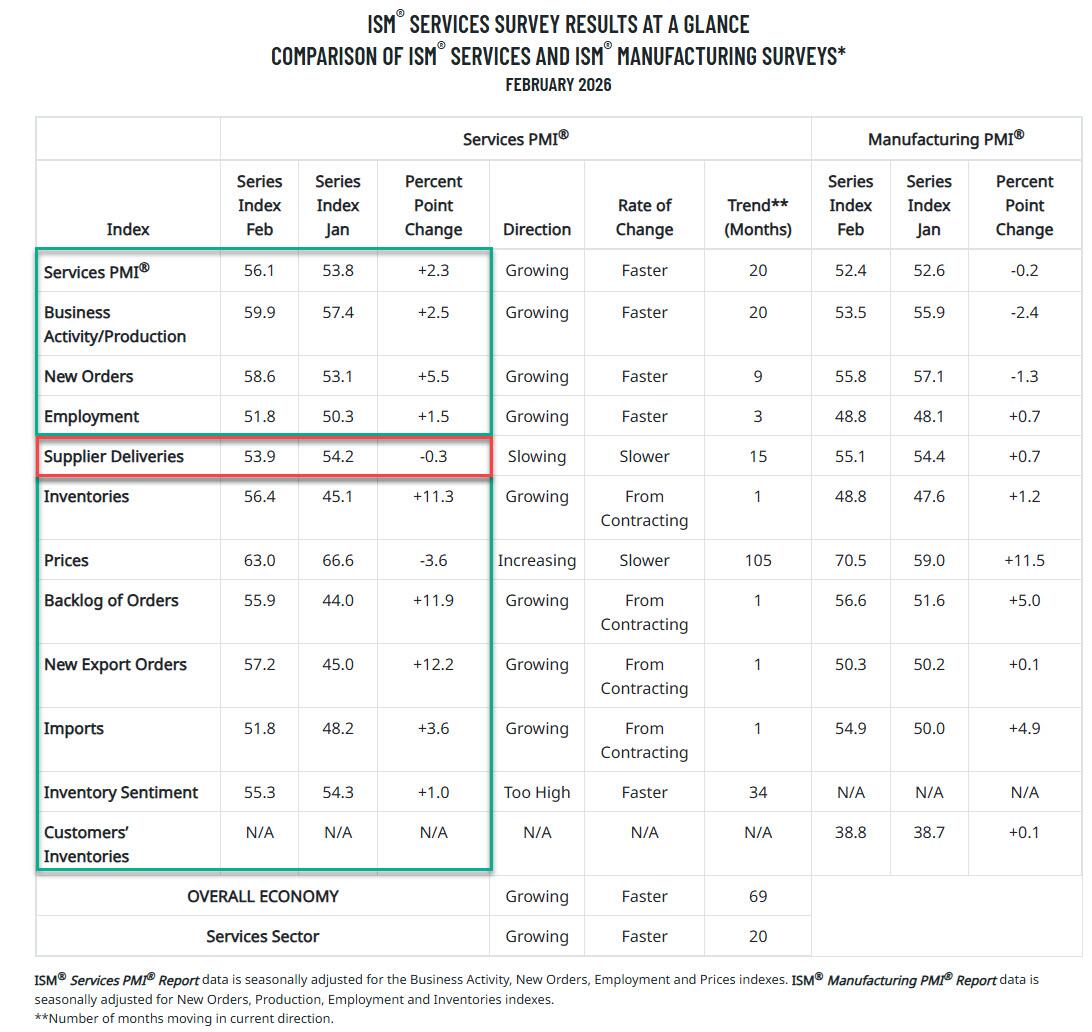
The breakdown shows improvements across virtually every category (a decline in prices paid is actually a good thing, as it means less inflation/stagflation risk).
Digging into the report we find that three demand indicators (the New Orders, Backlog of Orders and New Export Orders indexes) are in expansion, and the Customers’ Inventories Index remains in ‘too low’ territory, contracting at a slightly slower rate. That said, a ‘too low’ status for the Customers’ Inventories Index is usually considered positive for future production.
Regarding output, the Production Index is in expansion for the fourth month in a row, and the Employment Index, though still in contraction, improved by 0.7- percentage points. However, 45% of panelists still indicate that managing head counts is the norm at their companies as opposed to hiring.
Finally, inputs (defined as supplier deliveries, inventories, prices and imports) all increased since the previous month’s reading. The Supplier Deliveries Index indicated slower deliveries, Inventories Index contraction has slowed, and the Prices Index took a huge leap to 70.5 percent from 59 percent in January.
And while both employment and new orders posted gains, perhaps the most important indicator was that Prices Paid tumbled from 66.6 to 63.0, the lowest print in 11 months.
Here is a snapshot of what the ISM respondents are saying:
“India tariffs are anticipated to provide some measure of cost relief once current inventory levels are worked through. At a high level, we are addressing price/value perception which continues to drive negative sales impact.” [Accommodation & Food Services]
“Our industry seems to have adapted to the tariffs. The costs are embedded into the import cost the company has to shoulder.” [Agriculture, Forestry, Fishing & Hunting]
“Residential homebuilding continues to lag due to affordability and interest rate issues. While we saw improved sales last month due to further discounts, we struggled to achieve similar results in February. More material cost increases have rolled in for beginning of the second quarter, so margins continue to be reduced.” [Construction]
“Higher education institutions are operating cautiously due to enrollment fluctuations and uncertainty in state and federal funding and name, image and likeness licensing. While supply chains have improved, costs remain high for technology, facilities, utilities, and contracted services. Labor expenses are also increasing due to competitive hiring. As a result, purchasing decisions are focused on essential needs, cost control, and maintaining key operations, with some noncritical projects being delayed.” [Educational Services]
“Tariff volatility and shifting bilateral trade agreements are materially impacting our purchasing operations. Changes in U.S. semiconductor supply constraints continue to pressure component pricing and availability. The combination of tariff exposure and semiconductor market instability is increasing procurement risk, compressing margins, and requiring more aggressive supplier diversification and contractual protections to maintain cost competitiveness.” [Mining]
“The business climate remains solid overall, but significant unknown risks from further potential tariff actions by the U.S. government are dampening business investment.” [Real Estate, Rental & Leasing]
“Due to random-access memory shortages, we are seeing increased cost and lead times from key technology providers. Quotes that were normally secure for 90 days are now 30 days or less.” [Retail Trade]
“Transportation/truck capacity has been extremely tight, causing rates to spike 30 percent to 40 percent. Some of this can be attributed to the weather; some can be attributed to the Federal Highway Administration’s push to make sure all drivers are proficient in English and others can be attributed to an increase in commerce.” [Transportation & Warehousing]
“Mid-first quarter business conditions are good. The unseasonable cold weather has helped to increase demand and boost revenues. All else is on track so far.” [Utilities]
“Overall, our business performance in January and February has been solid (minus some winter storm hurdles). Our upstream oil and gas business has stalled for two years and is not supporting our growth. On the other hand, all data center-related activity continues to grow substantially. Downstream is always steady, but we are taking more market share within it. The business here is busy. All industries are doing well, minus the oil field business.” [Wholesale Trade]
The report listed the following commodities as going up in price: Cement Products; Chips; Computers; Copper (3); Fuel; Labor (7); Lumber (2); Memory Products (2); Software; Software — Licensing; Software Maintenance; and Wire & Cable.
There were two commodities that dropped in price: Diesel Fuel (3); and the all important Gasoline which is now down 12 months in a row.
Commenting on today’s ISM report, Bloomberg says that it comes as close as it possibly can to goldilocks as “the headline reading posted its highest level since the summer of 2022, with lower-than-expected prices paid (63 versus 68.3 forecast) and nice jumps in new orders and employment, both of which comfortably exceeded market forecasts. If you are a believe that AI will drive non-inflationary growth, this is the survey for you, and it’s given equities a bit of a fillip as a result.”
Judging by the positive market reaction which has sent stocks sharply higher after the report, the market agrees.
Tyler Durden
Wed, 03/04/2026 – 10:28
Rising Energy Costs May Hit All Sectors Eventually
Rising Energy Costs May Hit All Sectors Eventually
By Bas van Geffen, Senior Macro Strategist at Rabobank
Nowhere To Run
There don’t appear to be many safe havens as the situation in Middle East continues to evolve. Not in markets, and not in the region either. At the time of writing, Israel has launched a new strike on Iran. And the US is considering arming Kurdish forces, trying to convince them to take part in a ground offensive against the regime.
Iran, meanwhile, has retaliated not only against the US and Israel, but against various countries in the region and against both military and civilian targets. Maybe this is simply an attempt to sow more chaos as the Iranian regime feels it is on its last legs. Or, perhaps, this is an attempt to convince its neighbors to appeal to the US to stop further operations; a signal that more of these attacks may happen if the US doesn’t.
Yet, if this was the plan, then it has backfired. Iran may have drawn its neighbors into the conflict – and they may side with the US instead. Saudi Arabia may attack Iran soon, Qatar reportedly already has. That’s quite the shift: it effectively sees them side with Israel in this conflict.
Iran’s strikes have reached as far as Cyprus, which means the EU is now involved too – if its energy security wasn’t a reason yet. However, European leaders remain divided on how to deal with the situation. The UK, Greece and France are scrambling to bolster Cyprus’ defences. Elsewhere, Spain has denied the US access to its military bases for air strikes.
That angered President Trump, who has threatened to cut trade ties with Spain. This follows on his Greenland threats earlier this year, and the recalibration of the US tariff structure after the Supreme Court invalidated many of Trump’s original tariffs.
The spat also raises the question whether the US is willing to protect European ships, or ships headed for the continent. President Trump has announced that the navy will escort tankers and freighters through the Strait of Hormuz, as a surge in petrol prices adds to US inflation fears. However, does that protection apply to all ships, or just to US allies? And does the EU have the capacity to protect its own tankers, if necessary? A French carrier does not suffice, but Europe does have some other assets in the area already. In fact, the US may lack the required assets, such as minesweepers, implying it may need its allies to back its pledge with the required muscle.
Nous sommes à l’initiative pour bâtir une coalition afin de réunir les moyens, y compris militaires, pour reprendre et sécuriser le trafic dans ces voies maritimes essentielles à l’économie mondiale. pic.twitter.com/Dv7vNJQA9N
— Emmanuel Macron (@EmmanuelMacron) March 3, 2026
The effective shuttering of the Strait of Hormuz also poses a dilemma for China. What options does the country have? Escalate too, in order to distract the US and draw it away from the region? Or will Beijing work with Washington to end the conflict as quickly as possible and/or to safeguard energy flows through the Strait?
The longer world leaders take to effectively reopen the Strait of Hormuz, the more backlogs in energy supplies will build. So, thus far, markets have largely traded the Middle East war as an inflation risk. Money markets across the globe priced in tighter monetary policy – in the case of the Fed and Bank of England that means fewer rate cuts are being priced, but EUR money markets are now pricing in around 40% odds that the ECB may have to hike rates before the end of the year.
The inflation shock in the aftermath of the Russian invasion of Ukraine is clearly still in peoples’ minds. And yesterday’s Eurozone inflation data probably did not help either. At 1.9% y/y in February, the inflation rate still ran slightly below the ECB’s target, but prices rose faster than the 1.7% that had been expected – and that’s before any real disruptions to energy supplies. We estimate that recent energy price increases could add about 0.5pp to Eurozone inflation. This would see inflation average 2.3% this year, instead of undershooting the ECB’s target.
But if monetary policymakers do prioritize the inflation risks, where does that leave the economic outlook? Equity markets were deeply in the red yesterday, and a 12% drop in the Korean KOSPI index today suggests that global equity markets may not have bottomed out yet.
Rising energy costs may hit all sectors eventually, and aluminium and fertilizer prices are already being affected. But energy-hungry AI data centers are another key sector that comes to mind.
Governments may step in to shield households and companies from surging energy prices, like they did a couple of years ago. However, that will weigh on public finances, while fiscal space is already limited. Long-term sovereign bonds have taken a hit as a result, both in terms of outright yields, and in terms of swap spreads.
And in other markets, too, there appears to be little to no escape. Traditional safe havens, like gold, are not playing their usual part. Curiously, the metal has fallen 5% from its intraday peak at the start of this week. Considering the sharp appreciation of the DXY index, dollar liquidity appears to be king.
Tyler Durden
Wed, 03/04/2026 – 10:20
https://www.zerohedge.com/markets/rising-energy-costs-may-hit-all-sectors-eventually

With 100 days to go, World Cup faces new challenges with Iran war and Mexico violence
GENEVA — With 100 days to go until the World Cup, the Iran war has added a new layer of complexity to the tournament co-hosted by the United States, Mexico and Canada.
How the conflict will affect the world’s most watched sporting event is the latest issue facing organizers already grappling with cartel violence in one of Mexico’s host cities, scaled-back plans for fan festivals in the U.S. and criticism from fans against soaring ticket prices.
Officials of the qualified teams are meeting with FIFA staff in Atlanta this week. The tournament kicks off on June 11 when Mexico plays South Africa in Mexico City. It will be the biggest World Cup ever with 48 participating teams, up from 32 at the previous tournament in Qatar.
Here’s a look at some of the issues drawing scrutiny as the countdown began.
A backdrop of geopolitical tension
It’s not unusual for international politics to overshadow a global sports event like the World Cup — at least in the early stages before the soccer action takes over the headlines.
In 2022, Qatar’s treatment of migrant workers and the LGBTQ+ community drew headlines off the field. LGBTQ+ rights, the annexation of Crimea and the poisoning of a spy in Britain were in focus when Russia hosted the tournament in 2018.
In Brazil in 2014 and South Africa in 2010 there were concerns about crime and security.
The 2026 tournament looks set to kick off amid a backdrop of political tensions involving the U.S. and the participating nations.
Many have been hit by tariffs. Some are facing travel restrictions. Denmark, which can still qualify through playoffs in March, has been shaken by President Donald Trump’s calls for the U.S. to take over Greenland. And with 100 days to go, the U.S. was in a military conflict with Iran, one of the first teams to qualify.
Iran’s status at the World Cup is unclear
Iran is set to play two group stage games in Inglewood, California, and one in Seattle.
However, whether the Iranian team will come to the U.S. is uncertain.
“What is certain is that after this attack, we cannot be expected to look forward to the World Cup with hope,” Iran’s top soccer official, Mehdi Taj, said last weekend as the U.S. and Israel launched coordinated attacks that killed Supreme Leader Ayatollah Ali Khamenei and dozens more senior officials.
Still, Iran has not announced it is withdrawing from the tournament, which no team that qualified has done in the past 75 years. Iran, the second-highest ranked team in Asia, was drawn in a group with Belgium, Egypt and New Zealand.
“I really don’t care,” if Iran participates, Trump told Politico on Tuesday. “I think Iran is a very badly defeated country. They’re running on fumes.”
FIFA did not immediately respond to a request on whether Iran federation officials attended the Atlanta workshop.
Fan festivals are being slimmed down
Fan festivals have been a key part of the World Cup experience in the past two decades. They offer a chance for thousands of fans without match tickets to take part in the World Cup atmosphere by coming together to watch games on a big screen.
Some of those plans are now being scaled back in the U.S.
New York/New Jersey eliminated its Fan Fest in Jersey City, New Jersey, even though it had started selling tickets for an event scheduled to be open every day of the tournament.
Planning to sell tickets was itself unprecedented for World Cup fan zones, which were free to enter since being launched at the 2006 edition in Germany.
Seattle cut down its original plan and rescheduled it for smaller venues and Boston trimmed its event to 16 days.
The chief operating officer of Miami’s FIFA World Cup host committee said during a congressional hearing on Feb. 24 that it might cancel its event if it did not receive federal funding within 30 days. Kansas City, Missouri, Police Deputy Chief Joseph Maybin said the city had an immediate need for federal funds to prepare security.
House Republicans said federal money may be held up by the partial government shutdown of the Department of Homeland Security, caused by Democrats insisting restrictions be placed on Immigration and Customs Enforcement agents.
Foxborough games threatened
The New England Patriots’ stadium in Foxborough, Massachusetts, is due to host seven World Cup games, starting with Haiti-Scotland on June 13 and ending with a quarterfinal on July 9. That is FIFA’s plan.
The Select Board of Foxborough has refused to issue a permit for World Cup matches at the stadium and set a March 17 deadline to be paid $7.8 million — what the town estimates will be the cost of police and other expenses. Foxborough said it was not part of FIFA’s hosting agreement with Boston.
Pushback against FIFA’s ticket prices
FIFA has about 7 million seats to fill for the World Cup matches and said last month it received 500 million ticket requests. FIFA president Gianni Infantino has proclaimed all 104 games are sold out and yet some fans received emails last week offering an extra 48-hour window for tickets sales.
FIFA’s prices in December ranged up to $8,680 per ticket. After criticism, FIFA said it will offer a few hundred $60 tickets for every game to the 48 national federations in the tournament. Those federations will decide how to distribute them to their most loyal fans who attended previous games.
Most seats on FIFA’s ticket resale platform — seeking to cut out the secondary market and earn FIFA extra 15% fees from buyers and sellers — are well past the $1,000 mark.
Cartel violence in Mexico
Mexico’s ability to co-host the World Cup has been under scrutiny after a surge in violence last week in the state of Jalisco following the military’s killing of a powerful cartel boss.
The state’s capital, Guadalajara, is set to host four matches during the group stage.
Mexico’s government insists the World Cup won’t be affected and President Claudia Sheinbaum said there’s no risk for fans coming to the tournament.
Infantino told Sheinbaum that he has full confidence in Mexico as a World Cup host.
The FIFA leader has repeatedly promised the 2026 World Cup will be the greatest and most inclusive.
AP Sports Writers Ronald Blum in New York and Tim Reynolds in Miami contributed to this report
https://www.chicagotribune.com/2026/03/04/world-cup-iran-war-mexico-violence/

Seven running in U.S. House District 5 primaries
Since U.S. Rep. Mike Quigley, D-Chicago, began representing the southwest part of Lake County four years ago, he has been unopposed in the Democratic primary election. This year, he faces three challengers in the March 17 contest.
Those three challengers — Matthew Conroy, Ellen A. Corley and Anthony Michael Tamez — take different positions from Quigley on a number of issues. They lack the experience he has gained as a member of Congress since 2009.
Quigley’s Republican opponent in 2024, Tommy Hanson, is running once again in the GOP primary, and he has a pair of opponents — Kimball Ladien and Barry Wicker.
Lake County voters in the Democratic and Republican primaries will select their nominee for the U.S. House of Representatives in the March 17 primary for the Fifth Congressional District, with the winners advancing to the Nov. 23 general election.
Though Conroy, Quigley and Tamez see affordability as the key issue, they have differing ideas on the best way to help people maintain and improve their lifestyle.
Conroy, 37, of Chicago, is a onetime financial advisor and learning development professional.
Matthew Conroy. (Matthew Conroy)
Conroy said solving the “housing crisis” is the place to start because 800,000 people in the country are homeless, and 35,000 are military veterans. Increasing the U.S. Department of Housing and Urban Development and the U.S. Department of Veterans Affairs budgets will help.
“We need to build more housing, and it needs to be affordable,” he said. “We need to stop corporate consolidation of grocery stores,” he added, as a way to lower the price of food. “We need to use the antitrust laws to stop the mergers.”
Quigley, 67, said in an email that affordability is the most important issue facing his constituents. He said President Donald Trump’s solution of using tariffs to reduce prices is a failure. They have made goods more expensive for people. Congress must act to lower the cost of utilities, housing and healthcare, he said.
“Core pillars of the American dream — homeownership, quality education, and affordable health care — are still out of reach for too many families,” Quigley said in the email. “Donald Trump has done nothing to meaningfully address affordability and has instead pursued policies that have made it worse.”
Anthony Michael Tamez. (Michael Tamez)
Tamez, 26, of Chicago, is Native American. He was elected to represent the 17th District of the Chicago Police District Council. He said he is running because it is time for a generational change in Congress.
Eliminating the tariffs imposed by Trump for nearly a year is one way. Tamez said he would reduce the cost of living. Loosening corporate control of grocery stores and food manufacturers is the best way to make food more affordable, he said. Some manufacturers give different names to identical products.
“They are putting American farmers out of work,” Tamez said. “They are reducing competition and increasing prices.”
Abolishing the U.S. Immigration and Customs Enforcement (ICE) agency is a must for Tamez and Conroy. Tamez said his grandfather was briefly detained because “of the color of his skin.”
“They wanted to deport him to Mexico,” Tamez said. “It’s shocking what they are doing. Borders were a colonial strategy forced on indigenous people. People need to come here legally because they are fleeing violence.”
Though Quigley has not suggested abolishing ICE, he said he introduced legislation to freeze funding for ICE and U.S. Customs and Border Patrol until, “they end their illegal and hazardous behavior. A thorough overhaul of the immigration system is needed.
“Congress must acknowledge that the time for quick fixes is long past and that it’s high time to tackle comprehensive immigration reform,” Quigley said. “The current administration’s policy of sowing fear and chaos is completely counterproductive to the goals of addressing illegal immigration.”
Along with abolishing ICE, Conroy said there needs to be a better way to handle immigration for people who want to legally come to the U.S. There should be more immigration judges to expedite the process for people who are seeking asylum in this country.
“I despise the way the government is treating people because of their skin color,” Conroy said. “Donald Trump said he was going to get rid of the worst of the worst, but 75% of the people arrested have no criminal record at all.”
Both Conroy and Tamez said they support legislation introduced by U.S. Rep. Delia Ramirez, D-Chicago, which limits the sale of military weapons to Israel. They call it the “block the bombs” law. The use of arms must comply with international law.
“I hate all the wars there,” Conroy said, referring to Gaza and Iran. “There was genocide in Gaza. We should support the (international court) warrants against (Israeli Prime Minister Benjamin) Netanyahu and Yoav Galant, and those against the leaders of Hamas.”
Also referring to some of Israel’s actions in Gaza as genocide, Tamez said he is opposed to the wars in the entire Middle East, including Gaza, Palestine and Iran. He wants all military aid to Israel stopped. Though Hamas attacked Israel, the Israelis turned their response into genocide, he said.
“It should not have gone on for as long as it has, holding an entire people hostage,” Tamez said.
Quigley welcomed the Gaza ceasefire when it was finally arranged last year. He also said in a news release he continues his support for a two-state solution, but criticized ministers in Netanyahu’s government for behavior “tantamount to ethnic cleansing.”
“The United States and our partners in the region must do our part to help maintain a lasting peace, ensure Israel’s long-term security, rebuild Gaza and establish a true path forward for the peaceful coexistence of two states for the Palestinian and Israeli people,” he said.
Repeated attempts to contact Corley were unsuccessful.
Three seek GOP nomination
Hanson, 71, is a real estate professional who lives in Chicago. He would like to make credit card interest, insurance premiums, tuition and a variety of business expenses deductible from income taxes.
He wants more training for immigration officers, and wants Congress to be more aggressive in its approach to legislation rather than ceding power to the president.
Tommy Hanson (Tommy Hanson)
Neither Ladien nor Wicker could be reached for comment.
Early voting is ongoing at Deerspring Pool in Deerfield, the Fremont Township Center in Mundelein, the Grant Township Center in Ingleside, the History Center of Lake Forest-Lake Bluff in Lake Forest, the Lake Villa Township office in Lake Villa, the Lake County Central Permit Facility in Libertyville, the Vehe Barn in Deer Park and the Wauconda Township office.
Other early voting sites include William E. Peterson Park in Prairie View, Zion City Hall, Diamond Lake Recreation Center in Mundelein, the Highwood Library and Community Center, Lake Barrington Village Hall, the Lake County Courthouse in Waukegan, the Lilac Cottage at Bowen Park in Waukegan, the North Chicago Public Library and Round Lake Beach Village Hall.
The district includes all or part of the Barrington communities, Long Grove, Lake Zurich, Deer Park and Kildeer, as well as parts of Chicago and the Cook County suburbs.
https://www.chicagotribune.com/2026/03/04/house-district-5-preview/

Nearly 3.4 million pounds of recalled Trader Joe’s chicken fried rice products may contain glass
PORTLAND, Ore. — A Portland, Oregon, company is recalling nearly 3.4 million pounds of frozen chicken fried rice products sold at Trader Joe’s stores and in Canada because they may contain pieces of glass, U.S. Agriculture Department officials reported.
Ajinomoto Foods North America Inc. pulled Trader Joe’s Chicken Fried Rice from stores nationwide. The frozen product — containing fried rice, vegetables, chicken meat and eggs — is sold in 20-ounce plastic bags. The affected packages have best-by dates of Sept. 8 through Nov. 17, 2026. The products are stamped with the establishment number P-18356 inside the USDA mark of inspection.
The company also recalled cardboard packages containing six bags of frozen Ajinomoto Yakitori Chicken with Japanese-Style Rice with best by dates of Sept. 9 to Nov. 12, 2026. Those products were sold only in Canada.
The problem was detected after four consumers complained of finding glass. No injuries have been reported. Consumers should avoid eating the product and throw it away or return it to the store where it was purchased.
https://www.chicagotribune.com/2026/03/04/trader-joes-recall/
Petrolero con bandera rusa se incendia y se hunde frente a Libia
Por SAMY MAGDY
EL CAIRO (AP) — Un buque cisterna con bandera rusa que transportaba gas natural licuado explotó, se incendió y luego se hundió en el mar Mediterráneo frente a la costa de Libia, informaron el miércoles las autoridades del país norafricano. No se reportaron víctimas.
El buque cisterna estaba bajo sanciones occidentales y se sospecha que formaba parte de la flota fantasma rusa que intenta eludir las sanciones impuestas a Rusia por su invasión de Ucrania. De momento se desconoce la causa de la explosión.
Según la Autoridad Marítima de Libia, el martes se registraron “explosiones repentinas, seguidas de un incendio masivo” en el Arctic Metagaz, cuando el buque de GNL se encontraba a unos 240 kilómetros (150 millas) de la costa de la ciudad libia de Sirte.
El buque cisterna, que transportaba 61.000 toneladas de GNL, “se hundió por completo” entre Libia y Malta, indicó un comunicado. Agregó que los 30 tripulantes fueron rescatados y trasladados a otra embarcación con destino a la ciudad libia de Bengasi.
El Metagaz, añadió, había zarpado desde la ciudad rusa noroccidental de Murmansk, en el mar de Barents, y se dirigía a Port Said, en Egipto, en el Mediterráneo. Su última posición reportada estaba en el Mediterráneo occidental, frente a la costa de Malta, según MarineTraffic, una plataforma de seguimiento de buques.
___________________________________
Esta historia fue traducida del inglés por un editor de AP con ayuda de una herramienta de inteligencia artificial generativa.
Air Freight Rates To Spike As Iran War Escalates
Air Freight Rates To Spike As Iran War Escalates
By Eric Kulisch of FreightWaves
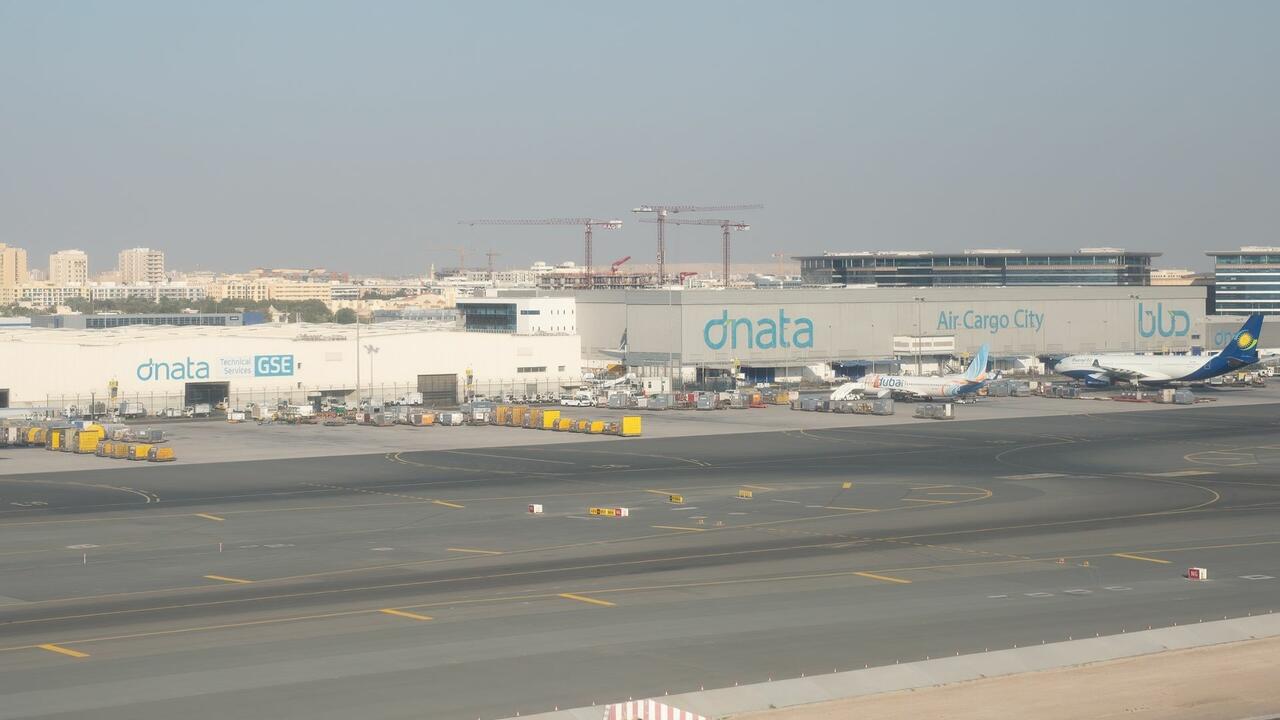
The war launched by the United States and Israel against Iran on Saturday is already disrupting air cargo traffic in the Middle East, a key freight corridor between Asia and Europe where two of the world’s largest cargo airlines are based, and raising the potential for a rise in air freight rates.
Airlines are suspending flights, rerouting traffic around the conflict zone and unable to use key transload hubs in Dubai, Abu Dhabi and Qatar because of retaliatory missile attacks by Iran. More scheduling changes are anticipated in the days ahead.
Longer routes require more fuel, reducing the amount of cargo aircraft can carry so as not to exceed weight limits. Some airlines are expected to add refueling stops.
“We are expecting some potentially significant move in rates, especially Asia-Europe, if the situation continues with large-scale flight cancellations,” said Neil Wilson, editor of global price reporting agency TAC Index, said in an email exchange.
FedEx has suspended flights to and from Bahrain, Iran, Iraq, Israel, Jordan, Kuwait, Lebanon, Oman, Qatar, United Arab Emirates and Saudi Arabia.
“The safety and well-being of our team members is our highest priority. As a result, pickup and delivery services in Bahrain, Kuwait, Iraq, Qatar and United Arab Emirates have been temporarily suspended until further notice. Shipments to and from other markets throughout the region may experience extended transit times,” the company said in a service alert. “We are closely monitoring the situation and will resume services as soon as it is safe to do so.”
UPS has not announced any operational changes, but said in a statement provided to FreightWaves, “We are closely monitoring this fluid situation and using established contingency plans to manage our operations safely and efficiently.”
Qatar Airways, which operates 29 Boeing 777 freighter aircraft and carries huge volumes of cargo on widebody passenger planes, has temporarily halted flights to, and from, Doha due to the closure of Qatar’s airspace. Qatar Airways Cargo offers shippers 13 tons of capacity per day.The airline warned customers to expect flight delays once the airspace re-opens and it resumes operations there. In the meantime, tendered cargo is being held at its hub and other stations around the world.
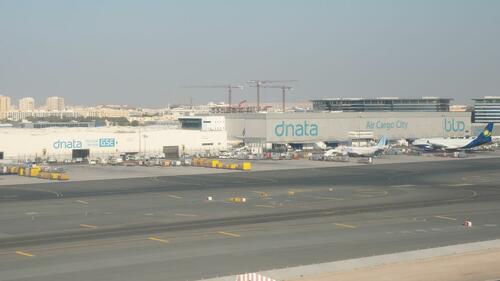
Emirates Skycargo, the fourth-largest cargo airline by traffic, has similarly suspended flights through Dubai. It operates nearly a dozen Boeing 777 freighters and leases several crewed Boeing 747-400s from third-party carriers. The United Arab Emirates has closed its airspace and Dubai International Airport sustained minor damage to a passenger concourse from an Iranian attack, according to news accounts from the region.
Bahrain’s international airport also suffered minor damage from a drone attack.
Etihad Airlines, which operates five Boeing 777 freighter aircraft in addition to a large fleet of widebody passenger aircraft, has suspended all flights through Abu Dhabi until Monday at 2 a.m. Airlines are monitoring the situation and could choose to extend any flight suspensions.
The cargo arm of Oman Air said it is experiencing limited disruption to some services within the region. Oman Air is a smaller carrier, with nine Boeing 787, 10 Airbus 330, and 32 Boeing 737-800/MAX8 passenger jets, plus one 737-800 converted freighter, according to Flightradar24 data. Services to Europe and the Asia Pacific continue to operate as scheduled, with rerouting implemented and some minor delays. As a precautionary measure, the carriage of perishable cargo has been temporarily restricted, while general cargo operations continue as normal.
Hong Kong-based Cathay Group, a hybrid carrier with 20 Boeing 747 cargo jets, suspended all operations in the Middle East, including passenger services to and from Dubai and Riyadh, as well as freighter services to and from Al Maktoum International Airport in Dubai. Flights typically passing over the affected area are being rerouted, it said.
Data from Netherlands-based consultancy Rotate shows global air cargo capacity is down 18% from last week due to flight suspensions by Middle East carriers and other carriers opting not to serve the Middle East. Freighter operators in Asia pivoting from the Middle East and flying over Russia (depending on sanctions), or central Asia, to reach European destinations, according to Rotate.
Air India has suspended all flights to destinations in the Middle East, as well as many flights to Europe and New York.
United Airlines has cancelled all departures to and from Tel Aviv, Israel through March 6. The airline has also canceled flights through Dubai through March 4. SWISS suspended flights to Dubai through March 4 and to Tel Aviv through March 8. “Until and including 8 March, we will continue to avoid the airspace of Israel, Lebanon, Jordan, Iraq, Iran, Kuwait and Bahrain,” the passenger airline said in a notice.
In addition to suspending flights to the region, European carriers impacted because they must take the longer northern route through central Asia to reach south and east Asia, instead of the southern corridor over Turkey, Iraq and Iran.
Freightos, an international cargo marketplace and freight data provider, said air cargo rates in and out of the Middle East have remained stable so far.
“While the situation is still developing, we can already now advise of significant delays ahead for both shipments already in transit and for upcoming shipments to and from the Middle East. It is also likely that there will be delays on the Asia-Europe trade lane as a result of this,” said Scan Global Logistics in a notice to customers.
Immediate hikes in air cargo rates could be tempered by the fact that Chinese exports are still slow as factories come back online following the Lunar New Year holiday, which means there is more slack in aircraft supply than there will be in a week or two, said Dmitry Kulisch, executive director of Air Cargo APAC Ltd., a Hong Kong freight consolidator. He said cargo rates could be pressured upward too because fewer passenger aircraft will be available to carry cargo as airlines prioritize repositioning aircraft within their networks to restart operations once the war ends.
Meanwhile, on the ocean front, container shipping lines Maersk, Hapag-Lloyd, MSC and CMA CGM are ceasing services to and diverting vessels away from the Strait of Hormuz and the region, with CMA CGM introducing a $4,000 emergency surcharge per forty-foot container for services to the region. Hapag Lloyd announced a war risk surcharge of $1,500 per 20-foot equivalent unit for cargo transiting the Arabian/Persian Gulf, effective March 2. Reefer and special containers will be charged at $3,500 per TEU.
Marsk also cautioned customers about possible service disruptions in the UAE, Oman and Qatar.
Iranian Revolutionary Guards attacked two oil tankers on Sunday. Four seafarers on the MT Skylight were injured and transferred ashore for medical treatment after their vessel was attacked in the Strait of Hormuz, according to officials in Oman and the Palau Ship Registry.
DP World has suspended operations at the port of Jebel Ali in Dubai after an aerial interception caused a fire there Saturday night.
Iran-backed Houthi rebels in Yemen have threatened to resume strikes. In response, carriers that had restarted some Red Sea sailings have diverted vessels back around the Cape of Good Hope, postponing industry plans to return to the shortcut between Asia and Europe.
The Freight & Trade Alliance and the Australian Peak Shippers Association, representing logistics providers and cargo owners in Australia, said Sunday night “the situation is already having direct and measurable impacts on Australian supply chains, with disruptions to air cargo connectivity, container shipping schedules, and the rapid imposition of significant conflict‑related surcharges by major international carriers.”
International supply chains have buffeted by geopolitical events in recent years, including the Ukraine war, the Israel-Hamas war and the proliferation of global tariffs triggered by the United States.
Tyler Durden
Wed, 03/04/2026 – 10:00
https://www.zerohedge.com/markets/air-freight-rates-spike-iran-war-escalates