Category: News
Dos hombres son juzgados por espiar a la diáspora hongkonesa en el Reino Unido
Por BRIAN MELLEY
LONDRES (AP) — Un expolicía de Hong Kong y un funcionario de fronteras del Reino Unido actuaron en nombre del gobierno chino como agentes policiales secretos o de inteligencia en Gran Bretaña, sostuvo un fiscal el miércoles.
Bill Yuen, de 65 años, y Peter Wai, de 38, ambos con doble nacionalidad china y británica, están siendo juzgados acusados de haber violado la Ley de Seguridad Nacional al ayudar a un servicio de espionaje extranjero.
“Los acusados participaron en operaciones de vigilancia policial clandestina en nombre de la Región Administrativa Especial de Hong Kong y, por ende, de la República Popular China”, declaró el fiscal Duncan Atkinson en el Tribunal Penal Central de Londres.
Atkinson sostuvo que ambos actuaron como si fueran fuerzas del orden legítimas para vigilar y recopilar información sobre individuos que Hong Kong consideraba “personas de interés”, como partidarios de la democracia.
Yuen fue anteriormente superintendente de la Policía de Hong Kong y trabajaba en la Oficina Económica y Comercial de Hong Kong en Londres.
Wai trabajó como agente de la Fuerza Fronteriza del Reino Unido, fue agente especial de la Municipalidad de Londres y dirigía una empresa privada de seguridad.
Los fiscales indicaron que el trabajo de Yuen fue más allá de sus supuestas funciones como gerente de oficina de la representación comercial de Hong Kong. Presuntamente ayudó a recopilar información de inteligencia para Hong Kong sobre activistas y políticos prodemocracia que se habían trasladado al Reino Unido en los últimos años, después de que las autoridades allá introdujeran una amplia ley de seguridad nacional.
Según la acusación, Yuen asignó tareas a Wai, a quien se acusa de usar sistemas policiales para obtener información para su trabajo privado, que servía de tapadera para su espionaje. Los fiscales señalaron que a Wai se le pagaba desde una cuenta de la oficina comercial.
Mensajes telefónicos mostraron que ambos vigilaban al exlegislador de Hong Kong Nathan Law y que su interés se extendía más allá de los activistas hongkoneses, a quienes llamaban “cucarachas”.
Yuen le indicó a Wai que prestara especial atención a parlamentarios o empleados públicos y, en 2023, proporcionó el nombre de políticos destacados, entre ellos el legislador conservador Iain Duncan Smith, copresidente de la Alianza Interparlamentaria sobre China.
Yuen y Wai se han declarado inocentes de violar la Ley de Seguridad Nacional al ayudar a un servicio de inteligencia extranjero entre diciembre de 2023 y mayo de 2024, y de cometer injerencia extranjera al intentar entrar por la fuerza en una vivienda. Wai ha negado un cargo separado de conducta inapropiada en el ejercicio de un cargo público.
El juicio está previsto a durar nueve semanas.
___________________________________
Esta historia fue traducida del inglés por un editor de AP con ayuda de una herramienta de inteligencia artificial generativa.

NY AG James Orders Hospital To Resume Gender-Transition Treatment For Minors
NY AG James Orders Hospital To Resume Gender-Transition Treatment For Minors
Authored by Jonathan Turley via jonathanturley.org,
In a rare and controversial move, New York Attorney General Letitia James has ordered a Manhattan hospital to resume offering gender-transition treatment to transgender youth. NYU Langone had discontinued such treatments after funding threats from the Trump administration. It is now caught between the proverbial rock (HHS) and a hard place (NYAG).
Last year, President Donald Trump signed an executive order entitled “Protecting Children from Chemical and Surgical Mutilation,” seeking to restrict gender-transition treatment for people under 19. HHS then threatened hospitals with a cut off of federal Medicaid and Medicare funding for continuing such treatment for children.
Various European countries have also halted certain procedures after countervailing studies suggesting that the risks are too high. England’s National Health Service 2024 report on the subject, known as the Cass Report, found concerning evidence of harm for minors and inconclusive benefits.
James threatened “further action” if NYU Langone does not defy the Trump Administration, declaring that the cessation of its Transgender Youth Health Program violates New York anti-discrimination law by “jeopardizing access to medically necessary healthcare for some of the most vulnerable New Yorkers.”
NYU Langone had previously declared that it would no longer provide certain gender-transition treatments for patients under the age of 19.
James’s move could trigger a fascinating challenge. In the Feb. 25 letter signed by the attorney general’s health care bureau chief, Darsana Srinivasan, the state said that the federal regulatory change did not affect a “medical institution’s existing duties and obligations under New York law.” That raises an interesting conflict between state and federal regulations.
The letter gives the hospital until March 11 to comply and resume these treatments.
Effectively, James is ordering the hospital to defy the federal government. However, the hospital, not James or the state, would bear the financial and regulatory consequences.
While James does not state how she will penalize the hospital, the letter is likely sufficient to challenge the move. The question is whether the political costs for the NYU hospital are prohibitive. There is also the question of whether the HHS has standing or interest in challenging the move as a direct threat to federal authority.
The problem with a federal challenge is that nothing in the New York threat prevents the federal government from carrying out its intent to cut off funding. Hospitals would have to choose between penalties in New York or loss of funding in Washington. Nevertheless, New York’s move is a direct attack on the enforcement of federal policy by state hospitals.
Tyler Durden
Wed, 03/04/2026 – 13:35

East Aurora School District 131 board OKs $1.1 million annual Chromebook purchase
At its meeting on Monday, the East Aurora School District 131 board approved the district’s purchase of around 2,500 Chromebooks for students, for a total cost of a little more than $1.1 million.
Monday’s approval was for a purchase that the district makes annually, according to the district’s Assistant Superintendent of Operations Andrew Allen.
At the school board’s Building and Grounds Committee meeting earlier that evening, Allen explained that new laptops are given to second-, sixth- and ninth-graders — meaning students in the district use the same laptop for three to four years before getting a new one. Seniors can keep their Chromebook after graduation.
At the Building and Grounds meeting, the district indicated that pricing has been a concern for the Chromebook purchases for students.
The purchase approved Monday of 2,500 Lenovo Chromebooks, including three-year protection plans, from North Star K12, Inc. came in at $1,152,500.
Allen said at the meeting that prices for this type of technology have “gone up exponentially.”
He said the district has discussed ways of making these annual purchases “more sustainable over a longer period of time,” like having cabinets or racks at school to hold the computers for elementary students so the devices would last longer and incur less damage.
District 131 Superintendent Bob Halverson noted that such a plan could still enable the district to send the laptops home with students as needed, but could “extend the life cycle on them a little bit.”
Halverson also noted that the district has had to go from a touch screen to a non-touch screen option because of costs.
The purchase was ultimately approved later that evening by the district’s school board.
mmorrow@chicagotribune.com
Karnage: Korea Kospi Suffers Biggest Crash In History – Is It A Buying Opportunity?
Karnage: Korea Kospi Suffers Biggest Crash In History – Is It A Buying Opportunity?
Yesterday we discussed the dramatic move in Korean stocks, which saw the Kospi tumble by 7.4%, its biggest drop since the August 2024 carry trade unwind, and which put a dramatic halt to the historic meltup in the country’s stock market driven almost entirely by memory (Samsung and SK Hynix) and semiconductor stocks.
However, as we noted earlier this week when we pointed out the unprecedented pile up in the Korea ETF which was virtually identical to what happened in silver in January, just before the commodity crashed, the euphoric investor pile up in the main Korean index was screaming a “get me out of here” warning…
Korea ETF volume pic.twitter.com/9PSDyTXyHJ
— zerohedge (@zerohedge) March 2, 2026
… and one which suggested that the pain for Korean stocks was only starting.
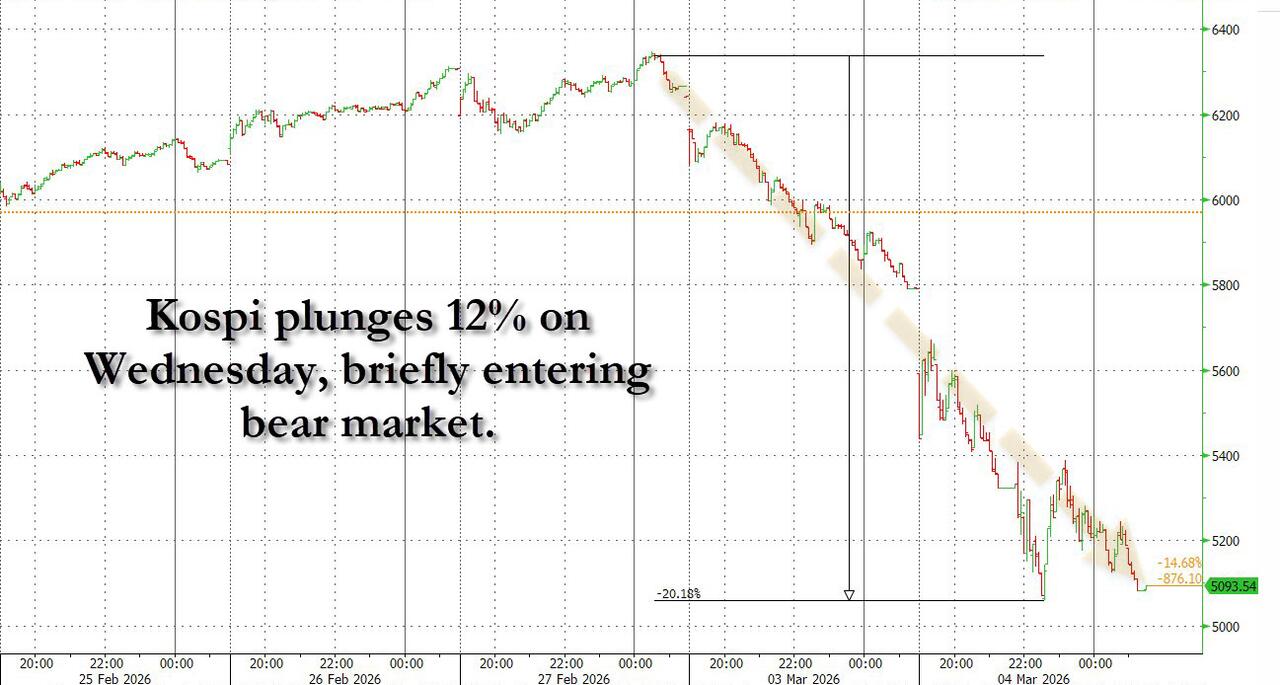
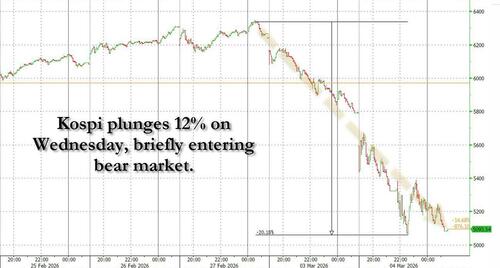
That proved accurate because overnight the Kospi suffered its biggest drop in history, surpassing both the covid and Lehman crashes, plunging by over 12% (one day after tumbling by 7.4%) in a move that was accompanied by a circuit-breaking trading halt, broad-based degrossing and leveraged liquidations (similar to what happened in crypto on Oct 10 last year). In fact, the move briefly tipped the Kospi into a bear market after the index dropped more than 20% from its all time high reached just 2 days earlier!
As Bloomberg describes the carnage, “panic swept across trading desks in South Korea as local stocks, by far the hottest in the world over the past year, extended their selloff into Wednesday.” The report notes that the high-flying Kospi Index, which until last week was up 50% YTD (!) just suffered for its biggest two-day drop since 2008, and biggest one-day drop ever. The losses were driven by the heavyweights that had supercharged the market higher until last month — Samsung Electronics, SK Hynix and Hyundai Motor.
Trading in both Kospi and Kosdaq shares was suspended for 20 minutes after the gauges fell by the 8% circuit-breaking trigger.
“Moves are too extreme so forecasting feels almost impossible — analysis doesn’t really help,” said An Hyungjin, chief executive officer at Seoul-based Billionfold Asset Management Inc. “Retail investors seem to hesitate as well, bids are fading since yesterday. While we’re picking quality names and hedging, this isn’t a clear opportunity.”
As South Korean stocks crashed, Bloomberg notes, panic spread through Seoul’s financial district. At the small downtown office of Mirae Asset Securities, scores of clients hurriedly lined up to get their money out.
Some in the crowd had snapped up stocks on leverage — part of the mania that had turned the market into a national pastime (as we frequently point out, Koreans are momentum kamikazes and pile up with reckless abandon into anything that goes up or down with a clear pattern) and made the Kospi the world’s top-performing benchmark — and they were now desperate to unload them as the war in Iran rocked the global economy. They gestured and shouted to get the attention of Mirae employees who could help them sell the positions they couldn’t unwind online. As they waited for help, their phones flashed ever-growing losses — the Kospi was down 8%, then 10%, then 12% — added to their angst.
Amusingly, just last week, the crowd of retail investors packing into offices like this one was rushing to buy stocks, and tap into the AI frenzy powering the Kospi to one new record high after another. Even the president, Lee Jae Myung, had put up his own apartment for sale to buy stocks.
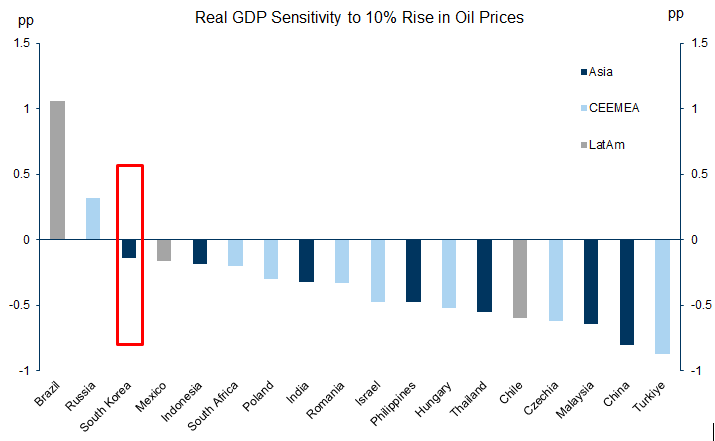
But by the end of the long holiday weekend, the math looked very different. The US and Israeli strikes on Iran had sent energy prices skyrocketing globally, and few countries in the world are as dependent on oil and gas imports as Korea to power its economy.
All at once, that collective fervor among the retail crowd in Seoul – the ants, as they’re known – turned into collective dread.
Seongchan Kim, a Busan‑based naval engineering student who invested the entirety of his 17 million won savings from his 18‑month military service into equities last November, has also added more into the market. “I tried short‑term trading before and lost heavily,” the 22-year old said.
Back at Mirae, an elderly woman was told to wait in line for an hour before she could see someone. She had no interest in talking. The leverage, the war, the promises of a rebound — nothing mattered at the moment. She just wanted out.
The borrowed money that fueled much of those stock gains – similar to what the Korean “ants” did with bitcoin before the stock market euphoria truly exploded in late 2025 – added an accelerant to the rout. By the close on Wednesday, the two-day plunge in the Kospi had reached more than 18%, the worst loss globally. Some $625 billion in market value, much of it coming from high-flying tech names like Samsung Electronics Co. and SK Hynix Inc., had been wiped out.
“It was a ferocious sell off — clean out of hedge fund hotel. That’s a nickname for crowded longs we use,” said Matthew Haupt, portfolio manager at Wilson Asset Management in Sydney.
Yet even after the declines, the Kospi is still up 21% this year and among the world’s top performers. But the episode shows just how fast a market dominated by leveraged, margin-fueled bets and amped up by frenzied day traders can sour, exposing the risks of an investment culture that had come to treat borrowing as a sure thing to bigger gains.
As we joke frequently on our X account, in Korea, leverage has become almost synonymous with the 14-million-strong legion of ants, turning what could have been an orderly stock market slump into chaotic unwind. Margin debt at a record of more than 32 trillion won ($21 billion) had forced a number of brokers to halt new loans after they hit their credit cap.
While we warned repeatedly, like for example here on February 25 when we joked that at some point the government would have to bailout the market…
Kospi up another 1.8% in early trading.
BOK better get those Fed swap lines ready pic.twitter.com/737ef5fX8P
— zerohedge (@zerohedge) February 26, 2026
… “few others on Wall Street saw a move this severe coming” (not our words, Bloomberg’s) . There were the naysayers who warned about the overheated valuations, the high margin, the impact of elevated oil prices on the big crude consuming nation. But there were also the pragmatists who believed that the global shortage of memory chips that fueled gains, combined with policy reforms and encouragement by President Lee, would deliver further gains.
“Korea’s moves are at least somewhat indicative of the equity markets finally starting to take this risk seriously,” Ajay Rajadhyaksha, global chairman of research at Barclays Capital Inc., said on Bloomberg TV. “For the first day, day and half, the markets were completely underpricing this risk.”
Ironically, while we joked that a market bailout would be coming, one almost did arrive this morning, when Korea’s Financial Services Commission Chairman Lee Eog-weon said that South Korea was “closely monitoring stock markets and will actively use its 100 trillion won market stabilization program in case of excessive market volatility.” He added that the regulator would “closely monitor market-disruptive activities that may occur amid heightened volatility in the stock market; to strictly punish any violations.”
Curious that he didn’t make the same warning when it would have been much more useful, namely when retail investors were blowing their savings (and adding massive leverage) to pile into stocks, sowing the seeds for the Kospi’s own momentum-drive destruction.
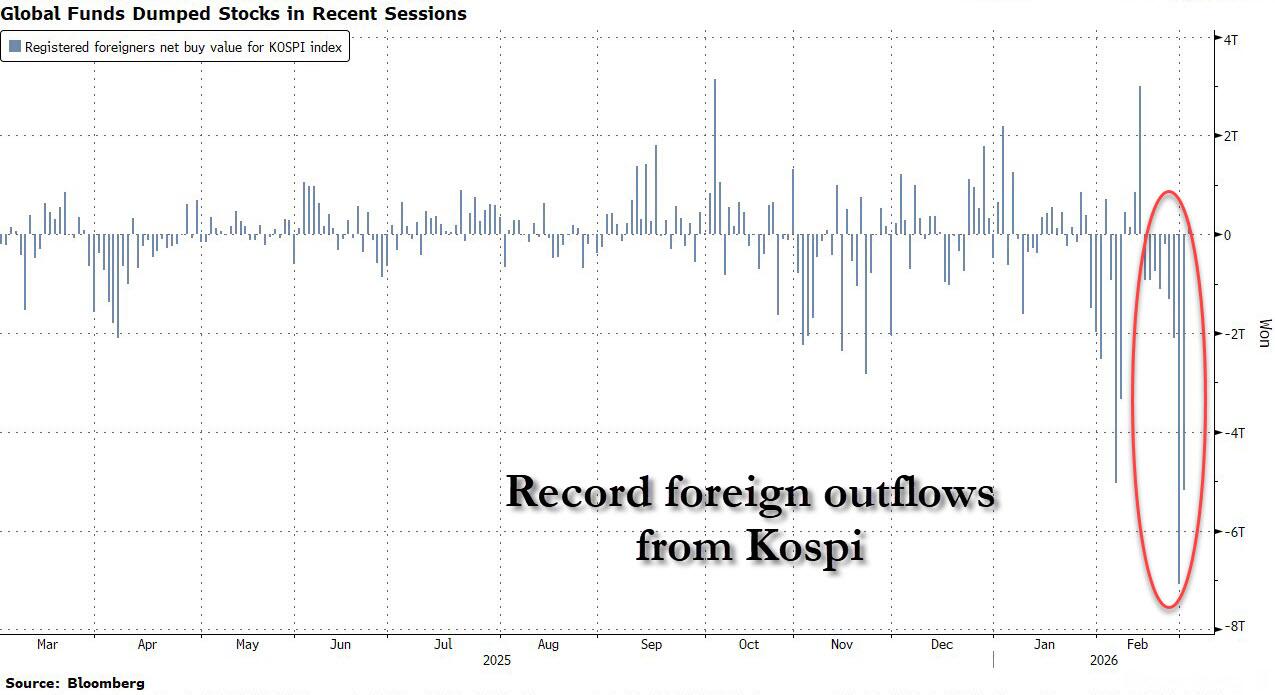
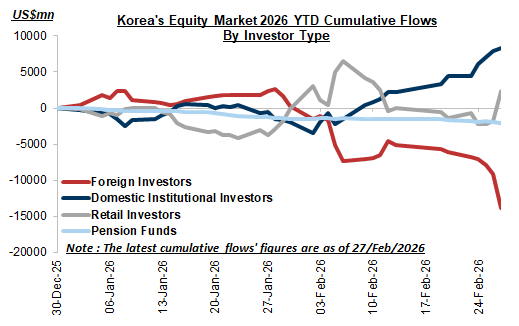
To be sure, as we also warned previously, there were clear signs of trouble even before this week: foreign funds that had spurred the market for much of last year abruptly turned net sellers in February, dumping a record amount of Korean stocks…
… while local retail investors continued to pile in.
Traders had also started swapping notes about certain funds bumping up against limits on their Korea exposure and various desks speculated about forced selling.
The rout in Korea accelerated this week even as global shares edged higher and oil dropped on hopes the war could be short lived. Those expectations have emboldened some investors, including Wilson Asset’s Haupt, to take a cautious long position. “Might not be for long, we will see. I just went long before it turned tactically oversold,” he said.
Which raises the question: after the biggest drop in history, is it time to buy the Kospi, if only looking for a short-term bounce?
Well, according to Francois Theis at Goldman’s EMEA desk, the answer is yes. This is how the desk frames it in a note published on Wednesday (available to pro subscribers):
18% correction, 2x circuit breakers, record single day loss (albeit both foreigners and retail turning net buyers today) and yet we are merely back to Feb 6th level on the KOSPI which remains the best performing index. 1 month of performance being unwound.
The context matters because as Goldman explains, Korea had been experiencing record net flow for 13th consecutive month and February was the highest monthly net inflows in Goldman PB record with net allocation in the GS Prime Book rising 170bps to 5.3% while gross allocation increasing to 2.85%. Both at all time highs here. In other words, everyone is in.
But to Goldman, that’s not nearly enough. And this is how Goldman justifies calling it a bottom right here, right now:
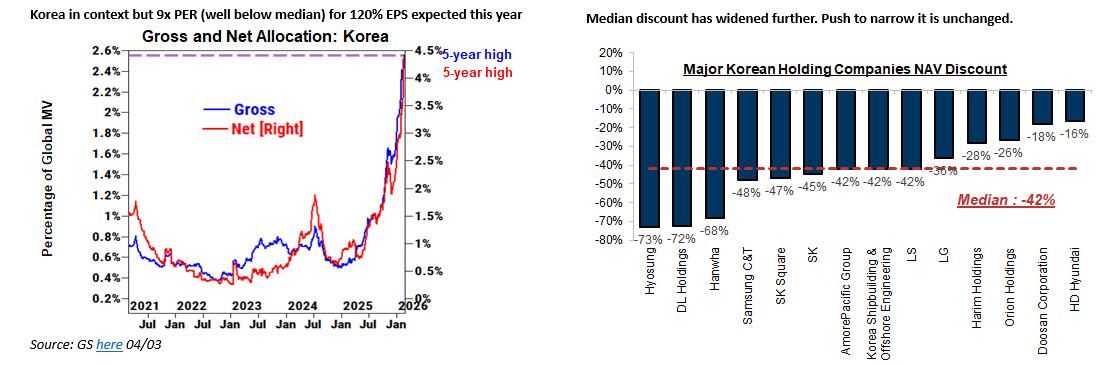
A painful short term cocktail around degrossing but the fundamentals haven’t changed and these moves represent an opportunity. In today’s presentation, our Chief Asia strategist Tim Moe reiterated his outlook for the KOSPI 120% EPS growth in light of hyperscale spending in U.S. (arguably this is decorrelated to geopolitics), macro and EPS outlook unchanged across Asia. With regards to oil price increase, he highlights how a $20/bbl rise in oil price could have a 2% cumulative negative on APAC regional earnings (but IF sustained throughout the year, this remains a big IF) and Korea is among the least affected by oil prices in the first place.
Holdcos discount have widened a bit (although interestingly not the double Holdco like SK Inc.) and pref underperformed ord in the 2x days route despite the fact that they were trading -29% and 47% respectively vs ord (Both Samsung & Hyundai pref ~-4% vs ord in 3x sessions).
In terms of execution, these are the trades Goldman likes:
Korea pref vs ord given further dislocation; we expect DPS increase (correlation) and push to close discount (buyback on pref line?)
Holdco. We have refreshed the monitor below post close (ty John Kwon) and the discount has widened slightly post mkt drawdown making it a better entry point. We continue to recommend a barbell approach: 50% SK Square (given 30% discount target) and 50% on holdcos with the widest discount to NAV
GS Korea Greatest Hits (GSXAKHIT): Selective alpha sectors across Defense, Shipbuilding, Nuclear, Cosmetics, K-pop, AI, Hold Cos that will likely continue to be supported by both domestic and international policy trends, offering strong alpha-generation potential. It overweights Defense over AI (Samsung/Hynix) relative to Kospi2.
For what it’s worth, we don’t know if this is the bottom for the Kospi. With massive leverage and gross exposure still embedded in the index, we doubt it and would suggest to wait for a much more powerful retracement before stepping in. We will, however, point out something else.
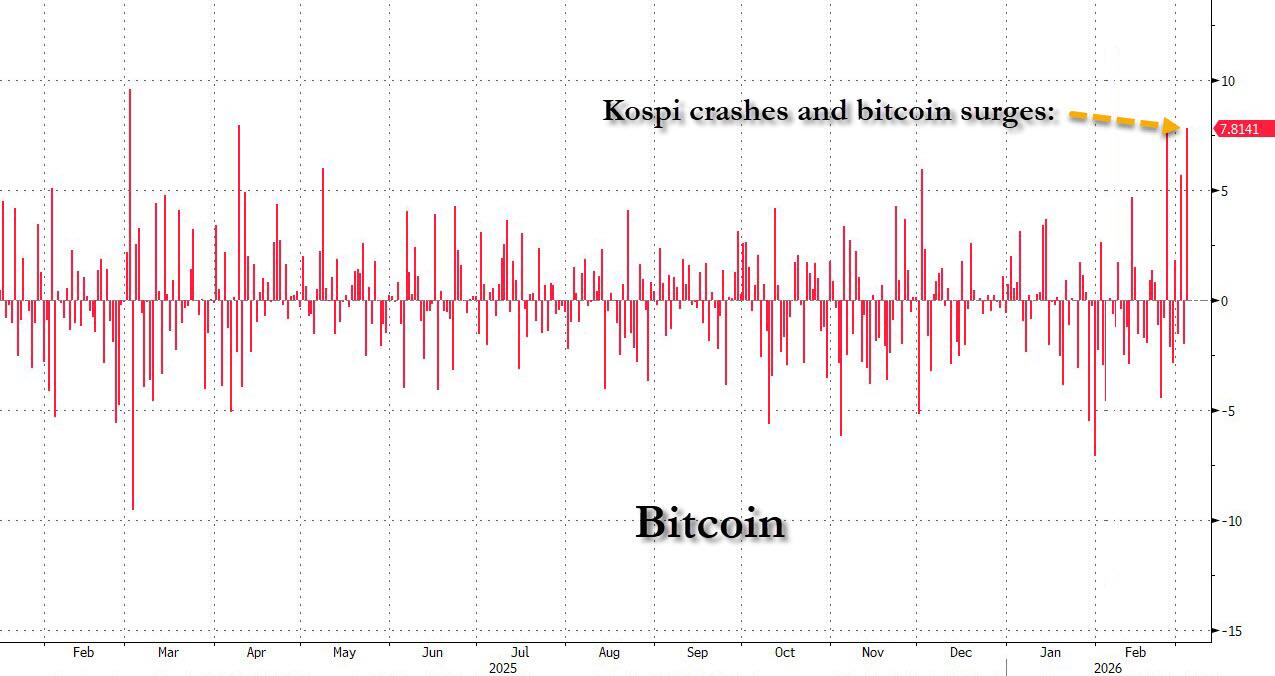
As we noted last month, the big disconnect in bitcoin with all other assets started when Korea’s momentum kamikazes capitulated on bitcoin, especially after the Oct 10 meltdown, and started piling into memory stocks and the Kospi.
Well, as we said around the time Kospi was crashing last night, “watch what assets the money will rotate to” after retail got burned again.
Kospi resumes trading, promptly tumbles to -10%.
Watch what assets the money will rotate to. https://t.co/QMxzf1Q5U9
— zerohedge (@zerohedge) March 4, 2026
The answer:
More in the Goldman note available to pro subscribers.
Tyler Durden
Wed, 03/04/2026 – 13:13
Chicago Fire break ground on $750 million South Loop soccer stadium, transforming the sports landscape
The Chicago Fire hosted a groundbreaking event Tuesday afternoon for their privately funded $750 million soccer stadium on a vacant former rail yard in the South Loop, staking their turf in the city’s competitive sports landscape.
If all goes well, the hardscrabble terrain will not only sprout Chicago’s first new pro sports stadium in three decades, but also a new neighborhood as part of The 78, a long-fallow, mixed-used megadevelopment that has struggled for years to get off the ground.
“There are few things that unite a city like a professional sports team,” said Fire owner Joe Mansueto, the founder and executive chairman of Chicago-based investment research firm Morningstar, who bought the team in 2019. “We look forward to getting this stadium up, bringing Chicago together, jump-starting a whole new neighborhood in Chicago.”
Announced in June, the Fire are building a 22,000-seat, open-air soccer facility – the most expensive in the MLS – which is slated to open by the 2028 season. Designed by architectural firm Gensler, the red brick stadium will feature a natural grass pitch, 50 luxury suites, intimate seating and a canopied roof, among other amenities.
The Fire stadium will be located at the north end of The 78, a planned $8 billion mixed-use community on an undeveloped 62-acre site along the Chicago River south of Roosevelt Road. On Tuesday, a large tent filled with hundreds of business leaders, politicos, team officials, players and fans marked the spot.
“We’ve been working on this project for a couple of years now,” Mansueto told the crowd. “And it’s amazing to me to go from renderings on paper to reality, to go to actually taking a shovel into the dirt and say this is really happening.”
Mayor Brandon Johnson called the groundbreaking Tuesday a “transformational day” for the city of Chicago. At the very least, it may transform more Chicagoans into soccer fans, as the sport gains traction across the U.S., bolstered by the World Cup coming to 13 MLS cities in June.
Chicago did not make the cut – this time.
MLS Commissioner Don Garber, who has been at the helm of the league for most of its 30-year history, oversaw its expansion to 30 teams, signed a 10-year, $2.5 billion partnership with Apple TV+ in 2023 and is opening new soccer stadiums in New York, Miami and Chicago.
Having a new soccer stadium is crucial to the sport’s evolution, Garber said at the event Tuesday.
“What league can be viable without having homes that are cathedrals for the sport?” Garber posed.
The Fire have been something of an itinerant franchise for much of their nearly three-decade history.
Founded as an early Major League Soccer expansion team, the Fire began playing at Soldier Field, winning the league championship during their inaugural season in 1998.
In 2006, the Fire moved into a newly built, $98 million stadium in Bridgeview, then known as Toyota Park, with a lease that ran through 2036. The 20,000-seat venue, which was rebranded as SeatGeek Stadium in 2018, was the Fire’s home for 14 seasons.
Fire Owner and Chairman Joe Mansueto speaks during a press conference announcing the team’s return to Soldier Field during a news conference Oct. 8, 2019. (Camille Fine/Chicago Tribune)
When Mansueto bought the Fire for about $325 million in 2019, he negotiated a $65.5 million lease buyout with Bridgeview, allowing a move back to Soldier Field.
The Fire averaged 23,420 fans per game at Soldier Field last season, making the playoffs and setting a club attendance record, but leaving the 61,500-seat stadium two-thirds empty for most matches. They were also booted out of their home stadium for several matches last year – including the playoffs – due to scheduling conflicts.
The team will call Soldier Field home for two more seasons, opening 2026 play there last week. After that, the Fire will be able to call their own shots at the new stadium beginning in 2028.
“Today is a huge step forward for our club, gigantic step forward in having our own stadium, and it’s a whole mindset shift as we move from a tenant to an owner,” Mansueto said. “We’ll be able to control our own schedule.”
The new Fire stadium is also a huge step forward for The 78.
The vacant swath of land bordered by Roosevelt Road, Clark Street and a half-mile stretch of riverfront south of downtown Chicago has been a field of dreams for developer Related Midwest since acquiring it in 2016. The ambitious plan from the outset was to create a sprawling residential, retail and commercial development that would become the city’s 78th neighborhood.
Crews move soil for environmental remediation in The 78 development, Feb. 16, 2026, before construction of the Chicago Fire stadium in the South Loop. (Brian Cassella/Chicago Tribune)
Over the years, The 78 has been in the running for everything from Amazon’s second headquarters to a Chicago casino, but time and again, Related was unable to land that elusive anchor tenant to catalyze the megadevelopment. In 2024, the White Sox proposed a new publicly funded ballpark at The 78, but Springfield lawmakers balked at the idea of contributing a reported $1 billion to build it. That’s when the Mansueto and the Fire stepped up.
“We saved the best for last,” an exuberant Curt Bailey, president of Related Midwest, said Tuesday. “This is the best thing that could happen on the site.”
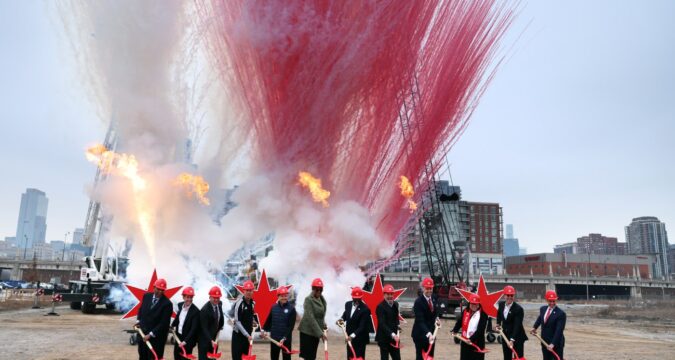
After nearly an hour of speeches, teams of dignitaries donned red hardhats and filed outside on a cold and gray March afternoon, grabbing shovels for the ceremonial groundbreaking.
Each photo op was capped off by explosive pyrotechnics yielding plumes of red and white smoke, which drifted toward the river and train tracks to the west across the backdrop of the Chicago skyline.
Turning the soil was an emotional moment 10 years in the making for Bailey and his development team.
“It’s obviously been a really long journey timewise, but also the amount of things that we’ve looked at to do on this project,” said Bailey. “To see this actually happen is really special and moving, and will be a game changer for our company, obviously, but really for the city of Chicago. It’s a big day.”
rchannick@chicagotribune.com
https://www.chicagotribune.com/2026/03/04/chicago-fire-break-ground-soccer-stadium/
Most endangered Chicago buildings list includes Pope Leo’s childhood church and Art Institute trading room
From Pope Leo XIV’s childhood church to the reconstructed and relocated Chicago Stock Exchange Trading Room at the Art Institute, Preservation Chicago’s annual ranking of the city’s seven most endangered buildings is so full of local history it has eight entries.
Like the guitar amplifier scene from the movie “This Is Spinal Tap,” the city’s architectural preservation watchdog offered up a simple explanation for having its top-seven list go to eight.
“It’s seven-plus-one,” said Ward Miller, executive director of Preservation Chicago. “Because we had an extra one.”
There’s a lot more than eight endangered structures if you count the iconic bridges and tender houses falling into disrepair along the Chicago River, which collectively form one item on the expanded list. And topping Preservation Chicago’s 24th annual list are two historical features at the Art Institute, which may fall by the wayside under a plan to expand the sprawling campus along South Michigan Avenue.
1. The Chicago Stock Exchange Trading Room and McKinlock Court at the Art Institute
The trading room of the Chicago Stock Exchange in 1894, designed by Alder and Sullivan. (Chicago Tribune archive)
In 2019, the Art Institute of Chicago retained Barcelona architectural firm Barozzi Veiga to craft a master plan to expand the museum’s 1 million square feet of space, transforming the campus by opening it up to Grant Park, the lake and even the train lines bisecting the 17-acre site.
The plan began to take shape with the 2024 announcement of a $75 million gift to create a new building to house the museum’s collection of late 19th century modern and contemporary art. While details have yet to emerge, Preservation Chicago fears it may spell the end for both the Chicago Stock Exchange Trading Room and the McKinlock Court Garden.
Designed by architects Louis Sullivan and Dankmar Adler, the Chicago Stock Exchange Building was demolished in 1972. But a piece of its history was relocated and restored at the Art Institute, where the ornate two-story trading room reopened in 1977 as a reception hall at the east end of the museum.
For nearly half a century, the trading room has hosted everything from weddings to corporate events, with visitors admiring its ornamented columns, stained-glass skylights and elaborate stenciled walls. Miller believes time may be running out on the room.
“It’s really a fabulous room that was used for events and receptions and art openings,” Miller said. “It was something they were really proud of.”
The adjacent McKinlock Court, a century-old outdoor garden with a replica of Carl Milles’ Fountain of the Tritons that has long served as a unique events space and alfresco oasis for weary museum visitors, may also be vulnerable to redevelopment, Miller said.
Preservation Chicago would like both the trading room and outdoor garden declared Chicago landmarks and is encouraging the Art Institute to locate its new building over the property’s railroad trench instead of demolishing those structures.
It is also launching a change.org petition to save both features at the Art Institute, Miller said.
2. Chicago River Bridges and Tender Houses
Chicago’s collection of bascule bridges is the largest in the world, crossing the Chicago River’s main channel and all of its branches, and occasionally stopping traffic as they rise to let boats pass underneath.
But the steel bridges and unique tender houses – some with intricate carvings – are in disrepair. A tender house at the 98-year-old LaSalle Street Bridge, for example, is the “poster child” for the cause, with “big chunks of stone” missing from the structure, Miller said.
“These are really beautiful gateways to our city,” Miller said. “It’s sad to see these bridges and these tender houses in need of so many repairs.”
Miller said the bridges and tender houses should be landmarked and preserved, and if they need to be replaced, the city should build modern facsimiles of the iconic structures.
The 124-year-old Cortland Street Bridge over the North Branch of the Chicago River – the oldest bascule bridge in the city – was designated as a Chicago Landmark in 1991 and is currently undergoing such a restoration. The Chicago Department of Transportation began the work in September with a pledge to “retain the character” of the historic bridge and tender houses.
3. “The Pope’s Church” – St. Mary of the Assumption Church and School
Closed by the Archdiocese of Chicago in 2011, St. Mary of the Assumption Church and School on the city’s Far South Side has been vacant and deteriorating for 15 years.
But Preservation Chicago is hoping the ascension of south suburban Dolton native Robert Francis Prevost, who was named last year to head the Catholic Church, may resurrect the buildings where the future Pope Leo XIV once attended school and served as an altar boy.
Located on East 137th Street in the Riverdale neighborhood, the gothic school and church building opened in 1917, with an adjacent midcentury modern church built in 1957. Both buildings have fallen on hard times, with a large hole in the roof of the church and years of neglect belying their storied history.
“We have the opportunity to restore a building tied to the first-ever American pope in history, who happens to also be from Chicago,” Miller said. “The whole idea of bringing this back and celebrating this as (an) historic site may really help a neighborhood that’s seen just so much disinvestment over that last half century.”
Preservation Chicago would like to see the church designated a local landmark and embark on a restoration project with community partners, creating a pilgrimage site for visitors interested in seeing the South Side religious roots of Pope Leo XIV.
In July, the village of Dolton purchased the pope’s modest childhood home for $375,000 as a potential tourism and pilgrimage site.
4. Chicago’s Labor Union Halls
A cyclist rides past the Chicago Federation of Labor Building (former Chicago Street Railroad Cable Car Powerhouse) in Chicago’s West Loop, March 3, 2026. It’s one of the union halls listed by Preservation Chicago as needing preservation. (Josh Boland/Chicago Tribune)
Chicago’s union roots run deep, dating back to the deadly Haymarket Riot in 1886, which grew out of a strike at the McCormick Reaper Works and became a seminal event in the modern labor movement.
As labor organizations began to make Chicago their home, many union halls sprang up on the city’s Near West Side during the middle of the last century, forming what came to be known as “Union Row.” Now more broadly dispersed, several union halls across the city are in need of repairs, listed for sale or facing demolition.
Built in 1951, the Amalgamated Meat Cutters and Butcher Workmen of North America Building on North Sheridan Road is facing demolition. The 122-year-old United Electrical Workers Union Building on South Ashland Avenue was recently sold and repurposed as a residential building, with historic murals inside the building rescued for relocation.
Preservation Chicago is recommending the creation of a thematic Chicago Landmark designation of the union halls across the city to protect the structures and their history.
5. Chicago Loop Synagogue
A congregation founded nearly a century ago, the Chicago Loop Synagogue opened its current midcentury modern building in 1957 on South Clark Street. Designed by the Chicago firm Loebl, Schlossman & Bennett, the synagogue contains an enormous stained-glass window on its eastern wall and the large bronze sculpture “Hands of Peace” by Israeli artist Henri Azaz over the entrance. The building has been hailed as one of the city’s architectural gems.
Once thriving with more than 8,000 members in the 1950s, synagogue membership has dwindled to less than 400. This winter’s severe cold snap caused the building’s boiler pipes to burst, adding to the synagogue’s financial strains.
Among Preservation Chicago’s recommendations is the potential sale of 17 unused stories of air rights for development, with the additional stories set back from the synagogue’s historic facade to fund building repairs and improvements.
6. South Park Terrace Apartments
Built in 1905, the South Park Terrace Apartments in the Washington Park neighborhood on the city’s South Side, were designed by architect Harry Hale Waterman, a Frank Lloyd Wright associate, in the Prairie School-style.
The courtyard building on South Dr. Martin Luther King Jr. Drive has deteriorated due to neglect, with structural issues, water leaks and rotted floors. In March 2025, a portion of the building caught fire, leaving burn marks on the blonde facade’s brickwork and boarded-up windows, forcing residents to vacate their apartments.
Preservation Chicago is seeking Chicago Landmark designation for the building, and is encouraging the city to acquire it through a sister agency such as the Chicago Housing Authority to restore it as affordable housing.
7. Yukon Building
Completed in 1898, the two-story Yukon Building was designed by Holabird & Roche, a pioneering Chicago architecture firm that built a number of early commercial high-rises.
Initially conceived as an eight- or 12-story building, the modern-looking structure of steel and plate glass was likely downsized due to the nearby construction of the “L” tracks on Van Buren Street in 1897.
Once a part of Chicago’s “Old Chinatown,” before the Chinese community migrated farther south in the 1920s, the Yukon Building has survived massive redevelopment in the Loop, in large part because its positioning under the “L” tracks limited other options, Miller said.
But the building is listed for sale and Preservation Chicago is recommending its designation as a Chicago Landmark to preserve a modest and enduring structure with rich architectural and cultural history.
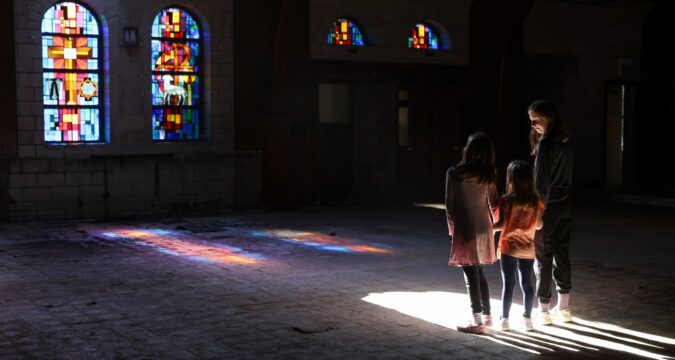
8. St. Mark Roman Catholic Church Campus
A Humboldt Park mainstay since the 1890s, the St. Mark Roman Catholic Church built a larger building to accommodate its growing congregation in 1963. The low-slung, midmodern church, designed by architect Allan Louis Karl, who worked at the firm Barry & Kay, features a large open hall supported by concrete and steel shafts, multi-textured walls and terrazzo floors. The church also has stained-glass windows created by French artist Gabriel Loire
Closed by the Archdiocese of Chicago in 2022, the vacant campus, which also includes a century-old greystone rectory and red-brick school building, was put up for sale.
Preservation Chicago supports the adaptive reuse of the church building as everything from a library to a community center.
rchannick@chicagotribune.com
Supremo Tribunal de Brasil ordena arrestar al exjefe de Banco Master
Por ELÉONORE HUGHES
RÍO DE JANEIRO (AP) — Un juez del Supremo Tribunal Federal de Brasil ordenó el arresto de Daniel Vorcaro, exdirector de un banco con activos de hasta 16.000 millones de dólares, en una nueva fase de una amplia investigación sobre un fraude por miles de millones de reales.
En la decisión de 48 páginas que autoriza la prisión preventiva de Vorcaro, firmada el martes y a la que The Associated Press tuvo acceso el miércoles, el juez André Mendonça señaló que la pesquisa ya había revelado indicios de delitos de Banco Master contra los sistemas financiero y de justicia, así como participación en crimen organizado y lavado de dinero.
Por su parte, la Policía Federal de Brasil informó el miércoles en un comunicado que había realizado allanamientos “para investigar los posibles delitos de amenazas, corrupción, lavado de dinero e invasión de sistemas informáticos cometidos por una organización criminal”.
La policía indicó que estaba ejecutando cuatro órdenes de detención y 15 órdenes de registro e incautación emitidas por el Supremo Tribunal Federal en los estados de Sao Paulo y Minas Gerais.
No se menciona a Vorcaro en el comunicado de la Policía Federal, pero se indica que los allanamientos eran la tercera etapa de la Operación Compliance Zero, nombre dado a las investigaciones sobre Banco Master.
Las autoridades también ordenaron el congelamiento de activos por 22.000 millones de reales (4.200 millones de dólares), según el comunicado de la Policía Federal. No se indica quién era el propietario de esos activos.
Vorcaro fue detenido en noviembre como parte de una investigación por presunto fraude, pero posteriormente fue liberado.
Sin embargo, nuevas investigaciones de la Policía Federal de Brasil indican que el hombre también formaba parte de un grupo llamado “The Crew”, que buscaba obtener información confidencial, vigilar a personas consideradas adversarias del grupo y llevar a cabo “acciones de intimidación para proteger los intereses del núcleo de la organización criminal”, afirmó Mendonça en su decisión.
Hasta el momento, The Associated Press no ha podido comunicarse con el equipo de representación legal de Vorcaro.
En su decisión, Mendonça sostuvo que Vorcaro planeaba montar un asalto o simular un escenario similar para agredir violentamente a un periodista, cuyo nombre aparece tachado. El diario local O Globo informó que la persona en cuestión era su columnista Lauro Jardim.
“Quiero que lo golpeen. Que le rompan todos los dientes. En un robo”, dijo Vorcaro, según la decisión.
Los reportes sobre el plan provocaron indignación, y O Globo afirmó en un comunicado que “repudia vehementemente las iniciativas criminales planeadas contra el columnista Lauro Jardim, uno de los periodistas más respetados del país”. El medio pidió que los involucrados sean castigados con todo el rigor de la ley y prometió no dejarse intimidar por amenazas.
La Asociación Brasileña de Prensa calificó los planes como “una barbaridad incompatible con el Estado Democrático de Derecho” y una “agresión brutal contra todo el gremio de periodistas y el derecho de la sociedad a estar informada”.
En noviembre, el Banco Central de Brasil cerró Banco Master, un banco con activos de hasta 16.000 millones de dólares. En ese momento, el director general de la Policía Federal de Brasil, Andrei Rodrigues, dijo a legisladores que el organismo había descubierto un fraude de 12.000 millones de reales brasileños (2.000 millones de dólares) dentro del sistema bancario del país.
___
Esta historia fue traducida del inglés por un editor de AP con la ayuda de una herramienta de inteligencia artificial generativa.

Steppenwolf Theatre’s 2026-27 season will have several world premieres
New work from Adam Rapp and Stephanie Alison Walker, both writers with ties to Chicago, and the return of both the director Tina Landau and the Pulitzer Prize-winning writer Branden Jacobs-Jenkins feature in the 2026-27 season at Chicago’s illustrious Steppenwolf Theatre. Both of Steppenwolf’s artistic directors, Glenn Davis and Audrey Francis, will also appear on stage in the five-show subscription season.
The slate kicks off in September in the Downstairs Theater with what appears essentially to be a Chicago restaging of director Kenny Leon’s 2022 Broadway revival of Suzan-Lori Parks’ “Topdog/Underdog” (Sept. 17 to Nov. 1). The Pulitzer Prize-winning drama will have a cast including Davis and Namir Smallwood. (Smallwood can currently be seen on Broadway in Tracy Letts’ “Bug.”)
In October in the in-the-round Ensemble Theater, Steppenwolf will mount the world premiere of Walker’s “Adirondack Chair Circle” (Oct. 22 to Dec. 6), a comedy about suburban life. Francis will be part of director Pam MacKinnon’s cast.
In a co-production with American Conservatory Theater of San Francisco, Steppenwolf will next stage director Landau’s new production of Jacobs-Jenkins’ “The Comeuppance” (Feb. 4 to March 21, 2027) in the Downstairs Theater, with a cast set to include Celeste M. Cooper, Caroline Neff, Karen Rodriguez and Smallwood. First seen at New York’s Signature Theatre in 2023, this play from the author of “Purpose” is set at a high school reunion.
April brings the Broadway director Whitney White to Steppenwolf for the English-language premiere of “Ellen B.” (April 1 to May 9, 2027), a psychological thriller by Marius von Mayenburg, a popular Nordic noir-style playwright. “Ellen B.” was first produced at the National Theatre of Iceland about three years.
Finally, Steppenwolf will stage the world premiere of Rapp’s “The Night Fawn” (May 27 to July 3, 2027), a searing and deeply personal drama set in and around the Illinois city of Joliet that already has generated significant national buzz. Terry Kinney will direct in the Downstairs Theatre with Cliff Chamberlain in the leading role. As with all these shows, further casting is yet to be announced.
Memberships for the upcoming season at Steppenwolf Theatre (1650 N. Halsted St.) are available now with tickets on sale at a later date; 312-335-1650 and www.steppenwolf.org
Chris Jones is a Tribune critic
cjones5@chicagotribune.com
https://www.chicagotribune.com/2026/03/04/steppenwolf-theatre-2026-27-season/
Column: Great Lakes-trained sailors at the tip of the spear
Training and discipline dished out at Naval Station Great Lakes is paying off as U.S. sailors again are in harm’s way with lethal missiles flying across the Persian Gulf. The Navy has a powerful armada on station in the widening Mideast conflict.
As the nation’s sole training facility for the Navy since 1994, enlisted personnel who have been processed or stationed at the North Chicago base are manning ships in the two strike forces in the Mediterranean and Arabian seas. Those from the “Quarterdeck of the Navy” have been doing yeomen’s jobs at the tip of our military spear, sea-based airpower.
Petty officers and chiefs who turn civilians into sailors during the 10-week “boot camp” training period have taught their charges well during the early days of the “Operation Epic Fury” campaign against Iran. Three “boot” graduations are slated this month at Great Lakes, on March 12, 19 and 26. The 1,600-acre base and surrounding communities support more than 20,000 sailors, Marines and Department of War civilians.
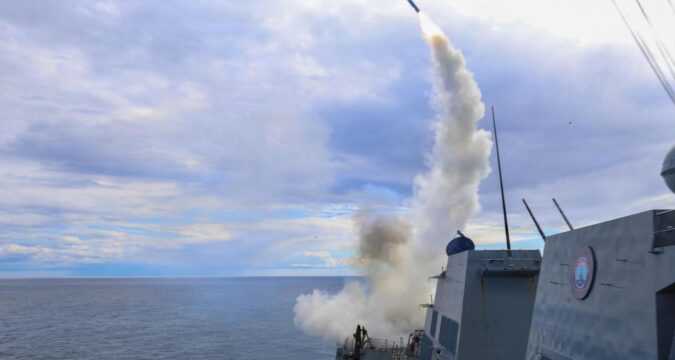
The Navy has a flotilla in the Gulf region, led by two supercarriers. One is the newest and most advanced of our floating airfields, the USS Gerald R. Ford, named for the former president who served in the Navy during World War II, with part of his stint at Great Lakes. The other is the USS Abraham Lincoln. Both task forces have numerous support vessels and guided-missile destroyers.
The Abraham Lincoln, honoring Illinois’ favorite son, our 16th president, has been on station in the Arabian Sea since January. The presence of our most-potent vessels is the largest buildup of U.S. warships and aircraft in the Mideast since the Iraq War. The Navy also has unleashed submariners, with a sub sinking an Iranian ship with a torpedo.
Given the way rockets are being launched indiscriminately by Iranian forces in retaliation for pinpoint American and Israeli bombing runs on the country, there is a risk of casualties at sea. Iran’s Islamic Revolutionary Guard Corps on March 1 falsely claimed it had attacked and damaged the Abraham Lincoln, which, if true, would have been a propaganda coup.
The main gate at Naval Station Great Lakes before sunset on Sept 2, 2025. The 1,600-acre base is the U.S. Navy’s only boot camp. (Stacey Wescott/Chicago Tribune)
The number of U.S. troops killed in the frenzied operations has risen to six so far. Another half-dozen aviators in three U.S. F-15E Strike Eagle fighter jets missed being injured after they ejected safely when downed by friendly fire over Kuwait earlier this week, according to U.S. Central Command. Three U.S. embassies in Saudi Arabia, Dubai and Kuwait, have been hit by Iran.
Several reports said Iranian drones or missiles have hit six U.S. military facilities in the region. Those targets were the headquarters of the Navy’s 5th Fleet in Bahrain, Army facilities in the United Arab Emirates and Iraq, and three bases in Kuwait, including Camp Arifjan in the oil-rich nation. Tens of thousands of U.S. military personnel are based in the region.
Also in danger into this breach are members of an Army Reserve unit based at Fort Sheridan, just south of Lake Forest. Reserve soldiers from the 337th Military Intelligence Battalion deployed to the region just before hostilities broke out on Feb. 28. The unit specializes in providing key intelligence support for theater operations, strategic missions and combat support activities.
Civilians, too, could be in jeopardy in the U.S. from Iranian retaliation or lone wolves sympathetic to the regime. Local, state and federal lawmen say they are on high alert for possible terrorist attacks in the homeland.
The aims of “Epic Fury,” launched by President Donald Trump, according to U.S. Command, are to dismantle the Iranian regime’s security apparatus, including Revolutionary Guard command-and-control facilities, Iranian air defense capabilities, missile and drone launch sites, and military airfields. That is occurring daily, and the pounding could, the president has said, last from a month to five weeks or longer.
Trump, who has not discounted “boots on the ground,” said he ordered the Iran attacks after nuclear disarmament talks broke down and he feared U.S. forces would be in the sights of Iranian forces. Iran has been declared an “axis of evil” by several U.S. presidents over the years.
Since its founding in 1979, the regime has threatened nearby Persian Gulf nations, and its citizens have chanted “Death to America” for decades. It has also financed several proxy paramilitary groups in the region, including Hezbollah.
Some may remember that Hezbollah was linked to the October 1983 bombing of the U.S. Marine barracks in Beirut, Lebanon, where 220 Marines, 18 sailors and three soldiers died. Following the truck blast, President Ronald Reagan withdrew all U.S. military forces from the country.
Whether one believes this military intervention was long overdue or is another “wag the dog” instance to distract from an administration’s polling ills, those soldiers, sailors and pilots in peril on the president’s mission deserve our support, and our hope for returning safe and sound.
Charles Selle is a former News-Sun reporter, political editor and editor. sellenews@gmail.com. X @sellenews.
https://www.chicagotribune.com/2026/03/04/charles-selle-column-sailors/
Western Official Claims Iran Has Just ‘Days Left’ For Depleting Missile Arsenal
Western Official Claims Iran Has Just ‘Days Left’ For Depleting Missile Arsenal
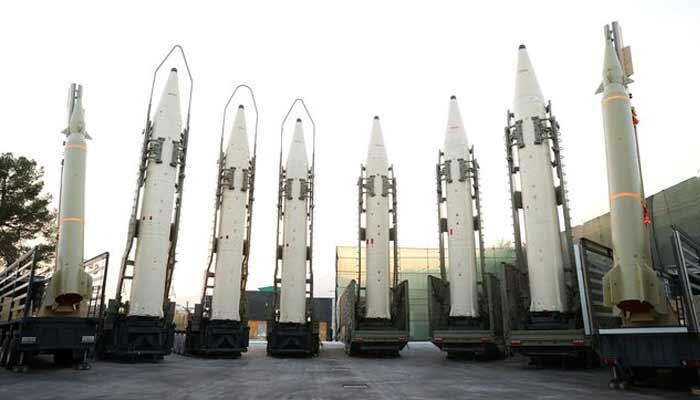
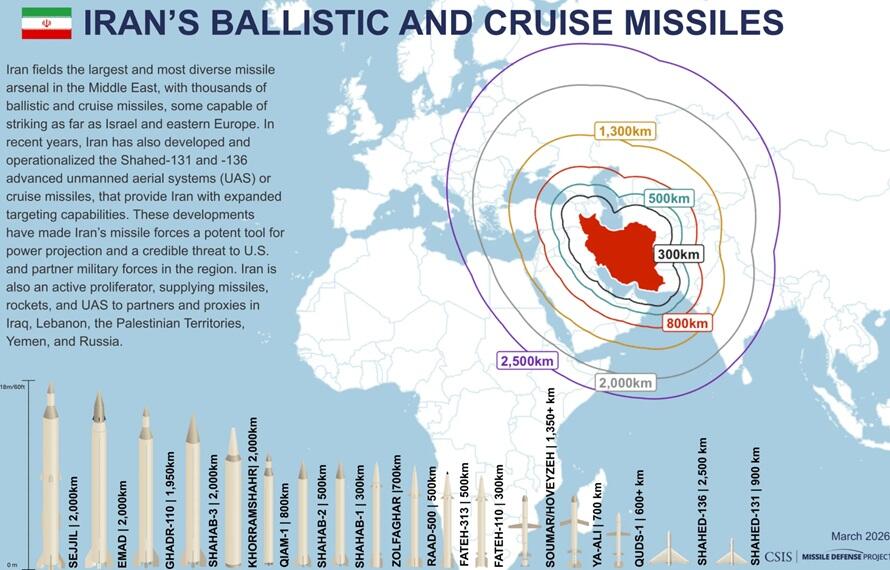
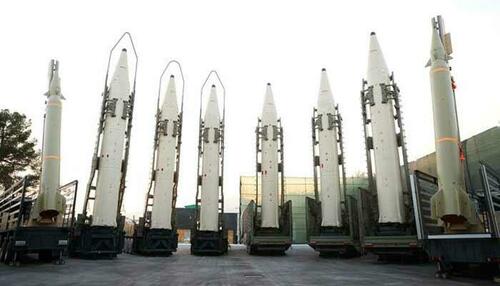
Among the most crucial open questions in the ongoing Operation Epic Fury – or perhaps the most pressing issue – is which warring side will outlast the other in terms of maintaining missile and interceptor numbers, and for the US side this means enough to achieve the (somewhat ambiguous) military objectives.
Speculation and estimates are flying wildly in international press reports, also with Iran now claiming it has only thus far expended its older and aging stockpile, but stands ready to use its newer, more advanced ballistic projectiles. But amid the fog of war in these opening days of conflict, and competing narratives, there’s also concern at the Pentagon over just how long this ‘air war’ will last.
War Secretary Pete Hegseth earlier Wednesday suggested that the campaign could extend to eight weeks. So already the scope is getting extended (and is so as each day passes), after President Trump initially floated a mere likely ‘days’ or up to “five weeks” of combat operations against Iran in the Persian Gulf region.
Enter The Wall Street Journal with a new Wednesday report just as the Pentagon wrapped up its press briefing…
“The number of Iranian ballistic missile launches is declining and at current rates Tehran has only several more days of firepower from them, according to a Western official,” the report says. “Still, the decline might also be because Iran is holding back missiles so its operations can last longer, the official said.”
But again, headline consumers might want to take such an assessment with a big grain of salt. Every hot war is accompanied by an information war – a reality for all wars since time immemorial. The major media, from NYT to WSJ to CNN to of course The Washington Post, typically gets its ‘scoops’ from anonymous Pentagon and US intelligence officials, or else from Mossad and the Israeli government (given the current war is also being waged by Israel).
And yet, there can also be little doubt that Iran’s missile capabilities are being degraded on at least some level, given the massive ‘shock and awe’ US-Israeli bombing raids, which is targeting Iranian missile sites among others. WSJ notes this in the following:
The decline is a result of U.S. and Israeli strikes on Iranian launch sites and the facilities that manufacture them, the official said. Even as its ability to fire sophisticated missiles dwindles, Iran can still maintain a drumbeat of attacks with cheaper systems, such as drones, another Western official said.
On Tuesday, the top U.S. commander in the region, Adm. Brad Cooper, said Iran’s ability to target the U.S. and its partners in the Middle East was declining after hundreds of its ballistic missiles, launchers and drones were targeted.
But there’s some other key trends worth emphasizing: these hard to intercept Iranian ballistic missiles are in fact unleashing significant damage on the Pentagon’s radar and military communications infrastructure in the Gulf region. Many are also getting through Israel’s significant anti-air defense systems. The death toll in Israel is at least ten, with dozens wounded, but the IDF has not issued more info on casualties since the weekend.
One prevailing view within the Western defense establishment…
They’re basically going to be done in a few days if this is true and the rate of decay stays the same. pic.twitter.com/IxeawP0Ihl
— Bojac (@backupjac) March 3, 2026
Again, all of this has to be taken in context of a raging info war and the fact that US, Israeli, and allied governments are doing some heavy narrative shaping at this moment, and feeding it to the press.
NEW 🔴
Chairman of the Joint Chiefs Gen. Caine: Iran’s ballistic missile fire is down 86% from day one.
Drone launches down 73%. pic.twitter.com/AlB3s83rWA
— Open Source Intel (@Osint613) March 4, 2026
We can say that the idea of Iran fast running out of ammo, while also possessing whole underground ‘missile cities’ – seems more like ‘wishful thinking’ at this moment. Iran has clearly been preparing for this showdown for years, it must also be noted.
Tyler Durden
Wed, 03/04/2026 – 12:40