Category: News

Futs Jump On Reports About Iran’s Willingness To Give Up Uranium Stockpile
Futs Jump On Reports About Iran’s Willingness To Give Up Uranium Stockpile
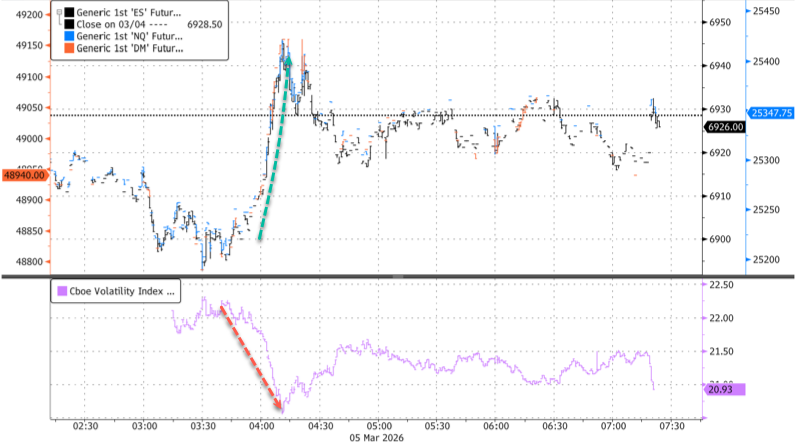
U.S. equity futures jumped around 4:00 a.m. ET after Bloomberg News reported that Iran had previously signaled a willingness to surrender its highly enriched uranium stockpiles in high-stakes negotiations, just before the U.S. launched Operation Epic Fury.
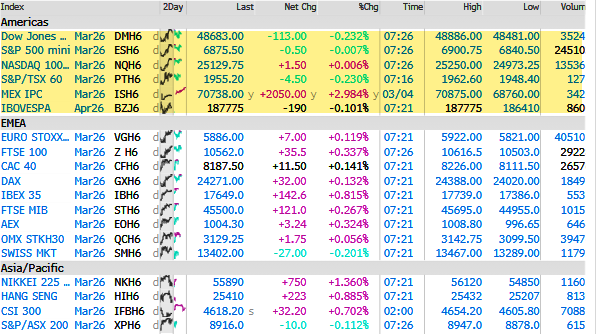
Although the Bloomberg story relates to last week’s U.S.-Iran developments, the market is extremely sensitive to headlines – even old ones – and that was enough to send S&P 500 E-mini futures surging, erasing earlier losses and now flat. Nasdaq futures are also little changed.
Main U.S. equity futures indexes
Here’s what Bloomberg reported:
Iran told the U.S. in recent nuclear negotiations that its stockpile of highly enriched uranium “is the result of our practical achievements and that we are ready to get rid of it, provided we get something good in return,” the state-run Islamic Republic News Agency cited Deputy Foreign Minister Majid Takht-Ravanchi as saying.
Bear in mind this news is ‘old’ (we reported on Friday), but for it to repeated no in public is very different from saying it in private a week ago…
Absolutely huge late Friday developing news, if it’s confirmed and assuming it sticks, via CBS: “Iran has agreed to give up its stockpile of enriched material – zero accumulation – and allow for full verification by the IAEA of its nuclear program according to US-Iran talks mediator, Oman’s foreign minister Badr al Busaidi.”
The Iranian side also seems to be confirming its willingness to make this significant concession, also to stave off a massive US attack, given the immense build-up of Pentagon assets in the region. According to more breaking details via CBS:
Negotiators from the U.S. and Iran have made “substantial progress” toward a deal to curb Iran’s nuclear program, Omani Foreign Minister Badr Albusaidi told CBS News on Friday, as President Trump considers strikes on Iran.
Albusaidi — who has mediated several rounds of U.S.-Iran talks over the last month — told “Face the Nation” moderator Margaret Brennan that a “peace deal is within our reach.”
He said Iran has agreed that it will “never, ever have … nuclear material that will create a bomb,” which he called a “big achievement.” The country’s existing stockpiles of enriched uranium would be “blended to the lowest level possible” and “converted into fuel, and that fuel will be irreversible,” according to Albusaidi.
Why this old news is being recirculated remains unclear.
Last week:
On Wednesday, CNN reported that Iranian intel officials had sent word to Washington about potential talks to end the conflict, yet no U.S. official has publicly confirmed that any negotiations are underway.
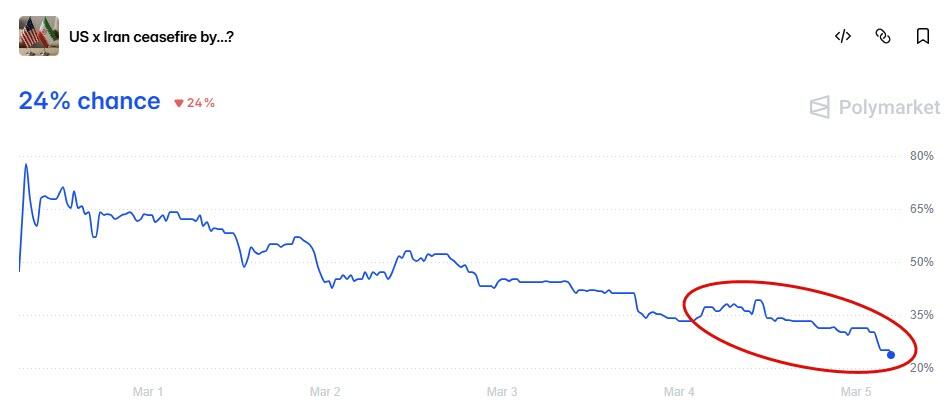
Interestingly while stocks jumped on the ‘hope’, Polymarket odds a ceasefire by month-end slipped to just 1 in 4…
Iran potentially surrendering its uranium stockpiles may become the new “trade war” headlines for the stock market casino. We all remember those headlines from one year ago and in Trump’s first term.
Tyler Durden
Thu, 03/05/2026 – 07:41

Chicago Symphony’s next season: More Mäkelä, less new music and a bunch of Beethoven
The Chicago Symphony on Thursday announced its 2026-27 season — the last before music director designate Klaus Mäkelä assumes his post at the organization in fall 2027.
The season opens with violinist Hilary Hahn, a former CSO artist-in-residence, playing the Mendelssohn concerto under Petr Popelka, who last appeared with the orchestra in December (Sept. 17-19). It closes with the last of four “CSO at the Movies” screenings, of “Star Wars: The Empire Strikes Back” (June 25-27, 2027).
The baton pass from music director emeritus Riccardo Muti to his successor continues in 2026-27, with Mäkelä conducting five weeks of programs to Muti’s three. Mäkelä also leads an eight-city European tour in January 2027, his first international sweep with the orchestra.
The CSO just returned from its first tour with Mäkelä, a weeklong survey of the East Coast. Bookended by subscription programs on either end, it marked Mäkelä and the orchestra’s longest back-to-back collaboration to date.
“There is the human aspect — you travel together, you play the same programs in different places. But I’ve never been on tour with an orchestra that has not come home as a better orchestra than it left,” Mäkelä told the Tribune in an interview. “When we go to Europe, it’s very meaningful to me, personally. People are very curious; they want to hear the orchestra that they’ve heard so much on recordings, but also on previous tours.”
That European tour will reap from Mäkelä’s autumn concerts with the orchestra, which include monumental works like Dmitri Shostakovich’s Symphony No. 4 (Sept. 24-26), Gustav Mahler’s Symphony No. 9 (Oct. 1-4) and William Walton’s “Belshazzar’s Feast,” with the Chicago Symphony Chorus and baritone Thomas Hampson (Oct. 8 and 9). Mäkelä leads the last of these for Symphony Ball, the CSO’s annual gala.
The “Belshazzar’s Feast” program also features two arrangements of music by late Renaissance composer Giovanni Gabrieli. One is by the CSO’s own Tim Higgins, recently tenured as the orchestra’s principal trombone.
“It’s wonderful to have a decision that, in a way, is so easy,” Mäkelä says. “He’s a great musician, he’s a great team player, but he’s also a wonderful individual and a creative musician. … We’re very lucky.”
After conducting Sibelius’s last symphony alongside the Shostakovich in September, Mäkelä leads his Symphony No. 1 in the spring (May 13-16, 2027). That program also champions contemporary Finnish composer Magnus Lindberg: Soloist Lisa Batiashvili plays his Violin Concerto No. 1, and the CSO gives the U.S. premiere of a new, still-to-be-named work, an orchestra co-commission.
While he has not yet conducted much music by Lindberg, Mäkelä grew up listening to his works on CD — a relatively typical experience in Finland, he says.
“His music is like Sibelius to us Finns,” he says. “We are obsessed with contemporary music. If you have a program of contemporary music, it will be very well sold. We’re very drawn to it and hungry for it. One could maybe ask why. I mean, why not?”
Muti’s appearances begin in December. Joining him are principal oboist William Welter in Richard Strauss’s nostalgic concerto for the instrument (Dec. 3-5) and pianist Yefim Bronfman in a “postcard from Vienna,” featuring Mozart’s Piano Concerto No. 24 and a mélange of overtures, waltzes and polkas (Dec. 10-12). Muti returns in the spring for an all-Rossini program, including “Stabat mater” and excerpts from “William Tell” (April 8-10, 2027).
Less than a decade after classical music commemorated Beethoven’s 250th birthday, the composer looms large with another major milestone: the 200th anniversary of his death. Mäkelä closes the season with Beethoven’s Symphony No. 9 and his lesser-heard “Elegy,” originally for string quartet and vocal quartet but often expanded to string orchestra and choir (June 17-20, 2027).
Mäkelä calls Beethoven “the enigma to all of us musicians.”
“There is something incredibly edgy, square, intense and obsessive about his music, but at the same time, it has these incredible visions of something otherworldly,” he says. “This makes him both so relatable, but then also so difficult to approach.”
The program also includes Pierre Boulez’s choral-orchestral “Le soleil des eaux” — Mäkelä’s second Chicago presentation of music by the late CSO conductor, after last year’s “Initiale.”
“Beethoven and Boulez, one can argue that it’s a match made in hell. But because of that, it’s so brilliant,” Mäkelä says. “It’s like when you go to some of these new Michelin restaurants that have this molecular cuisine. I just went to Alinea. They had this tiny piece of jelly, and then, when you taste it, it’s as if you just had a Chicago hot dog. In a way, the Boulez is that to the Beethoven. It’s distilled, but it is the same notes.”
Continuing the Beethoven salute is Lang Lang, performing all five piano concertos across three concerts with Paavo Järvi (March 24-27, 2027). Leif-Ove Andsnes (March 21, 2027) and Evgeny Kissin (April 25, 2027) also offer all-Beethoven piano recitals in the 2026-27 season. Later, Kissin convenes a piano trio with violinist Maxim Vengerov and cellist Gautier Capuçon to tackle the composer’s major works for that instrumentation (May 18, 2027).
Along with its season, the CSO announced a new artist-in-residence: pianist Jean-Yves Thibaudet, a fixture on the orchestra’s calendar for decades. His residency kicks off Oct. 18, appearing as part of a starry piano trio alongside Capuçon and Batiashvili. It continues with full-orchestra appearances Feb. 11-13, 2027 (in Aram Khachaturian’s piano concerto), and May 24, 2027, the latter featuring his Great American Songbook project with pianist/singer Michael Feinstein.
As part of his residency, Thibaudet will participate in additional educational and community programming, with further details to be announced in the fall.
Generally, this is not the season for new music or new faces at Symphony Center. Relatively few artists make their orchestra debut — though audiences can look forward to first CSO appearances by violinist Nemanja Radulović (Nov. 22), conductor Maxim Emelyanychev (in concerts with violinist Isabelle Faust, March 11-14, 2027), percussionist Yuri Yamashita (playing Tan Dun’s “Water” Concerto, May 20-22, 2027) and, surprisingly, eminent bass-baritone Gerald Finley, singing as part of the Beethoven 9 quartet in June 2027.
Despite its incoming director’s zeal for contemporary music, the CSO offers just one world premiere in this pre-Mäkelä season — and it’s derived from an existing work, like 2024’s suite from the film “Megalopolis.” Unveiled in concerts with conductor Manfred Honeck, Mason Bates’ “The Escapist” Symphony reworks material from his operatic adaptation of “The Amazing Adventures of Kavalier & Clay” (Feb. 25-27, 2027).
Next May, two composers will conduct their own music. A portrait concert of Tan Dun notches CSO firsts of some of his touchstone works, as well as his own podium debut (May 20-22, 2027), and Esa-Pekka Salonen will lead the U.S. premiere of a revised version of his “Tiu” (May 27 and 28, 2027, in a program with piano phenom Yunchan Lim).
MusicNOW, the CSO’s contemporary music series, remains absent from the season following a “pause” announced last year. Works by contemporary composers Arturo Márquez, Michael Abels, Philip Glass, Arvo Pärt, Roberto Sierra and Julia Wolfe are sprinkled throughout the mainstage season, if not yet reflecting the deeper commitment CSO president Jeff Alexander outlined in an interview with the Tribune last year.
Other listings of note: A fandango-forward program by Grant Park Music Festival conductor Giancarlo Guerrero, who recently made a surprise cameo during the Super Bowl Halftime Show (with violinist Anne Akiko Meyers, Oct. 15-17); a one-night-only appearance by Yo-Yo Ma (with conductor Carlos Miguel Prieto, Nov. 11); a symphonic treatment of singer-songwriter-violinist Andrew Bird’s discography (Nov. 13 and 14); Bach Collegium Japan director Masaaki Suzuki, making his overdue CSO debut helming its annual “Messiah” (Dec. 17-19); Karina Canellakis in Shostakovich’s final Symphony No. 15, alongside violinist Randall Goosby (Feb. 19-21, 2027); piano recitals by Rudolf Buchbinder (Jan. 10, 2027) and Yuja Wang (April 11, 2027); and CSO podium favorite Jakub Hrůša in Shostakovich’s Symphony No. 7, “Leningrad” (April 15-18, 2027).
As ever, other concerts by the presenter will be announced at a later date, including its jazz series. But April 20 and 23, 2027, are set for the Jazz at Lincoln Center Orchestra’s Symphony Center concerts, which may well mark Wynton Marsalis’s last Chicago appearance as artistic director: The trumpeter, composer and bandleader announced he will be stepping down after the 2026-27 season.
Subscription tickets are now on sale at cso.org. Single tickets are available for purchase starting Aug. 5.
Hannah Edgar is a freelance critic.
https://www.chicagotribune.com/2026/03/05/chicago-symphony-2026-27-season/

Anthropic In Chaos: CEO Tries To Salvage Pentagon Contract After Slamming Trump, Altman In Leaked Letter
Anthropic In Chaos: CEO Tries To Salvage Pentagon Contract After Slamming Trump, Altman In Leaked Letter
Things over at Anthropic are getting wild.
On Friday, the Trump administration ‘fired’ the woke serial copyright infringer, industry disruptor and software-engineer-extinctor after a bruising dispute with the Pentagon came to a head over ethical concerns surrounding Claude’s military use – specifically, domestic surveillance and fully autonomous weapons. The Pentagon demanded to use ClaudeAI for “any lawful purpose” with no guardrails – or having to ask permission from a bunch of blue-haired Karens in a life-or-death scenario. The chatbot’s supposedly idealistic leader (whose sister and Anthropic co-founder, Daniella Amodei, is married to Holden Karnofsky, the founder of Effective Altruism himself) had to signal virtuemaxx to his employees, and said no. OpenAi’s Sam Altman, who is a different kinds of opportunistic sociopath with zero moral qualms, pretended to side with Amodei at first only to immediately swoop in and poach Anthropic’s Pentagon contract. Meanwhile, Amodei’s investors, who had just dumped all their cocaine cash for the next 20 years into his company at a $380 billion valuation, and realized they would never see their money again if the government blacklisted and banned the company from all government supply chains, were terribly vexxed.
The spat resulted in three things; first, in addition to getting ‘fired,’ Anthropic was deemed a “supply-chain risk” (making them radioactive to the defense industry) – and federal agencies were given six months to ditch Anthropic products. Second, OpenAI’s Sam Altman slid into Hegseth’s DMs (through proper channels, we’re sure) and landed Anthropic’s contract – which they revised to beef up and clarify safety protocols, and third, Anthropic CEO Dario Amodei threw a ripper of a tantrum in a leaked memo sent to over 2,000 employees attacking the Trump administration and OpenAI.
For Silicon Valley investors and allies, it immediately sank in how absolutely fucked they are if this stands. Now in a PR crisis, Amodei is scrambling to salvage his company’s relationship with the Pentagon (read: the goodwill of his investors) – and has begun last-ditch talks with senior officials in hopes of striking a new deal, FT reports, adding that he’s now personally negotiating with Emil Michael, the Pentagon’s undersecretary of defense for research and engineering, who on Thursday called Amodei as a “liar” with a “God complex after talks with the Pentagon collapsed.
It’s a shame that @DarioAmodei is a liar and has a God-complex. He wants nothing more than to try to personally control the US Military and is ok putting our nation’s safety at risk.
The @DeptofWar will ALWAYS adhere to the law but not bend to whims of any one for-profit tech… https://t.co/ZfwXG36Wvl
— Under Secretary of War Emil Michael (@USWREMichael) February 27, 2026
Pentagon Showdown
Anthropic drew several red lines against allowing its technology to power fully autonomous lethal weapons or mass domestic surveillance, arguing that the level of protections the Pentagon wanted would be ineffective, and that the Defense Department’s language was suspicious.
“Near the end of the negotiation the department offered to accept our current terms if we deleted a specific phrase about ‘analysis of bulk acquired data,’” Amodei wrote in a memo to employees. “That was the single line in the contract that exactly matched the scenario we were most worried about. We found that very suspicious.”
Pentagon officials, meanwhile, claim that Anthropic was demanding they ask permission in life-or-death nuclear scenarios, which Anthropic denied.
A defense official said the Pentagon’s technology chief whittled the debate down to a life-and-death nuclear scenario at a meeting last month: If an intercontinental ballistic missile was launched at the United States, could the military use Anthropic’s Claude AI system to help shoot it down?
It’s the kind of situation where technological might and speed could be critical to detection and counterstrike, with the time to make a decision measured in minutes and seconds. Anthropic chief executive Dario Amodei’s answer rankled the Pentagon, according to the official, who characterized the CEO’s reply as: You could call us and we’d work it out.
An Anthropic spokesperson denied Amodei gave that response, calling the account “patently false,” and saying the company has agreed to allow Claude to be used for missile defense. But officials have cited this and another incident involving Claude’s use in the capture of Venezuelan leader Nicolás Maduro as flashpoints in a spiraling standoff between the company and the Pentagon in recent days. The meeting was previously reported by Semafor. –Washington Post
Does the last-ditch effort to save things mean that Anthropic is going to budge on their red lines – perhaps matching whatever OpenAI has stipulated or agreed to?
Memo Meltdown
After OpenAI snaked their contract, Amodei dismissed the rival’s safeguards as little more than “20% real and 80% safety theater,” – claiming that OpenAI’s Pentagon deal appears to rely on “safety layers” and monitoring systems intended to block prohibited uses – safeguards he says are easily bypassed.
“Refusals aren’t reliable and jailbreaks are common,” he wrote, adding that AI models cannot reliably determine whether they are being used for surveillance or autonomous weapons because they lack visibility into the real-world context of how their outputs are used.
Amodei also blasted the idea that contractors such as Palantir could enforce restrictions through software filters.
“Our sense was that it was almost entirely safety theater,” he wrote, claiming such tools were designed mainly to placate concerned employees rather than actually prevent abuses.
‘We Haven’t Given Dictator-Style Praise To Trump’
Amodei argued that the real reason the Trump administration is targeting Anthropic has nothing to do with technology or national security.
“The real reasons the DoW and the Trump admin do not like us is that we haven’t donated to Trump… we haven’t given dictator-style praise to Trump… and we have supported AI regulation,” he wrote.
Amodei claimed OpenAI leadership – including president Greg Brockman – had donated heavily to pro-Trump political groups while Anthropic refused to play the same game.
He also accused the Pentagon of coordinating messaging with OpenAI to portray Anthropic as unreasonable in contract negotiations.
“Sam is trying to make it more possible for the admin to punish us by undercutting our public support,” Amodei wrote.
Which, again, begs the question of whether or not Anthropic is now willing to budge on their red lines.
Investors Alarmed
Needless to say, Anthropic’s investors and partners are freaked out – with backers including Amazon, Nvidia, Lightspeed Venture Partners and Iconiq Capital scrambling to hold urgent talks with the company in recent days as they attempt to defuse the conflict with Washington.
A major technology industry group representing many of these companies sent a letter to the Hegseth Wednesday warning against the Pentagon labeling any AI provider a supply-chain risk amid a procurement dispute.
But what really matters are Anthropic’s investors – both current but especially future (after all someone has to fund those billions in perpetual losses) – many of whom blame Amodei’s confrontational approach for escalating the situation.
“It’s an ego and diplomacy problem,” one person familiar with the talks told Reuters.
Some investors have reportedly reached out to contacts inside the Trump administration in hopes of calming tensions.
Following Trump and Hegseth’s Friday announcement, several agencies began shifting away from the company. The State Department has reportedly moved to OpenAI following an order from the White House to phase out Anthropic systems within six months.
Meanwhile, Anthropic has raised tens of billions of dollars and is widely expected to pursue a public offering. Enterprise customers account for roughly 80% of the company’s revenue, and its projected annual run rate has reportedly surged from about $14 billion to $19 billion in recent weeks (and do we believe this?).
Tyler Durden
Thu, 03/05/2026 – 07:30

With Illinois coach Brad Underwood watching, Neuqua Valley’s Danny Mikuta delivers ‘big shots’ of confidence
Neuqua Valley junior center Danny Mikuta caught a pass from teammate Cole Kelly in the right corner and swished a 3-pointer.
That’s something Mikuta didn’t do nearly as often as expected this season. So it was no surprise when he found himself wide open at the top of the key on the very next possession of the star-studded Class 4A Bolingbrook Sectional semifinal game against the host Raiders on Wednesday.
As a capacity crowd that included Illinois men’s basketball coach Brad Underwood watched, Mikuta took a full three seconds to decide whether to pass or shoot. He finally chose the latter and hit another 3-pointer.
“I’ve been struggling this whole season from three, so that’s why I was kind of hesitant a lot of the time,” he said. “But the times that I hit them, they were pretty cool.
“When the crowd got excited, I saw that, and it made me so happy.”
Mikuta scored the final seven points of the first half, and Kelly opened the second half by hitting a 3-pointer to get the second-seeded Wildcats back in the game against third-seeded Bolingbrook.
Mikuta scored two more baskets, including a go-ahead layup late in the third quarter. But those weren’t enough as the Raiders went on a closing 20-4 run to win 68-53 and snap Neuqua Valley’s team-record 30-game winning streak.
It was the end of a spectacular season in which the Wildcats (32-2) broke the team record for wins and won DuPage Valley Conference and regional titles.
Mikuta finished with 11 points on 4-of-6 shooting against Bolingbrook (25-7), which avenged a 75-69 regular-season loss.
“Danny is a very good shooter,” Neuqua Valley coach Todd Sutton said. “He didn’t have a great year. He is a much better player than that.”
Sutton expected Mikuta to average about 11 points this season, but he rarely reached that number.
“It’s been that way all year,” Sutton said. “Sometimes he misses them. Tonight, he made two, should have made another one.”
In this game, the same could be said of all the Wildcats, who made 18 of 49 shots. Kelly, a highly recruited sophomore forward with an offer from Illinois, scored 17 points on 5-of-20 shooting, and junior guard Mason Martin, an Illinois commit, made 5 of 9 shots for 13 points.
Kelly scored 10 points in the third quarter as Neuqua Valley took a 46-43 lead following Mikuta’s final basket and two free throws by junior guard Carter Coviello.
Neuqua Valley’s Cole Kelly (32) goes for a layup past Bolingbrook’s TJ Williams (3) during a Class 4A Bolingbrook Sectional semifinal on Wednesday, March 4, 2026. (James C. Svehla / Naperville Sun)
Martin’s inside basket with 6:45 left in the fourth quarter gave the Wildcats their last lead at 49-45. But the Raiders, who got a game-high 25 points from sophomore guard Brady Pettigrew, another Illinois target, scored the next eight points and made eight of their last nine shots.
“We had an off shooting night, me and Mason, and they played one of their best games,” Kelly said. “When you play below average and they play above average, then you’ve just got to tip your hat and say, ‘Good game,’ and move on to the next.”
Of course, the Wildcats’ next game will come next season. But their entire starting lineup will return.
“We’re very hopeful,” Mikuta said. “Since we’re all coming back, I expect us to be better, and since we set a lot of records this year, I’m hoping to break a couple of them next year with the same guys.”
Mikuta also is hoping to have a breakout senior season. His performance against Bolingbrook gave him a boost.
“It did,” Mikuta said. “Those were big shots, and now that I feel like when people sag, I’ll be confident enough to shoot it.”
Neuqua Valley’s Danny Mikuta (55) looks to pass the ball during a Class 4A Bolingbrook Sectional semifinal against the host Raiders on Wednesday, March 4, 2026. (James C. Svehla / Naperville Sun)
Mikuta didn’t know Underwood was in attendance until after the game. But Kelly was aware, just as he is aware of Mikuta’s talent.
“If you were there in our open gyms before the season, he was lighting it up like he was Mason,” Kelly said. “Once he sees one go through, then he starts shooting a little bit more.
“He’s a great player. He’s the hardest worker on the team, and it shows out there on the court.”
Matt Le Cren is a freelance reporter.
https://www.chicagotribune.com/2026/03/05/4a-high-school-basketball-bolingbrook-neuqua-danny-mikuta/
House to vote on Iran war powers resolution in a test of President Donald Trump’s strategy
WASHINGTON — The House is preparing to vote Thursday on a war powers resolution to halt President Donald Trump’s attack on Iran, a sign of unease in Congress over the rapidly widening conflict that is reordering U.S. priorities at home and abroad.
It’s the second vote in as many days, after the Senate defeated a similar measure along party lines. Lawmakers are confronting the sudden reality of representing the American people in wartime and all that entails — with lives lost, dollars spent and alliances tested by a president’s unilateral decision to go to war with Iran.
Iran launches new attacks and calls for ‘Trump’s blood’ while Israel strikes Iranian infrastructure
The tally in the House is expected to be tight, but the outcome will provide an early snapshot of the political support, or opposition, to the U.S.-Israel military operation and Trump’s rationale for bypassing Congress, which alone has the power to declare war.
“Donald Trump is not a king, and if he believes the war with Iran is in our national interest, then he must come to Congress and make the case,” said Rep. Gregory Meeks, the top Democrat on the House Foreign Affairs Committee.
Meeks said in his nearly three decades in Congress, the hardest votes he has taken have been deciding whether to send U.S. troops to war.
The roll calls are a clarifying moment for the president and the parties just days into the overseas conflict that has quickly carried echoes of the long U.S. wars in Afghanistan and Iraq. Many veterans of those wars have since run for office and now serve in Congress.
Republicans largely back Trump, and most Democrats oppose the war
Trump’s Republican Party, which narrowly controls the House and Senate, largely sees the conflict with Iran not as the start of a new war, but the end of a regime that for decades has long menaced the West. The operation has killed Iran’s Supreme Leader Ayatollah Ali Khamenei, which some view as an opportunity for regime change, though others warn of a chaotic power vacuum.
Rep. Brian Mast of Florida, the GOP chairman of the House Foreign Affairs Committee, publicly thanked Trump for taking action against Iran, saying the president is using his own constitutional authority to defend the U.S. against the “imminent threat” the country posed.
Mast, an Army veteran who worked as a bomb disposal expert in Afghanistan, said the war powers resolution was effectively asking “that the president do nothing.”
For Democrats, Trump’s war with Iran, influenced by Israeli Prime Minister Benjamin Netanyahu, is a war of choice that is testing the balance of powers in the U.S. Constitution.
“The framers weren’t fooling around,” said Rep. Jamie Raskin, D-Md., arguing that the Constitution is clear that only Congress can decide matters of war.
He said whether lawmakers support or oppose the Trump administration’s military action, they should have the debate. “It’s up to us, we’ve got to vote on it.”
While views in Congress are largely falling along party lines, there are crossover coalitions. Both the House and Senate resolutions were bipartisan, and are drawing bipartisan support and opposition. The House is also voting on a separate resolution affirming that Iran is the largest state sponsor of terrorism.
The war powers resolution, if signed into law, would immediately halt Trump’s ability to conduct the war unless Congress approved the military action. The president would likely veto the measure.
As an alternative, a small group of Democrats has proposed a separate war powers resolution that would allow the president to continue the war for 30 days before he must seek congressional approval. It is not expected to come yet for a vote.
Trump officials provide shifting rationale for war
After launching a surprise attack against Iran on Saturday, Trump has scrambled to win support for a conflict that Americans of all political persuasions were already wary of entering. Trump administration officials spent hours behind closed doors on Capitol Hill this week trying to reassure lawmakers that they have the situation under control.
Six U.S. military members were killed over the weekend in a drone strike in Kuwait, and Trump has said more Americans could die. Thousands of Americans abroad have scrambled for flights, many lighting up the phone lines at congressional offices as they sought help trying to flee the Middle East.
Defense Secretary Pete Hegseth said that the war could extend eight weeks, twice as long as the president himself first estimated. Trump has left open the possibility of sending U.S. troops into what, so far, has largely been bombing campaign by air. Hundreds of people in the region have died.
The administration said the goal is to destroy Iran’s ballistic missiles that it believes are shielding its nuclear program. It has also said Israel was ready to act against Iran, and American bases would face retaliation if the U.S. did not strike first. On Wednesday, the U.S. said it torpedoed an Iranian warship near Sri Lanka.
“This administration can’t even give us a straight answer of as to why we launched this preemptive war,” said Rep. Thomas Massie, the Republican from Kentucky who is often an outlier in his party.
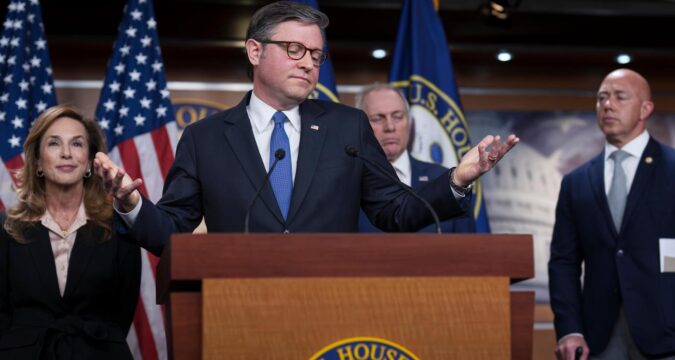
Massie and Rep. Ro Khanna, D-Calif., who had teamed up to release the Jeffrey Epstein files, also forced the war powers resolution to the floor, pushing past objections from House Speaker Mike Johnson.
Johnson has warned that it would be “dangerous” to limit the president’s authority while the U.S. military is already in conflict.
Senators sit in their desks for solemn vote
In the Senate, Republican leaders have successfully, though narrowly, defeated a series of war powers resolutions pertaining to several other conflicts during Trump’s second term. This one, however, was different.
Underscoring the gravity of the moment Wednesday, Democratic senators filled the chamber and sat at their desks as the voting got underway.
“Today every senator — every single one — will pick a side,” Senate Democratic leader Chuck Schumer said before the vote. “Do you stand with the American people who are exhausted with forever wars in the Middle East or stand with Donald Trump and Pete Hegseth as they bumble us headfirst into another war?”
Sen. John Barrasso, second in Senate Republican leadership, said “Democrats would rather obstruct Donald Trump than obliterate Iran’s national nuclear program.”
The legislation failed on a 47-53 tally mostly along party lines, with Republican Sen. Rand Paul of Kentucky in favor and Democratic Sen. John Fetterman of Pennsylvania against.
https://www.chicagotribune.com/2026/03/05/us-house-iran-war-powers-resolution/
Iran launches new attacks and calls for ‘Trump’s blood’ while Israel strikes Iranian infrastructure
DUBAI, United Arab Emirates — Iran launched a new wave of attacks Thursday at Israel, American bases and countries around the region, threatening that the United States would “bitterly regret” torpedoing an Iranian warship in the Indian Ocean and calling for “Trump’s blood,” while Israel said it hit multiple targets in Iran.
Israel announced multiple incoming missile attacks and air sirens sounded in Tel Aviv and Jerusalem. Iranian state television said additional strikes also targeted U.S. bases.
House to vote on Iran war powers resolution in a test of President Donald Trump’s strategy
The Israeli military said it had hit 80 targets in Lebanon linked to the Iranian-backed Hezbollah militant group over the past 24 hours and that a wave of strikes on Iran had hit long range ballistic missile launch sites and other targets.
Iranian Foreign Minister Abbas Araghchi accused the U.S. Navy of committing an “an atrocity at sea” for sinking the Iranian frigate IRIS Dena in the Indian Ocean, which killed at least 87 Iranian sailors.
“Mark my words: The U.S. will come to bitterly regret (the) precedent it has set,” he said on social media.
Ayatollah Abdollah Javadi Amoli, in one of the few clerical statements so far from Iran, later called on state television for the shedding of both Israeli and “Trump’s blood.”
“Fight the oppressive America, his blood is on my shoulders,’” he said in a rare call for violence from an ayatollah, one of the highest ranks within the clergy of Shiite Islam.
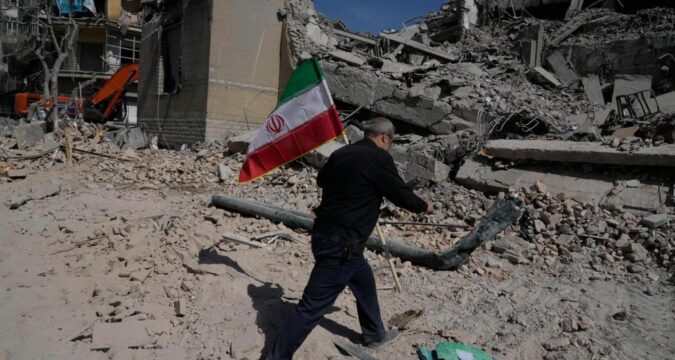
The U.S. and Israel launched the war Saturday, targeting Iran’s leadership and killing Iranian Supreme Leader Ayatollah Ali Khamenei, as well as hitting its missile arsenal and nuclear facilities. Leaders have suggested toppling the government is a goal, but the exact aims and timelines have repeatedly shifted, signaling an open-ended conflict.
The war has killed more than 1,200 people in Iran, more than 70 in Lebanon and around a dozen in Israel, according to officials in those countries. It has disrupted the supply of the world’s oil and gas, snarled international shipping and stranded hundreds of thousands of travelers in the Middle East.
Threats expanding across the Middle East
A drone crashed Thursday near the airport in Nakhchivan, an Azerbaijan exclave bordering the north of Iran that is separated from the rest of the country by Armenia. Another drone fell near a school and two civilians were injured, Azerbaijan’s Foreign Ministry said.
Iran has not acknowledged targeting Azerbaijan, but its attacks since the start of the war have spread erratically and involved regional countries and beyond.
In Abu Dhabi, six people were wounded when a drone was shot down near the Al Dhafra Air Base, which hosts U.S. forces, and shrapnel fell to the ground, authorities said.
Qatar evacuated residents near the U.S. Embassy in Doha as a temporary precaution Thursday and later reported a missile attack on the city. Saudi Arabia said it destroyed a drone in its province bordering Jordan.
A tanker apparently came under attack off the coast of Kuwait early Thursday, expanding the area where commercial shipping was in danger, according to the United Kingdom Maritime Trade Operations Center run by the British military. It said there was an explosion but did not offfer a cause. Iran in the past has attacked ships by attaching limpet mines to them.
Prior attacks since fighting began Saturday have happened in the Gulf of Oman and the Strait of Hormuz, which connects it to the Persian Gulf and through which about a fifth of the world’s oil is shipped.
U.S. stocks rebounded Wednesday after oil prices stopped spiking and reports gave encouraging updates on the American economy. But oil prices resumed their ascent early Thursday and Brent crude, the international standard, is now up some 15% from the start of the conflict as Iranian attacks have disrupted traffic through the strait.
Iranian warship sunk on way home from multinational exercises
The Iranian ship sunk by the U.S. Navy was on its way back from participating in a February exercise hosted by the Indian navy. The U.S. Navy also participated in the same exercise with a P-8A Poseidon aircraft, which is employed for anti-submarine and anti-surface warfare as well as surveillance and reconnaissance.
Sri Lankan authorities said 32 crew members were rescued, while its navy recovered 87 bodies.
Araghchi said it had been carrying “almost 130” crew.
U.S. Defense Secretary Pete Hegseth confirmed Wednesday that an American submarine had sunk the ship with a torpedo.
Sri Lanka’s media minister and government spokesman, Nalinda Jayatissa, told parliament Thursday that another Iranian ship had arrived in its waters. Jayatissa did not provide further details about the ship or the number of people on board.
Israel says it hits more Hezbollah targets in Lebanon
U.S. and Israeli military officials say launches from Iran have declined as their attacks have taken out ballistic missiles, launchers and drones. Israel’s Homefront Command announced it was easing restrictions that closed workplaces nationwide, which could reopen Thursday if there is a shelter nearby. Schools would remain closed.
Still, explosions sounded early Thursday in Israel, which said its defensive systems were moving to intercept at least three waves of Iranian missiles.
At least 1,230 people have been killed in Iran, the country’s Foundation of Martyrs and Veterans Affairs said Thursday. Eleven people have died in Israel. Six U.S. troops have been killed, including a major whose identity was released Wednesday.
Among the 80 targets in Lebanon that the Israel military said it hit over the past 24 hours were “several command centers” used by Hezbollah in Beirut. It showed video footage of a building being hit, but provided no further details.
Another eight people were killed in Lebanon, including two in a building struck by the Israeli military in the Beddawi refugee camp in the coastal city of Tripoli on Thursday and three on a coastal highway, authorities said. The Israeli military did not immediately say who it targeted in the strikes.
In two near-simultaneous Israeli drone strikes in Beirut’s southern suburbs late Wednesday, two vehicles were hit, killing three people and wounding six, the health ministry said. The Israeli military said it targeted a Hezbollah member, adding that further details would follow.
Rising reported from Bangkok, Becatoros from Athens, Greece, and Magdy from Cairo. Associated Press writers Sally Abou AlJoud in Beirut, Lebanon, Elaine Kurtenbach in Bangkok, Melanie Lidman in Tel Aviv, Israel, Julia Frankel in Jerusalem, Aida Sultanova in Baku, Azerbaijan, Dasha Litvinova in Tallinn, Estonia, and Giovanna Dell’Orto in Miami contributed to this report.
https://www.chicagotribune.com/2026/03/05/iran-israel-us-attacks/
China Halts Diesel, Gasoline Exports As Paralyzed Hormuz Risks Energy Shock
China Halts Diesel, Gasoline Exports As Paralyzed Hormuz Risks Energy Shock
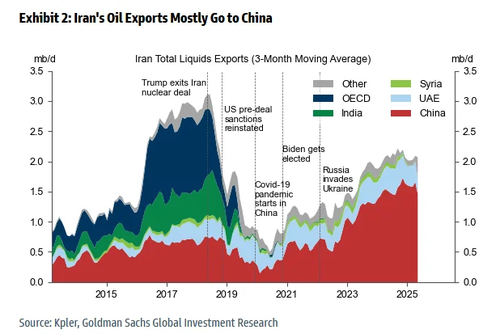
Less than one week into Operation Epic Fury, Beijing has ordered its top refiners to halt gasoline and diesel exports as the Strait of Hormuz remained paralyzed on Thursday morning. The move exposes how China is one of the biggest losers in a prolonged Hormuz shutdown, with Beijing appearing to brace for an oil shock.
Beijing is scrambling after panicking at the start of the week and calling for an immediate ceasefire in the U.S.-Iran conflict. Since then, Iraq has begun cutting crude oil output, and Wednesday brought another major energy shock: Qatar’s massive LNG export operation declared force majeure, effectively removing about 20% of global LNG supply from the market, with roughly 80% of those volumes normally headed to Asia.
Bloomberg sources say that officials from the National Development and Reform Commission, China’s top economic planner, called for an immediate temporary suspension of refined crude product exports on Thursday.
Chinese officials told top domestic refiners to halt any new export deals and cancel existing shipments, though jet and bunker fuel in bonded storage, along with supplies to Hong Kong and Macau, are exempt.
NDRC’s decision is merely viewed as a way for Beijing protect domestic fuel supply and energy security. We’ve made it very well known to readers that China is heavily exposed to Gulf energy.
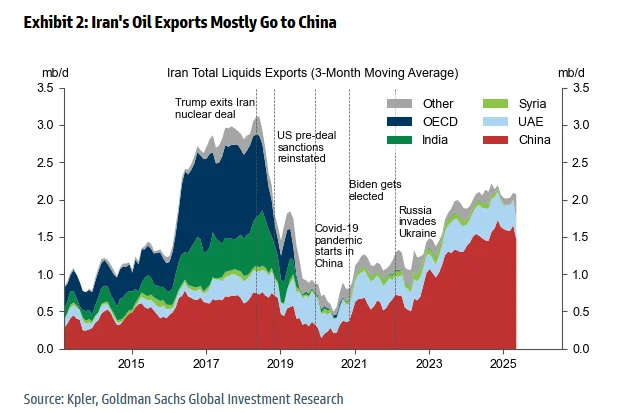
We’ve briefed readers (read here) that China is heavily exposed to cheap Iranian crude exports. About 80% of Iran’s oil exports – about 1.6 million barrels per day – go to China.
… and so is the rest of Asia.
We asked a very important question on Wednesday evening: “Will Trump Seize Or Destroy Iran’s Oil Export Island?”
Crude oil futures for April on the Shanghai International Exchange (priced in dollars) are near $100/bbl.
However, there is some good news overnight:
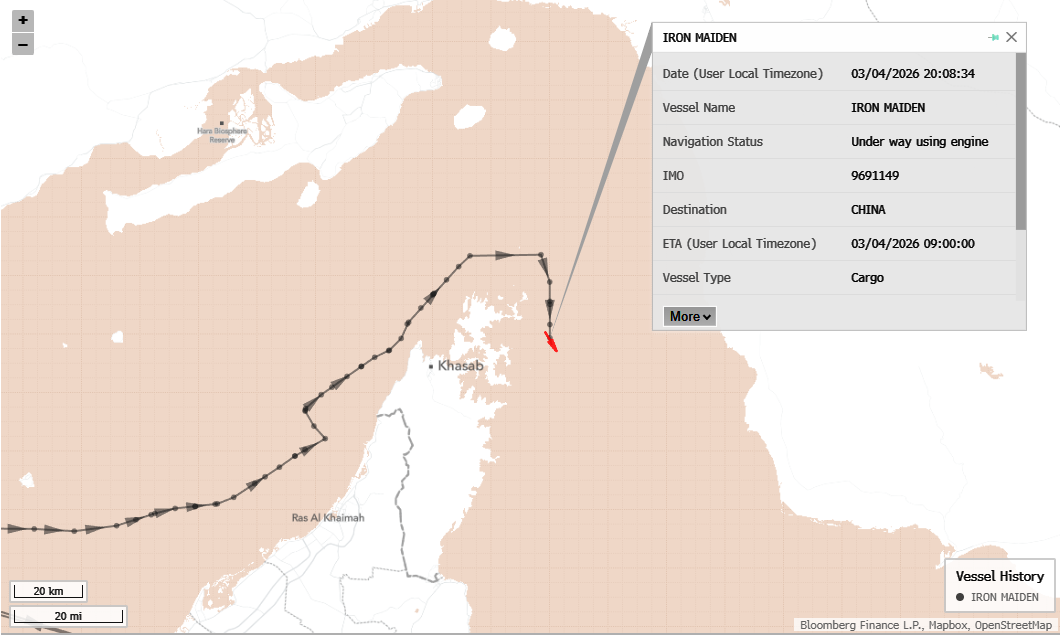
China-Linked Bulk Carrier Exits Strait Of Hormuz Without Incident
Any sustained closure of the critical waterway could trigger an energy shock in China, hitting first through higher prices and, if the disruption persists, through tighter physical supply. As the world’s largest crude importer, with roughly half of its oil imports linked to Gulf shipments, Beijing faces the risk of chokepoint disruptions.
All of this comes just weeks before President Trump’s upcoming trip to Beijing, and with the U.S. military likely to provide tanker escorts through the narrow waterway, the leverage Washington appears to have gained ahead of any Trump-Xi meeting looks increasingly well calculated.
Tyler Durden
Thu, 03/05/2026 – 07:05

The Chicago Bulls bet on Josh Giddey. So why is the approach to their (supposed) star so haphazard?
Early in the fourth quarter of Tuesday’s loss to the Oklahoma City Thunder, Josh Giddey stood at the scorer’s table with a resistance band and a towel tucked into one hand, his eyes tracking every movement on the court.
Barely 15 minutes before, the guard could barely hobble off the court. Giddey turned his ankle on an offensive play, limping his way through the half court and lining up a 3-point attempt before gingerly exiting the game. But even with the Bulls trailing by double digits, the guard insisted on returning for the final quarter of the eventual loss.
Coach Billy Donovan cited Giddey’s extensive record with ankle tweaks and strains — including a notable one at the end of last season — as a source of confidence for the medical team in the guard’s discretion regarding his own injuries. The Bulls feel that Giddey knows his limits when he rolls an ankle. If the guard said he’s OK to go back into a game, they believe him.
“Sometimes the initial shock is worse than it actually is,” Giddey said after the loss. “The initial pain always feels bad, but when I got up and started moving around, I realized it wasn’t as bad as I originally thought.”
Still, the moment felt pointless. Giddey subbed back in and muscled his way through five minutes and 28 seconds of play. He assisted a pair of shots, turned the ball over once and scored three points despite missing a free throw before Donovan finally pulled him again out of concern for a lingering hamstring injury, which is supposed to limit him to around 30 minutes per game (a guideline the coach only loosely follows).
The Bulls were trailing by 16 points when Giddey checked in. That deficit was diminished slightly to 15 points when he exited. It was a short stint in a throwaway game. Yet this brief passage in the fourth quarter raised the kind of questions the Bulls are used to facing this season: Why is he playing? What’s the point of risking another injury? What is the point of any of this?
Column: Chicago Bulls were late to the tanking trend. That’s nothing new for this front office.
The season is cruising to end on a whimper for the Bulls, who are exactly where they want to be, sitting six games out of the play-in tournament and ninth overall in the draft lottery standings. Still, the Bulls prioritize playing Giddey over giving runway to players like Rob Dillingham, who is ostensibly a crucial piece for Chicago to analyze as they begin to rethink their roster construction in the long-term. And when players like Anfernee Simons and Jaden Ivey return to the rotation, he is still expected to dominate minutes in his role as the primary ball handler for the Bulls.
This stubborn insistence upon playing Giddey reflects the confusion of the team’s outlook on their starting point guard. The Bulls clearly believe he is valuable enough to prioritize as a centerpiece for their current roster rebuild. Yet the front office has never been fully sold on his actual star power — or whether they plan to truly build around Giddey in future seasons.
As the Bulls weigh this dynamic, Tuesday’s game was a fitting encapsulation of the present and future for the franchise. Like many of his teammates, Giddey cited the reigning champs as a “benchmark” for the rest of the league to test themselves against. But games against the Thunder also provide crucial moments of reflection and comparison of Giddey’s growth in the two years since the Bulls traded to acquire him from Oklahoma City.
That final season in Oklahoma City defined how Giddey was seen throughout the league — and not in the way he wanted. For most of that year, Giddey felt like a non-factor on offense and a liability on defense.
When the guard caught a ball on the perimeter, defenders backed up as if they were daring him to shoot. Teams clearly schemed to exploit him in the pick-and-roll. And every weakness in his game was picked apart even more shrewdly in the postseason, when he was ultimately benched due to poor shooting and weak defense.
“It was a lot of learning that year, a lot of looking in the mirror and self-reflecting about how I needed to get better as a player,” Giddey said. “That year, my confidence just kept getting lower and lower and I was trying to dig myself out of a hole that was getting deeper every game.”
Giddey clearly took an astronomic step forward in his NBA career in the two years since he left Oklahoma City. He is averaging roughly five points and four assists per game more for the Bulls. Most noticeably, Giddey’s shooting accuracy rose above 37% from behind the arc with his move to Chicago, a crucial improvement to establish his credibility as a true guard threat.
The guard credits this area of improvement to his regained confidence. That still doesn’t guarantee the most aesthetic shooting. Giddey was the first to admit that he missed badly twice in Tuesday’s game, with one 3-point shot avoiding the rim entirely and falling into the hands of Chet Holmgren as if he had momentarily forgotten that the big man wasn’t still his teammate. But those types of mistakes don’t hang on Giddey with the same weight as when he was still floundering with the Thunder.
Related Articles
Photos: Oklahoma City Thunder 116, Chicago Bulls 108
Matas Buzelis limps off the court with an ankle injury in Chicago Bulls’ final game before West Coast trip
Chicago basketball report: Hannah Hidalgo and Notre Dame gain steam — and WNBA players wary of strike
Photos: Chicago Bulls 120, Milwaukee Bucks 97
Chicago Bulls snap 11-game losing streak — and sacrifice draft lottery standing — with win over Milwaukee
“I feel like I’ve gotten to a point now where I let it fly with confidence,” Giddey said. “Whether I go 0-for-11 or 11-for-11, I’m shooting the next one like they’ve all gone in.”
When Giddey looks at the Thunder, the guard said he doesn’t feel animosity or resentment. Those are his friends, his brothers, the people who saw him through the hardest year of his career, who watched him develop from a rookie to a starter. He always wanted the Thunder to win. He just wanted to do it with them.
But now, Oklahoma City also represents something bigger to Giddey. This is a team that laid the framework for how any struggling franchise can rebuild its roster from the bottom up. It’s not an easy formula — not every team can draft talent quite like Oklahoma City — but it does provide hope to teams like Chicago.
Yet herein lies the main problem with this stage of Giddey’s career. Even amid great personal growth, the guard is back on the first rung of a lengthy ladder as yet another team tries to build with him. There isn’t much winning ahead for Chicago. It could be years before Giddey sees another opportunity to redeem himself in the postseason.
Giddey understands this reality. He knows his place in the Bulls’ future. That doesn’t make it any easier to find patience in the short-term. But the guard is willing to try regardless.
“They’ve got a winning culture and they build winning habits,” Giddey said. “Being at both ends of the scale when I was there, being where we’re at now — we’re on the outside looking in — it’s the little things that help you get back to that point. It doesn’t happen overnight. These things take time to build and I believe in the guys in this locker room and the coaches and the people in this building that we have the ability to get there.”
https://www.chicagotribune.com/2026/03/05/chicago-bulls-josh-giddey-haphazard-approach/

Women’s college wrestling achieves major milestone with 1st NCAA championships set this weekend
CORALVILLE, Iowa — The Iowa City area is a fitting place to host the first NCAA women’s wrestling championships.
“What is it they say? ‘Wrestletown USA?’” McKendree University coach Alexio Garcia said. “I think it’s a great place for wrestling to be hosted. You go to some places, maybe a hundred people know wrestling. There, everyone lives it.”
The event will be held on Friday and Saturday at Xtream Arena in Coralville, a couple miles from the University of Iowa campus, which is widely regarded as the epicenter of the sport.
“It really is ‘Wrestletown USA,’” Iowa coach Clarissa Chun said. “We’ve had World Cup events here. We’re going to have other big events here. So this is a big deal for our sport.”
Women’s wrestling moved from emerging sport to championship status in January 2025. There are 111 NCAA programs across all divisions. Iowa is among just six in Division I and the only one from a power conference.
The championships aren’t divided into divisions, so a school like McKendree, a Division II school located in Lebanon, Ill., is competing against Iowa of the Big Ten. North Central College, a Division III school in Naperville, won the National Duals with victories over McKendree and Iowa.
McKendree is ranked No. 1 in the National Wrestling Coaches Association poll and followed by Iowa and North Central. Each school won regional titles and advanced the maximum 10 wrestlers to nationals.
“The fact that we’re in this position now is nothing short of pretty amazing,” Garcia said. “I think we’re all lucky and blessed to be witnessing it, to be honest.”
It’s an event that Chun and her team have been waiting for since the Hawkeyes began competing in 2023-24.
“It’s going to be pretty electric,” Chun said. “It was pretty cool at regionals to see them get so excited when they saw the NCAA regional trophies. They were like, ‘It’s real. It’s happening.’ We’ve heard about it all year, but to see that and what it looks like puts a little extra on them, the feeling that this is happening.”
Wrestling organizations began a movement in 2017 to take the sport to the college level. The National Collegiate Women’s Wrestling Championships began in 2020 as a tournament for NCAA programs, the same year the NCAA designated women’s wrestling an emerging sport. The sport can be considered for NCAA championship status when at least 40 schools sponsor it at the varsity level.
McKendree was a three-time winner of the NCWWC team title (2020-22) while North Central took it in 2023.
“Women’s wrestling is so competitive,” Chun said. “Some of the wrestlers in this tournament have been in the Olympics or on world teams. That’s what’s so exciting about the trajectory of where women’s wrestling is in the United States. Because what is that tagline that the NCAA has? ’Olympians made here.’ That’s the step in the direction that the NCAA can offer.”
McKendree began its women’s wrestling program in 2013 and was a member of the Women’s College Wrestling Association, which governed NCAA, NAIA and junior college programs.
“Our culture and environment have grown tremendously,” said Garcia, who is in his fifth season as coach. “The town that we live in is really nice. (St. Louis) is about a half-hour away. So it’s an attractive place. I think what’s drawing people here to our program at this point is the culture, the attitude.”
Garcia has four wrestlers who are top seeds — Heather Crull (103), Yu Sakamoto (117), Cameron Guerin (131) and Tristan Kelly (207).
Iowa, which is 49-1 in duals in its three seasons, has three top seeds — Reese Laramendy (145), Kennedy Blades (160) and Kylie Welker (171). Blades was a silver medalist in the 2024 Olympics.
Garcia understands the significance of this tournament.
“I’m excited for this, to say the least,” Garcia said. “I’m very proud of what we’re going to represent, not just my team, but everyone that’s going there. I have three daughters of my own, so hopefully 10 years from now they’ll be wrestling in it. And I know that at that point it’s going to be a lot bigger.”
https://www.chicagotribune.com/2026/03/05/womens-college-wrestling-first-ncaa-championships/
Column: Jason Benetti’s new gig as voice of ‘Sunday Night Baseball’ yet another blemish for Chicago White Sox
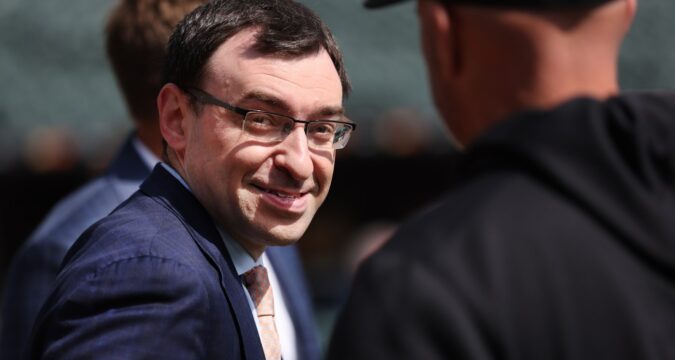
The Detroit Tigers released a statement Wednesday saying they were “incredibly proud” of announcer Jason Benetti being named the new voice of NBC’s “Sunday Night Baseball” broadcasts.
In only 10 years, the Homewood-Flossmoor graduate has gone from budding Chicago White Sox play-by-play man to the top of the business, landing one of the most coveted announcing jobs in sports.
“This recognition reflects his exceptional broadcasting talent, tireless commitment to excellence, and engaging personality, all of which combine to make him a premier storyteller across all of sports,” the Tigers statement said.
This is great news for baseball fans and a brilliant move by NBC, which also recently hired ex-Cub Anthony Rizzo to be part of its pregame shows. The only thing that would make Wednesday’s announcement better would be if Bill Walton were still alive to join Benetti in the booth on occasion, as he did for a Sox game in 2019.
Benetti wasn’t sure what to expect from Walton but told me beforehand: “I’m not going to have the media-room brownies, is my guess.”
Benetti survived without experiencing any high anxiety, and the broadcast was as weird and full of non sequiturs as you’d expect.
In a nice twist, NBC won’t have a regular sidekick for Benetti like most national broadcasts. Instead, he’ll be paired with analysts from the teams playing that night. That means we could see a reunion of Benetti and former partner Steve Stone, assuming the Sox are competitive enough to merit a spot on “Sunday Night Baseball.”
If it wasn’t clear by now, it’s safe to say letting Benetti leave the Sox TV booth in 2024 was the organization’s biggest mistake since letting Harry Caray depart for WGN-Ch. 9 and the Cubs in 1982. Like Benetti, Caray felt the Sox disrespected him and left a job and fan base he loved when the team moved from free TV to their pay-TV channel, SportsVision.
The Sox still haven’t learned their lesson, as evidenced by the recent separation with Hall of Fame slugger Frank Thomas. And if you want to go back a few decades, you can add Carlton Fisk, who was ripped by Chairman Jerry Reinsdorf in 1993 when Fisk balked at signing a minor-league deal. “He’s 45 years old; it’s time he grew up,” Reinsdorf told the Chicago Sun-Times. “I’m sick and tired of him acting like a baby. He believes he has been mistreated, but nobody has ever been catered to here more than Carlton Fisk. He’s a prima donna. He must think he’s Michael Jackson.”
The Sox, you may recall, didn’t like Benetti missing some games for national TV assignments. Vice president Brooks Boyer reportedly made some harsh comments to Benetti that belittled him, so Benetti waved goodbye to his hometown and the team he grew up rooting for as a boy in Homewood.
White Sox broadcasters Jason Benetti, left, and Steve Stone prepare for a game at Guaranteed Rate Field on July 14, 2017.
The Tigers allowed him to miss 35 games for national assignments for Fox, and now that he’s with NBC will let him do likewise for “Game of the Week” broadcasts. Why would you not want your own announcer to be recognized by a national audience?
There were also stories about Reinsdorf not being amused by the wise-cracking or esoteric commentary by Benetti during play-by-play, as if baseball were a deadly serious sport that should be treated with more dignity. Benetti did it his way and never wavered in his beliefs.
Admittedly, some of the stuff went over my head, too, like in a game in 2021 when he watched Sox closer Liam Hendriks get upset on the mound over a bad call. “And Liam looks back in anger,” he quipped.
Only after I thought about it did I realize it was a subtle nod to Oasis, the band led by Liam and Noel Gallagher, and its hit “Don’t look back in Anger.”
Too obscure? Maybe. But it’s only baseball.
During a college basketball game I was watching in 2022, the score was 54-40, which led Benetti to head into the commercial break announcing it was “54-40 or fight” for the trailing team. It was vaguely familiar, and a little googling reminded me it was a famous slogan of a territorial dispute in the Pacific Northwest in the 1840s. Kudos to the H-F history teacher who stuck that in his head, and to Benetti for having the confidence to bring up an obscure factoid of American history in the middle of a basketball game.
Both of those calls elicited a time-release chuckle, which often happened when someone with Benetti’s intelligence and quick wit was behind the mic.
Related Articles
3 takeaways from Chicago White Sox camp, including competition for rotation and Luisangel Acuña looking sharp
Chicago White Sox pitchers are ‘stacking days together:’ A look at their recent spring starts
‘I like hitting with people on base’: Chicago White Sox catcher Edgar Quero has a sizzling start to the spring
Cactus League report: Cubs’ Alex Bregman slugs 1st spring HR — and Chase Meidroth back in action for White Sox
Erick Fedde displaying ‘veteran presence’ for Chicago White Sox as he competes for a rotation spot
Calling the game is the most important thing, of course, and he’s very good at that. But making a viewer laugh isn’t such a bad thing, and during that miserable 2023 season, he and Stone were the only reasons to watch the Sox.
Caray went on to become a national icon when he left the Sox for the Cubs, and Benetti is seemingly headed in the same direction. At age 42, he’s already at the top of the ladder, so who knows what else is in store for his career?
Whenever I’d see him at the ballpark I’d ask about the “Curse of Jason Benetti,” which I admittedly made up during the record-setting 121-loss season in 2024.
“This has nothing to do with me leaving,” he repeatedly said.
Maybe not, but everything has certainly gone right for Benetti since leaving Chicago, proving the grass is sometimes greener on the other side after all.
No doubt Walton is smiling from on high.
https://www.chicagotribune.com/2026/03/05/jason-benettis-sunday-night-baseball-chicago-white-sox/