Category: News
Stranded travelers share firsthand accounts from the Middle East
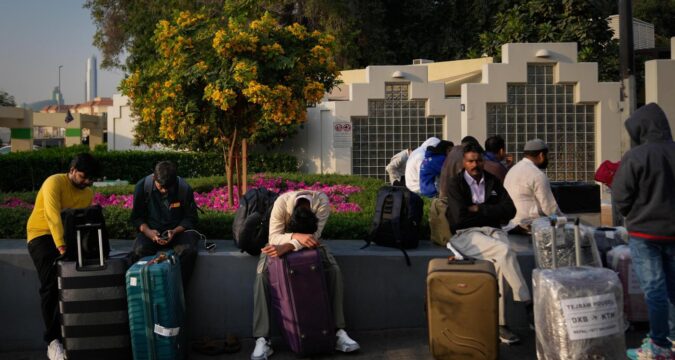
Hundreds of thousands of people have been stranded across the Middle East amid the U.S. and Israel’s joint war against Iran. And between swaths of flight cancellations and airspace closures, many are still scrambling for next steps.
In a matter of days, the conflict has continued to escalate — particularly with strikes in the Gulf states where, beyond the Middle East, airports serve as critical hubs connecting travelers going to Europe, Africa and Asia. Despite ongoing evacuation efforts, flights remain deeply disrupted. Many tourists, business travelers, migrant workers and others are navigating it all.
Some travelers shared their stories with The Associated Press. Here’s a glimpse of what they’ve experienced.
House to vote on Iran war powers resolution in a test of President Donald Trump’s strategy
A European couple stranded with their children
Viktoriia Lokhmatova, who lives in Serbia, and Michael Crepin, who lives in Belgium, had traveled to Dubai with their children for a special milestone.
Although the couple have been together for more than a year, the trip was the first time their children — her 8-year-old daughter, Anny, and his 13-year-old son, Gabriel, — would meet in person. And all four were celebrating their birthdays in February.
But their plans changed when their return flight was canceled amid regional airspace disruptions with the outbreak of the war. A rebooking was also canceled, leaving the group scrambling to find a way home while facing the cost of extending their stay.
“We stayed on calls with the airline for almost two days trying to figure out another flight,” Lokhmatova said.
While searching for options, she discovered an initiative by local vacation-home operators offering temporary accommodation to stranded travelers. The couple and their children were offered a free stay for one night in an apartment managed by AraBnB Homes, a Dubai-based luxury rental company that had opened vacant units to passengers unable to leave the city.
The temporary stay gave them time to regroup and make arrangements for the rest of their extended trip. During the first few days, they occasionally heard explosions from air defense systems intercepting missiles or drones — but “we tried to stay calm because the kids were there,” Crepin said.
But, he said, they’ve felt safe and have been grateful to be together throughout the experience. They now hope to leave Dubai on Saturday, if their latest flight goes ahead. They will then travel together to Istanbul before separating — Lokhmatova and Anny returning to Serbia and Crepin and Gabriel to Belgium.
Midflight turnaround impacts tech entrepreneur
Two hours into his flight over the weekend from the Qatari capital of Doha to Barcelona, Varun Krishnan says it became clear the aircraft was no longer heading toward Spain.
Krishnan, who runs the Indian technology business Fone Arena, was on the final leg of his flight from India to a telecommunications conference, Mobile World Congress, in Barcelona.
“It seemed something was off,” Krishnan said, noting that he had been tracking the flight and realized it didn’t seem to be proceeding on course.
Breakfast had just been served when the captain announced that Baghdad airspace was closed due to security issues. Instead of continuing across Iraq towards Europe, the aircraft began circling around the United Arab Emirates.
Krishnan said the captain provided updates about what was happening, “but still people were panicking.”
As the aircraft prepared to land back in Doha, emergency notifications sounded across the cabin. Once on the ground, long lines formed as departure boards filled with cancellations.
Krishnan said he’s been staying at a hotel since. And on Wednesday, he was still waiting for airlines to confirm when flights might resume.
US tourists stuck in Dubai
Louise Herrle, a retiree from Pittsburgh, and her husband got stranded in Dubai, where the couple had been vacationing when the war broke out.
She told the AP that they’ve had several flights canceled and are now scheduled to leave early Thursday morning, but don’t know if that flight will be canceled as well.
They’ve heard fighter jets flying overhead “from time to time,” as well as some explosions, she said. But despite the “extremely stressful” situation, she’s found support from fellow travelers.
“It’s not a great experience, but it’s, you know, a shared experience and it brings people together,” she said.
Hong Kong expat recounts search for safety
Agnes Chen Pun, a Hong Kong expatriate who moved to Dubai with her husband and their 1 1/2-year-old last year, said she has tried to keep her family safe amid escalating tensions in the United Arab Emirates. They have moved twice — first to a resort about an hour and a half away in Fujairah, then to one near the port city of Sharjah — after worrying about potential attacks.
“We were so nervous, so anxious,” said Chen, a partner at Asia Bankers Club, a Hong Kong- and Dubai-based investment company.
She finally secured commercial tickets for $2,200 per person to Singapore, although her departure is still uncertain. Despite the disruption, Chen said she plans to return to the UAE once the situation stabilizes, viewing the country as an attractive place to live and work.
“I think the scare, the fears, will be short-term. Definitely now, safety is the most important,” she said. “I will go to Hong Kong … wait (until) the war is over, and then I probably, definitely would come back again.”
https://www.chicagotribune.com/2026/03/05/stranded-travelers-middle-east/

US futures slide, oil and gasoline prices climb on retaliatory strikes from Iran
Renewed retaliatory strikes from Iran again raised anxiety in U.S. markets Thursday, sending futures lower and energy prices higher with prices at the pump jumping overnight.
Futures for the Dow Jones Industrial Average fell 0.3% before the opening bell, while futures for the S&P 500 future ticked down 0.1%. Nasdaq futures were also off 0.1%.
Uncertainty about the war in the Middle East has been rattling financial markets, with most taking their cues from what the price of oil is doing.
House to vote on Iran war powers resolution in a test of President Donald Trump’s strategy
After stabilizing a day earlier, crude prices resumed their climb early Thursday.
“Yesterday’s bounce in risk assets already looks less like a turning point and more like a classic relief rally in a market that briefly inhaled before realizing the room was still on fire,” Stephen Innes of SPI Asset Management said in a commentary.
U.S. benchmark crude jumped by $2.59 per barrel, or 3.5%, to $77.25, the highest level in more than a year. Brent, the international standard, gained 2.8% to $82.87 per barrel.
The rise in oil prices has already sent prices at the pump up close to 10%. One week ago, before the U.S. and Israel attacked Iran, a gallon of regular gas was $2.98, according to auto club AAA. Today, the average price for a gallon in the U.S. is $3.25, a 9% jump.
Investors are worried over how long the war with Iran could last, how high inflation may go because of more expensive oil and how much damage that might do to corporate profits.
The broadening war in Iran will make the Federal Reserve’s job of taming prices more difficult because of the jump in oil prices, which is pushing upward on already high inflation. That could make the central bank less likely to cut benchmark interest rates, meaning that the cost of borrowing money, for businesses and households, would remain higher than was thought even last month.
In equities trading early Thursday, shares of Broadcom jumped more than 6% after the chipmaker’s first quarter profits beat analyst expectations. The company said its AI revenue more than doubled from the same period a year ago, to $8.4 billion.
Elsewhere, in Europe at midday, Germany’s DAX and the CAC 40 in Paris were effectively unchanged, while Britain’s FTSE 100 inched up 0.1%.
In Asian trading, South Korea’s Kospi took back much of its historic losses from a day earlier, jumping 9.6% to 5,583.90. It had gained as much as 12% earlier in the day as investors hunted bargains, triggering temporary trading halts.
The government announced emergency measures for the economy after the benchmark fell by the most ever in a single day on Wednesday. President Lee Jae Myung urged officials to activate an emergency financial package worth 100 trillion won ($68.5 billion) aimed at calming market volatility.
Tokyo’s Nikkei 225 index gave back some early gains, closing 1.9% higher at 55,278.06.
In Hong Kong, the Hang Seng climbed 0.3% to 25,321.34 after Chinese Premier Li Qiang opened the annual session of the National People’s Congress with a report that set the annual target for economic growth this year at 4.5% to 5%. A draft budget put the increase in military spending at 7%, down from 7.2% in recent years.
The government pledged to support the sluggish domestic economy and spur more consumer spending, but did not announce any major new stimulus.
The Shanghai Composite index gained 0.6% to 4,108.57.
In Australia, the S&P/ASX 200 rose 0.4% to 8,940.30, while New Zealand’s benchmark rose 0.6%.
Taiwan’s main share index gained 2.6%.
In currency trading, the U.S. dollar rose to 157.40 Japanese yen from 157.07 yen. The euro fell to $1.1617 from $1.1636.
The dollar has advanced against other currencies partly because the U.S. is viewed as facing less risk from the war than other countries, analysts said.
“When the world becomes less certain, capital gravitates toward the deepest pool of liquidity available,” Innes said, adding that the dollar “remains the market’s preferred storm shelter.”
https://www.chicagotribune.com/2026/03/05/us-futures-slide-oil-gasoline-iran/

11-year-old girl reports being sexually assaulted by 3 juveniles on Near South Side
An 11-year-old girl reported she was sexually assaulted by three known juveniles Monday afternoon in the Near South Side neighborhood, Chicago police said.
The girl said she was outside in the 2200 block of South Federal Street when three known juveniles approached and sexually assaulted her before fleeing the scene, police said.
The girl was taken to Lurie Children’s Hospital for unknown injuries. Detectives were investigating.
https://www.chicagotribune.com/2026/03/05/sexual-assault-near-south-side/
Líderes de Canadá y Australia piden desescalada, pero coinciden: Irán no puede tener armas nucleares
Por ROD McGUIRK
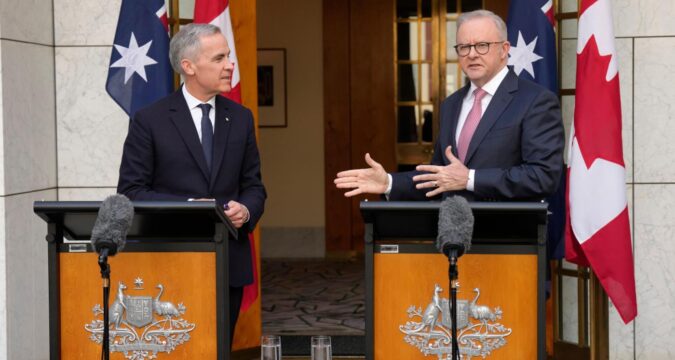
MELBOURNE, Australia (AP) — Los primeros ministros de Canadá y Australia pidieron una desescalada de la guerra con Irán el jueves, pero añadieron que los iraníes nunca deben obtener un arma nuclear.
Mark Carney, de Canadá, y su homólogo australiano, Anthony Albanese, hablaron sobre la guerra durante su reunión en la capital de Australia, Canberra.
La reunión se produjo después de que se informara que un submarino de Estados Unidos hundió un buque de guerra iraní en el océano Índico y después de que las defensas de la OTAN interceptaron un misil balístico lanzado desde Irán antes de que entrara en el espacio aéreo turco.
“Queremos ver una desescalada más amplia de estas hostilidades con un grupo de países más amplio que solo los beligerantes directos involucrados”, declaró Carney en una conferencia de prensa con Albanese.
“Subrayamos que eso no puede lograrse a menos que estemos en una posición en la que se ponga fin a la capacidad de Irán de adquirir un arma nuclear, desarrollar un arma nuclear y exportar terrorismo. Así que ese proceso debe conducir a esos resultados”, agregó Carney.
Señaló que el Consejo de Cooperación del Golfo, integrado por seis países, que estaban “mostrando una enorme moderación”, debería involucrarse en el proceso de desescalada.
“El mundo quiere ver una desescalada y quiere ver que Irán deje de extender los destinos de sus ataques”, indicó Albanese.
“Estamos viendo que Estados del Golfo Pérsico, que no han estado involucrados, son atacados en todos los frentes, incluidos ataques también contra zonas civiles y turísticas. Pero también queremos ver que se alcancen los objetivos. Quiero que se elimine de una vez por todas la posibilidad de que Irán obtenga un arma nuclear”, manifestó Albanese.
Ante la pregunta de un reportero, Carney no pudo descartar que Canadá llegue a involucrarse alguna vez en el conflicto.
“Usted ha planteado un hipotético fundamental en un conflicto que puede extenderse de manera muy amplia”, respondió Carney.
“Así que nunca se puede descartar categóricamente la participación. Estaremos al lado de nuestros aliados cuando tenga sentido”, añadió.
Carney está en Australia en una visita de tres países centrada en el comercio, que comenzó en India la semana pasada. Habló ante el Parlamento australiano el jueves y volará a Japón el viernes.
___________________________________
Esta historia fue traducida del inglés por un editor de AP con ayuda de una herramienta de inteligencia artificial generativa.

Down to Business: No salespeople to bother you at Naperville’s HassleLess Mattress
Business: HassleLess Mattress
Address: 1044 S. Route 59, Naperville
Phone/website: 888-777-6434; www.hassleless.com
Co-owner: Erin Borofka, of Greendale, Wisconsin
Years in business: 14. They opened a store in Aurora in 2020 and in Naperville last year.
What does your business do? “We sell mattresses, adjustable mattress bases, box springs, all things that have to do with sleep,” Borofka said.
What sets you apart? “We have no salespeople on site.”
With nobody there, how do you prevent theft? “Mattresses are kind of large, right? … Most people are good. … We have (security) cameras. We have local police departments. You can track that pretty well.” Someone is watching (a video screen for each store).”
HassleLess Mattress opened this store in Naperville in 2025. There are no salespeople there, which helps keep prices down, a co-owner says. (Steve Metsch/Naperville Sun)
Why did you start this business? “One of our partners is an introvert and a deep thinker who doesn’t like to be bombarded with a lot of questions. He came up with this idea.. … He thought wouldn’t it be nice if you could go shopping and not have anyone breathing down your neck or telling us what to do versus giving us information and letting us decide? … We were online only for year and quickly realized people like to lay on a bed. They don’t want to just look online. … The rest of us all agreed with him when he came up with this idea. … He likes to remain anonymous.”
What mattresses do you offer? We have all the big brands. Tempur-Pedic, Sealy, Serta, Beautyrest, Purple. Nectar, DreamCloud. All the big brands are there. And a selection of all the brands.”
What’s hot? “The Beautyrest blacks. The Sealy elite hybrids. Tempur-Pedic.”
Why are you in Naperville? “We’re in every major shopping district through the greater Chicagoland area. We have 24 stores in the area. That includes Merrillville and Highland (in Indiana). We have nine in Wisconsin. A total of 33 stores.”
When are you open? “The doors automatically open at 9 a.m. and close at 9 p.m.”
Are you locked in at 9:01 p.m.? “We have motion sensors. You can still get out.”
Erin Borofka, a co-owner of HassleLess Mattress, said free next day delivery is available. And they’ll take your old mattress. (Provided by Erin Borofka)
What about the computer kiosk in the store? “People have to have the option to purchase in the store. In the digital world, people are on their mobile devices more than ever. … They can see what we have for sale. It’s a large screen. … We want to meet people where they’re at.”
What should people know? “We deliver the mattress, set it up and take away your old mattress for free all within hours of purchase. If you order at 10 o’clock tonight, you can have it delivered tomorrow. As long as we have openings in the schedule, we’ll honor that request. We have our own employees who run our warehouse in Greendale. They deliver all those mattresses the next day.
“You’ll get a text or email the day before, ‘Hey, here’s your two-hour window.’ The day of, 15 to 45 minutes in advance, you get a call from our delivery staff letting you know they are on their way. … We are a family-owned and -operated company so we still have that personal touch. We want customers to be happy.”
How do people save money? “I hear it all the time, ‘Wow, you’re so much cheaper.’ That’s because we’re not charging for delivery, for sales people. The savings are 10 to 40 percent. … We want the customer to get the best price.”
What about the video that plays on a loop? “It’s in all our stores. It helps inform people. We reiterate it with wall signs.”
What mattress do you prefer? “I sleep on the softest bed in the store and I’m going to enjoy it. But mattresses are really a personal preference.”
Why do you like this business so much? “Every day I think, ‘How do I make this experience better, how do I make it easier, how do I make it so everybody only wants to shop this way because there’s less intrusion.’”
This sign tells you all you need to know at HassleLess Mattress in Naperville. The business has 24 locations in the Chicago area, including one in Naperville. (Steve Metsch/Naperville Sun)
How often should we buy a new mattress? “It depends (on the mattress). … You get what you pay for.”
Any negatives to the job? “I love what I do. I do work from home.”
What did you do before this? “I worked in floor planning for a furniture company.”
How many employees do you have? “About 35.”
What about competition? “You always have competition. But why worry about it when your customers are the first priority?”
What’s your advice for someone starting a business? “It is patience. It is hard work. You will work long hours. You need to be in touch with the people you serve.”
Steve Metsch is a freelance reporter for the Naperville Sun. If you know of a business you’d like to see profiled in Down to Business, contact him at metschmsfl@yahoo.com.
https://www.chicagotribune.com/2026/03/05/naperville-hassleless-mattress-salespeople-store/

El auto de Aston Martin podría causar “daño nervioso” y quizá no complete la primera carrera
Por STEWART BELL
MELBOURNE, Australia (AP) — Aston Martin pronosticó que es poco probable que termine el Gran Premio de Australia, la carrera inaugural de la temporada de Fórmula 1 este domingo, sin que sus pilotos corran el riesgo de sufrir daños nerviosos permanentes.
Adrian Newey, el afamado diseñador de autos de F1 que afronta su primera carrera como director de Aston Martin, manifestó el jueves que la unidad de potencia Honda del equipo provoca vibraciones que podrían dañar las manos de los pilotos Fernando Alonso y Lance Stroll.
Es probable que ninguno de los dos pueda tolerar siquiera la mitad de la distancia de la carrera, de 58 vueltas, y el tiempo de carrera del auto estará “muy severamente restringido” hasta que se encuentre una solución, añadió Newey.
Aston Martin tuvo una mala pretemporada, a menudo más lento incluso que el nuevo equipo Cadillac, y completó la menor cantidad de vueltas de los 11 equipos.
“Esa vibración (transmitida desde la unidad de potencia de Honda) hacia el chasis está causando algunos problemas de fiabilidad”, señaló Newey.
“Espejos que se caen del auto, luces traseras que se caen, ese tipo de cosas, que tenemos que abordar. Pero el problema mucho más significativo de eso es que esa vibración se transmite a los dedos del piloto”, expresó. “Así que Fernando siente que no puede hacer más de 25 vueltas consecutivas antes de arriesgarse a sufrir daños nerviosos permanentes en las manos. Lance opina que no puede hacer más de 15 vueltas antes de llegar a ese umbral”.
“Vamos a tener que estar muy severamente restringidos en cuántas vueltas hagamos en la carrera hasta que controlemos la fuente de la vibración — y para mejorar la vibración en su origen”, añadió.
Pese a la larga lista de problemas, Newey afirma que el AMR26 tiene un potencial enorme mientras la F1 inicia una nueva era de reglamentos.
Sostuvo que el chasis es el quinto mejor de la F1, por detrás de los equipos que se espera estén arriba: Mercedes, Ferrari, McLaren y Red Bull. Y luego de un programa de desarrollo agresivo, tiene potencial para rodar al frente en algún momento de 2026.
Alonso, sin embargo, mantiene la confianza hasta las prácticas del viernes en Melbourne, donde cree que las correcciones en el auto podrían ofrecer un panorama más alentador.
“Para nosotros, es que vibra todo”, expresó el dos veces campeón de la F1.
“Pero no es solo para nosotros”, manifestó el español. “El auto está sufriendo un poco, así que por eso tenemos algunos problemas, algunos problemas de fiabilidad que hicieron que nuestros días fueran un poco más cortos”.
“Desde (las pruebas de pretemporada en) Bahréin, se hicieron un par de pruebas y algunas de las soluciones ya están implementadas en el auto, así que (tengo) curiosidad por ver qué (pasa) mañana (y) si podemos mejorar”, añadió.
Su decepcionante rendimiento se ha atribuido de diversas maneras a un tiempo de diseño comprimido por una llegada tardía, a la necesidad de Honda de reconstruir sus capacidades de investigación y desarrollo tras dejar Red Bull, al desafío de producir una nueva caja de cambios propia, y a que el equipo está utilizando a Aramco como socio de combustibles, hasta ahora no probado.
Pero son los efectos secundarios los que probablemente dejarán fuera a sus autos temprano en la carrera del domingo en Albert Park.
El piloto de Cadillac Valtteri Bottas bromeó sobre la falta de forma de Aston Martin. Al pedírsele que identificara a los contendientes al título, mencionó a Alonso y Stroll junto a George Russell, de Mercedes —a quien se considera ampliamente uno de los favoritos—, y sugirió que Mercedes no alcanzaría a Aston Martin hasta la última carrera de la temporada.
“Acabarán superando a Aston al final, en Abu Dabi”, dijo.
___
Deportes AP: https://apnews.com/hub/deportes
Massive Wave Of Iranian Missiles Pummeled Israel Overnight, As Trump Hopes Of ‘Quick Victory’ Fading
Massive Wave Of Iranian Missiles Pummeled Israel Overnight, As Trump Hopes Of ‘Quick Victory’ Fading
The United States and Israel continue their history-shaping shock and awe style military campaign against Iran, with Israeli forces also now intensifying strikes in Lebanon. Since Saturday, at least 1,230 people have been killed in what’s clearly morphed into a regime change operation on Tehran, according to official numbers, which are expected to climb by the day. The war is expanding to nearby countries like Azerbaijan, and possibly even Turkey – in addition to the Gulf states.
Crucially, in Washington the US Senate blocked an effort to curb President Trump’s Operation Epic Fury, voting 53–47 against a procedural motion aimed at limiting the operation. Meanwhile Iran is going increasingly ‘gloves off’ in its response, with Tehran officials saying the war is expanding beyond just direct airstrikes. All the while, President Trump is still seeking ‘quick victory’ – the NY Times says Thursday. It writes, “his calculation has been that he can launch military operations with the loss of few American lives and minimal disruption to the economy. The opening days of the war in Iran are challenging that assumption.” The report continues:
Already, six Americans have been killed. Gulf allies are under attack. The stock market wobbled. Gas prices are rising. The U.S. military is spending, by some estimates, hundreds of millions of dollars per day. In Iran, an airstrike on a girls’ elementary school killed 175 people, according to local health officials and Iranian state media, and the Trump administration says it is investigating who was responsible.
Some of the most important latest developments at the Pentagon as well as CENTCOM headquarters come from fresh reporting in Politico:
Trump administration is scrambling to manage the fallout of the Iran war: The Pentagon is requesting additional intelligence officers for at least 100 days, suggesting the war could last far longer than the initially suggested four-week timeline. Officials say planning was limited. There’s talk of “through September.”
A State Department source said “too few people were read in on the war plans,” which slowed evacuation preparations and travel alerts for Americans in the region.
Critics say the response looked improvised, with one former U.S. diplomat calling it “a completely ad hoc operation… like they woke up on Saturday and decided to start a war.”
Again, if the Pentagon is requesting additional intelligence officers for at least 100 days, this strongly suggests the war could last far longer than the initially suggested four-week timeline. Hegseth has already suggested up to eight weeks, and the scope and timeline keeps sliding further.
In Iran, Foreign Minister Abbas Araghchi warned of “terrorist movements” along Iran’s border with Iraq and called for stronger security measures amid reports that the United States is in talks with Kurdish forces about arming them to foment an uprising against Tehran.
Israel hit hard overnight:
⚡🚨 BREAKING NEWS | 🇮🇷 🇮🇱
IRGC: Launching the 19th wave of Operation ‘True Promise 4’. pic.twitter.com/r8eFbCVhRc
— China live (@ChinaliveX) March 5, 2026
Crazy footage of Mid air turn by an iranian Missile to dodge israeli interceptors & then hit the targetpic.twitter.com/VolJC00uy1
— Azeem Sabzvari (@Azeem_Sabzvari) March 4, 2026
Some Kurdish groups are already ‘preemptively’ getting hit, with Iran’s Intelligence Ministry announcing its forces launched operations against Kurdish groups based in the semi-autonomous Kurdish region of Iraq. The ministry said it struck positions belonging to “separatist groups” attempting to cross Iran’s western border and reported that they suffered heavy losses.
The statement, carried by state media, said Iranian forces are cooperating with “noble Kurds” to thwart what it described as an “Israeli-American” plan to attack Iranian soil. This after many Western pundits have questioned the purpose of government officials airing or ‘leaking’ supposedly covert plans for the CIA and Mossad to arm Iranian Kurdish separatists. Still, the NY Times is freshly reporting Thursday:
Pro-American, Iranian Kurdish forces based in Iraq are preparing armed units that could enter Iran, creating a potential new front in an already expanding conflict.
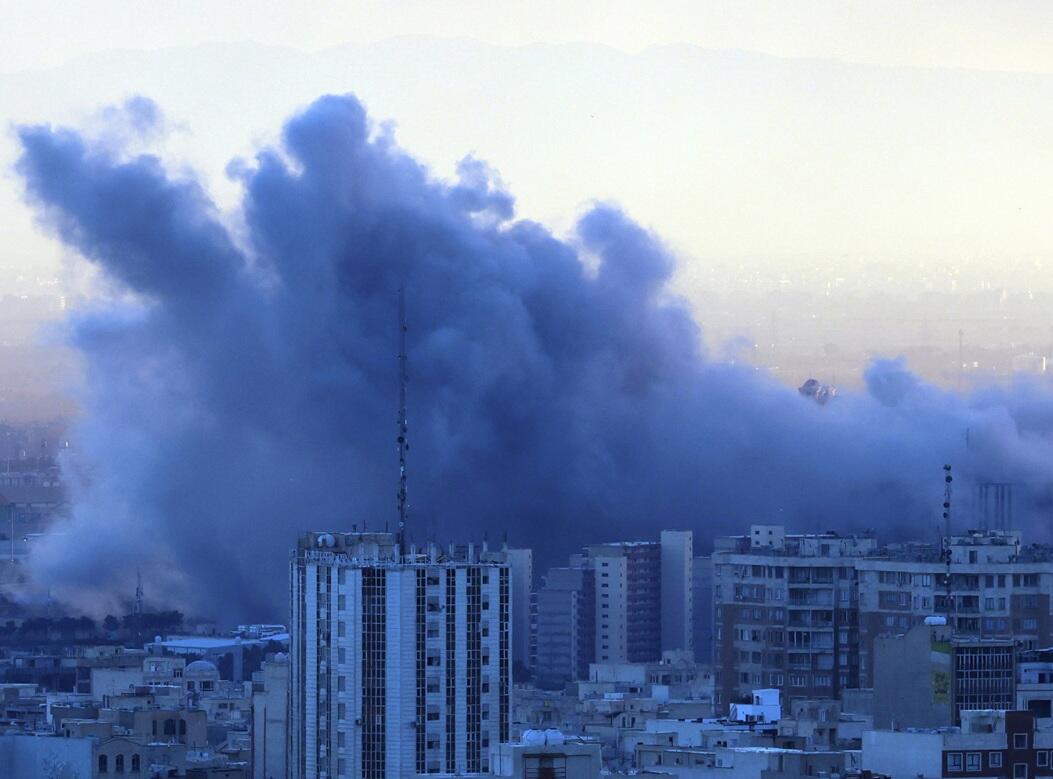
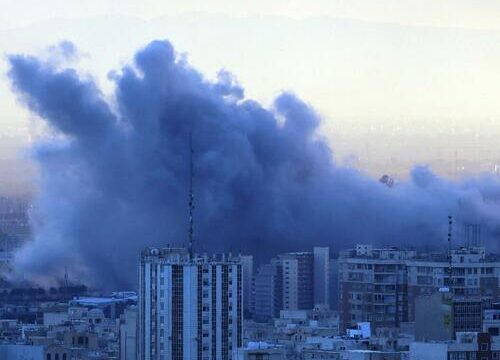
Meanwhile, Israel expanded its air campaign inside Iran. In a new wave of strikes around Tehran, the Israel Defense Forces said it hit the headquarters of Iran’s special forces, bases of the Basij paramilitary organization, and other government-linked sites – amid official claims the US and Israel are trying to ‘liberate’ and get the Iranian people to ‘rise up’. About 90 Israeli Air Force fighter jets participated in the operation, striking roughly 40 targets with about 200 bombs, according to the military.
Iranian authorities say civilian infrastructure has also been hit and have charged that more schools are getting obliterated. Missiles fired by the US and Israel struck two schools in the town of Parand, southwest of Tehran, Iran’s semiofficial Fars news agency is alleging. Images which were widely circulated showed debris and destruction inside what appeared to be a classroom, while several nearby residential buildings also sustained damage.
Tehran has decried European apathy as its cities get pummeled, with Iran’s Foreign Ministry spokesman Esmaeil Baghaei warning that European Union countries will “pay the price, sooner or later” if they remain silent over the US-Israeli attacks. Earlier in the week a few drones were sent against EU-member Cyprus, targeting a British airbase there.
Iran’s Large Missiles Are a Challenge for Interceptors
In this image, we see once again how Iranian missiles with larger and more modern warheads pass through the interceptors without any problem whatsoever. In recent days, I have been reporting that, from what it seems to me,… pic.twitter.com/sJBQCP8r7a
— Patricia Marins (@pati_marins64) March 5, 2026
Iran has upped its retaliatory strikes against Israel in another huge assault, launching its 19th wave of missile and drone attacks targeting Israel and US assets across the Middle East. The videos coming out of Tel Aviv overnight were surreal, showing dozens of ballistic missiles soaring above – often evading Israel’s air defenses – before hitting targets and erupting in huge fireballs. Damage on the ground also confirms that many missiles continue to get through, with Israel’s military appearing to conceal the extent of destruction – and possibly even casualties. Reuters reports Thursday:
Iran’s Revolutionary Guards have tightened their grip on wartime decision making despite the loss of top commanders, senior sources say, driving a hardline strategy that is propelling Tehran’s drone and missile campaign across the region.
The IRGC said it fired ballistic missiles carrying one-ton explosive warheads at Tel Aviv’s Ben Gurion Airport. One projectile landed in Bareket, east of Tel Aviv. Millions of residents across central Israel were sent into shelters overnight as missile intercepts triggered explosions that rattled buildings across the area. However, medics reported no injuries following the latest barrage. Official military assessments say that only a small number of missiles were launched and no impacts were recorded in residential neighborhoods.
While Iran military commander Amir Heydari told state TV on Thursday the vital Strait of Hormuz isn’t closed, traders and analysts still expect it will take weeks before oil flows can resume meaningfully.
Reuters and other have asked: how deep is Iran’s missile and drone arsenal (as similar questions are being asked of Pentagon stocks):
Iranian drone attacks could disrupt the Strait of Hormuz for months, but how long the Islamic Republic could sustain its missile barrage is less clear, according to intelligence sources and military analysts.
The Iranians are claiming to have only tapped their older stockpiles and that they’ve barely started using the shinier, high-tech and most devastating missiles. As for the ongoing Iranian attacks on US Gulf allies, Iran’s military said Thursday it carried out a drone attack on a US military site in Kuwait. Other countries have reported ongoing drone or missile activity, as well as projectiles still targeting oil and logistical sites.
Ground-level images Western networks don’t like to show, for some reason.
Hami Hamedi, RT’s bureau chief, takes a tour through the destruction of Tehran. pic.twitter.com/iMc1t1BL58
— Margarita Simonyan (@M_Simonyan) March 4, 2026
But most importantly, the conflict has come to Azerbaijan for the first time. Iranian drone strikes injured two people and damaged the terminal building of an airport near the Iran-Azerbaijan border – which marks the first such attack on Azerbaijani territory since the war began. The drones reportedly struck the exclave of Nakhchivan, which lies between Armenia and Iran, with another drone reportedly falling near a school in Shakarabad. “We strongly condemn these drone attacks launched from the territory of the Islamic Republic of Iran,” Azerbaijan’s foreign ministry said.
At sea, Iran’s foreign minister condemned a US torpedo strike that sank the Iranian warship IRIS Dena off the coast of Sri Lanka on Wednesday, calling it an “atrocity” and warning that Washington will come to regret the attack. More than 80 people were killed and several remain missing after the vessel sank. The event is under international scrutiny as some Western officials and pundits have stated that according to the Geneva Convention, the US Navy was obligated to search for and rescue sinking Iranian seamen in so far as possible – but that doesn’t appear to have happened.
The fighting continues to global energy markets, particularly given cargo vessels are avoiding the Strait of Hormuz after the IRGC announced the closure of the vital shipping route, throttling oil and gas flows – though we reported overnight on an apparently China-owned bulk carrier being able to make it through.
Iran itself remains under a severe communications blackout, with Internet connectivity across the country at roughly 1% of normal levels for more than 120 hours, according NetBlocks. Iranian authorities are reportedly messaging citizens warning they better not protest at this emergency moment when the country is under attack.
The war also continues to spread in Lebanon, where Israel and Hezbollah have been in a ground war for some 24 hours, amid reports of the IDF sending tanks. Since fighting resumed earlier this week, at least 77 people have been killed and 527 wounded, according to Lebanon’s health ministry.
The widening war has further stranded tens of thousands of travelers across the region. Roughly 23,000 foreign nationals remain stuck in Middle Eastern countries as commercial flights are disrupted. Several governments – including the United Kingdom, India, France, Germany, Italy, Japan, Australia, and the Czech Republic – are organizing additional flights and safe border crossings to evacuate their citizens. The Trump administration came under fire initially, but has since confirmed it is organizing evacuation flights and other methods for stranded American citizens in the region.
⚡️#BREAKING CENTCOM publishes footage of US military bombing Iranian fighter jets pic.twitter.com/RosUt7EKpt
— War Monitor (@WarMonitors) March 5, 2026
At the same time Western officials say the military campaign is still escalating, with senior US officials warning that American strikes will begin targeting deeper locations inside Iran and emphasized that the operation remains in its early stages. This means ongoing heavy long-range bomber raids by the US.
France has also allowed US non-combat aircraft to use an airbase on French territory, with what a French Armed Forces spokesperson described as the “complete guarantee” that the planes “do not participate in any way in US operations in Iran” and are used only to defend regional partners. Italy announced it will send air-defense support to Gulf countries struck by Iranian retaliatory attacks, according to Prime Minister Giorgia Meloni.
This question of whether US allies will jump in remains an open one. Prior precedents of American Middle East adventurism suggests it’s only a matter of time, and we are seeing the proverbial camel’s nose under the tent. Another excample: Canadian Prime Minister Mark Carney said he “can never categorically rule out participation” in the US-Israeli war with Iran after previously saying Canada would not take part.
Meanwhile, European Union foreign policy chief Kaja Kallas urged diplomacy to prevent further escalation. “There has to be room for diplomacy here to really get out of this cycle of escalation, she said, adding that “it’s clear wars really end in diplomacy.” Kallas said Gulf governments are increasingly “worried about civil war inside Iran” and the consequences that could ripple across the wider region. “Nobody can tell how it will really go, but the risks are clearly there,” she said. On this front Tehran and Washington do not appear to be engaged – not even indirectly:
Iran’s Deputy Foreign Minister said Iran is ready to abandon its nuclear program on the condition that the US presents a rewarding alternative offer, Sky News Arabia reported; adds no message was sent to the US to end the conflict. Focused on self defense efforts.
At the White House the war justifications have seemed to change daily. Even a key objective of full regime change appears to have been dropped from the official US list of objectives – perhaps on the realization that it would require major boots on the ground.
white house releases objectives for operation epic fury. regime change not (any longer) a specific goal pic.twitter.com/6cogYaAqgX
— ian bremmer (@ianbremmer) March 3, 2026
Still, looming large over this is the potential for a WW3-style whole regional and global confrontation to erupt, in the unlikely scenario that Russia or China gets directly involved. After all, the conflict has already brushed against NATO territory. Turkish air defenses intercepted what Ankara said was a missile launched from Iran on Wednesday; however, Iranian military leaders denied firing any missile toward Turkey. The interception marked the first – and highly dangerous – time NATO forces have shot down an Iranian missile heading toward a member state during the conflict.
Tyler Durden
Thu, 03/05/2026 – 08:45
Erratic Futures, Oil Jittery As Iran Newsflow Drives Markets
Erratic Futures, Oil Jittery As Iran Newsflow Drives Markets
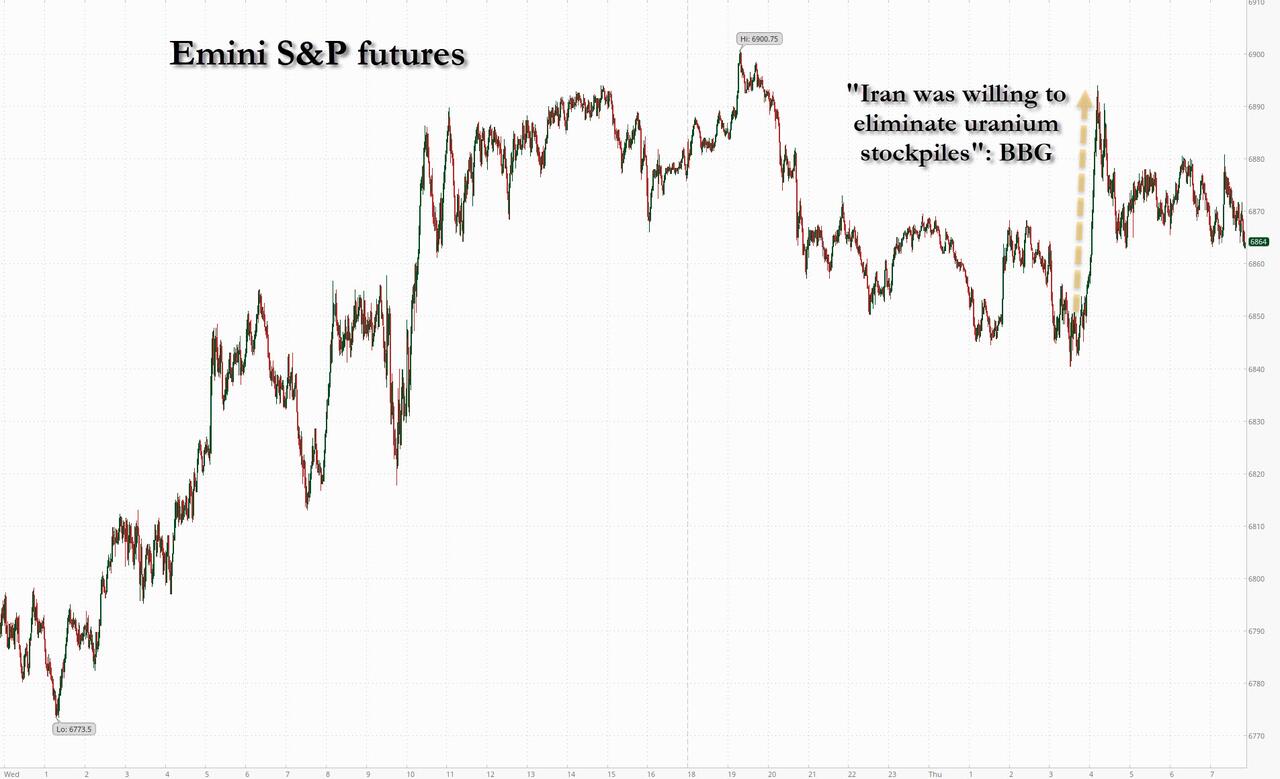
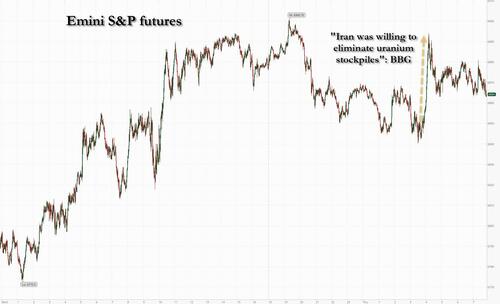
US futures are mixed, first dropping overnight to session lows after Iran vowed to escalate its retaliation against US strikes and avenge the US sinking of an Iranian warship as the conflict entered its sixth day, before spiking to session highs after Bloomberg reported that Iran had previously signaled a willingness to eliminate its uranium stockpiles in return for “something good” during talks with the US before the strikes began (although the remarks related to earlier negotiations, the headlines were enough to shift sentiment which however faded in the absence of a signal from Washington). As of 8:00am ET, S&P futures were down 0.2%, but off session lows; Nasdaq futures dropped 0.1% despite a 7% jump in AVGO shares after earnings with Mag7 lower. Cyclicals outperform Defensives led by Fins / Energy. Brent briefly pared an advance before resuming its climb above $83 a barrel amid increasing disruptions to energy markets from the war and after China was said to have told its largest refiners to suspend exports of diesel and gasoline. European stocks were little changed. A benchmark for Asian equities trimmed its rebound of as much as 3.8%. The dollar rose 0.2%, 10-year TSY yields rose for a fourth straight day, trading above 4.13%. Commodities are higher led by Energy; base leading precious metals and Ags have a mild bid. Arab states across the Persian Gulf reported interceptions of Iranian missiles and drones. Today’s macro data focus is on Challenger Job Cuts (pay attention to AI-induced layoffs) and Jobless Claims ahead of tomorrow’s NFP / Retail Sales prints.
In premarket trading, Mag 7 stocks are mixed: Meta received a downgrade at Arete, which said that the social media giant is “lagging” in terms of AI monetization. Shares are down 0.4% (Microsoft +0.2%, Tesla -0.09%, Nvidia -0.2%, Alphabet +0.6%, Apple shares are unchanged, Amazon -0.3%)
Broadcom (AVGO) rises 6% after Chief Executive Officer Hock Tan said the company expects its AI chip sales to top $100 billion next year, marking major inroads into territory dominated by Nvidia Corp.
Burlington Stores (BURL) rises 6% after the off-price retailer’s fourth quarter adjusted EPS and revenue topped expectations.
Ciena (CIEN) falls 3% after the maker of equipment used by telecom companies posted first quarter results and provided a second quarter guidance.
Grocery Outlet (GO) drops 22% after the discount supermarket chain provided an adjusted earnings per share forecast for 2026 that’s well short of the average analyst estimate.
JD.com Inc.’s ADRs (JD) slip 1% after the company reported its first quarterly loss in nearly four years following a costly foray into food delivery.
Stubhub (STUB) falls 13% after the ticket reseller’s 2026 forecast and fourth-quarter results came in below Wall Street’s expectations. Analysts flag that comparisons are tough given that there wasn’t a Taylor Swift tour to boost sales.
Trade Desk Inc. (TTD) jumps 18% after The Information reported that the company held talks to help OpenAI sells ads.
Veeva Systems (VEEV) climbs 10% after the tech firm’s first-quarter adjusted earnings per share outlook came in above the average analyst estimate.
In other corporate news, Marsh and Aon, two of the world’s largest insurance brokers, are in talks with the US government on a plan to help insure tankers navigating the Strait of Hormuz. KPMG is said to be nearing a decision to appoint Gary Wingrove as the next global CEO.
Developments in the US-Israeli war against Iran are once again driving traders to curb risk after sentiment picked up in the previous session. Stress in energy markets is increasingly coming to the fore, with China seeking to conserve fuel and Japanese refiners calling for the release of strategic petroleum reserves. While Iran military commander Amir Heydari told state TV on Thursday the vital Strait of Hormuz isn’t closed, traders and analysts still expect it will take weeks before oil flows can resume meaningfully.
“If it is blocked for more than a week, the risk of sustained high energy prices would become real,” said Roberto Scholtes, head of strategy at Singular Bank. “If it is resolved quickly, the economic and financial impact would likely be negligible.”
For markets, any sign of the conflict easing is being jumped on, but concrete news is hard to come by. A report that Iran signaled in recent talks it was ready to relinquish its uranium stockpiles caused a brief spike which rapidly faded. The reaction shows the market’s bias to seize on anything approaching positive news, Bloomberg notes. The comments were made in an interview last night and look to be based on pre-conflict talks. Traders are also reassessing the “Sell America, Buy Asia” trade because of Asia’s outsize reliance on fuel shipments through the Strait of Hormuz. They’re also looking at 2022 playbooks — though JPMorgan strategists reckon that the anticipated inflation shock from Iran looks “a lot more contained” than after Russia’s invasion of Ukraine. The VIX futures curve returned to contango after having inverted earlier in the week, a sign of some tension leaving the equity market. For Citadel’s flow guru Scott Rubner, now is the time to turn bullish on equities, while KKR co-CEO Scott Nutall is making a “shopping list” of opportunities to capitalize on market volatility.
The global bond selloff showed no respite, with the 10-year Treasury yield up three basis points to 4.13% while losses in Europe were steeper as Germany’s bunds headed for their worst week in a year on fears of an inflationary energy supply shock. Traders continued to dial back expectations for Federal Reserve interest-rate cuts as inflation expectations build and data reinforce the resilience of the economy.
As of now, “macro expectations have not materially repriced,” said Francisco Simón, European head of strategy at Santander Asset Management. “The risk scenario would be a combination of higher energy prices and a visible slowdown in activity, which would complicate the policy outlook and weigh on risk assets.”
Europe’s Stoxx 600 is up 0.4%,reversing earlier declines following a report that Iran told the US before the war started that it was ready to get rid of its stockpile of highly enriched uranium. Gains are led by utilities, retail and media shares. Here are some of the biggest movers on Thursday:
STMicro shares rally as much as 7.1% after CEO Jean-Marc Chery guided data center-related revenue to be “well above” $1 billion for next year.
Airbus shares gain as much as 2.7% as Citi analysts upgraded the airplane maker to buy from neutral, citing a ramp-up in deliveries, an improving defense business and dollar strengthening.
Campari shares gain as much as 9.9% after the Italian spirits group reported full-year adjusted Ebitda ahead of expectations.
Puma shares gain as much as 5.6% after entrepreneur Mike Ashley disclosed a 5.8% interest in the German sportswear maker’s voting rights, mostly through put option arrangements.
Rentokil shares rise as much as 13% after the pest-control company reported results that Jefferies analysts described as encouraging, showing continued recovery in US growth.
Scandinavian Tobacco falls as much as 25%, the most on record, after the Danish cigar and tobacco producer’s fourth-quarter earnings missed estimates, with proposed dividend of DKK4.5 per share falling well short of consensus expectations of DKK6.83.
Wizz Air shares slide as much as 8.8% after the budget airline cut its net income forecast for fiscal year 2026 to below its previous guidance range, flagging a €50 million impact from conflict in the Middle East.
Nexi shares slump as much as 22% to a record low, after the payments company’s 2026 guidance showed profits in the near-term will be hit by higher investments.
PageGroup plunges 22% after the company slashed its dividend by half.
Deutsche Post shares fall as much as 6.4% after the German logistics company gave an outlook for 2026, with Ebit at above €6.2 billion compared to earlier estimates at €6.39 billion.
AB Foods shares drop as much as 1.4%, lagging retail peers, after the consumer goods company made interim Primark CEO Eoin Tonge permanent, a move Barclays analysts said may disappoint investors who favored an external hire.
Earlier in the session,. Asian stocks rebounded as risk sentiment improved following a three-day selloff spurred by concerns over the conflict in the Middle East. The MSCI Asia Pacific Index rose as much as 3.8%, the most since April 10, with chipmakers Samsung, TSMC and SK Hynix among the biggest boosts. South Korea led advances, with the Kospi notching its best gain since 2008, bouncing back after its worst daily rout on record. Most key regional gauges were in the green. While traders are still gauging the length and impact of the Iran war, some investors are coming back into the market amid more palatable valuations after the recent selloff. Continued gains in oil remain a concern given the potential to accelerate inflation and quash Federal Reserve plans to lower interest rates. Stocks rose in China and Hong Kong after the government unveiled economic targets that market participants said were in line with expectations. That came as Beijing kicked off its annual “Two Sessions” meetings, which investors are closely watching in hopes of supportive policies.
Earnings season is almost over: Ciena and Kroger are among companies expected to report results before the market open. Kroger’s pricing will be in focus given intense competition, limited grocery inflation and ongoing consumer uncertainty. Earnings from Costco, Gap and Marvell Technology follow later in the day. It’s the final day of the MS TMT conference in San Francisco, with Perplexity and Crowdstrike among companies presenting.
In FX, the Bloomberg Dollar Spot Index is up 0.2%.EUR/USD down 0.2% to 1.1617, after falling as much as 0.5%; European Central Bank Vice President Luis de Guindos said a prolonged conflict in the Middle East would risk pushing inflation expectations higher, one of a number of ECB speakers to give non-committal views on the war’s impact. EUR/GBP little changed around 0.8703. EUR/CHF set for a third daily drop, slips 0.2% to 0.9054;x
In rates, treasuries hold small losses but outperform European bond markets after oil rose as much as 4.6% amid mounting supply disruptions from Middle East war before fading much of the gains. 10-year near session high 4.13% is 3bp higher, bunds and gilts in the sector about 6bp higher. US yields are about 2bp-3bp cheaper across the curve led by belly tenors, flattening 5s30s spread by around 1bp. European government bonds fall as traders boost bets on tightening by the ECB this year and less easing by the Bank of England. Focal points of US session include weekly jobless claims data and potential for corporate new-issue market to compete for duration needs.
In commodities, energy prices retreated while European stocks and US equity futures caught a bid after a report that Iran had previously told the US it was ready to get rid of its uranium stockpiles. Brent fell back to flat at one stage but has since climbed back up to around $83 a barrel. European natural gas futures briefly slipped into the red before turning higher again. Precious metals advance with spot silver climbing 1%.
US economic data slate includes February Challenger job cuts (7:30am New York time), January import/export price indexes, 4Q nonfarm productivity and weekly jobless claims (8:30am). Fed speaker slate includes Bowman (1:15pm) and Goolsbee (7pm).
Market Snapshot
S&P 500 -0.2%
Nasdaq 100 -0.2%
Russell 2000 mini -0.4%
Stoxx Europe 600 +0.4%
DAX +0.2%
CAC 40 +0.3%
10-year Treasury yield +3 basis points at 4.13%
VIX +0.2 points at 21.33
Bloomberg Dollar Index +0.1% at 1201.63, euro -0.1% at $1.162
WTI crude +2.1% at $76.2/barrel
Top Overnight News
Iran’s Revolutionary Guards have tightened their grip on wartime decision making despite the loss of top commanders, senior sources say, driving a hardline strategy that is propelling Tehran’s drone and missile campaign across the region. RTRS
Iranian drone attacks could disrupt the Strait of Hormuz for months, but how long the Islamic Republic could sustain its missile barrage is less clear, according to intelligence sources and military analysts. RTRS
President Donald Trump’s chief of staff, Susie Wiles, is telling his advisers to bring ideas to the Oval Office to lower gasoline prices in the wake of the U.S. attack on Iran, according to two energy industry executives familiar with the conversations. Politico
Pro-American, Iranian Kurdish forces based in Iraq are preparing armed units that could enter Iran, creating a potential new front in an already expanding conflict. NYT
The US countered Cuba’s steps to loosen the government’s grip on the economy by barring fuel transactions through Cuban banks. BBG
Treasury Secretary Bessent reportedly informed House Republicans that they should “take the lead” to “pass our own housing affordability” legislation, in order to prevent Democrats from controlling the issue: Semafor
US Senate Republicans await the endorsement of President Trump in the Texas Republican Senate runoff between Cornyn and Paxton, billed as a choice between an established Republican candidate, and a MAGA firebrand: Politico
US-brokered peace talks between Ukraine and Russia initially planned for this week are postponed indefinitely due to the war in Iran, President Volodymyr Zelenskiy said. BBG
A federal trade-court judge on Wednesday ordered the Trump administration to start refunding the more than $130 billion it collected in the global tariffs invalidated by the Supreme Court last month. WSJ
China set its annual GDP goal at a range of 4.5% to 5%, its least ambitious target since 1991, signaling a tolerance of slower expansion. It modestly dialed down fiscal stimulus. BBG
The ECB has no reason to raise interest rates as of today in response to higher oil prices, Governing Council member Francois Villeroy said. BBG
BofA card spending, week to Feb 28th: +1.8% (prev. 4.4% W/W), slowdown driven by the Northeast is which spending fell sharply due to the second snowstorm.
A more detailed look at global markets courtesy of Newsquawk
APAC stocks rebounded from yesterday’s sell-off as the region took impetus from the positive handover from Wall Street, where the Nasdaq led the advances on tech strength, while geopolitics remained in focus. ASX 200 was led higher by tech strength, but with gains capped by losses in the commodity-related sectors and after mixed trade data, which showed a contraction in monthly exports. Nikkei 225 surged at the open but is off today’s best levels after giving back the 56,000 status and with some headwinds from a stronger currency and firmer yields. KOSPI firmly rebounded from the prior day’s drastic sell-off and surged by over 11% in the first few minutes of trade. Hang Seng and Shanghai Comp followed suit to the gains in regional peers, but with gains initially contained in the mainland as the attention was on the Government Work Report, in which China set the 2026 GDP target at between 4.5%-5.0%, its slowest growth target on record since 1991.
Top Asian News
China targets 2026 GDP growth at 4.5%-5.0%, as expected, while it sees 2026 CPI at around 2%. To add, China is to issue CNY 800bln yuan of new policy financing tools.
Chinese Premier Li Qiang said solid progress in modernisation and successful conclusion of the 14th Five-Year Plan, while China aims to boost consumption in its 15th Five-Year Plan.
South Korea President Lee said need to counter volatility increase in financial markets and need to pay attention to energy prices and supply, reiterates KRW 100tln program is on standby to stabilise markets.
European bourses (STOXX 600 +0.4%) are mixed, with the IBEX 35 (+1.0%) leading while the SMI (-0.2%) lags slightly as distributor Kuehne+Nagel (-1.9%) weighs on the index. European sectors are tilted positively, with Utilities (+1.1%) outperforming while Basic Resources (-0.6%) sit at the bottom of the pile despite gains in metal prices. Technology (+0.8%) has been benefiting today after STMicroelectronics (+5.6%) announced a new generation of MCUs to boost performance of tiny smart devices while meeting extreme cost, size and power limitations.
Top European News
EU Retail Sales YoY (Jan) Y/Y 2.0% vs. Exp. 1.7% (Prev. 1.8%, Rev. From 1.3%, Low. 1.4%, High. 2.1%)
EU Retail Sales MoM (Jan) M/M -0.1% vs. Exp. 0.3% (Prev. 0.2%, Rev. From -0.5%, Low. -0.1%, High. 0.6%)
UK S&P Global Construction PMI (Feb) 44.5 vs. Exp. 47 (Prev. 46.4).
Italian Retail Sales YoY (Jan) Y/Y 2.3% (Prev. 0.9%).
Italian Retail Sales MoM (Jan) M/M -0.8% vs. Exp. 0.2% (Prev. -0.8%).
French Industrial Production MoM (Jan) M/M 0.5% vs. Exp. 0.5% (Prev. 0.5%, Rev. From -0.7%, Low. 0.2%, High. 1.0%).
Central Banks
Bank of Japan officials see little chance of a rate hike this month but still on track to raise interest rates, with the possibility of April not ruled out, according to sources cited by Bloomberg.
ECB’s Nagel says it is too soon to draw any monetary policy conclusion from the volatile Iran situation.
ECB’s Rehn said it is likely to raise inflation in the short-term; this kind of conflict tends to dampen demand and leads to more subdued growth.
ECB’s de Guindos said outlook for Europe is shaped by war in Iran, balance of risks was two-sided before the war. Baseline scenario is that it will be a short conflict, with other scenario being that of a more protracted one. ECB could change policy stance if inflation expectations change as a result of the war. Will look out for any steady modification of inflation and inflation expectations.
ECB’s Villeroy does not see a reason today why the ECB should raise interest rates.
ECB’s Villeroy said the ECB are following energy prices and markets very closely; financial stability is not at risk.
BoE DMP (Feb): 1yr ahead CPI expectation 3.00% (prev. 3.10%), 3yr ahead CPI expectation 2.8% (prev. 2.9%).
BoE is to scenario plan the potential economic and financial impact of an AI shock amid concerns of jobs cuts, according to Bloomberg.
CNB’s Prochazka tells Ekonom that he sees potential for 25bps rate cut to 3.25%, said the CNB may cut rates once more this year. NOTE: The interview was conducted prior to the Middle East conflict this week.
Morgan Stanley expects the ECB to keep interest rates steady in 2026 vs the prior forecast of two 25 bps cuts each in June and September; Morgan Stanley expects the ECB to resume rate cuts in 2027 with two 25 bp cuts each in June and September.
FX
DXY is mildly firmer this morning and currently trades within a 98.66 to 99.20 range; upside which follows on from some mild pressure in the prior session, as investors favoured risk assets. Haven inflow have resumed given the overall environment has not changed – the Gulf remains at war, and the Strait of Hormuz remains effectively shut, and there are currently little signs of easing. It is worth highlighting that Sky News Arabia reported commentary via the Iranian Deputy Foreign Minister who suggested that Iran “is prepared to abandon its nuclear program” on the condition that the US presents a rewarding alternative offer. This spurred risk-on trade, with the index falling from 99.08 to 98.75 over the course of around 15 minutes. Later Iranian press reported that Iran was prepared to get rid of its uranium stockpiles, in exchange for “something good” – though this proposal was made pre-war.
EUR and GBP are once again pressured, as focus remains firmly on geopolitics and the inflationary/growth impacts of the net-importers. The pairs are off worst levels, following the aforementioned commentary via the Iranian Deputy Foreign Minister. There have been a few ECB speakers today, notably de Guindos suggesting that the ECB could change policy stance if inflation expectations change as a result of the war. For the GBP, ING points out the outperformance in the GBP against the EUR – the bank suggests that asset managers are unwinding previously held long EUR trades; moreover, markets have been pushing back calls for near-term cuts.
JPY is mildly lower, with USD/JPY currently trading within a 156.44 to 157.35 range. Some modest strength in the JPY was seen on Bloomberg reports that officials see little chance of a rate hike in March, but will not rule one out in April.
Antipodeans underperform this morning, pressured by the downside across the metals complex and in the aftermath of mixed Australian trade data – a factor which has resulted in the Aussie lagging. Moreover, China set its 2026 GDP growth target at between 4.5-5% (as expected), nonetheless, the lowest since 1991, as Beijing seeks flexibility to manage economic challenges including weak consumption, a property-sector crisis, slowing population growth and global trade tensions.
Fixed Income
A bearish start for fixed with energy dynamics once again dictating price action. USTs and Bunds lower by 11 and over 50 ticks, respectively. In brief, the ongoing Middle East conflict is bolstering yields and, in turn, weighing on benchmarks themselves. USTs down to a 112-15+ low, notching an incremental new WTD base. If the move continues, we look to recent support at 112-06, 112-04, 111-31, 111-26, 111-13+.
For the US, and generally, today’s focus is firmly on any geopolitical updates, particularly around Iran’s uranium stockpiles in light of recent reporting. That aside, the day features weekly claims (does not coincide with the BLS window), Challenger jobs in addition to the Revelio and Chicago Fed statistics. Of note for PCE, the latest export/import prices will hit. The speaker docket has Fed’s Bowman (voter), and while we are not guided to a text, there will be a Q&A.
Within Europe, the story is much the same. The docket ahead is headlined by the ECB Minutes, though given recent developments, they are likely even more stale than typical. No real reaction to supply from France or Spain. As it stands, Bunds are at a 127.67 trough, approaching the WTD 127.50 base.
Gilts experienced another morning of catch-up trade, but this time with a bearish bias given the lead from peers and movements in energy prices. No reaction to the latest DMP, the views of which are now somewhat stale. Currently holding around 20 ticks off a 91.46 low, but still lower by over 40 ticks on the day.
EU is said to considers joint defence bonds amid concerns around the Iran war, Welt reported; a proposal is to be presented; defence bonds could be backed by member states.
Commodities
Crude benchmarks remain underpinned by the ongoing geopolitical conflict in the Middle East, despite facing mild pressure during the early European session. WTI and Brent are trading at the upper ranges of USD 74.97-78.09 and USD 81.50-84.74/bbl, respectively. The crude complex faced some pressure during the early European session. Brent saw some pressure following news that the Deputy Commander of the Iranian Army Central Command said Iran has not closed the Strait of Hormuz and is currently handling ships passing through the Strait in accordance with relevant international rules and existing agreements, CCTV reported. Further pressure was seen, following comments from the Iranian Deputy Foreign Minister that Iran is ready to abandon its nuclear program on the condition that the US presents a rewarding alternative offer, Sky News Arabia reports; adds no message was sent to the US to end the conflict.
Spot gold initially edged higher but then stalled near the vicinity of USD 5,200/oz. Price action was relatively tame compared to recent moves, and there was little reaction to news that Venezuela’s Minerven inked a multimillion-dollar deal with Trafigura to sell up to 1,000 kilos of gold destined for US markets. XAU and XAG are trading in the upper end of USD 5120.82-5158.77/oz and USD 80.523-85.545/oz, ranges respectively.
Base metals are trading slightly lower, with 3M LME copper trading in the lower range of USD 12.87-12.96k/t. Sentiment for the red metal has been weighed down by China, its biggest market, which set its lowest GDP growth target since 1991. Elsewhere, JPMorgan said if increased headlines indicate material disruptions to Middle East supply, then aluminium prices have the potential to quickly run toward USD 4,000/mt.
Saudi Aramco diverts more of its crude exports to the Red Sea port to bypass the Strait of Hormuz, WSJ sources reports.
China’s state iron ore buyer reportedly summons traders on BHP (BHP AT) restrictions following months of long standoff talks between CMRG and BHP over long term contracts on China’s mills, Bloomberg reported.
EU reportedly mulls aid to fix Ukraine’s oil plant at centre of its loan delay, according to sources.
Deputy Commander of the Iranian Army Central Command said Iran has not closed the Strait of Hormuz; Iran is currently handling ships passing through the Strait in accordance with relevant international rules and existing agreements, CCTV reported.
Iranian Revolutionary Guard said it hit a US oil tanker earlier this morning, SNN reported; Tanker hit in North Persian Gulf and is now burning; US, Israeli and European vessels are not allowed in the Strait of Hormuz.
India’s MRPL has reportedly shut a crude unit and some secondary units at its 300k BPD refinery due to crude shortages.
India is reportedly in talks with the US for ship insurance and in talks with the IEA and OPEC over the situation on crude oil supply, according to sources.
Geopolitics: Middle East
Iran was prepared to get rid of uranium stockpiles in US talks for something good in exchange, according to Iranian press.
Iran’s Deputy Foreign Minister said Iran is ready to abandon its nuclear program on the condition that the US presents a rewarding alternative offer, Sky News Arabia reported; adds no message was sent to the US to end the conflict. Focused on self defence efforts.
Iran’s ambassador to India said Tehran is not ready for negotiations with the US and Israel, while Iran does not want war but has the capability to respond.
Deputy Commander of the Iranian Army Central Command said Iran has not closed the Strait of Hormuz; Iran is currently handling ships passing through the Strait in accordance with relevant international rules and existing agreements, CCTV reported.
Iranians have been sending messages to the Trump admin in recent days through Gulf states and other countries in the region, Axios reported, citing US sources; but the US has not responded, “We treated those messages as bullshit”.
Iranian military denies firing any missiles at Turkey and affirms respect for its sovereignty.
Iranian media report that Iran has bombed Kurdish headquarters in Sulaymaniyah, Iraq, according to Al Arabiya.
Iranian semi official SNN reported Iran missiles hit Tel Aviv and that Israeli air defences failed.
US officials have discussed sending special operations teams into Iran to target senior Iranian Revolutionary Guard Corps (IRGC) officials and people familiar with Iran’s nuclear programme, Middle East Eye reported overnight citing a Gulf official.
Israel announced it is conducting a fresh widespread wave of strikes in Tehran; subsequently, blasts reported in Tehran and Karaj.
Sirens sound in Tel Aviv after an Iranian missile attack, while Sky News Arabia reported rockets were intercepted in the sky of Tel Aviv.
Explosions heard in Jerusalem following warning about rocket fire from Iran, while Lebanese media reported two Israeli raids on the town of Tol in southern Lebanon.
Israel Home Front gives all clear for central region, while sirens sound in Kiryat Shmona, according to N12.
IDF said rockets were fired from Iran towards Israel and defense systems are intercepting the threat.
Israel conducts a second raid on the southern suburbs of Beirut, according to Sky News Arabia.
Sirens sound in Upper Galilee, Northern Israel, amid fears of drone infiltration, according to Sky News Arabia.
Iraqi Kurdish sources deny involvement in the Iran war and said the Kurdistan region won’t be a part of the war with Iran, according to ISNA.
Iran’s strikes will intensify and expand in the coming days, according to Nour News, citing a statement by the IRGC.
US bases in Doha, Qatar, have been attacked, Iranian media reported.
Explosions heard in Doha, Qatar, Sky News Arabia reported citing AFP.
US Central Command has asked the Pentagon to send intelligence officers to its headquarters in Florida to support the war for at least 100 days.
US Senate blocks efforts to force Trump to end Iran’s strikes without Congress approval; final vote count at 53-47.
Geopolitics: Ukraine
Russia’s Kremlin said there’s no sign that Europe has changed its position on the Nord Stream, but that the EU is thinking of delaying imposing ban on LNG imports from Russia.
Russian Foreign Minister Lavrov said they are ready for further Ukraine talks, but have not yet seen the Western security guarantees and as such cannot approve them.
Russian Ambassador Alipov said they are always open to oil supplies to India.
US Event Calendar
8:30 am: Jan Import Price Index MoM, est. 0.3%, prior 0.1%
8:30 am: Feb 28 Initial Jobless Claims, est. 215k, prior 212k
8:30 am: Feb 21 Continuing Claims, est. 1845k, prior 1833k
1:15 pm: Fed’s Bowman In Moderated Discussion
7:00 pm: Fed’s Goolsbee Speaks at Foreign Policy Association
DB’s Jim Reid concludes the overnight wrap
Markets finally showed signs of stabilising yesterday, with investor fears easing thanks to a strong batch of US data, and the absence of any major escalations in the Middle East. Brent crude held steady at $81.40/bbl, having just seen its strongest two-day gain since 2020 at the start of the week. And financial stress came down across the board, with the S&P 500 (+0.78%) moving back within 2% of its record, whilst the VIX index (-2.42pts) fell to 21.15pts. Moreover in Asia this morning, equities have seen a very strong recovery, including an +11.02% gain for South Korea’s KOSPI after the previous day’s slump.
However, even as a lot of key assets began to recover, the geopolitical situation is clearly moving fast, and oil prices are moving up again overnight, with Brent back up +3.18% to $83.99/bbl. That comes as both the US and Iran have made clear they aren’t backing down, and other assets have also lost a bit of ground too. For instance, S&P 500 futures (-0.12%) have pulled back a bit, whilst 10yr Treasury yields moved up another +2.5bps overnight to 4.12%.
So while broader market contagion has eased somewhat, we’ve seen no signs of de-escalation yet, and oil prices are continuing to move higher. That comes as the IRGC said they would intensify and expand strikes in the coming days, while the US confirmed it had sunk an Iranian warship in the Indian Ocean near Sri Lanka. There was also little clarity over the war’s potential length, with US Defense Secretary Pete Hegseth saying “it could be six, it could be eight, it could be three” weeks. There’s also uncertainty on when shipping will resume through the Strait of Hormuz, and we’ve seen signs of oil importers beginning to adjust behaviour. For example, Bloomberg reported overnight that China had told the biggest oil refiners to suspend exports of diesel and gasoline.
Markets have also remained very sensitive to headlines, with oil prices seeing a clear intraday fall yesterday after a New York Times report said Iranian operatives had reached out indirectly to the CIA to discuss terms that would end the conflict. While this was later denied by Iran, it still helped limit the upward pressure on energy prices, and we also saw front-end European natural gas futures down -10.17% yesterday, having risen by almost +70% in the previous two days. In turn, that helped to push back against the ECB hike speculation for this year, with yields on 10yr bunds (-0.2bps), OATs (-2.6bps) and BTPs (-2.8bps) all coming down.
As all that was going on, investors got further reassurance on the outlook from the latest US data, which painted a consistently strong picture. For instance, the ISM services index rose to its highest since 2022, at 56.1 in February (vs. 53.5 expected). Moreover, the components were very positive too, with new orders surging to a 17-month high of 58.6, whilst prices paid came down to an 11-month low of 63.0. So the message from the print was the reverse of the stagflationary shock coming from the Middle East. On top of that, we also got the ADP’s report of private payrolls, which showed private payrolls up by +63k in February (vs. +50k expected). That was the strongest print in 7 months, so again a positive reading ahead of tomorrow’s US jobs report.
That backdrop of strong data meant investors kept pricing out the likelihood of an H1 rate cut from the Fed. Indeed, the probability of a cut by the June meeting (which would be the first with a new Chair) fell to just 39% by the close, the lowest so far this year. So clearly there’s growing scepticism that a new Chair can start cutting straight away, particularly with the data as strong as it is right now. And in turn, that meant Treasury yields continued to move higher across the curve, with the 2yr yield (+4.1bps) up to 3.55%. Meanwhile, the 10yr yield (+3.7bps) rose to 4.10%, and it’s seen another +2.5bps overnight to 4.12%, leaving it a full +18.3bps higher since Friday’s close.
In the meantime, equities also benefited from the strong data and the stabilisation in energy prices, with a clear rally for indices on both sides of the Atlantic. In the US, the S&P 500 (+0.78%) recovered most of Tuesday’s decline, aided by a particularly strong performance from tech stocks. Indeed the Magnificent 7 (+1.52%) actually surpassed its levels on Friday, prior to the latest escalation in the Middle East. Meanwhile in Europe, there was also a strong rally across the continent, with the STOXX 600 (+1.37%) recovering, alongside gains for the DAX (+1.74%), the CAC 40 (+0.79%) and the FTSE 100 (+0.80%).
Over in Europe, there was fresh news on the tariffs, as Bloomberg reported that the EU had received assurances from the US that they’d keep the 10% universal tariff rate for the bloc, rather than raise it to 15%. As a reminder, the US have placed a 10% universal tariff after the Supreme Court ruled against the previous IEEPA tariffs. But Trump has said he’ll raise that to 15%, and Treasury Secretary Bessent said that increase was “likely sometime this week”.
In other tariff news, refunds were also in the headlines after a US judge ordered the Customs and Border Protection to stop calculating IEEPA tariffs on importers’ customs paperwork, calling for the refund process to be carried out “pretty smoothly”. Earlier, the administration had confirmed to the court that it would pay interest on any tariff refunds it has to make. So an ongoing story to monitor as the timing and extent of refunds could have a material impact on the fiscal picture.
Turning to Asia, we’ve seen a very strong performance overnight after yesterday’s selloff. Notably, South Korea’s KOSPI (+11.02%) is currently on track for its biggest daily gain since 2008, after posting a -12.06% decline yesterday. And there’ve been consistent gains across Asia, with the Nikkei (+2.37%) recovering after 3 days of losses, alongside advances for the CSI 300 (+1.36%), the Hang Seng (+1.04%) and the Shanghai Comp (+0.98%).
Over in China, it’s also been announced that the growth target will be 4.5-5%, which is slightly beneath the 5% target over the previous 3 years, and the lowest target since 1991. Otherwise, it was announced that the CPI target would be around 2%, and the budget deficit was planned to be around 4%.
Looking at the day ahead, data releases include Euro Area retail sales and French industrial production for January, the German and UK construction PMIs for February, as well as the US weekly initial jobless claims. Central bank speakers include ECB President Lagarde, Vice President de Guindos, the ECB’s Nagel and Rehn, and the Fed’s Goolsbee. Otherwise, the ECB will publish the account of its February meeting.
Tyler Durden
Thu, 03/05/2026 – 08:38
https://www.zerohedge.com/markets/erratic-futures-oil-jittery-iran-newsflow-drives-markets
‘No Hire, No Fire’ Economy Rolls On As Job Cuts Plunge, Jobless Claims Hover Near Multi-Year Lows
‘No Hire, No Fire’ Economy Rolls On As Job Cuts Plunge, Jobless Claims Hover Near Multi-Year Lows
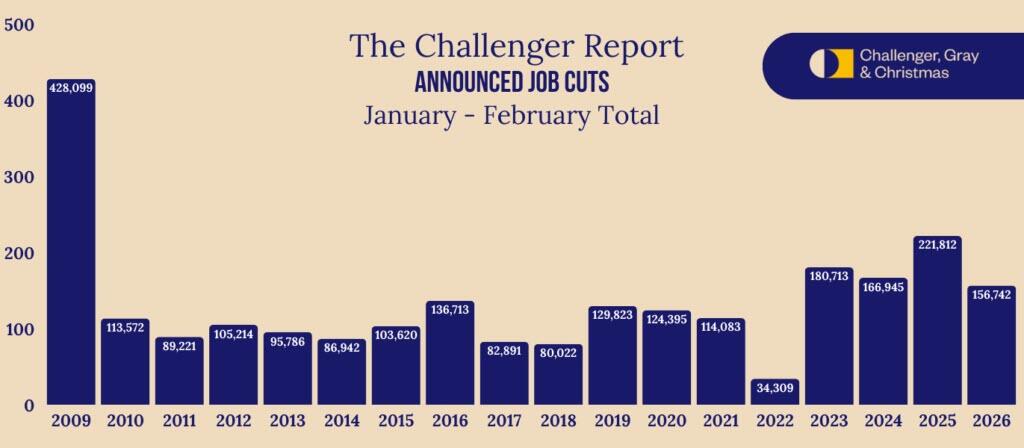
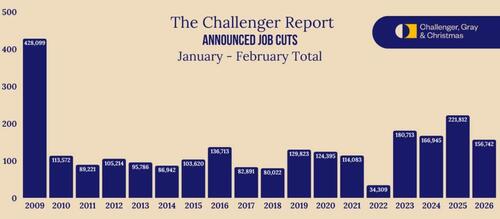
U.S.-based employers announced 48,307 job cuts in February, down 55% from the 108,435 job cuts in January. It is down 72% from the 172,017 cuts announced during the same month last year, according to a report released Thursday from global outplacement and executive coaching firm Challenger, Gray & Christmas.
“February’s dip is a nice reprieve from the elevated job cut plans to start the year. With U.S. involvement in a growing war in Iran, the end of Q1 may bring more layoff plans as companies tighten belts amid uncertainty and higher costs,” said Andy Challenger, workplace expert and chief revenue officer for Challenger, Gray & Christmas.
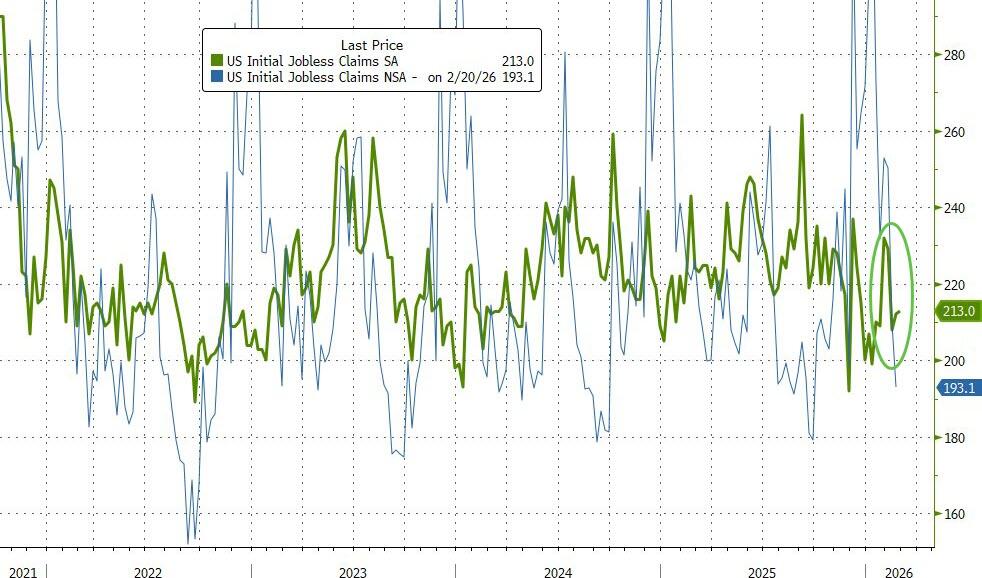
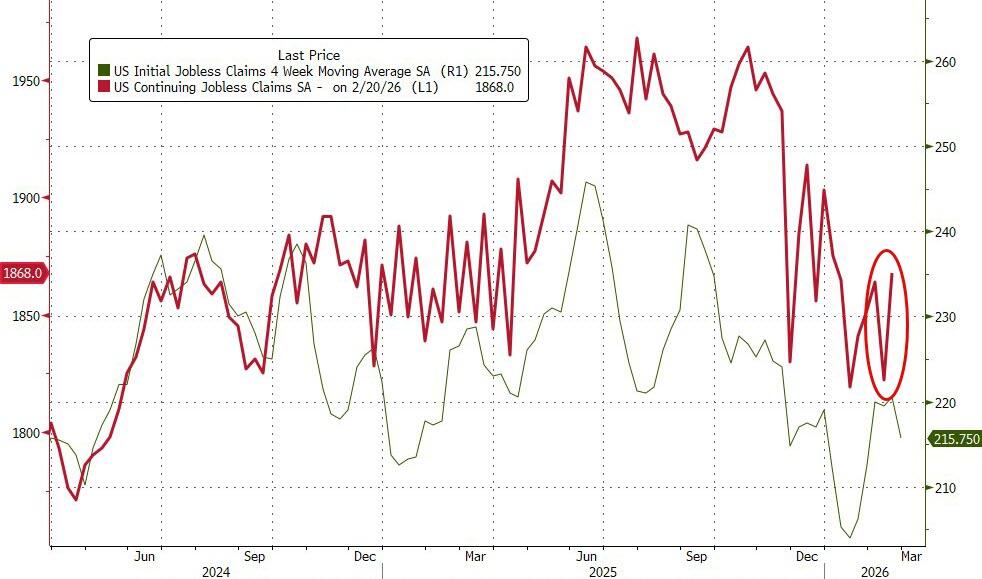
Initial jobless claims hovered near multi-year lows at 213k last week…
However, continuing jobless claims picked up to 1.864 million Americans – the highest of the year…
So the ‘no hire, no fire’ economy rolls on…
Tyler Durden
Thu, 03/05/2026 – 08:36

Editorial: The Chicago Fire, firing up even as Chicago’s World Cup mistake compounds
On Tuesday, U.S. Transportation Secretary Sean P. Duffy said the Federal Transit Administration would invest $100.3 million into public transit systems “within host cities preparing to welcome millions of fans during the 2026 FIFA World Cup.”
We should have been one of those. We should have had some of that. We should be about to welcome some of those millions (assuming they still plan to come).
That’s especially true since the federal monies apparently are designated for “operating expenses,” meaning more trains, longer trains, cleaner stations, better security and extended operation hours. Those are all good things and things for which it is notoriously difficult to secure federal largesse. To most riders on the Chicago Transit Authority, though, they are far more important than the fancy new station going up at State and Lake at a cost well in excess of $400 million and, anyone now can witness, years of ugly disruption to Chicago’s pivotally important State Street corridor.
Instead, Chicago passed and the World Cup is going to Kansas City, which effectively pitched itself as “one of the soccer capitals of the U.S.,” and as the Guinness World Record holder for “the loudest crowd roar at an outdoor stadium.” Kansas City got six games for its efforts with huge economic benefits — presumably including an injection of cash for its modestly scaled KC Streetcar line, which carries all of about 1% of the riders who take to the CTA. Not bidding for the World Cup has proved to be an expensive mistake for Chicago, the full scale of which only now is becoming clear.
Still, the good news this week in Chicago was the groundbreaking for the new Chicago Fire stadium, privately funded to the tune of some $750 million by the Chicago Fire’s owner and chairman, Joe Mansueto.
The city owes Mansueto a debt of gratitude.
He understood that to have a world-class soccer organization, you have to develop your own stadium and he set about doing so, not politicking until the eleventh hour. This one will be the first new, major stadium in the city limits for decades. We think it will have a hugely positive impact on the Fire’s fanbase. Especially in the wake of the coming World Cup frenzy.
Joe Mansueto, center, owner of the Chicago Fire soccer team, talks to Ald. Pat Dowell, 3rd, as Mayor Brandon Johnson, right, stands nearby during a groundbreaking ceremony on March 3, 2026, at the site of what will be the team’s new home, a 22,000-seat, open-air stadium at the north end of the area called “The 78” near Roosevelt Road in Chicago’s South Loop. (Terrence Antonio James/Chicago Tribune)
Tuesday also marked a new beginning for The 78, the new home of the Fire and a huge tract of land that (as we have lamented on this page for years) offers a pivotal connection to existing neighborhoods but has remained dormant for years. “For too long this stretch along the river has been empty,” said Chicago Mayor Brandon Johnson, “yet it has been filled with so much potential.”
Quite right, Mr. Mayor. Don’t let those kvetching about so-called gentrification or the usual NIMBY concerns spoil your celebration. Community benefits will accrue. A vibrant 78 is crucial to the future growth of this great sporting city, especially heading south from the Loop. Now you have an anchor.
The stadium will only use a portion of the available space. We look forward to the announcements of Mansueto’s new neighbors.
Submit a letter, of no more than 400 words, to the editor here or email letters@chicagotribune.com.