Category: News
Editorial: JB Pritzker’s ‘heavy-handed’ push for Juliana Stratton is making enemies within his own party
In many elections, endorsements of candidates by other elected officials are a sideshow. Often simply the repayment of political favors or a reward for past votes, they’re typically paid relatively light notice by voters.
Not so in 2026. Not with the 2028 presidential election already looming large for Democratic hopefuls as the party desperately seeks a standard-bearer to compete in a post-Trump political landscape.
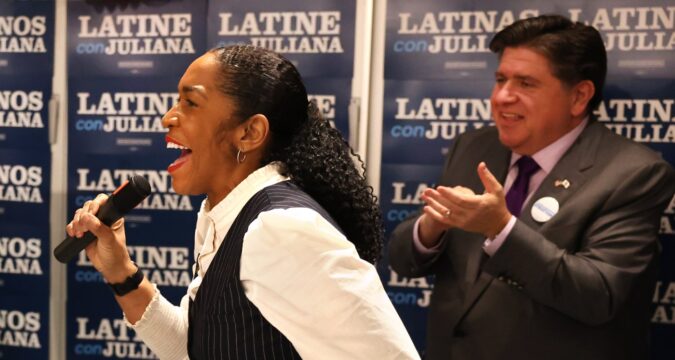
Gov. JB Pritzker learned the hard way this week that there are significant risks tied to his endorsements. His backing of his lieutenant governor, Juliana Stratton, in the hotly contested race to succeed retiring U.S. Sen. Dick Durbin has gotten Pritzker into hot water with a key Democratic Party constituency as the governor himself contemplates a presidential run.
The Congressional Black Caucus this week harshly criticized Pritzker for his involvement in the Senate race. The caucus was acting on behalf of one of its members, U.S. Rep. Robin Kelly, who is among the three leading contenders in the upcoming primary. CBC Chair Yvette Clarke, a House member from New York, called Pritzker’s monetary and other support for Stratton “beyond frustrating.”
“A sitting governor shouldn’t be heavy-handing this race,” Clarke told Punchbowl News. “Quite frankly, his behavior in this race won’t soon be forgotten by any of us.”
“Quite frankly” is a term that’s often abused by politicians (meaning that whatever they’re saying in the back-and-forth of the moment is anything but frank), but in this case Clarke’s warning indeed is, well, a tad ominous for our governor.
Before the Black Caucus lobbed this bomb at him, Pritzker would have been excused for thinking that his endorsement of a different Black woman would shield him from such criticism. If so, he miscalculated the way many House members think. An open Senate seat is a rare and valuable thing — one might even describe it as “golden,” as Illinois’ felonious former Gov. Rod Blagojevich famously did — and many lawmakers in the lower chamber naturally have ambitions to move up. Our guess is these CBC colleagues of Kelly’s see Pritzker’s involvement as a betrayal of one of their own and easily could picture themselves in a similar scenario.
As a billionaire willing to spend millions on Stratton’s race, Pritzker is more than just a prominent political name lending his verbal support. He’s the equivalent of his own super PAC.
Asked yesterday about the CBC’s stance, Pritzker said, setting off on an unnecessarily tortured rhetorical journey: “I would like a Black woman to represent us in the United States Senate. I just want the best person. She happens to be a Black woman. I think I’ve proven over many years now that I stand with communities of color across this state and with candidates who are running for public office.”
We’re not sure Clarke and other Black lawmakers in D.C. will take kindly to Pritzker’s unspoken dismissal of Kelly in those remarks. Of course, as political junkies in Illinois recall, Pritzker and Kelly have been at odds for years; the governor was instrumental four years ago in pressuring Kelly out as head of Illinois’ Democratic Party. He likes to extol his role in making Stratton the first Black female lieutenant governor in Illinois, but Kelly of course was the first Black female head of the Democratic Party of Illinois. And Pritzker was instrumental in supplanting her with a Hispanic woman, state Rep. Elizabeth “Lisa” Hernandez.
Clarke’s implied threat that Pritzker will pay a future price with CBC members for his role in the Senate contest isn’t the kind of message the governor wants to hear as he considers a run for president. Support from Black voters is critical in many Democratic primaries, and the Black Caucus is an influential player in such campaigns.
For now, there’s no place to go but onward for Pritzker, who’s all in for Stratton. A new ad featuring Pritzker endorsing Stratton is airing as the March 17 primary nears.
As it pertains to his political future on the national stage, he must hope first that she wins the Senate race, thereby affirming the power of his name and campaign cash, and then hope that he can mend fences with the CBC down the road. His wealth may well come in handy for that purpose.
If Stratton loses to her chief rival in the race, U.S. Rep. Raja Krishnamoorthi, not only will Pritzker’s political brand take a hit. He will have to face an angry CBC after not one, but two, Black candidates for Senate fell short.
All of the above is to say that in today’s tumultuous Democratic Party, sharply divided still on whether to move left or right in order to better compete nationally after losing twice to the detested Donald Trump, endorsements now are a dangerous game. Pritzker isn’t the only potential presidential hopeful suffering from endorsement blowback. Former Vice President Kamala Harris, who appears to be weighing another run for president, saw her stature diminished after U.S. Rep. Jasmine Crockett, her endorsed candidate in Tuesday’s Senate primary in Texas, lost to James Talarico.
Here in Illinois, we’re seeing a phenomenon we hadn’t noticed before — officeholders withdrawing previously made endorsements. First, retiring U.S. Rep. Jan Schakowsky took back her endorsement of Cook County Commissioner Donna Miller, who’s running for Congress in Robin Kelly’s 2nd District, over Miller’s big-money donors. And now, Politico’s Illinois Playbook reports, state Sen. Lakeshia Collins is withdrawing her backing for fellow state Sen. Willie Preston, who’s also running for Congress in the 2nd District, apparently over Preston’s treatment of an organizer who wants state legislative approval of a resolution honoring Palestinian Americans in the district.
In terms of their near-term political fortunes, Democrats are fortunate to have their intense opposition to Trump to unite them. Because if these endorsement misadventures are any indication, the Democratic Party has a long road still to travel to repair its own proxy battles over deeper issues.
And to make a cogent case to the American public in 2028.
Submit a letter, of no more than 400 words, to the editor here or email letters@chicagotribune.com.
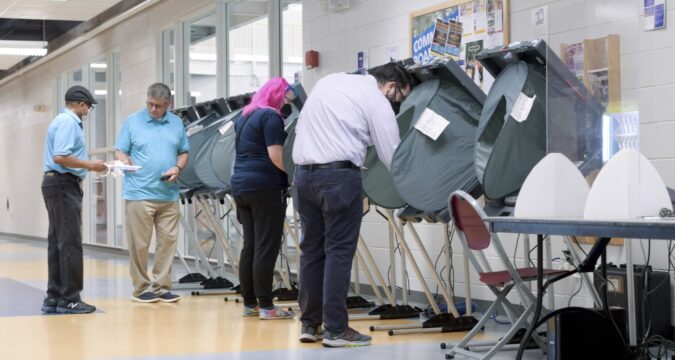
Brian Pollock, Brenda Rodgers vie in Democratic primary for Kane County clerk
Editor’s Note: This is one in a series of stories looking at contested races in the March 17 primary election.
In the upcoming primary election, two Democrats are vying for their party’s nomination in the race for Kane County clerk: Brian Pollock and Brenda Rodgers.
Whichever candidate wins will face off against Republican incumbent John “Jack” Cunningham in November. Cunningham has served in the role for more than two decades.
Early voting for the primary began in February, and will extend through March 16. The election is on March 17.
Brian Pollock
Brian Pollock, a lifelong resident of Aurora, is an attorney, a former Kane County Board member and currently works as a deputy clerk and the chief of staff for the Kane County Clerk’s Office, he told The Beacon-News in a recent interview.
He’s been working in the Kane County Clerk’s Office for the past nine years, he said, during which time the office initiated vote-by-mail and ballot tracking efforts, made upgrades to voting equipment and spearheaded the use of a tool that allows voters to see the wait times at polling places in advance of the upcoming primary.
Before that, he served from 2012 to 2016 as Kane County’s District 4 board member, where he chaired the Legislative Committee.
As for his decision to run for clerk, Pollock said it’s “time for a little bit of a philosophical and generational change in the office.”
He pointed to his interest in increasing transparency, noting the existence of “misinformation out there and the election deniers,” and said that though he thinks most voters in Kane County trust the election process, the more the office communicates with voters, “the less likely that (they) give oxygen to those types of conspiracy theories.”
One thing he’d look to do if elected clerk is create a citizen academy that would educate residents on the functions of the Clerk’s Office and enable them to share that information with the community.
He said the office also needs to “up (its) social media game,” making use of things like video to show how the office works, and should look into how AI could be used within the office.
Brian Pollock is running in the Democratic primary for Kane County clerk. (Brian Pollock)
Pollock also pointed to having experience on “both sides of” budgeting — as a board member and within the Clerk’s Office — as part of what prepares him for the role.
Acknowledging the county’s current financial situation, Pollock said the majority of the services the Clerk’s Office provides are mandated — other than its passport services, which generates revenue for the county — but that the office still needs to “live within the budget” allocated to them by the county board.
As for securing additional funds for the Clerk’s Office, he pointed to the possibility of the office looking for possible revenue-generating offerings like its passport service, and “being aggressive” in seeking out grants.
Pollock also noted that “protecting voting rights” and “increasing accessibility” for voting in the county are priorities of his.
“Go to where the voters are,” Pollock said.
He said that he intends to, if elected, make sure the county runs its elections in a way that “reflect(s) how people actually vote.”
Brenda Rodgers
Brenda Rodgers has lived in Elgin for more than four decades, she told The Beacon-News in a recent interview. A longtime Realtor, Rodgers previously served as a member of Elgin’s City Council, during which time, she noted, she helped with negotiations to keep a big box store in the community and with reintegration efforts for those who committed felonies.
Rodgers hasn’t served in an elected role since then — she ran unsuccessfully in 2024 for Kane County recorder as a Democrat — but has remained involved in local community organizations, she said, like the League of Women Voters.
Brenda Rodgers is running in the Democratic primary for Kane County clerk. (Brenda Rodgers)
Now, she’s throwing her hat in the ring for the Democratic nomination for county clerk. Rodgers pointed to her experience as a Realtor and on the Elgin City Council and said she wants to “carry that over into the Clerk’s Office.”
Among the major issues Rodgers hopes to address if elected is ensuring the proper functioning of election equipment — through doing test runs and maintaining contact with representatives from the companies providing the technology.
“It’s very important to restore individuals’ faith in our … elections,” Rodgers said.
Another priority of hers is increasing residents’ knowledge of the services the Clerk’s Office provides.
She pointed to, for example, the genealogy services the Clerk’s Office offers that many residents may not know about, and that tax extensions are handled by the office.
“Most people just think of it as elections,” she added.
As for getting out information on how the Clerk’s Office handles elections, Rodgers said that, if elected, she would plan to offer tours of the Clerk’s Office to residents, so they could see “how (their) ballot is handled from the beginning to the end, to when it’s counted.”
And she would also look to meet with neighborhood groups, providing updates about the Clerk’s Office. She cited the recent postmark changes, for example, which she thinks many are not aware of.
As for the county’s current financial issues, Rodgers noted that — in part because of passport fees — the Clerk’s Office has been “pretty good with their budget.” But she hopes to increase “transparency” for the office’s budget, making it easier for residents to find and look through.
And she emphasized that, if elected, she would represent a new voice in the role.
“You will definitely not only have a new person in the position, but you will also have new ideas in the position,” Rodgers said. “And I think that’s very important.”
mmorrow@chicagotribune.com

Jennifer Tescher: Despite progress on lessening financial vulnerability, we have work to do in Cook County
If you want to understand Americans’ financial future, start by looking at the financial health of Chicagoans.
Drive 20 minutes from the Gold Coast to Englewood, and you’ll travel between two economies — same city, same moment in time, radically different financial realities. That gap is not an accident. It is the product of decades of decisions about where to build, who to lend to and which neighborhoods to invest in. It is also, as new data shows, something that can change.
I came to Chicago more than 30 years ago to study income and wealth inequality. As one of the most segregated cities in America, it was, unfortunately, the perfect laboratory. Along the way, I learned that the places and spaces where people live, work, learn, play and pray hold enormous power over their well-being.
My organization, Financial Health Network, has measured the financial health — a household’s ability to make ends meet and stay on track through financial shocks — of Americans for nearly a decade. After a 2022 baseline study, FHN published the “Financial Health Pulse 2025 Chicago Trends Report” detailing how the financial health of households across Chicago and Cook County has evolved over three years. The findings show a story of both progress and persistence.
Financial vulnerability in Cook County has declined modestly since 2022, with fewer households reporting having less than a week of savings and fewer lacking confidence in reaching long-term goals. The clearest improvements occurred in Chicago itself — notably among households with Black and Latino residents, who have long faced disproportionate risk.
These gains matter. Population-level shifts are rarely dramatic. Even small improvements represent real households gaining stability.
But the gains are fragile.
More than one-third of Cook County households still report experiencing material hardship. Rents have climbed sharply. Debt delinquencies are rising. While many renters aspire to homeownership, most say buying today would be difficult, with the cost of a down payment as the primary barrier. Federal cuts to Medicaid and the Supplemental Nutrition Assistance Program also threaten to destabilize families who have only recently regained their post-COVID-19 footing.
Cities are where federal policies become personal. They are where trust in financial systems is built or eroded through daily experience. They are also where solutions can be tested and refined.
Sustained improvement will require focused action in three areas:
• Homeownership. Access to homeownership remains a challenge, despite a variety of homebuying assistance programs, because of a lack of affordable stock. But access alone is not enough — support also is needed to help homeowners stay in place; 20% of Chicago homeowners report they could not afford a needed repair, while 8% could not afford their property tax bill. Only 21% of Chicago homeowners have a will, compared with 37% in the suburbs, putting intergenerational wealth transfer at risk.
Representatives of the Hope Center Foundation, United Power for Action and Justice and Salem Baptist Church of Chicago were on hand Dec. 18, 2024, to provide keys and housewarming gifts to families on Chicago’s South Side, nearly 60 years since the last new residential home construction sale in the Roseland neighborhood. (Antonio Perez/Chicago Tribune)Community development financial institutions, city programs and philanthropy can expand home repair grants, property tax relief and estate planning support. Homeownership remains one of Chicago’s most powerful wealth-building tools — but only if families can hold onto what they’ve built and leverage that equity.
• Education and career pathways. Connecting education to economic mobility requires more than sending kids to college. Our data shows that a college degree does not guarantee strong financial health. We must support two- and four-year students to complete their degrees, but we also need to expand apprenticeships, credentials and skills-based hiring — connect graduates to quality jobs with benefits and real paths to advancement. This is critically important as artificial intelligence appears poised to erase a large portion of entry-level jobs.
• Targeted local investment. Pessimism about neighborhood conditions is highest in underinvested areas of the West, South, Far South and Southwest sides. On the Far South Side, 1 in 4 residents said their expectations for neighborhood improvement were worsening — compared with just 11% on the North Side. These differences mirror powerful gaps in household financial health across neighborhoods, which themselves follow long-standing patterns of geographic inequality.
Capital investments must be directed to areas with concentrated vulnerability, guided by resident priorities and linked to community development. Hyperlocal improvements in parks, child care, housing, transportation, public safety and more provide the foundation for enhanced quality of life; paired with income growth, they drive real improvements in financial health and opportunity.
Chicago is rich with institutions and leaders who bring their passion and expertise to tackling these issues, and their efforts are working. Our study also shows that Chicago and Cook County households outperform the nation overall in the ownership of retirement accounts, 529 education savings plans and short-term savings, thanks to years of targeted investment and policy advocacy.
Chicago has long been a city of neighborhoods, where residents’ identities are tied up to the block where they grew up. This is where innovation and possibility are rooted. Ensuring we are a nation in which the majority of citizens lead financially healthy lives requires working city by city, neighborhood by neighborhood, household by household.
When we close financial health gaps in Chicago, we move closer to closing them across America.
Jennifer Tescher is founder and CEO of the Financial Health Network, a Chicago-based nonprofit dedicated to improving financial health for all. She is also a fellow in the inaugural Leadership & Society Initiative’s Imagine Pathway at the University of Chicago.
Submit a letter, of no more than 400 words, to the editor here or email letters@chicagotribune.com.
https://www.chicagotribune.com/2026/03/05/opinion-financial-health-chicago-wealth-building/
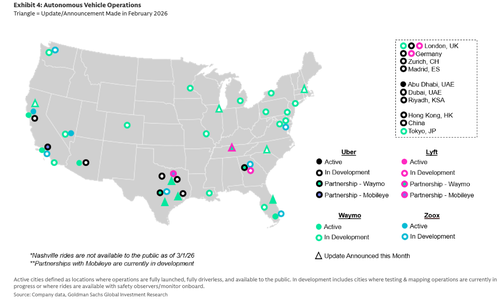
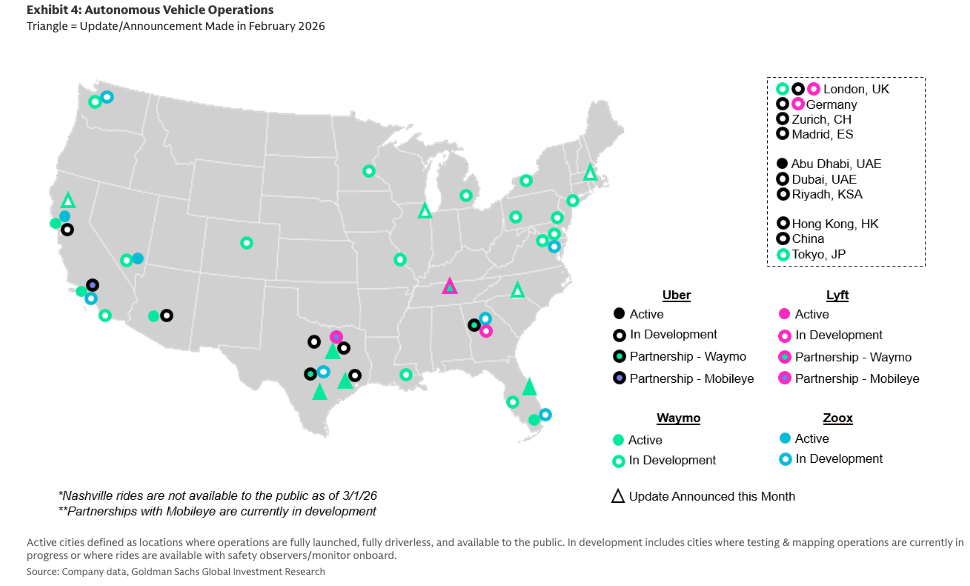
Map Shows Latest U.S. Robotaxi Deployment
Map Shows Latest U.S. Robotaxi Deployment
Goldman analysts, led by Eric Sheridan, updated clients this week on the latest developments in the North American autonomous vehicle rideshare market. They point out that the AV rideshare market continues to expand as Uber, Lyft, Waymo, and Zoox roll out AV operations nationwide.
Readers will notice that the commercial AV deployments this year, including Uber, Lyft, Waymo, and Zoox (Tesla in Texas), are full steam ahead.
Key AV deployment announcements for Uber, Lyft, and Waymo in 4Q25
Key AV deployment announcements for Uber, Lyft, and Waymo YTD 2026
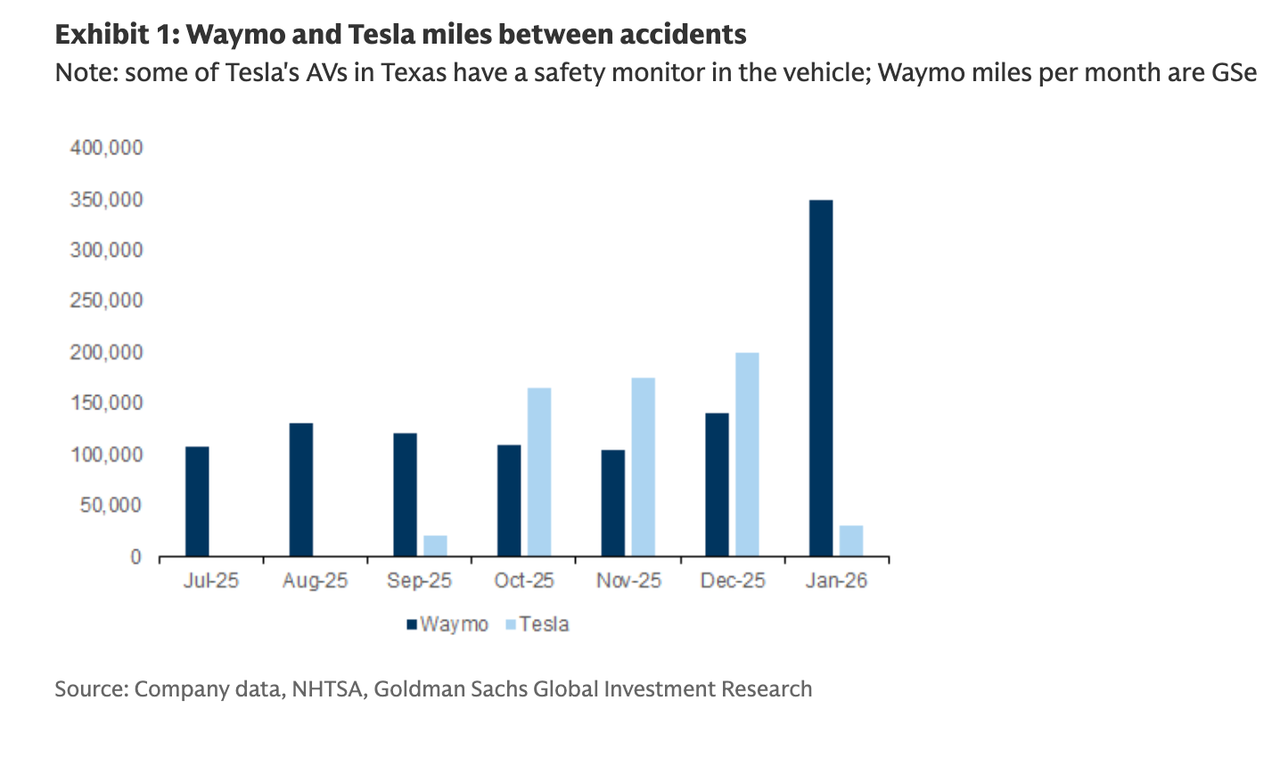
One of the most fascinating charts Sheridan produced for clients shows the miles between accidents for Waymo and Tesla.
Here’s more on the safety data:
Based on available crash data from the National Highway Traffic Safety Administration (NHTSA) from July 2025 through mid-January 2026, and disclosures from Waymo (for all US cities it’s operating in commercially) and Tesla (for Austin) around trips/miles driven by their respective robotaxi services, we estimate that Tesla has an accident (regardless of fault) every 45K-60K miles, while Waymo has an accident (regardless of fault) every 60K-110K miles. We note that these datapoints reflect driverless miles (including those with a safety observer/monitor for Tesla) and do not include manually operated vehicles and accidents in cities without public rides being offered. We show estimated monthly miles between accidents for both companies in Exhibit 1. Note that Tesla’s miles between accidents were ~1.5K miles in July and Tesla did not have any reported accidents in August. Further, note that January data only captures known/reported accidents through January 15th and further accidents are typically reported in the following month’s data (i.e., February data).
Note that because Tesla’s fleet in Austin is a mix of vehicles, both with and without a safety monitor, and because there are differences in where the rides are occurring (with Waymo operating commercially in more cities), the data may not be directly comparable. In addition, reports are filed with NHTSA even for minor issues that would be unlikely to be reported by a human (e.g. driving over a curb), and not all accidents are the fault of the AV.
Goldman has told clients that the AV rideshare buildout is still in its early stages and is set to accelerate from here.
In January, Elon Musk told BlackRock CEO Larry Fink at Davos that Tesla expects to operate a “widespread” robotaxi network by the end of this year.
It is only a matter of time before taxi drivers and human Uber drivers begin to revolt against AVs gaining deeper penetration in the rideshare market. That shift should become increasingly visible over the next several years, with the impact likely to be far more noticeable by 2028 and beyond.
The full Goldman note can be viewed (here) and is available to pro subs.
Tyler Durden
Thu, 03/05/2026 – 05:45
https://www.zerohedge.com/technology/map-shows-latest-us-robotaxi-deployment
Today in Chicago History: John Belushi’s death in LA shocks his hometown
Here’s a look back at what happened in the Chicago area on March 5, according to the Tribune’s archives.
Is an important event missing from this date? Email us.
Front page flashback: March 6, 1982
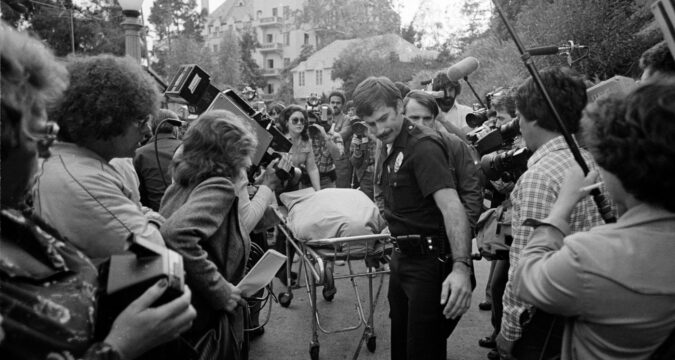
Actor and Chicago native John Belushi was discovered dead on March 5, 1982, at the Chateau Marmont in Los Angeles. (Chicago Tribune)
1982: Chicago native John Belushi was found dead at the Chateau Marmont, a Los Angeles hotel.
A coroner’s report later concluded the actor died of “acute cocaine and heroin intoxication.”
Cathy Evelyn Smith was sentenced to three years in prison in 1986 for injecting Belushi with a fatal dose of cocaine and heroin. She was released in 1988.
Weather records (from the National Weather Service, Chicago)
High temperature: 75 degrees (1983)
Low temperature: 0 degrees (1978)
Precipitation: 0.99 inches (1946)
Snowfall: 9.2 inches (2013)
Playboy magazine founder Hugh Hefner admires the pool in the basement of his apartment at 1340 N. State Parkway, in Chicago on April 20, 1961. (Arnold Tolchin/Chicago’s American)
1961: A spread in Chicago Tribune magazine described how Playboy founder Hugh Hefner turned a car-service area inside his Near North Side mansion at 1340 N. State Parkway into a lounge. He also convinced officials he needed to build a pool in the basement. The lounge was positioned slightly lower than the bottom of the pool: ” … in the manner of an aquarium, permitting a view of the swimmers and pool activities.”
A Playboy’s guide to Hugh Hefner’s Chicago
Hefner’s office was in his bedroom, which later included a 100-inch-diameter circular bed described as having “more controls and more gadgets than a Boeing 747.” Other Hefner additions included sun and steam rooms, a bowling alley, game room, a closed-circuit television security system and a full-size movie projection system.
The Chicago Housing Authority’s Robert Taylor Homes development opened on March 5, 1962. (Chicago Tribune)
1962: The Robert Taylor Homes — then one of the largest public housing projects in the United States — opened and its first family moved in. The development had 28 high-rises with 4,415 units.
But the complex soon caved under devastating poverty and violence. In the end, the Robert Taylor high-rises failed a congressional “viability test,” which found it was cheaper to house residents elsewhere than to maintain the crumbling high-rise slums.
Demolition of the buildings began in May 1997.
Former Chicago White Sox second baseman Nellie Fox, who died in 1975, was elected to baseball’s Hall of Fame on March 5, 1997. Fox was a 12-time All-Star who batted better than .300 six times and .288 during a 19-year career that included 14 with the Sox. (Chicago Tribune)
1997: Chicago White Sox second baseman Nellie Fox was elected to baseball’s Hall of Fame.
Chicago Mayor Brandon Johnson, center, is sworn in with Denver Mayor Mike Johnston, left, and Boston Mayor Michelle Wu in front of the House Oversight and Government Reform Committee on March 5, 2025, in Washington. (Brian Cassella/Chicago Tribune)
2025: Chicago Mayor Brandon Johnson defended the city’s sanctuary status before a GOP-led congressional committee.
Seated in the middle of a five-person witness panel that included the Democratic leaders from three other major U.S. cities, Johnson touted Chicago’s downward trend in crime as he argued its policy blocking local police from assisting in immigration enforcement in fact makes communities safer.
Chicago’s more than 40-year history as a sanctuary city
“I know there are myths about these laws,” Johnson said in his opening remarks to the U.S. House Oversight and Government Reform Committee. “But we must not let mischaracterizations and fearmongering obscure the reality that Chicago’s crime rates are trending down. We still have a long way to go, but sensationalizing tragedy in the name of political expediency is not governing. It’s grandstanding.”
Want more vintage Chicago?
Subscribe to the free Vintage Chicago Tribune newsletter, join our Chicagoland history Facebook group, stay current with Today in Chicago History and follow us on Instagram for more from Chicago’s past.
Have an idea for Vintage Chicago Tribune? Share it with Kori Rumore and Marianne Mather at krumore@chicagotribune.com and mmather@chicagotribune.com
https://www.chicagotribune.com/2026/03/05/march-5-chicago-history/

Today in History: Martha Stewart convicted
Today is Wednesday, March 5, the 64th day of 2025. There are 301 days left in the year.
Today in history:
On March 5, 2004, Martha Stewart was convicted in New York of conspiracy, obstructing justice and lying to the government about why she’d sold her Imclone stock just before the stock’s price plummeted; her ex-stockbroker, Peter Bacanovic, also was found guilty in the stock scandal. (Each later received a five-month prison sentence.)
Also on this date:
In 1770, the Boston Massacre took place as British soldiers who’d been taunted by a crowd of colonists opened fire, killing five people.
In 1933, in German parliamentary elections six days after the Reichstag fire, the Nazi Party won 44% of the vote; the Nazis joined with a conservative nationalist party to gain a slender parliamentary majority.
In 1946, Winston Churchill delivered a speech at Westminster College in Fulton, Missouri, in which he said: “From Stettin in the Baltic, to Trieste in the Adriatic, an iron curtain has descended across the continent.”
In 1953, Soviet dictator Josef Stalin died from a stroke at age 74 after nearly three decades in power.
In 1963, country music performers Patsy Cline, Cowboy Copas and Hawkshaw Hawkins died in the crash of their plane, a Piper Comanche, near Camden, Tennessee, along with pilot Randy Hughes (Cline’s manager).
In 1979, NASA’s Voyager 1 space probe made its closest approach to Jupiter, sending back photographs of the planet and its moons.
In 1982, comedian John Belushi was found dead of a drug overdose in a rented bungalow at Hollywood’s Chateau Marmont hotel; he was 33.
Related Articles
Today in History: President Abraham Lincoln inaugurated for a second term
Today in Chicago History: Billy Goat Tavern — of ‘Cheezborger, cheezborger’ fame — opens on Michigan Avenue
Today in History: Florida becomes a state
Today in Chicago History: Chester Weger convicted of Starved Rock murder
South Carolina honors native son the Rev. Jesse Jackson
In 2022, a promised ceasefire in the Ukrainian port city of Mariupol collapsed amid scenes of terror in the besieged town. The number of people fleeing the country reached 1.4 million just 10 days after Russian forces invaded.
Today’s birthdays: Actor Fred Williamson is 87. Magician Penn Jillette is 70. Actor Adriana Barraza is 69. Football Hall of Famer Michael Irvin is 59. Actor-comedian Aasif Mandvi is 59. Rock musician John Frusciante (Red Hot Chili Peppers) is 55. Actor Eva Mendes is 51. Model Niki Taylor is 50. Singer-songwriter Amanda Shires is 43.
https://www.chicagotribune.com/2026/03/05/martha-stewart-convicted/

Free Speech Victory In Germany After Top Court Issues Landmark Rulings For ‘Insults’
Free Speech Victory In Germany After Top Court Issues Landmark Rulings For ‘Insults’
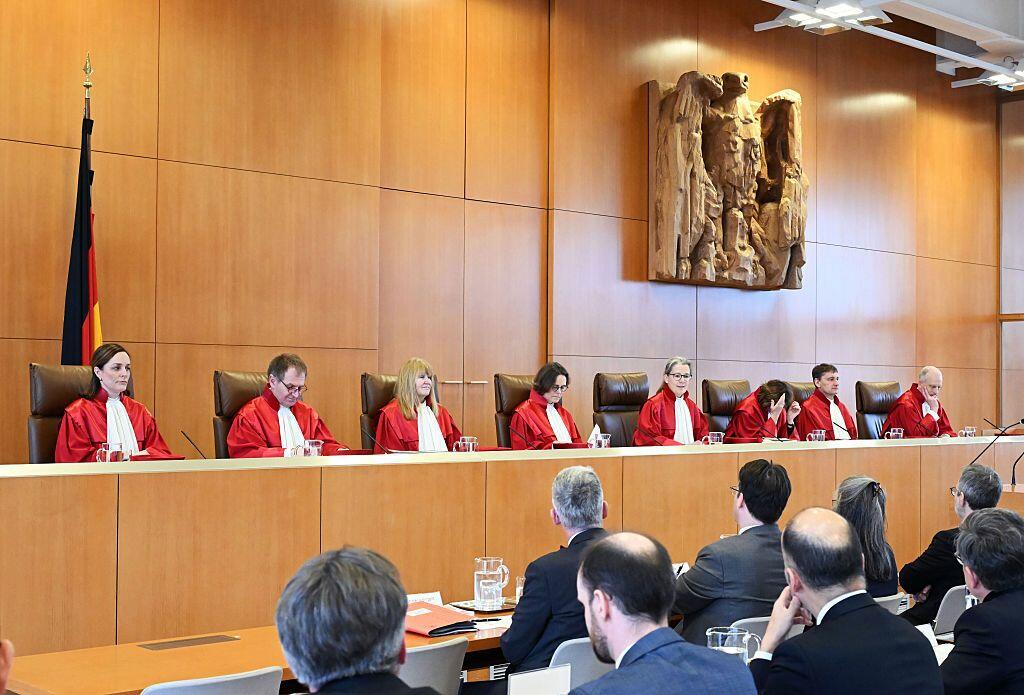
The wave of police searches and prosecutions in Germany may be facing a new hurdle after Germany’s top court, the Constitutional Court, issued two landmark rulings strengthening freedom of expression. However, Fatina Keilani, editor in Welt’s freedom of expression department, said that these two decisions have gone largely unnoticed by the public, an oversight that she finds remarkable.
Writing in Welt, Keilani reports that the Federal Constitutional Court in Karlsruhe handed down two resolutions in December that push back against what she describes as hasty convictions for insults. The rulings stem from two separate cases in which individuals used sharp, even offensive language against public officials and medical staff — and were criminally sentenced for it.
As Remix News has extensively reported, there have been hundreds, if not thousands, of such cases in recent years. Some of these cases have even attracted international attention and led to questions about freedom of speech and growing repression in Germany.
Just late last month, German prosecutors launched investigations into dozens of comments under just one post criticizing Chancellor Friedrich Merz, with one user calling him “Pinocchio.” A number of constitutional lawyers were quick to slam the investigations, with one labeling it “hysterical madness.”
Now, Germany’s top court is strengthening freedom of expression at a worrying time.
The first case involved a retired police officer whose son attended a high school during the Covid pandemic. Angered by the school’s testing requirements, the father sent the headmaster a series of emails accusing him of serving a “fascist system and its henchmen” and of “fascist cadre obedience.” The Göppingen District Court sentenced him to a fine of 70 daily rates of €80 each for insult. He lost every appeal before taking his case to Karlsruhe — where he finally prevailed.
The Constitutional Court found that his right to freedom of expression had been violated, ruling that the lower courts had not examined the meaning of his statements carefully enough, nor struck an adequate balance between free expression and the protection of personality.
Keilani quotes the court directly: “Part of this freedom is that citizens can attack officials they consider responsible in an accusatory and personalized way for their way of exercising power, without having to fear that the personal elements of such statements are removed from this context and form the basis for drastic judicial sanctions.”
The second case involved a man who had been placed in a psychiatric hospital on multiple occasions and subjected to coercive measures. In a letter to his lawyer in 2023, he described hospital staff as a “psychiatric mob.” When he applied to have the letter formally served, a senior bailiff refused on the grounds that its content was punishable. The Stuttgart Higher Regional Court upheld that refusal — but Karlsruhe disagreed.
The Constitutional Court was pointed in its criticism, noting that the Higher Regional Court’s entire reasoning had been reduced to just two sentences, and that it had made no real weighing of the fundamental right to free expression at all. The case has been sent back for reconsideration.
For Keilani, both rulings carry a significance that extends beyond the individual cases. She situates them within a broader climate of concern, noting that “numerous decisions against freedom of expression have recently raised doubts in Germany about the rule of law and about the stability of the courts with regard to this crucial fundamental right.”
In particular, the wave of politicians weaponizing comments on the internet to launch police raids and drag social media users to court. Against that backdrop, she finds the Karlsruhe decisions reassuring — while also reading them as a firm instruction to lower courts about the standard they must meet when judging speech.
These rulings do not necessarily mean, however, that internet users are now able to freely insult politicians without consequence. For one, prosecutors and politicians still have incentive to pursue such cases, both in order to stifle dissent and to intimidate the populace. Social media users may be able to defend themselves in court, but it will likely take years and cost them substantial amounts of money. Furthermore, outright insults without context are still likely to be prosecutable offenses under current German law. For example, insulting a politician’s physical appearance or simply calling them a slur could land social media users in hot water.
Regardless, the country’s top court has drawn a line in the sand, according to Keilani.
She also cited the “urgent decision of the Cologne Administrative Court regarding the classification of the AfD” as also a welcome sign that rule of law still stands in Germany. In that ruling, the Cologne court found that the designation of the AfD as a “confirmed” case of right-wing extremism was not constitutionally sound.
Tyler Durden
Thu, 03/05/2026 – 05:00

Fotos muestran ataques de US e Israel y la respuesta de Irán
Associated Press
Estados Unidos e Israel lanzaron un ataque contra Irán el sábado, en fotos.
___
Esta es una galería de fotos seleccionada por editores de fotografía de AP.

Zelenskyy dice que el diálogo Rusia-Ucrania está congelado mientras Oriente Medio pide drones a Kiev
Por The Associated Press
Una nueva ronda de conversaciones entre Rusia y Ucrania, mediadas por Estados Unidos y prevista para esta semana, se ha pospuesto debido a la guerra en Oriente Medio, según el presidente ucraniano Volodymyr Zelenskyy.
Mientras tanto, Estados Unidos y sus aliados en Oriente Medio buscan la experiencia de Kiev para contrarrestar los drones Shahed de Irán. Rusia ha lanzado decenas de miles de Shahed contra Ucrania desde que invadió a su vecino hace poco más de cuatro años, afirmó Zelenskyy. Irán ha respondido con el mismo tipo de drones a los ataques conjuntos de Estados Unidos e Israel contra objetivos iraníes.
La guerra con Irán, que ya va por su sexto día, ha desviado la atención internacional del mayor conflicto de Europa desde la Segunda Guerra Mundial. Gobiernos occidentales y analistas señalan que la guerra entre Rusia y Ucrania ha causado la muerte de cientos de miles de personas, mientras no hay indicios de que los esfuerzos de paz liderados por Estados Unidos desde hace un año vayan a detener los combates en el corto plazo.
“Ahora mismo, debido a la situación en torno a Irán, todavía no hay las señales necesarias para una reunión trilateral”, Zelenskyy declaró tarde el miércoles. “Pero en cuanto la situación de seguridad y el contexto político general nos permitan reanudar ese trabajo diplomático trilateral, se hará”.
Diversos países, entre ellos Estados Unidos, han recurrido a Ucrania para pedir ayuda en la defensa contra drones iraníes, comentó Zelenskyy. Indicó que en los últimos días ha hablado con los líderes de Emiratos Árabes Unidos, Qatar, Bahrein, Jordania y Kuwait sobre una posible cooperación.
La asistencia ucraniana, precisó, se brindará sólo si no debilita las propias defensas de Ucrania y si aporta mayor capacidad de presión a los esfuerzos diplomáticos de Kiev para detener la invasión rusa.
“Ayudamos a defender de la guerra a quienes nos ayudan a nosotros, a Ucrania, a lograr un final justo de la guerra” con Rusia, afirmó.
El ejército de Ucrania ha hecho retroceder recientemente a las fuerzas rusas en algunos puntos a lo largo de la línea del frente, de aproximadamente 1.250 kilómetros (750 millas), según el Instituto para el Estudio de la Guerra.
El centro de estudios con sede en Washington señaló esta semana que contraataques ucranianos localizados liberaron más territorio del que las fuerzas ucranianas perdieron en las dos últimas semanas de febrero, y estimó la tierra recuperada en unos 257 kilómetros cuadrados (100 millas cuadradas) desde el 1 de enero.
___
Esta historia fue traducida del inglés por un editor de AP con la ayuda de una herramienta de inteligencia artificial generativa.

US, Ecuador Launch Joint Military Operations Against Terrorist Organizations
US, Ecuador Launch Joint Military Operations Against Terrorist Organizations
US Southern Command on Tuesday stated that the US military had conducted a joint operation with Ecuadorian forces against “designated terrorist organizations” in Ecuador, as the Trump administration continues to fight narco-terrorism.
“We commend the men and women of the Ecuadorian armed forces for their unwavering commitment to this fight, demonstrating courage and resolve through continued actions against narco-terrorists in their country,” Marine Corps Lt. Gen. Francis L. Donovan, commander of U.S. Southern Command, said in a post on X.
The announcement comes after Donovan visited Ecuador on March 1 for a two-day visit, where he met President Daniel Noboa and senior Ecuadorian defense officials in Quito. They discussed security cooperation and US support of Ecuador’s efforts to combat narco-terrorism.
A Pentagon spox told the Epoch Times that the joint effort does not entail US troops in combat.
“Ecuador is one of the United States’ strongest partners in disrupting and dismantling Designated Terrorist Organizations in the region,” Donnovan said on Tuesday. “The Ecuadorian people have witnessed firsthand the terror, violence, and corruption that these narco-terrorists inflict on communities across the region.”
Noboa announced on Monday that Ecuador had entered a new phase in its fight against narcoterrorism and illegal mining.
“In the month of March, we will conduct joint operations with our regional allies, including the United States,” he said on X. “The security of Ecuadorians is our priority, and we will fight to achieve peace in every corner of the country.”
As the Epoch Times notes further, the operations come amid increased U.S. involvement in the region, including the capture of former Venezuelan leader Nicolás Maduro in January.
The Trump administration in September 2025 classified two Ecuadorian cartels, Los Choneros and Los Lobos, as foreign terrorist organizations.
“Los Choneros and Los Lobos have attacked and threatened public officials and their families, security personnel, judges, prosecutors, and journalists in Ecuador,” the U.S. State Department said in a September 2025 statement.
On Feb. 2, the U.S. Coast Guard detained three suspected narco-terrorists northwest of Ecuador during Operation Pacific Viper, an ongoing U.S. Coast Guard-led campaign launched in early August 2025, to undermine drug trafficking in the Eastern Pacific Ocean and the Caribbean Sea.
In March 2025, Noboa called for U.S. special forces, with assistance from Brazil and Europe, to dismantle the international narco-terrorist organizations, which have swelled to thousands of armed members.
“We need to have more soldiers to fight this war,” Noboa told the BBC at the time. “Seventy percent of the world’s cocaine exits via Ecuador. We need the help of international forces.”
Ryan Morgan contributed to this report.
Tyler Durden
Thu, 03/05/2026 – 04:15