Category: News
Aurora planning commission recommends approval of data center regulations
Aurora’s Planning and Zoning Commission on Wednesday voted to recommend the city adopt regulations around data centers that are stricter than were originally presented by city staff.
Under current Aurora city code, data centers are considered warehouses so have no special requirements and can be built in certain areas without Aurora City Council approval. The proposed changes would give the City Council the ability to approve or deny proposed data center developments and would set requirements around energy use, water use, noise and other emissions.
However, most of these proposed rules would apply only to new data centers looking to get approval after the city lifts its current moratorium on these types of developments, or those that get substantially renovated after the moratorium.
Although some of the proposed changes to city code have been recommended for approval by the Planning and Zoning Commission, they all still have to be approved by City Council. The earliest a final vote could take place is March 24, which is also the day the moratorium is set to end.
The Aurora City Council put the data center and warehouse moratorium in place last September to give staff the chance to create the now-proposed regulations in response to an increased number of data center applications and residents’ concerns with existing facilities.
In addition to the restrictions that have been proposed by Aurora city staff, the Planning and Zoning Commission also recommended barring data center developments from two of the three zoning districts warehouses are currently allowed in.
If the Aurora City Council adopts the commission’s recommendation, data centers would only be allowed in general industrial zones, not in limited industrial zones or in office, research and light industry districts.
The idea of limiting data centers only to general industrial zones was put forward by some of the residents who spoke during the public hearing portion of Wednesday’s meeting. Many who spoke at the public hearing argued that the proposed regulations do not go far enough in protecting the community, and some wanted the city to outright ban all new data centers or to continue the moratorium.
Aurora Chief Development Services Officer John Curley said that a total ban would not stand up to legal challenges. However, included in the new proposal is the same process through which Naperville recently was able to shoot down a data center project proposed for that city, he said.
In the rules proposed by city staff, noise is a key area of focus. Data centers are not allowed to produce sound louder than 59 decibels during the day or 49 decibels at night, as measured at the facility’s property line, and the city would require data centers monitor their sound around the clock.
Currently, city regulations around sound reference state regulations, but those are difficult to measure and to enforce, Curley has said.
The currently-proposed sound requirements are the lowest levels city staff have said they found communities to require through their past few months of research.
The proposal package would also not allow data centers to install roof-mounted chiller units within 1,500 feet of residential, educational or hospital uses. Similar space requirements would be set for ground-mounted chillers and back-up generators, which would need to be at least 1,000 feet away from residential, educational or hospital uses.
Minimum distances between sound-producing units and sensitive uses like residential are there to help mitigate the sound but also vibration, according to Curley.
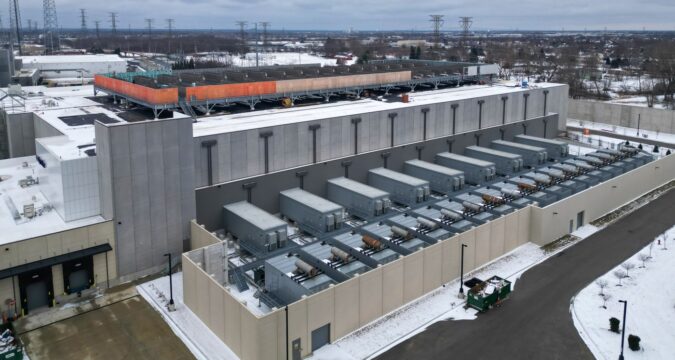
Sound coming from both chillers and back-up generators has been making life difficult for those living near the CyrusOne data center at the corner of Eola and Diehl roads on Aurora’s far East Side near Interstate 88, these homeowners have said.
Residents’ advocacy around this issue is one of the reasons the city has been working to create these recently-proposed regulations, according to Curley. Although these new rules won’t directly address residents complaints about the existing data center, the city and CyrusOne have been working together to address the ongoing noise issues.
Under the proposed regulations, both roof- and ground-mounted chiller units as well as ground-mounted generators would be required to have sound walls around them, similar to what is being built at the CyrusOne data center. Plus, rooftop generators would not be allowed.
Incoming data centers would be required under these proposed regulations to do sound studies and modeling at several points in the development process. This would include a baseline sound study before anything is built on the site, a sound modeling study showing that the planned data center would not go over maximum sound levels and a study of the sound the data center actually produces once it is built.
Additional studies would be required if the data center sees major renovations.
If a data center is shut down and the building is set to become something else, the data center’s owner would be required to remove all obsolete equipment like chillers and generators from the site. It is unlikely another type of facility would have use for these things — but if it did, far fewer would be needed, Curley has said.
The newly-proposed regulations would also require new data centers to meet certain energy efficiency levels, to provide energy modeling reports before they can be approved and to follow a number of established energy codes.
Data centers would also be required to either have renewable energy generation on-site, enough to power 25% of the facility at peak demand, or battery storage with the capacity to power up to 50% of the facility for 15 minutes, which is to stabilize the energy grid and help during brownouts. Curley said on Wednesday that a third option has now been added: data centers can simply buy renewable energy credits.
As for water, the proposed regulations would set a similar efficiency standard to energy usage. Aurora would also ban evaporative cooling, which staff have said is the most water-intensive type of cooling, and would require modeling and reporting on water usage.
Aurora is also proposing what is basically a copy of the state’s Biometric Information Privacy Act, which adds restrictions around biometric data.
While it doesn’t add onto state law, it does create local protections in the case that the state repeals its own restrictions, Aurora Director of Sustainability Alison Lindburg told the City Council’s Rules, Administration and Procedures Committee on Tuesday.
The portion of the proposed changes to city code related to zoning were recommended for approved by the Planning and Zoning Commission in a 5-1 vote on Wednesday, while the other parts of the proposal package were discussed and moved forward by the Rules, Administration and Procedures Committee.
Ald. Shweta Baid, 10th Ward, at the Tuesday meeting made several recommendations to strengthen the proposed requirements, which she said was based on the experiences of her residents. The ward she represents contains all of the city’s existing data centers.
Baid’s recommendations, some which had also been made by residents during recent public meetings, included increasing minimum distances between data centers and residents to 2.5 miles, lower sound minimums and stricter fines for those who don’t comply.
At Wednesday’s meeting, Curley said several of those suggestions, including the drastically increased minimum distances and the lower sound minimums, likely wouldn’t hold up to legal challenges.
Now that the Planning and Zoning Commission has formally recommended some parts of the proposal for approval, and the Rules, Administration and Procedures Committee moved the other parts forward without a recommendation, the whole package is set to go before the City Council Committee of the Whole on March 18.
That committee sets the agenda for the following week’s City Council meeting, so the proposed data center regulations in whole could be up for a final vote on March 24.
The Building, Zoning and Economic Development Committee could also hear the proposal, but not vote on it, at its meeting on March 11.
rsmith@chicagotribune.com

Asamblea Nacional de Venezuela comienza a recibir pedidos de amnistía desde el extranjero
CARACAS (AP) — Venezolanos en el extranjero figuran ya entre las personas que han pedido ser exoneradas de responsabilidad penal, procesos judiciales o condenas bajo la Ley de Amnistía aprobada en el país sudamericano, anunció el presidente del Legislativo el jueves.
“Hemos ordenado” a la comisión especial de la Asamblea Nacional que está a cargo de velar por el cumplimiento de la ley, que “empiece a atender cualquier caso que provenga del extranjero, cualquier político o política venezolana” para acelerar el proceso, dijo Jorge Rodríguez, presidente del Legislativo unicameral y hermano de la presidenta encargada Delcy Rodríguez.
El legislador declinó mencionar nombres pero ante la insistencia de los reporteros indicó que entre ellos figuran personas que “tuvieron una connotada participación en eventos de suma peligrosidad”.
“Hay personas que han ejercido la política en el pasado, que también han participado en eventos violentos, en usurpación de funciones, que en este momento están solicitando que la comisión de seguimiento aborde esos casos y los atienda”, acotó.
El gobierno niega que existan “presos políticos” y acusa a los detenidos de conspirar para desestabilizarlo.
La ley de Amnistía fue sancionada el 19 de febrero, apenas 20 días después de que la presidenta en funciones la presentara en un esfuerzo por impulsar la convivencia en el país. Delcy Rodríguez fue juramentada el 5 de enero, dos días después de la captura y traslado del entonces presidente Nicolás Maduro y su esposa a Nueva York para enfrentar cargos federales de tráfico de droga.
Justo uno de los puntos conflictivos de la ley radicaba en si se podía conceder amnistía a las personas que abandonaron el país para evitar un arresto. El proyecto de ley establecía que los exiliados debían “ponerse a derecho” ante un tribunal antes de acogerse a la amnistía.
El problema fue superado con una modificación que estableció que “excepcionalmente, cuando la persona no se encuentre a derecho y permanezca fuera del territorio nacional, podrá hacerse representar ante el tribunal competente mediante poder otorgado” a un abogado de su confianza y elección, “sin que sea necesaria ninguna otra formalidad”.
La Ley de Amnistía se aplica a dirigentes opositores, sindicalistas, activistas de derechos humanos, estudiantes, académicos y periodistas, entre otros. Excluye, en tanto, a los condenados por homicidio, narcotráfico, violaciones graves de derechos humanos y rebelión militar.
El jefe del Legislativo indicó que de las más 9.000 solicitudes recibidas se han otorgado “libertad plena“ hasta el momento 7.365 personas que ya tenían una medida cautelar de presentación o de arresto domiciliario. Otras 245, que estaban en prisión, también han recuperado su libertad plena desde que entró en vigor ese instrumento legal.

Portage man charged in Chesterton shooting
A Portage man faces multiple felonies after he fired a gun four times from his car while in the driveway of a Chesterton residence, wounding a male relative in the shoulder, court documents show.
The most serious charge against AJ Pingol, 32, of the 6900 block of Eisenhower Boulevard in Portage, is a Level 3 felony of aggravated battery. He is also charged with Level 5 felonies of criminal recklessness, intimidation and domestic battery, and Level 6 felonies of strangulation and domestic battery.
A female relative of Pingol was staying with her two children at the home of the male relative because of ongoing domestic conflict in the home, according to a probable cause statement filed in Porter Superior Court.
Pingol went to the Chesterton home in the 1100 block of Pam Drive around 12:20 a.m. Wednesday.
The man of the house was awakened and told that Pingol was out in the driveway. He went out and confronted Pingol, telling him to leave.
When he attempted to close the driver’s car door, Pingol bit him on the hand. The man then pulled his hand away and headed with his back turned, walking toward his house. He heard a pop, followed by three more in succession, a court record shows.
Chesterton Police soon arrived and found that the man had suffered a non-life-threatening wound to his shoulder. Several bullet fragments were found in the driveway and the exterior of the residence.
An interview with the woman revealed that Pingol had sent her threatening text messages. Chesterton Police also took photos of marks on her neck, which she said resulted from being assaulted by Pingol, the court record says.
Pingol is employed as a certified nurse assistant in Valparaiso, according to court documents.
Chesterton Police, hours later Wednesday morning, went to Pingol’s workplace, where he was arrested without incident. Police found in an oven a bag that contained a handgun and a wallet with his identification. A search of his vehicle found a bullet shell casing, the court record says.
When he was later interviewed, Pingol said he had fired his gun into the driveway because he wanted to “scare” the man. He also acknowledged that his actions were “stupid” because they endangered the women and children inside the residence, the court record shows.
Pingol admitted to sending the text messages, but stated that the choking of the woman had occurred accidentally, a court record says. He is being held in the Porter County Jail.
Jim Woods is a freelance reporter for the Post-Tribune.
https://www.chicagotribune.com/2026/03/05/portage-man-charged-in-chesterton-shooting/

Andrew McCutchen acuerda contrato de ligas menores con los Rangers, según fuente AP
Por DAVE CAMPBELL
Los Rangers de Texas y el veterano jardinero Andrew McCutchen acordaron un contrato de ligas menores el jueves, informó a The Associated Press una persona con conocimiento del acuerdo.
La persona confirmó el acuerdo a la AP bajo condición de anonimato porque el contrato no se había finalizado y aún debía completar un examen físico. McCutchen, de 39 años, ganará 1,5 millones de dólares esta temporada mientras juegue en las Grandes Ligas si es añadido al roster de 40 jugadores, señaló la persona.
McCutchen tiene tres semanas de entrenamiento de primavera para demostrarles a los Rangers que merece un lugar. Están bien posicionados en los jardines con las figuras emergentes Wyatt Langford en el jardín izquierdo y Evan Carter en el jardín central, y con el veterano recién llegado Brandon Nimmo en el jardín derecho.
Aun así, Carter estuvo limitado por lesiones a 63 juegos en 2025, por lo que la profundidad es una preocupación que McCutchen podría ayudar a aliviar. Su bate derecho también podría servir como un complemento natural en el puesto de bateador designado, donde se prevé que el bateador zurdo Joc Pederson tenga la mayor parte del tiempo de juego.
McCutchen jugó las últimas tres temporadas con los Piratas de Pittsburgh, el club que lo seleccionó en la primera ronda en 2005 y con el que debutó en las Grandes Ligas en 2009. McCutchen jugó sus primeros nueve años en la MLB con los Piratas, fue elegido a cinco Juegos de Estrellas consecutivos y ganó el premio al Jugador Más Valioso de la Liga Nacional en 2013, al tiempo que se convirtió en uno de los jugadores más populares en la historia de esa franquicia.
McCutchen pasó por otros cuatro equipos entre 2018 y 2022, antes de reunirse con los Piratas. Jugó en 135 partidos la temporada pasada, con 13 jonrones, 57 carreras impulsadas y un OPS de .700.
___
El redactor de béisbol de AP Ronald Blum contribuyó a este informe.
___
Deportes AP: https://apnews.com/hub/deportes

100% Of Audited Medicaid Claims For Autism Care In Colorado Were Improper Or Flawed: Report
100% Of Audited Medicaid Claims For Autism Care In Colorado Were Improper Or Flawed: Report
Authored by Sylvia Xu via The Epoch Times (emphasis ours),
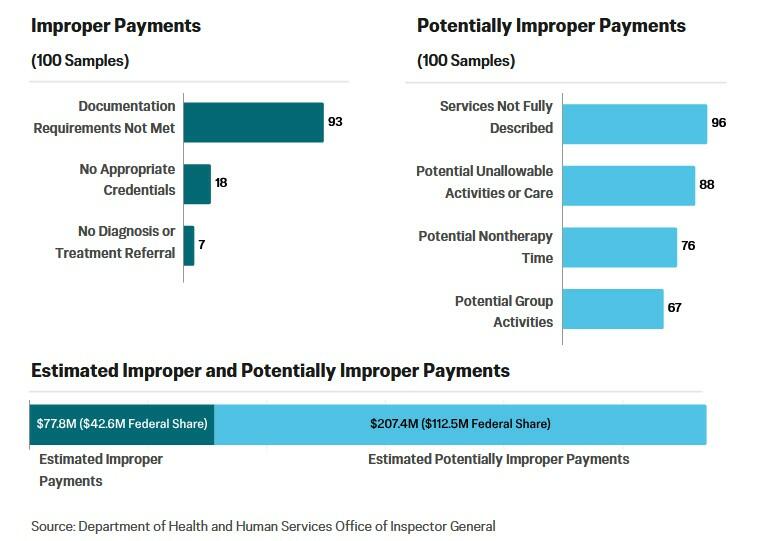
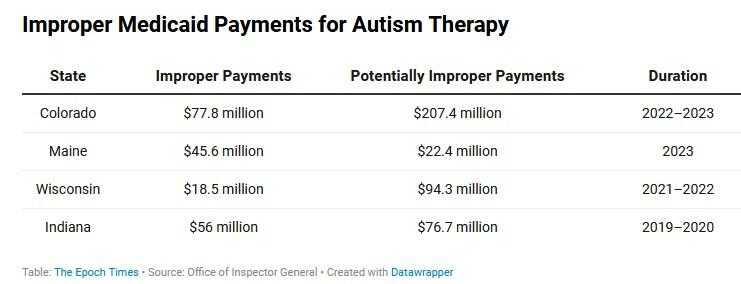
Colorado’s Medicaid program made an estimated $77.8 million in improper payments and another $207.4 million in potentially improper payments for autism therapy, according to a February report from the Inspector General for the Department of Health and Human Services.
Auditors investigated $289.5 million in Medicaid payments from 2022 to 2023 that paid for more than 1 million claims for Applied Behavior Analysis—a therapy used to treat autism and developmental disabilities.
Each of the 100 claims reviewed contained at least one improper or potentially improper payment, suggesting a 100 percent failure rate.
Improper payments are not necessarily fraudulent. Payments are considered improper when the claim does not meet federal or state requirements. Payments are potentially improper when the submitted claim is so poor or unreliable that auditors cannot verify that the services were provided correctly.
Claim Errors
In 93 of 100 claims examined, the billing providers either did not provide notes verifying that the therapy took place, didn’t provide the required signatures, or billed for more time than the notes indicated.
In 18 cases, the therapy that was supposed to be performed by a specialist—such as a Board Certified Behavior Analyst—was performed by staff without those qualifications.
In seven cases, the children receiving therapy lacked a current doctor’s diagnosis or referral on file.
In 88 cases, facilities billed for recreational activities that are not considered medical therapy, such as academic tutoring, day care, or custodial care. In one case, a facility billed for children swimming and playing on water slides.
In 76 cases, facilities billed for a full eight-hour day without subtracting time for naps, meals, or breaks.
Oversight and Safety Concerns
The report concludes that Colorado made these improper payments because it did not provide effective oversight. The state did not regularly review Medicaid payments to catch errors and failed to give clear guidance to therapy centers on how to bill or what counts as therapy.
Additionally, the state didn’t properly check if its prior authorization contractors were following the rules when approving therapy for children.
While the audit focused on money, it also uncovered problems that could affect the safety and quality of care.
Some staff members had criminal convictions for weapons offenses, assault, or driving under the influence. In one case, three staff members at a facility providing care to an 11-year-old child with autism had criminal histories.
A non-credentialed technician had a felony weapons offense conviction three months prior to treating children. A registered behavior technician had been convicted of misdemeanor assault and physical harassment, such as a strike, shove, or kick. Another behavior technician had an aggravated misdemeanor weapons conviction.
The state did not require background checks for these workers.
Previous Audits
The report comes as part of a series of seven Inspector General audits examining state Medicaid payments for autism therapy. Four are are complete and three remain in progress.
In previous audits, the agency estimated more than $120 million in improper payments and nearly $200 million in potential improper payments for Indiana, Wisconsin, and Maine.
The potential fraud, waste, and abuse in Medicaid autism therapy payments in Colorado was the highest among these audits.
The Office of Inspector General recommended that Colorado refund $42.6 million—the federal portion of the improper payments—to the federal government.
Also, the agency suggested that the state begin regular reviews of autism facilities to ensure they follow the rules and provide better training and guidance to facilities on documenting and billing for therapy.
The state of Colorado agreed to improve its guidance and conduct more regular reviews in the future, according to a statement. But it disagreed with the recommendation to refund the money, arguing that the audit derived its findings from a limited sample and didn’t have enough detail on the errors.
Further, Colorado argued that its Medicaid program does not require certification of behavior technicians before making payments, so the refund calculation based on this statute should be rescinded.
Tyler Durden
Thu, 03/05/2026 – 17:00

Of Notoriety: Orchestra concerts, ‘Woods’ on stage and Don Knotts’ daughter
The LaPorte County Symphony Orchestra continues the 2025-2026 concert season themed “America the Beautiful,” which marks the ensemble’s 53rd season and the fifth season under the direction of Dr. Carolyn Watson. This season focuses on the 250th anniversary of the 1776 signing of the Declaration of Independence, celebrating the country’s birthday with music that tells compelling stories of American resilience, joy and beauty. This weekend’s 3 p.m. Sunday, March 8 concert is the third musical program for this special season, and it’s titled “The New World,” reflecting on the themes of America’s struggles and triumphs as a young nation. Held at the Holdcraft Performing Arts Center, 1200 Spring St. in Michigan City, adult admission starts at $26 with the option of a senior rate of $23 by calling 219-362-9020 or www.lcso.net.
Kirk Muspratt is in the midst of his 25th season leading the Northwest Indiana Symphony Orchestra. (Philip Potempa/for the Post-Tribune)
MORE ORCHESTRA
The Northwest Indiana Symphony Orchestra’s music frames famed fairy tales led by Maestro Kirk Muspratt for “Spellbound!” 7:30 p.m. Friday, March 6, at Living Hope Church, 9000 West Taft St. in Merrillville. The two-part fun concert starts with Stravinsky’s “Firebird,” explaining the mysterious powers of a single feather bestowed by the mythical firebird to the story’s hero. After intermission, wicked stepsisters and a princess yet to be crowned are musically interpreted by composer Prokofiev with his famed ballet suite from “Cinderella.” Maestro leads a free gathering before the concert for the 6:15 p.m. “pre-concert discussion.” Tickets for Friday night’s “Spellbound!” concert range from $49 to $89, and a $10 student price, with the option of group sales discounts also available for 10 or more people. Call the Symphony office at 219- 836-0525 or visit the website at www.NISOrchestra.org for more information.
Storybook characters come to life with musical melodies for “Into the Woods” from March 6 to 15 at LaPorte Little Theatre. (Photo courtesy of LaPorte Little Theatre)
MORE FAIRYTALE FAVORITES
LaPorte Little Theatre, now a century old, is opening “Into the Woods,” the musical stage journey of a baker and his wife, who wish to have a child, with a crossover plot to Cinderella, who wishes to attend the King’s Festival, and Jack, who wishes his cow would give milk. When the baker and his wife learn that they cannot have a child because of the witch’s curse, the two set off on a journey to break the curse. Everyone’s wish is granted, but the consequences of their actions return to haunt them later with disastrous results. Running March 6 to 15 at LaPorte Little Theatre’s 200-seat stage space at 218 A St., tickets are $15 for students, $18 for seniors age 55 and older, and $19 for general adult admission by calling 219-362-5113 or visiting www.laportelittletheatreclub.com.
Karen Knotts, daughter of TV legend Don Knotts, brings her one-woman show “Tied Up in Knotts” back to Theatre at the Center in Munster for one performance at 3 p.m. Sunday, March 8. (Photo courtesy of Theatre at the Center)
A FAMOUS FATHER
Comedian Karen Knotts is back in Northwest Indiana this weekend to once again headline one performance of her hit one-woman stage show “Tied Up In Knotts” for her return to Theatre at the Center at 3 p.m. Sunday, March 8, in the stage space at The Center for Visual and Performing Arts, 1040 Ridge Road in Munster. Her father Don Knotts found fame and TV icon status playing nervous small-town police deputy Barney Fife on the CBS hit series “The Andy Griffith Show.” The 90-minute performance features behind-the-scenes stories from her famous dad, both his movie and TV career, the latter of which not only includes “The Andy Griffith Show,” but also his famed resurgence in the 1980s as fussy landlord Mr. Furley on ABC hit sitcom “Three’s Company,” co-starring with the late John Ritter and Suzanne Somers. Tickets to “Tied Up In Knotts starring Karen Knotts” are $40 and available by calling the theater box office at 219-836-3255 or online at www.TheatreAtTheCenter.com. There is also a special pre-show dining option in the ballroom of the CVPA before the performance. For an additional $30, guests can enjoy a special “Mayberry-themed” dinner served by 10Forty Catering and Banquets, featuring Cream of Broccoli Cheese Soup followed by Fried Chicken with Buttermilk Biscuits served with Homestyle Mashed Potatoes and Peas and Carrots, and a dessert finale of old-fashioned Peach Cobbler à la Mode. For booking the meal reservation and prepayment, guests can call the Dining and Events Office at 219-836-1930 Ext. 2.
Philip Potempa is a journalist, published author and radio show host on WJOB 1230 AM. He can be reached at PhilPotempa@gmail.com.

US Ambassador To UN Threatens Iran Counterpart: ‘Better Watch Himself In New York City’
US Ambassador To UN Threatens Iran Counterpart: ‘Better Watch Himself In New York City’
Trump’s Ambassador to the United Nations Mike Waltz has issued a veiled threat to his Iranian counterpart, and the clip is going viral, which is likely to further delay the potential for any talks toward halting the war – which at this point still seem non-existent.
The spat first erupted Sunday, when Waltz ripped into Iran’s UN Ambassador Amir-Saeid Iravani, coming just a day after Operation Epic Fury started and the bombs were unleashed on Tehran.
Walz had said at an emergency meeting of the UN Security Council, “Frankly, I’m not going to dignify this with another response, especially as this representative sits here in this body representing a regime that has killed tens of thousands of its own people and imprisoned many more simply for wanting freedom from your tyranny.”
But Walz later appeared on Fox Business, discussing the war and the exchange at the UNSC. That’s when he appeared to threaten Iravani on air, during Maria Bartiromo’s program:
“You know, I’m going to be kind here,” Waltz said, “but it wouldn’t surprise me if this guy ends up knocking on our door for asylum. This regime is falling apart, and they have abused, imprisoned, tortured their own people for far too long. They’ve threatened the world for far too long.”
Walz was then asked if he felt Iravani’s own rhetoric has posed a threat, and Waltz said the Iranian envoy had better watch himself while he’s in New York City.
“I can’t say how many American soldiers the Iranians have killed either at their hands or their proxies,” Waltz said. “I’m a Green Beret, not my first firefight, and he should be careful with his words sitting on American soil, and I’ll just leave it at that.”
Watch the on-air moment here:
NATO Ambassador Mike Waltz threatens Iran’s NATO ambassador: “Not my first firefight. He should be careful with his words sitting on American soil, and I’ll just leave it at that.” pic.twitter.com/wc4LlNigPP
— Aaron Rupar (@atrupar) March 4, 2026
The “be careful… on American soil” part of this is what’s raised eyebrows the most. Of course, UN grounds in NYC is considered international territory, and so this means Amb. Iravani is unlikely to venture too far out from the complex at this moment.
Conventionally, there’s strict international protocol in place regarding protection of diplomats and embassies, but increasingly ‘rules of war and diplomacy’ are being abandoned by all sides as the conflict spirals.
Tyler Durden
Thu, 03/05/2026 – 16:40
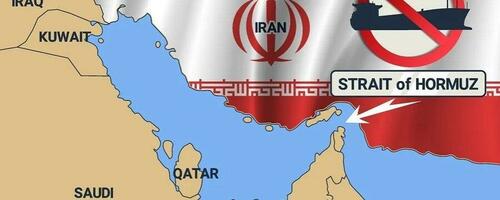
Systemic Risk: A 12-Order Cascading Analysis Of A Zero-Flow Strait Of Hormuz Closure
Systemic Risk: A 12-Order Cascading Analysis Of A Zero-Flow Strait Of Hormuz Closure
Authored by Craig Tindale via X:
Executive Summary
The modern world order, having organized itself around efficiency, cost minimization, and logistical precision, has created a machinery of dependence so extreme that the interruption of one narrow corridor can propagate outward into a general crisis of civilization.
What appears at first as a maritime blockade is in fact the exposure of the entire global system as a hierarchy of brittle interdependencies.
Oil and LNG fail as inputs into electricity, fertilizer, shipping, chemicals, mining, manufacturing, and state finance.
As an example, The global polyester chain begins in petrochemicals. A severe disruption to hydrocarbon and petrochemical feedstocks cascades into PTA, MEG, polyester resin, filament, and fabric production, causing acute shortages, price spikes, and factory stoppages across synthetic-heavy apparel segments. The industry does not vanish overnight, but the low-cost, high-volume apparel model starts to break down.
From this follows a chain whose logic is cumulative: fuel inflation becomes fertilizer inflation; fertilizer inflation becomes food inflation; food inflation becomes urban instability, sovereign subsidy exhaustion, and ultimately hunger. In this sequence, food shortages are not a secondary humanitarian issue. They are one of the central political outcomes of the crisis, because modern populations do not experience systemic breakdown first through grand strategy, but through unaffordable bread, intermittent power, empty pharmacies, and possibly the collapse of public order. A globalised Arab Spring.
In this framework, hyperinflation emerges as the social expression of real physical bottlenecks. When energy-importing states are forced to acquire dollarized fuel at any price, when currencies weaken, when fertilizer and transport costs reprice an entire harvest cycle, inflation ceases to be cyclical and becomes coercive.
It enters every household budget and every state ledger at once. The result is the destruction of planning itself: firms cannot quote, governments cannot subsidize, and populations can no longer calculate the future. Under such conditions, credit markets seize up, foreign-exchange reserves drain, sovereign spreads widen, and the boundary between economic crisis and political crisis disappears.
Modern technical systems amplify rather than dampen this disorder. The loss of sour crude becomes a sulphur and sulphuric acid crisis; that chemical crisis becomes a copper and cobalt crisis; the metals crisis becomes a transformer, switchgear, and grid crisis; the grid crisis becomes a semiconductor crisis; and the semiconductor crisis becomes a compute and data-centre crisis.
Thus, the closure of a maritime strait reaches, by entirely material means, into the server rack, the hospital network, the payment system, the electrical substation, and the defence-industrial base. The myth that digital civilization floats above heavy industry is, in this scenario, extinguished. Compute is shown to rest on copper, transformers, stable voltage, LNG, and ships.
For humanity, the systemic risk is therefore total in scope even if uneven in distribution.
The most immediate suffering falls on import-dependent and fiscally weak societies: blackouts, food insecurity, unemployment, debt default, regime stress, and mass unrest. Yet the advanced economies do not escape. They experience industrial contraction, infrastructure delays, AI and semiconductor bottlenecks, strategic stockpiling, and the permanent repricing of security over efficiency. What begins as a supply shock ends as a transformation of the political economy. States abandon the fiction of neutral markets and move toward command allocation, export controls, emergency powers, and militarized trade corridors. Market price gives way to strategic rationing. Globalization does not simply slow; it hardens into armed blocs.
The ultimate conclusion is grim : the terminal danger in this model is not one shortage, nor one recession, nor even one war-risk premium.
It is the transition from a globally integrated commercial order into a world system governed by scarcity, coercion, and administrative triage.
In such a world, hunger, hyperinflation, sovereign failure, technological stagnation, and geopolitical militarization are not separate crises.
They are the normal operating features of a civilization that has discovered, too late, that its efficiency was built on concentrated fragility. The closure of Hormuz, under this analysis, is the event through which the modern world recognizes that its supply chains were never only economic structures, but the hidden constitution of social peace itself.
A multipolar world is a very complicated and dangerous world. As always, be careful what you wish for.
Such is the risk. The whole world will be compelled to support efforts to bring this situation under control immediately. China, the US, and Europe will have to work together.
The political cycle over the coming days and weeks is going to matter like never before.
Here are 10 likely and immediate crises
Polyester -> apparel The global polyester chain begins in petrochemical feedstocks. If naphtha, paraxylene, PTA, or MEG are disrupted, polyester fiber, yarn, and fabric output contracts sharply, and synthetic-heavy apparel production starts seizing up. Chain: Petrochemicals -> PTA/MEG -> polyester -> fabric mills -> garment factories
Natural gas -> fertilizer -> food The global nitrogen fertilizer chain begins with natural gas. If gas supply is disrupted, ammonia and urea production falls, farm input costs spike, and food systems come under pressure within a single planting cycle. Chain: Natural gas -> ammonia -> urea -> crop yields -> food prices
Sour crude / sulfur -> sulfuric acid -> copper The copper and cobalt extraction chain depends on sulfuric acid, which in turn depends heavily on sulfur recovered from sour hydrocarbons and smelting. If sulfur or acid supply is disrupted, leaching operations stall and electrification inputs tighten fast. Chain: Sour crude/sulfur -> sulfuric acid -> SX-EW/HPAL -> copper/cobalt -> grids and EVs
Propylene -> polypropylene -> medical and packaging The polypropylene chain begins in petrochemicals. If propylene supply is disrupted, packaging, medical disposables, and automotive plastics face shortages, forcing manufacturers to ration output or redesign products. Chain: Propylene -> polypropylene resin -> molded parts/films -> hospitals, food packaging, autos
Salt + power -> chlorine / caustic soda -> water treatment The chlor-alkali chain begins with salt and electricity. If that system is disrupted, chlorine and caustic soda output drops, putting water treatment, sanitation, PVC, and pulp processing under immediate stress. Chain: Salt + electricity -> chlorine/caustic soda -> water treatment/PVC/paper
Natural rubber + synthetic rubber -> tires -> freight The tire industry begins with natural and synthetic rubber. If either is severely disrupted, tire production contracts, replacement cycles stretch, and trucking fleets start operating under maintenance and logistics constraints. Chain: Rubber feedstocks -> tires -> trucking fleets -> freight movement -> retail supply
Iron ore + metallurgical coal -> steel -> construction and machinery The steel chain begins with iron ore and metallurgical coal. If either feedstock is constrained, steel mills cut output, and construction, auto manufacturing, shipbuilding, and heavy machinery start absorbing delays and cost shocks. Chain: Iron ore + met coal -> steel -> beams, sheet, machinery -> construction/autos/industry
Bauxite + alumina + cheap power -> aluminum -> transport and packaging The aluminum chain begins with bauxite, alumina refining, and very large amounts of electricity. If any of those are disrupted, smelting capacity drops and packaging, aerospace, transport, and power transmission all get hit. Chain: Bauxite -> alumina -> aluminum smelting -> cans, aircraft, cable, vehicle parts
Soda ash + natural gas -> glass -> buildings, autos, solar The flat glass chain depends on soda ash, silica, and high-temperature continuous furnaces fed by stable energy. If those inputs are disrupted, glass production cannot be easily paused and restarted, and shortages hit construction, autos, and solar manufacturing. Chain: Soda ash + silica + gas -> float glass -> windows, windshields, solar panels
High-purity gases and chemicals -> semiconductors -> electronics and autos The semiconductor chain begins with ultra-pure gases, photoresists, specialty chemicals, and stable power. If those inputs are disrupted, chip yields collapse, lead times extend, and electronics, autos, telecom, and defense manufacturing start choking on shortages. Chain: Neon/photoresists/ultra-pure chemicals + stable power -> wafers -> chips -> downstream manufacturing
Section 1: The Master Cascade, An Institutional Matrix
The systematic rationalization of global supply chains has constructed an extraordinary vulnerability.
The following matrix outlines the chronological and mechanical breakdown of the global system, from initial logistical paralysis to the ultimate civilizational redesign.
Caution – Remember, these are just my own thoughts and don’t represent certainty. It’s an extrapolation of what could happen, not what will. That said, it is a serious risk warning
Order 1: Maritime Flow Interruption (0–14 Days)The mechanism is an logistical gridlock of approximately 20.9M bpd in liquids and 80 mtpa in LNG, operating against maximized bypass pipelines. The binding bottlenecks are the Saudi Petroline and UAE Habshan capacity limits, which offer a maximum of 2.8M to 3.1M bpd in spare diversion, alongside severe VLCC availability constraints. The leading indicators of this phase are prompt-month Brent crude backwardation, VLCC ton-mile rates exceeding $423k/day, and the instantaneous cancellation of P&I War Risk Insurance.
Order 2: Refining & Industrial Chemicals (2–6 Weeks)The mechanism relies on the starvation of sour crude, yielding an immediate, unmitigable global deficit in elemental sulphur by-production. The physical bottlenecks are strict toxic transport limits, local refinery storage capacities, and concurrent Russian export bans. The leading indicators are domestic Chinese sulphuric acid pricing breaching 1000 yuan/ton and the abrupt halt of Qatari sulphur exports, removing 3.8M tpa from the market.
Order 3: Mining & Metals Extraction (1–3 Months)The mechanism is a profound sulphuric acid famine that forces the halt of Solvent Extraction and Electrowinning (SX-EW) and High-Pressure Acid Leaching (HPAL) operations for copper and cobalt. The bottlenecks manifest in shallow regional acid inventory buffers and Zambian cross-border rail constraints. Leading indicators include formal force majeures declared across the DRC and Zambian copper belts, with spot acid prices in Kolwezi surging past $700/tonne.
Order 4: Grids & Power Hardware (3–12 Months)The mechanism dictates that the copper deficit exacerbates an already chronic shortage of Large Power Transformers (LPTs) and high-voltage switchgear. The bottlenecks are the highly concentrated supply of GOES (Grain-Oriented Electrical Steel), inflexible vapor-phase drying limits, and extreme OEM lead times extending to 120–210 weeks. Leading indicators are Siemens Energy and Hitachi order backlogs swelling beyond €146B, accompanied by a surging Federal Reserve Transformer Price Index.
Order 5: Semiconductor Supply Chains (11–30 Days)The mechanism involves Taiwanese LNG starvation triggering mandatory grid rationing, exposing fabrication equipment to catastrophic voltage sags. The bottlenecks are defined by Taiwan’s statutory 11-day LNG reserve limit, strict SEMI F47 tool tolerance limits, and 28-week lead times for ABF substrates. Leading indicators include Taipower’s percent operating reserve (POR) collapsing, skyrocketing TSMC wafer scrap rates, and extreme spot LNG premiums.
Order 6: Compute & Data Centers (6–18 Months)The mechanism is the violent collision of silicon supply constraints with transformer unavailability, freezing GW-scale expansions entirely. The bottlenecks are a stagnant 2,600 GW US interconnection queue and interconnection wait times extending up to 7 years in PJM and Northern Virginia. Leading indicators are the public delays of AWS and NVIDIA capex deployments, alongside the structural pausing and cancellation of hyperscaler contracts.
Order 7: Capital Markets & Credit (1–6 Months)The mechanism centers on material cost inflation driving severe margin compression, causing high-yield industrials to reprice violently. The bottlenecks are heavy industrial balance sheet leverage and the rapid draining of Emerging Market FX reserves required to secure dollarized energy. Leading indicators include Siemens Energy credit spreads widening past 300 bps, the KRW/USD exchange rate breaching 1460, and the INR hitting record lows.
Order 8: State Response Layer (13–90 Days)The mechanism involves sovereign authorities enacting SPR drawdowns and utilizing the DPA, only to be subordinated by uncompromising pipe and cavern physics. The bottlenecks are the SPR’s maximum daily hydraulic drawdown limit of 4.4M bpd and a strict 13-day lag for physical market entry. Leading indicators are US DOE spot-price indexed solicitation data and the issuance of federal mandates via the Defense Production Act.
Order 9: Trade Architecture (1–3 Years)The mechanism is the multi-year restructuring of maritime supply lines, marked by the acceleration of Petroyuan usage as dollar liquidity drains from the system. The bottlenecks are absolute global shipbuilding capacity limits, with Asian yards fully booked into 2029, and the constraints of an aging VLCC fleet. Leading indicators are surging non-dollar energy settlement volumes, newbuild VLCC orders, and shipyard utilization rates.
Order 10: Social Stability (6–12 Months)The mechanism traces extreme energy and fertilizer (ammonia/urea) inflation directly into structural food crises across Emerging Markets. The bottlenecks are the exhaustion of sovereign fiscal space and heavily import-reliant energy profiles in states like Egypt, Turkey, and Pakistan. Leading indicators include sovereign CDS spreads rupturing past 600 bps, formal EM debt defaults, and emergency IMF Extended Fund Facility interventions.
Order 11: Industrial Structure Shifts (2–5 Years)The mechanism is the forced substitution of aluminum for copper, which immediately strikes the physical and thermodynamic limits of engineering. The bottlenecks are aluminum’s inferior 61% IACS conductivity and its high thermal expansion and creep in dense grid environments and EV motors. Leading indicators are mass corporate hardware redesign announcements and shifting structural Cu/Al price ratios.
Order 12: Civilizational Redesign (5+ Years)The mechanism represents the terminal shift: the doctrine of economic efficiency is permanently subordinated to the bureaucratic mandate of resource security, resulting in industrial autarky. The bottlenecks are the limits of capital allocation, the physical militarization of supply chains, and the massive inflationary costs of near-shoring. Leading indicators are sweeping structural tariff escalations and massive strategic mineral stockpiling FIDs, such as the US Project Vault.
Section 2: The 12-Order Deep Dive
Order 1: Maritime Flow Interruption
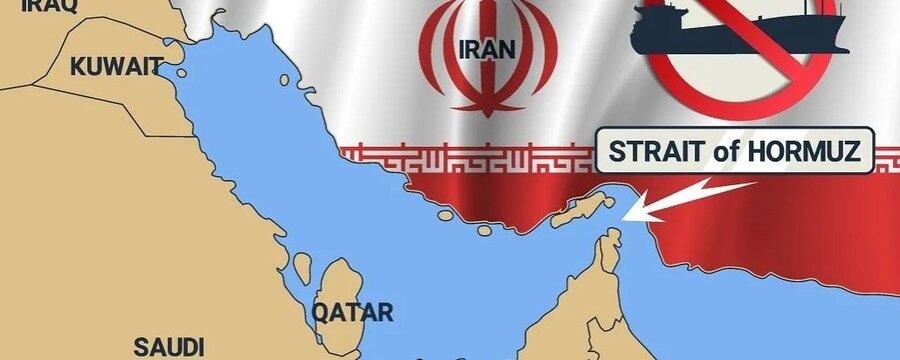
The Strait of Hormuz stands as the ultimate geographical monopoly over the global hydrocarbon economy. Its spatial reality, measuring a mere 21 miles wide at its narrowest point, with functional shipping lanes strictly demarcated by a two-mile buffer zone, constructs an unparalleled architecture of systemic vulnerability. A zero-flow closure instantaneously strands between 20.7 and 20.9 million barrels per day (bpd) of crude oil, condensate, and refined petroleum products. This volume dictates the terms of global trade, representing over 20% of global liquid consumption and more than 25% of the total seaborne oil market. Concurrently, a staggering 10.5 to 11.4 billion cubic feet per day (Bcf/d) of Liquefied Natural Gas (LNG), equating to roughly 80 million tonnes per annum (mtpa), or 20% of the entire global LNG trade, is physically trapped within the Persian Gulf. Qatar alone is responsible for 9.3 Bcf/d of this trapped volume, with an overwhelming 83% to 84% of these cargoes historically destined to feed the energy-starved industrial machines of Japan, South Korea, China, and Taiwan.
The prevailing market assumption that regional pipeline infrastructure offers salvation is mathematically false. The rationalization of bypass routes reveals severe limitations:
Saudi East-West Petroline: Boasting a nameplate capacity of 5.0 million bpd, this route from Abqaiq to the Red Sea port of Yanbu offers only an estimated ~2.4 million bpd of functional spare capacity. Crucially, the system cannot simultaneously fill buffer storage and maximize loading rates for VLCCs.
UAE Habshan-Fujairah Pipeline: Routing from Abu Dhabi to the Gulf of Oman, its 1.5 million bpd nameplate capacity is heavily constrained by existing utilization, providing a mere 0.4 to 0.7 million bpd of functional relief.
Combined, this optimal pipeline diversion achieves only 2.8 to 3.1 million bpd, guaranteeing an absolute, unmitigated physical supply deficit exceeding 17.5 million bpd of liquids globally.
The immediate bureaucratic reaction of the market is a hyper-spike in the Very Large Crude Carrier (VLCC) ton-mile multiplier. Protection and Indemnity (P&I) Clubs, the institutional gatekeepers covering 90% of global commercial tonnage, issue standard 72-hour notices of war-risk insurance cancellations. This actuarial withdrawal instantly idles upwards of 40 VLCCs and 13 LNG tankers within the Gulf. Consequently, VLCC freight rates on alternative global routes detonate. Benchmark Persian Gulf-to-China TD3 rates have previously spiked to W419 on the Worldscale index (approximately $423,736 per day) under lesser kinetic threats, pushing lumpsum US Gulf Coast-to-China voyages into the $20 million to $21.5 million range. Prompt-month backwardation on ICE Brent shatters historical norms as refineries blindly bid for survival barrels, structurally repricing the benchmark past $100/bbl, with extreme disruption models projecting a grim equilibrium between $108 and $140/bbl.
Order 2: Refining & Industrial Chemicals
The starvation of Middle Eastern crude imposes a harsh chemical calculus upon the global industrial sector. The majority of crude transiting the Strait is classified as “sour,” defined by a naturally occurring sulphur content exceeding 0.5% by weight. The bureaucratic mandate of global environmental fuel standards dictates that refineries must subject this crude to rigorous hydrodesulfurization, predominantly utilizing Claus technology, which operates at an inflexible 98% recovery efficiency. Thus, the petroleum sector operates as the world’s primary, involuntary producer of elemental sulphur.
The sudden erasure of 17.5 million bpd of sour Gulf crude, coupled with the shutdown of integrated gas-processing megaliths, like QatarEnergy’s Ras Laffan complex, which processes 10,000 tonnes of liquid sulphur daily, removes an exact 3.8 million tonnes of annual sulphur capacity from the global balance. This eliminates approximately 8% of the worldwide seaborne sulphur trade overnight.
This void immediately throttles the $35.13 billion global sulphuric acid (H₂SO₄) industry. As the foundational chemical for modern rationalized industry, it is non-negotiable for phosphate fertilizer production, wastewater treatment, and metallurgical leaching.
Pricing Volatility: The market responds with merciless volatility. Domestic Chinese smelter-grade sulphuric acid prices possess the proven capacity to surge 113% year-over-year, vaulting from 400 yuan/ton to over 1,170 yuan/ton during minor historical mismatches. Under a Hormuz closure, these numbers will shatter records.
Logistical Constraints: Sulphuric acid is toxic, highly corrosive, and ensnared in transport regulations. Global inventory coverage is perilously thin, measured in mere days or weeks. Furthermore, geographical arbitrage is physically impossible; the substance requires specialized, lined railcars and designated chemical tankers. Import-dependent industrial sectors are simply stranded by the physics of transport.
Order 3: Mining & Metals Extraction
The cascading sulphuric acid famine systematically paralyzes hydrometallurgical base metal extraction, inflicting acute devastation upon the Central African Copperbelt.
DRC & Zambia Exposure: The Democratic Republic of the Congo (DRC) and Zambia stand as the indispensable pillars of electrification, commanding approximately one-sixth of global copper output (the DRC producing 3.3 million tons, Zambia 680,000 tons in 2024) and over 70% of global cobalt supply. This output is entirely captive to the chemical requirements of Solvent Extraction and Electrowinning (SX-EW) for oxide copper ores, and High-Pressure Acid Leaching (HPAL) for cobalt and nickel. Both demand a relentless, uninterrupted deluge of sulphuric acid.
Acid Buffers and Force Majeure Risks: The region is structurally deficient in sulphur. The DRC alone is forced to import over 500,000 tonnes of elemental sulphur annually to feed its local sulphur-burning acid plants. In a zero-flow scenario, these seaborne imports vanish. Zambia will inevitably execute a sovereign override, instituting acid export bans to protect its domestic mining survival. Survival becomes a function of vertical integration: Ivanhoe Mines’ Kamoa-Kakula complex relies on a captive direct-to-blister smelter producing 1,200 tonnes per day of 98%-pure acid (400,000 tonnes annualized), offering a rare operational fortress. Conversely, standalone SX-EW and HPAL operations face mandatory force majeure as regional spot acid prices in Kolwezi violently breach $700 per tonne.
Chilean Contagion: Across the Pacific, Chile’s state-owned Codelco relies on bacteria-assisted bioleaching and SX-EW processes at colossal sites like Escondida, sustained by acid recycled from local solvent extraction and domestic smelting. Yet, as global acid prices ascend to unprecedented heights, merchants are heavily incentivized to export acid rather than supply domestic Chilean operations, forcing an artificial structural slowdown across South America’s primary copper veins.
Order 4: Grids & Power Hardware
The resulting base metal deficit collides with the pre-existing gridlock of the heavy electrical equipment supply chain. The rationalized goals of the renewable energy transition and the explosive electrification of AI data centers are entirely beholden to the availability of Large Power Transformers (LPTs) and high-voltage metal-clad switchgear.
OEM Backlogs & Lead Times: The manufacturing oligopoly, Siemens Energy, Hitachi Energy, and GE Vernova, is operating against the hard limits of physical capacity. Siemens Energy reported a staggering, record-breaking total order backlog of €146 billion in early 2026, driven by a 21.8% year-over-year surge in its Grid Technologies division. Capital interventions are underway, Hitachi Energy’s $1.5 billion injection into Virginia and Poland, and Siemens Energy’s €220 million Nuremberg expansion, but capital cannot instantly alter physical reality. Consequently, LPT lead times (100 MVA and above) have stretched from a historical baseline of 50 weeks to a new norm of 120 weeks, with ultra-high-voltage units demanding up to 210 weeks, or over four years of waiting.
The GOES Bottleneck: The ultimate constraint is not merely copper, but Grain-Oriented Electrical Steel (GOES), an engineered iron-silicon alloy requisite for minimizing magnetic core transmission losses. In the US, this supply is a functional monopoly dictated by Cleveland-Cliffs. Scaling the production of premium ultra-thin GOES (below 0.27 mm) requires glacial multi-year qualification cycles and prohibitive capital outlays of $500 to $700 million for bell-anneal lines.
Chemical/Physical Limits: LPT manufacturing cannot be optimized through software. The vapor-phase drying process required for the transformer core’s cellulose insulation is an inflexible chemical curing cycle. It submits to the laws of chemistry, not the agile demands of the market.
Order 5: Semiconductor Supply Chains
Taiwan’s structural energy procurement framework ensures that the entire global semiconductor supply chain is acutely exposed to the mechanics of a Hormuz closure.
LNG Starvation: The island’s industrial apparatus requires importing nearly 98% of its total energy, with state-owned Taipower relying on LNG for 42% to 47% of its total electricity generation. Crucially, roughly 30% of this LNG is sourced directly from Qatar. The vulnerability is legally hardcoded: Taiwan’s statutory security storage requirement for LNG is a critically low 11 days. A cessation of Qatari flows, met by a desperate global bid for Atlantic cargoes, guarantees that Taipower’s percent operating reserves (POR) will collapse within two weeks. The inevitable bureaucratic response is mandated grid rationing and rolling industrial brownouts.
Voltage Sag Tolerance Limits: The foundries of the Taiwan Semiconductor Manufacturing Company (TSMC) demand absolute electrical perfection. Governed by the SEMI F47-0706 standard, advanced semiconductor processing and metrology tools are engineered to withstand voltage sags of 50% for exactly 200 milliseconds (0.2 seconds), 70% for 0.5 seconds, and 80% for 1 second. Historical precedent at the Hsinchu Science Park proves that a microsecond drop of a mere 0.1 seconds (at 79% to 95% nominal voltage) triggers massive internal tool failures, resulting in the catastrophic scrapping of tens of thousands of wafers and hundreds of millions in vaporized capital.
ABF Substrate Chokepoints: Simultaneously, the advanced packaging of completed silicon faces an intractable chemical bottleneck. Ajinomoto Build-up Film (ABF) substrates, the essential insulators for high-performance computing, are trapped behind 28-week lead times. The laser-drill capacity required to manufacture them is monopolized by LPKF Laser and Mitsubishi Electric, both groaning under 18-month backlogs. This restricts key suppliers like Ibiden and Shinko Electric, choking the final assembly lines of NVIDIA and AMD.
Order 6: Compute & Data Centers
The intersection of Order 4 (transformer gridlock) and Order 5 (silicon fabrication failures) imposes a hard, mathematical stop upon the AI infrastructure supercycle.
Interconnection Queues: The institutional forecast for US summer peak demand growth skyrocketed to 166 GW in 2025, with data centers commanding 55% of this burden. The bureaucratic reality is a massively overloaded US interconnection queue, suffocating under 10,300 projects representing a 2,600 GW backlog. The friction of unpredictable delays and exorbitant grid upgrade costs has driven the project withdrawal rate to nearly 80%.
Time-to-Power Constraints: In critical digital geographies like Northern Virginia (the PJM footprint), GW-scale facilities face power interconnection wait times extending up to 7 years. Hyperscalers, AWS, Google, Meta, attempt to circumvent this reality by purchasing land for behind-the-meter gas generation. Yet, without the physical delivery of high-voltage switchgear and LPTs, these commercial operation dates are entirely fictitious. The metric of “speed-to-power” becomes an impossibility, threatening widespread capital expenditure cancellations and leaving billions locked in sterile real estate and dormant silicon.
Order 7: Capital Markets & Credit
The failure of physical supply chains translates directly into the financial system via rapid, unrelenting corporate margin compression and the vaporization of foreign exchange liquidity.
High-Yield Repricing: The heavy industrial conglomerates that build the world’s architecture are the first to absorb material inflation. Siemens Energy, bound by complex global execution and wind turbine logistics, has previously watched its bonds widen beyond 300 bps over mid-swaps, trading worse than BB+ high-yield peers, due to fixed-price contract overruns. As copper and specialized steel costs enter hyper-inflation, these OEM contracts bleed cash, ensuring credit downgrades and structural debt restructuring across the sector.
EM FX Depletion: Emerging markets tethered to dollar-denominated oil imports face the brutal mathematics of FX reserve depletion. At $100+ per barrel, central banks must hemorrhage dollar reserves merely to sustain baseline domestic survival. Currency acts as the immediate shock absorber. The South Korean Won (KRW) possesses high beta sensitivity to energy, previously surging past 1,462 per dollar during kinetic shocks. The Indian Rupee (INR) and Thai Baht face identical downward violence, embedding imported inflation deep into the domestic economy and obliterating local liquidity.
Order 8: State Response Layer
Faced with the collapse of the market mechanism, sovereign entities assert their monopoly on power through strategic overrides. Yet, these decrees remain strictly bounded by the inflexible laws of physics and hydraulic engineering.
US Strategic Petroleum Reserve (SPR) Limitations: The US SPR houses approximately 411 million barrels inside 61 engineered salt caverns across Texas and Louisiana. Politically, it is a weapon; physically, it is a pipe. The absolute maximum nominal hydraulic drawdown capability is strictly capped at 4.4 million bpd. Furthermore, the bureaucratic friction of execution ensures a 13-day lag from Presidential signature to physical market entry. Consequently, running at maximum stress, the SPR replaces only ~25% of the 17.5M bpd global shortfall. The system remains fundamentally starved. Prolonged extraction at these rates also risks severe dilatant and tensile stresses, threatening the structural integrity of the salt walls themselves.
Defense Production Act (DPA): The executive branch will inevitably invoke the DPA to forcibly reallocate domestic GOES and LPT production toward critical defense and civilian grid triage. However, administrative edicts cannot accelerate the chemical curing time of transformer insulation, nor can they summon specialized metallurgical engineers or conjure the heavy-haul railcars necessary to move 400-ton monoliths. The DPA does not create new supply; it merely engineers a rigid reallocation of poverty.
Order 9: Trade Architecture
The irrecoverable loss of the Persian Gulf corridor demands a multi-year restructuring of global maritime routes, exposing the severe limitations of global shipbuilding capital.
Shipbuilding Limits: The capacity to forge new vessels is heavily monopolized, with Chinese yards controlling 46% of total capacity (securing over 68% of new orders in late 2025) and South Korea commanding 25%. Western attempts to commission smaller bypass tankers or dedicated US-to-Asia LNG carriers hit an unyielding wall: premier Asian shipyards are entirely booked through 2028, with delivery cycles for high-end vessels dragging into 2029. The global VLCC fleet cannot rapidly scale to absorb the massive ton-mile inflation of Cape of Good Hope routing; effective fleet growth is structurally capped below 3% annually, compounded by the reality that nearly 20% of existing VLCCs are over 20 years old and destined for the shadow fleet or the scrapyard.
Petroyuan Acceleration: As dollar liquidity evaporates from the treasuries of Emerging Markets (Order 7), China deploys its strategic petroleum reserves and dominant refining infrastructure to exert geopolitical leverage. By issuing yuan-denominated swap lines to distressed Asian neighbors in exchange for refined products or access to overland Russian pipelines, Beijing forces the structural de-dollarization of East Asian energy trade, cementing the Petroyuan as the dominant mechanism for crisis survival.
Order 10: Social Stability
The inflation of core energy inputs directly degrades agricultural yields, efficiently translating a logistical bottleneck into a humanitarian catastrophe. Natural gas serves as the indispensable chemical feedstock for ammonia, the basis of urea and complex nitrogen fertilizers.
Fertilizer Shocks: With 40% to 50% of the world’s internationally traded nitrogen-based fertilizers originating from or passing through the Gulf, a Hormuz closure dictates an immediate, violent spike in agricultural input pricing. This mathematically guarantees elevated global food prices within a single harvest cycle.
Sovereign Debt Defaults: Sovereigns bearing high debt burdens and heavy import reliance face immediate insolvency as they attempt the impossible task of subsidizing fuel and food for their populations. Egypt, currently navigating an $8 billion IMF Extended Fund Facility with structural inflation and high LNG reliance, and Turkey, battling 10-Year Government Bond yields exceeding 31%, sit on the precipice of ruin. Their sovereign Credit Default Swap (CDS) spreads will violently breach the 600 bps distress threshold as FX reserves vanish. The sheer inability to procure fuel and fertilizer guarantees widespread power rationing, collapsing food security, and profound social unrest across North Africa and South Asia.
Order 11: Industrial Structure Shifts
Desperate to circumvent base metal scarcity (Order 3) and spiraling grid hardware costs (Order 4), the industrial complex attempts mass material substitution. The pivot from copper to aluminum, however, crashes instantly into the uncompromising laws of thermodynamics.
Conductivity and Spatial Limits: Aluminum offers a mere 61% of copper’s electrical conductivity on the IACS scale. To transmit an identical electrical current, the aluminum conductor demands a 1.6x larger cross-sectional area. In the spatial austerity of EV drivetrains, aerospace architecture, and high-density AI server racks, accommodating this added bulk is a physical impossibility without initiating multi-year, ground-up engineering redesigns.
Thermal Loads and Creep: Aluminum’s thermal conductivity is severely deficient (237 W/mK against copper’s 401 W/mK), failing to dissipate heat under high-load conditions. Moreover, aluminum exhibits a profound susceptibility to thermal expansion and “creep”, the cold flow away from pressure. Subjected to the intense mechanical vibrations of electric motors or industrial generators, this creep guarantees loose connections, spiking electrical resistance, and catastrophic fire hazards. Substitution is not an agile pivot; it is a hazardous, multi-year engineering commitment.
Order 12: Civilizational Redesign
The terminal phase of the cascade marks the permanent institutionalization of a new paradigm: “economic efficiency” is eradicated, replaced entirely by the doctrine of “resource security.” The illusion of Just-In-Time global logistics is shattered. Capital allocation pivots with extreme prejudice toward autarkic industrial policy. Sovereign wealth funds and defense budgets are forced to internalize the astronomical premiums of near-shoring critical supply chains, evidenced by policies like the US government’s $12 billion “Project Vault” to hoard domestic cobalt and sever Chinese dependencies.
To safeguard what remains of international trade, alternative maritime chokepoints, such as the Strait of Malacca and the Panama Canal, submit to overt, permanent naval militarization. The rationalized global economy formally fragments, abandoning the pursuit of free trade to operate as a system of heavily armed, partitioned, and aggressively redundant macro-blocs.
Section 3: Scenario Stress-Test Matrix
Subjecting this architecture to distinct temporal stresses reveals the precise breaking points of the global system.
Scenario A: Short Shock (≤ 14 days)
Top 5 Binding Constraints: The absolute physical stranding of 17.5M bpd of oil and 80 mtpa of LNG. Total withdrawal of P&I Club War Risk Insurance, instantly freezing off-shore tanker movement. Taiwan’s precarious 11-day statutory LNG reserve limit. The US SPR’s rigid 13-day temporal lag to physically inject its 4.4M bpd maximum into the market. Maximum functional bypass pipeline limits (Saudi/UAE capped at ~3.1M bpd).
First Two Structural Breaks: Spot LNG Markets: Panic buying shatters TTF and JKM pricing ceilings as European and Asian utilities irrationally bid up Atlantic cargoes to secure baseload survival. Taiwanese Grid Stability: Breaching the 11-day LNG buffer forces Taipower’s percent operating reserves (POR) below critical thresholds, necessitating immediate rolling blackouts across industrial zones.
Dominant Macro-Drivers: Orders 1 (Maritime Logistics), 5 (Semiconductor Power Security), and 8 (State SPR Response).
Scenario B: Medium Shock (1–3 months)
Top 5 Binding Constraints: Extreme depletion of EM Foreign Exchange reserves (KRW, INR) driven by dollar-denominated energy hyper-inflation. Global elemental sulphur shortage resulting from the total removal of Qatar’s 3.8M tpa capacity. Spot sulphuric acid prices (>1000 yuan/ton) obliterating the operating margins of base metal refiners. SEMI F47 voltage sag limits (50% drop for 0.2 seconds) breached at TSMC fabs due to sustained Taiwanese grid rationing. Codelco and African Copperbelt SX-EW hydrometallurgical operations forced into shutdown due to chemical starvation.
First Two Structural Breaks: Advanced Node Semiconductor Yields: Microsecond voltage sags across Taiwan trigger massive wafer scrap events and equipment recalibration delays, crippling advanced AI chip output. Base Metal Mining Force Majeures: SX-EW copper and HPAL cobalt mines in the DRC and Zambia officially issue force majeure as toxic sulphuric acid cannot physically be transported fast enough to replace local deficits.
Dominant Macro-Drivers: Orders 2 (Industrial Chemicals), 3 (Mining Extraction), and 7 (Credit & FX).
Scenario C: Long Shock (≥ 6 months)
Top 5 Binding Constraints: LPT lead times extending structurally beyond 210 weeks as copper input supply lines fail. Absolute exhaustion of global GOES production capacity and specialized bell-anneal capital expenditures. The 2,600 GW US interconnection queue permanently frozen due to the total lack of high-voltage switchgear. Sub-3% global VLCC fleet growth capacity, tightly restricted by Asian shipyards booked entirely through 2029. The thermodynamic impossibility of rapidly substituting aluminum for copper in high-thermal load EV and AI hardware.
First Two Structural Breaks: AI/Compute Capex Freeze: Hyperscalers (AWS, Meta) and semiconductor developers (NVIDIA) cancel multi-billion dollar deployments as the lack of switchgear and LPTs shoves commercial operation dates into the next decade. Emerging Market Sovereign Default: Heavily exposed nations (Turkey, Egypt, Pakistan) completely exhaust their fiscal space attempting to subsidize imported ammonia/urea and diesel, triggering systemic CDS defaults and requiring emergency IMF bailouts.
Dominant Macro-Drivers: Orders 4 (Grid Hardware), 6 (Compute Scaling), 10 (Social & Sovereign Stability), and 11 (Industrial Redesign).
Section 4: Terminal Stopping Rule
The 12-Order Cascading Systems Shock ceases to function as a predictive analytical framework beyond Order 12 because the causal pathways abandon exogenous linearity and become entirely endogenous and recursive.
Upon reaching Civilizational Redesign (Order 12), the panicked interventions of sovereign states and industrial monopolies generate infinite feedback loops that rewrite the foundational variables. The starvation of copper (Order 3) ensures the permanent halt of LPT production (Order 4), which directly barricades heavy electrical grid expansion (Order 6). Lacking grid expansion, the massive baseload power required to drive advanced smelting, desalination, and mining operations (Order 3) is suffocated, locking the system into a self-consuming industrial death spiral.
Furthermore, as the state apparatus enforces autarkic industrial policies and militarizes supply lines, the traditional metrics of market equilibrium, price elasticity, and marginal cost evaporate. Prices are no longer discovered; they are dictated by state decree, retaliatory export bans, and strategic hoarding (as demonstrated by China’s domestic sulphur export caps and the US execution of Project Vault).
Predictive quantitative macroeconomics shatters against this reality. Standard modeling of lead times and material substitution fails because commodities are transformed into direct kinetic weapons, and maritime trade routes submit to naval dominance rather than arbitrage. Thus, beyond Order 12, the paradigm shifts entirely: the global system can no longer be modeled as a supply-chain shock; it must be understood as the permanent bureaucracy of geopolitical total war.
Tyler Durden
Thu, 03/05/2026 – 16:20

‘Transformative’ tech: How AI is plugging in to doctor’s offices and emergency rooms
An extra set of eyes on radiology scans, double-checking for signs of prostate cancer. A green light telling surgeons when it’s safe to operate on trauma patients. A reminder system that finds and flags test results that need to be followed up on.
Artificial intelligence has bounded into the mainstream, into personal lives, classroom assignments and work meetings — so it should be no surprise to find it in doctors’ offices and emergency rooms, too.
Nationwide, according to a federal brief, hospitals’ use of AI tools is growing rapidly. In 2023, 66% of hospitals used predictive AI tools in their electronic record systems. A year later, that number was up to 71%.
As AI saturates nearly every aspect of our modern world, some medical applications run directly parallel to the types of tools we’re already familiar with. Many doctors, for instance, are using AI tools to listen to, transcribe and summarize their patient visits. Medical offices are using automated scheduling tools to navigate patient appointments and cancellations.
These administrative tools, while not the most exciting, are proving to be hugely important. By reducing medical providers’ workloads, these tools can help curb physician burnout, a problem that has plagued the medical field for years.
But in the field of medicine, there are also much more dynamic — and controversial — applications.
Artificial intelligence tools can be used in clinical processes and decision-making, too, interfacing either directly with patients or with those patients’ care plans. The people who are working most closely with the development and implementation of these tools are excited. There are so many backstops that AI can provide, they say, to keep medical providers from making mistakes and to help understaffed emergency rooms respond more effectively to patient needs.
Many of these tools are either in use or under development at North Texas hospitals, too.
The people who are most excited about AI in health care describe the technology as “transformative.”
As AI continues to evolve, day by day, the central question for health care leaders — including those in Texas — is no longer whether or not they’ll use the technology in their medical facilities. The question, now, is how they’ll make sure the technology is improving patient care instead of imperiling it.
The caveats
AI tools of all sorts come with caveats.
ChatGPT, among the most popular consumer-facing AI tools, has a caveat written at the bottom of the webpage. “ChatGPT can make mistakes,” the message says. “Check important info.” Google’s AI tool contains a caveat, too, in a sidebar. “Generative AI is a work in progress and info quality may vary,” it says.
AI mistakes or hallucinations may not have life-altering consequences when a user is looking for help rewriting emails or optimizing a to-do list. When AI tools are applied to medical diagnosis and decision-making, though, the stakes are significantly higher.
That’s part of why doctors and other health leaders emphasize that AI tools, at this stage in their evolution, are meant to assist medical professionals — not replace them.
Xiaoqian Jiang — a researcher and the director of the Center for Secure Artificial Intelligence for Healthcare at the University of Texas Health Houston — said that many of the existing tools perform well in straightforward medical cases. The same isn’t yet true, though, for complex cases.
“I think we are on the edge, but many of the models we currently have are still not actually to the level of the expert,” Jiang said. “A lot of the time, sophisticated scenarios still need human judgment.”
Even tools that do work well can still make mistakes or erroneous connections, which a human eye may be able to suss out before any damage is done.
AI is evolving rapidly, though, and in many ways it’s developing outside the boundaries of existing rules and regulations.
Dr. Ryan Choudhury, a hospice and geriatrics physician at University of North Texas Health Fort Worth, said he thinks AI has outpaced governmental and safety regulations.
“It feels like the government is probably five years behind on where they need to be in terms of legislating and helping guide what this looks like,” Choudhury said.
A number of health experts pointed to liability law as one protection mechanism.
From a legal perspective, doctors remain responsible for the care they provide, no matter what outside tools they’re using.
Angela Clark is the director of the Urology Research & Education Foundation. The organization was created by Dr. Pat Fulgham, a urologist who practiced at Texas Health Presbyterian Hospital Dallas for 35 years.
Clark and Fulgham said doctors’ legal liability is a built-in protection mechanism, preventing providers from leaning too heavily on AI tools.
“The providers are still held accountable, liable, for whatever they diagnose,” Clark said.
“Or fail to diagnose,” Fulgham added.
Even with those caveats on AI, experts say there are myriad ways the tools can help doctors do their jobs better. And there are some things, AI proponents say, that these tools can do even better than a human doctor can.
The applications
Even just looking at clinical and patient care applications, there are more potential uses of AI tools than could be covered in any one article.
But Dallas-Fort Worth doctors and health care leaders gave some examples of applications they’re focusing on, to give a sense of what role AI could increasingly play in the U.S. health care system.
Fulgham said there are AI tools that double check radiology scans to identify risk factors that a human radiologist might have missed. That could help to ensure accurate diagnosis of prostate cancer, he said.
“It’s not meant to replace the radiologist,” Fulgham said, “but it may point out something that was inobvious to them.”
Similarly, there are tools that can look over a biopsy and assist a pathologist in determining how aggressive of a cancer a patient has. That information can then be used to inform a treatment plan.
Dr. Brett Moran, the chief health officer at Parkland Health, which is Dallas County’s public hospital system, pointed to another soon-to-be implemented tool, which has its roots in a problem he’s seen firsthand.
Years ago, Moran said, a patient came into the emergency room for chest pain. The medical staff sent the patient for a CT scan, primarily to look for blood clots. The scan turned up no blood clots, but there was a small nodule in the patient’s lung. Separately from the chest pain, the staff told the patient, he should follow up on that nodule.
“In all the hoopla of the ER,” Moran said, “it didn’t sink in.” The patient didn’t go for follow-up scans.
A year later, the patient was admitted to Moran’s care. The patient had cancer and, by then, it had spread through his body.
“It’s a story that we’ve seen too often, and it really bothered me and it stuck with me,” Moran said. “This isn’t a single doctor that failed, this is a system failure.”
Parkland now has a team that follows up manually with patients, based on flags that have been raised by radiologists and other medical providers. But when a provider is treating a specific problem, and trying to juggle a large number of patients, they may forget to go back through scans and flag unrelated issues.
“What we needed was a more automated solution,” Moran said.
Soon, Moran said, Parkland will switch on an AI tool built by the Parkland Center for Clinical Innovation . The tool will look through the interpretations of medical scans and flag potential follow-ups that patients might otherwise miss.
It’s an example of an area where AI can shine.
The tool is not necessarily more accurate or smarter than the medical providers — but it’s indefatigable. It won’t forget to go back through the scans. It won’t be swayed by the tedious work of sorting through a ream of documents. It won’t get tired of the repetition.
It’s also an example of a tool or process evolving to include AI, as the technology has developed.
Joe Longo — chief digital information officer at Parkland Health — and James Gaston — chief data officer at Parkland — say the health system has a wide variety of AI tools already in use.
Some, such as an early warning system that alerts providers when a patient is heading toward coding, have been in use for years. The original version of the system wasn’t called “artificial intelligence” at the time it first rolled out, but it falls into that category now.
The goal of that system, and the other tools that Parkland and the Parkland Center for Clinical Innovation are working on, is to solve an actual problem in the hospital. AI tools are capable of all sorts of things. But if those tools are providing a solution where there is no problem, then they aren’t particularly useful to a health system.
“All the vendors are throwing spaghetti at the wall right now,” Gaston said. “We’re trying not to just spend money and be excited about AI; We’re trying to make sure we’re delivering that value for the organization, for our patients.”
Reality vs the ‘hype cycle’
When health leaders try to explain the potential impact of AI, they speak in sweeping terms.
Several health experts who talked to The Dallas Morning News compared it to electronic health records, which were adopted on a widespread basis about a decade and a half ago. The transition from paper to digital records was a massive lift for governmental and health organizations.
Longo, at Parkland, went back a bit further.
“I would parallel it to the advent of the internet,” he said.
There are some who worry that the transformative power of AI in health care might be exaggerated, at least based on what’s in use now. Paige Nong, a researcher and assistant professor in the University of Minnesota School of Public Health, said the majority of in-use tools are on the administrative and operational side of things, rather than patient care.
“There is so much public hype and excitement about AI,” Nong said, “and the claims that are made in public-facing ways are often a little misaligned with what’s actually happening in the health care system.”
There are also reasons to be cautious about the tools that are patient-facing: A tool that’s still in development, for instance, might sound like it’d be an amazing help to hospitals. But if it doesn’t actually work, then it might actually make things worse instead of improving them.
Nong pointed to one notorious instance. The massive health records company Epic Systems rolled out a tool that claimed to be able to predict sepsis. Sepsis is the body’s extreme and life-threatening reaction to a major infection, and it’s a significant threat to hospitalized patients.
But when journalists and researchers looked into the tool, they found that it did not work as advertised. (Epic Systems later revamped the tool, according to a STAT News report that followed up on the outlet’s investigations.)
Jiang, at UTHealth Houston, has seen a similar example firsthand.
At a competition for a sepsis prediction tool, he saw models that used, as a top prediction measure, whether the patient had their blood drawn in the middle of the night. But a blood draw in the middle of the night won’t lead to sepsis; It’s instead an indication that a medical provider is already concerned about the patient’s health.
“This is not a biological feature, but a human artifact,” Jiang said. “Probably the nurses already realized, otherwise nobody goes to the bed and draws blood.”
Longo, for his part, is aware of the possibility of getting swept up in a “hype cycle.” But he thinks the excitement around AI in health care is more than just that.
“I’m not one that gets overexcited about new things,” Longo said, pointing to the recent blockchain frenzy and noting that he pushed back on the excitement about that technology.
“Every year or two, people get amped up over certain new technologies,” he said. “Machine learning and AI, that’s the first one where I’m saying, ‘This has legs to be transformative.’”
https://www.chicagotribune.com/2026/03/05/ai-doctors-offices-emergency-rooms/

Venezuela espera que el Clásico Mundial sea una celebración, incluso en suelo de US
Por TIM REYNOLDS
MIAMI (AP) — Omar López se presentó con una gorra con la bandera venezolana cosida en un costado. A unos metros a su izquierda, había bandera estadounidense.
Les guste o no mezclar el deporte y la política, está pasando.
El Clásico Mundial —ya en marcha en Tokio— continuará el viernes en tres sedes, incluida Miami. Y, como era de esperarse, el equipo de Venezuela es una de las principales atracciones para los partidos en el sur de Florida, de fuerte presencia latina.
Que los eventos deportivos tengan vínculos geopolíticos no es nada nuevo, pero la situación que enfrenta el equipo venezolano —dirigido por López— en este torneo es inusual. Estos partidos llegan dos meses después de que Estados Unidos ejecutara una operación militar en Venezuela para capturar al líder depuesto Nicolás Maduro y llevarlo a Nueva York para que enfrente cargos por narcotráfico.
“Voy a ser honesto con ustedes”, recalcó López el jueves. “He trabajado en el béisbol durante 28 años y no hablo de cosas políticas, para ser sincero. Estoy aquí para hablar de nuestro equipo venezolano”.
Cuando la noticia de la captura de Maduro se filtró en las primeras horas de la madrugada del 3 de enero, muchos venezolanos salieron a las calles a celebrar. De acuerdo con estimaciones del Censo de Estados Unidos, unas 200.000 personas que se identifican como provenientes de ese país viven en el área de Miami-Fort Lauderdale.
Gran parte de esos festejos se concentraron en el suburbio de Doral, en Miami, que tiene la mayor población venezolana del sur de Florida y que además es donde el presidente Donald Trump es dueño de un resort de golf que albergará la cumbre del G20 este año.
Y, a juzgar solo por la cantidad de boletos disponibles y sus precios de reventa en internet, los cuatro partidos de Venezuela en el loanDepot Park entre el viernes y el miércoles atraerán a grandes multitudes.
“Estoy súper feliz, súper feliz de estar aquí en mi ciudad”, comentó el utility de los Marlins Javier Sanoja. “Me encanta Miami porque es lo más cerca que tenemos de nuestro país, y verla llena de venezolanos me llena de orgullo”.
Eso no será así solo para los venezolanos, por supuesto. Eventos como el Clásico Mundial están diseñados para avivar el orgullo nacional, incluso en tiempos inusuales tanto en Estados Unidos como en el extranjero.
El torneo comienza a menos de una semana de que Estados Unidos e Israel lanzaran ataques conjuntos contra Irán para iniciar una nueva guerra en Oriente Medio. Estados Unidos disputa sus partidos de grupo del Clásico Mundial en Houston; Israel juega los suyos en Miami. Cuba —un adversario político de larga data de Estados Unidos— debuta en San Juan, pero podría llegar a Miami si avanza en la fase de grupos. Y todo esto, además del Mundial de fútbol más adelante este año, ocurre en medio de una ofensiva contra la inmigración que hace que algunos se pregunten si siquiera es seguro intentar visitar Estados Unidos.
No se observaron protestas notorias fuera del estadio en Miami el jueves, cuando los equipos entrenaron, y se desconoce si habrá algún tipo de evento con carga política, ya sea dentro o fuera del recinto, cuando se jueguen los partidos en los próximos días.
___
Deportes AP: https://apnews.com/hub/deportes