Category: News

U.S. Wheat Crop Forecast To Hit Half-Century Low As Drought Hits Breadbasket
U.S. Wheat Crop Forecast To Hit Half-Century Low As Drought Hits Breadbasket
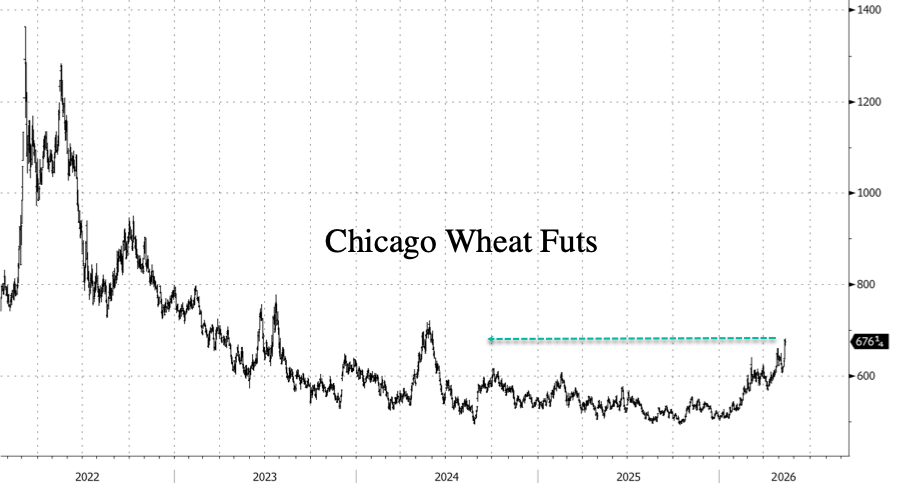
Chicago wheat futures surged on Tuesday, hitting two-year highs after the USDA’s latest WASDE report signaled a much tighter U.S. supply outlook than traders had anticipated.
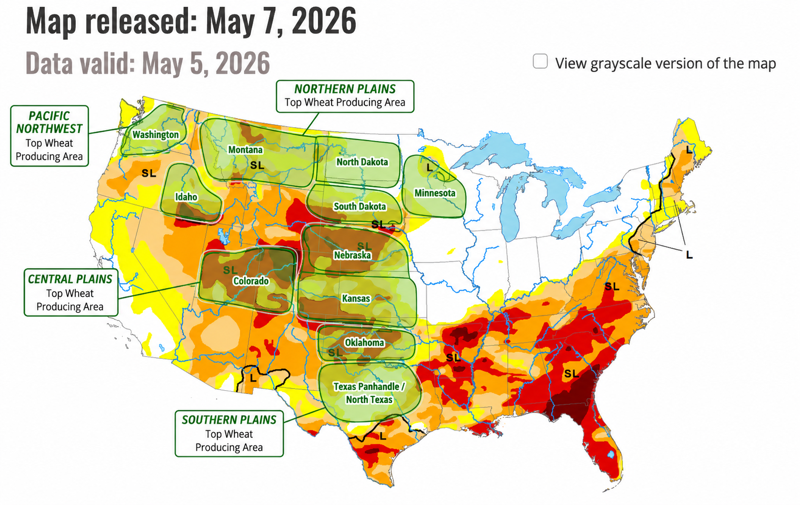
Production stress across America’s breadbasket is now converging with a megadrought and mounting fertilizer constraints, adding upward pressure on prices at a time when global food prices are rising.
🌾Due to poor crop health and a record-low planted area, the United States will produce the smallest wheat volume since 1972.
2026 winter wheat output (67% of total output) by class is seen at the lowest levels since:
All winter: 1965
Hard red winter: 1957
Soft red winter: 2020 pic.twitter.com/OcIP3DA0VS
— Karen Braun (@kannbwx) May 12, 2026
The USDA forecast 2026/27 U.S. all-wheat production at 1.56 billion bushels, sharply below Wall Street expectations of around 1.74 billion, marking the smallest harvest since 1972.
🇺🇸The U.S. in 2026 is set to harvest the smallest wheat crop in 54 years.
Weather has challenged winter wheat this year and condition ratings have plunged. Pairing low yield with low planted area, USDA projects the smallest U.S. winter wheat harvest since 1965. pic.twitter.com/xe2alJOPyr
— Karen Braun (@kannbwx) May 12, 2026
After the report on Tuesday, Chicago wheat futures jumped to their highest level since May 2024.
The latest WASDE report should come as no surprise to readers, as we have been closely tracking the intensifying drought stress plaguing the U.S. agricultural market:
Drought Engulfs 60% Of U.S. As Farmers Begin Spring Planting
UBS Warns Drought Shock Unfolding Across Breadbasket Of America
Wheat Spread Blows Out As Drought Chaos Plagues America’s Breadbasket
Saxo commodities head Ole Hansen penned a note on Wednesday, highlighting just how dire the report is for wheat production:
USDA projected the smallest U.S. wheat harvest since 1972, triggering sharp gains in both Chicago and Kansas wheat futures.
Hard red winter wheat production was estimated at the lowest level since 1957 following drought damage across the southern Plains.
The Bloomberg Grains Index has gained 17% YTD, supported by strong advances in soybean oil, wheat, and related biofuel-linked markets.
Managed money traders have returned aggressively to agriculture, although wheat positioning remains mixed due to continued contango focus.
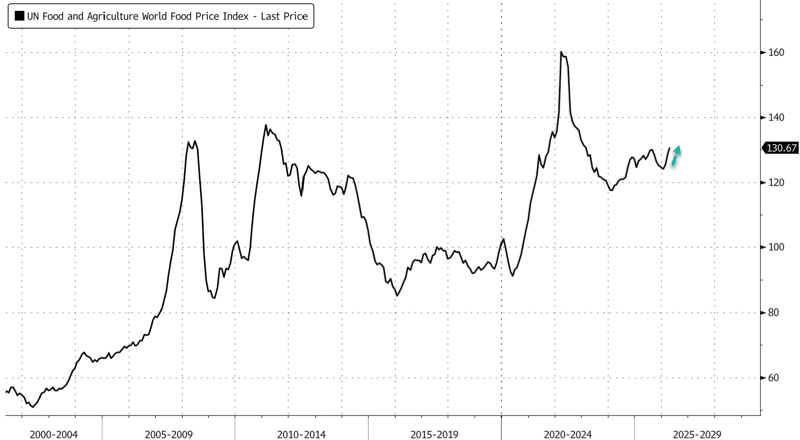
Let’s not forget America’s breadbasket, plagued by drought, as the Middle East energy shock has disrupted the fertilizer trade and may impact harvests later this year. Global food prices are rising.
Related:
Seven Reasons Why The Hormuz Crisis Has Yet To Cause The Global Economy
Our debate at the start of May featured former Bridgewater head of commodities Alex Campbell and Brent Johnson of Santiago Capital. It was hosted by Tony Greer and Jared Dillian, who discussed the potential food crisis that appears to be festering.
— ZeroHedge Debates (@zerohedgeDebate) May 2, 2026
Tyler Durden
Wed, 05/13/2026 – 11:15
IEA Revises 2026 Forecast: Global Oil Supply To Plunge Below Demand This Year
IEA Revises 2026 Forecast: Global Oil Supply To Plunge Below Demand This Year
Global oil demand is set to exceed supply in the current year amid the ongoing conflict in the Middle East, reversing previous projections of a surplus, OilPrice reports citing the latest IEA data.
“With Hormuz tanker traffic still restricted, cumulative supply losses from Middle East Gulf producers already exceed 1 billion barrels with more than 14 million (barrels per day) of oil now shut in, an unprecedented supply shock,” said the agency, which advises industrialized countries.
According to the May 2026 Oil Market Report by the International Energy Agency (IEA), global oil supply is projected to fall by 3.9 million bpd across 2026, with ~10.5 million bpd of Gulf oil production currently offline.
Global oil stocks are depleting at a record pace as supply losses from disruptions to flows via the Strait of Hormuz keep mounting
Producers & consumers are responding to the market signals, with Atlantic crude oil exports surging & refiners cutting runs: https://t.co/cOYraM4phx pic.twitter.com/QWJlPICebi
— International Energy Agency (@IEA) May 13, 2026
Consumption is also under pressure due to the war as price spikes lead to demand destruction and slower economic growth: Global demand is also forecast to contract by 420,000 bpd compared to a previous forecast of an 80,000 bpd drop due to surging prices, slow economic growth and widespread flight cancellations, with oil demand still set to outpace supply by 1.78 million bpd in the current year.
“Our latest supply and demand estimates imply that the market will remain severely undersupplied through the end of 3Q26, even assuming the conflict ends by early June,” the Paris-based agency said, adding that the second-quarter deficit will be as stark as 6 million bpd.
Global crude runs are expected to plunge by 1.6 million bpd to an average of 82.3 mb/d for the year as operators face infrastructure damage and severe feedstock shortages, with refinery throughput expected to fall by 4.5 million bpd in the second quarter alone.
Operators in the Middle East and Asia are battling significant damage to energy infrastructure and reduced availability of crude feedstocks, largely stemming from the closure of the Strait of Hormuz. The heaviest cuts have been in the Middle East and Asia-Pacific, heavily impacting naphtha, LPG and jet fuel production.
According to the IEA, global oil inventories are projected to fall by an average of 8.5 mb/d during the second quarter of 2026, with the drawdown largely due to a decline in crude output from countries including Iraq, Saudi Arabia, Kuwait and the UAE.
The steepest inventory draws are projected to occur in May and June, helping to keep Brent crude prices elevated at ~$106 per barrel.
Whereas the release of a total of 400 million barrels by 32 IEA members is expected to provide a temporary buffer, the market will still face a significant deficit that could keep prices high through the year.
Tyler Durden
Wed, 05/13/2026 – 11:00
IEA Revises 2026 Forecast: Global Oil Supply To Plunge Below Demand This Year
IEA Revises 2026 Forecast: Global Oil Supply To Plunge Below Demand This Year
Global oil demand is set to exceed supply in the current year amid the ongoing conflict in the Middle East, reversing previous projections of a surplus, OilPrice reports citing the latest IEA data.
“With Hormuz tanker traffic still restricted, cumulative supply losses from Middle East Gulf producers already exceed 1 billion barrels with more than 14 million (barrels per day) of oil now shut in, an unprecedented supply shock,” said the agency, which advises industrialized countries.
According to the May 2026 Oil Market Report by the International Energy Agency (IEA), global oil supply is projected to fall by 3.9 million bpd across 2026, with ~10.5 million bpd of Gulf oil production currently offline.
Global oil stocks are depleting at a record pace as supply losses from disruptions to flows via the Strait of Hormuz keep mounting
Producers & consumers are responding to the market signals, with Atlantic crude oil exports surging & refiners cutting runs: https://t.co/cOYraM4phx pic.twitter.com/QWJlPICebi
— International Energy Agency (@IEA) May 13, 2026
Consumption is also under pressure due to the war as price spikes lead to demand destruction and slower economic growth: Global demand is also forecast to contract by 420,000 bpd compared to a previous forecast of an 80,000 bpd drop due to surging prices, slow economic growth and widespread flight cancellations, with oil demand still set to outpace supply by 1.78 million bpd in the current year.
“Our latest supply and demand estimates imply that the market will remain severely undersupplied through the end of 3Q26, even assuming the conflict ends by early June,” the Paris-based agency said, adding that the second-quarter deficit will be as stark as 6 million bpd.
Global crude runs are expected to plunge by 1.6 million bpd to an average of 82.3 mb/d for the year as operators face infrastructure damage and severe feedstock shortages, with refinery throughput expected to fall by 4.5 million bpd in the second quarter alone.
Operators in the Middle East and Asia are battling significant damage to energy infrastructure and reduced availability of crude feedstocks, largely stemming from the closure of the Strait of Hormuz. The heaviest cuts have been in the Middle East and Asia-Pacific, heavily impacting naphtha, LPG and jet fuel production.
According to the IEA, global oil inventories are projected to fall by an average of 8.5 mb/d during the second quarter of 2026, with the drawdown largely due to a decline in crude output from countries including Iraq, Saudi Arabia, Kuwait and the UAE.
The steepest inventory draws are projected to occur in May and June, helping to keep Brent crude prices elevated at ~$106 per barrel.
Whereas the release of a total of 400 million barrels by 32 IEA members is expected to provide a temporary buffer, the market will still face a significant deficit that could keep prices high through the year.
Tyler Durden
Wed, 05/13/2026 – 11:00
IEA Revises 2026 Forecast: Global Oil Supply To Plunge Below Demand This Year
IEA Revises 2026 Forecast: Global Oil Supply To Plunge Below Demand This Year
Global oil demand is set to exceed supply in the current year amid the ongoing conflict in the Middle East, reversing previous projections of a surplus, OilPrice reports citing the latest IEA data.
“With Hormuz tanker traffic still restricted, cumulative supply losses from Middle East Gulf producers already exceed 1 billion barrels with more than 14 million (barrels per day) of oil now shut in, an unprecedented supply shock,” said the agency, which advises industrialized countries.
According to the May 2026 Oil Market Report by the International Energy Agency (IEA), global oil supply is projected to fall by 3.9 million bpd across 2026, with ~10.5 million bpd of Gulf oil production currently offline.
Global oil stocks are depleting at a record pace as supply losses from disruptions to flows via the Strait of Hormuz keep mounting
Producers & consumers are responding to the market signals, with Atlantic crude oil exports surging & refiners cutting runs: https://t.co/cOYraM4phx pic.twitter.com/QWJlPICebi
— International Energy Agency (@IEA) May 13, 2026
Consumption is also under pressure due to the war as price spikes lead to demand destruction and slower economic growth: Global demand is also forecast to contract by 420,000 bpd compared to a previous forecast of an 80,000 bpd drop due to surging prices, slow economic growth and widespread flight cancellations, with oil demand still set to outpace supply by 1.78 million bpd in the current year.
“Our latest supply and demand estimates imply that the market will remain severely undersupplied through the end of 3Q26, even assuming the conflict ends by early June,” the Paris-based agency said, adding that the second-quarter deficit will be as stark as 6 million bpd.
Global crude runs are expected to plunge by 1.6 million bpd to an average of 82.3 mb/d for the year as operators face infrastructure damage and severe feedstock shortages, with refinery throughput expected to fall by 4.5 million bpd in the second quarter alone.
Operators in the Middle East and Asia are battling significant damage to energy infrastructure and reduced availability of crude feedstocks, largely stemming from the closure of the Strait of Hormuz. The heaviest cuts have been in the Middle East and Asia-Pacific, heavily impacting naphtha, LPG and jet fuel production.
According to the IEA, global oil inventories are projected to fall by an average of 8.5 mb/d during the second quarter of 2026, with the drawdown largely due to a decline in crude output from countries including Iraq, Saudi Arabia, Kuwait and the UAE.
The steepest inventory draws are projected to occur in May and June, helping to keep Brent crude prices elevated at ~$106 per barrel.
Whereas the release of a total of 400 million barrels by 32 IEA members is expected to provide a temporary buffer, the market will still face a significant deficit that could keep prices high through the year.
Tyler Durden
Wed, 05/13/2026 – 11:00

‘Obvious Dangers’: Gabbard Probing US Funding To International Biolabs
‘Obvious Dangers’: Gabbard Probing US Funding To International Biolabs
Authored by Zachary Stieber via The Epoch Times,
U.S. Director of National Intelligence Tulsi Gabbard and other intelligence officials are investigating U.S. funding to overseas laboratories handling biological research.
Initial searches of intelligence files showed that the U.S. government has provided money to more than 120 biolaboratories in more than 30 countries, a spokesperson for the Office of the Director of National Intelligence told The Epoch Times in an email on May 12.
That includes biolabs in Ukraine that “may be at risk of compromise due to the ongoing Russia-Ukraine war” and other laboratories that have researched highly contagious pathogens, potentially including research that enhanced the pathogens’ virulence or transmissibility, with little visibility or oversight, according to the office.
The Department of Defense in a 2022 document said the United States had invested approximately $200 million since 2005 to support work at 46 Ukrainian laboratories, health facilities, and diagnostic sites.
Gabbard issued new guidance to officials that directs them to step up the collection of information on laboratories and related facilities outside the United States, which is already yielding new details on clinical trials being performed at the facilities, officials said.
The information has raised ethical, financial, and security concerns, according to the Office of the Director of National Intelligence.
“The COVID-19 pandemic revealed the catastrophic global impact research on dangerous pathogens in biolabs can have,” Gabbard said in a statement.
“Yet despite these obvious dangers, politicians, so-called health professionals … and entities within the Biden administration’s national security team lied to the American people about the existence of these U.S.-funded and supported biolabs and threatened those who attempted to expose the truth.”
She said that the Trump administration is “working closely with partners across the government to identify where these labs are, what pathogens they contain, and what ’research’ is being conducted, to end dangerous Gain-of-Function research that threatens the health and wellbeing of the American people and the world.”
The first COVID-19 cases were detected in 2019 near a biolaboratory in Wuhan, China, that received funding from the United States.
Gabbard’s investigation was prompted by a May 5, 2025, executive order from President Donald Trump that forbade federal funding from supporting risky research, or experiments aimed at increasing functions of a virus, unless proper oversight is in place.
Trump said in the order that “dangerous gain-of-function research on biological agents and pathogens has the potential to significantly endanger the lives of American citizens” and that the government had previously approved funding for research “in China and other countries where there is limited United States oversight or reasonable expectation of biosafety enforcement.” COVID-19, he said, “revealed the risk of such practices.”
Tyler Durden
Wed, 05/13/2026 – 10:45
https://www.zerohedge.com/medical/obvious-dangers-gabbard-probing-us-funding-international-biolabs
‘Obvious Dangers’: Gabbard Probing US Funding To International Biolabs
‘Obvious Dangers’: Gabbard Probing US Funding To International Biolabs
Authored by Zachary Stieber via The Epoch Times,
U.S. Director of National Intelligence Tulsi Gabbard and other intelligence officials are investigating U.S. funding to overseas laboratories handling biological research.
Initial searches of intelligence files showed that the U.S. government has provided money to more than 120 biolaboratories in more than 30 countries, a spokesperson for the Office of the Director of National Intelligence told The Epoch Times in an email on May 12.
That includes biolabs in Ukraine that “may be at risk of compromise due to the ongoing Russia-Ukraine war” and other laboratories that have researched highly contagious pathogens, potentially including research that enhanced the pathogens’ virulence or transmissibility, with little visibility or oversight, according to the office.
The Department of Defense in a 2022 document said the United States had invested approximately $200 million since 2005 to support work at 46 Ukrainian laboratories, health facilities, and diagnostic sites.
Gabbard issued new guidance to officials that directs them to step up the collection of information on laboratories and related facilities outside the United States, which is already yielding new details on clinical trials being performed at the facilities, officials said.
The information has raised ethical, financial, and security concerns, according to the Office of the Director of National Intelligence.
“The COVID-19 pandemic revealed the catastrophic global impact research on dangerous pathogens in biolabs can have,” Gabbard said in a statement.
“Yet despite these obvious dangers, politicians, so-called health professionals … and entities within the Biden administration’s national security team lied to the American people about the existence of these U.S.-funded and supported biolabs and threatened those who attempted to expose the truth.”
She said that the Trump administration is “working closely with partners across the government to identify where these labs are, what pathogens they contain, and what ’research’ is being conducted, to end dangerous Gain-of-Function research that threatens the health and wellbeing of the American people and the world.”
The first COVID-19 cases were detected in 2019 near a biolaboratory in Wuhan, China, that received funding from the United States.
Gabbard’s investigation was prompted by a May 5, 2025, executive order from President Donald Trump that forbade federal funding from supporting risky research, or experiments aimed at increasing functions of a virus, unless proper oversight is in place.
Trump said in the order that “dangerous gain-of-function research on biological agents and pathogens has the potential to significantly endanger the lives of American citizens” and that the government had previously approved funding for research “in China and other countries where there is limited United States oversight or reasonable expectation of biosafety enforcement.” COVID-19, he said, “revealed the risk of such practices.”
Tyler Durden
Wed, 05/13/2026 – 10:45
https://www.zerohedge.com/medical/obvious-dangers-gabbard-probing-us-funding-international-biolabs
‘Obvious Dangers’: Gabbard Probing US Funding To International Biolabs
‘Obvious Dangers’: Gabbard Probing US Funding To International Biolabs
Authored by Zachary Stieber via The Epoch Times,
U.S. Director of National Intelligence Tulsi Gabbard and other intelligence officials are investigating U.S. funding to overseas laboratories handling biological research.
Initial searches of intelligence files showed that the U.S. government has provided money to more than 120 biolaboratories in more than 30 countries, a spokesperson for the Office of the Director of National Intelligence told The Epoch Times in an email on May 12.
That includes biolabs in Ukraine that “may be at risk of compromise due to the ongoing Russia-Ukraine war” and other laboratories that have researched highly contagious pathogens, potentially including research that enhanced the pathogens’ virulence or transmissibility, with little visibility or oversight, according to the office.
The Department of Defense in a 2022 document said the United States had invested approximately $200 million since 2005 to support work at 46 Ukrainian laboratories, health facilities, and diagnostic sites.
Gabbard issued new guidance to officials that directs them to step up the collection of information on laboratories and related facilities outside the United States, which is already yielding new details on clinical trials being performed at the facilities, officials said.
The information has raised ethical, financial, and security concerns, according to the Office of the Director of National Intelligence.
“The COVID-19 pandemic revealed the catastrophic global impact research on dangerous pathogens in biolabs can have,” Gabbard said in a statement.
“Yet despite these obvious dangers, politicians, so-called health professionals … and entities within the Biden administration’s national security team lied to the American people about the existence of these U.S.-funded and supported biolabs and threatened those who attempted to expose the truth.”
She said that the Trump administration is “working closely with partners across the government to identify where these labs are, what pathogens they contain, and what ’research’ is being conducted, to end dangerous Gain-of-Function research that threatens the health and wellbeing of the American people and the world.”
The first COVID-19 cases were detected in 2019 near a biolaboratory in Wuhan, China, that received funding from the United States.
Gabbard’s investigation was prompted by a May 5, 2025, executive order from President Donald Trump that forbade federal funding from supporting risky research, or experiments aimed at increasing functions of a virus, unless proper oversight is in place.
Trump said in the order that “dangerous gain-of-function research on biological agents and pathogens has the potential to significantly endanger the lives of American citizens” and that the government had previously approved funding for research “in China and other countries where there is limited United States oversight or reasonable expectation of biosafety enforcement.” COVID-19, he said, “revealed the risk of such practices.”
Tyler Durden
Wed, 05/13/2026 – 10:45
https://www.zerohedge.com/medical/obvious-dangers-gabbard-probing-us-funding-international-biolabs
WTI Holds Gains Despite Biggest SPR Drawdown In 45 Year History, Production Jumped
WTI Holds Gains Despite Biggest SPR Drawdown In 45 Year History, Production Jumped
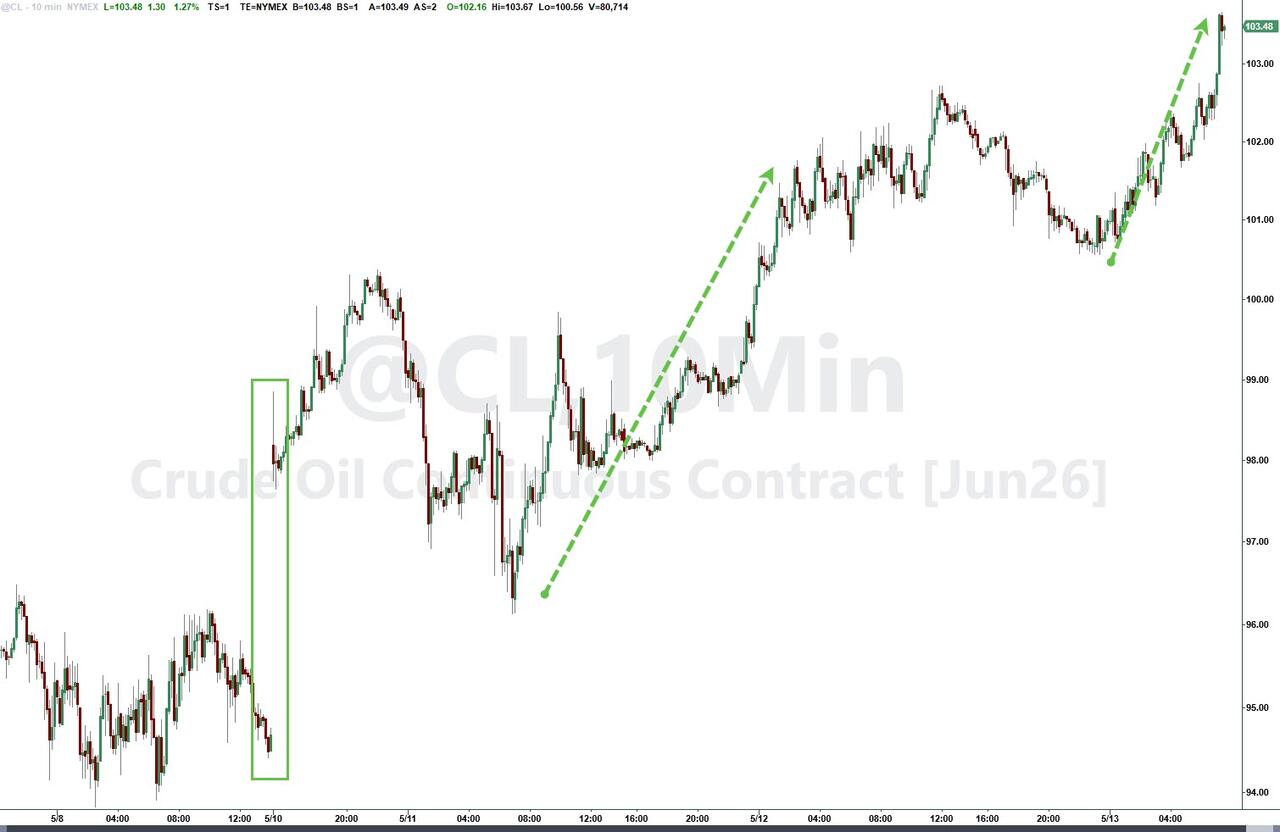
Oil prices are higher this morning (extending its 8%-plus surge of the last three days) as Middle East tensions simmer and global stockpiles shrink at a record pace.
WTI topped $103 and Brent crude traded near $108 a barrel, erasing its retreat earlier on Wednesday, after the IEA said global observed oil inventories declined at a rate of about 4 million barrels a day in March and April.
Saudi Arabia told OPEC that its output sank to the lowest level since 1990.
“With global oil inventories already drawing at a record clip, further price volatility appears likely ahead of the peak summer demand period,” the Paris-based IEA said in its Oil Market Report.
The market will remain “severely undersupplied” until October even if the conflict ends next month, the agency said.
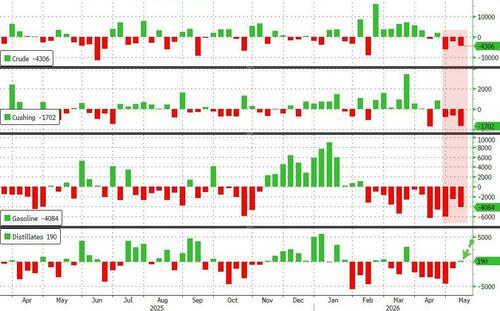
For obvious reasons, this morning’s official inventory and supply data (for the US) is now top of mind.
API
Crude -2.2mm
Cushing
Gasoline +502k
Distillates -319k
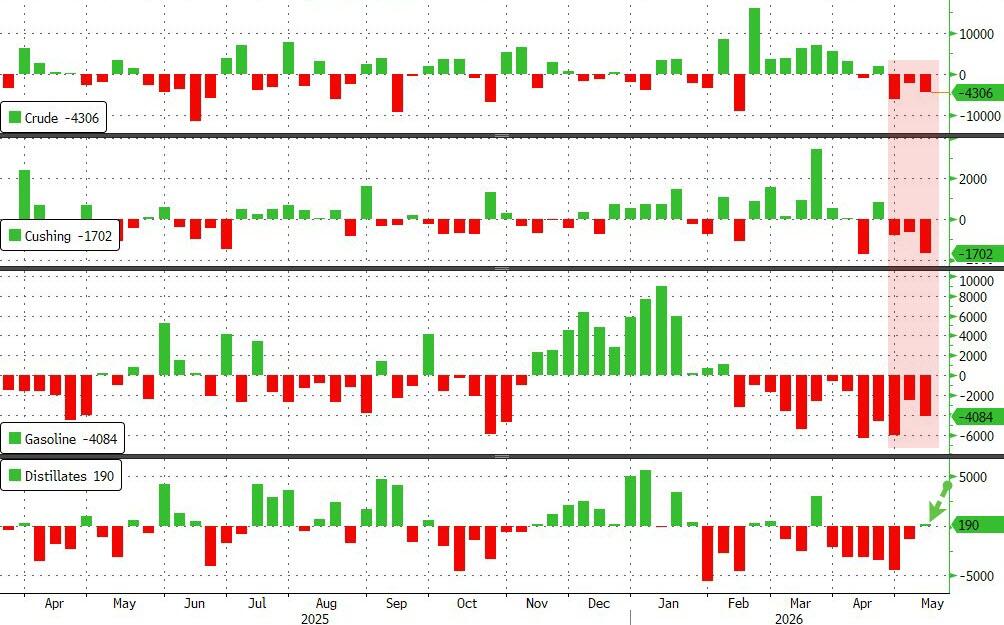
DOE
Crude -4.3mm (-2.5mm exp)
Cushing -1.7mm
Gasoline -4.08mm – 13th weekly draw in a row
Distillates +190k – first build in 7 weeks
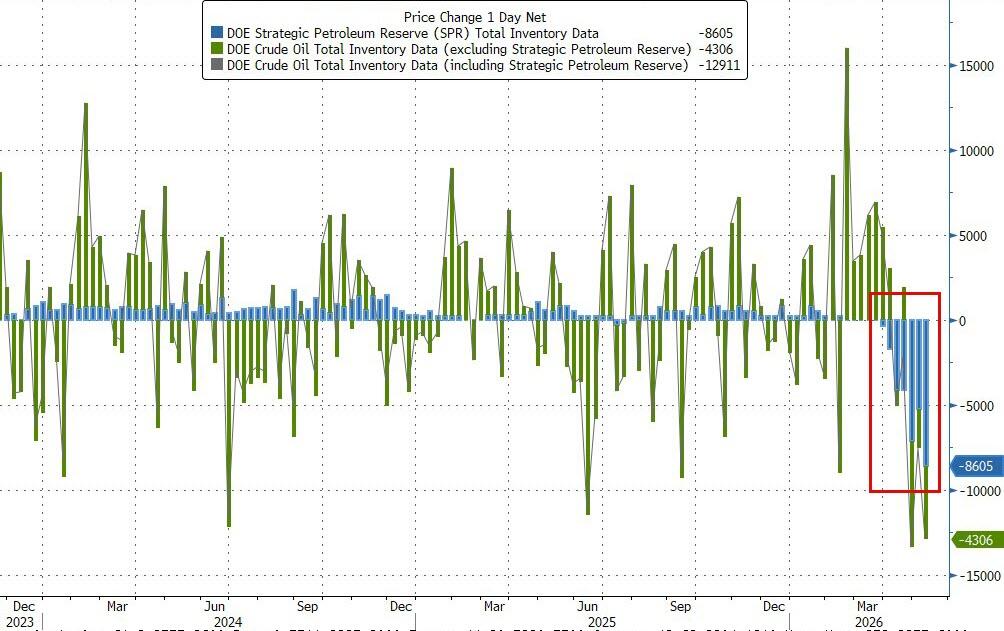
Crude stocks saw a bigger than expected drawdown last week (the third week in a row) as Cushing inventories drop and while Distillates saw a small build, Gasoline stocks plunged… again…
Source: Bloomberg
The drawdowns from the Strategic Petroleum Reserve continue to accelerate. The 8.6mm barrel draw was the largest on record…
Source: Bloomberg
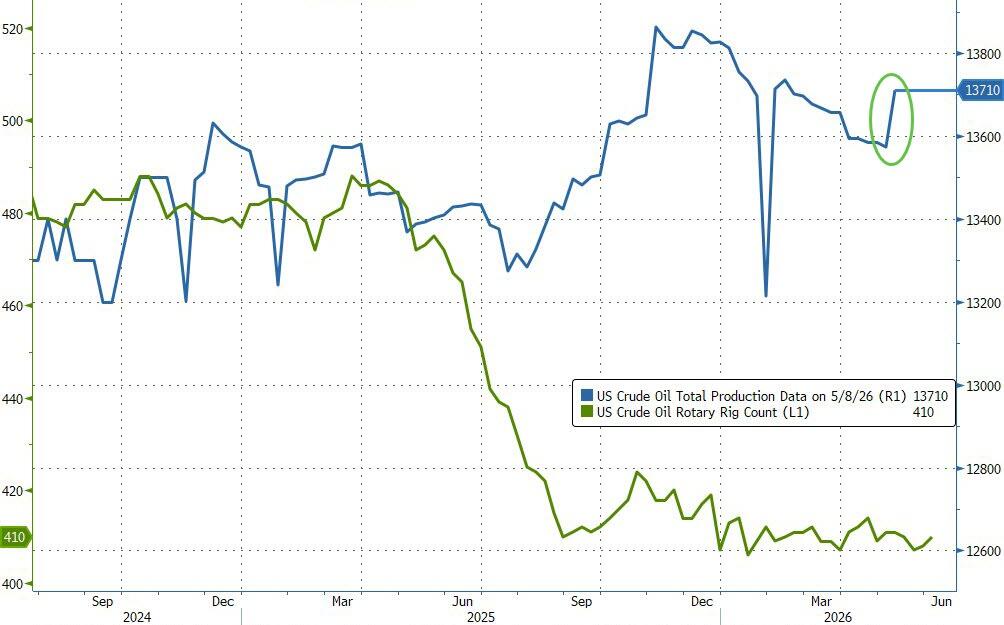
US crude production jumped last week…
Source: Bloomberg
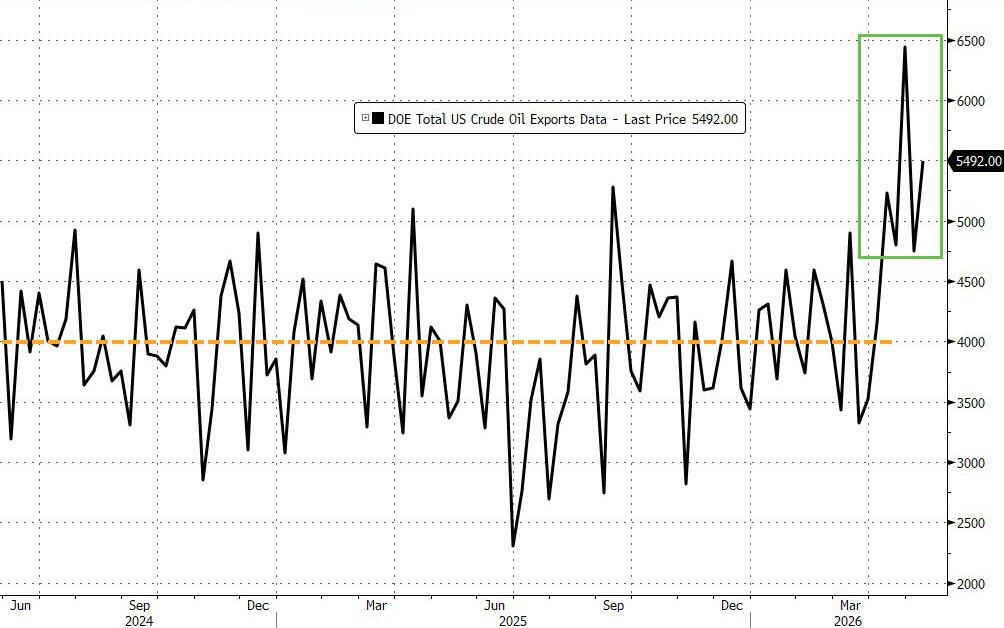
Crude exports jumped back up to near the 6 million barrel a day mark, rising 742,000 barrels to around 5.5 million barrels a day. Anything above 4 million barrels a day is generally considered robust demand and in recent weeks the US sets its all-time record for crude exports as the Iran war disrupts flows globally.
Imports of Venezuelan crude soared to 598,000 barrels a day, the highest since early 2019 when the US first imposed a de facto ban on oil imports from the country.
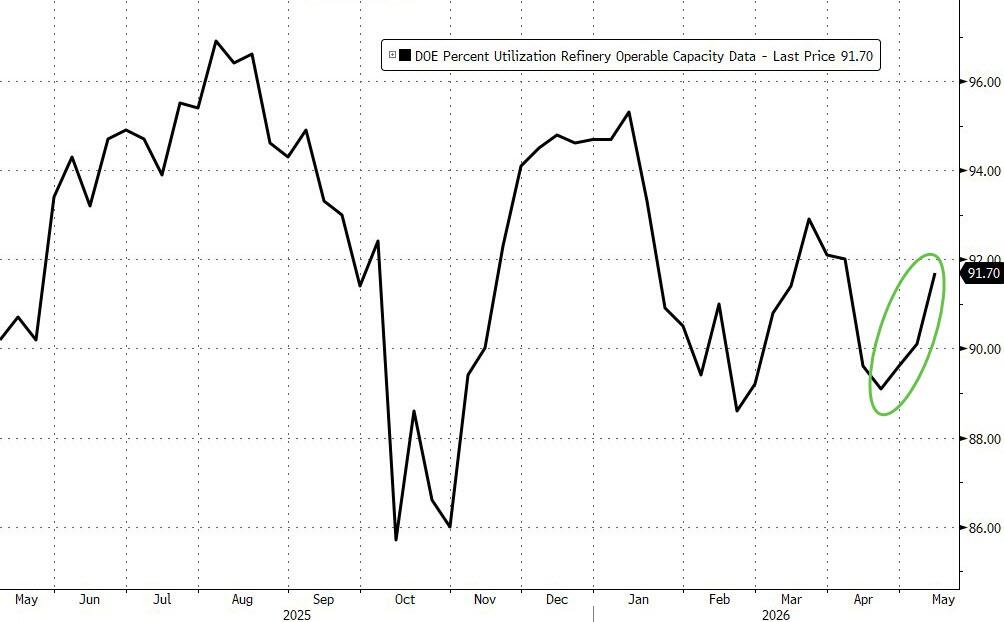
Refinery runs bounced back in a big way and are now just shy of levels seen at the same time last year as maintenance season wraps up.
Valero Port Arthur was finally able to restart its largest crude unit, following a end-March fire, helping to bolster crude processing in the region.
WTI extended gains, topping $103.50 this morning, as Martijn Rats, commodities strategist at Morgan Stanley, told clients in a Monday note: “That this is the largest oil supply disruption in the history of the oil market is neither an exaggeration nor controversial.”
Morgan Stanley forecasts the market will lose another billion barrels over the course of 2026 due to the time required to restart oilfields, repair refineries and reposition the tanker fleet’
“We expect this destocking environment to continue over the next number of months and ultimately drive a restocking phenomenon longer-term,” Plains All American Pipeline LP Chief Executive Officer Willie Chiang said on an earnings call Friday.
Tyler Durden
Wed, 05/13/2026 – 10:37
WTI Holds Gains Despite Biggest SPR Drawdown In 45 Year History, Production Jumped
WTI Holds Gains Despite Biggest SPR Drawdown In 45 Year History, Production Jumped
Oil prices are higher this morning (extending its 8%-plus surge of the last three days) as Middle East tensions simmer and global stockpiles shrink at a record pace.
WTI topped $103 and Brent crude traded near $108 a barrel, erasing its retreat earlier on Wednesday, after the IEA said global observed oil inventories declined at a rate of about 4 million barrels a day in March and April.
Saudi Arabia told OPEC that its output sank to the lowest level since 1990.
“With global oil inventories already drawing at a record clip, further price volatility appears likely ahead of the peak summer demand period,” the Paris-based IEA said in its Oil Market Report.
The market will remain “severely undersupplied” until October even if the conflict ends next month, the agency said.
For obvious reasons, this morning’s official inventory and supply data (for the US) is now top of mind.
API
Crude -2.2mm
Cushing
Gasoline +502k
Distillates -319k
DOE
Crude -4.3mm (-2.5mm exp)
Cushing -1.7mm
Gasoline -4.08mm – 13th weekly draw in a row
Distillates +190k – first build in 7 weeks
Crude stocks saw a bigger than expected drawdown last week (the third week in a row) as Cushing inventories drop and while Distillates saw a small build, Gasoline stocks plunged… again…
Source: Bloomberg
The drawdowns from the Strategic Petroleum Reserve continue to accelerate. The 8.6mm barrel draw was the largest on record…
Source: Bloomberg
US crude production jumped last week…
Source: Bloomberg
Crude exports jumped back up to near the 6 million barrel a day mark, rising 742,000 barrels to around 5.5 million barrels a day. Anything above 4 million barrels a day is generally considered robust demand and in recent weeks the US sets its all-time record for crude exports as the Iran war disrupts flows globally.
Imports of Venezuelan crude soared to 598,000 barrels a day, the highest since early 2019 when the US first imposed a de facto ban on oil imports from the country.
Refinery runs bounced back in a big way and are now just shy of levels seen at the same time last year as maintenance season wraps up.
Valero Port Arthur was finally able to restart its largest crude unit, following a end-March fire, helping to bolster crude processing in the region.
WTI extended gains, topping $103.50 this morning, as Martijn Rats, commodities strategist at Morgan Stanley, told clients in a Monday note: “That this is the largest oil supply disruption in the history of the oil market is neither an exaggeration nor controversial.”
Morgan Stanley forecasts the market will lose another billion barrels over the course of 2026 due to the time required to restart oilfields, repair refineries and reposition the tanker fleet’
“We expect this destocking environment to continue over the next number of months and ultimately drive a restocking phenomenon longer-term,” Plains All American Pipeline LP Chief Executive Officer Willie Chiang said on an earnings call Friday.
Tyler Durden
Wed, 05/13/2026 – 10:37
WTI Holds Gains Despite Biggest SPR Drawdown In 45 Year History, Production Jumped
WTI Holds Gains Despite Biggest SPR Drawdown In 45 Year History, Production Jumped
Oil prices are higher this morning (extending its 8%-plus surge of the last three days) as Middle East tensions simmer and global stockpiles shrink at a record pace.
WTI topped $103 and Brent crude traded near $108 a barrel, erasing its retreat earlier on Wednesday, after the IEA said global observed oil inventories declined at a rate of about 4 million barrels a day in March and April.
Saudi Arabia told OPEC that its output sank to the lowest level since 1990.
“With global oil inventories already drawing at a record clip, further price volatility appears likely ahead of the peak summer demand period,” the Paris-based IEA said in its Oil Market Report.
The market will remain “severely undersupplied” until October even if the conflict ends next month, the agency said.
For obvious reasons, this morning’s official inventory and supply data (for the US) is now top of mind.
API
Crude -2.2mm
Cushing
Gasoline +502k
Distillates -319k
DOE
Crude -4.3mm (-2.5mm exp)
Cushing -1.7mm
Gasoline -4.08mm – 13th weekly draw in a row
Distillates +190k – first build in 7 weeks
Crude stocks saw a bigger than expected drawdown last week (the third week in a row) as Cushing inventories drop and while Distillates saw a small build, Gasoline stocks plunged… again…
Source: Bloomberg
The drawdowns from the Strategic Petroleum Reserve continue to accelerate. The 8.6mm barrel draw was the largest on record…
Source: Bloomberg
US crude production jumped last week…
Source: Bloomberg
Crude exports jumped back up to near the 6 million barrel a day mark, rising 742,000 barrels to around 5.5 million barrels a day. Anything above 4 million barrels a day is generally considered robust demand and in recent weeks the US sets its all-time record for crude exports as the Iran war disrupts flows globally.
Imports of Venezuelan crude soared to 598,000 barrels a day, the highest since early 2019 when the US first imposed a de facto ban on oil imports from the country.
Refinery runs bounced back in a big way and are now just shy of levels seen at the same time last year as maintenance season wraps up.
Valero Port Arthur was finally able to restart its largest crude unit, following a end-March fire, helping to bolster crude processing in the region.
WTI extended gains, topping $103.50 this morning, as Martijn Rats, commodities strategist at Morgan Stanley, told clients in a Monday note: “That this is the largest oil supply disruption in the history of the oil market is neither an exaggeration nor controversial.”
Morgan Stanley forecasts the market will lose another billion barrels over the course of 2026 due to the time required to restart oilfields, repair refineries and reposition the tanker fleet’
“We expect this destocking environment to continue over the next number of months and ultimately drive a restocking phenomenon longer-term,” Plains All American Pipeline LP Chief Executive Officer Willie Chiang said on an earnings call Friday.
Tyler Durden
Wed, 05/13/2026 – 10:37