Category: News
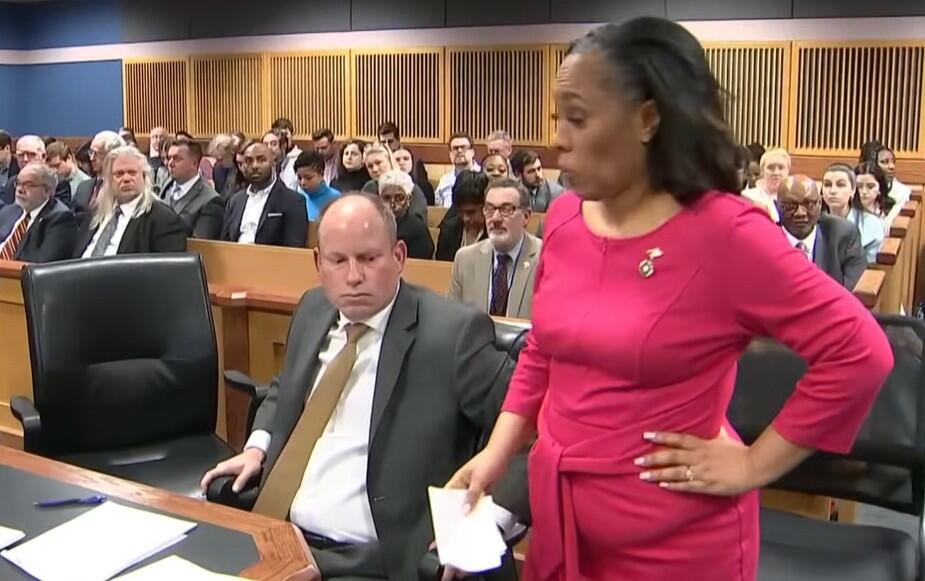
Fani Spanked Again: Judge Allows Trump And Co-Defendants To Pursue $17 Million In Legal Fees
Fani Spanked Again: Judge Allows Trump And Co-Defendants To Pursue $17 Million In Legal Fees
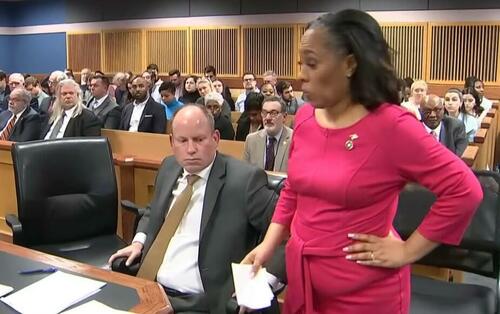
Fani Willis, the disgraced Fulton County, Georgia DA who couldn’t keep her clam in her pants while prosecuting Donald Trump, was just dealt a serious blow this week after a judge denied her attempt to intervene in litigation over the reimbursement of legal fees stemming from her now-dismissed Georgia election case against Trump and several co-defendants.
He knows what Willis is talkin’ ’bout…
The ruling by Scott McAfee allows efforts to recover nearly $17 million in attorney fees and costs to proceed after the high-profile prosecution collapsed late last year.
In August 2023, Trump and 18 others were indicted in Fulton County for allegedly conspiring to overturn then-President Joe Biden’s narrow election victory in Georgia. The case was dismissed in November, prompting Trump and several co-defendants to seek reimbursement for legal expenses incurred during the prosecution.
Willis’ office attempted to intervene in the fee litigation in an effort to block the claims. But McAfee ruled this week that the district attorney’s office had no legal basis to participate in the case after Willis had already been disqualified from it.
The judge noted that the state was already represented by a temporary district attorney appointed after Willis’ removal, meaning the office’s interests were already represented in the proceedings.
However, McAfee granted Fulton County itself permission to intervene in the case. The county funds most of the district attorney’s office and could ultimately be responsible for paying any reimbursement ordered by the court.
The dispute centers on a 2025 Georgia law that defendants say allows them to recover attorney fees if a prosecutor is disqualified and the case is later dismissed. The decision to allow the reimbursement claims to move forward could have significant financial implications, potentially exposing taxpayers to substantial costs if the requests are approved.
Trump alone is seeking more than $6.2 million in attorney fees from the Fulton County District Attorney’s Office under the statute.
Willis had argued that the law permitting the reimbursements was unconstitutional and maintained that her disqualification was not the cause of the case’s dismissal. McAfee declined to halt the reimbursement process at this stage.
Willis was removed from the case in December 2024 after Trump and his co-defendants argued that her romantic relationship with special prosecutor Nathan Wade created a conflict of interest and that she had made improper public statements about the prosecution.
The Supreme Court of Georgia declined in September 2025 to review her removal, leaving the Prosecuting Attorneys’ Council of Georgia to identify a replacement prosecutor. The case was later dropped.
Trump attorney Steve Sadow praised McAfee’s ruling in a statement posted to X, writing that the judge had “properly denied DA Willis’ motion to intervene in POTUS’ action for reimbursement of attorney fees because her disqualification for improper conduct bars Willis and her office from any further participation in this dismissed, lawfare case.”
Trump also criticized Willis following the Georgia Supreme Court’s decision not to hear her appeal, telling reporters last September: “What Fani Willis did to innocent people, patriots that love our country, what she did to them by indicting them and destroying them, she should be put in jail.”
Willis, speaking after she was disqualified from the case, said she hoped whoever took over the prosecution would “have the courage to do what the evidence and the law demand.”
The next phase of the litigation will focus on determining whether the requested reimbursements are reasonable under the statute. A judge will evaluate the fee claims – including Trump’s request exceeding $6.2 million – in a process that could take weeks or months and may lead to appeals.
Tyler Durden
Tue, 03/10/2026 – 19:10

Public Bitcoin Miners Are Dumping Crypto For AI, A Historic Mistake
Public Bitcoin Miners Are Dumping Crypto For AI, A Historic Mistake
Authored by Juan Galt via BitcoinMagazine.com,
There is no doubt about it, this is the age of AI. Corporations are cutting their workforces in half to invest cash flow into hardware, while the stock market remains near all-time highs, mostly thanks to FAANG. OpenClaw, a self-hosted AI agent, has more stars on GitHub than Linux and React, while even Jack Dorsey is taking harsh measures to restructure Block in the face of digital, artificial intelligence. But how much of this AI wave is hype, and how many of the companies that build its infrastructure will actually capture the profits?
Public Bitcoin miners in the United States have made their choice, a variety of them committing capital to building out AI datacenters, and some even making full rebrands, distancing themselves from the orange coin. While there’s a full range of AI-related pivots and statements made by public Bitcoin miners on the matter, a couple stand out as the most radical.
Cypher Mining, estimated to be worth around six billion dollars — placing it among the biggest in the country – announced a full rebrand away from Bitcoin and on to the AI hype train. In their most recent investment report titled “Rebrands to Cipher Digital to Reflect Strategic Shift Toward HPC,” the company explained why they “Divested 49% Stake in Alborz, Bear, and Chief Mining Sites”. Bitfarms Ltd, another large public miner valued at over a billion dollars, also made a full pivot to AI. The CEO, Ben Gagnon, went as far as saying “We are no longer a Bitcoin company,” as reported by Coindesk, though they did keep the ‘Bit’ in the name.
Some of these public companies are expecting more dollar returns from digital intelligence than those they get from Bitcoin, at least in the short to mid term, while other are others might consider it a diversification or an opportunity too large to miss.
Kent Halliburton — Co-Founder & CEO of Sazmining explained to Bitcoin Magazine in an exclusive interview that “The average cost to mine a bitcoin right now is about $87,000. The spot price of bitcoin is about $70,000. So most of the industry is underwater, and the public miners are using that as their excuse to pivot.” Sazmining is a private Bitcoin miner that specializes in frontier energy sources, with operations mostly outside of the United States.
Halliburtonalso noted that “$87,000 is an industry average — it includes guys running old-gen rigs on grid power in Texas. At our sites in Paraguay and Ethiopia, our clients are producing bitcoin on an energy cost basis of $50,000 to $64,000, on 100% renewable energy. That’s a 10 to 30 percent discount to spot. The profitability is right there.” It just requires a longer investment horizon or cheaper energy, neither of which appears to be actionable for American public miners who have dollar-denominated quarterly reports to target.
On the topic of cheaper energy, however, Halliburton suggests that public U.S. miners had the chance to be competitive but have failed to take advantage of their resources. He minced no words on the topic, saying that these public companies “had the power contracts, the land, the infrastructure — everything you need to mine bitcoin cheaply — and they’re handing it to Microsoft and Google in exchange for lease checks. They went from securing the Bitcoin network to securing rack space for hyperscalers, and they’re calling it a strategy. Meanwhile, they’ve dumped over 15,000 bitcoin off their balance sheets to fund the transition”.
Of the biggest public Bitcoin miners, IREN Limited began its pivot to AI cloud services in April 2025, announcing a$9.7 billion, five-year agreement with Microsoft for 200 MW of critical IT load using NVIDIA GB300 GPUs. TeraWulf has executed multiple Google-backed HPC expansions through Fluidstack, securing 10 year agreements for over 200 MW.
Cipher Digital completed its full rebrand to an HPC landlord with 600 MW of contracted capacity, including a 15-year, 300 MW lease with AWS and a 10-year, 300 MW lease with Fluidstack backed by Google. Hut 8 signed a 15-year, 245 MW lease with Fluidstack, also backed by Google, eyeing future possible extensions and a right of first offer for over 1,000 MW. Core Scientific has expanded its HPC focus to 270 MW through partnerships with CoreWeave, which serves Microsoft and OpenAI workloads.
Riot Platforms is strategically evaluating an AI hosting expansion by partnering with AMD on an operational 10-year, 25 MW lease and assessments for 600 MW of AI/HPC at its Corsicana site, though no hyperscaler agreements have been announced.
MARA Holdings is diversifying into AI through a joint venture with Starwood Capital’s Starwood Digital Ventures, targeting 1 GW of near-term IT capacity expandable to over 2.5 GW for hyperscale and AI workloads, with Starwood leading financing and tenant sourcing, but without named hyperscaler contracts yet.
CleanSpark is pursuing a pivot to AI by acquiring Texas land and power for AI/HPC, including 447 acres in Brazoria County for 300–600 MW potential and an Austin County site contributing to 890 MW aggregate, funded by Bitcoin sales, with tenant discussions ongoing but no hyperscaler leases disclosed.
So the AI gold rush is here, there’s no doubt about it, many of these public miners apparently see an opportunity to build out the infrastructure of — what is without a doubt— a profound technological trend. But history has not been kind to those who build the infrastructure of a new era, not in the long term anyway. It tends to be a very high-risk, medium-reward kind of bet. How many of the companies that built the railroads — for example — are still around today? Or, without going back that far, can you name any company that built out internet fiber lines in the late 90’s and 2000’s?
There is a long list of railroad bankruptcies from the late 1800’s, which even led to a financial crisis in what’s called the Panic of 1873, many overleveraged in debt to fund build-outs for which there was not enough demand yet. After the panic, J.P. Morgan led a consolidation of bankrupt railroad companies, resolving debt disputes and bringing their real estate assets under new ownership. It was they who ended up capturing the upside of the railway build-out.
And just around the corner of the century, the dot com bubble of the 2000’s left a graveyard of fiber line infrastructure companies that were also, in the end, bought out by hyper scalers like Google and Meta during the post crash consolidation, for pennies on the dollar.
While both the railway and fiber line build-outs overall helped scale commerce for the world in incredible ways — demonstrating the overall wisdom of the markets — most individual companies involved did not survive the process, and venture capitalists looking at the AI boom today are aware of this dynamic.
The Capex vs Revenue AI Gap
Various investor groups are starting to question where the returns on this massive infrastructure spending will come from. In an October 2025 report titled “AI: In a bubble?”, GoldmanSachs took a argued that, while the investments so far could be supported by big tech revenue, the valuations of some of these companies were starting to get “frothy”.
David Chan at Sequoia has been pointing out the growing gap between AI-driven revenue and capital expenditures (Capex) since 2023, leading to a widely reported number of a $600 billion gap between them. Capex spending commitments in 2026 are north of $700 for the hyper scalers, but where are the returns?
OpenAI’s $20 billion annual recurring revenue (ARR) is impressive for a new company, but that represents “roughly 3% of the projected 2026 hyperscaler capex total” as reported by FuturumGroup, who noted that “Anthropic’s $9 billion run rate, while showing 9x year-over-year growth, occupies a similar position. The entire cohort of pure-play AI vendors – including Cohere ($150 million ARR), Mistral (~$400 million), Perplexity ($148 million annualized), and others – likely accounts for less than $35 billion in projected combined 2026 revenue.”
Skepticism about where the value of AI will actually be captured has also been aired by VC’s like Chamath Palihapitiya. He was a prominent investor in Groq, a company building custom silicon for the AI age, which was licensed by NVIDIA in a $20 billion deal last year, and was a Facebook insider through the company’s rise to become a hyperscaler. If he has his doubts about the profitability of building the railroads of artificial intelligence, then perhaps there’s something worth giving a very close look at.
Palihapitiya also argued in a recent All In Podcast that corporations might soon start to realize they are exposing their trade secrets to cloud AI, preferring instead to self-host. Building out in-house GPU farms might seem like a bit of a side quest, but can you really risk your trade secrets with AI providers who train on user data? After all, new versions of models trained on that data will have it in their knowledge base, exposed to the world. And even if corporate agreements not to train on corporate data become the norm, a very high trust relationship would be formed, posing a systemic risk to certain corporations, a risk that the data might get leaked or seen by the wrong insiders inside the cloud AI provider companies.
There are also questions about whether the market fundamentally wants cloud AI for the same reasons. Would you hire a personal assistant if you knew the data you share with them would end up on the internet? Probably not, but that’s what’s happening with AI. In fact, the U.S. Southern District of New York recently ruled that users do not have client-attorney privilege when getting legal help from AI chatbots, and thus, sensitive discussions with AI could be legally subpoenaed and used against the clients in a court of law, a sign of the risks involved with trusting AI blindly. Some speculate that new kinds of terms and agreements will need to be formed to support this use case. But the legal case points to a fundamental element of the demand for AI: people want humanoid intelligence, digital or otherwise, that they can trust.
AI Loyalty and Trust
Ah, “Trust”, that ubiquitous, almost supernatural word that does so much work to carry the weight of the world. But what is trust? Fundamentally, it is predictability, one person’s confidence that another human, system, or AI will behave in a certain way, in a reliable, predictable, and positive way towards one’s interests. AI, when hosted in the cloud, however, can not give such assurances; the data is fundamentally leaving the user’s machine to be processed by “the cloud,” and what happens up there is beyond us mortals. In fact, “the cloud” has legal risks that might prevent it from being loyal to you as a user in certain scenarios. Hence, perhaps the public’s fascination with OpenClaw.
In recent weeks, a new open source project in the AI world has taken the tech industry by storm. 289,000 stars on GitHub, more than Linux has gotten despite supporting the software infrastructure of the world, more than React, one of the most popular web development languages in the world. And it’s only been live for what, weeks? How could this be? Why do people like it so much?
Well, arguably two reasons. It feels more like a human assistant than a chatbot; it updates itself, remembers what you are interested in, journals, and develops around your preferences. But most important of all, you can host it on your machine. People were buying Mac minis in droves to run OpenClaw, pairing it up with Claude Max API token plans of about $200 a month. Some argue this is a revolution in self-hosting, even though the above setup is still dependent on the cloud. But what’s actually happening here is that OpenClaw appears loyal, it remembers you, it is “in your home” in your PC. It’s not a chat interface whose context window will eventually become too much for it to manage, ending in a small death, replaced by a new chat tab. OpenClaw is not a chatbot; it’s an AI entity of sorts that users create a relationship with. And good relationships are built on trust.
So what does all of this have to do with public Bitcoin Miners? Well, perhaps self-hosted AI is the future, Chinese AI models are increasingly leaner and can run on machines far from the cutting edge, arguably pressured into innovation by sanctions on specialized AI hardware like high-end Nvidia chips. Open source tools of all kinds that manage and host models locally are regularly launched and improved, and if history is any guide, the mass production of AI hardware will lead to the commoditization of powerful computers that will make it to end users’ homes, and can handle AI.
In fact, Apple, the FAANG that has had the worst AI products deployed to date, may end up becoming one of the biggest winners of the AI race. Why? Because their user hardware is excellent. Recent Macs don’t have a distinction between RAM and VRAM, an issue all other computers dependent on GPUs, such as Nvidia, have. This limits the size and speed of models that can be self-hosted. Instead, all RAM is unified in the latest Mac machines, letting users run powerful models locally that don’t easily run on non-Apple hardware. Self-hosted AI is the future.
And thus, public Bitcoin miners, in the pursuit of mid-term fiat gains, might have just fallen for a trap.
The same trap the giants of the dot-com bubble fell for. The same trap that the titans of the industrial era, who built the railroads, fell for.
The infrastructure that runs the future does not necessarily capture the gains.
Tyler Durden
Tue, 03/10/2026 – 18:45
https://www.zerohedge.com/crypto/public-bitcoin-miners-are-dumping-crypto-ai-historic-mistake

AP Shills For Big Pharma Antidepressants With ‘Bewildering’ Hit Piece
AP Shills For Big Pharma Antidepressants With ‘Bewildering’ Hit Piece
Check this out… The Trump FDA’s top drug regulator, Dr. Tracy Beth Hoeg, is working to hire a researcher and friend who strongly believes the agency should add new warnings about antidepressants and pregnancy risks.
So what does the Associated Press do? They pen a hit piece, smearing Hoeg, her associate, and suggesting that peer reviewed studies over the risks are ‘unproven.’
This is how the medical arm of the blob works, and Paul Thacker of the DisInformation Chronicle is calling them out…
* * *
Associated Press Cannot Explain Bewildering Reporting on FDA’s Tracy Hoeg and Antidepressant Risks
By Paul D. Thacker
Cruising through X last week a weird story caught my eye: it reported that The Food and Drug Administration’s top drug regulator, Dr. Tracy Beth Hoeg, was trying to hire a “friend” who wants the FDA to add warnings to antidepressants about “unproven pregnancy risks.” The story makes several claims that are bewildering and appear to be fabricated. I sent several questions to AP’s global health editor Jonathan Fahey, but he did not respond to repeated requests to explain the article’s puzzling errors.
AP reporter Matthew Perrone later blocked me on X. I’ve pasted my email to Fahey at the bottom of this article.
The person AP’s Matthew Perrone identifies as a “friend” of FDA’s Hoeg is Dr. Adam Urato, chief of maternal-fetal medicine at Metro West Medical Center in Massachusetts.
One passage in the AP story stood out to me:
Within the agency, Hoeg’s close relationship with Urato is viewed as a clear conflict of interest that, under normal FDA standards, would result in her recusing herself from any work on the petition. But Hoeg is actively working to speed up the agency’s review of her friend’s proposal, according to the people familiar with the situation.
I have never seen the term “friend” defined as a “conflict of interest” by any federal agency. Nor have I run across “friend” defined as a “conflict of interest” in the peer-reviewed scientific literature. It’s a conflict of interest that doesn’t seem to exist.
And I happen to know quite a bit about conflicts of interest in science, because I’m an expert on the matter.
While I was a Senate staffer, I wrote a law on conflicts of interest called the Physicians Payments Sunshine Act. The bill I wrote was later passed into law and you can now go look up doctors on the government’s Open Payments website to see who is giving them money. I’m sure AP reporters use this website all the time. During my time in the Senate, I also helped to reform conflicts of interest at the National Institutes of Health. This took thousands of hours, untold numbers of meetings, and years of work to complete.
When I left the Senate and joined the Safra Ethics Center at Harvard, I was celebrated as the “Father of Sunshine” for this work to reform conflicts of interest in medicine.
Confused by the AP’s confusing reporting, I contacted Health and Human Services (HHS) and FDA, sending them almost the exact same questions that I sent to AP’s Jonathan Fahey.
“Being a friend is not a violation of ethics or conflicts of interests’ laws,” wrote HHS spokesman Andrew Nixon, in an email. Several senior FDA officials told me that HHS doesn’t even have a legal definition for what a “friend” is and no government conflict of interest form asks people to identify who their friends are.
“It’s a hit piece from industry against Dr. Hoeg, who is doing an amazing job at the FDA,” said one FDA official.
Hoeg did not respond to requests for comment, but during a phone call, Urato told me the AP story was filled with fake facts. The FDA has not offered him a full-time job as AP reported, and if they did, he couldn’t take it as he has a full-time clinical practice with hundreds of patients. FDA has expressed interest in offering him a limited, part-time position as an “advisor,” but nothing has been formalized.
He’s known Hoeg for only a couple years, and met her once when he went to DC to testify in favor of a labelling change for antidepressants that warns pregnant women about the documented risks for fetuses.
“This whole thing is being made up, and it’s an absurdity,” Urato said. “I’m not close friends with her as we’ve only discussed work. But If I say I’m not friends with her, then it’s like saying I’m her enemy.”
In his practice, Urato treats depressed women who are on antidepressants and always advises them of the research that has found risks for these drugs to developing fetuses. To ensure all women are warned, he has started a petition that asks the FDA to place a formal warning on the label for antidepressants. READ PETITION HERE.
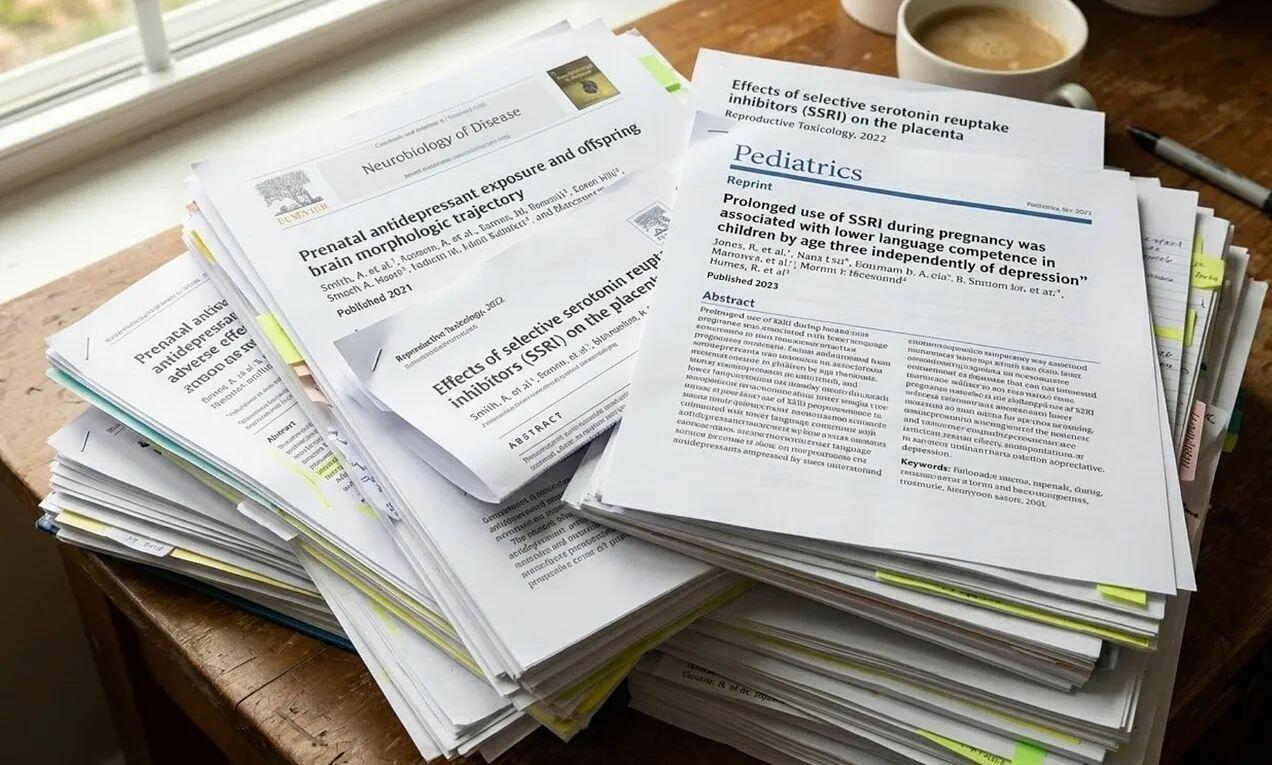
“There’s 12 MRI studies in humans that show brain alterations found in offspring who were exposed in utero to antidepressants, and the corporate media has ignored this,” Urato says.
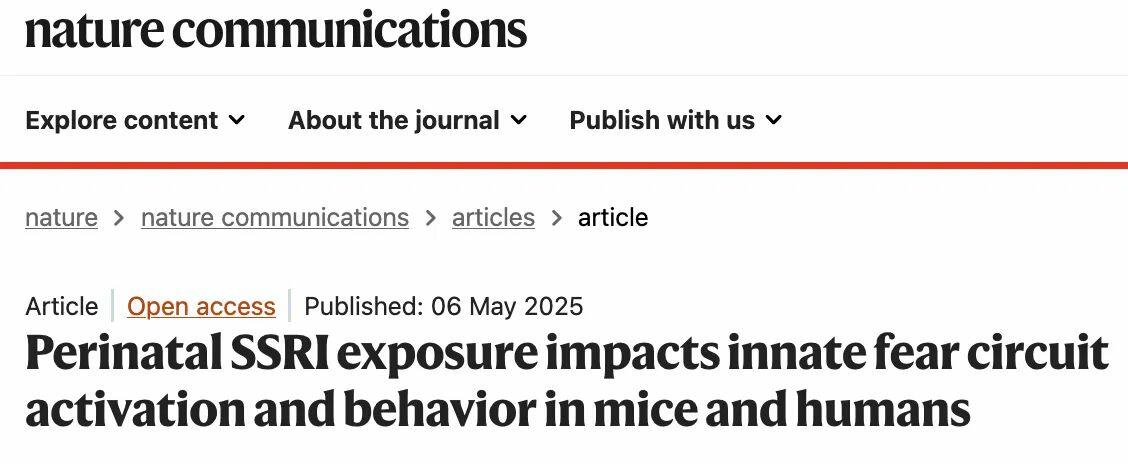
The AP falsely states in their story that Urato is making up “unproven pregnancy risks” but Nature Communications published a peer-reviewed study last May that found these exact risks that AP denies. The children of pregnant mothers on antidepressants later exhibited higher anxiety and depression symptoms than unexposed kids. Kids exposed to antidepressants while in utero were also found to have different brain activity when shown photos of fearful faces.
“These findings have potential implications for the clinical use of [antidepressants] during human pregnancy and for designing interventions that protect fetal brain development,” the authors concluded. The study appears in Urato’s petition along with dozens of other peer-reviewed studies.
“What a woman should do varies from patient to patient,” Urato told me. “But the first thing is to inform them. We know that cancer drugs are toxic, but we don’t ignore that and hide it from patients for fear they won’t get treated for cancer.”
Urato says he doesn’t know if the FDA will act on his petition, despite the evidence. “What the FDA will do with that, I don’t know.” However, Urato has had success with a prior FDA petition.
Urato partnered with Public Citizen in 2019 to petition the FDA to withdraw the drug Makena, because it had been approved to stop premature births without adequate data showing it helped pregnant women. The FDA later agreed with the petition and withdrew Makena from the market in 2023.
Oddly enough, AP’s Matthew Perrone covered Urato’s success at getting the FDA to remove Makena from the market, which you can read here: “FDA forces unproven premature birth drug Makena off market.”
“This is all a distraction,” Urato told me. “It’s so stupid. Of course we need to warn women.”
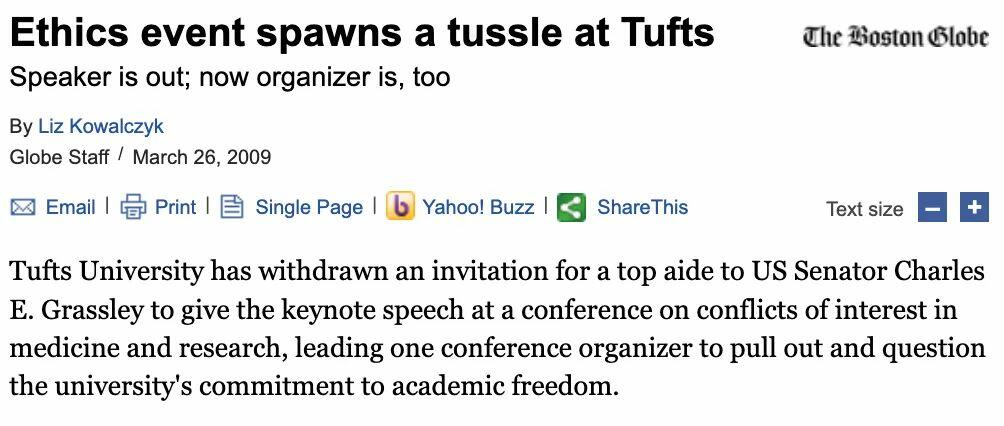
FULL DISCLOSURE: While working in the Senate, I was invited to give the keynote address at a conference on conflicts of interest in medicine and research hosted at Tufts University. Administrators later withdrew my invitation, causing one of the organizers to resign and creating a minor scandal that made news in the Boston Globe.
“It’s too bad a reform perspective has been removed from the program,” the Senate Committee’s spokeswoman told the Globe.
Some days later, I got a call from a physician who said Tufts organizers chose him to give the keynote speech in my place. I remember him being irate that Tufts had silenced me. He told me he wanted to know exactly what I was going to say, as he was going to give my exact same talk. He then took notes as I explained my speech. I may have also sent him my slide deck, but I can’t remember as this conversation took place in 2009.
I do remember laughing during the conversation at the thought that Tufts administrators were going to hear exactly what I was going to say, although it was coming from the mouth of someone they deemed more acceptable.
When I called Urato for this story, I thought it was the first time we had ever communicated. However, he reminded me during our conversation that he was the physician who called me all those years back, angry that Tufts had cancelled my keynote address. And he was the person who gave my talk at Tufts about the importance of conflicts of interest in medicine. Urato sent me this article in the Tufts newspaper to show this was the case.
I have no clue if AP or other reporters believe this makes Urato and I “friends” but feel free to discuss in the comments below.
* * *
Below is the email I sent to AP asking them to explain their bewildering article.
Hello Jonathan,
I’m working on a story about this AP article that claims FDA’s Tracy Hoeg is bringing a “friend” to FDA and that this is an FDA conflict of interest. That story is here https://apnews.com/article/hoeg-urato-fda-drugs-antidepressants-pregnancy-warnings-a2a48cd2285f5b33aef2d390b5b60d0c
While I was a Senate staffer, I wrote a law on COI called the Physicians Payments Sunshine Act that many reporters now use through the government’s Open Payments website. I also helped to reform NIH COI regs. I also wrote an award winning series for the BMJ on FDA COVID vaccine approvals by digging through FDA COI disclosures.
The AP alleges in this passage, which I’ve put in italics:
Within the agency, Hoeg’s close relationship with Urato is viewed as a clear conflict of interest that, under normal FDA standards, would result in her recusing herself from any work on the petition. But Hoeg is actively working to speed up the agency’s review of her friend’s proposal, according to the people familiar with the situation.
I have never seen the term “friend” defined as a COI for any federal agency. Nor have I run across this claim in the peer-reviewed literature. I also don’t know what “friend” means as I spoke to Adam Urato and he said he’s met Hoeg only a few times and it was only over professional matters.
Senior FDA officials have contacted me and explained that the FDA General Counsel has no legal definition of “friend” and no record of “friend” appearing in any COI policies. I have a couple questions, please.
1. Can you provide me with any evidence FDA/HHS has a legal definition for the term “friend”?
2. Can you provide me with an FDA/HHS policy that lists the term “friend” as a conflict of interest, as AP reports?
3. AP states that Urato wants FDA to add new warnings to antidepressants about “unproven pregnancy risks.” Nature communications published a study about the pregnancy risks to fetuses and SSRI use last May. Can you explain to readers why AP thinks this study is false? Has it been retracted? This is one of many studies showing effects to fetuses from SSRI use.
Again, we need a response by COB today.
Thank you for your time,
Paul
Tyler Durden
Tue, 03/10/2026 – 17:55
https://www.zerohedge.com/medical/ap-shills-big-pharma-antidepressants-bewildering-hit-piece
Rand Paul Warns Of “Disastrous” Midterms For GOP If Iran War Continues
Rand Paul Warns Of “Disastrous” Midterms For GOP If Iran War Continues
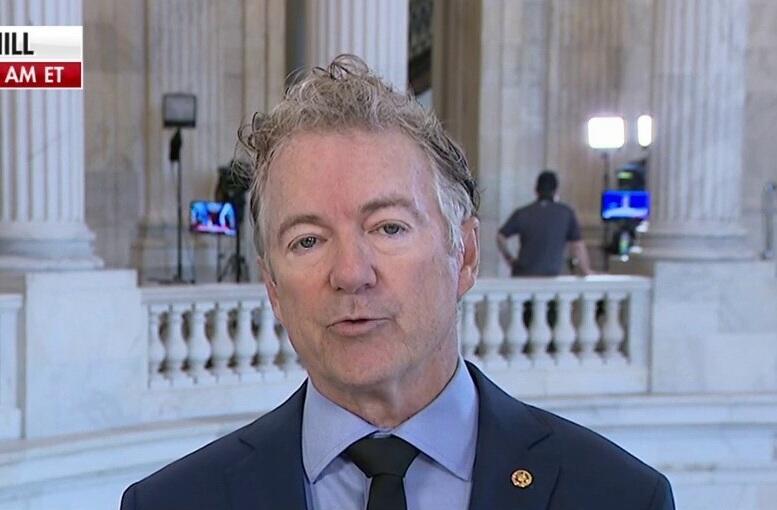
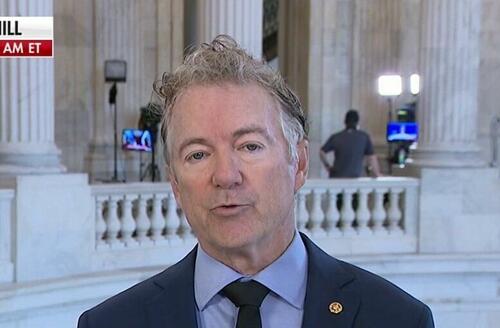
Sen. Rand Paul (R-Ky.), a leading voice for non-interventionism within the Republican Party, warned Tuesday that prolonged U.S. military action against Iran could spell disaster for Republicans in the 2026 midterm elections.
In an interview on Fox Business with host Maria Bartiromo, Paul downplayed internal party divisions as the main risk, instead pointing to economic fallout from the conflict, which began with joint U.S.-Israeli strikes on February 28.
“How worried are you that a split Republican Party will only mean losses in the midterm elections?” Ms. Bartiromo asked. “How are you expecting the midterms to play out?”
“I don’t think split party is the problem. I think high oil prices will be a problem. I think the 2026 election’s already – we are behind the eight ball as far as the electoral process,” Mr. Paul replied. “I think if you add in high gas prices, high oil prices, and if we are still bombing Iran with kinetic action – people don’t want to call it war – but if there’s still kinetic action that causes oil to be over $100, I think you’re gonna see a disastrous election.”
Rand Paul: “The 2026 elections, already we are behind the 8 ball. If you add in high gas prices, high oil prices, and if we’re still bombing Iran with kinetic action — people don’t want to call it war — I think you’re gonna see a disastrous election.” pic.twitter.com/lILcS0TUaa
— Aaron Rupar (@atrupar) March 10, 2026
In what should set off alarm bells in the White House and the House Speaker’s Office, Polymarket’s “Balance of Power: 2026 Midterms” market shows Democrats have a 44% of sweeping Congress in the midterms.
The U.S.-Israel strikes killed Iranian Supreme Leader Ayatollah Ali Khamenei in the opening wave, along with dozens of senior Islamic Revolutionary Guard Corps officials and other regime figures. Iranian sources reported 1,255 deaths and more than 12,000 injured. U.S. and Israeli assessments put Iranian military deaths at around 3,000. Iranian retaliatory missile and drone strikes killed 7 U.S. military personnel and 13 people in Israel.
The joint campaign has inflicted extensive damage on Iran’s military infrastructure, including the sinking of over 30 naval vessels, destruction of ballistic missile launchers and production facilities, airfields, drone sites, key IRGC bases, and residual nuclear-related structures at sites such as Natanz and Isfahan. Air defenses were heavily degraded, limiting Tehran’s ability to mount sustained retaliation, while allied proxy groups like Hezbollah sustained further losses.’
On Monday, President Donald Trump suggested that the war could end soon, describing the operation as a “short-term excursion” that was “very complete, pretty much.” Yet, the president warned of harsher military action should Iran attempt to disrupt oil flows through the Strait of Hormuz. The oil markets welcomed Trump’s dovish overtures as crude oil prices plunged as much as 10% on Tuesday morning, with Brent sliding around 8% to $91 a barrel and U.S. crude dropping 8.1% to roughly $87.
2026 Balance of Power: D Senate, D House
Yes 45% · No 56%
View full market & trade on Polymarket
Tyler Durden
Tue, 03/10/2026 – 17:30
https://www.zerohedge.com/political/rand-paul-warns-disastrous-midterms-gop-if-iran-war-continues

Loans To Non-Banks Threaten Banking Crisis
Loans To Non-Banks Threaten Banking Crisis
Authored by Christopher Whalen via DailyReckoning.com,
Last week, the Federal Deposit Insurance Corp released the industry data for US banks for 2025.
On the surface, the numbers look reassuring, even strong. But beneath the calm headline figures lies a growing risk that investors should not ignore.
Domestic deposits increased for the sixth consecutive quarter in Q4 2025 by $318.3 billion or 1.8%, the FDIC reports. Loans grew by 2% in Q4 and almost 6% YOY. Foreign deposits grew 11%, but subordinated debt and FHLB advances each fell ~ 14% as banks shed excess capital and funding.
U.S. bank loan growth in 2025 was robust, with total loans and leases reaching $13.4 trillion by year-end, a sequential increase in Q4 and a 5.9% annual growth rate, driven by larger institutions. Personal loan balances hit $2.2 trillion, while credit card debt rose 5.5% annually but the utilization rate for credit cards is still less than 20% of the total credit available. Yet behind this placid picture is a growing threat to banks and financial markets. At first glance, this looks like a healthy banking system. But that placid picture masks a fast-growing vulnerability that could become the next major pressure point for banks and financial markets.
The fastest growing bank asset category is loans to non-depository financial institutions (NDFIs), a corner of the financial system that regulators have struggled to monitor and control, up 7% in Q4 vs Q3 and up 35% YOY to $1.4 trillion at year-end 2025. With growing signs of credit stress among nonbank companies, banks will eventually pull back from lending to NDFIs. The problem is timing. By the time banks tighten lending standards, many private companies dependent on this funding may already be heading toward collapse, and those failures will not stay confined to the shadow banking system.
They will hit bank balance sheets directly.
The latest default involving UK mortgage issuer Market Financial Solutions threatens a £930 million shortfall in collateral backing loans to Apollo, TPG, other Wall Street private credit sponsors that are heavily involved with lending to private credit and equity, and various speculative ventures involving the current “AI investment boom.”
“The collapse of MFS, which attracted backing from firms including Barclays Plc, Apollo Global Management Inc.’s Atlas SP Partners unit, Jefferies Financial Group and TPG, is the latest crisis to hit both banks and direct lenders, and puts a spotlight on asset-based financing,” Bloomberg reveals.
“Accusations of double pledging also emerged in the collapses last year of US auto parts supplier First Brands Group and sub-prime auto lender Tricolor Holdings.”
Accusations of double pledging collateral have also surfaced in recent failures such as First Brands Group and Tricolor Holdings, further highlighting the fragility of the system.
The fact that Apollo’s Atlas SP unit was caught unawares by the apparent collateral fraud at MFS is especially notable given the firm’s past experience. One of the leading providers of secured financing to nonbank mortgage companies in the US, Atlas SP was formerly owned by Credit Suisse and has been the advisor on numerous financing transactions for NBFIs. Yet two supposedly “secured” warehouse facilities backed by Atlas SP are now reported to be in default. If the lenders structuring these deals are surprised by collateral problems, investors should be asking deeper questions about how widespread these risks really are.
The collapse of American Car Centers in 2023, another Atlas SP client, provided advanced warning of a wave of corporate insolvencies that now threaten the US banking sector with contagion. U.S. corporate bankruptcies in 2025 surged to their highest level in 15 years, with over 700 companies filing for protection through November, marking a 14% increase over 2024. A large share of those failures involved private equity-backed firms.
Why is the rapid growth in bank lending to NDFIs a problem?
Federal Reserve Chair Jerome Powell previously expressed that while non-depository financial institutions play a productive role in the economy, their growth outside the traditional regulatory perimeter poses risks to financial stability. We’re not talking here about mortgage companies with fully secured loans, but instead speculative credit and private equity schemes that are running out of cash.
The growth of private equity and credit is particularly problematic for banks. Many institutions are quietly masking early defaults through loan forbearance. When busted private equity firms cannot pay their debts, many seek to buy time by paying “in kind” with additional equity effectively issuing more of what the market already considers worthless. Paying “principal on original principal” or “POOP” (h/t Victor Hong) is one the thin canards used by private equity sponsors to conceal their financial malfeasance. In short: investors are being paid with more of the same failing capital structure.
In 2024, Federal Reserve Chair Jerome Powell expressed concerns regarding the rapid growth of non-bank financial institutions and the shifting of financial intermediation outside the regulated banking perimeter. He emphasized the need for regulators to be “smart” about where risks are emerging in this sector, noting that non-bank lending could lead to an overall lack of economic stability. But federal bank regulators have done little to address the explosion of lending to NDFIs. History shows that when a bank asset class grows significantly faster than the broader economy, it is usually a signal that systemic risk is building.
When you see a bank asset class growing far more quickly than the broad economy, this is a red flag that suggests potential systemic risk. But even more troubling that the high rate of growth in bank lending to NDFIs is the huge amount of undrawn loans available to these lightly capitalized companies involved in private equity and credit.
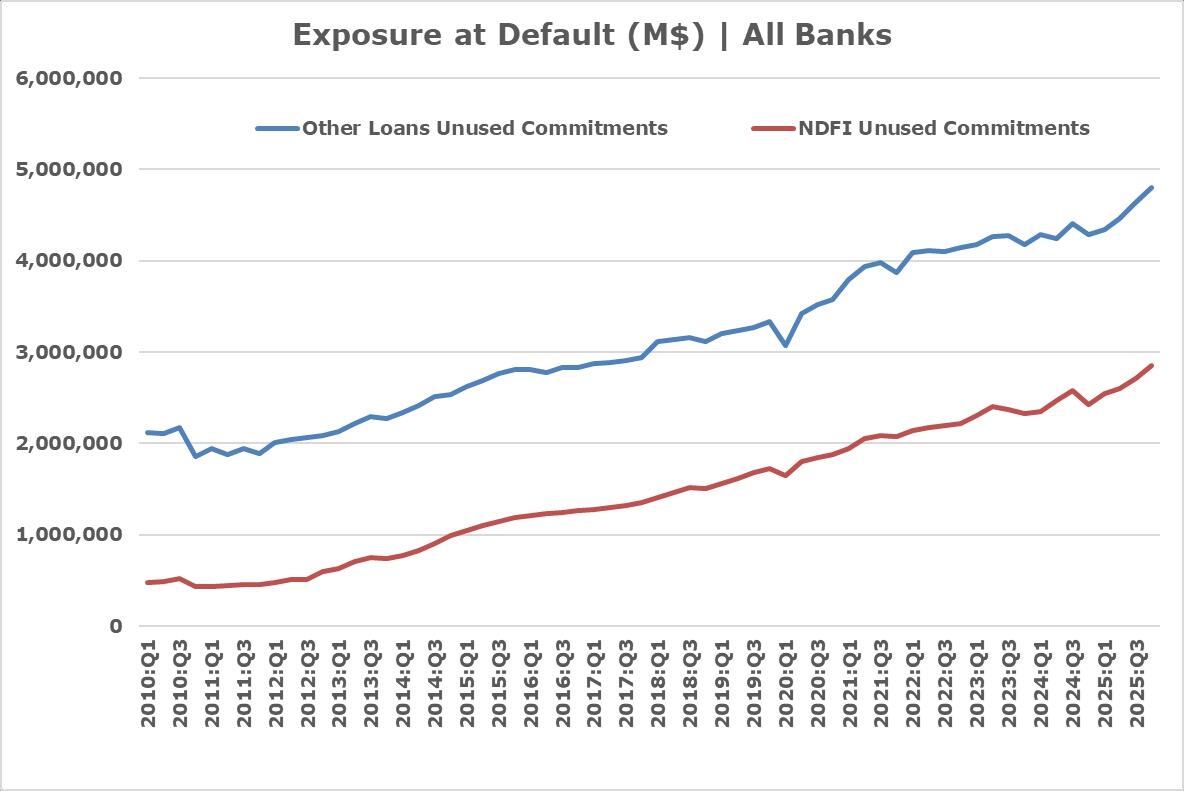
The FDIC does not yet disclose full loan category data on NDFI series, but we can infer from Other Loans line that banks currently have an estimated $2.8 trillion in unused loan commitments to NDFIs or exposure at default of 200% of current advances as defined by Basel III. A non-bank firm can draw on these contracted credit lines and immediately default, causing a massive loss to the bank lender. For every dollar of the $1.4 trillion in bank loans outstanding today to NDFIs, there are two dollars in undrawn loans or a total of $2.8 trillion, as shown in the chart below.
In practical terms:
Banks have $1.4 trillion in outstanding loans to NDFIs
They have another $2.8 trillion in undrawn commitments
That means for every dollar already lent, two more dollars are waiting to be drawn.
And a nonbank borrower can draw on those lines and default immediately, leaving banks with the loss.
Total potential exposure: roughly $4.2 trillion.
If stress spreads across private credit markets, that number becomes very important, very quickly.
Source: FDIC
The massive amount of bank lending to NDFIs is an approaching storm that has been largely ignored by federal regulators but is gaining growing attention from credit analysts. One public benchmark for the growing credit stress facing nonbanks is business development companies, which have seen an 18% decline in stock valuations over the past year vs an equal positive gain for the S&P 500. That divergence is not random. BDC investors are effectively voting with their capital that private credit risk is rising and rising quickly.
“UBS strategists say private credit could see default rates surge as high as 15% if artificial intelligence triggers an “aggressive” disruption among corporate borrowers,” the Swiss bank reports.
“Direct lenders that financed software companies are exposed to AI’s impact, with some estimates suggesting 40% of all sponsor-backed loans are tied up in the software industry.”
A 15% default rate is 2x the highest level of bank loan delinquency seen in 2008.
Put that number in perspective. A 15% default rate would be roughly twice the highest level of bank loan delinquencies seen during the 2008 financial crisis.
If even a portion of that scenario materializes, private credit markets, and the banks financing them, will feel the impact immediately.
The year 2025 was an extraordinary period for many reasons, including low credit loss rates and soaring asset values. QE teaches us that high asset prices suppress the cost of default, until asset values fall. But Wall Street is still trying to spin the growing delinquency among private companies as being only a problem “on the margins.”
“A review of the 3,649 middle market (MM) corporate credit assessments completed in 2025 shows mixed signals,” notes Kroll Bond Rating Agency.
“Slowing growth is negatively impacting some companies’ credit quality, but overall, our portfolio remains stable. The growing divergence in performance is driven by challenged subsectors that we believe will contribute to the rising, yet contained, default rate in 2026.”
In other words: the cracks are visible, but the market is still hoping the damage remains contained.
In the 1920s, many observers believed that asset values had reached a “permanently high plateau,” That confidence did not age well. This despite warnings from some observers of an impending collapse. Sectors like private equity and credit, and AI, all promise higher credit costs ahead. But for lenders, the immediate implication may be something very different: higher credit costs. When credit costs rise, earnings decline and stocks follow. The sharp declines in bank stocks in January and February illustrate this tendency.
We expect bank stocks to underperform their strong 2025 performance and face several challenges in the coming year:
Rising credit costs
Elevated market volatility
Higher operating expenses
Banks will benefit from falling funding costs, which should provide some support for margins.
But the outsized credit exposure to nonbank financial institutions may become one of the dominant financial narratives of 2026.
If stress spreads through private credit markets, investors may quickly discover that the shadow banking system is not nearly as “separate” from the traditional banking sector as many assume.
* * *
Investors who want deeper analysis of bank balance sheets and emerging credit risks can follow Christopher Whalen’s ongoing research and commentary.
Access to the index and detailed bank research is available via Institutional Risk Analyst.
Tyler Durden
Tue, 03/10/2026 – 17:05
https://www.zerohedge.com/markets/loans-non-banks-threaten-banking-crisis
Oracle Jumps On Solid Earnings And Guidance Boost Despite Soaring CapEx And Cash Burn
Oracle Jumps On Solid Earnings And Guidance Boost Despite Soaring CapEx And Cash Burn
There was much anxiety ahead of Oracle’s Q3 earnings release: yes, revenue growth would be solid but would it come at the expense of even more capex, which has sent the stock price tumbling more than 50% since its record high on Sept 10. In the end, it turned out the company had learned from recent mistakes and projected a goldilocks future: strong revenue and just right capex.
Here is what Oracle reports for Q3:
Adjusted EPS $1.79 vs. $1.47 y/y, beating estimate $1.70
Adjusted revenue $17.19 billion, +22% y/y, beating estimates of $16.89 billion (Revenue in constant fx +18%, in line with estimate +18.8%)
Cloud revenue (IaaS plus SaaS) $8.9 billion, +44% y/y, beating estimate $8.84 billion (in constant currency +41%, estimate +41.7%)
Cloud Infrastructure revenue (IaaS) $4.9 billion, +81% y/y, beating estimate $4.74 billion (in constant currency +81%, estimate +82.2%)
Cloud Application revenue (SaaS) $4.0 billion, +11% y/y, in line with the estimate $4 billion (in constant currency +11%, estimate +11.6%)
Software revenue $6.12 billion, +3.3% y/y, beating estimate $5.97 billion
Software Support revenue $4.97 billion, +3.6% y/y, beating estimate $4.89 billion
Software License revenue $1.15 billion, +1.9% y/y, beating estimate $1.1 billion
Hardware revenue $714 million, +1.6% y/y, missing estimate $724.6 million
Service revenue $1.44 billion, +12% y/y, beating estimate $1.36 billion
Of note here, sales in the company’s closely watched infrastructure business gained 81% to $4.9 billion in the period ended Feb. 28, the company said Tuesday in a statement. That marked a faster increase than estimate of 79% and compared with a 68% revenue rise in the previous quarter. Going down the line:
Adjusted operating income $7.38 billion, +19% y/y, estimate $7.21 billion
Adjusted operating margin 43% vs. 44% y/y, estimate 42.7%
Remaining performance obligations $553 billion vs. $130 billion y/y
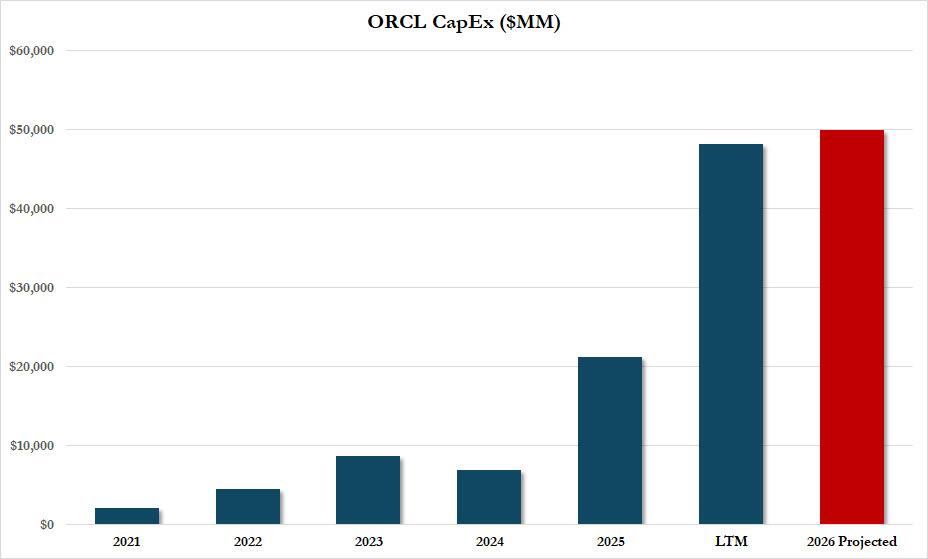
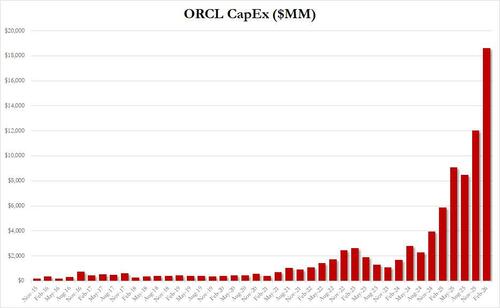
And while the above is all good, what wasn’t so good is that ORCL’s Q2 capex came in at a stunning $18.6 billion, triple the number from a year ago, and 50% higher than the Q1 capex print. To say that the company is incinerating money is doing a disservice to incinerators.
Elsewhere, the company’s remaining performance obligation, a measure of bookings, were $553 billion, compared with the $523 billion reported in the prior quarter.
Looking ahead to the fourth quarter, the company’s guidance range came above estimates:
Revenues to grow from 18% to 20% in constant currency (grow 19% to 21% in USD):
Adj. EPS to grow between 15% to 17% and be between $1.92 and $1.96, beating estimates of $1.95 (grow between 15% to 17% and be between $1.96 and $2.00 in USD)
Cloud revenue to grow between 44% to 48% in constant currency (expected to grow from 46% to 50% in USD)
Adding across, this means that for fiscal 2026, Oracle expects revenue of $67 billion and capital expenditures of $50 billion, which is unchanged from our most recent previous guidance. Incidentally, there is no way in hell ORCL’s full year 2026 CapEx is only $50 billion since its LTM capex is already $48.25 billion.
Perhaps most importantly, Oracle also published its fiscal 2027 guidance which is as follows:
For fiscal year 2027, Oracle is raising total revenue guidance to $90 billion, beating estimates of $86.7 billion.
There was no mention of what 2027 capex will be, so expect some very pointed questions on the call because alongside massive capex comes just as massive cash burn, which, as shown below… is terrifying. As readers are well aware, the question for the past 6 months has been: just how much debt will ORCL need to fund it?
Cash burn aside, Oracle’s earnings were solid, with the company posting cloud revenue that was better than expected and projected strong sales in the upcoming fiscal year, a sign the company is turning its massive AI bookings into revenue.
Oracle is working to deliver on massive cloud infrastructure contracts with customers like OpenAI and Meta. Known for its namesake database software, the company’s cloud business has found major success by providing chip-filled data centers and other equipment for training and deploying AI models.
The shares increased about 7% in extended trading after closing at $149.40 as the kneejerk reaction to the company’s earnings was viewed as favorable. Let’s see if this continues into tomorrow’s session.
As a reminder, the stock has lost more than 50% of its value from a September peak as Wall Street has grown worried about the costs and logistics associated with the massive build-out.
Tyler Durden
Tue, 03/10/2026 – 16:43

Epstein Guard Googled Him Minutes Before Body Found; Bank Made ‘Suspicious Activity Report’ Over Cash Deposits
Epstein Guard Googled Him Minutes Before Body Found; Bank Made ‘Suspicious Activity Report’ Over Cash Deposits
Authored by Jose Nino via HeadlineUSA,
A federal correctional officer assigned to monitor Jeffrey Epstein conducted internet searches about the convicted sex offender just moments before his body was discovered and received thousands of dollars in cash deposits in the weeks preceding his death, newly released Justice Department documents show.
Tova Noel worked as one of two Metropolitan Correctional Center employees who authorities later accused of fabricating logs claiming they had conducted required welfare checks on Epstein throughout the overnight hours before his August 10, 2019 death. Both guards lost their jobs, though prosecutors eventually dismissed criminal charges against them.
According to FBI forensic analysis of Bureau of Prisons computers, Noel entered the search term “latest on Epstein in jail” at 5:42 a.m. and repeated the query ten minutes later at 5:52 a.m. Her fellow officer Michael Thomas located the financier hanging in his cell at 6:30 a.m., less than 40 minutes after her final search.
Prosecutors stated that during the overnight shift, the 37-year-old Noel browsed furniture websites and slept rather than performing the required inmate checks every half hour. Thomas spent time looking at motorcycle listings online.
The New York Post reported that federal investigators produced a 66-page forensic report examining the desktop computers used by both officers. The Epstein related search was the sole query that the FBI chose to highlight in its analysis.
During sworn questioning by Justice Department officials in 2021, Noel disputed the FBI’s findings. “I don’t remember doing that,” she stated in the transcript. She characterized the federal records as not “accurate. I don’t recall looking him up.”
Noel also asserted that the failure to conduct proper monitoring was widespread at the Manhattan detention facility. “I’ve never worked in the Special Housing Unit and actually done rounds every 30 minutes,” she informed investigators.
Separate DOJ files reveal that Chase Bank submitted a “suspicious activity report” to the FBI in November 2019 regarding cash transactions in Noel’s account. The financial institution documented a total of 12 deposits starting in April 2018, with the largest single transaction of $5,000 occurring on July 30, 2019, just 11 days before Epstein died.
Available bank records beginning in December 2018 document seven separate cash deposits amounting to $11,880. Noel began her assignment in the Special Housing Unit where Epstein was held on July 7, 2019, approximately one month before his death.
Records indicate Noel operated a 2019 Land Rover Range Rover valued at $62,000. DOJ interviewers never questioned her about the cash transactions, according to the documents.
An internal FBI briefing contained in the released files indicates the bureau concluded that Noel was most likely the unidentified orange figure visible in grainy security camera footage near Epstein’s cell at approximately 10:40 p.m. on the night before his death.
“At approximately 10:40 pm, a correctional officer, believed to be Tova Noel, carried linen or inmate clothing up to the L-Tier, last time any correctional officer approached the only entrance to the SHU tier,” federal agents documented. Investigators determined that Epstein used strips of orange fabric to hang himself.
In her sworn testimony, Noel, who had been working consecutive shifts that day, stated she last observed Epstein alive “somewhere around after 10” that evening. She maintained that she “never gave out linen, ever” or clothing to inmates, asserting that such distributions occurred during earlier shifts.
The blurred orange shape captured on video has fueled speculation and conspiracy theories since the FBI made the footage public last summer. An inspector general report from 2023 described the figure only as “unidentified correctional officers,” making these newly released FBI documents the first official record to connect a specific name to the image.
Noel stated she could not explain why Epstein possessed additional bedding in his cell. She noted that Thomas, the other officer on duty, was asleep from 10 p.m. until midnight. Facility protocols prohibit staff members from entering the cell area without accompaniment, according to prison employees.
Legal representatives for Noel offered no comment. When investigators directly asked whether she played any role in Epstein’s death, Noel answered “no.”
As the New York Post reported, Noel currently faces a civil lawsuit in Westchester County Supreme Court alleging she committed assault while employed as a medical office assistant at Montefiore Einstein Advanced Care.
José Niño is the deputy editor of Headline USA. Follow him at x.com/JoseAlNino
Tyler Durden
Tue, 03/10/2026 – 16:25
Is This The Chart Pressuring Trump Toward An Iran Off-Ramp
Is This The Chart Pressuring Trump Toward An Iran Off-Ramp
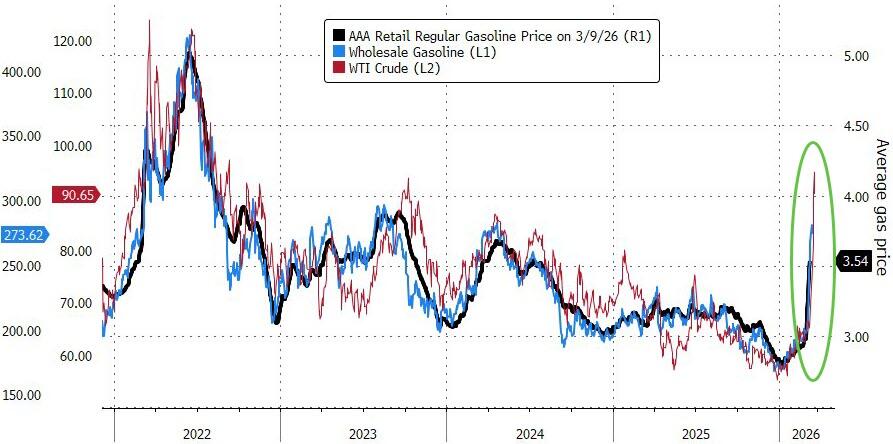
Brent crude futures tumbled from nearly $120/bbl early Monday morning to as low as $83/bbl by late Monday afternoon after President Trump said the Iran war could end soon. However, the contract had clawed back some losses and was trading around $91 to $95 Tuesday morning.
Trump’s assertion that Operation Epic Fury may end “very soon” only reinforces renewed Trump Always Chickens Out (TACO) expectations. His TACO-like comments came hours after G-7 leaders spent Monday morning jawboning Brent crude prices with headlines.
🚨 BREAKING: President Trump announces the strikes on Iran will end “soon”
Q: This week?
TRUMP: “No, but soon. I think soon. VERY soon. Look — everything they have is gone, including 2 levels of leadership!” 🔥
We’re moving towards victory at RAPID pace. pic.twitter.com/fmmW6Capfj
— Eric Daugherty (@EricLDaugh) March 9, 2026
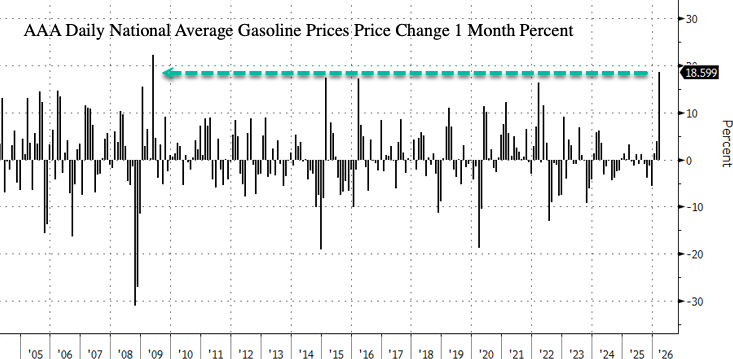
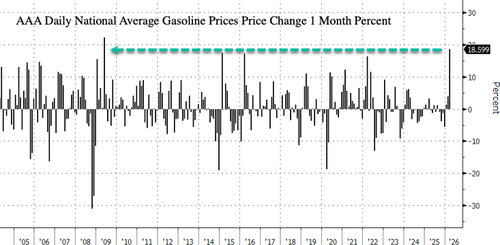
We suspect Trump’s “very soon” comment suggests the administration is searching for an exit strategy to the Iran conflict, given that the latest AAA data show the national average price for a gallon of regular gasoline has surged roughly 19% so far this month to $3.539 from $2.921, the largest monthly increase since May 2009.
…and is set to surge further in the next week or two (given the supply chain lags from crude to pump)…
UBS analyst Torsten Sippel told clients:
The recovery has been helped by easing crude prices, a lower VIX, and growing optimism around potential G-7 supply support or policy intervention. There are clear concerns about missing a rally that could follow even a modest geopolitical de-escalation, particularly given views that the oil market may already be pricing a worst-case scenario.
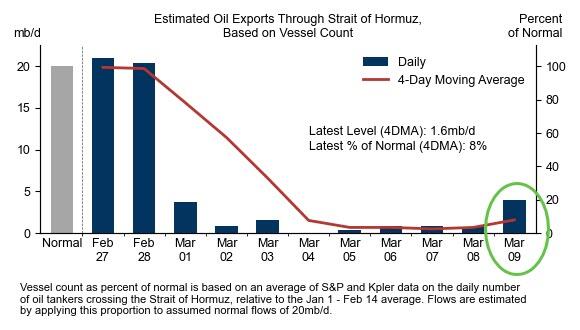
Crude has reversed sharply, down nearly $20 intraday after briefly approaching $120 overnight. The pullback reflects G-7 supply headlines, reports of tanker traffic moving through the Strait of Hormuz, and renewed “TACO” anticipation following comments from President Trump around a plan to address oil prices. Despite the volatility, no single dominant factor stands out today. Correlations were elevated in the morning, but dispersion is picking up this afternoon, pointing to more selective positioning. Overall, the tape feels orderly and headline-driven, with participants waiting for the next catalyst rather than aggressively de-risking.
Bloomberg quoted Graeme Miller, CFO at Melbourne-based Mercer Super, who said:
Trump saying the war is close to being over is being interpreted by many market participants as a sign the US is looking for some sort of off-ramp.
The truth is that none of us know how this will unfold, so there is no way to know whether the markets are pricing this correctly.
Central banks will be smart to get in front of an energy-driven inflation spike, but that comes with risks of slowing down the economy too much. It is very hard to be a central banker in this environment.
The Wall Street Journal reported earlier that Trump’s advisers are urging him to find an off-ramp to the conflict amid fears of political backlash.
We suspect the gasoline price shock at the pump could be enough to sway some cash-strapped voters in the midterms, that’s if prices stay high.
Tyler Durden
Tue, 03/10/2026 – 15:45
https://www.zerohedge.com/energy/could-chart-be-forcing-trump-toward-iran-ramp

Woke Media Struggles To Explain Why Gen Z Men Are Turning Against Feminism
Woke Media Struggles To Explain Why Gen Z Men Are Turning Against Feminism
The progressive left operates on the assumption that generational indoctrination is cumulative – That is to say, they think through time and indoctrination they will eventually lay claim to the minds of 100% of the population. Each new generation is supposed to be more “woke” than the last. However, this is not how society or individual psychology works.
Movements of “progress” crash in flames all the time, often because they turn out to be regressive rather than progressive. And once the smoke clears and the social experiment is dead, the public will usually go back to what worked best in the past.
Leftists thought they had the future in the bag with Gen Z. After all, this is the generation hit hardest with woke propaganda. No other generation has been so overwhelmed with LGBT brainwashing, anti-white racism and multiculturalism, socialist Utopian fantasy, moral relativism and anti-masculinity.
Young women have been convinced that abandoning femininity, rejecting their biological destiny and competing with men is “true freedom.” Third-wave feminism teaches women that their ultimate goal in life is to achieve power by any means necessary. It’s a dangerous delusion that relies on men to remain completely and utterly passive.
Gen Z men have been taught from an early age that they are inherently evil monsters that must be subdued and caged (figuratively or literally). They are warned that they will become “Incels”; dangerous landmines just waiting to explode unless they embrace feminism.
They are conditioned to see traditional manhood as a “social construct” that will ultimately end in a bullet riddled rain of toxic masculinity. They are told that the very root of their future happiness and sanity depends on leftist women accepting them as viable, docile and “safe”.
In other words, leftist women have positioned themselves as the arbiters of society by declaring they they will be the people who decide what manhood should be. It’s an interesting narrative. It is specifically designed to give progressives total power over the one thing that could destroy their socialist empire: Strong men who wake up one day and realize they are being treated unjustly and that the system does not work.
Ross Kemp made an entire docuseries on inceldom after watching Adolescence.
This was the moment he found out. pic.twitter.com/QxJtI8GmgX
— Jonathan Wong (@WONGthink) March 3, 2026
Female social circles tend to function on collectivist terms: The group determines membership through a series of struggle sessions and shame tests to ensure that new members submit to their control. Male groups determine membership by merit – Who is most useful, the hardest working, the most intelligent, the most able to move the group’s success forward.
Woke ideology is a vehicle for building a society using effeminate group structures. Most men are held back within such a system and left to rot, never fulfilling their roles because they are seen as threats to the power dynamics of the collective.
According to recent surveys, Gen Z is abandoning this feminist paradigm at record pace. In 2019 in the US, just one third of Americans surveyed agreed that traditional gender roles were becoming more popular. In 2026, that number rose to 40%; among Gen Z the number spikes to 61%.
The woke media is struggling to understand what is happening and trying to figure out how they can shame Zoomer men into coming back to the progressive fold. As Esquire Magazine asks:
“What the hell is going on with Gen Z?”
Both Esquire Magazine and The New York Times have recently lamented new data showing an unusual spike in support for traditional male/female roles in society among Gen Z males. Perhaps the most interesting data point comes from a recent survey out of King’s College London which polled a total of 23,000 adults across 29 countries worldwide. It indicates that 57% of Zoomer men agree that women’s rights have gone too far – to the point that men are being discriminated against.
The media, of course, acts as if this view is absurd even though it is entirely accurate. For the past decade in the US (until Donald Trump’s return to the White House) DEI initiatives in corporations, colleges and within many government institutions were deliberately designed to treat straight white men as second class citizens regardless of their qualifications.
They used to call it conspiracy theory, but numerous successful lawsuits have been filed against these institutions after years of rigging the system against men in favor of “equality of outcome” over equality of opportunity.
When it comes to relationships in the modern west, women have been given carte blanche through the “MeToo” Movement to act as destructive, promiscuous and unhinged as they please under the protection of the feminist zero accountability clause. If anything goes wrong they can simply blame men, and for a long time everyone was expected to automatically believe them.
Esquire engages in this same refusal to question women; blaming “podcasts” and the “male loneliness epidemic” for the rise in traditional views among Gen Z. They simply will not consider the possibility that this trend is caused by blowback from the trespasses of militant feminist ideology. Feminists can do no wrong. Esquire notes:
“The study doesn’t get into the why of respondents’ answers, but one guess is that this is the result of a generation raised on podcasts. Around every corner on the Internet, members of the so-called manosphere lurk, assuring young men that their failures and setbacks are not their fault. In fact, they are the persecuted ones; the world would be better off if women were subservient to guys. Progress, they seem to think, has gone too far…”
The “manosphere” did nothing more than point out the inconsistencies of the feminist movement and warn about the clear social decline that feminism has caused for men and women alike. Progress for the political left requires that men continue to sacrifice for the collective while never gaining any individual benefits in return.
The imbalance of society in scrambling to appease narcissistic women has radicalized an entire generation of men. Esquire notes:
“What’s most interesting is how divided Gen Z men and Gen Z women are on gender roles in relationships. Which makes a ton of sense, because if you haven’t heard, Gen Z women are facing a nightmare of a dating scene. In an opinion piece for The New York Times, Christine Emba claims that it’s not just app burnout or incels—at least, no more so than in my generation. Instead, there is a fundamental disconnect between what straight young men and women want from one another…”
Thirty-one percent of Gen Z men now agree that a wife should always obey her husband (compare this to 18% of Baby Boomers). 59% of Gen Z men say that men are expected to do too much to support equality. In every category, Gen Z greatly surpasses aging Baby Boomers on traditional values.
Big changes are coming in the form of a masculinity-driven cultural reckoning. Perhaps it’s because feminism flew too close the sun and got burned. They got a taste of power and went insane, once again confirming the theory that women should never be in charge. No matriarchy in history has produced anything of historical or technological significance. Biology and natural law recoils at the idea of a female-centric society.
Feminists try to use scare tactics, like the theory of the “male loneliness epidemic”, as a means to frighten men back into line. However, surveys also show that by 2030 nearly half of all women 25-44 are projected to become single and childless.
The truth is, feminists no longer hold the power of social rejection; it’s men who make that determination, and they are walking away from the woke system. What feminists should be more concerned about is the female loneliness epidemic that is looming for them in the near future.
Tyler Durden
Tue, 03/10/2026 – 15:05

CNN Does Propaganda For ‘ISIS-Inspired’ Gracie Mansion Attackers, Then Deletes Tweet
CNN Does Propaganda For ‘ISIS-Inspired’ Gracie Mansion Attackers, Then Deletes Tweet
Whenever the MSM has their cyclical ‘come to Jesus’ moments about why readership is down and nobody trusts them, it never lasts. According to a recent analysis, CNN lost over 40% of its total day and primetime audience from 2017 – 2025 after peddling egregious propaganda, including:
Russiagate
Joe Rogan horse dewormer
Hunter Biden’s laptop is ‘Russian Disinformation‘
Covington Catholic Students / Nick Sandman smear – Sandman sued and CNN settled
Kyle Rittenhouse smear
Charlottesville “Very Fine People” hoax
Jussie Smollett hoax
Haitian migrant whipping hoax
Which brings us to today’s propaganda, whereby CNN attempted to reframe a failed ISIS-inspired bombing plot to create sympathy for the bombers.
To review; 18-year-old Emir Balat and 19-year-old Ibrahim Kayumi threw an improvised device at demonstrators participating in a “Stop the Islamic Takeover of New York City” protest, which failed to detonate. Both suspects were arrested shortly after the incident. While in custody they reportedly made pro-ISIS statements.
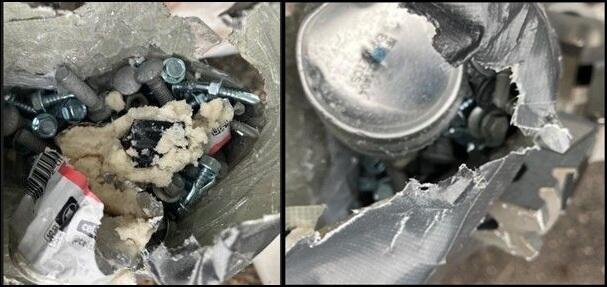
The device, a jar wrapped in tape and filled with screws, nuts, bolts and fuses, was in fact a makeshift bomb packed with a cheap but highly volatile chemical compound used in terrorist attacks worldwide, local and federal authorities said on Monday. -NYT
This is by FAR the clearest footage we have seen of the man who lit the bomb, dropped it at an officer’s feet and fled.
It happens so fast it’s hard to see, so I’ve slowed the footage and added arrows so you can see it.
He literally drops it RIGHT AT the feet of an officer. pic.twitter.com/y5nMNh7ibK
— Matt Van Swol (@mattvanswol) March 9, 2026
Here’s a picture of the contents of the bomb after it was opened by law enforcement:
CNN Runs Cover
In a now-deleted tweet, CNN wrote “Two Pennsylvania teenagers crossed into New York City Saturday morning for what could’ve been a normal day enjoying the city during abnormally warm weather. But in less than an hour, their lives would drastically change as the pair would be arrested for throwing homemade bombs during an anti-Muslim protest outside of Mayor Zohran Mamdani’s home.”
You can’t make this stuff up…
🚨 WTF?! CNN actually just covered the two Muslim bombers in NYC as
“Two Pennsylvania teenagers crossed into New York City Saturday morning for what could’ve been a normal day enjoying the city during abnormally warm weather” 🤯
You can’t hate these people ENOUGH. pic.twitter.com/PDeojFT30U
— Eric Daugherty (@EricLDaugh) March 10, 2026
Nineteen men arrived at East Coast airports Tuesday morning for what could’ve been a normal day enjoying a cross-country flight.
But in less than an hour, their lives would drastically change. https://t.co/JO3T0nhuye
— Scot Bertram (@ScotBertram) March 10, 2026
Not Just CNN
CNN isn’t the only network trying to downplay an attempted mass casualty bombing by ISIS supporters on US soil – as other networks went full mask-off to defend the poor Muslim teenagers.
The New York Times has now amended its “Smoking Jars of Metal and Fuses” headline, but it’s too late. Even in a world drowning in fake news, this particular masterpiece will live on in infamy. pic.twitter.com/TQhlQsgdQW
— Hans Mahncke (@HansMahncke) March 9, 2026
FAKE NBC NEWS NY PUSH FALSE NARRATIVE OF NYC MAYOR ZO AND WIFE UNDER ATTACK FOR MUSLIM BELIEFShttps://t.co/RHYJofBmBx
(*Witnesses say the attackers shouted “allahu akbar” as they threw the bombs at the protestors.) pic.twitter.com/TH5ZsE1Vao
— Politics On 𝕏 (@PoliticsOnX) March 9, 2026
Until the next come to Jesus…
Tyler Durden
Tue, 03/10/2026 – 14:25