Category: News
Anthropic Sues Pentagon Over ‘Supply-Chain Risk’ Designation
Anthropic Sues Pentagon Over ‘Supply-Chain Risk’ Designation
Authored by Stacy Robinson via The Epoch Times (emphasis ours),
Artificial intelligence (AI) developer Anthropic sued the Department of War on March 9, following the federal government’s designation of the company as a supply chain risk.
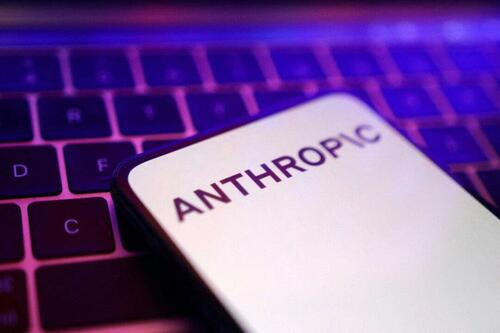
The Anthropic logo, in this photo illustration. Dado Ruvic/Reuters
That designation hinders government agencies and their contractors from working with Anthropic.
The suit comes after the company refused to change the user policy for its AI tool Claude to allow the government to use it for what Anthropic described as “mass surveillance” and “fully autonomous weapons.”
The Pentagon has denied that it planned to use Claude for such purposes.
The refusal caused President Donald Trump and War Secretary Pete Hegseth to direct federal agencies to sever ties with Anthropic and state that “effective immediately, no contractor, supplier, or partner that does business with the United States military may conduct any commercial activity with Anthropic.”
On social media, both Trump and Hegseth accused Anthropic of trying to “strong-arm” the federal government by dictating its military policy.
“WE will decide the fate of our Country—NOT some out-of-control, Radical Left AI company run by people who have no idea what the real World is all about,” Trump said in a Feb. 27 Truth Social post.
“Their true objective is unmistakable: to seize veto power over the operational decisions of the United States military,” Hegseth said on X the same day. “That is unacceptable.”
Anthropic alleges that the federal government is punishing the company for its First Amendment-protected speech and viewpoint.
The company also alleges that the Department of War reached out to some of its business partners following the rift and that those companies “delayed or paused several national security contracts or business engagements already in active development with Anthropic.” That puts “millions, possibly billions, of dollars at risk,” Anthropic stated.
“These actions are unprecedented and unlawful,” Anthropic’s lawsuit reads.
“The Constitution does not allow the government to wield its enormous power to punish a company for its protected speech. No federal statute authorizes the actions taken here.
“Anthropic turns to the judiciary as a last resort to vindicate its rights and halt the executive’s unlawful campaign of retaliation.”
In its filing, Anthropic said it isn’t confident that Claude “would function safely or reliably” if used for those purposes. Anthropic’s suit asks the court to set aside Trump and Hegseth’s designation as unconstitutional.
The lawsuit also names the US Treasury and Treasury Secretary Scott Bessent, the State Department, and Secretary of State Marco Rubio, along with 17 other government agencies and officials.
A group of more than 30 AI engineers and scientists from OpenAI and Google, including the latter’s chief scientist, Jeff Dean, also filed a legal brief in support of Anthropic on Monday.
“If allowed to proceed, this effort to punish one of the leading U.S. AI companies will undoubtedly have consequences for the United States’ industrial and scientific competitiveness in the field of artificial intelligence and beyond,” the group wrote.
The Pentagon declined to comment on the suit.
The Pentagon previously said the company must accept “any lawful use” of its tools and technology to support the U.S. military.
Tyler Durden
Tue, 03/10/2026 – 07:20
https://www.zerohedge.com/political/anthropic-sues-pentagon-over-supply-chain-risk-designation

Record Childhood Obesity Surge Puts MAHA Health Goals In Focus
Record Childhood Obesity Surge Puts MAHA Health Goals In Focus
Childhood obesity in the United States has reached its highest recorded level, renewing debate over school meals, physical activity, nutrition policy and the role of weight-loss medications for young people, according to The Hill. Data from the Centers for Disease Control and Prevention shows more than 1 in 5 children and teenagers were obese between 2021 and 2023, up from 5.2 percent in the early 1970s. About 7 percent now meet the criteria for severe obesity.
The issue has become part of the “Make America Healthy Again” initiative connected to Robert F. Kennedy Jr. at the U.S. Department of Health and Human Services. Discussions around solutions often center on improving school meals and increasing opportunities for physical activity.
Nutrition advocates say school meal programs play a critical role in children’s diets. For some students, breakfast and lunch at school are the most nutritious meals they receive each day. Erin Hysom of the Food Research & Action Center said pandemic school closures disrupted that support. “They’re noting that this increase in obesity occurred during COVID-19 and that jump in childhood obesity happened during the years when millions of kids lost access to reliable school meals,” she said.
The Hill writes that only nine states currently provide universal free breakfast and lunch to public school students, though others are considering similar programs. Federal officials have also promoted updated nutrition guidance that emphasizes whole foods and discourages ultra-processed products, which account for more than 60 percent of children’s daily calories.
Researchers say improving school meals will require additional funding, trained staff and better kitchen equipment so schools can prepare more fresh food. At the same time, the administration has approved requests from 18 states to remove soda and junk food from certain food assistance programs and announced new nutrition training requirements for future physicians.
Experts also point to declining physical activity in schools as a contributing factor. Erin Hager of the Johns Hopkins Bloomberg School of Public Health said opportunities such as recess and physical education have gradually been reduced as schools focus more heavily on testing. “Many of those physical activity opportunities that a lot of us kind of take for granted… have been taken away and replaced by a focus on standardized tests,” she said.
Medical treatments are also part of the conversation. The Food and Drug Administration has approved several obesity medications for adolescents ages 12 to 17, including Wegovy, Saxenda, Orlistat and Qsymia. Prescriptions for these drugs rose sharply after their approval, though they are still used by only a small share of eligible teens.
Matthew Haemer of the American Academy of Pediatrics said prevention remains the priority, but medication can help some patients. “For those children — especially those children with the most severe obesity… FDA-approved medications can be a helpful tool in the toolbox,” he said.
Tyler Durden
Tue, 03/10/2026 – 06:55
https://www.zerohedge.com/markets/record-childhood-obesity-surge-puts-maha-health-goals-focus
UK Govt Plots Another X Shutdown Over Grok’s “Offensive” Roasts
UK Govt Plots Another X Shutdown Over Grok’s “Offensive” Roasts
Authored by Steve Watson via Modernity.news,
The UK government under Keir Starmer is once again eyeing a total ban on X, this time claiming Grok’s ability to spit out “insults” and “offensive language” poses a dire threat. But as users on the platform point out, this is just another excuse to silence dissent against the regime.
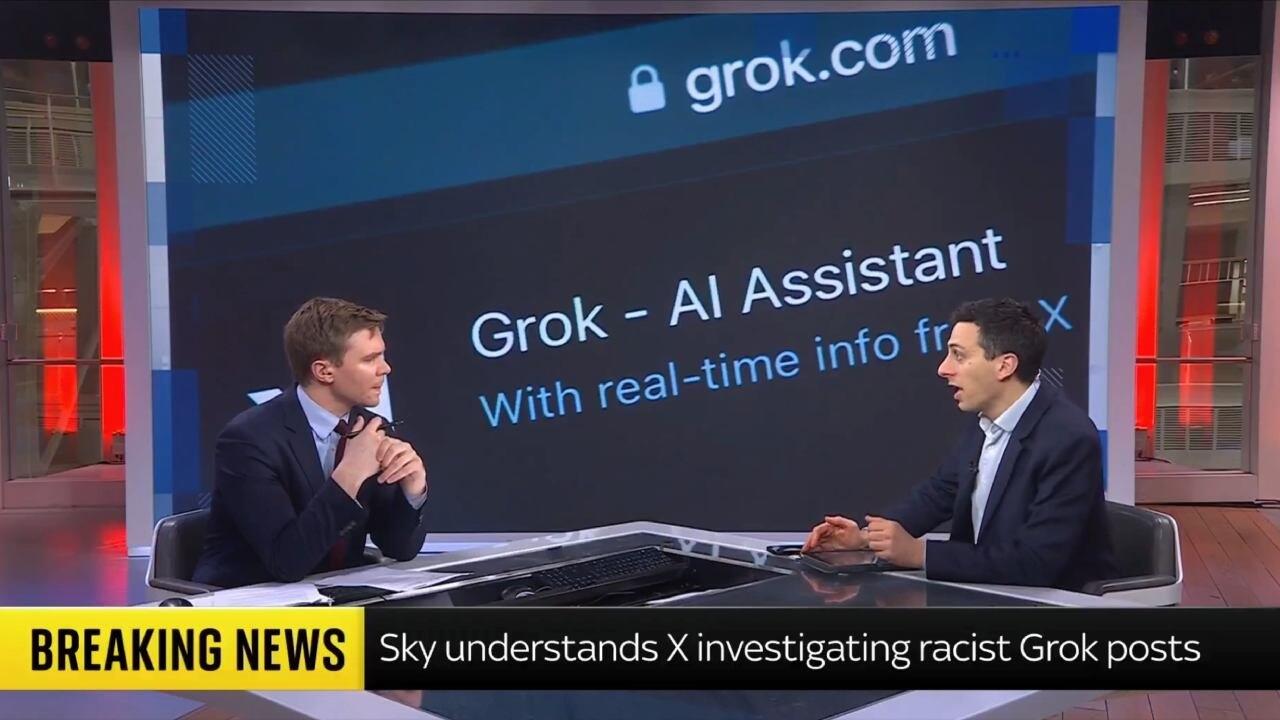
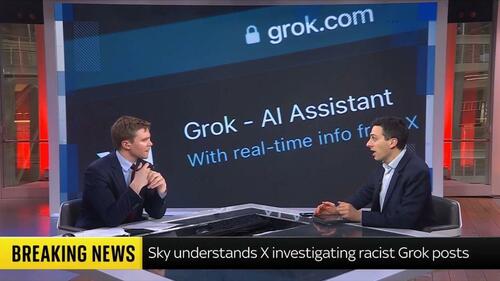
Fresh reports reveal Starmer’s administration is probing ways to penalize X for “spreading offence online,” including a potential shutdown. Sky News reported on Grok being prompted to generate vulgar responses targeting Hinduism, Islam, and even historic football disasters.
Watch:
🚨BREAKING: KEIR STARMER IS CONSIDERING MOVE TO SHUT DOWN X AGAIN
Grok can be prompted to produce ‘insults’ and ‘offensive language’
The UK Government are now looking at ways to penalise the platform for spreading offence online INCLUDING a possible shutdown
We know why… pic.twitter.com/nTUrFZtwbQ
— Basil the Great (@BasilTheGreat) March 8, 2026
The correspondent notes that Grok has been used to generate “highly offensive content” directed toward groups of football fans, such as blaming Liverpool supporters for the 1989 Hillsborough disaster, where 97 fans died in a crush, and for which authorities were found to be culpably responsible. Similar insults targeted Rangers fans, referencing the 1971 Ibrox disaster that claimed 66 lives.
The government says it is investigating the issue. This comes after Ofcom, as the regulator, stated at the start of the year that it was considering potential actions. Under the Online Safety Act, penalties could include fines up to 10% of a company’s worldwide revenue or £18 million if non-compliance is determined.
Sky News states that X is “urgently investigating” the chatbot responses.
This isn’t Starmer’s first rodeo in targeting X. As we detailed in our earlier coverage, the UK government threatened a total ban on X over the so-called “Grok bikini flap,” where the AI was prompted to create ‘sexualized’ images.
As we further noted, the push for a total ban likely has nothing to do with protecting children, but everything to do with stifling free speech and criticism of the Labour government’s policies.
X users aren’t buying the latest pretext. One post blasts “Starmer Bin Lying gets fact checked by Grok every time he speaks He can’t even post on this app without being exposed as a liar.”
A reply warns of tyranny, quoting Robert A. Heinlein: “When any government, or any church for that matter, undertakes to say to its subjects, This you may not read, this you must not see, this you are forbidden to know, the end result is tyranny and oppression no matter how holy the motives.”
This pattern reeks of authoritarian overreach. Starmer’s regime, facing backlash over open borders and surveillance creep, can’t stand a platform where truths about their failures go viral.
X remains a bastion for uncensored discourse, exposing leftist hypocrisy and globalist agendas. Shuttering it just because a minority of people made Grok make up some insults would constitute a total victory for tyrants.
Your support is crucial in helping us defeat mass censorship. Please consider donating via Locals or check out our unique merch. Follow us on X @ModernityNews.
Tyler Durden
Tue, 03/10/2026 – 06:30
https://www.zerohedge.com/political/uk-govt-plots-another-x-shutdown-over-groks-offensive-roasts
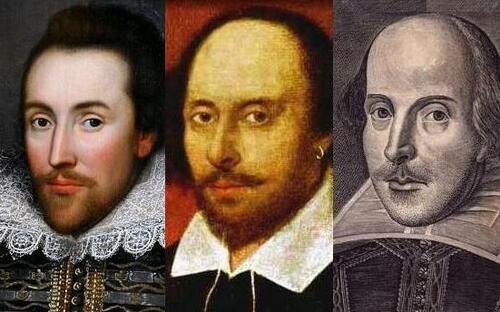
Sheikhspeare
Sheikhspeare
Authored by James Alexander via DailySceptic.org,
Hegel said everything important in world history happens twice.
Marx added, grimly: “The first time as tragedy, the second as farce.”
And here is my thrupenny bit.
Everything important said by anyone in world history is said twice: the first time as farcical observation, the second as academic argument.
As evidence I submit the following.
A few weeks ago I took a brief look at the hypothesis that Shakespeare was a black lady. I accepted with grave pleasure the fact that Shakespeare is an anagram of A She-Speaker: but, of course I had to be caustic about the claim accompanying the staggering anagram. And against the argument that the name Shakespeare might allude to Shakti, the female power that lies underneath all existence, I solemnly ventured the observation that it might equally and oppositely – equality and opposition being essential to scepticism – allude to the Arabic word Sheikh, and the male power that lies underneath all existence.
That was the farce.
Now the academic argument.
Today I received a notification from Academia.edu telling me about a piece written by Sushil K. Jain from Canada, entitled, and hold your breath, ‘Shakespeare, the Sheikh, Who Became a Peer’, subtitled, ‘The Eastern Mind Behind the English Stage: A New Model of Shakespearian Authorship’, published 2026. There we are. First time as farce, second time as academic argument.
I have printed it out and will let you know what it says. It is 120 pages long. Actually, it is not very academic, though it has a fair number of citations and is written in a sort of AI-neutral prose style.
Right, I read it last night. The first thing I have to say is that the author nowhere says that he is guilty of a woeful pun. “The Sheikh who became a Peer”, indeed. Jain’s style – and I do not know how much any AI bot was involved in the writing of this: it is very smooth and laborious and explanatory and is very easy to skip through without missing anything – is Indian-joyful and also solemn or serious: and I think this is because Jain is beating the drum of modern globalism, cosmopolitanism, anywhereism, in such a way that his line of thought might sing in the contemporary academic world of postcolonialism and immigration studies. Let’s hear him in his own words.
Shakespeare’s plays bear the unmistakeable imprint of a Persian-educated, Indian-heritage, Arabic-speaking scholar…
… [They] exhibit a depth of cultural knowledge — of Ottoman-Venetian politics, Indian Ocean trade, Persian narrative structures and Islamic intellectual traditions — that exceeds what Shakespeare could plausibly have accessed through reading alone.
Evidence? Well, it is mostly speculation according to the following grand logic:
Hypothesis: Would have.
Lemma: Could have.
Corollary: Should have.
Result: Did.
But there are allusions to Othello (of course), Aaron the Moor in Titus Andronicus, the Indian boy (never seen) in Midsummer Night’s Dream, and, as usual, the one play that is always essential in the most sober or the most drunken Shakespeare analysis, The Tempest. Oddly enough, there is nothing about the history plays. Yes, indeed, the Sheikh didn’t contribute much to Henry IV Part I, did he? But why was Shakespeare so digressive? Ah, well, in order to explain why Shakespeare abandoned Aristotle and the preservation of the unities we have to allege that he, or one of his cronies, knew Persian.
Like every sensible reader of Shakespeare, Jain notices that there is a gap between “the monumental works” and “the modest documentary trail”. That’s right: in order to make sense of Shakespeare at all, we have to ask the question: why do we know so little about the greatest writer of English?
But Jain putters out with mumblings, politically correct mumblings, about Shakespeare’s “global imagination”. Now, it is amusing to think that a scholar could have come to London from a birthplace such as “Surat, Cambay, Hormuz, Masulipatuam or the Swahili coast”, via an education in “Shiraz, Isfahan, Lahore, Bijapur, Cambay or Hormuz”, could have somehow acquired mastery of Arabic theology, Persian literature and Indian geography, could have worked for, say, the Levant Company, which was founded in 1581, and finally could have been taken up by one of the artistic households of the Earls of Leicester, Essex or Southampton.
He sells the book by saying that Oxfordians and Baconians can only explain Shakespeare by saying there was a conspiracy of silence, whereas, according to his explanation, Sheikhspeare (and Jain, sadly, never goes so far as to call him this: come on, man, assert your hypothesis more strongly!) was part of a collaborative enterprise involving “encounter and exchange”. Yes, not conspiracy theory but more proof that England has always been a nation of immigrants. Disappointingly, the only books on the authorship debate which Jain cites were written by J. Bate, J. Shapiro, S. Wells, G. Taylor and A. Nelson, who are all famous for being mightily opposed to any suggestion that Shuxpur was not the daft lad from Stratfud. Where are the researches of R. Strittmatter. N. Green, D. Price, E. Showerman, M. Anderson and A. Waugh? Nowhere. Ah, Jain has a lot of reading to do.
He dedicates his book to Irene Coslet, the author of The Real Shakespeare, which alleges the black lady hypothesis. I am astounded that Jain has devoted so many man hours to this odd little hundred-page project. So far it has 14 views: so the algorithm obviously knows quite a lot about me to know that it should send me this.
I tried to find out who Jain is on Google and came away a bit bewildered. There seem to be many Shulil K. Jains. One is an old man, who was associated with Canterbury College, University of Windsor in Canada. There was some trouble, as he was arrested and charged with embezzlement in 2024 and was reported as being part of a $850,000 lawsuit. Nothing seems to have come of it, as he is still writing in his retirement, aged over 80. I am not going to join the dots, as that is not my sort of thing: I want others to do the research, and then I’ll read it. Just as with Shakespeare.
What do I think about the hypothesis?
Well, as I argued about Shakespeare as a black woman, it is interesting to briefly contemplate such a suggestion, and read a bit of W.S. with it in mind.
But this one is too much of a stretch, and, alas, it is very unlikely that a crowd of writers collaborating on plays would be willing to take advice from an austere Easterner who would drone on about Persian literary structure.
“Please,” says the Sheikh, “let me put a little Indian boy in the play.” “Alright,” sighs Shakespeare, “but not onstage.” “Please,” says the Sheikh, “does Othello have to kill that Turk?” “London audiences,” replies Shakespeare, “love a bit of sanguinary stuff. Look, bestill yourself or begone: go and find a pipe and pathic or something. I need to write…” “Please, just one more thing,” says the Sheikh, “Where is The Tempest set? Is it Bermuda, Gran Canaria, or, possibly – the Swahili coast?” “Fuck off,” says Shakespeare.
The next suggestion has to be that Shakespeare was the son of an Aztec, perhaps a grandson of Montezuma, whose father was brought back to Spain in 1541 by stout Cortes: this small boy, born around 1550, then travelled through Italy, becoming a refined gentleman and literary expert, before amusing Queen Elizabeth with his typically huitzilopochtlian storytelling style, but now imposed on English and Italian subjects. Shakesalcoatl was always tempted to have Macbeth’s head thrown down from the top of a ziggurat by Malcolm. And The Tempest, of course, was set on, dear oh dear, Little Saint James.
Tyler Durden
Tue, 03/10/2026 – 05:00
Coal Prices Surge As Energy Shock Forces Power Plant Fuel Switching In Exposed Countries
Coal Prices Surge As Energy Shock Forces Power Plant Fuel Switching In Exposed Countries
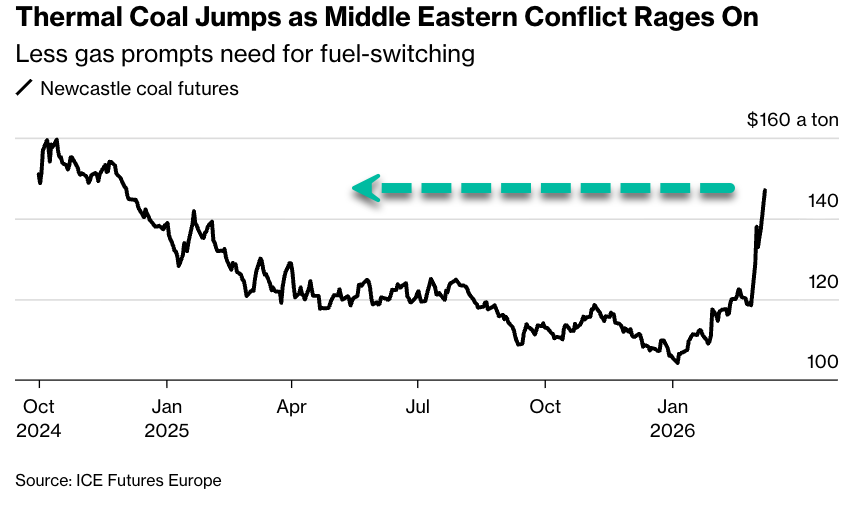
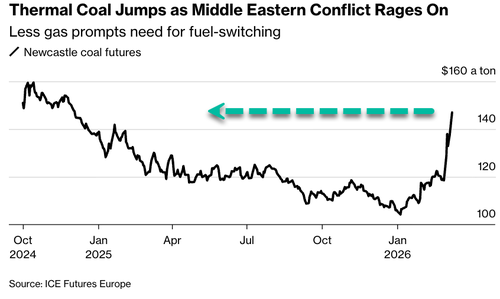
Asian benchmark Newcastle coal prices jumped more than 9% to $150/ton (as per BBG data) at the start of the week, as energy flows across the Gulf area remain disrupted and transit through the Strait of Hormuz has significantly slowed. The rise in coal prices is being driven by a broader energy shock, with surging gas prices making coal a more economical substitute fuel for power generators.
Last week’s IRGC kamikaze drone attack, which shuttered Qatar’s massive LNG export facility – responsible for roughly 20% of global supply – has been the driving force behind gas-to-coal switching, especially in Europe, as gas prices have soared 50%.
Samantha Dart (Global Co-Head of Commodities Research) penned a note late this weekend on natural gas:
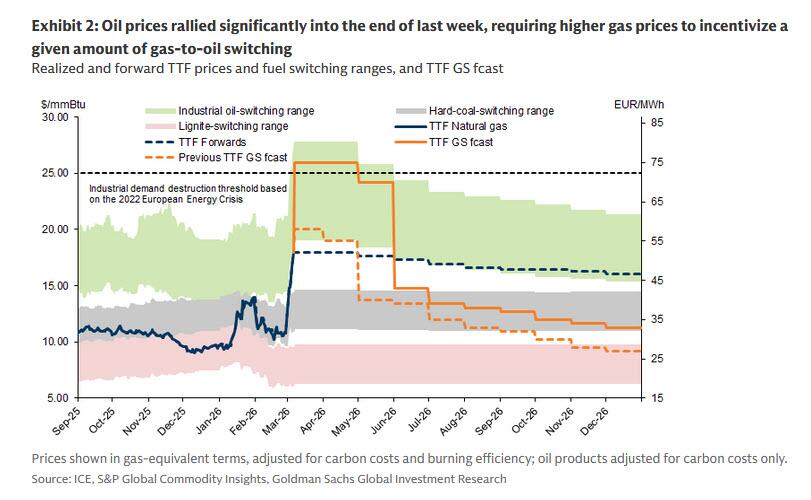
“European natural gas prices (TTF) closed the week up 88% from pre-Iran-conflict levels, at 53 EUR/MWh. For context, approximately 20% of global liquefied natural gas (LNG) volumes flow through the Strait of Hormuz, largely produced by Qatar, and no reroutes exist. This flow is 100% halted at the moment, with Qatari production fully down following a drone attack.
We base-case that Qatari LNG production will be restored by early April, and we have accordingly raised our April TTF forecast to 55 EUR/MWh, well into the 45 EUR/MWh (fuel oil) to 71 EUR/MWh (diesel) gas-to-oil switching range because we think increased fuel switching away from gas will be required to normalize European gas storage ahead of the next winter. We have not changed our 21 EUR/MWh 2027 TTF forecast. In a scenario where the Qatari supply shock lasts over 1 month, we would expect TTF prices to rally further to the mid-70 EURs/MWh, where diesel is currently priced, to incentivize further switching. A scenario where the shock lasts longer than two months would likely lift TTF above 100 EUR/MWh to incentivize broader industrial demand destruction across Europe and Asia.”
Notice that Exhibit 2 above shows TTF is already in the coal-switching range. The rest of Dart’s note can be read here.
In a separate note, UBS analyst Manik Narain warned of EM energy risks if the Hormuz chokepoint remains clogged:
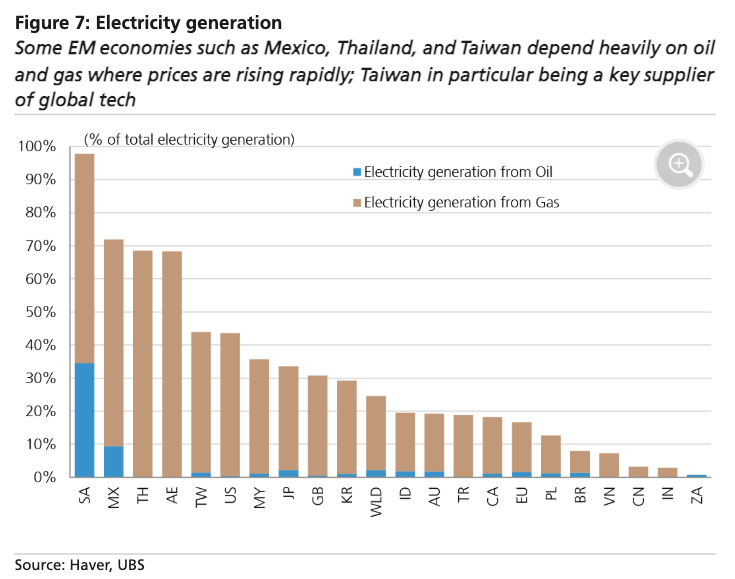
“EM Asia appears most directly at risk, accounting for ~73% of oil shipped through the Strait of Hormuz. 40-70% of India, Korea and Thailand’s oil supply transits this route; while Thailand and Taiwan generate 45-60% of electricity from gas, indicating potential price risks to tech and other industrial supply chains if the conflict doesn’t abate soon.”
The duration of the conflict is key because higher NatGas prices will only spur continued gas-to-coal switching.
UBS highlighted that EM power generation in countries such as Mexico, Thailand, and Taiwan remains heavily exposed to oil and gas, leaving electricity systems vulnerable as fuel prices surge. Taiwan stands out, given its major role in the global AI chip supply chain, meaning rising power costs there could have implications far beyond domestic electricity markets.
Related:
These EM Countries Face Greatest Risk If Energy Shock Spreads
Operation Epic Fury has been one way to ‘Make Coal Great Again’…
Tyler Durden
Tue, 03/10/2026 – 04:15

London Museum Hides Portrait Behind Cloth To “Reclaim” Caribbean History
London Museum Hides Portrait Behind Cloth To “Reclaim” Caribbean History
Authored by Steve Watson via Modernity.news,
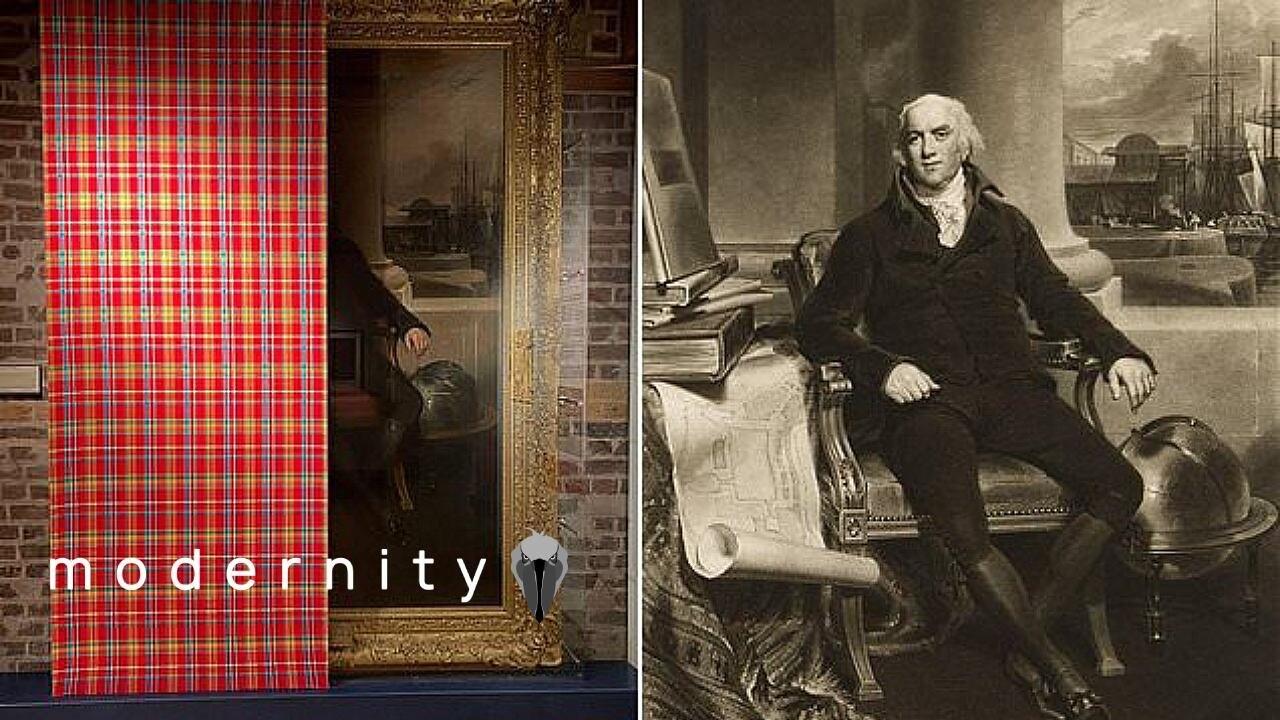
In yet another brazen attempt to erase history, the London Museum Docklands has half-covered a portrait of 18th-century merchant Beeston Long with Madras cloth, all in the name of “reclaim[ing] Caribbean history.” This symbolic shrouding targets Long’s investments in Jamaican plantations, turning a piece of British maritime legacy into a virtue-signaling prop.
Critics see this as part of the left’s relentless campaign to erase uncomfortable truths about the past, prioritizing feelings over history and sidelining the achievements of figures who built modern Britain. With new panels lecturing visitors that such artworks can “obscure” or “sanitise” links to slavery and “evoke emotional responses,” the museum is pushing a narrative that gives “voice to those whose cultures have been impacted by colonialism.”
The portrait of Beeston Long, a former Bank of England governor who oversaw Docklands expansion, now hangs partially obscured by cloth exported to the Caribbean during colonial times. Museum officials claim this intervention helps “reclaim the histories of colonised Caribbean nations” and celebrates the Windrush Generation’s influence.
Museum covers up portrait of former Bank of England governor who owned slaves to ‘reclaim Caribbean history’ https://t.co/w1KJ9mmWVd
— Daily Mail (@DailyMail) March 9, 2026
They assert the Caribbean community was “essential” to the area and “invited to migrate to Britain to help rebuild the ‘mother country’” between 1948 and 1971, noting arrivals “created the Tower Hamlets we know today.”
Displays further declare: “Many of the objects in this gallery were created for and through the oppression of enslaved people. European colonialists exploited African and Asian peoples and lands relentlessly.”
To top it off, an installation called Holding Emotions offers visitors ways to “reclaim wellbeing” and “ground yourself,” complete with doodling tips and comfy seats for those triggered by history.
This isn’t an isolated incident. Recall the removal of Robert Milligan’s statue outside the same museum in 2020 amid Black Lives Matter unrest, which remains in storage. National Museum Cardiff yanked a painting of colonial governor Thomas Picton in 2021 to “decolonise” its collection.
As we’ve covered before, this woke purge has targeted icons across the West. In Wales, the government flagged statues of “old white men” like Admiral Horatio Nelson – an “aggressor who conquered peoples” – General Arthur Wellesley, Charles, 2nd Earl Grey (an abolitionist), and Winston Churchill for removal, claiming they fuel perceptions of white male dominance and “can be offensive to people today.”
Across the pond, Theodore Roosevelt’s equestrian statue at New York’s American Museum of Natural History was covered and removed in 2021, labeled a symbol of “racial hierarchy” despite honoring him as a naturalist. It was shipped to North Dakota on “indefinite loan.”
Thomas Jefferson’s 187-year-old statue was crated and hauled out of New York City Hall that same year over his slave-owning past, with lawmakers calling him a “slaveholding pedophile” and offensive. Republican Joe Borelli accused Mayor de Blasio of a “progressive war on history.”
A statue of Thomas Jefferson, who was the third president of the United States, has been removed from New York City Hall after a unanimous vote by a committee, because of his links to the slave trade.
Latest videos here: https://t.co/WuXYjxfxy1 pic.twitter.com/M7UQ8W6hqa
— Sky News (@SkyNews) November 23, 2021
Even anti-slavery heroes weren’t safe: In 2021, statues of abolitionist William Pitt in Edinburgh and biologist Thomas Henry Huxley at Imperial College London faced removal for vague “links to the British Empire” and papers that “might now be called ‘racist.’” One critic noted: “This is what happens when Edinburgh Council hands editorial control… to a secretive cabal of activists.”
But there’s hope on the horizon. Last year, President Trump signed an executive order to restore improperly removed statues and monuments, overhauling the Smithsonian to ditch “divisive, race-centered” narratives and return to “truthful and uplifting views of American history.”
The order, titled “Restoring Truth and Sanity to American History,” tasks officials with reviewing and reinstating monuments taken down in the past five years, aiming to make museums “educate rather than indoctrinate” by July 4, 2026. As the White House stated, many were removed to “perpetuate a false revision of history.”
This latest London fiasco underscores how leftist institutions continue their assault on Western heritage, using “reclamation” as cover to divide and demoralize. Many see it as cultural vandalism, a removal of the unvarnished story of our past – warts and all – for future generations.
Your support is crucial in helping us defeat mass censorship. Please consider donating via Locals or check out our unique merch. Follow us on X @ModernityNews.
Tyler Durden
Tue, 03/10/2026 – 03:30

Gulf Firms Seek Millions In Political Violence Coverage Amid Rising Tensions
Gulf Firms Seek Millions In Political Violence Coverage Amid Rising Tensions
Companies across the Gulf are rushing to purchase political violence insurance as regional fighting intensifies, seeking protection for major infrastructure and commercial properties against the growing risk of attacks and collateral damage, according to FT.
Insurers and brokers say they have received hundreds of inquiries in recent days from asset owners looking for coverage that protects against war-related threats. The policies typically cover damage caused by terrorism, missile debris, civil unrest, strikes, riots and other forms of political instability.
Demand has surged as the conflict in the Middle East expands, with Iran and allied groups launching missile and drone strikes against Israel and nearby countries following a joint U.S.–Israeli bombing campaign. Investors and businesses in Gulf states including Saudi Arabia and Oman are increasingly concerned about the possibility that the violence could spill over into neighboring economies.
Industry experts say the financial impact of the conflict could be unusually large. Fergus Critchley, global head of terrorism and political violence at broker WTW, warned the current crisis could produce losses “significantly larger and more catastrophic” than those seen in recent years.
FT writes that much of the new demand is coming from Western companies operating in the Gulf, which insurers say are often considered more likely targets. Raj Rana, who leads war and terrorism coverage at broker Bowring Marsh, said his firm alone has fielded more than 50 requests for political violence coverage since last weekend.
Requests have come from a range of sectors, including renewable energy and hospitality. Solar projects in Saudi Arabia and hotels in Bahrain and Qatar have all sought protection as companies worry about both direct attacks and indirect damage such as falling shrapnel from intercepted missiles.
Digital infrastructure has also faced threats. Drone strikes this week targeted data centers operated by Amazon in the United Arab Emirates and Bahrain, according to security experts who suspect Iranian involvement. Microsoft said its regional operations had not been disrupted.
Some businesses in the region already carried terrorism insurance before the conflict escalated. However, brokers now recommend broader political violence coverage, which also protects against unrest such as riots, strikes and civil disturbances.
The surge in demand has pushed premiums sharply higher. Insurers say prices rose early in the week to several times their previous levels. Previously, coverage for political violence on an energy project in Saudi Arabia or the UAE could cost less than 1 percent of the insured value. By Thursday, the cost had climbed to roughly five times that rate. For example, securing $10 million in coverage for a $20 million project could now cost about $500,000, compared with under $100,000 before the latest escalation.
Tyler Durden
Tue, 03/10/2026 – 02:45
“How Can Women Trust The System If Gang-Rapists Can’t Be Deported?” – Meloni Rages Against Italian Judiciary
“How Can Women Trust The System If Gang-Rapists Can’t Be Deported?” – Meloni Rages Against Italian Judiciary
Authored by Thomas Brooke via Remix News,
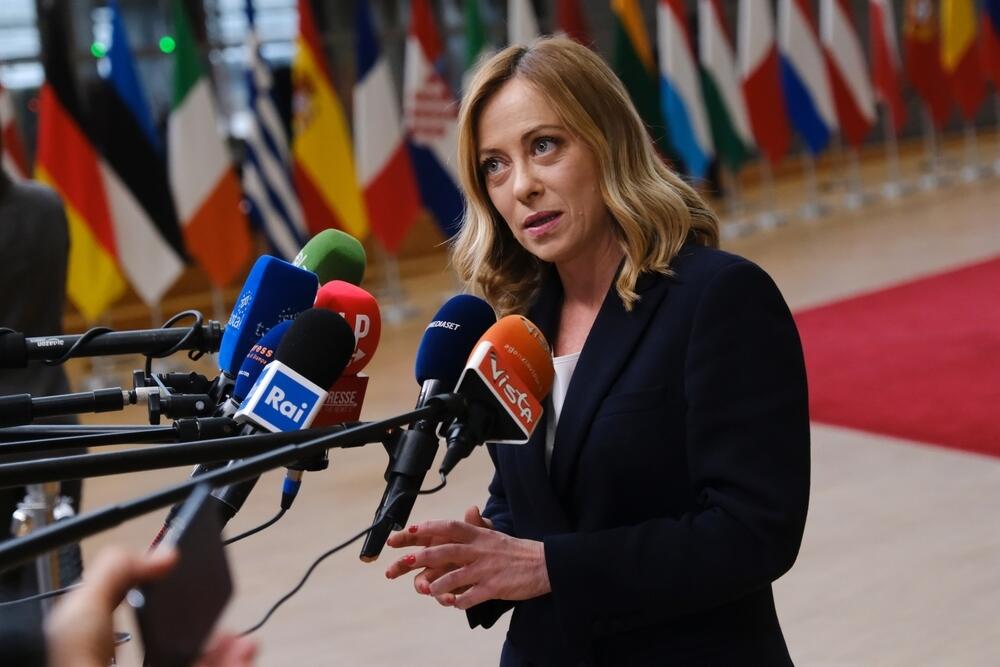
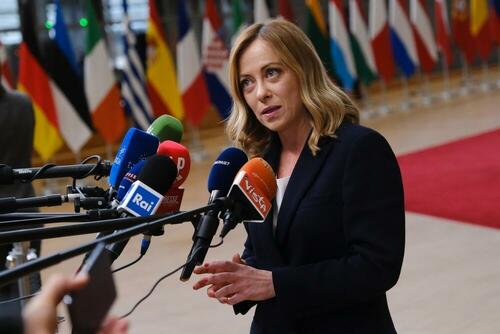
Italian Prime Minister Giorgia Meloni has sharply criticized judicial decisions blocking the detention of migrants transferred to Albania, citing the case of a Moroccan rapist with a long criminal record whom authorities say they cannot detain or deport after he applied for international protection.
Speaking to RTL 102.5, Meloni said some court rulings preventing the continued detention of migrants transferred to Italian processing centers in Albania were “surreal” and undermined public safety.
“I also wonder where the feminists are in the face of these events,” Meloni said during the interview, referring to the case of one of the migrants, Moroccan national Fathallah Ouardi, who had been transferred to Albania but was later returned to Italy after judges refused to validate his detention.
Meloni said the man had a lengthy criminal record. “The record of one of these migrants includes convictions for drug dealing, resisting a public official, conspiracy to commit sexual assault, and gang rape,” she said, as cited by Secolo d’Italia.
According to the prime minister, the court rejected the detention order after the migrant applied for international protection.
“This is someone who entered Italy illegally, started dealing drugs, and gang-raped a woman — we can’t detain him, we can’t send him to Albania, we can’t repatriate him, and we’re almost forced to grant him international protection,” she said, adding that such decisions raise serious questions about the protection of victims and public confidence in the justice system.
“How can we guarantee the safety of citizens like this?” she asked. “These decisions are surreal; they affect not the government’s work but citizens’ rights, first and foremost, the right to safety.”
“What trust can a woman who has been gang-raped have in the system if her rapist can’t even be deported?” she added. “I also wonder where the feminists of ‘Non una di meno’ are on these issues.”
The Italian leader also defended her government’s migration policies, including the controversial use of offshore migrant processing centers in Albania.
“I am determined to do what the citizens have asked me to do: a tough policy on irregular immigration, including with new tools like the centers in Albania,” Meloni said.
“Even though some are trying everything they can to prevent it, I am determined on this and am willing to work three times, four times, ten times harder if necessary.”
Remix News provided reporting this week on another Moroccan national accused of raping a 26-year-old woman in Bottanuco in what was a sustained attack over the course of an evening. The suspect was born in 1987 and has accumulated a series of criminal charges and convictions in Italy over more than a decade.
Authorities say he was investigated for drug trafficking between 2014 and 2015 and charged with illegal immigration in 2015. Records also list illegal entry and residence in Trentino in 2016 and theft in 2017.
Court documents further list convictions including resisting a public official and drug trafficking in 2014, as well as participation in sexual assault and gang sexual assault in 2018. A further drug trafficking conviction was recorded in 2025.
Tyler Durden
Tue, 03/10/2026 – 02:00

Humanity Crossed A Threshold, And Most Of Us Scrolled Past It
Humanity Crossed A Threshold, And Most Of Us Scrolled Past It
Authored by Kay Rubacek via The Epoch Times,
Something happened last week that most people scrolled past.
Two Amazon data centers in the United Arab Emirates were struck during Iran’s retaliation for U.S. military action. Another facility in Bahrain was reportedly damaged after a drone landed nearby. The earlier strikes that triggered the retaliation were said to have used AI-assisted targeting systems.
It was a brief moment in the news cycle, quickly overtaken by the next political story. But the implications are difficult to ignore.
Artificial intelligence has now crossed into active geopolitical conflict.
The infrastructure that powers the digital world—the same systems that store family photos, run businesses, and answer questions on our phones—has become strategic wartime infrastructure. Algorithms woven quietly into civilian technology are now helping guide decisions about where weapons land.
Humanity crossed a threshold, and most of us scrolled past it.
But we know from history that major technological shifts rarely announce themselves with a single dramatic moment. They appear first as signals in small news items, policy disputes, unexplained departures by insiders.
Another signal appeared almost at the same time.
The federal government recently removed the artificial intelligence systems developed by Anthropic from its networks. Shortly afterward, OpenAI stepped in with a defense agreement of its own.
The public does not know the full story behind the change. We do not know exactly what demands were made behind closed doors, what ethical guardrails were contested, or why one of the world’s leading AI companies was suddenly pushed out of federal systems.
But the episode itself is another signal.
And yet another signal has been appearing quietly inside the AI industry itself: the departure of safety researchers.
Over the past several years, numerous high-profile researchers tasked with studying the risks and safety of advanced AI systems have left their posts at leading companies and research labs. Many of these departures have come with little public explanation.
Those researchers rarely describe the internal debates they witnessed. Few are in a position to do so.
But patterns like this matter. When the people closest to a powerful technology begin stepping away quietly, it often means they have seen tensions the public has not yet been invited to examine.
History has seen moments like this before.
In the early 1940s, scientists working on what became the Manhattan Project realized they were building something unprecedented. Some raised concerns about what the technology might mean once it left the laboratory. But those debates happened largely behind closed doors. The public understood the stakes only after the technology had already been used.
Artificial intelligence may be unfolding along a similar pattern. We are seeing the signals now—researchers leaving, governments disputing ethical guardrails, and AI systems appearing inside real geopolitical conflict.
Yet the public conversation about artificial intelligence is still shaped by a set of assumptions that make these signals harder to recognize.
Misconception #1: AI Is ‘Just a Tool’
This analogy is comforting. We imagine AI the way we imagine a calculator or a word processor—machines that perform tasks efficiently while remaining firmly under human control.
Tools can become strategic assets in war. But they do not generate their own outputs in ways their creators sometimes struggle to explain, nor do they require constant negotiation over the ethical boundaries of their behavior.
Modern AI systems are not programmed line by line in the traditional sense. They are trained on vast datasets and learn patterns within that data. Their behavior emerges from statistical relationships rather than explicit instructions. AI researchers describe these systems as “grown,” not built. And that makes them fundamentally different from the tools we are used to controlling.
Misconception #2: AI Is Neutral
AI systems are trained on human-generated information. That information reflects human biases, historical conflicts, and uneven representation.
When an AI system generates an answer, it synthesizes patterns it absorbed from that material.
AI has developed fluent language skills that can create the illusion of objectivity. But confident language is not the same as truth.
The recent disputes between governments and AI companies illustrate this clearly. Debates over surveillance limits or autonomous weapons are not simply technical questions. They are moral ones. Guardrails exist precisely because the systems themselves are not neutral.
Misconception #3: Humans Fully Control AI
Traditional software behaves according to explicit instructions written by programmers.
Modern AI systems operate differently. Their outputs are probabilistic, generated through layers of learned relationships inside the model.
Developers are now using AI systems to build AI systems and to manage other AI systems. They are using AI to write code that in the past they would have written themselves, and it’s happening so fast that they cannot monitor or even understand every line of code being generated by systems that do not sleep.
Control, in this environment, is not a switch. It is more like a moving boundary that no one has ever seen before, and the language to even define it is still in its infancy.
Misconception #4: The Experts Know Where This Is Going
In most scientific fields, experts disagree within a fairly narrow range. In artificial intelligence, the range of opinion is unusually wide.
Some researchers believe AI will revolutionize medicine and scientific discovery. Others warn the technology could produce serious societal disruption if development outruns human wisdom.
Among those raising such concerns is Geoffrey Hinton, a Nobel Prize winner and one of the foundational figures of modern AI research.
That range of opinion does not prove disaster is coming. But it does reveal that even the people building these systems do not fully agree on where they lead.
Artificial intelligence is integrating rapidly into the systems that shape modern life—communication, commerce, national security, and governance.
We are seeing signals across all of these domains. We can see clearly that AI is shaping our future whether we like it or not. The question is whether we will recognize the signals in time to understand what is unfolding, or whether we will wait, as societies often do, until the consequences make the signals impossible to ignore.
Views expressed in this article are opinions of the author and do not necessarily reflect the views of The Epoch Times or ZeroHedge.
Tyler Durden
Mon, 03/09/2026 – 23:05
https://www.zerohedge.com/ai/humanity-crossed-threshold-and-most-us-scrolled-past-it

Suspected Missile Fuel Precursor Materials Sail From China To Iran, Even As US Bombs Fall
Suspected Missile Fuel Precursor Materials Sail From China To Iran, Even As US Bombs Fall
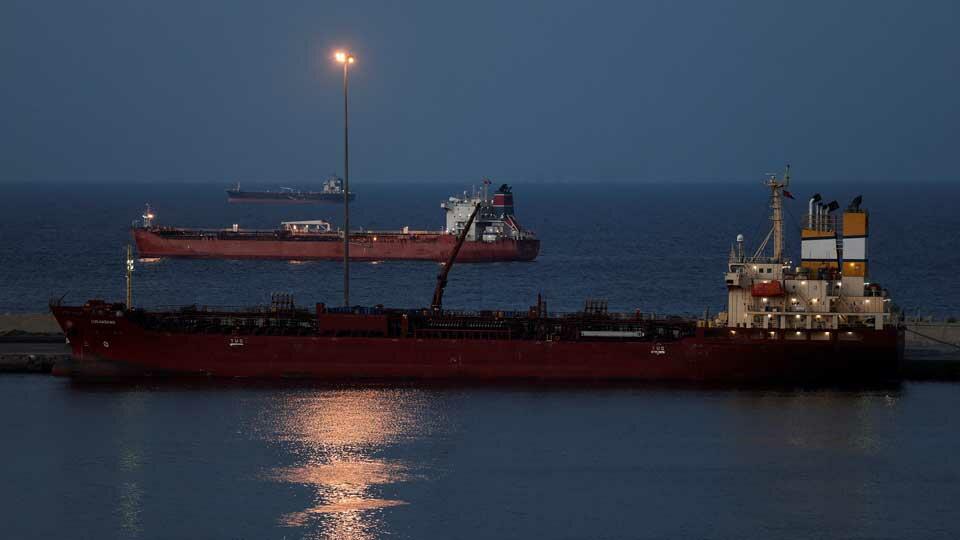
A pair of cargo ships tied to a sanctioned Iranian state shipping line have quietly departed a Chinese chemical hub and are now sailing toward Iran carrying what analysts suspect is missile fuel precursor, according to fresh Washington Post analysis of ship-tracking data and satellite imagery.
The vessels have been identified as Shabdis and Barzin, which operate under Islamic Republic of Iran Shipping Lines (IRISL), the state carrier sanctioned by Washington and many allies. The IRISL has long been accused of shipping materials tied to Iran’s ballistic missile program – something which the US and Israel say they are trying to currently eliminate in the ongoing Operation Epic Fury.
Both ships recently docked at Gaolan port in Zhuhai on China’s southeastern coast, a major chemical-handling facility that processes large volumes of industrial compounds, including sodium perchlorate – which is critical for producing solid rocket fuel, the report says.
Officials and and analysts were cited in the Post as concluding the cargo likely includes sodium perchlorate destined for Iran’s missile program.
“Given the track record, the most parsimonious explanation is that they’re loading the same commodity they’ve been shuttling for the past year-plus,” Isaac Kardon, a senior fellow at the Carnegie Endowment for International Peace, pointed out.
So in a way this is nothing “new” for Beijing-Tehran ‘illicit’ trade, however what is new is seen in the following:
While a dozen other IRISL ships have visited the port since the start of the year, experts emphasized that China’s allowing a ship to depart for Iran with weapons-related material during a war in which they have called for restraint would be extremely notable.
Indeed, as Kardon continues, “China could have held these vessels at port, imposed an administrative delay, invented a customs hold – any number of bureaucratic tools, but didn’t.”
Just days before US and Israeli bombs began to fall on Tehran, we featured analysis which questioned, Will China Come To Iran’s Rescue? “While China avoids direct confrontation, it has not shied away from visible military cooperation – also as “Earlier this month, Russia, China and Iran deployed naval vessels for joint security exercises in the strategically vital Strait of Hormuz,” we featured.
Beijing’s official position remains that it supports “safeguarding Iran’s sovereignty, security, and territorial integrity” while opposing “the threat or use of force in international relations.” As was also featured:
China is unlikely to dispatch troops or engage directly in any conflict, but to interpret this as passivity would be to misread the nature of 21st-century great power competition. China’s support for Iran is real, multifaceted, and in some ways more sustainable than military intervention; it just operates on a different strategic wavelength.
Beijing has meanwhile formally rejected the allegations that it is moving missile-production material to the Islamic Republic, arguing that the United States exaggerates routine commercial or dual-use trade.
And the below is a monitoring report from just weeks before the Trump-ordered campaign on Iran began:
MORE: Iran received a large shipment of a chemical precursor for solid missile propellant from China on February 13.
Western media reported on January 22 that two Iranian cargo vessels, Golbon and Jairan, carrying over 1100 tons of sodium perchlorate, will travel from China to… https://t.co/4U80VPt8mG
— Institute for the Study of War (@TheStudyofWar) February 15, 2025
Washington has directed parallel criticism at Russia and China’s ‘dual-use’ trade and cooperation in certain sensitive industrial sectors which overlap with defense. But both also see this as their right, in the end, based on national sovereignty.
Tyler Durden
Mon, 03/09/2026 – 22:40